NEET Physics Wave Motion Multiple Choice Question and Answers

NEET Physics Wave Motion

Each of the following questions comprises two statements. The assertion is expressed by Statement 1 and the reason is expressed by Statement 2.

Each question has four options (1), (2), (3), and (4) as given below, out of which only ONE is correct.

  1. Statement 1 is true; Statement 2 is true; and Statement 2 is a correct explanation of Statement 1.
  2. Statement 1 is true; Statement 2 is true; but Statement 2 is not a correct explanation of Statement 1.
  3. Statement 1 is true and Statement 2 is false.
  4. Statement 1 is false and Statement 2 is true.
  5. Both Statement 1 and Statement 2 are false.

Some questions are preceded, by a supporting paragraph in addition to the statements.

NEET Physics Sound Waves

Question 1. Statement 1 The flash of lightning is seen before the sound of thunder is heard.

Statement 2 The speed of sound is greater than the speed of light.

Answer: 3. Statement 1 is true and Statement 2 is false.

The speed of light (= 3 x 10⁸ m s-1) is much greater than the speed of sound (= 330 m s-1). So, the flash is observed much earlier.

Question 2. Statement 1 Sound waves cannot propagate through a vacuum but light waves can.

Statement 2 Sound waves cannot be polarized but light waves can be.

Answer: 2. Statement 1 is true; Statement 2 is true; but Statement 2 is not a correct explanation of Statement 1.

NEET Physics Wave Motion Multiple Choice Question and Answers

Light waves, which are electromagnetic in nature, can travel through a vacuum.

However, sound waves are mechanical elastic waves, which need an elastic medium that can undergo periodic compression and expansion.

Polarization occurs only in transverse waves (like light) and not in longitudinal waves (like sound waves).

Question 3. Statement 1 To hear distinct beats, the difference in frequencies of two sources should be less than ten.

Statement 2 The more the number of beats per second, the more difficult it is to hear them.

Answer: 1. Statement 1 is true; Statement 2 is true; and Statement 2 is a correct explanation of Statement 1.

The sensation of hearing of any sound persists in our brain for 0.1 s, so for distinct hearing of beats the difference in frequencies (= number of beats per second) must be less than 10.

a rope of length l and mass m

Question 4. Statement 1 Transverse sound waves do not occur in gases.

Statement 2 Gases cannot sustain shearing strain.

Answer: 2. Statement 1 is true; Statement 2 is true; but Statement 2 is not a correct explanation of Statement 1.

Sound is a longitudinal wave motion. Gases can undergo only volume strain and not shear strain.

Class 11 Physics Class 12 Maths Class 11 Chemistry
NEET Foundation Class 12 Physics NEET Physics

Question 5. Statement 1 The fundamental frequency of an organpipe increases as the temperature is increased.

“stationary wave equation “

Statement 2 This is because as the temperature increases, the velocity of sound increases more rapidly than the length of the pipe.

Answer: 1. Statement 1 is true; Statement 2 is true; and Statement 2 is a correct explanation of Statement 1.

The fundamental frequency (η) of an open organ pipe, \(\eta=\frac{v}{2 l}\) increases with temperature as the speed of sound v increases faster than length l.

Question 6. Statement 1 When two vibrating tuning forks with frequencies of 256 Hz and 512 Hz are held near each other, beats cannot be heard.

Statement 2 The principle of superposition is valid only if the frequencies of the oscillators are nearly equal.

Answer: 3. Statement 1 is true and Statement 2 is false.

Beats can be heard only if the beat frequency is less than 10 s-1. In this case, Δn = 256 s-1. The principle of superposition holds for any difference in frequency.

Question 7. Statement 1 In a stationary wave system, the displacement nodes are pressure antinodes and displacement antinodes are pressure nodes.

Statement 2 When a closed organ pipe is set into vibration, the pressure of the gas at the closed end remains constant.

Answer: 3. Statement 1 is true and Statement 2 is false.

When stationary waves are set up in a closed organ pipe, displacement nodes are produced at the closed end where pressure antinodes are formed.

At pressure antinodes, pressure/density undergoes the maximum variation.

“stationary wave equation “

Question 8. Statement 1 When two identical strings stretched to slightly different tensions vibrate together, the loudness of sound heard changes periodically.

Statement 2 Interference can occur in all wave motions under suitable conditions.

Answer: 1. Statement 1 is true; Statement 2 is true; and Statement 2 is a correct explanation of Statement 1.

Interference is a wave phenomenon exhibited by both longitudinal (sound) and transverse (light) waves.

The vibration of strings with slightly different frequencies produces waves that produce beats due to interference in time. This causes the periodic maximum and minimum of loudness.

Question 9. Statement 1 When two sounds of slightly different frequencies are heard together, periodic variations in intensity (called beats) are observed. A similar phenomenon is not observed when two lights of slightly different wavelengths reach a point and superpose.

Statement 2 Sound waves are longitudinal in nature, while light waves are transverse.

Answer: 2. Statement 1 is true; Statement 2 is true; but Statement 2 is not a correct explanation of Statement 1.

The superposition of sound waves from two independent sources having a small frequency difference produces beats, which is a rhythmic variation in intensity with time.

A similar phenomenon with light is not normally observed because the light we have around us comes from incoherent sources.

For such a production in light, we need a laser source. The laser beam can be split into two components. The frequency of one beam can be changed appropriately. Their superposition will lead to the desired result.

“stationary wave equation “

Question 10. Statement 1 An open organ pipe can be used as a musical instrument but not a closed organ pipe.

Statement 2 The fundamental frequency of an open organ pipe is twice the fundamental frequency of a closed organ pipe of the same length.

Answer: 2. Statement 1 is true; Statement 2 is true; but Statement 2 is not a correct explanation of Statement 1.

In an open organ pipe, all the harmonics of the fundamental are formed. This richness in overtone is the cause of the melodious note. In a closed organ pipe, only odd harmonics are present.

“stationary wave equation “

The absence of (even) harmonics makes the note nonmelodious. Fundamental frequencies in closed and open pipes are \(f_{\mathrm{c}}=\frac{v}{4 l} \text { and } f_{\mathrm{o}}=\frac{v}{2 l}\), where v =speed of sound.

Question 11. Statement 1 The Doppler effect occurs in all wave motions.

Statement 2 The Doppler effect can be explained by the principle of superposition of waves.

Answer: 3. Statement 1 is true and Statement 2 is false.

The Doppler effect corresponds to an apparent change in the frequency of both sound (longitudinal) and light (transverse) wave motions.

This effect has nothing to do with the superposition but it explains how fast the crest or trough reaches the observer due to the relative motion between the source and the observer.

Electricity and Magnetism Objective Questions And Answers

Electricity and Magnetism

Each of the following questions comprises two statements. The assertion is expressed by Statement 1 and the reason is expressed by Statement 2.

Each question has four options (1), (2), (3), and (4) as given below, out of which only ONE is correct.

  1. Statement 1 is true; Statement 2 is true; and Statement 2 is a correct explanation of Statement 1.
  2. Statement 1 is true; Statement 2 is true; but Statement 2 is not a correct explanation of Statement 1.
  3. Statement 1 is true and Statement 2 is false.
  4. Statement 1 is false and Statement 2 is true.
  5. Both Statement 1 and Statement 2 are false.

Some questions are preceded, by a supporting paragraph in addition to the statements.

Electricity And Magnetism Objective Questions And Answers

Current Electricity

Question 1. Statement 1 The total current entering and appointing the circuit is equal to the total current leaving the circuit, according to Kirchhoff’s law.

Statement 2 It is based on the law of conservation of energy.

Answer: 3. Statement 1 is true and Statement 2 is false.

Since the charge does not accumulate at any point, the total incoming current is equal to the total outgoing current. This corresponds to the conservation of charge and not of energy.

Question 2. Statement 1 A current continues to flow through a superconducting coil even after its supply is switched off.

Statement 2 Superconducting coils show the Meissner effect.

Answer: 2. Statement 1 is true; Statement 2 is true; but Statement 2 is not a correct explanation of Statement 1.

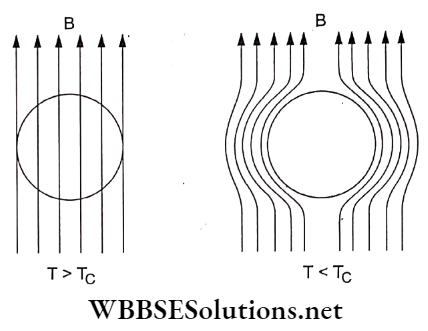
The Meissner effect is the expulsion of the magnetic field from a superconductor during its transition to the superconducting when cooled below the transition temperature Tc (usually close to absolute zero). Due to its zero resistance to the current flow, current continues to flow when switched off.

Electricity And Magnetism Objective Questions And Answers Current Electricity Meissner Effect Q2

Question 3. Statement 1 An electric bulb glows instantly as it is switched on.

Statement 2 The drift speed of electrons in a metallic wire is very large.

Answer: 3. Statement 1 is true and Statement 2 is false.

A conductor is full of free electrons. Any disturbance anywhere is instantly transmitted to the bulb which glows. The drift speed is small due to the collisions between the electrons and the ions.

Question 4. Statement 1 Ohm’s law is applicable to all conducting elements.

Statement 2 Ohm’s law is a fundamental law.

Answer: 5. Both Statement 1 and Statement 2 are false.

Ohm’s law is valid for circuits with a constant resistance, for which the V-I graph is a straight line with a positive slope. It is not valid for semiconductors, diodes, and superconductors. Ohm’s law is not a universal (fundamental) law but an empirical law.

Question 5. Statement 1 It is advantageous to transmit electric power at a high voltage.

Statement 2 A high voltage implies a high current.

Answer: 3. Statement 1 is true and Statement 2 is false.

In an AC circuit, the voltage is stepped up by a transformer. At a high voltage, the current is reduced, so the power loss is reduced.

Question 6. Statement 1 Current is passed through a metallic wire so that it becomes red hot. When cold water is poured on one half of its portion, the other half becomes hotter.

Statement 2 Resistance decreases due to a decrease in temperature.

Answer: 1. Statement 1 is true; Statement 2 is true; and Statement 2 is a correct explanation of Statement 1.

When cold water is poured on one half of the red-hot conductor, its temperature is reduced, resistance is reduced and the current through it is increased so that the other half becomes hotter.

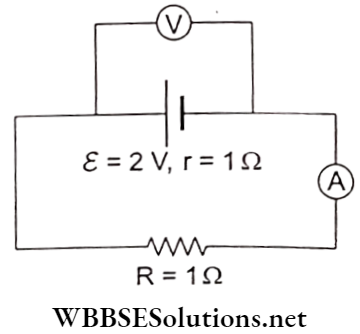
Question 7. Statement 1 In the given circuit, the emf is 2 V and the internal resistance of the cell is 1 Ω. When R = 1Ω, the reading of the voltmeter is 1 V.

Statement 2 V= ε -IR, where ε = 2 V.

Hence, \(I=\frac{2 \mathrm{~V}}{2 \Omega}=1 \mathrm{~A}\)

magnetism questions

Electricity And Magnetism Objective Questions And Answers Current Electricity Circuit Q7

Answer: 3. Statement 1 is true and Statement 2 is false.

The voltmeter reading gives the terminal voltage across the cell, so V= ε -Ir (and not ε-IR).

Main current = \(I=\frac{\varepsilon}{R+r}=\frac{2 \mathrm{~V}}{2 \Omega}=1 \mathrm{~A}\)

V = 2 V-(1A)(1Ω)=1V

Question 8. Statement 1 In a simple battery circuit, the point of the lowest potential is the positive terminal of the battery.

Statement 2 Current flows towards the point of the higher potential, as it does such a circuit from the negative to the positive terminal.

Answer: 5. Both Statement 1 and Statement 2 are false.

The point of lowest potential of the circuit is the negative terminal of the cell. Current flows from the higher potential (positive terminal) to the negative terminal (lower potential) through the outer circuit.

Question 9. Statement 1 The conductivity of an electrolyte is very low as compared to a metal at room temperature.

Statement 2 The number density of free ions in an electrolyte is much smaller as compared to the number density of free electrons in metals. Further, ions, being heavier, drift much more slowly.

Answer: 1. Statement 1 is true; Statement 2 is true; and Statement 2 is a correct explanation of Statement 1.

Conduction in an electrolyte is due to the movement of free ions which are comparatively much heavier than electrons and have a smaller drift speed. Hence, metals have higher conductivity than electrolytes.

Question 10. Statement 1 A domestic electrical appliance working on a threepin plug will continue working even if the top pin is removed.

Statement 2 The top pin (earth) is only a safety measure.

Answer: 1. Statement 1 is true; Statement 2 is true; and Statement 2 is a correct explanation of Statement 1.

The top pin is used for earthling as a safety measure. The remaining two terminals are active (live) and neutral which supply power to a device.

Question 11. Statement 1 Electronic appliances with metallic bodies, for example, heaters and electric irons, have three-pin connections, whereas an electric bulb has a two-pin connection.

Statement 2 Three-pin connections reduce the heating of connecting cables.

Answer: 3. Statement 1 is true and Statement 2 is false.

Devices with metallic bodies are connected to the ground (top pin) as a safety measure. No grounding is required for bulbs.

Question 12. Statement 1 Good conductors of heat are also good conductors of electricity, and vice versa.

Statement 2 Mainlyelectrons are responsible for these connections.

Answer: 1. Statement 1 is true; Statement 2 is true; and Statement 2 is a correct explanation of Statement 1.

Conduction of heat and current electricity are both linked to the motion of free electrons. According to Wiedemann-Franz law, the ratio of the electronic contribution to thermal conductivity (K) to the electrical conductivity (σ) of a metal is proportional to the temperature (T). This explains that good thermal conductors are also good conductors of electricity.

Question 13. Statement 1 A larger dry cell has a higher emf.

Statement 2 The emf of a dry cell is proportional to its size.

Answer: 5. Both Statement 1 and Statement 2 are false.

magnetism questions

The large plate area of cells is responsible for its capacity (in ampere-hour) and not the emf.

Question 14. Statement 1 A bird perches on a high-power line and nothing happens to the bird.

Statement 2 The level of the bird is very high from the ground. So, it is not grounded through any conducting device.

Answer: 1. Statement 1 is true; Statement 2 is true; and Statement 2 is a correct explanation of Statement 1.

Electricity flows through the path of least resistance. Birds do not get an electrical shock while sitting on live electrical wires because they are not good conductors of electricity. Further, the two points of contact are at the same potential and do not form a closed circuit for current to flow through the bird sitting on a power line.

Magnetic Effect of Current

Question 1. Statement 1 A voltmeter is connected in parallel with a circuit.

Statement 2 The resistance of a voltmeter is very high.

Answer: 1. Statement 1 is true; Statement 2 is true; and Statement 2 is a correct explanation of Statement 1.

A voltmeter is connected in parallel to measure the potential difference between two points. It has high resistance, so it draws a small current and does not change the main current appreciably.

Question 2. Statement 1 A charge, whether stationary or in motion, produces a magnetic field around it.

Statement 2 Moving charges produce only an electric field in the surrounding space.

Answer: 5. Both Statement 1 and Statement 2 are false.

A moving charge \(\left(d q v=\frac{d q}{d t} d l=I d l\right)\) is equivalent to a current element that produces a magnetic field. A charge at rest can produce an electric field.

Question 3. Statement 1 A planar circular loop of area A and carrying current I is equivalent to a magnetic dipole of dipole moment m = IA.

Statement 2 At large distances, the magnetic field due to a current-carrying circular loop and that due to a magnetic dipole are the same.

Answer: 1. Statement 1 is true; Statement 2 is true; and Statement 2 is a correct explanation of Statement 1.

A ‘current-carrying loop is equivalent to a magnetic dipole whose dipole moment \(|\vec{m}|\) is IA ampere metre2.

The magnetic field at a large distance from a circular current loop is

⇒ \(B=\frac{\mu_0 I R^2}{2\left(R^2+r^2\right)^{3 / 2}}=\frac{\mu_0 I R^2}{2 r^3} \quad(\text { for } r \gg R)\)

∴ \(\frac{\mu_0 I \pi R^2}{2 \pi r^3}=\frac{\mu_0}{2 \pi} \frac{I A}{r^3}=\frac{\mu_0 m}{2 \pi r^3}\)

Where m = IA = magnetic dipole moment.

Question 4. Statement 1 When the radius of a current-carrying loop is doubled, its magnetic moment becomes four times.

Statement 2 The magnetic moment depends on the area of the loop.

Answer: 1. Statement 1 is true; Statement 2 is true; and Statement 2 is a correct explanation of Statement 1.

magnetism questions

The magnetic dipole moment is m =IπR2.

When R is doubled, m’ = Iπ(2R)2 = 4 m.

This is because m ∝ area of the loop.

Question 5. Statement 1 A charged particle can be accelerated in a cyclotron by the alternate variation of the electric field.

Statement 2 The energy of a charged particle is increased by the electric field applied.

Answer: 1. Statement 1 is true; Statement 2 is true; and Statement 2 is a correct explanation of Statement 1.

In a cyclotron,both \(\vec{E}\) and \(\vec{B}\) fields act together. The \(\vec{B}\) field provides the circular path while the \(\vec{E}\) field gives an impulse in between the gaps.

Question 6. Statement 1 A cyclotron does not accelerate electrons.

Statement 2 The mass of an electron is very small.

Answer: 1. Statement 1 is true; Statement 2 is true; and Statement 2 is a correct explanation of Statement 1.

The frequency of the alternating electric field is kept constant, given by \(f=\frac{q B}{2 \pi m}\).

The electron mass is small and it changes considerably with speed given by \(m=\frac{m_0}{\sqrt{1-\frac{v^2}{c^2}}}\), so f is not synchronized for acceleration.

Question 7. Statement 1 A spark occurs between the poles of a switch when the switch is opened.

Statement 2 Current flowing in a conductor produces a magnetic field.

Answer: 2. Statement 1 is true; Statement 2 is true; but Statement 2 is not a correct explanation of Statement 1.

When the switch is opened, the magnetic energy stored in the coil or any inductive component gets discharged. This causes a huge current through the two terminals of the switch. This voltage across the terminal gap of the switch exceeds the dielectric strength of air and produces a spark.

Class 11 Physics Class 12 Maths Class 11 Chemistry
NEET Foundation Class 12 Physics NEET Physics

Question 8. Statement 1 If a proton and an α-particle enter a uniform magnetic field perpendicularly with the same speed, the time period of revolution of the α-particle is double that of the proton.

Statement 2 In a magnetic field, the period of revolution of a charged particle is directly proportional to the mass of the particle and is inversely proportional to the charge of the particle.

Answer: 1. Statement 1 is true; Statement 2 is true; and Statement 2 is a correct explanation of Statement 1.

The frequency of revolution of a charged particle in a magnetic field is

⇒ \(f=\frac{1}{T}=\frac{q B}{2 \pi m} \Rightarrow T=\frac{2 \pi m}{q B}\)

∴ \(T_{\text {proton }}=\frac{2 \pi m_{\text {proton }}}{q B} \text { and } T_\alpha=\frac{2 \pi \cdot 4 m_{\text {proton }}}{2 q B}=2 T_{\text {proton }}\)

Time of revolution \(\propto \frac{m}{q}\)

Question 9. Statement 1 The energy of a charged particle moving in a uniform magnetic field does not change.

Statement 2 The work done by the magnetic field on the charge is zero.

Answer: 1. Statement 1 is true; Statement 2 is true; and Statement 2 is a correct explanation of Statement 1.

magnetism questions

Force on a charged particle moving in a magnetic field = \(\vec{F}=q \vec{v} \times \vec{B}\) This force only provides centripetal force for circular motion and does no work. Hence, work done is zero and KE remains constant.

Question 10. Statement 1 When a magnetic dipole is placed in a nonuniform magnetic field, only a torque acts on the dipole.

Statement 2 A force would act on a dipole if the magnetic field is uniform.

Answer: 5. Both Statement 1 and Statement 2 are false.

In a nonuniform magnetic field, the two poles experience unequal forces as well as a torque. Hence, the torque and the net force act together producing translational and rotational motions.

Question 11. Statement 1 Magnetic field lines form a closed loop in nature.

Statement 2 Monomagnetic poles do not exist in nature.

Answer: 1. Statement 1 is true; Statement 2 is true; and Statement 2 is a correct explanation of Statement 1.

Magnetic field lines always form a closed loop in nature because no magnetic monopole exists in nature. Inside the magnet they travel from the south pole to the north pole and outside, from the north pole to the south pole, thereby forming a closed loop.

Electromagnetic Induction

Question 1. Statement 1 The possibility of an electric bulb fusing is higher at the time of switching on and off.

Statement 2 Inductive effects produce a surge in switching off and switching on.

Answer: 1. Statement 1 is true; Statement 2 is true; and Statement 2 is a correct explanation of Statement 1.

During switching on or off a sudden change in magnetic flux induces high voltage \(\left(|e|=\frac{d \phi}{d t}\right)\) which may cause an electric bulb to fuse.

Question 2. Statement 1 Only a change in magnetic flux will maintain the induced current in the coil.

Statement 2 The presence of a large magnetic flux through a coil maintains a current in the coil if the circuit is continuous.

Answer: 3. Statement 1 is true and Statement 2 is false.

When the magnetic flux linked with a coil changes with time, the induced current is maintained. The presence of a steady magnetic flux will not induce current in a closed coil.

Question 3. Statement 1 An emf ε is induced in a closed loop where magnetic flux is varied. The induced electric field \(\vec{E}\) is not a conservative field.

Statement 2 The line integral \(\int \vec{E} \cdot \overrightarrow{d l}\) around a closed loop is nonzero.

Answer: 1. Statement 1 is true; Statement 2 is true; and Statement 2 is a correct explanation of Statement 1.

Induced electric fields form closed loops, so that a charge moving along the loop under the induced field will experience a force parallel to its displacement, and nonzero work is done, unlike conservative forces, where the work done in a closed loop is zero. The non – conservative nature of the induced electric field is also expressed mathematically as \(\oint \vec{E} \cdot \overrightarrow{d l} \neq 0\)

magnetism questions

Question 4. Statement 1 If the current is flowing through a machine of iron, eddy currents are induced.

Statement 2 The change in magnetic flux through an area causes eddy currents.

Answer: 5. Both Statement 1 and Statement 2 are false.

Eddy currents are induced by the time-varying magnetic flux linked with a conductor and not by the current flowing through the conductor itself.

Question 5. Statement 1 In a moving train, a small potential difference arises across the axles of the wheels due to the earth’s magnetic field. This potential difference vanishes at the equator.

Statement 2 At the equator, the earth’s magnetic field is horizontal.

Answer: 1. Statement 1 is true; Statement 2 is true; and Statement 2 is a correct explanation of Statement 1.

A motional emf ε = Blv is produced when the moving conductor cuts the magnetic field lines. At the equator, the axles do not cut the field lines.

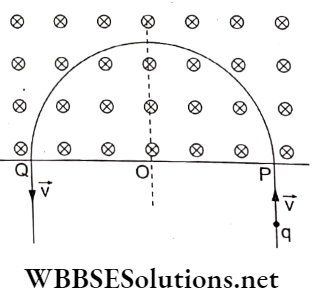
Question 6. Statement 1 When a charged particle enters a magnetic field from outside, it cannot complete one rotation inside the field.

Statement 2 The entry and exit of a charged particle into and out of a uniform magnetic field are symmetrical.

Answer: 1. Statement 1 is true; Statement 2 is true; and Statement 2 is a correct explanation of Statement 1.

The charged particle that enters the magnetic field at P will experience a force \(\vec{F}=q(\vec{v} \times \vec{B})\). This force, perpendicular to \(\vec{v}\) and \(\vec{B}\), provides a centripetal force. The path followed is a semicircle. The entry and exit at P and Q are symmetrical about the center O.

image

Electromagnetic Induction

Question 1. Statement 1 The possibility of an electric bulb fusing is higher at the time of switching on and off.

Statement 2 Inductive effects produce a surge in switching off and switching on.

Answer: 1. Statement 1 is true; Statement 2 is true; and Statement 2 is a correct explanation of Statement 1.

During switching on or off a sudden change in magnetic flux induces high voltage \(\left(|e|=\frac{d \phi}{d t}\right)\) which may cause an electric bulb to fuse.

Question 2. Statement 1 Only a change in magnetic flux will maintain the induced current in the coil.

Statement 2 The presence of a large magnetic flux through a coil maintains a current in the coil if the circuit is continuous.

Answer: 3. Statement 1 is true and Statement 2 is false.

When the magnetic flux linked with a coil changes with time, the induced current is maintained. The presence of a steady magnetic flux will not induce current in a closed coil.

Question 3. Statement 1 An emf 8 is induced in a closed loop where magnetic flux is varied. The induced electric field \(\vec{E}\) is not a conservative field.

Statement 2 The line integral \(\int \vec{E} \cdot \overrightarrow{d l}\) around a closed loop is nonzero.

Answer: 1. Statement 1 is true; Statement 2 is true; and Statement 2 is a correct explanation of Statement 1.

magnetism questions

Induced electric fields form closed loops, so that a charge moving along the loop under the induced field will experience a force parallel to its displacement, and nonzero work is done, unlike conservative forces, where the work done in a closed loop is zero. The non – conservative nature of the induced electric field is also expressed mathematically as \(\oint \vec{E} \cdot \overrightarrow{d l} \neq 0\)

Question 4. Statement 1 If the current is flowing through a machine of iron, eddy currents are induced.

Statement 2 The change in magnetic flux through an area causes eddy currents.

Answer: 5. Both Statement 1 and Statement 2 are false.

Eddy currents are induced by the time-varying magnetic flux linked with a conductor and not by the current flowing through the conductor itself.

Question 5. Statement 1 In a moving train, a small potential difference arises across the axles of the wheels due to the earth’s magnetic field. This potential difference vanishes at the equator.

Statement 2 At the equator, the magnetic field is horizontal.

Answer: 1. Statement 1 is true; Statement 2 is true; and Statement 2 is a correct explanation of Statement 1.

A motional emf ε = Blv is produced when the moving conductor cuts the magnetic field lines. At the equator, the axles do not cut the field lines.

Question 6. Statement 1 When a charged particle enters a magnetic field from outside, it cannot complete one rotation inside the field.

Statement 2 The entry and exit of a charged particle into and out of a uniform magnetic field are symmetrical.

Answer: 1. Statement 1 is true; Statement 2 is true; and Statement 2 is a correct explanation of Statement 1.

The charged particle that enters the magnetic field at P will experience a force \(\vec{F}=q(\vec{v} \times \vec{B})\). This force, perpendicular to \(\vec{v}\) and \(\vec{B}\), provides a centripetal force. The path followed is a semicircle. The entry and exit at P and Q are symmetrical about the center O.

Electricity And Magnetism Objective Questions And Answers Electromagnetic Induction Charged Particles Q6

Alternating Current

Question 1. Statement 1 Faraday’s laws are consequences of the conservation of energy.

Statement 2 In a purely resistive AC circuit the current lags behind the voltage.

Answer: 3. Statement 1 is true and Statement 2 is false.

Faraday’s laws of EMI follow the principle of conservation of energy. In pure resistance in an AC circuit, current and voltage are always in the same phase.

Question 2. Statement 1 While flowing through an inductor, an alternating current lags behind the voltage by a phase angle of \(\frac{\pi}{2}\), when AC flows through an inductor.

Statement 2 The inductive reactance increases as the frequency of an AC source decreases.

Answer: 3. Statement 1 is true and Statement 2 is false.

In an inductor, the current lags behind the voltage by \(\frac{\pi}{2}\).

Inductive reactance = XL = ωL = 2πfL increases with an increase in frequency.

Question 3. Statement 1 The quantity L/R possesses a dimension of time.

Statement 2 To reduce the rate, of increase of current through a solenoid, we should increase the time constant (L/R).

Answer: 2. Statement 1 is true; Statement 2 is true; but Statement 2 is not a correct explanation of Statement 1.

The induced emf in an inductor is \(|\varepsilon|=L \frac{d I}{d t}\) which has the dimensions of [I.R].

Thus, \(\left[\frac{L}{R}\right] \frac{d I}{d t}=[I]\)

So, \(\frac{L}{R}\) has dimention Of Time.

Further, \(\frac{d I}{d t}=\frac{I}{\left(\frac{L}{R}\right)}\)

To reduce \(\frac{d I}{d t}\) the value of \(\frac{L}{R}\) should be large.

magnetism questions

Question 4. Statement 1 In a series LCR circuit, the resonance occurs at one frequency only.

Statement 2 At resonance, the inductive reactance is equal and opposite to the capacitive reactance.

Answer: 1. Statement 1 is true; Statement 2 is true; and Statement 2 is a correct explanation of Statement 1.

At resonance, the circuit is purely resistive and has a single resonance frequency = \(f=\frac{1}{2 \pi \sqrt{L C}}\).

This corresponds to the equal and opposite values of the inductive reactance and capacitive reactance.

Question 5. Statement 1 No power loss is associated with pure capacitors in an AC circuit.

Statement 2 No current flows in this circuit.

Answer: 3. Statement 1 is true and Statement 2 is false.

In an AC circuit with a pure capacitor, the phase difference between the current and the voltage is \(\frac{\pi}{2}\), so power dissipated \(\left(\frac{1}{2} I_0 V_0 \cos \frac{\pi}{2}\right)\) is zero.

Question 6. Statement 1 At resonance, a series LCR circuit has a current.

Statement 2 At resonance, in a series LCR circuit, the current and the emf are not in phase with each other.

Answer: 5. Both Statement 1 and Statement 2 are false.

At resonance, in an LCR circuit, the current is maximum since the impedance is minimum (=R). At resonance, the circuit is purely resistive, so the current. and the voltage is in the same phase.

Question 7. Statement 1 Induction coils are usually made of a thick copper wire.

Statement 2 Induced current is more in resistance.

Answer: 1. Statement 1 is true; Statement 2 is true; and Statement 2 is a correct explanation of Statement 1.

Induction coils have high inductance and low resistance. For low resistance, the copper wire has to be thick. For more induced current, resistance has to be low according to Ohm’s law.

Question 8. Statement 1 Transformers are used only in alternating current, not in direct current.

Statement 2 Only alternating current can be stepped up or down by means of transformers.

Answer: 1. Statement 1 is true; Statement 2 is true; and Statement 2 is a correct explanation of Statement 1.

With a DC source, the periodic change in magnetic flux does not occur to induce voltage in the secondary coil. Hence, only an AC source can be used to raise or lower the voltage by adjusting the turn ratio Ns/Np.

Question 9. Statement 1 We use a thick wire in the secondary coil of a stepdown transformer to reduce heat production.

Statement 2 When the plane of the armature is parallel to the magnetic field lines, the magnitude of induced emf is maximum.

Answer: 2. Statement 1 is true; Statement 2 is true; but Statement 2 is not a correct explanation of Statement 1.

Thick wires have low resistance, hence there is less loss of energy by heat production.

Instantaneous magnetic flux linked with the coil of armature in a B-field is \(\phi=N \vec{A} \cdot \vec{B}=N A B \cos \theta\).

Induced emf = \(\varepsilon=-\frac{d \phi}{d t}=N A B \omega \sin \theta=\varepsilon_{\max } \sin \theta\)

Given, \(\theta=\frac{\pi}{2}\) so emf = maximum = NABω.

Magnetism And Matter

Question 1. Statement 1 We cannot think of a magnetic field configuration with three poles.

Statement 2 A bar magnet does exert a torque on itself due to its own field.

Answer: 2. Statement 1 is true; Statement 2 is true; but Statement 2 is not a correct explanation of Statement 1.

Monopolesin magnetism do not exist. Magnets always exist as dipoles. A system like a bar magnet can produce a magnetic field but does not experience a force or a torque in its own field.

Question 2. Statement 1 Magnetic field lines are continuous and closed.

Statement 2 Magnetic monopoles do not exist.

Answer: 1. Statement 1 is true; Statement 2 is true; and Statement 2 is a correct explanation of Statement 1.

Magnetic field lines form a closed loop. This is a consequence of the nonexistence of magnetic monopole.

Question 3. Statement 1 The magnetic force between two short magnets follows the inverse square law of distance when they are coaxial.

Statement 2 The magnetic force between two poles does not follow the inverse square law of distance.

Answer: 5. Both Statement 1 and Statement 2 are false.

The magnetic force between two coaxial short magnets is given by \(F \propto \frac{1}{r^4}\). The reason is also false as magnetic force between two poles does follow the inverse square law of distance.

magnetism questions

Question 4. Statement 1 Magnetic susceptibility is a pure number.

Statement 2 The value of magnetic susceptibility for vacuum is one.

Answer: 3. Statement 1 is true and Statement 2 is false.

Magnetic susceptibility % is the ratio of magnetization (= magnetic moment per unit volume) to the applied magnetizing field H. Both M and H have the same unit, so it is a pure number (dimensionless). Susceptibility for vacuum is zero since magnetization M in a vacuum is zero.

Question 5. Statement 1 A superconductor is a perfect diamagnetic substance.

Statement 2 A superconductor is a perfect conductor.

Answer: 2. Statement 1 is true; Statement 2 is true; but Statement 2 is not a correct explanation of Statement 1.

A superconductor is a perfect diamagnetic substance since in its interior the magnetic field \(\vec{B}\) = 0 and is completely screened. A superconductor is a perfect conductor as its resistance is zero.

Question 6. Statement 1 The magnetic poles of Earth do not coincide with the geographical poles.

Statement 2 The discrepancy between the orientation of a compass and true north-south direction is known as magnetic declination.

Answer: 2. Statement 1 is true; Statement 2 is true; but Statement 2 is not a correct explanation of Statement 1.

The axis about which the earth rotates passes through the geographical north and south poles whereas the magnetic axis of the earth (assumed to be a magnetized sphere) is somewhat inclined to the rotational axis. Magnetic declination is the angle between the magnetic meridian and the geographical meridian.

Question 7. Statement 1 Diamagnetic materials can exhibit magnetism.

Statement 2 Diamagnetic materials have permanent dipole moments.

Answer: 5. Both Statement 1 and Statement 2 are false.

Diamagnetic materials neither exhibit magnetism nor do they have permanent dipole moments.

Question 8. Statement 1 The true geographic north directions were found by using a magnetic needle.

Statement 2 The magnetic meridian of the earth is along the axis of rotation of the earth.

Answer: 5. Both Statement 1 and Statement 2 are false.

A magnetic needle is used to find the magnetic north but not the geographic north. A magnetic meridian is not aligned along the axis of rotation of the earth.

Question 9. Statement 1 A ferromagnetic substance becomes paramagnetic above the Curie temperature.

Statement 2 Domains are destroyed at high temperatures.

Answer: 1. Statement 1 is true; Statement 2 is true; and Statement 2 is a correct explanation of Statement 1.

The Curie temperature is the temperature above which a ferromagnetic material becomes paramagnetic due to the breaking up of magnetic domains.

Question 10. Statement 1 A disc-shaped magnet is levitated above a superconducting material that has been cooled by liquid nitrogen.

Statement 2 Superconductors repel magnets.

Answer: 1. Statement 1 is true; Statement 2 is true; and Statement 2 is a correct explanation of Statement 1.

Superconductors exist only below a certain critical temperature but above that temperature, they behave like normal materials. When a magnet is placed above a superconductor (which is cooled using liquid nitrogen), a magnetic field is induced within it which is exactly equal and opposite to the applied external magnetic field due to the magnet. The polarities are such that they repel each other and the repulsive force is enough to float the magnet.

Question 11. Statement 1 In water, the value of the magnetic field decreases.

Statement 2 Water is a diamagnetic substance.

Answer: 1. Statement 1 is true; Statement 2 is true; and Statement 2 is a correct explanation of Statement 1.

Water has relative permeability \(\left(\mu_{\mathrm{r}}=\frac{\mu}{\mu_0}\right)\) less than 1 and thus a negative magnetic susceptibility. Water is thus a diamagnetic substance in which magnetic field strength decreases.

Optics Objective Questions And Answers

Optics

Each of the following questions comprises two statements. The assertion is expressed by Statement 1 and the reason is expressed by Statement 2.

Each question has four options (1), (2), (3), and (4) as given below, out of which only ONE is correct.

  1. Statement 1 is true; Statement 2 is true; and Statement 2 is a correct explanation of Statement 1.
  2. Statement 1 is true; Statement 2 is true; but Statement 2 is not a correct explanation of Statement 1.
  3. Statement 1 is true and Statement 2 is false.
  4. Statement 1 is false and Statement 2 is true.
  5. Both Statement 1 and Statement 2 are false.

Some questions are preceded, by a supporting paragraph in addition to the statements.

Optics Objective Questions And Answers

Ray Optics

Question 1. Statement 1 A thick lens shows more chromatic aberration.

Statement 2 A thick lens behaves asifitis composed of many thin lenses.

Answer: 3. Statement 1 is true and Statement 2 is false.

Chromatic aberration is a defect in lenses in not focusing all the colors at the same point. It is caused by dispersion and is prominent with thick lenses. A thick lens is like a combination of truncated prisms and not composed of thin lenses.

Optics Objective Questions

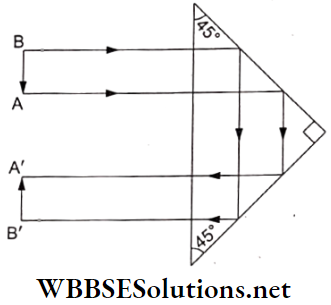
Question 2. Statement 1 A total reflecting prism is used to erect the inverted image without any deviation.

Statement 2 The rays of light incident perpendicular to the base of the prism emerge as parallel rays.

Answer: 1. Statement 1 is true; Statement 2 is true; and Statement 2 is a correct explanation of Statement 1.

An erecting prism is a right-angled isosceles prism used to erect an inverted image without any deviation, as shown in the ray diagram.

Optics Objective Questions And Answers Erecting Prism Q2

Question 3. Statement 1 The color of a green flower seen through a red glass appears to be dark.

Statement 2 A red glass transmits only red light.

Answer: 1. Statement 1 is true; Statement 2 is true; and Statement 2 is a correct explanation of Statement 1.

The green flower emits green light which is absorbed by the red glass and appears dark. This is true as a red glass emits only red light.

ray optics class 12 mcq

Question 4. Statement 1 If a convex lens is kept in water, its converging power decreases.

Statement 2 The focal length of a convex lens increases in water.

Answer: 1. Statement 1 is true; Statement 2 is true; and Statement 2 is a correct explanation of Statement 1.

Optics Objective Questions

The focal length of a lens depends on the refractive index of the surrounding medium.

When in air, \(\frac{1}{f_{\mathrm{a}}}=\left({ }^{\mathrm{a}} \mu_{\mathrm{g}}-1\right)\left(\frac{1}{R_1}-\frac{1}{R_2}\right)=k\left({ }^{\mathrm{a}} \mu_{\mathrm{g}}-1\right)\)

When in water, \(\frac{1}{f_{\mathrm{w}}}=\left({ }^{\mathrm{w}} \mu_{\mathrm{g}}-1\right) k=k\left(\frac{\mu_{\mathrm{g}}}{\mu_{\mathrm{w}}}-1\right)\)

As \(\frac{\mu_{\mathrm{g}}}{\mu_{\mathrm{w}}}<{ }^{w_{\mathrm{g}}} \mu_{\mathrm{g}}, \frac{1}{f_{\mathrm{a}}}>\frac{1}{f_{\mathrm{w}}}\)

Hence, the converging power is reduced when in water. This is the same as /w>/a.

ray optics class 12 mcq

Question 5. Statement 1 Diamonds glitter brilliantly.

Statement 2 Diamonds absorb sunlight.

Answer: 3. Statement 1 is true and Statement 2 is false.

The sparkling of a diamond is due to its high refractive power (refractive index = 2.4) and its cut shape. Due to the high refractive index, the critical angle is small and the light inside the diamond gets internally reflected several times before emergence, thus making ‘ the diamond glitter brilliantly. The glitter of a diamond is not due to the absorption of light but due to total internal reflection.

Question 6. Statement 1 Red light is used as the danger signal.

Optics Objective Questions

Statement 2 The velocity of red light is maximum and thus it offers more visibility in the dark.

Answer: 2. Statement 1 is true; Statement 2 is true; but Statement 2 is not a correct explanation of Statement 1.

Red light has the longest wavelength in the visible region and undergoes the least scattering according to Rayleigh’s law,\(I \propto \frac{1}{\lambda^4}\). Hence, a red signal is visible from a long distance. Scattering spreads the light in a wider area but reduces the intensity. Red light is scattered the least and has the maximum intensity as well.

Question 7. Statement 1 If the optical density of a substance is more than that of water then the mass density of the substance can be less than water.

Statement 2 Optical density and mass density are not related.

ray optics class 12 mcq

Answer: 2. Statement 1 is true; Statement 2 is true; but Statement 2 is not a correct explanation of Statement 1.

A greater optical density does not always mean a greater mass density (mass per unit volume). For example, kerosene is lighter than water, but it has a higher refractive index, so it is optically denser than water. In most cases though, a greater optical density is associated with a greater mass density.

Question 8. Statement 1 A secondary rainbow has an inverted color sequence, while a primary rainbow does not.

Statement 2 A secondary rainbow is formed by a single total internal reflection.

Answer: 3. Statement 1 is true and Statement 2 is false.

In the formation of a secondary rainbow, light undergoes two internal reflections inside water droplets. The color sequence in a secondary rainbow is thus inverted as compared to that in a primary one.

Question 9. Statement 1 When an object is placed between two plane mirrors kept parallelly, all the images formed are of the same intensity.

Statement 2 In the case of parallel plane mirrors, only two images are possible.

Answer: 5. Both Statement 1 and Statement 2 are false.

When an object is placed between two parallel plane mirrors, an infinite number of images are formed with gradually decreasing intensity due to absorption and multiple reflections.

Optics Objective Questions

Question 10. Statement 1 A single lens produces a coloured image of an object illuminated by white light.

Statement 2 The refractive index of the material of a lens is different for different wavelengths of light.

Answer: 1. Statement 1 is true; Statement 2 is true; and Statement 2 is a correct explanation of Statement 1.

A single lens produces a colored image of an object in white light (called chromatic aberration). Different components of white light have different values of focal length and do not get focused at a single position.

Question 11. Statement 1 Endoscopy involves the use of optical fibers to study internal organs.

Statement 2 The working of optical fibers is based on the phenomenon of total internal reflection.

Answer: 1. Statement 1 is true; Statement 2 is true; and Statement 2 is a correct explanation of Statement 1.

An endoscope is used to examine internal organs. In the process, optical fibers are used which work on the principle of total internal reflection.

Question 12. Statement 1 A double convex lens (μ = 1.5) has a focal length of 10 cm. When the lens is immersed in water(μ = 4/3), its focal length becomes 39 cm.

Statement 2 \(\frac{1}{f}=\left(\frac{1}{R_1}-\frac{1}{R_2}\right)\left(\frac{\mu_1-\mu_w}{\mu_w}\right)\)

Answer: 1. Statement 1 is true; Statement 2 is true; and Statement 2 is a correct explanation of Statement 1.

ray optics class 12 mcq

When air, the focal length fa is given by

⇒ \(\frac{1}{f_{\mathrm{a}}}=\frac{1}{10 \mathrm{~cm}}=\left(\mu_1-1\right)\left(\frac{1}{R_1}-\frac{1}{R_2}\right)\)

⇒ \((1.5-1)\left(\frac{1}{R_1}-\frac{1}{R_2}\right)\) (1)

When immersed in water, the focal length /w is given

∴ \(\frac{1}{f_{\mathrm{w}}}=\left(\frac{\mu_1}{\mu_{\mathrm{w}}}-1\right)\left(\frac{1}{R_1}-\frac{1}{R_2}\right)=\left(\frac{1.5}{1.33}-1\right)\left(\frac{1}{R_1}-\frac{1}{R_2}\right)\) (2)

Dividing (1) by (2),

ray optics class 12 mcq

∴ \(\frac{f_{\mathrm{w}}}{10 \mathrm{~cm}}=\frac{0.5}{\frac{1.5}{1.33}-1} \Rightarrow f_{\mathrm{w}}=39.1 \mathrm{~cm}\)

Optics Objective Questions

Question 13. Statement 1 A red-colored object appears dark in yellow light.

Statement 2 Red light is scattered less.

Answer: 2. Statement 1 is true; Statement 2 is true; but Statement 2 is not a correct explanation of Statement 1.

A red-colored object reflects only red light and absorbs yellow light. The scattering of red light is the least because its wavelength is maximum.

Question 14. Statement 1 By roughening the surface of a glass sheet, its transparency can be reduced.

Statement 2 A rough glass surface absorbs more heat.

Answer: 3. Statement 1 is true and Statement 2 is false.

Roughening a glass surface reduces its transparency because of irregular reflection and not due to absorption.

Question 15. Statement 1 A normal human eye can clearly see all the objects beyond a certain minimum distance.

Statement 2 The human eye has the capacity to suitably adjust the focal length of the eye lens to a certain extent.

Answer: 1. Statement 1 is true; Statement 2 is true; and Statement 2 is a correct explanation of Statement 1.

The human eye can adjust its focal length to see objects clearly beyond 25 cm.

Question 16. Statement 1 A microscope forms the magnified image of an object.

Statement 2 The angle subtended by the image is more than that subtended by the object.

Optics Objective Questions

Answer: 1. Statement 1 is true; Statement 2 is true; and Statement 2 is a correct explanation of Statement 1.

A microscope (simple or compound) increases the visual angle of an image so that the final image formed at 25 cm from the eye appears magnified as compared to the object.

Class 11 Physics Class 12 Maths Class 11 Chemistry
NEET Foundation Class 12 Physics NEET Physics

Question 17. Statement 1 If the objective and eye lenses of a microscope are interchanged then it can work as a telescope.

Statement 2 The objective lens of a telescope has a small focal length.

Answer: 5. Both Statement 1 and Statement 2 are false.

The objective and eye lenses of a microscope cannot be interchanged to convert it into a telescope. This is because a microscope’s lens has a small focal length (around a few cm), whereas a telescope’s objective has a large focal length.

Question 18. Statement 1 Magnification by a convex mirror is always positive, but that by a concave mirror may be either positive or negative.

Statement 2 It depends on the sign convention chosen.

Answer: 3. Statement 1 is true and Statement 2 is false.

In a convex mirror, the image formed is virtual, diminished, and erect (positive magnification).

In a concave mirror, the magnification is positive for an object lying between the focus and the pole (u < f) and negative for u >f when the image formed is real and inverted.

Question 19. Statement 1 Owls can move freely during the night.

Statement 2 They have a large number of rods on their retina.

Answer: 1. Statement 1 is true; Statement 2 is true; and Statement 2 is a correct explanation of Statement 1.

Owls have appreciably better night visions because they have comparatively more rods and not as many cones. Thus, they lose color vision but see a lot better at night when it is almost dark. But in total darkness, they can see nothing. They always need some light to see.

Question 20. Statement 1 The formula connecting u, v, and / for a spherical mirror is valid only for those mirrors whose sizes are very small compared to their radii of curvature.

Statement 2 The laws of reflection are strictly valid for plane surfaces but not for large spherical surfaces.

Answer: 1. Statement 1 is true; Statement 2 is true; and Statement 2 is a correct explanation of Statement 1.

The relation connecting u, v, and f in ray optics is valid for paraxial rays, and the laws of reflection are true for plane surfaces.

ray optics class 12 mcq

Question 21. Statement 1 The edge of the image of a white object formed by a concave mirror on the screen appears white.

Statement 2 A concave mirror does not suffer from chromatic aberration.

Answer: 1. Statement 1 is true; Statement 2 is true; and Statement 2 is a correct explanation of Statement 1.

The image formed due to a concave mirror does not suffer from chromatic aberrations, so it appears white.

Question 22. Statement 1 A ray of light is incident from outside on a glass sphere surrounded by air. This ray may suffer a total internal reflection at the second interface.

Statement 2 If a ray of light goes from a denser to a rarer medium, it bends away from the normal.

Answer: 2. Statement 1 is true; Statement 2 is true; but Statement 2 is not a correct explanation of Statement 1.

A ray of light incident on a glass sphere gets refracted and strikes the surface again. It may be totally reflected if the surface angle of incidence is greater than the critical angle.

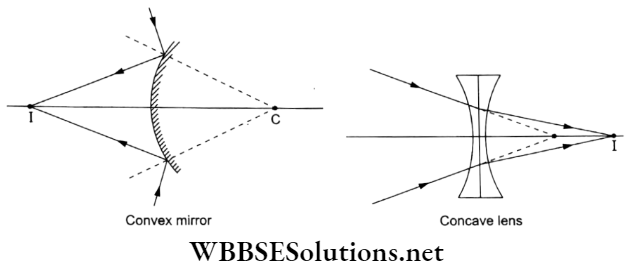
Question 23. Statement 1 A real image is formed when two rays starting from a point and moving along different paths meet again at some other point.

Statement 2 A real image can never be formed by reflection from a convex mirror or refraction through a concave lens.

Answer: 3. Statement 1 is true and Statement 2 is false.

Real images are formed by the actual intersection of rays after reflection or refraction.

Real images can be formed by a convex mirror or a concave lens, as shown in the following figure.

Optics Objective Questions And Answers Real Image Q30

Question 24. Statement 1 In high-quality optical devices, such as cameras, binoculars, and periscopes, prisms instead of plane mirrors are used to reflect light.

Statement 2 In-plane mirrors, reflections occur both at the front and rear (silvered) surfaces.

Answer: 1. Statement 1 is true; Statement 2 is true; and Statement 2 is a correct explanation of Statement 1.

A reflection from a prism is actually a total internal reflection, where there is 100% reflection. This is not true for a plane mirror.

Question 25. Statement 1 The sun rises before the actual sunrise.

Statement 2 During sunrise, refraction takes place through different atmospheric layers.

Answer: 1. Statement 1 is true; Statement 2 is true; and Statement 2 is a correct explanation of Statement 1.

The time delay (advanced sunrise and delayed sunset) is due to atmospheric refraction. The sun is visible to us 2 minutes before the actual sunrise and 2 minutes after the actual sunset.

Question 26. Statement 1 Sometimes the rainbow is seen in the sky when it is raining. When one sees a rainbow, one’s back is towards the sun.

Statement 2 Internal reflection from water droplets causes dispersion. The final ray is in the backward direction.

Answer: 1. Statement 1 is true; Statement 2 is true; and Statement 2 is a correct explanation of Statement 1.

A rainbow is caused by refraction, dispersion, and total internal reflection of sunrays through water droplets suspended in the atmosphere. Rainbows always appear in the section of the sky directly opposite the sun.

Question 27. Statement 1 The frequencies of the incident reflected and refracted beams of light incident from one medium to another are the same.

Statement 2 The incident, reflected, and refracted rays are coplanar.

Answer: 2. Statement 1 is true; Statement 2 is true; but Statement 2 is not a correct explanation of Statement 1.

ray optics class 12 mcq

During reflection and refraction, the frequency of photon (E =hf) does not change because E and B are continuous at the boundary of the two media. The planes of incidence and refraction are actually the same plane

Question 28. Statement 1 The corpuscular theory fails to explain the velocities of light in air and water.

Statement 2 According to the corpuscular theory, light should travel faster in a denser medium than in a rarer medium.

Answer: 1. Statement 1 is true; Statement 2 is true; and Statement 2 is a correct explanation of Statement 1.

According to Newton’s corpuscular theory, the speed of light in a denser medium is greater than the speed in a rarer medium, which is • not true.

Question 29. Statement 1 Optical fibers are used for telecommunications.

Statement 2 The optical fibers work on the principle of total internal reflection.

Answer: 1. Statement 1 is true; Statement 2 is true; and Statement 2 is a correct explanation of Statement 1.

Optical fibers work on the principle of total internal reflection. They are used in telecommunications because of their higher bandwidths, lower attenuations, and no interference from stray signals.

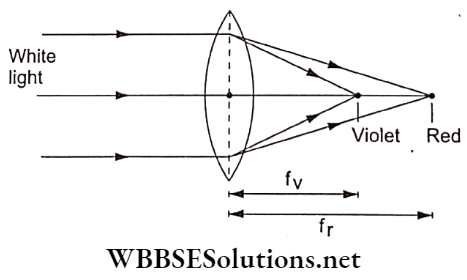
Question 30. Statement 1 When a beam of white light is passed through a lens, violet light gets more refracted than red light.

Statement 2 The focal length of the red light is greater than that of the violet light.

Answer: 1. Statement 1 is true; Statement 2 is true; and Statement 2 is a correct explanation of Statement 1.

White light passing through a lens undergoes dispersion. Violet light is the most refracted and red light is the least refracted because \(\mu_v>\mu_r\). This is why \(f_{\mathrm{v}}<f_{\mathrm{r}}\).

Optics Objective Questions And Answers Ray Optics Q30

Question 31. Statement 1 Goggles (sunglasses) have zero power.

Statement 2 The radius of curvature of both sides of the lens is the same.

Answer: 1. Statement 1 is true; Statement 2 is true; and Statement 2 is a correct explanation of Statement 1.

Power depends on the radii of curvature of the curved surfaces of a lens and this is given by

∴ \(P=\frac{1}{f}=(\mu-1)\left(\frac{1}{R_1}-\frac{1}{R_2}\right)\)

P = 0 when R1 =R2.

Wave Optics And Electromagnetic Waves

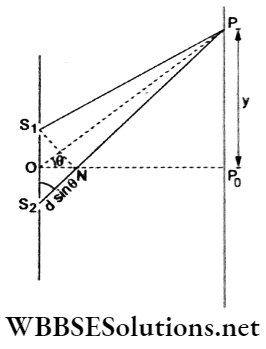
Question 1. Statement 1 In Young’s double-slit experiment (YDSE), bright and dark fringes are equally spaced.

Statement 2 It only depends upon phase differences.

Answer: 1. Statement 1 is true; Statement 2 is true; and Statement 2 is a correct explanation of Statement 1.

The separation between two consecutive dark or two consecutive bright fringes is equally spaced. The spacing, known as the fringe width, is given by \(\beta=\frac{D \lambda}{d}\). The position of the minima or maxima depends on the phase difference.

Question 2. Statement 1 A thin film such as a soap bubble or a thin layer of oil on water shows beautiful colors when illuminated by white light.

Statement 2 It happens due to the interference of light reflected from the upper Surface of the thin film.

Answer: 3. Statement 1 is true and Statement 2 is false.

ray optics class 12 mcq

Colors in a thin film arise due to interference of light waves reflected from the top and bottom surfaces of the thin film. The colors that appear depend upon the thickness of the film and the angle of incidence of the incident white light.

Question 3. Statement 1 The sun looks bigger in size at sunrise and sunset than during the day.

Statement 2 The phenomenon of diffraction bends light rays.

Answer: 2. Statement 1 is true; Statement 2 is true; but Statement 2 is not a correct explanation of Statement 1.

The appearance of the bigger size of the sun during sunrise or sunset is due to atmospheric refraction. It is not due to diffraction, which is a wave phenomenon of bending of light around the comer.

Question 4. Statement 1 A colored spectrum is seen when we look through a muslin cloth.

Statement 2 It is due to the diffraction of white light passing through fine slits.

Answer: 1. Statement 1 is true; Statement 2 is true; and Statement 2 is a correct explanation of Statement 1.

A piece of muslin cloth effectively acts as a series combination of fine slits (like a grating). White rays undergo diffraction and produce a colored spectrum.

Question 5. Statement 1 Clouds in the sky generally appear to be whitish.

Statement 2 Diffractions due to clouds are efficient in equal measures at all wavelengths.

Answer: 3. Statement 1 is true and Statement 2 is false.

Clouds consist of tiny water droplets and dust particles whose sizes are very large compared to the wavelength of light from the sun So, there is the least scattering and we receive unscattered sunlight, which is white.

Question 6. Statement 1 An electron microscope has more resolving power than an optical microscope.

Statement 2 We can control the energy of electrons.

Answer: 2. Statement 1 is true; Statement 2 is true; but Statement 2 is not a correct explanation of Statement 1.

The resolving power of a microscope is inversely proportional to wavelength. The de Broglie wavelength \(\left(\lambda=\frac{h}{m v}\right)\) of the electron beam used in an electron microscope is much shorter than the wavelength of the visible light used in an optical microscope. Hence, an electron microscope has a greater resolving power. The energy of an electron can be controlled by accelerating the voltage.

Question 7. Statement 1 The resolving power of a telescope is more if the diameter of the objective lens is more.

Statement 2 An objective lens of a larger diameter collects more light.

Answer: 2. Statement 1 is true; Statement 2 is true; but Statement 2 is not a correct explanation of Statement 1.

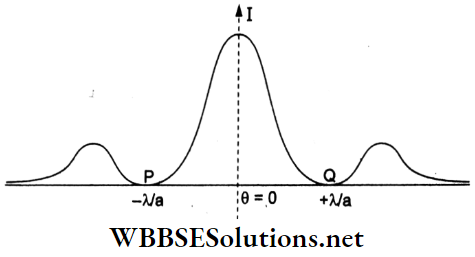
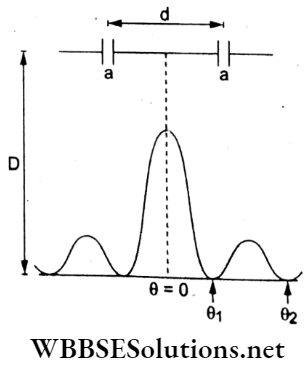
The angular position of the first minimum in the diffraction pattern of a circular aperture of diameter D is \(\theta_1=1.22 \frac{\lambda}{D}\)

The reciprocal of θ1 is the measure of resolving power, i.e., \(\frac{D}{1.22 \lambda}\)

With an increase in diameter, the resolving power will increase.

Question 8. Statement 1 The focal length of the objective lens in a telescope is longer than that of the eyepiece.

Statement 2 A telescope has a high resolving power due to the large focal length of its objective.

Answer: 3. Statement 1 is true and Statement 2 is false.

The large focal length of an objective lens produces a high magnification but for a high resolving power, the aperture (diameter) has to be large.

ray optics class 12 mcq

Question 9. Statement 1 The resolving power of a telescope depends only on the wavelength of the diffracted light.

Statement 2 The resolving power is proportional to the square of the wavelength of the diffracted light.

Answer: 5. Both Statement 1 and Statement 2 are false.

Resolving power is inversely proportional to the wavelength of light used and directly proportional to the aperture (diameter) of the objective lens.

Question 10. Statement 1 The standard optical diffraction gratings cannot be used to discriminate between different X-ray wavelengths.

Statement 2 The grating spacing is not of the order of X-ray wavelengths.

Answer: 1. Statement 1 is true; Statement 2 is true; and Statement 2 is a correct explanation of Statement 1.

Diffraction effects are appreciable when the wavelength is of the order of the size of the diffracting element.

The wavelengths of X-rays are much smaller than the spacing of the grating elements, so diffraction is insignificant in discriminating X-ray wavelengths.

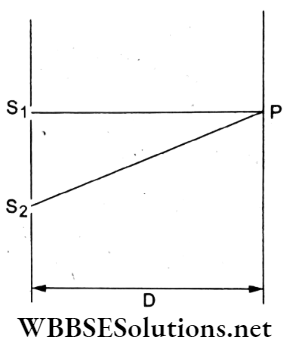
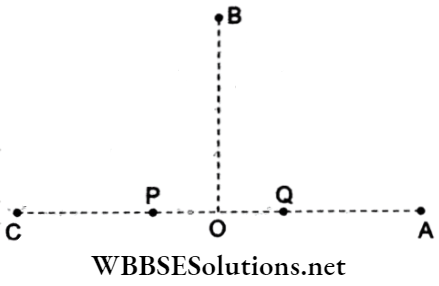
Question 11. Statement 1 Two coherent point sources of light S1 and S2 are placed on a line as shown. P and Q are two points on that line. If the maximum intensity is observed at point P then, the maximum intensity should also be observed at Q.

Statement 2 In the figure given with Statement 1, the distance |S1P- S2P| is equal to |S2Q- S1Q|

Answer: 1. Statement 1 is true; Statement 2 is true; and Statement 2 is a correct explanation of Statement 1.

Waves originating from the coherent sources S1 and S2 superpose at P to produce the maximum intensity. This is true when the path difference (S1P- S2P) is nk, where n = 0, 1, 2,…

The same path difference (S2Q- S1Q) is also given for Q, so Q will also be the position of maximum intensity.

Optics Objective Questions And Answers Wave Optics And Electromagnetic Waves Two Coherent Point Q11

Question 12. Statement 1 When a tiny circular obstacle is placed in the path of a beam of light some distance away, a bright spot is seen at the center of the shadow of the obstacle.

Statement 2 A destructive interference occurs at the center of the shadow.

Answer: 3. Statement 1 is true and Statement 2 is false.

A plane wavefront from a distant source incident on a circular obstacle gets diffracted and interferes constructively at the center of the shadow region and forms a bright spot.

Question 13. Statement 1 Radio waves can be polarized.

Statement 2 Sound waves in air are longitudinal in nature.

Answer: 2. Statement 1 is true; Statement 2 is true; but Statement 2 is not a correct explanation of Statement 1.

Radio waves are electromagnetic (transverse) waves and can be polarized.

Question 14. Statement 1 When a ray of light is incident at a polarizing angle on a glass, the refracted ray is partially polarized.

Statement 2 The intensity of light decreases during polarization.

Answer: 2. Statement 1 is true; Statement 2 is true; but Statement 2 is not a correct explanation of Statement 1.

When unpolarized light is incident on a transparent medium (glass or water) at a polarizing angle, the reflected light is completely polarized, whereas the refracted ray is partially polarized.

When unpolarized light is polarized at reflection, the energy is partly associated with the reflected and partly with the refracted waves. During transmission through a polaroid, the intensity is reduced according to Malus’s law.

Question 15. Statement 1 Skiers use polarized glasses.

Statement 2 Light reflected by snow is partially polarized.

ray optics class 12 mcq

Answer: 1. Statement 1 is true; Statement 2 is true; and Statement 2 is a correct explanation of Statement 1.

Skiers use polarized sunglasses to eliminate the glare from the plane surface office. The reflected light from plane surfaces is polarized and is blocked by the polarized glasses, thus reducing the glare.

Question 16. Statement 1 A famous painting was made not by using brush strokes in the usual manner but rather by putting a myriad of small color dots. In this painting, the color you see at any given area on the painting changes as you move away.

Statement 2 The angular separation of adjacent dots changes with the distance from the painting.

Answer: 1. Statement 1 is true; Statement 2 is true; and Statement 2 is a correct explanation of Statement 1.

The angular separation between two closely spaced dots changes with distance. Due to the finite resolving power of the eye, the two dots appear as one and lead to an apparent change in color.

Question 17. Statement 1 At first glance, the top surface of a morpho butterfly’s wings appears blue-green. If the wings move, the color changes.

Statement 2 Different pigments in the wings reflect light at different angles.

Answer: 3. Statement 1 is true and Statement 2 is false.

The wings of a morpho butterfly create colors by causing light waves to diffract and interfere with its wings, which are composed of nano and micro-scale structures.

Question 18. Statement 1 Dipole oscillations produce electromagnetic waves.

Statement 2 Accelerated charge produces electromagnetic waves.

Answer: 1. Statement 1 is true; Statement 2 is true; and Statement 2 is a correct explanation of Statement 1.

A dipole oscillation consists of accelerated charge which, according to Maxwell’s theory, radiates electromagnetic waves.

Question 19. Statement 1 The electromagnetic waves are transverse in nature.

Statement 2 Waves of wavelength 10 mm are radio waves and microwaves.

Answer: 3. Statement 1 is true and Statement 2 is false.

Electromagnetic waves constitute oscillating electric and magnetic fields, which are mutually perpendicular as well as perpendicular to the direction of propagation.

Electromagnetic waves of wavelength in the range 1-30 mm lie in the far-infrared region.

Question 20. Statement 1 Electromagnetic radiation exerts pressure.

Statement 2 Electromagnetic waves carry both momentum and energy.

Answer: 2. Statement 1 is true; Statement 2 is true; but Statement 2 is not a correct explanation of Statement 1.

The radiant energy falling on a surface exerts pressure \(p=\frac{I}{c}\) for 100% absorption and \(p=\frac{2 I}{c}\) for total reflection, where I = intensity of the incident wave and c = speed of light.

Both energy (E = hv) and momentum \(\left(p=\frac{E}{c}\right)\) are associated with electromagnetic waves.

Question 21. Statement 1 When a charged particle moves in a circular path, it produces electromagnetic waves.

Statement 2 A charged particle has an acceleration.

Answer: 1. Statement 1 is true; Statement 2 is true; and Statement 2 is a correct explanation of Statement 1.

A charged particle undergoing circular motion is accelerated, which produces electromagnetic waves.

Question 22. Statement 1 Electromagnetic waves are transverse in nature.

Statement 2 The electric and magnetic fields of an electromagnetic wave are mutually perpendicular to each other and also perpendicular to the direction of propagation.

Answer: 1. Statement 1 is true; Statement 2 is true; and Statement 2 is a correct explanation of Statement 1.

Electromagnetic waves are transverse in nature because their components — \(\vec{E}\) vector and \(\vec{B}\) vector—are mutually perpendicular and also perpendicular to the direction of propagation.

ray optics class 12 mcq

Question 23. Statement 1 In electromagnetic waves, electric and magnetic field lines are perpendicular to each other.

Statement 2 Electric and magnetic fields are self-sustaining.

Answer: 1. Statement 1 is true; Statement 2 is true; and Statement 2 is a correct explanation of Statement 1.

Electromagnetic waves are transverse waves with \(\vec{E}\)– and \(\vec{B}\)– components undergoing sinusoidal variations along mutually perpendicular directions. These oscillations are self-sustaining.

Question 24. Statement 1 UV radiations cause photodissociation of ozone (O3) into O2 and O, thus causing damage to the stratospheric ozone layer.

Statement 2 An ozone hole results from global warming and climate damage.

Answer: 2. Statement 1 is true; Statement 2 is true; but Statement 2 is not a correct explanation of Statement 1.

When high-energy ultraviolet rays are absorbed by ozone, the ozone molecules are split into ordinary oxygen molecules and free oxygen atoms:

\(\mathrm{O}_3 \stackrel{\mathrm{uv}}{\longrightarrow} \mathrm{O}_2+\mathrm{O}\)

The decline of ozone in the stratosphere (called the ozone hole) results in reduced absorption of ultraviolet radiation from the sun. This is the cause of global warming and climate damage.

Question 25. Statement 1 Microwave communications are preferred to optical communications.

Statement 2 Microwaves provide a large number of channels and bandwidths compared to optical signals.

Answer: 5. Both Statement 1 and Statement 2 are false.

Optical communication systems are preferred to microwave communication systems for the following reasons. An optical communications system has

  1. A wider bandwidth,
  2. A larger capacity,
  3. A lower power consumption and
  4. An immunity from interference.

Question 26. Statement 1 A quasar emits radio waves more than a radio galaxy.

Statement 2 A quasar is a very small size.

Answer: 3. Statement 1 is true and Statement 2 is false.

A quasar (quasi-stellar radio source) is a massive and extremely remote celestial object that emits large amounts of radiant energy, much larger than a radio galaxy. The average size of quasars is around 0.1 x 10⁶ AU, which is about 1.5 light-years.

ray optics class 12 mcq

Question 27. Statement 1 A pulsar is a source of radio waves that vary in intensity at regular intervals.

Statement 2 A pulsar is a rotating neutron star.

Answer: 1. Statement 1 is true; Statement 2 is true; and Statement 2 is a correct explanation of Statement 1.

A pulsar (pulsating star) is a rotating neutron star that emits radio waves that sweep through the earth and vary in intensity with time.

Question 28. Statement 1 The environmental damage has increased the amount of ozone in the atmosphere.

Statement 2 An increase in ozone increases the amount of ultraviolet radiation on the earth.

Answer: 5. Both Statement 1 and Statement 2 are false.

The ozone layer absorbs harmful ultraviolet radiation from the sun and saves life on Earth.

Ray Optics Multiple Choice Questions And Answers

Ray Optics

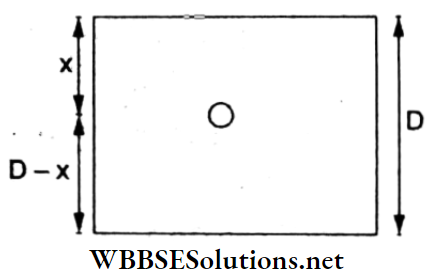
Question 1. An air bubble in a glass slab with refractive index1.5 (near normal incidence) is 5 cm deep when viewed from one surface and 3 deep when viewed from the opposite face. The thickness of the slab is

  1. 8 cm
  2. 10 cm
  3. 12 cm
  4. 16 cm

Answer: 3. 12 cm

Refractive index = \(\mu=\frac{\text { real depth }}{\text { apparent depth }}\)

In the first case, \(\mu=\frac{x}{5 \mathrm{~cm}}\),

and in the second case, \(\mu=\frac{D-x}{3 \mathrm{~cm}}\)

∴ x+(D-x) = μ(5 cm + 3 cm)

⇒ D = μ(8 cm) =1.5(8 cm) =12 cm
Ray Optics Multiple Choice Questions And Answers Refractive Index Q1

Question 2. A ray of light traveling in a transparent medium of refractive index μ. falls on a surface separating the medium from the air at an angle of incidence of 45°. For which of the following values of p can the ray undergo total internal reflection?

  1. μ =1.33
  2. μ =1.50
  3. μ =1.25
  4. μ =1.40

Answer: 2. μ = 1.50

For total internal reflection, the angle of incidence (i) must be greater than the critical angle (θC).

But, \(\mu=\frac{1}{\sin \theta_c} \Rightarrow \sin \theta_c=\frac{1}{\mu}\)

⇒ \(\sin i>\sin \theta_c \Rightarrow \sin 45^{\circ}>\frac{1}{\mu}\)

∴ \(\frac{1}{\sqrt{2}}>\frac{1}{\mu} \Rightarrow \mu>1.4\)

Hence, μ =1.50.

Ray Optics Multiple Choice Question And Answers

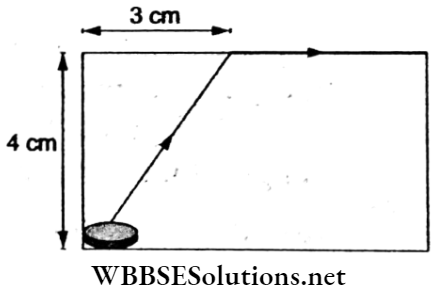
Question 3. A small coin is resting on the bottom of a beaker filled with a transparent liquid. A ray of light from the coin travels up to the 4 cm surface of the liquid and moves along the surface. How fast is the light traveling in the liquid?
Ray Optics Multiple Choice Questions And Answers Small Coin Q3

  1. 1.8 x 10⁸ m s-1
  2. 2.4 x 10⁸ m s-1
  3. 3.0 x 10⁸ m s-1
  4. 1.2 x 10⁸ m s-1

Answer: 1. 1.8 x 10⁸ m s-1

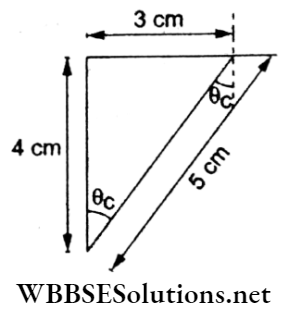
In the given situation, Medical the angle Entrance of incidence Physics is the critical angle θC, for which \(\theta_c=\frac{3 \mathrm{~cm}}{5 \mathrm{~cm}}=\frac{3}{5}\)

The refractive index is

⇒ \(\mu=\frac{1}{\sin \theta_c}=\frac{5}{3}\)

In terms of the speed of light,

⇒ \(\mu=\frac{c_0}{c_1}\)

The speed of light in the liquid is

Read And Learn Also NEET Physics Multiple Choice Question and Answers

∴ \(c_1=\frac{c_0}{\mu}=\frac{3 \times 10^8 \mathrm{~m} \mathrm{~s}^{-1}}{5 / 3}=\frac{9}{5} \times 10^8 \mathrm{~m} \mathrm{~s}^{-1}=1.8 \times 10^8 \mathrm{~m} \mathrm{~s}^{-1}\).
Ray Optics Multiple Choice Questions And Answers Critical Angle Q3

Question 4. For the given incident ray as shown in the figure, the condition for the total internal reflection of the ray will be satisfied if the refractive index of the block is
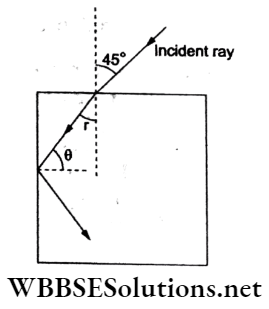
Ray Optics Multiple Choice Questions And Answers Incident Ray Q4

  1. \(\frac{\sqrt{3}+1}{2}\)
  2. \(\frac{\sqrt{2}+1}{2}\)
  3. \(\sqrt{\frac{3}{2}}\)
  4. \(\sqrt{\frac{7}{6}}\)

Answer: 3. \(\sqrt{\frac{3}{2}}\)

The refractive index of the block is

⇒ \(\mu=\frac{\sin 45^{\circ}}{\sin r}=\frac{1 / \sqrt{2}}{\sin \left(90^{\circ}-\theta\right)}=\frac{1}{\sqrt{2} \cos \theta}\)

⇒ \(\mu^2=\frac{1}{2 \cos ^2 \theta}=\frac{1}{2\left(1-\sin ^2 \theta\right)}\)

⇒\(\sin ^2 \theta=1-\frac{1}{2 \mu^2}\) (1)

For total internal reflection, θ > θC

⇒ \(\sin ^2 \theta>\sin ^2 \theta_c\left(=\frac{1}{\mu^2}\right)\) (2)

Comparing (1) and (2),

⇒ \(1-\frac{1}{2 \mu^2}>\frac{1}{\mu^2} \Rightarrow \frac{3}{2 \mu^2}<1\)

∴ \(\frac{2 \mu^2}{3}>1 \text {, hence } \mu \geq \sqrt{\frac{3}{2}}\).

“class 12th physics ray optics “

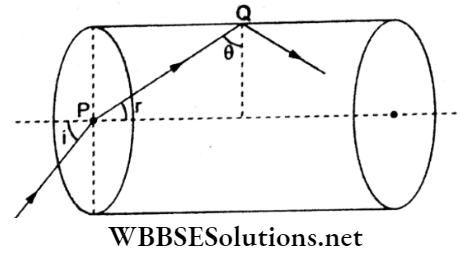
Question 5. Light enters at an angle of incidence in a transparent rod of refractive index μ. For what value of the refractive index of the material of the rod will the light once entered into it not leave it through its lateral face whatever be the value of the angle of incidence?

  1. μ = l
  2. μ = 1.4
  3. μ > √2
  4. μ = 1.3

Answer: 3. μ > √2

For refraction at P, from Snell’s law,

⇒ \(\mu=\frac{\sin i}{\sin r}=\frac{\sin i}{\sin \left(90^{\circ}-\theta\right)}=\frac{\sin i}{\cos \theta}\) (1)

For total internal reflection at Q, the angle of incidence (i) must be greater than the critical angle \(\theta_c\left[=\sin ^{-1}\left(\frac{1}{\mu}\right)\right]\)

From (1),

⇒ \(\cos \theta=\frac{\sin i}{\mu}\)

⇒ \(1-\sin ^2 \theta=\frac{\sin ^2 i}{\mu^2}\)

⇒ \(\sin ^2 \theta=1-\frac{\sin ^2 i}{\mu^2}\) → (2)

But \(\sin \theta>\sin \theta_c \Rightarrow \sin ^2 \theta>\frac{1}{\mu^2}\) → (3)

From (2) and (3),

⇒ \(\frac{1}{\mu^2}<1-\frac{\sin ^2 i}{\mu^2}\)

⇒ \(1<\mu^2-\sin ^2 i\)

⇒ \(1+\sin ^2 i<\mu^2\)

∴ \(\mu^2>1+\sin ^2 i\)

The maximum value of sin i is 1, so

μ2 > 2 or μ > √2.
Ray Optics Multiple Choice Questions And Answers Snells Law Q5

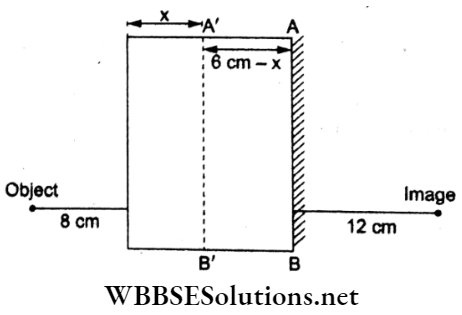
Question 6. One face of a 6-cm-thick rectangular glass plate is silvered. An object held at 8 cm in front of the first face forms an image 12 cm behind the silvered face. The refractive index of the glass is

  1. 1.2
  2. 1.6
  3. 1.8
  4. 1.4

Answer: 1. 1.2

Let AB be the true position of the plane mirror and A’B’ be its displaced apparent position due to refraction.

For a plane mirror, the object and image are at an equal distance from the mirror, so

8 cm + x = (6 cm – x) +12 cm

x = 5 cm

Now, the refractive index of glass is

∴ \(\mu=\frac{\text { real depth }}{\text { apparent depth }}=\frac{6 \mathrm{~cm}}{5 \mathrm{~cm}}=1.2\).
Ray Optics Multiple Choice Questions And Answers Plane Mirror Q6

Question 7. The apparent depth of water in a cylindrical water tank of diameter 2R cm is reduced at the rate of x cm min-1 when water is being drained out at a constant rate. The amount of water drained in cm3 min-1 is (n1 = refractive index of air, n2 = refractive index of water)

  1. \(\frac{x \pi R^2 n_1}{n_2}\)
  2. \(\frac{x \pi R^2 n_2}{n_1}\)
  3. \(\frac{2 \pi R x n_1}{n_2}\)
  4. \(\frac{2 \pi R x n_2}{n_1}\)

Answer: 2. \(\frac{x \pi R^2 n_2}{n_1}\)

The refractive index of water is

⇒ \(\frac{n_2}{n_1}=\frac{\text { real depth }}{\text { apparent depth }}\)

⇒ \(\frac{n_2}{n_1}=\frac{H}{h} \Rightarrow \frac{d h}{d t}=\frac{n_1}{n_2} \frac{d H}{d t}\)

Given, \(\frac{d h}{d t}=x \mathrm{~cm} \mathrm{~min}^{-1}, \text { so } \frac{d H}{d t}=\frac{n_2}{n_1} x \mathrm{~cm} \mathrm{~min}^{-1}\)

∴ Volume drained out per min = \(A\left(\frac{d H}{d t}\right)=\pi R^2 \frac{n_2}{n_1} x\).

Question 8. Light waves enter from medium 1 to medium 2. Its velocity in medium 2 is double that in medium 1. For total internal reflection, the angle of incidence must be greater than

  1. 90°
  2. 40°
  3. 30°
  4. 60°

Answer: 3. 30°

The refractive index of medium 1 is greater than that of medium 2 since the speed in medium 2 is greater than that in 1.

Now, \({ }^2 n_1=\frac{n_1}{n_3}=\frac{c_0 / c_1}{c_0 / c_3}=\frac{c_2}{c_1}=\frac{2 c_1}{c_1}=2\)

If θC is the critical angle,

⇒ \(\theta_c=\frac{1}{2 n_1}=\frac{1}{2}=\sin 30^{\circ}\)

θC = 30°.

“class 12 phy ray optics “

Question 9. Which of the following is not due to total internal reflection?

  1. Working with optical fiber
  2. Mirage on hot summer days
  3. Difference between the real and apparent depth of a pond
  4. Brilliance of diamond

Answer: 3. Difference between the real and apparent depth of a pond

Workings of optical fiber, formation of mirages, and brilliance of diamond can be explained on the basis of total internal reflection.

Question 10. In the given figure, the apparent depth of the liquid column is
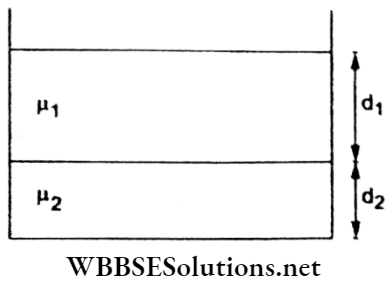
Ray Optics Multiple Choice Questions And Answers The Apparent Depth Of The Liquid Q10

  1. \(\frac{d_1}{\mu_2}+\frac{d_2}{\mu_1}\)
  2. \(\sqrt{\frac{d_1 d_2}{\mu_1 \mu_2}}\)
  3. \(\frac{d_1}{\mu_1}+\frac{d_2}{\mu_2}\)
  4. \(\frac{d_1+d_2}{\mu_1+\mu_2}\)

Answer: 3. \(\frac{d_1}{\mu_1}+\frac{d_2}{\mu_2}\)

Apparent shift of the bottom in the lower medium is x2 = \(d_2\left(1-\frac{1}{\mu_2}\right)\)

and in the upper medium is x1 = \(d_1\left(1-\frac{1}{\mu_1}\right)\)

Total shift is x1 + x2 = \(\left(d_1+d_2\right)-\left(\frac{d_1}{\mu_1}+\frac{d_2}{\mu_2}\right)\)

Apparent depth = total depth- shift

∴ \(\left(d_1+d_2\right)-\left(x_1+x_2\right)=\frac{d_1}{\mu_1}+\frac{d_2}{\mu_2}\).

Question 11. Considering the normal incidence of the ray, the equivalent refractive index of the combination of two slabs shown in the figure is
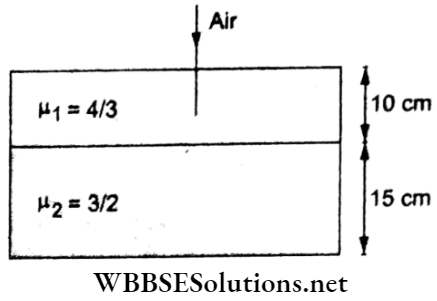
Ray Optics Multiple Choice Questions And Answers Combination Of Two Slabs Q11

  1. 1.8
  2. 1.43
  3. 2
  4. None of these

Answer: 2. 1.43

The apparent depth for the given pair of media is

⇒ \(d=\frac{d_1}{\mu_1}+\frac{d_2}{\mu_2}\)

For equivalent refractive index,

⇒ \(\mu=\frac{\text { real depth }}{\text { apparent depth }}=\frac{d_1+d_2}{\frac{d_1}{\mu_1}+\frac{d_2}{\mu_2}}\)

Given, \(\mu_1=\frac{4}{3}, d_1=10 \mathrm{~cm}, \mu_2=\frac{3}{2}, d_2=15 \mathrm{~cm}\)

∴ \(\mu=\frac{10 \mathrm{~cm}+15 \mathrm{~cm}}{(10 \mathrm{~cm}) \frac{3}{4}+(15 \mathrm{~cm}) \frac{2}{3}}=\frac{25}{17.5}=1.43\)

“class 12 phy ray optics “

Question 12. A microscope is focused on a mark on a piece of paper and a slab of glass of thickness 3 cm and refractive index 1.5 is placed over the mark. How should the microscope be moved to get the mark in focus again?

  1. 2 cm upward
  2. 1 cm upward
  3. 4.5 cm downward
  4. 1 cm downward

Answer: 2. 1 cm upward

In the given figure, O is the position of the mark and I is its apparent position.

Refractive index, \(\mu=\frac{\mathrm{AO}}{\mathrm{AI}}\)

∴ \(1.5=\frac{3 \mathrm{~cm}}{\mathrm{AI}} \Rightarrow \mathrm{AI}=2 \mathrm{~cm}\)

Shift of the image

= OI = 3 cm- 2 cm =1 cm.

The microscope must be raised upward from P to Q by 1 cm.
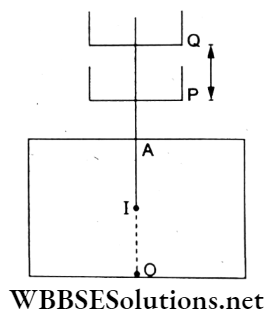
Ray Optics Multiple Choice Questions And Answers Shift Of The Image Q12

Question 13. For the situation shown in the figure, what should be the refractive index of glass so that the ray will suffer total internal reflection at the vertical face?
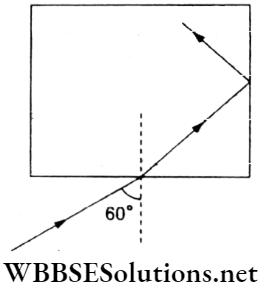
Ray Optics Multiple Choice Questions And Answers Refractive Index Of Glass Q13

  1. 1.732
  2. 1.5
  3. 1.32
  4. 1.6

Answer: 3. 1.32

Refractive index,

⇒ \(\mu=\frac{\sin 60^{\circ}}{\sin r}=\frac{\sin 60^{\circ}}{\sin \left(90^{\circ}-\theta\right)}=\frac{\sqrt{3}}{2 \cos \theta}\)

For total internal reflection,

θ ≥ θC,

⇒ \(\cos \theta_c=\frac{\sqrt{3}}{2 \mu}=\frac{\sqrt{3}}{2\left(1 / \sin \theta_c\right)}\)

⇒ \(\tan \theta_c=\frac{2}{\sqrt{3}}\)

Hence, μ = \({cosec} \theta_c=\frac{\sqrt{7}}{2}=1.32\)
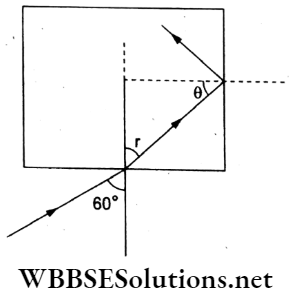
Ray Optics Multiple Choice Questions And Answers Total Internal Reflection Q13(1)

Ray Optics Multiple Choice Questions And Answers Total Internal Reflection Q13(2)

“class 12 phy ray optics “

Question 14. In a concave mirror, an object is placed at a distance d1 from the focus and the image is formed at a distance d2 from the focus. The focal length of the mirror is

  1. \(\sqrt{d_1 d_2}\)
  2. \(d_1 d_2\)
  3. \(\frac{d_1+d_2}{2}\)
  4. \(\sqrt{\frac{d_1}{d_2}}\)

Answer: 1. \(\sqrt{d_1 d_2}\)

From the mirror formula, \(\frac{1}{f}=\frac{1}{u}+\frac{1}{v}\)

Given, u = d1 + f, v = d2 + f

⇒ \(\frac{1}{f}=\frac{1}{d_1+f}+\frac{1}{d_2+f}=\frac{\left(d_1+d_2\right)+2 f}{\left(d_1+f\right)\left(d_2+f\right)}\)

⇒ d1d2 + f(d1+f2)+f2 = (d1+d2)f +2f2

∴ \(f^2=d_1 d_2 \Rightarrow f=\sqrt{d_1 d_2}\).

Question 15. A short linear object of length L lies along the axis of a concave mirror of focal length f at a distance d from the pole of the mirror. The size of the image is then (nearly)

  1. \(\frac{L f}{d-f}\)
  2. \(\frac{d-f}{L f}\)
  3. \(\frac{L f^2}{(d-f)^2}\)
  4. \(\frac{L(d-f)^2}{f^2}\)

Answer: 3. \(\frac{L f^2}{(d-f)^2}\)

Since \(\frac{1}{u}+\frac{1}{v}=\frac{1}{f}\)

Differentiating, \(\frac{\Delta u}{u^2}+\frac{\Delta v}{v^2}=0\)

Size of the object placed along the axis is L = AM, SO size of the image = \(|\Delta v|=\frac{v^2}{u^2} \cdot L\)

Now, \(1+\frac{u}{v}=\frac{u}{f} \Rightarrow \frac{u}{v}=\frac{u}{f}-1=\frac{u-f}{f}=\frac{d-f}{f}\)

∴ \(|\Delta v|=L\left(\frac{v}{u}\right)^2=\frac{L f^2}{(d-f)^2}\)

Question 16. A 2.0 cm-tall object is placed 15 cm in front of a concave mirror of a focal length of 10 cm. What is the size and nature of the image?

  1. 4 cm, real
  2. 4 cm, virtual
  3. 1 cm, real
  4. None of these

Answer: 1. 4 cm, real

Given,f =10 cm and M =15 cm. Since u >f, the image will be real and magnified.

∵ \(\frac{1}{u}+\frac{1}{v}=\frac{1}{f} \Rightarrow \frac{1}{15 \mathrm{~cm}}+\frac{1}{v}=\frac{1}{10 \mathrm{~cm}} \Rightarrow \frac{1}{v}=\frac{5}{150 \mathrm{~cm}}\)

⇒ v = 30 cm.

∴ magnification is m = \(\frac{v}{u}=\frac{30 \mathrm{~cm}}{15 \mathrm{~cm}}=2\)

∴ Size of the image = 2 x 2 cm = 4 cm.

Question 17. A concave mirror of focal length f1 is placed at a distance d from a convex lens of focal length f2. A beam of light coming from infinity and incident on this convex lens-concave mirror combination returns to infinity. The distance d must be equal to

  1. f1+f2
  2. -f1+f2
  3. 2f1+f2
  4. -2f1+f2

Answer: 3. 2f1+f2

Parallel rays from infinity incident on the convex lens L get focused at its focus F, where OF = f2. Since the rays retrace their paths after reflection from the concave mirror, the rays must be incident normally (coming from its center) and therefore F must be the center of curvature of the concave mirror. So, PF = R = 2f1

The distance between the lens and the mirror is

“class 12 phy ray optics “

d = OF + FP = f2 + 2f1.
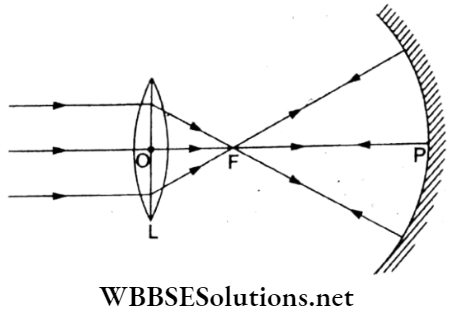
Ray Optics Multiple Choice Questions And Answers Parallel Rays Q17

Question 18. The angle of incidence for a ray of light at a refracting surface of a prism is 45°. The angle of the prism is 60°. If the ray suffers a minimum deviation through the prism, the angle of minimum deviation and the refractive index of the material of the prism respectively are

  1. \(30^{\circ}, \sqrt{2}\)
  2. \(45^{\circ}, \sqrt{2}\)
  3. \(45^{\circ}, \frac{1}{\sqrt{2}}\)
  4. \(30^{\circ}, \frac{1}{\sqrt{2}}\)

Answer: 1. [late]30^{\circ}, \sqrt{2}[/latex]

Given, A = 60° and i = 45°.

Since the ray suffers minimum deviation, i = i’ and r = r’ with r + r’ = A.

Hence, r + r’ = r+r = A = 60° ⇒ r = 30°.

Again, i+i’ = A+8 ⇒ i+i=A+δm.

the angle of minimum deviation,

δm = 2i-A = 2(45°)- 60° = 30°.

Refractive index,

∴ \(\mu=\frac{\sin i}{\sin r}=\frac{\sin 45^{\circ}}{\sin 30^{\circ}}=\sqrt{2}\).

Question 19. The refracting angle of a prism is A and the refractive index of the material of the prism is cot (A/2). The angle of minimum deviation is

  1. 180°- 3A
  2. 180°- 2A
  3. 90°- A
  4. 180° + 2A

Answer: 2. 180°- 2A

For a prism,

⇒ \(\mu=\frac{\sin \frac{A+\delta_m}{2}}{\sin \frac{A}{2}}=\cot \frac{A}{2} \text { (given) }\)

⇒ \(\cos \frac{A}{2}=\sin \left(90^{\circ}-\frac{A}{2}\right)=\sin \left(\frac{A+\delta_m}{2}\right)\)

Hence, \(\frac{A+\delta_m}{2}=\frac{\pi}{2}-\frac{A}{2}\).

So, the angle of minimum deviation, δm = π – 2A = 180°- 2A

Question 20. A ray of light is incident at an angle of incidence i on one face of a prism of angle A (assumed to be small) and emerges normally from the opposite face. If the refractive index of the material of the prism is μ, the angle of incidence is nearly equal to

  1. μA
  2. \(\frac{\mu A}{2}\)
  3. \(\frac{A}{\mu}\)
  4. \(\frac{A}{2 \mu}\)

Answer: 1. μA

Since the ray emerges normally out of the prism, angle r = A.

⇒ \(\mu=\frac{\sin i}{\sin r}=\frac{i}{r}=\frac{i}{A}\) (for small angles).

Hence, the angle of incidence is i = μA

“class 12 phy ray optics “
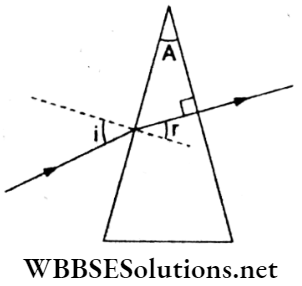
Ray Optics Multiple Choice Questions And Answers Prism Q20

Question 21. The refractive index of the material of a prism is √2 and its refracting angle is 30°. One of the refracting surfaces of the prism is silvered outward. A beam of monochromatic light entering the prism from the other face retraces its path after reflection from the silvered surface. The angle of incidence on the prism is

  1. 45°
  2. 60°
  3. 30°

Answer: 1. 45°

Given, μ ⇒ √2 and A = 30°.

Since the ray retraces its path after reflection from the second face, it must be normally incident. So, r = A = 30°.

Now, \(\mu=\frac{\sin i}{\sin r} \Rightarrow \sqrt{2}=\frac{\sin i}{\sin 30^{\circ}}\)

⇒ \(\sin i=\sqrt{2} \times \frac{1}{2}=\frac{1}{\sqrt{2}}=\sin 45^{\circ}\)

∴ i = 45°.
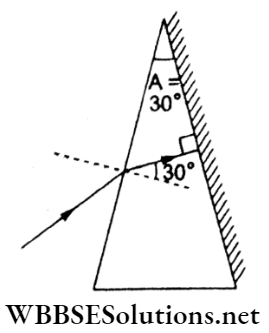
Ray Optics Multiple Choice Questions And Answers Path After Reflection From The Secnd Face Q21

Question 22. If the refractive index of the material of an equilateral prism is √3 then the angle of minimum deviation from the prism is

  1. 30°
  2. 45°
  3. 60°
  4. 75°

Answer: 3. 60°

Given, A = 60° and μ = √3.

⇒ \(\mu=\frac{\sin \left(\frac{A+\delta_m}{2}\right)}{\sin \left(\frac{A}{2}\right)}\)

⇒ \(\sqrt{3}=2 \sin \left(\frac{60^{\circ}+\delta_m}{2}\right)\)

⇒ \(\sin \left(\frac{60^{\circ}+\delta_m}{2}\right)=\frac{\sqrt{3}}{2}=\sin 60^{\circ}\).

∴ The angle of minimum deviation = δm = 60°.

Question 23. The angle of deviation δ through a dun prism (A small) whose material has its refractive index μ can be expressed by

  1. \(\delta=(\mu-1) A\)
  2. \(\delta=(\mu+1) A\)
  3. \(\delta=\frac{\sin \frac{A+\delta}{2}}{\sin \frac{A}{2}}\)
  4. \(\delta=\left(\frac{\mu-1}{\mu+1}\right) A\)

Answer: 1. \(\delta=(\mu-1) A\)

For a thin-angled prism, A = small.

So i, i, i’, r, r’ must be small for a ray to emerge.

⇒ \(\mu=\frac{\sin i}{\sin r} \approx \frac{i}{r} \Rightarrow i=\mu r\)

Similarly, i’ = μr’.

Adding, i+i’ = μ{r + r’)

⇒  A + δ = μA ⇒ δ = (μ.-1)A.

“class 12 phy ray optics “

Question 24. One face of a prism of refracting angle A is silvered. Light rays incident at an angle of incidence 2A on the first surface retrace their path after suffering reflection at the silvered surface. The refractive index of the die material of the prism is

  1. 2 sinA
  2. 2 cosA
  3. \(\frac{1}{2} \cos A\)
  4. tan A

Answer: 2. 2 cosA

Since the ray is reflected from the second face, it must be incident normally. Hence, the angle of refraction r-A. Refractive index is

⇒ \(\mu=\frac{\sin i}{\sin r}=\frac{\sin 2 A}{\sin A}=\frac{2 \sin A \cos A}{\sin A}\)

μ = 2cos A
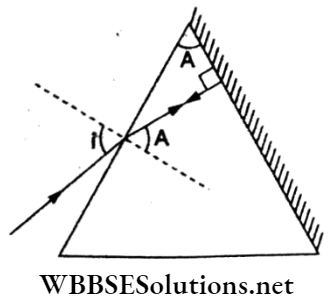
Ray Optics Multiple Choice Questions And Answers Refractive Index Q24

Question 25. The angle of minimum deviation for a glass prism is equal to its refracting angle. The refractive index of glass is 1.5. Then, the angle of the prism is

  1. \(2 \cos ^{-1}\left(\frac{3}{4}\right)\)
  2. \(\sin ^{-1}\left(\frac{3}{4}\right)\)
  3. \(2 \sin ^{-1}\left(\frac{3}{2}\right)\)
  4. \(\cos ^{-1}\left(\frac{3}{2}\right)\)

Answer: 1. \(2 \cos ^{-1}\left(\frac{3}{4}\right)\)

Given, the angle of prism = A = δm, refractive index = μ =1.5.

From the prism formula,

⇒ \(\mu=\frac{\sin \left(\frac{A+\delta_{\mathrm{m}}}{2}\right)}{\sin \frac{A}{2}}=\frac{\sin \left(\frac{A+A}{2}\right)}{\sin \frac{A}{2}}=\frac{\sin A}{\sin \frac{A}{2}}\)

⇒ \(\mu=\frac{2 \sin \frac{A}{2} \cos \frac{A}{2}}{\sin \frac{A}{2}} \Rightarrow \cos \frac{A}{2}=\frac{\mu}{2}=\frac{3}{4}\)

∴ \(\frac{A}{2}=\cos ^{-1}\left(\frac{3}{4}\right) \Rightarrow A=2 \cos ^{-1}\left(\frac{3}{4}\right)\).

Question 26. For the angle of minimum deviation through a prism to be equal to its refracting angle, the prism must be made of a material whose refractive index

  1. Lies between √2 and 1
  2. Lies between 2 and √2
  3. Is less than 1
  4. Is greater than 2

Answer: 2. Lies between 2 and √2

Given, δm = A

Hence, \(\frac{\sin \left(\frac{A+\delta_m}{2}\right)}{\sin \left(\frac{A}{2}\right)}=\frac{\sin A}{\sin \frac{A}{2}}=2 \cos \frac{A}{2}\)

Since i + i’ = A+8,

hence at minimum deviation,

i + i = 2A ⇒ i = A

Let us consider the limiting values of i:

⇒ For \(i_{\min }=0, A_{\min }=0 \Rightarrow \mu_{\max }=\left(2 \cos \frac{A}{2}\right)=2 \cos 0=2\)

⇒ Again, \(i_{\max }=90^{\circ}, A_{\max }=90^{\circ}, \text { so } \mu_{\min }=2 \times \cos \frac{90^{\circ}}{2}=\sqrt{2}\)

∴ μ lies between 2 and √2

“class 12 phy ray optics “

Question 27. A ray of light is incident on a 60° prism at the minimum deviation position. The angle of refraction at the first face of the prism is

  1. Zero
  2. 30°
  3. 45°
  4. 60°

Answer: 2. 30°

For a prism, r+r’ = A.

For minimum deviation, r = r’.

r + r = A = 60° ⇒ r = 30°.

Question 28. A thin prism having a refracting angle of 10° is made of crown glass with a refractive index of 1.42. This prism is combined with another thin prism of flint glass with a refractive index 1.7. This combination produces dispersion without deviation. The refracting angle of the second prism should be

  1. 10°

Answer: 1. 6°

For a crown prism, AC =10° and μC =1.42.

For the flint prism, μF =1.7.

For null deviation, δC + δF = 0

⇒ \(\left(\mu_C-1\right) A_C+\left(\mu_F-1\right) A_F=0\)

∴ \(\left|A_F\right|=\frac{\left(\mu_C-1\right) A_C}{\left(\mu_F-1\right)}=\frac{(1.42-1) 10^{\circ}}{(1.7-1)}=\frac{0.42}{0.70} \times 10^{\circ}=6^{\circ}\).

Class 11 Physics Class 12 Maths Class 11 Chemistry
NEET Foundation Class 12 Physics NEET Physics

Question 29. A plano-convex lens fits exactly into a plano-concave lens. Their plane surfaces are parallel to each other. If fine lenses are made of different materials of refractive indices μ1 and μ2, and R is the radius of curvature of the curved surface of the lenses then the focal length of the combination is

  1. \(\frac{R}{2\left(\mu_1+\mu_2\right)}\)
  2. \(\frac{R}{2\left(\mu_1-\mu_2\right)}\)
  3. \(\frac{R}{\left(\mu_1-\mu_2\right)}\)
  4. \(\frac{2 R}{\left(\mu_2-\mu_1\right)}\)

Answer: 3. \(\frac{R}{\left(\mu_1-\mu_2\right)}\)

For a convex lens,

⇒ \(\frac{1}{f_1}=\left(\mu_1-1\right)\left(\frac{1}{R_1}-\frac{1}{R_2}\right)\)

⇒ \(\left(\mu_1-1\right)\left(\frac{1}{\infty}-\frac{1}{-R}\right)=\frac{\left(\mu_1-1\right)}{R}\)

For a concave lens,

⇒ \(\frac{1}{f_2}=\left(\mu_2-1\right)\left(\frac{1}{R_1}-\frac{1}{R_2}\right)=\left(\mu_2-1\right)\left(-\frac{1}{R}-\frac{1}{\infty}\right)=-\frac{\left(\mu_2-1\right)}{R}\)

For the combination with equivalent focal length F

⇒ \(\frac{1}{F}=\frac{1}{f_1}+\frac{1}{f_2}=\frac{\left(\mu_1-1\right)-\left(\mu_2-1\right)}{R}=\frac{\mu_1-\mu_2}{R}\)

∴ \(F=\frac{R}{\left(\mu_1-\mu_2\right)}\)
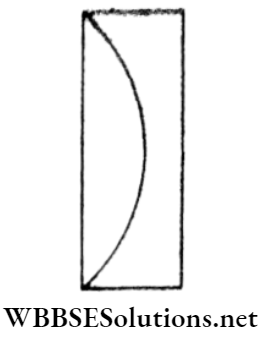
Ray Optics Multiple Choice Questions And Answers Combination With Equal Focal Length Q29

Question 30. A biconvex lens of glass (μ =15) has a radius of curvature of 20 cm. Which one of the following options describes best the image formed of a dying object of height 2 cm placed 30 cm from the lens?

  1. Virtual, erect, height = 0.5 cm
  2. Real, inverted, height = 4 cm
  3. Real, inverted, height =1 cm
  4. Virtual, erect, height =1 cm

Answer: 2. Real, inverted, height = 4 cm

Given, a convex lens,

μ =1.5, R1 = R2 = 20 cm, h0, = 2 cm, u = 30 cm.

From the lens formula,

⇒ \(\frac{1}{f}=(\mu-1)\left(\frac{1}{R_1}-\frac{1}{R_2}\right)=(1.5-1)\left(\frac{1}{20 \mathrm{~cm}}-\frac{1}{-20 \mathrm{~cm}}\right)\)

⇒ \(0.5\left(\frac{2}{20 \mathrm{~cm}}\right)=\frac{1}{20 \mathrm{~cm}}\)

Again \(\frac{1}{f}=\frac{1}{v}-\frac{1}{u}\)

⇒ \(\frac{1}{20 \mathrm{~cm}}=\frac{1}{v}-\frac{1}{(-30 \mathrm{~cm})} \Rightarrow \frac{1}{v}=\frac{1}{60 \mathrm{~cm}}\)

⇒ v = 60 cm.

Magnification = \(m=\frac{v}{u}=\frac{60 \mathrm{~cm}}{-30 \mathrm{~cm}}=-2\)

Negative magnification means the image is real, inverted and whose height is

⇒ \(h_{\mathrm{I}}=|m| h_0=2 \times 2 \mathrm{~cm}=4 \mathrm{~cm}\)

“class 12 phy ray optics “

Question 31. A lens having focal length f and an aperture of diameter D forms an image of intensity I. An aperture of diameter D/2 in the central region of the lens is covered by black paper. The focal length of the lens and intensity of the image now will be respectively

  1. \(f \text { and } \frac{I}{4}\)
  2. \(\frac{3 f}{4} \text { and } \frac{I}{2}\)
  3. \(f \text { and } \frac{3 I}{4}\)
  4. \(\frac{f}{2} \text { and } \frac{I}{2}\)

Answer: 3. \(f \text { and } \frac{3 I}{4}\)

The focal length of a lens does not depend on the area exposed to the incoming incident rays, so the focal length remains unchanged at f.

The intensity of the image formed is proportional to the area exposed.

Thus, \(\frac{I_2}{I_1}=\frac{A_2}{A_1}=\frac{\pi\left(\frac{D}{2}\right)^2-\pi\left(\frac{D}{4}\right)^2}{\pi\left(\frac{D}{2}\right)^2}=\frac{3}{4}\)

∴ \(I_2=\frac{3}{4} I_1=\frac{3}{4} I\)

Question 32. A biconvex lens is cut into two halves along

  • XOX’ and
  • YOY’ as shown in the figure. Let f,f’,f” be the focal lengths of the complete lens, of each half in case (1) and of each half in case (2) respectively.

Choose the correct statement from the following.
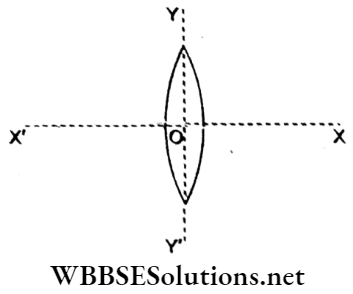
Ray Optics Multiple Choice Questions And Answers Equiconvex Lens Q32

  1. f’ = f, f” = f
  2. f’ = 2f, f” = 2f
  3. f’ = f, f” = 2f
  4. f’ = 2f, f” = f

Answer: 3. f’ = f, f” = 2f

For the complete lens,

⇒ \(\frac{1}{f}=(\mu-1)\left(\frac{1}{R}-\frac{1}{-R}\right)=\frac{2(\mu-1)}{R}\)

The focal length of each half-cut lens along X’OX will be

⇒ \(\frac{1}{f^{\prime}}=(\mu-1) \frac{2}{R}, \text { hence } f^{\prime}=f\)

The focal length of each half-cut lens along YOY’ is

⇒ \(\frac{1}{f^{\prime \prime}}=(\mu-1)\left(\frac{1}{R}-\frac{1}{\infty}\right)=\frac{\mu-1}{R}=\frac{1}{2}\left[\frac{2(\mu-1)}{R}\right]=\frac{1}{2 f} \Rightarrow f^{\prime \prime}=2 f\)

∴ \(f^{\prime \prime}=2 f \text { and } f^{\prime}=f\)

Question 33. An object is located on a wall. An image of the same size is to be obtained on the parallel wall with the help of a convex lens. The lens is placed at a distance d ahead of the second wall. The required focal length of the lens should be

  1. \(\text { only } \frac{d}{4}\)
  2. \(\text { only } \frac{d}{2}\)
  3. \(\text { more than } \frac{d}{4} \text { but less than } \frac{d}{2}\)
  4. \(\text { less than } \frac{d}{4}\)

Answer: 2. \(\text { only } \frac{d}{2}\)

Since the object and its image are of the same size, magnification is

⇒ \(m=\frac{|v|}{|u|}=1\)

Since v = d,

u = v = d.

From the lens formula,

⇒ \(\frac{1}{f}=\frac{1}{v}-\frac{1}{u}=\frac{1}{d}-\frac{1}{(-d)}=\frac{2}{d}\)

⇒ \(f=\frac{d}{2}\)
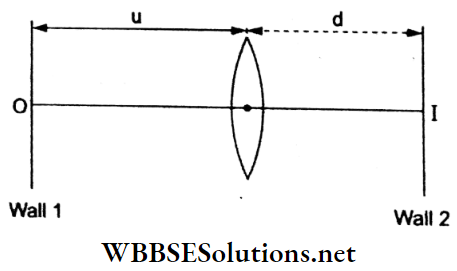
Ray Optics Multiple Choice Questions And Answers Magnification Q33

Question 34. A plano-convex lens is made of a material of refractive index μ, =1.5. The radius of curvature of the curved surface of the lens is 20 cm. If its plane surface is silvered, the focal length of the silvered lens will be

  1. 10 cm
  2. 20 cm
  3. 40 cm
  4. 60cm

Answer: 2. 20 cm

When the plane surface is not silvered, its focal length is f1 where

⇒ \(\frac{1}{f_1}=(\mu-1)\left(\frac{1}{R_1}-\frac{1}{R_2}\right)=(1.5-1)\left(\frac{1}{R}-\frac{1}{\infty}\right)=\frac{1}{2 R}\)

f1 = 2R = 2(20 cm) = 40 cm.

When the plane surface is silvered, rays from focus F will be parallel after refraction, fall normally on the silvered face, and retrace its path, forming the real image at F.

Thus, the silvered lens acts as a concave mirror with a center at F whose radius of curvature = f1 = 4O cm.

⇒ \(f \text { of mirror }=\frac{40 \mathrm{~cm}}{2}=20 \mathrm{~cm}\).
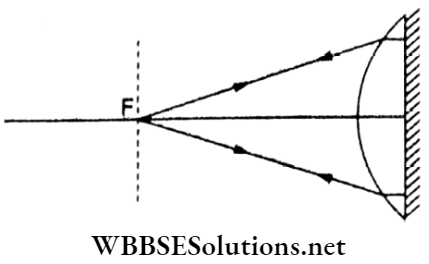
Ray Optics Multiple Choice Questions And Answers Silvered Lens Q34

Alternative method

In the silvered lens, there are two refractions from the curved surface and one reflection from the plane surface.

Hence, the power of the silvered lens

= power of the lens + power of the mirror

⇒ \(\frac{1}{F}=\frac{2}{f_l}+\frac{1}{f_{\mathrm{m}}}=\frac{2}{40 \mathrm{~cm}}+\frac{1}{\infty}\)

F = 20 cm.

Question 35. A plano-convex lens is made of a material with a refractive index of 1.6. The radius of curvature of the curved surface is 60 cm. The focal length of the lens is

  1. 50 cm
  2. 100 cm
  3. 200 cm
  4. 400 cm

Answer: 2. 100 cm

Given, μ =1.6, R1 = 60 cm, and R2 = ∞ (for plane surface).

From the lens maker’s formula,

⇒ \(\frac{1}{f}=(\mu-1)\left(\frac{1}{R_1}-\frac{1}{R_2}\right)\)

∴ \((1.6-1)\left(\frac{1}{60 \mathrm{~cm}}-\frac{1}{\infty}\right)=\frac{0.6}{60 \mathrm{~cm}}=\frac{1}{100 \mathrm{~cm}}\)

∴ f = 100 cm.

Question 36. A luminous object is placed at a distance of 30 cm from a convex lens of focal length 20 cm. On the other side of the lens, at what distance from the lens should a convex mirror of radius of curvature 10 cm be placed in order to have an upright image of the object coincident with it?

  1. 20 cm
  2. 30 cm
  3. 50 cm
  4. 60 cm

Answer: 3. 50 cm

For the lens,

⇒ \(\frac{1}{v}-\frac{1}{u}=\frac{1}{f}\)

⇒ \(\frac{1}{v}-\frac{1}{-30 \mathrm{~cm}}=\frac{1}{20 \mathrm{~cm}}\)

⇒ \(\frac{1}{v}=\frac{1}{20 \mathrm{~cm}}-\frac{1}{30 \mathrm{~cm}}=\frac{1}{60 \mathrm{~cm}}\)

v = 60 cm = OC

Rays emerging from the lens must be directed towards the center of curvature C of the convex mirror so as to retrace its path such that the object and the image are coincident.

The distance between the lens and the mirror is OP = OC- PC = v-R = 60 cm-10 cm = 50 cm.
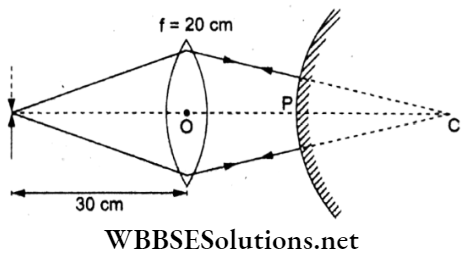
Ray Optics Multiple Choice Questions And Answers Distance Between The Lens And The Mirror Q36

Question 37. A lens is made of flint glass (refractive index = 1.5). When the lens is immersed in a liquid with a refractive index of 1.25, its focal length

  1. Increases by a factor of 1.25
  2. Increases by a factor of 2.5
  3. Increases by a factor of 1.2
  4. Decreases by a factor of 1.2

Answer: 2. Increases by a factor of 2.5

⇒ \(\frac{1}{f_{\mathrm{a}}}=\left({ }^{\mathrm{a}} \mu_{\mathrm{g}}-1\right)\left(\frac{1}{R_1}-\frac{1}{R_2}\right)\) → (1)

When the lens is immersed in the liquid (μ1 =1.25), the focal length is

⇒ \(\frac{1}{f_1}=\left({ }^1 \mu_{\mathrm{g}}-1\right)\left(\frac{1}{R_1}-\frac{1}{R_2}\right)\) → (2)

Taking the ratio of (1) and (2),

⇒ \(\frac{f_1}{f_{\mathrm{a}}}=\frac{{ }^{\mathrm{a}} \mu_{\mathrm{g}}-1}{\left(\frac{\mu_{\mathrm{g}}}{\mu_1}-1\right)}=\frac{(1.5-1)}{\left(\frac{1.5}{1.25}-1\right)}=\frac{5}{2}\)

⇒ \(f_1=\frac{5}{2} f_{\mathrm{a}}\)

Hence, f increases by a factor of 2.5.

Question 38. A camera lens has an aperture of f and the exposure time is (1/60) s. What will be the exposure time when the aperture becomes 1.4?

  1. \(\frac{1}{42} \mathrm{~s}\)
  2. \(\frac{1}{31} \mathrm{~s}\)
  3. \(\frac{1}{72} \mathrm{~s}\)
  4. \(\frac{1}{56} \mathrm{~s}\)

Answer: 2. \(\frac{1}{31} \mathrm{~s}\)

The f-number of an optical system. (camera lens) is the ratio of the system’s focal length to the diameter of the aperture (hole) through which light enters. It is the reciprocal of the relative aperture.

Time of exposure (t) ∝ (f-number)2

⇒ \(\frac{t}{(1 / 60) \mathrm{s}}=\frac{(1.4)^2}{1}\)

∴ \(t=(1.4)^2\left(\frac{1}{60}\right) \mathrm{s}=\frac{14 \times 14}{6000} \approx \frac{1}{31} \mathrm{~s}\)

Question 39. A convex lens of refractive index 3/2 has a power of 2.5 D in it is immersed in a liquid of refractive index 2 then the new poof of the lens is

  1. 1.25 D
  2. -1.25 D
  3. -1.5D
  4. 1.5 D

Answer: 2. -1.25 D

The power of a lens is

⇒ \(P=\frac{1}{f}=(\mu-1)\left(\frac{1}{R_1}-\frac{1}{R_2}\right)\)

When in the air,

⇒ \(2.5 \mathrm{D}=(1.5-1)\left(\frac{1}{R_1}-\frac{1}{R_2}\right)\)

When immersed in the liquid,

⇒ \(P=\frac{1}{f^{\prime}}=\left({ }^{\prime} \mu_{\mathrm{g}}-1\right)\left(\frac{1}{R_1}-\frac{1}{\dot{R}_2}\right)\)

⇒ \(\frac{P}{2.5 \mathrm{D}}=\frac{\left(\frac{\mu_{\mathrm{g}}}{\mu_1}-1\right)}{\left(\mu_{\mathrm{g}}-1\right)}=\frac{\left(\frac{1.5}{2}-1\right)}{(1.5-1)}\)

∴ \(P=-\frac{2.5}{2} \mathrm{D}=-1.25 \mathrm{D}\).

Question 40. In a convex lens of focal length f, the minimum distance between the object and its real image must be

  1. 3f
  2. 4f
  3. 1.5f
  4. 2f

Answer: 2. 4f

Let D be the separation between the object and its real image formed by a convex lens.

⇒ \(D=|u|+|v|=(\sqrt{u}-\sqrt{v})^2+2 \sqrt{u v}\)

For D to be minimum,

(√u-√v)2 = 0 = u = v.

From the lens formula (for real image),

⇒ \(\frac{1}{v}-\frac{1}{(-u)}=\frac{1}{f}\)

⇒ \(\frac{1}{v}+\frac{1}{v}=\frac{1}{f} \Rightarrow v=u=2 f\)

∴ \((D)_{\min }=2 \sqrt{u v}=2 \sqrt{(2 f)(2 f)}=4 f\)

Question 41. Two identical glass (μg = 1.5) biconvex lenses of focal length f each are kept in contact. The space between the two lenses is filled with water (μw = 4/3). The focal length of the combination is

  1. \(\frac{f}{3}\)
  2. f
  3. \(\frac{4 f}{3}\)
  4. \(\frac{3 f}{4}\)

Answer: 4. \(\frac{3 f}{4}\)

For a glass convex lens,

⇒ \(\frac{1}{f}=\frac{1}{f_1}=\frac{1}{f_2}=\left(\mu_{\mathrm{g}}-1\right)\left(\frac{1}{R_1}-\frac{1}{R_2}\right)\)

⇒ \(\frac{1}{f}=(1.5-1)\left(\frac{1}{R}-\frac{1}{-R}\right)=\frac{1}{R}\)

For water-biconcave lens,

⇒ \(\frac{1}{f_3}=\left(\mu_w-1\right)\left(\frac{1}{R_1}-\frac{1}{R_2}\right)\)

⇒ \(\left(\frac{4}{3}-1\right)\left(\frac{1}{-R}-\frac{1}{R}\right)\)

⇒ \(\left(\frac{1}{3}\right)\left(-\frac{2}{R}\right)=-\frac{2}{3 R}\)

For an equivalent focal length for the combination,

⇒ \(\frac{1}{F}=\frac{1}{f_1}+\frac{1}{f_2}+\frac{1}{f_3}=\frac{1}{R}+\frac{1}{R}-\frac{2}{3 R}=\frac{4}{3 R}=\frac{4}{3}\left(\frac{1}{f}\right)\)

∴ \(F=\frac{3 f}{4}\)
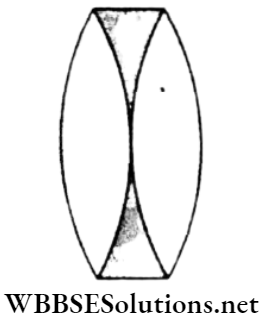
Ray Optics Multiple Choice Questions And Answers Equivalent Focal Length Q41

Question 42. Two identical thin plano-convex glass lenses (refractive index = 1.5) each having radius of curvature 20 cm are placed with their convex surfaces in contact at the center. The intervening space between them is filled with oil with a refractive index of 1.7. The focal length of the combination is

  1. -50 cm
  2. -25 cm
  3. 50 cm
  4. -20 cm

Answer: 1. -50 cm

For the two identical plano-convex lenses of glass,

⇒ \(\frac{1}{f}=\frac{1}{f_1}=\frac{1}{f_2}=\left(\mu_{\mathrm{g}}-1\right)\left(\frac{1}{R_1}-\frac{1}{R_2}\right)\)

⇒ \((1.5-1)\left(\frac{1}{\infty}-\frac{1}{-R}\right)=\frac{1}{2 R}\)

For the biconcave liquid lens,

⇒ \(\frac{1}{f_3}=\left(\mu_l-1\right)\left(\frac{1}{R_1}-\frac{1}{R_2}\right)=(1.7-1)\left(-\frac{1}{R}-\frac{1}{R}\right)=-\frac{1.4}{R}\)

For the equivalent focal length,

⇒ \(\frac{1}{F}=\frac{1}{f_1}+\frac{1}{f_2}+\frac{1}{f_3}=\frac{2}{f_1}+\frac{1}{f_3}=2\left(\frac{1}{2 R}\right)+\left(-\frac{1.4}{R}\right)=-\frac{0.4}{R}\)

∴ \(F=-\frac{R}{0.4}=-\frac{20 \mathrm{~cm}}{0.4}=-50 \mathrm{~cm}\)
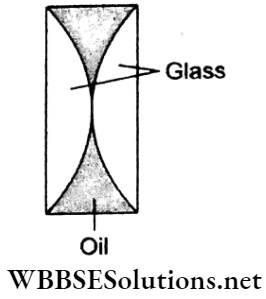
Ray Optics Multiple Choice Questions And Answers Plano Convex Lenses Of Glass Q42

Question 43. A converging beam of rays is incident on a diverging lens. After passing through the lens, the rays converge at a point 15 cm from the lens on the opposite side. If the lens is removed, the point where the rays converge moves 5 cm closer to the lens. The focal length of the lens is

  1. 5 cm
  2. -10 cm
  3. -30 cm
  4. 20 cm

Answer: 3. -30 cm

In the given figure, rays converge at O without the lens, hence acting as an object. After passing through the concave lens, the rays get slightly diverged and meet at I, which is the position of the image. Thus,

PI = v =15 cm and OP = u =15 cm-5 cm =10 cm.

From the lens formula,

⇒ \(\frac{1}{v}-\frac{1}{u}=\frac{1}{f}\)

⇒ \(\frac{1}{f}=\frac{1}{15 \mathrm{~cm}}-\frac{1}{10 \mathrm{~cm}}=-\frac{1}{30 \mathrm{~cm}}\)

Hence, f = -30 cm.
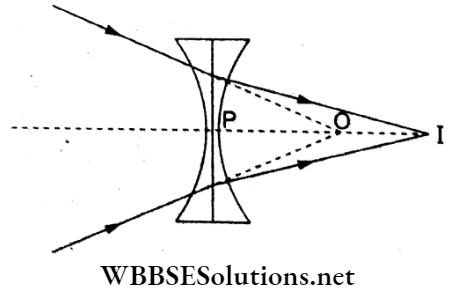
Ray Optics Multiple Choice Questions And Answers Q43

Question 44. Two thin lenses of focal lengths f1 and f2 are in contact and coaxial. The power of the combination is

  1. \(\frac{f_1+f_2}{2}\)
  2. \(\frac{f_1+f_2}{f_1 f_2}\)
  3. \(\sqrt{\frac{f_1}{f_2}}\)
  4. \(\sqrt{\frac{f_2}{f_1}}\)

Answer: 2. \(\frac{f_1+f_2}{f_1 f_2}\)

For two thin lenses in contact,

⇒ \(\frac{1}{F}=\frac{1}{f_1}+\frac{1}{f_2}=\frac{f_1+f_2}{f_1 f_2}\)

Equivalent power of the combination,

⇒ \(P=\frac{1}{F}=\frac{f_1+f_2}{f_1 f_2}\)

Question 45. A person can see objects clearly only when they lie between 50 cm and 400 cm away from his eyes. In order to increase the maximum distance of distinct vision to infinity, the type and power of the correcting lens the person has to use will be

  1. Convex, +2.25 dioptre
  2. Concave, -0.25 dioptre
  3. Concave, -0.2 dioptre
  4. Convex, +0.15 dioptre

Answer: 2. Concave, -0.25 dioptre

The person can see distinctly up to 400 cm = 4 m. For distinct vision up to ∞, he needs a concave lens that can form a virtual image at 400 cm when the object is at ∞ as shown in the figure.

From the lens formula,

⇒ \(\frac{1}{v}-\frac{1}{u}=\frac{1}{f}\)

⇒ \(\frac{1}{-400 \mathrm{~cm}}-\frac{1}{\infty}=\frac{1}{f}\)

power of the lens is

∴ \(P=\frac{100}{f_{\mathrm{cm}}} \mathrm{D}=\frac{100}{-400} \mathrm{D}=-\frac{1}{4} \mathrm{D}=-0.25 \mathrm{D}\)

The negative sign is for the concave lens.
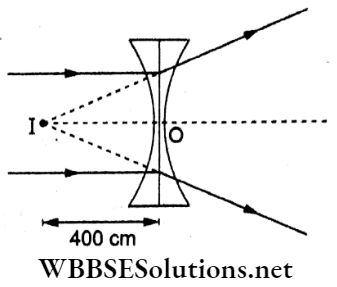
Ray Optics Multiple Choice Questions And Answers Object Is At Infinity Q45

Question 46. For a normal eye, the cornea of the eye provides a converging power of 40 D, and the least converging power of the eye lens behind the cornea is 20 D. Using this information, the distance between the retina and the cornea for the eye lens can be estimated to be

  1. 5 cm
  2. 2.5 cm
  3. 1.67 cm
  4. 1.5 cm

Answer: 3. 1.67 cm

Given, the converging power of the cornea, PC = +40 D; the least converging power of the eye lens, Pe = +20 D.

equivalent power of eye lens,

P = Pe + PC = 20 D + 40 D = 60 D

But, \(P=\frac{1}{\text { focal length of eye lens }(f)}\)

⇒ \(f=\frac{1}{P}=\frac{1}{60 \mathrm{D}}=\frac{1}{60} \mathrm{~m}=\frac{100}{60} \mathrm{~cm}=\frac{5}{3} \mathrm{~cm}\)

Distance between the retina and cornea for the eye lens

= focal length of the eye lens

∴ \(\frac{5}{3} \mathrm{~cm}=1.67 \mathrm{~cm}\).

Question 47. For a person, the near point of vision is 100 cm. The power the correcting lens requires to provide normal vision is

  1. +1 D
  2. -lD
  3. +3D
  4. -3D

Answer: 3. +3D

The near point for normal vision is 25 cm.

Hence, the correction lens must be a convex lens as shown in the figure.

The object O placed at 25 cm from the lens forms its virtual image I at 100 cm, which the defective eye can distinctly see.

Thus, \(\frac{1}{f}=\frac{1}{v}-\frac{1}{u}=\frac{1}{(-100 \mathrm{~cm})}-\frac{1}{(-25 \mathrm{~cm})}=\frac{3}{100 \mathrm{~cm}}\)

∴ Power = \(P=\frac{1}{f}=\frac{3}{1 \mathrm{~m}}=+3 \mathrm{D}\)
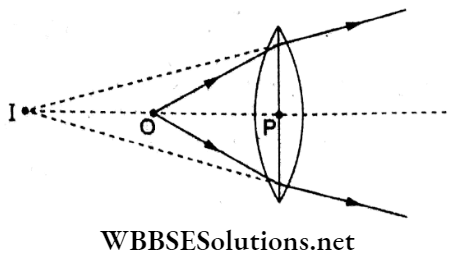
Ray Optics Multiple Choice Questions And Answers Normal Vision Q47

Question 48. A farsighted person has his near point at 50 cm. The power of the lens he should use to see at 25 cm clearly is

  1. +1D
  2. +2D
  3. -2D
  4. -1D

Answer: 2. +2D

Refer to the ray diagram of the preceding. Here, OP = u = 25 cm and IP = v = 50 cm.

⇒ \(\frac{1}{f}=\frac{1}{v}-\frac{1}{u}=\frac{1}{-50 \mathrm{~cm}}-\frac{1}{-25 \mathrm{~cm}}=\frac{1}{50 \mathrm{~cm}}\)

∴ f = + 50 cm.

So, its power = \(P=\frac{100}{f_{\mathrm{cm}}}=\frac{100}{50} \mathrm{D}=+2 \mathrm{D}\)

Question 49. An astronomical telescope has its objective and eyepiece of focal lengths 40 cm and 4 cm respectively. To view an object 200 cm away from the objective, the lenses must be separated by a distance of

  1. 46.0 cm
  2. 50.0 cm
  3. 54.0 cm
  4. 37.3 cm

Answer: 3. 54.0 cm

Given, f0 = 40 cm, fe = 4 cm.

Distance of the object AB from objective = u0 = -200 cm.

The image formed by the object is PQ which is formed at the focus of the eyepiece so that the final image is at infinity (for normal adjustment).

Now, \(\frac{1}{v_{\mathrm{o}}}-\frac{1}{u_{\mathrm{o}}}=\frac{1}{f_{\mathrm{o}}}\)

⇒ \(\frac{1}{v_{\mathrm{o}}}=\frac{1}{u_{\mathrm{o}}}+\frac{1}{f_{\mathrm{o}}}=\frac{1}{(-200 \mathrm{~cm})}+\frac{1}{40 \mathrm{~cm}}=\frac{1}{50 \mathrm{~cm}}\)

⇒ v0 = 50 cm.

Hence, the separation between the two lenses,

OQ + QE = 50 cm + 4 cm = 54 cm.
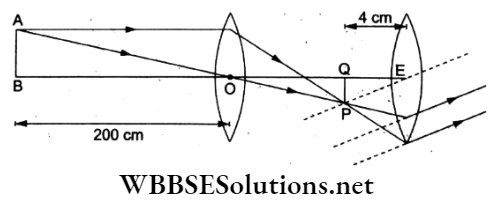
Ray Optics Multiple Choice Questions And Answers Q49

Question 50. In an astronomical telescope in normal adjustment, a straight black line of length L is drawn on the inner part of the objective lens. The eyepiece forms a real image of this line. The length of this line is l. The magnification of the telescope is

  1. \(\frac{L}{l}+1\)
  2. \(\frac{L}{l}-1\)
  3. \(\frac{L+1}{L-1}\)
  4. \(\frac{L}{l}\)

Answer: 4. \(\frac{L}{l}\)

Magnification produced by the eyepiece is

⇒ \(m_{\mathrm{e}}=\frac{\text { length of image }}{\text { length of object }}=\frac{l}{L}\)

Applying the lens formula,

⇒ \(\frac{1}{v_{\mathrm{e}}}-\frac{1}{\left(-u_{\mathrm{e}}\right)}=\frac{1}{f_{\mathrm{e}}} \Rightarrow \frac{u_{\mathrm{e}}}{v_{\mathrm{e}}}+1=\frac{u_{\mathrm{e}}}{f_{\mathrm{e}}}\)

the telescope is set for a normal adjustment,

\(u_{\mathrm{e}}=f_{\mathrm{o}}+f_{\mathrm{e}}\)

⇒ \(\frac{1}{m_{\mathrm{e}}}=\frac{f_{\mathrm{o}}+f_{\mathrm{e}}}{f_{\mathrm{e}}}-1=\frac{f_{\mathrm{o}}}{f_{\mathrm{e}}}\)

⇒ \(m_{\mathrm{e}}=\frac{l}{L}=\frac{f_{\mathrm{e}}}{f_{\mathrm{o}}} \Rightarrow \frac{f_{\mathrm{o}}}{f_{\mathrm{e}}}=\frac{L}{l}\) (1)

But magnification of telescope (in normal adjustment) is \(\frac{f_{\mathrm{o}}}{f_{\mathrm{e}}}=\frac{L}{l}\) [from (1)].
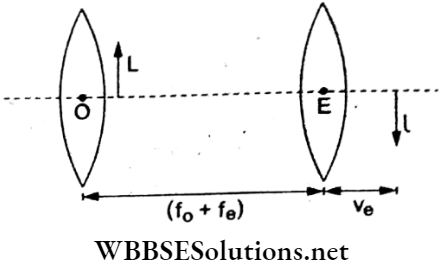
Ray Optics Multiple Choice Questions And Answers Telescope Is Set For Normal Adjustment Q50

Question 51. If the focal length of the objective lens is increased then the magnifying power(s) of

  1. A microscope will increase but that of a telescope will decrease
  2. Both a microscope and a telescope will increase
  3. Both a microscope and a telescope will decrease
  4. A microscope will decrease but that of a telescope will increase

Answer: 4. A microscope will decrease but that of a telescope will increase

The magnifying power of a microscope is m = \(\frac{L}{f_{\mathrm{o}}} \frac{D}{f_{\mathrm{e}}}\), thus \(m \propto \frac{1}{f_0}\).

Hence, an increase in f0 will decrease the magnifying power of the microscope.

For a telescope, \(m=\frac{f_{\mathrm{o}}}{f_{\mathrm{e}}}\), hence \(m \propto f_0\).

An increase in f0 will increase the magnifying power of the telescope.

Question 52. The magnifying power of a telescope is 9. When it is adjusted for parallel rays, the distance between the objective and the eyepiece is 20 cm. The focal lengths of the lenses are

  1. 10 cm and 10 cm
  2. 15 cm and 5 cm
  3. 18 cm and 2 cm
  4. 11 cm and 9 cm

Answer: 3. 18 cm and 2 cm

For a telescope in normal adjustment, tube length = L = f0 + fe = 20 cm

and magnifying power = \(\frac{f_{\mathrm{o}}}{f_{\mathrm{e}}}\) = 9, so f0 = 9fe.

fe + 9fe= 20 cm ⇒ fe = 2 cm

and f0 = 9fe = 9(2 cm) = 18 cm.

Question 53. An astronomical telescope of tenfold angular magnification has a length of 44 cm. The focal length of the objective is

  1. 440 cm
  2. 44 cm
  3. 40 cm
  4. 4 cm

Answer: 3. 40 cm

Given, angular magnification,

⇒ \(M=\frac{f_{\mathrm{o}}}{f_{\mathrm{e}}}=10 \text {, so } f_{\mathrm{o}}=10 f_{\mathrm{e}}\)

and tube length,

L = f0 + fe = 44 cm

⇒ fe + 10fe = 44 cm ⇒ fe = 4 cm.

A focal length of objective = f0 = 10fe = 40 cm.

Question 54. The astronomical telescope consists of an objective and an eyepiece. The focal length of the objective is

  1. Shorter than that of the eyepiece
  2. Greater than that of the eyepiece
  3. Equal to that of the eyepiece
  4. Five times shorter than that of the eyepiece

Answer: 2. Greater than that of the eyepiece

In an astronomical telescope the focal length of the objective (f0) is greater than that of the eyepiece (fe), i.e.,f0 > fe.

This produces higher magnification = m = \(\frac{f_0}{f_e}\).

Question 55. A telescope has an objective lens of focal length 200 cm and an eyepiece of focal length 2 cm. If this telescope is used to see a 50-meter-high building at a distance of 2 km, what is the height of the image of the building formed by the objective lens?

  1. 5 cm
  2. 10 cm
  3. 1 cm
  4. 2 cm

Answer: 1. 5 cm

For the objective lens,

focal length is f0 = 200 cm = 2 m;

object distance is u0= 2 km = 2000 m;

height of the object is h0= 50 m.

From the lens formula,

⇒ \(\frac{1}{v_0}-\frac{1}{\left(-u_0\right)}=\frac{1}{f_0}\)

Multiplying by u0 throughout

⇒ \(\frac{u_0}{v_0}+\frac{u_{\mathrm{o}}}{u_{\mathrm{o}}}=\frac{u_{\mathrm{o}}}{f_0}\)

⇒ \(\frac{1}{m_0}=\frac{u_0}{f_0}-1=\frac{2000 \mathrm{~cm}}{2 \mathrm{~cm}}-1=999\)

⇒ \(m_{\mathrm{o}}=\frac{1}{999}=\frac{h_1}{h_{\mathrm{o}}}=\frac{h_{\mathrm{I}}}{50 \mathrm{~m}}\)

height of the image formed by the objective,

∴ \(h_{\mathrm{I}}=\frac{50 \mathrm{~m}}{999} \approx \frac{50 \mathrm{~m}}{1000}=5 \mathrm{~cm}\).

Question 56. The focal lengths of the objective and the eyepiece of a microscope are 1.6 cm and 2.5 cm respectively. The distance between the two lenses is 21.7 cm. If the final image is formed at infinity, what is the linear magnification?

  1. 11
  2. 110
  3. 1.1
  4. 44

Answer: 2. 110

Given, that f0 =1.6 cm, fe = 2.5 cm, the distance between the lenses is OE = v0 + fe = 21.7 cm.

Since the final image is formed at infinity, the position of image PQ formed by the objective must be situated at the focus of the eyepiece, so ue = QE = fe = 2.5 cm.

Hence, the image distance for the objective,

v0 = OQ = 21.7 cm- 2.5 cm =19.2 cm.

Now, \(\frac{1}{v_0}-\frac{1}{\left(-u_0\right)}=\frac{1}{f_0}\)

⇒ \(\frac{v_0}{v_0}+\frac{v_0}{u_0}=\frac{v_0}{f_0}\)

So, magnification due to objective,

⇒ \(m_{\mathrm{o}}=\frac{v_{\mathrm{o}}}{u_{\mathrm{o}}}=\frac{v_{\mathrm{o}}}{f_{\mathrm{o}}}-1=\frac{19.2 \mathrm{~cm}}{1.6 \mathrm{~cm}}-1=11\)

The magnification when the final image is formed at infinity is given by

⇒\(m=\frac{v_{\mathrm{o}}}{u_{\mathrm{o}}}\left(\frac{D}{f_{\mathrm{e}}}\right)=11\left(\frac{25 \mathrm{~cm}}{2.5 \mathrm{~cm}}\right)=110\).
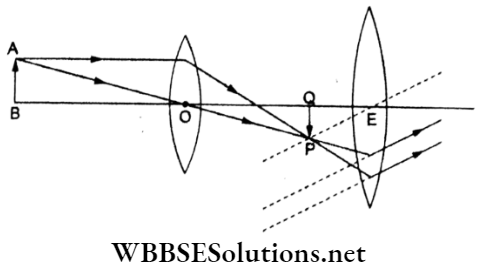
Ray Optics Multiple Choice Questions And Answers Focus Of Eyepiece Q56

Question 57. The magnifying power of a compound microscope increases a

  1. The focal length of the objective lens is increased and that of the eye lens is decreased
  2. The focal length of the eyelets is increased and that of the objective is decreased
  3. The focal lengths of both the objective and the eyepiece are increased
  4. The focal lengths of both the objective and the eyepiece are decreased

Answer: 4. The focal lengths of both the objective and the eyepiece are decreased

The magnifying power of a compound microscope is given by

⇒ \(M=\frac{v_{\mathrm{o}}}{u_{\mathrm{o}}}\left(1+\frac{\dot{D}}{f_{\mathrm{e}}}\right)=\frac{L}{f_{\mathrm{o}}}\left(1+\frac{D}{f_{\mathrm{e}}}\right)\)

Thus, M increases when both f0 and fe are decreased.

Question 58. The focal lengths of the objective and the eyepiece of a telescope are 200 cm and 4 cm respectively. What is the length of the telescope for normal adjustment?

  1. 196 cm
  2. 204 cm
  3. 250 cm
  4. 225 cm

Answer: 2. 204 cm

The tube length or the length of a telescope is given by

L = f0+fe =200 cm + 4 cm = 204 cm.

Question 59. A beam of red, green, and blue lights is incident on a right-angled prism. The material of the prism for the above three lights is 1.39, 1.47, and 1.44 respectively. The prism will
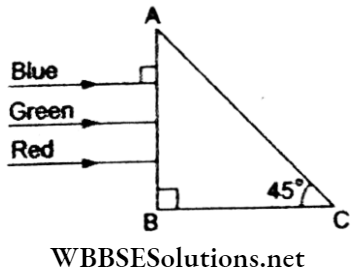
Ray Optics Multiple Choice Questions And Answers Right Angle Prism Q59

  1. Separate the blue light from the red and green lights
  2. Separate all title three lights from one another
  3. Not separate title three lights at all
  4. Separate the red light from the green and blue lights

Answer: 4. Separate the red light from the green and blue lights

The refractive index for the given prism when total reflection just occurs is

⇒ \(\mu=\frac{1}{\sin \theta_c}=\frac{1}{\sin 45^{\circ}}=\sqrt{2}\)

The component of the light beam for which μ = 2 will undergo total internal reflection.

Given, μred = 1.39,

μgreen = 1.47 > √2

μblue = 1.44 > √2

Thus, the red light will emerge while the blue and green lights will be totally reflected and separated from the red ones.
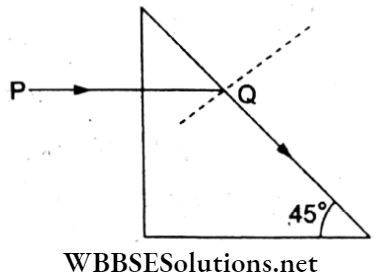
Ray Optics Multiple Choice Questions And Answers Total Reflection Q59

Question 60. Two similar thin biconvex lenses of focal lengths f  each are kept coaxially in contact with each other such that the focal length of the combination is F1. When the space between the two lenses is filled with glycerine which has the same refractive index (μ =1.5) as that of glass, the equivalent focal length is F2.. The ratio F1/F2 will be

  1. 2:1
  2. 1:2
  3. 2:3
  4. 3:1

Answer: 2. 1:2

The focal length of each biconvex lens is given by

⇒ \(\frac{1}{f_1}=(\mu-1)\left(\frac{1}{R}-\frac{1}{-R}\right)=(1.5-1) \frac{2}{R}=\frac{1}{R}\)

For the biconcave lens, the focal length is given by

⇒ \(\frac{1}{f_2}=(\mu-1)\left(\frac{1}{-R}-\frac{1}{+R}\right)=-\frac{1}{R}\)

For combination → (1),

⇒ \(\frac{1}{F_1}=\frac{1}{f_1}+\frac{1}{f_1}=\frac{2}{f_1}=\frac{2}{R}\)

For combination → (2),

⇒ \(\frac{1}{F_2}=\frac{1}{f_1}+\frac{1}{f_2}+\frac{1}{f_1}\)

⇒ \(\frac{2}{f_1}+\frac{1}{f_2}=\frac{2}{R}-\frac{1}{R}=\frac{1}{R}\)

F2 = R

⇒ \(\frac{F_1}{F_2}=\frac{R / 2}{R}=\frac{1}{2}\)
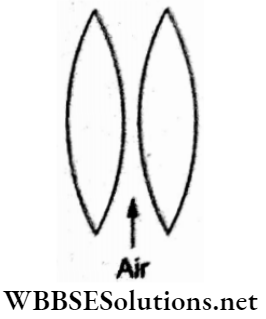
Ray Optics Multiple Choice Questions And Answers Equiconcave Lens Q60(1)

Ray Optics Multiple Choice Questions And Answers Equiconcave Lens Q60(2)

Question 61. Pick the incorrect option in the context of a rainbow.

  1. When the light rays undergo two internal reflections in a water droplet, a secondary rainbow is formed.
  2. The sequence of colors is reversed in the secondary rainbow.
  3. An observer can see a rainbow when he is facing the sun.
  4. A rainbow is a combined effect of refraction and reflection of sun rays.

Answer: 3. An observer can see a rainbow when he is facing the sun.

We cannot see the rainbow while facing the sun. Rainbow is due to refraction, reflection, and dispersion of light from water droplets reaching our eyes from the opposite side.

Question 62. In a total internal reflection when the angle of incidence is equal to the critical angle for the pair of media in contact, what will be the angle of refraction?

  1. 180°
  2. 90°
  3. Equal to the angle of incidence

Answer: 3. 90°

The critical angle for a given pair of media is the angle of incidence for which the corresponding angle of refraction is 90°.
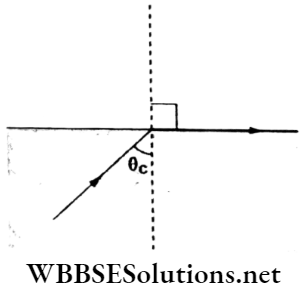
Ray Optics Multiple Choice Questions And Answers Angle Of Incident Q62

Question 63. A person wears normal glasses of -5 D keeping the distance of glasses from the eyes at 2 cm. If he uses contact lenses then the required power of the lens will be

  1. +4.5 D
  2. -5.2 D
  3. -4.54 D
  4. +5.2 D

Answer: 3. -4.54 D

The focal length f of the tire concave lens is

⇒ \(\frac{1}{f}=-5 \mathrm{D} \Rightarrow f=-20 \mathrm{~cm}\)

Distance OF = 20cm + 2cm = 22 cm.

With the contact lens, OF = 22 cm, the final image is formed at the retina.

focal length of the contact lens used is fC = OF = -22 cm.

required power,

∴ \(P=-\frac{100}{22} \mathrm{D}=-4.54 \mathrm{D}\)
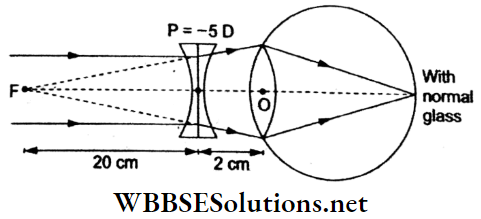
Ray Optics Multiple Choice Questions And Answers Focal Length Of Concave Lens Q63

Ray Optics Multiple Choice Questions And Answers Focal Length Of Concave Lens Q63(1)

Question 64. How can we change a camera from f/4 to f/5.6?

  1. By increasing the aperture two times keeping the focal length constant
  2. By increasing the aperture √2 times keeping the focal length constant
  3. By reducing the aperture to half keeping the focal length constant
  4. By reducing the aperture to l/√2 times keeping the focal length constant

Answer: 4. By reducing the aperture to l/√2 times keeping the focal length constant

The f-number of a camera is defined as \(\frac{\text { focal length }}{\text { diameter of aperture }}\)

Thus for an \(\frac{f}{4}\) camera, the F-number is 4, so 4 = \(\frac{f}{D_1}\)

For an \(\frac{f}{5.6}\) camera, the f-number is 5.6, so 5.6 = \(\frac{f}{D_2}\)

Hence, \(\frac{D_2}{D_1}=\frac{4}{5.6}=\frac{1}{1.4}=\frac{1}{\sqrt{2}} \Rightarrow D_2=\frac{D_1}{\sqrt{2}}\).

Question 65. One plano-convex and one plano-concave lens of the same radius of curvature R but of different materials are joined side by side as shown in the figure. The refractive indices of the materials are (μ1 and μ2)and the focal length of the combination is
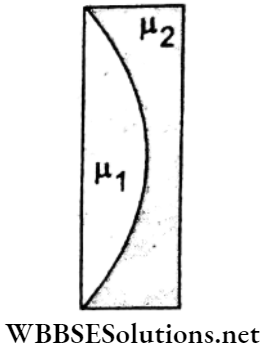
Ray Optics Multiple Choice Questions And Answers Plano Convex And Concave Lenses Q65

  1. \(\frac{R}{2-\left(\mu_1-\mu_2\right)}\)
  2. \(\frac{2 R}{\mu_1-\mu_2}\)
  3. \(\frac{R}{2\left(\mu_1-\mu_2\right)}\)
  4. \(\frac{R}{\mu_1-\mu_2}\)

Answer: 4. \(\frac{R}{\mu_1-\mu_2}\)

For a convex lens,

⇒ \(\frac{1}{f_1}=\left(\mu_1-1\right)\left(\frac{1}{\infty}-\frac{1}{-R}\right)=\frac{\left(\mu_1-1\right)}{R}\)

For a concave lens,

⇒ \(\frac{1}{f_2}=\left(\mu_2-1\right)\left(\frac{1}{-R}-\frac{1}{\infty}\right)=-\frac{\left(\mu_2-1\right)}{R}\)

If F is the equivalent focal length of the combination then

⇒ \(\frac{1}{F}=\frac{1}{f_1}+\frac{1}{f_2}=\frac{1}{R}\left(\mu_1-\mu_2\right)\)

∴ \(F=\frac{R}{\mu_1-\mu_2}\).

Question 66. A ray of light AO in a vacuum is incident on a glass slab at 60° and gets refracted at 30° along OB as shown in the figure. The optical path length of light rays from A to B is
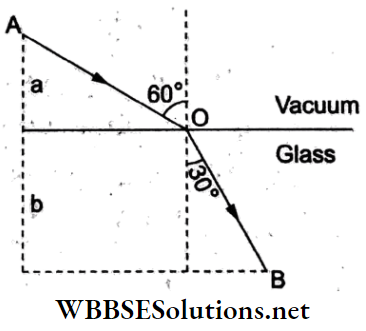
Ray Optics Multiple Choice Questions And Answers Vacuum Is Incident In Glass Slab Q66

  1. 2a + 2b
  2. \(\frac{2 \sqrt{3}}{a}+2 b\)
  3. \(2 a+\frac{2 b}{3}\)
  4. \(2 a+\frac{2 b}{\sqrt{3}}\)

Answer: 1. 2a + 2b

⇒ \(\mathrm{AO}+\mu \cdot \mathrm{OB}=\frac{a}{\cos 60^{\circ}}+\left(\frac{\sin 60^{\circ}}{\sin 30^{\circ}}\right) \frac{b}{\cos 30^{\circ}}\)

= 2a + 2b.
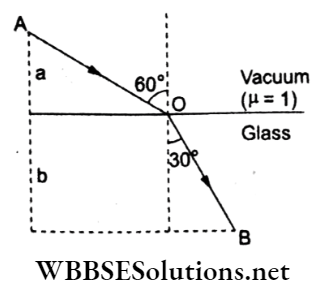
Ray Optics Multiple Choice Questions And Answers Optical Path Q66

Question 67. An upright object is placed at a distance of 40 cm in front of a converging lens of focal length 20 cm. A converging mirror Of a focal length of 10 cm is placed at a distance of 60 cm on the other side of the lens. The position and size of the final image will be

  1. 40 cm from the converging mirror, the same size as the object
  2. 20 cm from the converging mirror, the same size as the size of the object
  3. 20 cm from the converging mirror, twice the size of the object
  4. 40 cm from the converging lens, twice the size of the object

Answer: 2. 20 cm from the converging mirror, the same size as the size of the object

The situation is shown in the diagram shown below.

Object PQ is placed at 40 cm from the convex lens which is also equal to 2f(= 2 x 20 cm) of the lens. Thus, a real, inverted image P’Q’ is also formed at 2f(= 40 cm) on the other side of the lens. The distance between P’Q’ and the converging mirror is 20 cm (= 2 x 10 cm) which is the position of its centre of curvature. Hence, a real and inverted image of P’Q’ of the same size will be formed at P’Q’ itself.
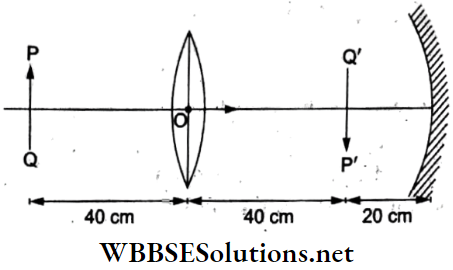
Ray Optics Multiple Choice Questions And Answers Q67

Question 68. A convex lens is placed 10 cm away from a light source and a sharp image is obtained on a screen 10 cm from the lens. Now a glass slab (refractive index = 1.5) of 1.5 cm thickness is placed in contact with the light source. To get the sharp image again, the screen is shifted by a distance d. Then, d is

  1. Zero
  2. 1.1 cm away from the lens
  3. 0.55 cm away from the lens
  4. 0.55 cm towards the lens

Answer: 3. 0.55 cm away from the lens

For the given convex lens,

⇒ \(|u|=|v|=10 \mathrm{~cm}=2 f \Rightarrow f=5 \mathrm{~cm}\)

When a glass slab (thickness t =1.5 cm, p = 1.5) is placed near the light source, the image of the source undergoes a shift

⇒ \(x=\left(1-\frac{1}{\mu}\right) t=\left(1-\frac{2}{3}\right) \frac{3}{2} \mathrm{~cm}=\frac{1}{2} \mathrm{~cm} \text { towards the lens }\)

Thus, u’ =10 cm-0.5 cm = 9.5 cm.

The corresponding image distance v’ is given by

⇒ \(\frac{1}{v^{\prime}}-\frac{1}{u^{\prime}}=\frac{1}{f}\)

⇒ \(\frac{1}{v^{\prime}}-\frac{1}{(-9.5 \mathrm{~cm})}=\frac{1}{5 \mathrm{~cm}}\)

⇒ \(\frac{1}{v^{\prime}}=\left(\frac{1}{5 \mathrm{~cm}}-\frac{1}{9.5 \mathrm{~cm}}\right) \Rightarrow v^{\prime}=10.55 \mathrm{~cm}\)

Thus, the screen has to be shifted by

(v’-v)- (10.55 cm-10 cm) = 0.55 cm

away from the lens to get a sharp image again

Question 69. A plano-convex lens of refractive index μ1 and focal length f1 is kept in contact with another plano-convex lens of refractive index μ2 and focal length f2. If the radius of curvature of their spherical faces is R each and \(f_1=2\left|f_2\right|\) then μ1 and μ2 are related as

  1. 2 – 2μ1 = 1
  2. 2 – μ1 =1
  3. 1 – μ2 = 1
  4. μ1 + μ2 = 3

Answer: 3. 2μ1 – μ2 = 1

For a plano-convex lens,

⇒ \(\frac{1}{f_1}=\left(\mu_1-1\right) \frac{1}{R} \text { and } \frac{1}{f_2}=\left(\mu_2-1\right) \frac{1}{R}\)

Since \(f_1=2 f_2 \text {, hence } \frac{\left(\mu_1-1\right)}{R}=\frac{\left(\mu_2-1\right)}{2 R}\)

⇒ 2μ1 – 2 = μ2 -1 ⇒ 2μ1 – μ2 =1.

Question 70. Two plane mirrors M1 and M2 are inclined to each other such that a ray of light incident on mirror M1 and parallel to mirror M2 is reflected from mirror M2 so as to be parallel to mirror M1. The angle between the two mirrors is

  1. 45°
  2. 75°
  3. 30°
  4. 60°

Answer: 4. 60°

The situation given in the question is shown by the diagram. Since AB is parallel to OC, the three angles are each equal to θ. Similarly, the CD is parallel to OB, and the angles θ are equal. In ΔOBC, 3θ =180°.

The angle between the two mirrors is \(\theta=\frac{180^{\circ}}{3}=60^{\circ}\)
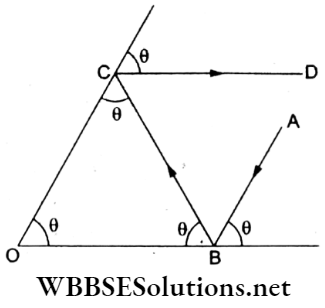
Ray Optics Multiple Choice Questions And Answers Angle Betwwen Two Mirrors Q70

Question 71. The eye can be regarded as a single refracting surface. The radius of curvature of this surface is equal to that of the cornea (7.8 mm). This surface separates two media of refractive indices 1.0 and 1.34. Calculate the distance from the refracting surface at which a parallel of light will come to focus.

  1. 0.5 cm
  2. 2.0 cm
  3. 3.1 cm
  4. 1 cm

Answer: 3. 3.1 cm

Given, μ1 =1, μ2 = 1.34 and R = +7.8 mm

Parallel rays from infinity converge at I, where PI = v.

For refraction through a spherical surface

⇒ \(\frac{\mu_2}{v}-\frac{\mu_1}{u}=\frac{\mu_2-\mu_1}{R}\)

⇒ \(\frac{1.34}{v}-\frac{1}{\infty}=\frac{1.34-1}{7.8 \mathrm{~mm}}\)

∴ Hence, \(v=\frac{1.34 \times 7.8 \mathrm{~nm}}{0.34}=30.74 \mathrm{~mm} \approx 3.1 \mathrm{~cm}\).
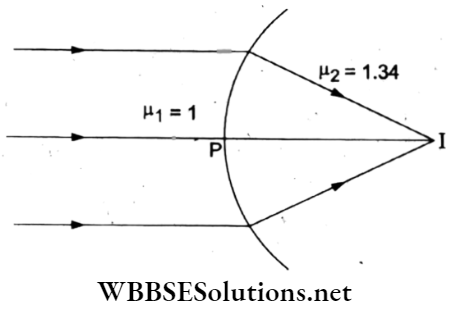
Ray Optics Multiple Choice Questions And Answers Parallel Rays Q71

Question 72. A monochromatic light is incident at a certain angle on an equilateral triangular prism and suffers minimum deviation. If the refractive index of the material of the prism is √3, the angle of incidence is

  1. 45°
  2. 30°
  3. 90°
  4. 60°

Answer: 4. 60°

For a prism,

⇒ \(\mu=\frac{\sin \left(\frac{A+\delta_m}{2}\right)}{\sin \frac{A}{2}}\) → (1)

Given, A = 60°.

For deviation to be minimum, i = i’, r = r’.

But A = 60° = r + r’ = 2r => r = 30°.

And i +i’ = A + δm => 2i = A+ δm . → (2)

Substituting (2) in (1),

⇒ \(\sqrt{3}=\frac{\sin i}{\sin 30^{\circ}}=2 \sin i\)

⇒ \(\sin i=\frac{\sqrt{3}}{2}=\sin 60^{\circ} \Rightarrow i=60^{\circ}\).

Question 73. A point source of light S is placed at a distance L in front of the center of a plane mirror of width d which is hanging vertically on a wall. A man walks in front of the mirror along a line parallel to the mirror at a distance 2L as shown in the figure. The distance over which the man can see the image of the light source in the mirror is
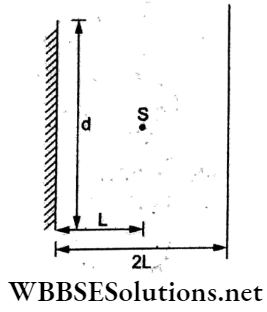
Ray Optics Multiple Choice Questions And Answers Source Of Light Q73


  1. \(\frac{d}{2}\)
  2. 2d
  3. d
  4. 3d

Answer: 4. 3d

In the given diagram, the distance of light source S from the mirror AB is OS = L = SP ⇒ IP = 3L,

where I is the image of S in the plane mirror.

The observer moving along CD can see the image till the rays reach his eyes at C and D after reflection from the extreme points of the mirror. Thus, from similar triangles IAB and ICD,

∴ \(\frac{\mathrm{AB}}{\mathrm{CD}}=\frac{\mathrm{IO}}{\mathrm{IP}} \Rightarrow \frac{d}{D}=\frac{L}{3 L} \Rightarrow D=3 d\)
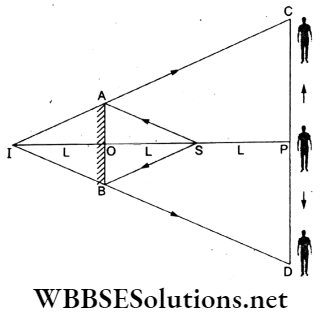
Ray Optics Multiple Choice Questions And Answers Plane Mirror Q73

Question 74. The formation of a real image using a biconvex lens is shown in the ray diagram. If the whole set-up is immersed in water without disturbing the object and the screen positions, what will one observe on the screen?
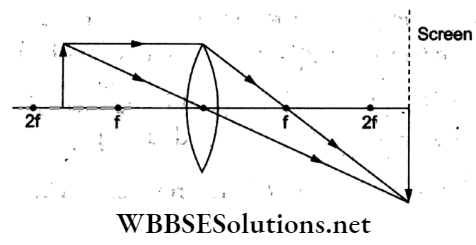
Ray Optics Multiple Choice Questions And Answers Bioconvex Lens Q74

  1. No change
  2. Erect and real image
  3. Magnified image
  4. Image disappears

Answer: 4. Image disappears

The focal length of a lens depends on the refractive index of the material of the lens as well as on the refractive index of the surrounding medium.

When in the air,

⇒ \(\frac{1}{f_{\mathrm{a}}}=\left({ }^{\mathrm{a}} \mu_{\mathrm{g}}-1\right)\left(\frac{1}{R_1}-\frac{1}{R_2}\right)\)

and when immersed in water,

⇒ \(\frac{1}{f_{\mathrm{w}}}=\left({ }^{\mathrm{w}} \mu_{\mathrm{g}}-1\right)\left(\frac{1}{R_1}-\frac{1}{R_2}\right)=\left(\frac{\mu_{\mathrm{g}}}{\mu_{\mathrm{w}}}-1\right)\left(\frac{1}{R_1}-\frac{1}{R_2}\right)\).

A change in focal length will cause the disappearance of the image from the screen.

Question 75. A ray of light passes through four transparent media with refractive indices μ1, μ2, μ3, and μ4 as shown in the figure. The surfaces of all the media are parallel. If the emergent ray CD is parallel to the incident ray AB, we must have
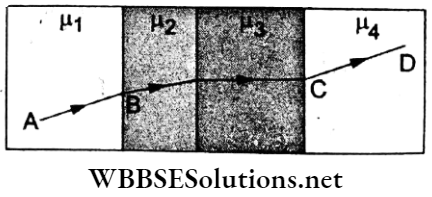
Ray Optics Multiple Choice Questions And Answers Four Transparent Media Q75

  1. μ1 = μ2
  2. μ2 = μ3
  3. μ3 = μ4
  4. μ4 = μ1

Answer: 4. μ4 = μ1

According to Snells’ law, the incident and emergent rays through a slab will be parallel provided the media on both sides are identical. This follows for μ4 = μ1

Question 76. A convex lens of focal length 20 cm produces images of the same magnification 2 when an object is placed at two distances x1 and x2 (x1 > x2) from the lens. The ratio of x1 and x2 is

  1. 4:3
  2. 3:1
  3. 5:3
  4. 2:1

Answer: 2. 3:1

When a real image is formed by a convex lens, v is +ve while u is -ve.

For magnification \(m=2, \frac{|v|}{|u|}=2\)

From the lens formula,

⇒ \(\frac{1}{v}-\frac{1}{u}=\frac{1}{f} \Rightarrow \frac{1}{2 x_1}-\frac{1}{\left(-x_1\right)}=\frac{1}{f}\)

⇒ \(x_1=\frac{3}{2} f\).

When a virtual image is formed, u and v both are negative. Thus,

⇒ \(\frac{1}{v}-\frac{1}{u}=\frac{1}{f} \Rightarrow \frac{1}{\left(-2 x_2\right)}-\frac{1}{\left(-x_2\right)}=\frac{1}{f}\)

⇒ \(x_2=\frac{f}{2}\)

Hence, \(\frac{x_1}{x_2}=3=3: 1\).

Question 77. A thin convex lens L (refractive index A’ 1.5) is placed on a plane mirror M. When a pin is placed at A, such that OA = 18 cm, its real inverted image is formed at A itself as shown in the figure. When a liquid of refractive index μ1 is put in between the lens and the mirror, the pin has to be moved to A’ such that OA’ = 27 cm to get its real inverted image at A’ itself. The value of μ1 will be
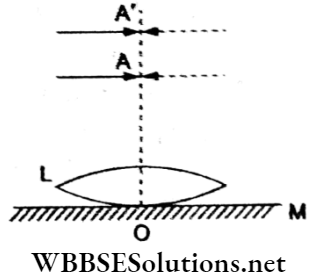
Ray Optics Multiple Choice Questions And Answers Thin Convex Lens Q77

  1. 3
  2. 2
  3. \(\frac{4}{3}\)
  4. \(\frac{3}{2}\)

Answer: 3. \(\frac{4}{3}\)

When the pin at A coincides with its own image, OA = f, the focal length of the convex lens, for which

⇒ \(\frac{1}{f}=\left(\mu_{\mathrm{g}}-1\right)\left\{\frac{1}{R}-\frac{1}{(-R)}\right\}=(1.5-1)\left(\frac{2}{R}\right)=\frac{1}{R}\)

f = R = OA =18 cm.

When the space between the lens and the plane mirror is filled with a liquid (refractive index \it), the liquid lens will be of focal length flt for which

⇒ \(\frac{1}{f_l}=\left(\mu_l-1\right)\left\{\frac{1}{R}-\frac{1}{\infty}\right\}=\frac{\mu_l-1}{-18 \mathrm{~cm}}\)

For the two lenses in contact, the equivalent focal length, F = OA’ = 27 cm.

⇒ \(\frac{1}{27 \mathrm{~cm}}=\frac{1}{18 \mathrm{~cm}}+\frac{\mu_l-1}{-18 \mathrm{~cm}} \Rightarrow \frac{1}{27}=\frac{1}{18}-\frac{\mu_l-1}{18}\)

⇒ \(\frac{1}{3}=\frac{1}{2}-\frac{\mu_l-1}{2} \Rightarrow \mu_l=\frac{4}{3}\)

∴ \(\mu_l=1+\frac{9}{27}=\frac{4}{3}\).

Question 78. The image of an object placed beyond the center of curvature of a concave mirror will be
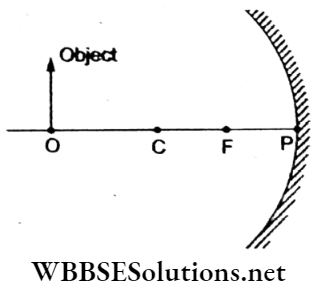
Ray Optics Multiple Choice Questions And Answers Beyond The Centre Of Curvature Of A Concave Mirror Q78

  1. Virtual, diminished, and inverted
  2. Virtual, magnified, and inverted
  3. Reed, magnified and inverted
  4. Real, diminished, and inverted

Answer: 4. Real, diminished, and inverted

The image of an object placed beyond C of a concave mirror is

  1. Diminished,
  2. Inverted,
  3. Real and
  4. Lies between C and F, as shown in this ray diagram.

Object: AB.

Image: A’B’.
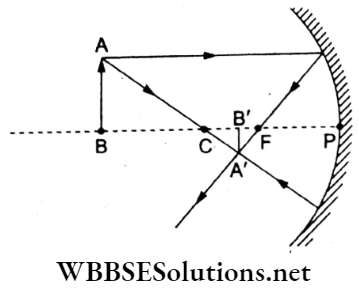
Ray Optics Multiple Choice Questions And Answers Q78

Question 79. A ray is incident at an angle of 60° on the surface of a transparent solid sphere of refractive index √3 at A. At Air Point B, there is partial reflection and emergence as shown. The angle θ between the reflected and emergent rays is
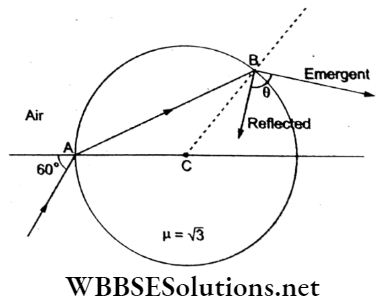
Ray Optics Multiple Choice Questions And Answers Solid Sphere Of Refractive Index Q79

  1. 60°
  2. 90°
  3. 80°
  4. 70°

Answer: 2. 90°

For refraction at A,

⇒ \(\mu=\frac{\sin i}{\sin r} \Rightarrow \sqrt{3}=\frac{\sin 60^{\circ}}{\sin r}=\frac{\sqrt{3}}{2 \sin r} \Rightarrow r=30^{\circ}\)

So, the angle of emergence ∠NBC = 60°.

The angle of reflection at B is

∠OBD = 30°.

= 180°- (60° + 30°) = 90°.
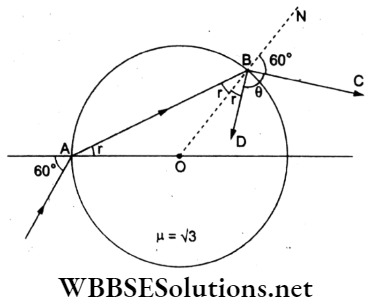
Ray Optics Multiple Choice Questions And Answers Angle Of Refraction Q79

Question 80. A compound microscope forms the final image of an object at 25 cm from the eyepiece. What is the focal length of the eyepiece if the focal length of the objective is 1 cm, the magnification produced is 100 and the tube length is 20 cm?

  1. 525 cm
  2. 6.25 cm
  3. 2.25 cm
  4. 4.25 cm

Answer: 2. 6.25 cm

For a compound microscope, magnification is

⇒ \(M=\frac{v_{\mathrm{o}}}{u_{\mathrm{o}}}\left(1+\frac{D}{f_{\mathrm{e}}}\right) \approx \frac{L}{f_{\mathrm{o}}}\left(1+\frac{D}{f_{\mathrm{e}}}\right)\)

⇒ \(100=\frac{20 \mathrm{~cm}}{1 \mathrm{~cm}}\left(1+\frac{25 \mathrm{~cm}}{f_{\mathrm{e}}}\right) \Rightarrow 5=1+\frac{25 \mathrm{~cm}}{f_{\mathrm{e}}}\)

⇒ \(f_{\mathrm{e}}=\frac{25 \mathrm{~cm}}{4}=6.25 \mathrm{~cm}\).

Question 81. In the displacement method for measuring the focal length of a convex lens, the distance between the object and the screen is 100 cm. The separation between the two positions of the lens for image formation was 40 cm. Find N, if the power of the lens is 100/N dioptre.

  1. 15
  2. 40
  3. 21
  4. 25

Answer: 3. 21

Focal length = \(f=\frac{D^2-x^2}{4 D}=\frac{(100 \mathrm{~cm})^2-(40 \mathrm{~cm})^2}{(400 \mathrm{~cm})}=21 \mathrm{~cm}\)

∴ Power: \(P=\frac{100}{f_{\mathrm{cm}}} \mathrm{D}=\frac{100}{N} \mathrm{D} \Rightarrow N=f=21\)

Question 82. An equiconvex lens of radius R has power P. A plano-convex lens with a radius of curvature R’ and made of the same material as power 1.5P. The value of R’ is

  1. \(\frac{3}{2} R\)
  2. 2R
  3. \(\frac{R}{2}\)
  4. \(\frac{R}{3}\)

Answer: 4. \(\frac{R}{3}\)

For the equiconvex lens,

⇒ \(P=\frac{1}{f}=(\mu-1)\left\{\frac{1}{R}-\frac{1}{(-R)}\right\}=(\mu-1) \frac{2}{R}\)

For the plano-convex lens

⇒ \(P^{\prime}=\frac{3}{2} P=(\mu-1)\left(\frac{1}{R^{\prime}}-\frac{1}{\infty}\right)=\frac{(\mu-1)}{R^{\prime}}\)

∴ \(\frac{3}{2}(\mu-1) \frac{2}{R}=\frac{(\mu-1)}{R^{\prime}} \Rightarrow R^{\prime}=\frac{R}{3}\)

Wave Optics Electromagnetic Waves Multiple Choice Question And Answers

Wave Optics Electromagnetic Waves

Question 1. The intensity ratio of the maxima and minima in an interference pattern produced by two identical coherent sources of light is 9: 1. The intensities of the used light sources are in the ratio

  1. 3:1
  2. 4:1
  3. 9:1
  4. 10:1

Answer: 2. 4:1

For maximum intensity, phase difference = Φ = 0 and for minimum intensity, Φ =180°.

Resultant intensity,

⇒ \(I=I_1+I_2+2 \sqrt{I_1 I_2} \cos \phi\)

⇒ \(I_{\max }=I_1+I_2+2 \sqrt{I_1 I_2}=\left(\sqrt{I_1}+\sqrt{I_2}\right)^2\),

and \(I_{\min }=I_1+I_2-2 \sqrt{I_1 I_2}=\left(\sqrt{I_1}-\sqrt{I_2}\right)^2\)

Given that \(\frac{I_{\max }}{I_{\min }}=\frac{9}{1}=\left[\frac{\sqrt{I_1}+\sqrt{I_2}}{\sqrt{I_1}-\sqrt{I_2}}\right]^2\)

⇒ \(\frac{\sqrt{I_1}+\sqrt{I_2}}{\sqrt{I_1}-\sqrt{I_2}}=\frac{3}{1} \Rightarrow \sqrt{\frac{I_1}{I_2}}=\frac{2}{1}\)

Hence, \(\frac{I_1}{I_2}=4: 1\).

Wave Optics Electromagnetic Waves Multiple Choice Question And Answers

Question 2. In an interference pattern, the intensities of two interfering waves are I and 4I respectively. They produce intensities at two points A and B with phase differences of TC/2 and π respectively. The difference in their intensities is

  1. I
  2. 2I
  3. 4I
  4. 5I

Answer: 3. 4I

Given that I1 = 1 and I2 = 4I.

Intensity at A is

⇒ \(I_{\mathrm{A}}=I_1+I_2+2 \sqrt{I_1 I_2} \cos \frac{\pi}{2}=I+4 I=5 I\)

Intensity at B is

⇒ \(I_{\mathrm{B}}=I_1+I_2+2 \sqrt{I_1 I_2} \cos \pi=I+4 I-2 \sqrt{I \cdot 4 I}=I\)

Difference in intensities = IA – IB = 5I – I = 4I.

Read And Learn Also NEET Physics Multiple Choice Question and Answers

Question 3. In Young’s double-slit experiment, the two slits act as coherent sources of equal amplitude a and of wavelength λ. In another experiment with the same set-up, the two slits are sources of equal amplitude a and wavelength λ but are incoherent. The ratio of intensities of light at the midpoint of the screen in the first case to that in the second case is

  1. 2:1
  2. 1:2
  3. 3:4
  4. 4:3

Answer: 1. 2:1

When the sources are coherent, the intensity at the central maxima (where phase difference Φ = 0), I1 = k(a + a)2– k4a2.

When the sources are incoherent, there is no phase relationship, hence no sustained interference. The net intensity, I2 = k(a2 + a2 ) = k2a2.

∴ \(\text { ratio }=\frac{I_1}{I_2}=\frac{k\left(4 a^2\right)}{k\left(2 a^2\right)}=2: 1\)

wave optics mcqs

Question 4. What is the path difference for destructive interference?

  1. n
  2. \(\frac{(n+1)}{2} \lambda\)
  3. n(λ + 1)
  4. \(\left(\frac{2 n+1}{2}\right) \lambda\)

Answer: 4. \(\left(\frac{2 n+1}{2}\right) \lambda\)

For destructive interference,

∴ path difference A = odd multiple of \(\frac{\lambda}{2}=(2 n+1) \frac{\lambda}{2}\)

Question 5. A monochromatic beam of light is used for the formation of fringes on the screen by illuminating the two slits in Young’s double-slit experiment. When a thin film of mica is interposed in the path of one of the interfering beams then

  1. Die fringe width increases
  2. The fringe width decreases
  3. The fringe width remains the same but the pattern shifts
  4. The fringe pattern disappears

Answer: 3. The fringe width remains the same but the pattern shifts

When a thin film of mica sheet covers one of the two slits, a path difference Δ = (μ – l)f is introduced in one path of interfering waves. So, there will be no change in the fringe width but the central maximum with the whole fringe pattern will shift.

Question 6. A double-slit experiment is performed with a light of wavelength 500 nm. A thin film of thickness 2 μm and a refractive index of 1.5 is introduced in the path of the upper beam. The location of the central maximum will

  1. Remain unshifted
  2. Shift downward by nearly two fringes
  3. Shift upward by nearly two fringes
  4. Shift downward by five fringes

Answer: 3. Shift upward by nearly two fringes

Given that λ = 500 nm, thickness t = 2 pm and μ =1.5.

The optical path introduced for wave originating from the upper slit is Δ = (μ-l)t.

Central maximum P0 will shift to P where the path difference is zero.

Thus, at P, S2P – S1P – (μ-l)t = 0

=> dsinθ =(μ-l)t

⇒ \(d \frac{y}{D}=(\mu-1) t\)

⇒ \(y=\frac{D}{d}(\mu+1) t=N \beta=N \frac{D \lambda}{d}\)

The Number of fringes shifted is

∴ \(N=\frac{(\mu-1) t}{\lambda}=\frac{(1.5-1)\left(2 \times 10^{-6} \mathrm{~m}\right)}{\left(500 \times 10^{-9} \mathrm{~m}\right)}=2\)

Two fringes will shift upward.

Wave Optics Electromagnetic Waves Multiple Choice Question And Answers Optical Path Q6

Question 7. Young’s double-slit experiment is first performed in air and then in a medium other than air. It is found that the 8th bright fringe in the medium lies where the 5th dark fringe lies in the air. The refractive index of the medium is nearly

  1. 1.25
  2. 1.50
  3. 1.69
  4. 1.78

Answer: 4. 1.78

When in the air, the position of the 5th dark fringe from the centre is

⇒ \(y=\left(4+\frac{1}{2}\right) \beta_{\mathrm{a}}=\frac{9}{2} \beta_{\mathrm{a}}=\frac{9}{2} \frac{D \lambda_{\mathrm{a}}}{d}\)

In the medium, the position of the 8th bright fringe is

⇒ \(y=8 \beta_m=\frac{8 D \lambda_m}{d}\)

⇒ \(\frac{9}{2} \frac{D}{d} \lambda_{\mathrm{a}}=\frac{8 D}{d} \lambda_{\mathrm{m}}\)

The refractive index of the medium is

∴ \(\mu_{\mathrm{m}}=\frac{\lambda_{\mathrm{a}}}{\lambda_{\mathrm{m}}}=\frac{8}{4.5}=\frac{16}{9}=1.78\)

Question 8. Two coherent monochromatic light beams of amplitudes 3 and 5 units are superposed. The ratio of the maximum and minimum intensities in the resulting interference pattern will be

  1. 4: 1
  2. 16:1
  3. 1:4
  4. 2:1

Answer: 2. 16:1

Given that the ratio of amplitudes of interfering waves is

⇒ \(\frac{A_1}{A_2}=\frac{5}{3}\)
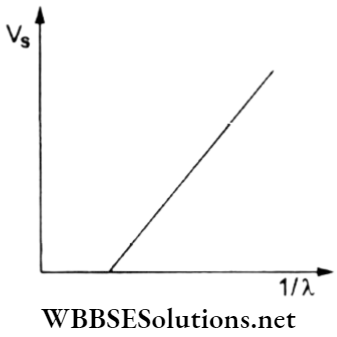
Now, \(\frac{A_1+A_2}{A_1-A_2}=\frac{5+3}{5-3}=\frac{8}{2}=\frac{4}{1}\)

Hence, \(\frac{I_{\max }}{I_{\min }}=\frac{\left(A_1+A_2\right)^2}{\left(A_1-A_2\right)^2}=\left(\frac{4}{1}\right)^2=16: 1\)

wave optics questions

Question 9. The two coherent sources with intensity ratio β produce interference. The fringe visibility will be

  1. \(\frac{2 \sqrt{\beta}}{1+\beta}\)
  2. \(\frac{2}{1+\beta}\)
  3. \(\frac{\sqrt{\beta}}{1+\beta}\)

Answer: 1. \(\frac{2 \sqrt{\beta}}{1+\beta}\)

Given that the intensity ratio of two coherent waves is

⇒ \(\frac{I_1}{I_2}=\beta\)

Fringe visibility is defined as

\(V=\frac{I_{\max }-I_{\min }}{I_{\max }+I_{\min }}\) → (1)

Now, \(I_{\max }=\left(\sqrt{I_1}+\sqrt{I_2}\right)^2 ; I_{\min }=\left(\sqrt{I_1}-\sqrt{I_2}\right)^2\)

Substituting these in (1),

∴ \(V=\frac{4 \sqrt{I_1 I_2}}{2\left(I_1+I_2\right)}=\frac{2 I_2 \sqrt{\beta}}{I_2(\beta+1)}=\frac{2 \sqrt{\beta}}{1+\beta}\).

Question 10. Two slits are separated by a distance of 0.5 mm and illuminated with a light of wavelength λ = 600 nm. If the screen is placed at 2.5 m from the slits, the distance of the third bright fringe from the centre will be

  1. 1.5 mm
  2. 3 mm
  3. 6 mm
  4. 9 mm

Answer: 4. 9 mm

Given that slit separation = d = 0.5 mm;

wavelength = λ, = 600 nm; D = 2.5 m.

Fringe width is

⇒ \(\beta=\frac{D \lambda}{d}=\frac{(2.5 \mathrm{~m})\left(600 \times 10^{-9} \mathrm{~m}\right)}{\left(0.5 \times 10^{-3} \mathrm{~m}\right)}=3000 \times 10^{-6} \mathrm{~m}=3 \mathrm{~mm}\)

Distance of the third bright fringe = 3β = 3 x 3 mm = 9 mm.

Question 11. In a double-slit experimental arrangement, interference fringes of width 1 mm each are observed when light of wavelength 500 nm is used. Keeping the set-up unaltered, if the light source is replaced by another of wavelength 600 nm, the fringe width will be

  1. 1.2 mm
  2. 0.5 mm
  3. 1 mm
  4. 1.5 mm

Answer: 1. 1.2 mm

Fringe width = \(\beta=\frac{D \lambda}{d} \Rightarrow \beta \propto \lambda\)

Ratio \(\frac{\beta_1}{\beta_2}=\frac{\lambda_1}{\lambda_2}=\frac{500 \mathrm{~nm}}{600 \mathrm{~nm}}=\frac{5}{6}\)

Given that \(\beta_1=1 \mathrm{~mm}, \text { hence } \beta_2=\frac{6}{5} \beta_1=\frac{6}{5}(1 \mathrm{~mm})=1.2 \mathrm{~mm}\)

Question 12. In Young’s double-slit experiment, the spacing between the slits is 0.3 mm and the screen is kept at a distance of 1.5 m. The second bright fringe is found at 6 mm from the central fringe. The wavelength of the light used in the experiment is

  1. 625 nm
  2. 600 nm
  3. 550 nm
  4. 500 nm

Answer: 2. 600 nm

Given that d = 0.3 mm, D =1.5 m, 2β = 6 mm.

Now, \(\beta=3 \mathrm{~mm}=\frac{D \lambda}{d}=\frac{(1.5 \mathrm{~m})(\lambda)}{(0.3 \mathrm{~mm})}=5 \times 10^3 \lambda\)

Wavelength \(\lambda=\frac{3 \mathrm{~mm}}{5 \times 10^3}=0.6 \times 10^{-6} \mathrm{~m}=600 \mathrm{~nm}\)

Question 13. In Young’s double-slit experiment if the fringe order is represented by m then the fringe width is

  1. Independent of m
  2. Directly proportional to m
  3. Directly proportional to (2m +1)
  4. Inversely proportional to (2m +1)

Answer: 1. Independent of m

In the double-slit experiment, all the interference fringes are of the same width \(\left(\beta=\frac{D \lambda}{d}\right)\) and are independent of the fringe order m.

Question 14. Which among the following cannot produce coherent sources?

  1. Fresnel biprism
  2. Lloyd’s mirror
  3. Young’s double-slit
  4. Prism

Answer: 4. Prism

A single prism can produce dispersion, deviation, spectrum, etc., but cannot produce coherent sources.

Question 15. In Young’s double-slit experiment if the separation between the two slits is made three times then the fringe width will become

  1. 9 times
  2. \(\frac{1}{9} \text { times }\)times
  3. 3 times
  4. \(\frac{1}{3} \text { times }\)times

Answer: 4. \(\frac{1}{3} \text { times }\)times

Fringe width = \(\beta=\frac{D \lambda}{d}\)

If D and X are constants, \(\beta \propto \frac{1}{d}\)

⇒ \(\frac{\beta_1}{\beta_2}=\frac{d_2}{d_1}\)

Given that d2 = 3d1

Hence, \(\beta_2=\frac{\beta_1}{3}\)

Question 16. When exposed to sunlight, a thin film of oil on water exhibits brilliant colours due to the phenomenon of

  1. Diffraction
  2. Interference
  3. Polarization
  4. Dispersion

Answer: 2. Interference

Sunlight incident on a thin film of oil spread over the surface of water undergoes multiple reflections and interference. Bright colours are obtained which satisfy the condition for maxima.

wave optics questions with answers pdf

Question 17. When a compact disc (CD) is illuminated by a source of white light, coloured lines are observed. This is due to

  1. Interference
  2. Dispersion
  3. Refraction
  4. Diffraction

Answer: 4. Diffraction

A compact disc (CD) consists of thousands of pits arranged in the form of spiral tracks. Visible light incident on the pits gets diffracted and constituent colours of the polychromatic light get separated and rainbow-like colours are observed.

Question 18. Young’s double-slit experiment is performed first in the air and then in a medium with a refractive index of 1.78. It is observed that the position of the nth bright fringe in the medium coincides with the 5th dark fringe in the air. The fringe order n has the value

  1. 5
  2. 7
  3. 8
  4. 10

Answer: 3. 8

Let y be the position of the 5th dark fringe in the air, so

⇒ \(y=\left(n+\frac{1}{2}\right) \beta=\left(4+\frac{1}{2}\right) \beta=\frac{9}{2} \frac{D \lambda_{\mathrm{a}}}{d}\)

In a medium of refractive index JI =1.78, wavelength = \(\lambda^{\prime}=\frac{\lambda_{\mathrm{a}}}{\mu}=\frac{\lambda_{\mathrm{a}}}{1.78}\)

the position of the nth bright fringe is

⇒ \(y^{\prime}=n \beta^{\prime}=n \frac{D \lambda^{\prime}}{d}=\frac{n D}{d} \frac{\lambda_{\mathrm{a}}}{1.78}\)

Given that \(y=y^{\prime}, \text { hence } \frac{9}{2} \frac{D \lambda_{\mathrm{a}}}{d}=\frac{n}{1.78} \frac{D \lambda_{\mathrm{a}}}{d}\)

∴ \(\frac{9}{2}=\frac{n}{1.78} \Rightarrow n=\frac{9 \times 1.78}{2}=8.01 \approx 8\)

Question 19. The intensity of the maximum in Young’s double-slit experiment is I0. The distance between the two slits is d = 5λ, where λ is the wavelength of light used in the experiment. What will be the intensity in front of one of the slits on the screen placed at a distance D =10d?

  1. \(\frac{I_0}{4}\)
  2. \(\frac{3}{4} I_0\)
  3. \(\frac{I_0}{2}\)
  4. I0

Answer: 3. \(\frac{I_0}{2}\)

Let I be the intensity of the two slits. At the maximum intensity,

⇒ \(I_0=I_1+I_2+2 \sqrt{I_1 I_2} \cos \phi\)

⇒  I + I + 2Icos 0° = 4I

\(I=\frac{I_0}{4}\) → (1)

Path difference at point P (in front of slit S1) is

⇒ \(\Delta=S_2 P-S_1 P=\sqrt{D^2+d^2}-D\)

⇒ \(D\left(1+\frac{d^2}{D^2}\right)^{1 / 2}-D=D+\frac{d^2}{2 D}-D=\frac{d^2}{2 D}\)

Given that d = 5λ and D = l0d =10(5λ) = 50λ.

path difference = \(\Delta=\frac{25 \lambda^2}{2(50 \lambda)}=\frac{\lambda}{4}\)

and phase difference = \(\phi=\frac{2 \pi}{\lambda} \Delta=\frac{\pi}{2}\)

Hence, the intensity at P is

∴ \(I_{\mathrm{p}}=I+I+2 \sqrt{I I} \cos \frac{\pi}{2}=2 I=2\left(\frac{I_0}{4}\right)=\frac{I_0}{2}\) [From (1)]

Wave Optics Electromagnetic Waves Multiple Choice Question And Answers Maximum Intensity Q19

Question 20. An interference pattern is obtained with two coherent light sources of intensity ratio n. In the interference pattern, the ratio \(\frac{I_{\max }-I_{\min }}{I_{\max }+I_{\min }}\) will be

  1. \(\frac{\sqrt{n}}{n+1}\)
  2. \(\frac{2 \sqrt{n}}{n+1}\)
  3. \(\frac{\sqrt{n}}{(n+1)^2}\)
  4. \(\frac{2 \sqrt{n}}{(n+1)^2}\)

Answer: 2. \(\frac{2 \sqrt{n}}{n+1}\)

Given that = \(\frac{I_1}{I_2}=n=\frac{a_1^2}{a_2^2}\), where a1 and a2 are the amplitudes of the coherent sources.

Hence, \(\frac{a_1}{a_2}=\frac{\sqrt{n}}{1}\).

⇒ \(\frac{\left(a_1+a_2\right)}{\left(a_1-a_2\right)}=\frac{\sqrt{n}+1}{\sqrt{n}-1} \Rightarrow \frac{\left(a_1+a_2\right)^2}{\left(a_1-a_2\right)^2}=\frac{(\sqrt{n}+1)^2}{(\sqrt{n}-1)^2} \Rightarrow \frac{I_{\max }}{I_{\min }}=\frac{(\sqrt{n}+1)^2}{(\sqrt{n}-1)^2}\)

∴ \(\frac{I_{\max }-I_{\min }}{I_{\max }+I_{\min }}=\frac{(\sqrt{n}+1)^2-(\sqrt{n}-1)^2}{(\sqrt{n}+1)^2+(\sqrt{n}-1)^2}=\frac{2 \sqrt{n}}{n+1}\)

wave optics questions with answers pdf

Question 21. In a double-slit experiment, the two slits are 1 mm apart and the screen is placed 1 m away. A monochromatic light of wavelength 500 run is used. What will be the width of each slit for obtaining ten maxima of double-slit within the principal maxima of a single-slit pattern?

  1. 0.2 mm
  2. 0.1mm
  3. 0.5 mm
  4. 0.02 mm

Answer: 1. 0.2 mm

In the given figure, intensity distribution due to a single-slit diffraction pattern is shown. The angular width of the principal maxima is \(\frac{2 \lambda}{a}\), where a = width of each slit.

The linear width is PQ = D (angular width), where D is the distance between the screen and the slits.

\(P Q=\frac{2 \lambda}{a} \cdot D\) → (1)

Given that 10 double-slit fringes are within PQ, we have

\(P Q=10 \beta=10 \frac{D \lambda}{d}\) → (2)

Equating (1) and (2)

⇒ \(\frac{2 \lambda}{a} D=\frac{10 D \lambda}{d}\)

∴ \(a=\frac{d}{5}=\frac{1 \mathrm{~mm}}{5}=0.2 \mathrm{~mm}\)

Wave Optics Electromagnetic Waves Multiple Choice Question And Answers Intensity Distribution Due To Single Slit Diffraction Pattern Q21

Question 22. Two slits in Young’s experiment have widths in the ratio 1: 25. The ratio of intensity at the maxima to the minima in the interference pattern \(\left(\frac{I_{\max }}{I_{\min }}\right)\) is

  1. \(\frac{9}{4}\)
  2. \(\frac{121}{49}\)
  3. \(\frac{49}{121}\)
  4. \(\frac{4}{9}\)

Answer: 1. \(\frac{9}{4}\)

Assuming that slit width is proportional to the intensity of light, we have

⇒ \(\frac{I_1}{I_2}=\frac{25}{1}=\left(\frac{a_1}{a_2}\right)^2, \text { where } \frac{a_1}{a_2}\) is the ratio of amplitudes.

⇒ \(\frac{a_1}{a_2}=\frac{5}{1} \Rightarrow \frac{a_1+a_2}{a_1-a_2}=\frac{5+1}{5-1}=\frac{3}{2}\)

Hence, \(\frac{I_{\max }}{I_{\min }}=\frac{\left(a_1+a_2\right)^2}{\left(a_1-a_2\right)^2}=\frac{9}{4}\)

Question 23. In Young’s double-slit experiment, the intensity of light at a point on the screen where the path difference is λ (λ being the wavelength of the light used) is k. The intensity at a point where the path difference is λ/A will be

  1. k
  2. \(\frac{k}{2}\)
  3. \(\frac{k}{4}\)
  4. Zero

Answer: 2. \(\frac{k}{2}\)

Let I be the intensity of the component of the interfering sources.

For path difference Δ = λ, phase difference = 2π

and intensity k = I + I + 2√II cos 2π = 4I

⇒ \(I=\frac{k}{4}\)

For path difference = \(\Delta=\frac{\lambda}{4}, \text { phase difference }=\phi=\frac{2 \pi}{\lambda} \frac{\lambda}{4}=\frac{\pi}{2}\).

∴ intensity = \(I^{\prime}=I+I+2 \sqrt{I I} \cos \frac{\pi}{2}=2 I=2\left(\frac{k}{4}\right)=\frac{k}{2}\).

Question 24. In Young’s double-slit experiment, the slits are 2 mm apart and are illuminated by photons of two wavelengths λ1 = 1200 run and λ2 = 1000 nm. At what minimum distance from the common central bright fringe on the screen, 2 m away from the slits will a bright fringe from one interference pattern coincide with a bright fringe from the other?

  1. 8 mm
  2. 6 mm
  3. 4 mm
  4. 3 mm

Answer: 2. 6 mm

Given that slit separation d = 2 mm, λ1 =1200 run, λ2 =1000 run and D = 2 m.

Fringe width = \(\beta=\frac{D \lambda}{d}\)

Since λ1 > λ2, so β1 > β2.

Let nth bright fringe of λ1 coincide with (n + 1)th bright fringe of λ2.

So, \(n \frac{D \lambda_1}{d}=(n+1) \frac{D \lambda_2}{d}\)

⇒ n(1200 run) = (n +1)(1000 run)

⇒ n = 5.

Hence, the minimum distance from the common centre is

∴ \(5 \beta_1=\frac{5 D \lambda_1}{d}=\frac{5(2 \mathrm{~m})\left(1200 \times 10^{-9} \mathrm{~m}\right)}{\left(2 \times 10^{-3} \mathrm{~m}\right)}=6 \mathrm{~mm}\).

wave optics questions with answers pdf

Question 25. Interference is possible in

  1. Light waves only
  2. Sound waves only
  3. Both light and sound waves
  4. Neither light nor sound waves

Answer: 3. Both light and sound waves

Interference is a wave phenomenon, which is observed in longitudinal (sound waves) as well as in transverse waves (light waves).

Question 26. If a yellow light emitted by a sodium lamp in Young’s double-slit experiment is replaced by a monochromatic blue light of the same intensity,

  1. Fringe width will decrease
  2. Fringe width will increase
  3. Fringe width will remain unchanged
  4. Fringes will become less intense

Answer: 1. Fringe width will decrease

Fringe width = \(\beta=\frac{D \lambda}{d}\)

λyellow > λblue.

Hence, βyellow > βblue.

Fringe width will decrease.

Question 27. In Young’s experiment, two coherent sources are placed 0.90 mm apart and a fringe pattern is observed one metre away. If it produces a second dark fringe at a distance of 1 mm from the central fringe, the wavelength of monochromatic light used is

  1. 60 x 10-4 cm
  2. 10 x 10-4 cm
  3. 10 x 10-5 cm
  4. 6 x 10⁻⁵ cm

Answer: 4. 6 x 10⁻⁵ cm

Given that d = 0.90 mm and D =1.0 m.

The distance of the 2nd dark fringe from the central fringe is

⇒ \(\beta+\frac{\beta}{2}=\frac{3}{2} \beta=1 \mathrm{~mm}\)

∴ \(\frac{3}{2} \frac{D \lambda}{d}=1 \mathrm{~mm}\)

⇒ \(\lambda=\frac{2 d}{3 D} \times 1 \mathrm{~mm}=\frac{2}{3}\left(\frac{9 \times 10^{-4} \mathrm{~m}}{1.0 \mathrm{~m}}\right)(1 \mathrm{~mm})=6 \times 10^{-7} \mathrm{~m}=6 \times 10^{-5} \mathrm{~cm}\).

Question 28. In Young’s double-slit experiment, the fringe width is found to be 0.4 mm. If the whole set-up is immersed in water of refractive index \(\frac{4}{3}\) without any change in the set-up, the new fringe width would be
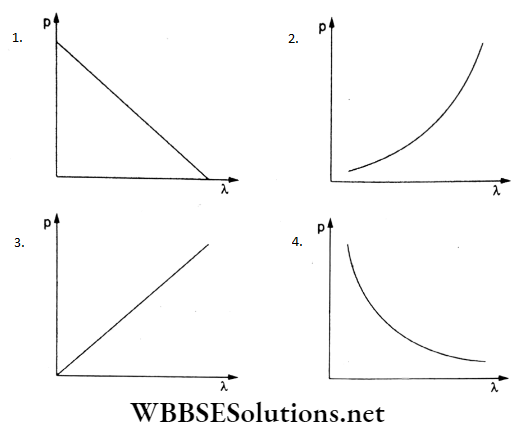
  1. 0.30 mm
  2. 0.40 mm
  3. 0.53 mm
  4. 450 microns

Answer: 1. 0.30 mm

Given that β = 0.4 mm (in air). Let it be β’ in water.

∴ \(\frac{\beta^{\prime}}{\beta}=\frac{D \lambda^{\prime} / d}{D \lambda / d}=\frac{\lambda^{\prime}}{\lambda}=\frac{f \lambda^{\prime}}{f \lambda}=\frac{c}{c_0}=\frac{1}{\mu}\)

∴ \(\beta^{\prime}=\frac{\beta}{\mu}=\frac{0.4 \mathrm{~mm}}{4 / 3}=0.3 \mathrm{~mm}\)
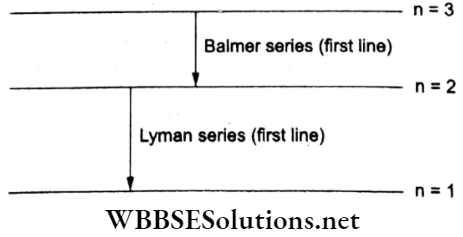
wave optics questions with answers pdf

Question 29. A Young’s double-slit experiment is performed with blue and green lights of wavelengths 4360 A and 5460 A respectively. If X be the distance of the 4th maxima from the central one then

  1. X (blue) = X (green)
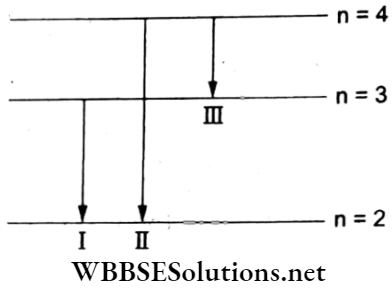
  2. X (blue) > X (green)
  3. X (blue) < X (green)
  4. \(\frac{X \text { (blue) }}{X \text { (green) }}=\frac{5460}{4360}\)

Answer: 3. X (blue) < X (green)

Given that λblue = 4360 Å and λgreen = 5460 Å.

Since fringe width = \(\beta=\frac{D \lambda}{d}\)

⇒ \(\beta_{\text {blue }}<\beta_{\text {green }}\)

⇒ \(4 \beta_{\text {blue }}<4 \beta_{\text {green }}\)

∴ \(X_{\text {blue }}<X_{\text {green }}\)

Question 30. An achromatic combination of lenses consists of

  1. Two convex lenses in contact
  2. Two concave lenses in contact
  3. One convex and one concave lens in contact
  4. One convex and one plane mirror in contact

Answer: 3. One convex and one concave lens in contact

An achromatic combination of lenses constitutes a combination of two lenses of different materials satisfying the condition \(\frac{\omega_1}{f_1}+\frac{\omega_2}{f_2}=0\).

As f1 and f2 are of opposite signs, one is convex and the other concave.

Class 11 Physics Class 12 Maths Class 11 Chemistry
NEET Foundation Class 12 Physics NEET Physics

Question 31. The focal length of a convex lens will be maximum for

  1. Blue light
  2. Yellow light
  3. Greenlight
  4. Red light

Answer: 4. Red light

Sunlight emerging from a convex lens undergoes dispersion, and blue light converges most and red light the least as shown in the given.

Hence, fred is the maximum.

This can also be seen in the relation

⇒ \(\frac{1}{f}=(\mu-1)\left(\frac{1}{R_1}-\frac{1}{R_2}\right)\)

Now, \(\mu_{\text {blue }}>\mu_{\text {green }}>\mu_{\text {yellow }}>\mu_{\text {red }}\)

∵ μ is least for red, \(\frac{1}{f_{\text {red }}}\) is least, hence is maximum.

Wave Optics Electromagnetic Waves Multiple Choice Question And Answers Sunlight Emerging From A Convex Lens Q31

Question 32. Cauchy’s dispersion formula is

  1. \(\mu=A+B \lambda^{-2}+C \lambda^{-4}\)
  2. \(\mu=A+B \lambda^{-2}+C \lambda^4\)
  3. \(\mu=A+B \lambda^2+C \lambda^{-4}\)
  4. \(\mu=A+B \lambda^2+C \lambda^4\)

Answer: 1. \(\mu=A+B \lambda^{-2}+C \lambda^{-4}\)

Cauchy’s dispersion formula is an empirical relationship between the refractive index and the wavelength of light for a particular transparent material. It is expressed as

⇒ \(\mu=A+\frac{B}{\lambda^2}+\frac{C}{\lambda^4}\)

where μ = refractive index and A, B, and C are constants.

Question 33. If the red light is replaced by a white light then

  1. The width of the diffraction pattern will increase
  2. The width of the diffraction pattern will decrease
  3. A central white band will be obtained
  4. No effect will be observed

Answer: 3. A central white band will be obtained

White light is a combination of seven colours. When diffracted through a single slit, the principal maxima will be white where all the components superpose in the same phase

Question 34. Greater accuracy in the determination of the position of a particle with an optical microscope can be had if the beam of light used

  1. Has higher wavelength
  2. Is polarized
  3. Has higher frequency
  4. Has greater intensity

Answer: 3. Has higher frequency

For a microscope, resolving power = \(\frac{2 \mu \sin \theta}{1.22 \lambda}\)

For higher resolution, λ should be small which means that a light of higher frequency should be used.

Question 35. The ratio of the resolving power of an optical microscope for two wavelengths λ1 = 400 nm and λ2 = 600 nm is

  1. 9:4
  2. 3:2
  3. 16: 81
  4. 8: 27

Answer: 2. 3:2

Resolving power of an optical instrument \(\propto \frac{1}{\lambda}\)

⇒ \(\frac{R_1}{R_2}=\frac{\lambda_2}{\lambda_1}=\frac{600 \mathrm{~nm}}{400 \mathrm{~nm}}=\frac{3}{2}\).

Question 36. A linear aperture whose width is 0.20 mm is placed immediately in front of a lens of focal length 60 cm. The aperture is illuminated normally by a parallel beam of monochromatic light of wavelength 500 nm. The distance of the first dark band of the diffraction pattern from the centre of the screen is

  1. 0.10 cm
  2. 0.25 cm
  3. 0.20 cm
  4. 0.15 cm

Answer: 4. 0.15 cm

Given that slit width a = 0.2 mm, λ = 500 nm and f = D = 60 cm.

Diffracted rays will be focused by a convex lens at its focal plane, so D = f.

The angular position of the first dark band is \(\theta_1=\frac{\lambda}{a}\) and its distance from the centre of the screen is

∴ \(y=D \theta=D \frac{\lambda}{a}=\frac{(60 \mathrm{~cm})(500 \mathrm{~nm})}{(0.2 \mathrm{~mm})}=0.15 \mathrm{~cm}\)

Question 37. In a diffraction pattern due to a single slit of width a, the first minimum is observed at an angle of 30° when light of wavelength 500 nm is incident on the slit. The first secondary maximum is observed at an angle of

  1. \(\sin ^{-1}\left(\frac{1}{2}\right)\)
  2. \(\sin ^{-1}\left(\frac{3}{4}\right)\)
  3. \(\sin ^{-1}\left(\frac{2}{3}\right)\)
  4. \(\sin ^{-1}\left(\frac{1}{4}\right)\)

Answer: 2. \(\sin ^{-1}\left(\frac{3}{4}\right)\)

The angular position of the first minimum = θ1

where sin \(\theta_1=\frac{\lambda}{a}=\sin 30^{\circ} \Rightarrow \frac{\lambda}{a}=\frac{1}{2}\)

Let the angular position of the first maximum be 01:

⇒ \(\sin \theta_1^{\prime}=\frac{3}{2} \frac{\lambda}{a}=\frac{3}{2}\left(\frac{1}{2}\right)=\frac{3}{4}\)

∴ \(\theta_1^{\prime}=\sin ^{-1}\left(\frac{3}{4}\right)\).

Question 38. At the first minimum adjacent to the central maximum of a single-slit diffraction pattern, the phase difference between the Huygens wavelet from the edge of the slit and the wavelet from the midpoint of the slit is

  1. π radian
  2. \(\frac{\pi}{2}\) radian
  3. \(\frac{\pi}{4}\) radian
  4. \(\frac{\pi}{8}\) radian

Answer: 1. π radian

While explaining the diffraction pattern due to a single slit, the unobstructed wavefront through the slit divided into 2, 3, and 4, parts take the path difference \(\Delta=a \sin \theta \text { as } \lambda, \frac{3}{2} \lambda, 2 \lambda\),…, etc. For the first minimum, the Huygens wavelets originating from the edge of the slit and from the midpoint of the slit are in opposite phases (phase difference = π) so that all cancel out leading to minimum intensity.

Question 39. For a parallel beam of monochromatic light of wavelength λ, diffraction is produced by a single slit whose width a is of the order of the wavelength of light. If D is the distance of the screen from the slit, the width of the central maxima will be

  1. \(\frac{D a}{\lambda}\)
  2. \(\frac{2 D a}{\lambda}\)
  3. \(\frac{2 D \lambda}{a}\)
  4. \(\frac{D \lambda}{a}\)

Answer: 3. \(\frac{2 D \lambda}{a}\)

The angular width of the central maxima is

⇒ \(2 \theta_1=2\left(\frac{\lambda}{a}\right)\)

So, the linear width of the central maxima is

∴ \(y=D\left(2 \theta_1\right)=2 \frac{D \lambda}{a}\)

Question 40. A beam of light of wavelength 600 nm from a distant source falls on a single slit 1 mm wide. The resulting diffraction pattern is observed on a screen 2 m away. The distance between the first dark fringes on either side of the central bright fringe is

  1. 1.2 cm
  2. 2.4 cm
  3. 1.2 mm
  4. 2.4 mm

Answer: 4. 2.4 mm

Given that λ, = 600 nm, slit width = a = 1 mm and D = 2 m.

The distance between the first minima on either side of the central bright is the width of the principal maxima which is

⇒ \(y=D\left(2 \theta_1\right)=2 \frac{D \lambda}{a}\)

⇒ \(\frac{2(2 \mathrm{~m})\left(600 \times 10^{-9} \mathrm{~m}\right)}{\left(1 \times 10^{-3} \mathrm{~m}\right)}=2.4 \mathrm{~mm}\).

Question 41. A parallel beam of fast-moving electrons is incident normally in a narrow slit. A fluorescent screen is placed at a large distance from the slit. If the speed of the electrons is increased, which of the following statements is true?

  1. The angular width of the central maximum will decrease.
  2. The angular width of the central maximum of the diffraction pattern will increase.
  3. The angular width of the central maximum will remain unaffected.
  4. Diffraction patterns will not be observed on the screen in the case of electrons.

Answer: 1. The angular width of the central maximum will decrease.

The de Broglie wavelength of fast-moving electrons is \(\lambda=\frac{h}{m v}\), which decreases with the increase in speed v. Hence, the angular width of the central maximum, \(2 \theta=\frac{2 \lambda}{a}\) will also decrease.

Question 42. A beam of monochromatic light of wavelength λ is incident normally on a narrow slit. A diffraction pattern is formed screen placed perpendicular to the direction of the incident beam. At the second minimum of the diffraction pattern, the phase difference between the rays coming from the two edges of the slit is

  1. πλ

Answer: 3. 4π

In order to describe the pattern of diffraction for the 2nd minima, we divide the unobstructed wavefront through the slit into four equal segments so that the 1st and 2nd as well as the 3rd and 4th cancel out. The path difference for wavelets originating from the extreme edges is 2A, and the equivalent phase difference is \(\phi=\frac{2 \pi}{\lambda}(2 \lambda)=4 \pi\).

Question 43. The angular resolution of a 10-cm-diameter telescope at a wavelength of 600 nm is of the order of

  1. 106 rad
  2. 10-2 rad
  3. 10-4 rad
  4. l0-6 rad

Answer: 4. l0-6 rad

Angular resolution = \(\Delta \theta=1.22 \frac{\lambda}{D}\),

Where = wave length = 600 nm and D = diameter = 10cm.

∴ \(\Delta \theta=\frac{1.22\left(600 \times 10^{-9} \mathrm{~m}\right)}{\left(10 \times 10^{-2} \mathrm{~m}\right)}=7.32 \times 10^{-6} \mathrm{rad} \approx 10^{-6} \mathrm{rad}\).

Question 44. A telescope has an objective lens of 10 cm diameter and is situated at a distance of one kilometre from two objects. The minimum distance between these two objects which can be resolved by the telescope when the mean wavelength of light is 500 nm, is of the order of

  1. 0.5 m
  2. 5 m
  3. 5 mm
  4. 5 cm

Answer: 3. 5 mm

According to the Rayleigh criterion, two objects can be resolved if the principal maxima of one falls on the first minima of the other in the diffraction pattern.

Hence, the limit of resolution is

⇒ \(\theta=1.22 \frac{\lambda}{d}=\tan \theta=\frac{y}{D}\)

where y is the minimum distance and D = distance of the objects from the lens.

⇒ \(y=1.22 \frac{\lambda}{d} \times D=1.22 \times \frac{\left(500 \times 10^{-9} \mathrm{~m}\right)(1000 \mathrm{~m})}{\left(10 \times 10^{-2} \mathrm{~m}\right)}\)

∴ 6.10 x 10⁻³ m = 6 mm = 5 mm.

Question 45. The diameter of the human eye lens is 2 mm. What will be the minimum separation between two points to resolve them, which are situated at a distance of 50 m from the eye? The wavelength of light is 500 nm.

  1. 2.32 m
  2. 4.28 m
  3. 1.52 cm
  4. 12.48 cm

Answer: 3. 1.52 cm

The required minimum separation is

⇒ \(y=D \tan \theta=D \theta=D\left(1.22 \frac{\lambda}{d}\right)\)

Given that d = 2 mm, D = 50 m and A = 500 nm.

⇒ \(y=\frac{50 \mathrm{~m}(1.22)\left(500 \times 10^{-9} \mathrm{~m}\right)}{\left(2 \times 10^{-3} \mathrm{~m}\right)}=15.25 \times 10^{-3} \mathrm{~m}=1.52 \mathrm{~cm}\)

Question 46. An astronaut is looking down on the earth’s surface from a space shuttle at an altitude of 400 km. Assuming that the astronaut’s pupil diameter is 5 mm and the wavelength of visible light is 500 nm, the astronaut will be able to resolve linear objects of size about

  1. 0.5 m
  2. 5 m
  3. 50 m
  4. 500 m

Answer: 3. 50 m

As done in the preceding question, the minimum size to be resolved,

∴ \(y=1.22 \frac{D \lambda}{d}=\frac{1.22(400 \mathrm{~km})(500 \mathrm{~nm})}{(5 \mathrm{~mm})}\)

⇒ \(\frac{1.22\left(400 \times 10^3 \mathrm{~m}\right)\left(500 \times 10^{-9} \mathrm{~m}\right)}{\left(5 \times 10^{-3} \mathrm{~m}\right)}=4.88 \times 10 \mathrm{~m} \approx 50 \mathrm{~m}\).

Question 47. A beam of light is incident normally on a diffraction grating through which the first diffraction is seen at 32°. In this case, there will be the 2nd-order diffraction? 

  1. At 80°
  2. At 64°
  3. At 48°
  4. There will be no second-order diffraction

Answer: 4. There will be no second-order diffraction

In a diffraction grating, the nth-order diffraction angle (θn) is given by dsin 0n = nλ.

For the lst-order diffraction (n = 1),

d sin θ1 = X

⇒  d sin 32° = X.

For the 2nd-order diffraction (n = 2),

d sin θ2 = 2X = 2(d sin 32°)

⇒ sin θ2 = 2 x sin 32° = 2(0.53) =.1.06.

Since sin θ2 cannot be greater than one, there will be no second-order diffraction.

Question 48. At what angle of incidence will the light reflected from glass (μ = 1.5) be completely polarized?

  1. 56.3°
  2. 40.3°
  3. 72.8°
  4. 51.6°

Answer: 1. 56.3°

According to Brewster’s law, refractive index μ = tan ip, where ip = angle of polarization.

∴ ip = tan-1(1.5) = 56.3°

Question 49. Two polaroids P1 and P2 are placed with their pass axes perpendicular to each other. Unpolarized light of intensity I0 is incident on P2. A third polaroid P3 is kept in between P1 and P2 such that its pass axis makes an angle of 45° with that of P1. The intensity of transmitted light through P2 is

  1. \(\frac{I_0}{4}\)
  2. \(\frac{I_0}{8}\)
  3. \(\frac{I_0}{16}\)
  4. \(\frac{I_0}{2}\)

Answer: 2. \(\frac{I_0}{8}\)

The intensity of the light transmitted through polaroid P1 is I0/2 which is plane polarized. Since the pass axes of P1 and P2 are inclined at 45°, the intensity of the light transmitted through P3 (according to Malus’s law)

⇒ \(\left(\frac{I_0}{2}\right) \cos ^2 45^{\circ}=\frac{I_0}{4}\)

Pass axes of P3 and P2 are also inclined at 45°, so the final intensity of light transmitted through P2 will be

∴ \(\frac{I_0}{4} \cos ^2 45^{\circ}=\frac{I_0}{8}\)

Question 50. In the case of linearly polarized light, the magnitude of the electric field vector

  1. Does not change with time
  2. Varies periodically with time
  3. Increases and decreases linearly with time
  4. Is parallel to the direction of propagation

Answer: 2. Varies periodically with time

Light is an electromagnetic wave in which electric and magnetic fields are mutually perpendicular and perpendicular to the direction of propagation. In the case of linearly (or plane-) polarized light, \(\vec{E}\) -vector varies periodically with time

Question 51. Which of the following diagrams represents the variation of the electric field vector with time for a circularly polarized light?

Wave Optics Electromagnetic Waves Multiple Choice Question And Answers Variation Of Electric Field With Time Q51

Answer: 2.

Circular polarization of an electromagnetic wave describes a polarization state in which at each point, the electric field of the wave has a constant magnitude but its direction rotates with time at a steady rate in a plane perpendicular to the direction of the wave. The tip of the electric field vector at any point in space describes a circle as time passes.

Question 52. In a YDSE, a light of wavelength 500 nm is used. The distance between the slits and the screen is 1.8 m and the slit separation is 0.4 mm. If the screen is moved parallel to itself with a speed of 4 m s-1, with what speed will the first maxima move?

  1. 2 mm s-1
  2. 3 mm s-1
  3. l mm s-1
  4. 5 mm s-1

Answer: 4. 5 mm s-1

When the screen is displaced parallel to itself, the position of the central maxima remains unchanged but the fringe width increases.

Now, \(\beta=\frac{D \lambda}{d}\)

⇒ \(\frac{d \beta}{d t}=\frac{\lambda}{d} \frac{d D}{d t}=\frac{500 \times 10^{-9} \mathrm{~m}}{0.4 \times 10^{-3} \mathrm{~m}} \times v_{\text {screen }}\)

⇒ \(\left(\frac{5}{4} \times 10^{-3}\right)\left(4 \mathrm{~m} \mathrm{~s}^{-1}\right)=5 \mathrm{~mm} \mathrm{~s}^{-1}\)

This is the speed with which the first maxima will move.

Question 53. Find the resolving power of a microscope whose objective lens has focal length f0 = 5 cm, and diameter = 2 cm. (Wavelength of light used, λ = 6000 A.)

  1. 11.9 x l05 m-1
  2. 10.9 x 10⁵ m-1
  3. 10.9 x l04 m-1
  4. 10.9 x l03 m-1

Answer: 2. 10.9 x 10⁵ m-1

Given that f0 = 5 cm and sin \(\theta \approx \tan \theta=\frac{D}{f}=\frac{2}{5}\)

The resolving power of the microscope is

∴ \(\frac{2 \mu \sin \theta}{1.22 \lambda}=\frac{2(1)(2 / 5)}{1.22\left(600 \times 10^{-9} \mathrm{~m}\right)}=10.9 \times 10^5 \mathrm{~m}^{-1}\)

Question 54. In a double-slit experiment, when light of wavelength 400 nm was used, the angular width of the first minima formed on a screen placed 1 m away was found to be 0.2°. What will be the angular width of the first minima if the entire set-up is immersed in water? \(\left(\mu_{\text {water }}=\frac{4}{3}\right)\).

  1. 0.26°
  2. 0.15°
  3. 0.05°
  4. 0.1°

Answer: 2. 0.15°

The angular width of a fringe is

⇒ \(\theta=\frac{\beta}{D}=\frac{D \lambda}{d D}=\frac{\lambda}{d}\)

Now, \(\frac{\theta_{\text {water }}}{\theta_{\text {air }}}=\frac{\lambda_\omega}{\lambda_{\mathrm{a}}}=\frac{C_\omega / v}{C_{\mathrm{a}} / v}=\frac{1}{\mu_\omega}=\frac{3}{4}\)

Hence, \(\theta_{\text {water }}=\frac{3}{4}\left(\theta_{\text {air }}\right)=(0.75)\left(0.2^{\circ}\right)=0.15^{\circ}\).

Question 55. In a YDSE, the ratio of the slit widths is 4: 1. The ratio of the intensity of the maxima to that of the minima in the fringe pattern close to the central fringe on the screen will be

  1. 3: 16
  2. 2: 9
  3. 9: 1
  4. 4: 1

Answer: 3. 9: 1

Assuming that the slit width is proportional to the intensity of light transmitted,

⇒ \(\frac{I_1}{I_2}=\frac{4}{1}=\frac{a_1^2}{a_2^2}\),

where a1 and a2 represent the corresponding amplitudes.

∴ \(\frac{a_1}{a_2}=\frac{2}{1} \Rightarrow \frac{a_1+a_2}{a_1-a_2}=\frac{3}{1}\)

Hence, \(\frac{I_{\max }}{I_{\min }}=\frac{\left(a_1+a_2\right)^2}{\left(a_1-a_2\right)^2}=\frac{9}{1}\).

Question 56. In a YDSE, when a thin film of thickness t having refractive index μ is introduced in front of one of the slits, the maximum at the centre of the fringe system shifts by one fringe width. The value of t in terms of λ (the wavelength used) is

  1. \(\frac{\lambda}{(2 \mu-1)}\)
  2. \(\frac{2 \lambda}{(\mu-1)}\)
  3. \(\frac{\lambda}{(\mu-1)}\)
  4. \(\frac{\lambda}{2(\mu-1)}\)

Answer: 3. \(\frac{\lambda}{(\mu-1)}\)

Insertion of a thin film in the path of rays coming from one slit will introduce an additional optical path Δ = (μ- l)t, where 4 is the refractive index of the film and t is its thickness. Since one fringe shift corresponds to an additional path μ, therefore

∴ \((\mu-1) t=\lambda \Rightarrow t=\frac{\lambda}{(\mu-1)}\).

Question 57. In an interference experiment, the ratio of amplitudes of coherent waves is \(\frac{a_1}{a_2}=\frac{1}{3}\). The ratio of maximum and minimum intensities of fringes will be

  1. 4
  2. 2
  3. 9
  4. 18

Answer: 1. 4

Given that \(\frac{a_1}{a_2}=\frac{1}{3} \Rightarrow \frac{a_2+a_1}{a_2-a_1}=\frac{4}{2}=\frac{2}{1}\)

∴ \(\frac{I_{\max }}{I_{\min }}=\left(\frac{a_2+a_1}{a_2-a_1}\right)^2=\left(\frac{2}{1}\right)^2=4\).

Question 58. Two coherent sources produce waves of different intensities which interfere. After interference, the ratio of the maximum intensity to the minimum intensity is 16. The intensities of the component waves are in the ratio

  1. 16:9
  2. 5:3
  3. 25:9
  4. 4:1

Answer: 3. 25:9

Given that \(\frac{I_{\max }}{I_{\min }}=\frac{16}{1}=\left(\frac{a_1+a_2}{a_1-a_2}\right)^2\)

⇒ \(\left(\frac{a_1+a_2}{a_1-a_2}\right)=\frac{4}{1} \Rightarrow \frac{a_1}{a_2}=\frac{5}{3} \Rightarrow \frac{I_1}{I_2}=\frac{a_1^2}{a_2^2}=\frac{25}{9}\).

Question 59. In Young’s double-slit experiment with slit separation 0.1 mm, one observes a bright fringe at an angle (1/40) radian by using a light of wavelength λ1. When a light of wavelength λ2 is used, a bright fringe is seen at the same angle in the same set-up. Given that λ1 and λ2 are in the visible range (380 nm-740 nm), their values are

  1. 380 nm and 525 nm
  2. 400 nm and 500 nm
  3. 380 nm and 500 nm
  4. 625 nm and 500 nm

Answer: 4. 625 nm and 500 nm

The angular position of the nth bright fringe at P„ is

⇒ \(\theta=\frac{P_0 P_n}{O P_0}=\frac{y}{D}\)

If this region contains n bright fringes,

⇒ \(y=n \beta=n \frac{D \lambda}{d}\); hence

⇒ \(\theta=\frac{1}{D}\left(\frac{n D \lambda}{d}\right)=\frac{n \lambda}{d}\)

⇒ \(n \lambda=\theta \cdot d=\frac{1}{40} \times(0.1 \mathrm{~mm})=\frac{10^{-4} \mathrm{~m}}{40}=\frac{10000}{4} \mathrm{~nm}=2500 \mathrm{~nm}\)

Thus, \(\lambda=\frac{2500}{n} \mathrm{~nm} \text {, where } n=1,2,3\),….

For k to lie within the visible range (380 nm-740 nm),

⇒ \(\lambda=\frac{2500 \mathrm{~nm}}{5}, \frac{2500 \mathrm{~nm}}{4}\),…

Hence, λ1= 500 nm and λ2 = 625 nm.

Question 60. In a YDSE, the slit separation is 0.320 mm and light of wavelength λ = 500 nm is incident on the slits. The total number of bright fringes that are observed in the angular range -30° < 0 < 30° is

  1. 320
  2. 321
  3. 640
  4. 641

Answer: 4. 641

Given that slit separation = d = 0.32 mm and wavelength = λ = 500 nm.

If N bright fringes are contained within the angular range 0 then the path difference is

A = dsinθ = Nλ,

⇒ \(N=\frac{d \sin \theta}{\lambda}=\frac{\left(0.32 \times 10^{-3} \mathrm{~m}\right)(0.5)}{\left(500 \times 10^{-9} \mathrm{~m}\right)}=320\).

Same number of fringes (N = 320) will be contained in the range θ = 0 to θ = -30°.

Thus, the total number of bright fringes contained will be 2N + central bright fringe = 641.

Question 61. Consider a YDSE set-up as shown in the figure. What should be the slit-separation d in terms of wavelength X such that the first minima occurs directly in front of the slit S1?

Wave Optics Electromagnetic Waves Multiple Choice Question And Answers TDSE Set Up Q61

  1. \(\frac{\lambda}{2(5-\sqrt{2})}\)
  2. \(\frac{\lambda}{(5-\sqrt{2})}\)
  3. \(\frac{\lambda}{2(\sqrt{5}-2)}\)
  4. \(\frac{\lambda}{(\sqrt{5}-2)}\)

Answer: 3. \(\frac{\lambda}{2(\sqrt{5}-2)}\)

Since the position of the first dark fringe P is directly in front of slit Sl, the path difference

at P will be \(\Delta=\frac{\lambda}{2}\)

or \(\frac{\lambda}{2}=\Delta=\mathrm{S}_2 \mathrm{P}-\mathrm{S}_1 \mathrm{P}=\sqrt{4 d^2+d^2}-2 d\)

⇒ (√5 – 2)d

⇒ \(d=\frac{\lambda}{2(\sqrt{5}-2)}\)

Wave Optics Electromagnetic Waves Multiple Choice Question And Answers Path Difference Q61

Question 62. In a YDSE, the path difference at a certain point on the screen between two interfering waves is \(\frac{1}{8}\) of the wavelength. The ratio of the intensity at this point to that at the centre of a bright fringe will be close to

  1. 0.94
  2. 0.74
  3. 0.85
  4. 0.80

Answer: 3. 0.85

Let I be the intensity of each of the coherent waves. The phase difference is

⇒ \(\phi=\frac{2 \pi}{\lambda} \Delta=\frac{2 \pi}{\lambda} \cdot \frac{\lambda}{8}=\frac{\pi}{4}\)

Intensity at point P is

⇒ \(I_{\mathrm{P}}=I+I+2 \sqrt{I} \sqrt{I} \cos \frac{\pi}{4}=2 I\left(1+\frac{1}{\sqrt{2}}\right)\)

Intensity at the central bright fringe,

⇒ \(I_0=I+I+2 \sqrt{I} \sqrt{I} \cos 0^{\circ}=4 I\)

∴ \(\frac{I_{\mathrm{P}}}{I_0}=\frac{\sqrt{2}+1}{2 \sqrt{2}}=0.85\)

Question 63. In a YDSE, green light (A. = 5303 A) falls on the slits having a slit separation of 19.44 |j,m and a width of 4.05 |im. The number of bright fringes between the first and the second diffraction minima is

  1. 4
  2. 10
  3. 9
  4. 5

Answer: 4. 5

Angular positions of the first and the second minima are \(\theta_1=\frac{\lambda}{a} \text { and } \theta_2=\frac{2 \lambda}{a}\)

where a is the width of each slit. The linear separation between the two minima is

⇒ \(D \theta=\left(\theta_2-\theta_1\right) D=\frac{D \lambda}{a}=N \beta\)

where N is the number of bright fringes and j} = fringe width = \(\frac{D \lambda}{d}\)

⇒ \(N\left(\frac{D \lambda}{d}\right)=\frac{D \lambda}{a}\)

∴ \(N=\frac{d}{a}=\frac{19.44 \mu \mathrm{m}}{4.05 \mu \mathrm{m}}=4.8 \approx 5\)

Wave Optics Electromagnetic Waves Multiple Choice Question And Answers Angular Position Q63

Question 64. The value of the numerical aperture of the objective lens of a microscope is 1.25. If light of wavelength 500 nm is used, the minimum separation between two points to be seen distinctly will be

  1. 0.38 μm
  2. 0.48 μm
  3. 0.24 μm
  4. 0.12 μm

Answer: 3. 0.24 μm

The minimum separation between two objects that can be resolved by a microscope is given by

⇒ \(d_{\min }=\frac{1.22 \lambda}{2 \mu \sin \theta}=\frac{1.22 \lambda}{2(N A)}\)

where numerical aperture = 1.25 and λ = 500 run.

∴ \(d_{\min }=\frac{1.22\left(500 \times 10^{-9} \mathrm{~m}\right)}{2(1.25)}=2.44 \times 10^{-7} \mathrm{~m}=0.24 \mu \mathrm{m}\)

Question 65. Calculate the limit of resolution of a telescope objective having a diameter of 200 cm, if it has to detect a light of wavelength 500 nm coming from a star.

  1. 305 x 10-9 radian
  2. 152.5 x l0-9 radian
  3. 610 x 10-9 radian
  4. 457.5 x 10⁻⁹ radian

Answer: 3. 610 x 10-9 radian

The limit of resolution (angular) for a telescope is

⇒ \(\Delta \theta=1.22 \frac{\lambda}{\mathrm{D}}=\frac{1.22\left(500 \times 10^{-9} \mathrm{~m}\right)}{2 \mathrm{~m}} \mathrm{rad}\)

∴ 610 x 10-9 rad.

Question 66. The diameter of the objective lens of a telescope is 250 cm. For a light of wavelength 600 nm coming from a distant object, the limit of resolution of the telescope is close to

  1. 3.0 x 10⁻⁷ rad
  2. 2.0 x 10⁻⁷ rad
  3. 1.5 x 10⁻⁷ rad
  4. 4.5 x 10⁻⁷ rad

Answer: 1. 3.0 x 10⁻⁷ rad

Limit of resolution = \(1.22 \frac{\lambda}{D}=1.22 \frac{\left(600 \times 10^{-9} \mathrm{~m}\right)}{250 \times 10^{-2} \mathrm{~m}}=2.9 \times 10^{-7} \mathrm{rad}\)

∴ 3.0 x 10⁻⁷ rad.

Question 67. Consider a tank made of glass (refractive index 1.5) with a thick bottom. It is filled with a liquid of refractive index μ. A student finds that irrespective of what the incident angle i is (as shown in the figure), a beam of light entering the liquid-glass interface is never completely polarized. For this to happen, the tire minimum value of p should be

Wave Optics Electromagnetic Waves Multiple Choice Question And Answers Tank Made Of Glass Q67

  1. \(\frac{3}{\sqrt{5}}\)
  2. \(\frac{5}{\sqrt{3}}\)
  3. \(\frac{4}{3}\)
  4. \(\sqrt{\frac{5}{3}}\)

Answer: 1. \(\frac{3}{\sqrt{5}}\)

Under the given situation, light will be transmitted from liquid to air if r ≤ θC, where θC is the critical angle for the liquid.

Further, transmitted light in the air will never be completely polarized if the polarizing angle 0pC.

Thus, tan 0p > tan θC.

⇒ \(\frac{\mu_{\mathrm{g}}}{\mu_l}>\frac{\sin \theta_{\mathrm{c}}}{\cos \theta_{\mathrm{c}}} \Rightarrow \frac{\mu_{\mathrm{g}}}{\mu_l}>\frac{1 / \mu_l}{\sqrt{1-\frac{1}{\mu_l^2}}}\)

⇒ \(2 \mu_c->\frac{1}{\sqrt{\mu_l^2-1}} \Rightarrow 9\left(\mu_l^2-1\right)>4 \mu_l^2\)

∴ Hence, \(\mu_l>\frac{3}{\sqrt{5}}\).

Wave Optics Electromagnetic Waves Multiple Choice Question And Answers Light Will Be Transmitted From Liquid Q67

Question 68. A system of three polaroids P1, P2 and P3 is set up such that the pass axis of P3 is crossed with respect to that of P1. The pass axis of P2 is inclined at 30° to that of P1. When a beam of unpolarized light of intensity I0 is incident on P1 the intensity of light transmitted by the three polaroids is I. The ratio I0/I is equal to (nearly)

  1. 5.33
  2. 16.00
  3. 10.67
  4. 1.80

Answer: 3.

Pass axes of I1 and I2 are inclined at 30°, so according to Malus’s law,

⇒ \(I_2=I_1 \cos ^2 30^{\circ}=\frac{3 I_1}{4}\)

But \(I_1=\frac{I_0}{2}, \text { so } I_2=\frac{3}{4}\left(\frac{I_0}{2}\right)=\frac{3 I_0}{8}\)

Similarly, P2 and P3 are inclined at 60°, so

⇒ \(I=I_2 \cos ^2 60^{\circ}=\frac{3}{8} I_0 \times \frac{1}{4}=\frac{3}{32} I_0\)

∴ \(\frac{I_0}{I}=\frac{32}{3}=10.67\)

Wave Optics Electromagnetic Waves Multiple Choice Question And Answers Malus Law Q68

Question 69. An electromagnetic wave is represented by the electric field \(\vec{E}=E_0 \sin (\omega t+6 y-8 z) \hat{n}\). Then, the direction of propagation of the wave is

  1. \(\frac{-3 \hat{j}-4 \hat{k}}{5}\)
  2. \(\frac{-3 \hat{j}+4 \hat{k}}{5}\)
  3. \(\frac{-3 \hat{i}-4 \hat{k}}{5}\)
  4. \(\frac{3 \hat{i}-4 \hat{j}}{5}\)

Answer: 2. \(\frac{-3 \hat{j}+4 \hat{k}}{5}\)

From the given wave equation, it is clear that the direction of propagation of the wave is along the negative direction of \(6 \hat{j}-8 \hat{k}\). The unit vector along the direction of propagation will be

∴ \(-\frac{6 \hat{j}-8 \hat{k}}{\sqrt{36+64}}=\frac{-6 \hat{j}+8 \hat{k}}{10}=\frac{-3 \hat{j}+4 \hat{k}}{5}\).

Question 70. A plane electromagnetic wave travels in free space along the electric field component of the wave at a particular point of space and time is E = 6 V m-1 along the y-direction. Its corresponding magnetic field component B would be

  1. 6 x 10⁻⁸ T along the z-direction
  2. 6 x 10⁻⁸ T along
  3. 2 x 10⁻⁸ T along z-direction
  4. 2 x 10⁻⁸ T along y-direction

Answer: 3. 2 x 10⁻⁸ T along z-direction

Since \(\frac{E}{B}=c\), hence magnitude of the magnetic field is

⇒ \(B=\frac{E}{c}=\frac{6 \mathrm{Vm}^{-1}}{3 \times 10^8 \mathrm{~m} \mathrm{~s}^{-1}}=2 \times 10^{-8} \mathrm{~T}\)

But \(\vec{E}=E_0 \hat{i}\) (given) and the wave travels along the x-direction, \(\hat{E} \times \hat{B}=\hat{i}\), gives the direction along the z-direction, \(\vec{B}=\left(2 \times 10^{-8} \mathrm{~T}\right) \hat{k}\).

Question 71. A plane electromagnetic wave of frequency 50 MHz travels in free space along the positive x-direction. At a particular point in space at time t, \(\vec{E} \text { is }\left(6.3 \mathrm{Vm}^{-1}\right) \hat{j}\). The corresponding magnetic field \(\vec{B}\) a that point will be

  1. \(\left(18.9 \times 10^8 \mathrm{~T}\right) \hat{k}\)
  2. \(\left(6.3 \times 10^{-8} \mathrm{~T}\right) \hat{k}\)
  3. \(\left(18.9 \times 10^{-8} \mathrm{~T}\right) \hat{k}\)
  4. \(\left(2.1 \times 10^{-8} \mathrm{~T}\right) \hat{k}\)

Answer: 4. \(\left(2.1 \times 10^{-8} \mathrm{~T}\right) \hat{k}\)

Given that \(\vec{E}=\left(6.3 \cdot \mathrm{Vm}^{-1}\right) \hat{j}\). The direction of propagation of the electromagnetic wave is along the x-direction. Thus,

⇒ \(\frac{E}{B}=c \text { and } \hat{E} \times \hat{B}=\hat{i} \Rightarrow \hat{j} \times \hat{B}=\hat{i}\)

Thus, \(B=\frac{E}{c}=\frac{6.3}{3 \times 10^8} \mathrm{~T}=2.1 \times 10^{-8} \mathrm{~T}\)

and \(\hat{B}=\hat{k}\)

∴ \(\vec{B}=B \hat{B}=\left(2.1 \times 10^{-8} \mathrm{~T}\right) \hat{k}\).

Question 72. If the magnetic field of a plane electromagnetic wave is given by \(B=\left(100 \times 10^{-6} \mathrm{~T}\right) \sin \left[2 \pi \times 2 \times 10^{15}\left(t-\frac{x}{c}\right)\right]\) then the maximum electric field associated with the wave is

  1. 6 x 10⁴ N C-1
  2. 4 x 10⁴ N C-1
  3. 3 x 10⁴ N C-1
  4. 4.5 x 10⁴ N C-1

Answer: 3. 3 x 10⁴ N C-1

The amplitude of the magnetic field B0 = 100 x10-6 T, hence the corresponding amplitude of the electric field is

E0 = B0 x c = (100 x10-6 T)(3 x10⁸ m s-1 ) = 3 x10⁴ N C-1.

Question 73. The intensity of a plane-polarized light is 3.3 W m-2. A polarizer of area 3 x 10⁻⁴ m2 rotates at a constant angular frequency of 10jc rad s-1. The total amount of energy transmitted in one complete revolution is

  1. 6.95 x 10⁻⁴ J
  2. 1.0 x 10⁻⁴ J
  3. 3.95 x 10⁻⁴J
  4. 2.95 x 10⁻⁴J

Answer: 2. 1.0 x 10⁻⁴ J

According to Malus’s law, the intensity of a transmitted light is

I = I0 Cos2θ.

The total energy transmitted in one revolution is

⇒ \(E=\int I A d t=\int I_0 \cos ^2 \theta A d t\)

⇒ \(I_0 A \int \cos ^2 \omega t d t=\frac{I_0 A^{2 \pi}}{\omega} \int_0^{2 \pi} \cos ^2 \omega t d(\omega t)\)

∴ \(\frac{I_0 A \pi}{\omega}=\frac{\left(3.3 \mathrm{~W} \mathrm{~m}^{-2}\right)\left(3 \times 10^{-4} \mathrm{~m}^2\right) \pi}{(10 \pi) \mathrm{rad} \mathrm{s}^{-1}}\)

= 0.99 x 10⁻⁴ J ≈1.0 x 10⁻⁴ J

Question 74. A single slit of width 0.6 x10⁻⁴ m is illuminated by a light of wavelength 600 nm. The highest order of minima on both sides of the central maxima is

  1. 200
  2. 100
  3. 20
  4. 10

Answer: 2. 100

For a single-slit diffraction pattern, the position for the minima is d sin0 = nX

⇒ \(\sin \theta=\frac{n \lambda}{d}<1\)

Hence, \(n \leq \frac{d}{\lambda}\)

Here, d = slit width = 0.6 x 10⁻⁴m and λ = 600 x 10-9 m.

∴ \(n \leq \frac{6 \times 10^{-5} \mathrm{~m}}{6 \times 10^{-7} \mathrm{~m}}=100\)

Question 75. In the given figure, P and Q are two equally intense coherent sources emitting radiation of the same wavelength 20 m. The separation between P and Q is 5 m and the phase of P is ahead of Q by 90°. A, B and C are three points each at the same distance from the midpoint O of PQ. The intensities observed at A, B and C will be in the ratio

Wave Optics Electromagnetic Waves Multiple Choice Question And Answers Two Equally Intense Coherent Sources Q75

  1. 0:1:4
  2. 0:1:2
  3. 4:1:0
  4. 2:1:0

Answer: 2. 0:1:2

Resultant intensity due to superposition is

I = 2I0(1 + cos π), where Φ= phase difference.

At point A: path difference = \(\Delta=P A-Q A=P Q=5 \mathrm{~m}=\frac{20 \mathrm{~m}}{4}=\frac{\lambda}{4}\)

and phase difference = \(\frac{2 \pi}{4}=\frac{\pi}{2}\)

Since P is ahead of Q by \(\frac{\pi}{2}\), hence net phase difference Φ = π.

IA = 2I0(l + cos π) = 0.

At point B: B is equidistant from both P and Q, hence path difference = 0.

But P is ahead in phase by \(\frac{\pi}{2}, \text { so } \phi=\frac{\pi}{2}\)

⇒ \(I_{\mathrm{B}}=2 I_0\left(1+\cos \frac{\pi}{2}\right)=2 I_0\)

At point C: path difference = \(\Delta=Q C-P C=\frac{\lambda}{4}\)

But P leads by \(\frac{\pi}{2}\left(\equiv \frac{\lambda}{4}\right)\), hence Φ = 0.

∴ Ic = 2I0(1 + cos 0°) = 4I0.

∴ Hence, IA : IB : Ic = 0 : 2I0 : 4I0 = 0 : 1 : 2.

Question 76. In a YDSE with a slit separation of 1 mm and distance of the screen from the slit 1 m, the wavelength of the light used is 650 nm. At a distance y =1.270 mm from the central fringe where a bright fringe is observed, the path difference is

  1. 1.27 μm
  2. 2.45 μm
  3. 2.27 μm
  4. 0.27 μm

Answer: 1. 1.27 μm

Path difference at P due to sources S1 and S2 is

Δ = S2P-S1P ≈ S2N = S1S2sin θ.

For θ to be small, \(\sin \theta \rightarrow \tan \theta=\frac{y}{D}\)

⇒ \(\Delta=d\left(\frac{y}{D}\right)=(1 \mathrm{~mm}) \frac{(1.27 \mathrm{~mm})}{1 \mathrm{~m}}\)

= 1.27 μm.

Wave Optics Electromagnetic Waves Multiple Choice Question And Answers Path Difference Q76

Question 77. In a YDSE, the total number of fringes observed between points O and P with λ = 700 nm was 16. With λ’ = 400 nm, the total number of fringes in the same region OP will be

Wave Optics Electromagnetic Waves Multiple Choice Question And Answers Total Number Of Fringes Q77

  1. 7
  2. 12
  3. 28
  4. 14

Answer: 3. 28

y = N1p1 = N2P2

⇒ \(16 \cdot \frac{D(700 \mathrm{~nm})}{d}=N_2 \cdot \frac{D(400 \mathrm{~nm})}{d}\)

∴ Hence, \(N_2=\frac{16 \times 700}{400}=28\).

Question 78. In a YDSE, the intensity at a point where the path difference is λ is k units. At another point where the path difference is \(\frac{\lambda}{6}\), the intensity is\(\frac{n}{12}\) K. The value of n is

  1. 7
  2. 12
  3. 6
  4. 9

Answer: 4. 9

Intensity, \(I=2 I_0(1+\cos \phi)=2 I_0\left(1+\cos \frac{2 \pi \Delta}{\lambda}\right)\).

For \(\Delta=\lambda, I=4 I_0=k ; \text { for } \Delta=\frac{\lambda}{6} ; \phi=\frac{\pi}{3}\), so

⇒ \(I^{\prime}=2 I_0\left(1+\cos \frac{\pi}{3}\right)=2 I_0 \cdot \frac{3}{2}=3 I_0=\frac{3 k}{4}=9\left(\frac{k}{12}\right)\)

∴ n = 9.

Question 79. Two light waves having the same wavelength λ in vacuum are in phase initially. If the first wave travels a path L1 through a medium of refractive index μ1 while the second wave travels a path of length L2 through a medium of refractive index μ2 then the phase difference between the two is

  1. \(\frac{2 \pi}{\lambda}\left(\frac{L_1}{\mu_1}-\frac{L_2}{\mu_2}\right)\)
  2. \(\frac{2 \pi}{\lambda}\left(\mu_1 L_1-\mu_2 L_2\right)\)
  3. \(\frac{2 \pi}{\lambda}\left(\frac{L_1}{\mu_2}-\frac{L_2}{\mu_1}\right)\)
  4. 0

Answer: 2.

Optical path = μL.

Path difference = Δ = (μ1L1 – μ2L2).

Phase difference = \(\phi=\frac{2 \pi}{\lambda} \Delta=\frac{2 \pi}{\lambda}\left(\mu_1 L_1-\mu_2 L_2\right)\)

Question 80. In a YDSE, if the separation between coherent sources is halved and the distance of the screen from the coherent sources is doubled then the fringe width becomes

  1. Half
  2. Four times
  3. One fourth
  4. Double

Answer: 2. Four times

Fringe width = \(\beta=\frac{D \lambda}{d}\)

Given that d is changed to \(\frac{d}{2}\) and D is changed to 2D

∴ Hence, \(\beta^{\prime}=\frac{D^{\prime} \lambda}{d^{\prime}}=\frac{2 D \lambda}{d / 2}=4 \frac{D \lambda}{d}=4 \beta\)

Question 81. The Brewster angle ip for an interface should be

  1. \(30^{\circ}<i_p<45^{\circ}\)
  2. \(45^{\circ}<i_{\mathrm{p}}<90^{\circ}\)
  3. \(i_p=90^{\circ}\)
  4. \(0^{\circ}<i_{\mathrm{p}}<30^{\circ}\)

Answer: 2. \(45^{\circ}<i_{\mathrm{p}}<90^{\circ}\)

Polarization from reflection is

ip + r = 90° ⇒ = 90°- r.

Thus, ip <90°.

For ip = r; 2ip = 90° ⇒ ip = 45°

⇒ 45° < ip <90°.

Question 82. Assume that light of wavelength 600 nm is coming from a star. The limit of resolution of a telescope whose objective lens has a diameter of 2 m is

  1. 1.83 x l0-7 rad
  2. 7.32 x l0-7 rad
  3. 6.00 x l0-7 rad
  4. 3.66 x l0-7 rad

Answer: 4. 3.66 x l0-7 rad

According to the Rayleigh criterion, the angular limit of resolution is

⇒\(\theta=1.22 \frac{\lambda}{D}=1.22 \times \frac{600 \times 10^{-9} \mathrm{~m}}{(2 \mathrm{~m})}\)

= 1.22 x 300 x l0-9 rad

= 3.66 x l0-7 rad.

Modem Physics Notes

Modem Physics Synopsis

Photon’s energy, \(E=h f=\frac{h c}{\lambda}=\frac{1240 \mathrm{eV} \mathrm{nm}}{\lambda}\)

Photon’s momentum, \(p=\frac{E}{c}=\frac{h}{\lambda}\).

Einstein’s photoelectric equation:

hf = Φ + KEmax,

where f = frequency of the incident light

and Φ = photoelectric work function = \(h f_0=\frac{h c}{\lambda_0}\)

For photoemissions, hf ≥ Φ ⇒ \(\lambda \leq \lambda_0=\frac{h c}{\phi}\)

Stopping potential (Vs): KEmax = eVs => hf = Φ0 + eVs.

The de Broglie wavelength of a matter wave is given by

⇒ \(\lambda_{\mathrm{dB}}=\frac{h}{p}=\frac{h}{m v}\)

∵ \(\mathrm{KE}=\frac{p^2}{2 m} \Rightarrow p=\sqrt{2 m E_{\mathrm{k}}}\),

∴ \(\lambda_{\mathrm{dB}}=\frac{h}{\sqrt{2 m E_{\mathrm{k}}}}\)

Modern Physics Notes

The wavelength of an electron accelerated by a voltage V: This is given by

∴ \(\lambda=\frac{h}{\sqrt{2 m e V}}=\frac{1.227}{\sqrt{V}} \mathrm{~nm}=\sqrt{\frac{150}{V}}\) Å.

Bohr’s quantum conditions:

Angular momentum, L = mvrn = \(n\left(\frac{h}{2 \pi}\right)\)

Radius of the nth orbit, rn = \(\left(\frac{a_0}{Z}\right)\) n2,

where a0 = Bohr radius = 0.53 Å.

Speed of an electron in the nth orbit, \(v_n=\frac{Z e^2}{2 \varepsilon_0 h} \cdot \frac{1}{n}\)

So, \(v_n \propto \frac{1}{n}\).

KE in the nth orbit, \(\mathrm{KE}_n=\frac{Z e^2}{8 \pi \varepsilon_0 r_n}=Z^2\left(\frac{13.6}{n^2}\right) \mathrm{eV}\).

PE in the nth orbit, \(\mathrm{PE}_n=-\frac{Z e^2}{4 \pi \varepsilon_0 r_n}=-2 \mathrm{KE}_n\).

The total energy in the nth orbit, En = KEn + PEn

⇒ \(-\frac{\mathrm{Z} e^2}{8 \pi \varepsilon_0 r_n}\)

⇒ \(-\left(\frac{13.6}{n^2}\right) Z^2 \mathrm{eV}\)

Note that | PE| = 2KE and| Etot| = KE.

Photon energy during emission, hv = E2-E1.

Photon energy during absorption, hv = E2-E1.

The energy of the emitted photons, ΔE = Ei-Ef

⇒ \(h v=13.6 \mathrm{Z}^2\left(\frac{1}{n_{\mathrm{f}}^2}-\frac{1}{n_{\mathrm{i}}^2}\right)\)

Wave number, \(\frac{1}{\lambda}=\frac{13.6 \mathrm{Z}^2}{h c}\left(\frac{1}{n_{\mathrm{f}}^2}-\frac{1}{n_{\mathrm{i}}^2}\right)=R_{\infty} Z^2\left(\frac{1}{n_{\mathrm{f}}^2}-\frac{1}{n_{\mathrm{i}}^2}\right)\),

where R = Rydberg constant = 1.0973 x 10⁷ m-1

and Rhc = 13.6 eV.

Ionization energy = energy required to detach an electron.

∴ \(E_{\text {ion }}=\frac{13.6}{n^2} \mathrm{eV}\)

Ionization potential = \(\frac{13.6}{n^2} \mathrm{~V}\).

Maximum number of possible transitions from the nth state to the ground state, \(N=(n-1)+(n-2)+\ldots+1=\frac{n(n-1)}{2}\).

Class 11 Physics Class 12 Maths Class 11 Chemistry
NEET Foundation Class 12 Physics NEET Physics

Constitution of a nucleus: Any nucleus AXZ has the following:

    • Z = number of protons = atomic number
    • A-Z = number of neutrons
    • A- mass number

Isotopes: Nuclei having the same number of protons (Z) but different mass numbers (A) are called isotopes (Example., \({ }_1^2 \mathrm{H},{ }_1^3 \mathrm{H} ;{ }_8^{17} \mathrm{O}, { }_8^{18} \mathrm{O} ;{ }_{92}^{235} \mathrm{U},{ }_{92}^{238} \mathrm{U}\)).

Isobars: Nuclei having the same mass number (A) but different numbers of protons (Z) are called isobars (Example., \({ }_1^3 \mathrm{H},{ }_2^3 \mathrm{He} ;{ }_3^7 \mathrm{Li}, { }_4^7 \mathrm{Be} ;{ }_{18}^{40} \mathrm{Ar},{ }_{20}^{40} \mathrm{Ca}\)).

Isotones: Nuclei having the same number of neutrons (A- Z) called isotones (Example., \({ }_1^3 \mathrm{H},{ }_2^4 \mathrm{He} ;{ }_7^{17} \mathrm{~N},{ }_8^{18} \mathrm{O},{ }_9^{19} \mathrm{~F}\)).

Nuclear radius, R = R0A1/3, where R0 = 1.1 x 10⁻¹⁵m and A = mass number.

The density of nuclear matter is independent of the mass number A, and its value is around 2.3 x 10¹⁷ kg m-3.

Atomic mass unit (in short, amu) (symbol: u)

= \(\frac{1}{12} \text { (mass of a }{ }_6^{12} \mathrm{C} \text { atom) }\).

Thus, \(1 \mathrm{u}=1.66 \times 10^{-27} \mathrm{~kg} \approx \frac{931.5 \mathrm{MeV}}{c^2}\).

The mass defect is the amount ΔM by which the mass of an atomic nucleus differs from the sum of the masses of its constituent particles. Thus,

ΔM = Zmp+(A-Z)mn-M.

Binding energy = ΔMc2.

Q-value of a nuclear process: Q = Ui -Uf = (mi– mf )c2 = Amc2.

Rate of disintegration (decay), \(\frac{d N}{d t}=-\lambda N\).

An instantaneous number of active nuclei, N = N0e-λt.

Activity: \(A=\left|\frac{d N}{d t}\right|=\lambda N \text { and } A(t)=A_0 \mathrm{e}^{-\lambda t}\)

Half-life, \(T_{1 / 2}=\frac{1}{\lambda} \ln 2=\frac{0.693}{\lambda}\)

Average life, \(T_{\mathrm{av}}=\frac{1}{\lambda}\)

Number of active (undecayed) nuclei after n half-lives, \(N=N_0\left(\frac{1}{2}\right)^n\).

Photoelectric Effect Multiple Choice Questions And Answers

Photoelectric Effect

Question 1. The number of photoelectrons emitted for a light of frequency v (higher than the threshold frequency v0) is proportional to

  1. The intensity of the light
  2. The threshold frequency (v0)
  3. v – v0 (d) the frequency of the light
  4. The frequency of the light

Answer: 1. The intensity of the light

The intensity (I) of light is proportional to the number of photons emitted per second. The greater the intensity, the greater will be the number of photoelectrons emitted (N). Hence, N ∝ I.

Photoelectric Effect Multiple Choice Question And Answers

Question 2. When a photosensitive surface is illuminated with a radiation of wavelength λ, the stopping potential is V. If the same surface is illuminated with a radiation of wavelength 2λ, the stopping potential is V/4. The threshold wavelength for the given surface is

  1. \(\frac{5 \lambda}{2}\)

Answer: 3. 3λ

According to the equation of the photoelectric effect,

hv = Φ0 + eVs.

For the wavelength λ,

⇒ \(\frac{h c}{\lambda}=\phi_0+e V\) → (1)

For the wavelength 2λ,

⇒ \(\frac{h c}{2 \lambda}=\phi_0+\frac{e V}{4}\)

or \(\frac{2 h c}{\lambda}=4 \phi_0+e V\) → (2)

Subtracting (1) from (2),

⇒ \(\frac{h c}{\lambda}=3 \phi_0\)

But \(\phi_0=\frac{h c}{\lambda_0}\), where λ0 = threshold wavelength.

∴ \(\frac{h c}{\lambda}=3\left(\frac{h c}{\lambda_0}\right) \text { or } \lambda_0=3 \lambda\).

the charge of a photo electron is

Question 3. The number of ejected photoelectrons increases with an increase in

  1. The intensity of light
  2. The wavelength of light
  3. The frequency of light
  4. None of these

Answer: 1. The intensity of light

The emission of photoelectrons takes place due to the absorption of the incident photons. Hence, the number of photoelectrons ejected will be proportional to the intensity of the incident light.

Question 4. The threshold frequency for the photoelectric effect on sodium corresponds to a wavelength of 500 nm. Its work function is

  1. 4 x l0-19 J
  2. 3 x 10-19 J
  3. 1J
  4. 2 x 10-19 J

Answer: 1. 4 x l0-19 J

Photoelectric work function = \(\phi_0=h v_0=\frac{h c}{\lambda_0}\)

⇒ \(\frac{\left(6.67 \times 10^{-34} \mathrm{~J} \mathrm{~s}\right)\left(3 \times 10^8 \mathrm{~m} \mathrm{~s}^{-1}\right)}{500 \times 10^{-9} \mathrm{~m}}\)

∴ 4 x 10-19 J.

Question 5. A light of wavelength 500 nm falls on a photosensitive surface with a photoelectric work function of 1.9 eV. The kinetic energy of the fastest photoelectrons emitted will be

  1. 0.58 eV
  2. 2.48 eV
  3. 1.24 eV
  4. 1.16 eV

Answer: 1. 0.58 eV

According to Einstein’s photoelectric equation,

hv = Φ0 + KEmax

⇒ \(\frac{h c}{\lambda}=\phi_0+\frac{1}{2} m v_{\max }^2\)

Substituting the values,

⇒ \(\frac{h c}{500 \mathrm{~nm}}=1.9 \mathrm{eV}+\mathrm{KE}_{\max }\)

∴ \(\mathrm{KE}_{\max }=\frac{1242 \mathrm{eV} \mathrm{nm}}{500 \mathrm{~nm}}-1.9 \mathrm{eV}=2.48 \mathrm{eV}-1.9 \mathrm{eV}=0.58 \mathrm{eV}\).

Question 6. Einstein’s work on the photoelectric effect gives support to

  1. E = mc2
  2. \(E=\frac{h}{\lambda}\)
  3. E = hv
  4. \(h v=\frac{1}{2} m v^2\)

Answer: 3. E = hv

Einstein’s work on the photoelectric effect supports the particle nature of light, which consists of photons with the energy E = hv.

Question 7. If the threshold wavelength for a certain metal is 200 nm, the work function of the metal is

  1. 6.2 J
  2. 6.2 eV
  3. 6.2 MeV
  4. 6.2 keV

Answer: 2. 6.2 eV

Work function = \(\phi_0=h v_0=\frac{h c}{\lambda_0}\)

Substituting hc =1242 eV nm and λ0 = 200 nm in the above expression,

∴ \(\phi_0=\frac{1242 \mathrm{eV} \mathrm{nm}}{200 \mathrm{~nm}} \approx 6.2 \mathrm{eV}\).

the charge of a photoelectron is

Read And Learn Also NEET Physics Multiple Choice Question and Answers

Question 8. The photoelectric threshold wavelength of silver is 3250 x 10-10 m. The maximum velocity of the electron ejected from a silver surface by ultraviolet radiation of wavelength 2536 x 10-10 m is (given that h = 4.14 x 10⁻¹⁵ eV s and c = 3 x10⁸ m s-1 )

  1. 0.3 x 10⁶ m s-1
  2. 6 x l05 m s-1
  3. 0.6 x 10⁶ m s-1
  4. 61 x 103 m s-1

Answer: 2. 6 x l05 m s-1

Given that threshold wavelength = λ0 = 3250 Å and wavelength of the incident radiation = λ = 2536 Å.

From the photoelectric equation,

⇒ \(\frac{h c}{\lambda}=\frac{h c}{\lambda_0}+\frac{1}{2} m v_{\max }^2\)

⇒ \(h c\left(\frac{1}{\lambda}-\frac{1}{\lambda_0}\right)=\frac{1}{2} m v_{\max }^2\)

∴ the maximum velocity of the ejected photoelectron is

⇒ \(v_{\max }=\sqrt{\frac{2 h c}{m}\left(\frac{1}{\lambda}-\frac{1}{\lambda_0}\right)}\)

⇒ \(\sqrt{\frac{2\left(6.67 \times 10^{-34} \mathrm{~J} \mathrm{~s}\right)\left(3 \times 10^8 \mathrm{~m} \mathrm{~s}^{-1}\right)}{9.1 \times 10^{-31} \mathrm{~kg}} \times \frac{(3250-2536) \times 10^{10}}{2536 \times 3250 \mathrm{~m}}}\).

≈ 6 x l05 m s-1.

Question 9. A metallic surface is illuminated with a monochromatic light of wavelength λ, The stopping potential for the photoelectric current for this light is 3V0. If the same surface is illuminated with a light of wavelength 2λ, the stopping potential is V0 The threshold wavelength for this photo-sensitive surface is

  1. \(\frac{\lambda}{4}\)
  2. \(\frac{\lambda}{6}\)

Answer: 2. 4λ

For the wavelength A,

⇒ \(\frac{h c}{\lambda}=\frac{h c}{\lambda_0}+e\left(3 V_0\right)\) → (1)

For the wavelength 2λ,

⇒ \(\frac{h c}{2 \lambda}=\frac{h c}{\lambda_0}+e V_0\) → (2)

Multiplying (2) by 3 and then subtracting it from (1), we obtain

∴ threshold wavelength = λ0= 4λ.

Question 10. Photons of ultraviolet radiation of 6.2 eV fall on an aluminum surface. The kinetic energy of the fastest electron emitted is (given that work function = 4.2 eV)

  1. 3.2 x 10⁻²¹ J
  2. 3.2 x 10⁻¹⁹ J
  3. 7 x 10-25J
  4. 9 x l0-32 J

Answer: 2. 3.2 x 10⁻¹⁹ J

Given that the energy of a photon = hv = 6: 2 eV and Φ0 = 4.2 eV.

From hv = Φ0 + KEmax , we have

KEmax = hv – Φ0 = 6.2 eV – 4.2 eV

= 2.0 eV = 2.0(1.6 x 10⁻¹⁹ J)

= 3.2 x 10⁻¹⁹ J.

Question 11. A monochromatic light of frequency 6.0 x 10¹⁴ Hz is produced by a laser beam. The power emitted is 2 x 10⁻³ W. The average number of photons emitted by the source per second is

  1. 5 x 10¹⁵
  2. 5 x l016
  3. 5 x l017
  4. 5 x l014

Answer: 1. 5 x 10¹⁵

Power of the light source = 2 x 10⁻³ W = 2 x 10⁻³ J s-1.

The energy of each photon = hv.

If N is the number of photons emitted per second,

N(hv) = 2 x 10⁻³ J

⇒ \(N=\frac{2 \times 10^{-3} \mathrm{~J}}{h \mathrm{v}}=\frac{2 \times 10^{-3} \mathrm{~J}}{\left(6.67 \times 10^{-34} \mathrm{~J} \mathrm{~s}\right)\left(6.0 \times 10^{14} \mathrm{~s}^{-1}\right)}=5 \times 10^{15}\).

the charge of a photo electron is

Question 12. During a photoelectric emission from a metal surface of work function 1.8 eV, the kinetic energy of the most energetic electron is 0.5 eV. The corresponding stopping potential is

  1. 1.3 V
  2. 2.3 V
  3. 0.5 V
  4. 1.8 V

Answer: 3. 0.5 V

Given that KEmax = 0.5 eV.

From the work-energy principle,

work done by the stopping voltage = change in KE

⇒ eVs = KEmax = 0.5 eV

⇒ \(V_{\mathrm{s}}=\frac{0.5 \mathrm{eV}}{e}=0.5 \mathrm{~V}\).

Question 13. A photoelectric emission occurs only when the incident light has more than a certain minimum

  1. Power
  2. Intensity
  3. Frequency
  4. Wavelength

Answer: 3. Frequency

For photoelectric emission, the frequency of the incident light must be greater than the threshold (minimum) frequency.

Question 14. Electrons of mass m with a de Broglie wavelength of λ fall on the target in an X-ray tube. The cutoff wavelength λ0 of the emitted X-rays is

  1. \(\lambda_0=\frac{2 m c \lambda^2}{h}\)
  2. \(\lambda_0=\frac{2 h}{m c}\)
  3. \(\lambda_0=\frac{2 m^2 c^2 \lambda^3}{h^2}\)
  4. \(\lambda_0=\lambda\)

Answer: 1. \(\lambda_0=\frac{2 m c \lambda^2}{h}\)

The cutoff wavelength (λ0) of the continuous X-rays corresponds to the maximum kinetic energy of an electron in the X-ray tube.

For an electron of de Broglie wavelength λ,

⇒ \(\mathrm{KE}=\frac{p^2}{2 m}=\frac{(h / \lambda)^2}{2 m}=\frac{1}{2 m} \cdot \frac{h^2}{\lambda^2}\)

Corresponding to this KE, the maximum energy of each photon is

⇒ \(h v_{\max }=\frac{h c}{\lambda_{\min }}, \text { where } \lambda_{\min }=\lambda_0=\text { cutoff wavelength }\)

∴ \(\frac{h c}{\lambda_0}=\frac{h^2}{2 m \lambda^2} \Rightarrow \lambda_0=\frac{2 m c \lambda^2}{h}\).

Question 15. A monochromatic radiation emitted during the electron transition in hydrogen from the first excited state to the ground state irradiates a photosensitive material. The stopping potential is measured to be 3.57 V. The threshold frequency of the material is

  1. 25 x 1015 Hz
  2. 4 x 10¹⁵Hz
  3. 1.6 x l015 Hz
  4. 5 x 10¹⁵ Hz

Answer: 3. 1.6 x l015 Hz

The energy of a photon emitted from the hydrogen atom is

⇒ \(\Delta E=h v=13.6\left(\frac{1}{1}-\frac{1}{2^2}\right) \mathrm{eV}=\frac{3}{4} \times 13.6 \mathrm{eV}=10.2 \mathrm{eV}\)

Now, hv = Φ0 + eVs

⇒ 10.2 eV = Φ0 + 3.57 eV

⇒ Φ0 = hv0 = (10.2- 3.57) eV = 6.63 eV.

Hence, the threshold frequency is

∴ \(\mathrm{v}_0=\frac{6.63 \times\left(1.6 \times 10^{-19} \mathrm{~J}\right)}{6.67 \times 10^{-34} \mathrm{Js}}=1.6 \times 10^{15} \mathrm{~Hz}\).

Question 16. When the energy of the incident radiation is increased by 20%, the maximum kinetic energy of the photoelectrons emitted from a metal surface increases from 0.5 eV to 0.8 eV. The work function of the metal is

  1. 0.65 eV
  2. 1.5 eV
  3. 1.3 eV
  4. 1.0 eV

Answer: 4. 1.0 eV

Initially, hv = Φ0 + = Emax + 0.5 eV. → (1)

With 20% increase in hv, we have

the charge of a photo electron is

⇒ \(h v+\frac{1}{5} h v=\phi_0+0.8 \mathrm{eV}\)

⇒ \(\frac{6}{5} h v=\phi_0+0.8 \mathrm{eV}\)

⇒ \(h v=\frac{5}{6} \phi_0+\frac{2}{3} e V\) → (2)

Equating (1) and (2),

⇒ \(\phi_0+0.5 \mathrm{eV}=\frac{5}{6} \phi_0+\frac{2}{3} \mathrm{eV}\)

∴ work function = Φ0 = 1.0 eV.

Question 17. A photocell employs the photoelectric effect to convert

  1. A change in the frequency of light into a change in the electric voltage
  2. A change in the intensity of illumination into a change in the photoelectric current
  3. A change in the intensity of illumination into a change in the work function of the photocathode
  4. A change in the frequency of light into a change in the electric current

Answer: 2. A change in the intensity of illumination into a change in the photoelectric current

In a photocell, the radiant energy of the incident light produces a stream of electrons constituting an electric current.

The change in the intensity of light changes the photoelectric current.

Question 18. Photons of energy 5 eV are incident on a cathode (C) in a photoelectric cell. The maximum kinetic energy of the emitted photoelectrons is 2 eV. When photons of energy 6 eV are incident on C, no photoelectrons will reach the anode (A) if the stopping potential of A relative to C is

  1. +4 V
  2. +3 V
  3. -3 V
  4. -1 V

Answer: 3. -3 V

From Einstein’s photoelectric equation,

hv = Φ0 + KEmax

In the first case,

hv = 5 eV and KEmax = 2 eV.

∴5 eV = Φ0 + 2eV ⇒ Φ0 = 3 eV.

In the second case,

hv = 6 eV.

∴ 6 eV = Φ0 + KEmax

⇒ (6-3) eV = KEmax = (-e)(Vs), where Vs is the stopping potential

⇒ 3eV = e(3V)= -eVs.

Hence, Vs =-3 V.

Question 19. A photosensitive surface is illuminated successively by monochromatic light waves of wavelengths λ and λ/2. If the maximum kinetic energy of the emitted photoelectrons in the second case is thrice that in the first case, the work function of the surface of the material is

  1. \(\frac{h c}{2 \lambda}\)
  2. \(\frac{h c}{\lambda}\)
  3. \(\frac{2 h c}{\lambda}\)
  4. \(\frac{h c}{3 \lambda}\)

Answer: 1. \(\frac{h c}{2 \lambda}\)

We know that hv = Φ0 + E1, where E1 = maximum KE of the emitted photoelectrons.

In the first case,

⇒ \(\frac{h c}{\lambda}=\phi_0+E_1\) → (1)

and in the second case,

⇒ \(\frac{h c}{\lambda / 2}=\phi_0+E_2\)

Given that E2 = 3E1. Hence,

⇒ \(\frac{2 h c}{\lambda}=\phi_0+3 E_1\)

⇒ \(\frac{2}{3} \cdot \frac{h c}{\lambda}=\frac{\phi_0}{3}+E_1\) → (2)

Subtracting (2) from (1),

⇒ \(\frac{h c}{3 \lambda}=\frac{2 \phi_0}{3}\)

Hence, work function = \(\phi_0=\frac{h c}{2 \lambda}\).

Class 11 Physics Class 12 Maths Class 11 Chemistry
NEET Foundation Class 12 Physics NEET Physics

Question 20. A monochromatic light of wavelength 667 nm is produced by a helium-neon laser. The power emitted is 9 mW. The average number of photons reaching per second at a target irradiated by the beam is

  1. 9 x 10¹⁷
  2. 3 x 10¹⁹
  3. 3 x l016
  4. 9 x l015

Answer: 3. 3 x l016

Given that λ = 667 run and power = P = 9 mW.

Let N = number of photons reaching per second

Power = \(P=\frac{\text { energy }}{\text { time }}=\frac{N(h v)}{1 \mathrm{~s}}\)

⇒ \(9 \times 10^{-3} \mathrm{~J} \mathrm{~s}^{-1}=N\left(\frac{h c}{\lambda}\right) \mathrm{s}^{-1}\)

⇒ \(N=\frac{9 \times 10^{-3} \mathrm{~J}}{h c / \lambda}=\frac{\left(9 \times 10^{-3}\right)\left(667 \times 10^{-9}\right)}{\left(6.67 \times 10^{-34}\right)\left(3 \times 10^8\right)}=3 \times 10^{16}\).

the charge of a photo electron is

Question 21. When a light beam of wavelength 300 nm falls on a photoelectric emitter, photoelectrons are just emitted. For another emitter, however, light of wavelength 600 nm is sufficient for liberating photoelectrons. The ratio of the work functions of the two emitters is

  1. 1:2
  2. 2:1
  3. 1:4
  4. 4:1

Answer: 2. 2:1

Just for the emission of photoelectrons, its KE is zero, so that

hv = Φ0 + 0

or \(\frac{h c}{300 \mathrm{~nm}}=\phi_0\) = work function.

Similarly, for the second surface,

⇒ \(\frac{h c}{600 \mathrm{~nm}}=\phi_0^{\prime}\)

∴ \(\frac{\phi_0}{\phi_0^{\prime}}=\frac{\frac{h c}{300 \mathrm{~nm}}}{\frac{h c}{600 \mathrm{~nm}}}=2 \Rightarrow \phi_0: \phi_0^{\prime}=2: 1\).

Question 22. When a light source is at a distance d from a photoelectric cell, the number of photoelectrons emitted from the cell is n. If the distance of the light source from the cell is reduced to d/2, the number of photoelectrons emitted will become

  1. \(\frac{n}{2}\)
  2. n
  3. 2n
  4. 4n

Answer: 4. 4n

We know that according to the inverse-square law, the intensity (I) of the incident radiation is inversely proportional to the square of the distance from the surface. Thus,

⇒ \(I \propto \frac{1}{d^2}\)

⇒ \(\frac{I_1}{I_2}=\frac{d_2^2}{d_1^2}\) → (1)

The number of photoelectrons emitted is directly proportional to the intensity of the incident radiation. Thus,

⇒ \(\frac{I_1}{I_2}=\frac{n_1}{n_2}\) → (2)

⇒ \(\frac{n_1}{n_2}=\frac{d_2^2}{d_1^2}\)

∴ \(\frac{n}{n_2}=\frac{(d / 2)^2}{d^2}=\frac{1}{4} \Rightarrow n_2=4 n\) [From (1)]

Question 23. A radio transmitter operates at a frequency of 880 kHz and a power of 10 kW. The number of photons emitted per second is

  1. 1.327 x l037
  2. 1.327 x l025
  3. 1.7 x l031
  4. 1.327 x l045

Answer: 3. 1.7 x l031

Power P = \(\frac{\text { energy }}{\text { time }}=\frac{N(h v)}{1 \mathrm{~s}}\)

⇒ \(N=\frac{P}{h v}=\frac{10 \times 10^3 \mathrm{Js}^{-1}}{\left(6.67 \times 10^{-34} \mathrm{Js}\right)\left(880 \times 10^3 \mathrm{~s}^{-1}\right)}=1.7 \times 10^{31} \mathrm{~s}^{-1}\).

Question 24. A 200-W lamp emits a monochromatic light of wavelength 0.6 nm. Assuming it to be 25% efficient in converting the electrical energy to light, the number of photons of light emitted per second is

  1. 1.55 x l020
  2. 3 x l019
  3. 62 x l020
  4. 6 x l018

Answer: 1. 1.55 x l020

Power = \(\frac{\text { energy }}{\text { time }}=\frac{N}{t}(h v)\),

the charge of a photo electron is

where hv = energy of each photon and N/t = number of photons emitted per second.

For 25% efficiency,

⇒ \(P^{\prime}=\frac{P}{4}=\frac{200 \mathrm{~W}}{4}=50 \mathrm{~W}\)

⇒ \(50 \mathrm{~W}=\left(\frac{N}{t}\right)\left(\frac{h c}{\lambda}\right)\)

∴ \(\frac{N}{t}=\frac{\left(50 \mathrm{~J} \mathrm{~s}^{-1}\right)\left(0.6 \times 10^{-6} \mathrm{~m}\right)}{\left(6.6 \times 10^{-34} \mathrm{~J} \mathrm{~s}\right)\left(3 \times 10^8 \mathrm{~m} \mathrm{~s}^{-1}\right)}=1.55 \times 10^{20} \mathrm{~s}^{-1}\)

Question 25. A photosensitive metallic surface has a work function of hv0. If photons of energy 2hv0 fall on this surface, the electrons come out with a maximum velocity of 4 x 10⁶ m s-1. When the photon energy is increased to 5hv0, the maximum velocity of the photoelectrons will be

  1. 8 x 10⁵ m s-1
  2. 2 x l07 m s-1
  3. 2 x l06 m s-1
  4. 8 x l06 m s-1

Answer: 4. 8 x l06 m s-1

We know that hv = \(\phi_0+\frac{1}{2} m v_{\max }^2\).

For the incident photon of energy 2hv0,

vmax = 4 x 10⁶ m s-1

⇒ \(2 h v_0=h v_0+\frac{1}{2} m\left(4 \times 10^6 \mathrm{~m} \mathrm{~s}^{-1}\right)^2\) → (1)

With photons of energy 5hv0,

⇒ \(5 h v_0=h v_0+\frac{1}{2} m v_{\max }^2\) → (2)

From (1) and (2),

⇒ \(h v_0=\frac{1}{2} m\left(4 \times 10^6 \mathrm{~m} \mathrm{~s}^{-1}\right)^2\) → (3)

and \(4 h v_0=\frac{1}{2} m v_{\max }^2\) → (4)

Now, dividing (3) by (4),

∴ \(\left(\frac{v_{\max }}{4 \times 10^6 \mathrm{~m} \mathrm{~s}^{-1}}\right)^2=4 \Rightarrow v_{\max }=8 \times 10^6 \mathrm{~m} \mathrm{~s}^{-1}\).

Question 26. Light beams of two different frequencies, whose photons have energies of 1 eV and 2.5 eV respectively, illuminate successively a metallic surface whose work function is 0.5 eV. The ratio of the maximum speeds of the emitted electrons will be

  1. 1:2
  2. 1:5
  3. 1 :1
  4. 1:4

Answer: 1. 1:2

For photons of energy 1 eV, we have

⇒ \(1 \mathrm{eV}=\phi_0+\frac{1}{2} m v_{\max }^2=0.5 \mathrm{eV}+\frac{1}{2} m v_1^2\)

⇒ \(0.5 \mathrm{eV}=\frac{1}{2} m v_1^2\) → (1)

Similarly, for 2.5-eV photons,

⇒ \(2.5 \mathrm{eV}=0.5 \mathrm{eV}+\frac{1}{2} m v_2^2\)

⇒ \(2.0 \mathrm{eV}=\frac{1}{2} m v_2^2\) → (2)

Dividing (2) by (1)

∴ \(\frac{v_2^2}{v_1^2}=\frac{2}{0.5}=4 \Rightarrow \frac{v_1}{v_2}=\frac{1}{2} \Rightarrow v_1: v_2=1: 2\).

Question 27. When ultraviolet rays are incident on a metal surface, photoelectrons are not emitted. The emission of electrons will occur by the incidence of

  1. Infrared rays
  2. X-rays
  3. Radio waves
  4. Lightwaves

Answer: 2. X-rays

For the emission of photoelectrons, the frequency of the incident radiations must be greater than the threshold frequency. No photoemission by the UV rays means that the frequency of the UV rays is less than the threshold frequency. Hence, photoemission will occur when the frequency is greater than that of the ultraviolet rays, which is true only for X-rays.

Question 28. The energy of a photon of a light beam is 3 eV. Then, the wavelength of the photon must be

  1. 4125 nm
  2. 414 nm
  3. 41250 nm
  4. 4nm

Answer: 2. 414 nm

The energy of a photon is

the charge of a photo electron is

⇒ \(h v=\frac{h c}{\lambda}=3 \mathrm{eV}\)

∴ Wavelength = \(\lambda=\frac{h c}{3 \mathrm{eV}}=\frac{1242 \mathrm{eV} \mathrm{nm}}{3 \mathrm{eV}}=414 \mathrm{~nm}\)

Question 29. In a photoemissive cell with an exciting wavelength of λ, the fastest electron has a speed of v. If the exciting wavelength is reduced to 3λ/4, the speed of the fastest electron will be

  1. \(\left(\frac{3}{4}\right)^{-1 / 2}\).v
  2. \(\left(\frac{4}{3}\right)^{1 / 2}\).v
  3. Less than \(\left(\frac{4}{3}\right)^{1 / 2}\).v
  4. Greater than \(\left(\frac{4}{3}\right)^{1 / 2}\).v

Answer: 4. Greater than \(\left(\frac{4}{3}\right)^{1 / 2}\).v

For photoemission,

⇒ \(\frac{h c}{\lambda}=h v=\phi_0+\frac{1}{2} m v_{\max }^2=\phi_0+\frac{1}{2} m v^2\).

Since the exciting wavelength is reduced to 3λ/4, let the maximum speed of an electron be vmax

∴ \(\frac{h c}{3 \lambda / 4}=\phi_0+\frac{1}{2} m v_{\max }^{\prime 2}\)

⇒ \(\frac{4 h c}{3 \lambda}=\phi_0+\frac{1}{2} m v_{\max }^{\prime 2}\)

∴ \(\frac{\frac{1}{2} m v_{\max }^{\prime 2}}{\frac{1}{2} m v^2}=\frac{\frac{4}{3} \cdot \frac{h c}{\lambda}-\phi_0}{\frac{h c}{\lambda}-\phi_0}=\frac{\frac{4}{3}\left(\frac{h c}{\lambda}-\phi_0\right)+\frac{\phi_0}{3}}{\frac{h c}{\lambda}-\phi_0}\)

⇒ \(\frac{4}{3}+\frac{\phi_0}{3\left(\frac{h c}{\lambda}-\phi_0\right)}=\frac{4}{3}+(\text { a positive constant })\)

⇒ \(\frac{v_{\max }^{\prime}}{v}>\sqrt{\frac{4}{3}}\)

∴ \(v_{\max }^{\prime}>\left(\frac{4}{3}\right)^{1 / 2} \cdot v\).

Question 30. The work function of the surface of a photosensitive material is 6.2 eV. The wavelength of the incident radiation for which the stopping potential is 5 V lies in the

  1. Ultraviolet region
  2. Visible region
  3. Infrared region
  4. X-ray region

Answer: 1. Ultraviolet region

Given that work function = Φ0 = 6.2 eV.

If stopping potential = Vs = 5V, from the photoelectric equation we have

⇒ \(h v=\phi_0+\frac{1}{2} m v_{\max }^2\)

⇒\(\frac{h c}{\lambda}=\phi_0+e V_s\)

∴ Wave length = \(\lambda=\frac{h c}{\phi_0+e V_s}=\frac{1242 \mathrm{eV} \mathrm{nm}}{6.2 \mathrm{eV}+5 \mathrm{eV}}=\frac{1242}{11.2} \mathrm{~nm}=110.9 \mathrm{~nm}\).

The wavelength range for UV rays is 10-310 nm.

Hence, the required wavelength lies in the ultraviolet region

Question 31. For the photoelectric emission from a certain metal, the cutoff frequency is v. If radiations of frequency 2v be incident on the metal plate, the maximum possible velocity of the emitted electron will be (given that me = mass of an electron)

  1. \(\sqrt{\frac{h v}{2 m_{\mathrm{e}}}}\)
  2. \(\sqrt{\frac{h v}{m_{\mathrm{e}}}}\)
  3. \(\sqrt{\frac{2 h v}{m_{\mathrm{e}}}}\)
  4. \(2 \sqrt{\frac{h v}{m_e}}\)

Answer: 3. \(\sqrt{\frac{2 h v}{m_{\mathrm{e}}}}\)

Given that cutoff frequency = v0 = v and frequency of the incident radiation = 2v.

⇒ \(h v=\phi_0+\mathrm{KE}_{\max }=\phi_0+\frac{1}{2} m_e v_{\max }^2\)

⇒ \(h(2 v)=h v+\frac{1}{2} m_e v_{\max }^2\)

∴ \(v_{\max }=\sqrt{\frac{2 h v}{m_e}}\)

the charge of a photo electron is

Question 32. When the intensity of an incident light beam increases, the

  1. Photocurrent increases
  2. Photocurrent decreases
  3. The kinetic energy of the emitted photoelectrons increases
  4. The kinetic energy of the emitted photoelectrons decreases

Answer: 1. Photocurrent increases

The maximum KE of photoelectrons depends on the frequency of the incident radiation and not on the intensity of the incident light. However, the rate of emission of electrons (= photocurrent) depends on its intensity. An increase in the intensity increases the photocurrent.

Question 33. The figure shows the plots of the photocurrent versus the anode potential for a photosensitive surface for three different radiations. Which of the following statements is true?

Photoelectric Effect Multiple Choice Questions And Answers The Anode Potential Q33

  1. The curves a and b represent the incident radiations of different frequencies and different intensities.
  2. The curves a and b represent the incident radiations of the same frequency but of different intensities.
  3. The curves b and c represent the incident radiations of different frequencies and different intensities.
  4. The curves b and c represent the incident radiations of the same frequency and the same intensity.

Answer: 2. The curves a and b represent the incident radiations of the same frequency but of different intensities.

The curves a and b have the same stopping potential V1. Hence, the incident radiations have the same frequency but different intensities. The curves b and c have the same intensity as the saturation current for both the stopping potentials. V1 and V2 are different Hence, the frequency of the incident radiations must be different.

Photoelectric Effect Multiple Choice Questions And Answers The Curves Have The Same Potential Q33

Question 34. The work functions for the metals A, B, and C are respectively 1.92 eV, 2.0 eV, and 5eV. According to Einstein’s equation, the metal(s) which will emit photoelectrons for a radiation of wavelength 4100 A is/are

  1. A and B only
  2. All the three
  3. An only
  4. None of these

Answer: 1. A and B only

The work function of a photosensitive surface is given by

⇒ \(\phi_0=h v_0=\frac{h c}{\lambda_0}\)

∴ \(\lambda_0=\frac{h c}{\phi_0}\)

For photoeniission, λ ≤ λ0.

For A, \(\lambda_0=\frac{1242 \mathrm{eV} \mathrm{nm}}{1.92 \mathrm{e} V}=646.8 \mathrm{~nm}=6468\) Å

For B, \(\lambda_0=\frac{1242 \mathrm{eV} \mathrm{nm}}{2 \mathrm{eV}}=621 \mathrm{~nm}=6210\) Å

For C ,\(\lambda_0=\frac{1242 \mathrm{eV} \mathrm{nm}}{5 \mathrm{eV}}=248.4 \mathrm{~nm}=2484\) Å

Since the given value of λ (= 4100 Å) is less than that of A and B, the emission will be possible only for A and B.

Question 35. The photoelectric work function for a metal is 4.125 eV. The cut-off wavelength for this surface is

  1. 412.5 nm
  2. 301 nm
  3. 600 nm
  4. 206.2 nm

Answer: 2. 301 nm

Work function = \(\phi_0=\frac{h c}{\lambda_0}=4.125 \mathrm{eV}\)

the charge of a photo electron is

∴ cutoff wavelength = \(\lambda_0=\frac{1242 \mathrm{eV} \mathrm{nm}}{4.125 \mathrm{eV}} \approx 301 \mathrm{~nm}\)

Question 36. In the photoelectric effect, the work function of a metal is 3.5 eV. The emitted electrons can be stopped by applying a potential of -1.2 V. Then,

  1. The energy of the incident photons is 4.7 eV
  2. The energy of the incident photons is 2.3 eV
  3. If higher-frequency photons are used, the photoelectric current will rise
  4. In case the energy of photons is 3.5 eV, the photoelectric current will be the maximum

Answer: 1. The energy of the incident photons is 4.7 eV

Given that work function = Φ0 = 3.5 eV

and stopping potential = Vs = -1.2 V.

∴ KEmax=(-e)(-1.2V) =1.2eV.

From the photoelectric equation, the energy of the incident photon is

∴ hv = Φ0 + KEmax = 3.5 eV + 1.2 eV = 4.7 eV.

Question 37. A photoelectric cell is illuminated by a point source of light 1 m away. When the source is shifted to 2 m,

  1. Each emitted electron carries half the maximum initial energy
  2. The number of electrons emitted is a quarter of the initial number
  3. Each emitted electron carries one-quarter of the initial maximum kinetic energy
  4. The number of electrons emitted is half the initial number

Answer: 2. The number of electrons emitted is a quarter of the initial number

Varying the distance of the light source from a photoelectric cell will change the intensity but not the frequency. Hence, the KE of the photoelectrons will not change but their number will change according to the inverse-square law. Hence,

⇒ \(N \propto I \propto \frac{1}{d^2}\)

⇒ nd2 = n’d22 => n(1 m)2 = n'(2 m)2

⇒ \(n^{\prime}=\frac{n}{4}\)

Question 38. According to Einstein’s photoelectric equation, the graph between the maximum kinetic energy of the photoelectrons ejected and the frequency of the incident radiation is

Photoelectric Effect Multiple Choice Questions And Answers Einsteins Photoelectric Q38

Answer: 2.

According to Einstein’s-photoelectric equation,

hv = Φ0 + KEmax

KEmax = hV – Φ0.

This represents a straight-line graph of the form y = mx-c, where the slope is h and the intercept on the x-axis is v0 (the threshold frequency) as in option (2).

Question 39. A beam of light is incident normally on a completely absorbing surface with an energy flux of 25 W cm-2. If the surface area by 25 cm2, the momentum transferred to the surface in a duration of 40 minutes will be

  1. 6.3 x 10⁻⁴ Ns
  2. 3.5 x 10⁻⁶ N s
  3. 5.0 x 10⁻³ N s
  4. 1.4 x l0-6 N s

Answer: 3. 5.0 x 10⁻³ N s

The intensity of the incident light = I = 25 W cm-2.

The rate at which energy is absorbed by the surface (of area = A = 25 cm-2) will be 625 W.

∴ momentum transferred = \(\Delta p=\frac{E}{c}=\frac{(625 \mathrm{~W})(40 \times 60 \mathrm{~s})}{3 \times 10^8 \mathrm{~m} \mathrm{~s}^{-1}}=5 \times 10^{-3} \mathrm{~N} \mathrm{~s}^2\).

Question 40. A 2-mW laser operates at a wavelength of 500 nm. The number of photons emitted per second is

  1. 5 x 10¹⁵
  2. 2 x 10¹⁶
  3. l x l016
  4. 1.5 x l016

Answer: 1. 5 x 10¹⁵

The power of the laser is

P = 2 mW = 2 x l0-3 J s-1.

This is the energy emitted per second associated with N photons each of energy hv.

∴ \(N\left(\frac{h c}{\lambda}\right)=2 \times 10^{-3} \mathrm{~J}\)

Hence, \(N=\frac{\left(2 \times 10^{-3} \mathrm{~J}\right)\left(500 \times 10^{-9} \mathrm{~m}\right)}{\left(6.6 \times 10^{-34} \mathrm{~J} \mathrm{~s}\right)\left(3 \times 10^8 \mathrm{~m} \mathrm{~s}^{-1}\right)}=5 \times 10^{15}\)

the charge of a photo electron is

Question 41. The magnetic field associated with an electromagnetic wave at the origin is given by B = \(B_0\left[\sin \left(3.14 \times 10^7\right) c t+\sin \left(6.28 \times 10^7\right) c t\right]\). If the wave is incident on a silver plate having a photoelectric work function of 4.7 eV, what will be the maximum kinetic energy of the emitted photoelectrons?

  1. 7.7 eV
  2. 6.82 eV
  3. 8.52 eV
  4. 12.5 eV

Answer: 1. 7.7 eV

Angular frequency = ω = (6.28 x10⁷ )c

⇒ 2πv = 2π x 107 x (3 x108) Hz ⇒ v = 3 x l015Hz.

From the photoelectric equation,

hv = Φ0 + KEmax

⇒ KEmax = hv – Φ = (6.6 x10⁻³⁴ J s)(3 x10¹⁵ s-1) – 4.7 eV

⇒ \(\frac{6.6 \times 3 \times 10^{-19}}{1.6 \times 10^{-19}} \mathrm{eV}-4.7 \mathrm{eV}=7.7 \mathrm{eV}\)

Question 42. In a photoelectric-effect experiment, the threshold wavelength of the photosensitive surface is 380 nm. If the wavelength of the incident light is 260 nm, the maximum kinetic energy of an emitted photoelectron will be [given that E (in eV) = 1237/λ, (in nm)]

  1. 1.5 eV
  2. 15.0 eV
  3. 3.0 eV
  4. 4.5 eV

Answer: 1. 1.5 eV

From the equation,

hv = hv0 + KEmax

⇒ \(\frac{h c}{\lambda}=\frac{h c}{\lambda_0}+\mathrm{KE}_{\max }\)

the charge of a photo electron is

⇒ \(\mathrm{KE}_{\max }=h c\left(\frac{1}{\lambda}-\frac{1}{\lambda_0}\right)=(1237 \mathrm{eV} \mathrm{nm})\left(\frac{1}{260 \mathrm{~nm}}-\frac{1}{380 \mathrm{~nm}}\right)\)

∴ \((1237 \mathrm{eV})\left(\frac{120}{260 \times 380}\right)=1.5 \mathrm{eV}\)

Question 43. The stopping potential corresponding to the incident radiation of wavelength λ, is V. If the wavelength of the incident light on the same photosensitive surface is increased to 3λ, the stopping potential becomes V/4. If the threshold wavelength be kλ then k is

  1. 6
  2. 3
  3. 9
  4. 2

Answer: 3. 9

According to Einstein’s photoelectric equation,

⇒ \(\frac{h c}{\lambda}=\phi+e V \text { and } \frac{h c}{3 \lambda}=\phi+\frac{e V}{4}\)

Eliminating V,

⇒ \(\frac{h c}{12 \lambda}=\frac{3}{4} \phi=\frac{3}{4}\left(\frac{h c}{\lambda_0}\right)\)

∴ threshold wavelength = X0 = 9X.

Hence, k = 9.

Question 44. The kinetic energy of the most energetic photoelectrons increases from K to 3K when the wavelength of the incident radiation changes from 500 nm to 200 nm. The photoelectric work function of the metallic surface is

  1. 0.50 eV
  2. 0.25 eV
  3. 0.62 eV
  4. 0.70 eV

Answer: 3. 0.62 eV

Einstein’s photoelectric equation is

⇒ \(\frac{h c}{\lambda}=\phi-\mathrm{KE}_{\max }\)

For λ = λ1 = 500 nm,

⇒ \(\frac{h c}{500 \mathrm{~nm}}=\phi+K\)

For λ = λ2 = 200 nm,

⇒ \(\frac{h c}{200 \mathrm{~nm}}=\phi+3 K\)

⇒ \(2 \phi=h c\left(\frac{3}{500 \mathrm{~nm}}-\frac{1}{200 \mathrm{~nm}}\right)=\frac{1240 \mathrm{eV} \mathrm{nm}}{1000 \mathrm{~nm}}=1.24 \mathrm{eV}\).

Hence, work function = Φ = 0.62 eV.

Question 45. The given graph shows the variation of the stopping potential (Vs) with the frequency (f) of the incident radiation. The photoelectric work function of the metallic surface is

Photoelectric Effect Multiple Choice Questions And Answers Variation Of The Stopping Potential Q45

  1. 4.01 eV
  2. 2.07 eV
  3. 5.01 eV
  4. 3.01 eV

Answer: 2. 2.07 eV

hf = Φ + eVs,

∴ \(V_{\mathrm{s}}=\left(\frac{h}{e}\right) f-\frac{\phi}{e}\)

This represents the given straight-line graph. When Vs = 0,

⇒ \(\left(\frac{h}{e}\right) f-\frac{\phi}{e}=0\)

Hence, the work function is

∴ \(\phi=h f=\left(\frac{6.63 \times 10^{-34}}{1.6 \times 10^{-19}} \mathrm{eV} \mathrm{s}\right)\left(5 \times 10^{14} \mathrm{~s}^{-1}\right)=2.07 \mathrm{eV}\)

Question 46. In the case of the photoelectric effect, the graph showing the variation of the stopping potential (Vs) against the reciprocal of the wavelength (1/λ) of the incident radiation is given. What will happen to the graph on increasing the intensity of light?

Photoelectric Effect Multiple Choice Questions And Answers Photoelectric Effect Q46

  1. The graph will not change.
  2. The intercept on the y-axis will change.
  3. The slope of the graph will increase.
  4. The graph will shift to the right remaining parallel to the given graph.

Answer: 1. The graph will not change.

The stopping potential depends on the frequency (and wavelength) of the incident radiation and is independent of the intensity.

Hence, the Vs – λ-1 graph does not change.

Question 47. In a photoelectric experiment, the potential difference between the plates increases while keeping the incident light on the photocathode unchanged. Which of the following is the correct statement about the saturation current?

  1. It increases.
  2. It decreases.
  3. It remains unchanged.
  4. It first increases and then decreases.

Answer: 3. It remains unchanged.

The saturation current depends on the intensity of the incident light only. An increase in the accelerating voltage will not affect the saturation current and it will remain unchanged.

Question 48. Two monochromatic sources emitting photons of λ1 = 500 nm and λ2 =1 nm have the same power of 200 W. What is the ratio of the densities of the photons emitted from the two sources?

  1. 200
  2. 500
  3. 300
  4. 0.8

Answer: 2. 500

Power is defined as the energy radiated per unit of time.

nhf = \(n\left(\frac{h c}{\lambda}\right)\) where n is the number of photons emitted per unit time.

∴ photon density = n = \(\frac{P \lambda}{h c} \propto \lambda\)

∴ \(\frac{n_1}{n_2}=\frac{\lambda_1}{\lambda_2}=\frac{500 \mathrm{~nm}}{1 \mathrm{~nm}}=500\).

Question 49. A beam of light with an average flux of 20 W cm-2 falls normally on a non-reflecting surface having a total surface area of 20 cm2. The energy received by the surface during a time span of 1 min is

  1. 12 kJ
  2. 24 kJ
  3. 48 kJ
  4. 10 kJ

Answer: 2. 24 kJ

Average flux = 20 J s-1 cm-2.

∴ the energy received in1 min on 20 cm2 will be

(20 J s-1 cm-2 X 60 s)(20 cm2) = 20 x 60 x 20 J = 24 kJ.

Question 50. A light beam of frequency 1.5 times the threshold frequency is incident on a photosensitive material. What will be the photoelectric current if the frequency is halved and the intensity is doubled?

  1. Four times
  2. One fourth
  3. Zero
  4. Doubled

Answer: 3. Zero

Let the threshold frequency be v0.

Initially, frequency = v = 1.5v0.

Finally, when the frequency is halved, it becomes

⇒ \(v^{\prime}=\frac{v}{2}=\frac{1.5 v_0}{2}=0.75 v_0<v_0\)

For frequencies v’ less than the threshold value, no photoemission is possible, so the photocurrent will be zero.

Matter Waves Multiple Choice Questions And Answers

Matter Waves

Question 1. An electron beam has a kinetic energy equal to 100 eV. The wavelength associated with the beam is

  1. 24.6 Å
  2. 0.12 Å
  3. 1.2 Å
  4. 6.3 Å

Answer: 3. 1.2 Å

The kinetic energy of an electron is E = \(E=\frac{p^2}{2 m}\)

∴ its momentum = p = \(\sqrt{2 m E}\)

The associated wavelength is

⇒ \(\lambda=\frac{h}{p}=\frac{h}{\sqrt{2 m E}}\)

Substituting the values,

∴ \(\lambda=\frac{6.6 \times 10^{-34} \mathrm{~J} \mathrm{~s}}{\sqrt{2\left(9.1 \times 10^{-31} \mathrm{~kg}\right)\left(100 \times 1.6 \times 10^{-19} \mathrm{~J}\right)}}=1.2 \times 10^{-10} \mathrm{~m}=1.2\) A.

Alternative method

KE =100 eV means accelerating voltage = V =100 V, i.e.,

∴ \(\lambda=\frac{1.2 \mathrm{~nm}}{\sqrt{V}}=1.2\) A.

wave nature of matter

Matter Waves Multiple Choice Questions And Answers

Question 2. Radiant energy E falls normally on a perfectly reflecting surface. The momentum transferred to the surface is (given that c = velocity of light)

  1. \(\frac{E}{c}\)
  2. \(\frac{2 E}{c^2}\)
  3. \(\frac{E}{c^2}\)
  4. \(\frac{2 E}{c}\)

Answer: 4. \(\frac{2 E}{c}\)

Energy of a photon = E = hv = \(\frac{h c}{\lambda}\) and de Broglie wavelength = \(\lambda=\frac{h}{p}\).

∴ momentum = \(p=\frac{h}{\lambda}=\frac{h c}{\lambda c}=\frac{E}{c}\)

The momentum transferred to the surface is the change in momentum, i.e.,

⇒ \(\overrightarrow{\Delta p}=\vec{p}-(-\vec{p})=2 \vec{p}\)

∴ \(|\overrightarrow{\Delta p}|=2 p=\frac{2 E}{c}\)

Read And Learn Also NEET Physics Multiple Choice Question and Answers

Question 3. The wavelength associated with an electron accelerated through a potential difference of 100 V is of the order

  1. 1000 Å
  2. 100 AÅ
  3. 10.5 Å
  4. 1.2 Å

Answer: 4. 1.2 Å

The KE gained by the electron is

⇒ \(E=\frac{p^2}{2 m}=e(100 \mathrm{~V})=100 \cdot \mathrm{eV}=100\left(1.6 \times 10^{-19} \mathrm{~J}\right)\)

∴ associated wavelength = \(\lambda=\frac{h}{p}=\frac{h}{\sqrt{2 m E}}\)

Substituting the values,

∴ \(\lambda=\frac{6.6 \times 10^{-34} \mathrm{~J} \mathrm{~s}}{\sqrt{2\left(9.1 \times 10^{-31} \mathrm{~kg}\right)\left(1.6 \times 10^{-17} \mathrm{~J}\right)}}=1.2 \times 10^{-10} \mathrm{~m}=1.2\) A

Alternative method

∴ \(\lambda=\frac{1.227 \mathrm{~nm}}{\sqrt{V}}=\frac{1.227 \mathrm{~nm}}{\sqrt{100}}=1.2\) A.

Question 4. A particle of mass 1 mg has the same wavelength as that of an electron moving with a velocity of 3 x 10⁶ m s-1. The velocity of the particle is (given that the mass of an electron = 9.1 x 10⁻³¹ kg)

  1. 2.7 x10⁻¹⁸ m s-1
  2. 2.7 x10⁻²¹ m s-1
  3. 3 xl0-31 m s-1
  4. 9 x10⁻² m s-1

Answer: 1. 2.7 x10⁻¹⁸ m s-1

The wavelength associated with the moving particle of mass m is

⇒ \(\lambda=\frac{h}{p}=\frac{h}{m v}=\frac{h}{(1 \mathrm{mg}) v}\)

The wavelength of an electron is

⇒ \(\lambda_{\mathrm{e}}=\frac{h}{m_{\mathrm{e}} v_{\mathrm{e}}}=\frac{h}{\left(9.1 \times 10^{-31} \mathrm{~kg}\right)\left(3 \times 10^6 \mathrm{~m} \mathrm{~s}^{-1}\right)}\)

Given that λ = λe. Thus

(1 x 10⁻⁶ kg)v = (9.1 x 10⁻³¹ kg)(3 x 10⁶ m s-1)

⇒ v = 27.3 x 10⁻¹⁹ m s-1 = 2.7 x 10¹⁸ m s-1

wave nature of matter

Question 5. Electrons, each of mass m and having the de Broglie wavelength λ, fall on the target in an X-ray tube. The cutoff wavelength of the emitted X-rays is

  1. \(\lambda_0=\frac{2 m c \lambda^2}{h}\)
  2. \(\lambda_0=\frac{2 h}{m c}\)
  3. \(\lambda_0=\frac{2 m^2 c^2 \lambda^3}{h^2}\)
  4. \(\lambda_0=\lambda\)

Answer: 1. \(\lambda_0=\frac{2 m c \lambda^2}{h}\)

The kinetic energy of the electron incident on the target is

⇒ \(E=\frac{p^2}{2 m}=\frac{1}{2 m}\left(\frac{h}{\lambda}\right)^2=\frac{h^2}{2 m \lambda^2}\)

Its total absorption produces X-ray photons of the maximum energy. Hence,

⇒ \(E=h v_{\max }=\frac{h c}{\lambda_{\min }}=\frac{h c}{\lambda_0}\)

∴ \(\frac{h^2}{2 m \lambda^2}=\frac{h c}{\lambda_0} \Rightarrow \lambda_0=\frac{2 m c \lambda^2}{h}\)

Question 6. Which of the following graphs correctly represents the variation of a particle’s momentum (p) with the associated de Broglie wavelength?

Matter Waves Multiple Choice Questions And Answers Variation Of Particles Momentum Q6

Answer: 4.

The de Broglie wavelength is λ = λ/p, where p is the momentum.

Thus, pλ = constant.

Like Boyle’s law(pV = constant), the p-λ graph represents a rectangular hyperbola, as depicted in (d).

Class 11 Physics Class 12 Maths Class 11 Chemistry
NEET Foundation Class 12 Physics NEET Physics

Question 7. If the kinetic energy of a particle is increased to 16 times its previous value, the percentage change in the de Broglie wavelength of the particle is

  1. 25%
  2. 75%
  3. 60%
  4. 50%

Answer: 2. 75%

Initial wavelength = \(\lambda=\frac{h}{p}=\frac{h}{\sqrt{2 m E}}\)

and final wavelength = A.’ = \(\frac{h}{p^{\prime}}=\frac{h}{\sqrt{(2 m)(16 E)}}=\frac{\lambda}{4}\)

∴ % change in wavelength = \(\frac{\lambda-\lambda^{\prime}}{\lambda} \times 100 \%\)

∴ \(\left(1-\frac{1}{4}\right) \times 100 \%=75 \%\)

wave nature of matter

Question 8. The wavelengths λe of an electron and λph of a photon of the same energy E are related by

  1. \(\lambda_{\mathrm{ph}} \propto \sqrt{\lambda_{\mathrm{e}}}\)
  2. \(\lambda_{\mathrm{ph}} \propto \frac{1}{\sqrt{\lambda_{\mathrm{e}}}}\)
  3. \(\lambda_{\mathrm{ph}} \propto \lambda_{\mathrm{e}}^2\)
  4. \(\lambda_{\mathrm{ph}} \propto \lambda_{\mathrm{e}}\)

Answer: 3. \(\lambda_{\mathrm{ph}} \propto \lambda_{\mathrm{e}}^2\)

The wavelength associated with an electron is \(\lambda_{\mathrm{e}}=\frac{h}{\sqrt{2 m_{\mathrm{e}} E_{\mathrm{e}}}}\)

∴ KE of an electron = \(E_{\mathrm{e}}=\frac{h^2}{2 m_{\mathrm{e}} \lambda_{\mathrm{e}}^2}\) → (1)

Energy of a photon = \(E_{\mathrm{ph}}=h v=\frac{h c}{\lambda_{\mathrm{ph}}}\) → (2)

Since Ee = Eph (given), then, equating (1) and (2), we have

⇒ \(\frac{h c}{\lambda_{\mathrm{ph}}}=\frac{h^2}{2 m_{\mathrm{e}} \lambda_{\mathrm{e}}^2}\)

⇒ \(\lambda_{\mathrm{ph}}=\left(\frac{2 m_{\mathrm{e}} c}{h}\right) \lambda_{\mathrm{e}}^2\)

∴ \(\lambda_{\mathrm{ph}} \propto \lambda_{\mathrm{e}}^2\)

Question 9. The velocity of a particle P is thrice that of an electron, whereas the ratio of the de Broglie wavelength of the particle to that of an electron is 1.824 x 10⁻⁴. Then, the particle will be

  1. A neutron
  2. Adeuteron
  3. An alpha particle
  4. A tritium nucleus

Answer: 1. A neutron

For the given, particle, Up = 3ve and wavelength = \(\lambda_P=\left(1.824 \times 10^{-4}\right) \lambda_e\)

∴ \(\frac{\lambda_{\mathrm{P}}}{\lambda_{\mathrm{e}}}=\frac{h / m_{\mathrm{P}} v_{\mathrm{P}}}{h / m_{\mathrm{e}} v_e}=\left(\frac{m_{\mathrm{e}}}{m_{\mathrm{P}}}\right)\left(\frac{v_{\mathrm{e}}}{v_{\mathrm{P}}}\right)\)

⇒ \(1.824 \times 10^{-4}=\left(\frac{m_{\mathrm{e}}}{m_{\mathrm{P}}}\right)\left(\frac{1}{3}\right)\)

∴ the mass of the particle is

⇒ \(m_{\mathrm{P}}=\frac{m_{\mathrm{e}}}{3\left(1.824 \times 10^{-4}\right)}=\frac{\left(9.1 \times 10^{-31} \mathrm{~kg}\right) \times 10^4}{3 \times 1.824}\)

⇒ \(1.663 \times 10^{-27} \mathrm{~kg} \approx 1.67 \times 10^{-27} \mathrm{~kg}\)

This mass corresponds to that of a neutron.

Question 10. An electron of mass m and a photon have the same energy E. The ratio of the de Broglie wavelengths associated with them is (c being the velocity of light)

  1. \(c(2 m E)^{1 / 2}\)
  2. \(\frac{1}{c}\left(\frac{2 m}{E}\right)^{1 / 2}\)
  3. \(\frac{1}{c}\left(\frac{E}{2 m}\right)^{1 / 2}\)
  4. \(\left(\frac{E}{2 m}\right)^{1 / 2}\)

Answer: 3. \(\frac{1}{c}\left(\frac{E}{2 m}\right)^{1 / 2}\)

For an electron, wavelength = \(\lambda_{\mathrm{e}}=\frac{h}{p}=\frac{h}{\sqrt{2 m E}}\)

For a photon,

⇒ \(E=h v=\frac{h c}{\lambda} \Rightarrow \lambda_{\mathrm{ph}}=\frac{h c}{E}\)

∴ \(\frac{\lambda_{\mathrm{e}}}{\lambda_{\mathrm{ph}}}=\frac{h}{\sqrt{2 m E}} \times \frac{E}{h c}=\frac{1}{c}\left(\frac{E}{2 m}\right)^{1 / 2}\)

wave nature of matter

Question 11. A light beam of wavelength 500 run is incident on a metal with a work function of 2.28 eV. The de Broglie wavelength of the emitted electron is

  1. λ ≥ 2.8 x 10⁻⁹ m
  2. λ ≤ 2.8 x l0-12 m
  3. λ < 2.8 x l0-10 m
  4. λ < 2.8 x 10⁻⁹ m

Answer: 1. λ ≥ 2.8 x 10⁻⁹ m

According to Einstein’s photoelectric equation,

⇒ \(h v=\phi_0+\mathrm{KE}_{\max } \Rightarrow \frac{h c}{\lambda}=\phi_0+\frac{p_{\max }^2}{2 m_{\mathrm{e}}}\)

Substituting the values,

⇒ \(\frac{1242 \mathrm{eV} \mathrm{nm}}{500 \times 10^{-9} \mathrm{~m}}=2.28 \mathrm{eV}+\frac{p_{\max }^2}{2 m_{\mathrm{e}}}\)

⇒ \(p_{\max }^2=(2.484 \mathrm{eV}-2.28 \mathrm{eV})\left(2 m_{\mathrm{e}}\right)\)

⇒ \(p_{\max }=\sqrt{\left(0.204 \times 1.6 \times 10^{-19} \mathrm{~J}\right)\left(2 \times 9.1 \times 10^{-31} \mathrm{~kg}\right)}\)

= 2.4 x 10⁻²⁵ kg m s-1.

∴ the associated wavelength is

⇒ \(\lambda_{\min }=\frac{h}{p_{\max }}=\frac{6.6 \times 10^{-34} \mathrm{~J} \mathrm{~s}}{2.4 \times 10^{-25} \mathrm{~kg} \mathrm{~m} \mathrm{~s}^{-1}}=2.75 \times 10^{-9} \mathrm{~m}\)

∴ λ > 2.8 x 10⁻⁹ m

Question 12. The momentum of a photon of energy 1 MeV will be

  1. 5 x 10-22 kg m s-1
  2. 0.33 x l06 kg ms-1
  3. 7 x 10-24 kg m s-1
  4. 10-22 kg m s-1

Answer: 1. 5 x 10-22 kg m s-1

The momentum of a photon is

⇒ \(p=\frac{E}{c}=\frac{1 \mathrm{MeV}}{3 \times 10^8 \mathrm{~m} \mathrm{~s}^{-1}}=\frac{\left(1 \times 10^6\right)\left(1.6 \times 10^{-19} \mathrm{~J}\right)}{3 \times 10^8 \mathrm{~m} \mathrm{~s}^{-1}}\)

∴  5 x 10-22 kg m s-1

Question 13. An electron of mass me, when accelerated through a potential difference V, has a de Broglie wavelength of λe. The de Broglie wavelength associated with a proton of mass mp accelerated through the same potential difference will be

  1. \(\lambda_{\mathrm{e}}\left(\frac{m_{\mathrm{p}}}{m_{\mathrm{e}}}\right)\)
  2. \(\lambda_{\mathrm{e}}\left(\frac{m_{\mathrm{e}}}{m_{\mathrm{p}}}\right)\)
  3. \(\lambda_{\mathrm{e}} \sqrt{\frac{m_{\mathrm{p}}}{m_{\mathrm{e}}}}\)
  4. \(\lambda_{\mathrm{e}} \sqrt{\frac{m_{\mathrm{e}}}{m_{\mathrm{p}}}}\)

Answer: 4. \(\lambda_{\mathrm{e}} \sqrt{\frac{m_{\mathrm{e}}}{m_{\mathrm{p}}}}\)

KE gained = \(e V=\frac{p^2}{2 m}\) and momentum = p = \(\sqrt{2 m e V}\)

For an electron, \(\lambda_{\mathrm{e}}=\frac{h}{p_{\mathrm{e}}}=\frac{h}{\sqrt{2 m_{\mathrm{e}} e V}}\)

For a proton, \(\lambda_{\mathrm{p}}=\frac{h}{p_{\mathrm{p}}}=\frac{h}{\sqrt{2 m_{\mathrm{p}} e V}}\)

∴ \(\frac{\lambda_{\mathrm{p}}}{\lambda_{\mathrm{e}}}=\sqrt{\frac{m_{\mathrm{e}}}{m_{\mathrm{p}}}} \Rightarrow \lambda_{\mathrm{p}}=\lambda_{\mathrm{e}} \sqrt{\frac{m_{\mathrm{e}}}{m_{\mathrm{p}}}}\)

wave nature of matter

Question 14. What is the kinetic energy of an electron associated with a de Broglie wavelength of 1 nm?

  1. 1.5 eV
  2. 4.2 eV
  3. 2.1 eV
  4. 3.1 eV

Answer: 1. 1.5 eV

The wavelength of an electron accelerated through a potential difference of V volts is given by \(\lambda=\frac{1.227}{\sqrt{V}}\).

For λ =1 nm, √V =1.227 ⇒ V =1.5.

∴ kinetic energy = e(1.5 V) =1.5 eV

Question 15. If the following particles move with the same speed, which has the maximum de Broglie wavelength?

  1. A proton
  2. An α-particle
  3. A β-particle
  4. A neutron

Answer: 3. A β-particle

The de Broglie wavelength is given by

⇒ \(\lambda=\frac{h}{m v}\)

∴ \(\lambda \propto \frac{1}{m}\)

We know that m > mn > mp > me.

The particle with the least mass has the maximum value of the wavelength λ. Thus, β-particles have the maximum de Broglie wavelength.

Question 16. The de Broglie wavelength of a neutron of mass m in thermal equilibrium with heavy water at a temperature T is

  1. \(\frac{h}{\sqrt{3 m k T}}\)
  2. \(\frac{2}{\sqrt{3 m k T}}\)
  3. \(\frac{2 h}{\sqrt{m k T}}\)
  4. \(\frac{h}{\sqrt{m k T}}\)

Answer: 1. \(\frac{h}{\sqrt{3 m k T}}\)

A neutron has 3 degrees of freedom.

At die temperature T, its energy is

⇒ \(E=3\left(\frac{1}{2} k T\right)=\frac{3}{2} k T\)

But \(\mathrm{KE}=E=\frac{p^2}{2 m}\)

∴ \(p=\sqrt{2 m E}=\sqrt{2 m\left(\frac{3}{2} k T\right)}\)

⇒ \(\lambda=\frac{h}{p}=\frac{h}{\sqrt{3 m k T}}\)

Question 17. The momentum of a photon of a visible light beam of wavelength 500 nm is about

  1. 1.33 x 10⁻²⁷ kg m s-1
  2. 2.46 x l0-27 kg m s-1
  3. 1.84 x l0-27 kg m s-1
  4. 3.67 x l0-27 kg m s-1

Answer: 1. 1.33 x 10⁻²⁷ kg m s-1

The momentum of a photon is

⇒ \(p=\frac{E}{c}=\frac{h c / \lambda}{c}=\frac{h}{\lambda}\)

∴ \(p=\frac{6.67 \times 10^{-34} \mathrm{~J} \mathrm{~s}}{500 \mathrm{~nm}}=1.33 \times 10^{-27} \mathrm{~kg} \mathrm{~m} \mathrm{~s}^{-1}\).

wave nature of matter

Question 18. A monochromatic source of light having a power of 200 W emits 4 x 10²⁰ photons per second. The wavelength of the light is

  1. 200 nm
  2. 800 run
  3. 400 nm
  4. 600 nm

Answer: 3. 400 nm

Energy of each photon = \(\frac{200 \mathrm{~J} \mathrm{~s}^{-1}}{4 \times 10^{20} \mathrm{~s}^{-1}}=5 \times 10^{-19} \mathrm{~J}\)

The corresponding wavelength is

∴ \(\lambda=\frac{h}{p}=\frac{h}{E / c}=\frac{h c}{E}=\frac{\left(6.6 \times 10^{-34} \mathrm{~J} \mathrm{~s}\right)\left(3 \times 10^8 \mathrm{~m} \mathrm{~s}^{-1}\right)}{5 \times 10^{-19} \mathrm{~J}}\)

⇒ 4.0 x 10⁻⁷ m = 400 nm.

Question 19. If a hydrogen atom (of mass m) at rest emits a photon of wavelength λ, the recoil speed of the atom will be

  1. \(\frac{m h}{\lambda}\)
  2. \(\frac{\lambda h}{m}\)
  3. \(m h \lambda\)
  4. \(\frac{h}{m \lambda}\)

Answer: 4. \(\frac{h}{m \lambda}\)

Conserving the linear momentum,

| momentum of the photon | = | momentum of the atom |

⇒ \(\frac{h}{\lambda}=m v\)

∴ recoil speed of the atom = v = \(\frac{h}{m \lambda}\).

Question 20. Two particles of masses m and 2m have equal kinetic energies. Their de Broglie wavelengths are in the ratio

  1. 1:2
  2. 1:1
  3. √2:1
  4. 1: √2

Answer: 3. √2:1

Kinetic energy = E = \(\frac{p^2}{2 m} \Rightarrow p=\sqrt{2 m E}\)

∴ \(\frac{\lambda_1}{\lambda_2}=\frac{h / p_1}{h / p_2}=\frac{p_2}{p_1}=\sqrt{\frac{2(2 m) E}{2 m E}}=\sqrt{2}\)

λ1 : λ2 ⇒ √2:1

Question 21. An electron is accelerated through a potential difference of 10000 V. Its de Broglie wavelength is nearly

  1. 12.27 x l0-12 m
  2. 12.2 x 10⁻¹⁴ m
  3. 12.2 x l0-13 m
  4. 12.2 nm

Answer: 1. 12.27 x l0-12 m

The de Broglie wavelength linked with an electron accelerated through a potential difference of V volts is given by

⇒ \(\lambda=\frac{12.27}{\sqrt{V}} Å=\frac{12.27 \times 10^{-10}}{\sqrt{10000}} \mathrm{~m}=12.27 \times 10^{-12} \mathrm{~m}\)

Question 22. A particle P is formed due to a completely inelastic collision of two particles x and y having de Broglie wavelengths λx and λy respectively. If x and y are moving in opposite directions, the de Broglie wavelength of P is

  1. \(\lambda_x-\lambda_y\)
  2. \(\frac{\lambda_{\mathrm{x}} \lambda_{\mathrm{y}}}{\lambda_{\mathrm{x}}-\lambda_{\mathrm{y}}}\)
  3. \(\lambda_x+\lambda_y\)
  4. \(\frac{\lambda_{\mathrm{x}} \lambda_{\mathrm{y}}}{\lambda_{\mathrm{x}}+\lambda_{\mathrm{y}}}\)

Answer: 2.

The de Broglie wavelengths associated with x and y are λx = h/px and λy = h/py respectively.

Conserving the momentum,

Px – Py = P [v moving in opposite directions]

⇒ \(\frac{h}{\lambda_x}-\frac{h}{\lambda_y}=\frac{h}{\lambda}\)

⇒ \(\lambda=\frac{\lambda_x \lambda_y}{\lambda_x-\lambda_y}\).

wave nature of matter

Question 23. Two particles move at a right angle to each other. Their de Broglie wavelengths are λ1 and λ2 respectively. The particles suffer a perfectly inelastic collision. The de Broglie wavelength (λ) of the final particle is given by

  1. \(\lambda=\frac{\lambda_1+\lambda_2}{2}\)
  2. \(\frac{2}{\lambda}=\frac{1}{\lambda_1}+\frac{1}{\lambda_2}\)
  3. \(\lambda=\sqrt{\lambda_1 \lambda_2}\)
  4. \(\frac{1}{\lambda^2}=\frac{1}{\lambda_1^2}+\frac{1}{\lambda_2^2}\)

Answer: 4. \(\frac{1}{\lambda^2}=\frac{1}{\lambda_1^2}+\frac{1}{\lambda_2^2}\)

The de Broglie wavelengths associated with the colliding particles are λ1 = h/p1 and λ2 = h/p2 respectively. Hence,

⇒ \(p_1=\frac{h}{\lambda_1} \text { and } p_2=\frac{h}{\lambda_2}\)

Conserving the momentum,

⇒ \(\vec{p}=p_1 \hat{i}+p_2 \hat{j}\)

⇒ \(p^2=p_1^2+p_2^2\)

∴ \(\frac{h^2}{\lambda^2}=\frac{h^2}{\lambda_1^2}+\frac{h^2}{\lambda_2^2} \Rightarrow \frac{1}{\lambda^2}=\frac{1}{\lambda_1^2}+\frac{1}{\lambda_2^2}\)

Question 24. If the de Broglie wavelength of an electron is equal to 10 3 times the wavelength of a photon of frequency 6 x10¹⁴ Hz then the speed of the electron is equal to (given that c = 3 x l08 m s-1, h = 6.64 x 10⁻³⁴ Js and me = 9.1 x 10⁻³¹ kg)

  1. 1.45 x l06 m s-1
  2. 1.7 x 10⁶ m s-1
  3. 1.1 x l06 m s-1
  4. 1.8 x l06 m s-1

Answer: 1. 1.45 x l06 m s-1

Given that \(\lambda_{\mathrm{e}}=10^{-3} \lambda_{\mathrm{ph}}=10^{-3}\left(\frac{c}{6 \times 10^{14} \mathrm{~s}^{-1}}\right)\)

But \(\lambda_{\mathrm{e}}=\frac{h}{m_{\mathrm{e}} v_{\mathrm{e}}} \Rightarrow v_{\mathrm{e}}=\frac{h}{m_{\mathrm{e}} \lambda_{\mathrm{e}}}\)

Substituting the given values, the velocity of an electron becomes

∴ \(v_{\mathrm{e}}=\frac{\left(6.63 \times 10^{-34} \mathrm{~J} \mathrm{~s}\right)\left(6 \times 10^{14} \mathrm{~s}^{-1}\right)}{\left(9.1 \times 10^{-31} \mathrm{~kg}\right)\left(10^{-3} \times 3 \times 10^8 \mathrm{~m} \mathrm{~s}^{-1}\right)}=1.45 \times 10^6 \mathrm{~m} \mathrm{~s}^{-1}\).

Question 25. A particle A of mass m and charge q is accelerated by a potential difference of 50 V. Another particle B of mass 4m and charge q is accelerated by a potential difference of 2500 V. The ratio of their de Broglie wavelengths λA and λB is close to

  1. 14.14
  2. 10.00
  3. 0.07
  4. 4.47

Answer: 1. 14.14

Kinetic energy = \(\frac{p^2}{2 m}=q V\)

For A, \(p_{\mathrm{A}}=\sqrt{2 m q V}=\sqrt{2 m q(50 \mathrm{~V})}\)

For B, \(p_{\mathrm{B}}=\sqrt{2(4 m) q(2500 \mathrm{~V})}\)

∴ \(\frac{\lambda_{\mathrm{A}}}{\lambda_{\mathrm{B}}}=\frac{h / p_{\mathrm{A}}}{h / p_{\mathrm{B}}}=\frac{p_{\mathrm{B}}}{p_{\mathrm{A}}}=\sqrt{\frac{2 \times 4 \times 2500}{2 \times 50}}=10 \sqrt{2}=14.14\).

Question 26. A beam of electrons moving with an energy of E gets scattered from a target having an atomic spacing of 1 Å. The first maximum intensity occurs at θ = 60°. The value of E is

  1. 20 eV
  2. 40 eV
  3. 50 eV
  4. 60 eV

Answer: 3. 50 eV

For the first maximum intensity in the diffraction of electrons,

2dsinθ = λ ⇒ 2(1 Å)\(\left(\frac{\sqrt{3}}{2}\right)\) = λ = √3 Å.

The de Broglie wavelength for an electron accelerated through a potential of V volts is

⇒ \(\lambda=\sqrt{\frac{150}{V}} Å=\sqrt{3}\) Å.

∴ V volts = 50 V

Hence, the energy of an electron is E = 50 eV

Question 27. A particle A of mass mA = m/2 moving along the x-axis with a velocity v0 collides elastically with another particle B at rest having a mass of mB = m/3. If the particles continue to move along the x-axis after the collision, the change in the de Broglie wavelength of A in terms of λ0 is

  1. \(\Delta \lambda=2 \lambda_0\)
  2. \(\Delta \lambda=\frac{3}{2} \lambda_0\)
  3. \(\Delta \lambda=4 \lambda_0\)
  4. \(\Delta \lambda=\frac{5}{2} \lambda_0\)

Answer: 3. \(\Delta \lambda=4 \lambda_0\)

Conserving the momentum,

⇒ \(\left(\frac{m}{2}\right) v_0=\left(\frac{m}{2}\right) v_{\mathrm{A}}+\left(\frac{m}{3}\right) v_{\mathrm{B}} \Rightarrow v_0=v_{\mathrm{A}}+\frac{2}{3} v_{\mathrm{B}}\) → (1)

For an elastic collision, e = 1. Hence,

VB – VA = V0 ⇒ VB = V0 + VA → (2)

Substituting uB from (2) in (1)

⇒ \(v_0=v_{\mathrm{A}}+\frac{2}{3}\left(v_0+v_{\mathrm{A}}\right) \Rightarrow v_{\mathrm{A}}=\frac{v_0}{5}\)

Hence, after the collision,

⇒ \(\lambda_{\mathrm{A}}=\frac{h}{m_{\mathrm{A}} v_{\mathrm{A}}}=\frac{5 h}{m_{\mathrm{A}} v_0}=5 \lambda\)

∴ Δλ = 5λ0 – λ0 = 4λ0.

wave nature of matter

Question 28. An electron is accelerated from rest through a potential difference of V volts. If the de Broglie wavelength of the electron is 1.227 x10⁻² nm, the potential difference is

  1. 102 V volts
  2. 104 V volts
  3. 103 V volts
  4. 10V volts

Answer: 3. 103 V volts

The de Broglie wavelength of the electron is

⇒ \(\lambda=\frac{1.227}{\sqrt{V}} \mathrm{~nm}\)

Given that \(\lambda=1.227 \times 10^{-2} \mathrm{~nm}=\frac{1.227}{\sqrt{V}} \mathrm{~nm}\)

√V = 102 ⇒ V = 104 V.

Bohr Model And Hydrogen Spectrum Multiple Choice Questions And Answers

Bohr Model And Hydrogen Spectrum

Question 1. The energy of a hydrogen atom in the ground state is -13.6 eV. The energy of an He+ ion in the first excited state will be

  1. -13.6 eV
  2. -54.4 eV
  3. -27.2 eV
  4. -6.8 eV

Answer: 1. -13.6 eV

In the ground state (n = 1) of hydrogen, the total energy is

⇒ \(E_1=-\frac{13.6 \mathrm{eV}}{1^2}=-13.6 \mathrm{eV}\)

In the first excited state (n = 2), the total energy of an He+ ion (Z = 2) will be

∴ \(E_1^{\prime}=-\frac{Z^2(13.6 \mathrm{eV})}{2^2}=-\frac{4(13.6 \mathrm{eV})}{4}=-13.6 \mathrm{eV}\).

Read And Learn Also NEET Physics Multiple Choice Question and Answers

Question 2. The ground-state energy of a hydrogen atom is -13.6 eV. When the electron is in the first excited state, its excitation energy is

  1. 3.4 eV
  2. 6.8 eV
  3. 10.2 eV
  4. Zero

Answer: 3. 10.2 eV

In the ground state (n =1),

energy = E1 = \(-\frac{13.6 \mathrm{eV}}{1^2}=-13.6 \mathrm{eV}\)

In the first excited state(n = 2),

energy = E2 = \(-\frac{13.6 \mathrm{eV}}{2^2}=-3.4 \mathrm{eV}\)

The excitation energy is the energy required to raise the electron from the initial state (ni = 1) to the final state (nf = 2).

Thus, excitation energy = E2 – E1 = -3.4 eV -(-13.6 eV)

= (13.6- 3.4) eV = 10.2 eV.

Bohr Model And Hydrogen Spectrum Multiple Choice Question And Answers

Question 3. The total energy of an electron in the first excited state of a hydrogen atom is about -3.4 eV. Its kinetic energy in this state is

  1. -3.4 eV
  2. 3.4 eV
  3. 6.8 eV
  4. -6.8 eV

Answer: 2. 3.4 eV

In a hydrogen atom, both the total energy and the potential energy are negative such that

Etot = -KE and PE = -2KE.

∴ total energy = \(E_{\text {tot }}=\mathrm{KE}+\mathrm{PE}=\mathrm{KE}+(-2 \mathrm{KE})=-\mathrm{KE}=\frac{1}{2} \mathrm{PE}\)

Given that Etot = -3.4 eV.

∴ KE = -Etot = 3.4 eV.

Question 4. The ground-state energy of an H atom is -13.6 eV. The energy required to ionize an H atom from its second excited state is

  1. 13.6 eV
  2. 3.4 eV
  3. 12.1 eV
  4. 1.51 eV

Answer: 4. 1.51 eV

Given that E1 = -13.6 eV.

The energy in the second excited state (n = 3) is

⇒ \(E_3=-\frac{13.6 \mathrm{eV}}{3^2}=-\frac{13.6}{9} \mathrm{eV}=-1.51 \mathrm{eV}\)

Ionization means the extraction of the electron from the given state to n = ∞.

∴ the energy required to ionize is

E = E – E3 = 0- (-1.51 eV) =1.51 eV

Question 5. The ionization energy of a hydrogen atom in its ground state is 13.6 eV. Following Bohr’s theory, the energy corresponding to a transition between the third and fourth orbits is

  1. 3.40 eV
  2. 0.66 eV
  3. 0.85 eV
  4. 1.51 eV

Answer: 2. 0.66 eV

Given that ionization energy = 13.6 eV.

In the third orbit,

⇒ \(E_3=-\frac{13.6 \mathrm{eV}}{n^2}=-\frac{13.6 \mathrm{eV}}{9}\)

In the fourth orbit,

⇒ \(E_4=\frac{-13.6 \mathrm{eV}}{4^2}=\frac{-13.6 \mathrm{eV}}{16}\)

The energy required for the transition from the state n = 3 to the state n = 4 is

⇒ \(\Delta E=E_4-E_3=\frac{-13.6 \mathrm{eV}}{16}-\left(-\frac{13.6 \mathrm{eV}}{9}\right)\)

∴ \(13.6\left(\frac{1}{9}-\frac{1}{16}\right) \mathrm{eV}=\frac{13.6 \times 7}{9 \times 16} \mathrm{eV}=0.66 \mathrm{eV}\)

Question 6. The ratio of the longest wavelengths corresponding to the Lyman series and the Balmer series in the hydrogen spectrum is

  1. \(\frac{5}{27}\)
  2. \(\frac{7}{29}\)
  3. \(\frac{9}{31}\)
  4. \(\frac{2}{23}\)

Answer: 1. \(\frac{5}{27}\)

The energy difference during the transition is

⇒ \(\Delta E=h \mathrm{v}=\frac{h c}{\lambda}\)

For the Lyman series,

⇒ \(\frac{h c}{\lambda_1}=E_2-E_1=13.6\left(1-\frac{1}{4}\right)\)

For the Balmer series,

⇒ \(\frac{h c}{\lambda_2}=E_3-E_2=13.6\left(\frac{1}{4}-\frac{1}{9}\right)\)

∴ \(\frac{\lambda_1}{\lambda_2}=\frac{E_3-E_2}{E_2-E_1}=\frac{5 / 36}{3 / 4}=\frac{5}{27}\).

Bohr Model And Hydrogen Spectrum Multiple Choice Questions And Answers The Energy Q6

in the bohr model of the hydrogen atom

Question 7. The electron in a hydrogen atom first jumps from the third excited state to the second excited state and then from the second excited state to the first excited state. The ratio of the wavelengths λ1 and λ2 emitted in the two cases is

  1. \(\frac{27}{20}\)
  2. \(\frac{20}{7}\)
  3. \(\frac{7}{5}\)
  4. \(\frac{27}{5}\)

Answer: 2. \(\frac{20}{7}\)

For the electronic transition from the third excited state (n = 4) to the second excited state (n = 3), the wavelength λ1 is given by

⇒ \(\frac{h c}{\lambda_1}=E_4-E_3=13.6\left(\frac{1}{9}-\frac{1}{16}\right) \mathrm{eV}\)

For the transition from the second excited state(n = 3) to the first excited state (n = 2), the wavelength λ2 is given by

⇒ \(\frac{h c}{\lambda_2}=E_3-E_2=13.6\left(\frac{1}{4}-\frac{1}{9}\right) \mathrm{eV}\)

⇒ \(\frac{\lambda_1}{\lambda_2}=\frac{13.6\left(\frac{5}{36}\right) \mathrm{eV}}{13.6\left(\frac{7}{144}\right) \mathrm{eV}}=\frac{5}{36} \times \frac{144}{7}=\frac{20}{7}\).

Question 8. The wavelength of the first line of the Lyman series for a hydrogen atom is equal to that of the second line of the Balmer series for a hydrogen-like ion. The atomic number Z of this hydrogenlike ion is

  1. 1
  2. 3
  3. 2
  4. 4

Answer: 3. 2

For the first line of the Lyman series for an H atom, the transition takes place from n = 2 to n = 1. Thus,

⇒ \(\Delta E=\frac{h c}{\lambda_1}=E_2-E_1=13.6\left(1-\frac{1}{4}\right) \mathrm{eV}=13.6 \times \frac{3}{4} \mathrm{eV}\)

For the second line of the Balmer series, the energy needed for the transition for the atomic number Z is

⇒ \(\Delta E=\frac{h c}{\lambda_2}=13.6 \mathrm{Z}^2\left(\frac{1}{2^2}-\frac{1}{4^2}\right) \mathrm{eV}=13.6 \mathrm{Z}^2\left(\frac{3}{16}\right) \mathrm{eV}\)

Since λ1 = λ2 (given),

⇒ \(13.6 Z^2\left(\frac{3}{16}\right)=13.6 \times \frac{3}{4}\)

∴ Z2 = 4 ⇒ Z = 2.

Question 9. Which of the following transitions gives photons of the maximum energy?

  1. From n = 1 to n = 2
  2. From n = 2 to n = 1
  3. From n = 2 to n = 6
  4. From n = 6 to n = 2

Answer: 2. From n = 2 to n = 1

The energy of a photon depends on the change in the principal quantum number (n).

For the transition from n = 2 to n = 1,

⇒ \(\Delta E_1=(13.6 \mathrm{eV})\left(\frac{1}{1^2}-\frac{1}{2^2}\right)=\frac{3}{4}(13.6 \mathrm{eV})\)

For the transition from n = 6 to n = 2,

⇒ \(\Delta E_2=(13.6 \mathrm{eV})\left(\frac{1}{4}-\frac{1}{36}\right)=\frac{2}{9}(13.6 \mathrm{eV})\)

∵ ΔE1 > ΔE2,

∴ the transition from n = 2 to n = 1 will give photons of the maximum energy.

Question 10. The energy of the ground state of a hydrogen atom is -13.6 eV. The energy of the first excited state will be

  1. -6.8 eV
  2. -3.4 eV
  3. -27.2 eV
  4. -54.4eV

Answer: 2. -3.4 eV

Given that in the ground state,

⇒ \(E_1=-\frac{13.6}{1^2} \mathrm{eV}=13.6 \mathrm{eV}\)

In the first excited state (n = 2),

⇒ \(E_2=-\frac{13.6 \mathrm{eV}}{2^2}=-3.4 \mathrm{eV}\)

Question 11. Consider the third orbit of an He+ ion. The speed of the electron in this orbit will be (given that 1/4πε0 = 9 x 10⁹ SI units, Z = 2, and h = 6.6 X 10⁻³⁴J S)

  1. 2.92 x l06 m s-1
  2. 0.73 x 10⁶ m s-1
  3. 1.45 x l06 m s-1
  4. 3.0 x l08 m s-1

Answer: 2. 0.73 x 10⁶ m s-1

The electrostatic attraction provides the centripetal force. Hence,

⇒ \(\frac{m v^2}{r}=\frac{1}{4 \pi \varepsilon_0} \cdot \frac{(\mathrm{Z} e) e}{r^2}\)

⇒ \(m v^2 r=\frac{1}{4 \pi \varepsilon_0}\left(Z e^2\right)\) → (1)

From the quantization rule,

⇒ \(m v r=\frac{n h}{2 \pi}\) → (2)

Dividing (1) by (2)

⇒ \(v=\frac{1}{4 \pi \varepsilon_0} \cdot \frac{\left(Z e^2\right)(2 \pi)}{n h}\)

Substituting the velocity,

∴ \(v=\left(9 \times 10^9\right) \times \frac{2\left(1.6 \times 10^{-19}\right)^2 \times 2(3.14)}{3\left(6.67 \times 10^{-34}\right)} \mathrm{m} \mathrm{s}^{-1} \approx 1.45 \times 10^6 \mathrm{~m} \mathrm{~s}^{-1}\)

Question 12. A hydrogen atom in its ground state is excited by a monochromatic radiation of wavelength 975 Å. The number of spectral lines in the resulting spectrum emitted will be

  1. 2
  2. 6
  3. 10
  4. 3

Answer: 2. 6

The energy of the photon absorbed is

⇒ \(E=\frac{h c}{\lambda}=\frac{12420 \mathrm{eV} Å}{975 Å}=12.74 \mathrm{eV}\)

This energy gap corresponds to the transition from n = 4 to n = 1.

∴ the number of spectral lines in the spectrum is

∴ \(E=\frac{h c}{\lambda}=\frac{12420 \mathrm{eV} Å}{975 Å}=12.74 \mathrm{eV}\)

“atomic model of hydrogen “

Question 13. The ionization energy of the electron in a hydrogen atom in its ground state is 13.6 eV. The atoms are excited to high energy levels to emit radiations of six wavelengths. The maximum wavelength of the emitted radiations corresponds to the transition between the states

  1. n = 3 and n = 2
  2. n = 3 and n = l
  3. n = 2 and n = 1
  4. n = 4 and n = 3

Answer: 4. n = 4 and n = 3

As seen in the preceding question, six spectral lines exist in the spectrum for the transition from n = 4 to n = 3. The maximum wavelength corresponds to the minimum energy gap, which is from n = 4 to n = 3.

Question 14. When an electron jumps from the n = 4 orbit to the n = 2 orbit, we get

  1. The second line of the Lyman series
  2. The second line of the Balmer series
  3. The second line of the Paschen series
  4. An absorption line of the Balmer series

Answer: 2. The second line of the Balmer series

From the energy-level diagram, transition I corresponds to the first line of the Balmer series; transition 2 corresponds to the second line of the Balmer series; and transition 3 corresponds to the first line of the Paschen series.

Hence, the option (2) is true.

Bohr Model And Hydrogen Spectrum Multiple Choice Questions And Answers Energy level Diagram Q14

Question 15. The radius of a hydrogen atom in its ground state is 5.3 x 10⁻¹¹ m. After a collision with an electron, it is found to have a radius of 21.2 x l0-11 m. What is the value of the principal quantum number (n) of the final state of the atom?

  1. 3
  2. 2
  3. 4
  4. 16

Answer: 2. 2

The radius of Bohr’s stationary orbit in the nth state (rn) varies as n2.

∴ \(\frac{r_n}{r_1}=\frac{n^2}{1} \Rightarrow \frac{21.2 \times 10^{-11} \mathrm{~m}}{5.3 \times 10^{-11} \mathrm{~m}}=n^2 \Rightarrow n^2=4\)

The principal quantum number in the final state is n = 2

Question 16. The energy levels A, B, and C of a certain atom correspond to increasing values of energy, i.e., EA < EB < EC. If λ1, λ2, and λ3 are the wavelengths of the radiations corresponding to the transitions C→ B, B → A, and C→ A respectively, which of the following relations is correct?

  1. λ1 + λ2 + λ3 = 0
  2. \(\lambda_3=\frac{\lambda_1 \lambda_2}{\lambda_1+\lambda_2}\)
  3. \(\lambda_3=\sqrt{\lambda_1^2+\lambda_2^2}\)
  4. λ3 = λ1+ λ2

Answer: 2. \(\lambda_3=\frac{\lambda_1 \lambda_2}{\lambda_1+\lambda_2}\)

From the energy-level diagram,

⇒ \(E_{\mathrm{C}}-E_{\mathrm{B}}=\frac{h c}{\lambda_1}\) → (1)

⇒ \(E_{\mathrm{B}}-E_{\mathrm{A}}=\frac{h c}{\lambda_2}\) → (2)

and \(E_{\mathrm{C}}-E_{\mathrm{A}}=\frac{h c}{\lambda_3}\) → (3)

Adding (1) and (2)

⇒ \(E_{\mathrm{C}}-E_{\mathrm{A}}=h c\left(\frac{1}{\lambda_1}+\frac{1}{\lambda_2}\right)\) (4)

Equating (3) and (4),

∴ \(\frac{h c}{\lambda_3}=h c\left(\frac{\lambda_1+\lambda_2}{\lambda_1 \lambda_2}\right) \Rightarrow \lambda_3=\frac{\lambda_1 \lambda_2}{\lambda_1+\lambda_2}\)

Bohr Model And Hydrogen Spectrum Multiple Choice Questions And Answers Q16

Question 17. If an electron in a hydrogen atom jumps from the third orbit to the second orbit, it emits a photon of wavelength λ. When it jumps from the fourth orbit to the third orbit, the corresponding wavelength of the emitted photon will be

  1. \(\frac{9 \lambda}{16}\)
  2. \(\frac{20 \lambda}{7}\)
  3. \(\frac{20 \lambda}{13}\)
  4. \(\frac{9 \lambda}{16}\)

Answer: 2. \(\frac{20 \lambda}{7}\)

For the transition from n = 3 to n = 2,

⇒ \(\Delta E=\frac{h c}{\lambda}=(13.6 \mathrm{eV})\left(\frac{1}{2^2}-\frac{1}{3^2}\right)=13.6\left(\frac{5}{36}\right) \mathrm{eV}\) → (1)

For the transition from n = 4 to n = 3,

⇒ \(\Delta E=\frac{h c}{\lambda^{\prime}}=(13.6 \mathrm{eV})\left(\frac{1}{3^2}-\frac{1}{4^2}\right)=13.6\left(\frac{7}{144}\right) \mathrm{eV}\) → (2)

Dividing (1) by (2),

∴ \(\frac{\lambda^{\prime}}{\lambda}=\frac{5}{36} \times \frac{144}{7}=\frac{20}{7} \Rightarrow \lambda^{\prime}=\frac{20 \lambda}{7}\).

Question 18. The ratio of the wavelengths of the last line of the Balmer series and the last line of the Lyman series is

  1. 1
  2. 4
  3. 2
  4. 0.5

Answer: 2. 4

The last line of any series corresponds to the transition from n = ∞ to any value of n.

Hence, for the last line of the Balmer series,

⇒ \(\Delta E=\frac{h c}{\lambda_1}=(13.6 \mathrm{eV})\left(\frac{1}{2^2}-\frac{1}{\infty}\right)=\frac{13.6}{4} \mathrm{eV}\)

For the last line of the Lyman series,

⇒ \(\Delta E=\frac{h c}{\lambda_2}=(13.6 \mathrm{eV})\left(\frac{1}{1^2}-\frac{1}{\infty}\right)=13.6 \mathrm{eV}\)

∴ \(\frac{\lambda_1}{\lambda_2}=\frac{13.6}{13.6 / 4}=4\)

Question 19. The ionization energy of a hydrogen atom is 13.6 eV. The ionization energy of an He+ ion would be

  1. 13.6 eV
  2. 27.2 eV
  3. 6.8 eV
  4. 54.4 eV

Answer: 4. 54.4 eV

The ionization energy of an H atom in its ground state is the energy required to knock out the electron from n = 1 to n = ∞.

Thus, for the H atom,

⇒ \(E_{\mathrm{H}}=(13.6 \mathrm{eV})\left(\frac{1}{1^2}-\frac{1}{\infty}\right)=13.6 \mathrm{eV}\).

For the He+ ion,

⇒ \(E_{\mathrm{He}^{+}}=(13.6 \mathrm{eV}) \mathrm{Z}^2\left(\frac{1}{1^2}-\frac{1}{\infty}\right)=(13.6 \times 4) \mathrm{eV}=54.4 \mathrm{eV}\)

Question 20. Consider an electron in the nth orbit of a hydrogen atom in the Bohr model. The circumference of the orbit can be expressed in terms of the de Broglie wavelength (λ) of that electron as

  1. 0.529nλ
  2. \(\sqrt{n \lambda}\)
  3. 13.6λ

Answer: 3. nλ

According to the de Broglie relation,

wavelength = \(\lambda=\frac{h}{m v}\) → (1)

From Bohr’s quantization condition,

angular momentum = \(\frac{n h}{2 \pi}\)

\(m v r=\frac{n h}{2 \pi} \Rightarrow \frac{h}{m v}=\frac{2 \pi r}{n}\) → (2)

Equating (1) and (2),

⇒ \(\lambda=\frac{2 \pi r}{n}\)

∴ the circumference of the orbit is 2πr = nλ.

Question 21. When a hydrogen atom is raised from the ground state to an excited state,

  1. The PE decreases and the KE increases
  2. The PE increases and the KE decreases
  3. Both PE and KE decrease
  4. An absorption spectrum is obtained

Answer: 2. The PE increases and the KE decreases

The total energy of an H atom is negative, as a result of a positive value of the \(\mathrm{KE}\left(=\frac{1}{4 \pi \varepsilon_0} \cdot \frac{Z e^2}{2 r}\right)\) and a negative value of the \(\mathrm{PE}\left(=-\frac{1}{4 \pi \varepsilon_0} \cdot \frac{Z e^2}{r}\right)\).

When the atom is raised to the higher excited state, its orbital radius (r) increases, hence the KE decreases; and the PE becomes less negative, i.e., it increases.

Question 22. Some hydrogen atoms are excited from their ground states to the states having the principal quantum number 4. Then, the number of spectral lines observed will be

  1. 3
  2. 2
  3. 5
  4. 6

Answer: 4. 6

The total number of spectral lines observed in an H atom for all possible transitions from n = 4 is \(N=\frac{n(n-1)}{2}=\frac{4 \times 3}{2}=6\)

This is also shown in the adjoining energy-level diagram.

Bohr Model And Hydrogen Spectrum Multiple Choice Questions And Answers Number Of Spectral Lines Q22

Question 23. In terms of the Bohr radius a0, the value of the second Bohr orbit of a hydrogen atom is

  1. 2a0
  2. 4a0
  3. √2a0
  4. 8a0

Answer: 2. 4a0

The radius of the nth orbit in an H atom is rn = n2a0, where a0 = Bohr radius (radius of the first orbit).

∴ for the second orbit, r2 = 22a0 = 4a0

“hydrogen bohr model “

Class 11 Physics Class 12 Maths Class 11 Chemistry
NEET Foundation Class 12 Physics NEET Physics

Question 24. The ionization potential of a hydrogen atom is 13.6 V. Some hydrogen atoms in their ground states are excited by a monochromatic radiation of photons of energy 12.1 eV. According to Bohr’s theory, the number of spectral lines emitted by the hydrogen atoms will be

  1. 2
  2. 4
  3. 3
  4. 1

Answer: 3. 3

The ionization potential in the ground state is 13.6 V. So, the ionization energy is 13.6 eV, and the energy in the ground state is E1 = -13.6 eV. Let the absorption of the 12.1 eV energy by the atom raise the electron to the nth state. Thus,

E1 + ΔE = En

⇒ \(-13.6 \mathrm{eV}+12.1 \mathrm{eV}=-\frac{13.6 \mathrm{eV}}{n^2} \Rightarrow-1.5=-\frac{13.6}{n^2} \Rightarrow n=3\)

Hence, the number of spectral lines is

∴ \(N=\frac{n(n-1)}{2}=\frac{3 \times 2}{2}=3\)

Question 25. An electron of a stationary hydrogen atom passes from the fifth energy level to the ground level. The velocity that the atom acquires as a result of the emission of photons will be (given that m = mass of an electron, R = Rydberg constant arid h = Planck constant)

  1. \(\frac{24 R_{\infty} h}{25 m}\)
  2. \(\frac{24 m}{25 R_{\infty} h}\)
  3. \(\frac{25 m}{24 R_{\infty} h}\)
  4. \(\frac{25 R_{\infty} h}{24 m}\)

Answer: 1. \(\frac{24 R_{\infty} h}{25 m}\)

The energy of an H atom in its nth state in terms of the Rydberg constant (R) is given by

⇒ \(E_n=-\frac{R_{\infty} h c}{n^2}\)

The energy of the photon emitted during the transition 5 → 1 will be

⇒ \(\Delta E=E_5-E_1=R_{\infty} h c\left(\frac{1}{1}-\frac{1}{5^2}\right)=\frac{24}{25} R_{\infty} h c\)

⇒ \(\frac{h c}{\lambda}=\frac{24}{25} R_{\infty} h c \Rightarrow \frac{1}{\lambda}=\frac{24}{25} R_{\infty}\)

∴ \(\frac{p}{h}=\frac{m v}{h}=\frac{24 R_{\infty}}{25} \Rightarrow v=\frac{24 R_{\infty} h}{25 m}\)

Question 26. The maximum wavelength λ which can ionize a hydrogen atom in its ground state is

  1. 150.2 nm
  2. 100.5 nm
  3. 91.3 nm
  4. 110 nm

Answer: 3. 91.3 nm

The ionization of an H atom from its ground state results in a transition from n =1 to n = ∞. The required energy is

⇒ \(\Delta E=\frac{h c}{\lambda_0}=(13.6 \mathrm{eV})\left(\frac{1}{1^2}-\frac{1}{\infty}\right)=13.6 \mathrm{eV}\)

∴ \(\lambda_0=\frac{h c}{13.6 \mathrm{eV}}=\frac{1242 \mathrm{eV} \mathrm{nm}}{13.6 \mathrm{eV}}=91.3 \mathrm{~nm}\)

Question 27. Which of the following parameters is the same for an H+ ion, an He+ ion, and a Li2+ ion in their ground states?

  1. Energy
  2. Speed of an electron
  3. The orbital angular momentum of an electron
  4. The radius of the orbit

Answer: 3. Orbital angular momentum of an electron

According to Bohr’s quantum condition, the angular momentum of an orbital electron in the nth orbit is quantized as nh/2π. Hence, the orbital angular momentum is the same for all ions in the same state.

Question 28. What can be the maximum photoelectric work function of a metal from which photoelectrons can be ejected by the light of the Balmer series of hydrogen?

  1. 13.6 eV
  2. 3.4 eV
  3. 1.5 eV
  4. None of these

Answer: 2. 3.4 eV

In the Balmer series, the maximum energy of a photon corresponds to the transition from n = ∞ to n = 2.

∴ \(\Delta E=\frac{h c}{\lambda}=(13.6 \mathrm{eV})\left(\frac{1}{2^2}-\frac{1}{\infty}\right)=\frac{13.6 \mathrm{eV}}{4}=3.4 \mathrm{eV}\)

This maximum value is equal to the maximum work function.

“hydrogen bohr model “

Question 29. Consider the radiations from an H-atom, an He+ ion, and a Li2+ ion. The ratio of the smallest wavelengths radiated from them will be

  1. 1 : 4: 9
  2. 9: 4: 1
  3. 36: 9: 4
  4. 4: 9: 36

Answer: 3. 36: 9: 4

The smallest wavelength corresponds to the maximum energy of radiations, which corresponds to the transition from n = ∞ to n = 1. Thus,

⇒ \(\Delta E=h v=\frac{h c}{\lambda}=13,6\left(\frac{1}{1^2}-\frac{1}{\infty}\right) Z^2 \mathrm{eV}\)

For H – atom, \(\lambda_{\mathrm{H}}=\frac{h c}{13.6 \mathrm{eV}}\)

For He+, \(\lambda_{\mathrm{He}^{+}}=\frac{h c}{4(13.6 \mathrm{eV})}\)

For Li2+, \(\lambda_{\mathrm{L}^{2+}}=\frac{h c}{9(13.6 \mathrm{eV})}\)

∴ H+ : He+: Li2+ = 36: 9: 4.

Question 30. A hydrogen atom emits ultraviolet radiation of wavelength 102.5 ran. The values of the principal quantum number for the stationary states involved in this transition are

  1. n = 2 and n = 1
  2. n = 3 and n = 1
  3. n = 3 and n = 2
  4. n = 4 and n = 2

Answer: 2. n = 3 and n = 1

The possible transitions are shown in the adjoining energy-level diagram in which E1 = -13.6 eV, E2 = -3.4 eV, and E3 = -1.5 eV.

The energy of the photon emitted is

⇒ \(\Delta E=\frac{h c}{\lambda}=\frac{1242 \mathrm{eV} \mathrm{nm}}{102.5 \mathrm{~nm}}=121 \mathrm{eV}\)

This energy corresponds to the transition 3 → 1.

Bohr Model And Hydrogen Spectrum Multiple Choice Questions And Answers Possible Transitions Q30

Question 31. A photon of wavelength 50 nm is absorbed by an H atom in its ground state and is ionized. The kinetic energy associated with the ejected electron is

  1. 13.6 eV
  2. 10.6 eV
  3. 11.24 eV
  4. 9.12 eV

Answer: 3. 11.24 eV

Given that λ = 50 nm. Hence, the energy of the photon is

⇒ \(E=\frac{h c}{\lambda}=\frac{1242 \mathrm{eV} \mathrm{nm}}{50 \mathrm{~nm}}=24.84 \mathrm{eV}\)

The energy in the ground state of hydrogen is E1 = -13.6 eV.

∴ ionization energy = (energy spent in the extraction of an electron)

= 13.6 eV.

The energy remaining in the electron is

KE = 24.84 eV – 13.6 eV = 11.24 eV.

Question 32. Find the magnetic field at the center of a hydrogen atom in its ground state. (Given that Bohr radius = a0 = 5 x 10-11 m).

  1. 20 T
  2. 14 T
  3. 15.7 T
  4. 10.75 T

Answer: 2. 14 T

An electron revolving around the nucleus constitutes an electric current given by

⇒ \(I=\frac{e}{T}=\frac{e v}{2 \pi r}\)

the magnetic field at the center is

⇒ \(B=\frac{\mu_0 I}{2 r}=\frac{\mu_0 e v}{4 \pi r^2}\) →(1)

From Bohr’s quantum condition,

⇒ \(m v r_n=\frac{n h}{2 \pi}\)

For the ground state (n = 1),

⇒ \(m v r=\frac{h}{2 \pi} \Rightarrow v=\frac{h}{2 \pi m r}\)

Substituting v in (1),

⇒ \(B=\frac{\mu_0 e}{4 \pi r^2} \cdot \frac{h}{2 \pi m r}=\frac{\mu_0 e h}{4 \pi\left(2 \pi m r^3\right)}\)

Substituting the standard values,

∴ \(B \approx \frac{10^{-7}\left(1.6 \times 10^{-19}\right)\left(6.62 \times 10^{-34}\right)}{2(3.14)\left(9.1 \times 10^{-31}\right)\left(5 \times 10^{-11}\right)^3} \mathrm{~T} \approx 14 \mathrm{~T}\).

Question 33. How many spectral lines exist in the visible region Of the Balmer series of hydrogen atoms?

  1. 5
  2. 4
  3. 2
  4. 3

Answer: 2. 4

Transitions in the Balmer series are given by

⇒ \(\Delta E=\frac{h c}{\lambda}=13.6\left(\frac{1}{2^2}-\frac{1}{n^2}\right) \mathrm{eV}, \text { where } n=3,4,5, \ldots\)

For n = 3, \(\lambda=\frac{h c(4 \times 9)}{13.6 \times 5}=\frac{1242 \mathrm{eV} \mathrm{nm} \times 36}{13.6 \mathrm{eV} \times 5}=657.5 \mathrm{~nm}\)

For n = 4, \(\lambda=\frac{1242 \mathrm{eV} \mathrm{nm} \times 64}{13.6 \mathrm{eV} \times 12}=487 \mathrm{~nm}\)

For n = 5, \(\lambda=\frac{1242 \times 100}{13.6 \times 21} \mathrm{~nm}=434.8 \mathrm{~nm}\)

For n = 6, \(\lambda=\frac{1242 \times 36 \times 4}{13.6 \times 32} \mathrm{~nm}=411 \mathrm{~nm}\)

The line for n = 7 lies in the ultraviolet region. So, only four lines exist in the visible region

Question 34. The energy of the orbital electron in the first excited state of an He+ ion is

  1. -10.6 eV
  2. -25.6 eV
  3. 15.6 eV
  4. -13.6 eV

Answer: 4. -13.6 eV

For the first excited state, n = 2. So, the energy of an electron is

∴ \(E_2=-\frac{13.6 \mathrm{Z}^2}{n^2} \mathrm{eV}=-\frac{13.6\left(2^2\right)}{2^2} \mathrm{eV}=-13.6 \mathrm{eV}\)

Question 35. If the energy of the electron in the ground state of an H atom is -13.6 eV, find the orbital speed of the electron in the third excited state.

  1. 5.45 x l03 m s-1
  2. 5.45 x l04 m s-1
  3. 5.45 x l06 m s-1
  4. 5.46 x 10⁵ m s-1

Answer: 4. 5.46 x 10⁵ m s-1

In the hydrogen atom,|PE| = 2KE and total energy = KE + (-2KE) = -KE.

In the ground state,

⇒ \(-13.6 \mathrm{eV}=\frac{1}{2} m v^2\)

For the third excited state, n = 4. So,

⇒ \(\left|E_4\right|=+\frac{13.6}{4^2} \mathrm{eV}=\frac{1}{2} m v^2\)

∴ \(v=\sqrt{\frac{2\left|E_4\right|}{m}}=\sqrt{\frac{2\left(13.6 \times 1.6 \times 10^{-19} \mathrm{~J}\right)}{16\left(9.1 \times 10^{-31} \mathrm{~kg}\right)}}=5.46 \times 10^5 \mathrm{~m} \mathrm{~s}^{-1}\)

“hydrogen bohr model “

Question 36. If an energy of 15 eV is given to a hydrogen atom with the electron in the fourth orbit, the final KE of the electron when it leaves the atom will be

  1. 13.6 eV
  2. 12.08 eV
  3. 14.15 eV
  4. 15.85 eV

Answer: 3. 14.15 eV

The energy of the electron in the fourth orbit is

⇒ \(E_4=-\frac{13.6}{4^2} \mathrm{eV}=-0.85 \mathrm{eV}\)

For ionization (extraction of the electron from the atom), an energy of 0.85 eV is now required. Adding 15 eV to the atom will eject the electron with

KE = 15 eV- 0.85 eV = 14.15 eV

Question 37. The total energy of an electron in an atom in an orbit is -3.4 eV. Its kinetic and potential energies are respectively

  1. -3.4 eV and -3.4 eV
  2. -3.4 eV and -6.8 eV
  3. 3.4 eV and -6.8eV
  4. 3.4 eV and 3.4 eV

Answer: 3. 3.4 eV and -6.8eV

According to Bohr’s theory, the total energy and the potential energy of an atom are negative.

But KE of an electron = |total energy| = \(\mid \text { total energy }\left|=\frac{1}{2}\right| \mathrm{PE} \mid\)

Given that Etot = -3.4 eV.

∴ KE =|Etot| = 3.4eV

and PE = 2(-KE) = -2(3.4 eV) = -6.8 eV.

Question 38. Taking the wavelength of the first Balmer line in the hydrogen spectrum (from n = 3 to n = 2) as 660 runs, the wavelength of the second Balmer line (from n = 4 to n = 2) will be

  1. 642.7 nm
  2. 889.2 nm
  3. 488.9 nm
  4. 388.9 run

Answer: 3. 488.9 nm

For the first Balmer line,

⇒ \(\Delta E=\frac{h c}{\lambda_1}=13.6\left(\frac{1}{2^2}-\frac{1}{3^2}\right) \mathrm{eV}=13.6 \times \frac{5}{4 \times 9} \mathrm{eV}\) → (1)

For the second Balmer line,

⇒ \(\frac{h c}{\lambda_2}=13.6\left(\frac{1}{2^2}-\frac{1}{4^2}\right) \mathrm{eV}=13.6 \times \frac{12}{4 \times 16} \mathrm{eV}\) → (2)

Dividing (1) by (2), we have

⇒ \(\frac{\lambda_2}{\lambda_1}=\frac{5}{36} \times \frac{64}{12}=\frac{20}{27}\)

∴ \(\lambda_2=\frac{20}{27} \lambda_1=\frac{20}{27}(660 \mathrm{~nm})=488.88 \mathrm{~nm} \approx 488.9 \mathrm{~nm}\)

Question 39. A hydrogen atom initially in the ground state is excited by absorbing a photon of wavelength 980 Å. The radius of the atom in the excited state in terms of its Bohr radius a0 will be (assuming that he = 12500 eV Å)

  1. 4a0
  2. 16a0
  3. 9a0
  4. 25a0

Answer: 2. 16a0

The energy of the photon of wavelength λ = 980 A is

⇒ \(h c=\frac{12500 \mathrm{eV} Å}{980 Å}=12.76 \mathrm{eV}\)

This energy gap corresponds to the transition from n =1 (E1 = -13.6 eV) to n = 4 (E4 = -0.85 eV). Hence, the radius of the orbit of the electron in the state n = 4 is R4 = a0(42) =16a0.

Question 40. A singly ionized helium ion (He+) is in its first excited state. Its ionization energy is

  1. 54.40 eV
  2. 13.60 eV
  3. 48.36 eV
  4. 6.04 eV

Answer: 2. 13.60 eV

The ionization energy is the energy required to extract an electron from the atom. It is the positive value of the energy of the electron in the given quantum state.

For a singly ionized helium atom in its first excited state (n = 2), its energy is

⇒ \(E_2=-\frac{13.6 Z^2}{2^2} \mathrm{eV}=-\frac{13.6 \times 4}{4} \mathrm{eV}=-13.6 \mathrm{eV}\)

∴ ionization energy = \(-E_2=-(-13.6 \mathrm{eV})=13.6 \mathrm{eV}\).

Question 41. Consider an electron in a hydrogen atom revolving in its second excited state (having a radius of 4.65 Å). The de Broglie wavelength of this electron is

  1. 6.6 Å
  2. 9.7 Å
  3. 3.5 Å
  4. 12.9 Å

Answer: 2. 9.7 Å

According to Planck’s quantum condition,

⇒ \(m v r=\frac{n h}{2 \pi} \Rightarrow p=\frac{n h}{2 \pi r}\)

∴ the de Broglie wavelength is

⇒ \(\lambda=\frac{h}{p}=\frac{2 \pi r}{n}=\frac{2(3.14)(4.65 Å)}{3}=9.7 Å\)

Question 42. For n > > 1, the frequency of a photon emitted from a hydrogen atom 1 during the transition from the (n + 1)th state to the wth state is directly proportional to

  1. n
  2. \(\frac{1}{n}\)
  3. \(\frac{1}{n^2}\)
  4. \(\frac{1}{n^3}\)

Answer: 4. \(\frac{1}{n^3}\)

The energy in the nth state of an H atom is

⇒ \(E_n=-\frac{13.6}{n^2} \mathrm{eV}\)

Hence, during the transition (n +1)-» n, the energy difference is

⇒ \(\Delta E=h v=13.6\left[\frac{1}{n^2}-\frac{1}{(n+1)^2}\right] \mathrm{eV}\)

∴ \(\mathrm{v} \propto \frac{1}{n^2}-\frac{1}{n^2}\left(1+\frac{1}{n}\right)^{-2}\)

⇒ \(\mathrm{v} \propto \frac{1}{n^2}-\frac{1}{n^2}\left(1-\frac{2}{n}\right)\)

⇒ \(v \propto \frac{1}{n^3}\).

“hydrogen bohr model “

Question 43. If the difference λmax – λmin for the Lyman series is 340 Å, the corresponding difference for the Paschen series is

  1. 12502 Å
  2. 13802 Å
  3. 11802 Å
  4. 10000 Å

Answer: 3. 11802 Å

For the Lyman series,

⇒ \(\frac{1}{\lambda_{\min }}=R_{\infty}\left(\frac{1}{1^2}-\frac{1}{\infty}\right)=R_{\infty}\)

and \(\frac{1}{\lambda_{\max }}=R_{\infty}\left(\frac{1}{1^2}-\frac{1}{2^2}\right)=\frac{3}{4} R_{\infty}\)

∴ \(\lambda_{\max }-\lambda_{\min }=\frac{4}{3 R_{\infty}}-\frac{1}{R_{\infty}}=\frac{1}{3 R_{\infty}}\)

⇒ \(\frac{1}{3 R_{\infty}}=340 Å \Rightarrow \frac{1}{R_{\infty}}=3 \times 340 Å\)

For the Paschen series,

⇒ \(\frac{1}{\lambda_{\min }}=R_{\infty}\left(\frac{1}{3^2}-\frac{1}{\infty}\right)=\frac{R_{\infty}}{9}\)

and \(\frac{1}{\lambda_{\max }}=R_{\infty}\left(\frac{1}{3^2}-\frac{1}{4^2}\right)=\frac{7 R_{\infty}}{9 \times 16}\)

∴ \(\lambda_{\max }-\lambda_{\min }=\frac{9}{R_{\infty}}\left(\frac{16}{7}-1\right)=\frac{81}{7 R_{\infty}}=\frac{81}{7}(340 \times 3 Å)=11802 Å\).

Question 44. If λ is the maximum wavelength in the Lyman series in the spectrum of a hydrogen atom, the minimum wavelength in the Balmer series of the spectrum of an He+ ion is

  1. \(\frac{\lambda}{4}\)
  2. \(\frac{3 \lambda}{4}\)
  3. \(\frac{2 \lambda}{3}\)
  4. \(\frac{\lambda}{3}\)

Answer: 2. \(\frac{3 \lambda}{4}\)

For the He+ ion, the minimum wavelength corresponds to the maximum energy difference. Hence, for the Balmer series,

⇒ \(\frac{1}{\lambda_{\mathrm{He}^{+}}}=R_{\infty} \mathrm{Z}^2\left(\frac{1}{2^2}-\frac{1}{\infty}\right)=\frac{R_{\infty}}{4} \cdot 4=R_{\infty}\)

For the Hatom, the maximum wavelength corresponds to the minimum energy difference. Hence, for the Lyman series,

⇒ \(\frac{1}{\lambda_{\mathrm{H}}}=R_{\infty}\left(\frac{1}{1^2}-\frac{1}{2^2}\right)=\frac{3}{4} R_{\infty}=\frac{1}{\lambda} \text { (given). }\)

∴ \(\lambda_{\mathrm{He}^{+}}=\frac{1}{R_{\infty}}=\frac{3 \lambda}{4}\).

Question 45. A particle of mass 200 MeV/c2 collides with a hydrogen atom at rest. Soon after the collision, the colliding particle comes to rest, and the atom recoils and goes to its first excited state. The initial kinetic energy of the particle is (N/4) eV, where N is (given that mass of a hydrogen atom =1 GeV/c2)

  1. 24
  2. 48
  3. 51
  4. 73

Answer: 3. 51

The mass of the colliding particle is

⇒ \(m=\frac{200 \mathrm{MeV}}{c^2}=200 \times 10^6 \mathrm{u}\)

The mass of the hydrogen atom is

⇒ \(m_{\mathrm{H}}=\frac{1 \mathrm{GeV}}{c^2}=10^9 \mathrm{u}\)

∴ \(\frac{m_{\mathrm{H}}}{m}=\frac{1 \times 10^9 \mathrm{u}}{200 \times 10^6 \mathrm{u}}=\frac{1000}{200}=5\)

⇒ mH = 5m.

Conserving the momentum,

⇒\(m v=m_{\mathrm{H}} v_{\mathrm{H}} \Rightarrow v_{\mathrm{H}}=\left(\frac{m}{m_{\mathrm{H}}}\right) v=\frac{v}{5}\)

∴ loss of energy = \(\frac{1}{2} m v^2-\frac{1}{2} m_{\mathrm{H}} v_{\mathrm{H}}^2\)

⇒ \(\frac{1}{2} m v^2-\frac{1}{2}(5 m)\left(\frac{v}{5}\right)^2=\frac{1}{2} m v^2\left(\frac{4}{5}\right)\)

This energy loss is spent in exciting the H atom in its first excited state, which is

\(\Delta E=E_2-E_1=13.6\left(1-\frac{1}{4}\right) \mathrm{eV}=13.6 \times \frac{3}{4} \mathrm{eV}=10.2 \mathrm{eV}\)

∴ \(\left(\frac{1}{2} m v^2\right)\left(\frac{4}{5}\right)=10.2 \mathrm{eV}\)

∴ initial KE = \(=\frac{1}{2} m v^2=(10.2 \mathrm{eV}) \frac{5}{4}=\frac{51}{4} \mathrm{eV}=\frac{N}{4} \mathrm{eV}\).

Hence, N = 51.

Semiconductors Multiple Choice Questions And Answers

Semiconductors

Question 1. In a semiconductor at room temperature,

  1. The valence band is completely filled
  2. The valence band is partially empty and the conduction band is partially filled
  3. The conduction band is completely empty
  4. The valence band is partially filled and the conduction band is partially filled

Answer: 2. The valence band is partially empty and the conduction band is partially filled

At room temperature in semiconductors, the electrons from the covalent bond get sufficient thermal energy so that they get detached from the bond and are able to overcome the forbidden energy gap. Thus, the valence band is partially empty (or ‘holes’ are created) and the conduction band is partially filled. At the absolute zero temperature (0 K), the conduction band in a semiconductor is completely empty and thus behaves as a perfect insulator.

Semiconductors Multiple Choice Question And Answers

Question 2. In a p-type semiconductor, the majority carriers of current are

  1. Protons
  2. Holes
  3. Neutrons
  4. Electrons

Answer: 2. Holes

When a trivalent impurity, such as boron (B) or gallium (Ga), is added to an intrinsic (or pure) semiconductor, such as silicon (Si) or germanium (Ge), it is said to be a p-type semiconductor. Each boron atom has three valence electrons and each silicon atom has four.

The three valence electrons of each. boron atoms form three covalent bonds with the three neighboring atoms. In the fourth covalent bond, one electron from a silicon atom is present and the bond is incomplete with the shortage of one electron.

This missing electron is called a hole. These holes act as the majority charge carriers in the conduction of electricity in a p-type semiconductor.

semiconductor mcq class 12

Question 3. The depletion layer consists of

  1. Electrons
  2. Protons
  3. Mobile ions
  4. Immobile ions

Answer: 4. Immobile ions

A depletion layer is formed instantaneously across a p-n junction due to the diffusion of electrons and holes. The n-side has an excess of electrons, which diffuse through the p-side. Similarly, holes diffuse from the p-side to the n-side. During the diffusion, the majority of charge carriers (free electrons in the n-type and holes in the p-type) are gone due to recombinations. This constitutes the depletion layer containing only immobile ions.

Read And Learn Also NEET Physics Multiple Choice Question and Answers

Question 4. At absolute zero, Si acts as

  1. A conducting metal
  2. A nonmetal
  3. An insulator
  4. None of these

Answer: 3. An insulator

At absolute zero, all the electrons are tied to their atoms in the valence band and no thermal energy is available to detach the electrons. This means that the conduction band is completely empty (no free electrons). Hence, the semiconducting material (Si) acts as an insulator.

Question 5. When an n-type semiconductor is heated,

  1. The number of electrons increases, while that of holes decreases
  2. The number of holes increases, while that of electrons decreases
  3. The number of electrons and holes increases equally
  4. The number of electrons and holes remains the same

Answer: 3. The numbers of electrons and holes increase equally

When an n-type extrinsic semiconductor is heated, the thermal energy is sufficient for the electron to break the bond and become free. Simultaneously, a hole is also created. The numbers of electrons and holes remain equal and increase equally with time.

Question 6. The depletion layer in a p-n junction region is caused by

  1. Drift of holes
  2. Diffusion of charge carriers
  3. Migration of impurity ions
  4. Drift of electrons

Answer: 2. Diffusion of charge carriers

In a p-n junction, the depletion layer is caused by the diffusion of charge carriers and the consequent recombinations.

semiconductor mcqs class 12

Question 7. In a junction diode, the holes are nothing but

  1. Protons
  2. Neutrons
  3. Missing of electrons
  4. Extra electrons

Answer: 3. Missing of electrons

Holes and electrons are the two types of charge carriers responsible for currents in a semiconductor. A hole is nothing but the absence of an electron. Although a hole is not a physical particle like an electron, it can ‘shift’ from one atom to another in a semiconductor.

Question 8. To obtain a p-type germanium semiconductor, it must be doped with

  1. Indium
  2. Arsenic
  3. Antimony
  4. Phosphorus

Answer: 1. Indium

When an intrinsic tetravalent semiconductor (such as germanium) is doped with a trivalent impurity (such as indium) atom, the impurity atom leaves an empty space in the bond structure and the intrinsic semiconductor becomes a p-type semiconductor.

Question 9. When arsenic is added as an impurity to silicon, the resulting material is

  1. An n-type conductor
  2. An n-type semiconductor
  3. A p-type semiconductor
  4. None of these

Answer: 2. An n-type semiconductor

Arsenic is a pentavalent impurity, which when doped with a silicon semiconductor leaves one free electron. Such free electrons (negative particles) constitute currents and thus the semiconductor is called an n-type semiconductor.

Question 10. Which one of the following statements is false?

  1. Pure Si doped with trivalent impurities gives a p-type semiconductor.
  2. The majority of carriers in an n-type semiconductor are holes.
  3. The minority carriers in a p-type semiconductor are electrons.
  4. The resistance of an intrinsic semiconductor decreases with an increase in temperature.

Answer: 2. The majority of carriers in an n-type semiconductor are holes.

In a p-type semiconductor, silicon is doped with a trivalent impurity atom leaving behind a hole in the covalent bonds. Here, the majority of carriers are holes and not electrons

Question 11. The device that can act as a complete electronic circuit is an

  1. Junction diode
  2. Integrated circuit
  3. Zener diode
  4. Junction transition

Answer: 2. Integrated circuit

An integrated circuit (IC), also called a chip or a microchip, is a set of electronic circuits on one small flat piece of a semiconductor material (normally silicon)

Question 12. The application of a forward bias to a p-n junction

  1. Widens the depletion zone
  2. Increases the potential difference across the depletion zone
  3. Increases the number of donors on the n-side
  4. Decreases the electric field in the depletion zone

Answer: 4. Decreases the electric field in the depletion zone

The electric field across a p-n junction is reduced which thus supports the flow of electric current).

semiconductor mcqs class 12

Question 13. Which of the following elements produces an n-type semiconductor when added as an impurity into silicon?

  1. B
  2. P
  3. Al
  4. Mg

Answer: 2. P

For the growth of an n-type semiconductor, silicon (a tetravalent semiconductor) has to be doped with a pentavalent impurity, such as phosphorus.

Question 14. A semiconductor device is connected in series with a battery and a resistor. A current is found to pass through the circuit. If the polarity of the battery is reversed, the current drops to almost zero. The device may be

  1. A p-type semiconductor
  2. An intrinsic semiconductor
  3. A p-n junction diode
  4. An n-type semiconductor

Answer: 3. A p-n junction diode

A p-n junction diode conducts fairly well in its forward bias. Reversing the polarity of the cell brings the diode in the reverse bias, which restricts the current. Hence, the device is a p-n junction diode.

Question 15. In forward-biasing a p-n junction diode,

  1. The positive terminal of the battery is connected to the p-side and the depletion region becomes thick
  2. The positive terminal of the battery is connected to the n-side and the depletion layer becomes thin
  3. The positive terminal of the battery is connected to the n-side and the depletion region becomes thick
  4. The positive terminal of the battery is connected to the p-side and the depletion region becomes thin.

Answer: 4. The positive terminal of the battery is connected to the p-side and the depletion region becomes thin.

In a p-n junction diode with forward bias, the depletion layer becomes thin.

semiconductor mcqs class 12

Question 16. A p-n junction photodiode is made of a material having a band gap of 2.0 eV. The minimum frequency of radiation that can be absorbed by the material is nearly

  1. 1 x 10¹⁴ Hz
  2. 20 x 1014 Hz
  3. 5 x 10¹⁴ Hz
  4. 10 x 1014 Hz

Answer: 3. 5 x 10¹⁴ Hz

The incident photon (radiation) must have an energy of 2.0 eV.

Now, E = hv

∴ \(\mathrm{v}=\frac{E}{h}=\frac{2.0 \mathrm{eV}}{6.67 \times 10^{-34} \mathrm{Js}}=\frac{2.0 \times 1.6 \times 10^{-19} \mathrm{~J}}{6.67 \times 10^{-34} \mathrm{~J} \mathrm{~s}}\)

= 4.8 x 10¹⁴ Hz ≈ 5.0 x 10¹⁴ Hz.

Question 17. A p-n junction photodiode is fabricated from a semiconductor having a band gap of 2.5 eV. It can detect a signal of wavelength

  1. 6000 Å
  2. 6000 nm
  3. 4000 Å
  4. 4000 nm

Answer: 3. 4000 Å

Energy of photon = \(E=\frac{h c}{\lambda} \Rightarrow \lambda=\frac{h c}{E}\)

Given that band gap = E = 2.5 eV and he =1242 eV nm.

∴ \(\lambda=\frac{h c}{E}=\frac{1242 \mathrm{eV} \mathrm{nm}}{2.5 \mathrm{eV}}=496.8 \mathrm{~nm}=4968 Å\)

Hence, the required wavelength will be 4000 Å

Question 18. In a p-n junction photocell, the value of the photoelectromotive force produced by a beam of monochromatic light is proportional to the

  1. Barrier voltage at the p-n junction
  2. The intensity of the light falling on the cell
  3. Frequency of the light falling on the cell
  4. Voltage applied at the p-n junction

Answer: 2. Intensity of the light falling on the cell

In a p-n junction photocell, the photoelectromotive force produced by incident monochromatic radiation is proportional to the intensity of the incident radiation.

Question 19. Which of the following bonds produces a solid that reflects light in the visible region whose electrical conductivity decreases with temperature and has a high melting point?

  1. Metallic bonding
  2. Ionic bonding
  3. van der Waals bonding
  4. Covalent bonding

Answer: 1. Metallic bonding

For solids with metallic bonding, there is a reflection in the visible range. They also have a high melting point, and the electrical conductivity decreases with an increase in temperature.

Question 20. The carbon, silicon, and germanium atoms have four valence electrons each. Their valence and conduction bands are separated by energy-band gaps represented by EGC, EGSi, and EGGe respectively. Which of the following relationships is true in their cases?

  1. EGC > EGSi
  2. EGC – EGSi
  3. EGC < EGGe
  4. EGC < EGSi

Answer: 1. EGC > EGSi

The energy-band gap in carbon is 5.5 eV, that in silicon is 1,14 eV, and that in germanium is 0.67 eV. Thus, EGC > EGSi.

semiconductor mcqs class 12

Question 21. A reverse bias applied across a p-n junction diode

  1. Lowers the potential barrier
  2. Raises the potential barrier
  3. Increases the majority-carrier current
  4. Increases the minority-carrier current

Answer: 2. Raises the potential barrier

A p-n junction diode operating in a reverse bias has its potential barrier raised across the depletion layer.

Question 22. A p-n junction diode can be used as

  1. A capacitor
  2. An amplifier
  3. A rectifier
  4. A regulator

Answer: 3. A rectifier

A p-n junction conducts only in a forward bias and offers high resistance in a reverse bias. Hence, it is used as a rectifier.

Question 23. The cause of the potential barrier in a p-n junction diode is the

  1. Depletion of negative charges near the junction
  2. The concentration of positive charges near the junction
  3. Depletion of positive charges near the junction
  4. The concentration of positive and negative charges near the junction

Answer: 4. Concentration of positive and negative charges near the junction

During the formation of a junction diode, holes from the p-region diffuse into the n-region, and electrons from the n-region diffuse into the p-region.

In the course of this diffusion process, a thin layer at the junction becomes free from any charge carriers and is called the depletion layer. There is a potential gradient in the depletion layer – negative on the p-side and positive on the n-side. This is called the potential barrier.

Question 24. A piece of copper and another of germanium are cooled from room temperature to 80 K. Then,

  1. The resistance of each will increase
  2. The resistance of copper will decrease
  3. The resistance of copper will decrease, while that of germanium will increase
  4. The resistance of copper will increase, while that of germanium will decrease

Answer: 3. The resistance of copper will decrease, while that of germanium will increase

With a decrease in temperature, the resistance of copper (a metallic conductor) decreases due to a decrease in thermal agitation. Germanium (a semiconductor) has its resistance increased, as the thermal energy is insufficient to free the electrons from the covalent bonds.

Question 25. In a forward bias, the width of the potential barrier in a p-n junction diode

  1. Increases
  2. Decreases
  3. Remains constant
  4. First increases, then decreases

Answer: 2. Decreases

As more electrons and holes flow in the depletion region in a forward bias, the number of positive and negative ions is reduced, which causes the width of the potential barrier to narrow.

Question 26. The barrier potential of a p-n junction depends on

  • The type of the semiconductor material,
  • The amount of doping,
  • Temperature.

Which of the following combinations is correct?

  1. (1) and (2) only
  2. (1) only
  3. (2) and (3) only
  4. (1), (2), and (3)

Answer: 4. (1), (2) and (3)

The potential barrier of a p-n junction depends on

  1. The type of the material (Si: 1.14 V but Ge: 0.67 V),
  2. The amount of doping, and
  3. The temperature.

semiconductor mcqs class 12

Question 27. For an n-type semiconductor, which of the following statements is true?

  1. Electrons are majority carriers and trivalent atoms are dopants.
  2. Electrons are minority carriers and pentavalent atoms are dopants.
  3. Holes are minority carriers and pentavalent atoms are dopants.
  4. Holes are majority carriers and pentavalent atoms are dopants.

Answer: 3. Holes are minority carriers and pentavalent atoms are dopants.

Doping an intrinsic tetravalent semiconductor (Si or Ge) by a pentavalent impurity brings out a drastic increase in conductivity due to electrons as the majority charge carriers and holes as the minority charge carriers.

Question 28. If a small amount of antimony is added to a germanium crystal,

  1. The antimony atoms become acceptor atoms
  2. There will be more free electrons than holes in the semiconductor
  3. The resistance of the germanium crystal increases
  4. The germanium crystal becomes a p-type semiconductor

Answer: 2. There will be more free electrons than holes in the semiconductor

On adding a pentavalent impurity, such as antimony, to germanium, the intrinsic semiconductor becomes an n-type extrinsic semiconductor. Hence, there will be more free electrons than holes.

Question 29. Choose only the false statement from the following.

  1. Substances with energy gaps of the order of 10 eV are insulators.
  2. The conductivity of a semiconductor increases with an increase in temperature.
  3. In conductors, the valence and conduction bands may overlap.
  4. The resistivity of a semiconductor increases with an increase in temperature.

Answer: 4. The resistivity of a semiconductor increases with an increase in temperature.

With an increase in the temperature of a semiconductor, the electrons forming covalent bonds get sufficient thermal energy to get detached. Hence, the conductivity increases and the resistivity decreases. Thus, an increase in resistivity is a false consequence.

Question 30. In a semiconducting material, the mobilities of electrons and holes are μe and μh respectively. Which of the following is true?

  1. \(\mu_{\mathrm{e}}>\mu_{\mathrm{h}}\)
  2. \(\mu_{\mathrm{e}}<\mu_{\mathrm{h}}\)
  3. \(\mu_e=\mu_h\)
  4. \(\mu_{\mathrm{e}}<0 \text { but } \mu_{\mathrm{h}}>0\)

Answer: 1. \(\mu_{\mathrm{e}}>\mu_{\mathrm{h}}\)

The mobility (μ) of an electron or a hole is defined as the drift velocity per unit electric field (μ = vd/E). The effective mass of an electron is smaller than that of a hole. Hence, the mobility of an electron is higher than that of a hole (μe > μh).

Question 31. When there is a saturation current in a diode, what is its resistance?

  1. Zero
  2. Infinity
  3. Periodic
  4. Data insufficient

Answer: 2. Infinity

The dynamic resistance is defined as the slope of the V-I characteristic curve representing the equation r = ΔV/ΔI. At saturation, ΔI = 0 but

∴ \(\Delta V \neq 0, \text { so } r=\frac{\Delta V}{0}=\infty\)

Question 32. The temperature-dependence of resistivity, ρ = f(T), of a semiconductor, is represented by

Semiconductors Multiple Choice Questions And Answers The Temperature Q32

Answer: 3.

As the temperature of a semiconductor is increased, the electrons in the valence band gain sufficient energy to escape the pull of their atoms. Consequently, a conduction of electrons results. This decreases the resistivity nonlinearly, as shown in the option (3).

semiconductor mcqs class 12

Question 33. The peak voltage in the output of a half-wave diode rectifier fed with a sinusoidal signal without any filter is 10 V. The DC component of the output voltage is

  1. 10√2 V
  2. 10 V
  3. \(\frac{10}{\pi} \mathrm{V}\)
  4. \(\frac{20}{\pi} \mathrm{V}\)

Answer: 3. \(\frac{10}{\pi} \mathrm{V}\)

The input AC voltage is V = (10 V)sin ωt. The output is rectified to be V = (10 V)sinωt (only for the positive half cycle, as shown). The average output is

⇒ \(V_{\mathrm{av}}=\frac{1}{T} \int V_0 \sin \omega t d t\)

⇒ \(\frac{1}{T}\left[V_0 \int_0^{T / 2} \sin \omega t d t\right]\)

⇒ \(\frac{V_0}{T}\left[\frac{\cos \omega t}{\omega}\right]_{T / 2}^0\)

∴ \(\frac{V_0}{\pi}=\frac{10 \mathrm{~V}}{\pi}\)

Semiconductors Multiple Choice Questions And Answers Positive Half Cycle Q33

Question 34. If a full-wave rectifier circuit is operating from 50-Hz mains, the fundamental frequency of the ripple will be

  1. 25 Hz
  2. 100 Hz
  3. 70.7 Hz
  4. 50 Hz

Answer: 2. 100 Hz

In a full-wave rectifier circuit, the output has current and voltage signals for both positive and negative halves of the input sinusoidal cycles. Hence, the frequency of the output will be double that of the input, i.e., 2 x 50 Hz = 100 Hz.

Class 11 Physics Class 12 Maths Class 11 Chemistry
NEET Foundation Class 12 Physics NEET Physics

Question 35. For conduction through a p-n junction diode, which of the following is correct?

  1. A high potential on the n-side and a low potential on the p-side
  2. A high potential on the p-side and a low potential on the n-side
  3. The same potential on both the p- and n-sides
  4. Undetermined

Answer: 2. A high potential on the p-side and a low potential on the n-side

Conduction occurs in a p-n junction when it is in a forward bias, i.e., when the p-side is connected to its positive terminal (higher potential) and the n-side to its negative terminal (lower potential).

semiconductor mcqs class 12

Question 36. In the energy-band diagram of a material shown in the adjoining figure., the empty circles and filled circles represent holes and electrons respectively. The material is

Semiconductors Multiple Choice Questions And Answers The Energy Band Q36

  1. An insulator
  2. A metal
  3. An n-type semiconductor
  4. A p-type semiconductor

Answer: 4. A p-type semiconductor

In a p-type semiconductor, holes are the majority carriers (in the valence band) and electrons are the minority carriers, as shown in the energy-band diagram. Hence, the given diagram corresponds to a p-type semiconductor.

Question 37. In the given circuit, the voltage across the load is 12 V. The current in the Zener diode varies from 0 A to 50 mA. What is the maximum wattage of the diode?

Semiconductors Multiple Choice Questions And Answers The Circuit Q37

  1. 12 W
  2. 6 W
  3. 0.6 W
  4. 1.2 W

Answer: 3. 0.6 W

The maximum current through the Zener diode is Iz = 50 mA = 0.05 A, and the voltage across the load is V =12 V.

∴ the maximum, wattage of the diode will be

IzV = (0.05 A)(12 V) = 0.6 W.

Question 38. When a p-n junction diode is reverse-biased, the resistance measured by an ohmmeter will be

  1. High
  2. Zero
  3. Infinity
  4. Low

Answer: 1. High

In the reverse bias, the obstruction to the current through a p-n junction diode is very high. So, the ohmmeter will measure a high resistance.

Question 39. If the internal resistance of the cell is negligible then the current flowing through the circuit is

Semiconductors Multiple Choice Questions And Answers Internal Resistance Of The Cell Q39

  1. 0.06 A
  2. 0.02 A
  3. 0.08 A
  4. 0.1 A

Answer: 4. 0.1 A

The diode D1 is forward-biased, while D2 is reverse-biased. Thus, D2 offers a high resistance and hence it is nonconducting. The current through the circuit is

∴ \(I=\frac{5 \mathrm{~V}}{20 \Omega+30 \Omega}=\frac{5 \mathrm{~V}}{50 \Omega}=0.1 \mathrm{~A}\)

semiconductor mcqs class 12

Question 40. In the given figure, a diode D is connected to an external resistor of resistance R = 100 Ω and a battery of emf 3.5 V. If the barrier potential developed across the diode is 0.5 V, the current in the circuit will be

Semiconductors Multiple Choice Questions And Answers Diode Connected To An External Resistor Q40

  1. 20 mA
  2. 35 mA
  3. 30 mA
  4. 40 mA

Answer: 3. 30 mA

The potential drop across the resistor R is

V = 3.5V – 0.5 V = 3.0 V.

∴ the current through the circuit is

⇒ \(I=\frac{V}{R}=\frac{3.0 \mathrm{~V}}{100 \Omega}=0.03 \mathrm{~A}=30 \mathrm{~mA}\)

Question 41. Two ideal diodes are connected to a battery as shown in the circuit. The current supplied by the battery is

Semiconductors Multiple Choice Questions And Answers Two Ideal Diodes Connected To A Battery Q41

  1. 0.75 A
  2. 0.25 A
  3. 0.5 A
  4. zero

Answer: 3. 0.5 A

In the given circuit, D1 is in a forward bias (conducting), whereas D2 is in a reverse bias (nonconducting). Hence, the effective resistance is R =10Ω and the current delivered by the cell is

∴ \(I=\frac{5 \mathrm{~V}}{10 \Omega}=0.5 \mathrm{~A}\)

Question 42. In the given diagram, the input is across the terminals A and C, and the output is across B and D. Then, the output is

Semiconductors Multiple Choice Questions And Answers Q42

  1. Zero
  2. The same as the input
  3. Half-wave-rectified
  4. Full-wave-rectified

Answer: 4. Full-wave-rectified

The given circuit containing four p-n junction diodes forms a bridgelike arrangement, as shown in the circuit diagram, which gives a full-wave rectified output, as shown in the graph given below.

An AC voltage source is applied across AC, which gives a DC output across BD. As shown source in the waveforms, in a positive half cycle across AC, the diodes D1 and D4 are conducting, and the current through the load is along BD. Similarly, in the negative half cycle, the diodes D2 and D3 are conducting, with the current through R from B to D.

Semiconductors Multiple Choice Questions And Answers Bridgelike Arrangement Q42

Question 43. The given circuit has two ideal diodes connected as shown in the figure. The current flowing through the resistor of resistance R1 will be

Semiconductors Multiple Choice Questions And Answers Circuit Has Two Ideal Diodes Q43

  1. 2.5 A
  2. 10.0 A
  3. 1.43 A
  4. 4.13 A

Answer: 1. 2.5 A

In the given diagram, D1 is nonconducting.

So, the current through the cell is

∴ \(I=\frac{10 \mathrm{~V}}{R_1+R_3}=\frac{10 \mathrm{~V}}{4 \Omega}=2.5 \mathrm{~A}\)

Question 44. Consider the junction diode as ideal. The value of the current flowing through AB is

Semiconductors Multiple Choice Questions And Answers The Junction Diode As Ideal Q44

  1. 10-2 A
  2. 10-3 A
  3. 10-4 A
  4. 0 A

Answer: 1. 10-2 A

Potential difference = VA– VB = 4 V- (-6 V) =10 V.

∴ Current = I = \(\frac{V_{\mathrm{A}}-V_{\mathrm{B}}}{R}=\frac{10 \mathrm{~V}}{1000 \Omega}=0.01 \mathrm{~A}=10^{-2} \mathrm{~A}\)

Question 45. Which one of the following represents a forward-biased diode?

Semiconductors Multiple Choice Questions And Answers Forward Biased Diode Q45

Answer: 1.

A p-n junction diode is in its forward bias when the p-side is at a higher potential compared to the n-side, as shown in option (1).

Question 46. The diode used in the circuit shown in the figure has a constant voltage drop of 0.5 V at all currents and a maximum power rating of 100 mW. What should be the value of the resistance R connected in series L with the diode for obtaining the maximum current?

Semiconductors Multiple Choice Questions And Answers Diode Used In Circuit Q46

  1. 6:76 Ω
  2. 20 Ω.
  3. 5 Ω
  4. 5.6 Ω

Answer: 3. 5 Ω

For the diode, the voltage drop is VD = 0.5 V, and its maximum power rating is Pmax = 100 mW = 100 x 10-3 W.

∴ diode resistance = \(R_{\mathrm{D}}=\frac{V_{\mathrm{D}}^2}{P_{\max }}=\frac{(0.5 \mathrm{~V})^2}{10^{-1} \mathrm{~W}}=2.5 \Omega\).

∴ the current through the diode is

⇒ \(I_D=\frac{V_{\mathrm{D}}}{R_{\mathrm{D}}}=\frac{0.5 \mathrm{~V}}{2.5 \Omega}=0.2 \mathrm{~A}\)

Since this 0.2 A current flows through the circuit, the total resistance is

⇒ \(R_{\mathrm{T}}=\frac{V}{I_{\mathrm{D}}}=\frac{1.5 \mathrm{~V}}{0.2 \mathrm{~A}}=7.5 \Omega\)

the resistance of the series resistor is

R = RT – RD = 7.5Ω – 2.5Ω = 5.0Ω.

Question 47. If in a p-n junction, a Square input signal of 10 V is applied as shown in the figure, the output signal across RL will be

Semiconductors Multiple Choice Questions And Answers Input And Output Signal Q47

Semiconductors Multiple Choice Questions And Answers Q47

Answer: 2.

The p-n junction diode is conducting in a forward bias. In the given case, it is for V = 0 V to V = 5 V only.

So, the output across R will be 0-5 V, as shown in the option (2).

Question 48. In the case of forward-biasing a p-n junction diode, which of the following figures correctly depicts the direction of the flow of carriers?

Semiconductors Multiple Choice Questions And Answers Q48

Answer: 2.

When a p-n junction is formed, a diffusion of charge carriers across the junction takes place. The charge carriers undergo recombinations with their opposite charges. This is indicated by the direction of the flow of carriers, as shown in option (2).

Question 49. Of the diodes shown in the following diagrams, which one is reverse-biased?

Semiconductors Multiple Choice Questions And Answers Reverse Biased Q49

Answer: 3.

In option (3), the p-side is at a zero potential (i.e., earth-connected), while the n-side is at +5 V. This indicates a reverse bias.

semiconductor mcqs class 12

Question 50. For a given circuit with an ideal p-n junction diode (D), which of the following statements is correct?

Semiconductors Multiple Choice Questions And Answers P-N Junction Diode Q50

  1. In a forward bias, the voltage across R is V.
  2. In a reverse bias, the voltage across R is V.
  3. In a forward bias, the voltage across R is 2V.
  4. In a reverse bias, the voltage across R is 2V.

Answer: 1. In a forward bias, the voltage across R is V.

An ideal diode has effectively zero resistance in its forward bias. So, the potential drop across R is V.

Question 51. The application of a forward bias in a p-n junction

  1. Increases the number of donors on the n-side
  2. Increases the electricity Held in the depletion zone
  3. Increases the potential difference across the depletion zone
  4. Widens the depletion zone

Answer: 1. Increases the number of donors on the n-side

In a forward-biased p-n junction diode, there is an increase in the number of donors on the n-side and a decrease in the potential barrier.

Question 52. A Zener diode is used for

  1. Producing oscillations in an oscillator
  2. Amplification
  3. Stabilization
  4. Rectification

Answer: 3. Stabilization

A Zener diode is a highly doped p-n junction device used for voltage stabilization.

Question 53. A Zener diode is specified as having a breakdown voltage of 9.1 V with a maximum power dissipation of 364 mW. What is the maximum current that the diode can handle?

  1. 40 mA
  2. 60 mA
  3. 50 mA
  4. 45 mA

Answer: 1. 40 mA

Power = voltage x current.

∴ \(I_{\max }=\frac{\text { power }}{\text { voltage }}=\frac{364 \times 10^{-3} \mathrm{~W}}{9.1 \mathrm{~V}}=40 \times 10^{-3} \mathrm{~A}=40 \mathrm{~mA}\)

Question 54. What is the direction of the electric field (in the depletion layer) of a p-n junction diode?

  1. From the p-side to the n-side
  2. From the n-side to the p-side
  3. Randomly oriented
  4. No electric field

Answer: 2. From the n-side to the p-side

Across the p-n junction, the electric field \(\overrightarrow{E_{\mathrm{b}}}\) is directed from the n-side to the p-side.

semiconductor mcqs class 12

Question 55. A Zener diode having a breakdown voltage equal to 15 V is used in a voltage regulator circuit. The current through the diode is

Semiconductors Multiple Choice Questions And Answers Zener Diode Q55

  1. 5 mA
  2. 10 mA
  3. 15 mA
  4. 20 mA

Answer: 1. 5 mA

The p.d. across the l-kΩ resistor is Vz =15 V.

∴ Current = \(I^{\prime}=\frac{15 \mathrm{~V}}{1 \mathrm{k} \Omega}=15 \mathrm{~mA}\)

The p.d. across the 25-Ω resistor is

20 V-15 V = 5 V

∴ Current = I = \(\frac{5 \mathrm{~V}}{250 \Omega}=20 \mathrm{~mA} .\)

Hence, the current through the Zener is

Iz = I-I’ = 20 mA – 15 mA = 5 mA.

Semiconductors Multiple Choice Questions And Answers Current Through The Zener Q55

Question 56. The given graph represents the V-I characteristics of a semiconductor device. Which of the following statements is correct?

Semiconductors Multiple Choice Questions And Answers Semiconductor Device Q56

  1. It is the V-I characteristic of a solar cell where point A represents the open-circuit voltage and point B is the short-circuit current.
  2. It is the V-I characteristics of a solar cell, and the points A and B represent the open-circuit voltage and current respectively.
  3. It is the V—I characteristics of a photodiode, and the points A and B represent the open-circuit voltage and current respectively.
  4. It is the V-I characteristics of an LED, and the points A and B represent the open-circuit voltage and the short-circuit current respectively.

Answer: 1. It is the V-I characteristic of a solar cell where point A represents the open-circuit voltage and point B is the short-circuit current.

The given graph represents the V-I characteristic curve of a solar cell with Voc as the open-circuit voltage and Isc as the short-circuit current.

semiconductor mcqs class 12

Semiconductors Multiple Choice Questions And Answers Short Circuit Current Q56

Question 57. In an unbiased p-n junction, holes diffuse from the p-region to the n-region because of the

  1. Attraction of the free electrons of the n-region
  2. Higher hole concentration in the p-region than the n-region
  3. Higher concentration of electrons in the n-region than in the p-region
  4. Potential difference across the p-n junction

Answer: 2. Higher hole concentration in the p-region than the n-region

Diffusion takes place from the higher concentration to the lower concentration. Hence, in an unbiased p-n junction, holes diffuse from the p-side to the n-side as the p-region has a higher hole concentration.

Question 58. For a p-type semiconductor, which of the following statements is true?

  1. Electrons are majority carriers and trivalent atoms are dopants.
  2. Holes are majority carriers and trivalent atoms are dopants.
  3. Holes are majority carriers and pentavalent atoms are dopants.
  4. Electrons are majority carriers and pentavalent atoms are dopants.

Answer: 2. Holes are majority carriers and trivalent atoms are dopants.

In a p-type semiconductor, an intrinsic (tetravalent Ge or Si) semiconductor is doped with a trivalent impurity. This creates vacancies of valence electrons called holes, which act as the majority charge carriers.

Question 59. The reverse-breakdown voltage of a Zener diode is 5.6 V in the given circuit. The current Iz through the Zener is

Semiconductors Multiple Choice Questions And Answers Reverse Breakdown Voltage Q59

  1. 7 mA
  2. 17 mA
  3. 10 mA
  4. 15 mA

Answer: 3. 10 mA

Given that Iz = 5.6 V.

Hence, the voltage across R1 is 9 V- 5.6 V = 3.4 V.

∴ main current = I = \(\frac{3.4 \mathrm{~V}}{200 \Omega}\)

= 17 mA.

The current through Rz is

∴ \(I_2=\frac{V_{\mathrm{Z}}}{R_{\mathrm{Z}}}=\frac{5.6 \mathrm{~V}}{800 \Omega}=7 \mathrm{~mA}\)

∴ Iz =I – I2 = 17 mA – 7 mA = 10 mA.

Semiconductors Multiple Choice Questions And Answers Q59

Question 60. At 0.3 V and 0.7 V, the Ge and Si diodes become conducting respectively, as shown in the given figure. If the ends of the Ge diode are reversed, the change in the potential V0 will be

Semiconductors Multiple Choice Questions And Answers Q60

  1. 0.2 V
  2. 0.6 V
  3. 0.4 V
  4. 0.8 V

Answer: 3. 0.4 V

When the Ge and Si diodes are both forward-biased, a current passes through Ge with a potential drop of 0.3 V.

Hence, the initial output voltage is V0 =12 V- 0.3 V =11.7 V.

When Ge is reverse-biased, a current flows through Si alone with a potential drop of 0.7 V. Hence, the output voltage is

V0 =1 2 V – 0.7 V =11.3 V.

∴ the change in the output voltage is

V0 – V0‘ = 11.7 V – 11.3 V = 0.4 V

Question 61. The current through the tire Zener diode in the given circuit will be

Semiconductors Multiple Choice Questions And Answers The Current through The Zener Diode Q61

  1. 14 mA
  2. 5 nrA
  3. 9 mA
  4. Zero

Answer: 3. 9 mA

The potential drop across the 5-kΩ resistor is

V =120 V – Vz =120 V- 50 V = 70 V.

the main current through the battery is \(I=\frac{70 \mathrm{~V}}{5 \mathrm{k} \Omega}=14 \mathrm{~mA}\)

The current through the 10-kΩ resistor is

∴ [latexI_0=\frac{50 \mathrm{~V}}{10 \mathrm{k} \Omega}=5 \mathrm{~mA}][/latex).

the current through the Zener diode is

Iz = I – I0 = 14 mA – 5 mA = 9 mA

Question 62. In the given circuit, the current through the Zener diode is close to

Semiconductors Multiple Choice Questions And Answers The Circuit Q62

  1. 6.0 mA
  2. 6.7 mA
  3. 4.0 mA
  4. Zero

Answer: 4. Zero

When the Zener voltage (Vz) reaches 10 V, the potential drop across the R1 resistor is 12 V – 10 V = 2 V.

∴ main current = \(=\frac{2 \mathrm{~V}}{500 \Omega}=4 \mathrm{~mA}\)

The Zener diode with two R2 resistors makes a parallel combination.

The current through each R2 resistor (=1500 Ω.) is

∴ \(I_2=\frac{V_{\mathrm{Z}}}{R_2 / 2}=\frac{10 \mathrm{~V}}{750 \Omega}=13.3 \mathrm{~mA}\)

Since l2 cannot be greater than the main current, the Zener diode will not reach its breakdown voltage. So, Iz = 0.

Question 63. The adjoining figure represents a voltage-regulator circuit using a Zener diode. The breakdown voltage of the Zener diode is 6 V and the load resistance of the circuit is RL= 4 kΩ. The series resistance
of the circuit is Ri
= 1 kΩ. If the battery voltage VB varies from 8 V to 16 V, what are the minimum and maximum values of the current through the Zener diode?

Semiconductors Multiple Choice Questions And Answers Voltage Regulator Circuit Q63

  1. 0.5 mA and 8.5 mA
  2. 1.5 mA and 8.5 mA
  3. 0.5 mA and 6 mA
  4. 1 mA and 8.5 mA

Answer: 1. 0.5 mA and 8.5 mA

Given that breakdown voltage = Vz = 6 V.

With VB = 8 V, the potential drop across RL is 8V – 6V = 2V.

∴ main current = \(I=\frac{2 \mathrm{~V}}{R_{\mathrm{i}}}=\frac{2 \mathrm{~V}}{1 \mathrm{k} \Omega}=2 \mathrm{~mA}\)

The current through RL is

⇒ \(I_1=\frac{V_{\mathrm{Z}}}{R_{\mathrm{L}}}=\frac{6 \mathrm{~V}}{4 \mathrm{k} \Omega}=1.5 \mathrm{~mA}\)

∴ Iz = I- I1 = 2 mA-1.5 mA = 0.5 mA.

With VB = 16 V

⇒ \(I=\frac{16 \mathrm{~V}-6 \mathrm{~V}}{1 \mathrm{k} \Omega}=10 \mathrm{~mA}\)

The current through RL is I1=1.5 mA.

So, Iz = I – I2 = 10 mA – 1.5 mA = 8.5 mA.

Question 64. The adjoining figure shows a DC-voltage-regulator circuit with a Zener diode of breakdown voltage 6 V. If the unregulated input voltage varies between 10 V and 16 V, what is the maximum Zener current?

Semiconductors Multiple Choice Questions And Answers Zener Diode Of Breakdown Voltage Q64

  1. 7.2 mA
  2. 3.5 mA
  3. 1.5 mA
  4. 2.5 mA

Answer: 2. 3.5 mA

Given that Zener breakdown voltage = Vz = 6 V.

The Zener current will be maximum when the supply voltage is maximum (= 16 V).

The voltage across Rs is 16 V- 6 V = 10 V.

The main current (through Rs) is \(I_{\mathrm{s}}=\frac{10 \mathrm{~V}}{2 \mathrm{k} \Omega}=5 \mathrm{~mA}\)

But \(I_{\mathrm{L}}=\frac{V_{\mathrm{Z}}}{R_{\mathrm{L}}}=\frac{6 \mathrm{~V}}{4 \mathrm{k} \Omega}=1.5 \mathrm{~mA}\)

∴ The maximum current through the zener is

Iz = Is– IL = 5 mA-1.5 mA = 3.5 mA.

Question 65. A diode has a potential drop of 0.5 V in its forward bias. The maximum current that can flow through the diode is 10 mA. Find the resistance R to be connected in series with the diode so that the setup can be connected across a battery of 1.5 V.

  1. 50 Ω
  2. 25 Ω
  3. 100 Ω
  4. 20 Ω

Answer: 3. 100 Ω

The potential drop across the resistor is

V = IR = 1.5 V- 0.5 V = 1.0 V.

Given that I = 10 mA = 10-2 A.

the required resistance is

⇒ \(R=\frac{1.0 \mathrm{~V}}{10^{-2} \mathrm{~A}}=100 \Omega\)

Semiconductors Multiple Choice Questions And Answers Potential Drop Q65

Question 66. If a semiconductor photodiode can detect a photon with a maximum wavelength of 400 nm then its band-gap energy is

  1. 1.1 eV
  2. 3.1 eV
  3. 2.0 eV
  4. 1.5 eV

Answer: 2. 3.1 eV

The band gap is equal to the energy (hv) of the photon.

∴ bad gap = \(\Delta E=\frac{h c}{\lambda}=\frac{1240 \mathrm{eV} \mathrm{nm}}{400 \mathrm{~nm}}=3.1 \mathrm{eV}\).

Question 67. The increase in the depletion region in a p-n junction diode is due to

  1. Its reverse bias
  2. Its forward bias
  3. Both its forward and reverse biases
  4. An increase in the forward current

Answer: 1. Its reverse bias

In a reverse bias, the potential barrier becomes higher, so the width of the depletion layer is increased and the junction offers a large resistance.

Question 68. The solid materials which have negative temperature coefficients of resistance are

  1. Insulators only
  2. Semiconductors only
  3. Insulators and semiconductors
  4. Metals only

Answer: 3. Insulators and semiconductors

The resistance and resistivity of metallic conductors increase with increasing temperature, so they have a positive coefficient of resistance. In (intrinsic) semiconductors, the resistivity decreases with increasing temperature. The same is the case with insulators, in which electrons absorb energy at a higher temperature to contribute to conduction. Hence, both semiconductors and insulators have a negative temperature coefficient of resistance.