WBBSE Solutions For Class 9 Physical Science Chapter 1 Measurement Topic C Measurement Of Different Physical Quantities And Errors In Measurement

Chapter 1 Topic C Measurement Of Different Physical Quantities And Errors In Measurement Synopsis

  1. Scale is used for measurement of length.
  2. The smallest scale division is usually 1 mm or 0.1 cm.
  3. While taking the readings of the two sides during measurements of length by an ordinary scale, it is essential to look perpendicularly at the point of reading other wise the reading becomes erroneous, this error, which gives different readings due to different positions of eyes is called parallax error.
  4. Common balance is used for the measurement of the mass of an object.
  5. In a weight box weights are in the ratio 5 : 2: 2: 1.
  6. Sensitivity of a common balance is directly proportional to its capacity of measuring the slightest difference in the mass of an object.
  7. Watch is used for measurement of time.

Read and Learn More WBBSE Solutions for Class 9 Physical Science and Environment

Chapter 1 Topic C Measurement Of Different Physical Quantities And Errors In Measurement Short And Long Answer Type Questions

Question 1. Which instrument is used for the measurement of length? Describe this instrument in brief.

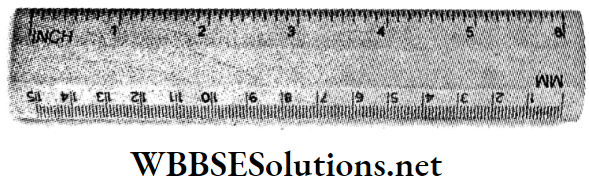
Answer: A scale is used for the measurement of length is to be placed on a straight line in such a way.

WBBSE Solutions For Class 9 Physical Science Chapter 1 Topic C Measurement Of Different Physical Quantities And Errors In Measurement Measuremnt Of Lenght Scale

The scale is generally made up of thin wood, plastic sheet, aluminium or steel. Its length could be 30 cm, 50 cm or 1 m.On the one side of the scale, the centimetre unit is graduated (marked) and on the other side, the unit inch is marked.

1 centimetre is divided in 10 equal parts, every smallest length being 1 millimetre. One inch is divided into 8 or 16 equal parts. In a metre scale, only millimetre and centimetre markings are present whereas in a foot scale, markings are in inch or its smaller parts.

Question 2. How would you measure the length of a straight line by an ordinary scale?

Answer: Suppose the length of a straight line AB is to be measured by an ordinary scale.

The scale is to be placed on the staright line im such a way that the straight line is along the length of the scale and the graduations of the scale are coincidental to the straight line.

Side A of the line is set to coincide with a fixed marking of the scale.

random errors vs systematic errors

In this case, it is prudent if side A coincides with a fixed cm. Now looking perpendicularly, reading of the side B is taken. The difference of the two readings gives the length of AB.

Length of line AB = reading of side B – reading of side A = 4.2 cm – 1 cm = 3.2 cm

Concepts Related to Accuracy and Precision in Measurements for Class 9 Solutions

Question 3. What is meant by parallax error?

Answer:

Parallax Error

While taking the readings of the two sides during measurement of length of a line by an ordinary scale, it is essential to look perpendicularly at the points of the reading.

Otherwise, the reading becomes erroneous. This error, which gives different readings due to different positions of the eyes, is called parallax error.

D is the correct position of the eye.

WBBSE Solutions For Class 9 Physical Science Chapter 1 Topic C Measurement Of Different Physical Quantities And Errors In Measurement

Question 4. How do you measure the thickness of a page of a book with the help of an ordinary scale?

Answer: It is not possible to measure directly a thickness of less than 1 mm by an ordinary scale.

As the thickness of a page is generally less than 1 mm, the thickness of a page is measured indirectly by an ordinary scale.

Suppose there are n number of pages in a book.

By compressing only the pages (excluding the covers) such that the thickness of layers of air between the pages is excluded, the thickness of the book is measured several times. The mean of the readings is, say, b.

WBBSE Solutions For Class 9 Physical Science Chapter 1 Topic C Measurement Of Different Physical Quantities And Errors In Measurement

Then, the thickness of each page is \(\frac{b}{n}\).

WBBSE Solutions For Class 9 Physical Science Chapter 1 Measurement Topic C Measurement Of Different Physical Quantities And Errors In Measurement

Question 5. How do you measure the length of a curved line with the help of a thread and an ordinary scale?

Answer: Measurement of the length of a curved line with the help of a thread and a scale:

A long thread is taken and an ink mark is made at one end (A) of the thread.

“examples of systematic errors “

Marked end of the thread is placed at one end point of the curved line and the thread is positioned along the curve till it reaches the other end point.

Another ink mark is made on the thread at position B.

Now, this thread is stretched over a scale and the length between the two marks on the thread is measured. This gives the length of the curved line by the thread and scale method.


WBBSE Solutions For Class 9 Physical Science Chapter 1 Topic C Measurement Of Different Physical Quantities And Errors In Measurement (2)

Question 6. How do you measure the diameter of a wire with the help of an ordinary scale?

Answer: It is not possible to directly measure a length less than 1 mm by scale. As the diameter of a thin wire is less than 1 mm, it is measured indirectly.

The wire is wound several times on a cylinder of small radius so that there is no gap between the rounds. Now with the help of a scale, total length of the wounds on the cylinder is measured.

Several measurements are made to take an average measure. Suppose the mean length of the wire is b. If the number of coils made is n, then diameter of wire is \(\frac{b}{n}\).

WBBSE Solutions For Class 9 Physical Science Chapter 1 Topic C Measurement Of Different Physical Quantities And Errors In Measurement Diameter Of A Wire

Question 7. Why is an ordinary scale made up of wood instead of metal?

Answer: Metal is a good conductor of heat. If the temperature of a metal scale is increased or decreased, its length increases or decreases.

As a result, the length between the two markings changes. Thus, a correct reading is obtained only at the temperature at which the scale was marked. If temperature increases, the correct reading is greater than the reading shown on the scale and if temperature decreases, the correct reading is smaller.

Wood is a bad conductor of heat. So, the increase or decrease of the length of wood with changing temperature is ignored. As a result, the reading shown in the scale may be assumed to be correct. Hence, an ordinary scale is made of wood instead of metal.

Question 8. Which instrument is used for the measurement of time? Describe a pendulum clock.

Answer: A clock is used for the measurement of time.

In a pendulum clock, a metal bob is attached to a metallic rod at one end and the other end is tied firmly with a fixed support and is suspended.

This is a pendulum. The length from the point of suspension to the centre of gravity of the bob is known as the working length. The pendulum oscillates in a periodic motion.

“accuracy in measurement “

There are two hands in the clock, the bigger one indicates minutes and the smaller one indicates hours. The clock works with the help of a spring which stores potential energy when it is wound.

This stored potential energy is the source of energy of a pendulum clock and is converted into kinetic energy. The clock needs to be wound at a regular interval as the clock stops working when the stored potential energy is exhausted.

WBBSE Solutions For Class 9 Physical Science Chapter 1 Topic C Measurement Of Different Physical Quantities And Errors In Measurement Pendulum Clock

Sample Solutions from WBBSE Class 9 Physical Science Chapter 1

Question 9. What type of watch is used in swimming and running competitions? What is the problem of using an ordinary clock in these cases?

Answer: Stopwatch is used in swimming and running competitions.

The ordinary clock cannot be started and stopped at will. But the stopwatch may be started and stopped according to our convenience.

Further, one can measure a minimum amount of one second by an ordinary clock whereas with the help of a modern digital stopwatch, a time interval of one-tenth of a second can be measured accurately.

WBBSE Solutions For Class 9 Physical Science Chapter 1 Topic C Measurement Of Different Physical Quantities And Errors In Measurement Stop Watch

Question 10. Mention different types of clocks.

Answer: We measure time with the help of clocks. The oldest clock is sundial. With the progress of science and technology, different types of clocks have been invented over the time.

Example: Pendulum clock, table clock, wrist watch, electronic digital watch, chronometer, caesium atomic clock etc.

Question 11. What is the inconvenience of expressing your age in seconds?

Answer: Let us suppose that the age of a person is 14 years. If this is converted to seconds, it becomes 14 x 365 x 86400 s = 441504000s.

Hence, if age is expressed in seconds, the number becomes enormous and is inconvenient to handle. For this reason, convenient units like year, month, day are used to express the age of a person.

Question 12. What is a metronome?

Answer: A metronome (electronic metronome) is a modern watch which measures time very accurately. This watch is used during the launching of artificial satellites.

Question 13. Which instrument is used for measurement of the mass of a body? Elaborate the principle used in the measurement of mass by this instrument.

Answer: Common balance is used for measurement of the mass of a body.

While measuring the mass of a body by a common balance, the body is kept in the left pan while some known standard weights are put in the right pan.

When the balance beam comes to a horizontal position, weight of the body in the left pan becomes equal to the standard weight placed in the right pan. This is the principle of measurement of mass.

NEET Biology Class 9 Question And Answers WBBSE Class 9 History Notes WBBSE Solutions for Class 9 Life Science and Environment
WBBSE Class 9 Geography And Environment Notes WBBSE Class 9 History Multiple Choice Questions WBBSE Class 9 Life Science Long Answer Questions
WBBSE Solutions for Class 9 Geography And Environment WBBSE Class 9 History Long Answer Questions WBBSE Class 9 Life Science Multiple Choice Questions
WBBSE Class 9 Geography And Environment Multiple Choice Questions WBBSE Class 9 History Short Answer Questions WBBSE Solutions For Class 9 Maths
WBBSE Solutions for Class 9 History WBBSE Class 9 History Very Short Answer Questions


Question 14. What do you mean by the sensitivity of a common balance? Write down the conditions for a common balance to be sensitive.

Answer: The sensitivity of a common balance is directly proportional to its capacity of measuring the slightest difference in the mass of a body.

The conditions for a common balance to be sensitive are:

  1. The arms should be long.
  2. The balance beam should be light.
  3. The pointer should be long.
  4. The centre of gravity of the common balance should be situated very near to the fulcrum.

Question 15. Explain whether the mass of a body or Its weight is measured by a common balance.

Answer: The mass of a body and not its weight is measured by a common balance.

While measuring the mass of a body by a common balance, it is placed in the left pan of the common balance and some standard weights are placed in the right pan.

O is the fulcrum of the balance and A, B are the left and right ends of the common balance, respectively.

WBBSE Solutions For Class 9 Physical Science Chapter 1 Topic C Measurement Of Different Physical Quantities And Errors In Measurement Measured By A Common Balance

if the acceleration due to gravity of the place is g, then in a horizontal state of the common balance, mass of the body x g x AO

= mass of the standard weights x g x OB or, mass of the body

= mass of the standard weights [AO = OB]

“errors of measurement “

Question 16. Why are the masses of the standard weights in a weight box kept in the ratio of 5:2:2:17.

Answer: The masses of the standard weights in a weight box are kept in the ratio of 5:2:2:1 so that any mass between 10 mg and 211.11 g can be measured using them.

WBBSE Solutions For Class 9 Physical Science Chapter 1 Topic C Measurement Of Different Physical Quantities And Errors In Measurement Weight Of The Box

Understanding Types of Measurement Errors for Solutions

Question 17. What are the qualities of a good common balance?

Answer: Qualities of a good common balance are:

  1. The common balance should be sensitive, that is, it should be able to measure the slightest difference in the mass of a body.
  2. The common balance must be strong.
  3. The common balance should be accurate, i.e., equal amount of masses put in the two pans should keep it horizontal.
  4. The common balance should be stable, i.e., its oscillation should be short-lived.
  5. The lengths of the arms and the masses of the two pans should be equal.

Question 18. Why is a sensitive common balance not stable?

Answer: A common balance is considerably sensitive if the centre of gravity of the common balance is situated very near to the fulcrum. Again, the balance is stable if the centre of gravity is well below the fulcrum.

Now, it is not possible to have two opposite conditions in the same common balance simultaneously. This is the reason why a very sensitive common balance is not stable.

Question 19. The lengths of the two arms of a common balance are equal, but the masses of the two scale pans are different. How do you determine the correct mass of a body?

Answer: Let the masses of the left and the right hand sides of the common balance be M1 and M2 respectively and the actual mass of the body is m.

If a mass m1 is put in the right pan by keeping the body in the left pan, the balance becomes horizontal.

∴ M1 + m = M2 + m1…(1)

Again, keeping the body in the right pan, putting a mass m2 in the left pan makes the balance horizontal.

∴ M1 + m2 = M2 + m……(2)

By subtracting equation (2) from (1), we get

m1 – m2 = m1 – m

or, 2m = m1 + m2 or, \(m=\frac{m_1+m_2}{2}\)

Question 20. The lengths of the two arms of a common balance are unequal but the masses of the two scale pans are equal. How would you measure the correct mass of a body?

Answer: Suppose the lengths of the left and the right sides of the common balance are given by x and taken as m.

The lengths of the arms and the masses of the balance becomes horizontal when by keeping two pans should be equal. the body in the left pan, a mass m1 is put in the right pan.

If the acceleration due to gravity at that place is given by g, then mxg = m1yg…(1)

Again, the balance becomes horizontal when by keeping the body in the right pan, a mass m2 is put in the left pan.

∴ m2xg = m1yg…….(2)

By adding equations (1) and (2), we get

\(\frac{m \times g}{m_2 \times g}=\frac{m_1 y g}{m y g} \text { or, } \frac{m}{m_2}=\frac{m_1}{m}\)

or, \(m^2=m_1 m_2 \quad or, m=\sqrt{m_1 m_2}\)

Question 21. What is a measuring cylinder? How do you measure the volume of a liquid with the help of a measuring cylinder? Or, How do you measure the volume of tea in a tea cup?

Answer: A measuring cylinder is a vessel made up of a strong glass closed at one end, with uniform cross section. This is used for the measurement of volume.

It has graduation marks in millilitres (cm3) on its exterior surface, along its length. Each cm3 is further divided into 5 or 10 equal parts.

To measure the volume of a liquid, it is poured inside the measuring cylinder and the reading of its upper surface is taken. While taking a reading, eyes have to be placed in a perpendicular direction to the point of observation.

For those liquids which wet the glass (like water), for which the upper surface is concave inside the cylinder, reading of the lowest portion of the concave surface is to be taken.

For those liquids which do not wet the glass (like mercury) and for which the upper surface is convex inside the cylinder, reading of the highest portion of the convex surface is to be taken.

WBBSE Solutions For Class 9 Physical Science Chapter 1 Topic C Measurement Of Different Physical Quantities And Errors In Measurement Measuring Cylinder

Question 22. How do you measure the volume of an irregular solid body with the help of a measuring cylinder?

Answer: To measure the volume of an irregular solid body with the help of a measuring cylinder, a measuring cylinder is taken whose inner volume is 4 to 5 times larger than the volume of the body and the area of its cross-section is such that the body may easily be entered inside the cylinder.

A liquid, in which the body does not dissolve or float or react chemically, is taken in the cylinder up to a certain height. Suppose the volume of the liquid in this condition is V1 cm3.

Now, a wax-coated, thin and strong thread is fastened with the body and the body is slowly immersed completely inside the liquid.

If the volume of the liquid, with the solid inside it is V2 cm3, then the volume of the body (V1 – V2) cm3.

If the volume of the immersed thread is deducted from this reading, the accurate volume of the body can be obtained.

WBBSE Solutions For Class 9 Physical Science Chapter 1 Topic C Measurement Of Different Physical Quantities And Errors In Measurement Irregular Solid Body

WBBSE Class 9 Measurement of Physical Quantities Solutions

Question 23. What are the precautionary measures to be taken while measuring the volume of an irregular solid body by a measuring cylinder?

Answer: Required precautionary measures are:

  1. A liquid, which neither dissolves nor reacts chemically with the body, has to be taken inside the measuring cylinder.
  2. The solid body has to be immersed very slowly in the liquid so that no liquid splashes out.
  3. The thread by which the solid body is wound has to be coated with wax so that the thread does not soak water.
  4. Reading has to be taken in such a way that there is no parallax error.
  5. No bubble of the body should stick to the wax is attached to the stone and it is dipped surface of the cylinder inside the liquid.

Question 24. How do you determine the rate of fall of water from a tap with the help of a volume-measuring cylinder and a stopwatch?

Answer: Rate of fall of water from a tap can be determined with the help of a volume-measuring cylinder and a stopwatch. Suppose water is falling from a tap at a uniform rate.

A dry and empty cylinder is held below a running tap and the stopwatch is switched on immediately. After accumulation of some water, the cylinder is removed from under the tap and the stopwatch is stopped simultaneously.

Readings of the measuring cylinder and the stopwatch gives the volume of water collected during a period. Suppose, V1 volume of water is collected during a time t1.

∴ rate of fall of water, \(W_1=\frac{V_1}{t_1}\)

In this way, several readings are to be taken and the mean of these gives the rate of fall of water which is reasonably error-free.

Unit of rate of fall of water is cm3/s if units of volume of water and time are taken as cm3 and second.

Question 25. How do you measure the volume of piece of stone which does not fit into a measuring cylinder?

Answer: A glass cylinder with an attached side pipe and with sufficient cross-sectional area is taken so that the piece of stone may fit into it.

If water is poured continuously in the above cylinder, it flows out by the side pipe at a particular time.

Now, if the pouring of water is stopped, water level stands just beneath the level of the side pipe.

The measuring cylinder is kept just below the side pipe. Now a thin and strong thread coated with wax is attached to the stone and it is dipped slowly into the water of the glass cylinder.

The stone displaces an equal amount of water of its volume which flows out by the side pipe into the measuring cylinder. The volume of water that is stored in the measuring cylinder is the volume of the piece of stone.

If the volume of the submerged thread is deducted from the last reading, the actual volume of the stone can be obtained.

WBBSE Solutions For Class 9 Physical Science Chapter 1 Topic C Measurement Of Different Physical Quantities And Errors In Measurement Volume Of Piece Of Sound

Question 26. How do you measure the density of a solid body with the help of a common balance and a measuring cylinder?

Answer: At first, the mass of the solid body is measured by the common balance. Suppose, m is the mass of the body. Now a measuring cylinder is taken whose area of cross section is sufficient for entry of the solid body inside the cylinder.

A particular liquid, that neither dissolves nor reacts chemically with the solid, is taken in the cylinder. Suppose, V1 is the volume of the liquid in the cylinder.

Now a thin, strong and wax-coated thread is fastened tightly around the body and is slowly dipped into the liquid of the cylinder.

Let the volume of the liquid with the solid be V2.

Hence, the volume of the body V2 – V1. Here, if the volume of the submerged thread is deducted from the reading V2-V1, actual volume of the body is obtained.

∴ Density of the body, \(d=\frac{m}{V_2-V_1}\)

Question 27. How do you measure the density of a liquid with the help of a common balance and a measuring cylinder?

Answer: At first, the mass of the measuring cylinder in a dry condition is measured by a common balance.

Suppose, the mass is m1.

Next the cylinder is nearly half-filled with the liquid whose density is being measured here.

Volume of the liquid is determined from the scale calibrated on the cylinder. Suppose, V is the volume of the liquid. The mass of the cylinder filled with the liquid is then measured by a common balance.

Suppose, m2 is the mass in this case.

∴ Mass of the liquid = m2 -m1

“types of errors in measurement “

∴ Density of the liquid = \(\frac{m_2-m_1}{V}\)

Question 28. How do you measure the volume of one drop water of a dropper with the help of a volume measuring cylinder?

Answer: 200 to 300 drops of water are dropped in a dry and empty measuring cylinder using the dropper. Volume of this quantity of water is measured.

Let the volume of water be V cm3 and let n drops of water have been dropped.

∴  Volume of 1 drop of water = \(\frac{V}{n} \mathrm{~cm}^3\)

Chapter 1 Topic C Measurement Of Different Physical Quantities And Errors In Measurement Very Short Answer Type Questions Choose The Correct Answer

Question 1. Smallest distance that can be measured by an ordinary scale is

  1. 0.1 cm
  2. 0.01 cm
  3. 0.001 cm
  4. 0.2 cm

Answer: 1. 0.1 cm

Question 2. The length which cannot be measured by an ordinary scale is

  1. 4.2 cm
  2. 2.13 cm
  3. 7.7 cm
  4. 9.5 cm

Answer: 2. 2.13 cm

Question 3. Lengths of the two arms of a common balance are equal but the two pans are of different masses. A body is found to be 20 g and 21 g when put in the left pan and the right pan, respectively. The actual mass of the body is

  1. 20.2 g
  2. 20.4 g
  3. 20.5 g
  4. 20.6 g

Answer: 3. 20.5 g

Question 4. In the weight box of a common balance, the weights are taken in the ratio of

  1. 5:3:2:1
  2. 5:4:2:1
  3. 5:2:2:1
  4. 5:3:3:1

Answer: 3. 5:2:2:1

Question 5. The physical quantity which is measured by a common balance is

  1. Volume
  2. Mass
  3. Weight
  4. Force

Answer: 2. Mass

Question 6. Which of the following instruments can be used to measure the volume of a wooden block of irregular shape?

  1. common balance
  2. Measuring cylinder
  3. Metre scale
  4. Stopwatch

Answer: 2. Measuring cylinder

Question 7. Which of the following is not a prerequisite for sensitivity of a common balance?

  1. Beam of the balance should be long
  2. The balance should be light
  3. The pointer should be small in size
  4. The centre of gravity should be very close to the fulcrum

Answer: 3. The pointer should be small in size

Question 8. Which of the following instruments does not function in a place where there is no gravity?

  1. Spring balance
  2. Common balance
  3. Ordinary scale
  4. Both A and R

Answer: 4. Both A and R

Question 9. When mass of a body is measured on the earth surface by a common balance its value becomes m kg. When the measurement is done on the moon’s surface it is m’kg.If gravitational force on the surface of the moon is only 1/6 as the gravitational force on the earth, then

  1. m = m’
  2. m = 1/6m’
  3. m = 6m’
  4. m = m’ = 0

Answer: 1. m = m’

Question 10. Time taken to complete one oscillation by a second pendulum is

  1. 1s
  2. 2s
  3. 3s
  4. 1/2 s

Answer: 2. 2s

Question 11. Which of the following can be used to measure the area of a metallic strip with irregular shape?

  1. Ordinary scale
  2. Common balance
  3. Graph paper
  4. String

Answer: 3. Graph paper

Chapter 1 Topic C Measurement Of Different Physical Quantities And Errors In Measurement Answer In Brief

Question 1. What is the use of a chronometer watch?

Answer: A chronometer watch gives the correct time at Greenwich, London and this time has been adopted as a global standard time.

Question 2. Name an instrument by which a length of 0.01 cm can be measured accurately.

Answer: A length of 0.01 cm can be measured accurately by using slide calipers.

Question 3. Name an instrument by which a length of 0.001 cm can be measured accurately.

Answer: A length of 0.001 cm can be measured accurately by using a screw gauge.

Question 4. What is the effective length of a pendulum clock?

Answer: The effective length of a pendulum clock is. measured from the point of suspension to the centre of mass of its bob.

Question 5. What type of energy is stored in the spring of a pendulum clock?

Answer: Potential energy is stored in the spring of a pendulum clock.

Important Concepts in Measurement of Physical Quantities for Class 9

Question 6. Which instrument is used to measure the mass of a body?

Answer: Common balance is used to measure the mass of a body.

Question 7. What is the ratio in which the weights are kept in a weight box?

Answer: Weights are kept in the ratio of 5:2:2:1 in a weighing box.

Question 8. What is least count?

Answer: The minimum measurement which can be performed by using an instrument in measuring a physical quantity, is called least count of this instrument.

Question 9. What is the minimum length that can be measured by a metre scale correctly?

Answer: The minimum length that can be measured by a metre scale is 0.1 cm or 1 mm.

Question 10. What is the maximum length that can be measured by a metre scale accurately?

Answer: 1 m or 100 cm is the maximum length that can be measured by a metre scale accurately.

Question 11. What is the maximum time that can be measured by a wall clock?

Answer: The maximum time that can be measured by a wall clock is 12 hours.

Question 12. What is the maximum mass that can be measured by a common balance using its weight box?

Answer: The maximum mass that can be measured by a common balance by using its weight box is 211.11 g.

Question 13. What is the use of rider of a common balance?

Answer: Rider is used in a common balance To measure a mass of less than 10 mg.

Question 14. What are the minimum and maximum measurement that can be measured by a measuring cylinder of volume 100 mL and 10 mL?

Answer: The minimum and maximum measurement of volume that can be measured by a measuring cylinder of 100 mL and 10 mL are 1 mL and 0.1 mL; 100 mL and 10 mL respectively.

Question 15. For measuring 72.05 g mass of a body what are the different weights in grams and milligrams to be taken from the weight box?

Answer: The weights that can be used are 50g, 20g, 2g and 50 mg.

Question 16. What can be used to measure the length of a curve line?

Answer: The length of a curve line can be measured by using a thread and a meter scale.

Question 17. What can be done to level the base of a common balance?

Answer: levelling screw can be used to balance the base of a common balance.

Chapter 1 Topic C Measurement Of Different Physical Quantities And Errors In Measurement Fill In The Blanks

Question 1. ________ cylinder and stopwatch can be used to measure the rate of flow of water from a tap.

Answer: Measuring

Question 2. _______ time is the minimum possible time that can be measured by a wrist watch.

Answer: 1s

Question 3. ________ is the minimum mass that can be measured by a common balance.

Answer: 10 mg

Question 4. Very small time intervals are measured by _______

Answer: Stopwatch

Question 5. Number of hour hand in stop watch is _______

Answer: Zero

Chapter 1 Topic C Measurement Of Different Physical Quantities And Errors In Measurement State Whether True Or False

Question 1. Common balance is used for the measurement of the weight of an object.

Answer: False

Question 2. Determination of area of a regular shaped sheet can not be done by using a graph paper.

Answer: False

Question 3. Digital clock is used for accurate measurement of time.

Answer: True

Question 4. Common balance can work even in the place where there is no gravity.

Answer: True

Question 5. Volume of an irregular shaped body can be measured by a measuring cylinder.

Answer: True

Question 6. Mass of a body can be measured by a spring balance even in a place where there is no gravity.

Answer: False

Chapter 1 Topic C Measurement Of Different Physical Quantities And Errors In Measurement Numerical Examples

Percentage of error in the measurment of length by a metre scale is

= \(\frac{\text { value of the smallest division of the scale }}{\text { measured length }}\) x 100%

Then actual mass of the body m = √m1m2.

“types of errors in measurement “

A common balance have equal lengths of arms but to different masses of pans.

If m1 and m2 be the measured of a body when it is kept on right and left pan respectively

Percentage of error in the measurement of but of different masses of pans. If m1 and m2 be the measured masses of a body when it is kept on right and left pan respectively.

Then actual mass of the body \(m=\frac{m_1+m_2}{2}\)

Vernier constant (c) = length of 1 main scale division-length of 1 vernier scale division measurement of length (l)= main scale reading + vernier scale reading x vernier constant.

Question 1. The two arms of the balance beam of a common balance are unequal but the masses of the two scale pans are equal. When a body is weighed at first in the left pan and then in the right pan, 8 g and 12.5 g are obtained respectively as masses. What is the real mass of the body?

Answer: If the masses of the body are m1 and m2 in the two cases,

m1 = 8g and m2 = 12.5 g

∴ real mass of the body,

\(m =\sqrt{m_1 m_2}=\sqrt{8 \mathrm{~g} \times 12.5 \mathrm{~g}}\)

= \(\sqrt{100 \mathrm{~g}^2}=10 \mathrm{~g}\)

Question 2. 5.00 cm length is measured by a scale whose vernier constant is 0.01 cm. Find percentage of error in this measurement.

Answer: Maximum possible error in the measurement by this scale is = 0.01 cm.

∴ Percentage of error = \(\frac{0.01}{5.00} \times 100 \%=0.20 \%\)

Practice Problems for Chapter 1 Measurement Errors

Question 3. In a measuring cylinder 1 ml is divided into 10 equal divisions. Volume of liquid is measured by it and the reading is 25 ml. Find percentage of error in this measurement.

Answer: Here least count of the measuring cylinder is = \(\frac{1}{10}\) mL = 0.1 mL

Measured volume of the liquid = 25 mL.

“types of errors in measurement “

∴ Percentage of error in measurement of volume \(\frac{0.1}{25}\) = 0.4

Question 4. The two arms of a common balance are equal but masses of the two pans are different. The measured mass of a body when placed in the left pan is 10 g and that of the body when placed in the right pan is 10.2 g. Find exact mass of the body.

Answer: The measured mass of a body in the two cases are m1 = 10 g and m2 = 10.2 g.

∴ Exact mass of the body

\(m=\frac{m_1+m_2}{2}=\frac{10+10.2}{2}=10.1 \mathrm{~g}\)

Chapter 1 Topic C Measurement Of Different Physical Quantities And Errors In Measurement

1. Match the physical quantities in column A with their respective units in coloumn B.

WBBSE Solutions For Class 9 Physical Science Ch 1 Topic C Measurement Of Different Physical Quantities And Errors In Measurement Match The Column 1

Answer: 1. D, 2. A, 3. B, 4. C

2.

WBBSE Solutions For Class 9 Physical Science Ch 1 Topic C Measurement Of Different Physical Quantities And Errors In Measurement Match The Column 2

Answer: 1. C, 2. A, 3. D, 4. B

WBBSE Solutions For Class 9 Physical Science Chapter 1 Measurement Topic B Dimension

Chapter 1 Topic B Dimension Synopsis

Dimension of physical quantity is the power or index to which fundamental units like mass, length, time, etc are raised to express that quantity.

The dimensional formula is the relationship between a physical quantity and the dimension of its fundamental units.

Example: Dimensional formula of force = MLT-2.

Dimensional equation is the equation by which any physical quantity is expressed in terms of dimensional formula.

Example: Dimensional equation of force is [F]= MLT-2.

1. The value of a constant in a dimensional equation can not be determined by using dimensional analysis.

Read and Learn More WBBSE Solutions for Class 9 Physical Science and Environment

Example: The time period of a simple pendulum is \(T=k \sqrt{\frac{1}{g}}\)

Where l is length, g is acceleration due to gravity and k is a constant.

We can not determine the value of the constant k by using dimensional analysis.

2. The relation containing a constant which is not dimensionless can not be established by dimensional analysis.

Example: We can not find the law of mm2 from dimensional gravitation \(F=G \frac{m_1 m_2}{d^2}\) analysis because G is not dimensionless.

Class 9 Physics Chapter 1 Dimensions

Chapter 1 Topic B Dimension Short And Long Answer Type Questions

Question 1. What do you mean by the dimension of a physical quantity? What is dimensional formula?

Answer:

  1. Dimension of a physical quantity is the power or index to which fundamental units like mass, length, time, etc are raised to express that quantity.
  2. Dimensional formula is the relationship between a physical quantity and the dimension of its fundamental units.

Question 2. What is dimensional equation?

Answer:

Dimensional equation is the equation by which any physical quantity is expressed in terms of dimensional formula.

Question 3. How are the dimensional formulae of fundamental physical quantities expressed

Answer:

There are seven fundamental units in SI. These are length, mass, time, temperature, electric current, luminous intensity, and quantity of matter, units of which are considered as fundamental units.

These dimensional formulas are denoted as L, M, T, Θ, I, J, and N, respectively.

WBBSE Solutions For Class 9 Physical Science Chapter 1 Measurement Topic B Dimension

Question 4. Write down the dimensional formula and dimensional equation of velocity.

Answer:

Velocity is the rate of change of displacement with time.

∴ \(\text { unit of velocity }=\frac{\text { unit of displacement }}{\text { unit of time }}\)

= \(\text { unit of length } \times(\text { unit of time })^{-1}\)

∴ dimension of velocity is 1 in length and -1 in time.

Dimensional formula of speed is LT-1.

If velocity is expressed by v, then dimensional equation of velocity is [v] = LT-1.

WBBSE Class 9 Dimensions Solutions

Question 5. Write down the dimensional formula and dimensional equation of force.

Answer:

Force = mass x acceleration

∴ unit of force

= unit of mass x unit of acceleration

= \(\text { unit of mass } \times \frac{\text { unit of length }}{(\text { unit of time })^2}\)

= \(\text { unit of mass } \times \text { unit of length }\) x \(\times(\text { unit of time })^{-2}\)

∴ dimension of force is 1 in mass; 1 in length and -2 in time.

Dimensional formula of force is MLT-2.

If force is expressed by F, then dimensional equation of force is [F] = MLT-2.

Question 6. Write down the dimensional formula and dimensional equation of a physical quantity x whose dimension is 0 in mass, 1 in length, and -2 in time.

Answer:

Since the dimension of the quantity is 0 in mass, 1 in length, and -2 in time, the dimensional formula of the quantity is M0LT-2.

Dimensional equation of the quantity is [x] = M0LT-2.

Question 7. The dimensional equation of a physical quantity x is [x] = M-2L3T-1. Write down the dimension and the dimensional formula of the quantity.

Answer:

Here, [x] = M-2L3T-1.

∴ Dimension of the quantity is -2 in mass, 3 in length, and -1 in time.

Dimensional formula of the quantity is M-2L3T-1

Class 9 Physics Chapter 1 Dimensions Long Answer Questions

Question 8. Show that plane angle is a dimensionless physical quantity.

Answer:

Magnitude of an angle in radian

\((\theta)=\frac{\text { length of arc }(s)}{\text { radius of the circle }(r)}\)

∴ Dimentional formula of angle

= \(\frac{\text { Dimensional formula of length of arc }}{\text { Dimensional formula of radius }}\)

= \(\frac{L}{L}=L^0\)

∴ Plane angle is a dimensionless physical quantity.

NEET Biology Class 9 Question And Answers WBBSE Class 9 History Notes WBBSE Solutions for Class 9 Life Science and Environment
WBBSE Class 9 Geography And Environment Notes WBBSE Class 9 History Multiple Choice Questions WBBSE Class 9 Life Science Long Answer Questions
WBBSE Solutions for Class 9 Geography And Environment WBBSE Class 9 History Long Answer Questions WBBSE Class 9 Life Science Multiple Choice Questions
WBBSE Class 9 Geography And Environment Multiple Choice Questions WBBSE Class 9 History Short Answer Questions WBBSE Solutions For Class 9 Maths
WBBSE Solutions for Class 9 History WBBSE Class 9 History Very Short Answer Questions


Chapter 1 Topic B Dimension Very Short Answer Type Questions Choose The Correct Answer

Question 1. Which of the following quantities has a unit but no dimension?

  1. Strain
  2. Atomic weight
  3. Angle
  4. None of the above

Answer: 3. Angle

Question 2. Dimensional formula of force is

  1. MLT-3
  2. M2LT-2
  3. ML-1T-2
  4. MLT-2

Answer: 4. MLT-2

Question 3. Solid angle has

  1. Both dimension and unit
  2. Only dimension but no unit
  3. Only unit but no dimension
  4. Neither dimension nor unit

Answer: 3. Only unit but no dimension

Question 4. Strain has

  1. Both dimension and unit
  2. Only dimension but no unit
  3. Only unit but no dimension
  4. Neither dimension nor unit

Answer: 4. Neither dimension nor unit

Practice Questions for Chapter 1 Dimensions

Question 5. Dimension of time in the dimensional formula of power is

  1. -1
  2. -2
  3. -3
  4. -4

Answer: 3. -3

Question 6. Dimension of absolute humidity is ML-3. It is similar to the dimension of

  1. Mass
  2. Density
  3. Specific gravity
  4. Area

Answer: 2. Density

Question 7. Dimensional formula of a dimensionless physical quantity is

  1. M0L0T0
  2. MLT
  3. M2LT-2
  4. None of these

Answer: 1. M0L0T0

Class 9 Physics Chapter 1 Dimensions very short Answer questions

Question 8. Dimensional formula of weight is

  1. MLT-2
  2. ML-1T-2
  3. M-1LT-2
  4. MLT-3

Answer: 1. MLT-2

Question 9. Which two physical quantities of the following have same dimensional formula?

  1. Velocity, speed
  2. Displacement, work done
  3. Force, momentum
  4. Velocity, acceleration

Answer: 1. Velocity, speed

Question 10. Dimensionless physical quantity is

  1. Mass
  2. Specific heat
  3. Weight
  4. Atomic weight

Answer: 4. Atomic weight

Question 11. ML-1T-2 is dimensional formula of

  1. Acceleration
  2. Density
  3. Force
  4. Pressure

Answer: 4. Pressure

Question 12. Dimensional formula of surface tension is

  1. MLT-2
  2. MT-2
  3. MT-1
  4. LT-1

Answer: 2. MT-2

Question 13. In A=B+C equation

  1. Dimension of A and C are same but that of B is different
  2. Dimension of A, B, and C are equal
  3. A, B, and C all have different dimension
  4. Dimension of a and b are same but that of c is different

Answer: 2. Dimension of A, B, and C are equal

Question 14. in (P+a/V2) (V-b) = RT equation dimensional formula is

  1. MLT-2
  2. ML2T-1
  3. ML5T-2
  4. ML3T-2

Answer: 3. ML5T-2

Chapter 1 Topic B Dimension Answer In Brief

Question 1. Give example of two physical quantities which do not have any dimension or unit.

Answer: Atomic mass and specific gravity are two physical quantities which do not have any dimension or unit.

Question 2. Give an example of a dimensionless physical quantity which has unit.

Answer: Angle is a physical quantity which is dimensionless but has unit (radian).

Question 3. Write dimension of acceleration.

Answer: Acceleration has dimension 1 in length, 0 in mass, and -2 in time.

Question 4. Give an example of a physical quantity which have unit but no dimension.

Answer: Angle is such a physical quantity which have unit (radian) but no dimension.

Question 5. Give example of two physical quantities which have no unit and dimension.

Answer: Atomic weight and specific density are two such physical quantities which have no unit and dimension.

Important Concepts in Dimensions for Class 9

Question 6. Write dimensional formula of velocity.

Answer: Dimensional formula of velocity is LT-1.

Question 7. Which physical quantity have dimensional formula ML-1T-2?

Answer: Pressure is a physical quantity which have dimensional formula ML-1T-2. (strain also have dimensional formula ML-1T-2).

Question 8. A physical quantity have unit °F-1. Write dimensional formula of the physical quantity.

Answer: Dimensional formula of the physical quantity is K-1.

Chapter 1 Topic B Dimension Fill In The Blanks

Question 1. _____________ of two sides of a correct equation or relation is always same.

Answer: Dimension

Question 2. Angle is a ____________ physical quantity.

Answer: Dimensionless

Question 3. Nuclear density is a dimensionless quantity. Its dimensional formula is __________

Answer: M0L0T0

Question 4. All the terms on the two sides of a physical equation must have the _______ dimension.

Answer: Same

Question 5. Dimension of atomic weight is _______

Answer: M0L0T0

Question 6. _________ is such a physical quantity whose dimension is T-1

Answer: Frequency

Question 7. Pressure and _________  both have the dimensional formula.

Answer: Stress

Chapter 1 Topic B Dimension State Whether True Or False

Question 1. Dimensional formula is the relationship between a physical quantity and the dimension of its fundamental units.

Answer: True

Question 2. Dimensional formula of kinetic energy is ML2T-2.

Answer: True

Chapter 1 Topic B Dimension Numerical Examples

Key Information:

In any mathematical equation involving physical quantities, each term on either side of the equation must have the same dimension.

Question 1. The two arms of the balance beam of a common balance are equal but the masses of the two scale pans are different. When a body is weighed first in the left pan and then in the right pan, 10 g and 10.2 g are obtained respectively as masses. What is the real mass of the body?

Answer:

If the masses of the body are m1 and m2 in the two cases, m1 = 10g and m2 = 10g.

∴ Real mass of the body,

\(m=\frac{m_1+m_2}{2}=\frac{10 \mathrm{~g}+10.2 \mathrm{~g}}{2}=10.1 \mathrm{~g}\)

Question 2. In P = \(\frac{W}{t}\) equation p, W, and t are power, work done, and time. Find dimensional formula of P.

Answer:

Here P = \(\frac{W}{t}\)

∴ Dimensional formula of P is

\([P]=\left[\frac{W}{t}\right]=\frac{M L^2 \mathrm{~T}^{-2}}{\mathrm{~T}}=\mathrm{ML}^2 \mathrm{~T}^{-3}\)

Concepts Related to Fundamental and Derived Dimensions for Class 9 Solutions

Question 3. Buoyancy of a body is equal to the weight of the displaced liquid by the body. By using this relation find dimensional formula of buoyancy.

Answer:

Buoyancy = weight of the displaced liquid

= v.ρ.g[where v is the volume of the displaced liquid of density ρ and g is acceleration due to gravity]

∴ Dimensional formula of buoyancy = [vρg]=L3.ML-3.LT-2 = MLT-2

Question 4. Velocity of a particle is \(v=a t^2+\frac{b}{t+c}\) where t is time. Find dimensional formula of a, b, and c.

Answer:

Here, the equation is \(v=a t^2+\frac{b}{t+c}\)

∴ Dimensional formula of the left hand side is [v] = LT-1

Now [at2] = [a]T+2 = LT-1

∴ [a] = LT-3

Again, \(\frac{[b]}{[t]+[c]}=\mathrm{LT}^{-1} \text { or, } \frac{[b]}{\mathrm{T}}=\mathrm{LT}^{-1}\)

∴ Dimensions of a, b, and c are LT-3, L, and T.

Question 5. Vander Waals equation is \(\left(p+\frac{a}{v^2}\right)(v-b)\) = RT. Find dimension of a and b.

Answer:

\(\frac{a}{v^2}\) is added to pressure. So its dimension would be the same as that of pressure P.

∴ \({[P]=\left[\frac{a}{v^2}\right] \text { or, } \mathrm{ML}^{-1} \mathrm{~T}^{-2}=\frac{[a]}{\left(\mathrm{L}^3\right)^2}}\)

∴ \({[a]=M L^{6-1} \mathrm{~T}^{-2}=\mathrm{ML}^5 \mathrm{~T}^{-2}}\)

Again b is subtracted from v. So its dimension would be the same as that of volume v.

∴ [v] = [b]

or, [b] = L3

Question 6. In \(s=\frac{1}{2} a t^2\) equation, s, a and t are displacement, acceleration, and time. By using dimensional analysis check whether the equation is correct or not.

Answer:

The equation is \(s=\frac{1}{2} a t^2\)

∴ Dimension of the left hand side is = [s] = L and dimension of the right-hand side is

= \(\left[\frac{1}{2} a t^2\right]=\mathrm{LT}^{-2} \cdot \mathrm{T}^2=\mathrm{L}\)

∴ Dimension of the L.H.S= dimension of the R.H.S.

∴ The equation is dimensionally correct.

Question 7. In the K = It + mt2 + nt3 equation t and K are expressed in second and m/s respectively. Find SI unit of I and n, where l, m, and n are three physical quantities.

Answer:

According to the principle of dimensional homogeneity, in any mathematical expression or equation involving physical quantities, each term on either side of the equation must have the same dimension.

Here, dimension of K is = [K] = LT-1

∴ Dimension of It is [It] = [K] or, [I]T=LT-1

∴ [l] = LT-2

∴ Unit of in SI is m · s-2.

Again, dimension of nt3 is [nt3] = [n]T3 = LT-1

∴ \([n]=\frac{\mathrm{LT}^{-1}}{\mathrm{~T}^3}=\mathrm{LT}^{-4}\)

∴ Unit of n in Sl is m · s-4.

Study Guide for Class 9 Measurement and Dimensions Questions

Question 8. Dimensional formula of three physical quantities A, B, and C are MLT-2, ML2T-3, and LT-1 respectively. Show that the equation A = \(\frac{B}{C}\) is dimensionally correct.

Answer: For the given equation, dimensional formula of the left hand side is

[A] = MLT-2 and dimensional formula of the right-hand side is

= \(\left[\frac{B}{C}\right]=\frac{\mathrm{ML}^2 \mathrm{~T}^{-3}}{\mathrm{LT}^{-1}}=\mathrm{MLT}^{-2}\)

∴ \({[A]=\left[\frac{B}{C}\right] . \quad therefore[A]=\left[\frac{B}{C}\right]}\) equation is dimensionally correct.

Sample Solutions from WBBSE Class 9 Physical Science Chapter 1

Question 9. Time period of a simple pendulum is T = \(2 \pi \sqrt{\frac{1}{g}}\), where l is effective length of the pendulum and g is acceleration due to gravity. Using dimensional analysis verify whether the equation is correct or not.

Answer:

Here time period of a simple pendulum is T = \(2 \pi \sqrt{\frac{1}{g}}\)

∴ Dimension of the left hand side of the equation is [T] = T and dimension of the right hand side is

= \(2 \pi \sqrt{\frac{1}{g}}=\left[L^{\frac{1}{2}} \cdot L^{-\frac{1}{2}} T^{+\frac{2}{2}}\right] \text {, as }[g]=L T^{-2}\)

= \(L^{\frac{1}{2}}-\frac{1}{2} \cdot T^{+1}=T\)

∴ T= \(2 \pi \sqrt{\frac{1}{g}}\) equation is dimensionally correct.

WBBSE Solutions For Class 9 Physical Science Chapter 3 Matter Structure And Properties Topic B Surface Tension

Chapter 3 Topic B Surface Tension Synopsis

What is surface tension

Surface tension

  1. Tangential force per unit length on a liquid surface that acts perpendicularly with a line imagined on the free surface of a liquid is called surface tension of the liquid.
  2. If length of the line = l and force acting on the line = F, then surface tension, S = \(\frac{F}{l}\)
  3. Units of surface tension in CGS system and SI are dyn/cm and N/m, respectively.
  4. Dimensional formula of surface tension is MT-2
  5. If temperature increases, surface tension of a liquid decreases. The particular temperature, at which surface tension of the liquid becomes zero is called critical temperature.
  6. If at any point of the flow line during the flow of a fluid, magnitude and direction of the flow remains unchanged, then that flow is called streamline flow or laminar flow.
  7. In case of a streamline motion, the path followed by a particle in the fluid is called streamline.
  8. A tangent drawn at any point of a streamline indicates the direction of velocity of the fluid at that point.
  9. If at any point of a flow line during the flow of a fluid, magnitude and direction of the flow changes in a haphazard way, then that flow is called turbulent flow. If the velocity of the fluid exceeds the critical velocity, then the flow becomes turbulent. In a turbulent motion, whirls are created at different places of the fluid.

Read and Learn More WBBSE Solutions for Class 9 Physical Science and Environment

Chapter 3 Topic B Surface Tension Short And Long Answer Type Questions

Question 1. What do you mean by surface tension? Which natural phenomena gives us ideas about surface tension?

Answer:

Surface tension

A tangential force per unit length on a liquid surface that acts perpendicularly with a line imagined on the free surface of a liquid is called surface tension of the liquid.

If length of the line = l and force acting on the line = F, then surface tension, S = \(\frac{F}{l}\).

Water droplets, raindrops, soap bubble, air bubbles inside water, etc. are spherical in shape due to surface tension.

Question 2. What do you mean by cohesive force and adhesive force?

Answer:

Cohesive Force:

Molecules always attract each other. The force of attraction between like molecules of the same element is called cohesive force.

Adhesive Force:

The force of attraction between unlike molecules of a different type is called adhesive force.

WBBSE Solutions For Class 9 Physical Science Chapter 3 Matter Structure And Properties Topic B Surface Tension

Question 3. What do you understand by molecular range?

Answer:

Molecular range

Theoretically, cohesive and adhesive forces are supposed to act up to an infinite distance but in reality, it is seen that this force is felt up to a definite distance (r ≈10-7 cm) and afterwards, its influence is insignificant.

The measure of this distance is called molecular range. So, molecular range is defined as the maximum distance up to which mutual cohesive and adhesive forces between the molecules of a material remains effective.

Class 9 Physical Science Chapter 3 Surface Tension Short And Long Answer Type Questions

Question 4. With the help of a simple experiment, how can you prove that surface tension is working on the free surface of a liquid?

Answer:

If a needle or a blade is floated in water, it sinks.

But if the same needle or blade is kept on a piece of newspaper or on a blotting paper and then floated, it is seen after some time that the paper has became heavier by soaking water. At one point of time, the piece of paper sinks in water but the needle or the blade is found floating on the surface of water.

WBBSE Solutions For Class 9 Physical Science Chapter 3 Topic B Surface Tension Surface Tension Is Working On the Free Surface Of A Liquid

If a small amount of pressure is given by the finger on a tightly held rubber membrane, it is found that the membrane is slightly depressed around the finger. In the same way, water surface is slightly depressed along the side adjacent to the needle or the blade.

From this experiment, it is proved that surface tension is working on the free surface of a liquid.

NEET Biology Class 9 Question And Answers WBBSE Class 9 History Notes WBBSE Solutions for Class 9 Life Science and Environment
WBBSE Class 9 Geography And Environment Notes WBBSE Class 9 History Multiple Choice Questions WBBSE Class 9 Life Science Long Answer Questions
WBBSE Solutions for Class 9 Geography And Environment WBBSE Class 9 History Long Answer Questions WBBSE Class 9 Life Science Multiple Choice Questions
WBBSE Class 9 Geography And Environment Multiple Choice Questions WBBSE Class 9 History Short Answer Questions WBBSE Solutions For Class 9 Maths
WBBSE Solutions for Class 9 History WBBSE Class 9 History Very Short Answer Questions


Question 5. Write down the influence of different factors on surface tension.

Answer:

The influence of different factors on surface tension

Surface tension of a liquid depends on the following factors:

Temperature:

If temperature increases, surface tension of the liquid decreases. At a particular temperature, surface tension of a liquid becomes zero. This is called the critical temperature.

Pollution:

If the water surface is polluted by some material, there is a change of surface tension. For example, surface tension decreases if oil or fat is spread on water.

Presence Of A Solute:

The surface tension of a liquid changes, if any other material is dissolved in the liquid. For example, surface tension increases if any inorganic substance is dissolved in water and surface tension decreases, if any organic substance is dissolved in water.

Medium Above The Surface Of Liquid:

Surface tension depends on the medium present above the free surface of the liquid. At ordinary temperature, if dry air is present above water, surface tension of water is 72 dyn/cm. At the same temperature, if water vapour is present above water, surface tension is reduced to 70 dyn/cm.

Question 6. A circular ring made of thin wire is dipped in soap water and then withdrawn, a small water-soaked knot of thread is on the ring and finally, a hole is made in the knot by means of a needle. Explain what happens.

Answer:

Experiment:

A ring made of thin wire is dipped into soap water. It is found that a thin film of soap water has been formed in the ring. This is the free surface of the liquid. A small knot made of thread is soaked in soap water and kept on the film formed in the ring. It is seen that the knot is lying on the film in a haphazard way.

Now a pointed pin is taken to pierce the film inside the knot. It is seen that the knot is stretched to take a spherical shape. In this condition also, the film of soap formed in between the ring and the knot of thread remains intact.

WBBSE Solutions For Class 9 Physical Science Chapter 3 Topic B Surface Tension A Circular Ring Made Of Thin Wire Is Dipped In Soap Water And Then Withdrawn

Conclusion:

  1. At first, equal and opposite forces act in the inside and outside of every point of the knot of thread due to surface tension. Therefore, at every point of the thread at that time, total force due to surface tension is zero. For this reason, thread is lying on the film in a haphazard and static manner.
  2. Afterwards, when the film inside the knot is pierced, equal forces act in a tangential way to the free surface at every point outside the thread of the knot. Due to this reason, the thread takes a spherical shape.

Class 9 Physical Science Chapter 3 Surface Tension Short And Long Answer Type Questions

Question 7. Why is a small water drop or a mercury drop spherical in shape?

Answer:

A small water drop or a mercury drop spherical in shape because

Due to cohesive forces between the molecules of a liquid, there is always a tension acting on the free surface of a liquid for which a liquid wants to reduce the free surface of its area. This tendency of contraction of the area of free surface is called surface tension.

WBBSE Solutions For Class 9 Physical Science Chapter 3 Topic B Surface Tension A Small Water Drop Or A Mercury Drop Spherical In Shape

Of all the spherical bodies that may be constructed with a given specific volume, a sphere has the minimum area. A small water drop or a mercury drop takes the shape of a sphere only due to surface tension.

As a water drop or mercury drop always wants to reduce the area of its free surface, it takes a spherical shape. But as there is some influence of gravity on them, a large sized water drop or mercury drop is slightly distorted.

Question 8. If a painting brush is soaked in water and then taken out, the hairs stick to each other. why?

Answer:

If a painting brush is soaked in water, it is found that the hairs stick out from each other. Now if the brush is taken out of the water, it is observed that the hairs stick together.

After it is brought out of water, a coating of water is formed in the hairs of the brush. This coating of water tries to reduce the area of the free surface due to the property of surface tension. As a result, the hairs stick to each other.

WBBSE Solutions For Class 9 Physical Science Chapter 3 Topic B Surface Tension A Circular Ring Made Of Thin Wire Is Dipped In Soap Water Then Withdrawn

Question 9. If oil is poured on a rough sea, it calms down—explain.

Answer:

If oil is poured on a rough sea, it calms down

If oil is poured on water, surface tension of water reduces. If some amount of oil is poured on a rough sea, oil spreads in the direction of the movement of air. As a result, surface tension of oily water reduces.

Class 9 Physical Science Chapter 3 Surface Tension Short And Long Answer Type Questions

Pure water having greater surface tension which remains just behind the oily water drags water backwards with less surface tension. As a result, waves of lesser heights are produced than before and as a result, the rough sea calms down.

Question 10. If A piece of camphor is thrown on water, the piece keeps moving on water in a haphazard way. why?

Answer:

If A piece of camphor is thrown on water, the piece keeps moving on water in a haphazard way.

Camphor is soluble in water. The place where water mixes with camphor gets a reduced surface tension. Now the surrounding area of water, having higher surface tension drags the surface having low surface tension towards itself.

The camphor also moves along the surface of low surface tension to the surface of high surface tension, where it again gets soluble with water and reduces the surface tension of that region.

Thus in this way, a non-uniform force acts on camphor due to this non-uniform surface tension of water, causing the camphor to move in a haphazard manner on water.

Chapter 3 Topic B Surface Tension Very Short Answer Type Questions Choose The Correct Answer

Question 1. At critical temperature, the surface tension of a liquid is

  1. Zero
  2. Maximum
  3. 100 dyn/cm
  4. 200 dyn/cm

Answer: 1.  Zero

Question 2. Dimensional formula of surface tension is

  1. MT-2
  2. MT-1
  3. M-1T-2
  4. MLT-2

Answer: 1. MT-2

Class 9 Physical Science Chapter 3 Surface Tension Very Short Answer Type Questions Choose The Correct Answer

Question 3. Unit of surface tension in SI is

  1. N
  2. N•m
  3. N•m-1
  4. N•m-2

Answer: 3. N•m-1

Question 4. If temperature is increased, surface tension of a liquid

  1. Increases
  2. Remains unchanged
  3. Decreases
  4. Increases at first, and then decreases

Answer: 3. Decreases

Question 5. If water vapour is present above water instead of dry air, surface tension of water

  1. Increases
  2. Decreases
  3. Remains unchanged
  4. Increases or decreases depending on the amount of water vapour

Answer: 2. Decreases

Question 6. A blade is floating on water. This phenomenon is mainly due to

  1. Viscosity
  2. Gravity
  3. Buoyancy
  4. Surface tension

Answer: 4. Surface tension

Class 9 Physical Science Chapter 3 Surface Tension Very Short Answer Type Questions Choose The Correct Answer

Question 7. If oil is poured on a rough sea, then the sea becomes calm. This is due to

  1. Viscosity
  2. Surface tension
  3. Buoyancy
  4. None of these

Answer: 2. Surface tension

Question 8. Surface tension is a general property of

  1. Solids
  2. Liquids
  3. Gases
  4. All of these

Answer: 2. Liquids

Class 9 Physical Science Chapter 3 Surface Tension Very Short Answer Type Questions Choose The Correct Answer

Question 9. The upper surface of mercury is convex due to

  1. Surface tension
  2. Viscosity
  3. Density
  4. Pressure

Answer: 1. Surface tension

Question 10. Which of the following shapes (of equal volume) has minimum surface area?

  1. Sphere
  2. Cone
  3. Cylinder
  4. Cuboid

Answer: 1. Sphere

Class 9 Physical Science Chapter 3 Surface Tension Very Short Answer Type Questions Choose The Correct Answer

Question 11. When a piece of camphor is put on water, it darts in different direction. This is due to

  1. Viscosity
  2. Vapour density
  3. Humidity
  4. Surface tension

Answer: 4. Surface tension

Chapter 3 Topic B Surface Tension Answer in Brief

Question 1. What do we call the force of attraction between two molecules of the same material?

Answer: Force of attraction between two molecules of the same material is called cohesion.

Question 2. What do we call the force of attraction between two molecules of different materials?

Answer: Force of attraction between two molecules of different materials is called adhesion.

Question 3. What do we call the tendency of the surface area of the free surface of a liquid to contract?

Answer: The tendency of the surface area of the free surface of a liquid to contract is called surface tension.

Question 4. What is the dimensional formula of surface tension?

Answer: Dimensional formula of surface tension is MT-2.

Question 5. With rise of temperature, does the surface tension of a liquid increase or decrease?

Answer: Surface tension decreases with rise of temperature.

Question 6. At what temperature, does the surface tension of a liquid become zero?

Answer: At critical temperature, surface tension of a liquid becomes zero.

Question 7. If some inorganic material is dissolved in water, does the surface tension increase or decrease?

Answer: Surface tension increases if some inorganic material is dissolved in water.

Question 8. If some organic material is dissolved in water, does the surface tension increase or decrease?

Answer: Surface tension decreases if some organic material is dissolved in water.

Question 9. In place of dry air, if water vapour is present over a water surface, then does the surface tension increase or decrease?

Answer: In place of dry air, if water vapour is present over a water surface, then surface tension decreases.

Question 10. Does surface tension work inside a liquid?

Answer: No, surface tension does not work inside a liquid.

Question 11. What is the power of’ L’ in the dimensional formula of surface tension?

Answer: Power of ‘L’ in the dimensional formula of surface tension is zero.

Chapter 3 Topic B Surface Tension Fill In the Blanks

Question 1. If inorganic material is dissolved in water, its surface tension _________

Answer: Increases

Question 2. Surface tension becomes zero at ________ temperature.

Answer: Critical

Question 3. Due to _________ equal force acts in every direction along the surface of a liquid at every point.

Answer: Surface tension

Question 4. When a laminar flow of liquid takes place over a firmly held horizontal plane, velocity of the liquid layer in contact with the bottom surface becomes _________

Answer: Zero

Question 5. Due to the property of ______, raindrops are spherical in shape.

Answer: Surface tension

Question 6. A blade can float on water due to the property of ______ of water.

Answer:  Surface tension

Question 7. The tendency of a liquid surface to ________ its area is called surface tension.

Answer: Scalar

Chapter 3 Topic B Surface Tension Stae Whether True Or False

Question 1. At critical temperature, surface tension of a liquid becomes zero.

Answer: True

Question 2. When temperature increases, tension of a liquid decreases.

Answer: True

Question 3. Surface tension of liquids is a molecular phenomena.

Answer: True

Question 4. The force applied by the liquid tangentially on the surface adjacent to the liquid is known as surface tension of the liquid.

Answer: False

Question 5. The tendency of the surface area of the free surface of a liquid to expand.

Answer: False

Question 6. Due to surface tension capillary action is observed in liquids.

Answer: True

Question 7. Surface tension decreases if some inorganic material is dissolved in water.

Answer: False

Chapter 3 Topic B Surface Tension Numerical Examples

  1. If we imagine a line of length l on the surface of a liquid and F force acts perpendicular to the line, then surface tension of the liquid, S = \(\frac{F}{l}\)
  2. Units of surface tension in CGS system and in SI are dyn • cm-1 and N • m-1 respectively.
  3. 1N • m-1 = 1000 dyn • cm-1

Question 1. Surface tension of water is 72 dyn/cm. Find the total force acting on a 12 cm line imagined on surface of the liquid.

Answer:

Given

Surface tension of water (S) = 72 dyn/cm

∴ Total force (F) = s x d = 72 x 12 = 744 dyn

Question 2. A beaker of radius 15 cm is filled with a liquid of surface tension 0.075 N/m. Find the total force acting on a diameter imagined on the surface of the liquid.

Answer:

Given

A beaker of radius 15 cm is filled with a liquid of surface tension 0.075 N/m.

Diameter of the beaker,

(d) = 2 x 15 cm s 0.30 m

Surface tension of the liquid, (s) = 0.075 N/m

∴ Total force

(F) = s x d = 0.075 x 0.30 N = 2.25 x 10⁻² N

WBBSE Solutions For Class 9 Physical Science Chapter 3 Matter Structure And Properties Topic A Pressure Of Liquids And Air Archimedes Principle

Chapter 3 Topic A Pressure Of Liquids And Air Archimedes Principle Synopsis

The force acting normally on unit area of a surface is called pressure. It is given by

\(P=\frac{\text { normal force }}{\text { area }}=\frac{F}{A}\)

In CGS system and SI, units of pressure are dyn/cm2 and N/m2 (or Pa), respectively and they are related as 10 dyn/cm2 = 1 N/m2 = 1 Pa.

Those materials whose molecules move freely past one another (or the materials which flow) are called fluid. Liquids and gases are fluid.

Pressure Of A Liquid at a point inside the liquid is defined as the force applied by the liquid in a perpendicular direction on a surface of unit area surrounding that point.

Read and Learn More WBBSE Solutions for Class 9 Physical Science and Environment

Thrust Of A Liquid is defined as the force applied by the liquid in a perpendicular direction on a surface adjacent to the liquid. It is given by

thrust(F) = pressure(P) x area(A)

Pressure due to the liquid at a depth of h and density d is given by P = hdg

and the total pressure is given by P’ = Pa + hdg

where Pa denotes the atmospheric pressure.

Height of water barometer under standard atmospheric pressure is 10.336 m (taking, g = 980 cm/s2).

what is archimedes principle

The force per unit area applied perpendicularly against a surface by the weight of the atmosphere at a point is known as atmospheric pressure.

The pressure of a mercury column of 76 cm at a temperature of 0°C at sea level and at 45° latitude is known as the standard atmospheric pressure.

Standard atmospheric pressure = 1.01325 x 10⁶ dyn/cm2 = 101325 Pa .

Barometer is the instrument by which atmospheric pressure is measured.

Siphon is an arrangement that carries a liquid from a higher level up and over a barrier and then to a lower level. Here, the flow is maintained by gravity and atmospheric pressure as long as tube in the arrangement remains full.

Density of a substance is defined as its mass per unit volume.

Specific Gravity of a material is defined as the ratio of its mass to the mass of an equal volume of water at 4°C. It is a dimensionless and unitless quantity.

The upward thrust exerted by a liquid at rest on a body partially or fully immersed in it is known as buoyant force and the phenomenon is known as buoyancy.

Buoyant force is given by Fb = vdg, where v is the volume of the immersed portion, d is the density of the liquid and g is acceleration due to gravity.

Archimedes’ Principle:

When a body is partially or fully immersed in a stationary liquid or gaseous material, there is an apparent reduction in the weight of the body. This apparent reduction is equal to the weight of the liquid or gaseous material displaced by the body.

Archimedes’ principle is not applicable for a freely falling body or for an artificial satellite.

Floatation And Submersion Of A Body:

Suppose, weight of a body in air = W and weight of the displaced water by the fully submerged body = W1.

  1. If W > W1, the body moves downward inside the liquid.
  2. If w = w1, the body floats completely immersed inside the liquid.
  3. If W < W1, the body tends to move upward and floats in an equilibrium condition.

WBBSE Solutions For Class 9 Physical Science Chapter 3 Matter Structure And Properties Topic A Pressure Of Liquids And Air Archimedes Principle

Chapter 3 Topic A Pressure Of Liquids And Air Archimedes Principle Short And Long Answer Type Questions

Question 1. What is pressure? Write its mathematlcal expression.

Answer:

The force acting normally on unit area of a surface is called pressure.

If a force(F) is applied in a perpendicular direction on an area (A) of a surface, then pressure, P = \(\frac{F}{A}\)

Question 2. What are the units of pressure in CGS system and SI? Establish a relationship between them.

Answer:

Units of pressure in CGS system and in SI are dyn/cm2 and N/m2 or pascal (Pa), respectively.

The relationship between them is given by

applications of archimedes principle

\(1 \mathrm{~N} / \mathrm{m}^2=\frac{10^5 \mathrm{dyn}}{10^4 \mathrm{~cm}^2}=10 \mathrm{dyn} / \mathrm{cm}^2\)

Question 3. What do you mean by a fluid?

Answer:

A material which can flow is called a fluid, The molecules of liquid and gaseous materials can move freely past one another. Hence, liquid and gas are called fluids.

Question 4. With the help of a simple experiment, show that liquid exerts pressure.

Answer:

A vessel is taken. A hole is made on the surface of thevessel and a cork is used to plug it. The vessel is filled up with water and then the cork is taken out. It is found that water is coming out (gushing out) with great speed.

WBBSE Solutions For Class 9 Physical Science Chapter 3 Topic A Pressure Of Liquids And Air Archimedes Principle Liquid Experts Pressure

Now if the hole is blocked by hand, it is found that water has stopped coming out. But to make this happen, one has to use a good amount of force. The reason is that water applies a force on the wall of the vessel and to stop that flow, equal force has to be applied in the opposite direction.

The force that water applies on an unit area of the wall in a perpendicular direction is the pressure of water. It can be inferred from this experiment that liquid exerts pressure.

Question 5. What do you mean by pressure and thrust of a liquid? Thrust of a liquid can be categorised as which type of quantity?

Answer:

Pressure:

Pressure of a liquid at a point inside the liquid is defined as the force applied by the liquid in a perpendicular direction on a surface of unit area surrounding that point.

Thrust:

Thrust of a liquid is defined as the force applied by the liquid in a perpendicular direction on a surface adjacent to the liquid. Suppose the liquid exerts a force (F) in a perpendicular direction on an area (A) around a point inside the liquid.

∴ Pressure of liquid at that point,

P = \(\frac{F}{A}\) or, F = PA

i.e., Thrust of liquid = pressure x area.

archimedes principle of buoyancy

Thrust is a kind of force. So, thrust is a vector quantity.

NEET Biology Class 9 Question And Answers WBBSE Class 9 History Notes WBBSE Solutions for Class 9 Life Science and Environment
WBBSE Class 9 Geography And Environment Notes WBBSE Class 9 History Multiple Choice Questions WBBSE Class 9 Life Science Long Answer Questions
WBBSE Solutions for Class 9 Geography And Environment WBBSE Class 9 History Long Answer Questions WBBSE Class 9 Life Science Multiple Choice Questions
WBBSE Class 9 Geography And Environment Multiple Choice Questions WBBSE Class 9 History Short Answer Questions WBBSE Solutions For Class 9 Maths
WBBSE Solutions for Class 9 History WBBSE Class 9 History Very Short Answer Questions


Question 6. Write down the characteristics of the pressure of a liquid.

Answer:

Characteristics Of The Pressure Of A Liquid Are As Follows:

  1. Pressure of a liquid at a point inside the liquid depends on the depth and not on the shape of the vessel.
  2. At any point inside a stationary liquid, a liquid exerts the same amount of pressure in every direction.
  3. Pressure of a liquid is same at every point on any horizontal plane inside a stationary liquid.

Question 7. Why is bottom of the dam made thicker than the top?

Answer:

Water pressure increases with the increase of depth. Hence, the lateral pressure of water is maximum at the bottom. To tolerate such huge pressure, bottom of a dam is made thicker than the top.

WBBSE Solutions For Class 9 Physical Science Chapter 3 Topic A Pressure Of Liquids And Air Archimedes Principle Bottom Of Dam Made Thicker Than The Top

Question 8. Establish the mathmatical expression  for pressure inside a liquid of depth h.

Answer:

A vessel contains a liquid of density d. We have to calculate pressure of liquid at a point M at a depth h from the upper surface of the liquid. A circular surface of area A around the point M is imagined.

From each point on the circumference of this circular surface, a perpendicular is drawn on the upper surface. As a result, a right circular cylinder is obtained.

The weight of the liquid inside this right circular cylinder of surface area A acts downward in a perpendicular direction.

So the thrust of liquid on this surface,

F = weight of liquid pillar of height h

= Ahdg

∴ pressure of liquid at point M,

P = \(\frac{F}{A}=\frac{A h d g}{A}=h d g\)

WBBSE Solutions For Class 9 Physical Science Chapter 3 Topic A Pressure Of Liquids And Air Archimedes Principle Pressure Inside A Liquid Of Deapth h

Question 9. There is some liquid in a vessel. What is the pressure at a depth h of the liquid when the vessel is lifted up with an acceleration a?

Answer:

When the vessel is lifted up with an acceleration a, effective acceleration due to gravity, g1 = g + a

If the density of the liquid is d, then pressure at a depth h of the liquid, P = hdg1= hd(g + a)

Question 10. There is some liquid in a vessel. What is the pressure at a depth h of the liquid when the vessel is brought down with an acceleration a?

Answer:

When the vessel is brought down with an acceleration o, effective acceleration due to gravity, g1 = g – a

If the density of the liquid is d, then pressure at a depth h of the liquid, P = hdg1 = hd(g – a)

Question 11. With the help of an experiment, show that the free surface of a stationary liquid always remains horizontal.

Answer:

Let us assume that the upper surface of a stationary liquid is not horizontal but wavy. A horizontal plane MN is imagined inside the liquid kept in a vessel. Let us suppose that two points A and B are taken on this plane.

If density of the liquid is d and the depths of points A and B are h1 and h2 respectively, then pressure of liquid at point A, P1 = h1dg, and pressure of liquid at point B, P2 = h2dg.

WBBSE Solutions For Class 9 Physical Science Chapter 3 Topic A Pressure Of Liquids And Air Archimedes Principle Free Surface Of Stationary Liquid

Now, as we know that pressure of liquid is same everywhere on a horizontal plane of a stationary liquid, we may write

P1 = P2 or, h1dg = h2dg

∴ h1 = h2

“archimedes principle diagram “

Hence, points A and B are located at the same depth from the free surface of the liquid. Again, points A and B are located on the same horizontal plane. Therefore, our assumption was incorrect and a stationary free surface is horizontal and not wavy.

Question 12. With the help of an experiment, explain the property of a liquid by which it attains same height in several vessels connected simultaneously.

Answer:

When a liquid remains in a stationary state in several vessels of different shapes inter-connected with each other, upper surfaces of the liquid remains in the same horizontal level.

To explain the above property, we consider a U-shaped tube. In the horizontal portion at the lower end of this U-tube, a stopcock is fitted. By closing the stopcock, a liquid is poured in the left arm (A) and the right arm (S) of the stopcock so that height of liquid in the arm A is greater than that in arm B.

Now if the stopcock is opened, it is seen that the liquid flows from arm A to arm B. This flow continues till the liquid attains the same level in both the arms.

When the stopcock was closed, pressure of the liquid at the bottom surface of arm A was greater than that at the bottom surface of arm B. As a result, when the stopcock is opened, liquid starts flowing from arm A to arm B.

When heights of the liquid column in both the arms are equal, pressure of liquid at the bottom surface of both the arms becomes equal and water stops flowing. This proves that stationary liquid surface always prefers to settle at the same level which is an inherent property of a liquid.

WBBSE Solutions For Class 9 Physical Science Chapter 3 Topic A Pressure Of Liquids And Air Archimedes Principle Property Of The Liquid

Question 13. Write down one practical application of the inherent property of a liquid by which it attains uniform level in several vessels connected simultaneously.

Answer:

In many places of a city, the property of a liquid to attain uniform level is utilised for water supply in multi-storied buildings, Filtered water from river or lake or from underground is purified and stored in a huge tank at a height by means of motor pumps.

WBBSE Solutions For Class 9 Physical Science Chapter 3 Topic A Pressure Of Liquids And Air Archimedes Principle Inherent Property Of A Liquid

This water is supplied to different buildings through pipes. This water goes up to different heights from the earth’s surface without the help of pumps. Of course, this height is kept lower than the height of the tank so that even at the highest elevation, water can come out from the tap whenever required.

Question 14. What do you mean by atmospheric pressure?

Answer:

The force per unit area applied perpendicularly against a surface by the weight of the atmosphere at a point is known as atmospheric pressure.

Question 15. Define standard atmospheric pressure. Calculate the value of standard atmospheric pressure.

Answer:

The pressure of a mercury column of 76 cm at a temperature of 0°C at sea level and at 45° latitude is known as the standard atmospheric pressure.

At the sea level and at 45° latitude, if acceleration due to gravity, g = 980.6 cm/s2; density of mercury at 0°C, d = 13.596 g/cm3 and height of mercury column h = 76 cm, then the standard atmospheric pressure is given by

P = hdg = 76 x 13.596 x 986.6

= 1.01325 x 10⁶ dyn/cm2

Question 16. Describe the construction and working principle of a Fortin barometer.

Answer:

Construction of Fortin barometer:

A glass tube (AB) of uniform diameter and of length 1 meter sealed at one end is filled with mercury and immersed upside down in a vessel (D).

The lower portion of the vessel is made up of leather and the upper portion of brass. To protect it from external injury, the entire glass tube is covered with a metal tube (C).

“buoyant force equation “

To observe the upper surface of mercury, a portion is cut. For measurement of the height of the mercury column, a primary scale (M) and a vernier scale (V) are attached,

Working principle:

Through the leather coating of vessel D, air may pass freely but not mercury. So pressure at the mercury surface of the vessel is equal to the air pressure. This barometer is hung from a hook (E).

By adjusting the screw S, surface of mercury is brought in contact with the ivory pin (l) so that the mercury surface coincides with the zero marking of the primary scale (M). Height of mercury column in the glass tube is measured with the primary scale.

Reading of vernier scale is taken by adjusting the screw P. With the help of these two scales, height of mercury column in the tube is calculated.

A thermometer is kept by the side of the barometer to measure the temperature at which barometer reading is taken because with the change of temperature, density of mercury and reading of scale also change. So by making necessary corrections in the observed reading, actual reading can be obtained.

WBBSE Solutions For Class 9 Physical Science Chapter 3 Topic A Pressure Of Liquids And Air Archimedes Principle Principle Of A Fortin Barometer

Question 17. How can one forecast the weather with the help of a barometer?

Answer:

One can forecast the weather from a change of the reading of a barometer.

  1. If the reading of a barometer decreases slowly, there is a possibility of rainfall. Water vapour is lighter compared to air. If the amount of water vapour increases in air, density of air also decreases at that place. As a result, reading of the barometer comes down slowly.
  2. If the reading of a barometer drops suddenly, there is a possibility of storm, i.e., low pressure has been created at that place.
  3. If the reading of a barometer increases slowly, we may conclude that the amount of water pressure in air at that place is decreasing slowly. As a result, weather of that place becomes dry and clear.
  4. If the reading of a barometer increases suddenly, it may be concluded that the amount of water vapour in air at that place has decreased considerably. So, weather of that place remains dry and clear temporarily.

Question 18. What are the advantages mercury in a barometer?

Answer:

The advantages of using mercury in a barometer are

  1. Pure mercury is easily available. © Mercury do not wet glass, as a result it is easier to take readings.
  2. Freezing point and boiling point of mercury are -39°C and 357°C, respectively. So, within this long range of temperature, mercury remains in a liquid state.
  3. Mercury is opaque and bright. So one can take the reading of mercury column easily.
  4. As the pressure of mercury vapour on the top of the mercury column in a barometer tube is very less, it does not influence the actual reading.
  5. As mercury is a good conductor of heat, temperature of mercury throughout the tube remains uniform.
  6. As the density (13.6 g/cm3) of mercury is high, height of the mercury column does not reach so high.
  7. Volume expansion, density, and coefficient of thermal expansion of mercury can be measured accurately. If there is a change of temperature in the room, it is not difficult to get the original reading after making necessary corrections.

Question 19. Why is a thermometer attached to the barometer tube?

Answer:

To know the temperature at which the reading is taken, a thermometer is placed by the side of the barometer tube. With the change of temperature, density of mercury and reading of scale also change. So, necessary correction of the primary reading gives the actual reading.

Question 20. What is a siphon? Briefly write how it works.

Answer:

Siphon is an arrangement that carries a liquid from a higher level up and over a barrier and then to a lower level. Here, the flow is maintained by gravity and atmospheric pressure as long as the tube in the arrangement remains full.

WBBSE Solutions For Class 9 Physical Science Chapter 3 Topic A Pressure Of Liquids And Air Archimedes Principle Siphon Experiment.


Working Principle:

Siphon means a U-tube made up of glass, rubber, or plastic with unequal arms and open ends. The vessel (A) from which liquid has to be transferred is kept at a higher level and the vessel (B) in which liquid has to be transferred at a lower level.

The tube is filled up with the liquid which is to be transferred. Now when the shorter arm of the pipe is placed in the filled-up vessel kept at a higher place and the longer arm of the pipe is placed in the other vessel, then flow of liquid through the tube starts immediately.

Question 21. Explain the siphon process.

Answer:

Two points C and D are imagined in the same horizontal level in a siphon.

If h1 is the height from liquid surface of vessel A to point C, then pressure at point C, Pc = P – h1dg;

where P is the atmospheric pressure, d is the density of liquid and g is the acceleration due to gravity.

Again, if h2 is the height from the open end of the longer arm to the point D, then pressure at point D, PD = P – h2dg

Since, h2 > h1, so, PC > PD.

This means that the liquid flows from C towards D. After coming to point 0, the liquid flows downward due to gravity and accumulates in vessel B As a result, when liquid is displaced from point C, a vacuum is created at that place. So, liquid from vessel A goes up the pipe to reach point C due to atmospheric pressure and fill up that vacuum.

A steady flow of liquid continues through the tube. This is how the siphon process goes on.

archimedes principle experiment

Question 22. Write down the conditions of siphon process.

Answer:

Conditions Of The Siphon Process Are:

  1. The tube should be filled with the liquid which has to be transferred.
  2. Level of liquid in the vessel from which liquid has to be transferred is to be kept higher than the level of water in the vessel in which it has to be transferred.
  3. Due to the atmospheric pressure, liquid goes up the tube in the siphon process So in order to keep the siphon process continuous, atmospheric pressure has to be maintained.
  4. There should not be any hole in the tube.

Question 23. Write two applications of siphon.

Answer:

Siphon is used in automatic flush system in public toilet. It is also used to transfer liquid from one vessel to another.

Question 24. Is there a change of rate of flow of a liquid through a siphon if there is a slight change of atmospheric pressure?

Answer:

Rate of change of flow of a liquid through a siphon depends on the difference of pressures between two points situated on the tube. [p = (h2 – h1)dg, where h2 and h1 are the respective heights of the long and the short arms of the siphon from the liquid surface.)

So if there is a slight change of atmospheric pressure, there is not any change of difference of pressure between the two points situated on the tube. As a result, there is not any change of rate of flow of the liquid through the siphon.

Question 25. A drum is being filled up with water through a long pipe attached to a tap. After the drum is filled up, the pipe gets disconnected from the tap for some reason ‘ and falls on the ground. If the other end of the pipe remains immersed upto the bottom surface of the drum, what happens? Give a scientific explanation of the phenomenon that takes place.

Answer:

Total amount of water of the drum is drained out through the pipe. Raising of water through the pipe, crossing the rim of the drum, and then draining out is a phenomenon that may be explained only through the siphon process.

In this process, a liquid kept in a vessel may be transferred to a lower level crossing a comparatively higher point through a continuous pipe by the atmospheric pressure. Siphon works without the help of a pump, mainly due to pressure difference inside a stationary liquid.

Question 26. What is buoyancy? Mention is cause.

Answer:

The upward thrust exerted by a liquid at rest on a body partially or fully immersed in it is known as buoyant force and the phenomenon is known as buoyancy.

Buoyancy arises from the fact that fluid pressure increases with depth and from the fact that the increased pressure is exerted in all directions so that there is an unbalanced upward force on the bottom of a submerged body.

Question 27. What is Archimedes’ principle?

Answer:

Archimedes’ principle or the physical law of buoyancy states that if any body is submerged completely or partially in a fluid at rest, there is a .reduction in its apparent weight, whose magnitude is equal to the weight of the fluid displaced by the body.

Question 28. Write down the mathematical expression for buoyancy.

Answer:

If a body is immersed partially or fully in a liquid or gaseous material, buoyancy of the liquid or fluid becomes Fb = vdg;

where v is the volume of the immersed portion of the body, d is the density of liquid or gas and g is the acceleration due to gravity.

Question 29. Buoyancy depends on which factors?

Answer:

Buoyancy depends on three factors. They are:

volume of the immersed portion of the body (v), density of the medium in which the body is immersed (d) and acceleration due gravity at that place (g).

Question 30. What is the direction of buoyancy? When completely immersed, how does buoyancy change with the depth of a body?

Answer:

Buoyancy always acts in an upward direction which is the opposite direction of the weight of a body. When completely immersed, buoyancy does not change with the depth of a body.

Question 31. What is centre of buoyancy?

Answer:

Centre of buoyancy, is the point where the centre of gravity of the liquid or gas is located before it is displaced by the immersed body. The centre of buoyancy and centre of gravity are same for totally immersed body in a fluid whereas for partial immersion, these two are different.

Question 32. What do you mean by reaction of buoyancy?

Answer:

Reaction of buoyancy is the equal and opposite force that the body applies on the liquid or gaseous material when it is partially or fully immersed in a liquid or gaseous material.

Question 33. Why is 1kg of cotton heavier than 1kg of iron in a vacuum? Or, Real weight of 1kg cotton is greater than that of 1kg iron—explain the statement.

Answer:

The weight of a body in air is its apparent weight because the body remains immersed in air.

∴ Real weight of the body = weight of the body in air (apparent weight of the body) + weight of air displaced by the body

Apparent weights of 1kg cotton and 1kg iron in air are the same. But volume of 1kg cotton is greater than the volume of 1kg iron. So, cotton displaces comparatively greater volume of air than iron.

Hence, weight of this air displaced by cotton is more than the weight of the air displaced by iron. So, the real weight of cotton is greater than that of iron.

Therefore, 1kg of cotton is heavier than 1kg of iron in vacuum.

Question 34. Two balloons of the same volume are filled up with two different gases under the same pressure. First one is filled with hydrogen gas and the second one with helium gas. Which balloon experiences higher upward force?

Answer:

If any gas lighter than air is used to fill up the balloon, upward thrust on the balloon due to buoyancy of air is higher than the weight of the balloon. So, an upward resultant force acts on the balloon.

upward resultant force on the balloon = buoyant force – weight of the balloon

Now, volume of the two balloons are the same. So, buoyancy is the same in both cases. But helium is a heavier gas than hydrogen, so the balloon which is filled up with hydrogen gas experiences more upward force acting on it.

Question 35. What are the conditions of floatation and submersion?

Answer:

Whether a body sinks or floats in a liquid depends on whether the weight of water displaced by the body is more or less than the weight of the body. Suppose, the weight of the body = W and the weight of the liquid displaced by the body when it is fully immersed in liquid = W1.

Now the body is immersed in the liquid and then released.

  1. If W > W1, the body remains immersed in liquid.
  2. If W = W1, the body fully floats inside the liquid.
  3. If W< W1 the immersed body comes up through the liquid from the bottom. During its upward movement, it becomes stationary at a particular movement. At this juncture, a portion of the body remains outside the liquid. In this condition, the weight of the body is equal to the weight of an equal volume of liquid displaced by the immersed portion of the body.

Question 36. Is buoyancy of water equal or unequal in case of a block of wood and a block of iron, both having the same volume?

Answer:

Value of buoyancy of liquid is the weight of the liquid displaced by a fully or partially immersed body in that liquid. The portion of the volume of the body that remains immersed in the liquid is equal to the volume of the liquid displaced by the body.

It is known that a block of wood floats partially in water but a block of iron sinks. Clearly, as the two volumes are equal, iron block displaces comparatively more amount of water. As a result, value of buoyancy of water is more in case of iron block.

Question 37. Which of the following incidents signifies an equilibrium condition?

  1. A gas balloon is going up in the sky.
  2. A gas balloon is floating and moving with uniform velocity at a great height parallel to the earth’s surface.
  3. A piece of wood is immersed fully In water and then released.
  4. An iron nail is let loose slowly on a water surface.
  5. An iron cauldron is immersed in water and then released.
  6. A paper boat is floated in water.

Answer:

  1. As the buoyant force of air on the balloon is greater than the weight of the gas balloon, it goes up flying from the ground. So, it is not in equilibrium condition.
  2. The buoyant force of air on the balloon is equal to the weight of the balloon. So, it floats in the sky and moves with uniform velocity parallel to the earth’s surface. This means total force acting on it is zero. So, it is in equilibrium condition.
  3. If a piece of wood is immersed fully in water and then released, it comes up with an acceleration. In this case, buoyant force is greater than the weight of the wood. Thus, this wood is not in equilibrium condition.
  4. If an iron nail is let loose slowly on a water surface, it sinks fast in water with an uniform acceleration. In this case, weight of the nail is greater than the buoyant force. So the nail is not in an equilibrium condition.
  5. If an iron cauldron is immersed in water and then released, it sinks in water. In this case, the cauldron is not in an equilibrium condition.
  6. A paper boat floats in water. In this case, buoyant force = weight of the boat. This means that the boat is in an equilibrium condition.

Question 38. A piece of wood is floating in water in a dosed container. If some amount,of air is pumped out of the container, what is the change of state of floatation of the piece of wood?

Answer:

According to the condition of floatation, weight of the piece of wood is equal to the summation of weight of water displaced by the piece of wood and weight of air displaced by the piece of wood.

If some amount of air is pumped out of the container, density of air inside the container is reduced. So, weight of air displaced by the piece of wood also reduces but weight of the piece of wood remains unchanged. As a result, the piece of wood displaces more water than earlier. So, the piece of wood sinks a bit more in water.

Question 39. A piece of wood is floating in water in a closed container. If some amount of air is pumped into the container, what is the change of state of floatation of the piece of wood?

Answer:

According to the condition of floatation, weight of the piece of wood is equal to the summation of weight of water displaced by the piece of wood and weight of air displaced by the piece of wood. If some more air is pumped into the container, density of air inside the container increases.

So, weight of air displaced by the piece of wood also increases but weight of the piece of wood remains unchanged. As a result, the piece of wood displaces less amount of water than earlier. So, the piece floats up a bit more.

Question 40. There are two blocks of the same mass, one made up of wood and the other of iron. Which of the two has a higher value of buoyancy of water?

Answer:

Wooden block floats on water but iron block sinks in it.

Buoyancy in case of wooden block (B1) is equal to the weight of the wooden block (W1) but in case of iron block, buoyancy (B2) is less than the weight of the iron block (W2).

Now according to the question, mass of the wooden block is equal to the mass of the iron block. So, weight of the wooden block (W1) is equal to the weight of the iron block (W2).

∴ B2 < B1 i.e., value of buoyancy of water in case of wooden block is higher.

Question 41. A body is fully immersed inside a liquid or a body floating in a liquid in an equilibrium condition. What do you mean by this ‘equilibrium condition’?

Answer:

A body is shown which is fully immersed in a liquid and floating in a stationary state. The same body is shown partially immersed in another liquid, floating in stationary conditions.

In both the cases, the weight [W] of the body is working downward. But buoyant force (B1 in the first case and B2 in the second case) works on the body in an upward direction. In these two cases, weight of the body and buoyant force are equal but working in opposite directions, so the body is floating in a stationary state.

WBBSE Solutions For Class 9 Physical Science Chapter 3 Topic A Pressure Of Liquids And Air Archimedes Principle Equilibrium Condition

According to mechanics, if the resultant of total forces acting on a body is zero, then the body floats in equilibrium, i.e., it remains stationary or moves with uniform velocity. In this case, the body is stationary and hence, it is in an equilibrium condition.

Considering the magnitude of force and its direction, W + B1 = 0 in the first case and W + B2 = 0 in the second case.

Question 42. What is density? What is the mathematical relationship between mass, volume, and density?

Answer:

  1. The density of a substance is its mass per unit volume.
  2. If the volume of a mass m is V, then its density, \(\frac{m}{V}\).

Question 43. What are the units of density in CGS system and Si? Establish a relationship between these two.

Answer:

Units of density is CGS system and SI are g/cm3 and kg/m3, respectively.

The relationship between them is given by

\(1 \mathrm{~kg} / \mathrm{m}^3=\frac{1000 \mathrm{~g}}{\left(10^2\right)^3 \mathrm{~cm}^3}=\frac{1}{1000} \mathrm{~g} / \mathrm{cm}^3\)

or, \(1 \mathrm{~g} / \mathrm{cm}^3=1000 \mathrm{~kg} / \mathrm{m}^3\)

Question 44. Discuss the influence of pressure on density.

Answer:

Solid and liquid materials are generally considered as incompressible. So, there is not much change in densities of solid and liquid materials due to application of pressure. But in the case of gaseous materials, the temperature remaining constant, density is directly proportional to pressure or d ∝ P (when temperature remains constant).

Question 45. What do you mean by relative density? Does a body float or sink in water, if the value of its relative density in comparison to water is less than 1?

Answer:

  1. Relative density is the ratio of the density of a body to the density of a given reference material.
  2. The relative density of a body compared to water is less than 1 means that the density of the body is less than the density of water.

So, it floats on water.

Question 46. Define specific gravity. What is its unit?

Answer:

  1. The ratio of the mass of a body to the mass of an equal volume of distilled water at 4°C is called the specific gravity of the material of that body.
  2. Specific gravity has no unit since it is a ratio of similar quantities.

Question 47. What is the necessity of temperature correction during determination of specific gravity of a material?

Answer:

While determining the specific gravity of a material in a laboratory, if water at 4°C is not available, then necessary temperature correction has to be made. Suppose, at the time of measurement of specific gravity in the laboratory, temperature of water is t°C.

∴ Specific gravity of the material,

s = \(\frac{\text { mass of the body }}{\text { mass of equal volume of water at } 4^{\circ} \mathrm{C}}\)

= \(\frac{\text { mass of the body }}{\text { mass of equal volume of water at } t^{\circ} \mathrm{C}}\) x \(\frac{\text { mass of equal volume of water at } t^{\circ} \mathrm{C}}{\text { mass of equal volume of water at } 4^{\circ} \mathrm{C}}\)

= calculated specific gravity x specific gravity of water at t°C

Question 48. What is the relationship between the density of a material and its specific gravity?

Answer:

Specific gravity = \(\frac{\text { density of a material }}{\text { density of pure water at } 4^{\circ} \mathrm{C}}\)

In the CGS system, density of pure water at 4°C is 1 g/cm3. So in this system, numerical values of specific gravity and density of a material are the same.

On the other hand, density of pure water in SI at 4°C is 1000 kg/m3.

So, specific gravity of a material in SI = \(\frac{\text { density of the material }}{1000}\)

∴ numerical value of the density of a material = 1000 x specific gravity.

Question 49. Difference between specific gravity and density.

Answer:

Differences between specific gravity and density

WBBSE Solutions For Class 9 Physical Science Chapter 3 Topic A Pressure Of Liquids And Air Archimedes Principle Difference Between Specific Gravity And Density

Question 50. With the help of Archimedes’ principle, how do you measure the density of a solid material insoluble in water and whose density is less than that of water?

Answer:

Suppose, the weight of a solid insoluble material having density less than that of water is mgf. As the density of the body is less than the density of water, so the body does not sink in water. So, a sinker (a piece of iron or brass) is taken.

When the body is in air and the sinker is in water, the weight is m1gf and when both are submerged in water, weight is m2gf.

∴ if the volume of the body is V and the density of water is d,

\(V d g=\left(m_1-m_2\right) g \quad \text { or, } \quad V=\frac{m_1-m_2}{d}\)

Density of water (d) = 1g/cm3

So, V = (m1 – m2) cm3

∴ density of the body,

\(d_1=\frac{m}{V}=\frac{m}{m_1-m_2} \mathrm{~g} / \mathrm{cm}^3\)

Question 51. With the help of Archimedes’ principle, how do you measure the density of a solid material insoluble in water and whose density is greater than that of water?

Answer:

Suppose the weight of a solid insoluble material in water having density greater than that of water is m1gf in air and its weight is m2gf when fully immersed in water.

∴ Apparent reduction of its weight = (m1 – m2) gf

Density of water (d) = 1 g/cm3

∴ Volume of the body, \(v=\frac{m_1-m_2}{d} \mathrm{~cm}^3=\left(m_1-m_2\right) \mathrm{cm}^3\)

and density of the body, \(d_1=\frac{m_1}{V}=\frac{m_1}{m_1-m_2} \mathrm{~g} / \mathrm{cm}^3\).

Chapter 3 Topic A Pressure Of Liquids And Air Archimedes Principle Very Short Answer Type Questions Choose The Correct Answer

Question 1. Dimensional formula of pressure is

  1. MLT-2
  2. ML-1T-3
  3. ML-1T2
  4. ML-2T-2

Answer: 3. ML-1T2

Question  2. 1N/m2 = how many dyn/cm2?

  1. 10
  2. 100
  3. 0.1
  4. 0.01

Answer: 1. 10

Question 3. Which of the following does not express a general property of a liquid?

  1. Elasticity
  2. Buoyancy
  3. Surface tension
  4. Viscosity

Answer: 2. Buoyancy

Question 4. Which of the following are fluid?

  1. Solid, liquid and gas
  2. Solid and liquid
  3. Liquid and gas
  4. Solid and gas

Answer: 3. Liquid and gas

Question 5. The relationship between pressure and thrust is

  1. pressure = thrust x area
  2. pressure = \(\frac{\text { thrust }}{\text { area }}\)
  3. pressure = thrust x area2
  4. pressure = \(\frac{\text { thrust }}{\text { area }^2}\)

Answer: 2. pressure = \(\frac{\text { thrust }}{\text { area }}\)

Question 6. A liquid is kept in a vessel. If the vessel falls freely, pressure at a depth h of the liquid is

  1. hdg
  2. 0
  3. 1/2hdg
  4. 3/2hdg

Answer: 2. 0

Question 7. Buoyant force acting on a body does not depend on the

  1. Depth of a body completely immersed inside a liquid
  2. Volume of the immersed portion of the body
  3. Value of acceleration due to gravity
  4. Density of displaced liquid

Answer: 1. Depth of a body completely immersed inside a liquid

Question 8. If density of a material is 8000 kg/m3, then the value of its specific gravity is

  1. 6
  2. 16
  3. 4
  4. 8

Answer: 4. 8

Question 9. The weight of a piece of metal is 200 gf in air and when fully immersed in water, it iS 150 gf. The specific gravity of the metal is

  1. 3
  2. 5
  3. 6
  4. 4

Answer: 4. 4

Question 10. A body is completely submerged in a liquid and then released. It starts rising upward. In this condition

  1. Buoyancy = weight of the body
  2. Buoyancy > weight of the body
  3. Buoyancy < weight of the body
  4. Buoyancy changes depending on the depth of the liquid

Answer: 2. Buoyancy > weight of the body

Question 11. A wooden block is floating on water. In this condition

  1. Volume of displaced water is equal to the volume of the body
  2. Mass of displaced water is equal to the mass of the body
  3. Mass of displaced water is equal to the mass of immersed portion of the body
  4. Volume of displaced water is equal to the volume of the remaining portion of the body in air

Answer: 2. Mass of displaced water is equal to the mass of the body

Question 12. In the definition of standard atmospheric pressure, the latitude mentioned is

  1. 30°
  2. 45°
  3. 60°
  4. 90°

Answer: 2. 45°

Question 13. Value of standard atmospheric pressure is

  1. 1.013 bar
  2. 1 bar
  3. 1.1 bar
  4. 1.2 bar

Answer: 1. 1.013 bar

Question 14. Weight of different materials of the same volume are different because different materials have different

  1. Elasticity
  2. Density
  3. Young’s modulus
  4. Concentration

Answer: 2. Density

Question 15. The reading of a barometer taken on the surface of the moon is

  1. 76 cm
  2. 38 cm
  3. 0 cm
  4. 19 cm

Answer: 3. 0 cm

Question 16. While calculating specific gravity, temperature of water is taken as

  1. 0°C
  2. l°c
  3. 4°C
  4. 10°C

Answer: 3. 4°C

Question 17. Three liquids have their densities in the proportion 2:3:4. Density of the first liquid is 1 g/cm3. If the three liquids are mixed together in equal volumes, then the density of the mixture is

  1. 1.2 g/cm3
  2. 2.5 g/cm3
  3. 2 g/cm3
  4. 1.5 g/cm3

Answer: 4. 1.5 g/cm3

Question 18. Two circular wheel like structures are floating in a liquid at the same depth. Radii of these two wheels are 2 cm and 3 cm, respectively. If P1 and P2 are the pressures on the wheels respectively, then

  1. P1 : P2 = 2:3
  2. P1 : P2 = 4:9
  3. P1 : P2 = 8:27
  4. P1 : P2 = 1:1

Answer: 4. P1 : P2 = 1:1

Question 19. Buoyancy always acts

  1. Downward in a perpendicular direction
  2. In a parallel direction
  3. Upward in a perpendicular direction
  4. In upward or downward direction

Answer: 3. Upward in a perpendicular direction

Question 20. Two circular wheel like structures are floating in a liquid at the same depth. Area of these two wheels are 20 cm2 and 30 cm2, respectively. If thrust of the liquid on them are F1 and F2 respectively, then F1 : F2 is

  1. √20:√30
  2. 2:3
  3. 4:9
  4. 1:1

Answer: 2. 2:3

Question 21. A solid body floats in water keeping 3/5 th portion of its entire body immersed. Its density is

  1. 0.4 g/cm3
  2. 0.5 g/cm3
  3. 0.6 g/cm3
  4. 0.8 g/cm3

Answer: 3. 0.6 g/cm3

Question 22. The density of a solid material is d1. If it floats in a liquid of density d2 keeping its n portion immersed, then

  1. \(n=\frac{d_2}{d_1}\)
  2. \(n=\frac{d_1}{d_2}\)
  3. \(n=\frac{d_1}{d_2-d_1}\)
  4. \(n=\frac{d_2-d_1}{d_1}\)

Answer: 2. \(n=\frac{d_1}{d_2}\)

Question 23. Sudden increase of barometer reading indicates that

  1. Amount of water vapour in air is increasing slowly
  2. Amount of water vapour in air has reduced considerably
  3. Air pressure has come down very fast
  4. Amount of water vapour in air is decreasing slowly

Answer: 2. Amount of water vapour in air has reduced considerably

Question 24. Keeping the applied force unchanged, if area is reduced by 10%, then pressure increases by

  1. 10%
  2. 11.11%
  3. 21%
  4. 20%

Answer: 2. 11.11%

Question 25. Liquid is kept in a vessel and it is lowered with an acceleration 2. Pressure at a depth h inside the liquid is

  1. 1/2 hdg
  2. hdg
  3. 3/2 hdg
  4. 2 hdg

Answer: 1. 1/2 hdg

Question 26. The height of a cone is 10 cm. Area of the base is 10 cm2. The cone is filled up with water and kept on the table. Thrust of water on the table is [g = 10 m/s2]

  1. 0.5 N
  2. 1 N
  3. 1.5 N
  4. 2 N

Answer: 2. 1 N

Question 27. Densities of two liquids are d1 and d2. If the two liquids are mixed together in equal masses, density of the mixture is

  1. \(\frac{d_1+d_2}{2}\)
  2. \(\frac{2 d_1 d_2}{d_1+d_2}\)
  3. \(\frac{d_1+d_2}{2 d_1 d_2}\)
  4. \(\sqrt{d_1 d_2}\)

Answer: 2. \(\frac{2 d_1 d_2}{d_1+d_2}\)

Question 28. 1 torr is equal to

  1. 0.5 cm Hg
  2. 1 mm Hg
  3. 2 mm Hg
  4. 1cm Hg

Answer: 2. 1 mm Hg

Question 29. When two liquids are mixed in equal volumes, density of the mixture is dv and when they are mixed in equal masses, density of the mixture becomes dm. So

  1. dv = dm
  2. dv > dm
  3. dv < dm
  4. Cannot be determined

Answer: 2. dv > dm

Question 30. A piece of wood is floating in water in a closed container. If some amount of air is pumped out from the container, then

  1. The piece of wood sinks a bit more
  2. The piece of wood floats up a bit further
  3. Volume of the immersed portion of the piece of wood remains unchanged
  4. It may float a bit further up at first but later gets completely submerged

Answer: 1. The piece of wood sinks a bit more

Question 31. A piece of wood is floating in water in a – closed container. If some amount of air is pumped into the container, then

  1. The piece of wood sinks a bit more
  2. The piece of wood floats up a bit further
  3. Volume of the immersed portion of the piece of wood remains unchanged
  4. It may sink a bit more at first but floats up later

Answer: 2. The piece of wood floats up a bit further

Question 32. 1 N/m = x dyn/cm, value of x is

  1. 1
  2. 10
  3. 100
  4. 1000

Answer: 4. 1000

Question 33. Spheres of Iron and Zinc having same mass are completely immersed in water. Density of Zinc is more than that of iron. Apparent loss of weight is W1 for Iron and W2 for Zinc spheres. Then \(\frac{w_1}{w_2}\) is

  1. 1
  2. 0
  3. <1
  4. >1

Answer: 4. >1

Chapter 3 Topic A Pressure Of Liquids And Air Archimedes Principle Answer In Brief

Question 1. What is the relationship between N/m2 and Pa?

Answer:  1 N/m2 = 1Pa

Question 2. Keeping the force unchanged, if area of the base is reduced, then does the pressure increase or decrease?

Answer: Keeping the force unchanged, if area of the base is reduced, then pressure also increases.

Question 3. Among solid, liquid and gaseous materials, which are fluids?

Answer: Liquid and gaseous materials are fluids.

Question 4. What is the relationship between pressure and thrust?

Answer: Pressure = \(\frac{thrust}{area}\)

Question 5. What is the reading of a barometer if it is taken on the surface of the moon?

Answer: As there is no atmosphere on the moon, pressure of air is zero and hence, reading of a barometer becomes zero if it is taken on the surface of the moon.

Question 6. Does a siphon work in an air-free place?

Answer: Siphon does not work in an air-free place because in the siphon process, liquid goes up in the pipe due to the atmospheric pressure. According to modern explanation cohesive force of liquid molecules can causes siphon to work; Therefore presence of atmospheric pressure is not essential.

Question 7. If the density of iron in CGS unit is 7.8g/cm3, what is its value in SI?

Answer: Density of iron in SI = 7.8 X 1000 =7800 kg/m3

Question 8. If the density of a liquid is 1.2 g/cm3, what is the specific gravity of that liquid?

Answer: The numerical value of density of any material in CGS system is its specific gravity and hence, in this case, specific gravity and hence of the liquid is 1.2.

Question 9. What is the dimension of specific gravity?

Answer: Specific gravity is a dimensionless physical quantity.

Question 10. What is the dimensional formula of buoyant force?

Answer: Dimensional formula of buoyant force is MLT-2.

Question 11. Specific gravity of a liquid in CGS system is 1.5. What is its specific gravity in SI?

Answer: Value of specific gravity is the same in any type of measurement. So, specific gravity of the liquid in SI is also 1.5.

Question 12. What is the apparent weight of a floating body?

Answer: The apparent weight of a floating body is zero.

Question 13. What is the condition of floatation of a floating body?

Answer: The weight of the floating body must be equal to the weight of the liquid displaced by the body.

Question 14. Does Archimedes’ principle apply to a freely falling body?

Answer: No, Archimedes’ principle is not applicable. since weight of a freely falling body is zero.

Question 15. What is the relationship between specific gravity and relative density?

Answer: Relative density is the ratio of the density of a substance to the density of a given substance taken as reference, and when the reference substance is pure water at,4°C, then the ratio is called specific gravity.

Question 16. What is a barometer?

Answer: Barometer is an instrument by which atmospheric pressure is measured.

Question 17. Force applied on a plane in a perpendicular direction is 10 N and its area is 0.1 m2. Find the pressure.

Answer: Pressure = \(\frac{10 \mathrm{~N}}{0.1 \mathrm{~m}^2}\) = 100 N/m2.

Question 18. A vessel contains a liquid. If the vessel falls freely, what is the pressure at a depth of h inside the liquid?

Answer: If the density of the liquid is d, then pressure at a depth h is p = hd(g -g) = 0.

Question 19. What is the value of standard pressure in bar unit?

Answer: Standard pressure = 1.013 bar.

Question 20. There is a mercury barometer inside a lift. If the lift starts moving up with acceleration a(a < g), does the reading of the barometer increase or decrease?

Answer: If the lift goes up with acceleration a(a < g), reading of the barometer decreases.

Question 21. There is a mercury barometer inside a lift. If the lift starts coming down with acceleration a(a < g), does the reading of the barometer increase or decrease?

Answer: If the lift comes down with acceleration a(a < g), reading of the barometer increases.

Question 22. What happens if there is a hole in the siphon?

Answer: If there is a hole in any place of a siphon tube, atmospheric pressure acts on the liquid at that place and as a result, activity of the siphon stops.

Question 23. Give an example where density increases with increase of temperature.

Answer: Density of water increases if temperature increases in the range 0°C to 4°C.

Question 24. 1 torr = how many Pa?

Answer: 1 torr = 133.28 Pa.

Question 25. 1 bar = how many dyn/cm2?

Answer: 1 bar = 106 dyn/cm2.

Question 26. Where is centre of buoyancy located?

Answer: Centre of buoyancy of a floating body is located at the centre of gravity of the volume of the displaced liquid.

Question 27. When does a body apply buoyant force on another body?

Answer: When a body is partly or fully immersed in a liquid or gaseous material, then that liquid or gaseous material applies buoyant force on the body.

Question 28. Which body applies reaction of buoyancy on another body?

Answer: When a body is partly or fully immersed in a liquid or gaseous material, then that body applies reaction of buoyancy opposite to the buoyancy on the liquid or gaseous material.

Question 29. How much portion of a solid body of density 0.8 g/cm3 remains immersed, when it floats in a liquid of density 1.2 g/cm3?

Answer: The body keeps \(\frac{0.8}{1.2}\) = \(\frac{2}{3}\)rd of its volume immersed in the liquid while floating.

Chapter 3 Topic A Pressure Of Liquids And Air Archimedes Principle Fill In the Blanks

Question 1. Pressure of a liquid is constant everywhere in any ______ plane inside a stationary liquid.

Answer: Horizontal

Question 2. Specific gravity is the ratio of the mass of a body and the mass of an equal volume of water at ________

Answer: 4◦C

Question 3. In SI, density = _________ x specific gravity.

Answer: 1000

Question 4. If the depth of a body inside a liquid of uniform density increases, value of the ________ of liquid on the body also increases.

Answer: Pressure

Question 5. A solid material A is fully immersed in a liquid material B. This means density of B is ________ than the density of A.

Answer: Less

Question 6. The weight of a body is ________ to the value of buoyant force when it floats in a partly immersed state in a liquid.

Answer: Equal

Question 7. In vacuum, 1 kg of iron is _______ than 1 kg of cotton.

Answer: Lighter

Question 8. The density of material B compared to the density of material A is the ________ of B.

Answer: Relative density

Question 9. Due to the upthrust of a liquid, a body immersed in the liquid suffers an apparent _________ in weight.

Answer: Loss

Question 10. The density of silver is 10500 kg. m-3 means it relative density is ___________

Answer: 10.5

Chapter 3 Topic A Pressure Of Liquids And Air Archimedes Principle State Whether True Or False

Question 1. Density is defined as the pressure per unit volume.

Answer: False

Question 2. Barometer is the instrument used to measure atmospheric pressure.

Answer: True

Question 3. The force applied by the liquid tangentially on the surface adjacent to the liquid is known as the thrust of the liquid.

Answer: False

Question 4. Archimedes’ principle is also applicable for a freely falling body or for an artificial satellite.

Answer: False

Question 5. The ratio of mass of a material to the mass of an equal volume of water at 4°C the specific gravity of that material.

Answer: True

Question 6. During construction of a dam, the base of the dam wall is usually made wider.

Answer: True

Question 7. Siphon is used in intermittent flush system.

Answer: True

Question 8. In any unit system the value of relative density have the same value.

Answer: True

Question 9. Pressure of 1 mm of mercury column is 1 torr.

Answer: True

Chapter 3 Topic A Pressure Of Liquids And Air Archimedes Principle Numerical Examples

Useful formula

  1. If F force is applied on a surface of area A normally, then the pressure at any point on the surface, P = \(\frac{\text { force }}{\text { area }}\) or, P = \(\frac{F}{A}\)
  2. Pressure of a liquid of density d at any point at a depth h below the surface of the liquid is P = hdg where g is acceleration due to gravity.
  3. Upthrust or buoyant force = volume of the displaced liquid x density of the liquid x acceleration due to gravity = Vdg
  4. Specific gravity or relative density = \(\frac{\text { density of a substance }}{\text { density of water at } 4^{\circ} \mathrm{C}}\)
  5. Standard atmospheric pressure = 1.013 x 10⁵ Pa

Question 1. Water pressure at the ground floor of a multi storey building is 5 x 10⁵ Pa. What is the water pressure in the second floor at a height of 8 m? (g = 10/s2)

Answer:

Density of water, d = 1000 kg/m3

Height of seconcf floor, h = 8 m

Water pressure in the second floor,

P = 5 x 10⁵ – hdg

= 5 x 10⁵ – 8 x 1000 x 10 = 5 x 10⁵ – 0.8 x 105 = 4.2 x 10⁵ Pa

Question 2. At what depth inside a lake, total .pressure is double of the atmospheric pressure?

Answer:

1 atmospheric pressure P0

= 76 cm pressure of mercury column

= 76 x 13.6 x 980 dyn/cm2

Suppose, at a depth h inside the lake, pressure (P) is double of the atmospheric pressure, i.e., P = 2P0.

If density of water, d = 1g/cm3, then total pressure, P = P0 + hdg.

So, 2P0 = P0 + hdg

or, hdg = P0

or, h x 1 x 980 = 76 x 13.6 x 980

or, h = 76 x 13.6 = 1033.6

Hence, at a depth of 1033.6 cm or 10.336 m inside the lake, pressure is double of the atmospheric pressure.

Question 3. what is the pressure at the bottom surface of a clean lake of depth 10 m? Atmospheric pressure is equivalent to the pressure 76 cm of a mercury column and density of mercury is 13.6 g/cm3.

Answer:

Atmospheric Pressure,

Pa = pressure of 76 cm of mercury column

= 76 x 13.6 x 980

= 1.013 X 10⁶ dyn/cm2

Depth of lake, h = 10 m = 10 x 100 cm

Density of water, d = 1 g/cm3

So, pressure at the bottom surface of the lake,

P = hdg + Pa

= 10 x 100 x 1 x 980 + 1.013 x 106

= 0.98 x 10⁶ + 1.013 x 106 = 1.993 x 10⁶ dyn/cm2

Question 4. The height of a cone is 50 cm and the area of its base is 20 cm2. The cone is filled with water and kept on the table. What is the thrust of this cone on the table?

Answer:

Height of the cone, h = 50 cm

Density of water, d = 1 g/cm3

Acceleration due to gravity g = 980 cm/s2

∴ Water pressure at the base of cone,

P = hdg

Area of the base of the cone, A = 20 cm2

So, thrust of water on the table,

F = PA = hdgA = 50 x 1 x 980 x 20 = 9.8 x 10⁵ dyn = 9.8 N

Question 5. A man of moss 50 kg is standing with support on his left ankle. If the area of his ankle is 4 cm2, what amount of pressure is he exerting on the ground?

Answer:

Mass of the man, m = 50 kg

∴ Weight of the man,

W = mg = 50 x 9.8 N

Area of the ankle of the man,

A = 4 cm2 = 4 x 10⁻⁴ m2

So the pressure exerted by the man on the ground,

P = \(\frac{W}{A}=\frac{50 \times 9.8}{4 \times 10^{-4}}\) = 1.225 X 10⁶ N/m2

Question 6. Area of the base of a right circular cylinder is 50 cm2. Water is filled up to a height of 30 cm inside the cylinder. Calculate pressure and thrust of water at the base of the cylinder.

Answer:

Height of water in cylinder, h = 30 cm

Density of water, d = 1 g/cm3

∴ Pressure at the base of the cylinder due to water, P = hdg = 30 x 1 x 980

= 2.94 x 10⁴ dyn/cm2

If the area of the base of the cylinder, A = 50 cm2, then thrust of water at the base of the cylinder is given by

F = P x A = 2.94 x 104 x 50

= 14.7 x 10⁵ dyn = 14.7 N

Question 7. Equal weights of mercury and water are taken in a beaker. Total height of these two liquids is 43.8 cm. What is the total pressure at the base of the beaker? (Density of mercury = 13.6 g/cm3)

Answer:

Suppose, depth of mercury in the beaker and depth of water is equal to h cm and (43.8-h) cm, respectively.

Density of mercury = 13.6 g/cm3

Density of water = 1 g/cm3

Weight of mercury and water are same.

Now if the area of a cross section of the beaker is A, then Ah x 13.6 x g = A (43.8 – h) x 1 x g [g = acceleration due to gravity]

or, 13.6 h = 43.8 – h

or, 14.6 h = 43.8

∴ h = \(\frac{43.8}{14.6}\) = 3 cm

So the depth of mercury in the beaker = 3 cm and depth of water = (43.8 – 3) cm = 40.8 cm.

Hence, total pressure at the base of the beaker,

P = pressure of a mercury column of 3 cm + pressure of a water column 40.8 cm = (3 X 13.6 X 980 + 40.8 X 1 x 980)

= 79968 dyn/cm2

Question 8. Three liquids have densities in the proportion of 1:2:3. Density of the first liquid is 1 g/cm3, If these three liquids are mixed in the same volume, what is the density of the mixture?

Answer:

If the density of first liquid, d1 = d = 1 g/cm3, then the density of the second liquid, d2 = 2d= 2 g/cm3, and the density of the third liquid, d3 = 3d = 3 g/cm3.

Suppose, a mixture is prepared by taking V cm3 of each liquid.

So, density of the mixture is given by \(D=\frac{V d_1+V d_2+V d_3}{V+V+V}\)

= \(\frac{V+2 V+3 V}{3 V}=2 \mathrm{~g} / \mathrm{cm}^3\)

Question 9. The mass of a metallic alloy made up of iron and aluminium is 588 g and its volume is 100 cm3. Specific gravities of iron and aluminum are 8 and 2.7, respectively. Calculate the ratio of

  1. The volume and
  2. The mass of the components present in the metallic alloy.

Answer:

Suppose, the volume of iron in the metallic alloy, V1 = Vcm3, and volume of aluminium,

V2 = (100 – V) cm3.

Specific gravity of iron = 8.

So the density of iron, d1 = 8 g/cm3.

Now, specific gravity of aluminium = 2.7.

So, the density of aluminium, d2 = 2.7 g/cm3.

1. According to the question, mass of the metallic alloy = 588 g

So, V1d1 + V2d2 = 588

or, V X 8 + (100 – V)x 2.7 = 588

or, 8V + 270 – 2.7V = 588

or, 5.3V = 318

∴ V = \(\frac{318}{5.3}\) = 60

Now volume of iron, V1 = 60 cm3 and volume of aluminium, V2 = 100 – 60 = 40 cm3.

So, \(\frac{V_1}{V_2}=\frac{60 \mathrm{~cm}^3}{40 \mathrm{~cm}^3}=\frac{3}{2}\)

Hence, ratio of volumes of iron and aluminium in this metallic alloy is 3: 2.

2. In the metallic alloy, mass of iron, m1 = 60 x 8 g = 480 g, and mass of aluminium, m2 = (588 – 480)g = 108 g.

So, \(\frac{m_1}{m_2}=\frac{480 \mathrm{~g}}{108 \mathrm{~g}}=\frac{40}{9}\)

Hence, the ratio of masses of iron and aluminium in the metallic alloy is 40: 9.

Question 10. If two materials are mixed in equal volumes, specific gravity is 4.5. But if they are mixed in equal masses, the specific gravity is 4. Calculate the specific gravity of these two materials.

Answer:

Suppose, specific gravities of these two materials are s1 and s2.

∴ Densities of these two materials are s1 g/cm3 and s2 g/cm3.

If 1 cm3 volume of each material is taken to produce a mixture, specific gravity of the mixture is 4.5. Therefore, density is 4.5 g/cm3.

∴ \(\frac{V s_1+V s_2}{V+V}=4.5 \quad \text { or, } \frac{s_1+s_2}{2}=4.5\)

Again, if m g of mass of each material is taken to produce a mixture, specific gravity of the mixture is 4, i.e., density is 4 g/cm3.

∴ \(\frac{m+m}{\frac{m}{s_1}+\frac{m}{s_2}}=4 \quad \text { or, } \frac{2}{\frac{1}{s_1}+\frac{1}{s_2}}=4\)

or, \(\frac{1}{\frac{s_1+s_2}{s_1 s_2}}=2 \text { or, } \frac{s_1 s_2}{s_1+s_2}=2\)

or, \(\frac{s_1\left(9-s_1\right)}{9}=2\)

or, \(s_1^2-9 s_1+18=0\)

or, \(\left(s_1-3\right)\left(s_1-6\right)=0\)

If (s1 -3) is zero, then s1 = 3

∴ s2 = 9-3 = 6

Again if (s1 – 6) = 0, then s1 = 6

∴ s2 = 9 – 6 = 3

∴ Specific gravities of the materials are 3 and 6.

Question 11. If the densities of iron, mercury, and pure water are 7870 kg/m3, 13546 kg/m3, and 1000 kg/m3 (at 4°C temperature) respectively, then

  1. What are the values of specific gravity of iron in CGS system and SI?
  2. What is the relative density of iron in comparison with mercury?
  3. By discussing the value of relative density, how can it be said that a nail of iron sinks in water but floats in mercury?

Answer:

1. The specific gravity of a material is the ratio of two quantities, similar in nature. So the value of specific gravity is the same in CGS system or SI.

Specific gravity of iron = \(\frac{7870}{1000}\) = 7.87.

2. Relative density of iron in comparison with = \(\frac{7870}{1000}\) = 0.58 (approx)

3. In comparison to water, relative density of iron = specific gravity of iron = 7.87, which is greater than 1.

But relative density of iron in comparison to mercury = 0.58, which is less than 1.

Therefore, an iron nail sinks in water but floats in mercury.

Question 12. 108 g of sulphuric acid with specific gravity 1.8 is taken in a vessel. If 100 g of water is mixed with it, specific gravity of the mixture becomes 1.5. Calculate the contraction of volume of the mixture.

Answer:

Specific gravity of sulphuric acid = 1.8

Density of sulphuric acid = 1.8 g/cm3

So the volume of 108 g of sulphuric acid

= \(\frac{108}{1.8 \mathrm{~g} / \mathrm{cm}^3}\) = 60 cm3

And Volume of 100 g of water

= \(\frac{100 \mathrm{~g}}{1 \mathrm{~g} / \mathrm{cm}^3}\) = 100 cm3

So the total volume of sulphuric acid and water before mixing,

V1 = 60 + 100 = 160 cm3

Mass of the mixture = 108 g + 100 g = 208 g

Now, specific gravity of mixture = 1.5.

So, density of mixture = 1.5 g/cm3.

∴ Volume of mixture,

\(V_2=\frac{208 \mathrm{~g}}{1.5 \mathrm{~g} / \mathrm{cm}^3}=138.67 \mathrm{~cm}^3\)

Hence, contraction of volume of mixture ΔV = V1 – V2 = (160 – 138.67) cm3 = 21.33 cm3.

Question 13. Densities of two liquids are 1.1 g/cm3 and 1.3 g/cm3, respectively. What is the density and specific gravity, if equal volumes of the two liquids are mixed?

Answer:

Suppose, a mixture is prepared by taking V cm3 of each liquid.

Mass of first liquid = 1.1 V g and mass of second liquid = 1.3 V g.

So, mass of the mixture,

m = (1.1 V+ 1.3 V) g = 2.4 Vg

And volume of the mixture, V1 = (V + V) cm3 = 2 V cm3

∴ Density of the mixture = \(\frac{m}{V_1}=\frac{2.4 \mathrm{~V}}{2 \mathrm{~V}}\) = 12 g/cm3

In CGS system, numerical value of density is its specific gravity. Hence, specific gravity of the mixture = 1.2.

Question 14. On a particular day, the reading of a mercury barometer at a place is 76 cm. What is the reading of a water barometer in that place at that time?

Answer:

According to the question, we know that reading of a mercury barometer is 76 cm. The atmospheric pressure on that day and at that place (P) is equal to the product of height of mercury, density of mercury and acceleration due to gravity.

So, P =76 x 13.6 x g dyn/cm2

Suppose, reading of a water barometer at that place on that day = h cm.

∴ Atmospheric pressure at that place on that day, (P’) = height of water x density of water x acceleration due to gravity

= h x 1 x g = hg dyn/cm2

Now according to t a condition,

P’ = P

or, hg = 76 x 13.6 x g

∴ h = 76 x 13.6 = 1033.6 cm = 10.3 m

Question 15. A piece of metal weighs 1000 gf in air and weighs 900 gf when fully immersed in water. What is the density of the material?

Answer:

Weight of the piece of metal in air = 1000 gf

And when fully immersed in water, its weight = 900 gf

∴ Weight of displaced water by the piece of metal = (1000-900) = 100 gf

Suppose, volume of the piece of metal be V cm3.

Now, in the CGS system, density of water, d = 1 g/cm3.

So, Vdg = 100 g or, V x 1 = 100

∴ V = 100 cm3

Now, mass of the piece of metal, m = 1000 g

Hence, density of metal = \(\frac{m}{V}=\frac{1000 \mathrm{~g}}{100 \mathrm{~cm}^3}\) = 10 g/cm3

Question 16. A solid body floats with 4/5th of its volume immersed in water. What is the density of the body?

Answer:

Suppose the volume of the body = V and density = d.

Density of water, d1 = 1 g/cm3

So the weight of the body = Vdg, where g is the acceleration due to gravity.

Volume of water displaced by the body = 4/5 V

∴ Weight of water displaced by the body = 4/5 Vd1g

As per the condition of floatation,

Vdg = 4/5Vd1g

or, d = 4/5 x 1

∴ d = 0.8 g/cm3

Hence, Density of the body is 0.8 g/cm3.

Question 17. A body floats in water with 40% of its volume outside the water. When the same body floats in an oil-like material, 60% of its volume remains outside the oil. What is the density of the oil-like material?

Answer:

Suppose, volume of the body = V, its density = d, and density of the oil-like material = d1.

Density of water = 1 g/cm3

The body floats with (100-40)% or 60% of its volume immersed in water.

As per the condition of floatation,

Vdg = 60/100 V x 1 x g

or, d = 0.6 g/cm3

Again, the body floats with (100 – 60)% = 40% of its volume immersed in oil-like material.

Now as per the condition of floatation,

Vdg = \(\frac{40}{100} V \times d_1 \times g\)

or, \(0.6=0.4 d_1\)

∴ \(d_1=\frac{0.6}{0}=1.5 \mathrm{~g} / \mathrm{cm}^3\)

Hence, density of the oil-like material is 1.5 g/cm3.

Question 18. A brass weight of mass 5 kg is hanging from a spring balance. In this condition, aportion of the weight is immersed in water in a beaker and it is seen that a reading of 4 kg is shown in the spring balance. Now, when the weight is immersed completely, a reading of 3 kg is shown.

  1. What is the buoyancy acting on the weight in the above two cases? {Take g = 9.8 m/s2)
  2. If the weight is taken further inside water, is there any change of buoyancy?

Answer:

1. According to this question, mass of the brass weight = 5 kg.

That means, its weight in air, W = 5gN

Reading of the spring balance with the body in partially submerged condition = 4 kg.

That means, its apparent weight, W1 = 4g N.

So the buoyancy of water,

B1 = W-W2 = 5g – 4g = g = 9.8 N

Again, reading of the spring balance when the weight is immersed completely = 3 kg.

So its apparent weight, W2 = 3g N.

Hence, buoyancy of water,

B2 = W- W2 = 5g -3g = 2g

= 2 X 9.8 N = 19.6 N

2. For a completely immersed body, value of buoyancy does not depend on the depth of the body inside the liquid. As water inside the heater has same density everywhere, so if the weight is taken further inside the water of the beaker, there is not any change in buoyancy, and reading of the spring balance shows only 3 kg.

Question 19. A body, weighed in a spring balance, has a weight of 100 g in air and 70 kg when immersed fully in water. What is the apparent weight of the body, if immersed in a liquid of density 1.2 g/cm3? {Density of water = 1 g/cm3)

Answer:

Mass of water displaced by the body = (100 – 70) g = 30 g

If volume of the body is V,

V x 1 x g = 30 x g or, V = 30

∴ volume of body, V = 30 cm3

Density of liquid, d = 1.2 g/cm3

So, apparent weight of the body when fully immersed in a liquid of density 1.2 g/cm3

= (100 – Vd) = (100 – 30 X 1.2) = 64 g.

Question 20. A glass sphere is coated fully with wax. If this glass sphere floats while fully immersed in water, what is the ratio of the volumes of wax and glass?
(Density of glass = 2.6 g/cm3; Density of wax = 0.8 g/cm3)

Answer:

Suppose, volume of wax = Vr cm3

Volume of glass = V2 cm3

So, total mass of glass and wax,

W = (V1 x 0.8 + V2 x 2.6)g

Now mass of water displaced by glass and wax, W1 = V1 x 1 + V2 x 1= (V1 + V2)g

Since this glass sphere coated with wax floats while fully immersed in water,

W = W1 or, 0.8 V1 + 2.6 V2 = V1 + V2

or, 1.6V2 = 0.2 V1

or,\(\frac{V_1}{V_2}=\frac{1.6}{0.2}\)

or, \(\frac{V_1}{V_2}\) = 8

∴ V1 :V2 = S:1

Thus, ratio of volume of wax and glass is 8 :1.

Question 21. Some amount mercury is kept in a vessel. Rest of the vessel is filled by water. If a cubical body is released in this vessel, half of the body remains immersed in mercury and half in water. What is the density of the body?

Answer:

Density of mercury, d1 = 13.6 g/cm3

Density of water, d2 = 1 g/cm3

Suppose, volume of the body = V and its density = d

According to the condition of floatation,

Weight of the body = weight of mercury displaced by body + weight of water displaced by body.

or, Vdg = \(\frac{V}{2}\) x 13.6 xg + \(\frac{V}{2}\) x 1 x g

∴ d = 6.8 + 0.5 =s 7.3 g/cm3

Question 22. The inner and outer diameter of a hollow sphere are 8 cm and 10 cm respectively. The sphere remains floating completely immersed in a liquid of density 1.5 g/cm3. Find the density of the material of the sphere.

Answer:

The volume of the displace liquid (V) = \(\frac{4}{3} \times \pi \times\left(\frac{10}{2}\right)^3=\frac{4}{5} \times \pi \times 5 \times 5 \times 5 \mathrm{cc}\)

Volume of the material of the sphere (V’)

= \(\frac{4}{3} \times \pi\left[\left(\frac{10}{2}\right)^3-\left(\frac{8}{2}\right)^3\right]\)

= \(\frac{4}{3} \pi(125-64)=\frac{4}{5} \pi 61 \mathrm{~cm}^3\)

Suppose, the density of the material of the sphere is d g/cm3.

For equilibrium, weight of the.sphere = upthrust on the sphere

or, \(\frac{4}{3} \pi 61 \times d \times g=\frac{4}{5} \pi \times 5 \times 5 \times 5 \times 1.5 \times g\)

d = \(\frac{125 \times 1.5}{61}=3.07\)

Question 23. A body of mass 200 g is immersed completely in water as shown in figure. Find the volume and density of the body.

WBBSE Solutions For Class 9 Physical Science Chapter 3 Topic A Pressure Of Liquids And Air Archimedes Principle Volume And Density Of The Body

Answer:

The volume of the body = Final reading of the volume – initial reading of the volume

= 75 – 50 = 25 cm3

And Density of the body = \(\frac{\text { mass }}{\text { volume }}\)

= \(\frac{200}{25}=8 \mathrm{~g} / \mathrm{cm}^3\)

WBBSE Solutions For Class 9 Physical Science Chapter 2 Force And Motion Topic C Newtons Third Law Of Motion And Law Of Conservation Of Linear Momentum

Chapter 2 Topic C Newtons Third Law Of Motion And Law Of Conservation Of Linear Momentum Synopsis:

Newton’s Third Law Of Motion:

To every action, there is an equal and opposite reaction.

Forces can be divided primarily into two types

  1. Contact forces and
  2. Non-contact force.

A forces that require being in contact with another object are contact forces.

Examples: Frictional force, tension force, etc.

A forces that can be exerted without requiring any contact with any object are non-contact forces.

Examples: Gravitational force, magnetic force, electrostatic force, etc.

Read and Learn More WBBSE Solutions for Class 9 Physical Science and Environment

Law Of Conservation Of Linear Momentum:

If no external force is applied on a system of particles, the total linear momentum of the system remains unchanged.

Explanation:

Suppose two bodies of masses m1 and m2 moving along a straight line with velocities u1 and u2 (u1 > u2) respectively collide with each other.

After the collision, the velocities of these two bodies are v1 and v2 respectively.

law of conservation of momentum

WBBSE Solutions For Class 9 Physical Science Chapter 2 Topic C Newtons Third Law Of Motion And Law Of Conservation Of Linear Momentum

The total linear momentum of the system before the collision is m1u1 + m2u2 and total linear momentum of the system after the collision is m1v1 + m2v2.

According to the law of conservation of linear momentum,

m1u1 +m2u2 = m1v1 +m2v2

WBBSE Solutions For Class 9 Physical Science Chapter 2 Force And Motion Topic C Newtons Third Law Of Motion And Law Of Conservation Of Linear Momentum

Chapter 2 Topic C Newtons Third Law Of Motion And Law Of Conservation Of Linear Momentum Short And Long Answer Type Questions

Question 1. Write down Newton’s third law of motion and explain it.

Answer:

To every action, there is an equal and opposite reaction.

WBBSE Solutions For Class 9 Physical Science Chapter 2 Topic C Newtons Third Law Of Motion And Law Of Conservation Of Linear Momentum Newton'sThird Law Of Motion

Suppose, block P in a moving state applies a force \(F_{Q P}\) on the block Q.

At the same time, block Q also applies a force \(F_{P Q}\) on block P.

If force \(F_{Q P}\) is action, then \(F_{P Q}\) is reaction.

According to Newton’s third law of motion,

\(F_{Q P}\) = –\(F_{P Q}\)

As long as action exists, reaction also continues to exist.

If there is no action, there is also no reaction. This means that action and reaction take place simultaneously, it never happens that one occurs earlier and the other occurs later.

NEET Biology Class 9 Question And Answers WBBSE Class 9 History Notes WBBSE Solutions for Class 9 Life Science and Environment
WBBSE Class 9 Geography And Environment Notes WBBSE Class 9 History Multiple Choice Questions WBBSE Class 9 Life Science Long Answer Questions
WBBSE Solutions for Class 9 Geography And Environment WBBSE Class 9 History Long Answer Questions WBBSE Class 9 Life Science Multiple Choice Questions
WBBSE Class 9 Geography And Environment Multiple Choice Questions WBBSE Class 9 History Short Answer Questions WBBSE Solutions For Class 9 Maths
WBBSE Solutions for Class 9 History WBBSE Class 9 History Very Short Answer Questions


Question 2. With the help of an experiment, show that action and reaction are equal and opposite.

Answer:

Two spring balances are taken. The hook of one balance is attached to the hook of the other. Now the remaining two ends of the balances are pulled by two hands in such a way that there is no displacement of the two spring balances.

It is seen that the reading shown by the left spring balance is equal to the reading shown by the right spring balance.

Now, the right spring balance is fixed with the wall and the end of the left spring balance is pulled. In this case also, the reading of the left spring balance is the same as the reading of the right spring balance.

“derivation of conservation of momentum “

In the first case, if the force of the left hand is designated as action, then the force of the right hand is reaction.

In the second case also, if the force applied on the spring is action, then the force applied by the wall is reaction. Hence, it is found that action and reaction are equal and opposite.

WBBSE Solutions For Class 9 Physical Science Chapter 2 Topic C Newtons Third Law Of Motion And Law Of Conservation Of Linear Momentum Action And Reaction

Question 3. Opposite poles of two magnets attract each other—explain this phenomenon with the help of Newton’s third law of motion.

Answer:

If the north pole of a bar magnet is brought near the south pole of another bar magnet, it is seen that the two magnets move towards each other, that is, the two poles attract each other.

If the magnet on the left side attracts the magnet on the right side with force F1 and the magnet on the right side attracts the magnet on the left side with force F2, then F1 = -F2. Therefore, if force F1 is called action, then F2 is the reaction.

Since action and reaction are equal and opposite, hence this type of attraction is called mutual attraction force.

WBBSE Solutions For Class 9 Physical Science Chapter 2 Topic C Newtons Third Law Of Motion And Law Of Conservation Of Linear Momentum opposte Poles Of 2 Magnents

Question 4. When a shell is fired from a cannon, the cannon recoils. Explain this phenomenon with the help of Newton’s third law of motion.

Answer:

When a shell is fired from a cannon, the shell moves forward with high velocity and the cannon recoils immediately. The force applied by the cannon on the shell is taken as action, then the shell moves forward due to this action. The equal and opposite reaction exerted by the shell on the cannon causes the cannon to recoil.

Question 5. Give a scientific explanation of our walking with the help of Newton’s third law of motion.

Answer:

When we walk, we obliquely exert a force (F) on the ground. The ground also exerts an equal reaction (R) on us in the opposite direction. The horizontal component of this reaction force (H) helps us to move forward.

derive the mathematical formula of conservation of momentum

WBBSE Solutions For Class 9 Physical Science Chapter 2 Topic C Newtons Third Law Of Motion And Law Of Conservation Of Linear Momentum Scientific Walking

Question 6. Why is a boat pushed backward, if a passenger jumps from it towards the shore?

Answer:

When a passenger jumps from a boat, he applies a force on the boat with his legs. Due to the influence of this force, the boat moves backward. At the same moment, the boat also applies a reaction force of equal magnitude, opposite to the direction of force applied by the passenger.

This force helps the passenger to reach the shore.

WBBSE Solutions For Class 9 Physical Science Chapter 2 Topic C Newtons Third Law Of Motion And Law Of Conservation Of Linear Momentum Boat Pushed Backward

Question 7. Though action and reaction forces are equal and work in opposite directions, why cannot they establish equilibrium?

Answer:

Two equal and opposite forces applied on a body with the same line of action, keep the body in equilibrium. But though action and reaction are equal and in opposite directions, they always act on two different bodies.

Hence, action and reaction forces cannot establish equilibrium.

Question 8. What do you mean by tension of a rope?

Answer:

One end of a rope is firmly fixed and the other end is hanged with a wooden block attached to it.

WBBSE Solutions For Class 9 Physical Science Chapter 2 Topic C Newtons Third Law Of Motion And Law Of Conservation Of Linear Momentum Tension Of A Rope

The weight (W) of the block is acting downward in a perpendicular direction, so the block applies a force of equal amount of its weight on the rope which acts downward.

The rope also applies a force on the block equal to the weight of the body, acting in an opposite direction. This force is called tension of a rope.

conservation of momentum equation

Question 9. According to the third law of motion, if a person pushes a book, then the book also pushes the person in the opposite direction. In which direction does the book move?

Answer:

As the person pushes the book, then according to Newton’s third law of motion, the book also pushes the person in the opposite direction with equal magnitude of force.

The force applied by the person is action force whereas the force applied by the book is reaction force. Action and reaction are always of equal magnitude working in opposite directions but they always act on separate bodies.

That is why they cannot establish equilibrium. So the book moves in the direction of the force applied by the person. But the amount of force applied should be greater than the frictional force applied by the book to put it in motion.

Question 10. What do you mean by attraction and repulsion?

Answer:

If the opposite poles of two-rod magnets are brought nearby, it is seen that due to mutual action-reaction, they come close to each other. This type of force is called attraction.

Again, if the like poles of these two-rod magnets are brought nearby, it is seen that due to mutual action-reaction, they recede away. This type of force is called repulsion.

This means if two bodies come nearby due to mutual action-reaction, then that force is called attraction and if two bodies move away from each other, then that force is called repulsion.

Question 11. In the following given cases, what is the acting force?

  1. A stone is attached to a string and the system is suspended.
  2. A rolling iron ball strikes another ball.
  3. A man is standing on the floor.
  4. An iron nail kept in front of a magnet moves towards the magnet.
  5. When two rod magnets are kept In front of each other, they repulse each other and move away In opposite directions.
  6. A book when pushed on a table, traverses some distance and then stops.

Answer:

Incidents and acting forces are mentioned below:

WBBSE Solutions For Class 9 Physical Science Chapter 2 Topic C Newtons Third Law Of Motion And Law Of Conservation Of Linear Momentum Incident And Acting Force

Question 12. Among the forces mentioned below, Which are responsible for acceleration, deceleration, and establishment of equilibrium:

  1. Tension,
  2. Force due to collision,
  3. Normal force,
  4. Attraction,
  5. Repulsion,
  6. Friction.

Answer:

  1. Tension: force that establishes equilibrium.
  2. Force due to collision: Force that creates acceleration or deceleration.
  3. Normal force: Force that establishes equilibrium.
  4. Attraction: Force that creates acceleration or deceleration.
  5. Repulsion: Force that creates acceleration.
  6. Friction: Force that creates deceleration.

Question 13. Give an example to show that attraction force may create acceleration as well as deceleration.

Answer:

If a body is thrown upwards from the earth’s surface, its velocity gradually decreases due to force of gravity acting on it. This means it decelerates. Here, gravity is the attraction force.

Again, when the body moves downwards after reaching the highest point, its velocity gradually increases. This means it accelerates. This acceleration also takes place due to gravity.

Hence, attraction force may create acceleration as well as deceleration.

“law of conservation of momentum class 9 formula ”

Question 14. A sand clock is weighed twice using a sensitive common balance, once when sand particles are slowly falling from upper chamber to lower chamber and the other time when all particles have accumulated in the lower chamber. Are the two weights equal?

Answer:

In the first case, when some sand particles keep falling downward from the upper chamber, they do not apply any force on the common balance.


WBBSE Solutions For Class 9 Physical Science Chapter 2 Topic C Newtons Third Law Of Motion And Law Of Conservation Of Linear Momentum Sand Clock

But in the second case, when all the particles have accumulated in the lower chamber, all the sand particles apply force on the common balance. So, reading in the first case is somewhat lower than the reading in the second case.

Question 15. What do you mean by thrust?

Answer:

Suppose, a man is sitting on a floor. He applies a force on the floor acting downward and equal to his own weight and the floor also applies an equal reaction force on the man, but in the opposite direction. This type of force is called thrust.

In other words, if a body is kept on another body, then the mutual action-reaction force applied by them is called thrust.

Question 16. What do you mean by push?

Answer:

A tennis ball is thrown toward the wall. When the ball touches the wall, it applies a force on the wall and the wall also applies an equal and opposite force on the tennis ball as reaction. As a result, the tennis ball and the wall try to move away from each other. This type of action-reaction is called push.

In other words, if two bodies want to move away from each other during the period of their contact due to mutual action-reaction, then this action- reaction is called push.

Question 17. Establish the law of conservation of third law of motion.

Answer:

Suppose two bodies of masses m1 and m2 are moving in the same straight line with velocities u1 and u2. There is a collision between these two bodies if u1 > u2.

After collision, these bodies move with velocities v1 and v2 in the same straight line. During collision, force applied by the body with mass m1 on the body with mass m2 is F1 and the force applied by the body with mass m2 on the body with mass m1 is F2.

Clearly, F1 and F2 are action and reaction,

∴ according to Newton’s third law of motion,

F1 = -F2 ……(1)

Now, force F1 is applied on the body with mass m2.

∴ \(F_1=\frac{m_2 v_2-m_2 u_2}{t}\) [t= time of collision]

Again, force F2 is applied on the body with mass m1.

“momentum conservation equation “

∴ \(F_2=\frac{m_1 v_1-m_1 u_1}{t}\)

WBBSE Solutions For Class 9 Physical Science Chapter 2 Topic C Newtons Third Law Of Motion And Law Of Conservation Of Linear Momentum Linear Momentum

So from equation (1), we get

\(\frac{m_2 v_2-m_2 u_2}{t}=-\frac{m_1 v_1-m_1 u_1}{t}\)

or, \(m_2 v_2-m_2 u_2=-m_1 v_1+m_1 u_1\)

or, \(m_1 u_1+m_2 u_2=m_1 v_1+m_2 v_2\)

∴ total linear momentum remains unchanged after collision of two bodies, unless an external force acts on the system.

Question 18. Establish Newton’s third law of motion with the help of law of conservation of linear momentum.

Answer:

Suppose two bodies of masses m1 and m2 are moving in the same straight line with velocities u1 and u2 (u1 > u2). After collision, these bodies will move with velocities v1 and v2 in the same straight line.

From the law of conservation of linear momentum, we get

\(m_1 u_1+m_2 u_2=m_1 v_1+m_2 v_2\)

or, \(m_2 u_2-m_2 v_2=m_1 v_1-m_1 u_1\)

or, \(-m_2\left(v_2-u_2\right)=m_1\left(v_1-u_1\right)\)

or, \(\frac{m_2\left(v_2-u_2\right)}{t}=-\frac{m_1\left(v_1-u_1\right)}{t}\) [t= time of collision]

Now, it is known that \(F_1=\frac{m_2\left(v_2-u_2\right)}{t}\) is the force applied on the second body by the first body and \(F_2=\frac{m_1\left(v_1-u_1\right)}{t}\) is force applied on the first body by the second body.

∴ F1 = -F2

Hence, if F1 is action, F2 is reaction. Further, F1 and F2 are equal and act in opposite directions. This is Newton’s third law of motion.

Question 19. If a bullet is fired from a gun, explain this phenomenon with the help of the law of conservation of linear momentum.

Answer:

When a bullet is fired from a gun, the bullet moves forward with high velocity, and the gun also recoils or kicks back immediately. We can explain this phenomenon with the help of the law of conservation of linear momentum.

WBBSE Solutions For Class 9 Physical Science Chapter 2 Topic C Newtons Third Law Of Motion And Law Of Conservation Of Linear Momentum Bullet Fired From Gun

Suppose, a bullet of mass m is fired with velocity u in the forward direction from the gun of mass M. As a result, the velocity of the gun becomes V.

Just before firing the bullet, total linear momentum of the system = 0, and the moment after the firing the bullet, total linear momentum = MV+ mu.

Since no external force is acting here. So from the law of conservation of linear momentum, we get 0 = MV + mu or,V = –\(\frac{m}{M}\)u…..(1)

“prove conservation of linear momentum using newton’s third law “

Negative sign in equation (1) indicates that directions of velocities of bullet and gun are opposite, i.e., if the bullet moves forward, the gun recoils backward.

Question 20. A body is at rest in a floor. After the explosion, it divided into two parts of equal mass. A parts moves towards north direction with velocity u. In which direction and with what velocity the other part of the body will move?

Answer:

Let, mass of the each parts of the body be m and the second part moves with velocity v.

Now, according to conservation of linear momentum we can write, (m + m) x 0 = mu + m • V m

or, \(v=-\frac{m}{m} \cdot v=-u\)

∴ The second part of the body will move with velocity u and in the direction opposite to the first part i.e., the second part will move towards south direction with the velocity u.

Question 21. Explain the working principle of a rocket with the help of law of conservation of linear momentum.

Answer:

The working principle of a rocket can be explained with the help of law of conservation of linear momentum. Due to the burning of fuel in the combustion chamber of a rocket, gas produced is emitted out through the nozzle at one end with high velocity, producing thrust.

Gas emitted through the nozzle has a high value of linear momentum. As a result, the rocket also attains a linear momentum of equal value in opposite direction and moves forward with high velocity.

Question 22. Five balls of equal masses are kept in a straight line, touching each other. The balls are suspended from separate strings. Now, the ball at the extreme left is displaced a little and then let loose. It is seen that when this ball strikes the next one, only one ball of the other end is budged (displaced). Again, if two balls of the left side strike in the same way, two balls of the right side are displaced. What is the reason behind these phenomena?

WBBSE Solutions For Class 9 Physical Science Chapter 2 Topic C Newtons Third Law Of Motion And Law Of Conservation Of Linear Momentum Five Straight Line Balls

Answer:

According to the question, the balls have the ass. When one of them is displaced and released, it strikes the next ball. Now according to the law of conservation of momentum, the total linear momentum of the system should remain conserved.

Consequently, only one ball of the other end is deflected with the same velocity (the velocity with which the left ball struck).

If two balls of the left side strike in the same way, then two balls from the right side are deflected with the same velocity so that the total linear momentum of the system remains conserved.

Question 23. Why is it difficult to hold a hose pipe properly when water emits through the pipe with high velocity?

Answer:

When water emits out with high velocity through a hose pipe, the emitted water has a definite momentum in the forward direction. So, according to the law of conservation of linear momentum, the pipe would also have a momentum of equal value but in the opposite direction.

For this reason, force has to be applied to hold the pipe, making it a bit difficult.


WBBSE Solutions For Class 9 Physical Science Chapter 2 Topic C Newtons Third Law Of Motion And Law Of Conservation Of Linear Momentum

Question 24. Why a cricket player lowers his hand while catching a cricket ball? Explain.

Answer:

When a cricketer catches a ball, its momentum reduces to zero in his hands. If initial momentum of the cricket ball be P, t be the time duration in which the ball stops in his hand and F be the average force applied by the cricketer to stops the ball, then,

\(F=\frac{\text { change of momentum }}{\text { time }}=\frac{0-P}{t}=\frac{P}{t}\)

(-ve sign shows that force is applied against the motion of the ball).

“prove conservation of linear momentum using newton’s third law “

By lowering his hands while catching the ball, the player allows a longer time for change in momentum and stops the ball slowly in hands, and protects his hands from getting injury.

Question 25. A wooden block of mass m is kept on a table. What is its normal reaction?

Answer:

A is a wooden block of mass m kept on a table. The earth extras downward force on the block which is its weight, w = mg.

WBBSE Solutions For Class 9 Physical Science Chapter 2 Topic C Newtons Third Law Of Motion And Law Of Conservation Of Linear Momentum Wooden Block On Table

The table also extras an equal and opposite reaction force of magnitude W = mg on the block. This is the normal reaction force (N) on the block that directed vertically upward.

Question 26. A body is placed on an inclined plane such that it is in rest without slipping. In which direction normal reaction force acts? Explain with proper diagram.

Answer:

If a body is kept at rest in an inclined plane then normal reaction force acts on the body in upward direction perpendicular to the inclined plane.

WBBSE Solutions For Class 9 Physical Science Chapter 2 Topic C Newtons Third Law Of Motion And Law Of Conservation Of Linear Momentum Inclined Plane

[If mass of the body be m and angle of inclination of the inclined plane be θ, then weight of the body W = mg, component of weight perpendicular to the plane = W cosθ.

Therefore normal reaction force is R = Wcosθ.]

Chapter 2 Topic C Newtons Third Law Of Motion And Law Of Conservation Of Linear Momentum Multiple Choice Questions

Question 1. The basis of working principle of a jet engine is

  1. Principle of conservation of mass
  2. Principle of conservation of energy
  3. Principle of conservation of linear momentum
  4. Principle of conservation of angular momentum

Answer: 3. Principle of conservation of linear momentum

Question 2. The motion of a rocket is established on the principle of conservation of

  1. Energy
  2. Kinetic energy
  3. Linear momentum
  4. Mass

Answer: 3. Linear momentum

Question 3. Action and reaction

  1. Are applied on the same body
  2. Are applied on different bodies
  3. Are equal and unidirectional
  4. Are in opposite directions but their values are not

Answer: 2. Are applied on different bodies

“prove conservation of linear momentum using newton’s third law “

Question 4. A gun recoils if a bullet is fired from it

  1. According to Newton’s second’law of motion
  2. According to Newton’s first law of motion
  3. Due to reaction force
  4. Due to action force

Answer: 3. Due to reaction force

Question 5. The principle of conservation of linear momentum states that the linear momentum of a system

  1. Can not be changed
  2. Can not remain constant
  3. Can be changed only if internal forces act
  4. Can be changed only if external forces acts

Answer: 4. Can be changed only if external forces acts

Question 6. A boy of mass 40 kg jumps from a boat of mass 200 kg at a velocity 10 m/s. What is the velocity of the boat?

  1. 2 m/s
  2. 1 m/s
  3. 4 m/s
  4. 5 m/s

Answer: 1. 2 m/s

Question 7. A bullet of mass m hits a wooden block of mass M with velocity v and attached with it. Velocity of the system after collision is

  1. \(\frac{M}{M+m} v\)
  2. \(\frac{M-m}{M} v\)
  3. \(\frac{m}{M+m} v\)
  4. \(\frac{M+m}{M} v\)

Answer: 3. \(\frac{m}{M+m} v\)

Question 8. A gun fires N bullets per second, each of mass m with velocity v. The force exerted by the bullet on the gun is

  1. \(\frac{m v}{N}\)
  2. \(\frac{m v^2}{N}\)
  3. mNv
  4. mNv2

Answer: 3. mNv

Question 9. A nucleus disintegrates into two nuclear parts which have their velocities in the ratio of 3:2. The ratio of their mass will be

  1. 3:2
  2. 2:3
  3. 9:4
  4. 4:9

Answer: 2. 2:3

Question 10. The difference between the ,nature of a rocket and a jet is

  1. Rockets can only move in air but jets can not
  2. Rockets can move out side the atmosphere but jets can not
  3. Rockets obtain oxygen from air but jets carries its own oxygen
  4. Both of them carries own oxygen

Answer: 2. Rockets can move out side the atmosphere but jets can not

Question 11. If 10 N force acts on a body, then reaction force will be

  1. 10 N along the direction applied force
  2. 20 N along the direction of applied force
  3. 10 N opposite to the direction of the applied force
  4. 20 N opposite to the direction of the applied force

Answer: 3. 10 N opposite to the direction of the applied force

Question 12. A and B are two spring balances of negligible small weight. Mass M is hang from lower end of B. Reading of any of the two spring balances is

WBBSE Solutions For Class 9 Physical Science Chapter 2 Topic C Newtons Third Law Of Motion And Law Of Conservation Of Linear Momentum Two Spring Balances

  1. M kgf
  2. Mg kgf
  3. 2M kgf
  4. 2 Mg kgf

Answer: 1. M kgf

Question 13. Conservation of linear momentum is applicable when external force will be

  1. Very small in magnitude
  2. Zero
  3. Very large in magnitude
  4. Constant in magnitude

Answer: 2. Zero

Question 14. An iron ball collides with another iron ball at rest. Here the force comes into play is

  1. Friction force
  2. Normal reaction force
  3. Tension force
  4. Collision force

Answer: 4. Collision force

Question 15. When a book lying on a table is pushed, it moves some distance and then stops. The external force which affects the motion of the body is

  1. Collision force
  2. Tension
  3. Friction
  4. Normal reaction

Answer: 3. Friction

Question 16. In the case of a game of tug-of-war, if both the parties exert a force T from either side, what will be the tension in the rope?

  1. T
  2. 2T
  3. T/2
  4. 3

Answer: 1. T

Question 17. According to Newton’s third law of motion, the angle between action force and its reaction force

  1. 180°
  2. 90°
  3. 360°

Answer: 2. 180°

Question 18. Which is not a contact force?

  1. Friction
  2. Gravitational force
  3. Tensile force
  4. Collision force

Answer: 2. Gravitational force

Question 19. Recoil velocity of a gun

  1. Less than the velocity of the bullet
  2. Grater then the velocity of the bullet
  3. Equal to the velocity of the bullet
  4. A and B Both

Answer: 1. Less than the velocity of the bullet

Chapter 2 Topic C Newtons Third Law Of Motion And Law Of Conservation Of Linear Momentum Answer In Brief

Question 1. What is the force due to which it is difficult to push a body on the ground?

Answer: It is difficult to push a body on the gro due to the force of friction between ground and the body.

Question 2. “Action-reaction can establish equilibrium” is the statement, true or false?

Answer: The statement is false.

Question 3. The working principle of a rocket depends on which basic principle?

Answer: The working principle of a rocket depends on the principle of conservation of linear momentum.

Question 4. What is repulsion?

Answer: Due to action-reaction, if two bodies move away from each other, then it is called repulsion.

Question 5. Write down the law of conservation of linear momentum.

Answer: The law states that if no external force is applied, the total linear momentum of a body or system of bodies always remains unchanged.

Question 6. What do you mean by friction?

Answer: When a body moves or tends to move on another body or on any surface, then the opposing force that acts against this movement or tendency of movement is called friction.

Question 7. What change in total linear momentum does occur in the case of collision between two bodies?

Answer: If no external force is applied total linear momentum of the system will remain unchanged.

Question 8. Give one example of contact force.

Answer: Force of friction or simply friction is an example of contact force.

Question 9. Why it is difficult to move a body over the earth’s surface?

Answer: Due to the arise of frictional force it is difficult to move a body over the earth’s surface.

Question 10. Give one example of a non contact force.

Answer: Gravitational force of attraction is an example of non contact force.

Question 11. What do you mean by friction?

Answer: When a body moves or tends to move on another body or any surface, then the opposing force that acts against this movement or tendency of movement is called friction.

Question 12. Why do not the forces of action and reaction cancel each other?

Answer: Action and reaction forces act on different bodies which is why they do not cancel each other.

Question 13. Name the principle on which a rocket works.

Answer: Conservation of linear momentum is the principle on which a rocket works.

Question 14. A bucket full of water is suddenly pushed. State whether the water splashes forward or backward?

Answer: Water splashes backward.

Chapter 2 Topic C Newtons Third Law Of Motion And Law Of Conservation Of Linear Momentum Fill In The Blanks

Question 1. Every action has an _________ and opposite _________

Answer: Equal, reaction

Question 2. Rocket propulsion is possible even in an __________ place.

Answer: Air-free

Question 3. Action-reaction cannot ________ mutually.

Answer: Balance

Question 4. The theory of flight of a jet plane can be explained by Newton’s _______ law of motion.

Answer: Third

Question 5. Action and reaction forces acts on ________ bodies.

Answer: Different

Question 6. If a body A slips over another body B the force comes into play that resist this motion is called ________

Answer: Friction

Question 7. The linear momentum of a system remains constant if no _______ force acts on it.

Answer: External

Question 8. Normal reaction force is a ________ force.

Answer: Contact

Question 9. Magnetic force is an example of _______ force.

Answer: Non-contact

Chapter 2 Topic C Newtons Third Law Of Motion And Law Of Conservation Of Linear Momentum State Whether True Or False

Question 1. The total linear momentum of a system of bodies can be changed without the application of an external force.

Answer: False

Question 2. A spring can pull an object as well as push an object.

Answer: True

Question 3. A ball moving on a horizontal surface stops because of the force of friction.

Answer: True

Question 4. Any pair of equal and opposite forces forms an action-reaction pair.

Answer: False

Question 5. Magnetic force is contact force.

Answer: True

Question 6. Birds can fly in air-free space.

Answer: False

Question 7. If the magnitude of action force be 15 N then the magnitude of the reaction force will be 15 N.

Answer: True

Question 8. A boat is floating on still water. A man walks from one end of the boat moves backwards.

Answer: True

Chapter 2 Topic C Newtons Third Law Of Motion And Law Of Conservation Of Linear Momentum Numerical Examples

Useful relations

Two bodies of masses m1 and m2 respectively, moves in a straight line with velocities u1 and u2 (u1 > u2) respectively, collides with each other.

  1. If after collision these two bodies moves along the same straight line with velocity v1 and u2 respectively, then, m1u1 + m2u2 = m1v1 + m2v2
  2. If after collision they coalesce with each other and moves with velocity V in a straight line then,
\(m_1 u_1+m_2 u_2=\left(m_1+m_2\right) V\)


or, \(v=\frac{m_1 u_1+m_2 u_2}{m_1+m_2}\)

If a bullet of mass m is fired with a velocity u from a gun of mass M and the recoil velocity of the gun be V, then,

(M + m) x 0 = mv + M • V

or, V = -(\(\frac{m}{M}\))v

Question 1. A bullet of mass 20 g is fired from a gun of mass 5 kg with a velocity of 400 m/s. What is the recoil velocity of the gun?

Answer:

Mass of the gun, M = 5 kg; mass of the bullet, m = 20 g = 0.02 kg; velocity of the bullet, u = 400 m/s

Let the velocity of the gun be V.

So, from the law of conservation of linear momentum, we get

mu + MV = 0 or, MV = -mu

or, \(V=-\frac{m u}{M}=\frac{0.02 \times 400}{5}=-1.6 \mathrm{~m} / \mathrm{s}\)

∴ recoil velocity of the gun = 1.6 m/s .

Question 2. A bullet of mass 20 g moving with a velocity of 500 m/s strikes a stationary wooden block of mass 3.98 kg. Calculate the velocity of the wooden block.

Answer:

Mass of the bullet, m = 20 g = 0.02 kg; velocity of the bullet, u = 500 m/s; mass of the wooden block, M = 3.98 kg

Let us assume that the bullet is stuck in the wooden block and both, as a single system, move with a velocity V.

So, from the law of conservation of linear momentum, we get mu = (M + m)V

∴ \(V=\frac{m u}{(M+m)}=\frac{0.02 \times 500}{(3.98+0.02)}=2.5 \mathrm{~m} / \mathrm{s}\)

Question 3. A piece of stone of mass m is sliding over a smooth surface of ice with a velocity v. The stone is collected by a boy of mass M who is standing on the surface. What is the gain in velocity of the boy standing on the surface of ice?

Answer:

Since the surface of the ice is smooth, it is frictionless. So, no external resistant force is applied on the boy or the stone.

Then, according to the law of conservation of momentum, the sum of initial velocity of the moving stone and initial momentum of the boy is equal to the final velocity of the boy with stone in his hand.

So, mv + 0 x M = (m + M) x V where V = velocity attained by the boy.

∴ \(V=\frac{m v}{(m+M)}\)

Question 4. A body (A) of mass 100 g and another body (B) of mass 400 g are approaching each other with velocities 100 cm/s and 10 cm/s, respectively. After a head on collision, they coalesce with each other. This coalesced mass will move in which direction after the collision and how much distance will it cover in 10s?

Answer:

As no external force is being applied, so the law of conservation of momentum is applicable here. Suppose, velocity of the coalesced mass after collision = V.

So, sum of individual momentums of A and B before collision is equal to the total momentum after collision.

So, 100 X 100 + 400 X (-10) = (100 + 400) x V

[As velocities of the two masses are in opposite directions, if the velocity of one body is taken as positive, the other must be negative]

So, 10000 – 4000 = 500 V

Positive sign of the velocity of 12 cm/s signifies that after collision, the coalesced mass will move in the direction of the mass of 100 g.

∴ distance traversed by this coalesced mass in 10s, s = vt = 12 x 10 = 120 cm .

Question 5. A rocket consumes fuel at the rate of 100 kg • s-1. Gas ejects out of it with a velocity of 5 x 10³ m/s. Find the force experienced by the rocket.

Answer:

Here, rate of consumption of fuel is = 100 kg/s.

Velocity of ejected gas = 5 x 10³ m/s.

∴ Upward impulsive force experienced by the rocket is

= rate of consumption of fuel x velocity of ejected has = 100 x 5 x 103 N = 5 x 10⁵ N

Question 6. A body of mass 5 kg while moving with velocity 15 m/s explodes in two parts of mass 3 kg and 2 kg. if the first part moves with velocity 5 m/s find velocity of the second.

Answer:

Initial mass of the body M = 5 kg and initial velocity V = 15 m/s.

Mass of the first part m1 = 3 kg and mass of the second part m2 = 2 kg.

Velocity of the first part v1 = 5 m/s

Let, velocity of the second part be v2 m/s.

∴ From conservation of linear momentum,

M • V = m1v1 + m2v2

or, 5 x 15 = 3 x 5 + 2 x v2 or, 2v2 = 75 – 15

∴ v2 = 60/2 = 30 m/s

∴ Velocity of the second part is 30 m/s.

Question 7. From a gun of mass M, a bullet of mass m is fired with a velocity v. If recoil of the gun stops after time t second by applying an average force F, show that F = \(\frac{m}{v}{t}\).

Answer:

Here, initial mass of the gun bullet system is = M and initial velocity of the system = 0.

Velocity of the bullet = v and mass of the bullet = m.

Let, recoil velocity of the gun be V

∴ According to conservation of linear momentum,

0 = MV + mv

∴ MV = -mv

∴ Average force applied on the gun to stop its recoil

\(F =\frac{\text { change of momentum of the gun }}{\text { time }}\)

= \(\frac{0-M V}{t}=-\frac{M V}{t}=\frac{m v}{t}\) (proved)

Chapter 2 Topic C Newtons Third Law Of Motion And Law Of Conservation Of Linear Momentum Miscellaneous Type Questions

Match The Columns

Question 1.

WBBSE Solutions For Class 9 Physical Science Chapter 2 Topic C Newtons Third Law Of Motion And Law Of Conservation Of Linear Momentum Match the Column 1

Answer: 1. B, 2. A, 3. D, 4. C

Question 2. 

WBBSE Solutions For Class 9 Physical Science Chapter 2 Topic C Newtons Third Law Of Motion And Law Of Conservation Of Linear Momentum Match the Column 2

Answer: 1. C, 2. A, 3. D, 4. B

WBBSE Solutions For Class 9 Physical Science Chapter 2 Force And Motion Topic B Newtons First And Second Laws Of Motion

Chapter 2 Topic B Newton’s First And Second Laws Of Motion Synopsis

Newton’s First Law Of Motion:

Everybody continues to be in its state of rest or of uniform motion in a straight line unless an external force is applied to it.

Inertia is the property of a body existing in a state of rest or of uniform motion due to which it continues to remain in that state and opposes any effort or attempt to change that state.

The tendency of a moving body to continue to exist in its state of motion with uniform velocity in a straight line is called inertia of motion.

The tendency of a stationary body to continue its state of rest is called inertia of rest.

Read and Learn More WBBSE Solutions for Class 9 Physical Science and Environment

A single force, which represent the result of the summation of a number of forces both in magnitude and in direction, is called the resultant of those forces.

The Law Of Parallelogram Of Forces:

If a particle is acted on by two forces represented in magnitude and direction by the two sides of a parallelogram drawn from a point simultaneously then they are equivalent to a force represented in magnitude and direction by the diagonal of the parallelogram passing through the point.

Explanation: If P and Q be two forces acting simultaneously on point A are represented in magnitude and direction by two adjacent sides AB and AD of a parallelogram ABCD respectively, then their resultant force R is given in magnitude and in direction by the diagonal of the parallelogram.

Resolution of a force refers to the division of a force in two given directions in such a way that the resultant of the two components is equal to the given force.

Resolution Of A Force Into Components At Right Angles To Each Other:

Resolution of a force into components at right angles to each other means that the force is resolved into two components which are at right angles to each other, so that the resultant of the two components is equal to the given force.

Explanation: A force R is resolve into two components P and Q perpendicular to each other.

Here, \(R^2=p^2+Q^2 \text { or, } R=\sqrt{p^2+Q^2}\)

Where 9 is the angle between R and P.

When more than one force acts on a body such that the resultant of the forces is zero, then the forces are called balanced forces. Balanced forces acting on a body do not produce acceleration of the body but the body becomes strained.

When one or more than one force acts on a body, the resultant of the acting forces is non-zero, then these forces are called effective forces or unbalanced forces. Acceleration of a body arises mainly due to the influence of effective force.

During application of force on a body, if the applicator is a part of the whole system, then the applied force cannot change the velocity of the particle but only attempts to change it. This force is called internal force.

WBBSE Solutions For Class 9 Physical Science Chapter 2 Force And Motion Topic B Newtons First And Second Laws Of Motion

During application of force on a body, if the applicator of the force and the body are different systems, then the applied force changes the velocity of the body or attempts to change the velocity. This force is called external force.

The ratio of the applied force on a body and the acceleration of the body is called, its inertial mass.

Linear Momentum is defined as the property of motion of a body that is produced due to the combination of velocity and mass of the moving body. Linear momentum is a vector quantity. Unit of linear momentum in SI is kg • m • s-1 and its dimensional formula is MLT-1.

Newton’s Second Law Statement:

The time rate of change of momentum of a body is proportional to the applied force and takes place in the direction in which the force acts.

Mathematical Expression: Suppose an external constant force F is applied on a body of constant mass m.

If a be the acceleration of the body, then according to Newton’s second law of motion

F = ma, i.e., Force = mass x acceleration

The force applied on a body of unit mass and produces an acceleration of one unit is called unit force.

Newton’s Second Law Of Motion For A Constant Mass:

If the mass unchanged, then the effective force applied on the body is equal to the product of its mass and acceleration. Acceleration takes place in the direction of the applied force.

Variable Mass System is a system whose mass increases or decreases during its state of motion but its mass is never created nor destroyed.

Newton’s Second Law Of Motion For A Variable Mass:

The rate of change of momentum of a body is equal to the external working force applied on the body. Change of momentum takes place in the direction in which the force is applied.

Units Of Force in CGS system and SI are dyne and newton respectively.

The amount of force that acts on a mass of 1 g and produces an acceleration of 1 cm/s2 is called 1 dyne.

The amount of force that acts on mass of 1 kilogram and produces an acceleration of 1 m/s2 is called 1 newton.

Relation Between Newton And Dyne:

I N = 1 kg x 1 m • s-2

= 1000 g x 100 cm • s-2  = 105 g • cm • s-2 = 105 dyn

Dimensional Formula Of Force:

Dimensional formula of force = Dimensional formula of mass x Dimensional formula of acceleration

= M x LT-2 = MLT-2

NEET Biology Class 9 Question And Answers WBBSE Class 9 History Notes WBBSE Solutions for Class 9 Life Science and Environment
WBBSE Class 9 Geography And Environment Notes WBBSE Class 9 History Multiple Choice Questions WBBSE Class 9 Life Science Long Answer Questions
WBBSE Solutions for Class 9 Geography And Environment WBBSE Class 9 History Long Answer Questions WBBSE Class 9 Life Science Multiple Choice Questions
WBBSE Class 9 Geography And Environment Multiple Choice Questions WBBSE Class 9 History Short Answer Questions WBBSE Solutions For Class 9 Maths
WBBSE Solutions for Class 9 History WBBSE Class 9 History Very Short Answer Questions


Chapter 2 Topic B Newtons First And Second Laws Of Motion Short And Long Answer Type Questions

Question 1. What is resultant force?

Answer:

A resultant force is a single force obtained by combining several active forces. The important describing feature of a resultant force is that it has the same effect on the body as the original system of forces.

Question 2. What are the effects of an applied force on a body.

Answer:

By applying a force,

  1. A static body may be set in motion,
  2. Magnitude or direction or both of a moving body may be changed,
  3. A moving body may be brought to a stationary state or
  4. Form or shape of a body may be changed.

Question 3. What is balanced force?

Answer:

When more than one force acts on a body and the resultant of the forces is zero, then the forces are called balanced forces.

Question 4. State Newton first law of motion.

Answer:

Every body continues to be in its state of rest or of uniform motion in a straight line unless the body is compelled to change its state by a net external force i.e. there will be no acceleration of the object.

Question 5. Give an example of balanced force.

Answer:

In a tug-of-war game, four boys on the left side and four boys on the right side pull the rope in such a way that the rope does not move in either direction. Here, a total of eight forces are working on the rope.

But as the forces applied by the boys on the left side are equal to the forces applied by the boys on the right side and are in the opposite directions, resultant force on the rope is zero.

Hence, the rope does not move in any direction. These eight forces working on the rope are called balanced forces.

WBBSE Solutions For Class 9 Physical Science Chapter 2 Topic B Newtons First And Second Laws Of Motion Balanced Force

Key Questions on Newton’s First and Second Laws for Class 9

Question 6. What do you mean by effective force? Which property of the body changes due to its influence?

Answer:

When the resultant of the forces due to the application of one or more than one force on a body is not zero, then those forces are called effective forces. The property of motion (rest or motion) changes due to the influence of effective forces.

Question 7. Two friends are pulling a table without being able to move it. How is it possible?

Answer:

If two friends are Ruling a table from two sides by applying two opposite and equal forces, then it will not move. This type of application of force means that balanced force is being applied on the table.

Due to this reason, the value of the resultant force on the table is zero.

WBBSE Solutions For Class 9 Physical Science Chapter 2 Topic B Newtons First And Second Laws Of Motion 2 Friends Are Pulling A Table Without Move It

Question 8. Two friends are moving a table by pulling it with equal forces. Application of forte in which direction does make this possible?

Answer:

If the table is to be moved by the two friend by pulling it with equal force, the forces can never be applied opposite to each other.

Applying the forces in any other direction budges the table.

Question 9. What is the influence of effective force on a body?

Answer:

The action of effective force on a body generates acceleration, i.e., change of velocity.

Change of velocity may take place in different ways:

  1. A static body may start moving,
  2. There may be a change in the velocity of a moving body,
  3. There may be a change of direction of the moving body or
  4. Both the magnitude and the direction of the moving body may change.

Question 10. The action of balanced force on e body creates strain—explain with example.

Answer: A spring shrinks when it is compressed with equal force by two hands. In this case, equal and opposite forces are applied on the spring by the hands.

This is a balanced force. No acceleration is produced in the spring due to this. But the spring gets compressed. This compression or shrinkage of the spring is known as strain.

WBBSE Solutions For Class 9 Physical Science Chapter 2 Topic B Newtons First And Second Laws Of Motion Action Of Balanced Force On A Body Creates Strain

Concepts Related to Mass, Acceleration, and Force for Class 9 Solutions

Question 11. What is internal force and external force?

Answer:

Internal Force:

During application of a force on a body, if the applicator is a part of the system applying force, then the applied force cannot change the velocity of the particle but only attempts to change it. This force is called internal force.

External Force:

During application of a force on a body, if the applicator of the force and the body are different systems, then applied force changes the velocity of the body or attempts to change the velocity. This force is called external force.

Question 12. Which force is responsible for change of the state of a body? Answer with the help of Newton’s first law of motion.

Answer: It is obvious from Newton’s first law of motion that it is possible to change the state of rest or state of motion of a body with the help of only external effective force. Internal force or external balanced force cannot do it.

Question 13. Give an idea of force from Newton’s first law of motion.

Answer:

We get a qualitative definition of force from Newton’s first law of motion. The velocity of a body does not change if any external effective force is not applied on the body.

This means that there is no change in velocity of the body if it is zero (body at rest) or of any definite magnitude (with uniform velocity).

Question 14. What are the things known from Newton’s first law of motion?

Answer:

The following things are known from Newton’s first law of motion:

  1. Property of inertia of matter.
  2. Qualitative definition of force.
  3. Change of velocity of a body is possible only by external unbalanced force and not by any internal force.
  4. A clear statement that there is some sort of similarity or resemblance between the state of rest and state of motion with uniform velocity.

Question 15. What is inertia? How many types of inertia are there and what are those?

Answer:

The property of a body due to which it exists in a state of rest or of uniform motion and continues to remain in that state and opposes any attempt to change that state, is called inertia.

It is of two types, inertia of rest and inertia of motion.

Question 16. What Is inertia of rest and inertia of motion?

Answer:

Inertia Of Rest:

The tendency of a stationary body to always continue in its state of rest is called inertia of rest.

Inertia Of Motion:

The tendency of a moving body to always continue in its state of motion with uniform velocity in a straight line is called inertia of motion.

Question 17. A stationary bus starts moving suddenly. Why do the passengers standing inside lean in the backward direction?

Answer:

When the bus is at rest, the bodies of the passengers in contact with it also remain at rest.

When the bus starts moving suddenly, the lower parts of the bodies of the passengers in contact with the floor of the bus move forward while the upper parts tend to remain at rest due to inertia and the passengers lean in the backward direction.

WBBSE Solutions For Class 9 Physical Science Chapter 2 Topic B Newtons First And Second Laws Of Motion A Stationary Bus Moves Suddenly In Backward Direction

Study Guide for Class 9 Force and Motion Questions

Question 18. What happens if a bucket full of water is suddenly pushed?

Answer:

When a force is applied suddenly to a bucket full of water in the forward direction, the bucket moves forward. But water inside the bucket continues to remain at rest due to inertia of rest. So, water splashes in the backward direction.

WBBSE Solutions For Class 9 Physical Science Chapter 2 Topic B Newtons First And Second Laws Of Motion A Bucket Full Of Water Is Suddenly Pushed What Happen

Question 19. If a running bus stops suddenly, passengers standing inside lean forward. Why? Or, It is not prudent to get down from a running bus, because if one does it carelessly he may fall in the forward direction. Explain.

Answer:

If a running bus with passengers stops suddenly, passengers within the bus stumble or lean in the forward direction. The reason is that when the bus was in motion, the passengers were also moving with the same velocity.

When the bus stops by the application of brakes, lower parts of the bodies of passengers remaining in contact with the floor stop immediately.

But the upper parts move forward due to inertia of motion and as a result, passengers lean forward. This is the reason why one should not get down from a running bus.

WBBSE Solutions For Class 9 Physical Science Chapter 2 Topic B Newtons First And Second Laws Of Motion

Question 20. Why cannot the participant of a sprinting competition stop after reaching the end point?

Answer:

In a sprinting competition, the goal of the competitor is to reach the end point before all.

WBBSE Solutions For Class 9 Physical Science Chapter 2 Topic B Newtons First And Second Laws Of Motion

With this goal, he does not reduce his speed even at the moment before reaching the end. Now, if he stops suddenly after reaching the end point, the upper part of his body continues to move forward due to inertia of motion.

As a result, there are chances of his stumbling in the forward direction. In order to save himself from injury due to the fall, he does not stop suddenly. Rather, he gradually reduces his speed and runs for some distance before stopping.

“numericals of physics class 9 chapter 2 “

Question 21. When a blanket is to be dusted, why is rope and then beaten with a stick?

Answer:

To dust a blanket, it is hung on a support (say, a rope) and then beaten vigorously with a stick. The reason is that when beaten vigorously, the blanket moves in the direction of the applied force.

But the dust particles attached lightly to the blanket prefer to continue in stationary state due to inertia of rest. As a result, dust particles get separated from the blanket, thereby cleaning it.

WBBSE Solutions For Class 9 Physical Science Chapter 2 Topic B Newtons First And Second Laws Of Motion

Question 22. Is it possible for a passenger sitting inside a stationary car to move it by pushing from the inside?

Answer:

No, it is not possible for a passenger sitting inside a stationary car to move it by pushing from the inside. Because a passenger sitting inside may be considered to be a part of th system.

Without application of force from outside, it is not possible to move it by overcoming the frictional force between the car and the road.

Question 23. A passenger sitting inside a bus moving on a horizontal plane with uniform velocity throws a ball upward. After some time, how does the ball come back in the hands of the passenger?

Answer:

The velocities of the passenger and the ball inside the bus moving with uniform velocity are always equal to the velocity of the bus. When the ball is thrown up, an upward motion is also created along with horizontal motion.

Horizontal velocity and perpendicular velocity are in perpendicular direction to each other. So, the velocities do not affect each other. This is the reason why the ball tries to maintain its inertia of motion in the horizontal direction even when it is in air.

As a result, the distance traversed by the passenger in the forward direction is equal to the distance traversed by the ball in the forward direction during the same period.

On the other hand, motion of the ball in the perpendicular direction is accompanied by acceleration due to gravity. So, its velocity gradually decreases to zero and then it falls downwards to reach the hands of the passenger.

WBBSE Solutions For Class 9 Physical Science Chapter 2 Topic B Newtons First And Second Laws Of Motion A passenger Instant The Ball Touching And Throwing

Question 24. Write down Newton’s second law of motion without introducing the concept of momentum. Or, Write down Newton’s second law of motion in case of unchanged mass.

Answer:

If the mass of a body remains unchanged, then the magnitude of external applied effective force on the body is the product of its mass and acceleration. Acceleration takes place in the direction of the applied force.

This is Newton’s second law of motion without the concept of momentum or in case of unchanged mass.

Question 25. Explain the equation F = m x o of Newton’s second law of motion with examples.

Answer:

A qualitative definition of force is obtained from Newton’s first law of motion. But a quantitative definition of force is obtained from Newton’s second law of motion. A driver starts his car.

As the engine of the car applies force on the car, it starts moving. The driver increases the velocity with the help of the accelerator to raise it to a certain value. Accelerator is responsible for the acceleration of the car.

Force applied by the engine is responsible for this acceleration. Now, if the applied force by the engine increases, acceleration also increases. So, there is a direct relationship between the applied force and the acceleration produced.

According to the second law of motion, force applied on a body of definite mass and its acceleration are directly proportional and the direction of the acceleration generated is in the direction of applied force, i.e., applied force = mass x acceleration

If applied force = F, mass of the body = m, and acceleration = a, then F = ma.

Question 26. How do you infer that mass is an inherent property of matter? Or, A hanging sand bag and an oscillating pendulum are displaced by the same distance. Which one requires more force to displace and why?

Answer:

A sand bag requires more force for its displacement by the same distance compared to that for an oscillating pendulum. Both of them were initially at rest.

Now, while producing the same amount of acceleration in them by application of force, both the bodies oppose the forces due to their properties of inertia.

This property of inertia of a body is measured by its mass. Since the mass of the sand bag is many times greater than the mass of the oscillating pendulum, hence more force is required in this case.

Question 27. From Newton’s second law of motion, explain mass as an inherent property of a body.

Answer:

According to Newton’s second law of motion, force (F) applied on a body = mass of the body (m) x acceleration (a) due to the application of force.

According to this, we can infer that applying same amount of force on different stationary bodies do not produce the same magnitude of acceleration in them.

“force and law of motion class 9 question answer “

The reason due to which this difference arises is the mass of the body. So, mass is an inherent property of a body. It is not possible to change the mass of a body unless quantity of matter in the body is increased or decreased.

Question 28. According to Newton’s second law of motion, if force is taken as the cause then acceleration may be treated as the effect.Explain the above statement with reasons.

Answer:

From our ordinary experience, we observe that more the amount of force applied on a body, more is the amount of change of its state of motion, that is, the acceleration or deceleration of the body will be more.

For example, a rope is tied to a solid brick kept on the ground and one starts walking by holding the rope in his hand. The brick starts moving with a definite velocity from its state of rest.

This means that the brick has got acceleration. Instead of walking, if one starts running, the brick also starts moving with the same velocity. Acceleration is greater in the second case.

Hence, we may conclude that increase of force on the body increases its acceleration. So, if force is taken as the cause, acceleration may be regarded as the effect.

Question 29. Mass of a body is the measure of its inertia—explain.

Answer:

Suppose, forces F1 and F2 are applied on two bodies of masses m1 and m2 respectively to produce same acceleration on them.

According to Newton’s second law of motion,

\(F_1=m_1 a \text { and } F_2=m_2 a\)

∴ \(\frac{F_1}{F_2}=\frac{m_1}{m_2}\)

Now as m1 > m2, F1 is greater than F2. Therefore, to produce same amount of acceleration (that is, to change state of motion by same amount at the same time) in a heavier body, a comparatively greater amount of force has to be applied.

Resistance against the force, i.e., property of inertia will be greater for a heavier body.

Question 30. How is inertial mass measured?

Answer:

Let the acceleration of a body be a when a force of F is applied on it. From Newton’s second law of motion, we may say that mass of the body,

\(m=\frac{F}{a}\)

So, the ratio of the force applied on a body and the acceleration of the body is the inertial mass (m,).

∴ inertial mass, \(m_i=\frac{F}{a}\)

Question 31. Draw applied force-acceleration graph for a body of constant mass.

Answer:

If a body of constant mass m is moving under the action of an external applied force F. Then according to Newton’s second law of motion,

WBBSE Solutions For Class 9 Physical Science Chapter 2 Topic B Newtons First And Second Laws Of Motion Force Acceleration Graph For A Body Of Constant Mass

F = ma, where a is the acceleration of the body.

If a is considered along x-axis (horizontal axis) and F is considered along y-axis (vertical axis) then F-a graph is a straight line that passes through the origin and the gradient of the straight line is the mass (m) of the body.

[gradient (m) = tanθ = \(\frac{F}{a}\) = m]

Question 32. Define unit force from Newton’s second law of motion.

Answer:

If a force F is applied on a mass of m to produce acceleration a, then according to Newton’s second law of motion, F = ma

Now, if m = 1 and a = 1, then F = 1.1 = 1.

So, the amount of force applied on a body of unit mass to produce unit acceleration is called a unit force.

Question 33. Write down the definition of units of force in CGS system and SI. Establish a relationship between them.

Answer:

Units of force in CGS system and SI are dyne (dyn) and newton (N), respectively.

The amount of force that is applied on a body of mass of 1 g to produce an acceleration of 1 cm/s2 is called 1 dyn.

∴ 1 dyn = 1 g • cm • s-2

Again, the amount of force that is applied on a body of mass 1 kg to produce an acceleration of 1 m/s-2 is called 1 N.

∴ 1 N = 1 kg • m • s-2

Relation between Newton (N) and dyn:

∴ 1 N = 1 kg. m.s-2

= 1000 g x 100 cm/s2= 105 dyn

Question 34. With your heavy school bag full of books kept in the carrier of the bicycle, you are riding the bicycle to go to the school with uniform velocity. The bag suddenly falls from the carrier.

  1. What is the change of motion of the cycle at that moment due to this fall?
  2. What is the change of this system-cycle with the bag?
  3. Give an idea of momentum through this incident.

Answer:

  1. The velocity of the cycle increases at the moment when the bag falls.
  2. When the bag falls, the mass of the system decreases and as a result, its velocity increases.
  3. It is clear from this incident that the velocity of the body may change simply by a change of mass of the moving body without applying any force from outside. Therefore, a new property of the body emerges by combination of the velocity of the moving body with its mass. This property is called the momentum of the moving body.

Question 35. A cycle and a rickshaw moving with the same uniform velocity are to be stopped within the same interval of time. Greater force has to be applied on which vehicle to achieve the desired result?

Answer: One has to apply a greater force to stop the rickshaw compared to the moving cycle within the same interval of time. This is because the mass of the rickshaw is more than that of the cycle.

Hence, the momentum of the rickshaw is greater even though both of them have the same velocity. To stop within the same interval of time, rate of change of momentum of the rickshaw or force applied on the rickshaw is greater.Sample Solutions from WBBSE Class 9 Physical Science Chapter 2

Question 36. Define linear momentum. How do you measure the momentum of a body? What are the units of linear momentum in CGS system and SI? Write down the dimensional formula of linear momentum.

Answer:

Linear momentum is defined as the property of motion of a body that is manifested due to the combination of velocity and mass of the moving body.

Momentum of a body is measured by the product of its mass and velocity. If v is the velocity of a body of mass m, then its momentum, p = mv.

Units of linear momentum in CGS system and SI are g • cm • s-1 and kg • m • s-1, respectively.

“force and laws of motion exercise “

Dimensional formula of linear momentum is MLT-1.

Question 37. What do you mean by variable mass system? Give examples.

Answer:

Variable mass system is such a system whose mass keeps on increasing or decreasing during its state of motion, but its mass is neither created nor destroyed.

Examples:

  1. A rain drop falls towards the earth’s surface when it is attracted by gravity. When it passes through moist air, its mass keeps on increasing due to the blending of water particles with this drop.
  2. When a rocket is launched, combustion of rocket’s fuel takes place and the gas produced is emitted with very high velocity. Due to this burning of fuel, the mass of the rocket decreases gradually.

Question 38. Using the concept of linear momentum, write down Newton’s second law of motion.

Answer:

The rate of change of linear momentum of a body is equal to the force applied on it. The direction of change of momentum of a body takes place in the direction of the applied force.

Question 39. Several phenomena are described here. In which, case, the formula \(F=\frac{m_1-m_2}{t} \times u\) applied, and in which case, the formula x if is applied?

  1. A body is falling freely from a height.
  2. A piece of iron kept in front of a magnet ; is attracted to it.
  3. Brakes are applied to maintain the uniform velocity of a cycle when a heavy bag falls from the carrier of a running cycle.
  4. A moving wagon is filled up with coal and its uniform velocity maintained with the help of an engine.
  5. A bucket full of water, with a hole in its bottom, is tied to a rope and is towered from the second floor with uniform velocity.

Answer:

1. There is no change in the mass of a freely falling body. But due to gravitational attraction, its velocity gradually increases. In this case, the formula F = ma is applicable. Here, F = gravity and a = acceleration due to gravity.

2. A piece of iron moves towards the magnet with uniform acceleration. The formula F = ma is applicable as there is no change of mass.

3. The mass of a cycle is reduced when a heavy bag falls off from the carrier of a moving cycle. Brakes have to be applied to maintain its velocity.

In this case, the formula \(F=\frac{m_1-m_2}{t} \times u\) is applicable.

Here, m1 = mass of the cycle with the bag,

m2 = mass of the cycle without the bag,

u = uniform velocity of the cycle,

F = force applied on the wheel of the cycle due to application of brakes,

t = duration of application of brakes at the moment the bag falls off.

4. The mass of a moving wagon gradually increases when it is filled up with coal. As a result, its velocity tends to decrease. Its uniform velocity is maintained by application of force by the engine.

Here, the formula \(F=\frac{m_2-m_1}{t} \times u\) is applicable.

Here, m2 = mass of the wagon with additional coal, and m1 = mass of the wagon before coal was dumped in it.

5. Water leaks continuously through the hole at the bottom of the bucket. As a result, mass of the water filled bucket is reduced. To maintain a uniform velocity, magnitude of tension force on the rope in the upward direction is to be increased.

Here, the formula \(F=\frac{m_1-m_2}{t} \times u\) is applicable.

Question 40. Establish the equation F = ma from the concept of linear momentum. Here, m = mass of the body, F = applied force and a = acceleration of the body.

Answer:

Suppose, a body of mass m is moving with a velocity u. Due to the application of a constant force F in the direction of motion of the body for a time t, its velocity becomes v.

WBBSE Solutions For Class 9 Physical Science Chapter 2 Topic B Newtons First And Second Laws Of Motion Establish the Equation F = ma

Initial linear momentum of the body = mu and after time f, its linear momentum = mv.

∴ Change of linear momentum during time t = mv – mu = m(v – u)

∴  Rate of change of linear momentum

= \(\frac{m(v-u)}{t}=m a\)

Where, a = \(\frac{m(v-u)}{t}\) = acceleration of the body.

According to Newton’s second law of motion, F ∝ ma

or, F = Kma ……(1)

(where K is a constant)

If we assume that unit force produces unit acceleration on a body of unit mass, then m = 1, F= 1, results in F= 1.

From Equation (1), we get

1 = K • 1 • 1 or, K = 1

∴ F = ma

This is Newton’s second law of motion in case of a stationary mass.

Question 41. Explain Newton’s first law of with the help of second law of motion.

Answer:

If an acceleration a is produced by the application of a force F on a body of a mass m, then according to Newton’s second law of motion, F = ma. If no external force is applied on the body, then F = 0 and thus, o = 0 (because m cannot be zero).

This means the body does not have any acceleration. A body is without acceleration only if it is stationary or is moving with uniform velocity.

Hence, if no external force is applied on a body, then a stationary body always remains stationary and a moving body always keeps moving with uniform velocity. This is Newton’s first law of motion.

Question 42. Write down the law of parallelogram of forces and explain it.

Answer:

A particle is acted on by two forces represented in magnitude and direction by the two sides of a parallelogram drawn from a point. The resultant is equivalent to a force represented in magnitude and direction by the diagonal of the parallelogram passing through that point. This is the law of. parallelogram of forces.

Suppose, two forces P and Q are working simultaneously from point A. Forces P and Q have been represented in magnitude and direction by the two adjacent sides AB and AD of the parallelogram ABCD, respectively.

Then, diagonal of the parallelogram through the point A or the line AC will represent the resultant of the two forces.

WBBSE Solutions For Class 9 Physical Science Chapter 2 Topic B Newtons First And Second Laws Of Motion Law Of Parallelogram Of Forces

Question 43. A car and a lorry are moving with the same momentum. Equal and retarding forces are applied to bring them to rest. Determine which one will take less time to stop?

Answer:

Mass of lorry is greater than that of car.

Suppose, mass of car = m1,

Mass of lorry = m2,

Initial velocity of car = v1

And initial velocity of lorry = v2.

As per the question, both had the same initial momentum,

∴ m1v1 = m2v2

Suppose, same opposing force F is applied in both the cases to stop them. This means final velocity is zero for both of them.

∴ \(F=m_1 a_1=m_1 \frac{v_1}{t_1}\)

[a1 = deceleration of car and t1 = duration of application of force on the car]

and \(F=m_2 a_2=m_2 \frac{v_2}{t_2}\)

[a2 = deceleration of lorry and t2 = duration of application of force on the lorry]

∴ \(m_1 \frac{v_1}{t_1}=m_2 \frac{v_2}{t_2}\)

or, \(m_1 v_1 t_2=m_2 v_2 t_1\)

or, \(\frac{t_2}{t_1}=\frac{m_2 v_2}{m_1 v_1}=1\)

or, \(t_2=t_1\)

∴ equal time is required to stop both of them.

Question 44. How does a bird fly in the sky? Can a bird fly In an air-free atmosphere?

Answer:

When a bird intends to fly from ground to sky, it exerts force on air through its wings. As a reaction, air also exerts equal and opposite force on the bird. It flies along the resultant of these two reaction forces.

In an air-free atmosphere, this type of reaction force cannot be produced. So, a bird cannot fly in air-free atmosphere.

WBBSE Solutions For Class 9 Physical Science Chapter 2 Topic B Newtons First And Second Laws Of Motion A Bird In Air Free Atmosphere

Question 45. Explain resolution of forces with an example.

Answer:

As two forces may be added, similarly a single force may be resolved into two forces. But the resolution should be such that these resolved forces when added, would result in the given force.

Suppose, a force of 5 N is to be divided along two angles 30° and 45° on two opposite sides. By taking length 1 cm as 1 N, a straight line OA of length 5 cm is drawn. Lines OD and Of are drawn in two opposite sides of OA with angles 30° and 45°, respectively.

From point A, straight lines parallel to Of and OD are drawn which intersect OD and Of at points B and C, respectively.

WBBSE Solutions For Class 9 Physical Science Chapter 2 Topic B Newtons First And Second Laws Of Motion Resolution of Force

“laws of motion class 9th exercise “

As per the diagram, OBAC is a parallelogram. Lengths of OB and OC are measured by a scale.

It is seen that OB = 3.7 cm (approx.) and OC = 2.6 cm (approx).

This means that magnitude of resolved part of force along OD is 3.7 N and magnitude of resolved part of force along Of is 2.6 N.

Understanding Inertia and Force for Solutions

Question 46. Resolve a force R along two opposite angles a and fi.

Answer:

Force R is represented by OC. R is to be resolved along two angles α and β on the opposite sides. Two lines OA and OB are drawn in two opposite sides along angles α and β.

Two straight lines are drawn from point C parallel to OA and OB which intersect OB and OA at points E and D, respectively. ODCE is a parallelogram. If OD = P and OE=Q, then P and Q are two components of R along two opposite angles α and β.

WBBSE Solutions For Class 9 Physical Science Chapter 2 Topic B Newtons First And Second Laws Of Motion Resolve A Force R along Two Opposite Angles

Question 47. What is resolution of a force into components at right angles to each other?

Answer:

The resolution of a force into components at right angles to each other means that the force is resolved into two components in such a way that the resultant of the two components is equal to the given force.

Question 48. Resolve a force R into components Which are at right angles to each other along an angle 0 and its perpendicular.

Answer:

The force R is represented by OC. R is to be divided along an angle θ or along OX and its perpendicular, that is along / into components at right angles to each other.

WBBSE Solutions For Class 9 Physical Science Chapter 2 Topic B Newtons First And Second Laws Of Motion Resolution of Force Resolve A Force R Into Components

From point C, two perpendiculars CD and CE are drawn on OX and OY, respectively. So, ODCE is a parallelogram. Hence, OD = P and OE = Q are the two rightangled components of force R.

Question 49. Explain orthogonal resolution Of a force with examples.

Answer:

Suppose a force 4 N has to be resolved into components at an angle 30° and its perpendicular. By taking a length of 1 cm as 1 N, a straight line OA of length 4 cm is drawn. An angle of 30° is drawn at one side of OA along straight line OX and also along OY, its perpendicular direction is drawn.

Two perpendiculars AB and AC are drawn from point A on OX and OY, respectively. OBAC is a rectangle. OB and OC are two right angled components of a force 4 N along OX and OY. Measurement with a scale gives OB = 3.4 cm (approx) and OC = 2 cm

WBBSE Solutions For Class 9 Physical Science Chapter 2 Topic B Newtons First And Second Laws Of Motion Orthogonal Resolution Of A Force

Hence, the orthogonal components of 4 N force along OX and OY are 3.4N (approx.) and 2N, respectively.

Question 50. Resolution of a force Is the opposite process of addition of forces is this statement wholly true?

Answer:

A definite force is obtained by the addition of two forces. Again, resolution of a force means its division in two different directions such that the resultant of these two resolved forces is equal to the given force. So we may get a lot of forces by resolution of a force. Hence, the given statement is not wholly true.

Question 51. A brick attached to a rope is dragged through the ground when one starts walking by holding the other end of the rope. Explain this phenomenon by orthogonal components of a force.

Answer:

The weight of a brick acts downwards in a perpendicular way. If tension force is applied to the rope in a slightly oblique way to the surface of the earth, the vertical component of the force acts in an upward direction.

WBBSE Solutions For Class 9 Physical Science Chapter 2 Topic B Newtons First And Second Laws Of Motion Brick Attaced The Rope

“laws of motion class 9th exercise “

This vertical component reduces the natural weight of the weight of the brick body to some extent. In this case, the brick is dragged on the ground due to the horizontal component of the tension force.

Question 52. Why is it easier to pull a roller than to push it?

Answer:

Suppose, a roller on the ground is pulled along the line OA with a force F. The force F is resolved into its parallel and perpendicular components. Parallel component H acting along the line OB helps the roller to move forward.

WBBSE Solutions For Class 9 Physical Science Chapter 2 Topic B Newtons First And Second Laws Of Motion Is It Easier To Pulla A Roller Than To Pust It

The perpendicular component V along OC that works against the weight (W) of the roller acts in an opposite direction to reduce its weight.

Again, when a roller is pushed with a force F along OA, the force F is resolved into parallel and perpendicular directions at right angle.

The parallel component H working along OB helps the roller to move forward and the perpendicular component V working along OC towards the direction of the weight of the roller increases its effective weight.

WBBSE Solutions For Class 9 Physical Science Chapter 2 Topic B Newtons First And Second Laws Of Motion Is It Easier To Pulla A Roller Than To Pust It

For this reason, it is easier to pull a roller than to push it.

Chapter 2 Topic B Newtons First And Second Laws Of Motion Multiple Choice Questions

Question 1. Which law of motion of Newton defines force qualitatively?

  1. First law of motion
  2. Second law of motion
  3. Third law of motion
  4. Law of gravitation

Answer: 1. First law of motion

Question 2. Dimensional formula of momentum is

  1. MLT-1
  2. MLT-2
  3. ML-1T-2
  4. ML-1T2

Answer: 1. MLT-1

Question 3. Amount of force acting on a body of mass 1 kg moving with an acceleration of lm • s~2 is

  1. 1 dyn
  2. 1 N
  3. 5 dyn
  4. 10 N

Answer: 2. 1 N

Question 4. If a force of 50 dyn acts on a body of mass 10 g, its acceleration is

  1. 3 cm • s-2
  2. 7cm • s-2
  3. 8 cm • s-2
  4. 5cm • s-2

Answer: 4. 5cm • s-2

Question 5. Compared to a light body, inertia of a heavy body is

  1. More
  2. Less
  3. Same
  4. Not possible to determine

Answer: 1. More

Question 6. The momentum of a body of mass 100 kg is 8000 kg • m • s-1. Its velocity is

  1. 80 cm • s-1
  2. 8 x 10⁵m • s-1
  3. 8 x 105cm • s-1
  4. 80 cm • s-1

Answer: 4. 80 cm • s-1

Question 7. An example of inertia of rest is

  1. Dusting of a blanket by a stick
  2. Fixing of a nail by a hammer
  3. Recoiling of a gun after firing of a bullet
  4. Circling of a fan after switching off

Answer: 1. Dusting of a blanket by a stick

Question 8. When a force of 75 N acts on a body to produce an acceleration of 3m• s-2, mass of the body is

  1. 20 kg
  2. 30 kg
  3. 35 kg
  4. 25 kg

Answer: 4. 25 kg

Question 9. An iron balL rolls and strikes another ball. This is an example of a force called

  1. Frictional force
  2. Colliding force
  3. Normal force
  4. Tension force

Answer: 2. Colliding force

Question 10. A book which is pushed on the table, goes some distance and stops. The book stops due to a force called

  1. Frictional force
  2. Colliding force
  3. Normal force
  4. Tension force

Answer: 1. Frictional force

Question 11. Which of the following is an example of normal force?

  1. A stone is attached to one end of a rope and is hung from hand
  2. A man is standing on the floor
  3. An iron nail is moving towards a magnet
  4. A man stumbles forward while getting down from a car

Answer: 2. A man is standing on the floor

Question 12. A body is moving with constant speed. Force is not required in which of the following cases?

  1. To reduce speed of the body
  2. To increase speed of the body
  3. To change the direction of velocity of the body
  4. To keep the direction of velocity of the body same

Answer: 4. To keep the direction of velocity of the body same

Question 13. A motor-driven belt is in motion with a uniform velocity of 8 m/s. If sand is poured on the belt at the rate of 2 kg/s, then how much force does the motor apply to keep the same motion?

  1. 8N
  2. 12N
  3. 32N
  4. 16N

Answer: 4. 16N

Question 14. The value of a force which has two rectangular components of 15N and 8N is

  1. 17N
  2. 23N
  3. 20N
  4. 46N

Answer: 1. 17N

Question 15. A force x has two rectangular components, one of them being y. The other one is

  1. x – y
  2. x2 – y2
  3. \(\sqrt{x^2-y^2}\)
  4. \(\frac{x}{2}-y\)

Answer: 3. \(\sqrt{x^2-y^2}\)

Question 16. A particle moving with uniform acceleration has an initial velocity of 10 m/s and a final velocity of 20 m/s. Velocity of the particle when it finishes half the total journey time is

  1. 15 m/s
  2. 18 m/s
  3. 12 m/s
  4. 16 m/s

Answer: 1. 15 m/s

Question 17. A particle moving with uniform acceleration has an initial velocity of 30 cm/s and a final velocity of 40 cm/s. Velocity of the particle when it crosses half the total distance is

  1. 35 m/s
  2. 25√2 cm/s
  3. 32 cm/s.
  4. 28√2cm/s

Answer: 2. 25√2 cm/s

Important Concepts in Newton’s Laws of Motion for Class 9

Question 18. Starting from rest, a particle traversed a certain distance in 100 s with uniform acceleration. How much time does it take to traverse half the distance?

  1. 50s
  2. 70s
  3. 70.7 s
  4. 71s

Answer: 3. 70.7 s

Question 19. A bullet loses half of its velocity after entering 3 cm in a wooden block. The distance that the bullet goes further before coming to rest is

  1. 3 cm
  2. 2 cm
  3. 1.5 cm
  4. 1cm

Answer: 2. 2 cm

Question 20. A bullet moving with a velocity of 100 m/s can penetrate a 1 cm thick wooden plank. The velocity required by the bullet to penetrate a plank having a thickness of 16 cm is

  1. 200 m/s
  2. 400 m/s
  3. 800 m/s
  4. 150 m/s

Answer: 2. 400 m/s

Question 21. Dimensional formula of force is

  1. LT-2
  2. MLT-2
  3. MLT-1
  4. ML

Answer: 2. MLT-2

Question 22. In inertial frame of reference

  1. Only Newton’s first law of motion is valid
  2. Only Newton’s second law is valid
  3. Only Newton’s.third law is valid
  4. All the laws of motion are valid

Answer: 4. All the laws of motion are valid

Question 23. SI unit of force is

  1. Newton
  2. Fermi
  3. Pascal
  4. Dyne

Answer: 1. Newton

Question 24. Measure of inertia is

  1. Mass
  2. Velocity
  3. Acceleration
  4. Displacement

Answer: Mass

Question 25. Momentum of a body of mass 2 kg and velocity 20 cm/s is

  1. 0.04 kg • m • s-1
  2. 0.4 kg • m • s-1
  3. 4 kg • m • s-1
  4. 40 kg • m • s-1

Answer: 2. 0.4 kg • m • s-1

Question 26. Unit of linear momentum is

  1. kg • m • s-2
  2. N/s
  3. N • s
  4. kg2 • m • s-1

Answer: N • s

Question 27. From Newton’s first law of motion we get

  1. Qualitative definition of force
  2. Definition of inertia
  3. Measurement of weight
  4. Idea about kinetic energy

Answer: 2. Definition of inertia

Question 28. By applying a force 1 N, one can hold a body of mass (g = 10 m • s-2)

  1. 1 kg
  2. 0.1 kg
  3. 10 kg
  4. 0.01 kg

Answer: 2. 0.1 kg

Question 29. Which of the following has the largest inertia?

  1. A pencil
  2. A needle
  3. A brick
  4. Your body

Answer: 4. Your body

Question 30. The momentum of a body of given mass is proportional to its

  1. Density
  2. Velocity
  3. Volume
  4. Displacement

Answer: 2. Velocity

Question 31. A body of mass 1 kg moves along a straight line with a velocity 1 m • s-1. Magnitude of the external applied force on the body is

  1. 1 N
  2. kgf
  3. 0
  4. 1 dyn

Answer: 3. 0

Question 32. Which of the following relation is not correct?

  1. 1 N = 105 dyn
  2. 1 N = 1 kg • m/s2
  3. 1 N = 981 dyn
  4. 1 N = 105 g. cm/s2

Answer: 3. 1 N = 981 dyn

Question 33. Mathematical representation of Newton’s second law is

  1. \(F=\frac{m}{a}\)
  2. F = ma
  3. \(\frac{F}{a}=m^2\)
  4. a = Fm

Answer: 2. F = ma

Question 34. Which of the following relation is correct?

  1. \(\text { acceleration }=\frac{\text { displacement }}{\text { time }}\)
  2. \(\frac{\text { mass } \times \text { displacement }}{\text { time }}=\text { momentum }\)
  3. \(\text { velocity }=\frac{\text { distance }}{\text { time }}\)
  4. \(\frac{\text { mass } \times \text { displacement }}{\text { time }}=\text { force }\)

Answer: 2. \(\frac{\text { mass } \times \text { displacement }}{\text { time }}=\text { momentum }\)

Question 35. When a bus suddenly starts moving from its rest position, the passengers standing on it lean backwards in the bus. This is because

  1. Inertia of rest
  2. Inertia of motion
  3. Angular momentum
  4. Conservation of mass

Answer: 1. Inertia of rest

Question 36. A car is moving with uniform velocity. Resultant force acts on the car F is such that

  1. F > 0
  2. F ≥ 0
  3. F = 0
  4. F ≤ 0

Answer: 3. F = 0

Question 37. Velocity of a body of mass 1 kg changes from 20 m/s to 30 m/s in 2 s. Amount of force applied on the body is

  1. 25N
  2. 4N
  3. 2N
  4. 5N

Answer: 3. 2N

Question 38. N • kg-1 is unit of the physical quantity

  1. Acceleration
  2. Velocity
  3. Time rate of change of velocity
  4. Speed

Answer: 3. Time rate of change of velocity

Question 39. Resultant force applied on a body under the action of balanced forces is

  1. Zero
  2. Unit force
  3. Undefined
  4. None of these

Answer: 1. Zero

Question 40. Under the action of a constant force a body moves with

  1. Constant velocity
  2. Constant momentum
  3. Constant acceleration
  4. Constant kinetic energy

Answer: 3. Constant acceleration

Chapter 2 Topic B Newtons First And Second Laws Of Motion Answer In Brief

Question 1. What is the shape of the path of a particle when it is in uniform motion?

Answer: The shape of the path of a particle when it is in uniform motion is straight line.

Question 2. What is the change in total linear momentum of two bodies due to their collision?

Answer: In this case, if there is no applied force from the outside, the total linear momentum of the two bodies does not change.

Question 3. Two friends are displacing a table by application of unequal forces. Application of force in which direction does make this possible?

Answer: When two friends displace the table by application of unequal forces, then application of force in any direction makes this possible.

“laws of motion class 9th exercise “

Question 4. Under the influence of which force on a mass at rest, no acceleration is generated?

Answer: No acceleration is generated on a mass at rest under the influence of balanced force.

Question 5. Under the influence of which force on a mass at rest, acceleration is generated?

Answer: Acceleration is generated on a mass at rest under the influence of effective force.

Question 6. Strain of a body is produced under the influence of which force?

Answer: Strain of a body is produced under the influence of balanced force.

Question 7. Which force can change the state of rest or state of motion of a body?

Answer: External effective force can change the state of rest or the state of motion of a body.

Question 8. Write down Newton’s first law of motion.

Answer: Everybody continues to be in its state of rest or uniform motion in a straight line unless an external force is applied to it.

Question 9. What are the forces active on a body?

Answer: Two types of forces can be active on a body.

These are:

  1. Internal forces and
  2. External forces.

Question 10. Which law of motion of Newton gives a qualitative definition of force?

Answer: Newton’s first law of motion gives a qualitative definition of force.

Question 11. A bucket full of water is suddenly pushed. State whether the water splashes forward or backward.

Answer: If a bucket full of water is suddenly pushed, water splashes backward.

Question 12. Why do the blades of a rotating electric fan continue to rotate for some time even after switching it off?

Answer: Due to inertia of motion, the blades of a rotating electric fan rotates for a couple of times before it comes to rest.

Question 13. Which law of motion of Newton gives a quantitative definition of force?

Answer: Newton’s second law of motion gives a quantitative definition of force.

Question 14. What is the relationship between Newton and Dyne?

Answer: 1 N = 105 dyn

Question 15. What is the dimensional formula of linear momentum?

Answer: Dimensional formula of linear momentum is MLT-1.

Question 16. Which one is more convenient—pushing a roller or pulling a roller?

Answer: Pulling a roller is more convenient than pushing it.

Practice Questions for Chapter 2 Newton’s Laws

Question 17. What is attraction?

Answer: If two bodies come nearer to each other due to action-reaction, then that is called attraction.

Question 18. What do you understand by resolution of a force into two components?

Answer: A force is said to be resolved into two components in two given directions such that the resultant of these two components is equal to the applied force.

Question 19. What is the magnitude of a force if its two rectangular components are 3 N and 4 N?

Answer: Magnitude of the force = \(\sqrt{3^2+4^2}\) = 5 N

Question 20. A force of 13 N has two rectangular components 5 N and x. What is the magnitude of x?

Answer: The component,

\(x =\sqrt{13^2-5^2}\)

= \(\sqrt{169-25}=\sqrt{144}\)

= \(12 \mathrm{~N}\)

Question 21. Write the relationship between force applied on a body and change of momentum of the body due to this force.

Answer: The relationship is force = rate of change of momentum i.e. change of momentum

\(\begin{gathered}
\text { Force }=\frac{\text { change of momentum }}{\text { duration of time of application }} \\
\text { of the force }
\end{gathered}\)

Question 22. In which case Newton’s laws of motion are not applicable?

Answer: In non-inertial frame of reference Newton’s law of motion is not applicable.

Question 23. In which type of reference frame Newton’s laws of motion are applicable?

Answer: Newton’s laws of motions are applicable in inertial frame of reference.

Question 24. Find the mass of the body on which force of attraction of the earth is 1 N. [g = 10 m.s-2]

Answer:

Mass of the body = \(\frac{\text { force }}{\text { acceleration }}\)

= \(\frac{1 \mathrm{~N}}{10 \mathrm{~m} \cdot \mathrm{s}^{-2}}=\frac{1}{10} \mathrm{~kg}\)

= \(\frac{1000}{10} \mathrm{~g}=100 \mathrm{~g}\)

Question 25. Is motion possible without force?

Answer: Yes, uniform motion is possible without external force.

Question 26. What will be the direction of motion of a body if more than one forces are applied on it?

Answer: The body will move in the direction of the resultant of those applied forces.

Question 27. Force = mass x y. Write unit of x in CGS system.

Answer: Here y is acceleration. Therefore CGS unit of y is cm/s-2.

Question 28. lgf = ______ N.

Answer: 1 gf = 980 dyn = 980 x 10-5 N = 0.0098 N

Question 29. A particle is moving with uniform velocity and another particle is moving with uniform acceleration. On which particle force is acting?

Answer: Force is acting on that particle which is moving with uniform acceleration.

Question 30. Under the influence of balanced force can a body have acceleration?

Asnwer: No. A body under the influence of balanced force have no acceleration.

Question 31. Velocity of a body of variable mass is fixed. Is there any force acting on the body?

Answer: Here velocity is fixed. But mass of the body is variable. Therefore momentum of the body changes with time. Thus force is acting on the body.

Question 32. Two bodies X and Y have mass 20 kg and 90 kg respectively. Which have greater inertia?

Asnwer: Mass is the measurement of inertia. Here Y is heavier than X and hence it have greater inertia.

Chapter 2 Topic B Newtons First And Second Laws Of Motion Fill In The Blanks

Question 1. In spite of application of a ______ force on a moving body of fixed mass, it may move with uniform velocity.

Answer: Balanced

Question 2. In case of addition of ______ quantities, law of parallelogram is applied.

Answer: Vector

Question 3. The two resolved parts of any force are the two _____ of that force.

Answer: Components

Question 4. Any body at _____ cannot move on its own and any _____ body can not stop on its own.

Answer: Rest, moving

Question 5. Mass is the ________ property of a body.

Answer: Inherent

Question 6. Mass is the measure of __________ of a body.

Answer: Inertia

Question 7. 1 N = ________ dyn.

Answer: 105

Question 8. The total linear momentum of a system of bodies is conserved if the total external force is ________

Answer: Zero

Question 9. Dimensional formula of force is ______

Answer: MLT-2

Question 10. An electric fan rotates due to _______, even after the current is switched off.

Answer: Inertia of motion

Question 11. More the mass of a body is increased, more its ________ increases.

Answer: Property of inertia

Question 12. Force = mass x ______

Answer: Acceleration

Question 13. We know about the property of inertia from Newton’s ________ law of motion.

Answer: First

Question 14. If the amount of _______ applied to a body increases, its acceleration also increases.

Answer: Force

Question 15. Absolute unit of force in CGS system is _______

Answer: dyn

Question 16. Unit of momentum in SI is ________

Answer: kg.m.s-1

Question 17. When a bus at rest suddenly starts moving, its passengers fall backward due to ________

Answer: Inertia of rest

Question 18. A body moves with uniform velocity when no ________ act on it.

Answer: Force

Question 19. Direction of momentum is directed along the ________ of the body.

Answer: Velocity

Question 20. Momentum of two bodies of masses m and 4m are equal ratio of their velocities is ________

Answer: 4: 1

Question 21. To accelerate a body an _________ must act on it.

Answer: Unbalanced force

Question 22. Acceleration is not produced under the action of ________ force.

Answer: Balanced

Chapter 2 Topic B Newtons First And Second Laws Of Motion State Whether True Or False

Question 1. If more than one force acts on a body such that the resultant of the forces is non-zero, then the forces are called balanced forces.

Answer: False

Question 2. Variable mass system is a system whose mass remains constant during its state of motion.

Answer: False

Question 3. The ratio of the force applied on a body and the acceleration of the body is called its inertial mass.

Answer: True

Question 4. Dimensional formula of linear momentum is MLT-2.

Answer: False

Question 5. Newton’s second law of motion states that to every action, there is an equal and opposite reaction.

Answer: False

Question 6. The tendency of a stationary body to continue to exist in its state of rest is called inertia of rest.

Answer: True

Question 7. Amount of force can be calculated from Newton’s second law of motion.

Answer: True

Question 8. Inertia of a body increases with the increase of acceleration of the body.

Answer: False

Question 9. Amount of force required to stop a body depends on the momentum of the body.

Answer: True

Question 10. Force is necessary to maintain the uniform velocity of a moving object having variable mass.

Answer: True

Question 11. CGS unit of linear momentum is g • cm/s.

Answer: True

Question 12. Qualitative definition of force is known from Newtons first law of motion.

Answer: True

Question 13. 1 N = 106 dyn .

Answer: False

Question 14. Two rectangular components of a force are 5 N and 12 N. The magnitude of the force is 13 N.

Answer: True

Question 15. According to Newton’s second law of motion the direction of change of linear momentum is along the direction of applied force.

Answer: True

Question 16. Definition of unit force is known from Newton’s first law.

Answer: False

Chapter 2 Topic B Newtons First And Second Laws Of Motion Numerical Examples

Linear momentum of a body of mass m and velocity v is p = mv.

If initial and final velocity of a body of mass m are u and v respectively and time interval be t, then

Initial momentum = mu, final momentum = mv. Change of linear momentum = mv-mu.

Rate of change of linear momentum \(p=\frac{m(v-u)}{t}=m \cdot a\)

If a be the acceleration of a body of mass m under the influence of force F then,

\(F=m a \quad \text { or, } a=\frac{F}{m}\)

If two rectangular components of a force F be F1 and F2 then,

∴ \(F^2=F_1^2+F_2^2 therefore F=\sqrt{F_1^2+F_2^2}\)

Question 1. A motor-driven belt is moving with a uniform velocity of 10 m/s. If sand from above falls on the belt at the rate of 2 kg/s, then what amount of force has to be applied by this motor to maintain the same motion?

Answer:

Here, velocity of the belt remains unchanged but the mass of the belt increases by 2 kg per second due to the sand falling at the rate of 2 kg/s on the belt.

Velocity of the belt,u = 10 m/s

∴ to maintain the same velocity, force required,

\(F=\frac{m_2-m_1}{t} \times u=\frac{2}{1} \times 10=20 \mathrm{~N}\)

Question 2. Starting from rest, a body of mass m attains a velocity V at a distance of x by application of a force F for time t. Show that, \(t=\frac{m v}{F} \text { and } x=\frac{m v^2}{2 F}\)

Asnwer:

Acceleration of the body, a = \(\frac{F}{m}\)

Velocity of the body after time t,

v = at or, v = \(\frac{Ft}{m}\)

∴ t = \(

Again, v2 = lax or, v2 = [latex]\frac{2F}{m}\)x

∴ \(x=\frac{m v^2}{2 F}\)

Question 3. A car of mass 100 kg is running with a velocity of 2 m/s. What amount of forte is to be applied to stop the car within a distance of 10 m?

Answer:

The car is running with a velocity of u = 2 m/s.

A force is applied on the car to stop it within s = 10 m .

Suppose, deceleration of the car = a.

Final velocity of the car, v = 0

So, the equation v2 = u2 – 2as gives 0 = u2 – 2as or, 2as = u2

∴ \(a=\frac{u^2}{2 s}\)

Now, mass of the car, m = 100 kg

∴ applied force

\(F=m a=\frac{m u^2}{2 s}=\frac{100 \times 2^2}{2 \times 10}=20 \mathrm{~N}\)

Question 4. A body of mass 2 kg is moving with a velocity of 10 m/s. It Is stopped after a time of 10s. What amount of force is applied to the body?

Answer:

Initial velocity of the body, u = 10 m/s When the body is stopped after t = 10 s, its final velocity, v = 0

If deceleration of the body is a, then from the equation v = u – a t, we get

0 = 10 – a x 10 or, l0a = 10

∴ a = \(\frac{10}{10}\) = 1 m/s2

Now, mass of the body, m = 2 kg

∴ Force applied against the motion of the body,

F = ma = 2 kg x 1 m/s2 = 2 N

Question 5. A tennis ball of mass 100 g comes running with a velocity of 10 m/s. It is sent back in the opposite’direction by a racket with a velocity of 15 m/s. If the duration of collision is 0.01s, what is the average force applied by the racket?

Answer:

If the direction of return of the ball is considered as positive, initial velocity of the ball, u = -10 m/s and final velocity, v = 15 m/s .

Duration of collision, t = 0.01s and mass of the ball, m = 100 g = 0.1 kg

∴ Average force applied on the tennis ball,

\(F=\frac{m(v-u)}{t}=\frac{0.1\{15-(-10)\}}{0.01}=250 \mathrm{~N}\)

Question 6. A force acts on a body of mass 100 g for 2 s and then stops acting. In the next 2 s, the body moves 100 cm. What amount of force is applied on the body?

Answer: After the force stops acting, the body moves a distance, s = 100 cm in t = 2 s.

If the velocity of the body is v, then from equation s = vt , we get

\(v=\frac{s}{t}=\frac{100 \mathrm{~cm}}{2 \mathrm{~s}}=50 \mathrm{~cm} / \mathrm{s}\)

The force acted on the body for t1 = 2 s. If the acceleration of the body during that time is a, then

\(v=a t_1\)

∴ \(a=\frac{v}{t_1}=\frac{50 \mathrm{~cm} \cdot \mathrm{s}^{-1}}{2 \mathrm{~s}}=25 \mathrm{~cm} \cdot \mathrm{s}^{-2}\)

Now, mass of the body, m = 100 g applied force,

F = ma = 100 g x 25 cm/s2 = 2500 dyn

Question 7. A force of 20 N acts on a mass of 10 kg for 4 s. What is the change in velocity of the body?

Answer:

Mass of the body, m = 10 kg; force applied, F = 20 N; force acted for a time t = 4s; initial velocity of the body = u and final velocity = v.

Change in velocity =(v-u) = V (say).

So, \(F=\frac{m(v-u)}{t}=\frac{m V}{t}\)

∴ V = \(\frac{F \cdot t}{m}=\frac{20 \times 4}{10}=8 \mathrm{~m} / \mathrm{s}\)

Question 8. A man of mass 50 kg is standing on a lift. Write down the reaction force on the man by the lift (or apparent weight of the man) in each of the following cases:

  1. When the lift is at rest;
  2. The lift is moving up with an acceleration of 30 cm/s2 [acceleration due to gravity, g = 980 cm/s2]

Answer:

1. The weight of the man when the lift is at rest = 50 kg x g cm/s2

= 50 kg x \(\frac{980}{100}\) m/s2 = 50 x 9.8 N = 490 N

2. The effective acceleration of the man when the lift moves upwards with an acceleration of 30 cm/s2

= (g + 30) cm/s2

= (980 + 30) cm/s2 = 1010 cm/s2

= 10.1 m/s2

∴ The apparent weight of the body

= 50 x 10.1 N = 505 N

Question 9. A bullet of mass 50 g moving with a velocity of 400 m/s penetrates 20 cm in a wall and comes to rest. What is the average resistance of the wall?

Answer:

In this case, initial velocity of the bullet, u = 400 m/s; final velocity of the bullet, v = 0;

mass of the bullet, m = 50 g = \(\frac{50}{1000}\)kg

Distance traversed by the bullet inside the wall,

s = 20 cm = \(\frac{20}{100}\) m

Suppose, deceleration of the bullet = a

∴ according to the formula, v2 = u2 – 2as or, 2as = u2 – v2

\(v^2=u^2-2 a s\) \(2 a s=u^2-v^2\)

∴ \(a=\frac{u^2-v^2}{2 s}=\frac{(400)^2-0}{2 \times \frac{20}{100}}\)

= \(\frac{400^2 \times 100}{2 \times 20}=100000 \mathrm{~m} / \mathrm{s}^2\)

So, the average resistance of the wall,

∴ \(F=m a=\frac{50}{1000} \times 100000=5000 \mathrm{~N}\)

Question 10. Two blocks A and B have masses 2 kg and 3 kg, respectively. According to the figure, two blocks are kept on a smooth horizontal table such that they are in contact with each other. A force of 10 N is horizontally applied on block A. How much force will be applied on B by A?


WBBSE Solutions For Class 9 Physical Science Chapter 2 Topic B Newtons First And Second Laws Of Motion How Much Force Will Be Applied On B By A

Answer:

A force of amount 10 N acts on a combined system of (2 + 3) or 5 kg mass and produces an acceleration of a = \(\frac{F}{m}\) = \(\frac{10}{5}\) =2 m/s2.

This means that acceleration of 2 m/s2 is produced on each of the two blocks A and B.

Therefore, force applied on block 6 by block A,

F= mass of block B x acceleration of the block = 3 x 2 = 6N

Question 11. Two bodies of masses 3 kg and 5 kg are placed in rest. If same amount of force is applied to them then find the ratio of time required to acquire Same velocity.

Asnwer:

Here, initial velocities of the two bodies are zero.

Let, F be the same force applied on both of the bodies through time t1 a t2 respectively to acquire same velocity v.

According to Newton’s second law, for the 1st body,

\(F=\frac{3(v-0)}{t_1}=\frac{3 v}{t_1}\)

And for the second body,

\(F=\frac{5(v-0)}{t_2}=\frac{5 v}{t_2}\)

∴ The required ratio \(t_1: t_2=\frac{3 v}{F}: \frac{5 v}{F}=3: 5\).

Question 12. Two forces of magnitude 10 dyn each acts at an angle 120° with each other. Find resultant of this two forces using the law of parallelogram of vectors.

Answer:

ABCD is a parallelogram, whose AB and AD sides represent 10 dyn force both in direction and magnitude.

WBBSE Solutions For Class 9 Physical Science Chapter 2 Topic B Newtons First And Second Laws Of Motion Parallelogram Of Vectors

∠BAD = 120° and AB = 10 dyn, AD = 10 dyn .

The diagonal of the parallelogram, AC represents the resultant of the two forces.

Here, AB = BC= CD = AD

Thus ABCD is a rhombus and AC is the bisector of the angle ∠BAD.

∴ \(\angle B A C=\frac{120^{\circ}}{2}=60^{\circ}\)

AB = BC

∴ ∠BAC = ∠ACB = 60°

or ∠ABC = 180° – 60° – 60° = 60°

∴ ΔABC is a equilateral triangle.

So, AC – AB = 10 dyn

∴ The magnitude of the resultant of the two forces is 10 dyn and it inclined at an angle of 60° with any of the two forces.

Question 13. A hammer of mass 2 kg falling from a height 5 m, hit a nail partially fixed on a surface, and stops in 1/10 s. Find the average force exerted on the nail, [g = 10 m • s-2]

Answer:

Mass of the hammer m = 2kg, distance covered by the hammer in 1/10 s is h = 5 m and its velocity,

v = \(\sqrt{2 g h}=\sqrt{2 \times 10 \times 5}=10 \mathrm{~m} \cdot \mathrm{s}^{-1}\)

∴ Total force exerted on the nail = Impulsive force exerted by the hammer + weight of the hammer

= \(\left(\frac{m v-m u}{t}\right)+m g=\frac{2 \times 10}{\frac{1}{10}}+2 \times 10\)

= 200 + 20 = 220 N

[If a large force acts on a body for a very short interval of time, it is called an impulsive force.

When a nail is hammered the force acts for a very short period of time. Hence it is impulsive force.

\(\text { Impulsive force } \left.=\frac{\text { change of momentum }}{\text { time }}\right]\)

Question 14. A force produces an acceleration of 2 m/s2 in a block. Four such block are tied together and the same force is applied on the combination. What will be the acceleration of the combination?

Answer:

Let, mass of a single block = m kg and the force is = F N

∴ Acceleration produced in a single block, a = \(\frac{F}{m}\) = 2 m • s-2

∴ The acceleration of the combination

= \(\frac{F}{4 m}=\frac{2}{4}\) = 0.5 m • s-2

WBBSE Solutions For Class 9 Physical Science Chapter 2 Force And Motion Topic A Rest Motion And Equation Of Motion

Chapter 2 Topic A Rest Motion And Equation Of Motion Synopsis

The state of rest or motion of a body is always observed with respect to some other bodies in the surrounding. This some other bodies provide the frame of reference or reference frame.

There are two types of reference frame:

  1. Inertial frame and
  2. Non-inertial frame.

If a body does not change its position with respect to a neighboring object with the change of time, then the body is said to be a static body and its state is known as state of rest.

If a body changes its position with respect to a neighbouring object with change of time, then the body is said to be a dynamic body and its state is known as state of motion.

Read and Learn More WBBSE Solutions for Class 9 Physical Science and Environment

The motion of a particle is generally of two types:

  1. Translational or linear motion and
  2. Rotating motion.

Translational motion is the motion of a body along a straight line.

If a body rotates around a fixed axis or a fixed point, its motion is called rotational motion. If a body undergoing periodic motion moves repeatedly along the same straight line at equal intervals of time, then its motion is called rectilinear oscillatory motion.

If a particle rotates around an axis or a point in a circular path, its motion is said to be a circular motion.

Speed of a moving particle is the distance traversed by it in unit time. Speed is a scalar quantity. Unit of speed in SI is m/s. Dimensional formula of speed is LT-1.

If a moving particle traverses equal distances in equal time intervals, its corresponding speed is said to be uniform speed.

If a moving particle traverses different distances in equal time intervals, its corresponding speed is said to be non-uniform.

For a particle moving with non-uniform speed, its average speed is obtained by dividing the total distance traversed by the total time required to traverse that distance.

If a moving particle traverses s1 distance in the first t1 time, s2 distance in the next t1 time, and s3 distance in the last t3 time, then. average speed,

\(v_a=\frac{s_1+s_2+s_3}{t_1+t_2+t_3}\)

If the magnitude and direction of the velocity of a particle always remain unchanged with time, then the velocity of that particle is called uniform velocity.

If the magnitude and direction or both of a particle change with respect to time, then the velocity of that particle is called non-uniform velocity.

class 9 chapter 2 physics

If a particle moves along a circular path with uniform speed, then the motion of the particle is called uniform circular motion.

It is the motion with uniform speed. In this case, acceleration of the particle (centripetal acceleration) acts towards the centre along the radius of the circular path.

Rate of change of velocity of a particle with respect to time is called its acceleration. Since acceleration has both magnitude and direction, hence it is a vector quantity. Unit of acceleration in SI is m/s2 and the dimensional formula is LT-2.

The initial velocity of a particle moving in a straight line is u. If its velocity is v after time t, then its acceleration, a = \(\frac{v-u}{t}\).

Deceleration is negative acceleration.

The directions of velocity and acceleration are the same if the velocity of a particle moving in a straight line increases but if the velocity of the particle decreases, velocity and acceleration are in the opposite directions.

WBBSE Solutions For Class 9 Physical Science Chapter 2 Force And Motion Topic A Rest Motion And Equation Of Motion

Equations Of Dynamics: If initial velocity of a particle moving in a straight line = u, uniform acceleration = a, velocity after time t = v, and distance traversed in time t = s, then,

  1. \(v=u-a t\)
  2. \(s=u t-\frac{1}{2} a t^2\)
  3. \(v^2=u^2-2 a s\)

Case 1: If the initial velocity of the particle, u = 0, that is, the particle started its journey from rest,

  1. v = at
  2. s = 1/2 at2
  3. v2 = 2as

Case 2: If the particle is moving with uniform deceleration of a, starting with initial velocity of u,

  1. v = u – at
  2. s = ut- \(/frac{1}{2}\)at2
  3. v2 = u2 – 2as

Case 3: If the particle falls under gravity with an initial velocity of u, it comes down with an uniform acceleration of a = g. Here, if s = h,

  1. \(v=u+g t\)
  2. \(h=u t+\frac{1}{2} g t^2\)
  3. \(v^2=u^2+2 g h\)

Case 4: If the particle falls from rest under gravity,

  1. \(v=g t\)
  2. \(h=\frac{1}{2} g t^2\)
  3. \(v^2=2 g h\)

Case 5: If the particle is thrown upwards in a perpendicular direction with u velocity,

  1. \(v=u-g t\)
  2. \(h=u t-\frac{1}{2} g t^2\)
  3. \(v^2=u^2-2 g h\)
NEET Biology Class 9 Question And Answers WBBSE Class 9 History Notes WBBSE Solutions for Class 9 Life Science and Environment
WBBSE Class 9 Geography And Environment Notes WBBSE Class 9 History Multiple Choice Questions WBBSE Class 9 Life Science Long Answer Questions
WBBSE Solutions for Class 9 Geography And Environment WBBSE Class 9 History Long Answer Questions WBBSE Class 9 Life Science Multiple Choice Questions
WBBSE Class 9 Geography And Environment Multiple Choice Questions WBBSE Class 9 History Short Answer Questions WBBSE Solutions For Class 9 Maths
WBBSE Solutions for Class 9 History WBBSE Class 9 History Very Short Answer Questions

Chapter 2 Topic A Rest Motion And Equation Of Motion Short And Long Answer Type Questions

Question 1. What do you understand by rest and motion?

Answer:

Rest: If a body does not change its position with change of time and with respect to a object, then that body is said to be a stationary body. In this condition, it is said to be at rest.

Motion: If a body changes its position with change of time and with respect to a neighbouring object, then that body is said to be a moving body. In this condition, it is said to be in motion.

Question 2. All rest and motion are relative- explain.

Answer:

All objects like houses, trees, etc. surrounding us do not change their positions with respect to the earth’s surface and also with change of time. So these are called stationary objects with respect to the surface of the earth.

WBBSE Solutions For Class 9 Physical Science Chapter 2 Force And Motion Topic A Rest Motion And Equation Of Motion All Rest And Motion Are Relative

But the earth itself is moving around the sun. So, houses, trees, etc. which are stationary with respect to the earth are not at absolute rest. In reality, every object of this universe is in motion with respect to every other object.

So, there is no state of absolute rest in nature. Since there is no existence of absolutely stationary bodies, so there is also no absolutely moving body. Thus, all rest and motion are relative.

Key Questions on Rest and Motion for Class 9

Question 3. How many types of motion a body may possess? What are those types?

Answer:

A body may possess two types of motion.

These Two Types Of Motion Are

  1. Rotational motion and
  2. Translational motion or linear motion.

Question 4. What do you understand by rotational motion? Explain with examples.

Answer:

If a body rotates with respect to one of its axes, then the motion of the body is called rotational motion.

Example: The motion of blades of a running electric fan is rotational motion. Again, the diurnal motion of the earth around its axis throught day and night like a top is also a rotational motion.

“numericals of physics class 9 chapter 2 “

Question 5. What is translational motion? Explain with examples.

Answer:

If a body moves in a straight line, its motion is called translational motion.

Example: If a stone is dropped from a roof top, it falls straight downward. In this case, motion of the stone is a translational motion.

Practice Questions for Chapter 2 Rest and Motion

Question 6. What is compound motion? Give example.

Answer:

If a body is moving in such a way that its motion is neither a pure translational motion nor a rotational motion but a mixture of both, then this motion is called a compound motion.

Example: Let us consider the motion of wheel of a running car. Except the particle at the centre point of the wheel, all other particles are undergoing compound motion.

WBBSE Solutions For Class 9 Physical Science Chapter 2 Force And Motion Topic A Rest Motion And Equation Of Motion Compound Motion

Question 7. Write down the differences between translational motion and rotational motion.

Answer:

Differences between translational motion and rotational motion:

WBBSE Solutions For Class 9 Physical Science Chapter 2 Force And Motion Topic A Rest Motion And Equation Of Motion Translation And Rotational Differences

Question 8. What do you mean by rotational plane and axis of rotation?

Answer:

Rotational Plane: When a particle rotates around a fixed axis or point, then during the state of rotation the particle makes a circle. The horizontal plane on which the circle lies is called rotational plane.

Axis Of Rotation: When a particle rotates in a circular path, the straight line perpendicular to the rotational plane and passing through the centre of the circle is called the axis of rotation.

Question 9. What is the difference between a rotational motion and a circular motion? Explain with examples.

Answer:

A rigid body consists of more than one particle. When such a rigid body rotates around a fixed axis of its own, then this motion is called rotational motion.

In this case, the body does not change its place with respect to its axis but simply changes its orientation. The axis about which the body
rotates is called the rotational axis.

The motion of the blades of a fan is rotational motion. In this case, the blades rotate with respect to the axis situated at the centre of the fan.

In the same way, the motion of a top remaining stationary at one place on the floor, motion of a disc on CD drive, dlurnal motion of the earth (due to which the phenomenon of day and night occurs) etc. are examples of rotational motion.

WBBSE Solutions For Class 9 Physical Science Chapter 2 Force And Motion Topic A Rest Motion And Equation Of Motion Rotational And Circular Motion

“force and law of motion class 9 question answer ”

On the other hand, the motion of a particle along a circular path is the circular motion of the particle. Since the particle has the shape of a point, hence it is not possible for the particle to have an axis. So the particle has no rotational motion.

The revolving motion of an electron around the nucleus is circular motion. Again, if the earth is considered to be a point in comparison to the sun, its motion around the sun (due to which seasonal changes occur) is the earth’s circular motion.

WBBSE Solutions For Class 9 Physical Science Chapter 2 Force And Motion Topic A Rest Motion And Equation Of Motion Circular Motion Of Electron

Question 10. Diurnal and annual motion of the earth fall under which category?

Answer:

If we assume that the earth rotates in a circular path around the sun (actually it is an elliptical path), annual motion of the earth is a circular motion.

While moving around the sun, the earth rotates with respect to its own axis. This is called diurnal motion which falls under rotational motion.

Question 11. What do you understand by periodic motion? Give examples.

Answer:

If a body traverses the same path repeatedly after equal intervals of time, then the motion of the body is known as periodic motion.

Example: Diurnal motion of the earth around the sun, motion of the hand of a clock, motion of a simple pendulum etc. are examples of periodic motion.

Question 12. What is displacement? What type of quantity is it?

Answer: The change of position of a moving body in a particular direction is the displacement of the body. Displacement is a vector quantity because it has both magnitude and direction.

Question 13. Can the displacement of a particle be greater than the traversed distance?

Answer:

The displacement of a moving particle can never be greater than the traversed distance. If the particle travels from one point to another in a straight line path, the value of displacement becomes equal to that of the traversed distance but if the particle moves in a curved path, value of displacement is less than that by distance traversed.

Question 14. What are the differences between displacement and distance traversed?

Answer:

Differences between displacement and distance traversed:

WBBSE Solutions For Class 9 Physical Science Chapter 2 Force And Motion Topic A Rest Motion And Equation Of Motion Displacement And Distance Traversed Differences

Question 15. What is speed? What type of quantity is speed? What are the units of speed in CGS system and SI?

Answer:

  1. The amount of distance a moving particle traverses in unit time is called its speed.
  2. Speed has magnitude but no direction, hence it is a scalar quantity.
  3. Units of speed in CGS system and SI are cm/s and m/s respectively.

Question 16. Define uniform speed and non-uniform speed.

Answer:

Uniform Speed: A moving particle has a uniform speed if it travels equal distances in equal intervals of time.

Non-Uniform Speed: A moving particle has a non-uniform speed if it travels unequal distances in equal intervals of time.

Question 17. What do you mean by average speed?

Answer:

Average speed is the ratio of the distance traversed and the time taken to cover that distance by a moving particle traveling with non-uniform speed.

Suppose, while going to your friend’s house, you cover the first s1 distance by rickshaw in time t1, the next s2 distance by auto-rickshaw in time t2, and the last s3 distance by walking in time t3. In this case, you cover the whole journey with non-uniform speed.

Here, the average speed is defined as

\(v_a=\frac{s_1+s_2+s_3}{t_1+t_2+t_3}\)

Question 18. How do you define velocity? What type of quantity is velocity?

Answer:

  1. Rate of change of displacement of a body with respect to time in a particular direction is called the velocity of a body.
  2. Velocity is a vector quantity because it has both moving in a circular path, the velocity of the magnitude and direction.

Important Concepts in Equations of Motion for Class 9

Question 19. Define uniform velocity and non-uniform velocity.

Answer:

Uniform Velocity: A particle is said to have uniform velocity if it covers equal distance in equal intervals of time in a given direction.

Non-Uniform Velocity: A particle is said to have non-uniform velocity if the magnitude or direction or both of the particle change with respect to time.

“force and laws of motion exercise ”

Question 20. Write down the differences between speed and velocity.

Answer:

Differences between speed and velocity:

WBBSE Solutions For Class 9 Physical Science Chapter 2 Force And Motion Topic A Rest Motion And Equation Of Motion Speed And Velocity Differences

Question 21. Explain how a body with uniform speed may not have uniform velocity.

Answer:

A body is said to have uniform speed if it traverses equal distances in equal intervals of time in a curved path. As the body is moving in a curved path, the direction of its velocity changes every moment so it is not moving with uniform velocity.

Hence, a body moving with uniform speed need not have uniform velocity, if it traverses equal distances in equal intervals of time by changing its direction.

Question 22. What do you mean by uniform circular motion?

Answer:

Suppose, a particle is moving in a circular path with uniform speed as shown in the figure. While particle at any moment at a point on the circumference always acts in a tangent to that point.

As a result, the velocity of the particle changes every moment. This type of motion of a particle is called uniform circular motion.

WBBSE Solutions For Class 9 Physical Science Chapter 2 Force And Motion Topic A Rest Motion And Equation Of Motion uniform Circular Motion

Question 23. What do you mean by acceleration?

Answer:

The rate of change of velocity of a moving particle with respect to time is called its acceleration.

Suppose the initial velocity of a particle moving in a straight line = u and after time t, its velocity becomes v.

∴ according to the definition of acceleration of the particle, \(a=\frac{v-u}{t}\)

Question 24. Determine the dimensional formula of acceleration. What is the dimension of acceleration? What are the units of acceleration in CGS system and SI?

Answer:

Dimensional formula of acceleration

= \(\frac{\text { dimensional formula of velocity }}{\text { dimensional formula of time }}=\frac{\mathrm{LT}^{-1}}{\mathrm{~T}^{-1}}=\mathrm{LT}^{-2}\)

Dimension of acceleration is 1 in length and -2 in time.

Units of acceleration in CGS system and SI are cm/s2 and m/s2, respectively.

Question 25. Displacements of a particle in time t, s = 4t + 6t2. If displacement is expressed in unit m and time in unit s, what is the acceleration of the particle?

Answer:

If we compare the two equations, s = 4t + 6t2 and s = ut + \(\frac{1}{2}\)at2,

we find, \(\frac{a}{2}\) = 6 or, a = 12 m/s2

∴ acceleration of the particle = 12 m/s2.

Question 26. What are uniform acceleration and non-uniform acceleration?

Answer:

Uniform Acceleration: A moving particle is said to have uniform acceleration if it travels in a straight line and its velocity increases by equal amount in equal intervals of time.

Non-Uniform Acceleration: A moving particle is said to have non-uniform acceleration if its velocity increases by unequal amounts in equal intervals of time.

Question 27. A moving particle starting from rest traverses a distance x in 1 s with uniform acceleration. How much distance does it cover in 2 s time?

Answer:

Distance traversed by a particle moving with uniform acceleration starting from rest in time t, s ∝ t2.

∴ The particle covers a distance of 4x in 2 s time.

Question 28. If the initial velocity of a moving particle with uniform acceleration is zero, what is the nature of its velocity-time curve?

Answer:

The graph of a moving particle with uniform acceleration is always a straight line. Again, since the initial velocity of the particle is zero, hence the graph will always pass through the origin.

Question 29. What is instantaneous acceleration?

Answer: Instantaneous acceleration is the limiting value of the ration of the change in velocity of a moving particle during a very small change of time at any particular instant.

Understanding Types of Motion for Solutions

Question 30. Is it possible for a moving particle to have acceleration but constant magnitude of its velocity?

Answer:

If a particle moves in such a way that its acceleration always acts perpendicularly to the direction of its motion, the magnitude of velocity remains unchanged even though the moving particle has acceleration.

For example, the acceleration of a particle moving in a circle with uniform speed is acting towards the centre along the radius of the circle and at any moment, velo- city is acting at that point along the tangent to the circle.

In this case, angle between acceleration and velocity is always 90°. So for this type of motion, magnitude of velocity always remains unchanged even though acceleration is present.

WBBSE Solutions For Class 9 Physical Science Chapter 2 Force And Motion Topic A Rest Motion And Equation Of Motion Moving Particle To Have Acceleration

Question 31. Deceleration is negative acceleration- explain.

Answer:

If the velocity of a moving particle reduces with the change of time, then the rate of change of velocity or acceleration is negative. This negative acceleration is called deceleration or retardation.

In this case, deceleration and velocity act in opposite directions.

Question 32. Why is the phrase ‘per second’ used twice in the unit of acceleration?

Answer:

The word second is used twice in the unit of acceleration because it has two significances. It signifies change of velocity as well as rate of change of velocity.

Question 33. Is it possible for a moving particle to have velocity but no acceleration?

Answer:

It is possible for a particle moving with uniform velocity to have velocity but no acceleration. If a particle remains stationary or moves with uniform velocity, it does not have any acceleration.

“laws of motion class 9th exercise “

Question 34. Is it possible for a body to have acceleration but no velocity?

Answer: It is possible that a particle has acceleration but no velocity. A body is thrown upwards in a perpendicular direction. It moves up and at the highest point, it comes to rest for a moment.

At that time, velocity is zero but acceleration due to gravity still works on the body.

Question 35. Establish the equation s = ut+1/2at2 by algebraic method.

Answer: Let the initial velocity of a particle moving in a straight line with uniform acceleration a and its velocity after time t be u and v, respectively.

∴ v = u + at

Since the particle is moving with uniform 0.38 Show that the average velocity of a acceleration, rate of increase of velocity is the same.

∴ Average velocity of the particle at time t,

\(v_a=\frac{u+v}{2}\)

As the particle is moving with uniform acceleration, distance traversed by the particle at time t is equal to the distance traversed in time t with average velocity Va.

If s is the distance traversed by the particle in time t, then

s = \(v_a \cdot t=\frac{u+v}{2} \cdot t=\frac{u+u+a t}{2} \cdot t\)

= \(\frac{(2 u+a t) t}{2}=\frac{2 u t+a t^2}{2}\)

∴ \(s=u t+\frac{1}{2} a t^2\)

Question 36. Establish the equation v2 = u2 + 2as by algebraic method.

Answer:

Let the initial velocity of a particle moving in a starigh line with uniform acceleration a and velocity after time t be u and v respectively.

∴ v = u + at ……(1)

If s is the distance traversed by the particle in time t, then

s = ut + \(\frac{1}{2}\)at2 …..(2)

Squaring both sides of euqation (1), we get

\(v^2=(u+a t)^2=u^2+2 u a t+a^2 t^2\)

= \(u^2+2 a\left(u t+\frac{1}{2} a t^2\right)\)

Now from equation (2), we get

v2 = u2 + 2as

Question 37. The equation \(s=u t+\frac{1}{2} a t^2+s_0\) signifies what type of motion?

Answer:

If we put t=0 in the equation \(s=u t+\frac{1}{2} a t^2+s_0\), we get s = S0

∴ The particle starts its movement from position s = s0 with initial velocity u and uniform acceleration a.

Question 38. Show that the average velocity of a particle in case of motion with uniform acceleration is half of the sum of initial and final velocities.

Answer: Let the initial velocity of a particle moving with uniform acceleration be u and its velocity after time t be v.

Distance traversed by the particle in time t,

\(s=u t+\frac{1}{2} a t^2\)

∴ Average Velocity,

\(v_a =\frac{s}{t}=\frac{u t+\frac{1}{2} a t^2}{t}=u+\frac{1}{2} a t\)

= \(\frac{2 u+a t}{2}=\frac{u+u+a t}{2}=\frac{u+v}{2}\)

Question 39. The initial velocity of a particle moving with uniform acceleration is u and after travelling a distance s, its velocity becomes v. What is its velocity after it covers half of the total path?

Answer:

If the acceleration of the particle is a, then v2 = u2 + 2as.

Let the velocity of the particle is v1 after it traverses half of the total distance or \(\frac{s}{2}\).

∴ \(v_1^2=u^2+2 a \cdot \frac{s}{2}=\frac{2 u^2+2 a s}{2}\)

= \(\frac{u^2+u^2+2 a s}{2}=\frac{u^2+v^2}{2}\) \([because v^2=u^2+2 a s]\)

∴ velocity of the particle after it traverses distance \(\frac{s}{2}\),

\(v_1=\sqrt{\frac{u^2+v^2}{2}}\)

Question 40. Initial velocity of a moving particle with uniform acceleration is u, after time tits velocity is v. What is the velocity of the particle after half the time \(\frac{t}{2}\)?

Answer:

If the velocity of the particle is a, then v = u + at.

Velocity after time \(\frac{t}{2}\),

\(v_1=u+\frac{a t}{2}=\frac{2 u+a t}{2}=\frac{u+u+a t}{2}=\frac{u+v}{2}\) \([because v=u+a t]\)

Sample Solutions from WBBSE Class 9 Physical Science Chapter 2

Question 41. 41 Distances traversed by a particle moving with uniform acceleration and starting from rest in the first, second, and third seconds are s1, s2, and s3, respectively. Determine s1 : s2 : s3.

Answer: 

If the acceleration of the particle is a, then \(s_1=\frac{1}{2} a \times 1^2=\frac{a}{2}\)

If the particle traverses a distance s’2 in 2s, then \(s_2^{\prime}=\frac{1}{2} a \times 2^2=2 a\)

∴ \(s_2=s_2^{\prime}-s_1=2 a-\frac{a}{2}=\frac{3}{2} a\)

Again, if the particle traverses a distance s’3 in 3s, then

\(s_3^{\prime}=\frac{1}{2} \times a \times 3^2=\frac{9}{2} a\)

∴ \(s_3=s_3^{\prime}-s_2^{\prime}=\frac{9}{2} a-2 a=\frac{5}{2} a\)

So, \(s_1: s_2: s_3=\frac{a}{2}: \frac{3}{2} a: \frac{5}{2} a=1: 3: 5\)

Question 42. Establish the equation v=u+at with the help of a velocity-time graph.

Answer:

Let the initial velocity of a particle moving with uniform acceleration along a straight line be u and after time t, let its velocity be v.

OX and OY are two mutually perpendicular axes.

WBBSE Solutions For Class 9 Physical Science Chapter 2 Force And Motion Topic A Rest Motion And Equation Of Motion Velocit Time Graph v = u + at

A velocity-time line graph of the particle is drawn by taking time (t) along x-axis and velocity (v) along y-axis. Straight line AB represents the velocity-time line graph of the particle.

Here, initial velocity, OA = u and at any definite time, OC=t, velocity of the particle, BC = v. A straight line AD is drawn parallel to OC.

From the graph, we may write BC = BD + DC = BD + OA [because OA=DC]

∴ v = BD + u or, BD = v – u …(1)

As per the graph, acceleration of the particle,

\(a=\frac{\text { change of velocity }}{\text { time }}=\frac{B C-A C}{O C}\)

= \(\frac{B C-D C}{O C}=\frac{B D}{O C}=\frac{B D}{t}\) [because OC = t]

∴ BD = at…(2)

By comparing equations (1) and (2), we get at=v-u or, v=u+at

Question 43. Establish the equation s = ut + \(\frac{1}{2}\) at2 with the help of a velocity-time graph.

Answer:

Let a particle with initial velocity u is moving along a straight line with uniform acceleration a. Now suppose v is the velocity of the particle after time t and distance traversed by the particle during that time is s.

OX and OY are two mutually perpendicular axes. If time is expressed along x- axis and velocity is expressed along y-axis, straight line AE expresses velocity-time graph of the particle.

Here, OA = u is the initial velocity of the particle. Straight line AF parallel to the time axis and passing through the point A expresses velocity-time graph of the particle in a state without acceleration.

At any specific time, OB = t, velocity of the particle, BC = v = u + at.

Distance traversed by the particle in time t,

s = area of trapezium OACB

= \(\frac{1}{2}\)(OA + BC) X OB

∴ s = \(\frac{1}{2}\)(u+u+at) xt

= \(\frac{1}{2}\)(2ut + at2)

= \(\frac{1}{2}\)ut + at2

Question 44. Establish the relationship s=vt by using velocity-time graph.

Answer: Suppose, a particle is moving with uniform velocity v.

OX and OY are two mutually perpendicular axes. If time is represented by x- axis and velocity by y-axis, then length OA represents uniform velocity v of the particle.

As the particle is moving with uniform velocity, there would not be any change in its velocity with change of time.

WBBSE Solutions For Class 9 Physical Science Chapter 2 Force And Motion Topic A Rest Motion And Equation Of Motion Velocity Time Graph Relationship s = ut

So, velocity-time graph is a Istraight line AB parallel to the time axis. Suppose, length OC represents a definite time t. A perpendicular CD is drawn from C to AB.

Distance traversed by the particle in time t, s = vt = OA x OC = area of the rectangle OADC.

Hence, the area formed by the velocity-time graph with the time axis in a definite time gives the distance traversed by the particle.

Question 45. Establish the equation s = \(\frac{1}{2}\) at2 with the help of a velocity-time graph.

Answer:

Let a particle starting from rest, travels along a straight line with uniform acceleration and after time t, its velocity is v.

OX and OY are two mutually perpendicular axes. If time is expressed along x-axis and velocity is expressed along y-axis, straight line OA which passes through the point of origin will express velocity- time graph of the particle.

According to the line graph, velocity of the particle, BC = v at any definite time OB = t.

WBBSE Solutions For Class 9 Physical Science Chapter 2 Force And Motion Topic A Rest Motion And Equation Of Motion

Distance traversed by the particle at time t,

s = area of ΔOBC

= \(\frac{1}{2}\) x OB x BC = \(\frac{1}{2}\) x t x v = \(\frac{1}{2}\) at2

Question 46. Establish the equation v2=u2+2as with the help of a velocity-time graph.

Answer:

Let a particle with initial velocity u is moving along a straight line with uniform acceleration a.

Now suppose v is the velocity of the particle after time t and distance traversed by the particle during that time is s.

WBBSE Solutions For Class 9 Physical Science Chapter 2 Force And Motion Topic A Rest Motion And Equation Of Motion Velocity Time Graph v2 = u2 + 2as

OX and OY are two mutually perpendicular axes. If time is expressed along x-axis and velocity is exposed along y-axis, straight line AE expresses velocity-time graph of the particle.

Here, OA = u is the initial velocity of the particle. Straight line AF parallel to the time axis and passing through the point A expresses velocity- time graph of the particle in a state without acceleration.

At any specific time, OB =t, velocity of the particle, BC = v = u + at.

Distance traversed by the particle in time t,

s = area of trapezium OACB

= \(\frac{1}{2}\)(OA + BC) X OB

= \(\frac{1}{2}\)(OA + BC) X OB X \(\frac{CD}{CD}\)

= \(\frac{1}{2}\)(OA + BC) x OB x \(\frac{BC-BD}{CD}\)

= \(\frac{1}{2}\)(OA + BC) x (BC -OA) x \(\frac{OB}{CD}\)

= \(\frac{1}{2}\)(u + v) x (v – u) x \(\frac{t}{at}\)

[because CD = BC = v – u = at]

or, \(s=\frac{v^2-u^2}{2 a}\)

or, \(v^2-u^2=2 a s\)

∴ \(v^2=u^2+2 a s\)

Question 47. Draw the displacement-time graph of a particle moving with uniform velocity. What is the nature of this graph?

Answer:

Suppose, a particle is moving with uniform velocity v.

∴ Distance traversed by the particle in time t, s = vt

WBBSE Solutions For Class 9 Physical Science Chapter 2 Force And Motion Topic A Rest Motion And Equation Of Motion Displacement Time Graph

If time (t) is expressed along x-axis and displacement is expressed along y-axis in the line graph, s-t graph (OA) of the particle is a straight line passing through the origin.

Question 48. Draw the displacement-time graph of a particle moving with uniform acceleration. What is the nature of this line graph?

Answer:

Suppose, a particle is moving with uniform acceleration a. If the initial velocity of the particle is u, distance traversed in time t,

s = ut + \(\frac{1}{2}\) at2……(1)

WBBSE Solutions For Class 9 Physical Science Chapter 2 Force And Motion Topic A Rest Motion And Equation Of Motion Displacement Time Graph Uniform Acceleration

In the line graph, if time (t) is expressed along x-axis and displacement (s) is expressed along y-axis, s-t graph (OA) of the particle will be a parabola passing through the origin.

Question 49. Velocity-time graphs of four different particles are shown in the given figure. Out of these, no. 1 and no. 2 curves are parallel to each other. Answer the following questions according to the image:

  1. Which particles have zero initial velocity?
  2. Which particle is moving with uniform velocity?
  3. Which particles have same acceleration?
  4. Among the particles moving with uniform acceleration, which particle or particles have lowest acceleration?

Answer:

  1. Curves no. 2 and no. 3 are passing through the origin. So the initial velocity of both the particles is zero.
  2. Curve no. 4 curve is parallel to the time axis. So the corresponding particle is moving with uniform velocity.
  3. Curves no. 1 and no. 2 are parallel to each other. Hence the corresponding particles have the same acceleration.
  4. Out of the curves numbered 1, 2, 3, and 4, the curve no. 3 is inclined to the x-axis with lowest angle. Hence, the acceleration of the particle corresponds to curve no. 3 is the lowest.

Question 50. Velocity-time graphs of two bikes in a bike competition are shown in the image. At the end of this competition of two hours duration:


WBBSE Solutions For Class 9 Physical Science Chapter 2 Force And Motion Topic A Rest Motion And Equation Of Motion Velocity Time Graph Two Bike Competitions

  1. Which bike continues to have greater velocity?
  2. Which bike traverses greater distance?
  3. Which bike has the greater acceleration?

Answer:

It is seen that after two hours, both the graphs meet at the same point. That is, the velocities of both particles are the same and that is 80 km/h.

According to the graphs, the curve corresponding to the first bike is line OAB and for the second bike, it is line OB.
In this case, area of quadrilateral OABC > area of triangle OBC.

In the velocity-time graph, the area contained within the curve and the time axis at a definite time indicates the distance traversed by the concerned particle. Hence, the first bike covers a greater distance.

The first bike traveled the first one hour with uniform acceleration and the second bike was in motion with uniform acceleration throughout the journey. Since the curve OA is inclined to the x-axis with a greater angle than the curve OB, the acceleration of the first car is greater.

Chapter 2 Topic A Rest Motion And Equation Of Motion Multiple Choice Questions

Question 1. A ball is thrown. What type of motion will the ball follow if rotation of the ball along its own axis is ignored?

  1. Compound motion
  2. Circular motion
  3. Linear motion
  4. Oscillatory motion in a straight line

Answer: 1. Compound motion

Question 2. A particle traverses a semi-circular path of 1m radius in 1s time. What is the average velocity of the particle?

  1. 3.14 m/s
  2. 2 m/s
  3. 1 m/s
  4. Zero

Answer: 2. 2 m/s

Question 3. Starting from your house, you walk 8 km in 2 hours and come back to the house. What will be your displacement?

  1. 4 km
  2. 2 km
  3. 8 km
  4. Zero

Answer: 4. Zero

Question 4. n number of bullets are pumped out per second from a machine gun. If mass of each bullet is m kg and its velocity is v m/s, what is the applied force (in N unit) on this machine gun?

  1. mnv
  2. \(\frac{mn}{v}\)
  3. mn
  4. \(\frac{mv}{n}\)

Answer: 1. mnv

Question 5. An example of compound motion is

  1. A ball rolling on the ground
  2. Rotation of a ball at one place
  3. Slippery motion of a ball
  4. Perpendicular fall of a ball from a height

Answer: 1. A ball rolling on the ground

Question 6. A plane flies 6000 km eastward and then 8000 km northward. Then the plane comes back to its initial position by the shortest route. If the speed of this plane is 200 km/h, what was its average velocity in the total journey path?

  1. 0
  2. 120 km/h
  3. 200 km/h
  4. 220 km/h

Answer: 1. 0

Question 7. Which of the following quantity remains unchanged in rotational motion?

  1. Velocity
  2. Axis
  3. Linear momentum
  4. None of these

Answer: 2. Axis

Question 8. The motion of a wheel of a running car is

  1. Translational motion
  2. Rotational motion
  3. Compound motion
  4. None of the above

Answer: 3. Compound motion

Question 9. Ratio of traversed distance and displacement of a moving body is

  1. <1
  2. ≤1
  3. ≥1
  4. = 1

Answer: 3. ≥1

Question 10. A man travels along the circumference of a semi-circular field of radius 14 m and goes to the other side. The magnitude of displacement of the man is

44 m
28 m
88 m
14 m

Answer: 2. 28 m

Question 11. A particle moves from point A along the circumference of a circle of radius 5√2 cm to point B, so that an angle of 60° is formed at the centre. The displacement of the particle is

  1. 5√2 cm
  2. 5 cm
  3. 10√2 cm
  4. 10 cm

Answer: 1. 5√2 cm

Question 12. Initial velocity and deceleration of a particle are 20 m/s and 2.5 m/s2 respectively. Time taken by the particle to come to rest is

  1. 4s
  2. 6s
  3. 8s
  4. 10s

Answer: 3. 8s

Question 13. For uniformly circular motion

  1. Velocity of a particle always remains unchanged
  2. Speed and acceleration of a particle remain unchanged
  3. Speed changes
  4. Magnitudes of speed and acceleration remain unchanged

Answer: 4. Magnitudes of speed and acceleration remain unchanged

Question 14. Velocity-time (v-t) graph of a particle. Average velocity of the particle is

WBBSE Solutions For Class 9 Physical Science Chapter 2 Force And Motion Topic A Rest Motion And Equation Of Motion Distance Traversed By The Particle

  1. 4 m/s
  2. 5 m/s
  3. 6 m/s
  4. 7.5 m/s

Answer: 2. 5 m/s

Question 15. Velocity-time (v-t) graph of a particle is shown in the figure. Acceleration of the particle is

WBBSE Solutions For Class 9 Physical Science Chapter 2 Force And Motion Topic A Rest Motion And Equation Of Motion Velocity Time Graph Acceleration Particle

  1. 0.2 m/s2
  2. 0.3 m/s2
  3. 0.4 m/s2
  4. 0.5 m/s2

Answer: 3. 0.4 m/s2

Question 16. Dimensional formula of acceleration is

  1. LT-2
  2. LT-2
  3. LT-3
  4. L-1T

Answer: 2. LT-2

Question 17. A particle moving with uniform velocity has an initial velocity u and a final velocity v. The average velocity of the particle is

  1. \(\frac{v-u}{2}\)
  2. \(\frac{u+v}{2}\)
  3. \(\sqrt{\frac{u^2+v^2}{2}}\)
  4. \(\sqrt{\frac{v^2-u^2}{2}}\)

Answer: 2. \(\frac{u+v}{2}\)

Question 18. Velocity-time (v-t) graph of a particle is shown in the figure. Ratio of distances traversed by the particle with uniform acceleration and with uniform velocity is

WBBSE Solutions For Class 9 Physical Science Chapter 2 Force And Motion Topic A Rest Motion And Equation Of Motion Velocity Time Graph Ratio Distance

  1. 1:2
  2. 2:1
  3. 2:3
  4. 3:5

Answer: 1. 1:2

Question 19. Which of the following is at absolute rest?

  1. Earth
  2. Sun
  3. Moon
  4. None of these

Answer: 4. None of these

Question 20. Motion of all moving bodies is

  1. Absolute motion
  2. Relative motion
  3. Translational motion
  4. Rotational motion

Answer: 4. Rotational motion

Question 21. Example of translational motion is

  1. Rolling motion of a ball on ground
  2. Vertical fall of a ball from a height
  3. Rotation of a ball at one place
  4. Slippery motion of a ball

Answer: 2. Vertical fall of a ball from a height

Question 22. Direction of motion of particles inside a body which moves with translational motion in a straight line

  1. Always remains unchanged
  2. Always changes
  3. May remain unchanged ormay change
  4. Changes at first and then remains unchanged

Answer: 1. Always remains unchanged

Question 23. Direction of motion of particles inside a body which moves with oscillatory motion in a straight line

  1. Always remains unchanged
  2. Changes at an interval of time
  3. Always changes
  4. None of the above

Answer: 2. Changes at an interval of time

Question 24. Rest and motion of a body is measured in comparison with another body which is called the

  1. Reference frame
  2. Relative frame
  3. Body at rest
  4. Reference body

Answer: 4. Reference body

Question 25. Unit of acceleration in CGS system is

  1. m.s-1
  2. cm.s-2
  3. m.s-2
  4. cm.s-1

Answer: 2. cm.s-2

Question 26. To express speed

  1. Only magnitude is required
  2. Only direction is required
  3. Both magnitude and direction are required
  4. Either magnitude or direction is required

Answer: 1. Only magnitude is required

Question 27. Velocity and acceleration of a body moving in a straight line

  1. Always act in the same direction
  2. Always act in opposite directions
  3. Act in opposite directions in some cases
  4. Never act in opposite directions

Answer: 1. Always act in the same direction

Question 28. Which of the following is a constant quantity in case of a freely falling body?

  1. Displacement
  2. Acceleration
  3. Velocity
  4. Speed

Answer: 2. Acceleration

Question 29. A particle moves half the distance of a semi- circular path with radius r. Displacement of this particle is

  1. r
  2. 2r
  3. r/2
  4. 3r

Answer: 2. 2r

Question 30. The initial velocity and acceleration of a particle are u and a, respectively. After time t, its velocity is v. The relationship between u, v, a, and t is given by

  1. u = v + at
  2. u + v = at
  3. v – u = at
  4. v = u + at

Answer: 4. v = u + at

Question 31. A boy walks 3 km eastwards and then 4 km northwards. Displacement of the boy is

  1. 10 km
  2. 5 km
  3. 8 km
  4. 14 km

Answer: 2. 5 km

Question 32. Dimensional formula of velocity is

  1. LT-1
  2. LT-2
  3. LT
  4. MLT-1

Answer: 1. LT-1

Question 33. A body at rest starts moving with uniform acceleration of 8 cm s-2 when a force is applied on it. Its final velocity after 12s is

  1. 50 cm.s-1
  2. 75 cm-s-1
  3. 80 cm. s-1
  4. 96 cm.s-1

Answer: 4. 96 cm.s-1

Question 34. Area between the curve and time axis in a velocity-time graph indicates

  1. Displacement of the body
  2. Acceleration of the body
  3. Change of velocity of the body
  4. None of the above

Answer: 1. Displacement of the body

Question 35. A ball is thrown by a man upward in a perpendicular direction with a velocity of 10m s-1. After sometime, the ball comes back to the man again. Average velocity of the ball is

  1. 15 m.s-1
  2. 10 m.s-1
  3. 20 m.s-1
  4. Zero

Answer: 4. Zero

Question 36. Which one of the four graphs shown below represents a body moving with uniform acceleration?

WBBSE Solutions For Class 9 Physical Science Chapter 2 Force And Motion Topic A Rest Motion And Equation Of Motion Moving Particle

Answer: 2.

WBBSE Solutions For Class 9 Physical Science Chapter 2 Force And Motion Topic A Rest Motion And Equation Of Motion

Question 37. The velocity-time graph of a particle moving with uniform velocity is

  1. A straight line parallel to the time axis
  2. A straight line parallel to the velocity axis
  3. A straight line passing through the origin
  4. A curved line passing through the origin

Answer: 1. A straight line parallel to the time axis

Question 38. A boy is tossing up a coin perpendicularly inside a running compartment of a train with his face towards the engine. If the coin falls behind the boy, then the train

  1. Is moving forward with uniform velocity
  2. Is moving backward with uniform velocity
  3. Is moving forward with deceleration
  4. Is moving forward with acceleration

Answer: 4. Is moving forward with acceleration

Question 39. In a rotational motion

  1. Velocity of any particle is constant
  2. Velocity of a particle further from the axis of rotation is greater
  3. Velocity of a particle further from the axis of rotation is lesser
  4. Angular velocity and rectilinear velocity are constant

Answer: 2. Velocity of a particle further from the axis of rotation is greater

Question 40. Which of the following is a simple oscillatory motion?

  1. Motion of the hand of a clock
  2. Motion of the earth around the sun
  3. Motion of a simple pendulum
  4. Uniform circular motion

Answer: 3. Motion of a simple pendulum

Question 41. A man goes 4 m eastwards, then 4 m northwards and at the end, 3√2 m south- westwards. Displacement of the man is

  1. 2√2m
  2. √2m
  3. 4m
  4. 3√2m

Answer: 2. √2m

Question 42. During its journey, a car covers half of the total distance with a speed of 40 km/h and the rest half distance with a speed by 60 km/h. Average speed of the car is

  1. 50 km/h
  2. 46 km/h
  3. 48 km/h
  4. 52 km/h

Answer: 3. 48 km/h

Question 43. A ball is thrown vertically upward. If the rotation of the ball along its own axis is ignored then What type of motion will the ball follows?

  1. Compound motion
  2. Circular motion
  3. Linear motion
  4. Simple harmonic oscillation

Answer: 3. Linear motion

Question 44. A particle is revolving in a circular path of radius R. The displacement of the particle, when it completes one complete rotation, is

  1. πR
  2. 2πR
  3. 0
  4. 2R

Answer: 3. 0

Question 45. Distance travelled by a free falling body under the action of gravity in first 3s of motion is

  1. g
  2. \(\frac{3g}{2}\)
  3. \(\frac{9g}{2}\)
  4. \(\frac{9g}{4}\)

Answer: 3. \(\frac{9g}{2}\)

Question 46. Which of the following displacement-time dimensional graph represents one displacement of a particle?

Answer: 4.

WBBSE Solutions For Class 9 Physical Science Chapter 2 Force And Motion Topic A Rest Motion And Equation Of Motion. png

Question 47. The velocity-time graph of a particle moving with uniform velocity is

  1. A straight line parallel to the time axis
  2. A straight line parallel to the velocity axis
  3. A straight line passing through the origin
  4. A curve line passing through the origin

Answer: 1. A straight line parallel to the time axis

Question 48. Velocity-time graph of a particle projected vertically upward is

WBBSE Solutions For Class 9 Physical Science Chapter 2 Force And Motion Topic A Rest Motion And Equation Of Motion Velocity Time Graph

Answer: 2.

WBBSE Solutions For Class 9 Physical Science Chapter 2 Force And Motion Topic A Rest Motion And Equation Of Motion Moving Particle

Question 49. Initial and final velocity of a particle moving with constant acceleration are 30 cm/s and 40 cm/s respectively. Velocity of the particle at the midpoint of its way is

  1. 35 m/s
  2. 25√2 cm/s
  3. 32 cm/s
  4. 28√2 cm

Answer: 2. 25.2 cm/s

Question 50. A particle starts moving from its rest with constant acceleration and travel a certain distance in 100 s. Time required to travel first half of the distance is

  1. 50s
  2. 70s
  3. 70.7s
  4. 71s

Answer: 3. 70.7s

Question 51. A particle is projected vertically upward such that it attains maximum height ‘h’ and returns to ground. Here total distance traversed by the particle and total displacement of the particle are

  1. h, 0
  2. 0, 2h
  3. 2h,0
  4. 0, h

Answer: 3. 2h,0

Question 52. A body travels along a circular path of radius r and complete one rotation in time t: Here

  1. average velocity = \(\frac{2 \pi r}{t}\)
  2. total displacement = 2πr
  3. total distance travel = 0
  4. average speed = \(\frac{2 \pi r}{t}\)

Answer: 4. average speed = \(\frac{2 \pi r}{t}\)

Question 53. A piece of stone is dropped from the peak of a minar of height 20 m. What will be the speed of the stone when it hits the ground? (g = 10 m.s-2)

  1. 10 m.s-1
  2. 40 m.s-1
  3. 20 m.s-1
  4. 5 m.s-1

Answer: 2. 40 m.s-1

Question 54. In the velocity-time graph of a car is shown. Here the car moves with

WBBSE Solutions For Class 9 Physical Science Chapter 2 Force And Motion Topic A Rest Motion And Equation Of Motion Velocity Time Graph Of A Car

  1. Non-uniform velocity
  2. Uniform acceleration
  3. Uniform deceleration
  4. Non-uniform deceleration

Answer: 3. Uniform deceleration

Question 55. Gradient of velocity-time graph of a particle is

  1. Velocity
  2. Acceleration
  3. Distance traveled
  4. Displacement

Answer: 2. Acceleration

Question 56. A boat first moves 12 m towards east and then 5 m towards west In a river. What is the total displacement of the boat?

  1. 13m
  2. 17m
  3. 7m
  4. 8m

Answer: 3. 7m

Question 57. SI unit of retardation is

  1. -m.s-2
  2. cm.s-2
  3. m.s-2
  4. -cm.s-2

Answer: 3. m.s-2

Question 58. Rotation of the earth about it’s own axis is

  1. Circular motion
  2. Rotational motion
  3. Translational motion
  4. Compound motion

Answer: 3. Translational motion

Question 59. Motion of electron round a nucleus is

  1. Circular motion
  2. Rotational motion
  3. Translation motion
  4. Simple harmonic motion

Answer: 1. Circular motion

Question 60. Velocity of a particle moving in a straight line changes from 10 m.s-1 to 20 m.s-1 in time t s. If the particle travel 130 m distance in this time interval then value of t is 12

  1. 1.8 s
  2. 10 s
  3. 12 s
  4. 8.67 s

Answer: 4. 8.67 s

Question 61. Which of the following velocity-time graph represents the motion of a particle with non zero initial velocity and non uniform acceleration?

WBBSE Solutions For Class 9 Physical Science Chapter 2 Force And Motion Topic A Rest Motion And Equation Of Motion Moving Particle

Answer: 1.

WBBSE Solutions For Class 9 Physical Science Chapter 2 Force And Motion Topic A Rest Motion And Equation Of Motion Moving Particle

Question 62. Angle between displacement-time graph and time axis of two particles are 45° and 60° respectively. The Ratio of the velocity of two particles is

  1. √3:1
  2. 1:√3
  3. 3:4
  4. 1:1

Answer: 2. 1:3

Question 63. Average velocity of a particle is equal to its instantaneous velocity if the particle moves with

  1. Constant acceleration
  2. Constant speed
  3. Gradually increasing speed
  4. Constant velocity

Answer: 4. Constant velocity

Chapter 2 Topic A Rest Motion And Equation Of Motion Answer In Brief

Question 1. Imagining the earth as a point with respect to sun, what type of motion does the earth undergo around the sun?

Answer: In this case, rotation of the earth is a circular motion.

Question 2. What type of motion does a rotating body undergo around its own axis?

Answer: A rotating body undergoes a rotating motion around its own axis.

Question 3. Two bodies of masses 5 kg and 6 kg are falling from rest without any resistance. Which one has more acceleration?

Answer: Both the bodies fall with the same acceleration (acceleration due to gravity).

Question 4. Velocity-time (v-t) curve of a moving body is parallel to the time axis. What is the acceleration of the body?

Answer: Acceleration of the body is zero.

Question 5. Velocity-time (v-t) curves of two moving bodies form inclined angles of 30° and 60°. Which body has more acceleration?

Answer: The curve in respect of the body with inclined angle of 60° has comparatively more acceleration.

Question 6. Is it possible for the velocity-time (v-t) curve of a body to be perpendicular to the time-axis?

Answer: No, because in that case, the curve denotes different velocities of the body at a particular time which is impossible.

Question 7. What is the distance that a moving particle with initial velocity u and uniform deceleration a covers in time t?

Answer: Required distance, s = ut – \(\frac{1}{2}\) at2.

Question 8. What is the velocity of a particle moving with initial velocity u and uniform acceleration a after traversing a distance s?

Answer: If v is the required velocity, then

v2 = u2 + 2at2

or, v = √u2+2as

Question 9. What is the change in acceleration of a body falling freely from a height without any resistance?

Answer: No, there is no change in acceleration of the body as this is acceleration due to gravity.

Question 10. What type of motion is the motion of wheel of a moving bicycle?

Answer: Motion of wheel of a moving bicycle is compound motion.

Question 11. What type of motion is the motion of an arm of a clock?

Answer: Motion of an arm of a clock is rotational motion or uniform circular motion.

Question 12. What type of motion is the motion of a freely falling body?

Answer: Motion of a freely falling body is translational motion.

Question 13. When do the passengers of two moving trains find each other to be stationary?

Answer: When two trains move in parallel with the same velocity, passengers find them to be stationary.

Question 14. What type of motion is the motion of a merry-go-round?

Answer: The motion of a merry-go-round is rotational motion.

Question 15. What is circular motion?

Answer: If a particle rotates around a fixed axis or a point in a circular path, then the motion of the particle is called circular motion.

Question 16. What is rectilinear oscillatory motion?

Answer: If a body moves repeatedly along the same straight line at equal intervals of time, then its motion is called rectilinear oscillatory motion.

Question 17. Can the distance traversed by a moving particle be zero?

Answer: No, the distance traversed by a moving particle cannot be zero.

Question 18. Can the displacement of a moving particle be zero?

Answer: If a particle starting from a particular point comes back to the same point, then the displacement of that particle is said to be zero.

Question 19. When displacement of a moving particle is zero?

Answer: Displacement of a moving is zero when its initial position and final position are the same.

Question 20. Can the ratio of distance traversed and displacement of a moving particle be less than 1?

Answer: No, the ratio of the distance travelled and the displacement of a moving particle is always 1 or more than 1.

Question 21. When is the ratio of the distance traversed and the displacement of a moving particle equal to 1?

Answer: The ratio of the distance traversed and the displacement of a moving particle is 1 when it moves in a straight line.

Question 22. When is the ratio of the distance traversed and the displacement of a moving particle more than 1?

Answer: The ratio of the distance traversed and the displacement of a moving particle is more than 1 when it moves in a curved path.

Question 23. What is the dimensional formula of speed?

Answer: Dimensional formula of speed is LT-1.

Question 24. What type of physical quantity is speed?

Answer: Speed is a scalar quantity because it has magnitude, but no direction.

Question 25. A particle traverses the circumference of a circle of radius r and comes back to the position from where it started. What is its displacement?

Answer: Displacement of the particle is zero.

Question 26. What are the units of displacement in CGS system and SI?

Answer: Units of displacement in CGS system- centimetre (cm) and in SI-metre (m).

Question 27. A particle traverses the circumference of a circle of radius r and comes back to the position from where it started. What is the distance covered?

Answer: Distance covered = 2πr.

Question 28. Can the average speed of a moving particle be zero?

Answer: No, the average speed of a moving particle cannot be zero.

Question 29. Can the average velocity of a moving 38 What remains unchanged during a particle be zero?

Answer: Yes, the average velocity of a moving particle can be zero.

Question 30. What is negative acceleration called?

Answer: Negative acceleration is called deceleration or retardation.

Question 31. Displacement s of a particle in time t,s = 4t + 5t2. If displacement of the particle is expressed in unit m and time in units, what is the initial velocity?

Answer: If we compare the equation s = 4t+5t2 with the equation s = ut + 1/2 at2, initial velocity is u = 4 m/s.

Question 32. What does the area made by a velocity-time graph with the time axis indicate?

Answer: It indicates the distance traversed.

Question 33. What is the nature of a displacement-time graph of a particle moving with uniform velocity?

Answer: The displacement-time graph of a particle moving with uniform velocity is a straight line passing through the origin.

Question 34. How do you define a reference body?

Answer: A reference body is a body with reference to which states of rest and motion of another body are measured.

Question 35. What is the direction of a particle moving in a circular path at a point?

Answer: The direction of a particle moving in a circular path at a point is along the tangent to the circle at that point.

Question 36. What does the odometer of a car indicate?

Answer: The odometer of a car indicates the instantaneous speed of the car.

Question 37. Can the average and the instantaneous speed of a moving particle be equal at any moment?

Answer: The average speed and the instantaneous speed of a particle moving with uniform speed are equal.

Question 38. What remains unchanged during a rotational motion?

Answer: The axis of rotation remains unchanged during rotational motion.

Question 39. 1 km/h = how many m/s?

Answer: 1 km/h = \(\frac{1000}{60 \times 60}\)m/s = \(\frac{5}{8}\) m/s

Question 40. How many times the words ‘per second’ come in the unit of acceleration?

Answer: The words ‘per second’ come twice in the unit of acceleration.

Question 41. What does the inclined angle of a displacement-time graph indicate?

Answer: Inclined angle of a displacement-time graph indicates the instantaneous velocity.

Question 42. What does the inclined angle of a velocity- time graph indicate?

Answer: Inclined angle of velocity-time graph indicates the instantaneous acceleration.

Question 43. What is the nature of the displacement-time graph of a particle moving with uniform acceleration?

Answer: The nature of the displacement-time graph of a particle moving with uniform acceleration is parabolic.

Question 44. What type of motion does a rotating body undergo around its own axis?

Answer: A rotating body under goes a rotational motion around its own axis.

Question 45. What is the direction of displacement?

Answer: Direction of displacement is considered from the initial position towards the final position of a body.

Question 46. s = 4t + 6t2 is the displacement of a particle in time t. Considering displacement in m and time is s find acceleration of the particle.

Asnwer: Comparing s = ut + \(\frac{1}{2}\) at2 and s = 4t + 6t2 equations,

We get, = \(\frac{a}{2}\) = 6 or, a = 12

Therefore acceleration of the particle is 12 m.s-2.

Question 47. What is the nature of velocity-time graph of a particle moving with constant acceleration and zero initial velocity?

Answer: Velocity-time graph of the particle moving with uniform acceleration and zero initial velocity is a straight line passing through the origin and inclined by an angle with the time axis.

Question 48. Initial velocity and uniform acceleration of a moving particle are A and B respectively. Find its velocity after time C.

Answer: Velocity of the particle after time C is = A + B X C. (Using v = u + at equation)

Question 49. What is the direction of acceleration of a particle moving in a circular path with uniform speed?

Answer: The direction of acceleration of a particle moving in a circular path with uniform speed is towards the ncentre of the circle (centripetal acceleration).

WBBSE Solutions For Class 9 Physical Science Chapter 2 Force And Motion Topic A Rest Motion And Equation Of Motion Direction Of Acceleration Of Particle

Question 50. Give an example where velocity and acceleration of a particle are directed opposite to each other.

Answer: Velocity and acceleration are directed opposite to each other for vertical motion of a body. Here gravitational acceleration directed opposite to the velocity of the particle.

Question 51. What are the units of acceleration in SI and CGS system?

Answer: Units of acceleration in CGS and SI system are cm-s-2 and m.s-2 respectively.

Question 52. What are the units of velocity in SI and CGS system?

Answer: Units of velocity in CGS and SI system are cm.s-2 and m.s-2 respectively.

Question 53. Initial and final velocity of a particle moving with uniform acceleration are u and v respectively. what is its average velocity?

Answer: Average velocity of the particle is = \(\frac{u+v}{2}\)

Question 54. Draw velocity-time graph of a particle moving with uniform velocity.

Answer: Velocity-time graph of a particle moving with uniform speed is drawn. Here the graph is parallel to time axis.

WBBSE Solutions For Class 9 Physical Science Chapter 2 Force And Motion Topic A Rest Motion And Equation Of Motion

Question 55. A train travels 10 km in 10 minute. What is the speed of the train in km/h unit?

Answer: 10 min = \(\frac{10}{60}h=\frac{1}{6}\)h

∴ speed of the train \(\frac{10}{\frac{1}{6}}\) km/h = 60 km/h

Chapter 2 Topic A Rest Motion And Equation Of Motion Fill In The Blanks

Question 1. Average _______ of a body may be zero but its average speed need not be zero.

Answer: Velocity

Question 2. Velocity-time (v-t) curve of a moving body with uniform acceleration starting from rest passes through the ______ of the graph.

Answer: Origin

Question 3. Starting from a particular place for a journey, if one comes back to the same place, total displacement is _______

Answer: Zero

Question 4. Speed is a ______ quantity.

Answer: Scalar

Question 5. If both the magnitude and the direction of the velocity of a particle remain unchanged with time, then velocity of that particle is called ________ velocity.

Answer: Uniform

Question 6. For a particle falling freely under gravity, constant quantity is ________

Answer: Acceleration

Question 7. Rest and motion for a particle are ______

Answer: Relative

Question 8. From a moving train, distant trees appear to be ________

Answer: Moving

Question 9. For pure rotation, the axis of rotation always remains _______

Answer: At rest

Question 10. Diurnal motion of the earth is an example of _______ motion.

Answer: Rotational

Question 11. Unit of ________ is used twice in the unit of acceleration.

Answer: Time

Question 12. The ______ of a body may not be zero even though its is zero.

Answer: Acceleration velocity

Question 13. Increase of velocity of a particle with time is called ________

Answer: Acceleration

Question 14. Velocity-time graph of a body moving from its rest with uniform acceleration is a straight line passing through the _______

Answer: Origin

Question 15. Mass of a body is its ______ property.

Answer: Intrinsic

Question 16. Retardation is also called _______ acceleration.

Answer: Negative

Question 17. The value of average velocity and average speed are same in _______ motion.

Answer: Translation

Question 18. Motion of simple pendulum is _______ in nature.

Answer: Periodic

Question 19. Area bounded by velocity-time graph and time axis divided by total time taken gives the physical quantity _______

Answer: Average velocity

Chapter 2 Topic A Rest Motion And Equation Of Motion State Whether True Or False

Question 1. If a body rotates around a fixed axis or a fixed point, its motion is called rotational motion.

Answer: True

Question 2. Rate of change of velocity of a particle with respect to time is called its acceleration.

Answer: True

Question 3. Average speed can be obtained by dividing the total displacement by the total time required to transverse the total distance.

Answer: False

Question 4. Dimensional formula of retardation is LT-3

Answer: True

Question 5. Passengers of two trains running side by side with the same speed in the same direction, find them mutually at rest.

Answer: True

Question 6. Average velocity of a body will be zero when average speed of the body is zero.

Answer: False

Question 7. If speed is zero, velocity may not be zero.

Answer: False

Question 8. Speed may not be negative.

Answer: True

Question 9. v-t graph of a particle moving with uniform velocity is parallel to time axis.

Answer: True

Question 10. Free falling of a body is translational motion with constant acceleration.

Answer: True

Question 11. The annual motion of the centre of mass of the earth around the sun is rotational motion.

Answer: False

Question 12. Even if the instantaneous velocity of an object is zero, it may have acceleration.

Answer: True

Question 13. Particle having uniform speed must not have non-uniform velocity.

Answer: False

Question 14. Particle moving in a circular path may have uniform speed.

Answer: True

Question 15. Velocity and acceleration of an object must not have opposite directions.

Answer: False

Question 16. Gradient at any point in a v-t graph represents acceleration at that instant.

Answer: True

Chapter 2 Topic A Rest Motion And Equation Of Motion Numerical Examples

Useful Relations

If d be the distance covered by a particle in time t then speed, u = \(\frac{d}{t}\)

If distance covered by a particle in time \(t_1, t_2, t_3, \cdots, t_n \quad \text { are } \quad d_1, d_1, d_3, \cdots, d_n\) respectively, then

average speed, \(v_{a v g}=\frac{d_1+d_2+d_3+\cdots+d_n}{t_1+t_2+t_3+\cdots+t_n}\)

If s be the displacement of a moving particle in time t then velocity, v = \(\frac{s}{t}\)

If the initial velocity of a particle is u and the final velocity of the particle after time t will be v, then acceleration, a = \(\frac{v-u}{t}\)

If initial velocity of a particle = u, final velocity of the particle = v, acceleration = a, time taken = t, displacement = s then,

  1. \(v=u+a t\)
  2. \(s=u t+\frac{1}{2} a t^2\)
  3. \(v^2=u^2+2 a s\)

If the initial velocity, u = 0,

  1. v = at
  2. s = \(\frac{1}{2}\)at2
  3. v = √2as

If a be the retardation,

  1. v = u – at
  2. s = ut – \(\frac{1}{2}\)at2
  3. v2 = u2-2as

Question 1. Two individuals start their journey from C and reach B. One goes through the path CDAB and the other through the path CDB. ABCD is a square whose length of each side is 2 m. What are the displace ments of C and B? How much distance does each one cover?

WBBSE Solutions For Class 9 Physical Science Chapter 2 Force And Motion Topic A Rest Motion And Equation Of Motion Displacement Of C And B

Answer:

As both of them start from initial position C and reach final position B, both have the displacement, CB = 2 m.

Distance covered by the first individual

= CD + DA + AB = 2 + 2 + 2 = 6m

Distance covered by the second individual

= CD + DB = 2 + 2√2 = 2(1+ √2) m

Concepts Related to Speed, Velocity, and Acceleration for Class 9 Solutions

Question 2. A moving particle goes from one end to the other end of a semicircular path of radius 7 cm. Calculate the total distance cov- ered and the magnitude of displacement.

Answer:

Radius, r = 7 cm

WBBSE Solutions For Class 9 Physical Science Chapter 2 Force And Motion Topic A Rest Motion And Equation Of Motion Moving Particle

∴ Distance Covered

= Circumference of the semicircle

= πr = \(\frac{22}{7}\) x 7 = 22 cm

∴ displacement 2r = 2 x 7 = 14 cm

Question 3. A particle moves from point A to point B along the circumference of a circle of radius 10√2 cm such that an angle of 90° is formed at the centre. What displacement of the particle?

Answer:

Suppose, centre of circle is at point O.

Radius of the circle = 10√2 cm

According to AOB is a right-angled triangle.

WBBSE Solutions For Class 9 Physical Science Chapter 2 Force And Motion Topic A Rest Motion And Equation Of Motion AOB Is Right Angled Triangle

∴ \(A B^2=O A^2+O B^2=r^2+r^2=2 r^2\)

or, AB = \(\sqrt{2} r=\sqrt{2} \times 10 \sqrt{2}=20 \mathrm{~cm}\)

∴ Displacement of the particle is 20 cm.

Question 4. A wheel makes half a rotation on a plane surface. If radius of this wheel is 21 cm, what is the displacement of the point touching the ground?

Answer:

Initial and final positions of the wheel are shown respectively.

Point A touching the ground has moved to the position A1 after making half a rotation.

At the final position, B1 is the point touching the ground.

WBBSE Solutions For Class 9 Physical Science Chapter 2 Force And Motion Topic A Rest Motion And Equation Of Motion Wheels Make Half Rotation

Radius of the wheel, r = 21 cm

∴ \(A B_1=\pi r=\frac{22}{7} \times 21=66 \mathrm{~cm}\)

and \(A_1 B_1=2 r=2 \times 21=42 \mathrm{~cm}\)

So, \(A A_1=\sqrt{\left(A B_1\right)^2+\left(A_1 B_1\right)^2}\)

= \(\sqrt{(66)^2+(42)^2}=\sqrt{6120}=78.23 \mathrm{~cm}\)

∴ Displacement of the point touching the ground is 78.23 cm.

Question 5. During the first half of its journey, a car moves with a speed u and it makes the remaining half of the journey with a speed v. What is the average speed of this car?

Answer:

Suppose, distance to be covered = 2s.

Time taken to cover the first half of the journey, \(t_1=\frac{s}{u}\)

Time taken to cover the second half of the journey, \(t_2=\frac{s}{v}\)

∴ Average Speed,

\(v_a=\frac{2 s}{t_1+t_2}=\frac{2 s}{\frac{s}{u}+\frac{s}{v}}=\frac{2}{\frac{1}{u}+\frac{1}{v}}=\frac{2}{\frac{u+v}{u v}}=\frac{2 u v}{u+v}\)

Question 6. A particle moves along the circumference of a circle of radius 21 cm from point A to point B with uniform speed and forms an angle of 60° at the centre. What is the speed of the particle?

Answer:

Circumference of a circle of radius 21 cm

= \(2 \pi r=2 \times \frac{22}{7} \times 21=132 \mathrm{~cm}\)

After completion of one round along the circumference, the particle forms an angle of 360° at the centre with respect to the line joining the initial position of the particle (A) and the centre of circle (O).

But as the particle forms an angle of 60° at the centre, distance traversed by it is given by

s = \(2 \pi r \times \frac{60^{\circ}}{360^{\circ}}=132 \times \frac{1}{6}=22 \mathrm{~cm}\)

Now, Time Spent, t = 2 s

∴ Speed of the particle, v = \(\frac{s}{t}=\frac{22}{2}\) = 11 cm/s

WBBSE Solutions For Class 9 Physical Science Chapter 2 Force And Motion Topic A Rest Motion And Equation Of Motion A Particle Moves Along The Circumference

Question 7. A train travels the first 30 km of its total journey of 100 km at the uniform speed of 30 km/h. What is its speed for the remaining 70 km so that the average speed of the total journey is 40 km/h?

Answer:

Train travels first s1 = 30 km of the journey at the uniform speed of v1 = 30 km/h.

Let the train travel remaining s2 = 70 km distance at uniform speed v2 so that its average speed for the total journey, va becomes 40 km/h.

If time t1 and t2 are taken to cover the first 30 km and the last 70 km respectively, then

\(v_a=\frac{s_1+s_2}{t_1+t_2} \quad \text { or, } v_a=\frac{s_1+s_2}{\frac{s_1}{v_1}+\frac{s_2}{v_2}}\)


or, \(40=\frac{30+70}{\frac{30}{30}+\frac{70}{v_2}} \quad \text { or, } 1+\frac{70}{v_2}=\frac{100}{40}\)

or, \(\frac{70}{v_2}=2.5-1\)

∴ \(v_2=\frac{70}{1.5}=46.67 \mathrm{~km} / \mathrm{h}\)

Question 8. A train goes from Dum Dum to Naihati with uniform speed u and comes back from Naihati to Dum Dum with uniform speed v. What is the average speed of this train?

Answer:

Let the distance between Dum Dum and Naihati is s.

∴ Time taken to go from Dum Dum to Naihati with uniform speed u, \(t_1=\frac{s}{u}\)

During the return journey, time taken to cover this same path with uniform speed v, \(t_2=\frac{s}{v}\)

∴ Average speed of the train

= \(\frac{\text { total distance }}{\text { total time }}=\frac{s+s}{t_1+t_2}=\frac{2 s}{\frac{s}{u}+\frac{s}{v}}\)

= \(2 s \times \frac{u v}{s u+s v}=\frac{2 s \times u v}{s(v+u)}=\frac{2 u v}{u+v}\)

Question 9. A car picks up a velocity of 45 km/h after 10s of starting. Calculate the acceleration of the car.

Answer:

Velocity of the car after t = 10 s of starting,

v = \(45 \mathrm{~km} / \mathrm{h}=\frac{45 \times 1000}{60 \times 60} \mathrm{~m} / \mathrm{s}=12.5 \mathrm{~m} / \mathrm{s}\)

Suppose, acceleration of the car = a

∴ \(v=a t \text { or, } a=\frac{v}{t} \text { or, } a=\frac{12.5}{10}=1.25 \mathrm{~m} / \mathrm{s}^2\)

Example 10. A train stops after 10s of application of brakes. If deceleration of the train is 3 m/s2, what is its velocity at the time of application of the brakes?

Answer:

Suppose, velocity of the train at the time of application of brakes is u.

Deceleration of the train, a = 3 m/s2

The train stops after time t = 10 s

From the equation v=u-at, we get

0 = u – at [v=0]

or, u = at = 3 x 10 = 30 m/s

Question 11. A train running with a velocity of 10 m/s attains an acceleration of 2 m/s2. What is the distance covered by it in 10s?

Answer:

Initial velocity (u) = 10 m/s and acceleration (a) = 2 m/s2.

A train traverses a distnce s in t = 10 s.

∴ \(s=u t+\frac{1}{2} a t^2=10 \times 10+\frac{1}{2} \times 2 \times 10^2\)

= 100 + 100 = 200 m

Question 12. A car travels y km in the first x min and x km in the next y min. What is the average velocity of this car?

Answer:

Total distance traversed, s = (y + x) km

Total time required, t = (x + y) min

= \(\frac{x+y}{60} \mathrm{~h}\)

∴ Average velocity of this car,

\(v_a=\frac{s}{t}=\frac{x+y}{\frac{x+y}{60}}=60 \mathrm{~km} / \mathrm{h}\)

Question 13. A train was running with a velocity of 72 km/h. It took a time of 40 s to stop after the brakes were applied. Calculate the distance traversed by the train and its deceleration after the application of brakes.

Answer:

Initial velocity of the train,

\(u=72 \mathrm{~km} / \mathrm{h}=\frac{72 \times 1000}{60 \times 60} \mathrm{~m} / \mathrm{s}=20 \mathrm{~m} / \mathrm{s}\)

Velocity of train, v = 0 after t = 40 s

Let deceleration of the train = a.

From the equation v = u – at, we get

0 = u – at or, at = u

or, \(a=\frac{u}{t}=\frac{20}{40}=0.5 \mathrm{~m} / \mathrm{s}^2\)

If the train traverses a distance s before it stops, v2 = u2-2as gives

\(0=u^2-2 a s \quad \text { or, } 2 a s=u^2\)

∴ \(s=\frac{u^2}{2 a}=\frac{20^2}{2 \times 0.5}=400 \mathrm{~m}\)

Question 14. A particle starts from rest and covers a distance of 200 m with uniform accelera- tion. What percentage of total time is required to cover half the distance?

Answer:

Suppose, acceleration of the particle = a and t time is taken to cover a distance of s = 200 m.

∴ \(s=\frac{1}{2} a t^2\)

If half the disnce \(s_1=\frac{s}{2}=100 \mathrm{~m}\) is traversed in time, t1 then

∴ \(s_1=\frac{1}{2} a t_1^2 \quad \text { or, } \frac{s}{2}=\frac{1}{2} a t_1^2\)

or, \(\frac{1}{2} \times \frac{1}{2} a t^2=\frac{1}{2} a t_1^2\) [from equation (1)]

or, \(t_1^2=\frac{t_2}{2}\)

or, \(t_1=\frac{t}{\sqrt{2}}=\frac{\sqrt{2}}{2} t=\frac{1.414}{2} t=0.707 t\)

∴ \(t_1=70.7 \% of t\)

Question 15. A bullet loses half of its velocity after entering 6 cm in a wooden block. How much more distance does it penetrate to come to a halt?

Answer:

Suppose the deceleration of the bullet in the wooden block a and its initial velocity = u.

If the velocity of the bullet is \(v_1=\frac{u}{2}\) after it traverses a distance s1 = 6 cm.

∴ \(v_1^2=u^2-2 a \cdot s_1 \quad \text { or, } \frac{u^2}{4}=u^2-2 \cdot a \cdot 6\)

or, \(12 a=u^2-\frac{u^2}{4}=\frac{3 u^2}{4} \quad \text { or, } a=\frac{u^2}{16}\)

Its final velocity is V = 0 as it comes to rest after traversing a further distance.

So, \(v^2=v_1^2-2 a s\)

or, \(0=\frac{u^2}{4}-2 \cdot a s \quad or, 2 a s=\frac{u^2}{4}\)

or, \(2 \times \frac{u^2}{16} \times s=\frac{u^2}{4} \quad or, \frac{s}{8}=\frac{1}{4}\)

∴ \(s=\frac{8}{4}=2 \mathrm{~cm}\)

Question 16. A bullet running with a velocity enters a wooden block. After moving x distance in it, its velocity becomes v and after moving a further distance y, it comes to rest. Show that \(\frac{y}{y}=\sqrt{\frac{y}{x+y}}\).

Answer:

Suppose the deceleration of the bullet in the wooden block = a and it stops after traversing a total distance of (x + y).

∴ 0 = u2 – 2a(x + y)

or, u2 = 2a(x+y) ……(1)

Again, when its velocity is v, it stops after traversing an additional distance y.

∴ 0 = v2 – 2ay or, v2 = 2ay…..(2)

Dividing equation (1) by (2), we get

\(\frac{v^2}{u^2}=\frac{y}{x+y}\)

∴ \(\frac{v}{u}=\sqrt{\frac{y}{x+y}}\)

Study Guide for Class 9 Force and Motion Questions

Question 17. Velocity-time (v-t) graph of a particle is shown in the following diagram.

WBBSE Solutions For Class 9 Physical Science Chapter 2 Force And Motion Topic A Rest Motion And Equation Of Motion Velocity Time Graph Of A Particle

  1. What is the highest velocity of the particle?
  2. What is the acceleration of the particle?
  3. How much distance does it cover with uniform acceleration?
  4. How much distance does it cover with uniform velocity?
  5. What is the deceleration of the particle?
  6. How much distance does it cover with uniform deceleration?
  7. How much total distance does the particle cover?

Answer:

It is seen from the graph that the particle moves with uniform acceleration for the first 2 s to attain a velocity of 10 m/s. Then it travels with a uniform velocity of 10 m/s for 4s (from 2s to 6s).

It travels with uniform deceleration to come to rest in the last 2s(6 s to 8 s).

1. Highest velocity of the particle = AD = 10 m/s

2. Acceleration during the first 2 s

= \(\frac{\text { final velocity }- \text { initial velocity }}{\text { time }}\)

= \(\frac{(10-0) \mathrm{m} / \mathrm{s}}{2 \mathrm{~s}}=5 \mathrm{~m} / \mathrm{s}^2\)

3. Distance traversed by the particle with uniform acceleration,

s1 = area of AOAD = \(\frac{1}{2}\) × OD X AD

= \(\frac{1}{2}\) x 2s x 10 m/s = 10 m

4. Distance traversed by the particle with uniform velocity,

s2 = area of rectangle ABED

=AD X DE = 10 m/s x (6-2)s

= 40m

5. Deceleration of the particle in the last 2s

= \(\frac{\text { initial velocity }- \text { final velocity }}{\text { time }}\)

= \(\frac{(10-0) \mathrm{m} / \mathrm{s}}{2 \mathrm{~s}}=5 \mathrm{~m} / \mathrm{s}^2\)

6. Distance traversed by the particle with uniform deceleration,

\(s_3=\text { area of } \triangle B E C=\frac{1}{2} \times E C \times B E\)

= \(\frac{1}{2} \times(8-6) \times 10=\frac{1}{2} \times 2 \times 10=10 \mathrm{~m}\)

7. Distance traversed by the particle in total 8 seconds,

s = s1 + s2 + s3 = 10 + 40 + 10 = 60 m

Question 18. Velocity-time (v-t) graph of a particle is shown in the following diagram. Determine the average velocity of the particle.

WBBSE Solutions For Class 9 Physical Science Chapter 2 Force And Motion Topic A Rest Motion And Equation Of Motion A Particle Is Average Velocity

Answer:

Distance traversed by the particle,

s = \(\text { area of } \triangle O A B=\frac{1}{2} \times O B \times A C\)

= \(\frac{1}{2} \times 10 \times 10=50 \mathrm{~m}\)

WBBSE Solutions For Class 9 Physical Science Chapter 2 Force And Motion Topic A Rest Motion And Equation Of Motion Distance Traversed By The Particle

∴ Average velocity of the particle,

\(v_a=\frac{\text { total displacement }}{\text { total time }}=\frac{50}{10}\)

= 5 m/s

Question 19. A particle moves in a straight line with uniform acceleration. Velocity of the particle at different times is given In the following chart:

WBBSE Solutions For Class 9 Physical Science Chapter 2 Force And Motion Topic A Rest Motion And Equation Of Motion Graph Table

Draw The Velocity-Time Graph Of The Particle.

Determine From The Graph:

  1. Velocity after 3 s,
  2. Acceleration of the particle and
  3. Distance traversed during the last 6 s.

Answer:

Velocity-time (v-t) graph of the particle is

1. From the graph, velocity of the particle after 3s, v1 = BC = 6 m/s

2. Acceleration of the particle, \(a=\frac{B C}{O B}=\frac{6}{3}=2 \mathrm{~m} / \mathrm{s}^2\)

WBBSE Solutions For Class 9 Physical Science Chapter 2 Force And Motion Topic A Rest Motion And Equation Of Motion Draw Velocity Time Graph

3. Distance traversed during the last 6 s time,

s = area of trapezium DEFG

= \(\frac{1}{2}\)(DE + FG) X DG

= \(\frac{1}{2}\)(8 + 20) X (10 – 4)

= \(\frac{1}{2}\) X 28 X 6 = 84 m

Question 20. A particle starts from rest and attains a velocity of 40 cm/s after traversing for 10s with uniform acceleration. Next, the particle moves for 10s with uniform velocity. Finally, the particle comes to rest while moving for 10s with uniform deceleration. Draw the velocity-time graph for the partide. Calculate the total distance traversed from the graph.

Answer:

Velocity-time (v-t) graph of the particle is shown where OA is the graphical representation of time 0-10 s during uniform acceleration state.

Further, AB and BC are graphical representations of the uniform velocity period during 10s-20s and uniform deceleration period during 20s – 30s, respectively.

WBBSE Solutions For Class 9 Physical Science Chapter 2 Force And Motion Topic A Rest Motion And Equation Of Motion Velocity Time Graph

∴ Total distance traversed by the particle,

s = area of trapezium OABC

= \(\frac{1}{2}\)(OC + AB) X AE = \(\frac{1}{2}\)(30 + 10) X 40

= \(\frac{1}{2}\) x 40 x 40 = 800 cm = 8 m

Question 21. A ball is thrown vertically upward with a velocity 50 m/s. Calculate the time taken by the ball to return at the point of ejection. [g = 10m-s-2].

Answer:

Initial velocity of the ball is u = 50 m • s-1.

Let, t be the required time.

∴ Total height covered by the ball in time t is,

h = 0

From equation h = ut-1/2 gt2 we get,

0 =(50.t) – (1/2 .10.t1)

or, t(50 – 5t) = 0

∴ t = 0 or, 50 – 5t = 0 or, t = 50/5 = 10

(t = 0 means initial position of the ball)

Therefore, the required time is 10 s.

Question 22. A car starts moving with an initial velocity and uniform acceleration. It traversed 81 m distance in 5 s. After that it
travels 72 m with uniform velocity in next 4s. Determine the initial velocity and acceleration of the car.

Answer:

Let, the initial velocity and the acceleration of the car be u m/s and a m • s-2.

Final velocity of the car after 5 s is v m/s .

The car travels 72 m distance in 4 s with uniform velocity.

∴ v = 72/4  = 18 m/s

Now from equation v = u + at we get,

18 = u + a x 5

∴ u = 18 – 5a

Here, t = 5 s, u = 18 m/s

Again from equation v2 = u2 + 2as we get,

182 = (18- 5a)2 + 2 x a • 81 [s = 81 m]

or, 182 = 182 – 2 • 18 • 5a + 25a2+ 162a

or, 25a2 -(180-162)a = 0

or, a[25a- 18] = 0

∴ a = 0

or, a = 18/25 = 0.72 [Here, car moves with uniform acceleration.  ∴ a ≠ 0]

∴ Acceleration of the car is 0.72 m • s-2 and initial velocity,

u = 18 – 5a = 18 – 5 x 0.72

= 18- 3.6 = 14.4 m • s-2

WBBSE Solutions For Class 10 Physical Science And Environment Physical And Chemical Properties Of Elements Ionic And Covalent Bonds

Ionic and Covalent Bonds Topic A Electronic Concept of Valency, Ionic Bonding, and Properties of Ionic Compounds Synopsis

WBBSE Class 10 Ionic and Covalent Bonds Overview

Chemical bond

The force of attraction which holds two of more constituents (atoms, ions, etc.) together in different chemical species is known as a chemical bond. It is formed either by losing or gaining electrons or by sharing pairs of electrons.

Octet rule: To attain chemical stability, an atom tends to acquire stable electronic configuration of the nearest noble gas, i.e., tends to attain 8 electrons in its outermost shell either by gaining or losing electrons or by sharing pairs of electrons. This tendency to acquire 8 electrons in the outermost shell of the atoms is called octet rule. There are many compounds where the constituent atoms do not follow the octet rule.

Wbbse Class 10 Physical Science Notes

Duplet rule: The elements near helium (H, Li, Be ) in the periodic table try to attain the stable electronic configuration of He by gaining, losing or sharing electrons in their outermost shells. This tendency to acquire 2 electrons in the outermost shell of atoms is called duplet rule.

Read and Learn Also WBBSE Solutions for Class 10 Physical Science and Environment

Electrovalency: To achieve stable electronic configuration of the nearest noble gas, some atoms completely give up one or more electrons from their outermost shell to form stable cations while some other atoms gain these electrons to form stable anions.

These two oppositely charged ions then combine together through the electrostatic force of attraction to form chemical compounds. The capacity of the elements for such chemical combination is known as electrovalency or ionic valency.

The bond formed between the atoms due to electrovalence is called an electrovalent bond or ionic bond and the compound formed in this way is called electrovalent or ionic compound.

WBBSE Solutions for Class 10 History WBBSE Solutions for Class 10 Geography and Environment
WBBSE Class 10 History Long Answer Questions WBBSE Solutions for Class 10 Life Science And Environment
WBBSE Class 10 History Short Answer Questions WBBSE Solutions for Class 10 Maths
WBBSE Class 10 History Very Short Answer Questions WBBSE Solutions for Class 10 Physical Science and Environment
WBBSE Class 10 History Multiple Choice Questions


Characteristics of ionic compounds: Ionic compounds do not exist as discrete molecules. They are solid crystalline substances with high melting and boiling points. They do not conduct electricity in solid state but are good conductors in a molten state or in an aqueous solution. Ionic compounds are soluble in polar solvents and react very fast in solution.

The term ‘molecular mass’ is not applicable for ionic compounds as they do not exist in molecular form. Instead, the formula mass of these compounds is determined. For covalent compounds, both molecular and formula mass are the same.

Wbbse Class 10 Physical Science Notes

In NaCI crystal, a large number of Na+ and Cl ions remain closely packed by a strong electrostatic force of attraction. This leads to the formation of stable three-dimensional crystal lattices.

Electron structure of NaCI:

WBBSE Solutions For Class 10 Physical Science And Environment Physical And Chemical Properties Of Elements Ionic And Covalent Bonds Electron Structure Of NaCl

Electron structure of CaO:

WBBSE Solutions For Class 10 Physical Science And Environment Physical And Chemical Properties Of Elements Ionic And Covalent Bonds Electron Structure Of CaO

Electron structure of MgCI:

WBBSE Solutions For Class 10 Physical Science And Environment Physical And Chemical Properties Of Elements Ionic And Covalent Bonds Formation Of MgCl2

Examples of electrovalent compounds include calcium oxide, magnesium chloride, sodium fluoride, lithium hydride, etc. In it, the outermost shell of each constituent atom contains one electron.

WBBSE Solutions For Class 10 Physical Science And Environment Physical And Chemical Properties Of Elements Ionic And Covalent Bonds

Ionic and Covalent Bonds Topic A Electronic Concept of Valency, Ionic Bonding, and Properties of Ionic Compounds Short And Long Answer Type Questions

Question 1. Why do atoms of different elements react With each other?

Answer: The electronic configuration of the noble gases are very stable. To attain the electronic configuration of the nearest noble gases, atoms of different elements react with each other.

Question 2. Define chemical bond.

Answer:

Chemical bond:

The force of attraction which holds two or more constituents (atoms, ions etc.) together, different chemical species is .called chemical bond. It is formed either by losing or gaining electrons or by sharing pairs of electrons by atoms.

Wbbse Class 10 Physical Science Solutions

Question 3. What is the octet rule?

Answer:

Octet rule:

To attain chemical stability, an atom tends to acquire stable electronic configuration of the nearest noble gas either by gaining or losing electrons or by sharing pairs of electrons of its outermost shell. This tendency to acquire 8 electrons in the outermost shell of an atom is called the octet rule.

Question 4. state the limitations of octet rule.

Answer:

Octet rule has certain limitations. These are:

1. In some compounds, the central atom has more or less than 8 electrons, yet the molecules are highly stable. The Octet rule fails to explain this.
2. Octet rule is based on the stability and inertness of noble gases. But some noble gases specifically Xe form compounds with oxygen and fluorine.
3. This rule cannot explain the relative stability of different molecules.

Question 5. The octet rule is not always followed in case of ionic compounds. Give examples.

Answer:

The octet rule is not always followed in case of ionic compounds

The stability of ionic compounds cannot be always explained by octet rule. In case of transition metals, it is observed that octet rule is not followed. For example, in FeCl2, Fe2+ ion has 14 electrons in its valence shell, and in FeCI3, the Fe3+ ion has 13 electrons in its valence shell.

In both cases, octet rule is violated. Again, in LiH, h u+ ion and H~ ion have 2 electrons in their valence shells. Hence, octet rule is not valid for all ionic compounds.

Question 6. Show with an example that compounds can be formed without fulfillment of octet of the corresponding ions.

Answer: The stability of all ionic compounds can not be explained with the concept of sharing 8 electrons in the valence shell of the constituting ions, or the octet rule, e.g., in LiH the constituting ions Li and HΘ both have 2 electrons in their valence shell.

Moreover, in case of elements showing variable electrovalency, especially in transition metals octes rule is not obeyed in many instances. E.g., in FeCl2 or FeCI3, octet rule is not obeyed in Fe2+ and Fe3+.

Question 7. What is duplet rule?

Answer:

Duplet rule:

To attain chemical stability an atom of an element nearer to He (H, Li, Be) tends to acquire stable electronic configuration like He either by gaining or losing electrons or by sharing electron pairs of its outermost shell. This tendency to acquire 2 electrons in the outermost shell of an atom is called duplet rule.

Wbbse Class 10 Physical Science Solutions

Question 8. Which type of chemical bond is formed by complete transfer of electron from one atom to another atom? Explain with an example.

Answer:
1. Ionic bond or electrovalent bond is formed by complete transfer of electron from one atom to another atom.

2. Magnesium (electronic configuration: 2, 8, 2) loses 2 valence electrons to form an Mg2+ ion and attains the stable electronic configuration of nearest inert gas. On the otherhand oxygen (electronic configuration: 2, 6) accepts these two electrons to form O2- ion and attains the stable electronic configuration of the nearest inert gas.

WBBSE Solutions For Class 10 Physical Science And Environment Physical And Chemical Properties Of Elements Ionic And Covalent Bonds Complete Transfer Of Electron From One Atom To Another Atom

Therefore when Mg and O atoms combine, the former transfers its valence electron to the latter resulting in the formation of Mg2+ and O2- respectively. The two ions are then held together by strong electrostatic forces of attraction to form MgO.

Question 9. Define electrovalency.

Answer:

Electrovalency:

To achieve the stable electronic configuration of nearest noble gas, some atoms give up one or more electrons from the outermost shell completely to form stable cations while some other atoms gain these electrons to form stable anions. These two types of oppositely charged ions combine together through electrostatic force of attraction to form chemical compounds. The capacity of the elements for such chemical combination is known as electrovalency.

Question 10. How is the electrovalency of an atom measured? Explain with example.

Answer:
1. The number of electrons gained or released by an atom during the formation of an ionic compound is measured as the electrovalency of that atom.
2. For example, during formation of NaCl, a Na – atom releases one electron to form a Na ion while a Cl – atom accepts that electron and converts it to Cl ion. Hence, the electrovalency of both sodium and chlorine in NaCl is 1.

Question 11. Ionic bonds are not real bonds- Justify the statement.

Answer:

Ionic bonds are not real bonds:

In covalent compounds, two atoms share one or more pairs of electrons with each other to form bonds having definite directions. But, in electrovalent compounds, the bond between two atoms is formed due to the strong electrostatic force of attraction between the cations and the anions. Here, no electron pair is shared by the involved ions. That is why ionic bonds are not considered as real bond.

Understanding Ionic Bonds: Formation and Properties

Question 12. State two important characteristics of ionic bond.

Answer:

An ionic bond shows the following characteristics:

1. An ionic bond is formed between atoms of an electropositive and an electronegative element.
2. Ionic bond is in fact an electrostatic force of attraction between oppositely charged ions. So, sometimes, it is not considered, as a real bond.

Wbbse Class 10 Physical Science Solutions

Question 13. Write down some properties of ionic compound.

Answer:

Some properties of ionic compound:

1. Ionic compounds form crystals of definite geometrical shape.
2. The melting and boiling points .of ionic compounds are generally very high.
3. Ionic bond is non-directional in nature.
4. Ionic compounds do not exhibit isomerism.
5. Ionic compounds do not conduct electricity in the solid state, but in the molten state or in solution in a suitable solvent (like water) conduct electricity.
6. Ionic compounds generally dissolve in polar solvents.

Question 14. Why any ionic compound possesses high boiling point and melting point?

Answer: In ionic compounds, the oppositely charged ions are held together by strong electrostatic force of attraction. The mutual attraction between large number of oppositely charged ions results in the formation of large crystal lattices. Separation of ions from these crystal lattices requires large amount of energy. Hence, ionic compounds possess high melting and boiling points.

Question 15. Discuss the physical state of ionic compounds.

Answer:

The physical state of ionic compounds:

At normal temperature and pressure all ionic compounds are crystalline solids. This is because the oppositely charged ions are held together by strong electrostatic force of attraction which results in the formation of regular three-dimensional network called crystal lattice. Ionic compounds do not exist as discrete molecules.

Question 16. Why are ionic compounds hard in nature?

Answer: In ionic compounds, large number of oppositely charged ions are held together by strong electrostatic force of attraction which results in the formation of large crystal lattices. The ions remain closely packed in the crystal and the intermolecular space between them is very small. The hardness of an ionic compound is due to the aggregation of large number of ions in a very small space.

Question 17. Ionic compounds conduct electricity in molten state or in aqueous solutions but are non-conductors in the solid state. Explain with reason.

Answer:

Ionic compounds conduct electricity in molten state or in aqueous solutions but are non-conductors in the solid state.

In solid state, the cations and anions in an ionic compound are held together by a strong electrostatic force of attraction. Hence, the ions are immobile and the compound fails to conduct electricity in solid state.

However, when the compound is in a molten state or is dissolved in water, the crystal lattice breaks, and the ions are separated. Due to presence of such mobile ions, ionic compounds conduct electricity in a molten state or in an aqueous solution.

Wbbse Class 10 Physical Science Solutions

Question 18. Discuss with example the solubility of ionic compounds.

Answer: Ionic compounds are generally soluble in polar solvents (such as water), but are insoluble in nonpolar solvents (such as CH2, CCI4, benzene, etc). For example, NaCI is soluble in water but insoluble in benzene.

Question 19. Why does the reactions involving ionic compounds occur at a faster rate?

Answer: Reactions of ionic compounds generally take place in solutions. In solution, the ionic compounds dissociate to form ions that take part in the reaction. Due to the participation of the ions, the reactions occur at a faster rate.

Question 20. Explain why ionic compounds are soluble in polar solvents.

Answer: When an ionic compound is dissolved in a polar solvent, the negatively charged end of the polar solvent attracts the cations present in the crystal lattice of the solid. Similarly the positive end of the solvent attracts the anions.

This attraction by the solvent molecules decreases the force of attraction between cations and anions in the crystal lattice. Hence the dissociated ions are separated and are surrounded by solvent molecules in solution to get stabilised. This is why ionic compounds are soluble in polar solvents.

Question 21. Why are ionic compounds insoluble in non-polar solvents?

Answer: The molecules of a non-polar solvent cannot attract the ions of an ionic compound effectively. Hence, ionic compounds do not generally dissociate in non-polar solvent. That is why ionic compounds are generally insoluble in non-polar solvents.

Question 22. A compound has high boiling and melting point. It does not conduct electricity in solid state but is a good conductor in solution. Which type of bond is present in the compound? What is the nature of the constituent particles of the compound?

Answer:
1. The compound is an ionic or electrovalent compound. So, ionic bond is present in it.
2. The compound is composed of cations and anions.

Question 23. Describe the formation of NaCI.

Answer:

The formation of NaCl

Electronic configuration of Na-atom is K = 2, L = 8, M = 1, and that of chlorine is K= 2, L = 8, M = 7. When sodium reacts with chlorine, 1 electron from the outermost shell of a sodium atom is transferred to a chlorine atom. As a result, Na+ and Cl–  ions are formed. These ions combine by the electrostatic force of attraction to from NaCl.

WBBSE Solutions For Class 10 Physical Science And Environment Physical And Chemical Properties Of Elements Ionic And Covalent Bonds Formation Of NaCl molecule

Covalent Bonds Explained with Examples

Question 24. Why the bond of sodium chloride can not be expressed as Na — Cl?

Answer: Na-atom loses its valence electron to form Na+ cation and  Clatom accepts it to form Clanion. Na+and Cl–  ions are then held together by strong electrostatic forces of attraction to form the electrovalent compound NaCI. Here no electron pair is formed and this force of attraction has no definite direction. So it can be said that the bond of sodium chloride can not be expressed as Na—Cl.

Question 25. Describe the nature of bond present in CaO.

Answer:

The nature of bond present in CaO:

Electronic configuration of Ca-atom is K= 2, L = 8, M = 8, N = 2 and that of oxygen is K = 2, L = 6 . When calcium reacts with oxygen, Ca-atom releases 2 electrons from its outermost shell to form Ca2+ ion and acquire the stable electronic configuration of the nearest noble gas Ar [K = 2, L = 8, M = 8).

Similarly, oxygen atom accepts those electrons to form O2- ion and attains the electronic configuration of neon [K = 2, L= 8). Ca2+ ions and O2- ions then combine by electrostatic force of attraction to form crystals of CaO. Hence the bond in CaO is ionic.

Wbbse Class 10 Physical Science Solutions

WBBSE Solutions For Class 10 Physical Science And Environment Physical And Chemical Properties Of Elements Ionic And Covalent Bonds Nature Of Bond Present In CaO.
Question 26. Describe the formation of MgCI2.

Answer:

The formation of MgCI2

Electronic configuration of Mg-atom is K = 2, L = 8, M = 2, and that of chlorine is K = 2, L = 8, M = 1. When magnesium reacts with chlorine, an Mg-atom releases 2 electrons from its outermost shell to form an Mg2+ ion and acquire the electronic configuration of the nearest noble gas Ne (K = 2, L = 8).

On the other hand, two Cl-atoms accept one electron each to form two Cl–  ions, and each Clion attains the electronic configuration of Ar [K= 2, L = 8, M = 8). Mg2+ ions and two Cl ions combine by the electrostatic force of attraction to form MgCI2. In the MgCI2 crystal, Mg2+ and Cl ions are present in 1: 2 ratio.

WBBSE Solutions For Class 10 Physical Science And Environment Physical And Chemical Properties Of Elements Ionic And Covalent Bonds Formation Of MgCl2
Question 27. Describe how NaF is formed?

Answer: Electronic configuration of the Na-atom is K-2, L – 8, M = 1, and that of the F-atom is K = 2, L = 7. When Na reacts with F, a Na-atom releases 1 electron from its outermost shell to form a Na+ ion and acquire the electronic configuration of the nearest noble gas Ne {K = 2, L = 8). An F -atom accepts this electron to form F“ ion and attains the electronic configuration of Ne [K = 2, L = 8). These ions combine by the electrostatic force of attraction to form NaF.

WBBSE Solutions For Class 10 Physical Science And Environment Physical And Chemical Properties Of Elements Ionic And Covalent Bonds Formation Of NaF

Question 28. Describe the nature of bond present in LiH.

Answer:

The nature of bond present in LiH:

Electronic configuration of Li-atom is K= 2, L = 1, and that of hydrogen is K = 1, When Li reacts with H, 1 electron is transferred from the outermost shell of Li to the outermost shell of hydrogen. Due to loss of an electron, Li is converted to Li+ ion while hydrogen becomes H ion by accepting the electron.

Both of them attain the electronic configuration of their nearest noble gas helium (K = 2). Oppositely charged Li+ and H ions combine through electrostatic force of attraction to form ionic bond.

WBBSE Solutions For Class 10 Physical Science And Environment Physical And Chemical Properties Of Elements Ionic And Covalent Bonds Formation Of LiH

Question 29. Three elements X, Y, and 2 have atomic numbers 6, 9, and 12 respectively.
1. Which elements among them will form an anion and cation?
2. Which type of bond will be formed between Y and Z when they chemically combine with each other?

Answer:

Element X Y z
Atomic number 6 9 12
Electronic configuration 2,4 2,7 2,8,2

1. Y has only one electron short of the stable electronic configuration of its nearest noble gas. Hence, it will easily form an anion by accepting an electron. Z has two electrons in its outermost orbit. So, it can easily release these two electrons to form a Z2+ cation.

2. Y is an electronegative element and Z is an electropositive element. Hence, the bond formed between Y and Z will be ionic in nature. The electrovalency of Z is 2 and that of Y is 1. Hence the formula of the compound will be  ZY2.

Wbbse Class 10 Physical Science Solutions

Question 30. Complete the following table:

Element Na P C
Formula of chloride
Nature of bond
The physical state of chloride

Answer:

Element Na  P C
Formula    of chloride NaCI PCI3,PCI5 CCI4
Nature of bond Ionic Covalent, covalent Covalent
The physical state of chloride Solid Liquid, liquid Liquid


Question 31. Electronic configuration of two elements M and N are 2, 8, 1, and 2,7 respectively. By which type of valency will the atoms combine to form compound? What will be the probable formula of the compound?

Answer:
1. It is obvious from the electronic configurations that element M has a tendency to lose an electron from its valence shell to attain the stable electronic configuration and form M+ cation. On the other hand element, N has the tendency of accepting the electron in its valence shell to attain the stable electronic configuration and form N anion.

Therefore M+ and N ions will held together by strong electrostatic force of attraction and form compound by electrovalency.

2. The probable formula of the compound will be MN.

Question 32. Electronic configuration of two elements A and B are K(2) 1(7) and K(2) L(8) M(2) respectively. By which type of valency they will combine to form the compound? What will be the formula of the compound.

Answer:
1. Element B will lose 2 electrons to attain the stable electronic configuration and form a B cation while two atoms of elements A will accept one electron each for attaining the stable electronic configuration and form two A anions.

These ions will be hold together by strong electrostatic force of attraction to form the compound. Therefore by electrovalency or ionic valency, they will combine to form compound.

2. Formula of the compound will be BA2.

Question 33. Which one between NaCI and CHCL3 will form a white precipitate by reacting with AgNO3?

Answer: NaCI is an ionic compound. Hence it dissociates in aqueous solution to form Na+ and Clions. Due to the presence of free chloride ions in aqueous solution, it reacts with AgNO3 to produce white precipitate of AgCl.

But CHCL3 does not produce chloride ions in aqueous solution. Hence, it will not produce any precipitate when reacted with AgNO3.

Question 34. An element X combines with oxygen to form a compound X2O. If the molten oxide conducts electricity, then
1. In which group of the periodic table does the element X belong to?
2. what will be the nature and formula of the chloride if X combines with chlorine?

Answer: The molten oxide conducts electricity. Hence, the compound X2O is an ionic compound. As O is electronegative, X must be an electropositive element.

1. X should be present in . group IA of Mendeleev’s periodic table.
2. Chlorine is electronegative and X is an electropositive element. Hence, ionic bond will be formed between them. The formula of the compound will be XCI.

Question 35. Sodium is a highly reactive metal which reacts with water violently. Chlorine is also a highly reactive non-metal having strong oxidising property. But the compound NaCI is safely used as common salt. Explain with reason.

Answer: Ions are generally more stable than free atoms. During chemical combination, Na-atom loses one electron to form Na+ ion while Cl – atom easily accepts that electron to form Clion. Both Na+ and Clions have stable electronic configurations of their nearest noble gases.

In case of NaCI, a large number of Na+ and Cl ions aggregate together to form crystals of NaCI. So, free atoms of sodium and chlorine are not present in NaCI and hence the compound is not as much reactive as free sodium and chlorine atoms. Hence, we can safely use NaCI as common salt.

Question 36. When an aqueous solution of NaCI is added to a solution of AgNO3 the reaction takes place at a very fast rate. Explain why.

Answer: In the reaction between NaCI and AgNO3, AgCI is precipitated out. It is insoluble in water as well as in acid. Both NaCI and AgNO3 are ionic compounds. In aqueous solution, both the compounds completely dissociate into ions. These ions react with each other at a very faster rate in the solution. Hence ionic reactions take place rapidly.

\(\begin{gathered}
\mathrm{AgNO}_3(a q) \rightarrow \mathrm{Ag}^{+}(a q)+\mathrm{NO}_3^{-}(a q) \\
\mathrm{NaCl}(a q) \rightarrow \mathrm{Na}^{+}(a q)+\mathrm{Cl}^{-}(a q) \\
\mathrm{NaCl}(a q)+\mathrm{AgNO}_3(a q) \rightarrow \mathrm{AgCl}^2+\mathrm{NaNO}_3(a q)
\end{gathered}\)


Question 37. Atomic number of two elements A and B are respectively 19 and 17. Which type of compound will be formed between A and B? Justify your answer.

Answer: Electronic configuration of A is K =2, L = 8, M = 8, N = 1, and electronic configuration of B is K = 2, Z. = 8, M = 7.

From the electronic configurations, it can easily be understood that A has a strong tendency to release a single electron from its outermost shell to acquire the stable electronic configuration of Ar. Hence A will easily form A+ ion.

On the other hand, B has only one electron short from the stable electronic configuration of the nearest noble gas. So, it will show strong tendency to accept an electron to form B ion. These ions will bind by electrostatic force of attraction to form an ionic compound AB.

WBBSE Solutions For Class 10 Physical Science And Environment Physical And Chemical Properties Of Elements Ionic And Covalent Bonds Atomic Number Of Two Elements A and B

Ionic and Covalent Bonds Topic A Electronic Concept of Valency, Ionic Bonding, and Properties of Ionic Compounds Very Short Answer Type Questions Choose The Correct Answer

Question 1. At normal temperatures, ionic compounds exist as

  1. Solids
  2. Liquids
  3. Gases
  4. Crystalline solids

Answer: 4. Crystalline solids

Question 2. The solubility of ionic compounds are higher in

  1. Water
  2. Alcohol
  3. Benzene
  4. Ether

Answer: 1. Water

Question 3. In aqueous solution, the crystals of ionic solid dissociates to release

  1. Molecules
  2. Atoms
  3. Cations
  4. Both cations and anions

Answer: 4. Both cations and anions

Question 4. Which of the following has the highest boiling point?

  1. Sugar
  2. Naphthalene
  3. Wax
  4. NaCI

Answer: 4. NaCI

Question 5. Which of the following, though ionic, is insoluble in water?

  1. CuSO4
  2. CH3COOH
  3. NaNO3
  4. CaCO3

Answer: 4. CaCO3

Question 6. An example of a polar solvent is

  1. Benzene
  2. Ether
  3. Chloroform
  4. Water

Answer: 4. Water

Question 7. Which of the following is not characteristic of an ionic compound?

  1. High melting point
  2. Electrical conductivity in fused state
  3. Consist of oppositely charged ions
  4. Constituent ions form crystal lattice fused state

Answer: 4. Constituent ions form crystal lattice fused state

Question 8. The bond formed between the elements of group-1 (except H) and group-17 of the periodic table is

  1. Ionic
  2. Covalent
  3. Coordinate
  4. Polar covalent

Answer: 1. Ionic

Question 9. The idea of ionic bond was given by

  1. Dalton
  2. Lewis
  3. Kossel
  4. Avogadro

Answer: 3. Kossel

Question 10. The term ‘formula mass’ is applicable for

  1. CH4
  2. CaCl2
  3. H2O
  4. CH3COOH

Answer: 2. CaCl2

Question 11. In which of the following compounds, the metal ion has an incomplete octet?

  1. LiH
  2. NaCI
  3. CaO
  4. MgCI2

Answer: 1. LiH

Question 12. The electrovalency of Fe in ferrous compounds is

  1. 3
  2. 1
  3. 2
  4. 4

Answer: 3. 2

Question 13. An element has 2 electrons in its outermost shell. Which of following statements is correct for the element?

  1. The element will form cation
  2. The element will form anion
  3. The element is capable of forming both cation and anion
  4. The element will not form ions

Answer: 1. The element will form cation

Question 14. An element has 6 electrons in its outermost shell. The element will

  1. Form cation
  2. Form anion
  3. Form both cation and anion
  4. Not form ions

Answer: 2. Form anion

Question 15. Between Na and Na+, which one has a filled octet?

  1. Na
  2. Na
  3. Both Na and Na
  4. None of these

Answer: 2. Na

Question 16. Which one among O, Oand O2- most stable?

  1. O
  2. O
  3. O2-
  4. All are of equal stability

Answer: 3. O2-

Question 17. The electronic configuration of Li+ resembles which of the following noble gas?

  1. He
  2. Ne
  3. Ar
  4. Kr

Answer: 1. He

Question 18. The electronic theory of valency was proposed by

  1. Lewis and Kossel
  2. Born and Haber
  3. Proust
  4. Avogadro

Answer: 1. Lewis and Kossel

Question 19. The nature of bond present in a compound consisting of molecules will be

  1. Ionic
  2. Electrovalent
  3. Covalent
  4. Metallic

Answer: 3. Covalent

Question 20. In liquid state, a compound comprised of molecules

  1. Is ionic
  2. Is electrolytic
  3. Conducts electricity
  4. Does not conduct electricity

Answer: 4. Does not conduct electricity

Question 21. An ionic compound used in our daily life is

  1. Common salt
  2. Water
  3. Sugar
  4. Kerosene

Answer: 1. Common salt

Question 22. The atomic number of elements A, B, and C are respectively (Z- 2), Z, and (Z + 1). If B is a noble gas, the formula of compound formed by A and C will be

  1. CA2
  2. CA
  3. C2A3
  4. C2A

Answer: 4. C2A

Question 23. Which of the following electrovalent compounds is least soluble in water?

  1. NaCI
  2. AgCI
  3. NaBr
  4. Nal

Answer: 2. AgCI

Question 24. The non-directional bond is

  1. Covalent bond
  2. Coordinate bond
  3. Electrovalent bond
  4. All of these

Answer: 3. Electrovalent bond

Question 25. Which one of the following does not conduct electricity?

  1. Molten NaOH
  2. Molten KOH
  3. Solid NaCI
  4. Molten NaCI

Answer: 3. Solid NaCI

Question 26. Which one is an ionic compound?

  1. HCI
  2. CH4
  3. MgCI2
  4. NH3

Answer: 3. MgCI2

Question 27. If the atomic number of two elements X and Y be 11 and 17 respectively, then the formula of the compound formed with them

  1. XY
  2. X2Y
  3. XY2
  4. X2Y3

Answer: 1. XY

Question 28. In the compound LiH, both/Li’ and ‘H’ atom have attained the electronic configuration of the inert gas as in

  1. Ar
  2. He
  3. Ne
  4. Kr

Answer: 2. He

Question 29. The values of electronegativity of A and B are 1.2 and 3.5 respectively. What will be the nature of chemical bond formed between them?

  1. Covalent
  2. Coordinate
  3. Metallic bond
  4. Ionic bond

Answer: 3. Metallic bond

Question 30. Which of these does not exist in molecular form?

  1. CO2
  2. CH4
  3. NaCl
  4. SO2

Answer: 3. NaCl

Question 31. Solid form of which compound is made up of ions?

  1. Sodium chloride
  2. Hydrogen chloride
  3. Naphthalene
  4. Glucose

Answer: 1. Sodium chloride

Ionic and Covalent Bonds Topic A Electronic Concept of Valency, Ionic Bonding, and Properties of Ionic Compounds Answer In Brief

Question 1. What happens when electricity is passed through an aqueous solution of an ionic compound?
Answer: Electrolysis takes place when electricity is passed through an aqueous solution of an ionic compound, resulting in the formation of new substances at the anode and cathode.

Question 2. Mention the nature of force that operates between constituents of an ionic compound and water molecules in an aqueous solution.
Answer: Electrostatic force of attraction operates between constituents of an ionic compound and water molecules in aqueous solution.

Question 3. If an electron is transferred from one atom to another what will be the nature of valency?
Answer: Transfer of an electron from one atom to another result in electrovalency.

Question 4. Between magnesium chloride and naphthalene, which one conducts electricity in a molten state?
Answer: Magnesium chloride, being an ionic compound, conducts electricity in molten state.

Question 5. In MgCI2, the electronic configuration of the constituent ions resembles which noble gases?
Answer: In MgCI2, electronic configuration of magnesium and chlorine ions resembles the electronic configuration of neon and argon respectively.

Differences Between Ionic and Covalent Bonds

Question 6. What are valence electrons?
Answer:

Valence electrons

The electrons present in the outermost shell of an atom of an element takes part in bond formation. These electrons are known as valence electrons.

Question 7. Who discovered noble gases?
Answer: Scientists Ralley and Ramsay discovered noble gases.

Question 8. Find the formula mass of sodium chloride.
Answer: The formula mass of sodium chloride is (23 + 35.5) = 58.5

Question 9. The atomic number of an element is 12. What type of bond will it form with chlorine?
Answer: It will form electrovalent bond with chlorine.

Question 10. The atomic number of an element is 9. What type of bond will it form with sodium?
Answer: It will form ionic bond with sodium.

Question 11. Name the atom with which the electronic configuration of hydride ion is identical.
Answer: The electronic configuration of the hydride ion is identical with that of a helium atom.

Question 12. What is the similarity between O2- ion, and Ne-atom?
Answer: Both O2- ion and Ne-atom contain 10 electrons and hence they have identical electronic configurations, i.e., they are isoelectronic species.

Question 13. Name an electropositive element that forms both ionic as well as covalent compounds.
Answer: Hydrogen forms both ionic as well as covalent compounds.

Question 14. Write the formula of the compound formed between elements X and Y placed in group 2 and group 17 respectively in periodic table.
Answer: The formula of the compound will be XY2.

Question 15. What is an electrovalent bond?
Answer:

Electrovalent bond

The bond formed between the atoms due to electrovalence is called an electrovalent bond or ionic bond.

Question 16. Name an ionic compound in which the electrovalency of both the anion and cation is 3.
Answer: Aluminium nitride (AIN)

Question 17. A metallic element M forms an ionic oxide MO. How many electrons are present in the valence shell of the M- atom?
Answer: The valency of the metal M is 2. Hence it contains 2 electrons in its valence shell.

Question 18. Give example of an ionic compound where the octet rule is not applicable.
Answer: Lithium hydride (LiH).

Question 19. Give example of a stable cation in which octet is not fulfilled.
Answer: Li+.

Question 20. Write down the number of valence electrons of alkali metals and halogens.
Answer: Number of valence electrons in alkali metals and halogens are 1 and 7 respectively.

Question 21. In which type of compound molecule does not exist?
Answer: Ionic compound.

Question 22. How manyelectrons are present in the valence shell of Ca?
Answer: 2 electrons.

Question 23. Which type of chemical bond is present in CaO?
Answer: Ionic bond.

Question 24. Which type of bond is present in CaCl2.
Answer: Ionic bond.

Question 25. Atomic number of an element is 12. which type of compound will be formed by its reaction with chlorine?
Answer: Ionic compound will be formed.

Question 26. Atomic number of an element is 9. Which type of compound will be formed by its reaction with sodium?
Answer: Ionic compound will be formed.

Question 27. Which type of bond will be formed between A (2, 8, 2) and B (2, 8,7)?
Answer: Ionic bond will be formed between A and B.

Ionic and Covalent Bonds Topic A Electronic Concept of Valency, Ionic Bonding, and Properties of Ionic Compounds Fill In The Blanks

Question 1. Ionic compounds are generally ________ and their crystals have a definite _____ shape.
Answer: Solid, geometrical

Question 2. The crystals of ionic compounds are formed by a large number of ______ and ________
Answer: Cations, anions

Question 3. Ionic compounds do not conduct electricity in ______ state.
Answer: Solid

Question 4. Ionic compounds conduct electricity in ________ state or in _______ solution.
Answer: Fused, aqueous

Question 5. Ionic compounds are soluble in _______ Solvents such as ________
Answer: Polar, water

Question 6. Ionic compounds are generally __________ in organic solvents.
Answer: Insoluble

Question 7. An element which forms a cation to achieve the electronic configuration of neon is _______
Answer: Sodium

Question 8. In ______ bonds, the particles are held together by electrostatic force of attraction.
Answer: Ionic

Question 9. An atom gains _______ by either accepting or losing electron(s).
Answer: Stability

Question 10. An ionic bond is formed between a _______ and a _______element.
Answer: Metallic,non-metallic

Question 11. Two elements form ionic bond with each other when the difference in electronegativity between the elements is _______
Answer: High

Question 12. An ionic compound is formed when a stable three-dimensional _______ is formed.
Answer: Crystal

Question 13. Electrovalency of Cu in cupric salts is _______
Answer: 2

Question 14. Greater the magnitude of the _______ energy of an ionic compound, the greater will be the ________ of its crystal.
Answer: Lattice, stability

Question 15. In ionic compounds, the ionisation potential of the element forming cation should be ________
Answer: Low

Question 16. In ionic compounds, the electronegativity of the elementforming anion should be _______
Answer: High

Question 17. In CaO, the charge of calcium ion is _______
Answer: 2+

Question 18. In LiH, the cation is _______ and the anion is ________
Answer: Li+, H–  

Question 19. _______ bond is not considered as a real bond.
Answer: Ionic

Question 20. In 1894, Scientist _______ discovered existence of Argon gas.
Answer: Lord Raley

Question 21. Except He, all the inert gases contain ________ electrons in their valence shell.
Answer: 8

Question 22. In _______ compound bond means the electrostatic force of attraction.
Answer: Ionic

Question 23. Ionic bonds are formed between _______ and _______ elements.
Answer: Metalic,non-metallic

Ionic and Covalent Bonds Topic A Electronic Concept of Valency, Ionic Bonding, and Properties of Ionic Compounds State Whether True Or False

Question 1. Li, Be and H obeys the octet rule.
Answer: False

Question 2. Sodium chloride All the inert gas elements are chemically inert.
Answer: False

Question 3. Duplet rule is only applicable to H, Li and Be.
Answer: True

Question 4. In ionic compounds, there is no existence of independent molecules.
Answer: True

Question 5. In electrovalency, atoms complete their octet or duplet by sharing electron pairs.
Answer: False

Question 6. Ionic compounds undergo very fast reactions in solution.
Answer: True

Question 7. Crystal lattice is found in ionic compounds.
Answer: True

Question 8. Molecular mass can be calculated for ionic compounds.
Answer: False

Question 9. BN (boron nitride) is an ionic compound.
Answer: False

Question 10. Ionic bonds are real bonds as they can form crystal lattice.
Answer: False

Question 11. An example of a compound with incomplete octet is BF3.
Answer: True

Question 12. Ionic compounds are hard as the intermolecular spaces between the constituent particles are very small.
Answer: True

Question 13. Formation of ionic bond is favoured by high electron gain enthalpy of the atom that forms the anion.
Answer: True

Question 14. Ionic compounds are good conductors of electricity in solid state as the crystal lattice of ionic compounds contain free electrons.
Answer: False

Question 15. Ionic bonds are directional and hence they can show isomerism.
Answer: False

Question 16. Distilled water can conduct electricity.
Answer: False

Question 17. Individual molecules of ionic compounds do not exist.
Answer: True

Question 18. Isomerism isnotobserved in ioniccompounds.
Answer: True

Question 19. Na and Cl atoms are combined to each other by ionic valency.
Answer: True

Ionic and Covalent Bonds Topic B Covalent Bonding And Properties Of Covalent Compounds Synopsis

Covalency: In order to achieve the stable electronic configuration of the nearest noble gas, equal number of electron(s) from the outermost shells of two atoms form one or more electron pairs which are evenly shared between the two atoms. The capacity of the elements for this type of chemical combination is called covalency. The bond formed between the atoms due to covalency is called a covalent bond and the compound formed in this way is called a covalent compound.

Types of covalent bonds: Covalent bonds of three types. The atoms involved in the formation of covalent bonds may share 1, 2, or 3 electron pairs equally with each other to form a single bond, double bond, and triple bond respectively.

Characteristics of covalent compounds: Covalent compounds exist as discrete molecules. These compounds may be solid, liquid or gas and have low melting and boiling points. They usually do not conduct electricity. Covalent compounds are generally soluble in non-polar solvents and the rate of the reactions involving covalent molecules are very slow.

Lewis-dot diagram is a simple representation of a covalent molecule. Here, each electron is represented by a dot, and each bond is represented by a pair of dots in between the two atoms involved in bond formation. In the Lewis-dot diagram only the bonded electron pairs are shown.

H2, N2, O2, Cl2 etc., are examples of covalent element while NH3, CO2, CH4, HF etc., are examples of covalent compounds. Single bond is present in the molecules of H2, F2, HF, HCI, H2O, NH3, CH4, etc. Molecules like CO2, C2H4, O2, etc., contain double bond while triple bond is present in areN2, C2, H2, etc.

The Lewis-dot diagram of O2 molecule does not agree with the experimental observations regarding the structure of O2. Hence, O2 is not represented by Lewis-dot structure. In fact no such Lewis-dot structure of O2 is possible which can describe the experimental observations.


Ionic and Covalent Bonds Topic B Covalent Bonding And Properties Of Covalent Compounds Short And Long Answer Type Questions

Question 1. What is covalency?

Answer:

Covalency:

In order to achieve the electronic configuration of the nearest noble gas, equal number of electron(s) from the outermost shells of two atoms form one or more electron pairs which are evenly shared by the two atoms. The capacity of the elements for this type of chemical combination is called covalency.

Question 2. What are covalent bonds and covalent compounds?

Answer:

Covalent bonds and covalent compounds

The bond formed between the atoms by the mutual sharing of electron pairs is called covalent bond and the compound containing covalent bonds is called a covalent compound.

Question 3. Classify covalent molecules.

Answer:

Covalent molecules are of two types. These are:

1. Covalent elementary molecules: The atoms of the same element are covalently bonded with each other to form covalent elementary molecules. H2, N2, O2 F2, etc., are examples of this type.
2. Covalent compound molecule: The atoms of different elements are covalently bonded with each other to form covalent compound molecules. NH3, CO2, HCl, and CH4 are examples of this type.

Applications of Ionic and Covalent Bonds in Chemistry

Question 4. How is a covalency covalent molecule?

Answer: During the formation of a covalent molecule, the number of electron pairs formed by an atom of an element is its covalency. For example, in methane (CH4) C-atom forms four electron pairs with 4 hydrogen atoms. Hence, covalency of carbon in methane is 4.

Question 5. Glucose is a solid but methane is a gas though both are covalent compounds. Explain.

Answer:

Glucose is a solid but methane is a gas though both are covalent compounds

The force of attraction between the molecules of a covalent compound is very weak and the attractive force increases with an increase in molecular mass.

The molecular mass of glucose is much higher than that of methane and hence the force of attraction between glucose molecules is stronger than that between methane molecules. Hence, glucose is solid at room temperature but methane Is a gas.

Question 6. Explain why naphthalene is insoluble in water but readily dissolves in benzene.

Answer: Covalent molecules are generally insoluble in polar solvents and soluble in non-polar solvents. Water is a polar solvent while benzene is a nonpolar solvent. Thus, naphthalene being a covalent compound dissolves in benzene but is insoluble in water.

Question 7. An aqueous solution of sodium chloride conducts electricity, but aqueous solution of sugar or glucose does not conduct electricity. Explain why.

Answer:

An aqueous solution of sodium chloride conducts electricity, but aqueous solution of sugar or glucose does not conduct electricity.

Sodium chloride (NaCI) being an ionic compound dissociates in aqueous solution to form Na+ and Clions. These ions are responsible for conducting electricity and hence NaCI is a good conductor of electricity in aqueous solution. On the other hand, sugar or glucose being covalent compound does not dissociate in solution and hence they do not conduct electricity.

Question 8. Though HCI is a covalent compound, its aqueous solution conducts electricity. Why?

Answer:

Though HCI is a covalent compound, its aqueous solution conducts electricity.

The electronegativity of chlorine is greater than that of hydrogen. As a result, the electron pair shared between H and Cl-atom in HCI molecule shifts more towards Cl-atom. Due to this, a partial positive charge develops on H-atom and a partial negative charge develops on Chatom.

Water is also a polar molecule in which H-atom is partially positively charged and O-atom is partially negatively charged. Due to force of attraction between the opposite charges of HCI and water molecules, HCI ionises to form H3O+ and Clions. As a result, of the formation of these ions in solution, HCI conducts electricity.

Question 9. Why are the melting and boiling point of covalent compounds generally low?

Answer: The intermolecular force acting between the molecules of covalent compounds is very weak. Hence, less energy is required to separate the molecules. So, covalent compounds generally have low melting and boiling point.

Question 10. The reactions involving covalent molecules are slow. Explain with reason.

Answer:

The reactions involving covalent molecules are slow.

In covalent molecules, the atoms are bonded by strong covalent bonds. The cleavage of these bonds requires sufficient energy, time and sometimes catalysts. That is why, reactions involving covalent molecules take place slowly. For example— fermentation of glucose to ethanol takes almost 3 days to complete.

Common Misconceptions About Ionic and Covalent Bonds

Question 11.  Cl2 molecules are formed but Ne2 molecules do not exist. Explain why.

Answer:

Cl2 molecules are formed but Ne2 molecules do not exist.

Cl-atom has 7 electrons in its outermost shell. Two chlorine atoms contribute one electron each to form a commonly shared pair and in this way, both of them complete their octets.

The sharing of the electron pair results in the formation of Cl2 molecule. On the other hand, Ne-atoms already have filled octet and hence do not show any tendency to combine with each other to form Ne2 molecule.

Question 12. What is polar covalent bond?

Answer:

Polar covalent bond?:

When a covalent bond is formed between two atoms of different elements, due to the difference in electronegativity between the atoms the shared electron pair is attracted more towards the atom with greater electronegativity.

As a result the more electronegative atom becomes partially negatively charged. On the other hand, the less electronegative element develops a partial positive charge. This charge difference between the atoms causes polarity in the covalent bond. This type of bond is called polar covalent bond.

Question 13. Discuss about the electrical conductivity of covalent compound.

Answer:

The electrical conductivity of covalent compound:

Covalent compounds do not possess cations or anions and so cannot usually conduct electricity in the fused or dissolved state. However, some covalent compounds when dissolved in a polar solvent form ions by reacting with the solvent molecules and conducting electricity.

For example, hydrogen chloride dissolves in water and forms hydronium ions and chloride ions by reacting with water molecule. As a consequence aqueous solution of hydrogen chloride can conduct electricity.

\(\mathrm{HCl}+\mathrm{H}_2 \mathrm{O} \rightleftharpoons \mathrm{H}_3 \mathrm{O}^{+}+\mathrm{Cl}^{-}\)


Question 14. Mention which of the following compounds conduct electricity and which can not—Cl2, Al2O3, an aqueous solution of HO, NaBr.

Answer: Al2O3, aqueous solution of HCI and NaBr can conduct electricity and Cl2 can not conduct electricity.

Question 15. Classify the following compound as ionic and covalent compound—CCI4, Na2SO4, CaCI2, CaO, CHCI3, C2H2, NaH, LiH, MgO, NaBry NaCI, Cl2, O2, H2O, KCI, N2, CO2, Na2O, NH3, Mg(NO3)2, K2S, C2H6, HCI, NaF, MgCI2, CH4.

Answer:
Ionic compound: Na2SO4, CaCl2, CaO, NaH, LiH, MgO, NaBr, NaCI, KCI, Na2O, Mg(NO3)2, K2S, NaF, MgCI2.
Covalent compound: CCI4, CHCI3, C2H2, Cl2, O2, H2O, N2, CO2, NH3, C2H6, HCl, CH4.

Question 16. Compare naphthalene and sodium chloride by the following properties—boiling point and solubility in water.

Answer:

Comparison between naphthalene and sodium chloride are:

Property Naphthalene Sodium chloride
Boiling point Since naphthalene is a covalent compound its boiling point is comparatively low(80.2°C). Being an ionic compound sodium chloride has a comparatively higher boiling point (801°C).
Solubility in water Naphthalene is insoluble in water. Sodium chloride is soluble in water.


Question 17. Differentiate between ionic and covalent compounds on the basis of the following properties:
1. Hardness and brittleness and
2. Melting and boiling point.

Answer:

The differences are listed below:

Property Ionic compound Covalent compound
1. Hardness and brittleness The crystals of ionic compounds are hard and brittle in nature. Most of the solid covalent compounds are very soft. However, some covalent compounds are able to form giant crystal lattices having a high degree of hardness.
2. Melting    and boiling point Ionic compounds generally have high melting and boiling point. Except for some solid covalent compounds ( SiO2 etc.), the melting and boiling point of most covalent compounds are low.


Question 18. Differentiate between ionic and covalent compounds on the basis of the following properties:
1. Electric conductance and
2. Solubility.

Answer:

The differences are listed below:

Property Ionic compound Covalent compound
1. Electrical conductance Ionic compounds are non-conductors of electricity in solid state but in aqueous solution or in molten state they conduct electricity. Pure covalent compounds are usually non-conductors of electricity. (Exception— aqueous solution of HCI conducts electricity).
2. Solubility Ionic compounds are generally soluble in polar solvents but insoluble in non-polar solvents. Covalent compounds are generally soluble in non-polar solvents but insoluble in polar solvents. However, covalent compounds such as HCl, sucrose, glucose, ethanol are soluble in water.


Question 19. Differentiate between ionic and covalent compounds on the basis of the following properties:

1. Nature of bond and
2. Electrolytic nature.

Answer:

The differences are listed below:

Property Ionic compound  Covalent compound  
1. Nature of bond Ionic compounds are formed by the electrostatic force of attraction acting between two oppositely charged ions. There is no existence of discrete molecules. Covalent compounds are formed by sharing of equal number of electron pairs between the two atoms. Covalent compounds form discrete molecules.
2. Electrolytic nature Almost all ionic compounds are electrolytes in a molten state or when dissolved in a suitable solvent. Most covalent compounds are nonelectrolytes. However, some polar covalent compounds (e.g, HCI) ionise in polar solvents and hence act as electrolytes.


Question 20. State three important differences between ionic and covalent bond.

Answer:

The three major differences between ionic and covalent bonds are discussed below:

Characteristic Ionic bond Covalent bond
1. Process of bond formation An ionic bond is formed by transfer of electron(s) from the atom of an electropositive element to the atom of an electronegative element. The atoms involved in covalent bond formation share equal number of electrons to form electron pair(s) and both of them use these electron pair(s) equally to form a covalent bond.
2. Difference in electronegativity The difference in electronegativity of the participating atoms is very high. The participating atoms have comparable electronegativity.
3. Nature of bond It is actually an electrostatic force of attraction. The force of attraction arises due to sharing of electron pairs is known as a covalent bond.


Question 21. Explain with an example how the covalent bond is formed according to Lewis’s concept.

Answer:

G.N. Lewis (1916) proposed an electronic model, according to which, when both the atoms taking part in a chemical combination are short of electrons than the stable electronic configuration of the nearest noble gas, they can share their electrons in order to complete their octets (duplet in the case of H) to form a covalent bond.

During formation of a covalent bond, the two combining atoms contribute equal number of electrons for sharing. The shared electrons become a common property of both atoms and are responsible for holding the atoms together. Since such a combination of atoms does not involve the transfer of electrons form one atom to another, the atoms are electrically neutral.

WBBSE Solutions For Class 10 Physical Science And Environment Physical And Chemical Properties Of Elements Ionic And Covalent Bonds Covalent Bond Is Formed According lewis

Example: Of the two F-atoms (electronic configuration 2, 7), one electron from each F atoms are shared to form an electron pair. This electron pair is then used by both atom to attain the stable configuration like Ne-atom. (electronic configuration: 2, 8). As a consequence, F2 molecule is formed.

Question 22. Describe the formation of hydrogen molecule using Lewis-dot structure.

Answer:

Formation of hydrogen molecule using Lewis-dot structure

Hydrogen molecule is diatomic. Two hydrogen atoms combine with each other by single bond to form  H2 molecule. Hydrogen atom contains a single electron in its K orbit. During the formation of  H2 molecule, two hydrogen atoms share 1 electron each to form an electron pair, and this electron pair equally.

As a result, both the atoms attain the electronic configuration of the nearest noble gas He. Due to sharing of an electron pair, a single bond is formed between two H -atoms to form an H2 molecule.

WBBSE Solutions For Class 10 Physical Science And Environment Physical And Chemical Properties Of Elements Ionic And Covalent Bonds Formation Of Hydrogen molecule Using Lewis Dot Structure

Question 23. Justify the Lewis-dot structure of oxygen.

Answer:

The Lewis-dot structure of oxygen

Two O-atoms combine with each other by forming covalent double bond (O=O) in which both the atoms attain the stable electronic configuration of Ne. But the Lewis-dot structure of oxygen molecule fails, to explain all the experimental observations regarding the structure of O2 molecule.

Actually, no such Lewisdot structure of O2 molecule can describe all the properties of oxygen.


WBBSE Solutions For Class 10 Physical Science And Environment Physical And Chemical Properties Of Elements Ionic And Covalent Bonds Lewis-Dot structure Of Oxygen

Question 24. Describe the formation of F2 molecule with the help of Lewis-dot diagram. Or, Describe the formation of homonuclear diatomic molecule.

Answer:

The formation of F2 molecule with the help of Lewis-dot diagram

Two F-atoms combine chemically by forming a single covalent bond to form an F2 molecule. An F -atom contains 2 electrons in its K orbit and in its L orbit. During the formation of F2 molecule, each F-atom shares one electron from its valence shell equally with the other to form an electron pair. As a result, both the atoms attain the stable electronic configuration of the nearest noble gas Ne. This results in the formation of stable F2 molecule.


WBBSE Solutions For Class 10 Physical Science And Environment Physical And Chemical Properties Of Elements Ionic And Covalent Bonds Formation Of F2 molecule Using Lewis Dot Diagram

Question 25. Explain how an HF molecule is formed with the help of Lewis-dot diagram.

Answer: HF molecule is formed by the chemical combination of an H-atom and an F-atom. H-atom has 1 electron in its valence shell. On the other hand, F-atom has 7 electrons in its valence shell.

During chemical combination, an H-atom and an F-atom share one electron each from their valence shell to form an electron pair which is equally shared between them. As a result, both the atoms attain the stable electronic configuration of their nearest noble gases. This results in the formation of HF molecule.

WBBSE Solutions For Class 10 Physical Science And Environment Physical And Chemical Properties Of Elements Ionic And Covalent Bonds Formation Of HF molecule Using Lewis Dot Diagram
Question 26. Explain how an HCI molecule is formed with the help of Lewis-dot diagram. Or, Describe the formation of a heteronuclear diatomic molecule.

Answer: An HCI molecule is formed by the chemical combination of an H-atom and a Cl-atom. H-atom has 1 electron in its valence shell. On the other hand, Cl-atom has 7 electrons in its valence shell.

During chemical combination, an H-atom and a Cl-atom share one electron each from their valence shell to form an electron pair which is equally shared between them. As a result, both the atoms attain the stable electronic configuration of their nearest noble gases. This results in the formation of HCI molecule.

WBBSE Solutions For Class 10 Physical Science And Environment Physical And Chemical Properties Of Elements Ionic And Covalent Bonds Formation Of HCl molecule Using Lewis Dot Diagram

Question 27. Describe the formation of molecule with the help of Lewis-dot diagram.

Answer:

The formation of molecule with the help of Lewis-dot diagram:

In H2O molecule, an O-atom is covalently bonded to two H-atoms. H-atom has 1 electron in its valence shell. On the other hand, O-atom has 6 electrons in its valence shell. During chemical combination, an oxygen atom shares its two valence electrons to separately pair with each electron of the two H-atoms.

As a result, O-atom attains the stable electronic configuration of Ne and both the hydrogen atoms attain the electronic configuration of He. Thus, two single bonds are formed between O-atom and two H-atoms. The other two pairs of electrons in the valence shell of oxygen atom do not take part in bond formation and remain as lone pairs of electrons.
WBBSE Solutions For Class 10 Physical Science And Environment Physical And Chemical Properties Of Elements Ionic And Covalent Bonds Formation Of H2O Molecule Using Lewis Dot Diagram

Question 28. Describe the formation of NH3 molecule with the heip of Lewis-tlot diagram.

Answer:

The formation of NH3 molecule with the heip of Lewis-tlot diagra

In NH3 molecule, N-atom is covalently bonded with three H-atoms. H-atom has 1 electron in its valence shell. On the other hand, N-atom has 5 electrons in its valence shell. During chemical combination, a nitrogen atom shares its three valence electrons to separately pair with each electron of the three H-atoms.

As a result, N-atom attains the stable electronic configuration of Ne and all the three hydrogen atoms attain stable electronic configuration of He. Thus, three single bonds are formed between N-atom and three H-atoms. One pair of electron in the valence shell of nitrogen does not take part in bond formation and remains as lone pair of electron.

WBBSE Solutions For Class 10 Physical Science And Environment Physical And Chemical Properties Of Elements Ionic And Covalent Bonds Formation Of NH3 molecule Using Lewis Dot Diagram

Question 29. Describe the formation of CH4 molecule with the help of Lewis-dot diagram.

Answer:

The formation of CH4 molecule with the help of Lewis-dot diagram:

In a CH4 molecule, a C-atom (2,4) is covalently bonded with four H-atoms. H-atom has 1 electron in its valence shell. On the other hand, C-atom has 4 electrons in its valence shell. During the chemical combination, a carbon atom shares its four valence electrons to separately pair with each electron of the four H-atoms.

As a result, C- atom attains the stable electronic configuration of Ne and all the four hydrogen atoms attain the electronic configuration of He and become stable. Thus, four single bonds are formed between C- atom and four H-atoms. This results in the formation of CH4 molecule.

WBBSE Solutions For Class 10 Physical Science And Environment Physical And Chemical Properties Of Elements Ionic And Covalent Bonds Formation Of CH4 molecule Using Lewis Dot Diagram

Question 30. Describe how a CO2 molecule is formed with the help of Lewis-dot diagram.

Wbbse Class 10 Properties Of Covalent Compounds

Answer: During the formation of CO2 molecule, two electrons out of the 4 valence electrons of C-atom are shared with 2 valence electrons of an oxygen atom.

As a result, a double bond is formed between C-atom and its O-atom. C-atoms uses its remaining two valence electrons to form a double bond with another O-atom similarly. Thus, in a CO2 molecule the C-atom forms two double bonds with two oxygen atoms.

WBBSE Solutions For Class 10 Physical Science And Environment Physical And Chemical Properties Of Elements Ionic And Covalent Bonds Formation Of CO2 Molecule Using Lewis Dot Diagram

Question 31. Describe the formation of a C2H4 molecule with the help of Lewis-dot diagram.

C2h4 Covalent Bond Diagram

Answer:

The formation of a C2H4 molecule with the help of Lewis-dot diagram

Ethylene molecule is formed by the combination of two C-atoms with four H-atoms. Each of the two C-atoms share two valence electron pairs with each other to form a double bond (C — C). Each of the C-atoms uses its two remaining valence electrons to form two single bonds with two hydrogen atoms. Thus, the molecule contains four C—H bonds apartfrom a C = C bond.

WBBSE Solutions For Class 10 Physical Science And Environment Physical And Chemical Properties Of Elements Ionic And Covalent Bonds Formation Of C2H4 molecule Using Lewis Dot Diagram

Question 32. Describe the formation of a N2 molecule with the help of Lewis-dot diagram.

Answer:

The formation of a N2 molecule with the help of Lewis-dot diagram

During the formation of N2 molecule by the combination of two N-atoms (2,5), each N-atom shares its three valence electrons with three valence electrons of the other N-atom. Thus, three electron pairs are formed, which are equally shared by both N -atoms. Due to sharing of three electron pairs, a triple bond is formed between two N-atoms, and N2 molecule is formed.

C2h4 Covalent Bond Diagram

WBBSE Solutions For Class 10 Physical Science And Environment Physical And Chemical Properties Of Elements Ionic And Covalent Bonds Formation Of N2 molecule Using Lewis Dot Diagram

Question 33. Describe how a C2H2 molecule is formed with the help of Lewis-dot diagram.

Answer: An acetylene molecule is formed by the combination of two C-atoms with two H-atoms. Each of the two C-atoms share three electron pairs with each other to form a triple covalent bond (C = C). Each of the C-atoms uses its remaining valence electron to form single bond with a hydrogen atom, Thus, C2H2 molecule contains two C—H bonds apart from a C=-C bond.

WBBSE Solutions For Class 10 Physical Science And Environment Physical And Chemical Properties Of Elements Ionic And Covalent Bonds Formation Of C2H2 molecule Using Lewis Dot Diagram

Question 34. Draw the Lewis dot structure of CCI4.

Answer:

Lewis dot structure of CCI4WBBSE Solutions For Class 10 Physical Science And Environment Physical And Chemical Properties Of Elements Ionic And Covalent Bonds Lewis Dot Structure Of CCl4


Question 35. Through what sort of chemical bonding does chloride combines with sodium and hydrogen to form sodium chloride and hydrogen chloride- respectively? Draw corresponding electron dot structure in both cases.

Wbbse Class 10 Properties Of Covalent Compounds

Answer: Chlorine combines with sodium through ionic bonding or electrovalent bonding and with hydrogen through covalent bonding. Electron dot structure of sodium chloride Electron dot structure of hydrogen chloride:

WBBSE Solutions For Class 10 Physical Science And Environment Physical And Chemical Properties Of Elements Ionic And Covalent Bonds Electronic Dot Structure Of Sodium Chloride

Electron dot structure of hydrogen chloride:

WBBSE Solutions For Class 10 Physical Science And Environment Physical And Chemical Properties Of Elements Ionic And Covalent Bonds Electronic Dot Structure Of Hydrogen Chloride

Question 36. Atomic number of the elements X, Y, and Z are respectively 9, 10, and 11.
1. Which one of them will form ionic bond only and which one will form both ionic and covalent bonds? Answer bn the basis of electronic configuration only.
2. Draw the Lewis-dot diagram of the compounds formed by the combination of these elements.

Answer:
1. Electronic configuration of X is K = 2, L = 7 . The electronic configuration of Y is AT = 2, L = 8. The electronic configuration of Z is K= 2, L = 8, and M = 1.

C2h4 Covalent Bond Diagram

X has 7 electrons in its outermost orbit. So, it will form both ionic and covalent bonds. The complete octet of Vindicates that it is chemically inert. Z has only 1 electron in its outermost shell. Hence, it can form ionic bonds only.

2. Atoms of X and Z will combine with each other to form a compound ZX.

WBBSE Solutions For Class 10 Physical Science And Environment Physical And Chemical Properties Of Elements Ionic And Covalent Bonds Atoms Of X And Z Will Combine With Each Other

Two atoms of element X combine with each other to form X2 molecule.

WBBSE Solutions For Class 10 Physical Science And Environment Physical And Chemical Properties Of Elements Ionic And Covalent Bonds Two Atoms Of Element X Combine With Eachother To Form X2 Molecule

Visual Representation of Ionic and Covalent Bonding

Question 37. Number of valence electrons in the atoms of the elements A, B, C, and D are respectively 1, 4, 6, and 7. Form two ionic and two covalent compounds with these elements and draw their structures.

Answer:

Element A B C D
Number of valence electrons 1 4 6 7

Ionic compounds formed from these elements are:

WBBSE Solutions For Class 10 Physical Science And Environment Physical And Chemical Properties Of Elements Ionic And Covalent Bonds Number Of Valence Electrons In The Atom Of Elemets

Covalent compounds formed from the these elements are:

WBBSE Solutions For Class 10 Physical Science And Environment Physical And Chemical Properties Of Elements Ionic And Covalent Bonds Covalent Compounds Formed From These Elements

Question 38. Atomic numbers of elements A, B and C are 3,11, and 19 respectively. Which type of compound, ionic or covalent, will be formed by the reaction of B with chlorine?

Answer:

Element Atomic No. Electronic configuration    
A 3 2 1
B 11 2 8 1
C 19 2 8 8 1

The atom of element B contains 1 electron in its valence shell which may be donated to attain the stable electronic configuration. On the other hand Cl (electronic configuration: 2, 8, 7) atom has the tendency to accept electron to attain the stable electronic configuration.

Hence atom of B will lose 1 electron to form the B ion and ClΘ ion. These two ions will hold together, to form BCI, by a strong electrostatic force of attraction. Hence ionic compound will be formed by the reaction of B with chlorine.

Question 39. Atomic number of the element X is 7. If two atom of X combines to form molecule, then which type of bond-ionic or covalent will be formed? Draw the electron dot structure of the molecule.

Answer: Electronic configuration of X is 2, 5. Each of the two combining atoms of X will contribute 3 electrons form their valence shell to form 3 common shared pair of electron and in this way both of them complete their octets. Hence covalent triple bond will be formed during the formation of X2 molecule.

Question 40. Assume symbols of two elements are A and B and their atomic numbers are 7 and 20 respectively. If two atom of A combine to form a molecule then which type of bonding occurs during bond formation. Draw the electron dot structure of the molecule.

Answer:
1. During the formation of molecule of A by the combination of two atoms of it will combine through covalent bonding.
2. Electronic configuration of A is 2, 5.

Now electron dot structure of the molecule A2.

WBBSE Solutions For Class 10 Physical Science And Environment Physical And Chemical Properties Of Elements Ionic And Covalent Bonds Electronic Dot structure Of the Molecule

Ionic and Covalent Bonds Topic B Covalent Bonding And Properties Of Covalent Compounds Very Short Answer Type Questions Choose The Correct Answer

Question 1. With respect to covalent compounds, the melting points of ionic compounds are generally

  1. Lower
  2. Higher
  3. Equal
  4. Lower or higher

Answer: 2. Higher

Question 2. Which of the following is insoluble in water?

  1. MgCI2
  2. Na2SO4
  3. CHCI3
  4. HCL

Answer: 3. CHCI3

Wbbse Class 10 Properties Of Covalent Compounds

Question 3. A covalent compound used in our daily life is

  1. Washing soda
  2. Alum
  3. Water
  4. Chalk

Answer: 3. Water

Question 4. Both ionic and covalent bonds can not be formed by

  1. H
  2. O
  3. Na
  4. Cl

Answer: 3. Na

Question 5. Which of the following compounds form both ionic and covalent bonds?

  1. NH3
  2. CCI4
  3. CO2
  4. CaCO3

Answer: 4. CaCO3

Physical Science Class 10 West Bengal Board

Question 6. Which of the following, though covalent, but possesses high melting point?

  1. C2H6
  2. SiO2
  3. C4H10
  4. CO2

Answer: 2. SiO2

Question 7. The concept of covalent bonding was given by

  1. Lewis
  2. Arrhenius
  3. Kelvin
  4. Avogadro

Answer: 1. Lewis

Question 8. The Lewis structure does not justify the experimental result for

  1. N2
  2. NH3
  3. CH4
  4. O2

Answer: 4. O2

Question 9. A double bond is present in

  1. H2O
  2. NH3
  3. CO2
  4. CH4

Answer: 3. CO2

Physical Science Class 10 West Bengal Board

Question 10. A triple bond is present in’

  1. H2
  2. O2
  3. N2
  4. F2

Answer: 3. N2

Question 11. Elements forming covalent bonds are placed in periodic table at the

  1. Extreme left
  2. Extreme right
  3. Middle of the table
  4. The bottom

Answer: 2. Extreme right

Question 12. Maximum number of covalent bonds that can be formed between two atoms is

  1. 1
  2. 2
  3. 3
  4. 4

Answer: 3. 3

Question 13. In which of the following compounds, the central atom has an expanded octet?

  1. CH4
  2. PCI5
  3. NH3
  4. NCl3

Answer: 2. PCI5

Question 14. In which of the following compounds, the central atom has an incomplete octet?

  1. HCN
  2. BF3
  3. CO2
  4. H2O

Answer: 2. BF3

Physical Science Class 10 West Bengal Board

Question 15. Covalent bond is not formed between

  1. C&CI
  2. B&F
  3. Cl & Cl
  4. Na & F

Answer: 4. Na & F

Question 16. A triple bond is absent in

  1. C2H2
  2. N2
  3. HCN
  4. C2H4

Answer: 4. C2H4

Question 17. The nature of the bonds in HCI(g) .

  1. Covalent
  2. Ionic
  3. Coordinate
  4. Ionic and covalent

Answer: 1. Covalent

Wbbse Class 10 Properties Of Covalent Compounds

Question 18. In which of the following compounds ionic, covalent and coordinate—all the three types of bond are present?

  1. KCI
  2. H2O
  3. NH4CI
  4. NaCN

Answer: 3. NH4CI

Question 19. Which of the following combines with hydrogen to form covalent compounds?

  1. Ca
  2. Na
  3. C
  4. Li

Answer: 3. C

Question 20. Which of the following is a covalent compound?

  1. CaO
  2. MgO
  3. NaCI
  4. CH4

Answer: 4. CH4

Question 21. Which of the following compound central atom contains lone pair of electron?

  1. CH4
  2. NH3
  3. C2H2
  4. C2H4

Answer: 2. NH3

Physical Science Class 10 West Bengal Board

Question 22. A compound with covalent triple bond is

  1. H2O
  2. CO2
  3. C2H2
  4. CH4

Answer: 3. C2H2

Question 23. Compound containing covalent double bond is

  1. OF2
  2. N2
  3. C2H4
  4. C2H2

Answer: 3. C2H4

Wbbse Class 10 Properties Of Covalent Compounds

Question 24. Which one of the following does not conduct electricity in molten state or in solution?

  1. NaCI
  2. NaF
  3. CCI4
  4. KCI

Answer: 3. CCI4

Question 25. True bond can be found in

  1. Ionic bond
  2. Covalent bond
  3. Nuclear bond
  4. None of these

Answer: 2. Covalent bond

Question 26. Number of covalent bonds in nitrogen molecule is

  1. 1
  2. 2
  3. 3
  4. 4

Answer: 3. 3

Physical Science Class 10 West Bengal Board

Question 27. In which of the following compound covalent bonds are present?

  1. Hydrogen chloride
  2. Sodium chloride
  3. Lithium hydroxide
  4. Calcium oxide

Answer: 1. Hydrogen chloride

Ionic and Covalent Bonds Topic B Covalent Bonding And Properties Of Covalent Compounds Answer In Brief

Question 1. Name a non-polar solvent.
Answer: Benzene is a non-polar solvent.

Question 2. Between water and benzene, which one dissolves kerosene?
Answer: Kerosene, a covalent organic substance, dissolves in a non-polar solvent like benzene.

Question 3. Name a crystalline substance that contains covalent bonds.
Answer: Diamond is a crystalline solid in which C-C covalent bonds are present.

Question 4. Name a covalent solid whose hardness is more than any ionic compound.
Answer: Diamond, a covalent compound, is the hardest substance. Its hardness is more than any ionic compound.

Question 5. How many lone pairs of electrons are present in nitrogen molecules?
Answer: Nitrogen molecule contains two lone pairs of electrons (N = N).

Wbbse Class 10 Properties Of Covalent Compounds

Question 6. Define crystal lattice.
Answer:

Crystal lattice

A crystal lattice is defined as a regular three-dimensional network of constituent particles (atoms, molecules, or ions) of the crystal.

Physical Science Class 10 West Bengal Board

Question 7. The atomic number of an element is 6. What type of bond will it form with the element having atomic number 17?
Answer: Both elements are non-metals. So, they will form covalent bonds.

Physical Science Class 10 West Bengal Board

Question 8. Name an electronegative element that forms both ionic and covalent compounds.
Answer: Chlorine forms both ionic and covalent compounds.

Question 9. What happens when crystals of sugar are heated?
Answer: When crystals of sugar are heated, it releases molecules of water and black particles of carbon are left behind as residue.

Word Problems Involving Ionic and Covalent Bonds

Question 10. Name a non-volatile covalent compound.
Answer: Sugar or cane sugar (C12H22O11) is a nonvolatile covalent compound.

Question 11. Give example of a solid and a liquid covalent compound.
Answer: A solid covalent compound is a glucose (C6H12O6) and a liquid covalent compound is water (H2O).

Question 12. Between water and ethanol, which one is more volatile?
Answer: Ethanol is more volatile than water.

Question 13. Is it possible to differentiate between solid naphthalene and solid common salt on the basis of their electrical conductivity?
Answer: In solid state, both naphthalene and common salt are bad conductors of electricity. Hence, it is not possible to differentiate between them on the basis of their electrical conductivity.

Physical Science Class 10 West Bengal Board

Question 14. How many covalent bonds can be formed between two atoms?
Answer: Two atoms can form a maximum of 3 covalent bonds between them.

Question 15. Show the structure of  C2H2 by dash formula.
Answer: H—C=C—H.

Physical Science Class 10 West Bengal Board

Question 16. Give an example of a single bonded covalent molecule which is liquid at normal temperature.
Answer: Water is a single bonded covalent molecule which is liquid at normal temperature.

Question 17. Name a gaseous hydrocarbon that contains only single bonds.
Answer: Methane (CH4) is a gaseous hydrocarbon that contains only single bonds.

Wbbse Class 10 Properties Of Covalent Compounds

Question 18. Name a gaseous hydrocarbon that contains double bond.
Answer: Ethylene (C2H4) is a gaseous hydrocarbon that contains a double bond.

Question 19. Give an example of a molecule which contains an atom having a lone pair of electrons.
Answer: In ammonia (NH3) molecule, the nitrogen atom contains a lone pair of electrons.

Question 20. The electronic configuration of N-atom is 2(K), 5(L). How many electrons in the valence shell of nitrogen do not take part in the formation of N2 molecule?
Answer: 2 electrons from each N-atom do not take part in the formation of N2 molecule.

Question 21. Name a gaseous covalent compound which ionises in aqueous solution and conducts electricity.
Answer: Hydrogen chloride (HCI) is a gaseous covalent compound which ionises in an aqueous solution and conducts electricity.

Question 22. What is Lewis-dot diagram?
Answer:

Lewis-dot diagram

Lewis-dot diagram is a simple representation of a covalent molecule. Here, each electron is represented by a dot, and each bond is represented by a pair of dots in between two atoms involved in bond formation.

Physical Science Class 10 West Bengal Board

Question 23. What is the linear formula of covalent compounds?
Answer: Linear formula of a covalent compound is a simple representation in which each covalent bond is represented by a line or dash between the atoms involved in bond formation.

Question 24. How many types of covalent bonding are there?
Answer: There are three types of covalent bond single bond, double bond, and triple bond.

Question 25. Isomerism can be found in which type of compound?
Answer: Covalent compound.

Wbbse Class 10 Properties Of Covalent Compounds

Question 26. Give example of a solid covalent which is good conductor of electricity.
Answer: Graphite.

Question 27. Give example of a single bonded covalent compound which is liquid at room temperature.
Answer: Water.

Question 28. Give example of two covalent compounds whose boiling and melting points are very high.
Answer: Boron carbide ( B4C) and Silica ( SiO2).

Question 29. Which one between ionic or covalent compounds are generally electrolytes?
Answer: Ionic compounds are generally electrolytes.

Question 30. Which type of chemical bond is present in hydrogen chloride molecule?
Answre: Covalent bonds are present in pure hydrogen chloride molecule.

Question 31. Draw the Lewis dot structure of F2 molecule.
Answer:

Question 32. Which type of bond is present in HF?
Answer: Covalent bonding is present in HF.

Question 33. By which type of bonding do carbon and hydrogen atoms combine to form methane?
Answer: Covalent single bond.

Ionic and Covalent Bonds Topic B Covalent Bonding And Properties Of Covalent Compounds Fill In The Blanks

Question 1. An example of a solid covalent crystalline compound is ______
Answer: Sugar

Question 2. The total number of valence electrons in the atoms of the molecule of HCN is _______
Answer: 10

Question 3. Ethanol is _______ in water.
Answer: Soluble

Question 4. Chloroform and water are _______ each other.
Answer: Immiscible

Question 5. An aqueous solution of glucose is a _______ of electricity.
Answer: Non-conductor

Wbbse Class 10 Properties Of Covalent Compounds

Question 6. _______is a covalent substance that conducts electricity in a solid state.
Answer: Graphite

Question 7. Only _______ electrons are shown in the Lewis-dot diagram.
Answer: Bonded

Question 8. ______ is an example of a covalent compound which is widely used as a solvent.
Answer: Water

Question 9. Sugar does not ______ in aqueous solution.
Answer: Ionise

Question 10. Covalent bonds are formed due to the formation of _______
Answer: Electron-pairs

Question 11. The covalent bond in HCI is _______ in nature.
Answer: Polar

Question 12. The number of lone pairs of electrons in O atom of H2O molecule is _______
Answer: 2

Question 13. _________ is a covalent compound in which all the 4 bonds are identical.
Answer: Methane

Question 14. The number of bond pairs of electrons in CO2 is _______
Answer: 4

Wbbse Class 10 Properties Of Covalent Compounds

Question 15. Among CH4, C2H4 and C2H2, triple bond is present in _______
Answer: C2H2

Question 16. Covalent bond has a definite _______
Answer: Direction

Question 17. In NH3 molecule, N-atom has ______ lone pair of electrons.
Answer: 1

Question 18. The structure of covalent compounds are represented by ______ diagram.
Answer: Lewis-dot

Question 19. The number of single bonds present in C2H4 is a _______
Answer: 4

Question 20. Number of covalent bonds present i nitrogen molecule is _____
Answer: Three

Ionic and Covalent Bonds Topic B Covalent Bonding And Properties Of Covalent Compounds State Whether True Or False

Question 1. Lewis-dot diagram cannot explain’ the experimental observation regarding the structure of O2.
Answer: True

Question 2. Boiling and melting point of covalent compounds are high due to strong force of attraction between the covalent molecules.
Answer: False

Question 3. van der Waal’s force of attraction between two covalent molecules increases as the molecular mass increases.
Answer: True

Question 4. A coordinate bond can be found in H3O+ ion.
Answer: True

Question 5. Covalent compounds can exist as discrete molecules.
Answer: True

Question 6. Covalent compounds can be soft solid at normal temperature.
Answer: True

Question 7. Some transition metal elements can form four bonds between two atoms.
Answer: True

Question 8. Formula mass and molecular mass are not the same for covalent compounds.
Answer: False

Question 9. NaH is a covalent compound.
Answer: False

Question 10. Aqueous solution glucose can conduct electricity.
Answer: False

Question 11. Carbon tetrachloride is a polar solvent.
Answer: False

Question 12. Maximum two covalent bonds can be formed between two atoms.
Answer: False

Question 13. There are 5 covalent bonds present in ethyne molecule.
Answer: True

Ionic and Covalent Bonds Miscellaneous Type Questions Match The Columns

Question 1.

Column A Column B
 CaCO 1. Ionic and soluble in water
NaCI 2. Contains coordinate bond
NH4+ 3. Covalent but conducts electricity in solution
HCI 4. Ionic but insoluble in water

Answer:

CaCO3: 4. Ionic but insoluble in water:
NaCI: 1. Ionic and soluble in water
NH4+: 2. Contains coordinate bond
HCI: 3. Covalent but conducts electricity in solution

Question 2.

Column A Column B
The Duplet rule is applicable for 1. Na
Electrovalency 2. Be
Both ionic and covalent bonds are not formed by 3. PCI
Expanded octet 4. Electrostatic force of attraction


Answer:
The Duplet rule is applicable for: 2. Be
Electrovalency: 4. Electrostatic force of attraction
Both ionic and covalent bonds are not formed by:  1. Na
Expanded octet:  3. PCI

WBBSE Solutions for Class 10 Physical Science and Environment

WBBSE Solutions For Class 10 Physical Science And Environment Physical And Chemical Properties Of Elements Inorganic Chemistry In Laboratory And Chemical Industry

Inorganic Chemistry In Laboratory And Chemical Industry Topic A Ammonia And Urea Synopsis

WBBSE Class 10 Physical and Chemical Properties Overview

Laboratory preparation of NH3: Ammonia (NH3) is prepared in the laboratory by heating a mixture of ammonium chloride and anhydrous slaked lime taken in a ratio of 1 : 3 by mass.

Drying and collection of NH3: Water vapour is then removed from the ammonia gas by passing the gas through a column of quick lime and then it is collected by downward displacement of air.

Physical properties of NH3: Ammonia is a colourless and pungent-smelling gas. It is highly soluble in water. A saturated aqueous solution of ammonia having a specific gravity of 0.88 is known as liquor ammonia.

Read and Learn Also WBBSE Solutions for Class 10 Physical Science and Environment

Chemical properties of NH3:
1. The aqueous solution of ammonia is alkaline in nature.
2. Ammonia exhibits strong reducing property and can precipitate metal ions such as Fe3+, Al3+ etc., as insoluble hydroxides from their aqueous solution.
3. Nessler’s reagent turns brown in presence of ammonia.
4. When excess NH3 gas is passed through  CuSO4 solution, the solution turns deep blue.

Wbbse Class 10 Inorganic Chemistry

Industrial preparation of ammonia by Haber’s process: Ammonia is industrially prepared by Haber’s process by the direct combination of 1 volume of N2 gas and 3 volumes of H2 gas. The reaction is carried out at an optimum temperature and a pressure of 450°C and 200 atm respectively. Iron oxide is used as the catalyst and a mixture of K2O and Al2O3 is used as the promoter in this reaction.

Preparation of urea: Urea [CO(NH2)2] is commercially manufactured by heating a mixture of liquid NH3 and CO2 gas in a closed vessel at 170-190°C temperature and a pressure of about 175 atm.

Reactions:

⇒ \(\begin{aligned}
2 \mathrm{NH}_3+\mathrm{CO}_2 & \rightleftharpoons \mathrm{H}_2 \mathrm{NCOONH}_4 \\
\mathrm{H}_2 \mathrm{NCOONH}_4 & \rightleftharpoons \mathrm{H}_2 \mathrm{NCONH}_2+\mathrm{H}_2 \mathrm{O}
\end{aligned}\)

Uses of ammonia:

1. NH3 gas and aqueous solution of ammonia are extensively used in the laboratories as important reagents.
2. Liquid ammonia is used as a refrigerant in refrigerators, cold storages and ice manufacturing units.
3. Ammonia is also used to prepare urea.

Uses of urea:
1. Urea is widely used as nitrogenous fertiliser.
2. It is also used in the preparation of different medicines such as urea stibamine, barbiturates etc.
3. It is also used in the commercial preparation of nitrocellulose, cellophane etc.

WBBSE Solutions For Class 10 Physical Science And Environment Physical And Chemical Properties Of Elements Inorganic Chemistry In Laboratory And Chemical Industry

Inorganic Chemistry In Laboratory And Chemical Industry Topic A Ammonia And Urea Short And Long Answer Type Questions


Question 1. Why is concentrated H2SO4 or phosphorus pentoxide ( P2O5) or anhydrous CaCI2 not used to dry NH3 gas prepared in the laboratory?

Answer: Ammonia being a basic compound cannot be dried by using concentrated H2SO4 or P2O5 as these are acidic in nature. This is because concentrated H2SO4 and P2O5 react with ammonia to produce ammonium sulphate and ammonium phosphate respectively.

\(\begin{gathered}
2 \mathrm{NH}_3+\mathrm{H}_2 \mathrm{SO}_4 \rightarrow\left(\mathrm{NH}_4\right)_2 \mathrm{SO}_4 \\
6 \mathrm{NH}_3+\mathrm{P}_2 \mathrm{O}_5+3 \mathrm{H}_2 \mathrm{O} \rightarrow 2\left(\mathrm{NH}_4\right)_3 \mathrm{PO}_4
\end{gathered}\)


On the other hand, anhydrous CaCI2 absorbs ammonia to form an addition compound. Hence, it is also not suitable to dry NH3 gas prepared in the laboratory.

\(\mathrm{CaCl}_2+8 \mathrm{NH}_3 \rightarrow \mathrm{CaCl}_2 \cdot 8 \mathrm{NH}_3\)
additional compound

Wbbse Class 10 Physical Science Solutions

WBBSE Solutions for Class 10 History WBBSE Solutions for Class 10 Geography and Environment
WBBSE Class 10 History Long Answer Questions WBBSE Solutions for Class 10 Life Science And Environment
WBBSE Class 10 History Short Answer Questions WBBSE Solutions for Class 10 Maths
WBBSE Class 10 History Very Short Answer Questions WBBSE Solutions for Class 10 Physical Science and Environment
WBBSE Class 10 History Multiple Choice Questions


Question 2. What precautionary measures should be taken if an accident occurs due to leakage of ammonia gas in cold storages, factories or from storage tanks containing ammonia?

Answer: Ammonia is a basic gas with a characteristic strong, pungent smell. It is extremely harmful to eyes and can cause respiratory troubles if it is inhaled.

Large quantities of ammonia can dissolve in a small volume of water. So, in case of ammonia leakage, the eyes and face of the affected person should be immediately washed with plenty of water and the face of the person should be covered with a wet cloth or handkerchief to avoid further contact with ammonia.

Then the person should be immediately taken to the doctor. In addition to this, plenty of water should be sprayed at the site of the leakage so that ammonia gas present in the air is absorbed by water, thereby diminishing the chance of further harmful effects.

Question 3. State the principle and suitable chemical equation for the industrial preparation of Urea.

Answer:

The principle and suitable chemical equation for the industrial preparation of Urea

Urea is industrially prepared by heating a mixture of liquid ammonia and carbon dioxide gas in a closed vessel at around 170-190°C and under 175 atmospheric pressure.

Chemical equation: The reaction takes place in two steps—
1. In the first step, liquid ammonia and carbon dioxide gas react with each other to form ammonium carbamate (H2NCOONH4). This step is reversible in nature.

\(2 \mathrm{NH}_3+\mathrm{CO}_2 \rightleftharpoons \mathrm{H}_2 \mathrm{NCOONH}_4\)

2. In the second step, ammonium carbamate decomposes to form urea (H2NCONH2). This step is also reversible in nature.

\(\mathrm{H}_2 \mathrm{NCOONH}_4 \rightleftharpoons \mathrm{H}_2 \mathrm{NCONH}_2+\mathrm{H}_2 \mathrm{O}\)

Wbbse Class 10 Physical Science Solutions

The first step almost proceeds towards completion, but in the second step only 40-60% of ammonium carbamate gets converted into urea.

Question 4. Mention some important uses of ammonia in different industries.

Answer:

Important uses of ammonia are—

1. Ammonia is used to manufacture important nitrogenous fertilisers such as ammonium sulphate, ammonium nitrate, ammonium phosphate, urea etc.
2. It is used to produce nitric acid by Ostwald’s process and sodium carbonate by Solvay process.
3. Liquid ammonia is used as a refrigerant in cold storages, ice factories, refrigerators etc.

Question 5. State some important uses of urea.

Answer:

Some important uses of urea are—

1. It is extensively used as a nitrogenous fertiliser for agricultural purposes.
2. Urea stibine, a medicine for treating of Kala-azar, is prepared from urea. Barbiturates (a kind of sedative) is also made from urea.
3. Urea is used as a raw material in the industrial preparation of cellophane papers, rayons, nitrocellulose (an explosive) etc. It is used to make urea-formaldehyde resin.

Understanding Inorganic Chemistry in Industry

Question 6. State the principle and chemical reactions involved in the laboratory preparation of ammonia.

Answer:

The principle and chemical reactions involved in the laboratory preparation of ammonia

Principle: In the laboratory, ammonia is prepared by heating a mixture of ammonium chloride (NH4CI) and slaked lime [Ca(OH)2] or quick lime (CaO).

Chemical reactions:

\(\begin{gathered}
2 \mathrm{NH}_4 \mathrm{Cl}+\mathrm{Ca}(\mathrm{OH})_2 \rightarrow 2 \mathrm{NH}_3 \uparrow+\mathrm{CaCl}_2+2 \mathrm{H}_2 \mathrm{O} \\
2 \mathrm{NH}_4 \mathrm{Cl}+\mathrm{CaO} \rightarrow 2 \mathrm{NH}_3 \uparrow+\mathrm{CaCl}_2+\mathrm{H}_2 \mathrm{O}
\end{gathered}\)

WBBSE Solutions For Class 10 Physical Science And Environment Physical And Chemical Properties Of Elements Inorganic Chemistry In Laboratory And Chemical Industry Laboratory Preparation Of Ammonia


Question 7. How is water vapour removed from ammonia gas produced in the laboratory? Why is a particular drying agent used in this case?

Answer:

Water vapour removed from ammonia gas produced in the laboratory As follows:

1. Ammonia gas produced in the laboratory is passed through a column containing quick lime (CaO) with the help of a delivery tube. Quick lime absorbs water vapour present in ammonia gas and as a result, dry ammonia gas is obtained.

2. NH3, being a basic compound, cannot be dried up using acidic compounds. Hence a particular drying agent should be used to dry ammonia. Therefore a basic substance, such as quick lime (CaO) is used for drying ammonia in the laboratory.

Question 8. In the laboratory preparation of ammonia, NH4CI and Ca(OH)2 are mixed thoroughly in their dry states and then heated. Why?

Answer:

In the laboratory preparation of ammonia, NH4CI and Ca(OH)2 are mixed thoroughly in their dry states and then heated

Dry NH4CI undergoes sublimation on heating, /.e., it directly vapourises from its solid state. So, if NH4CI and Ca(OH)2 are not mixed thoroughly, NH4CI on heating will sublime and get eliminated from the reaction mixture.

The mixture of NH4CI and Ca(OH)2 is heated in their dry states because ammonia is highly soluble in water and thus, on heating its aqueous solution, ammonia gas cannot be obtained in its free state.

Wbbse Class 10 Physical Science Solutions

Question 9. How will you prepare ammonia gas in the laboratory at room temperature?

Answer: When liquor ammonia is added dropwise on solid caustic potash or caustic soda, water gets absorbed by the alkali thereby liberating ammonia gas.

Question 10. Why is liquid ammonia used as a refrigerant?

Answer: The latent heat of vaporisation of liquid ammonia is very high. So, it absorbs large amounts of heat from the surroundings during evaporation. This physical property of liquid ammonia makes it very useful as a refrigerant.

Question 11. We get a strong pungent smell of ammonia near laboratories and stables. Why?

Answer:

We get a strong pungent smell of ammonia near laboratories and stables.

The urine of humans and other mammals contains urea (NH2CONH2) which is decomposed by bacteria to produce ammonia. This is why we get a strong pungent smell of ammonia near laboratories and stables.

Question 12. Is it justified to term the aqueous solution of ammonia as ammonium hydroxide?

Answer: There is no existence of NH4OH molecules in the aqueous solution of ammonia. So, an aqueous solution of ammonia cannot be termed as ammonium hydroxide rather, it is justified to term it as aqueous ammonia.

Question 13. Write with equation what happens hydrogen chloride gas.

Answer: When ammonia gas comes in contact with hydrogen chloride gas, dense white fumes are formed. These fumes are actually the aggregation of fine ammonium chloride (NH4CI) particles floating in air.

\(\mathrm{NH}_3(g)+\mathrm{HCl}(g) \rightarrow \mathrm{NH}_4 \mathrm{Cl}(s)\)


Question 14. Write with equation what happens when chlorine gas reacts with excess ammonia.

Answer: When chlorine gas reacts with excess ammonia, the latter gets oxidised to nitrogen while the former gets reduced to ammonium chloride.

\(8 \mathrm{NH}_3+3 \mathrm{Cl}_2 \rightarrow \mathrm{N}_2 \uparrow+6 \mathrm{NH}_4 \mathrm{Cl}\)


Question 15. Give an example of the reducing property of ammonia.

Answer:

An example of the reducing property of ammonia

When ammonia is passed over heated cupric oxide, the latter is reduced to form red metallic copper and ammonia itself gets oxidised to nitrogen.

\(3 \mathrm{CuO}(s)+2 \mathrm{NH}_3(g) \stackrel{\Delta}{\longrightarrow} 3 \mathrm{Cu}(s)+\mathrm{N}_2(g)+3 \mathrm{H}_2 \mathrm{O}(g)\)

Common Inorganic Compounds and Their Uses


Question 16. Write with equation what happens when ammonia gas is passed over heated lead oxide.

Answer: When ammonia is passed over heated lead oxide, yellow-coloured lead oxide is reduced to form a grey precipitate of metallic lead while ammonia itself gets oxidised to nitrogen.

\(\underset{\substack{\text { (yellow) }}}{3 \mathrm{PbO}}+2 \mathrm{NH}_3 \rightarrow \underset{\text { (grey) }}{3 \mathrm{~Pb}}+\mathrm{N}_2+3 \mathrm{H}_2 \mathrm{O}\)


Question 17. Write with equation what happens when an aqueous solution of ammonia is added to an aqueous solution of ferric chloride.

Answer: When an aqueous solution of ammonia is added to a yellow-coloured solution of ferric chloride, a brown precipitate of ferric hydroxide is produced.

\(\begin{aligned}
& \mathrm{FeCl}_3+3 \mathrm{NH}_3+3 \mathrm{H}_2 \mathrm{O} \rightarrow \mathrm{Fe}(\mathrm{OH})_3 \downarrow+3 \mathrm{NH}_4 \mathrm{Cl} \\
& \text { (yellow } \\
& \text { solution) } \\
&
\end{aligned}\)
Question 18. What happens when aqueous solution of ammonia is added to an aqueous solution of aluminium chloride? Give equation.

Answer: When aqueous solution of ammonia is added to a colourless aqueous solution of aluminium chloride, a white gelatinous precipitate of aluminium hydroxide is produced.

\(\begin{aligned}
& \mathrm{AlCl}_3+3 \mathrm{NH}_3+3 \mathrm{H}_2 \mathrm{O} \rightarrow \mathrm{Al}(\mathrm{OH})_3 \downarrow+3 \mathrm{NH}_4 \mathrm{Cl} \\
& \text { (colourless } \\
& \text { solution) } \\
&
\end{aligned}\)

Question 19. What happens when ammonia reacts With excess chlorine gas? Give equation.

Answer: When ammonia reacts with excess chlorine gas, a yellow-coloured oily explosive compound, nitrogen trichloride (NCl3) is formed along with hydrogen chloride.

Reaction: \(\mathrm{NH}_3+3 \mathrm{Cl}_2 \rightarrow \mathrm{NCl}_3+3 \mathrm{HCl}\)

Question 20. What happens when ammonia is oxidised in presence of a catalyst? Give equation.

Answer: When a mixture of ammonia and excess oxygen is passed over heated platinum or a wire-gauze made of platinum-rhodium alloy (catalyst) at around 700°C, ammonia is oxidised to produce nitric oxide.

Reaction: \(4 \mathrm{NH}_3+5 \mathrm{O}_2 \rightarrow 4 \mathrm{NO}+6 \mathrm{H}_2 \mathrm{O}\)

Question 21. What is meant by liquor ammonia’ and ‘liquid ammonia’?

Answer:
Liquor ammonia: A concentrated aqueous solution of ammonia containing 35% ammonia is known as ‘liquor ammonia’. It has a specific gravity of almost 0.88.

Liquid ammonia: Ammonia is condensed to a colourless liquid at around -33.4°C temperature and at normal atmospheric pressure. This is known as ‘liquid ammonia’.

Question 22. Why. is a bottle containing liquor ammonia cooled before opening?

Answer: In a bottle of liquor ammonia, ammonia gas is dissolved in water under high pressure. So, when the bottle is opened, the ammonia gas dissolved in water immediately comes out of the bottle with great force.

This may cause serious eye injuries. On the other hand, if the bottle is cooled, then the solubility of ammonia in water increases as a result of which the pressure inside the bottle decreases. So on opening the bottle, ammonia does not spout.

Question 23. What changes are observed when an aqueous solution of ammonia is added to an aqueous solution of copper sulphate?

Answer: When an aqueous solution of ammonia is added to a blue coloured aqueous solution of copper sulphate, initially a bluish-white precipitate is formed. On addition of the excess ammonia solution, the precipitate dissolves and the solution turns deep blue.

Question 24. What is Nessler’s reagent? What happens when ammonia comes in contact with Nessler’s reagent?

Answer:

Nessler’s reagent:

1. An alkaline solution of potassium mercuric iodide [K2Hgl4] is known as Nessler’s reagent.
2. When ammonia comes in contact with a small amount of Nessler’s reagent it forms a brown solution. When excess ammonia is passed through Nessler’s reagent, a brown precipitate is formed.

Question 25. State the principle of preparation of ammonia by Haber’s process along with suitable chemical equation.

Answer:

The principle of preparation of ammonia by Haber’s process along with suitable chemical equation

When a mixture of nitrogen and hydrogen (in the volumetric ratio of 1:3) is heated at a temperature of about 450°C and 200 atmospheric pressure in the presence of iron oxide as catalyst and a mixture of  K2O and Al2O3 as promoter, ammonia gas is produced by the direct combination of nitrogen and hydrogen.

Chemical equation: \(\mathrm{N}_2(g)+3 \mathrm{H}_2(g) \rightleftharpoons 2 \mathrm{NH}_3(g)+22.4 \mathrm{kcal}\)

Question 26. Why is Ca(OH)2 more acceptable than NaOH in the laboratory preparation of ammonia?

Answer:

Ca(OH)2 is more acceptable than NaOH due to the following reasons:

1. Ca(OH)2 is cheaper and easily available.
2. Ca(OH)2 does not absorb moisture from air like NaOH.

Question 27. How is the dry ammonia gas collected at laboratory? Why is ammonia gas not collected by the downward displacement of water?

Answer:
1. Ammonia gas is lighter than air. Hence, at the laboratory, the dry ammonia gas is collected by the downward displacement of air in an inverted dry gas jar.
2. Ammonia gas is highly soluble in water. Hence, if it is collected by downward displacement of water it promptly gets dissolved in the water and forms ammonium hydroxide. Moreover to fill the vacuum caused by the dissolution of ammonia, water enters the hot round bottom flask. As a consequence the flask bursts. That is why ammonia is not collected by downward displacement of water.

Question 28. Why aqueous solution of ammonia can not be concentrated by heating?

Answer: On applying heat to the aqueous solution of ammonia, the dissolved ammonia gets evaporated from the solution. Hence amount of ammonia in the solution gets reduced and the solution becomes diluted instead of getting concentrated.

Question 29. Show with example that ammonia gas is basic in nature.

Answer:

Ammonia gas is basic in nature:

1. Ammonia gas turns moist red litmus paper blue.
2. Ammonia reacts with different acids like HCI, H2SO4,  HNO3 etc. to produce ammonium chloride (NH4CI), ammonium sulphate [(NH4)2SO4], ammonium nitrate (NH4NO3) etc. respectively.

\(\begin{gathered}
\mathrm{NH}_3+\mathrm{HCl} \rightarrow \mathrm{NH}_4 \mathrm{Cl} \\
\mathrm{NH}_3+\mathrm{H}_2 \mathrm{SO}_4 \rightarrow\left(\mathrm{NH}_4\right)_2 \mathrm{SO}_4 \\
\mathrm{NH}_3+\mathrm{HNO}_3 \rightarrow \mathrm{NH}_4 \mathrm{NO}_3
\end{gathered}\)

The above facts proves that ammonia gas is basic in nature.

Question 30. What is vanishing ink? Why is it named so?

Answer:

Vanishing ink:

1. The aqueous solution of ammonia mixed with a few drops of phenolphthalein indicator is called vanishing ink. The solution is pink in colour.
2. The aqueous solution of ammonia is alkaline in nature. On addition of a few drops of phenolphthalein the solution turns pink. Since ammonia is volatile in nature it evaporates from the solution. As a result the solution becomes neutral is nature. As phenolphthalein is colourless in neutral medium, the pink colour of the ammonia solution vanishes after some time. Hence it is called Vanishing ink’.

Laboratory Techniques in Inorganic Chemistry

Question 31. What happens when ammonia gas is passed over heated sodium metal? How the ammonia gas be regenerated from the product?

Answer: When ammonia gas is passed over heated sodium at 360°C white wax like solid sodamide or sodium amide and hydrogen gas are formed.

\(2 \mathrm{Na}+2 \mathrm{NH}_2 \rightarrow 2 \mathrm{NaNH}_2+\mathrm{H}_2\)
(Sodamide)

When water is added to sodamide, pungent smelling ammonia gas is regenerated.

\(\mathrm{NaNH}_2+\mathrm{H}_2 \mathrm{O} \rightarrow \mathrm{NaOH}+\mathrm{NH}_3\)

Question 32. Of the two aqueous solutions one ischloride. How do you identify the ferric chloride solution by using aqueous solution of ammonia? Answer with balanced equations.

Answer: Addition of aqueous solution of ammonia to each of the results of the given solution in the formation of white gelatinous precipitate in one case and formation of brown precipitate in the other. White gelatinous precipitate is for aluminium hydroxide (AI(OH)3) and the brown precipitate is for ferric hydroxide ([Fe(OH)3]).

Hence the solution that contains ferric chloride becomes brown after addition of aqueous solution of ammonia due to the formation of ferric hydroxide.

\(\mathrm{AlCl}_3+3 \mathrm{NH}_4 \mathrm{OH} \rightarrow \mathrm{Al}(\mathrm{OH})_3+3 \mathrm{NH}_4 \mathrm{Cl}\)
Aluminium             Ammonium                         Aluminium
chloride                   hydroxide                          hydroxide

\(\mathrm{FeCl}_3+3 \mathrm{NH}_4 \mathrm{OH} \rightarrow \mathrm{Fe}(\mathrm{OH})_3+3 \mathrm{NH}_4 \mathrm{Cl}\)
Ferric         Ammonium          Ferric
chloride     hydroxide             hydroxide

Question 33. Prove that ammonia contains hydrogen.

Answer:

Ammonia contains hydrogen:

When ammonia gas is passed over heated (360°C) sodium metal, a colourless odourless gas is formed. If a lighted splint is exposed to the gas, it starts burning with a squeaky pop and a blue flame but the flaming splint gets extinguished. Hence the gas is hydrogen and this hydrogen comes from ammonia. Hence it can be concluded that ammonia contains hydrogen.

\(2 \mathrm{Na}+2 \mathrm{NH}_3 \rightarrow 2 \mathrm{NaNH}_2+\mathrm{H}_2\)


Question 34. Prove that ammonia contains nitrogen.

Answer:

Ammonia contains nitrogen:

When ammonia gas is passed over heated cupric oxide, a colourless and odourless gas is obtained. Now if a burning Mg-ribbon is introduced to the gas, it continues burning and a white residue is produced.

The white residue, such obtained, when boiled with water, a pungent smelling gas evolves which turns the alkaline Nessler’s reagent brown. Therefore, this pungent smelling gas is ammonia. Hence the white residue is of magnesium nitride and the colourless, odourless gas is nitrogen. So it can be concluded that ammonia contains nitrogen.

\(\begin{gathered}
3 \mathrm{CuO}+2 \mathrm{NH}_3 \rightarrow 3 \mathrm{Cu}+\mathrm{N}_2+3 \mathrm{H}_2 \mathrm{O} \\
3 \mathrm{Mg}+\mathrm{N}_2 \rightarrow \mathrm{Mg}_3 \mathrm{~N}_2 \\
\mathrm{Mg}_3 \mathrm{~N}_2+6 \mathrm{H}_2 \mathrm{O} \rightarrow 3 \mathrm{Mg}(\mathrm{OH})_2+2 \mathrm{NH}_3
\end{gathered}\)


Question 35. A chloride salt ‘A’ is heated with lime to produce a gas reacts with HCI vapour to regenerate ‘A’. Identify ‘A’ and ‘8’. Write down the corresponding equations.

Answer:

A chloride salt ‘A’ is heated with lime to produce a gas reacts with HCI vapour to regenerate ‘A’. Identify ‘A’ and ‘8’.

1. A is NH4CI (ammonium chloride)
B is NH3 (ammonia)

2. \(2 \mathrm{NH}_4 \mathrm{Cl}+\mathrm{CaO} \stackrel{\Delta}{\longrightarrow} 2 \mathrm{NH}_3+\mathrm{CaCl}_2+\mathrm{H}_2 \mathrm{O}\)

\(\mathrm{NH}_3+\mathrm{HCl} \rightarrow \mathrm{NH}_4 \mathrm{Cl}\)


Question 36. Two colourless gases react to form a pungent smelling gas which forms a dense white fume when a glass rod dipped in dilute HCI is held in it. Identify the three gases.

Answer:

Two colourless gases react to form a pungent smelling gas which forms a dense white fume when a glass rod dipped in dilute HCI is held in it.

The pungent smelling gas forms dense white fumes when the glass rod dipped in dilute HCI is held in it. Therefore the pungent smelling gas is ammonia (NH3).

Now ammonia is produced by the reaction of N2 and H2 which are colourless gases. Hence the gases are N2, H2 and NH3.

\(\mathrm{N}_2+3 \mathrm{H}_2 \rightarrow 2 \mathrm{NH}_3 ; \mathrm{NH}_3+\mathrm{HCl} \rightarrow \mathrm{NH}_4 \mathrm{Cl}\)


Question 37. Differentiate between liquor ammonia and liquid ammonia.

Answer:

Difference between liquor ammonia and liquid ammonia:

Liquor Ammonia Liquid Ammonia
1. Concentrated aqueous solution of ammonia (specific gravity 0.88), where 35% ammonia is dissolved in water under high pressure, is termed as liquor ammonia. 1. Under normal atmospheric pressure, ammonia gas when cooled down at -33.4°C, it transforms into a colourless liquid. This liquid is known as liquid ammonia.
2. It is used as an important reagent in qualitative analysis to identify several cations. 2.  It is used as a refrigerant in cold storage and in ice factories.
3. Liquor ammonia is a solution where ammonia is solute and water is the solvent. 3. Liquid ammonia is a pure substance.


Inorganic Chemistry In Laboratory And Chemical Industry Topic A Ammonia And Urea Very Short Answer Type Questions Choose The Correct Answer

Question 1. Which of the following substances is present in the urine of animals?

  1. NH4CI
  2. (NH4)2SO4   
  3. CO(NH2)2
  4. Ca(OH)2    

Answer: 3. CO(NH2)2

Question 2. Which of the following does not react with water to form ammonia?

  1. Mg3N2
  2. NO2
  3. AIN
  4. CaNCN

Answer: 2. NO2

Question 3. Ammonia is dried by using

  1. P2O
  2. Anhydrous CaCl
  3. Concentrated H2SO4
  4. Quick lime (CaO)

Answer: 4. Quick lime (CaO)

Question 4. The nature of aqueous solution of ammonia

  1. Is acidic
  2. Is alkaline
  3. Is neutral
  4. Changes according to conditions

Answer: 2. Is alkaline

Question 5. If excess ammonium hydroxide is added to copper sulphate solution, then the solution turns

  1. Deep red
  2. Deep yellow
  3. Deep violet
  4. Deep blue

Answer: 4. Deep blue

Question 6. In the presence of Nessler’s reagent, ammonia turns

  1. Black
  2. Green
  3. Brown
  4. Yellow

Answer: 3. Brown

Question 7. The catalyst used in the catalytic oxidation of ammonia to produce NO is

  1. MnO2
  2. Platinum
  3. Iron
  4. Copper

Answer: 2. Platinum

Question 8. The amount of ammonia present in liquor ammonia is

  1. 25%
  2. 30%
  3. 35%
  4. 45%

Answer: 3. 35%

Question 9. The industrial preparation of ammonia is carried out by

  1. Ostwald’s process
  2. Solvay process
  3. Bayer’s process
  4. Haber’s process

Answer: 4. Haber’s process

Question 10. The catalyst used in the preparation of ammonia by Haber’s process is

  1. MnO2
  2. Platinum
  3. Iron oxide
  4. Copper

Answer: 3. Iron oxide

Question 11. The reaction involved in the production of ammonia by Haber’s process is a type of

  1. Isochoric reaction
  2. Isobaric reaction
  3. Endothermic reaction
  4. Exothermic reaction

Answer: 4. Exothermic reaction

Question 12. Which of the following is used as a promoter in Haber’s process of ammonia synthesis?

  1. K2O, Al2O
  2. Na2O, AI2(SO4)3
  3. Na2O, Al2O
  4. K2O, AI2(SO4)3

Answer: 1. K2O, Al2O

Question 13. The volumetric ratio in which N2 and H2 are mixed in Haber’s process is

  1. 2:3
  2. 3:1
  3. 1:3
  4. 3:2

Answer: 3. 1:3

Question 14. The compound formed in the first step of the industrial preparation of urea is

  1. Ammonium carbamate
  2. Ammonium carbonate
  3. Ammonium sulphate
  4. Ammonium sulfite

Answer: 1. Ammonium carbamate

Question 15. The aqueous solution of which of the following salts does not form any precipitate when NH3 gas or NH40H solution is passed through it?

  1. CuSO4
  2. AlCl3
  3. FeCl3
  4. NH4NO3

Answer: 4. NH4NO3

Question 16. Ammonia does not react with

  1. NaOH
  2. H2SO
  3. HCl
  4. H3PO4

Answer: 1. NaOH

Question 17. Ammonia gas is collected at laboratory by

  1. Upward displacement of air
  2. Upward displacement of water
  3. Downward displacement of air
  4. Downward displacement of water

Answer: 3. Downward displacement of air

Question 18. The optimum temperature for the industrial preparation of ammonia in Haber’s process

  1. 723°C
  2. 723K
  3. 813K
  4. 823K

Answer: 2. 723K

Question 19. On cooling ammonia gas converts to a colourless liquid at

  1. 0°C
  2. 25°C
  3. -33.4°C
  4. 30°C

Answer: 3. -33.4°C

Question 20. Which of the following metallic salt solutions reacts with aqueous solution of NH3 to form a brown precipitate?

  1. Al3+ salt
  2. Cu2+ salt
  3. Fe3+ salt
  4. Ni2+ salt

Answer: 3. Fe3+ salt

Question 21. Which of the following gases can be identified by Nessler’s reagent?

  1. NH3
  2. H2S
  3. N2
  4. CO2  

Answer: 1. NH3

Question 22. Which of the following is obtained by heating ammonium carbamate?

  1. NH3
  2. CO(NH2)2
  3. CO2  
  4. N2

Answer: 2. CO(NH2)2

Question 23. Which of the following is obtained by heating ammonium nitrate and calcium oxide?

  1. N2  
  2. NO2
  3. NH3
  4. NO

Answer: 3. NH3

Question 24. Which of the following forms a brown precipitate with ferric chloride solution?

  1. NH4Cl
  2. NH4OH
  3. NaCl
  4. CuSO4

Answer: 2. NH4OH

Question 25. Substance used in the preparation of medicine of human leishmaniasis is

  1. Ammonia
  2. Hydrogen sulphide
  3. Urea
  4. Sulphuric acid

Answer: 3. Urea

Question 26. Solubility of which gas in water is the highest?

  1. N2  
  2. NH3
  3. H2S
  4. CO2  

Answer: 2. NH3

Question 27. Which of the following is used in ice factories for cooling purpose?

  1. NH3
  2. CO2  
  3. NH4OH
  4. CHCl3

Answer: 1. NH3

Question 28. The gas formed by passing NH3 gas over heated CuO is

  1. H2
  2. O2
  3. H2S
  4. N2  

Answer: 4. N2

Question 29. Which of the following creates white fumes with HCI?

  1. CO2
  2. H2S
  3. N2  
  4. NH3

Answer: 4. NH3

Question 30. Formula of Nessler’s reagent is

  1. K2Hgl4 + KOH
  2. K2SO4.10H2O + KOH
  3. K2HgCl4 + KOH
  4. K2Mgl4 + KOH

Answer: 1. K2Hgl4 + KOH

Inorganic Chemistry In Laboratory And Chemical Industry Topic A Ammonia And Urea Answer In Brief


Question 1. Name the chemical substances required for the laboratory preparation of ammonia.

Answer: Ammonium chloride (NH4Cl) and dry slaked lime [Ca(OH)2] are used for the laboratory preparation of ammonia.

Question 2. What happens when moist ammonia gas is treated with phosphorus pentoxide?
Answer: Moist ammonia gas reacts with phosphorus pentoxide (P2O5) to form ammonium phosphate [(NH4)3PO4] salt.

Question 3. What is the specific gravity of liquor ammonia?
Answer: Specific gravity of liquor ammonia is 0.88.

Question 4. Write down the formula of the addition compound formed when ammonia is absorbed by anhydrous CaCI2.
Answer: The formula of the addition compound is CaCI.8NH3.

Question 5. Write the name of the oily explosive liquid that is produced by the reaction of excess chlorine with ammonia.
Answer: The oily explosive liquid .is nitrogen trichloride (NCI3).

Question 6. What can be concluded from the fountain experiment?
Answer: The fountain experiment proves that ammonia is highly soluble in water and its aqueous solution is alkaline in nature.

Question 7. Give an example of a reaction where two gases react to form a solid.
Answer: When ammonia gas reacts with hydrogen chloride gas, dense white fumes of solid ammonium chloride (NH4CI) are formed.

\(\mathrm{NH}_2(g)+\mathrm{HCl}(g) \rightarrow \mathrm{NH}_4 \mathrm{Cl}(s)\)

Chemical Properties of Metals vs. Nonmetals


Question 8. Which gas is produced by the combustion of ammonia gas in the presence of oxygen?

Answer: Nitrogen (N2) gas is produced.

Question 9. What is the colour of the precipitate formed when ammonia gas is passed through aqueous solution of ferric salts?
Answer: Reddish brown precipitate of ferric hydroxide [Fe(OH)3] is formed in this case.

\(\mathrm{FeCl}_3+3 \mathrm{NH}_4 \mathrm{OH} \rightarrow \mathrm{Fe}(\mathrm{OH})_3 \downarrow+3 \mathrm{NH}_4 \mathrm{Cl}\)


Question 10. What is the colour of the precipitate formed when ammonia gas is passed through aqueous solution of aluminium salts?
Answer: In this case, white gelatinous precipitate of aluminium hydroxide [Al(OH)3] is formed.

\(\mathrm{AlCl}_3+3 \mathrm{NH}_4 \mathrm{OH} \rightarrow \mathrm{Al}(\mathrm{OH})_3 \downarrow+3 \mathrm{NH}_4 \mathrm{Cl}\)


Question 11. Why should a bottle of liquor ammonia always be cooled before opening?

Answer: On cooling, the solubility of ammonia in water increases which prevents accidental spouting of NH3 gas from the bottle.

Question 12. Name an inorganic fertilizer which is prepared from ammonia.
Answer: An inorganic fertiliser which is prepared from ammonia is ammonium phosphate [(NH4)PO4].

Question 13. Name the chemical compounds that are used as raw materials for the industrial preparation of urea.
Answer: Liquid ammonia and carbon dioxide are used as raw materials for the industrial preparation of urea.

Question 14. What is the percentage of nitrogen present in urea?
Answer: The amount of nitrogen present in urea is almost 46% by mass.

Question 15. Which nitrogenous organic compound is used to prepare medicine for kala azar or black fever?
Answer: Urea is used to prepare medicine for kala azar or black fever.

Question 16. Why is liquid ammonia used as a coolant?
Answer: Liquid ammonia is used as a coolant due to its high latent heat of vaporisation.

Question 17. State whether the chemical reaction involved in Haber’s process of ammonia synthesis is exothermic or endothermic.
Answer: The chemical reaction involved in Haber’s process of ammonia synthesis is exothermic.

Question 18. Name a promoter which can be used instead of molybdenum (Mo) dust in Haber’s process of ammonia synthesis.
Answer: A mixture of  Al2O3 and K2O can be used as a promoter instead of Mo dust in Haber’s process of ammonia synthesis.

Question 19. Which nitrogenous compound is produced by the hydrolysis of calcium cyanamide?
Answer: Ammonia (NH3) is produced by the hydrolysis of calcium cyanamide.

Question 20. Which gas when passed over heated CuO produces N2 gas?
Answer: Ammonia gas when passed over heated CuO produces N2 gas.

Question 21. By the decomposition of which element, present in the urine of vertebrates, ammonia gas is released?
Answer: Urea.

Question 22. Which gas is termed as alkaline air?
Answer: Ammonia gas is termed as alkaline air.

Question 23. How is ammonia gas collected at laboratory?
Answer: Ammonia gas is collected at laboratory by the downward displacement of air.

Question 24. Name the process by which ammonia gas is prepared commercially.
Answer: Haber’s process.

Question 25. Name a gas which turns the moist red litmus paper blue?
Answer: Ammonia (NH3).

Question 26. Name a gas which forms dense white fumes when it comes in contact to HCI?
Answer: Ammonia (NH3).

Question 27. Which gas is formed by the reaction of ammonia with sodium?
Answer: Hydrogen ( H2)gas is formed by the reaction of ammonia with sodium.

Question 28. Which gas is identified using Nessler’s reagent?
Answer: Ammonia gas.

Question 29. Mention an use of liquid ammonia.
Answer: Liquid ammonia is used as a refrigerant in cold storages or in ice factories.

Question 30. What is liquor ammonia?
Answer:

Liquor ammonia

Concentrated aqueous solution of ammonia (specific gravity = 0.88) is termed as liquor ammonia. In liquor ammonia, almost 35% ammonia is dissolved in water under high pressure.

Question 31. Write down the name and formula of a nitrogenous organic fertiliser.
Answer: Urea (formula H2NCONH2).

Question 32. Write down the conditions for the preparation of urea from ammonia and carbon dioxide.
Answer: Urea is prepared by the reaction of liquid ammonia and carbon dioxide at around 175 atmospheric pressure and at a temperature of 170-190°C.

Question 33. Mention an use of urea.
Answer:

Use of urea

Urea is used as a nitrogenous organic fertiliser.

Inorganic Chemistry In Laboratory And Chemical Industry Topic A Ammonia And Urea Fill In The Blanks

Question 1. Ammonia gas is ______ than air.
Answer: Lighter

Question 2. Anhydrous CaCI2 absorbs ammonia to form an ______ compound.
Answer: Addition

Question 3. Quicklime can be used to dry ammonia gas because it is ______ in nature.
Answer: Basic

Question 4. At normal temperature and pressure _______ mL ammonia gas can dissolve in 1 mL water.
Answer: 1300

Question 5. The reaction between FeCl3 and NH4OH is a ______ reaction.
Answer: Double displacement

Question 6. Concentrated H2SO4 absorbs ammonia to from _____ salt.
Answer: (NH4)2SO4

Question 7. _____ is widely used as a non-aqueous aolvent.
Answer: Liquid ammonia

Question 8. The chemical name of urea is _____
Answer: Carbamide

Question 9. An example of a nitrogenous organic fertiliser is ______
Answer: Urea

Question 10. Ammonia can not be dried up using concentrated H2SO4 as ammonia is an ______ substance.
Answer: Alkaline

Question 11. Optimum temperature and pressure for the preparation of ammonia by Haber’s process is ____ and ______ respectively.
Answer: 450C, 200atm

Question 12. Vapour density of ammonia gas is ______
Answer: 8.5

Question 13. The latent heat of vaporisation of liquid ammonia is very ______
Answer: High

Question 14. The deep blue complex salt formed by dissolving the compound formed by adding ammonia solution in CuSO4 solution in excess NH4OH is ______
Answer: Cu(NH3)4SO4

Inorganic Chemistry In Laboratory And Chemical Industry Topic A Ammonia And Urea State Whether True Or False

Question 1. In the laboratory preparation of ammonia, ammonium chloride and calcium hydroxide are taken in a ratio of 3 :1 by mass.
Answer: False

Question 2. Liquor ammonia contains about 50% of ammonia.
Answer: False

Question 3. The addition compound formed due to the reaction between anhydrous calcium chloride and ammonia is CaCl2 • 10NH3
Answer: False

Question 4. Trace amount of ammonia present in air or water can be detected by its reaction with Nessler’s reagent.
Answer: True

Question 5. The chemical reaction involved in preparation of ammonia by Haber’s process is an endothermic reaction.
Answer: False

Question 6. Urea is used to prepare barbiturates which is a kind of tranquilizer.
Answer: True

Question 7. Ammonia was initially named as ‘alkaline air’ by Priestly.
Answer: True

Question 8. Nessler’s solution turns brown by absorbing ammonia gas.
Answer: True

Question 9. Liquor ammonia is aqueous solution of ammonia.
Answer: True

Question 10. In case of ammonia leakage, you have to give a splash of water in the eyes and all over your face.
Answer: True

Question 11. The required pressure in Haber’s process is 2 atm.
Answer: False

Question 12. Iron dust is used as catalyst in the industrial preparation of ammonia from  N2 and H2.
Answer: True

Question 13. Urea is used to prepare cellophane and rayon.
Answer: True

Question 14. Catalytic oxidation of ammonia produces nitric oxide.
Answer: True

Inorganic Chemistry In Laboratory And Chemical Industry Topic B Hydrogen Sulphide And Nitrogen Synopsis


Laboratory preparation of H2S:
Hydrogen sulphide (H2S) gas is prepared in the laboratory by treating ferrous sulphide with dilute H2SO4 at ordinary temperature. Hydrogen sulphide being heavier than air is collected in a gas jar by upward displacement of air. Kipp’s apparatus is used in the laboratory to get a continuous supply of H2S.

\(\mathrm{FeS}+\mathrm{H}_2 \mathrm{SO}_4 \text { (dil.) } \rightarrow \mathrm{FeSO}_4+\mathrm{H}_2 \mathrm{~S}\)


Properties of H2S:

1. Hydrogen sulphide (H2S) is a colourless, poisonous gas having a smell similar to that of rotten eggs. The poisonous nature of the gas is due to its chemical properties.
2. The aqueous solution of H2S is mildly acidic. It is a strong reducing agent and precipitates metal ions from aqueous solutions of their salts as insoluble sulphides.
3. Freshly prepared alkaline solution of sodium nitroprusside turns violet in the presence of H2S gas. Hence, this reaction can be used for the identification of H2S gas.

Reaction of H2S with blue CuSO4 solution: \(\mathrm{CuSO}_4+\mathrm{H}_2 \mathrm{~S} \rightarrow \mathrm{CuS} \downarrow+\mathrm{H}_2 \mathrm{SO}_4\)
(black)

Reaction of H2S with Pb(NO3)2 solution: \(\mathrm{Pb}\left(\mathrm{NO}_3\right)_2+\mathrm{H}_2 \mathrm{~S} \rightarrow \text { PbS } \downarrow+2 \mathrm{HNO}_3\)
(black)

Reaction of H2S with acidified AgNO3 solution: \(\mathrm{AgNO}_3+\mathrm{H}_2 \mathrm{~S} \rightarrow \mathrm{Ag}_2 \mathrm{~S} \downarrow+2 \mathrm{HNO}_3\)
(black)

Uses of H2S: H2S is used in the preparation of different sulphide and bisulphide salts. It is used as an important laboratory reagent. It works as a precipitating reagent in the qualitative and quantitative analysis of inorganic salts.

Laboratory preparation of N2: In the laboratory, nitrogen gas is prepared by cautiously heating a concentrated aqueous solution of a mixture of sodium nitrite and ammonium chloride. The gas so formed is collected by downward displacement of water.

Step 1: \(\mathrm{NaNO}_2+\mathrm{NH}_4 \mathrm{Cl} \rightarrow \mathrm{NaCl}+\mathrm{NH}_4 \mathrm{NO}_2\)

Step 2: \(\mathrm{NH}_4 \mathrm{NO}_2 \rightarrow \mathrm{N}_2+2 \mathrm{H}_2 \mathrm{O}\)

Physical properties of N2: Nitrogen (N2) is a colourless, odourless and tasteless gas. It is sparingly soluble in water. The boiling point of liquid nitrogen is -195.8°C.

Chemical properties of N2: Nitrogen is chemically inert at normal temperatures. This is due to the high stability of N2 molecule as the two nitrogen atoms are linked to each other by a triple bond. This bond cannot be dissociated by the heat liberated during ordinary chemical reactions. Very high temperature is required to rupture this strong bond.

Reaction of N2 with Mg: N2 reacts with Mg at a very high temperature to form Mg3N2 (magnesium nitride).

\(3 \mathrm{Mg}+\mathrm{N}_2 \rightarrow \mathrm{Mg}_3 \mathrm{~N}_2\)

Reaction of N2 with Calcium carbide: When nitrogen gas is passed over hot calcium carbide (heated at 1100°C), a grey mixture of caicium cyanamide and carbon is formed. This mixture is termed as nitrolim and is used as fertiliser.

\(\mathrm{CaC}_2+\mathrm{N}_2 \stackrel{1100^{\circ} \mathrm{C}}{\longrightarrow} \mathrm{CaNCN}+\mathrm{C}\)
(Nitrolium)

Uses of N2:

1. Nitrogen is used in the preparation of different nitrogenous fertilisers such as ammonium sulphate, ammonium nitrate, urea, nitrolim etc.
2. It is also used for the industrial preparation of NH3 and HNO3.
3. Liquid nitrogen is used as a refrigerant to preserve eye, blood, cornea etc.
4. In laboratories nitrogen is used to create inert environment.

Nitrogen fixation: The conversion of atmospheric nitrogen into several nitrogenous compounds by natural or artificial processes is called nitrogen fixation.

Inorganic Chemistry In Laboratory And Chemical Industry Topic B Hydrogen Sulphide And Nitrogen Short And Long Answer Type Questions

Applications of Inorganic Chemistry in Manufacturing


Question 1. Why is concentrated H2SO4 or anhydrous CaCl or quick lime (CaO) not used to dry H2S gas prepared in the laboratory?

Answer: If concentrated  H2SO4 is used in drying H2S gas, then H2S is oxidised by concentrated  H2SO4 to sulphur. So, concentrated  H2SO4 is,not suitable for drying H2S gas prepared in the laboratory.

\(\mathrm{H}_2 \mathrm{~S}+\mathrm{H}_2 \mathrm{SO}_4 \rightarrow \mathrm{S} \downarrow+\mathrm{SO}_2 \uparrow+2 \mathrm{H}_2 \mathrm{O}\)


On the other hand, CaCl2 reacts with H2S to form calcium sulphide and liberates hydrogen chloride gas. So, anhydrous CaCl2 is not a suitable drying agent for H2S.

\(\mathrm{CaCl}_2+\mathrm{H}_2 \mathrm{~S} \rightarrow \mathrm{CaS}+2 \mathrm{HCl}\)


H2S being an acidic compound reacts with bases such as quick lime to produce calcium sulphide and water. Thus, quick lime cannot be used to dry H2S gas prepared in the laboratory.

\(\mathrm{CaO}+\mathrm{H}_2 \mathrm{~S} \rightarrow \mathrm{CaS}+\mathrm{H}_2 \mathrm{O}\)


Question 2. Why does the white colour of objects made of silver or oil paintings slowly turn black?

Answer: Atmospheric air contains traces of H2S. It slowly reacts with silver to form silver sulphide (Ag2S) which forms a black layer over the object made of silver. Hence, the object turns black with time.

\(2 \mathrm{Ag}+\mathrm{H}_2 \mathrm{~S} \rightarrow \mathrm{Ag}_2 \mathrm{~S}+\mathrm{H}_2\)

The white colour of oil paintings contain compounds of lead such as PbCO3, Pb(OH)2 etc. These lead compounds react with H2S present in air to form black lead sulphide (PbS). Hence, the white colour of oil paintings turn black with time.

\(\begin{gathered}
\mathrm{Pb}(\mathrm{OH})_2+\mathrm{H}_2 \mathrm{~S} \rightarrow \mathrm{PbS}+2 \mathrm{H}_2 \mathrm{O} \\
\mathrm{PbCO}_3+\mathrm{H}_2 \mathrm{~S} \rightarrow \mathrm{PbS}+\mathrm{H}_2 \mathrm{CO}_3
\end{gathered}\)


Question 3. Write some of the important uses of H2S.

Answer:

Some important uses of H2S gas are as follows:

1. H2S is used for the preparation of different sulphide and bisulphide salts.
2. It is used as a reducing agent in laboratories.
3. It is also used as a precipitating agent for the qualitative and quantitative analysis of inorganic salts.

Question 4. Discuss the principle of preparation of nitrogen gas in the laboratory along with a suitable equation.

Answer:

The principle of preparation of nitrogen gas in the laboratory along with a suitable equation

Principle: In the laboratory, nitrogen gas is prepared by carefully heating a concentrated aqueous mixture of sodium nitrite and ammonium chloride taken in a 1:1 molar ratio. The reaction takes place in two steps-

1. In the first step, ammonium chloride and sodium nitrite reacts with each other to form ammonium nitrite and sodium chloride.

\(\mathrm{NaNO}_2+\mathrm{NH}_4 \mathrm{Cl} \rightarrow \mathrm{NH}_4 \mathrm{NO}_2+\mathrm{NaCl}\)


2. Ammonium nitrite produced in the first step immediately decomposes to produce nitrogen on heating.

WBBSE Solutions For Class 10 Physical Science And Environment Physical And Chemical Properties Of Elements Inorganic Chemistry In Laboratory And Chemical Industry Laboratory Preparation Of Nitrogen

Question 5. Write some important uses of nitrogen.

Answer:

Some important uses of nitrogen are:

1. Nitrogen is used in the industrial preparation of ammonia and nitric acid.
2. It is used in the preparation of nitrogenous fertilisers such as ammonium sulphate, ammonium phosphate, ammonium nitrate, urea, nitrolim etc.
3. It is used to provide inert environment during chemical reactions.
4. Liquid nitrogen is used as a refrigerant to provide very low temperatures.

Question 6. Write with chemical equations what happens when a burning Mg-ribbon is introduced into a gas jar filled with N2 gas and the product thus obtained is boiled with water.

Answer:

When a red hot or a burning Mg-ribbon is introduced into a gas jar filled with dry N2 gas, it burns with a bright flame and magnesium nitride is produced.

\(3 \mathrm{Mg}(s)+\mathrm{N}_2(g) \rightarrow \mathrm{Mg}_3 \mathrm{~N}_2(s)\)


When magnesium nitride is boiled with water, it undergoes hydrolysis to produce magnesium hydroxide and liberates pungent-smelling ammonia gas.

\(\begin{array}{r}
\mathrm{Mg}_3 \mathrm{~N}_2(s)+6 \mathrm{H}_2 \mathrm{O}(\mathrm{I}) \rightarrow \\
3 \mathrm{Mg}(\mathrm{OH})_2(a q)+2 \mathrm{NH}_3(g)
\end{array}\)


Question 7. Discuss nitrogen fixation of aerial nitrogen by natural processes, or, Thunderstorms and electric discharge during rainy season are helpful for the plant kingdom—explain.

Answer:

During thunderstorms and electric discharge in the rainy season, atmospheric nitrogen and oxygen combine chemically with each other to form nitric oxide (NO).

\(\mathrm{N}_2+\mathrm{O}_2 \stackrel{\text { electric discharge }}{\longrightarrow} 2 \mathrm{NO}\)


This nitric oxide is then oxidised by aerial oxygen to form nitrogen dioxide.

\(2 \mathrm{NO}+\mathrm{O}_2 \rightarrow 2 \mathrm{NO}_2\)


NO2 thus formed dissolves in rain water to form nitrous acid (HNO2) and nitric acid (HNO3). These acids fall to the ground with rain water

\(2 \mathrm{NO}_2+\mathrm{H}_2 \mathrm{O} \rightarrow \mathrm{HNO}_2+\mathrm{HNO}_3\)


HNO3 reacts with different basic salts, such as, calcium carbonate, sodium carbonate etc., present in the soil to form water soluble nitrate salts. Plants utilise these nitrate salts for protein synthesis.

Thus, thunderstorms and electric discharge in the rainy season are helpful for the plant kingdom.

Word Problems on Physical and Chemical Properties

Question 8. A colourless, odourless gas A reacts with magnesium to form a compound B. When B is boiled with water, a gas C having strong pungent smell is formed. C produces white fumes of compound D when it comes in contact with a glass rod dipped in HCI. Identify A, B, C and D and write the corresponding equations.

Answer:
A: Nitrogen (N2)
B: Magnesium nitride (Mg3N2)
C: Ammonia (NH3)
D: Ammonium chloride (NH4CI)

Reactions:

\(3 \mathrm{Mg}+\mathrm{N}_2 \rightarrow \mathrm{Mgg}_3 \mathrm{~N}_2\) \(\mathrm{Mg}_3 \mathrm{~N}_2+6 \mathrm{H}_2 \mathrm{O} \rightarrow 3 \mathrm{Mg}(\mathrm{OH})_2+2 \mathrm{NH}_3\) \(\mathrm{NH}_3+\mathrm{HCl} \rightarrow \mathrm{NH}_4 \mathrm{Cl}\)


Question 9. State the principle of laboratory preparation of hydrogen sulphide and give Re equation involved.

Answer:
Principle: In the laboratory, hydrogen sulphide is prepared by reacting ferrous sulphide (FeS) with dilute sulphuric acid (H2SO4) at normal temperature.

Chemical equation: \(\mathrm{FeS}(s)+\mathrm{H}_2 \mathrm{SO}_4(l) \rightarrow \mathrm{FeSO}_4(s)+\mathrm{H}_2 \mathrm{~S}(g) \uparrow\)

Question 10. Why is concentrated H2SO4 not used in the laboratory preparation of H2S?

Answer: Concentrated H2SO4 being an oxidising agent oxidises the produced H2S gas to S and itself gets reduced to SO2. Thus, concentrated H2SO4 is not used in the laboratory preparation of H2S.

\(\begin{gathered}
\mathrm{FeS}+\mathrm{H}_2 \mathrm{SO}_4 \text { (conc) } \rightarrow \mathrm{FeSO}_4+\mathrm{H}_2 \mathrm{~S} \uparrow \\
\mathrm{H}_2 \mathrm{~S}+\mathrm{H}_2 \mathrm{SO}_4 \text { (conc) } \rightarrow \mathrm{S} \downarrow+\mathrm{SO}_2 \uparrow+2 \mathrm{H}_2 \mathrm{O}
\end{gathered}\)


Question 11. Why is HNO3 not used in the laboratory preparation of H2S?

Answer: HNO3 being an oxidising agent oxidises the produced H2S gas to sulphur and itself gets reduced to  NO2. Hence, HNO3 is not used in the laboratory preparation of H2S.

\(\begin{gathered}
\mathrm{FeS}+2 \mathrm{HNO}_3 \rightarrow \mathrm{Fe}\left(\mathrm{NO}_3\right)_2+\mathrm{H}_2 \mathrm{~S} \\
\mathrm{H}_2 \mathrm{~S}+2 \mathrm{HNO}_3 \rightarrow \mathrm{S} \downarrow+2 \mathrm{NO}_2 \uparrow+2 \mathrm{H}_2 \mathrm{O}
\end{gathered}\)


Question 12. What type of gases can be prepared in the Kipp’s apparatus? What is the advantage of using the Kipp’s apparatus?

Answer:

1. The gases which can be produced at room temperature without heating the reactants (such as, CO2, H2, H2S etc.) can be prepared in the Kipp’s apparatus. In case of such gases the reactants start reacting whenever they come in contact to each other. Moreover in order to prepare a gas in Kipp’s apparatus, one of the two reactants must be in liquid phase.

2. The advantage of using the Kipp’s apparatus in the laboratory is that a continuous supply of the gas, prepared in the Kipp’s apparatus, can be conveniently obtained. Moreover by using Kipp’s apparatus a gas can be prepared as per the requirement and the production of the gas can be stopped as soon as the requirement is over.


Question 13. Hydrogen sulphide is a toxic gas— explain.

Answer:

Hydrogen sulphide is a toxic gas

Hydrogen sulphide is a colourless toxic gas with a strong smell similar to that of rotten eggs. It causes burning sensation in eyes, headache, nausea etc. On inhaling the gas, one may become unconscious and may even die on prolonged inhalation of the gas.

So, inhaling air containing more than 5 ppm of H2S adversely affects our health. The toxic effect of H2S is basically due to its reaction with the essential proteins of the body cells.

Question 14. Under what conditions, combustion of H2S produces S and SO2 respectively? Give the corresponding chemical equation for each case.

Answer: H2S burns with a blue flame in presence of oxygen or air. Combustion of H2S in limited supply of oxygen produces yellow powder of sulphur. However, in presence of sufficient oxygen, SO2 and water are formed as the products.

\(\begin{aligned}
& 2 \mathrm{H}_2 \mathrm{~S}+\mathrm{O}_2 \text { (insufficient) } \rightarrow 2 \mathrm{~S}+2 \mathrm{H}_2 \mathrm{O} \\
& 2 \mathrm{H}_2 \mathrm{~S}+3 \mathrm{O}_2 \text { (excess) } \rightarrow 2 \mathrm{SO}_2+2 \mathrm{H}_2 \mathrm{O}
\end{aligned}\)


Question 15. H2S behaves as a dibasic acid in aqueous medium—explain.

Answer:

H2S behaves as a dibasic acid in aqueous medium

H2S partially ionises in water to produce H + ions. The ionisation takes place in two steps.

\(\mathrm{H}_2 \mathrm{~S} \rightleftharpoons \mathrm{H}^{+}+\mathrm{HS}^{-} ; \mathrm{HS}^{-} \rightleftharpoons \mathrm{H}^{+}+\mathrm{S}^{2-}\)

Hence, it behaves as a dibasic acid in aqueous medium.

In aqueous medium, H2S reacts with a base and produces two different types of salts. For example, when aqueous solution of H2S reacts with NaOH, sodium bisulphide (NaHS) which is an acidic salt and sodium sulphide (Na2S) which is a normal salt are formed.

Question 16. A water sample saturated with H2S gas turns turbid when it is left in the open air for a long period of time. Why?

Answer:

A water sample saturated with H2S gas turns turbid when it is left in the open air for a long period of time.

When a water sample saturated with H2S gas is left in the open air for a long period of time, the dissolved H2S gas is partially oxidised by aerial oxygen to form insoluble sulphur which remains in water as colloidal particles. Consequently the solution turns turbid.

\(2 \mathrm{H}_2 \mathrm{~S}+\mathrm{O}_2 \rightarrow 2 \mathrm{~S} \downarrow+2 \mathrm{H}_2 \mathrm{O}\)


Question 17. Give an example of the reducing property of H2S.

Answer:

An example of the reducing property of H2S

When H2S gas is passed through an orange coloured solution of acidified potassium dichromate solution, H2S reduces potassium dichromate to green chromic salt [Cr2(SO4)3] due to which the solution turns green. H2S itself gets oxidised to form sulphur (S).

Question 18. What happens when H2S gas is passed through an aqueous solution of copper sulphate? Give balanced chemical equation.

Answer: When H2S gas is passed through a blue coloured aqueous solution of copper sulphate, a black precipitate of copper sulphide is formed.

\(\mathrm{CuSO}_4+\mathrm{H}_2 \mathrm{~S} \rightarrow \mathrm{CuS} \downarrow+\mathrm{H}_2 \mathrm{SO}_4\)
(blue solution)    (black)


Question 19. What happens when H2S gas is passed through an aqueous solution of lead nitrate? Give balanced chemical equation.

Answer: When H2S gas is passed through a colourless aqueous solution of lead nitrate, a black precipitate of lead sulphide is formed.

\(\mathrm{Pb}\left(\mathrm{NO}_3\right)_2+\mathrm{H}_2 \mathrm{~S} \rightarrow \mathrm{PbS} \downarrow+2 \mathrm{HNO}_3\)
(Colorless solution)    (black)

WBBSE Class 10 Inorganic Chemistry


Question 20. What happens when H2S gas is passed through an aqueous solution of silver nitrate? Give balanced chemical equation.

Answer: When H2S gas is passed through a colourless aqueous solution of silver nitrate, a black precipitate of silver sulphide is formed.

\(2 \mathrm{AgNO}_3+\mathrm{H}_2 \mathrm{~S} \rightarrow \mathrm{Ag}_2 \mathrm{~S} \downarrow+2 \mathrm{HNO}_3\)
(Colourless Solution)     (black)


Question 21. Why does a paper soaked in lead acetate solution turn black in presence of H2S gas?

Answer: A paper soaked in lead acetate solution turns black in presence of H2S gas because lead acetate reacts with H2S to form a black precipitate of lead sulphide. As a result, the paper turns black.

\(\mathrm{Pb}\left(\mathrm{CH}_3 \mathrm{COO}\right)_2+\mathrm{H}_2 \mathrm{~S} \rightarrow \underset{\text { (black) }}{\mathrm{PbS} \downarrow}+2 \mathrm{CH}_3 \mathrm{COOH}\)


Question 22. How is hydrogen sulphide identified by an alkaline solution of sodium nitroprusside?

Answer: The gas to be identified is passed through an aqueous solution of caustic soda followed by addition of freshly prepared alkaline sodium nitroprusside solution. If the colourless solution turns violet, then it is confirmed that the unknown gas is hydrogen sulphide.

Na2[Fe(CN)5NO] + H2S + 2NaO(H)  → Na4[Fe(CN)5NOS] + 2H2O

Question 23. A black solid A reacts with dilute H2SO4 to produce a gas B having a characteristic smell. When B is passed through acidified potassium dichromate solution, compound C is produced due to which the orange colour of the solution turns green. Identify A, B and C and write the corresponding chemical equations.

Answer:
A: Ferrous sulphide (FeS)
B: Hydrogen sulphide (H2S)
C: Chromic sulphate [Cr2(SO4)3]

Wbbse Class 10 Inorganic Chemistry

Chemical reactions:
1. \(\mathrm{FeS}+\mathrm{H}_2 \mathrm{SO}_4 \rightarrow \mathrm{FeSO}_4+\mathrm{H}_2 \mathrm{~S} \uparrow\)

2. K2Cr2O7 + 3H2S + 4H2SO4 → Cr2(SO4)3 + K2SO4 + 3S↓ + 7H2O

Question 24. Nitrogen gas is not produced by directly heating ammonium nitrate. Why?

Answer:

Nitrogen gas is not produced by directly heating ammonium nitrate

Ammonium nitrite is an unstable compound and its thermal decomposition occurs very rapidly. So, if ammonium nitrite is directly heated, explosion may occur due to the high rate of the reaction. In order to avoid this, a saturated solution containing ammonium chloride and sodium nitrite is heated to produce nitrogen.

First step: \(\mathrm{NH}_4 \mathrm{Cl}+\mathrm{NaNO}_2 \rightarrow \mathrm{NaCl}+\mathrm{N}_2 \uparrow+2 \mathrm{H}_2 \mathrm{O}\)

Second step: \(\mathrm{NH}_4 \mathrm{NO}_2 \stackrel{\Delta}{\longrightarrow} \mathrm{N}_2 \uparrow+2 \mathrm{H}_2 \mathrm{O}\)

Question 25. N2 is not Produced by heating a dry mixture of solid NH4CI and NaNO2, rather a saturated aqueous solution of these two substances are taken. Why?

Answer:

N2 is not Produced by heating a dry mixture of solid NH4CI and NaNO2, rather a saturated aqueous solution of these two substances are taken.

Solid NH4CI undergoes sublimation, i.e., it directly converts into its vapour state on heating. So,  N2 is not produced by heating a dry mixture of solid NH4CI and NaN O2. As nitrogen is almost insoluble in water, it is produced by heating a saturated aqueous solution of ammonium chloride and sodium nitrite.

Impact of Inorganic Compounds on the Environment

Question 26. Write some important uses of liquid nitrogen.

Answer:

Some important uses of liquid nitrogen:

Liquid nitrogen can create very low temperatures, even lower than -196°C. This property of liquid nitrogen makes it useful to act as a refrigerant in preserving blood, the cornea of eye etc. Nowadays, it is also used as a refrigerant for storing different food items.

Question 27. Why is nitrogen chemically inert at ordinary temperature?

Answer: In a nitrogen molecule, two adjacent nitrogen atoms are linked to each other by a triple covalent bond which is highly stable in nature: To break such a strong bond, large amount of energy is required which cannot be obtained from chemical reactions occurring at ordinary temperature. So nitrogen does not participate in chemical reactions at ordinary temperature.

Question 28. What happens when nitrogen reacts with oxygen? Give the balanced chemical equation and proper condition of the reaction.

Answer: When a mixture of nitrogen and oxygen is heated around 3000°C in an electric arc, nitric oxide (NO) is obtained as a product. The reaction is reversible and endothermic in nature.

\(\mathrm{N}_2+\mathrm{O}_2 \rightleftharpoons 2 \mathrm{NO}-43.3 \mathrm{kcal}\)

Wbbse Class 10 Inorganic Chemistry

Question 29. What happens when nitrogen reacts with hydrogen? Give the balanced chemical equation and proper condition of the reaction.

Answer: When a mixture of nitrogen and hydrogen is heated at a temperature of about 450°C under 200 atm pressure in presence of iron oxide as catalyst and a mixture of K2O and Al2O3 as promoter, ammonia is produced. The reaction is reversible and exothermic in nature.

\(\mathrm{N}_2+3 \mathrm{H}_2 \rightleftharpoons 2 \mathrm{NH}_3+22.4 \mathrm{kcal}\)


Question 30. How is nitrolim prepared?

Answer: When nitrogen gas is passed over calcium carbide heated around 1100°C, a grey mixture of calcium cyanamide (CaNCN) and carbon is obtained. This mixture is known as nitrolim.

\(\mathrm{CaCl}_2(s)+\mathrm{N}_2(g) \rightarrow \underbrace{\operatorname{CaNCN}(s)+\mathrm{C}(s)}_{\text {Nitrolim }}\)


Question 31. How does nitrolim act as a fertiliser?

Answer: Nitrolim slowly hydrolyses to form ammonia which gets oxidised to nitrate salts by atmospheric oxygen in presence of bacteria. These nitrate ‘salts are water soluble and are consumed by the roots of plants as food.

\(\mathrm{CaNCN}(s)+3 \mathrm{H}_2 \mathrm{O}(I) \rightarrow \mathrm{CaCO}_3+2 \mathrm{NH}_3(g)\) \(2 \mathrm{NH}_3+2 \mathrm{O}_2 \stackrel{\text { Bacteria }}{\longrightarrow} \mathrm{NH}_4 \mathrm{NO}_3+\mathrm{H}_2 \mathrm{O}\)


Question 32. Why is H2S gas collected by downward displacement of hot water instead of downward displacement of cold water?

Answer: H2S gas is soluble in cold water but insoluble in hot water. Moreover H2S is lighter than water. That is why it can be collected by downward displacement of hot water. H2S is 1.2 times heavier than air and due to this it can also be collected in the gas jar by the upward displacement of air.

Question 33. Mention a chemical reaction which shows that H2S gas is acidic in nature.

Answer: H2S forms salt and water by reacting with alkalis which shows that H2S gas is acidic in nature.

\(\begin{aligned}
& \mathrm{H}_2 \mathrm{~S}+\mathrm{NaOH} \rightarrow \mathrm{NaHS}+\mathrm{H}_2 \mathrm{O} \\
& \mathrm{NaHS}+\mathrm{NaOH} \rightarrow \mathrm{Na}_2 \mathrm{~S}+\mathrm{H}_2 \mathrm{O}
\end{aligned}\)

NaHS is the acid salt and Na2S is the neutral salt.

Wbbse Class 10 Inorganic Chemistry

Question 34. Write down the change in colour that takes place when H2S gas is passed through Cu(NO3)2 solution.

Answer: When H2S gas is passed through blue Cu(NO3)2 solution, a black precipitate of copper sulphide (CuS) is obtained.

\(\mathrm{Cu}\left(\mathrm{NO}_3\right)_2+\mathrm{H}_2 \mathrm{~S} \rightarrow \mathrm{CuS} \downarrow+2 \mathrm{HNO}_3\)


Question 35. Write down with equation what happens when H2S gas is passed through chlorine water.

Answer: When H2S gas is passed through chlorine water, chlorine is reduced by H2S to produce hydrochloric acid (HCI) and H2S itself gets oxidised to elemental sulphur.

\(\mathrm{H}_2 \mathrm{~S}+\mathrm{Cl}_2 \rightarrow 2 \mathrm{HCl}+\mathrm{S} \downarrow\)


Question 36. How would you prove that hydrogen sulphide contains hydrogen?

Answer: A colourless gas is produced when heated copper, lead etc. react with hydrogen sulphide gas. This gas burns in the air with a blue flame and water is produced when it burns in presence of oxygen. Therefore, the colourless gas is nothing but hydrogen. Therefore, it can be said that hydrogen sulphide contains hydrogen.

\(\begin{gathered}
\mathrm{Cu}+\mathrm{H}_2 \mathrm{~S} \rightarrow \mathrm{CuS}+\mathrm{H}_2 \uparrow \\
\mathrm{Pb}+\mathrm{H}_2 \mathrm{~S} \rightarrow \mathrm{PbS}+\mathrm{H}_2 \uparrow \\
2 \mathrm{H}_2+\mathrm{O}_2 \rightarrow 2 \mathrm{H}_2 \mathrm{O}
\end{gathered}\)


Question 37. Prove that H2S contains sulphur.

Answer: When a burning splint is inserted in a gas jar containing H2S, the gas starts to burn with a blue flame and the flaming splint gets extinguished. The yellow powder obtained in the gas jar produces a suffocating gas with a smell of gunpowder on burning.

This suffocating gas when passed through orange K2Cr2O7 solution (acidified by dilute H2SO4), colour of the solution turns green. So the suffocating gas is SO2 which is formed by burning of yellow powder.

Therefore the yellow powder is sulphur which is obtained during the combustion of H2S. So it can be concluded that H2S contains sulphur.

\(2 \mathrm{H}_2 \mathrm{~S}+\mathrm{O}_2 \rightarrow 2 \mathrm{H}_2 \mathrm{O}+2 \mathrm{~S} \downarrow\) \(\mathrm{S}+\mathrm{O}_2 \rightarrow \mathrm{SO}_2 \uparrow\)

3 SO2 + K2Cr2O7 + H2SO4 → K2SO4+ Cr2(SO4)3 + H2O

Question 38. How do you Identify H2S by chemical reaction?

Answer:
1. If a paper moistened with lead acetate turns black when it comes in contact with a gas smelt like a rotten egg, it can be said that the gas is definitely hydrogen sulphide.

H2S  + (CH3COO)2Pb → PbS↓ + 2CH3COOH

2. If the freshly prepared alkaline sodium nitroprusside solution turns violet when a gas is passed through it, then the gas can be identified as hydrogen sulphide.

Question 39. Why is a bit of brown fumes observed when the connection between a tram when pantograph and an electric wire gets disconnected?

Answer: A lightning spark is generated when the connection between a tram pentograph and an electric wire gets disconnected. This causes a very high temperature. At this high temperature N2 and O2 present in the atmosphere combine to form nitric oxide (NO). This NO is then oxidised by the oxygen of air to form nitrogen dioxide (NO2) which is brown in colour. As a result brown fumes can be observed.

\(\mathrm{N}_2+\mathrm{O}_2 \rightarrow 2 \mathrm{NO} ; 2 \mathrm{NO}+\mathrm{O}_2 \rightarrow 2 \mathrm{NO}_2\)


Question 40. What happens when calcium cyanamide is hydrolysed by extremely hot steam?

Answer: Pungent smelling ammonia gas is evolved when calcium cyanamide is hydrolysed by extremely hot steam.

\(\mathrm{CaCN}_2+3 \mathrm{H}_2 \mathrm{O} \rightarrow \mathrm{CaCO}_3+2 \mathrm{NH}_3 \uparrow\)


Question 41. How can you identify a gas as nitrogen?

Answer: A burning Mg-ribbon is inserted in a colourless, odourless, non-combustible gas and the Mg- ribbon continues burning with glowing flame. A white powder is obtained as residue. The residue forms pungent smelling ammonia gas on reaction with hot water. Hence the colourless, odourless, non-combustible gas is nothing but nitrogen.

\(\begin{gathered}
3 \mathrm{Mg}+\mathrm{N}_2 \rightarrow \mathrm{Mg}_3 \mathrm{~N}_2 \\
\mathrm{Mg}_3 \mathrm{~N}_2+6 \mathrm{H}_2 \mathrm{O} \rightarrow 3 \mathrm{Mg}(\mathrm{OH})_2+2 \mathrm{NH}_3 \uparrow
\end{gathered}\)

Wbbse Class 10 Lab Preparation Of Ammonia

Question 42. Why is H2 gas used in electric bulb instead of air?

Answer: ln order to create an inert atmosphere nitrogen gas is used in electric bulbs. Air can oxidise the tungsten metal of the filament and as a result the filament will burn. That is why nitrogen gas is used instead of air as nitrogen will not undergo any reaction with the filament, hence the filament will remain intact.

Inorganic Chemistry In Laboratory And Chemical Industry Topic B Hydrogen Sulphide And Nitrogen Very Short Answer Type Questions Choose The Correct Answer

Question 1. Which of the following is used in the laboratory preparation of hydrogen sulphide?

  1. FeSO4 and concentrated  HNO3  
  2. FeS and concentrated  H2SO
  3. FeS and dilute  H2SO
  4. FeSO4 and dilute HNO3  

Answer: 3. FeS and dilute  H2SO

Question 2. Dilute HCr is not used in the laboratory preparation of hydrogen sulphide because,

  1. It is an oxidising agent
  2. It is a reducing agent
  3. It reacts very slowly
  4. It is a volatile substance

Answer: 4. It is a volatile substance

Question 3. In aqueous solution, H2S behaves as a

  1. Weak monobasic acid
  2. Weak dibasic acid
  3. Weak monoacidic base
  4. Strong dibasic acid

Answer: 2. Weak dibasic acid

Wbbse Class 10 Lab Preparation Of Ammonia

Question 4. The aqueous solution of ‘which of the following salts does not produce black precipitate when H2S gas is passed through it?

  1. ZnSO4
  2. CuSO4  
  3. AgNO3
  4. Pb(NO3)2

Answer: 1. ZnSO4

Question 5. Combustion of H2S in inadequate supply of oxygen produces

  1. SO2
  2. H2SO
  3. S
  4. Both 1 and 2

Answer: 3. S

Question 6. If  HNO3 is used in the laboratory preparation of H2S, then the produced H2S gas will get oxidised to

  1. SO2
  2. SO3
  3. H2SO4
  4. S

Answer: 4. S

Question 7. Which of the following solutions turns violet on passing H2S gas through it?

  1. Alkaline sodium nitroprusside
  2. Sodium argentocyanide
  3. Nessler’s reagent
  4. Potassium dichromate solution

Answer: 1. Alkaline sodium nitroprusside

Wbbse Class 10 Lab Preparation Of Ammonia

Question 8. H2S is a poisonous gas, because it

  1. Affects the central nervous system
  2. Decreases the efficiency of lungs
  3. Causes brain haemorrhage
  4. Reacts with the essential proteins of our body

Answer: 4. Reacts with the essential proteins of our body

Question 9. When H2S gas is passed through an acidified solution of potassium dichromate (K2Cr2O7), the solution turns

  1. Yellow
  2. Green
  3. Black
  4. Orange

Answer: 2. Green

Question 10. When H2S gas is passed through an aqueous solution of lead nitrate, the colour of the precipitate formed is

  1. White
  2. Brown
  3. Green
  4. Black

Answer: 4. Black

Question 12. Which of the following compounds N2 gas is trapped?

  1. Gunpowder
  2. Bauxite
  3. Chile saltpetre
  4. Haematite

Answer: 3. Chile saltpetre

Question 13. Nitrogen is fixed in the soil as

  1. N2  
  2. NH3
  3. Metallic nitrates
  4. None of these

Answer: 3. Metallic nitrates

Wbbse Class 10 Lab Preparation Of Ammonia

Question 14. Which of the following gases is not prepared in Kipp’s apparatus?

  1. CO2
  2. H2
  3. O2
  4. H2S

Answer: 3. O2

Question 15. Which of the following gas is collected by the downward displacement of water?

  1. NH3
  2. H2S
  3. N2
  4. HCl(g)

Answer: 3. N2

Question 16. Nitrolim is used as a

  1. Fertiliser
  2. Explosive
  3. Medicine
  4. None of these

Answer: 1. Fertiliser

Question 17. Which of the following gases can not be identified by its colour?

  1. CI2
  2. NO2
  3. H2S
  4. None of these

Answer: 3. H2S

Question 18. Which of the following gases is used to detect the basic radicals present in a salt in laboratory?

  1. CO2
  2. N
  3. H2
  4. H2S

Answer: 4. H2S

Question 19. Which of the following gases can be prepared by using Kipp’s apratus?

  1. N
  2. H2S
  3. HCl
  4. NH3

Answer: 2. H2S

Question 20. Which of the following gases has a brown colour?

  1. NO
  2. N2O3
  3. N2O
  4. NO2

Answer: 4. NO2

Question 21. H2S burns with a flame of which colour?

  1. Green
  2. Yellow
  3. Red
  4. Blue

Answer: 4. Blue

Question 22. Which of the following is used to dry moist H2S?

  1. H2SO4(conc.)
  2. H2SO4 (dilute)
  3. P2O5
  4. Anhydrous CaCI2  

Answer: 3. P2O5

Wbbse Class 10 Lab Preparation Of Ammonia

Question 23. In order to remove acid vapour, H2S gas is passed through

  1. HCI (dilute)
  2. H2SO (dilute)
  3. NaOH solution
  4. NaHS solution

Answer: 4. NaHS solution

Question 24. Which of the following gases is heavier than air?

  1. H2S
  2. NH
  3. N2
  4. All of the above

Answer: 1. H2S

Question 25. Which of the following is formed when nitrogen is passed over heated CaC2?

  1. CaCN2
  2. Ca(CN)2
  3. CaCN
  4. Ca2CN

Answer: 1. CaCN2

Question 26. Which of the following is used to prepare nitrogen in laboratory?

  1. NH4CI and CaO.
  2. NH4OH and HNO3
  3. NH3 and NaNO2
  4. NH4CI and NaNO2

Answer: 4. NH4CI and NaNO2

Question 27. Which of the following is used to preserve eye-cornea?

  1. NO
  2. H2S
  3. N2
  4. NO2

Answer: 3. N2

Question 28. Ag turns black in contact with which gas?

  1. HNO3 vapour
  2. NH3 vapour
  3. H2S vapour
  4. H2SO4 vapour

Answer: 3. H2S vapour

Question 29. In the first step of nitrogen fixation, which of the following gases is prepared through lightning?

  1. NO
  2. NO2
  3. N2O5
  4. HNO3  

Answer: 1. NO

Inorganic Chemistry In Laboratory And Chemical Industry Topic B Hydrogen Sulphide And Nitrogen Answer In Brief

Question 1. Write the formula of hydrosulphuric acid.
Answer: The formula of hydrosulphuric acid is H2S.

Question 2. Name the types of salts produced by H2S.
Answer: H2S   can produce two types of salts – acid salts like NaHS and neutral salts like  Na2S.

Question 3. What happens when H2S gas is passed through an alkaline solution of sodium nitroprusside?
Answer: When H2S gas is passed through an alkaline solution of sodium nitroprusside, the solution turns violet.

Question 4. Why does an orange solution of acidified potassium dichromate turns green when H2S gas is passed through it?
Answer: When H2S gas is passed through an orange solution of acidified potassium dichromate K2Cr2O7, the later is reduced by H2S to form green coloured chromic sulphate [Cr2(SO4)].

Question 5. Under what conditions does H2S undergo combustion to produce powdered sulphur?
Answer: H2S undergoes combustion in limited supply of air (oxygen) to produce powdered sulphur.

Question 6. Name the only stable hydride of sulphur.
Answer: The only stable hydride of sulphur is hydrogen sulphide (H2S).

Question 7. In the laboratory preparation of nitrogen, the first step is the formation of NH4NO2. Which type of reaction is this?
Answer: It is a double decomposition reaction.

Question 8. State the temperature at which calcium carbide reacts with N2 to produce nitrolim.
Answer: At 1100°C calcium carbide reacts with nitrogen to produce nitrolim.

Question 9. During lightning, which compound is formed due to the reaction between atmospheric N2   and O2?
Answer: During lightning, atmospheric N2 and O2 react with each other to form nitric oxide

Question 10. Name two major gases that play a vital role in acid production.
Answer: Nitrogen (N2) and oxygen (O2) are the major gases that play a vital role in acid production.

Question 11. Using which apparatus one can get H2S gas as and when required?
Answer: Kipp’s apparatus is used to get H2S gas as and when required.

Question 12. Smell of which gas can be sensed from black salt?
Answer:  H2S gas.

Question 13. How does H2S gas smell like?
Answer: H2S gas smells like rotten egg.

Question 14. Is H2S gas heavier than air or lighter than air?
Answer: H2S gas is heavier than air.

Question 15. What is the colour of the flame when H2S burns in the air?
Answer: H2S burns in the air with a blue flame.

Question 16. Name a gas which is reducing as well as acidic in nature.
Answer: Hydrogen sulphide (H2S) gas.

Question 17. Write down the formula of the black precipitate formed by passing H2S gas through lead nitrate solution.
Answer: Lead sulphide (PbS).

Question 18. Old oil paintings turn black on contact with which gas of air?
Answer: Hydrogen sulphide (H2S) gas.

Question 19. Write down the name and colour of the precipitate obtained by passing H2S through AgNO3 solution.
Answer: Black precipate of silver sulphide (Ag2S) is formed.

Question 20. Why do nickel or silver substances gradually turn black?
Answer: H2S, present in air reacts very slowly with nickel or silver present in these substances and forms corresponding metallic sulphides which are black in colour. This metallic sulphides form a coating on the substances. As a result they turn black.

Question 21. Solution of which substance is mixed with aqueous solution of ammonium chloride and heated to form nitrogen at laboratory?
Answer: Aqueous solution of sodium nitrite.

Question 22. Write down the boiling point of nitrogen.
Answer: Boiling point of nitrogen is -195.8°C .

Question 23. How can ammonia and nitrogen gas be distinguished by their physical properties?
Answer: Ammonia gas is pungent smelling while nitrogen gas is odourless. So by this physical property these two gases can be distinguished.

Question 24. Write down the name of the product formed by the reaction of nitrogen gas with magnesium at high temperature.
Answer: Magnesium nitride.(Mg3N2).

Question 25. Which gas can be obtained by hydrolysis of calcium cyanamide?
Answer: Ammonia (NH3)

Question 26. What is nitrolim?
Answer: The grey mixture of calcium cyanamide and carbon.

Question 27. Write down the use of nitrolim.
Answer: Nitrolim is used as a fertiliser.

Question 28. Which gas is used in gas thermometer?
Answer: Nitrogen gas.

Question 29. Mention the use of liquid nitrogen.
Answer: Liquid nitrogen is used as refrigerant to preserve cornea, eye and blood.

Inorganic Chemistry In Laboratory And Chemical Industry Topic B Hydrogen Sulphide And Nitrogen Fill In The Blanks


Question 1. H2S gas can be dried by using _______ as the dehydrating agent.
Answer: P2O5

Question 2. The poisonous nature of H2S is related to its ______ property.
Answer: Chemical

Question 3. The sulphide compound used in the laboratory preparation of H2S is ______
Answer: FeS

Question 4. The acid which cannot be used in the laboratory preparation of H2S is ______
Answer: HNO3

Question 5. H2S being ______ in nature cannot be dried using _____ dehydrating agents.
Answer: Acidic, alkaline

Question 6. H2S gas is _____ than air.
Answer: Heavier

Question 7. The basicity of hydrogen sulphide is ______
Answer: 2

Question 8. H2S is ______ in cold water but _____ in hot water.
Answer: Soluble, insoluble

Question 9. H2S itself is a ______ substance but does not combustion.
Answer: Compustible, support

Question 10. Zinc sulphide is _____ in colour but silver sulphide is ______ in colour.
Answer: White, black

Question 11. H2S gas is identified by using alkaline _______ solution.
Answer: Sodium nitroprusside

Question 12. Magnesium nitride reacts with hot water to produce _____
Answer: Ammonia

Question 13. Nitric acid forms ______ salts while react with the alkaline substances present in the soil.
Answer: Nitrate

Question 14. Solubility of nitrogen in water is very _____
Answer: Low

Question 15. N2 itself is _____ and _____ supprt combustion.
Answer: Incombustible

Question 16. The grey mixture of ______ And carbon is known as nitrolim.
Answer: Calcium cyanamide

Question 17. When metal nitrides are boiled with water the smell of _______ gas is found.
Answer: Ammonia

Question 18. Vapour density of H2S is ______
Answer: 17

Question 19. ______ is formed by combustion of H2S in excess air.
Answer: SO2

Question 20. The antidote of H2S toxicity is dilute ______ solution.
Answer: Chlorine

Question 21. Formula of neither is ______
Answer: KNO3

Question 22. The formed N2 gas is passed through cone, ______ solution to free form moisture.
Answer: H2SO

Question 23. N2 gas is ______ at normal temperature.
Answer: Inert

Question 24. A stable covalent _____ bond is present between two N-atoms of nitrogen molecule.
Answer: Triple

Inorganic Chemistry In Laboratory And Chemical Industry Topic B Hydrogen Sulphide And Nitrogen State Whether True Or False


Question 1. Hydrogen sulphide reacts with sodium hydroxide to form sodium sulphide only.
Answer: False

Question 2. Hydrogen sulphide gas itself is a combustible substance but not a supporter of combustion.
Answer: True

Question 3. H2S gas reacts with a colourless aqueous solution of silver nitrate to form a black precipitate of silver sulphide.
Answer: True

Question 4. Kipp’s apparatus is used for the preparation of those gases which are prepared in the laboratory by heating the reactants.
Answer: False

Question 5. At ordinary temperature, nitrogen is chemically very reactive due to the presence of triple bond.
Answer: False

Question 6. In order to remove chlorine, present as impurity, from nitrogen gas prepared in the laboratory,  N2 is passed through concentrated caustic soda solution.
Answer: True

Question 7. Nitrogen gas is adsorbed by active charcoal.
Answer: True

Question 8. Concentrated H2SO4 is used in the laboratory to prepare hydrogen sulphide gas.
Answer: False

Question 9. Old oil paintings turn black in presence of ammonia gas.
Answer: False

Question 10. Components of nitrolim are CaC2 and C.
Answer: False

Question 11. Nitrolim is used as a pesticide in agricultural field.
Answer: False

Inorganic Chemistry In Laboratory And Chemical Industry Topic C [Industrial preparation of HCI, HNO3 and H2SO4] Synopsis


Industrial preparation of HCI: Hydrogen chloride gas is produced by the combustion , of equal volumes of H2 and Cl2 gas in a chamber made of silica. The produced gas is cooled and is then dissolved in water to form a saturated solution of hydrochloric acid.

\(\mathrm{H}_2+\mathrm{Cl}_2 \rightarrow 2 \mathrm{HCl}\)


Industrial preparation of HNO3:
Nitric acid is industrially manufactured by Ostwald’s process. In this process, nitric oxide (NO) is produced by catalytic oxidation of ammonia in the presence of aerial oxygen at 700-800°C temperature and 5-7 atm pressure. NO thus obtained is oxidised to form  NO2 gas and it is then dissolved in water to produce  HNO3

Step 1: \(4 \mathrm{NH}_3+5 \mathrm{O}_2 \frac{\mathrm{Pt} \text { (catalyst) }}{5-7 \mathrm{~atm}, 700-800^{\circ} \mathrm{C}} 4 \mathrm{NO}+6 \mathrm{H}_2 \mathrm{O}\)

Step 2: \(2 \mathrm{NO}+\mathrm{O}_2 \rightarrow 2 \mathrm{NO}_2\)

Step 3: \(3 \mathrm{NO}_2+\mathrm{H}_2 \mathrm{O} \rightarrow 2 \mathrm{HNO}_3+\mathrm{NO}\)

Industrial preparation of H2SO4: The industrial preparation of sulphuric acid is carried out by the contact process. In the first step, elemental sulphur or iron pyrites (FeS2) is burnt in air to produce SO2 which is then oxidised to SO3 by aerial oxygen in the presence of V2O5 or platinised asbestos catalyst.

SO3 thus obtained in the second step is absorbed by 98% concentrated H2SO4 to produce oleum (H2S2O7). Oleum is then diluted by adding required amount of distilled water to produce 98% concentrated H2SO4.

Step 1: \(\begin{aligned}
& 4 \mathrm{FeS}_2+11 \mathrm{O}_2 \rightarrow 2 \mathrm{Fe}_2 \mathrm{O}_3+8 \mathrm{SO}_2 \\
& \mathrm{~S}+\mathrm{O}_2 \rightarrow \mathrm{SO}_2
\end{aligned}\)

Step 2: \(2 \mathrm{SO}_2+\mathrm{O}_2 \rightleftharpoons 2 \mathrm{SO}_3+\text { heat }\)

Step 3: \(\begin{aligned}
& \mathrm{H}_2 \mathrm{SO}_4+\mathrm{SO}_3 \rightarrow \mathrm{H}_2 \mathrm{~S}_2 \mathrm{O}_7 \text { (oleum) } \\
& \mathrm{H}_2 \mathrm{~S}_2 \mathrm{O}_7+\mathrm{H}_2 \mathrm{O} \rightarrow 2 \mathrm{H}_2 \mathrm{SO}_4
\end{aligned}\)


Inorganic Chemistry In Laboratory And Chemical Industry Topic C [Industrial preparation of HCI, HNO3 and H2SO4] Short And Long Answer Type Questions

Question 1. Describe briefly the industrial preparation of hydrochloric acid.

Answer:

The industrial preparation of hydrochloric acid:

Nowadays hydrochloric acid is commercially prepared by modern synthetic method. The major steps of the method are discussed below—

1. Almost equal volumes of hydrogen gas and chlorine gas are taken in a combustion chamber made up of silica. When this mixture silica made is combusted hydrogen and chlorine combine with each other to form HCI gas.

\(\mathrm{H}_2(g)+\mathrm{Cl}_2(g) \rightarrow 2 \mathrm{HCl}(g)\)


2. The produced hydrogen chloride is cooled by passing it through a coiled tube within a condenser.
3. The condensed gas is then absorbed in water to produce a saturated solution of hydrochloric acid.

Question 2. Describe the principle of industrial Ipreparation of nitric acid by Ostwald’s process and give the corresponding chemical equations.

Answer: The steps involved in the Ostwald’s process are as follows—

First step: A mixture of pure and dry ammonia and dust-free air taken in a ratio of 1: 7.5 by volume is rapidly passed over Pt or a Pt-Rh wire gauze (which acts as a catalyst) at 800-900°C under 5-7 atm pressure.

The time of contact between the gas mixture and the catalyst should not be more than 0.0014 sec. As a result, ammonia is oxidised by aerial oxygen to produce nitric oxide (NO). The reaction is reversible and exothermic in nature.

\(\begin{aligned}
4 \mathrm{NH}_3(g)+5 \mathrm{O}_2(g) \rightleftharpoons 4 \mathrm{NO}(g) & +6 \mathrm{H}_2 \mathrm{O}(g) \\
& +216 \mathrm{kcal}
\end{aligned}\)

Second step: NO gas thus obtained is cooled (by bringing the temperature down to 50°C) and is then oxidised by aerial oxygen to form nitrogen dioxide (NO2).

\(2 \mathrm{NO}(g)+\mathrm{O}_2(g) \rightleftharpoons 2 \mathrm{NO}_2(g)+27.2 \mathrm{kcal}\)

Third step: NO2 gas thus produced is dissolved in water to produce 50% nitric acid. It is then heated to 120°C and distilled with concentrated H2SO4 to obtain 98% HNO3.

\(3 \mathrm{NO}_2(g)+\mathrm{H}_2 \mathrm{O}(l) \rightleftharpoons 2 \mathrm{HNO}_3(a q)+\mathrm{NO}(g)\)

Visual Representation of Chemical Reactions in Inorganic Chemistry


WBBSE Solutions For Class 10 Physical Science And Environment Physical And Chemical Properties Of Elements Inorganic Chemistry In Laboratory And Chemical Industry Inustrial Preparation Of HNO3

NO gas evolved in this step can be reused ti prepare nitric acid.

Question 3. Discuss the principle of industrial preparation of sulphuric acid by contact process and give the corresponding chemical equation for each step.

Answer: The industrial preparation of sulphuric acid by contact process is as follows—

1. Elementary sulphur or iron pyrites (FeS2) is burnt in excess air to produce SO2.

\(\mathrm{S}(s)+\mathrm{O}_2(g) \rightarrow \mathrm{SO}_2(g)\)


4FeS2(s) + 11O2 (g) → 2Fe2O3(s) + 8 SO2(g)

2.  SO2 gas is then purified and mixed with excess amount of pure and dust-free air. It is then heated around 450°C under 1.5 atm pressure and passed over platinised asbestos . or vanadium pentoxide (V2O5) catalyst. Consequently,  SO2 is oxidised by aerial oxygen to form sulphur trioxide ( SO3). The reaction is reversible & exothermic in nature.

\(2 \mathrm{SO}_2(g)+\mathrm{O}_2(g) \rightleftharpoons 2 \mathrm{SO}_3(g)+45 \mathrm{kcal}\)


3.  SO3 gas thus produced is then cooled and passed through the absorption tower filled with coke pieces. Here, it gets absorbed in 98% H2SO4 and oleum or pyrosulphuric acid (H2S2O7) is obtained as the product. It is collected in a tank coated with lead.

\(\mathrm{H}_2 \mathrm{SO}_4(l)+\mathrm{SO}_3(g) \rightarrow \mathrm{H}_2 \mathrm{~S}_2 \mathrm{O}_7(l)\)


4. Finally, proportionate amount of distilled water is added to oleum to produce 98% concentrated sulphuric acid.

\(\mathrm{H}_2 \mathrm{~S}_2 \mathrm{O}_7(l)+\mathrm{H}_2 \mathrm{O}(l) \rightarrow 2 \mathrm{H}_2 \mathrm{SO}_4(l)\)


WBBSE Solutions For Class 10 Physical Science And Environment Physical And Chemical Properties Of Elements Inorganic Chemistry In Laboratory And Chemical Industry Industrial Preparation Of H2SO4

Question 4. Why is SO3 not directly dissolved into water during industrial preparation of H2SO4 by contact process?

Answer:
1. Dissolution of  SO in water is a very rapid and exothermic process. Consequently, it leads to an increase in temperature due to which the solubility of  SO in water decreases and most of  SO gas, instead of getting absorbed by water, comes out of the absorption tower.
2. At such a high temperature, water vapour and H2SO4 droplets form a kind of dense white mist which does not easily condense into liquid and causes various problems.
3. Due to the generation of large amount of heat, H2SO4 produced partially decomposes to S03 and oxygen. Hence, production of H2SO4 gets reduced.

Question 5. Why are the catalysts used in the industrial preparation of ammonia, sulphuric acid or nitric acid taken in powdered form?

Answer: In all the cases, gaseous reactants react in presence of solid catalysts. Catalysts are taken in their powdered form in order to increase their surface area. When gases react in the presence of a solid catalyst, the gas molecules are adsorbed on the surface of the catalyst.

This increases the probability of effective collisions among the reactant molecules and hence, the rate of reaction increases. Greater the surface area of the catalyst, greater will be the number of adsorbed reactant molecules on the surface of the catalyst and hence the reaction will take place at a faster rate.

Question 6. Why should the mixture of ammonia and air used for the preparation of nitric acid by Ostwald’s process be pure and dust free?

Answer: In Ostwald’s process, platinum is used as the catalyst which is very expensive. If the mixture of air and ammonia is contaminated with dust, then the dust particles accumulate on the surface of the catalyst, thereby reducing its efficiency. Thus, the dust as well as impurities act as catalyst poison in this case.

Question 7. Why is the mixture of ammonia and air rapidly passed over platinum gauze catalyst for the preparation of nitric acid by Ostwald’s process?

Answer: The mixture of ammonia and air is rapidly passed over Pt-gauze catalyst for the preparation of nitric acid by Ostwald’s process. This is because the time of contact between the reactant mixture and the catalyst should not be longer than 0.0014 seconds. If the time of exposure exceeds this limit, then ammonia gets oxidised to form nitrogen instead of forming NO.

\(4 \mathrm{NH}_3+3 \mathrm{O}_2 \rightarrow 2 \mathrm{~N}_2+6 \mathrm{H}_2 \mathrm{O}\)


Question 8. How can we concentrate the dilute nitric acid produced by Ostwald’s method?

Answer: The dilute nitric acid (almost 50%) produced by Ostwald’s process can be first concentrated by heating it to 120°C. First of all it is concentrated up to 68% (by mass) on distillation. Then this acid is concentrated by performing distillation in . presence of concentrated H2SO4 to produce 98%  HNO3.

Question 9. Name the substance which is used as the catalyst in the contact process for manufacturing H2SO4. Why is the process so named?

Answer: Any one of the given compounds can be used as the catalyst in the contact process for manufacture of H2SO4:
1. Platinised asbestos or
2. vanadium pentoxide (V2O5).

As the reactants react with each other in contact with the solid surface of the catalyst, the process for the industrial preparation of H2SO4 is called contact process.

Question 10. Why is V2O5 preferably used as the catalyst in contact process?

Answer: Even though platinised asbestos is more efficient than  V2O5 as a catalyst, the efficiency of the former decreases considerably in presence of even trace amount of impurities. On the other hand,  V2O5 is cheaper and has less chance of getting contaminated in presence of impurities. Hence,  V2O5 is preferably used as the catalyst in the contact process.

Question 11. Why is the mixture of SO2 and Oused in the preparation of sulphuric acid by . icontact process, needed to be free of dust and impurities?

Answer: The mixture of SO2 and Oused for the preparation of sulphuric acid by contact process is needed to be free of dust and impurities (mainly arsenious oxide) because there are several impurities which can act as catalyst poison and reduce the efficiency of the catalyst.

Question 12. Why is the mixture of NO and O2 gases being cooled before passing through oxidation chamber?

Answer: In Ostwald process, the mixture of NO and O2 gases is being cooled before passing through the oxidation chamber. The main objective of this measure is’ to reduce the probability of decomposition of the nitrogen dioxide (NO2) which is to be formed by the reaction of NO and O2 in the oxidation chamber.

Question 13. What is the advantage of being exothermic in nature of the catalytic oxidation of ammonia in Ostwald process.

Answer: In Ostwald process the catalytic oxidation of ammonia is an exothermic process, so there is no need to heat the oxidation chamber once the oxidation reaction has started. Hence the fuel for heating the oxidation chamber is thus saved.

Physical Science Class 10 West Bengal Board

Question 14. Convert: Iron pyrites to sulphur dioxide.

Answer: Iron pyrites can be converted to sulphur dioxide by burning it in excess air.

\(4 \mathrm{FeS}_2+11 \mathrm{O}_2 \rightarrow 2 \mathrm{Fe}_2 \mathrm{O}_3+8 \mathrm{SO}_2 \uparrow\)


Question 15. What is oleum?

Answer: Pyrosulphuric acid is commonly known as oleum. It is a light yellow oily liquid with the chemical formula of H2S2O7. It is also known as fuming sulphuric acid. When sulphur trioxide is absorbed by 98% concentrated sulphuric acid, oleum is obtained.

Inorganic Chemistry In Laboratory And Chemical Industry Topic C [Industrial preparation of HCI, HNO3 and H2SO4] Very Short Answer Type Questions Choose The Correct Answer


Question 1. Which of the following reactions is endothermic?

  1. \(\mathrm{N}_2+3 \mathrm{H}_2 \rightarrow 2 \mathrm{NH}_3\)
  2. \(\mathrm{N}_2+\mathrm{O}_2 \rightarrow 2 \mathrm{NO}\)
  3. \(4 \mathrm{NH}_3+5 \mathrm{O}_2 \rightarrow 4 \mathrm{NO}+6 \mathrm{H}_2 \mathrm{O}\)
  4. \(2 \mathrm{SO}_2+\mathrm{O}_2 \rightarrow 2 \mathrm{SO}_3\)

Answer: 2. \(\mathrm{N}_2+\mathrm{O}_2 \rightarrow 2 \mathrm{NO}\)

Question 2. Which of the following acids reacts with skin proteins to form xanthoproteic acid?

  1. Sulphuric acid
  2. Hydrochloric acid
  3. Nitric acid
  4. Nitrous acid

Answer: 3. Nitric acid

Physical Science Class 10 West Bengal Board

Question 3. Which of the following compounds is commercially manufactured by Leblanc process?

  1. Nitric acid
  2. Ammonia
  3. Sulphuric acid
  4. Soda ash

Answer: 4. Soda ash

Question 4. In Leblanc process, the gas produced as a by-product in the first step is

  1. HCI
  2. SO2
  3. NH3
  4. H2S

Answer: 1. HCI

Question 5. The formula of pyrosulphuric acid is

  1. H2S2O8
  2. H2S2O6
  3. H2S2O7
  4. H2S2O5

Answer: 3. H2S2O7

Question 6. The type of reaction involved in the industrial preparation of hydrochloric acid is

  1. Synthesis reaction
  2. Substitution reaction
  3. Double decomposition reaction
  4. Decomposition reaction

Answer: 1. Synthesis reaction

Physical Science Class 10 West Bengal Board

Question 7. In the industrial preparation of nitric acid by Ostwald’s process, the catalyst used is

  1. Ni
  2. Pt
  3. Fe
  4. Cu

Answer: 2. Pt

Question 8. The starting materials used in the industrial preparation of nitric acid by Ostwald’s process are

  1. N2 and O2
  2. NO and O2
  3. NH3 and O2
  4. N2O and O2

Answer: 3. NH3 and O2

Question 9. Optimum temperature for the 1st step of the Ostwald process of HNO3 preparation is

  1. 400°C-500°C
  2. 600°C-700°C
  3. 700°C-800°C
  4. 1000°C-1200°C

Answer: 3. 700°C-800°C

Question 10. The catalyst used in the contact process of H2SO4 preparation

  1. Platinised asbestos
  2. V2O5         
  3. Ni-dust
  4. 1 or 2

Answer: 4. 1 or 2

Question 11. In which of the following phases, efficiency of the solid catalyst increases?

  1. Solid particle
  2. Fused state
  3. Dust
  4. None of the above

Answer: 3. Dust

Physical Science Class 10 West Bengal Board

Question 12. The optimum temperature of the contact process for H2SO4 preparation

  1. 623°C
  2. 623K
  3. 723°C
  4. 723K

Answer: 4. 723K

Question 13. Which of the following acid is known as ‘oil of vitriol’?

  1. HNO3
  2. H2SO4
  3. HCI
  4. HBr

Answer: 2. H2SO4

Question 14. The oxide formed by catalytic oxidation of ammonia for the industrial preparation of nitric acid

  1. NO2
  2. N2O4
  3. N2O5
  4. NO

Answer: 4. NO

Inorganic Chemistry In Laboratory And Chemical Industry Topic C [Industrial preparation of HCI, HNO3 and H2SO4] Answer In Brief


Question 1. Name the industrial process by which nitric acid is prepared from ammonia.
Answer: Industrially nitric acid is prepared from ammonia by Ostwald’s process.

Question 2. HCI gas produces white fumes in moist air. Why?
Answer: HCI gas combines with water vapour to form tiny particles of acid which float in air producing white fumes.

Question 3. What happens when a mixture of ammonia and air is passed over heated platinum?
Answer: When a mixture of ammonia and air is passed over heated platinum, nitric oxide (NO) and water vapour are formed.

Question 4. Which acids are produced when NO2 gas is absorbed in water?
Answer: When NO2 gas is absorbed in water, nitric acid (HNO3) and nitrous acid (HNO2) are formed.

Question 5. Name the process for the industrial preparation of H2SO4.
Answer: Contact process is used for the industrial preparation of H2SO4.

Question 6. In the industrial preparation of H2SO4, which mineral of iron undergoes combustion in air to produce  SO2?
Answer: In the industrial preparation of H2SO4, iron pyrites (FeS2) undergoes combustion in air to produce  SO2.

Physical Science Class 10 West Bengal Board

Question 7. What is the chemical formula of fuming sulphuric acid or oleum?
Answer: The chemical formula of fuming sulphuric acid or oleum is H2S2O7.

Question 8. In what form catalysts are usually used in the industrial preparations of different compounds?
Answer: During industrial preparations of different compounds, catalysts are usually used in their powdered form.

Question 9. Which inorganic acid is secreted in the stomach?
Answer: Hydrochloric acid (HCI).

Question 10. Write down the formula of muriatic acid?
Answer: Formula of muriatic acid is HCI.

Question 11. Which gas is evolved in the reaction of common salt with concentrated H2SO4?
Answer: Steamy fumes of hydrogen chloride (HCI) gas is evolved.

Question 12. Write down the formula of ‘aquafortis’?
Answer: Formula of ‘aqua fortis’ is HNO3 .

Question 13. Name the industrial process for the preparation of nitric acid from ammonia.
Answer: Ostwald process.

Question 14. Which catalyst is used in the conversion of SO2 to SO3 in contact process?
Answer: Vanadium pentoxide (V2O5).

Question 15. Write down one use of oleum.
Answer: Oleum is used as a reagent (especially in organic reactions) in chemical laboratory.

Question 16. What is sulphan?
Answer:

Sulphan

Sulphan is 100% oleum. In other words sulphan or oleum is a mixture of concentrated sulphuric acid that has been saturated with excess sulphur trioxide.

Inorganic Chemistry In Laboratory And Chemical Industry Topic C [Industrial preparation of HCI, HNO3 and H2SO4] Fill In The Blanks


Question 1. When an electric spark is passed through a mixture of Nand O2 at 3000°C, ______ is formed as the product.
Answer: NO

Physical Science Class 10 West Bengal Board

Question 2. In the industrial preparation of HNO3 by Ostwald’s process, ammonia is first oxidised to _____
Answer: NO

Question 3. The chemical name of fuming sulphuric acid is ______
Answer: Pyrosulphuric acid

Question 4. ______ is mixed with fuming sulphuric acid to produce sulphuric acid solution.
Answer: Water

Question 5. _______ gas is formed by the combustion of the mixture of equal volume of H2 and CI2 gas.
Answer: HCl

Question 6. ______ is used as catalyst in the industrial preparation of HNO3 by Ostwald process.
Answer: Platinum

Question 7. ________ acid is prepared by contact process.
Answer: Sulphuric

Question 8. The conversion of SO2 to SO3 by contact process is ______ and _______ is nature.
Answer: Reversible, exthermic

Question 9. The formula of pyrosulfuric acid is ______
Answer: H2S2O7

Inorganic Chemistry In Laboratory And Chemical Industry Topic C [Industrial preparation of HCI, HNO3 and H2SO4] State Whether True Or False


Question 1. The anhydride of nitric acid is nitrogen pentoxide (N2O5).
Answer: True

Question 2. The oxidation of SO2 to SO3 in the contact process is carried out at a temperature of 450°C under 1.5 atm pressure.
Answer: True

Question 3. The first step of the contact process involves reduction of iron pyrites to form sulphur dioxide.
Answer: False

Physical Science Class 10 West Bengal Board

Question 4. The industrial preparation of HCI involves combustion of a mixture of equal volumes of hydrogen and chlorine gases.
Answer: True

Question 5. In contact process of H2SO4 preparation, SO3 is directly dissolved in water to form sulphuric acid.
Answer: False

Question 6. Greater the surface area of a catalyst, higher will be the number of reactant molecules adsorbed on the surface of the catalyst.
Answer: True

Question 7. If the contact time between reactants and the catalyst becomes longer in the first step of the Ostwald’s process then nitrogen is formed by incomplete oxidation of ammonia.
Answer: True

Question 8. HCI is obtained as a byproduct in the first step of Leblanc process.
Answer: True

Inorganic Chemistry In Laboratory And Chemical Industry Miscellaneous Type Questions Match The Column


Question 1.

Column A Column B
NH4CI and Ca(OH)2 1. Laboratory preparation of hydrogen sulphide
FeS and dil. H2SO4 2. Industrial preparation of urea
NH4CI and NaNO2 3. Laboratory preparation of ammonia
NH3 + CO2 4. Laboratory preparation of nitrogen


Answer:
NH4CI and Ca(OH)2: 3. Laboratory preparation of ammonia
FeS and dil. H2SO4: 1. Laboratory preparation of hydrogen sulphide
NH4CI and NaNO2: 4. Laboratory preparation of nitrogen
NH3 + CO2: 2. Industrial preparation of urea

Question 2.

Column A Column B
Pyrosulphu-ric acid 1. Chemical name of urea
Smelling salt 2. Mixture of calcium cyanamide and carbon
Nitrolim 3. A mixture of ammonium carbonate and lime water
Carbamide 4. Oleum


Answer:
Pyrosulphu-ric acid: 4. Oleum
Smelling salt: 2. Mixture of calcium cyanamide and carbon
Nitrolim: 1. Chemical name of urea
Carbamide: 3. A mixture of ammonium carbonate and lime water

Question 3.

Column A     Column B
Nessler’s reagent 1. Used in making gas thermometers
Vanadium pentoxide 2. Alkaline solution of potassium mercuric iodide
Nitrogen 3. Catalytic oxidation of ammonia to produce NO
Ostwald’s process 4. Catalyst used in contact process of H2SO4 synthesis


Answer:
Nessler’s reagent:  2. Alkaline solution of potassium mercuric iodide
Vanadium pentoxide: 4. Catalyst used in contact process of H2SO4 synthesis
Nitrogen:  1. Used in making gas thermometers
Ostwald’s process: 3. Catalytic oxidation of ammonia to produce NO

WBBSE Solutions for Class 10 Physical Science and Environment

WBBSE Solutions For Class 10 Physical Science And Environment Physical And Chemical Properties Of Elements Electric Current And Chemical Reactions

Electric Current And Chemical Reactions Topic A Electrolyte And Electrolysis Synopsis

WBBSE Class 10 Physical and Chemical Properties Overview

1. Compounds, in their molten state or in solution undergo chemical decomposition to yield their respective ions and are called electrolytic substances or electrolytes. Acids such as HCI, H2SO4 etc., bases such as KOH, NaOH etc., and an aqueous solution of salts such as NaCI, KCI etc., are some examples of electrolytes.

On the other hand, compounds which do not conduct electricity in their molten state or in solution are called non-electrolytes. Sugar, wax, glucose, butter etc., are some examples of non-electrolytes.

2. Electrolytes which dissociate almost completely into their constituent ions in molten state or in solution and thus have high electrical conductivity are called strong electrolytes.

For example, HCI, NaOH, NaCI etc. are strong electrolytes. On the other hand, electrolytes that dissociate partially into their constituent ions in molten state or in solution and thus have low electrical conductivity are known as weak electrolytes. For example, CH3COOH, NH4OH etc., are weak electrolytes.

Read and Learn Also WBBSE Solutions for Class 10 Physical Science and Environment

3. Electrolytes dissociate spontaneously in solution to form cations and anions which are responsible for conduction of electricity. Undissociated molecules are non-conductors of electricity. In fact, electrons do not play any role in conduction of electricity through an electrolyte.

4. The number of cations and anions produced due to the dissociation of an electrolyte in a solution may not be equal but the total positive charge of the cations at any moment during the conduction of electricity must be equal to the total negative charge of the anions.

5. The fraction of total number of molecules of an electrolyte that ionise in molten or dissolved state under a particular condition is called the degree of dissociation of that electrolyte.

Obviously, the degree of dissociation of a strong electrolyte at any point is more (almost equal to one) than that that of a weak electrolyte (less than one). With the increase in the degree of dissociation, the conductance of the corresponding electrolyte also increases.

Understanding Electric Current in Chemistry

6. In solid metallic conductors, free electrons conduct electricity, but in case of electrolytic solutions, the ions produced due to dissociation of the electrolyte conduct electricity.

The metal atoms do not change their position while conducting electricity but the ions in the electrolytic solution change their positions while conducting electricity. Besides, the conductivity of a metallic conductor is almost 106 times than that of an electrolytic solution.

7. The process by which an electrolyte in its molten state or in solution undergoes chemical decomposition to form new substances due to passage of electricity is known as electrolysis.

8. The apparatus in which electrolysis is carried out is known as voltameter. The setup consists of a vessel (generally made of glass or fibre) in which the electrolytic solution (either molten or dissolved in a suitable solvent) is taken along with the corresponding
electrodes.

WBBSE Solutions for Class 10 History WBBSE Solutions for Class 10 Geography and Environment
WBBSE Class 10 History Long Answer Questions WBBSE Solutions for Class 10 Life Science And Environment
WBBSE Class 10 History Short Answer Questions WBBSE Solutions for Class 10 Maths
WBBSE Class 10 History Very Short Answer Questions WBBSE Solutions for Class 10 Physical Science and Environment
WBBSE Class 10 History Multiple Choice Questions


Wbbse Class 10 Current Electricity Questions And Answers

9. The two metallic rods or plates that are partially immersed in the electrolytic solution are known as electrodes. Generally the metals which are good conductors of electricity such as platinum, copper, iron etc., are taken as electrodes.

10. Graphite, although being a non-metal is also used as an electrode because of its ability to conduct electricity. The electrode which is connected to the negative terminal of a battery is called the cathode while the other electrode which is connected to the positive terminal of the battery is known as the anode.

11. Electrolysis takes place when direct current (DC) is passed through an electrolyte in its molten or dissolved state with the help of the electrodes. The cations move towards the cathode and are converted into neutral atoms or radicals by accepting electrons i.e.,
reduction occurs at the cathode.

12. On the other hand, the anions move towards the anode and are converted into neutral atoms or radicals by releasing electrons i.e., oxidation occurs at the anode.

13. Pure water is a non-conductor of electricity. However, in the presence of a trace amount of acid or base, water can conduct electricity. Electrolysis of water produces hydrogen at the cathode and oxygen at the anode.

14. When an aqueous solution of CuSO4 is electrolysed using copper electrodes, copper atoms from the anode are oxidised to Cu2+ ions which passes into the solution whereas Cu2+ ions from the solution are reduced to Cu atoms by accepting electrons and get deposited at the cathode. Consequently, the anode gradually dissolves into the solution while the cathode becomes thicker.

WBBSE Solutions For Class 10 Physical Science And Environment Physical And Chemical Properties Of Elements Electric Current And Chemical Reactions

Electric Current And Chemical Reactions Topic A Electrolyte And Electrolysis Short And Long Answer Type Questions:


Question 1. What are electrolytes and nonelectrolytes? Give example.

Answer:

Electrolytes: An electrolyte is a compound which conducts electricity in molten state or in aqueous solution and thus dissociates to form ions in solution.

Example:

Acid: HCI, HNO3, H2SO4, CH3COOH etc.
Base: NaOH, KOH,Ca(OH)2 etc.
Salt: NaCl, AICI3, CuSO4 etc.

Non-electrolytes: The compounds which do not conduct electricity in molten state or in solution are called non-electrolytes. Non-electrolytes do not form ions in molten state or in solution.

Example: pure water, glucose, urea etc.

Wbbse Class 10 Physical Science Solutions

Question 2. Discusscs.

Answer:

The important characteristics of electrolytic substance:

1. Electrolytes dissociate into ions in their molten state or in solution. The cations and anions produced due to ionization move randomly in the solution.
2. Due to the presence of ions, the solution of an electrolyte can conduct electricity.
3. The conductivity of an electrolytic solution depends on the following factors- nature of electrolyte, concentration of solution and temperature.

Question 3. Classify the following substances as electrolytes and non electrolytes-sugar solution, fused sodium chloride, liquid HCI, mercury, kerosene, fused KCI, aqueous solution of sodium chloride.

Answer:

Electrolytes Non-electrolytes
Fused sodium chloride, fused KCI, and aqueous solution of sodium chloride. Sugar solution, mercury, liquid HCI, kerosene.


Question 4. State the differences between electrolytes and non-electrolytes.

Answer:

The differences are listed below:

Electrolytes Non-electrolytes
Almost all ionic compounds and some polar covalent compounds act as electrolytes. Non-electrolytes are mainly covalent compounds.
Electrolytes are soluble in polar solvents, e.g. water. Non-electrolytes are generally soluble in non-polar solvents. Exception— glucose, sugar etc.
They produce ions in a molten state or in solution. They do not produce ions either in molten state or in solution.
These substances conduct electricity in molten state or in solution. Solution of non-electrolytes are non-conductors of electricity.
These substances undergo chemical changes during electrolysis. These are non-conductors, so do not undergo chemical change during electrolysis.


Wbbse Class 10 Physical Science Solutions

Question 5. Describe the major differences in conduction of electricity by a metallic conductor and a solution of an electrolyte.

Answer:

The major differences are:

Metallic conductor Electrolyte
During the conduction of electricity through a metallic conductor only physical changes take place in the conductor. During conduction of electricity, an electrolyte undergoes chemical change to produce new substances.
Free electrons conduct electricity. Cations and anions produced by the electrolyte conduct electricity.
Metallic conductors conduct electricity both in solid or liquid states e.g. mercury. Electrolytes conduct electricity only in molten state or in solution.
The atoms do not change their positions during the conduction of electricity. Ions migrate towards the electrodes to conduct electricity.
With increasing temperature, resistance of metallic conductor increases and hence Hurtiwity decreases. With increasing temperature electrolytes increases.
The conductivity of metalic conductors are higher than that of electrolytes. Electrolytic solutions generally have low conductivity compared to metalic conductors.


Question 6. Discuss the factors on which tonductance of an electrolyte depends.

Answer:

Conductance of electrolyte depends on:

1. Nature of electrolyte: A strong electrolyte dissociates almost completely in solution and hence the solution contains large number of ions. So the conductance of strong electrolytes is generally higher. On the other hand, a weak electrolyte dissociates only partially and hence it produces less number of ions in the solution. Therefore, the solution of a weak electrolyte conducts less electricity.

2. Concentration of solution: Higher the concentration of a solution, more ions will be produced in the solution and hence the conductance will increase.

3. Temperature: With increasing temperature kinetic energy of ions increases and hence cations and anions move quickly towards the electrodes. This increases the conductance of the solution.

Question 7. What is degree of dissociation? How is conductance of an electrolyte related to its degree of dissociation?

Answer:

Degree of dissociation

1. The fraction of total number of moles of an electrolyte that dissociates in solution or in molten state is known as degree of dissociation of that electrolyte. Degree of dissociation of strong electrolytes is high and that of weak electrolytes is low.
2. With an increase in the degree of dissociation, the conductance of an electrolyte increases.

Wbbse Class 10 Physical Science Solutions

Question 8. Why do electrolytes conduct electricity only in solution or in molten state but not in solid state?

Answer: Electrolytic substances are generally crystalline solids at normal conditions. In a crystalline state, the cations and anions are strongly held together by the electrostatic force of attraction.

As the ions cannot move in a solid state they cannot conduct electricity. In solution, the ions are separated and the force of attraction becomes weak. Hence the mobility of the ions increases. As a result, the solution conducts electricity.

Question 9. Among mercury and acidified water which one is an electrolyte and why?

Answer: Although mercury conducts electricity in liquid state, yet it is not termed as an electrolyte. Because mercury is an element and no chemical changes occur during conduction of electricity through it.

On the other hand during electrical conduction of acidified water, it chemically decomposes and produces hydrogen and oxygen at cathode and anode respectively. That is why it is called an electrolyte.

Examples of Physical Properties of Elements

Question 10. Hydrogen chloride can not conduct electricity in its liquid state whereas sodium chloride can conduct electricity in its fused state—explain.

Answer: Being a covalent compound hydrogen chloride does not ionise in liquid state. it exists as a molecule and acts as a non-electrolyte. Hence liquid HCI can not conduct electricity.

On the other hand, sodium chloride is an ionic compound and ionises in the fused state to form Naand ClΘ ions. Due to the presence of such ions, it is considered as an electrolyte and can conduct electricity.

Question 11. An aqueous solution of HCI conducts electricity although it is a covalent compound—explain. Why CCl4 is not an electrolyte?

Answer:

1. Hydrogen chloride (HCI) is a covalent gaseous substance that can not conduct electricity. But in aqueous solution HCI ionises to form H3O(hydronium ion) and Cl ion-

\(\mathrm{HCl}+\mathrm{H}_2 \mathrm{O} \rightleftharpoons \mathrm{H}_3 \mathrm{O}^{+}+\mathrm{Cl}^{-}\)

Due to presence of such ions aqueous solution of HCI conducts electricity.

2. Carbon tetrachloride (CCI4), being a covalent compound does not dissociate into ions and hence can not conduct electricity.

Wbbse Class 10 Physical Science Solutions

Question 12. Define strong electrolyte and weak electrolyte. Give example.

Answer: The electrolytes which dissociates almost completely in solution are called strong electrolytes. Acids like HCI, H2SO4 bases like NaOH, KOH and salts like NaCI, KCI, CaCl2 etc act as strong electrolytes.

The electrolytes which dissociate partially in solution and most of the molecules remain undissociated are called weak electrolytes etc., Weak acids like H2CO3, HCOOH, CH3COOH etc.., and weak bases like NH4OH, Mg(OH)2 etc., are examples of weak electrolyte.

Question 13. State the differences between a strong electrolyte and a weak electrolyte.

Answer:

The major differences are listed below:

Characteristic Strong Electrolyte Weak
Conductance These substances are good conductors of electricity. Conductance is relatively low as compared to strong electrolytes.
Number of ions in solution These substances dissociate almost completely in solution and hence produce large number of ions. These substances dissociate only partially and hence the number of ions produced in solution is relatively less.
Nature These are generally ionic compounds. Example—NaCI, NaOH etc.  Exception—HCI is a covalent compound. However it is a strong electrolyte. These are generally covalent compounds. Example—ammonia (NH3); acetic acid (CH3COOH) etc.
Constituent particles in solution The solution only contains ions. The solution contains ions as well as undissociated molecules.


Question 14. Explain why NaOH is a strong electrolyte but NH4OH is a weak electrolyte.

Answer: In molten state or in aqueous solution, NaOH dissociates almost completely to give Na+ and OH ions. Due to the presence of greater number of ions in the solution, the conductivity of NaOH solution is high. Hence, NaOH is a strong electrolyte.

\(\mathrm{NaOH} \rightarrow \mathrm{Na}^{+}+\mathrm{OH}^{-}\)

On the other hand, NH4OH dissociates partially in solution and most of the molecules remain undissociated. As a result, the number of ions present in NH4OH solution is less. Hence, it is a weak electrolyte.

\(\mathrm{NH}_4 \mathrm{OH} \rightleftharpoons \mathrm{NH}_4^{+}+\mathrm{OH}^{-}\)

Wbbse Class 10 Physical Science Solutions


Question 15. A metal undergoes physical changes during conduction of electricity—explain with example.

Answer:

A metal undergoes physical changes during conduction of electricit

When electricity is passed through a metallic conductor, it becomes hot. This is known as heating effect of electricity. Sometimes the metal glows due to conduction of electricity.

For example, if electricity is passed through a tungsten filament of an electric bulb, the filament gets illuminated and radiates light. When the flow of electricity is stopped, the filament comes back to its initial state. Thus, it is a physical change.

Question 16. What is electrode? What is cathode and anode?

Answer:

Electrode: Two metallic (eg: Cu or Ag) or non-metallic (eg: graphite, gas carbon) rods that are partially immersed in the electrolytic solution or fused electrolyte are known as electrodes. When the electrodes are connected with the battery electricity passes through the electrolytes.

Cathode: The electrode which is connected with the -ve end of a battery is called cathode. During electrolysis reduction occurs here.
Anode:The electrode which is connected with the +ve end of a battery is termed as anode. During electrolysis oxidation occurs here.

Question 17. Define electrolysis. Is electrolysis of fused wax possible?

Answer:

Electrolysis:

The process by which an electrolyte in its molten state or in solution dissociates into its constituent ions on passing electricity through it, is known as electrolysis. Electrolysis of fused wax is not possible as wax is not an electrolyte.

Question 18. Write the differences between cathode and anode.

Answer:

The major differences between cathode and anode are listed below:

Cathode Anode
Cathode is connected to the negative end of the battery. Anode is connected to the positive end of the battery.
Cations are released at cathode. Anions are released at anode.
At the cathode, cations are reduced to free atom by accepting electrons. At anode, anions give up electrons and are oxidised to free atoms or radicals.


Question 19. Is electrolysis of an element possible? Justify.

Answer:

During electrolysis, a substance is decomposed to produce new substances when electricity is passed through the molten state or solution of the substance in an appropriate solvent. In solution, the process of electrolysis takes place due to the presence of cations and anions formed by the dissociation of the electrolyte.

Obviously, the electrolyte must produce oppositely charged ions in solution Elements do not dissociate into oppositely charged ions. Hence electrolysis of an element is not possible.

Question 20. Describe the ionic theory of electrolysis.

Answer:

The ionic theory of electrolysis:

Electrolytes dissociate into ions in a molten state or in solution. When electricity is passed through the solution, cations move towards the cathode and anions move towards the anode. At the cathode, cations accept electrons and form neutral atoms or radicals.

Similarly anions, at the anode, give up electrons to form neutral atoms or radicals. For example, when molten NaCI is electrolysed using a graphite anode and iron cathode, chlorine gas is produced at anode and metallic sodium is deposited at cathode.

\(\mathrm{NaCl} \rightarrow \mathrm{Na}^{+}+\mathrm{Cl}^{-}\)

At cathode: \(\mathrm{Na}^{+}+e \rightarrow \mathrm{Na}\)

At anode: \(\mathrm{Cl}^{-} \rightarrow \mathrm{Cl}+e ; \mathrm{Cl}+\mathrm{Cl} \rightarrow \mathrm{Cl}_2\)

Question 21. During electrolysis, the solution of an electrolyte contains large number of cations and anions. Yet the solution remains neutral—explain.

Answer: Electrolytes dissociate into cations and anions in their molten state or in solution. The number of cations present in the solution at any moment may not be equal to the number of anions. But the total positive charge carried by the cations and total negative charge of the anions are equal. For example, dissociation of one molecule of Na2SO4 gives two Na+ ions and one 4SO2- ion.

Here, total positive charge = 2 x (+1) = +2 and total negative charge = 1 x (-2) = -2 . Again, during electrolysis, the number of electrons accepted by the cations per second at cathode is equal to the number of electrons lost by the anions per second at anode. Thus, at any moment, total positive charge in the solution is equal to total negative charge and hence electrical neutrality of the solution is maintained.

WBBSE Solutions For Class 10 Physical Science And Environment Physical And Chemical Properties Of Elements Electric Current And Chemical Reactions Electrical Neutrality Of Electrolytic Solution

Chemical Properties of Metals vs. Nonmetals

Question 22. Electrolysis is basically a redox reaction—justify the statement.

Answer: According to the electronic theory of oxidation and reduction, oxidation is a process of loss of one or more electrons by an atom or ion and reduction is the gain of one or more electron(s) by an atom or ion.

When electricity is passed through the solution of an electrolyte, cations produced due to dissociation of the electrolyte move towards the cathode while anions move towards the anode. At the cathode, cations accept electrons and form neutral atoms or radicals.

So, we can say that the cations are reduced at the cathode. Similarly anions, at the anode, give up electrons to form neutral atoms or radicals. So, anions undergo oxidation at anode. Therefore, we can say that electrolysis is an oxidation-reduction reaction or redox reaction.

Question 23. Discuss the principle of electrolysis of acidified water using platinum electrodes with equations.

Answer:
Principle: Pure water is a non-conductor of electricity. But if a few drops of acid (H2SO4) is added to water, it becomes a good conductor. In this condition, water molecules ionize to produce H+ and OHions.

\(\mathrm{H}_2 \mathrm{O} \rightleftharpoons \mathrm{H}^{+}+\mathrm{OH}^{-}\)


Electrolyte:
Water containing trace amount of H2SO4.
Electrodes: Cathode and anode made of platinum.

Cathode reaction: When electricity is passed through acidified water, H+ ions move towards the cathode. At cathode, an H+ ion accepts one electron and forms H-atom. H-atoms being unstable, combine with each other to form diatomic H2 molecules. As a result, hydrogen gas is liberated at cathode.

\(\mathrm{H}^{+}+e \rightarrow \mathrm{H}, \mathrm{H}+\mathrm{H} \rightarrow \mathrm{H}_2 \uparrow\)


Anode reaction:
On passing electricity, OH ions move towards the anode. At anode, each OH ion releases an electron to form OH radical. These OH radicals then combines together to form H2O and oxygen (O2). As a result oxygen gas is liberated at the anode.

\(\mathrm{OH}^{-} \rightarrow \mathrm{OH}+e, 4 \mathrm{OH} \rightarrow 2 \mathrm{H}_2 \mathrm{O}+\mathrm{O}_2 \uparrow\)

WBBSE Solutions For Class 10 Physical Science And Environment Physical And Chemical Properties Of Elements Electric Current And Chemical Reactions Electrolysis Of Acidified Water
At a given temperature and pressure, the volume of hydrogen gas produced at the cathode is twice the volume of oxygen gas produced at the anode.

Question 24. How do you identify the gases formed by the electrolysis of water?

Answer: The gases formed at the cathode and anode can be identified in the following way:

1. When a burning stick is introduced into the gas accumulated at the cathode, the fire in the stick extinguishes but the gas burns with a bluish flame. This indicates that the gas is hydrogen.
2. When a burning stick without a flame is introduced into the gas accumulated at the anode, the stick catches fire and burns strongly with a flame but the gas itself does not burn. This indicates that the gas formed at anode is oxygen.

Question 25. Describe the electrolysis of CuSO4 solution using platinum electrode.

Answer: The ionisation process occurred in aqueous solution of CuSO4 is:

\(\mathrm{CuSO}_4 \rightarrow \mathrm{Cu}^{2+}+\mathrm{SO}_4^{2-}\) \(\mathrm{H}_2 \mathrm{O} \rightleftharpoons \mathrm{H}^{+}+\mathrm{OH}^{-}\)

Since the tendency of accepting electron is greater in case of Cu2+ ion than H+ ion, Cu2+ ions move towards Pt-cathode, during electrolysis and deposited as metallic Cu by accepting two electrons at the cathode.

On the other hand tendency of losing electron is greater in case of OHion than 4SO2- ion.
Hence OHions moves towards Pt-anode and get neutralised by losing electron to form OH radical. These OH radicals react with each other to form H2O and O2.

Reaction at cathode: \(\mathrm{Cu}^{2+}+2 e \rightarrow \mathrm{Cu}\)

Reaction at anode: \(\mathrm{OH}^{-} \rightarrow \mathrm{OH}+e ;\), \(4 \mathrm{OH} \rightarrow 2 \mathrm{H}_2 \mathrm{O}+\mathrm{O}_2 \uparrow\)

H+ and 4SO2- ions remain in the solution. Hence the residual solution becomes acidic in nature.

Question 26. Describe the process, of electrolysis of aqueous solution of copper sulphate (CuSO4) using copper electrodes.

Answer:

Electrolyte: An aqueous solution of copper sulphate (CuSO4).
Electrode: Both cathode and anode are made of copper.
In aqueous solution, CuSO4 dissociates into Cu2+ and 4SO2- ions. Water molecules also dissociate partially to produce H+ and OHions.

\(\mathrm{CuSO}_4 \rightleftharpoons \mathrm{Cu}^{2+}+\mathrm{SO}_4^{2-}\) \(\mathrm{H}_2 \mathrm{O} \rightleftharpoons \mathrm{H}^{+}+\mathrm{OH}^{-}\)


Cathode reaction:
When electricity is passed through the solution, both Cu2+ and H+ ions are migrated towards the cathode. As tendency of Cu2+ ions to discharge at cathode is more than H+ ions, it accepts 2 electrons to form Cu-atom. The produced atoms are deposited at cathode and hence the mass of cathode increases.

\(\mathrm{Cu}^{2+}+2 e \rightarrow \mathrm{Cu} \text { (reduction) }\)


WBBSE Solutions For Class 10 Physical Science And Environment Physical And Chemical Properties Of Elements Electric Current And Chemical Reactions Electrolysis Of CuSO4 Solution Using Cu Electrodes
Anode reaction:
Though both the anions present in the solution are migrated towards the anode, neither of them is discharged, instead, Cu-atoms from the anode are oxidised to Cu2+ ions, which dissolves in the solution. Thus, the anode plate begins to erode gradually.

\(\mathrm{Cu} \rightarrow \mathrm{Cu}^{2+}+2 e \text { (oxidation) }\)

At any instant, the amount of Cu deposited at cathode is equal to the amount of Cu dissolved in the solution from anode. Hence, the concentration of Cu2+ ions in solution does not change.

Question 27. During electroplating, DC of low intensity should be applied for longer period of time. Explain. What will happen if AC is applied instead Of DC?

Answer: During electroplating, DC current of low intensity is applied for a longer period of time. Due to low supply of current, the solution does not become hot. At the same time, it helps in the formation of a uniform coating over the article.

If AC is applied instead of DC, the electrodes continuously change their nature. As a result, movement of ions in solution is restricted and electrolysis does not take place. Hence, alternating current is not suitable for electroplating.

Applications of Electric Current in Chemical Processes

Question 28. During electrolysis of CuSO4 solution using Cu-electrodes, the mass of anode gradually decreases while the mass of cathode increases. Explain.

Answer: Aqueous solution of CuSO4 contains Cu2+ and H+ ions as cations and 4SO2- and OHions as anion. When aqueous solution of CuSO4 is electrolysed using Cu-electrodes, the Cu2+ ions are preferably discharged over H+ ions at the cathode. Consequently Cu2+ ions accept electrons to form Cu-atoms, which deposit over the cathode.

Hence, the mass of the cathode increases. On the other hand, the copper rod acts as an anode. At the anode, each copper atom loses two electrons to form Cu2+ ions, which go into the solution. So, the anode is gradually dissolved into the solution and its mass decreases.

Cathode reaction:\(\mathrm{Cu}^{2+}+2 e \rightarrow \mathrm{Cu}\)

Anode reaction: \(\mathrm{Cu} \rightarrow \mathrm{Cu}^{2+}+2 e\)

Question 29. Does the concentration of the solution change during electrolysis of CuSO4 solution using Gu-electrodes?

Answer: During electrolysis of an aqueous solution of CuSO4 using Cu-electrodes, at any moment the amount of copper deposited at cathode is equal to the amount of copper brought into solution from the anode. Hence, the concentration of Cu2+ ions in solution remains the same. So, the colour of the solution also does not change.

Cathode reaction: \(\mathrm{Cu}^{2+}+2 e \rightarrow \mathrm{Cu}\)

Anode reaction: \(\mathrm{Cu} \rightarrow \mathrm{Cu}^{2+}+2 e\)

Electric Current And Chemical Reactions Topic A Electrolyte And Electrolysis Very Short Answer Type Questions Choose The Correct Answer

Question 1. Electrolytes conduct electricity in

  1. Solid state
  2. Molten state
  3. Aqueous solution
  4. Both 2 and 3

Answer: 4. Both 2 and 3

Question 2. An example of a strong electrolyte is

  1. H2CO3
  2. HNO3
  3. NH4OH
  4. HCOOH

Answer: 2. HNO3

Question 3. An example of an inorganic salt which acts as a weak electrolyte is

  1. KNO3
  2. ZnCl2
  3. CaCl2
  4. Ca3(PO4)2

Answer: 4. Ca3(PO4)2

Question 4. The aqueous solution of a weak electrolyte contains

  1. Only molecules
  2. Only ions
  3. Both ions and molecules
  4. None of these

Answer: 3. Both ions and molecules

Question 5. The solution of a non-electrolyte contains

  1. Only molecules
  2. Only ions
  3. Both ions and molecules
  4. None of these

Answer: 1. Only molecules

Question 6. Which of the following is a non-electrolyte?

  1. Acetic acid
  2. Carbonic acid
  3. Chloroform
  4. Formic acid

Answer: 3. Chloroform

Question 7. With the rise in temperature, the conductance of a metallic conductor

  1. Increases
  2. Decreases
  3. Remains unchanged
  4. May either increase or decrease

Answer: 2. Decreases

Question 8. When an aqueous solution of an electrolyte is heated, the velocity of ions in the solution

  1. Decreases
  2. Increases
  3. Either decreases or increases
  4. Remains unchanged

Answer: 2. Increases

Question 9. The conductance of metallic conductors when compared to that of electrolytes is

  1. Low
  2. High
  3. Either low or high
  4. Equal

Answer: 2. High

Question 10. During electrolysis, the temperature of the electrolyte

  1. Increases
  2. Decreases
  3. Shows no change
  4. Either increases or decreases

Answer: 1. Increases

Question 11. Which of the following compounds containing-OH group acts as an electrolyte?

  1. Phenol (C6H5OH)
  2. Methanol (CH3OH)
  3. Ethanol (C2H5OH)
  4. 2-propanol (CH3CHOHCH3)

Answer: 1. Phenol (C6H5OH)

Question 12. Which of the following compounds does not conduct electricity in its solid state?

  1. NaCI
  2. PbBr2
  3. Ice
  4. All of these

Answer: 4. All of these

Question 13. Aqueous solution of which of the following compounds contains both ions and molecules of the compound?

  1. NaCI
  2. CH3COOH
  3. CH3CH2OH
  4. CHCI3

Answer: 2. CH3COOH

Question 14. Which of the following compounds is not an electrolyte?

  1. NaCI
  2. H2SO4
  3. KOH
  4. Glucose

Answer: 4. Glucose

Question 15. Which of the following compounds is an electrolyte?

  1. Urea (H2NCONH2)
  2. Ethanol (C2H5OH)
  3. Acetic acid (CH3COOH)
  4. Distilled water

Answer: 3. Acetic acid (CH3COOH)

Question 16. Which of the following pairs of bases acts as weak electrolytes?

  1. Mg(OH)2,Fe(OH)2
  2. KOH, NH4OH
  3. NaOH, Mg(OH)2
  4. NaOH, KOH

Answer: 1. Mg(OH)2,Fe(OH)2

Question 17. The ratio of the mass of hydrogen to oxygen produced during electrolysis of water, is

  1. 1:8
  2. 2:1
  3. 2:3
  4. 3:1

Answer: 1. 1:8

Question 18. The ions discharged at the anode during the electrolysis of dilute and concentrated HCI are respectively

  1. OH–   & Cl– 
  2. Cl–  & OH–  
  3. Cl–  in both cases
  4. OHin both cases

Answer: 1. OH–   & Cl– 

Question 19. The relative tendency of an ion to discharge at a particular electrode depends on the

  1. Position of the ion in the electrochemical series
  2. Concentration of the ion in the solution
  3. Nature of the electrode
  4. All of these

Answer: 4. All of these

Question 20. During electrolysis of CuS04 solution using Pt-electrode

  1. The anode gradually dissolves into the solution while cathode becomes thicker
  2. The anode becomes thicker while the cathode gradually dissolves into the solution
  3. Both cathode and anode become thicker
  4. Both cathode and anode remain unchanged

Answer: 4. Both cathode and anode remain unchanged

Question 21. Which has the maximum tendency to get reduced at the cathode?

  1. K+
  2. Na+
  3. H+
  4. Ag+

Answer: 4. Ag+

Question 22. Which of the following cations does not exist in free state in its aqueous solution?

  1. H+
  2. Na+
  3. K+
  4. Cu2+

Answer: 1. H+

Question 23. The metal which can be extracted by electrolysis of its molten salt is

  1. Fe
  2. AI
  3. Cu
  4. Ag

Answer: 2. AI

Question 24. Electrolysis of which of the following aqueous solutions will discharge the corresponding metal at the cathode?

  1. NaCl
  2. KCI
  3. CuSO4
  4. AICI3

Answer: 3. CuSO4

Question 25. When CuSO4 solution is electrolysed using copper electrodes, blue colour of solution

  1. Deepens
  2. Fades
  3. Remains unchanged
  4. Becomes colourless

Answer: 3. Remains unchanged

Question 26. When CuSO4 solution is electrolysed using Pt-electrodes, product obtained at anode is

  1. Cu
  2. Cu2+
  3. O2
  4. H2

Answer: 3. O2

Question 27. When CuSO4 solution is electrolysed using either copper or Pt-electrodes, the product obtained at the cathode is

  1. H2
  2. Cu
  3. O2
  4. Cu2+

Answer: 2. Cu

Question 28. Aqueous solution of which one is an weak electrolyte?

  1. CH3COOH
  2. NaOH
  3. H2SO4
  4. NaCl

Answer: 1. CH3COOH

Question 29. Which one of the following can conduct electricity?

  1. Fused NaCl
  2. Liquid HCI
  3. Solid NaCl
  4. Aqueous solution of glucose

Answer: 1. Fused NaCl

Question 30. Which of the following is an electrolyte?

  1. Mercury
  2. Aqueous solution of sugar
  3. Salt solution
  4. Bromine water

Answer: 3. Salt solution

Question 31. 1.12 L of a gas is formed at cathode in the electrolysis of water. The amount of gas formed at anode at same temperature and pressure will be

  1. 5.6 L
  2. 11.2 L
  3. 22.4 L
  4. 44.8 L

Answer: 1. 5.6 L

Question 32. Which of the following reaction occurs at anode during the electrolysis of CuSO4 using Cu-electrode?

  1. \(4 \mathrm{OH}^{-} \rightarrow 2 \mathrm{H}_2 \mathrm{O}+\mathrm{O}_2+4 e\)
  2. \(\mathrm{Cu}^2+2 e \rightarrow \mathrm{Cu}\)
  3. \(2 \mathrm{H}^{+}+2 e \rightarrow \mathrm{H}_2\)
  4. \(\mathrm{Cu} \rightarrow \mathrm{Cu}^{2+}+2 e\)

Answer: \(\mathrm{Cu} \rightarrow \mathrm{Cu}^{2+}+2 e\)

Question 33. The container or the vessel where electrolysis is done is termed as

  1. Voltameter
  2. Ammeter
  3. Thermometer
  4. Voltmeter

Answer: 1. Voltameter

Question 34. During electrolysis the reaction occurs at anode is

  1. Oxidation
  2. Reduction
  3. Substitution
  4. None of these

Answer: 1. Oxidation

Question 35. Which of the following is formed at cathode during electrolysis of aqueous NaCI solution?

  1. Na
  2. H2
  3. Cl2
  4. O2

Answer: 2. H2

Question 36. Which of the following is formed at anode during electrolysis of water?

  1. H2S
  2. H2
  3. O2
  4. H2O2

Answer: 3. O2

Wbbse Class 10 Current Electricity Questions And Answers

Question 37. During electrolysis of CuSO solution using Cu-electrode

  1. No change in concentration of CuSO4 occurs
  2. Concentration of CuSO4 in solution increases
  3. Concentration of CuSO4 in solution first increases and then decreases
  4. Concentration of CuSO4 in solution first decreases and then increases.

Answer: 1. No change in concentration of CuSO4 occurs

Question 38. Which of the following energy conversion takes place during electrolysis?

  1. Chemical energy → electrical energy
  2. Chemical energy → sound energy
  3. Electrical energy → chemical energy
  4. Electrical energy → light energy

Answer: 3. Electrical energy → chemical energy

Question 39. Nature of the current used in electrolysis is

  1. DC
  2. AC
  3. DC or AC
  4. Not specific

Answer: 1. DC

Question 40. The nature of the residual solution during electrolysis of aqueous solution of CuS04 using Pt-electrode is

  1. Neutral
  2. Acidic
  3. Basic
  4. Firstly acidic and then basic

Answer: 2. Acidic

Question 41. Which of the following is not a characteristic of electrolysis?

  1. DC is used in electrolysis
  2. Ions of the electrolyte conduct electricity
  3. Metallic ions are reduced and non metallic ions are oxidised
  4. Oxidation takes place at cathode and reduction takes place at anode

Answer: 4. Oxidation takes place at cathode and reduction takes place at anode

Question 42. During electrolysis, electricity is conducted by

  1. Free electrons
  2. Ions
  3. Metal
  4. Non-metal

Answer: 2. ions

Electric Current And Chemical Reactions Topic A Electrolyte And Electrolysis Answer In brief


Question 1. What do you mean by conductors of electricity?

Answer:

Conductors of electricity

Substances through which electricity can pass are called conductors of electricity. For example—different metals.

Question 2. What do you mean by non-conductors of electricity or insulators?
Answer:

Non-conductors of electricity or insulators

Substances through which electricity cannot pass are called non-conductors of electricity or insulators. For example—wood, glass etc.

Question 3. Name a non-metallic solid element which is a non-conductor of electricity.
Answer: Sulphur.

Question 4. Between NaCI and HCI, which one is a nonelectrolyte in its pure state?
Answer: HCI.

Common Misconceptions About Electric Current and Reactions

Question 5. Name an organic compound which can conduct electricity in its aqueous solution. Or, Give example of a compound whose aqueous solution is an weak electrolyte.
Answer: Acetic acid (CH3COOH)

Wbbse Class 10 Current Electricity Questions And Answers

Question 6. Name a liquid which can conduct electricity though it is not an electrolyte.
Answer: Mercury.

Question 7. Name an compound.
Answer: Silica (SO2)

Question 8. Name a liquid element which is a nonconductor of electricity.
Answer: Bromine.

Question 9. Name a non-metallic substance which can conduct electricity but does not ionise. Or, Give example of a non electrolytic conductor of electricity.
Answer: Graphite.

Question 10. State whether an aqueous solution of sugar containing small amount of salt will conduct electricity or not.
Answer: An aqueous solution of sugar cannot conduct electricity but an aqueous solution of salt is an electrolyte. Hence, the aqueous solution of sugar containing a pinch of salt will conduct electricity.

Question 11. Give an example of a non-metallic cation.
Answer: Ammonium ion (NH4+).

Question 12. Give an example of a liquid non-electrolyte compound which is soluble in water.
Answer: Ethyl alcohol.

Question 13. What are the constituents of the solution of a strong electrolyte?
Answer: The solution of a strong electrolyte contains cations and anions formed by the dissociation of the electrolyte. As a strong electrolyte dissociates completely, there is no undissociated molecules of the electrolyte in the solution.

Question 14. What are the constituents of the solution of a weak electrolyte?
Answer: The solution of a weak electrolyte contains cations and anions formed by the dissociation of the electrolyte along with the undissociated molecules of the electrolyte.

Question 15. Identify the strong electrolytes and weak electrolytes from the given compounds— fused NaOH, aqueous solution of KCl, H2CO3, CH3COOH, HCN, ZnSO4 solution, Al(OH)3.
Answer:
Strong electrolytes: Fused NaOH, aqueous solution of KCl, and ZnSO4 solution.
Weak electrolytes: H2CO3,CH3COOH, HCN, Al(OH)3.

Question 16. Give an example of a weak electrolytic salt.
Answer: Sodium carbonate (Na2CO).

Question 17. Is the number of cations and anions formed due to the dissociation of an electrolyte always equal?
Answer: The number of cations in the solution of an electrolyte may or may not be equal to the number of anions. For example, in case of NaCI, it is same whereas, for Na2SO4, it is not.

Wbbse Class 10 Current Electricity Questions And Answers

Question 18. How the degree of dissociation of an weak electrolyte can be increased?
Answer: Degree of dissociation of a weak electrolyte can be increased up to a certain limit by diluting the solution of the weak electrolyte.

Question 19. Liquids like benzene, chloroform do not conduct electricity. Why?
Answer: Chloroform or benzene exists in liquid state, but they do not dissociate into cations and anions. Thus, they cannot conduct electricity.

Question 20. Though HCI is a covalent compound, it acts as a strong electrolyte in aqueous solution. Explain with reasons.
Answer: HCI is a covalent compound. But, HCI molecule is polar and it ionises in polar solvent like water to produce hydronium ion (H3O+) and chloride ion (Cl–  ).

\(\mathrm{HCl}+\mathrm{H}_2 \mathrm{O} \rightleftharpoons \mathrm{H}_3 \mathrm{O}^{+}+\mathrm{Cl}^{-}\)

Due to the presence of these ions in aqueous solution, HCI acts as a strong electrolyte.

Question 21. What is a voltameter?
Answer:

Voltameter

The apparatus in which the electrolysis of an electrolyte is carried out is known as a voltameter. It consists of a vessel (generally made of glass or fibre) in which the electrolytic solution is taken along with the corresponding electrodes.

Question 22. What is electrolytic dissociation?
Answer:

Electrolytic dissociation

Electrolytic substances dissociate spontaneously in molten state or in solution partially or completely to form their constituent ions. This phenomenon is known as electrolytic dissociation.

Question 23. Which type of current is used in electrolysis?
Answer: Direct current or DC.

Question 24. In which direction does the current flow through the electrolytic solution during electrolysis?
Answer: During electrolysis, electric current flows from the battery to the anode and again passes into the battery through the cathode.

Question 25. State whether electrolysis will take place if alternating current (AC) is passed through an electrolytic solution?
Answer: No, electrolysis will not take place.

Question 26. Which energy is responsible for chemical reaction occurring during electrolysis?
Answer: Electrical energy.

Question 27. Which is responsible for conducting of electricity during electrolysis of electrolytes?
Answer: Corresponding cations and anions of the electrolyte.

Question 28. Where do the cations migrate during electrolysis?
Answer: Towards the cathode.

Question 29. Where do the anions migrate during electrolysis?
Answer: Towards the anode.

Question 30. Mention the volumetric ratio of the gases produced at the cathode and anode during electrolysis of acidified water.
Answer: 2:1.

Wbbse Class 10 Current Electricity Questions And Answers

Question 31. Which metal is used as cathode during electrolysis of water?
Answer: Platinum (Pt) metal.

Question 32. Between Na+ and Na, which one is more stable?
Answer: Na+ ion.

Question 33. Which substance is formed at anode during electrolysis of concentrated NaCI solution?
Answer: Chlorine gas.

Question 34. Which one of OHand Na+ ion will be neutralised at anode?
Answer: OHion.

Question 35. Which one of Cu2+ and H+ ion has the higher tendency to be neutralised at cathode?
Answer: Cu2+ ion.

Question 36. What can be observed during electrolysis of CuSO4 using Cu-electrode?
Answer: Cu-anode gets thinner while Cu-cathode gets thicker.

Question 37. What happens to the colour of the solution when an aqueous solution of CuSO4 is electrolysed using Pt-electrodes?
Answer: The blue colour of the solution gradually fades away.

Question 38. What happens to the colour of the solution when an aqueous solution of CuSO4 is electrolysed using Cu-electrodes?
Answer: The blue colour of the solution remains unchanged.

Question 39. Which ions are present in an aqueous solution of CuSO4?
Answer: Cu2+, 4SO2-, H+ and OH.

Electric Current And Chemical Reactions Topic A Electrolyte And Electrolysis Fill In The Blanks

Question 1. Electrolytic compounds are generally ________ in nature.
Answer: Ionic

Question 2. Generally, ________ compounds are non-electrolytes.
Answer: Covalent

Question 3. The gas produced at _____ during electrolysis of water burns with a bluish flame.
Answer: Cathode

Question 4. The conductivity of water increases on the addition of a small amount of _______ or ______
Answer: Acide, base

Question 5. _______ is a non-metal that can be used as electrode.
Answer: Graphite

Question 6. At the cathode, cations get _______ by accepting _______
Answer: Reduced, electron

Question 7. At the anode, anions get _______ by releasing ________
Answer: Oxidised, electron

Wbbse Class 10 Current Electricity Questions And Answers

Question 8. At the electrodes, ions lose their _______
Answer: Charge

Question 9. _______ is a covalent compound which acts as an electrolyte in its aqueous solution.
Answer: Hcl

Question 10. Strong electrolytes dissociate _______ to produce ions in aqueous solutions.
Answer: Completely

Question 11. In aqueous solution, very few molecules of a weak electrolyte undergo _______
Answer: Dissociation

Question 12. NaCI does not conduct electricity in _______ state.
Answer: Solid

Question 13. Electrolytes dissociate into their corresponding _______ in polar solvents.
Answer: Ions

Question 14. ________ are responsible for conduction of electricity through metals.
Answer: Free electrons

Question 15. _______ are not transferred during conduction of electricity through metals.
Answer: Atoms

Question 16. The ions ______ from one part of the solution to another part during electrolysis.
Answer: Move

Wbbse Class 10 Current Electricity Questions And Answers

Question 17. The _______ of the electrolyte is maintained at any instant during electrolysis.
Answer: Electrical neutrality

Question 18. The tendency of H+ ions to be discharged at the cathode is _______ than that of Na+.
Answer: Greater

Question 19. Electrolysis of a dilute aqueous solution of NaCI using mercury electrodes produces _______ at the cathode.
Answer: Sodium-amalgam

Question 20. In an electrolytic cell, _______ energy is converted into ________ energy.
Answer: Chemical, Electrical

Question 21. Electrolysis is a _______ process.
Answer: Redox

Question 22. In an electrolytic cell, the electric current flows from _______ to _______ within the electrolyte.
Answer: Cathode, anode

Question 23. HCI does not conduct electricity in _______ solvents.
Answer: Non-polar

Question 24. If an electrolyte is added to pure water, then its electrical conductivity ______ compared to that of pure water.
Answer: Increase

Question 25. During electrolysis of CuSO4 solution using Cu electrodes, the ________ gets gradually eroded while the ________ becomes thicker.
Answer: Anode, cathode

Question 26. HCOOH is ________ electrolyte.
Answer: Weak

Question 27. Na+ is deposited at ______
Answer: Cathode

Wbbse Class 10 Current Electricity Questions And Answers

Question 28. _________ gas is formed at anode during electrolysis of water.
Answer: Oxygen

Question 29. _______ is formed at anode during electrolysis of copper sulfate solution using Cu-electrode.
Answer: Cu2+

Electric Current And Chemical Reactions Topic A Electrolyte And Electrolysis State Whether True Or False

Question 1. Electrolytes conduct electricity in solid state.
Answer: False

Question 2. H2CO3 is a strong electrolyte.
Answer: False

Question 3. The solution of a weak electrolyte contains both ions and molecules.
Answer: True

Question 4. With the rise in temperature, the conductance of an aqueous solution of an electrolyte remains unchanged.
Answer: False

Question 5. Distilled water conducts electricity.
Answer: False

Question 6. HCI is an electrolyte in its pure state.
Answer: False

Question 7. During electrolysis of acidified water, H2 gas is produced at the cathode.
Answer: True

Question 8. Electrolysis takes place if alternating current (AC) is passed through the solution.
Answer: False

Question 9. Reduction takes place at cathode whereas oxidation takes place at anode.
Answer: True

Question 10. Copper is an example of an inert electrode.
Answer: False

Wbbse Class 10 Current Electricity Questions And Answers

Question 11. During electrolysis of CuSO4 solution using Cu electrodes, the anode gets gradually eroded while the cathode gets thicker.
Answer: True

Question 12. When CuSO4 solution is electrolysed using Pt-electrodes, the blue colour of the solution remains unchanged.
Answer: False

Question 13. Mercury can conduct electricity but it is a non-electrolyte.
Answer: True

Question 14. The number of cations and anions present in an electrolyte is always equal.
Answer: False

Question 15. Voltameter is used to measure the potential difference between any two points of an electrical circuit.
Answer: False

Question 16. Lower the position of a metal in the electrochemical series, lower will be the tendency of the cations of that metal to get discharged at the cathode.
Answer: False

Question 17. Electrolytes conduct electricity through electron during electrolysis.
Answer: False

Question 18. CH3COOH is a strong electrolyte.
Answer: False

Question 19. NH4OH is weak electrolyte.
Answer: True

Wbbse Class 10 Current Electricity Questions And Answers

Question 20. H2 gas is formed at cathode during electrolysis of aqueous solution of NaCI.
Answer: True

Question 21. O2 gas is formed at cathode during electrolysis of water.
Answer: False

Question 22. Mass of the cathode gradually increases during electrolysis of copper sulfate solution (aqueous) using copper electrode.
Answer: True

Electric Current And Chemical Reactions Topic B Application Of Electrolysis Synopsis

1. The process of electrolysis is used in the extraction of metals, refining of metals and in electroplating.
2. When a molten mixture of alumina, cryolite and fluorspar is electrolysed using graphite as anode and gas carbon as cathode, pure aluminium is deposited at the cathode.

Electrorefining of copper is carried out by taking an aqueous solution of CuSO4 containing small amount of H2SO4 as the electrolyte in a container coated with lead, the impure copper rod as anode and a thin plate of pure copper as cathode.

3. During electroplating, the object on which electroplating is to be done is taken as the cathode, a plate of pure metal to be deposited on the object is taken as the anode and an aqueous solution of a salt of the metal to be deposited is taken as the electrolyte.

Electric Current And Chemical Reactions Topic B Application Of Electrolysis Short And Long Answer Type Questions


Question 1. Mention the practical uses of electrolysis.

Answer:

Practical uses of electrolysis

1. Strong electro-positive metals like Na, K, Ca, Mg, Al etc are extracted using electrolysis.
2. Electrolysis is used in the purification process of some metals like Cu, Ag and Al.
3. Electrolysis is used in the industrial preparation of several substances like oxygen, chlorine, sodium hydroxide etc.
4. Electrolysis is used in the process of electroplating.

Question 2. What do you mean by the term ‘extraction of metal’? Which type of metals can be extracted by electrolytic reduction and why?

Answer:

‘Extraction of metal

1. Separation of a metal from its ores using a series of physical and chemical processes is known as extraction of metal. The processes are employed to obtain the pure metal by removing the impurities present in the ore of the metal.
2. Highly reactive metals like Na, K, Ca, Al, Mg etc., are extracted from their ores by electrolytic reduction. The oxides of these metals are highly stable and hence carbon reduction process is not suitable for extraction of these metals. Thus, they are extracted by electrolysis of their molten chloride salts or sometimes their molten oxides (e.g. Al).

Physical Science Class 10 West Bengal Board

Question 3. Describe the process of extraction of aluminium from alumina by electrolytic method.

Answer:

The process of extraction of aluminium from alumina by electrolytic method

Electrolyte used: A molten mixture of pure alumina (Al2O3), cryolite (Na3AIF6) and fluorspar ( CaF2) is used as the electrolytic solution.

Voltameter and electrodes: An iron tank is used as container in which the electrolyte is taken. The inner walls of the container are lined with gas carbon which acts as cathode. Some graphite rods are partially immersed into the solution. These rods act as anode.

Process: In the tank, a molten mixture of the electrolyte containing 60% cryolite (Na3AIF6), 20% pure alumina(Al2O3) and 20% fluorspar (CaF2) is taken. The melting point of pure alumina is 2050°C, but in the mixture the melting point decreases considerably to 900°C.

The surface of the electrolytic mixture is covered with powdered coke to prevent the oxidation and resulting corrosion of the graphite anode. Aluminium is liberated at the cathode in molten state which deposits at the bottom of the vessel from where it is taken out through the outlet. At anode, oxygen is produced. The aluminium thus obtained is about 99.95% pure.

Visual Representation of Chemical Reactions with Electric Current

WBBSE Solutions For Class 10 Physical Science And Environment Physical And Chemical Properties Of Elements Electric Current And Chemical Reactions Extraction Of AI By Electrolytic Method
Electrolytic dissociation:
\(\begin{aligned}
& \mathrm{Al}_2 \mathrm{O}_3 \rightleftharpoons 2 \mathrm{Al}^{3+}+3 \mathrm{O}^{2-} \\
& \text { (molten) }
\end{aligned}\)

Cathode reaction: \(\mathrm{Al}^{3+}+3 e \rightarrow \mathrm{Al}\)

Anode reaction: \(3O^{2-} \rightarrow 3O+6 e\); \(3 \mathrm{O}+3 \mathrm{O} \rightarrow 3 \mathrm{O}_2 \uparrow\)

Question 4. Why is cryolite and fluorspar added to alumina during the extraction of aluminium by electrolytic method?

Answer: During electrolysis of aluminium by electrolytic method, cryolite and fluorspar are added to pure alumina because of the following:

1. Alumina has a melting point of about 2050°C. At such a high temperature, most of the aluminium produced is wasted due to evaporation. Also, it requires a large amount of electricity to carry out the reaction. When cryolite and fluorspar are added to pure alumina the melting point of the mixture drops to 900°C . Hence, the cost of production decreases.

2. Fluorspar decreases the viscosity of the solution. Therefore, ions can move freely in solution and the conductivity increases.

Word Problems Involving Electric Current and Chemical Reactions

Question 5. Electrolysis of acidified solution of CuS04 deposits Cu at cathode. But, electrolysis of acidified solution of an Al-salt does not deposit Al at cathode. Explain with reasons.

Answer: Acidified solution of CuSO4 contains Cu2+ and H+ ions as cations. Tendency of Cu2+ ions to get discharged at cathode is more than that of H+ ions. Hence, Cu2+ ions migrate preferentially to cathode and accept electrons to form Cu-atoms.

On the other hand, aqueous solution of an Al-salt contains Al3+ and H+ ions. But, the tendency of H+ ions to get discharged at cathode is more than that of Al3+ ions. So, H+ ions migrate preferentially towards cathode and are reduced to H-atom. Hence, Al-atoms are not discharged at cathode.

Question 6. What do you mean by electrorefining of metals? Discuss the principle of electrolytic refining.

Answer:

Electrorefining of metals:

The process of removal of impurities from a metal extracted from its ore and its conversion to pure metal by electrolysis is known as electro-refining of metal.

Physical Science Class 10 West Bengal Board

In electrolytic refining, a block of impure metal is taken as an anode and a plate or rod of pure metal is taken as cathode. An aqueous solution of a salt of that metal is taken as an electrolyte. On electrolysis, metal atoms at anode are oxidized to ions and dissolve into solution. The cations of the metal are discharged at cathode and deposited on the cathode in pure state.

Question 7. Briefly describe the electrolytic refining of copper.

Answer:
Electrolyte: Aqueous solution of copper sulphate (CuSO4) mixed with dilute H2S04.
Electrodes: A thin plate of pure copper is used as the cathode and a plate of impure copper is used as the anode.

Process: The electrolyte is taken in a container lined with lead and electricity is passed through the solution. At anode (impure Cu block), Cu- atoms are oxidised to Cu2 + ions and dissolves into the solution.

These Cu2 + towards the cathode (pure Cu plate) and each accepts 2 electrons to form Cu-atom. The produced atoms are deposited at the cathode. The copper obtained in this method is almost 99.99% pure.

WBBSE Solutions For Class 10 Physical Science And Environment Physical And Chemical Properties Of Elements Electric Current And Chemical Reactions Electrolytic Refining Of Copper

Electrolytic dissociation: \(\mathrm{CuSO}_4 \rightleftharpoons \mathrm{Cu}^{2+}+\mathrm{SO}_4^{2-}\)

Cathode reaction: \(\mathrm{Cu}^{2+}+2 e \rightarrow \mathrm{Cu}\)

Anode reaction: \(\mathrm{Cu} \rightarrow \mathrm{Cu}^{2+}+2 e\)

Question 8. What is important.

Answer:
1. During the electrorefining of copper, the more electropositive metals (Fe, Ni, Zn etc.) present as impurities in the impure copper anode, move into the solution and the less electropositive metals (Au, Ag, Pt etc.) deposit with other impurities below the anode as mud. This is known as anode mud.
2. Anode mud contains precious metals like gold, silver, platinum etc.

Physical Science Class 10 West Bengal Board

Question 9. What is electroplating? Describe the principle.

Answer:

Electroplating:

1. The process of formation of a uniform coating of a less reactive metal (such as iron, copper etc.) over a relatively more reactive metal (such as silver, gold, nickel etc.) by electrolytic method is known as electroplating.

2. The article which is to be electroplated is taken as cathode and a pure block of the metal which is to be used as coating is taken as anode. A solution of a water-soluble salt of the metal which is used as coating is taken as electrolytic solution.

For example, while a silver article is electroplated with gold, the silver article is taken as cathode, a block of pure gold is taken as anode and an aqueous solution of potassium aurocyanide is taken as the electrolytic solution.

WBBSE Solutions For Class 10 Physical Science And Environment Physical And Chemical Properties Of Elements Electric Current And Chemical Reactions Electroplating
Question 10. What are the purposes of electroplating?

Answer:

The purposes of electroplating:

1. A reactive metal or its alloys are easily attacked by atmospheric oxygen, water vapour or C02 and undergo corrosion. To prevent corrosion, the article is electroplated by a less reactive metal.
2. The physical appearance can be made more attractive by electroplating. For example, when silver jewellery are electroplated with gold, they become more attractive and beautiful.
3. Metal surface can be made more rigid and corrosion of metal due to friction can be avoided by electroplating.

Question 11. What precautions should be during electroplating?

Answer:

Precautions should be taken during electroplating

1. The concentration of metal ions in electrolytic solution should be high.
2. The solution should be of high conductivity.
3. The salt (electrolyte) should be stable, i.e., it should not react with air.
4. There should be considerable rate of dissolution at the anode so that concentration of the solution remains constant.
5. Direct current (DC) of low intensity should be applied to the solution for a longer period of time.
6. The metal surface on which the electroplating is to be done should be smooth and clean.

Wbbse Class 10 Current Electricity Questions And Answers

Question 12. Name the electrodes arid electrolytic solution used in electroplating an article with the following metals:
1. Copper, 2. Silver, 3. Tin, 4. Nickel, 5. Chromium, 6. Gold.

Answer: Answers are given in the given table:

The metal used for electroplating Cathode Anode (metal plate) Electrolyte (aqueous solution)
1. Copper The article which is to be electroplated A thin plate of pure copper Copper sulphate (CuSO4)
2. Silver A thin plate of pure silver Potassium argentocyanide K[Ag(CN)2]
3. Tin A thin plate of pure tin Stannous chloride ( SnCI2)
4. Nickel A thin plate of pure nickel Nickel sulphate (NiSO4)
5. Chromium A thin plate of pure chromium Chromic sulphate [Cr2(SO4)3] and chromic acid (H2CrO4)
6. Gold A thin plate of pure gold Potassium aurocyanide K[Au(CN)2]


Electric Current And Chemical Reactions Topic B Application Of Electrolysis Very Short Answer Type Questions Choose The Correct Answer

Question 1. The process of electrolysis is applied in

  1. Electroplating
  2. Electrorefining
  3. Extraction of metals
  4. All of these

Answer: 4. All of these

Physical Science Class 10 West Bengal Board

Question 2. During electroplating by nickel, the electrolyte used is

  1. Ni Br2 solution
  2. NiSO4.(NH4)2SO4.6H2O solution with small amount of H2SO4
  3. Molten nickel oxide (NiO)
  4. NiCI2 solution

Answer: 2. NiSO4.(NH4)2SO4.6H2O solution with small amount of H2SO4

Question 3. The objective of electroplating is to

  1. Protect metallic object from weathering
  2. Make the metallic object more attractive
  3. Increase the metallic mass of the object
  4. Both A and B

Answer: 4. Both A and B

Question 4. During the electroplating of an object by silver, a pure silver plate is used as the

  1. Cathode
  2. Anode
  3. Either anode or cathode
  4. Electrolyte

Answer: 2. Anode

Question 5. During electroplating, electrical conductivity of electrolytic solution used should be

  1. High
  2. Low
  3. Moderate
  4. Of any value

Answer: 1. High

Wbbse Class 10 Current Electricity Questions And Answers

Question 6. During electroplating

  1. The cathode is eroded
  2. The anode is eroded
  3. Neither cathode nor anode is eroded
  4. Both the electrodes are eroded.

Answer: 2. The anode is eroded

Question 7. Which is not present in the anode mud deposited during electrorefining of copper?

  1. Au
  2. Ag
  3. Pt
  4. Fe

Answer: 4. Fe

Question 8. During electrorefining of copper, the electrolyte used is

  1. Pure CuSO
  2. Aqueous solution of pure CuSO
  3. Mixture of aqueous solution of CuS04 and small amount of H2SO4
  4. None of these

Answer: 3. Mixture of aqueous solution of CuSO4 and small amount of H2SO4

Question 9. Which of the following is used as cathode to electroplate iron substances with copper?

  1. Iron substance
  2. Copperplate
  3. Carbon substance
  4. Nickel substance

Answer: 1. Iron substance

Question 10. Which of the following is used as cathode to electroplate on a substance with gold (gold plating)?

  1. Pure gold plate
  2. The substance on which gold plating is to be done
  3. Platinum plate
  4. Copperplate

Answer: 2. The substance on which gold plating is to be done

Question 11. Which of the following is used as anode in the electrorefining of copper?

  1. Copper
  2. Graphite
  3. Platinum
  4. Steel

Answer: 1. Copper

Physical Science Class 10 West Bengal Board

Question 12. Which one of the following is used as anode to electroplate a spoon of silver by gold?

  1. Pt
  2. Ag
  3. Au
  4. Graphite

Answer: 3. Au

Question 13. Which of the following metal is obtained from anode mud?

  1. Au
  2. Mg
  3. Al
  4. Na

Answer: 1. Au

Question 14. Which of the following metal can not be extracted by electrolysis?

  1. Na
  2. Zn
  3. Al
  4. K

Answer: 2. Zn

Question 15. On which of the following metal can anodizing be done?

  1. Iron
  2. Aluminium
  3. Copper
  4. Zinc

Answer: 2. Aluminium

Question 16. Which of the following is used as anode to electroplate iron with nickel?

  1. Iron
  2. Nickel sulfate
  3. Nickel
  4. NiSO4 + H2SO4

Answer: 3. Nickel

Electric Current And Chemical Reactions Topic B Application Of Electrolysis Answer In Brief


Question 1. Mention some important practical applications of electrolysis.

Answer:

Some of the important practical applications of electrolysi are:

  1. Electroplating, electrorefining and
  2. Metal extraction by electrolytic reduction.

Question 2. Which compounds are used as cathode and anode during the extraction of aluminium from bauxite?
Answer: Graphite as anode and gas carbon as cathode.

Question 3. Which substances are added to alumina during extraction of aluminium by electrolytic reduction?
Answer: Cryolite (AIF3 • 3NaF) and fluorspar (CaF2)

Physical Science Class 10 West Bengal Board

Question 4. Name a metal which is extracted by electrolytic process.
Answer: Aluminium.

Question 5. What is the melting point of the electrolytic mixture containing alumina, cryolite and fluorspar?
Answer: 900°C.

Wbbse Class 10 Current Electricity Questions And Answers

Question 6. Name a metal other than aluminium which is extracted by electrolytic reduction.
Answer: Sodium.

Question 7. How many electrons are exchanged between the cathode and anode during aluminium extraction?
Answer: 6 electrons are exchanged between the cathode and anode during aluminium extraction.

Cathode:\(2 \mathrm{Al}^{3+}+6 e \rightarrow 2 \mathrm{Al}\)

Anode: \(3O^{2-} \rightarrow 3O+6 e\)

Question 8. What are the products obtained during aluminium extraction form alumina?
Answer: Aluminium metal is obtained at cathode and oxygen gas is obtained at anode.

Question 9. State the composition of the electrolytic mixture used in the extraction of aluminium by electrolytic method.
Answer: 20% alumina (AI2O3),60% cryolite (Na3AIF6) and 20% fluorspar (CaF2).

Question 10. Name the electrolyte used during electroplating of a metallic object by gold?
Answer: Potassium aurocyanide, K[Au(CN)2].

Physical Science Class 10 West Bengal Board

Question 11. As which electrode the impure copper rod is taken during the purification of copper in electrolytic method?
Answer: A thick slab of impure copper is taken as an anode.

Question 12. Name an element present in anode mud.
Answer: Gold (Au).

Question 13. What should be used as the electrolyte to electroplate an iron spoon with chromium?
Answer: A mixture of chromic sulphate solution and a little amount of chromic acid i.e., Cr2(SO4)3 + H2CrO4.

Question 14. Name the electrolyte used during electroplating of copper on any subject.
Answer: Aqueous copper sulphate solution along with a little amount of sulfuric acid.

Question 15. What substance do you take as electrolyte to electroplate a silver spoon with gold?
Answer: Potassium aurocyanide (K[Au(CN)2]) .

Question 16. What should be the electrolyte for the electroplating of an iron spoon by nickel?
Answer: A mixture of nickel sulphate and a little amount of boric acid.

Question 17. What can be taken as cathode while electroplating a copper spoon with silver?
Answer: The copper spoon.

Electric Current And Chemical Reactions Topic B Application Of Electrolysis Fill In The Blanks

Question 1. During electroplating, metal plate with which the electroplating is to be done is taken as the ________
Answer: Anode

Question 2. During electroplating, the object on which the plating is to be done is taken as the ________
Answer: Cathode

Question 3. During electroplating, a _______ electric current should be passed through the solution for ______ period of time.
Answer: Small,long

Question 4. Highly _________ renderer metals are extracted from their ores by electrolytic reduction method.
Answer: Electropositive

Question 5. Almost ________ pure copper is obtained by electrorefining.
Answer: 99.9%

Physical Science Class 10 West Bengal Board

Question 6. To reduce the melting point of the electrolyte in aluminium extraction _______ are mixed with alumina.
Answer: Cryolite,fluorspar

Question 7. The electrolyte used in Al-extraction melts at ______
Answer: 900C

Question 8. ______ metal can be purified by electrolytic method.
Answer: Copper

Question 9. By electroplating coating of ______ metal is done on ______ reactive metal.
Answer: Less, more

Question 10. During silver plating rod of pure _______ is used as anode.
Answer: Silver

Electric Current And Chemical Reactions Topic B Application Of Electrolysis State Whether True Or false

Question 1. During extraction of aluminium from bauxite, graphite is used as anode and gas carbon is used as cathode.
Answer: True

Question 2. During electroplating of an object by nickel, the electrolyte used is NiCI2 solution.
Answer: False

Question 3. In case of electrorefining, a rod of impure metal is taken as anode while a rod of pure metal is taken as cathode.
Answer: True

Question 4. Less reactive metals are generally extracted from their ores by electrolytic reduction.
Answer: False

Question 5. Ag, Au, Pt etc, metals can be found in anode mud.
Answer: True

Question 6. Coating of more reactive metal is done on less reactive metal by electroplating.
Answer: False

Question 7. The substance on which electroplating is to be done is used as cathode.
Answer: True

Physical Science Class 10 West Bengal Board

Question 8. Gold plate is used as cathode electroplating silver jewellery by gold.
Answer: False

Electric Current And Chemical Reactions Miscellaneous Type Questions Match The Columns


Question 1.

Column A Column B 
Liquid non-conductor 1. Hg
Solid conductor 2. Sulphur
Solid non-conductor 3. Br2
Liquid conductor 4. Graphite


Answer:
Liquid non-conductor: 3. Br2
Solid conductor: 4. Graphite
Solid non-conductor:  2. Sulphur
Liquid conductor:  1. Hg

Question 2.

Column A Column B
Non-metallic electrode 1. Pure water
Anode 2. K[Ag(CN)2]
Electroplating by gold 3. Graphite
Non-conductor 4. Oxidation occurs


Answer:
Non-metallic electrode: 2. K[Ag(CN)2]
Anode: 4. Oxidation occurs
Electroplating by gold: 1. Pure water
Non-conductor: 3. Graphite

WBBSE Solutions for Class 10 Physical Science and Environment