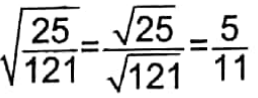
WBBSE Solutions For Class 7 Maths Arithmetic Chapter 4 Square Root Of Fraction Exercise 4 Solved Example Problems

Arithmetic Chapter 4 Square Root Of Fraction Exercise 4 Solved Example Problems

 Introduction

You have learnt the method of finding the square root of the perfect square integers in the previous class. Here, you will be able to learn the method of finding the square root of fractions and decimals.

As in our practical life we have to deal not only with integers but also with fractions and decimals so it is necessary to know the method of finding the square root of fractions and decimals as well.

The square roots of fractions and decimals are calculated in a similar way as that of integers but here the method is slightly complicated.

Read and Learn More WBBSE Solutions For Class 7 Maths

Square root of decimal fraction

If a decimal fraction is multiplied by itself then the product is called the square of the decimal fraction and the original decimal fraction is called the square root of the product.

Example:

Square of 0.2 0.2 0.2 = 0.04; the therefore square root of 0.04 = √0.04= 0.2.

Square of 0.7 0.7 x 0.7 = 0.49; therefore square root of 0.49 = √0.49 = 0.7.

Similarly, (0.12)2= 0.12 x 0.12 = 0.0144, hence √0.0144 = 0.12

(0.24)2 = 0.24 x 0.24 = 0.0576, hence √0.0576 = 0.24

WBBSE Solutions For Class 7 Maths Arithmetic Chapter 4 Square Root Of Fraction Exercise 4 Solved Example Problems

Rule:

1. Mark pair of digits, for an integral part, starting from the digit in the units’ place (i.e., from the digit immediately before the decimal point), towards the left in a similar way as you have done in the case of integers.

Then, similarly, mark the digits immediately after the decimal point in pairs towards the right.

2. If the decimal fraction do not contain any integral part then perform marking the pairs after the decimal point.

3. If the given decimal fraction has an odd number of decimal places, put a zero at the end to make the number of digits after decimal point even.

4. The decimal point should be put in the square root immediately when the pair of digits from the decimal part is brought down at the end of an integral part.

WBBSE Class 7 Arithmetic Square Root Examples

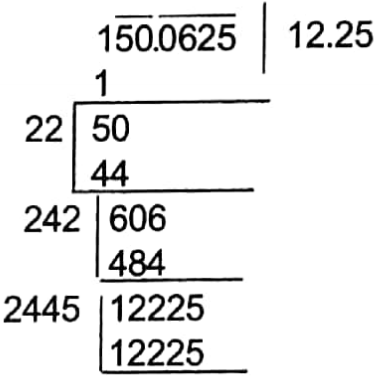
Example: Find the square root of: 150.0625

WBBSE Solutions For Class 7 Maths Arithmetic Chapter 4 Square Root Of Fraction Exercise 4 Square Root Of Decimal Fraction Example

∴ The required square root is 12.25.

Example: (0.1)2 = 0.01; Here, 0.01 < 0.1

And (1.5)2 = 2.25; here 2.25 > 1.5

The square root of a vulgar fraction

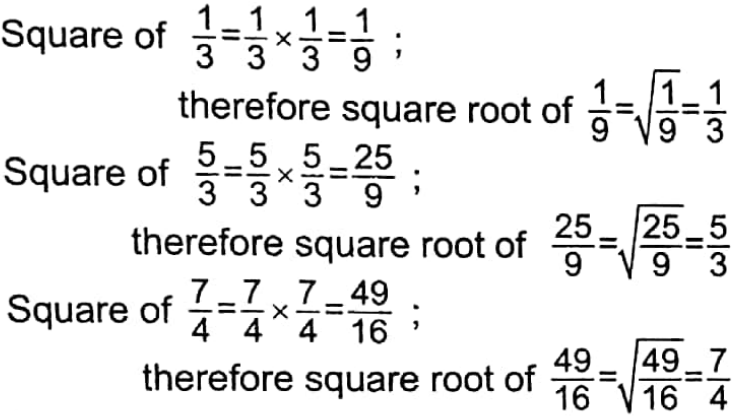
If a vulgar fraction is multiplied by itself then the product is called the square of that vulgar fraction and the original vulgar fraction is called the square root of the product.

Example: Square of \(\frac{1}{2}\) = \(\frac{1}{2}\) x \(\frac{1}{2}\) = \(\frac{1}{4}\)

therefore square root of \(\frac{1}{2}\) = WBBSE Solutions For Class 7 Maths Arithmetic Chapter 4 Square Root Of Fraction Exercise 4 Square Root Of Vulgar Fraction Example = \(\frac{1}{2}\)

WBBSE Solutions For Class 7 Maths Arithmetic Chapter 4 Square Root Of Fraction Exercise 4 Square Root Of Vulgar Fraction Example

Arithmetic Chapter 4 Square Root Of Fraction Exercise 4 Some Problems On Square Root Of Decimal Fractions

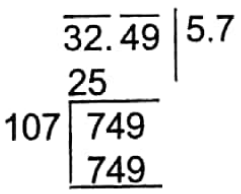
Example 1. The area of a square is 32.49 sq cm. What is the length of one side of the square?

Solution:

Given:

The area of a square is 32.49 sq cm.

The length of the side of the square = √32.49 cm = 5.7 cm.

WBBSE Solutions For Class 7 Maths Arithmetic Chapter 4 Square Root Of Fraction Exercise 4 Problem On Square Root Of Decimal Fractions Example 1

∴ 5.7 cm

The length of one side of the square 5.7 cm.

WBBSE Class 7 Geography Notes WBBSE Solutions For Class 7 History
WBBSE Solutions For Class 7 Geography WBBSE Class 7 History Multiple Choice Questions
WBBSE Class 7 Geography Multiple Choice Questions WBBSE Solutions For Class 7 Maths


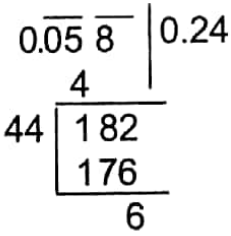
 Example 2. What least number must be subtracted from 0.0582 so that the result of subtraction be a perfect square decimal number?

Solution:

Given:

0.0582

WBBSE Solutions For Class 7 Maths Arithmetic Chapter 4 Square Root Of Fraction Exercise 4 Problem On Square Root Of Decimal Fractions Example 2

Hence, it is found that the number 0.0582 exceeds the square of 0.24 by 0.0006.

Hence, at least 0.0006 should be subtracted from 0.0582 so that the result of subtraction will be a perfect square decimal number.

∴ At least 0.0006 should be subtracted.

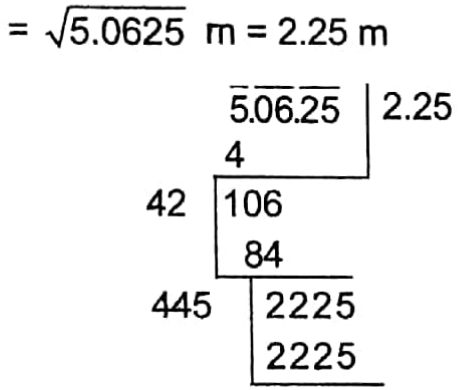
Example 3. Find the length of one side of a square whose area is equal to the sum of the areas of two rectangles whose areas are 2.1214 sq m and 2.9411 sq m.

Solution:

Given:

2.1214 sq m And 2.9411 sq m

Total area of the two rectangles = (2.1214+2.9411) sq m = 5.0625 sq m

∴ Area of the square = 5.0625 sq m

∴ Length of the side of the square = √5.0625 m = 2.25 m

WBBSE Solutions For Class 7 Maths Arithmetic Chapter 4 Square Root Of Fraction Exercise 4 Problem On Square Root Of Decimal Fractions Example 3

∴ 2.25 m

Length of the side of the square 2.25 m

Example 5. What must be added with 0.28 so that the square root of 1?

Solution:

Given:

0.28

Since, square root of the sum is 1 therefore, sum is also 1.

Number to be added = (1-0.28) = 0.72 = 0.72

∴ 0.72

Solved Problems for Class 7 Square Roots of Fractions

Example 6. Find the square root of the product of 0.032 and 0.2.

Solution:

Given:

0.032 And 0.2

The required square root

= √0.032×0.2= √0.0064=0.08

= 0.08

The square root of the product 0.08

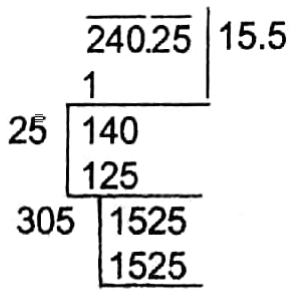
Example 7. Find the value of √240.25 + √2.4025 + √0.024025

Solution:

Given:

√240.25 + √2.4025 + √0.024025

WBBSE Solutions For Class 7 Maths Arithmetic Chapter 4 Square Root Of Fraction Exercise 4 Problem On Square Root Of Decimal Fractions Example 7

∴ √240.25 = 15.5

Similarly, √240.25 = 1.55 and,

√0.024025 = 0.155

∴ The required sum = 15.5 + 1.55 + 0.155 = 17.205

∴ 17.205

The value of √240.25 + √2.4025 + √0.024025 = 17.205

Class 7 Maths Exercise 4 Solutions on Square Roots

Example 8. Which number should be subtracted from 48.03 so that the square root of the difference is 5.7?

Solution:

Since, the square root of the difference is 5.7 therefore, the difference = (5.7)2 = 32.49.

Hence, the number to the subtracted = 48.03 – 32.49 = 15.54

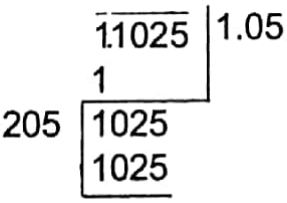
Example 9. Find the decimal number which when multiplied by itself gives 1.1025 as the product.

Solution: The required number will be the square root of 1.1025 = √1.1025 = 1.05

WBBSE Solutions For Class 7 Maths Arithmetic Chapter 4 Square Root Of Fraction Exercise 4 Problem On Square Root Of Decimal Fractions Example 9

∴ 1.05

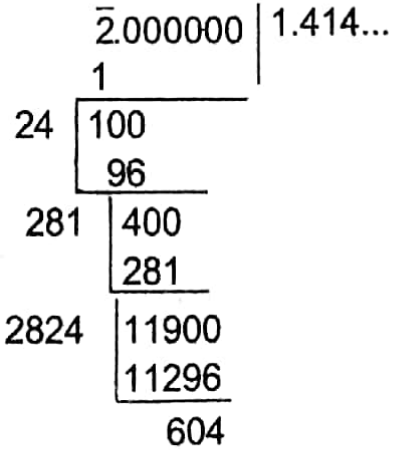
Example 10. Find the square root of 2 upto 3 places of decimals.

Solution:

Given:

Here, although 2 is an integer it is not a perfect square number.

Hence, the square root of 2 must be a decimal fraction.

Also, we may consider 2 as 2.000000…

WBBSE Solutions For Class 7 Maths Arithmetic Chapter 4 Square Root Of Fraction Exercise 4 Problem On Square Root Of Decimal Fractions Example 10

∴ The required square root = 1.414.

Example 11. Which decimal number is to be added with 0.75 so that square root of the sum will be 2?

Solution:

Since, the square root of the sum will be 2 therefore the sum will be 4.

∴ Number to be added = 4-0.75 = 3.25

∴ 3.25.

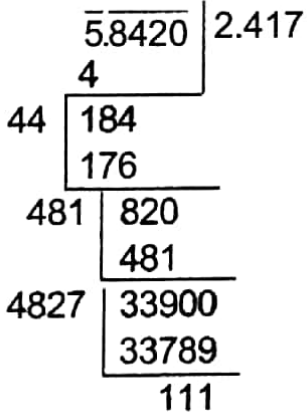
Example 12. Find the square root of 5.842 up to 3 places of decimals.

Solution:

WBBSE Solutions For Class 7 Maths Arithmetic Chapter 4 Square Root Of Fraction Exercise 4 Problem On Square Root Of Decimal Fractions Example 12

∴ The required square root is 2.417.

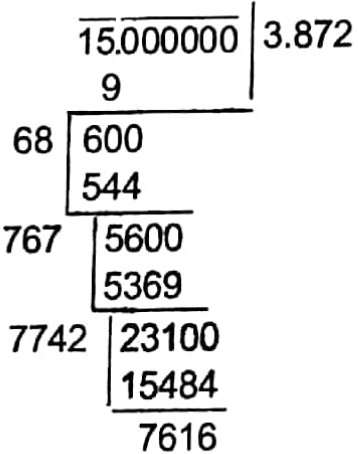
Example 13. Find the approximate value of √15 upto 2 decimal places. Find how greater or less than 15 is the square of this approximate value.

Solution:

WBBSE Solutions For Class 7 Maths Arithmetic Chapter 4 Square Root Of Fraction Exercise 4 Problem On Square Root Of Decimal Fractions Example 13

Therefore, the approximate value of upto 2 decimals places is 3.87.

Now, square of 3.87 = (3.87)2 = 14.9769.

Therefore, the square is less than 15 by (15-14.9769)=0.0231.

∴  3.87, 0.0231 less.

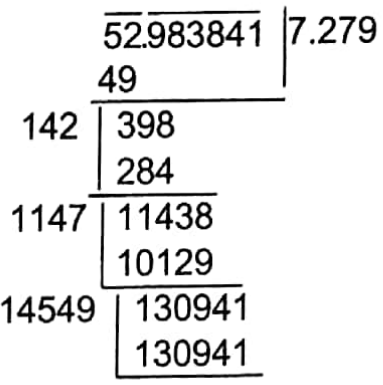
Example 14. Find the square root of 52.983841 correct upto two places of decimals

Solution:

WBBSE Solutions For Class 7 Maths Arithmetic Chapter 4 Square Root Of Fraction Exercise 4 Problem On Square Root Of Decimal Fractions Example 14

Hence, the square root of 52.983841 correct up to two places of decimals is 7.28

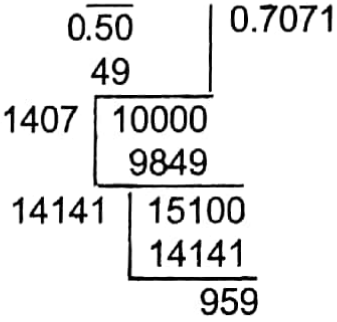
Example 15. Find the value of √0.5 correct up to three decimal places.

Solution:

WBBSE Solutions For Class 7 Maths Arithmetic Chapter 4 Square Root Of Fraction Exercise 4 Problem On Square Root Of Decimal Fractions Example 15

∴ The value of √0.5 correct up to three decimal places is 0.707.

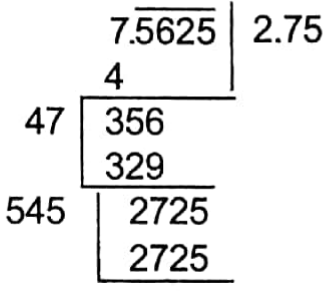
Example 16. Which decimal fraction multiplied by itself will give a product 7.5625?

Solution: The required decimal fraction will be the square root of 7.5625

WBBSE Solutions For Class 7 Maths Arithmetic Chapter 4 Square Root Of Fraction Exercise 4 Problem On Square Root Of Decimal Fractions Example 16

∴ 2.75

West Bengal Board Class 7 Square Root Assistance

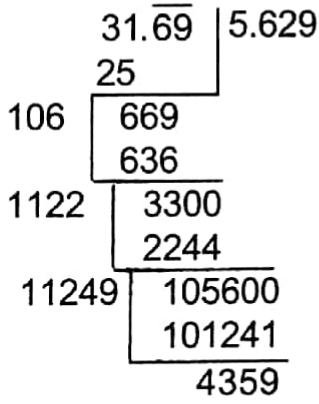
Example 17. Find the least number which when added to 31.69 will make it a perfect square having 4 places after the decimal.

Solution:

WBBSE Solutions For Class 7 Maths Arithmetic Chapter 4 Square Root Of Fraction Exercise 4 Problem On Square Root Of Decimal Fractions Example 17

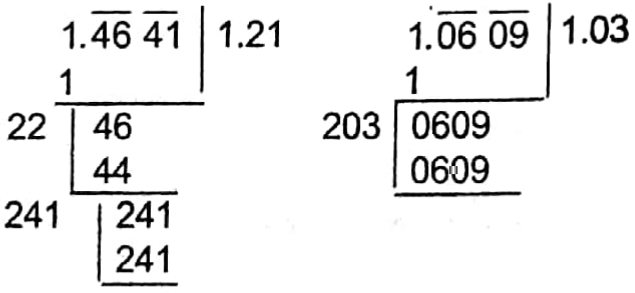
Example 18. Find the difference of the lengths of the sides The area of the new square of the squares whose areas are 1.4641 sq m and 1.0609 sq m.

Solution:

The length of side of the first square. Each side of the new square = √14641 m = 1.21 m.

The length of side of the second square = √1.0609 m = 1.03 m

WBBSE Solutions For Class 7 Maths Arithmetic Chapter 4 Square Root Of Fraction Exercise 4 Problem On Square Root Of Decimal Fractions Example 18

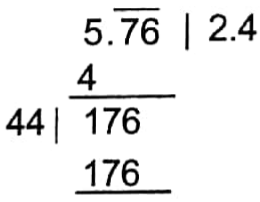
Example 19. Find the length of the side of the square whose area is equal to the sum of the areas of two rectangles having areas 3.24 sq m and 2.52 sq m.

Solution:

The sum of the areas of two rectangles (3.24 + 2.52) sq m = 5.76 sq m.

∴ Length of the side of the square = √5.76 m = 2.4 m

WBBSE Solutions For Class 7 Maths Arithmetic Chapter 4 Square Root Of Fraction Exercise 4 Problem On Square Root Of Decimal Fractions Example 19

∴ The length of the side of the square is 2.4 m.

Example 20. The sides of two squares are 16.5 and 22 metres respectively. Find the side of a square whose area is equal to the sum of the areas of the two squares.

Solution:
Area of the first square = (16.5)2 sq m = 272.25 sq m

Area of the second square = (22)2 sq m = 484 sq m

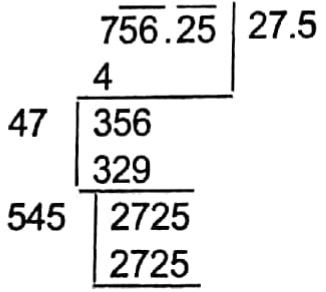
The area of the new sqaure = (272.25 + 484)  sq m = 756.25 sq m

∴ Each side of the new square = √756.25 m = 27.5 m

WBBSE Solutions For Class 7 Maths Arithmetic Chapter 4 Square Root Of Fraction Exercise 4 Problem On Square Root Of Decimal Fractions Example 20

∴ 27.5 meters.

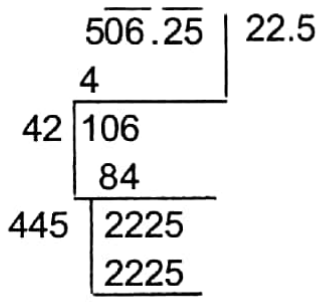
Example 21. A man spent ₹ 506.25 and each day he spent as many rupees as the number of days in which the money was spent. How much did he spend each day?

Solution:

Since the number of days and the number of rupees spent each day are equal, therefore the product of two equal numbers = 506.25

∴ Each number = √506.25 = 22.5

WBBSE Solutions For Class 7 Maths Arithmetic Chapter 4 Square Root Of Fraction Exercise 4 Problem On Square Root Of Decimal Fractions Example 21

Example 22. A ladder 36 metres long, stands against a wall so that its bottom is 21.6 metres away from the wall. How high is its top on the wall?

Solution:

Let Bc = 36 metres be the ladder and AB = 21.6 metres.

Let AC = h metres.

Now h2+ (21.6)2 = (36)2

or, h = (36)2 – (21.6)2

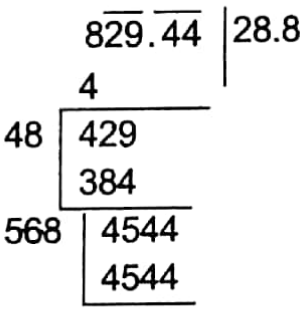
= 1296 – 466.56 = 829.44

or, h =√829.44 = 28.8

WBBSE Solutions For Class 7 Maths Arithmetic Chapter 4 Square Root Of Fraction Exercise 4 Problem On Square Root Of Decimal Fractions Example 22


Arithmetic Chapter 4 Square Root Of Fraction Exercise 4 Some Problems On Square Root Of Vulgar Fractions

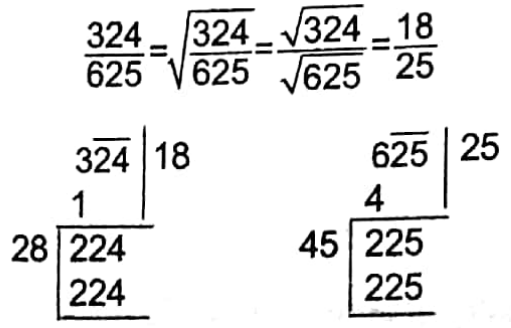
Example 1. Find the square root of \(\frac{324}{625}\)

Solution:

Square root of

WBBSE Solutions For Class 7 Maths Arithmetic Chapter 4 Square Root Of Fraction Exercise 4 Problems On Square Root Of Vulgar Fractions Example 1

∴ \(\frac{18}{25}\)

WBBSE Class 7 Chapter 4 Square Roots Guide

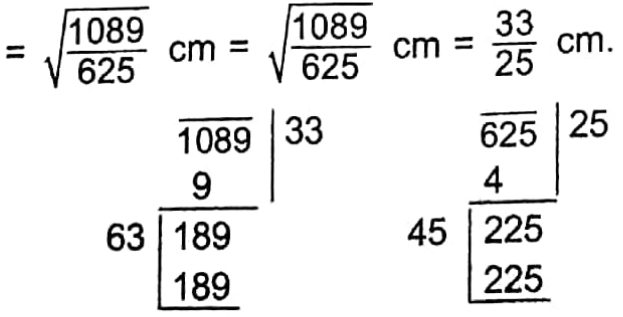
Example 2. The area of a square is \(\frac{1089}{825}\) sq. cm.What is 825 the length of one side of the square?

Solution:

Length of the side of the square

WBBSE Solutions For Class 7 Maths Arithmetic Chapter 4 Square Root Of Fraction Exercise 4 Problems On Square Root Of Vulgar Fractions Example 2

∴ Length of one side of the square is \(\frac{33}{25}\) cm.

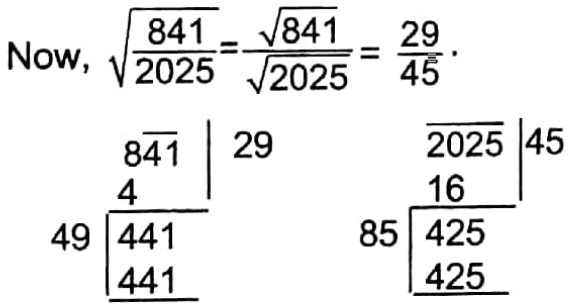
Example 3. A vulgar fraction multiplied by itself gives the product \(\frac{841}{2025}\) Find the fraction.

Solution:

Here the required vulgar fraction is the Square root of \(\frac{841}{2025}\)

WBBSE Solutions For Class 7 Maths Arithmetic Chapter 4 Square Root Of Fraction Exercise 4 Problems On Square Root Of Vulgar Fractions Example 3

∴ \(\frac{29}{45}\)

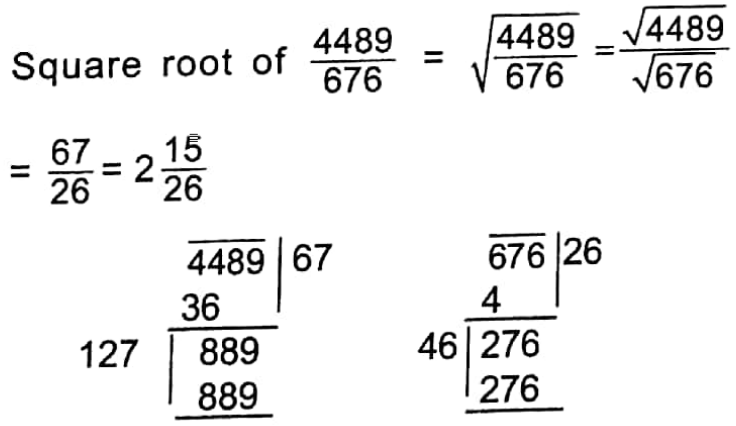
Example 4. Find the square root of 6 \(\frac{433}{676}\)

Solution:

WBBSE Solutions For Class 7 Maths Arithmetic Chapter 4 Square Root Of Fraction Exercise 4 Problems On Square Root Of Vulgar Fractions Example 4


∴ The required square root = 2 \(\frac{15}{26}\)

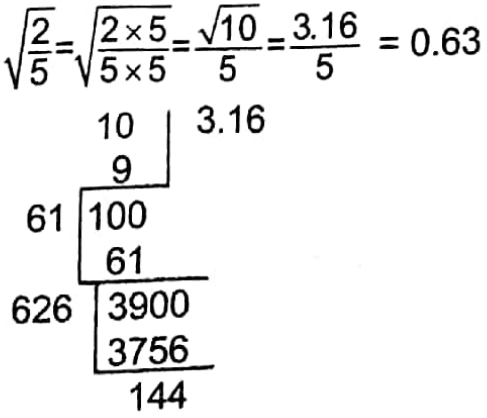
Example 5. Extract the square root of \(\frac{2}{5}\) to two places of decimals.

Solution:

WBBSE Solutions For Class 7 Maths Arithmetic Chapter 4 Square Root Of Fraction Exercise 4 Problems On Square Root Of Vulgar Fractions Example 5

∴ 0.63

Understanding Square Roots of Fractions for Class 7

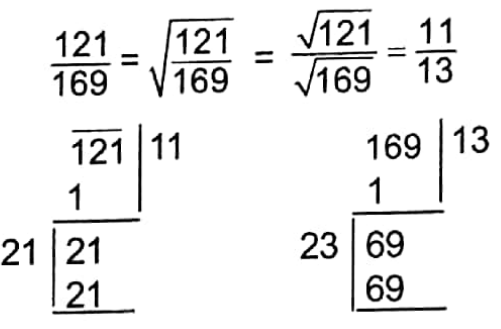
Example 6. By what should the square root of \(\frac{121}{169}\) be multiplied so that the product will be 1?

Solution: Square root of

WBBSE Solutions For Class 7 Maths Arithmetic Chapter 4 Square Root Of Fraction Exercise 4 Problems On Square Root Of Vulgar Fractions Example 6

Now, \(\frac{11}{13}\) should be multiplied by \(\frac{13}{11}\) so that the product will be 1.

∴ To be multiplied by \(\frac{13}{11}\)

Example 7. The product of two numbers is \(\frac{75}{121}\) and one of them is threice the other. Find the  numbers

Solution:

Greater number x smaller number = \(\frac{75}{121}\)

or, 3 x smaller x smaller number = \(\frac{75}{121}\)

or,(smaller number)2 = \(\frac{75}{3 x 121}\) = \(\frac{25}{121}\)

or, smaller number = WBBSE Solutions For Class 7 Maths Arithmetic Chapter 4 Square Root Of Fraction Exercise 4 Square Root Of Vulgar Fraction

∴ greater number = 2 x \(\frac{7}{8}\) = \(\frac{7}{4}\)

∴ The two numbers are \(\frac{7}{4}\) and \(\frac{7}{8}\)

Example 9. Find the smallest whole number by which \(\frac{64}{125}\) should be multiplied so that the product will be a fraction which is a perfect square.

Solution:

\(\frac{64}{125}\) = \(\frac{8 x 8}{5 x 5 x 5}\)

Clearly, it should be multiplied at least by 5 so that the product will be a fraction which is a perfect square.

∴ 5

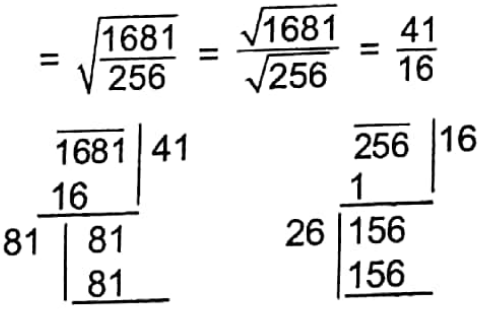
Example 10. Find a fraction, which when multiplied by itself gives 6 \(\frac{145}{256}\)

Solution:

6 \(\frac{145}{256}\) = \(\frac{1681}{256}\)

The required fraction will be the sqaure root of \(\frac{1681}{256}\)

WBBSE Solutions For Class 7 Maths Arithmetic Chapter 4 Square Root Of Fraction Exercise 4 Problems On Square Root Of Vulgar Fractions Example 10


∴ The required fraction = \(\frac{41}{61}\)

Class 7 Maths Exercise 4 Solved Examples

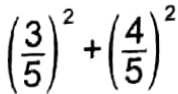
Example 11. Find the square root of WBBSE Solutions For Class 7 Maths Arithmetic Chapter 4 Square Root Of Fraction Exercise 4 Problems On Square Root Of Vulgar Fractions Example 11

Solution:

WBBSE Solutions For Class 7 Maths Arithmetic Chapter 4 Square Root Of Fraction Exercise 4 Problems On Square Root Of Vulgar Fractions Example 11

= \(\frac{9}{25}\) + \(\frac{16}{25}\) = \(\frac{9 + 16}{25}\) = \(\frac{25}{25}\) = 1

the square root of 1 is 1

Question 12. By which fraction should \(\frac{49}{91}\) be multiplied so that the square root of the product is 1?

Solution:

Square root of the product will be 1. Therefore, product will also be 1.

\(\frac{49}{91}\) should be multiplied by \(\frac{91}{49}\) sp, that the product is 1.

∴To be multiplied by \(\frac{91}{49}\)

Example 13.  WBBSE Solutions For Class 7 Maths Arithmetic Chapter 4 Square Root Of Fraction Exercise 4 Problems On Square Root Of Vulgar Fractions Example 13=what?

Solution:

WBBSE Solutions For Class 7 Maths Arithmetic Chapter 4 Square Root Of Fraction Exercise 4 Problems On Square Root Of Vulgar Fractions Example 13

∴ 2

Example 14. By which fraction should \(\frac{35}{42}\) be multiplied so that the square root of the product is 2?

Solution:

\(\frac{35}{42}\) = \(\frac{5}{6}\)

If the square root of the product is 2 then the product is 4.

∴ The required number = 4 ÷ \(\frac{5}{6}\)

= 4 x \(\frac{5}{6}\) = \(\frac{24}{5}\) = 4 \(\frac{4}{5}\)

∴ To multiplied by 4 \(\frac{4}{5}\)

Step-by-Step Solutions for Class 7 Square Root Problems

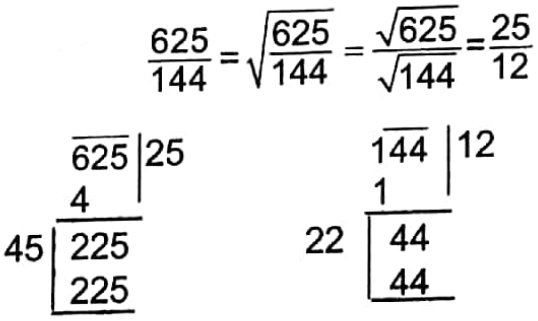
Example 15. By what number should the square root of \(\frac{625}{144}\) be multiplied nso that the product will be 1?

Solution:

Square root of

WBBSE Solutions For Class 7 Maths Arithmetic Chapter 4 Square Root Of Fraction Exercise 4 Problems On Square Root Of Vulgar Fractions Example 15

Now, the number by which \(\frac{25}{12}\) should be multiplied so that the product will be 1 is \(\frac{12}{25}\)

∴ \(\frac{12}{25}\)

Example 16. Find the least positive integer by which \(\frac{9}{50}\) should be multiplied so that the product will be a perfect square.

Answer:

\(\frac{9}{50}\) = \(\frac{3 X 3}{5 X 5 X 2}\)

Therefore, it should be multiplied at least by 2, so that the product will be a perfect sqaure.

∴ To be multiplied by 2.

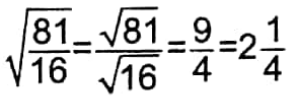
Example 17. One number is thrice the other, If the product of the two numbers be 15\(\frac{3}{16}\) then what are the numbers?

Solution:

The greater number x smaller number = 15 \(\frac{3}{16}\)

or, 3x smaller number x smaller number= \(\frac{243}{16}\)

or, (smaller number)2 = \(\frac{243}{16 X 3}\) = \(\frac{81}{16}\)

or, smaller number = WBBSE Solutions For Class 7 Maths Arithmetic Chapter 4 Square Root Of Fraction Exercise 4 Problems On Square Root Of Vulgar Fractions Example 17

∴ greater number = 3 x \(\frac{9}{4}\) = \(\frac{27}{4}\) = 6 \(\frac{3}{4}\)

∴ The numbers are 2 \(\frac{1}{4}\) and 6 \(\frac{3}{}\)

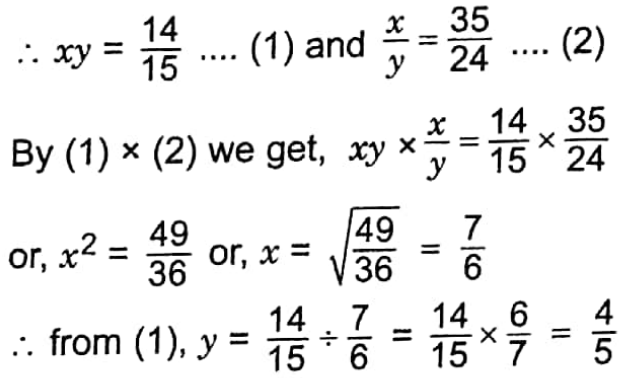
Example 18. The product of two positive numbers is \(\frac{14}{15}\) and their quotient is \(\frac{35}{24}\). Find the numbers.

Solution:

Let the two numbers be x and y.

WBBSE Solutions For Class 7 Maths Arithmetic Chapter 4 Square Root Of Fraction Exercise 4 Problems On Square Root Of Vulgar Fractions Example 18

∴ The two numbers are \(\frac{7}{6}\) and \(\frac{4}{5}\)

Example 19. Out of the three numbers, the product of the first and the second number is 3, that of the second and the third number is 8 \(\frac{2}{5}\) and that of the third and the first number is 4 \(\frac{3}{8}\). Find the three numbers.

Solution:

First number x second number=3…………..(1)

Second number x third number = \(\frac{42}{5}\) …..(2)

Third number x first number = \(\frac{35}{8}\) ……(3)

By (1) x (2) x (3) we get,

(First number x second numnber x third number)2

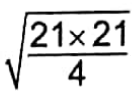
= 3 x \(\frac{42}{5}\) x \(\frac{35}{8}\) = \(\frac{21 X 21}{4}\)

∴ First number x second number x third number = WBBSE Solutions For Class 7 Maths Arithmetic Chapter 4 Square Root Of Fraction Exercise 4 Problems On Square Root Of Vulgar Fractions Example 19  = \(\frac{21}{2}\)

By (4) ÷ (1) we get, the third number

= \(\frac{21}{2}\) x \(\frac{1}{3}\) = \(\frac{7}{2}\) = 3 \(\frac{1}{2}\)

By (4) ÷ (2) we get, first number

= \(\frac{21}{2}\) x \(\frac{5}{42}\) = \(\frac{5}{4}\) = 1 \(\frac{1}{4}\)

By (4) ÷ (3) we get, second number

= \(\frac{21}{2}\) x \(\frac{8}{35}\) = \(\frac{12}{5}\) = 2 \(\frac{2}{5}\)

∴ The numbers are 1 \(\frac{1}{4}\), 2 \(\frac{2}{5}\), 3 \(\frac{1}{2}\)

Example 20. Find by what magnitude is (√25+ √81) more than (√16 + √36).

Solution:

√16+ √36=4+6=10

√25+√815+9=14

Now, 14-10=4

∴  Is more by 4.

Example 21. The area of a square is 4225 sq metres. If it is divided into 9 equal parts then each part becomes a square. What is the length of each side of such a square?

Solution:

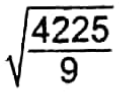
If a square of area 4225 sq metres is divided into 9 equal parts then area of each part becomes \(\frac{4225}{9}\) sq metres.

If these parts are squares, then length of each side of such a square= WBBSE Solutions For Class 7 Maths Arithmetic Chapter 4 Square Root Of Fraction Exercise 4 Problems On Square Root Of Vulgar Fractions Example 21meters =

= \(\frac{65}{3}\) metres = 21 \(\frac{2}{3}\)

∴ 21 \(\frac{2}{3}\)

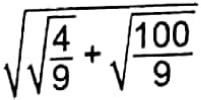
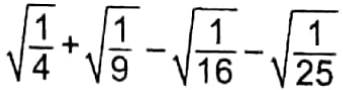
Example 22. Find the value of WBBSE Solutions For Class 7 Maths Arithmetic Chapter 4 Square Root Of Fraction Exercise 4 Problems On Square Root Of Vulgar Fractions Example 22

Solution:

WBBSE Solutions For Class 7 Maths Arithmetic Chapter 4 Square Root Of Fraction Exercise 4 Problems On Square Root Of Vulgar Fractions Example 22

= \(\frac{1}{2}\) + \(\frac{1}{3}\) – \(\frac{1}{4}\) – \(\frac{1}{5}\)

⇒ 2 x 3 x 10 = 60

= (\(\frac{1}{2}\) + \(\frac{1}{3}\)) – (\(\frac{1}{4}\) + \(\frac{1}{5}\))

= \(\frac{5}{6}\) – \(\frac{9}{20}\) = \(\frac{50- 27}{60}\) = \(\frac{23}{60}\)

∴ \(\frac{23}{60}\)

Example 23. Area of the square ‘A’ is \(\frac{225}{289}\)th of the area of the square ‘B’. What fraction of the side of ‘B’ is the side of ‘A’?

Solution:

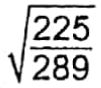
Area of the square ‘A’ = Area of the square ‘B’ x \(\frac{225}{289}\)

∴ Length of the side of ‘A’ = Length of the side of ‘B’ x WBBSE Solutions For Class 7 Maths Arithmetic Chapter 4 Square Root Of Fraction Exercise 4 Problems On Square Root Of Vulgar Fractions Example 23

∴ Length of the side of ‘A’ = Length of the side of ‘B’ x \(\frac{15}{17}\)

Hence, length of the side of the square ‘A’ is \(\frac{15}{17}\) th part of the length of the side of the square ‘B’.

∴ \(\frac{15}{17}\)
Example 24. Arrange the following in the descending order of their magnitude: WBBSE Solutions For Class 7 Maths Arithmetic Chapter 4 Square Root Of Fraction Exercise 4 Problems On Square Root Of Vulgar Fractions Example 24

Solution:

WBBSE Solutions For Class 7 Maths Arithmetic Chapter 4 Square Root Of Fraction Exercise 4 Problems On Square Root Of Vulgar Fractions Example 24

∴ In descending order of magnitude the numbers are:

WBBSE Solutions For Class 7 Maths Arithmetic Chapter 4 Square Root Of Fraction Exercise 4 Problems On Square Root Of Vulgar Fractions Example 24

Example 25. The areas of two rectangles are \(\frac{24}{25}\) sq metres and \(\frac{12}{25}\) sq metres respectively, Find the length of each side of a square whose area is equal to the sum of the areas of these two rectangles.

Solution:

Given:

The areas of two rectangles are \(\frac{24}{25}\) sq metres and \(\frac{12}{25}\) sq metres respectively

The sum of the areas of the two rectangles = (\(\frac{24}{25}\) + \(\frac{12}{25}\)) sq metres = \(\frac{36}{25}\) sq meters.

Hence, the area of the square = \(\frac{35}{25}\) sq metres.

Hence, the length of each side of the square

= WBBSE Solutions For Class 7 Maths Arithmetic Chapter 4 Square Root Of Fraction Exercise 4 Problems On Square Root Of Vulgar Fractions Example 25metres

= \(\frac{6}{5}\) metres = 1 \(\frac{1}{5}\) metres.

∴ 1 \(\frac{1}{5}\) metres.

Example 26. 308 square stones are required to pave a square of area 1925  square metres. Find the length of each side of such a stone.

Solution:

Given:

308 square stones are required to pave a square of area 1925  square metres.

By 308 stones 1925 sq metres is paved

By 1 stones \(\frac{1925}{308}\) sq metres is paved

= \(\frac{25}{4}\)  sq metres is paved

Therefore, area ofeach stone = \(\frac{25}{4}\) sq metres.

∴ Length of each side of a stone = WBBSE Solutions For Class 7 Maths Arithmetic Chapter 4 Square Root Of Fraction Exercise 4 Problems On Square Root Of Vulgar Fractions Example 26 metres =\(\frac{5}{2}\) metres = 2 \(\frac{1}{2}\) metres.

∴ 2 \(\frac{1}{2}\) metres.

Example 27. The sides of two squares are \(\frac{12}{5}\) metres. metres and \(\frac{9}{5}\) metres.respectively. Find the side of a a square whose area is equal to the sum of the areas of the two squares.

Solution:

Given:

The sides of two squares are \(\frac{12}{5}\) metres. metres and \(\frac{9}{5}\) metres.respectively.

The area of the first square = (\(\frac{1}{2}\))2 sq metres

= \(\frac{144}{25}\) = sq metres

∴ The area of the second square = (\(\frac{9}{5}\))2

= \(\frac{81}{25}\) sq metres.

∴ Area of the new square

=(\(\frac{144}{25}\) + \(\frac{81}{25}\))

= \(\frac{225}{25}\) sq metres = 9 sq metres.

∴ Each side of the new square=√9 metres = 3 metres

∴ 3 metres.

The side of a a square whose area is equal to the sum of the areas of the two squares is 3 metres.

WBBSE Solutions For Class 7 Maths Arithmetic Chapter 3 Approximate Value Exercise 3 Solved Example Problems

Arithmetic Chapter 3 Approximate Value Exercise 3 Solved Example Problems

Approximate Value

In our daily life, in many cases, it is not possible to calculate the actual value of a quantity or the actual price or weight of a body accurately.

Therefore, in such cases for practical purpose, a value is taken nearest to the actual value, actual price, or actual weight.

It is called the approximate value of that quantity or the approximate price or weight of that body.

Suppose, ₹262.50 is to be divided among 50 boys. Then each boy will get ₹262.50 +50 =₹5.25.

Now observe that, if each boy is given ₹5 then each boy gets 25 paise less than what he would have obtained.

Again, if each boy is given ₹6 then each boy gets 75 paise more than his due.

Therefore, neither ₹5 nor ₹6 is due for that boy. Hence, this less or more is to be termed an error.

Read and Learn More WBBSE Solutions For Class 7 Maths

Since there is an error in both cases, therefore, the less is the amount of error more is the degree of purity.

In the above case, if ₹5 is given then an error is 25 paise and if ₹6 is given the error is 75 paise. Hence, if each is given 5 then he will be given the nearest money due for him.

Again, let ₹287.50 is to be divided among 50 boys equally. Then each boy will get ₹287.50÷ 50= ₹5.75.

Therefore, in this case, if each boy is given 6 then he will be given the nearest money due for him.

WBBSE Class 7 Approximate Value Notes

Rule: In order to calculate the approximate value instead of the actual value of any quantity, if the digit after the decimal be less than 5 (₹ 5 and paise 25 = ₹ 5.25) then it is to be ignored and if it be 5 or greater than 5 (₹ 5 and paise 75 =₹ 5.75) then 1 is to be added with the digit in the units’ place.

WBBSE Solutions For Class 7 Maths Arithmetic Chapter 3 Approximate Value Exercise 3 Solved Example Problems

Approximate value of the integer

If the value of the number 5832 is written as 5000 then 832 less than the actual value is written. Again if 6000 is written instead of 5832 then, (60005832) or 168 more than the actual value is written.

Now observe that between 6000 and 5000 the former is nearer to the actual value of 5832.

Therefore, the value of 5832 in the approximate thousands of places is 6000. Similarly, the value of 5832 in the approximate hundreds’ place is 5800, and in the approximate tens’ place is 5830.

Approximate value of decimal fraction

In order to find the approximate value of any decimal fraction up to a definite decimal place, write the digits up to that decimal place and reject the next remaining digits.

But if the first digit from the left-hand side of the rejected digits be 5 or more than 5 then 1 is to be added with the last digit of that particular place.

For example, the approximate value of 3.65038 up to integer = 4. (Since, the number 6 at the left end of the rejected portion after 3 is greater than 5 therefore, 4 is the result after adding 1 with 3).

Its approximate value up to 1 decimal place =3.7 (Here, since the first digit of the rejected portion is 5 therefore, 1 is added with the previous digit.

Its approximate value up to 2 decimal places = 3.65.
(Here, since the first digit of the rejected portion is 0 therefore, nothing has been added to the previous digit.)

Its approximate value up to 3 decimal places = 3.650.

Its approximate value up to 4 decimal places = 3.6504.

WBBSE Class 7 Geography Notes WBBSE Solutions For Class 7 History
WBBSE Solutions For Class 7 Geography WBBSE Class 7 History Multiple Choice Questions
WBBSE Class 7 Geography Multiple Choice Questions WBBSE Solutions For Class 7 Maths


Examples:

1. Find the correct value of 0.655172 up to 4 decimal places.

Solution: 0.6552 (first digit of the rejected portion is 7)

2. Express 3628753 in approximate hundred.

Solution: 3628800

Class 7 Maths Exercise 3 Solved Examples

3. Find the correct values of 1.218713 upto 3 and 4 decimal places and express the approximate value of their difference corrected to 2 decimal places.

Solution:

WBBSE Solutions For Class 7 Maths Arithmetic Chapter 3 Approximate Value Exercise 3

The subtracted value, when corrected upto 2 decimal places, is 0.00

Significant digit

The numbers are formed by the digits 1 to 9. They are called significant digits. If between two significant digits, there is/are one or more than one zeroes (0) then those zeroes are also taken as significant digits.

If in any decimal fraction, there is a decimal point in the beginning and there are some zeroes after the decimal point then digits other than zeroes are called significant digits. The last zero or zeroes of an integer or decimal fraction are sometimes significant digits and sometimes they are not so.

Example:

1. The approximate value of 30.23046 up to 4 significant digits 30.23. But its approximate value corrects up to 4 decimal places = 30.2305.

2. In the case of the number 0.12065 the value is correct up to 4 decimal places and also the approximate value up to 4 significant digits are both equal to 0.1207.

3. In the case of the number 0.00147, the value corrects up to one significant digit = 0.001 and the value corrects up to two significant digits= 0.0015.

4. The approximate value of 0.000240079 up to five decimal places= is 0.00024. But its approximate value up to 5 significant digits= 0.00024008.

5. In the case of the number 0.44598 the correct value up to 4 decimal places and the approximate value up to 4 significant digits are both equal to 0.4460 (Here 0 is the significant digit; here since the rejected digit is 8, therefore, adding 1 with the last digit 9 of 0.4459 we obtained 0.4460.)

6. The approximate value of 163289 up to 4 significant digits is 163300. (Here, the two zeroes are not significant digits).

7. In case of 705769, the approximate value up to a thousand and the approximate value up to a hundred are 706000 and 705800 respectively. (In both cases the last zeroes are not significant digits).

Error

If a value other than the actual value is taken then there occurs an error. In practical case this error should be as small as possible. Let us roughly take the weight of 100 kg of coal.

If the weight is taken more accurately then it may be found that the weight of coal is 99 \(\frac{1}{2}\) kg. In this \(\frac{1}{2}\) kg of coal, the loss is not significant.

But if it is gold in and that would not be negligible. Therefore, in lieu of coal then there would be a great loss if a goldsmith is compelled to measure gold more accurately.

Arithmetic Chapter 3 Approximate Value Exercise 3 Absolute Error, Relative Error, And Percentage Error

The difference between the actual value and the approximate value is called the absolute error of the approximate value.

That means, absolute error = Actual value ∼ approximate value.

The ratio of absolute error and the actual value is called the relative error.

That means, relative error = \(\frac{Absolute error}{Actual value}\).

The percentage error of the approximate value is that percentage of the actual value which the absolute error is.

That means, percentage error = \(\frac{Absolute error}{Actual value} \)

Example 1. Express 4325 kg in approximate hundred kg and find an absolute error, relative error, and percentage error.

Solution:

Given:

4325 kg

4325 kg = 4300 kg (in approximately 100 kg)

∴ absolute error = 4325 kg-4300 kg = 25 kg 25 kg

relative error = \(\frac{25 \mathrm{~kg}}{4325 \mathrm{~kg}}=\frac{1}{173}\)

and percentage error = relative error x 100 = \(\frac{1}{173}\) x100= 0.58 (correct up to 2 decimal places).

WBBSE Class 7 Arithmetic Approximate Values Examples

Example 2. Find the approximate value up to first two significant digits and the absolute error of 3.068.

Solution:

Given:

3.068

The approximate value of 3.068. The required sum = 13.67489.
up to first two significant digits = 3.1. absolute error = 3.068-3.1 = 0.032.

Example 3. A man measured a path of length 12 \(\frac{7}{200}\) km and told its length as 12.01 km. At this find his absolute error, relative error, and percentage error.

Solution:

Given:

A man measured a path of length 12 \(\frac{7}{200}\) km and told its length as 12.01 km.

12 \(\frac{7}{200}\) = 12.035

Absolute error = 12.035 km -12.01 km = 0.025 km

Relative error = \(\frac{0.025 \mathrm{~km}}{12035 \mathrm{~km}}=\frac{5}{2407}\)

and percentage error = \(\frac{5}{2407}\) x 100 = 0.21%

(correct up to 2 decimal places).

Arithmetic Chapter 3 Approximate Value Exercise 3 To Find The Addition And Subtraction In Approximate Value Of Decimal

Rule: When the result of addition and subtraction are to be known approximately up to a definite decimal place, it is necessary to know the next digit.

Therefore, we have to find the result of addition and subtraction up to two more digits than the digits up to which approximation is required to be done. Then the answer is to be given in approximate value as per requirement.

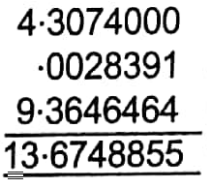
Example 1. What is the sum of 4.3074, 0.0028391, and 9.364 approximate up to five decimal places?

Solution:

Given:

4.3074, 0.0028391, And 9.364

WBBSE Solutions For Class 7 Maths Arithmetic Chapter 3 Approximate Value Exercise 3 The Sum Approximate Upto Five Decimal Places Example 1

Here, to get the approximate 5 decimal place the 6th decimal place must be known correctly.

So, writing up to one more decimal place i.e., 7th decimal place the sum is to be determined.

∴ The required sum = 13.67489

Solved Problems for Class 7 Approximate Values

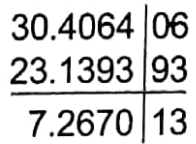
Example 2. Find the difference of 30.406 and 23.139 approximately up to 4 decimal places.

Solution:

Given:

30.406 And 23.139

WBBSE Solutions For Class 7 Maths Arithmetic Chapter 3 Approximate Value Exercise 3 The Difference Approximate Upto Four Decimal Places Example 2

∴ The required difference of 7.2670

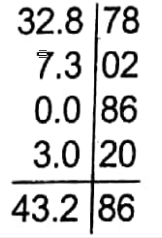
Example 3. Find the sum of 7.302, 0.0865, 32.87, and 3.02 approximately up to 3 significant digits.

Solution:

Given:

7.302, 0.0865, 32.87, And 3.02

WBBSE Solutions For Class 7 Maths Arithmetic Chapter 3 Approximate Value Exercise 3 The Sum Approximate Upto Three Significant Digits Example 3

∴The required sum = 43.3.

WBBSE Solutions For Class 9 Physical Science Chapter 6 Calorimetry

Chapter 6 Calorimetry Synopsis

Heat is a form of energy and exchange of heat is measurable. The branch of science which deals with the exchange of heat of a body, i.e., principles, methods or matters related to measurement of absorbed heat or emitted heat is known as calorimetry.

Specific Heat is the quantity of heat required to increase the temperature of unit mass of a substance by unit amount.

Units Of Specific Heat in CGS — cal • g-1 • °C-1 and in SI — J • kg-1 • K-1.

\(1 \mathrm{cal} \cdot \mathrm{g}^{-1} \cdot{ }^{\circ} \mathrm{C}^{-1}=\frac{4.2 \mathrm{~J}}{\frac{1}{1000} \mathrm{~kg} \cdot \mathrm{K}}\) = 4200 J • kg-1 • K-1

Thermal Capacity Or Heat Capacity is the quantity of heat needed to raise the temperature of a body by unity.

Units of thermal capacity in CGS —  cal/°C and in SI —  J/K.

Read and Learn More WBBSE Solutions for Class 9 Physical Science and Environment

Water Equivalent of a body is the mass of water for which the increase in temperature is same as that for the body when the amount of heat supplied is the same for both.

Units Of Water Equivalent in CGS—g and in SI—kg

The Amount Of Heat (H) Absorbed Or Released by a body during a thermal exchange depends on

  1. Mass of the body (m),
  2. Change of temperature (t1 ~ t2) of the body,
  3. Specific heat of the material of the body (s); i.e, H = m • s • (t1 ~ t2)

If two bodies of different temperatures are kept in contact with each other, the hotter body emits, heat and the other one receives that heat. If there is no loss of heat by any means, then at the time of thermal equilibrium, heat emitted by the hotter body = heat received by the colder body This is the fundamental principle of calorimetry.

Units Of Heat in CGS system and SI are calorie (cal) and joule (J), respectively. [Here, 1 cal = 4.1855 J]

Chapter 6 Calorimetry Synopsis Short And Long Answer Type Questions

Question 1. What do you mean by calorimetry?

Answer:

Calorimetry:-

Heat is a kind of energy and exchange of heat of a body is measurable. Calorimetry is that branch of science which deals with the exchange of heat of a body, i.e., principles, methods, or matters related to measurement of absorbed heat or emitted heat.

Question 2. Explain the basic principle of calorimetry.

Answer:

Basic Principle Of Calorimetry:-

If two bodies with different temperatures are kept in contact with each other, the body with the higher temperature releases heat to become colder and the other one accepts this heat to become hotter.

If there is no loss of heat, then at thermal equilibrium, heat emitted by the hotter body = heat received by the colder body This is the basic principle of calorimetry.

Suppose two bodies of masses m1, m2, and respective temperatures t1, t2 (t1 > t2) are kept in contact with each other. The first body emits heat and the second one receives heat. Let us assume that at the time of thermal equilibrium, the common temperature is t.

If the specific heats of the first and the second body are s1 and s2 respectively, then heat emitted by the first body, Q1 = m1s1(t1 -t), and heat received by the second body, Q2 = m2s2(t – t2).

Now as per the basic principle of calorimetry,

Q1 = Q2 or, m1s1(t1 – t) = m2s2(t – t2)

WBBSE Solutions For Class 9 Physical Science Chapter 6 Calorimetry

Question 3. What are the conditions for the applicability of the basic principle of calorimetry?

Answer:

Conditions Applicable For Basic Principle Of Calorimetry:-

The conditions for applicability of the basic principle of calorimetry are:

  1. During exchange of heat among different bodies with varied temperature, there should not be any exchange of heat with the surroundings.
  2. There should not be any chemical reaction between the bodies.
  3. If there is any exchange of heat between a liquid and a solid body, then the solid body must not dissolve in the liquid.
  4. There should not be any kind of physical change in the bodies while absorbing or releasing heat.

Question 4. Write down the differences between heat and temperature.

Answer:

The differences between heat and temperature are given below

WBBSE Solutions For Class 9 Physical Science Chapter 6 Calorimetry Differences Between Heat And Temperature

Question 5. Two bodies of different temperatures are bought into thermal contact. What change in temperature of the two bodies will happen?

Answer:

Given

Two bodies of different temperatures are bought into thermal contact.

When two bodies at different temperatures are bought in thermal contact, heat is transferred from the body at higher temperature to that at lower temperature. Therefore hotter body starts to cool down whereas the colder body starts to warm up.

The flow of heat continues till both reaches the same temperature. At thermal equilibrium temperature of both the bodies are equal.

NEET Biology Class 9 Question And Answers WBBSE Class 9 History Notes WBBSE Solutions for Class 9 Life Science and Environment
WBBSE Class 9 Geography And Environment Notes WBBSE Class 9 History Multiple Choice Questions WBBSE Class 9 Life Science Long Answer Questions
WBBSE Solutions for Class 9 Geography And Environment WBBSE Class 9 History Long Answer Questions WBBSE Class 9 Life Science Multiple Choice Questions
WBBSE Class 9 Geography And Environment Multiple Choice Questions WBBSE Class 9 History Short Answer Questions WBBSE Solutions For Class 9 Maths
WBBSE Solutions for Class 9 History WBBSE Class 9 History Very Short Answer Questions


Question 6. The temperature of three solid metallic bodies A, B, and C are 10°C, 20°C, and 10°C, respectively. If the three bodies are kept in contact with each other, which one releases heat and which one accepts?

Answer:

Given

The temperature of three solid metallic bodies A, B, and C are 10°C, 20°C, and 10°C, respectively. If the three bodies are kept in contact with each other,

In this case, temperature of B is highest. So, B releases heat. The other two bodies A and C have the same temperature which is less than that of B. So, these two accept heat.

Question 7. What do you mean by specific heat of a substance?

Answer:

Specific Heat Of A Substance Means:-

Specific heat is the quantity of heat required to increase the temperature of unit mass of a substance by unit amount.

Question 8. What is thermal equilibrium? When several bodies are in thermal equilibrium which physical quantity is same for all of the bodies?

Answer:

Thermal Equilibrium

When several bodies at different temperatures are bought into thermal contact with each other, they will exchange heat among themselves and ultimately attain the same temperature. This state where all the bodies are at the same temperature is called thermal equilibrium, b When several bodies are at thermal equilibrium the physical quantity ‘temperature’ is same for all of the bodies.

Question 9. Why water is used in hot water bag?

Answer:

Water has a specific heat higher than everything (except ammonia). Hence a fixed mass of water gains more heat than any other liquid of the same mass for the same rise in temperature.

Consequently, it loses more heat during cooling. This heat is used for fomentation. So a hot water bottle remains effective for a long period of time. That is why water is used in hot water bag.

Question 10. What is water equivalent of a substance?

Answer:

Water equivalent of a substance

The water equivalent of a body is the mass of water for which the increase in temperature is same as that for the body when the amount of heat supplied is the same for both.

Question 11. Write the factors on which the amount of heat absorbed or released by a body depends on.

Answer:

The amount of heat (H) absorbed or released by a body during a thermal exchange depends on

  1. Mass of the body (m),
  2. Change of temperature (t) of the body,
  3. Specific heat of the material of the body (s).

The relation among them is — H = m • s • t.

Question 12. Same amount of heat is supplied to two different bodies of equal mass but of different materials. The increase in temperature of the two bodies be equal or not?

Answer:

We know, given heat H = mst i.e., increase in temperature t = \(\frac{H}{m \cdot s}\).

Since for the two bodies, heat supplied (H) and mass (m) are equal but specific heat (s) of the material of the bodies are different, t ∝ 1/s.

Hence, the body with comparatively less specific heat will have a higher increase in temperature.

Question 13. Same amount of heat is supplied to equal mass of milk and water. Why milk warms quicker than water?

Answer:

Increase in temperature (t) of a substance is inversely proportional to specific heat (s) of the material of the substance when amount of heat (H) absorbed and mass of the body (m) are kept constant.

i.e., t ∝ 1/s, H, and m are constant

Specific heat of milk is less than that of the water. Hence milk warms quicker than water.

Question 14. Temperatures of two liquids of equal masses are t1 and t2 (t1 > t2) respectively. T is the final temperature of their mixture. Find the ratio of specific heat of the two liquids.

Answer:

Given

Temperatures of two liquids of equal masses are t1 and t2 (t1 > t2) respectively. T is the final temperature of their mixture.

As per the question, mass (m) of each liquid is same and specific heat of two liquids are s1 and s2 respectively.

According to basic principle of calorimetry, m • (t1 – t) • s1 = m • (t – t2) • s2

∴ \(\frac{s_1}{s_2}=\frac{t-t_2}{t_1-t}\)

or, s1 : s2 = (t – t2) : (t1 – t)

Question 15. What is the specific heat of water during its freezing at 0°C?

Answer:

Specific heat of water during its freezing at 0°C

Specific heat, s = \(\frac{H}{m \cdot t}\). During freezing, the temperature of water remains fixed at 0°C. So the change in temperature t = 0 hence h = ∞.

Chapter 6 Calorimetry Very Short Answer Type Questions Choose The Correct Answer

Question 1. If equal masses of two liquids at temperatures 10°C and 40°C are mixed together, the temperature of the mixture becomes 15°C. The ratio of specific heat of the two liquids is

  1. 5: 1
  2. 1: 5
  3. 2 : 3
  4. 4 : 3

Answer: 1. 5 : 1

Question 2. Heat is the of a material particle.

  1. Changed form of momentum
  2. Changed form of kinetic energy
  3. Changed form of potential energy
  4. Changed form of velocity

Answer: 2. Changed form of kinetic energy

Question 3. Thermometer is used to measure

  1. Temperature of a body
  2. Latent heat
  3. Radiated heat
  4. All of the above

Answer: 1. Temperature of a body

Question 4. Absorbed heat is _____ of a body.

  1. Directly proportional only to the mass
  2. Directly proportional only to the rise of temperature
  3. Directly proportional to the product of mass and increased temperature
  4. Directly proportional to the quotient of mass and increased temperature

Answer: 3. Directly proportional to the product of mass and increased temperature

Question 5. For calorimetric principle to be applicable

  1. Heat has to enter the body or the system from outside
  2. Heat has to go out of the body or the system
  3. A chemical reaction has to take place in the body or the system
  4. One body should not be soluble in another body

Answer: 4. One body should not be soluble in another body

Question 6. Among iron, mercury, water and air, which of the following has the highest specific heat?

  1. Water
  2. Iron
  3. Air
  4. Mercury

Answer: 1. Water

Question 7. A piece of iron and a wooden chair of the same mass are kept in sunlight. After keeping them for the same period of time, the piece of iron feels hotter on touching than the wooden chair due to

  1. Difference in water equivalent
  2. Difference in heat capacity
  3. Difference in heat conduction
  4. Difference in specific heat

Answer: 4. Difference in specific heat

Question 8. Heat accepted or rejected by a body is directly proportional to the increase or decrease of its temperature under the condition that

  1. Mass of the body is variable
  2. Mass of the body is fixed
  3. Water equivalent of the body is variable
  4. Latent heat of change of state of the body is constant

Answer: 2. Mass of the body is fixed

Question 9. According to the formula s = value of the specific heat of a body during melting becomes

  1. Zero
  2. 1
  3. Constant
  4. Infinite

Answer: 3. Constant

Question 10. According to the formula H = mst, which of the following is not true in case of a specific material?

  1. H ∝ m
  2. H ∝ t
  3. H ∝ s
  4. None of these

Answer: 3. H∝ s

Question 11. During fomentation, water bottle is used instead of iron. The main reason behind this is

  1. Specific heat of water is greater than that of iron
  2. Specific heat of iron is greater than that of water
  3. Iron gets heated slowly compared to water
  4. Water releases heat faster than iron

Answer: 1. Specific heat of water is greater than that of iron

Question 12. In the formula H = mst, t indicates

  1. The temperature of the body
  2. The change of temperature of the body
  3. The total time of heating
  4. All of the above

Answer: 2. The change of temperature of the body

Question 13. Mathematical form of the first law of thermodynamics is

  1. H = mL
  2. H = mst
  3. W = JH
  4. W = Fs

Answer: 3. W = JH

Question 14. Specific heat of copper is 0.1 cal • g-1 • °C-1. Water equivalent of a copper calorimeter of mass 0.4 kg is

  1. 40 g
  2. 4000 g
  3. 200 g
  4. 4 g

Answer: 1. 40 g

Question 15. What is the temperature difference between the top and bottom of a 100 m high waterfall, if the total amount of heat produced remains confined within the water?

  1. 0.23°C
  2. 0.46°C
  3. 0.15°C
  4. 0.69°C

Answer: 1. 0.23°C

Question 16. What is the final temperature of a mixture if 19.9 g of water at 30°C and 5g of ice at -20°C are mixed in a calorimeter? (specific heat of ice = 0.5 cal • g-1 • °C-1)

  1. 0°C
  2. -5°C
  3. 5°C
  4. 10°C

Answer: 3. 5°C

Question 17. Same masses of water and ice are mixed together at 0°C temperature. If the entire amount of ice melts, the initial temperature of water becomes

  1. 40°C
  2. 50°C
  3. 60°C
  4. 80°C

Answer: 4. 80°C

Question 18. Heat is supplied to a chunk of ice at the same rate. Ice starts melting after 5 s and in the next 40 s, the entire amount of ice melts. If the specific heat of ice is 0.5 cal • g-1 • °C-1, what is the initial temperature of ice?

  1. -20°C
  2. -22°C
  3. -15°C
  4. -10°C

Answer: 1. -20°C

Question 19. Calorimeters are generally made of

  1. Glass
  2. Copper
  3. Gold
  4. Wood

Answer: 2. Copper

Question 20. Which of the following substances has the highest specific heat?

  1. Water
  2. Alcohol
  3. Kerosene
  4. Milk

Answer: 1. Water

Question 21. cal • g-1 • °C-1 is the unit of

  1. Latent heat
  2. Water equivalent
  3. Thermal capacity
  4. Specific heat capacity

Answer: 4. Specific heat capacity

Question 22. Calorimetry relates to the measurement of

  1. Heat
  2. Temperature
  3. Mechanical energy
  4. Internal energy

Answer: 1. Heat

Question 23. Quantity of heat absorbed by a body depends on

  1. Mass
  2. Specific heat
  3. Increase in temperature
  4. All of them

Answer: 4. All of them

Question 24. Thermal capacity of a body of mass m and specific heat s is

  1. \(\frac{m}{s}\)
  2. \(\frac{s}{m}\)
  3. ms
  4. \(\frac{1}{ms}\)

Answer: 3. ms

Question 25. Mean calorie means

  1. The amount of heat required to increase the temperature of 1 g of water from 0°C to 1°C
  2. The amount of heat required to increase the temperature of 1 g of water from 50°C to 51°C
  3. The amount of heat required to increase the temperature of 1 g of water from 14.5°C to 15.5°C
  4. 1/100 part of the amount of heat required 100 to increase the temperature of 1 g of water from 0°C to 100°C

Answer: 4. 1/100 part of the amount of heat required 100 to increase the temperature of 1 g of water from 0°C to 100°C

Question 26. During boiling of water at 100°C, what will be its specific heat?

  1. Zero
  2. 0.5
  3. 1
  4. Infinite

Answer: 4. Infinite

Question 27. Two bodies of different temperatures are mixed in a calorimeter. Which one of the following will remain conserved?

  1. Sum of the temperatures of the bodies
  2. Total heat of the bodies
  3. Total internal energies of the bodies
  4. Internal energy of each body

Answer: 3. Total internal energies of the bodies

Question 28. Which of the following pairs of physical quantities may have the same unit?

  1. Specific heat capacity and heat
  2. Heat capacity and water equivalent
  3. Specific heat capacity and heat capacity
  4. Heat and work

Answer: 4. Heat and work

Question 29. Which one of the following physical quantity is not relevant in calculation of heat absorbed by a body?

  1. Mass
  2. Density
  3. Specific heat capacity
  4. Increase in temperature

Answer: 2. Density

Question 30. Specific heat of lead in CGS is 0.03 cal • g-1 • °C-1. Specific heat of lead in SI is

  1. 12.6 J • kg-1 • K-1
  2. 126 J • kg-1 • K-1
  3. 1260 J • kg-1 • K-1
  4. 552 J • kg-1 • K-1

Answer: 2. 126 J • kg-1 • K-1

Question 31. Due to release of heat, electrical conductivity of a body

  1. Decreases
  2. Increases
  3. Remains constant
  4. Sometimes increases, sometimes decreases

Answer: 2. Increases

Chapter 6 Calorimetry Answer In Brief

Question 1. What is the unit of heat in CGS system?

Answer: Unit of heat in CGS system is calorie (cal)

Question 2. What is the unit of heat in SI?

Answer: Unit of heat in SI is joule (J).

Question 3. Boiled rice is prepared by boiling grain rice. What type of change takes place in this case due to absorption of heat?

Answer: Due to absorption of heat, chemical reaction takes place in this case.

Question 4. Heat is sometimes given to open the lid of stuck steel tiffin box. What is the role of heat in this case?

Answer: In this case, due to absorption of heat, pressure of gas inside the tiffin box increases, thereby opening the lid of the box.

Question 5. How is the heat received by a body related to the mass of the body?

Answer: For the increase of temperature, heat received by a body is directly proportional to the mass of the body.

Question 6. How is the heat received by a body of definite mass related to the temperature of the body?

Answer: Heat received by a body of definite mass is directly proportional to the increase of temperature of the body.

Question 7. Suppose the velocity of a meteorite of mass 52 kg is reduced from 15 km/s to 5 km/s while passing through the atmosphere of the earth. Calculate the amount of heat produced due to this change in velocity?

Answer: Amount of heat = 109 cal.

Question 8. What is the heat capacity of a body?

Answer:

Heat capacity of a body

The amount of heat required to increase the temperature of the body by 1 kelvin (K) or 1°C is the heat capacity of the body.

Question 9. What is specific heat of a body?

Answer:

Specific heat of a body

Heat required to increase the temperature of a body by a unit (1°C or IK) is the specific heat of that body.

Question 10. If glucose is mixed with water, it gets completely dissolved. Is the basic principle of calorimetry applied here?

Answer: No, when one material is dissolved into another, basic principle of calorimetry is not applied.

Question 11. What does the quantity ms signify in the relationship, H = mst?

Answer: ms signifies heat capacity of the body.

Chapter 6 Calorimetry Fill In The Blanks

Question 1. Value of specific heat at the time of melting Of ice is __________

Answer: Infinite

Question 2. While ________ of heat of a body occurs, its temperature decreases.

Answer: Emission

Question 3. _________ of a body is defined as the amount of heat required to raise the temperature of the body by 1°C.

Answer: Heat capacity

Question 4. Unit of heat capacity in SI is _________

Answer: J.kg-1.K-1

Question 5. Specific heat of water in CGS system is taken as ________

Answer: 1

Question 6. Specific heat is sometimes referred to as _______ per unit mass of body.

Answer: Thermal capacity

Question 7. Specific heat of a substance can not be __________

Answer: Negative

Question 8. Two bodies are said to be in thermal equilibrium if they attain a _________ temperature.

Answer: Common

Chapter 6 Calorimetry State Whether True Or False

Question 1. According to Joule’s law, work done is directly proportional to the heat emitted.

Answer: True

Question 2. Specific heat of water is 4200 J • kg-1 • K-1.

Answer: True

Question 3. Temperature is the external manifestation of heat.

Answer: True

Question 4. Basic principle of calorimetry is not applicable for reaction of lime with water.

Answer: True

Question 5. The quantity of heat absorbed or given out by a body = weight of the body x specific heat capacity x change in temperature.

Answer: False

Question 6. Water equivalent indicates some volume of water.

Answer: False

Question 7. Water equivalent and heat capacity both can be measured by the term mL.

Answer: False

Question 8. Quantity of heat absorbed by a body depends on the medium of the surroundings.

Answer: False

Question 9. Thermal capacity and water equivalent of a body have some value in CGS system.

Answer: True

Chapter 6 Calorimetry Numerical Examples

Useful information

  1. Heat capacity of a body of mass m and specific heat s is = m • s.
  2. Quantity of heat absorbed or given out by a body (H) = mass of the body (m) x specific heat capacity (s) x change in temperature (t1 ~ t2).
  3. If two bodies of masses m1, m2; specific heat capacities s1, s2 and temperatures t1, t2 (t1 > t2) respectively are kept in thermal contact.
  4. At thermal equilibrium, final temperature is t. According to the basic principle of calorimeter, m1s1(t1-t) = m2s2(t-t2)

Question 1. Specific gravities of two liquids are 0.8 and 0.5, respectively. Equal amount of heat is required to raise the temperature of first liquid (3 L) and second liquid (2 L) by 1°C. What is the ratio of the specific heats of these two liquids?

Answer:

Given

Specific gravities of two liquids are 0.8 and 0.5, respectively. Equal amount of heat is required to raise the temperature of first liquid (3 L) and second liquid (2 L) by 1°C.

Specific gravities of two liquids are 0.8 and 0.5, respectively.

So, the densities of the liquids are 0.8 g/cm3 and 0.5 g/cm3, respectively.

Mass of 3 L or 3000 cm3 of first liquid,

m1 = 3000 x 0.8 = 2400 g

Mass of 2 L or 2000 cm3 of second liquid,

m2 = 2000 x 0.5 = 1000 g

Let us assume, s1 and s2 are the respective specific heats of first and second liquid.

According to the condition, we get

\(m_1 \times s_1 \times 1=m_2 \times s_2 \times 1\)

or, \(\frac{s_1}{s_2}=\frac{m_2}{m_1}\)

or, \(\frac{s_1}{s_2}=\frac{1000}{2400}\)

or, \(\frac{s_1}{s_2}=\frac{5}{12}\)

∴ \(s_1: s_2=5: 12\)

Hence, ratio of specific heats of two liquid is 5 : 12.

Question 2. A saucepan contains 100 g of water at 25°C. If 50 g of water of temperature 60°C is poured in it, the temperature of the mixture becomes 35°C. If the mass of the saucepan is 250 g, what is the specific heat of the constituent of the saucepan?

Answer:

Given

A saucepan contains 100 g of water at 25°C. If 50 g of water of temperature 60°C is poured in it, the temperature of the mixture becomes 35°C. If the mass of the saucepan is 250 g,

Mass of water in sauce pan, m1 = 100 g

Initial temperature, t1 = 25°C

Mass of an extra amount of water poured in the pan, m2 = 50 g, and initial temperature, t2 = 60°C

Mass of the saucepan, m3 = 250 g

Final temperature of the mixture, t = 35°C

Specific heat of water, s1 = 1 cal • g-1 • °C-1

Now let us assume, specific heat of the constituent of the saucepan = s

So, heat absorbed by the saucepan and water of saucepan,

Q1 =m3 • s(t – t1) + m1 x s1 x (t – t1)

= 250 x s x (35 – 25) + 100 x 1 x (35-25)

=(2500s + 1000) cal

Heat released by water that is poured,

Q2 = m2 x s2 x (t2 -1)

= 50 x 1 x (60 – 25) = 1250 cal

From the basic principle of-calorimetry, we get Q1 = Q2

or, 2500s + 1000 = 1250 or, 2500s = 250

s = \(\frac{250}{2500}\) = 0.1 cal • g-1 • °C-1

Question 3. Temperature of a copper weight of 50 g is 90°C. What is the final temperature if the weight is immersed in 100 g water of temperature 10°C ? Specific heat of copper is 0.09 cal • g-1  • °C-1.

Answer:

Given

Temperature of a copper weight of 50 g is 90°C.

Mass of the copper weight, m1 = 50 g

Initial temperature, t1 = 90°C

Specific heat, s1 = 0.09 cal • g-1 • °C-1

Mass of water, m2 = 100 g

Initial temperature, t2 = 10°C

Specific heat, s2 = 1 cal • g-1 • °C-1

Let us assume, final temperature = f.

So, heat released by the copper weight,

Q1 = m1s1(t1 – t)

= 50 x 0.09(90 -1) = 4.5(90 – t) cal

and heat absorbed by water,

Q2 = m2s2(t – t1)

= 100 x 1(t – 10) = 100 (t – 10) cal

From the basic principle of calorimetry, Q1 = Q2

or, 4.5(90 – t) = 100(t – 10)

or, 405 – 4.5t= 100t-1000

or, 104.5t = 1405

∴ t = \(\frac{1405}{104.5}\) = 13.44°c

Question 4. A platinum piece of mass 200 g is heated in a furnace and then slowly dipped in 650 g of water at 10° C in a vessel. This vessel has a mass of 500 g and specific heat of 0.1 cal • g-1 • °C-1. If the final temperature of the mixture is 25°C, what is the temperature of the furnace? Specific heat of platinum = 0.3 cal •  g-1 • °C-1.

Answer:

Given

A platinum piece of mass 200 g is heated in a furnace and then slowly dipped in 650 g of water at 10° C in a vessel. This vessel has a mass of 500 g and specific heat of 0.1 cal • g-1 • °C-1. If the final temperature of the mixture is 25°C

Suppose, temperature of the furnace is t1, then initial temperature of the platinum piece is also t1.

Mass of platinum, m1 = 200 g

Mass of water, m2 = 650 g

Initial temperature, t2 = 10°C

Specific heat, s2 = 1 cal • g-1 • °C-1

Mass of vessel, m3 = 500 g

Specific heat of constituent of vessel, s3 = 0.1 cal • g-1 • °C-1

Final temperature of mixture, t = 25°C

Now, heat released by the platinum piece,

Q1 = m1s1(t1 – t)

= 200 x 0.03 (t1 – 25) = (6t1 – 150) cal

and heat absorbed by vessel and water,

Q2 = m3s3(t – t2) + m2s2(t – t2)

= 500 x 0.1 x (25-10) + 650 x 1 x (25 – 10) = 10500 cal

From the basic principle of calorimetry, we get Q1 = Q2

or, 6t1 – 150 = 10500

∴ t = \(\frac{10650}{8}\)

Question 5. Temperature of three liquids of the same mass A, B, and C are 10°C, 30°C, and 4Q° C, respectively. If A and B are mixed together, the temperature of the mixture becomes 15°C. Again if B and C are mixed together, temperature of the mixture becomes 34°C. What is the ratio of specific heats of these three liquids?

Answer:

Given

Temperature of three liquids of the same mass A, B, and C are 10°C, 30°C, and 4Q° C, respectively. If A and B are mixed together, the temperature of the mixture becomes 15°C. Again if B and C are mixed together, temperature of the mixture becomes 34°C.

Suppose, specific heats of the three liquids A, B, and C are s1, s2, and s3, respectively and each liquid has a mass of m.

If A and B are mixed together, temperature of the mixture becomes 15°C.

From the basic principle of calorimetry, we get heat absorbed by liquid A = heat released by liquid B

∴ m x s1 x (15 – 10) = m x s2 x (30-15) or, 5s1 = 15s2

or, s2 = \(\frac{s_1}{3}\)

Again, if B and C are mixed together, temperature of the mixture becomes 34°C.

Again from basic principle of calorimetry, we get heat absorbed by liquid B = heat released by liquid C

∴ \(m \times s_2 \times(34-30)=m \times s_3 \times(40-34)\)

or, \(4 s_2=6 s_3 \quad \text { or, } s_3=\frac{2 s_2}{3}\)

or, \(s_3=\frac{2}{3} \times \frac{s_1}{3}=\frac{2 s_1}{9}\left[because s_2=\frac{s_1}{3}\right]\)

∴ ratio of specific heats of A , B, and C is

∴ \(s_1: s_2: s_3=s_1: \frac{s_1}{3}: \frac{2 s_1}{9}=9: 3: 2\)

Question 6. A 100 W powerful electric heater raises the temperature of 5 kg of a liquid from 25°C to 31°C in 2 minutes. What is the specific heat of the liquid?

Answer:

Given

A 100 W powerful electric heater raises the temperature of 5 kg of a liquid from 25°C to 31°C in 2 minutes.

In 2 min = 60 x 2s = 120s, heat given by the electric heater,

Q = 100 x 120 J = 12000 J

Mass of the liquid, m = 5 kg

Increase in temperature,

t = (31 – 25)°C = 6°C

As we know, change of 1°C = change of 1 K

∴  increase in temperature, t = 6 K

Let specific heat of the liquid = s.

So, m x s x t = Q

or, 5 x s x 6 = 12000

∴ s = 400 J • kg-1 • K-1

The specific heat of the liquid = 400 J • kg-1 • K-1

Question 7. 90 g of water at 20°C is kept in a vessel of mass 100 g and specific heat of 0.1 cal • g-1 • °C-1. A piece of metal of mass 50 g is heated and then slowly dropped in this vessel. If decrease in temperature of the piece of metal is 20 times the increase in temperature of the water, then what is the specific heat of the constituent of the metal?

Answer:

Given

90 g of water at 20°C is kept in a vessel of mass 100 g and specific heat of 0.1 cal • g-1 • °C-1. A piece of metal of mass 50 g is heated and then slowly dropped in this vessel. If decrease in temperature of the piece of metal is 20 times the increase in temperature of the water,

Mass of the vessel, m1 = 100 g

Specific heat of the constituent of vessel, s1 = 0.1 cal • g-1  • °C-1

Mass of water, m2 = 90 g

Specific heat of water, s2 = 1 cal • g-1 • °C-1

Mass of metallic piece, m3 = 50 g

If increase in temperature of water is t, then according to the question, decrease of temperature of the piece of metal = 20t.

Now, heat absorbed by the vessel, and water is given by,

Q1 = m1 x s1 x t + m2 x s2 x t

= 100 x 0.1 x t + 90 x 1 x t

= 10t+ 90 = 100t cal

Let s be the specific heat of the constituent of the metal.

So, heat released by the metallic piece is given by

Q2 = m3 x s x 20t = 50 x s x 20t = 100t cal

From basic principle of calorimetry, Q1 =Q2

or, 100t = 1000st

∴ s = 0.1 cal • g-1 – °C-1

Question 8. Three liquids have masses m1, m2, and m3, temperature t1, t2, and t3 (t1 > t2 > t3) and specific heats s1 ,s2 and s3, respectively. If these three liquids are mixed together, what is the final temperature of the mixture?

Answer:

Given

Three liquids have masses m1, m2, and m3, temperature t1, t2, and t3 (t1 > t2 > t3) and specific heats s1 ,s2 and s3, respectively. If these three liquids are mixed together,

Suppose, final temperature of the mixture = t.

From basic principle of calorimetry,

\(m_1 s_1\left(t-t_1\right)+m_2 s_2\left(t-t_2\right)+m_3 s_3\left(t-t_3\right)=0\)


or, \(t\left(m_1 s_1+m_2 s_2+m_3 s_3\right)\)

= \(m_1 s_1 t_1+m_2 s_2 t_2+m_3 s_3 t_3\)

∴ \(t=\frac{m_1 s_1 t_1+m_2 s_2 t_2+m_3 s_3 t_3}{m_1 s_1+m_2 s_2+m_3 s_3}\)

Question 9. How much amount of water at 100°C is to be mixed with some amount of water at 20°C to make a mixture of volume 28 L at a temperature of 40°C?

Answer:

Suppose, volume of water at 100°C = x L and mass = 100x g

So, volume of water at 20°C = (28 – x)L and mass = (28 – x) x 1000 g

Specific heat of water = 1 cal • g-1 • °C-1

∴ heat absorbed by water at 20°C,

Q1 =(28 – x) x 1 x (40-20)

= 1000 x (28 – x) x 20 cal

and heat released by water at 100°C,

Q2 = 1000x x 1 x (100-40) = 1000x x 60 cal

From the basic principle of calorimetry, Q1 = Q2

or, (28 – x) x 1000 x 20 = l000x x 60 or, 28x – x = 3x or, 4x = 28

So, x = 7 and 28 – x = 28 – 7 = 21

Hence, 7 L of water at 100°C is to be mixed with 21 L of water at 20°C to make a mixture of volume 28 L at 40°C.

Question 10. Heat is applied to two different object of same mass at the same rate. 8 minutes and 10 minutes are required for raising the temperature by 20°C of the respective objects. Calculate the ratio of the specific heat of these two objects. If the specific heat of the first object is 0.2 cal • g-1 • °C-1, what is the specific heat of the second object?

Answer:

Given

Heat is applied to two different object of same mass at the same rate. 8 minutes and 10 minutes are required for raising the temperature by 20°C of the respective objects.

Let the mass of each object = m g.

Specific heat are s1 cal • g-1 • °C-1 and s2 cal • g-1 • °C-1, respectively.

Heat is applied to these objects at the rate of x cal/min.

So for the first object,

m x s1 x 20 = 8x ……(1)

and for the second object,

m x s2 x 20 = 10x ……(2)

Now by dividing equation (1) by equation (2), we get

\(\frac{m \times s_1 \times 20}{m \times s_2 \times 20}=\frac{8 x}{10 x}\)


or, \(\frac{s_1}{s_2}=\frac{4}{5}\)

So, the ratio of the specific heat of these two objects is s1: s2 = 4: 5.

Now, s1 = 0.2 cal • g-1 • °C-1.

Substituting the value in equation (3), we get

\(\frac{0.2}{s_2}=\frac{4}{5}\)


∴  s2 = 0.25 cal • g-1 • °C-1.

Question 11. Water from two taps are accumulating in a big vessel at the rate of 1.2 kg/min from the first and 0.8 kg/min from the second. Temperature of water from the first is 10°C and temperature from the second is 90°C. Now if both of these taps are opened simultaneously, then what is the temperature of accumulated water after 5 minutes? (Assume that there is no exchange of heat from the vessel.)

Answer:

Given

Water from two taps are accumulating in a big vessel at the rate of 1.2 kg/min from the first and 0.8 kg/min from the second. Temperature of water from the first is 10°C and temperature from the second is 90°C. Now if both of these taps are opened simultaneously,

After 5 minutes, mass of water emitted from the first tap, m1 = 1.2 x 5 = 6 kg

and mass of water emitted from the second tap, m2 =0.8 x 5 = 4 kg.

Let specific heat of water be s and final temperature of mixed water be t.

From the basic principle of calorimetry,

Q1 = Q2

or, m1 x s x (t – 10) = m2 x s x (90 -t)

or, 6(t – 10) = 4(90 – t) or, 6t – 60 = 360 – 4t

∴ t = 42°C

WBBSE Solutions For Class 9 Physical Science Chapter 6 Saturated Unsaturated Vapour And Anomalous Expansion Of Water

WBBSE Class 9 Physical Science Chapter 6 Solutions

Chapter 6 Saturated Unsaturated Vapour And Anomalous Expansion Of Water Synopsis

If the vapour pressure in a closed space at a particular temperature is equal to the highest possible vapour pressure at that temperature, then that vapour is called
saturated vapour.

  1. If the vapour pressure in a closed space at a particular temperature is less than the highest possible vapour pressure at that temperature, then that vapour is called
    unsaturated vapour.
  2. Saturated vapour remains in equilibrium when in contact with the liquid whereas unsaturated vapour does not remain in equilibrium when in contact with the liquid.
  3. Dew point is that temperature at which a certain volume of air is saturated with the water vapour present in it.
  4. If the temperature of the atmosphere goes below the dew point, then some amount of water vapour of the atmosphere condenses as tiny water particles to accumulate on grass, leaves etc. These tiny particles are known as dew.
  5. If the temperature of a large part of air drops below the dew point, water vapour present in the atmosphere condenses as deposits on dust, coal particles etc. floating in air. A thick layer thus formed is called fog.
  6. Relative humidity is the ratio of the mass of water vapour present in a particular volume of air to the mass of water vapour required to saturate that volume at a particular temperature.
  7. In other words, relative humidity is the ratio of partial pressure of water vapour to the saturated pressure of water vapour at a particular temperature.
  8. ∴ relative humidity = \(\frac{m}{M} \times 100 \%\) = \(\frac{f}{F} \times 100 \%\)

where m is the mass of water vapour present in a particular volume of air at t°C, M is the mass of water vapour required to saturate that volume of air, f is the water vapour pressure in air at t°C and F is the saturated vapour pressure of water at that temperature.

Read and Learn More WBBSE Solutions for Class 9 Physical Science and Environment

Absolute humidity is defined as the amount of water vapour in grams present per cubic meter of air (g/m3).

Generally, if the temperature of any liquid is increased, its volume also increases. But there is an exception to this rule in case of water for a specific range of temperature,i.e., from 0°C to 4°C.

If the temperature of water is increased from 0°C, its volume decreases and density gradually increases. At a temperature of 4°C, density of water is maximum (1 g/cm3) and volume of a particular mass of water is minimum. This abnormal property of water from a temperature range of 0°C to 4°C is called the anomalous expansion of water.

Chapter 6 Saturated Unsaturated Vapour And Anomalous Expansion Of Water Short And Long Answer Type Questions

Question 1. Define saturated and unsaturated vapour.

Answer:

Saturated And Unsaturated Vapour:-

Saturated Vapour: At a particular temperature, if maximum amount of vapour is accommodated in a closed space, then that vapour is called saturated vapour.

Unsaturated Vapour: If the vapour in a closed space at a particular temperature is less than the highest possible vapour that can be accommodated at that temperature, then that vapour is called unsaturated vapour.

Question 2. What is vapour pressure?

Answer:

Vapour Pressure:-

A liquid can vaporise at any temperature. If a liquid is taken to fill a closed vessel partially, then the liquid vaporises and the empty portion of the vessel is filled up by that vapour. This vapour exerts pressure on the inner surface of the vessel. This pressure is called vapour pressure.

WBBSE Class 9 Physical Science Chapter 6 Solutions

Question 3. What is saturated vapour pressure and unsaturated vapour pressure?

Answer:

Saturated Vapour Pressure: If vapour pressure in a closed space at a specific temperature is equal to the maximum vapour pressure at that temperature, then that vapour pressure is called saturated vapour pressure of that closed space.

Unsaturated Vapour Pressure: If vapour pressure in a closed space at a specific temperature is less than the maximum vapour pressure possible at that temperature, then that vapour pressure is called unsaturated vapour pressure of that closed space.

Question 4. Write down the differences between saturated and unsaturated vapour.

Answer:

Differences Between Saturated And Unsaturated Vapours Are:

WBBSE Solutions For Class 9 Physical Science Chapter 6 Saturated Unsaturated Vapour And Anomalous Expansion Of Water Differenes Saturated And Unsaturated Vapour

Question 5. What do you mean by dew point?

Answer:

Dew Point:-

  1. The atmosphere is filled with water vapours almost at all times. If temperature is more, capacity to hold water vapour becomes more. As temperature remains high during the day, capacity to hold water vapour also remains high.So generally during day time, air is not saturated by water vapour present in it.
  2. At night, earth’s surface gets colder by radiation of heat, so atmosphere surrounding the surface gets cold. Then capacity of air to hold water vapour also decreases. Thus when temperature of the atmosphere decreases, air at a specific temperature gets saturated by the water vapour present it.
  3. This temperature is called dew point. In short, the specific temperature at which a certain volume of air is saturated with water vapour present in it is known as dew point.

WBBSE Solutions For Class 9 Physical Science Chapter 6 Saturated Unsaturated Vapour And Anomalous Expansion Of Water

Question 6. How does dew originate? What are the essential conditions for formation of dew?

Answer:

Dew Originate:-

When temperature of the atmosphere comes down below the dew point, some amount of water vapour of the atmosphere is condensed to form small droplets of water and settle on grass, leaves etc. These droplets are called dew.

Essential Conditions For Formation Of Dew:

  1. Cloud free clear sky;
  2. Calm and still air;
  3. Excess of water vapour in atmosphere;
  4. Closeness to objects which are bad conductors of heat.

WBBSE Class 9 Physical Science Chapter 6 Solutions

Question 7. Explain how fog is formed.

Answer:

Fog Forms As:-

If atmospheric temperature of a vast region falls below the dew point due to some reason, then some amount of water vapour present in the atmosphere condenses as deposits on coal particles, dust etc. and floats in the atmosphere.

This is called fog. When formed over a lake, it is called mist. As air in an industrial area contains considerable amount of dust, coal particles etc., dense fog is formed in those areas.

Question 8. Explain how cloud is formed.

Answer:

Cloud Forms As

Density of water vapour is less than density of air. So, water vapour present in air naturally goes up. As it goes up from the earth’s surface, air pressure decreases. So, volume of water increases due to reduction of air pressure and hence, its temperature decreases.

Now as we know that temperature of upper atmosphere remains low, when water vapours come in contact, the temperature of water vapour decreases further. Now if that temperature becomes less than the dew point, then water vapour condenses on dust particles present there and float around in the form of small water particles which is called cloud.

NEET Biology Class 9 Question And Answers WBBSE Class 9 History Notes WBBSE Solutions for Class 9 Life Science and Environment
WBBSE Class 9 Geography And Environment Notes WBBSE Class 9 History Multiple Choice Questions WBBSE Class 9 Life Science Long Answer Questions
WBBSE Solutions for Class 9 Geography And Environment WBBSE Class 9 History Long Answer Questions WBBSE Class 9 Life Science Multiple Choice Questions
WBBSE Class 9 Geography And Environment Multiple Choice Questions WBBSE Class 9 History Short Answer Questions WBBSE Solutions For Class 9 Maths
WBBSE Solutions for Class 9 History WBBSE Class 9 History Very Short Answer Questions


Question 9. ‘Cloudy sky is not favourable for formation of dews’—explain.

Answer:

Cloudy Sky Is Not Favourable For Formation Of Dews:-

Since radiated heat from the earth gets reflected back by cloud. For this the earth surface does not get cool sufficiently to help the formation of dew. That is why cloudy sky is not favourable for formation of dews.

Class 9 Physical Science Saturated and Unsaturated Vapour Notes WBBSE

Question 10. What do you mean by relative humidity?

Answer:

Relative Humidity Means:-

Relative humidity is the ratio of the mass of water vapour present in a particular volume of air to the mass of water vapour required to saturate that volume at a particular temperature. In other words, relative humidity is the ratio of the partial pressure of water vapour to the saturated pres- sure of water vapour at a particular temperature.

Now suppose, m is the mass of water vapour present in a specific volume of air at t°C and M is the mass of water vapour to be present at that temperature to make that volume of air saturated.

∴ relative humidity (RH) = \(\frac{m}{M}\) x 100%

Question 11. What do you mean by absolute humidity? What is its practical unit?

Answer:

Absolute Humidity:-

Absolute humidity (AH) is defined as the amount of water vapour in grams present per cubic meter of air.

Suppose, water vapour of mass m g is present in a specific amount of air of volume V m3 at temperature t°C.

∴ absolute humidity (AH) = \(\frac{m}{M}\)

Practical unit of absolute humidity is g/m3.

Question 12. On a summer day, suppose the temperatures of Delhi and Puri are the same. Which place feels more uncomfortable?

Answer:

Given

On a summer day, suppose the temperatures of Delhi and Puri are the same.

As Puri is situated on the seashore, the value of the relative humidity of air in Puri is higher than that in Delhi. Perspiration takes more time to dry up in Puri, as a result, an uncomfortable feeling is there, though the temperature of these two places are the same.

Question 13. If the temperature of a closed room is increased, is there any change of relative humidity?

Answer:

We know that, relative humidity = \(\frac{m}{M}\) x 100%

If room temperature is increased, capacity of air to hold water vapour increases. Hence, water vapour of greater mass is required (say, M1 where M1 > M) to saturate the air of that room. Since amount of water vapour in the room remains unchanged, hence relative humidity decreases.

Question 14. Is there any change of relative humidity when water is sprinkled in a closed room?

Answer:

When water is sprinkled in a closed room, mass of water vapour present in the air of the room increases. Now as the temperature of the room remains unchanged, mass of water vapour necessary to saturate remains unchanged. So, relative humidity of air in the room increases.

Class 9 Physical Science Saturated and Unsaturated Vapour Notes WBBSE

Question 15. Is there any change of dew point when water is sprinkled in a dosed room?

Answer:

When water is sprinkled in a closed room, amount of water vapour in the room increases. Now as the temperature of the room remains unchanged, so in order to make the air of the room saturated, comparatively less reduction of temperature has to be brought about. Hence, dew point increases.

Question 16. What do you mean by anomalous expansion of water? Explain it with a graphical representation of volume and temperature.

Answer:

Anomalous expansion of water

  1. In general, if the temperature of a liquid increases, its volume also increases. But in case of water, there is an exception to this rule in a specific range of temperature, i.e., from 0°C to 4°C temperature.
  2. If temperature of water is increased from 0°C, it volume decreases and density gradually increases. Density of water is maximum (1g • m3) at 4°C, so the volume of a specific mass is lowest. If temperature is increased after 4°C, the volume of water increases and density decreases.
  3. Change of volume of 1 g of water, when temperature in increased from 0 C to 10°C is shown.

WBBSE Solutions For Class 9 Physical Science Chapter 6 Saturated Unsaturated Vapour And Anomalous Expansion Of Water Anomalous expansion Of Water In Graph

This behaviour of water from 0°C to 4°C temperature is known as anomalous expansion of water.

Question 17. Discuss the influence of anomalous expansion of water on aquatic animals.

Answer:

The influence of anomalous expansion of water on aquatic animals

In cold countries, when atmospheric temperature decreases below 0°C, temperature of the upper surface of lakes, water bodies etc. also comes down gradually. During this time, cold and heavy water from the top of the lake goes down and comparatively warm and light water from the bottom of the lake comes upward.

This convection cycle goes on till the temperature of the water at the bottom reach 4°C. At this temperature 4°C, density of water is maximum, i.e., after this temperature, water does not rise any further. Now, temperature of the upper surface of the lakes, water bodies etc. keeps on decreasing.

At this temperature, density of water at the top starts decreasing causing the water not to go down further.

WBBSE Solutions For Class 9 Physical Science Chapter 6 Saturated Unsaturated Vapour And Anomalous Expansion Of Water Anomalous Expansion Of Water On Animals

Hence, temperature of the upper surface comes down to 0°C and finally is converted to ice. As ice is lighter than an equal volume of water, it floats on water. Ice is a bad conductor of heat and so rate of transmission of heat from the lower layer is very low and as a result, the thickness of ice increases gradually.

Some water remains below the ice layer or crust. Temperature of water just below this ice crust is 0°C and temperature increases down the water layers to become 4°C at the bottom. For this reason, though the atmospheric temperature in cold countries comes below 0°C to make the upper surface of lakes frozen, aquatic animals survive easily.

Class 9 Physical Science Saturated and Unsaturated Vapour Notes WBBSE

Chapter 6 Saturated Unsaturated Vapour And Anomalous Expansion Of Water Very Short Answer Type Questions Choose The Correct Answer

Question 1. Hygrometer is used to measure

  1. Amount of oxygen in air
  2. Density of air
  3. Increase of density with temperature
  4. Amount of water vapour present in the atmosphere

Answer: 4. Amount of water vapour present in the atmosphere

Question 2. If room temperature is equal to the dew point, relative humidity becomes

  1. 100%
  2. 0%
  3. 70%
  4. 85%

Answer: 1. 100%

Question 3. Which of the following statements regarding saturated vapour is true?

  1. Follows Boyle’s law
  2. Remains in equilibrium when in contact with the liquid
  3. Can be made unsaturated by reducing the temperature
  4. All of the above

Answer: 2. Remains in equilibrium when in contact with the liquid

Question 4. Anomalous expansion is seen for

  1. Mercury
  2. Kerosene
  3. Glycerine
  4. Water

Answer: 4. Water

Question 5. In a cold country if the upper surface of a lake is converted into ice, temperature of water at the bottom of the lake becomes

  1. 0°C
  2. 1°C
  3. 2°C
  4. 4°C

Answer: 4. 4°C

Class 9 Physical Science Saturated and Unsaturated Vapour Notes WBBSE

Question 6. On a particular day, temperature of Kolkata and Delhi are the same. But the levels of relative humidity in air are 80% and 60%, respectively. Which of the following statements is correct?

  1. Weather of both the places are equally comfortable
  2. Given information regarding weather is incomplete
  3. The weather of Kolkata is more comfortable
  4. Weather of Delhi is more comfortable

Answer: 4. Weather of Delhi is more comfortable

Question 7. The physical quantity determining the amount of water vapour in a definite volume of air is

  1. Humidity
  2. Dew point
  3. Temperature
  4. Water equivalent

Answer: 1. Humidity

Question 8. If the amount of water vapour increases in air, then

  1. Density of air increases
  2. Density of air decreases
  3. Relative humidity of air decreases
  4. Dew point of air decreases

Answer: 2. Density of air decreases

Question 9. Formation of fog takes place generally in

  1. Summer
  2. Rainy season
  3. Winter
  4. Autumn

Answer: 3. Winter

Question 10. Formation of dew takes place generally in

  1. Summer
  2. Rainy season
  3. winter
  4. Autumn

Answer: 4. Autumn

Question 11. Anomalous expansion of water is observed in the temperature range of

  1. 10°C-14°C
  2. 4°C-14°C
  3. 0°C-4°C
  4. 0°C-10°C

Answer: 3. 0°C-10°C

Class 9 Physical Science Saturated and Unsaturated Vapour Notes WBBSE

Question 12. If relative humidity of air decreases from 80% to 60%, then

  1. We feel comfortable
  2. Uneasiness due to perspiration increases
  3. We feel hotter
  4. Temperature comes down from 80°C to 60°C

Answer: 1. We feel comfortable

Question 13. If water is sprinkled in a closed room, then the room’s

  1. Relative humidity decreases
  2. Relative humidity increases
  3. Dew point decreases
  4. Dew point remains unchanged

Answer: 2. Relative humidity increases

Question 14. If temperature of water is decreased from 4°C to 0°C, then

  1. Density increases
  2. Density decreases
  3. Volume decreases
  4. Both density and volume decrease

Answer: 2. Density decreases

Question 15. If the temperature of water is increased from 4°C to 10°C, then

  1. Volume of water decreases
  2. Mass of water decreases
  3. Volume of water increases
  4. Mass of water increases

Answer: 3. Volume of water increases

Question 16. Volume expands due to application of heat. On the basis of this information, water behaves normally

  1. In the range of 0°C-4°C
  2. In the range of 0°C-10°C
  3. In the range of 4°C-10°C
  4. In the range of 3°C-4°C

Answer: 3. In the range of 4°C-10°C

Question 17. Temperature of air and its relative humidity are 30°C and 80%, respectively. If 32 mm Hg is the pressure of saturated water vapour at 30°C, then the pressure of water vapour present in air becomes

  1. 23.2 mm Hg
  2. 24.2 mm Hg
  3. 25.6 mm Hg
  4. 27.2 mm Hg

Answer: 2. 24.2 mm Hg

Question 18. What is the relative humidity if pressure of water vapour is 27 mm Hg and pressure of saturated water vapour at that temperature is 30 mm hg?

  1. 60%
  2. 70%
  3. 80%
  4. 90%

Answer: 4. 90%

Class 9 Physical Science Saturated and Unsaturated Vapour Notes WBBSE

Chapter 6 Saturated Unsaturated Vapour And Anomalous Expansion Of Water Answer In Brief

Question 1. What is the value of relative humidity, when temperature of the atmosphere, is equal to the dew point?

Answer: When temperature of the atmosphere is equal to the dew point, value of relative humidity is 100%.

Question 2. Which liquid shows anomalous expansion?

Answer: Water shows anomalous expansion.

Question 3. At what temperature, density of water is maximum?

Answer: At 4°C or 277 K, density of water is maximum.

Question 4. If the upper surface of a lake in a cold country freezes to ice, what is the temperature of water at the bottom surface?

Answer: If the upper surface of a lake in a cold country freezes to ice, the temperature of water at the bottom surface must be 4°C.

Question 5. If the upper surface of a lake in a cold country freezes to ice, what is the temperature of water just below the ice crust?

Answer: If the upper surface of a lake in a cold country freezes to ice, the temperature of water just below the ice crust must be 0°C.

Question 6. Does saturated vapour follow Charles’ law and Boyle’s law?

Answer: No, saturated vapour does not follow Charles’ law and Boyle’s law.

Class 9 Physical Science Saturated and Unsaturated Vapour Notes WBBSE

Question 7. What is the range of temperature in which anomalous expansion of water is seen?

Answer: Anomalous expansion of water is seen in the temperature range of 0°C to4°C.

Question 8. The volume of a definite mass of water is minimum at what temperature?

Answer: The volume of a definite mass of water is minimal at 4°C.

Question 9. Due to which property of water, aquatic animals survive in spite of atmosphere temperature going down below the freezing point in cold countries?

Answer: This happens due to anomalous expansion of water.

Question 10. A bowl made up of glass is filled with water up to the brim. What is the result if the temperature of the water is raised and reduced?

Answer: Water spills out for both the rise and fall of temperature.

Question 11. How is unsaturated vapour converted to saturated vapour?

Answer: By increasing the pressure or by decreasing the temperature, unsaturated vapour can be converted to saturated vapour.

Question 12. How is saturated vapour converted to unsaturated vapour?

Answer: By decreasing the pressure or by increasing the temperature, saturated vapour can be converted to unsaturated vapour.

Anomalous Expansion of Water Class 9 Physical Science WBBSE 

Question 13. Which of the two remains in equilibrium when in contact with the liquid, saturated vapour or unsaturated vapour?

Answer: Saturated vapour remains in equilibrium when in contact with the liquid.

Question 14. What is the required temperature of the atmosphere for the formation of fog?

Answer: If the temperature of the atmosphere comes down below the dew point, the formation of fog takes place.

Anomalous Expansion of Water Class 9 Physical Science WBBSE 

Chapter 6 Saturated Unsaturated Vapour And Anomalous Expansion Of Water Fill In The Blanks

Question 1. The capacity of a closed space to contain maximum vapour ________ with increasing temperature.

Answer: Increase

Question 2. _______ vapour does not remain in equilibrium when in contact with a liquid.

Answer: Unsaturated

Question 3. _______ vapour may be converted into ________ vapour by increasing temperature or by reducing pressure.

Answer: saturated, unsaturated

Question 4. In general, an increase in temperature of any liquid _______  its volume but in the case of water, there is an __________ to this rule.

Answer: Increase, exception

Question 5. Though Delhi and Puri may have the same temperature on a particular day of summer, we feel warmer in __________

Answer: Puri

Anomalous Expansion of Water Class 9 Physical Science WBBSE 

Question 6. When the temperature starts _____, the volume of water normally reduces to 4°C. When temperature starts anomalous expansion of water is observed up to 4°C.

Answer: Decreasing

Question 7. When temperature starts _______ anomalous expansion of water is observed up to 4°C.

Answer: Increasing

Question 8. _______ of water at 4°C is higher than its density at 3°C.

Answer: Density

Question 9. The volume of 1 g of water at 4°C is ________ than the volume of 1 g of water at 2°C.

Answer: Less

Question 10. ________ vapour exists on the top surface of a liquid in a closed vessel.

Answer: Saturated

Question 11. ________ indicates the amount of water vapour in air.

Answer: Humidity

Question 12. Air is _______ at the dew point.

Answer: Saturated

Question 13. The weather in Delhi is more dry compared to that of Kolkata. This means the amount of relative humidity in Delhi is comparatively ________

Answer: Lower

Question 14. _______ is defined as the amount of water vapour in grams present in every cubic metre of air.

Answer: Absolute humidity

Anomalous Expansion of Water Class 9 Physical Science WBBSE 

Chapter 6 Saturated Unsaturated Vapour And Anomalous Expansion Of Water State Whether True Or False

Question 1. The saturated vapour is the maximum amount of vapour that can be accommodated in a closed space at a particular temperature.

Answer: True

Question 2. If the temperature of the atmosphere goes above the dew point, dew is formed.

Answer: False

Question 3. If the temperature of water is increased from 0°C to 4°C, then its volume increases.

Answer: True

Anomalous Expansion of Water Class 9 Physical Science WBBSE 

Question 4. Clear sky is a favourable condition for the formation of dew.

Answer: True

Question 5. Dew forms only at night.

Answer: True

Question 6. Relative humidity has no unit.

Answer: True

Anomalous Expansion of Water Class 9 Physical Science WBBSE 

Chapter 6 Saturated Unsaturated Vapour And Anomalous Expansion Of Water Numerical Examples

Useful Information

  1. Relative humidity = \(\frac{M_P}{M_S}\)x 100%
  2. MP = mass of water vapour present in a certain volume of air
  3. MS = mass of water vapour required to saturate the same volume of air.
  4. Relative humidity = \(\frac{f}{F}\) x 100%
  5. Where, f = actual pressure of water vapour present in air.
  6. F = Saturated vapour pressure of water at that temperature of air.

Question 1. At a particular temperature actual pressure of water vapour present in the air is 34 mm of Hg and the saturated vapour pressure of water at that temperature is 40 mm of Hg. Find relative humidity.

Answer:

Given

At a particular temperature, the actual pressure of water vapour present in air (f) = 34 mmHg and saturated vapour pressure at that temperature (F) = 40 mmHg.

∴ Relative humidity = \(\frac{f}{F}\) x 100%

= \(\frac{30}{34}\) x 100% = 85%

∴ Relative humidity = 85%

WBBSE Solutions for Class 9 Physical Science Chapter 6 

Question 2. On a certain day, the room temperature is 20°C and the dew point is 15°C. Saturated vapour pressure at 20°C and 15°C are 20mmHg and 13mmHg respectively. Find the relative humidity of the aforesaid day.

Answer:

Given

Saturated vapour pressure at dew point (f) = 13 mmHg and saturated vapour pressure at room temperature (F) = 20 mmHg.

∴ Relative humidity (RH) = \(\frac{13}{20}\) x 100% = 65%

Question 3. At a particular temperature actual pressure of water vapour present in air is 30 mmHg and relative humidity is 60%. Find saturated water vapour pressure at that temperature.

Answer:

Given

At a particular temperature actual pressure of water vapour present in air (f) = 30mmHg.

Relative humidity (RH) = 60%

Let, saturated water vapour pressure be F at that temperature.

∴ Relative humidity (RH) = \(\frac{f}{F}\) x 100%

or, 60% = \(\frac{30}{F}\) x 100%

or, F = \(\frac{30 \times 100}{60}\) = 50

∴ Saturated water vapour pressure is 50 mmHg.

WBBSE Solutions for Class 9 Physical Science Chapter 6 

Chapter 6 Saturated Unsaturated Vapour And Anomalous Expansion Of Water Miscellaneous type Questions

Match the columns

1.

WBBSE Solutions For Class 9 Physical Science Chapter 6 Saturated Unsaturated Vapour And Anomalous Expansion Of Water Match The Column 1

Answer: 1. C, 2. B, 3. D, 4. A

Class 9 Physical Science Chapter 6 Study Material WBBSE 

2.

WBBSE Solutions For Class 9 Physical Science Chapter 6 Saturated Unsaturated Vapour And Anomalous Expansion Of Water Match The Column 2

Answer: 1. D, 2. A, 3. B, 4. C

WBBSE Solutions For Class 9 Physical Science Chapter 7 Sources Of Sound And Propagation Of Sound

Chapter 7 Sources Of Sound And Propagation Of Sound Synopsis

  1. Sound is a type of longitudinal elastic wave which is produced due to the vibration of a body. Sound can propagate through any material medium i.e., solid, liquid or gaseous medium.
  2. The sound produced due to the vibration of the two elastic vocal chords present in the larynx of human beings is known as voice. The air coming from the lungs passes through the larynx and generates vibration in the vocal chords. If there is a change in the tension of the vocal chords or a change of air flow during respiration, then different types of sound are produced.
  3. Sound waves are elastic waves, hence need a material medium for their propagation.
  4. If a body traverses the same path repeatedly at fixed intervals of time or its motion undergoes repetition, then the motion of the body is known as periodic motion.
  5. The motion of a particle is called vibration or oscillation when it follows a periodic motion along the same path and in opposite directions, repeatedly.

Some Quantities Related To Vibration:

Amplitude:

Read and Learn More WBBSE Solutions for Class 9 Physical Science and Environment

The maximum displacement of a particle in a vibratory motion from its equilibrium position.

Time Period:

The time required to complete one oscillation.

Frequency:

The number of complete oscillations performed per unit of time.

Relation Between Time Period And Frequency:

If time period of a vibrating particle is T s. Then,

Frequency of the particle n = \(\frac{1}{t}\)

or, nT = 1

The turbulence created due to the combined vibration of the particles of a material medium, which transmits energy from one place to another without moving the particles, is known as a mechanical wave.

Production And Propagation Of Mechanical Waves Depend On The Following Three Properties Of The Material Medium:

  1. Elasticity,
  2. Inertia and
  3. Cohesion

Waves Are Of Following Two Types:

  1. Longitudinal waves and
  2. Transverse waves.
  3. If a wave propagates in a direction parallel to the motion of the vibrating particles of a material medium, the wave is known as a longitudinal wave.
  4. If a wave propagates in a direction perpendicular to the motion of the vibrating particles of a material medium, the wave is known as a transverse wave.
  5. When a wave propagates through a material medium, then the maximum displacement of any vibrating particle of the medium from its position of equilibrium is called its amplitude (a).
  6. During propagation of a wave, the distance traversed by the wave during the time when a particle of the medium undergoes a complete vibration is called its
    wavelength (λ).
  7. If the velocity, wavelength, and frequency of a wave are V, λ, and n respectively, then the relationship between them is V = nλ.
  8. Among solid, liquid, and gaseous mediums, only the solid medium can oppose or resist any change of shape. Hence, transverse waves can propagate only through a solid medium.
  9. Among solid, liquid and gaseous mediums, all the three can oppose or resist any change of volume. Hence, longitudinal waves can propagate through all of them.
  10. Light wave is an electromagnetic wave. So, a light wave can also propagate through vacuum.
  11. Alternate compressions and rarefactions are generated during the propagation of a longitudinal wave.
  12. Alternate crests and troughs are generated during the propagation of a transverse wave.
  13. In case of longitudinal waves, the summation of one compression and one rarefaction gives us the definition of wavelength. In case of transverse waves, wavelength is defined as the distance between two consecutive crests or two consecutive troughs.
  14. In a solid medium, the velocity of a longitudinal wave is greater than the velocity of a transverse wave.

WBBSE Solutions For Class 9 Physical Science Chapter 7 Sources Of Sound And Propagation Of Sound

Chapter 7 Sources Of Sound And Propagation Of Sound Short And Long Answer Type Questions

Question 1. What is sound?

Answer:

Sound:

Sound is a type of longitudinal elastic wave which is produced due to the vibration of a body. It can propagate through any material medium, i.e., solid, liquid, or gaseous medium. If the frequency of sound is within the range of 20 Hz, it produces a sensation of nearing in human ears and is known as audible sound.

Question 2. Sound does not propagate in the absence of a material medium. Why?

Answer:

Sound Does Not Propagate In The Absence Of A Material Medium:-

Sound wave is an elastic wave. A material medium is necessary for the propagation of elastic waves. That is why sound does not propagate in the absence of a material medium.

Question 3. Show by experiments that sound produced due to vibration of a body.

Answer:

Sound Produced Due To Vibration Of A Body Is Shown Below:-

Experiment: A bell is hung by a rope. Now, the bell is struck by a hammer.

Observation: A loud sound is heard after the bell is struck by the hammer and the bell starts vibrating. Now if the’ bell is touched slowly, vibration of the bell can be felt and the sound of bell gradually stops.

WBBSE Solutions For Class 9 Physical Science Chapter 7 Sources Of Sound And Propagation Of Sound Experiment Sound Is Produced Due to Vibration Of A Body

Conclusion: Sound is emanated from the bell only because it vibrates.

Question 4. Explain the working principle of production of sound in the vocal chords of a human being with examples.

Answer:

Working Principle Of Production Of Sound In The Vocal Chords Of A Human Being With Examples:-

Narrow strips of two thin papers of the same type are taken. By keeping one of the papers on the other, the papers are stretched by both hands and air is blown heavily in the gap between the two papers. It is found that sound is produced.

Sound is produced in our vocal chords in a similar way. The vibration of the elastic vocal chords produces sound which we hear as our voice. Air from the lungs passes through the larynx and produces vibrations in the vocal chords. During each vibration of the vocal chord, free air enters the pharynx and initiates a sound.

As this sound progresses more through the oral cavity, it becomes louder. In this way, we can make different types of sound through our mouth by producing vibration of air.

WBBSE Solutions For Class 9 Physical Science Chapter 7 Sources Of Sound And Propagation Of Sound Principle Of Production Of Sound In Vocal chords Of A Humanbeing

Question 5. How different types of sound are produced in our vocal chords? Which muscle controls the elasticity of the two vocal chords?

Answer:

  1. If there is a change in the tension of the vocal chords or a change of airflow during respiration, then different types of sound are produced.
  2. Elasticity of the two vocal chords is controlled by thyroarytenoid muscles.
NEET Biology Class 9 Question And Answers WBBSE Class 9 History Notes WBBSE Solutions for Class 9 Life Science and Environment
WBBSE Class 9 Geography And Environment Notes WBBSE Class 9 History Multiple Choice Questions WBBSE Class 9 Life Science Long Answer Questions
WBBSE Solutions for Class 9 Geography And Environment WBBSE Class 9 History Long Answer Questions WBBSE Class 9 Life Science Multiple Choice Questions
WBBSE Class 9 Geography And Environment Multiple Choice Questions WBBSE Class 9 History Short Answer Questions WBBSE Solutions For Class 9 Maths
WBBSE Solutions for Class 9 History WBBSE Class 9 History Very Short Answer Questions


Question 6. Demonstrate with the help of an experiment that propagation of sound requires a material medium.

Answer:

Propagation of sound requires a material medium

A bell jar is kept on the upper platform of an air- extraction pump. A rubber stopper is fixed in the opening of the bell jar. Two wires are inserted through the stopper and connected to a calling bell in such a way that the bell remains inside the jar.

A battery and a switch is connected with the wires which come out of the rubber stopper. Vaseline is applied at the junction of the bell-jar and the platform to make the jar air tight. The calling bell starts ringing when the switch is turned on.

Now, air is slowly pumped out of the jar through the air-extraction pump and it is observed that the sound of the bell is reduced slowly and finally no sound can be heard anymore.

WBBSE Solutions For Class 9 Physical Science Chapter 7 Sources Of Sound And Propagation Of Sound Experiment Propagation Of Sound Requires A Material Medium

Again, if air is pumped into the jar slowly and the switch is turned on, sound of the calling bell can be heard again. We may conclude from the experiment that sound requires a material medium for its propagation. Sound cannot propagate through vacuum.

Question 7. Why is a walkie-talkie necessary for two people to talk standing side by side on the surface of the moon?

Answer:

There is no atmosphere on the surface of the moon. Entire space is a vacuum. Sound cannot propagate through vacuum. So, two people cannot hear each other even if they stand side by side. This is the reason why a walkie-talkie is necessary for two people to talk on the surface of the moon.

Question 8. Why does not the sound of an’explosion in the sun reach the earth?

Answer:

There is no material medium in the space between the sun and the earth. It is simply vacuum. As sound requires a material medium for its propagation, sound of an explosion in the sun does not reach the earth.

Question 9. If sound is made at one end of a long iron pipe, two sounds can be heard at the other end. Why?

Answer:

If sound is made at one end of a long iron pipe, two sounds can be heard at the other end.

If sound is made at one end of a long iron pipe, sound reaches the other side through both the mediums, iron and air. Velocity of sound in iron is far greater than the velocity of sound in air.

So, sound takes less time to travel through iron than it takes through air. As a result, the first sound one hears comes through iron and the second one that is heard comes through air.

Question 10. Explain with the help of simple experiments that sound may propagate through solid and liquid mediums.

Answer:

Sound may propagate through solid and liquid mediums

Suppose two boys are sitting on two sides of a table [Fig. 4]. If one of the boys put his ear on the table and the other boy knocks gently on the table at the other end, the first boy hears the sound very loudly. Table, made up of wood is a solid material. Hence, sound is propagated through this solid medium.

WBBSE Solutions For Class 9 Physical Science Chapter 7 Sources Of Sound And Propagation Of Sound Sound can Propagate Through Solid Medium

Sound can also propagate through liquid medium. A bell is immersed in a big bucket filled with water and vibrated. Now, if the ear is touched very carefully to the surface of the water, the ringing of the bell can be heard very clearly. Here, sound is propagated through water. So, sound can propagate through liquid medium.

WBBSE Solutions For Class 9 Physical Science Chapter 7 Sources Of Sound And Propagation Of Sound Sound Can propagate Through Liquid Medium

Question 11. What is periodic motion? Give examples.

Answer:

Periodic Motion:

  1. If a body traverses the same path repeatedly at fixed intervals of time or its motion undergoes repetition, then the motion of the body is known as periodic motion.
  2. Motion of the earth around the sun, motion of the hands of a clock, and motion of a simple pendulum are examples of periodic motion.

Question 12. What is vibration? Explain with examples.

Answer:

Vibration

  1. When a particle makes very fast movements on the two sides of its normal position, then the particle is said to undergo vibration.
  2. A thin string or wire fixed at its two ends and stretched firmly may be considered as a summation of many particles on the same line. If the mid-point of the wire is pulled and then released, it starts vibrating on its two sides.
  3. At that time, every point or particle of the wire undergoes vibration. Every particle is also said to undergo periodic motion.
  4. Thus the motion of a particle is called vibration or oscillation when it follows a periodic motion along the same path and in opposite directions.

WBBSE Solutions For Class 9 Physical Science Chapter 7 Sources Of Sound And Propagation Of Sound Motion Of A Particle Is Called Vibration

Question 13. What do you mean by the amplitude, time period, and frequency of a vibrating particle?

Answer:

Amplitude, Time Period, And Frequency Of A Vibrating Particle:-

Amplitude: The maximum displacement of a vibrating particle from its position of equilibrium is called its amplitude. Suppose, O is the equilibrium position of a vibrating particle.

The article is vibrating within the straight line AB. Then the maximum displacement of the particle in the right-hand side of its equilibrium position is OB and that in the left-hand side is OA. OA is always equal to OB.

Time period: The total time taken by a vibrating particle to execute one complete oscillation is called its time period. Time period T of the particle means that the particle starts from A reaches B and again comes back to A in T seconds.

Frequency: The frequency of a vibrating particle is the number of complete oscillations that the particle undergoes in one second.

Question 14. Establish a relationship between time period and frequency.

Answer:

Relationship Between Time Period And Frequency:-

If T is the time period of a vibrating particle, then one oscillation of the particle takes place in T seconds.

In one second, the particle undergoes \(\frac{1}{T}\) complete oscillation.

∴ frequency, n = \(\frac{1}{T}\)

Question 15. Explain with an example, what do you mean by waves.

Answer:

Waves:-

Wave is a type of turbulence that transmits energy from one place to another place due to collective vibration of the particles of a material • medium without displacement of the particles.

If a stone is thrown in still water of a pond, it is found that a turbulence is set in the water. This turbulence does not remain restricted to a single point. Centred around the point where the stone is struck, this turbulence spreads in a circular form. This is called a wave.

WBBSE Solutions For Class 9 Physical Science Chapter 7 Sources Of Sound And Propagation Of Sound Waves

Question 16. Explain the production of a longitudinal wave by using a spring. What is a longitudinal wave?

Answer:

Longitudinal Wave And Production Of A Longitudinal Wave By Using A Spring

  1. A long spring is attached to a hook and a small weight is hung at the lower end. The spring is pulled a little in the downward direction and then released. It is seen that the weight attached to the spring oscillates up and down. As a result, a wave proceeds from top to bottom through the spring by means of contraction and expansion.
  2. This wave is longitudinal in nature. At any moment, contraction of the spring is called compression of the medium, and expansion of the spring is called rarefaction of the medium.
  3. A longitudinal wave is defined as the wave moving parallel to the motion of the vibrating particles of a material medium.

WBBSE Solutions For Class 9 Physical Science Chapter 7 Sources Of Sound And Propagation Of Sound Production Of A Longitudianl Wave By Using A Spring

Question 17. What is a transverse wave? Explain the generation of a transverse wave by using a string.

Answer:

Transverse Wave And The Generation Of A Transverse Wave By Using A String:-

  1. If a wave moves in a direction perpendicular to the motion of the vibrating particles of a material medium, the wave is called a transverse wave.
  2. One side of a thin and long rope is attached to a firm support and the other side is kept horizontal and is jerked several times at right angle to the rope. It is seen that a wave is produced in the rope. Here, each particle vibrates at right angle to the length of the wire. This type of wave is called transverse wave.

WBBSE Solutions For Class 9 Physical Science Chapter 7 Sources Of Sound And Propagation Of Sound Tranverse Wave By Using A String

  1. A transverse wave produced in the wire at any particular moment is shown. At a particular moment, the displacements of points A and C are highest on the upper side, so these are called crests of the wave. At that moment, displacements of point B and D are lowest on the lower side, so these are called troughs of the wave.

WBBSE Solutions For Class 9 Physical Science Chapter 7 Sources Of Sound And Propagation Of Sound Troughs of The Wave

Question 18. Define

  1. Amplitude and
  2. Wavelength.

Answer:

Amplitude And Wavelength:-

  1. When a wave is transmitted through a material medium, then the maximum displacement of any vibrating particle from its equilibrium position is called the amplitude (a) of the wave.
  2. During the propagation of a wave, the distance traversed by the wave during the time when a particle of the medium undergoes a complete vibration is called its wavelength (λ).

Question 19. What do you mean by the frequency and velocity of a wave?

Answer:

Frequency And Velocity Of A Wave:-

Frequency: The frequency (n) is the number of complete vibrations made by a particle of the medium in one second during the propagation of a wave.

Velocity Of A Wave: Velocity (V) of a wave is the distance traversed by the wave through the medium in unit time.

Question 20. Establish the equation V = nλ, where V is the velocity of the wave, λ is its wavelength and n is its frequency.

Answer:

Suppose, the wavelength of a wave = λ, frequency = n, and velocity of the wave = V.

So, the wave traverses a distance A during the time when a particle of the medium makes one complete vibration. Therefore, the wave traverses a distance nλ during the time when the particle executes n complete vibrations.

The particle takes one second to complete n number of complete vibrations.

∴ The wave progresses a distance of nλ through the medium in one second.

∴ Velocity of the wave, V = nλ.

Question 21. Longitudinal waves can propagate through solid, liquid and gaseous mediums whereas transverse waves can propagate only through solid medium. Explain with reasons.

Answer:

Longitudinal waves can propagate only through that medium that opposes or resists the change of its volume or stops the change itself. As this property is a common feature of solid, liquid and gaseous mediums, longitudinal waves can propagate through all these three.

Again, transverse waves can propagate through that medium which opposes the change of its shape or stops the change itself. Liquid and gaseous mediums have no shape or form, unlike solid mediums. So, transverse waves can propagate only through a solid medium.

Question 22. Is a light wave a longitudinal wave?

Answer:

Longitudinal wave requires a material medium for its propagation. That is, a longitudinal wave propagates only through a material medium. As a light wave does not require any solid medium for its propagation (light wave can pass through vacuum also), it cannot be called a longitudinal wave. It is a type of electromagnetic wave.

Question 23. What are the differences between a longitudinal wave and a transverse wave?

Answer:

The differences between a longitudinal wave and a transverse wave:

WBBSE Solutions For Class 9 Physical Science Chapter 7 Sources Of Sound And Propagation Of Sound Differences Between Longitudinal And Transverse Wave

Question 24. Which event proves that sound wave is an elastic wave?

Answer:

An elastic wave requires a material medium for its propagation. Similarly, the propagation of a sound Wave also requires a material medium. This proves that sound wave is an elastic wave.

Question 25. Describe in brief, how sound propagates through air medium.

Answer:

Sound Propagates Through Air Medium

Air medium may be considered as a sum of several equidistant parallel layers in the absence of any sound wave in the medium. The source of sound is one arm of a vibrating tuning fork. The arm of the fork (B) vibrates in the direction AC. When it goes from A to C in its vibrating state, it compresses the layers of air. As a result, that layer condenses and its pressure is increased.

This is called compression. Again, the gaseous medium opposes the change of volume. Due to application of pressure on that layer of air, particles of that region are displaced from their equilibrium position (displacement is different for different positions). As a result of displacement, elastic stress is originated in that area which tries to restore the particles to its to its equilibrium position.

Hence, that layer of air applies pressure on the next layer which is compressed and energy is transmitted. Next, when the arm B of the tuning fork goes from C to A, then pressure on the right-hand side of point C is reduced. So, a partial vacuum is created and expansion of the layer of air at that place takes place. This is called rarefaction.

WBBSE Solutions For Class 9 Physical Science Chapter 7 Sources Of Sound And Propagation Of Sound Sound Propagates Through Air Medium

One full vibration takes place when the arm of the tuning fork goes from A to C and again from C to A. Thus, due to vibration (half-vibration) of the arm of the tuning fork from A to C, a compression of air adjoining the arm is produced and due to vibration (half-vibration) of the arm of the tuning fork from C to A, a rarefaction of air adjoining the arm is produced.

An long as the vibration of the tuning fork continues, compressions and rarefactions are created periodically and these move through the medium. In this way, sound propagates through air.

Chapter 7 Sources Of Sound And Propagation Of Sound Very Short Answer Type Questions Choose The Correct Answer

Question 1. When sound is produced by the mouth, vibration is observed in

  1. Vocal chords
  2. Pharynx
  3. Trachea
  4. Cochlea

Answer: 1. Vocal chords

Question 2. If sound is made at one end of a long pipe, how many times is it heard at the other end?

  1. Once
  2. Twice
  3. Thrice
  4. Four times

Answer: 2. Twice

Question 3. Sound waves can propagate through

  1. Gaseous medium only
  2. Solid and liquid mediums only
  3. Solid, liquid, and gaseous mediums
  4. Vacuum

Answer: 3. Solid, liquid, and gaseous mediums

Question 4. Velocity of a sound wave of wavelength 2 m is 350 m/s. What is its frequency?

  1. 170 Hz
  2. 175 Hz
  3. 700 Hz
  4. 350 Hz

Answer: 2. 175 Hz

Question 5. The frequency of a tuning fork is 300 Hz. How much distance does a sound wave traverse during 20 vibrations of the fork? Velocity of sound in air is 333 m/s.

  1. 11.1m
  2. 33.3 m
  3. 44.4 m
  4. 22.2 m

Answer: 4. 22.2 m

Question 6. Frequencies of two tuning forks are 100 Hz and 150 Hz respectively. The ratio of the wavelengths of the waves produced by them in air is

  1. 2:3
  2. 3:2
  3. 4:9
  4. 9:4

Answer: 2. 3:2

Question 7. Propagation of sound waves through a medium like air may be compared to

  1. Compression and rarefaction of a spring
  2. Vibration of a string
  3. Waves generated in water
  4. Propagation of light waves

Answer: 1. Compression and rarefaction of a spring

Question 8. If time period is 0.2 s, what is the corresponding frequency?

  1. 4 Hz
  2. 5 Hz
  3. 10 Hz
  4. 20 Hz

Answer: 2. 5 Hz

Question 9. Sound propagates fastest through which of the following mediums?

  1. Solid medium
  2. Liquid medium
  3. Gaseous medium
  4. Vacuum

Answer: 1. Solid medium

Question 10. Sound does not propagate at all through which of the following mediums?

  1. Solid medium
  2. Liquid medium
  3. Gaseous medium
  4. Vacuum

Answer: 4. Vacuum

Question 11. Sound is

  1. Longitudinal elastic wave
  2. Transverse elastic wave
  3. Electromagnetic wave
  4. None of the above

Answer: 1. Longitudinal elastic wave

Question 12. Frequency of sound is measured in the unit

  1. watt
  2. erg
  3. Second
  4. Hertz

Answer: 4. Hertz

Question 13. A simple pendulum takes 40 seconds to oscillate 20 times. Time period of oscillation of the pendulum is

  1. 1s
  2. 2s
  3. 3s
  4. 4s

Answer: 2. 2s

Question 14. A simple pendulum takes 40 seconds to oscillate 20 times. Frequency of oscillation of the pendulum is

  1. 0.1 Hz
  2. 0.2 Hz
  3. 0.3 Hz
  4. 0.5 Hz

Answer: 4. 0.5 Hz

Question 15. Production of sound requires

  1. Vibration of the source of sound
  2. Solid medium
  3. The presence of audience
  4. The presence of a reflector

Answer: 1. Vibration of the source of sound

Question 16. Propagation of sound requires

  1. Vibration of the source of sound
  2. Solid medium
  3. The presence of audience
  4. The presence of a reflector

Answer: 2. Solid medium

Question 17. It has been proved experimentally that the velocity of sound in air at 0°C is approximately

  1. 332 m/s
  2. 442 m/s
  3. 1080 m/s
  4. zero

Answer: 1. 332 m/s

Question 18. When velocity of sound in air at 0°C is 332 m/s, then which of the following cannot be the velocity of sound through a solid medium at the same temperature?

  1. 300 m/s
  2. 400 m/s
  3. 500 m/s
  4. 1000 m/s

Answer: 1. 300 m/s

Question 19. Air comes out of lungs and enters larynx through

  1. Vocal chords
  2. Pharynx
  3. Trachea
  4. Heart

Answer: 3. Heart

Question 20. Sound wave is a longitudinal wave. So vibration of the source of sound is

  1. Longitudinal
  2. Transverse
  3. Longitudinal or transverse
  4. None of the above

Answer: 3. Longitudinal or transverse

Question 21. What is the distance between two consecutive compressions in the air medium, if A is the wavelength of sound?

  1. λ
  2. λ/2
  3. 2λ/3

Answer: 1. λ

Question 22. If the distance between three consecutive compressions of longitudinal waves created by a spring is 30 cm, what is the wavelength of the wave?

  1. 90 cm
  2. 60 cm
  3. 45 cm
  4. 15 cm

Answer: 4. 15 cm

Question 23. When the direction of velocity of a wave produced in a medium is parallel to the vibration of the particles of the medium, then the wave is positively a

  1. Transverse wave
  2. Longitudinal elastic wave
  3. Electromagnetic wave
  4. Lightwave

Answer: 2. Longitudinal elastic wave

Question 24. Which is the essential property of a solid medium for the origin and propagation of mechanical waves?

  1. Elasticity only
  2. Inertia only
  3. Cohesion only
  4. All of the above

Answer: 4. All of the above

Question 25. What is the velocity of sound through copper’ if its density and Young’s modulus are 8.6 g/cm3 and 11.8 x 10¹¹ dyn/cm3 respectively?

  1. 3704 m/s
  2. 3604 m/s
  3. 3504 m/s
  4. 3404 m/s

Answer: 1. 3704 m/s

Chapter 7 Sources Of Sound And Propagation Of Sound Answer In Brief

Question 1. What type of wave is a sound wave?

Answer: Sound wave is a longitudinal elastic wave.

Question 2. Can sound wave propagate through vacuum?

Answer: No, sound wave cannot propagate through vacuum.

Question 3. What is a sonorous body?

Answer: A body which acts as a source of sound is called a sonorous body.

Question 4. How does the sound produced from the vocal chords of a human being change?

Answer: If there is change of tension of the two vocal chords or there is a change in air flow while breathing, then different types of sound are produced.

Question 5. How can one talk on the surface of the moon?

Answer: One has to take the help of walkie-talkie to talk on the surface of the moon.

Question 6. Write down the expression of velocity of sound through a solid medium.

Answer: Velocity of sound through a solid medium,

V = \(\sqrt{\frac{Y}{\rho}}\) where Y is Young’s modulus of the solid and ρ is the density of the solid medium.

Question 7. The velocity of sound is highest in which gaseous medium?

Answer: Velocity of sound is highest in hydrogen gas.

Question 8. How is sound produced in guitar, sitar and violin?

Answer: Sound is produced in these instruments due to vibration of strings.

Question 9. How is sound produced in a flute?

Answer: Sound is produced in a flute due to vibration of air particles inside the flute.

Question 10. How is sound produced in human larynx?

Answer: Sound is produced in human larynx due to vibration of the two elastic vocal chords present in the larynx.

Question 11. Which muscle controls the elasticity of two vocal chords of a human being?

Answer: A muscle named thyroarytenoid controls the elasticity of the vocal chords.

Question 12. Among iron, water, and air, velocity of sound is maximum in which medium?

Answer: Velocity of sound is maximum in iron.

Question 13. Among iron, water, and air, velocity of sound is minimum in which medium?

Answer: Velocity of sound is minimum in air.

Question 14. If a sound is made at one end of a long iron pipe, we hear sound twice at the other end (due to the two mediums, iron, and air). Which sound is heard at first?

Answer: The sound which is transmitted through iron is heard at first.

Question 15. Between the motion of the arm of a clock and the motion of a simple pendulum, which one is a periodic motion but not a linear simple harmonic motion?

Answer: The motion of the arm of a clock is a periodic motion but it is not a simple harmonic motion.

Question 16. A particle is executing a simple harmonic motion between two points A and B. If AB = 10 cm, what is the amplitude of the particle?

Answer: Amplitude of the particle = 10/5 = 5 cm

Question 17. If the time period of an oscillating particle is 0.01 s, then what is its frequency?

Answer: Time period, T = 0.01 s

∴ frequency, n = \(\frac{1}{T}\) = \(\frac{1}{0.01}\) = 100 Hz

Question 18. If the frequency of an oscillating particle is 5 Hz, what is its time period?

Answer: Frequency, n = 5 Hz

∴ time period, T = \(\frac{1}{n}\) = \(\frac{1}{5}\) = 0.2 s

Question 19. Which wave progresses parallel to the movement of particles oscillating in a material medium?

Answer: Longitudinal wave progresses in a direction parallel to the movement of particles oscillating in a material medium.

Question 20. Which wave progresses perpendicular to the movement of particles oscillating in a material medium?

Answer: Transverse wave progresses in a direction perpendicular to the movement of particles oscillating in a material medium.

Question 21. Can longitudinal waves propagate through solid, liquid, and gaseous mediums?

Answer: Yes, longitudinal waves can propagate through solid, liquid, and gaseous mediums.

Question 22. Can transverse waves propagate through solid, liquid, and gaseous mediums?

Answer: No, transverse waves can propagate only through solid medium.

Question 23. Which length is considered as a wavelength in case of a longitudinal wave?

Answer: Total length of one compression and one rarefaction is taken as a wavelength in case of a longitudinal wave.

Question 24. Which length is considered as a wavelength in case of a transverse wave?

Answer: The distance between two successive crests or two successive troughs is taken as a wavelength in case of a transverse wave.

Question 25. What is the relationship between propagation of a sound wave and medium?

Answer: Sound wave can propagate only through an elastic medium.

Question 26. How many types of waves are there? Name them.

Answer: There are two types of waves:

  1. Longitudinal wave and
  2. Transverse wave.

Chapter 7 Sources Of Sound And Propagation Of Sound Fill In the Blanks

Question 1. Sound is a  ______ elastic wave.

Answer: Longitudinal

Question 2. Any particle moving with linear simple harmonic motion periodically traverses the same path in _______

Answer: Opposite direction

Question 3. Transverse waves propagate only through solid medium because a solid medium can resist the change of its _______

Answer: Shape

Question 4. Light wave can propagate through vacuum because it is a type of ______ wave.

Answer: Electromagnetic

Question 5. The reciprocal of time period is ________

Answer: Frequency

Question 6. ______ is the number of complete oscillations made by an oscillating particle in one second.

Answer: Frequency

Question 7. Velocity of sound in air at 0°C is ______

Answer: 332 m/s

Question 8. During the propagation of ______ waves, the layers of the medium come very close to each other and the phenomenon is known as compression.

Answer: Longitudinal

Question 9. During the propagation of transverse waves, ______ and ______ are produced in a cyclic order.

Answer: Crests, troughs

Question 10. ______ waves propagate in a direction perpendicular to the direction of motion of the particles of the medium.

Answer: Transverse

Question 11. ______ waves propagate in a direction parallel to the direction of motion of the particles of the medium.

Answer: Longitudinal

Question 12. Velocity of sound waves is ______ compared to the velocity of light waves.

Answer: Less

Question 13. The unit of frequency is ______

Answer: Hertz(Hz)

Question 14. If the time period of a sound wave is 0.05s, its frequency is ______

Answer: 20Hz

Chapter 7 Sources Of Sound And Propagation Of Sound State Whether True Or False

Question 1. Sound is a type of transverse elastic wave which is produced due to the vibration of a body.

Answer: False

Question 2. Sound waves do not need any material medium for their propagation.

Answer: False

Question 3. Production and propagation of mechanical waves depend on the cohesive property of the material medium.

Answer: True

Question 4. Longitudinal waves propagate in a direction perpendicular to the motion of the vibrating particles of a material medium.

Answer: False

Question 5. Alternate compressions and rarefactions generate during the propagation of a longitudinal wave.

Answer: True

Question 6. Velocity of sound is highest in gaseous medium.

Answer: False

Question 7. Wavelength of sound wave is much larger than that of light wave.

Answer: True

Question 8. Sound is a kind of electromagnetic wave.

Answer: False

Question 9. Velocity of sound wave does not changes with the change of medium.

Answer: False

Question 10. Speed of light and speed of sound are same in a medium.

Answer: False

Question 11. Sound propagates in air medium in the form of longitudinal waves.

Answer: True

Chapter 7 Sources Of Sound And Propagation Of Sound Numerical Examples

Useful Information

  1. A particle executes simple harmonic motion between A and B. If AB = d.
  2. The amplitude of this oscillation a = \(\frac{d}{2}\)
  3. If time period of oscillation of a particle = T and frequency = n, then, n = \(\frac{1}{T}\).
  4. If the frequency and wavelength of a wave in a medium be n and λ respectively, then velocity of the wave V = nλ
  5. Velocity of sound in a solid V = \(\sqrt{\frac{Y}{\rho}}\), Y = Young’s modulus, and ρ = density of the solid.

Question 1. The velocity of a sound wave of wavelength 1.7 m is 340 m/s. What is its frequency?

Answer:

Given

Velocity V of the sound wave is 340 m/s and wavelength λ = 1.7 m

Suppose, frequency of the sound wave = n

∴ V = nλ or,n = \(\frac{360}{1.7}\) or, n = 200 Hz

Question 2. The frequency of a tuning for k is 280 Hz. During the time the fork completes 70 full vibrations, a sound wave traverses 80 m through a medium. What is the velocity of sound in the medium?

Answer:

Given

The frequency of a tuning for k is 280 Hz. During the time the fork completes 70 full vibrations, a sound wave traverses 80 m through a medium.

Suppose, the wavelength of the sound produced by this tuning fork = λ, then

70λ = 80 or, λ = \(\frac{80}{70}\) or, λ = \(\frac{8}{7}\) m

Again, frequency, n = 280 Hz

So, velocity of sound, V = nλ

∴ V = 280 Hz x \(\frac{8}{7}\) m = 320 m/s

Question 3. The frequencies of two tuning forks are 200 Hz and 300 Hz respectively. What is the ratio of wavelengths of the waves produced by the forks in air?

Answer:

Given

The frequencies of two tuning forks are 200 Hz and 300 Hz respectively.

Frequency of the first tuning fork, n1 = 200 Hz

In this case, if the wavelength of the sound produced = λ1.

Then velocity of sound, V = n1λ1….(1)

Again, frequency of second tuning fork, n2 = 300 Hz.

Here, if the wavelength of the sound produced = λ2, then velocity of sound is given by, V = n2λ2…..(2)

Comparing equations (1) and (2), we get

\(n_1 \lambda_1=n_2 \lambda_2\)


or, \(\frac{\lambda_1}{\lambda_2}=\frac{n_2}{n_1}\)

or, \(\frac{\lambda_1}{\lambda_2}=\frac{300}{200}=\frac{3}{2}\)

∴ λ1 :  λ2= 3:2

Question 4. Young’s modulus of a metal, Y = 12.8 x 10¹¹ dyn/cm2, and its density is 8 g/cm3. What is the velocity of sound in the metal?

Answer:

Given

Young’s modulus of a metal, Y = 12.8 x 10¹¹ dyn/cm2, and its density is 8 g/cm3.

Velocity of sound in the metal, = 4 x 105 cm/s

V = \(\sqrt{\frac{Y}{\rho}}=\sqrt{\frac{12.8 \times 10^{11}}{8}}=4 \times 10^5 \mathrm{~cm} / \mathrm{s}\)

= 4000 m/s = 4 km/s

Question 5. A and B are standing 1 km apart from each other. A fires a shot and B observes a flash of fire immediately but hears the sound of the shot after 2.5 s. What is the velocity of sound in air?

Answer:

Given

A and B are standing 1 km apart from each other. A fires a shot and B observes a flash of fire immediately but hears the sound of the shot after 2.5 s.

Distance between A and B, s = 1 km = 1000 m.

B sees the flash as soon as the shot is fired. Since the flash of fire and sound are produced at the same time as the firing of the shot, time taken by sound wave reaches B from A, t= 2.5 s.

∴ velocity of sound in air, v = \(\frac{s}{t}=\frac{1000}{2.5}=400 \mathrm{~m} / \mathrm{s}\)

Question 6. A man adjusts time in his watch by hearing the sound of siren in a factory. It is later found that the watch is running slow by 3 s. If the velocity of sound in air is 340 m/s, what is the distance of the factory from the man?

Answer:

Given

A man adjusts time in his watch by hearing the sound of siren in a factory. It is later found that the watch is running slow by 3 s. If the velocity of sound in air is 340 m/s,

If the watch is adjusted by hearing the sound of the siren and still it slows down by 3 s.

This means that sound takes 3 s to reacfi him from the factory.

∴ distance of the factory from the man = 340 X 3 = 1020 m

Question 7. The wavelength of a sound wave of frequency 2.5 kHz is 40 cm. How much time does this wave take to traverse a distance of 2 km?

Answer:

Given

The wavelength of a sound wave of frequency 2.5 kHz is 40 cm.

Frequency of sound wave, n = 2.5 kHz = 2500 Hz

Wavelength, λ = 40 cm = 0.4 m

Suppose, velocity of sound wave = V

∴ V = nλ = 2500 x 0.4 = 1000 m/s

So, required time = \(\frac{2000}{1000}\) = 2 s

Question 8. A body vibrating with a definite frequency produces waves of lengths 15 cm and 25 cm in mediums X and Y respectively. What is the ratio of the velocities of the waves in the two mediums?

Answer:

Given

A body vibrating with a definite frequency produces waves of lengths 15 cm and 25 cm in mediums X and Y respectively.

The wavelength of the wave in X medium = 15cm

The wavelength of the wave in Y medium = 25cm

As we know, V = nλ

∴ VX = nλX

and VY = nλY [frequency is constant]

So the ratio is given by

\(\frac{V_X}{V_Y}=\frac{n \lambda_X}{n \lambda_Y}=\frac{\lambda_X}{\lambda_Y}=\frac{15}{25}=\frac{3}{5}\)

∴ VX : VY= 3:5

Question 9. The frequency of a tuning fork is 512 Hz. How many complete vibrations does the tuning fork make when sound produced by it traverses 550 m? Assume velocity of sound in air = 320 m/s.

Answer:

Given

The frequency of a tuning fork is 512 Hz.

Velocity of sound in air, V = 320 m/s

Frequency, n = 512 Hz

Wavelength of sound, λ = \(\frac{V}{n}\) = \(\frac{320}{512}\) = 0.625 m

∴ The tuning fork executes \(\frac{550}{0.625}\) = 880 complete

Vibrations when sound travels 550 m.

WBBSE Solutions For Class 10 Physical Science And Environment Chapter 3 Chemical Calculations

Chapter 3 Chemical Calculations Synopsis

WBBSE Class 10 Chemical Calculations Overview

1. The chemical substances participating in a chemical reaction are known as reactants and the substances produced in the reaction are called products.

2. A chemical equation is the representation of a chemical reaction with the help of symbols and formulas. The reactants are written on the left side while the products are written on the right side of the equation.

3. A chemical equation gives us qualitative as well as quantitative information about the reaction. We can calculate the mass, number of moles and volumes of the involved reactants and products from the chemical equation.

4. Law of conservation of mass: According to the law of conservation of mass proposed by Lavoisier, in any physical or chemical change total mass of all the substances before the change is equal to the total mass of all the substances formed after the change.

5. Law of conservation of mass and energy: The law states that the total amount of mass and energy remains constant before and after any chemical or physical transformation.

Read and Learn Also WBBSE Solutions for Class 10 Physical Science and Environment

6. Equivalence of mass and energy: According to Einstein’s theory of relativity, mass and energy are different aspects of the same entity and are interconvertible.

If a substance ‘A’ of mass ‘m’ is converted into another substance ‘B’ to produce an equivalent amount of energy T, then according to Einstein’s equation of mass-energy equivalence, E=mc2, where c = velocity of light in vacuum.

WBBSE Solutions For Class 10 Physical Science And Environment Chapter 3 Chemical Calculations

7. In normal chemical reactions very minute change of mass takes place, which is too small to be measured. Hence, the law of conservation of mass and energy is not applicable to a general chemical reaction. However, the law is applicable to nuclear reactions where a change in energy is detectable.

8. The mass (measured in gram units) of 1 L of a gas at STP is known as the standard density of the gas.

9. The vapour density or relative density of a gas is defined as the ratio of the mass of a given volume of the gas at a given temperature and pressure to the mass of an equal volume of hydrogen gas at the same temperature and pressure.

10. Vapour density is a ratio and hence, it has no unit.

WBBSE Solutions for Class 10 History WBBSE Solutions for Class 10 Geography and Environment
WBBSE Class 10 History Long Answer Questions WBBSE Solutions for Class 10 Life Science And Environment
WBBSE Class 10 History Short Answer Questions WBBSE Solutions for Class 10 Maths
WBBSE Class 10 History Very Short Answer Questions WBBSE Solutions for Class 10 Physical Science and Environment
WBBSE Class 10 History Multiple Choice Questions


11. Vapour density is independent of temperature and pressure. So, its value is constant at any temperature or pressure.

12. Molecular mass of a gas is twice its vapour density.

13. At STP, the volume of 1 mol of any gas is 22.4 L.

14. At STP, the mass of 1 L of any gas = vapour density of the gas x 0.089

15. Calculation of relative quantities of reactants and products in a chemical reaction is known as stoichiometry.

Chapter 3 Chemical Calculations Short And Long Answer Type Questions

Question 1. Discuss the significance of a balanced chemical equation in chemical calculation.
Answer:

The significance of a balanced chemical equation in chemical calculation

A chemical equation provides us with qualitative as well as quantitative information about a chemical reaction.

Qualitative information: From the chemical equation we can easily identify the reactants and products in a chemical reaction.

  1. Quantitative information:

    It gives us an idea about the number of atoms and molecules of reactants and products involved in the reaction.
  2. It gives us an idea about the mass of the reactants that reacts with each other and the mass of the products formed.
  3. If the reactants or products are gases, then at a given temperature and pressure, their volume can be determined.

Question 2. What information can be obtained from the equation \(2 \mathrm{H}_2+\mathrm{O}_2 \rightarrow 2 \mathrm{H}_2 \mathrm{O}\)?

Answer:

Information can be obtained from the equation \(2 \mathrm{H}_2+\mathrm{O}_2 \rightarrow 2 \mathrm{H}_2 \mathrm{O}\)

The equation provides us with the following information:

Qualitative information: Hydrogen and oxygen react with each other to form water.

Quantitative information:

1. 2 mol of hydrogen reacts with 1 mol of oxygen to produce 2 mol of water.
2. Here, 2 X (2 x l)g = 4 g hydrogen reacts with (2 X 16)g = 32g oxygen to produce 2 x (2 x 1 + 16) = 36g water.
3. At the same temperature and pressure, 2 volumes of hydrogen combine with 1 volume of oxygen to produce 2 volumes of water vapour.
4. At STP, 2 x 22.4L = 44.8L hydrogen combines with 22.4 L oxygen to produce 2 x 22.4 L = 44.8 L steam.

Question 3. State the limitations of a chemical equation.
Answer:

A chemical equation cannot give us information about:

1. Concentration of reactants and products.
2. The rate of the reaction or the time required for the completion of the reaction.
3. Whether the reaction has completed or not.

Question 4. In a chemical reaction, mass is conserved explain.
Answer:

In a chemical reaction, mass is conserved as

In a chemical reaction, reactants are transformed into products. The total mass of the products is found to be equal to the total mass of the reactants.

Let us consider, A and B react with each other to produce C and D in a reaction. Hence, the mass of A + mass of B = mass of C + mass of D Thus, the total mass of A and B = total mass of C and D.

Understanding Molar Mass in Chemical Calculations

Question 5. Show with the help of an experiment that mass is conserved in a chemical reaction.
Answer:

With The help of an experiment that mass is conserved in a chemical reaction:

The law of conservation of mass can be proved with the help of rusting of iron.

Materials required: A hard glass test tube, some new iron nails, water, rubber cork, and common balance.

Experiment: A small amount of water is taken in a hard glass test tube and some glossy iron nails are dipped into the water. The mouth of the test tube is covered with the help of a rubber cork. The mass of the test tube is measured with a common balance and is left undisturbed for some days.

Observation: After some days it will be observed that brown-coloured rust is formed on the iron nails. In this condition, the mass of the test tube is measured again with a common balance and it is observed that the mass of the test tube before and after the experiment is equal.

Conclusion: Iron nails react with oxygen and water present in the test tube to form rust.

∴ \(\mathrm{Fe}+\mathrm{O}_2 \text { + water vapour } \rightarrow \mathrm{Fe}_2 \mathrm{O}_3 \cdot x \mathrm{H}_2 \mathrm{O}\)

x = a number of water molecules.

In this case, the total mass of the iron piece along with unreacted oxygen and water vapour is equal to the mass of the rusted iron. Thus, we can say that mass is conserved during chemical reactions.

Question 6. A piece of iron gets heavier when it is kept in moist air for a long time state whether mass is conserved in this case?
Answer:

When iron is kept in moist air for a long time rust is formed over the surface of the iron piece. Oxygen and water vapour present in the air react with iron to form hydrated ferric oxide (Fe2O3 . xH2O).

As a result, the mass increases. So, the total mass of the iron piece along with oxygen and water vapour is equal to the mass of rusted iron. Hence, mass is conserved in this process.

Question 7. On burning, the mass of a candle decreases state whether mass is conserved in this process.

Answer: On burning, the wax of the candle reacts with aerial oxygen to form carbon dioxide (CO2), other gases and water vapour. These products escape into atmosphere. If all the products are collected together, then it would be observed that the total mass of the products is equal to the total mass of wax and used oxygen.

Thus, it can be said mass of wax + mass of used oxygen before burning = mass of remaining candle + mass of produced CO2 + mass of other gases produced + mass of water vapour.
Hence, mass is conserved in this process.

Question 8. Explain with reasons whether law of conservation of mass is followed during electrolysis of acidified water.

Answer:

Reasons whether law of conservation of mass is followed during electrolysis of acidified water

During electrolysis of acidified water, water decomposes to form hydrogen and oxygen.

If electrolysis is carried out in a closed vessel it will be observed that the total mass remains same before and after the electrolysis, i.e., total mass of acidified water = mass of remaining acidified water + mass of produced hydrogen + mass of produced oxygen.

So, it can be said that law of conservation of mass is obeyed during the electrolysis of acidified water.

Question 9. In the normal chemical reactions, mass does not undergo measurable change-explain.

Answer:

In the normal chemical reactions, mass does not undergo measurable change

In the normal chemical reactions, heat is either evolved or absorbed. According to mass-energy equivalence, if heat is evolved in a reaction, an equivalent amount of mass of the reactant will decrease. On the other hand, if heat is absorbed, an equivalent amount of mass of the reactant will increase.

But, in normal chemical reactions, the change in mass observed due to the absorption or evolution of heat is too small to be measured with a balance. Hence, we can say that no measurable change of mass takes place in a chemical reaction.

Question 10. What is the significance of the equation E=mc2? In normal chemical reactions heat is either evolved or absorbed, yet, the change of mass is not observed. Why?

Answer:

Significance of the equation E=mc2

When a substance of mass ‘m‘ is converted into another substance, an equivalent amount of energy E is produced. The equation, E=mc2, represents the conversion of mass into energy and vice versa, where c = velocity of light in vacuum.

The change of mass involved in the normal chemical reactions is too small to be measured. Thus, a change of mass is not generally observed in normal chemical reactions.

Question 11. The law of conservation of mass is not applicable in high energy transformations— explain.
Answer:

The law of conservation of mass is not applicable in high energy transformations

During high-energy transformations such as in nuclear reactions, the total mass is converted into an equivalent amount of energy.

As a result, the large amount of energy produced can be determined from Einstein’s equation, E=mc2. Hence, it can be said that in high-energy transformations law of conservation of mass is not valid. Instead, in such cases, law of conservation of mass and energy is applicable.

Question 12. 1g of a substance is completely converted into energy. Using the equation E=mc2 find the amount of energy obtained due to the conversion.

Answer:

Given

1g of a substance is completely converted into energy. Using the equation E=mc2

The eqaution, E=mc2, represents mass-energy equivalence where,

E = energy, m = mass and c = speed of light in vacuum = 3 x 1010 cm . s-1

∴ E = 1 x (3 x 1010)2erg

= 9 x 10²⁰ erg = 2.14 x 10¹³ calorie. [∴1 cal = 4.2 x 10⁷ erg]

Question 13. What do you mean by standard density of a gas? What is vapour density or relative density of a gas?

Answer:

Density of a gas

1. The mass (measured in gram units) of 1 litre of a gas at STP is known as standard density of the gas.

Vapour densit

2. The vapour density or relative density of a gas is defined as the ratio of mass of a given volume of the gas at a given temperature and pressure to the mass of an equal volume of hydrogen gas at the same temperature and pressure.

Question 14. Deduce the relationship between the standard density and vapour density of a gas.

Answer:

The relationship between the standard density and vapour density of a gas

Vapour density of a gas = mass of a given volume of the gas at a given temperature and pressure/ mass of an equal volume of hydrogen gas at the same temperature and pressure

or, Vapour density of a gas = \(\frac{\text { mass of } V \text { volume of the gas at STP }}{\text { mass of } V \text { volume of hydrogen gas at STP }}\) = \(\frac{\text { mass of } 1 \mathrm{~L} \text { of the gas at STP }}{\text { mass of } 1 \mathrm{~L} \text { of hydrogen gas at STP }}\)

or, Vapour density of the gas =\(\frac{\text { standard density of the gas }}{\text { standard density of hydrogen gas }}\)

or, Vapour density of the gas =\(=\frac{\text { standard density of the gas }}{0.089 \mathrm{~g} \cdot \mathrm{L}^{-1}}\)

Examples of Chemical Calculation Problems

Question 15. Deduce the relationship between molecular mass (M) and vapour density (D) of a gas.
Answer:

The relationship between molecular mass (M) and vapour density (D) of a gas;

Vapour density of a gas =  mass of a given volume of the gas at a given temperature and pressure/ mass of equal volume of hydrogen gas at the same temperature and pressure

According to Avogadro’s law, if ‘n’ number of molecules are present in 1/ L of a gas at a given temperature and pressure, ‘n’ number of H2 molecules will also be present in V L of hydrogen gas at the same temperature and pressure.

Hence, vapour density of the gas (D) = \(\frac{\text { mass of } n \text { molecules of the gas }}{\text { mass of } n \text { molecules of hydrogen }}\)

= \(\frac{\text { mass of } 1 \text { molecule of the gas }}{\text { mass of } 1 \text { molecule of hydrogen }}\)

= \(\frac{\text { mass of } 1 \text { molecule of the gas }}{\text { mass of } 2 \text { atoms of hydrogen }}\) (as hydrogen molecule is diatomic)

= \(\frac{1}{2} \times \frac{\text { mass of } 1 \text { molecule of the gas }}{\text { mass of } 1 \text { atom of hydrogen }}\)

= \(\frac{1}{2} \times \text { molecular mass of the gas }(M)\)

∴ \(D=\frac{M}{2}\)  ∴ M = 2D

Thus, the molecular mass of gas = 2 Χ vapour density of the gas.

Question 16. How will you understand whether a gas is heavier than air or not? The vapour density of chlorine is 35.5. How will it displace air from a gas jar?
Answer:
1. lf the vapour density of a gas is found to be greater than that of air (14.4), it can be assumed that the gas is heavier than air.

2. The vapour density of chlorine is greater than air. Hence, it is heavier than air. So, there will be an upward displacement of air when chlorine gas is collected into a gas jar filled with air.

Question 17. Vapour density of a gas does not change with temperature justified.

Answer:

Vapour density of a gas does not change with temperature

The vapour density or relative density of a gas is defined as the ratio of the mass of a given volume of the gas at a given temperature and pressure to the mass of an equal volume of hydrogen gas at the same temperature and pressure.

With an increase or decrease in temperature the volumes of hydrogen as well as the concerned gas increase or decrease in the same proportion. Hence, the vapour density of a gas does not change, with temperature.

Question 18. Air contains 74% nitrogen, 24% oxygen and 2% CO2 by volume. Which of the following gases are heavier and which ones are lighter than air CO2, NH3, CH4, and Cl2?

Answer:

Given

Air contains 74% nitrogen, 24% oxygen and 2% CO2 by volume

Average molecular mass of air = \(\frac{28 \times 74+32 \times 24+2 \times 44}{100}\) = 29.28.

So, Vapour density of air = \(\frac{29.28}{2}\) = 14.64.

Now, the vapour density of CO2 = \(\frac{44}{2}\) = 22

Hence, it is heavier than air.

Vapour density of NH3 = \(\frac{17}{2}\) = 8.5.

Hence, it is lighter than air.

Vapour density of CH4 =\( \frac{16}{2}\) = 8.

Hence, it is lighter than air.

Vapour density of Cl2 = \(\frac{71}{2}\) = 35.5.

Hence, it is heavier than air.

Question 19. Dry air is heavier than moist air. Explain with reason.

Answer:

Dry air is heavier than moist air:

The average vapour density of air is 14.4 while that of water vapour is 9. Hence, a given volume of dry air is heavier than an equal volume of water vapour. Moist air contains more amount of water vapour as compared to dry air. That is why dry air is heavier than moist air.

Chapter 3 Chemical Calculations Very Short Answer Type Questions Choose The Correct Answer

Question 1. Law of conservation of mass was proposed

  1. Dalton
  2. Lavoisier
  3. Arrhenius
  4. Proust

Answer: 2. Lavoisier

Question 2. The difference in mass between reactants and products is

  1. Observed in low-energy transformations
  2. Observed in a general chemical reaction
  3. Observed in high-energy transformations
  4. Never observed

Answer: 3. Observed in high-energy transformations

Question 3. Two substances, A and B react with each other to produce C and D. Which of the following statements is true?

  1. Total mass of A and B > total mass of C and D
  2. Total mass of A and B < total mass of C
  3. Total mass of A and B = total mass of C and D
  4. Mass of A = mass of 8 and mass of C = mass of D

Answer: 3. Total mass of A and B = total mass of C and D

Question 4. The mass-energy equivalence is represented by the equation

  1. E2=mc
  2. E=mc2
  3. E= m2c
  4. E = mc

Answer: 2. E=mc2

Question 5. Which of the following cannot be determined from a chemical equation?

  1. Number of moles of reactants & products
  2. Volume of reactants and products at STP
  3. Concentration of reactants and products
  4. Mass of reactants and products.

Answer: 3. Concentration of reactants and products

Question 6. The equation E=mc2 is related to

  1. Newton
  2. Planck
  3. Avogadro
  4. Einstein

Answer: 4. Einstein

Question 7. Measurable change in mass takes place in

  1. General chemical reactions
  2. Nuclear reactions
  3. Exothermic reactions
  4. Endothermic reactions

Answer: 2. Nuclear reactions

Question 8. In the equation E=mc2, the terms E, m and c respectively represents

  1. Mass, energy and speed of light in vacuum
  2. Speed of light in vacuum, mass and energy
  3. Energy, mass and speed of light in vacuum
  4. Energy, speed of light in vacuum and mass

Answer: 3. Energy, mass and speed of light in vacuum

Question 9. According to mass-energy equivalence, in an exothermic reaction the mass of products

  1. Will decrease in an equivalent amount
  2. Will increase in an equivalent amount
  3. Will increase or decrease in an equivalent amount
  4. Will remain unchanged

Answer: 1. Will decrease in an equivalent amount

Question 10. According to mass-energy equivalence, in an endothermic reaction the mass of products

  1. Will decrease in equivalent amount
  2. Will increase in equivalent amount
  3. Will increase or decrease in equivalent amount
  4. Will remain unchanged

Answer: 2. Will increase in equivalent amount

Question 11. Total amount of mass and energy after any physical or chemical transformation

  1. Decreases
  2. Increases
  3. Remains constant
  4. Norie of these

Answer: 3. Remains constant

Question 12. The relationship between mass and number of moles is given by

  1. \(\text { number of moles }=\frac{\text { molar mass }}{\text { given mass }}\)
  2. \(\text { molar mass }=\frac{\text { number of moles }}{\text { given mass }}\)
  3. \(\text { number of moles }=\frac{\text { given mass }}{\text { molar mass }}\)
  4. Number of moles = given mass x molar mass

Answer: 3. \(\text { number of moles }=\frac{\text { given mass }}{\text { molar mass }}\)

Question 13. The amount of N2 produced from 64g NH4NO2 is

  1. 14g
  2. 28g
  3. 32g
  4. 40g

Answer: 2. 28g

Question 14. The volume of NO2 produced when 2 mol of NO reacts with O2 at STP is

  1. 11.2 L
  2. 44.8 L
  3. 22.4 L
  4. 5.6 L

Answer: 3. 22.4 L

Question 15. Which of the following relations is correct?

  1. At STP, mass of 1L of a gas = vapour density of the gas x 0.89
  2. At STP, mass of 1L of a gas = vapour density of the gas x 0.089
  3. Vapour density of a gas = 0.089 x mass of 1L of a gas at STP
  4. Vapour density of a gas = 2.24 x molecular masss of the gas

Answer: 2. At STP, mass of 1L of a gas = vapour density of the gas x 0.089

Question 16. 1 mol of nitrogen combines with 3 mol of hydrogen to produce.

  1. 1 mol NH3
  2. 2 mol NH3
  3. 3 mol N3  
  4. 4 mol NH3

Answer: 2. 2 mol NH3

Question 17. The relationship between molecular mass and vapour density is given by

  1. 2M = D
  2. M = D2
  3. M = 3D
  4. M = 2D

Answer: 4. M = 2D

Question 18. The vapour density of SO2 is

  1. 16
  2. 32
  3. 64
  4. 48

Answer: 2. 32

Question 19. The molecular mass of a gas is 46. Its vapour density is

  1. 23u
  2. 23 amu
  3. 23 g
  4. 23

Answer:  4. 23

Question 20. The vapour density of a gas is 22. The volume of 44g of the gas at STP is

  1. H.2L
  2. 5.6L
  3. 22.4L
  4. 44.8L

Answer: 3. 22.4L

Question 21. The average vapour density of air is

  1. 14.4
  2. 16.5
  3. 17.2
  4. 20.1

Answer: 1. 14.4

Question 22. The molecular mass of chlorine is 71. Which of the following statements is correct?

  1. Chlorine gas is lighter than air
  2. Chlorine gas is heavier than air
  3. Chlorine gas has the almost same mass as that of air
  4. Unpredictable

Answer: 2. Chlorine gas is heavier than air

Question 23. Mass of 112 mL O2 at NTP is

  1. 0.64 g
  2. 0.96 g
  3. 0.32 g
  4. 0.16g

Answer: 4. 0.16g

Question 24. Mass of 6.022 x10²² number of molecules of water is

  1. 18 g
  2. 1.8 g
  3. 9 g
  4. 0.18 g

Answer: 2. 1.8 g

Question 25. Volume of CO2 gas at STP, obtained by heating 1 mol of CaCO3 is

  1. 22.4 L
  2. 11.2 L
  3. 5.6 L
  4. 44.8L

Answer: 1. 22.4 L

Question 26. The percentage increase in mass of an Mg wire after its combustion in pure oxygen is

  1. 100%
  2. 66.7%
  3. 24%
  4. 80%

Answer: 2. 66.7%

Question 27. The volume of hydrogen at STP obtained from the reaction of 4 mol Na with water is

  1. 22.4 L
  2. 44.8 L
  3. 11.2 L
  4. 5.6L

Answer: 2. 44.8 L

Question 28. The number of moles of NH3 gas formed by the reaction of 2 mol Nwith 6 mol H2 is

  1. 6 mol
  2. 2 mol
  3. 8 mol
  4. 4 mol

Answer: 4. 4 mol

Question 29. Vapour density of sulphur trioxide is

  1. 40
  2. 32
  3. 36
  4. 80

Answer: 1. 40

Question 30. Vapour density of a gas is 32. Which of the following is the molecular mass of the gas?

  1. 8
  2. 16
  3. 32
  4. 64

Answer: 4. 64

Question 31. The volume of CO2 at STP, obtained by the complete combustion of 1.2 g of C is

  1. 1.2 L
  2. 2.24 L
  3. 4.8 L
  4. 4.4 L

Answer: 2. 2.24 L

Question 32. Molecular mass of methane is 16. Which of the following is its vapour density?

  1. 22.4
  2. 8
  3. 16
  4. 32

Answer: 2. 8

Question 33. The volume of 2 mol CO2 at STP is

  1. 11.2 L
  2. 22.4 L
  3. 44.8 L
  4. 44.8 mL

Answer: 3. 44.8 L

Question 34. The mass of 1 L of H2 gas at STP is

  1. 1g
  2. 2g
  3. 0.089 g
  4. 22.4 g

Answer: 3. 0.089 g

Question 35. Amount of nitrogen required to produce 4 mol NH3 is

  1. 14 g
  2. 28 g
  3. 42 g
  4. 56 g

Answer: 4. 56 g

Question 36. The volume of 1.7 g of ammonia gas, at STP is

  1. 22.4 L
  2. 2.24 L
  3. 11.2 L
  4. 1.12 L

Answer: 2. 2.24 L

Question 37. The volume of 2.8 g ethylene, at STP is

  1. 224 L
  2. 22.4 L
  3. 2.24 L
  4. 0.224 L

Answer: 3. 2.24 L

Question 38. Vapour density of a gas is 16. The mass of 11.2 L of the gas at STP is

  1. 22.4 g
  2. 8 g
  3. 16 g
  4. 11.2 g

Answer: 3. 16 g

Question 39. Ratio of the standard density of a gas at NTP to its vapour density is

  1. 0.89
  2. 0.98
  3. 0.089
  4. 8.9

Answer: 3. 0.089

Question 40. The volume of 17 g of a gas at STP is 22.4 L. Vapour density of the gas will be

  1. 17
  2. 0.85
  3. 8.5
  4. 1.7

Answer: 3. 8.5

Question 41. The ratio of molecular mass to the vapour density of a gas with respect to hydrogen is

  1. 2:1
  2. 1:2
  3. 1:1
  4. 1:3

Answer: 1. 2:1

Question 42. Number of molecules formed by the complete reaction of 1 mol of C with 1 mol of O2 is

  1. 6.022 × 10²³
  2. 1.806 × 1024
  3. 6.022 × 10²²
  4. 6.022 × 1024

Answer: 1. 6.022 X 10²³

Question 43. Value of c in the equation, E=mc2 is

  1. 3 x 10¹⁰ m/s
  2. 3 x 109 cm/s
  3. 3 x 10⁹ m/s
  4. 3 x 1010 cm/s

Answer: 4. 3 x 1010 cm/s

Question 45. Mass of 11.2 L CO2 at STP is

  1. 88 g
  2. 44 g
  3. 32 g
  4. 22 g

Answer: 4. 22 g

Question 46. Molar mass of water (in g .  mol-1 unit) is

  1. 16
  2. 18
  3. 20
  4. 22

Answer: 2. 18

Question 47. Mass of 12.046 × 10²³ number of molecules of N2 is

  1. 28 g
  2. 56 g
  3. 14 g
  4. 7g

Answer: 2. 56 g

Question 48. If the volume of 44 g of CO2 at STP be 22.4L, the mass of 5.6 L of CO2 will be

  1. 11g
  2. 22g
  3. 33 g
  4. 44 g

Answer: 1. 11g

Question 49. According to E=mc2 equation, the unit of E will be

  1. meV
  2. MeV
  3. mev
  4. mV

Answer: 2. MeV

Question 50. What is the amount of chalk to be reacted with HCI to produce 5.6 L of CO2 at STP?

  1. 25 g
  2. 30g
  3. 15 g
  4. 20 g

Answer: 1. 25 g

Question 51. If the vapour density of a compound be 13, its molecular formula may be

  1. CO2
  2. C2H4
  3. C2H6
  4. C2H2

Answer: 4. C2H2

Question 52. The gas whose vapour density is equal to that of CO gas is

  1. O2
  2. N2
  3. H2
  4. Cl2

Answer: 2. N2

Question 53. Amount of carbon required to produce 2 mol CO2is

  1. 12 g
  2. 6g
  3. 24 g
  4. 44 g

Answer: 3. 24 g

Question 54. The percentage of Ca in CaCO3 is

  1. 25
  2. 40
  3. 60
  4. 80

Answer: 2. 40

Question 55. Amount of hydrogen formed by electrolysis of 5 mol of water is

  1. 4 g
  2. 5 g
  3. 20 g
  4. 10g

Answer: 4. 10g

Question 56. Vapour density of carbon dioxide is

  1. 22
  2. 11
  3. 44
  4. 88

Answer: 1. 22

Question 57. 22 g CO2 is formed by the reaction of 6 g carbon with oxygen, the required amount of oxygen is

  1. 6g
  2. 18g
  3. 16g
  4. 28g

Answer: 3. 16g

Chapter 3 Chemical Calculations Answer In Brief

Common Mistakes in Chemical Calculations

Question 1. What do you mean by ‘conservation of mass’ in a chemical reaction?
Answer:

‘Conservation of mass’ in a chemical reaction

In a chemical reaction, total mass of all the reactants is equal to total mass of all the products. This is known as the ‘conservation of mass’ in a chemical reaction.

Question 2. State the law of conservation of mass and energy.
Answer:

Law of conservation of mass and energy

The law of conservation of mass and energy states that the total mass and energy before and after a transformation is always constant.

Wbbse class 10 physical science chapter 3 question answers

Question 3. When is the ‘law of conservation of mass and energy’ applicable instead of ‘law of conservation of mass’?
Answer: In high energy transformations like nuclear reactions, ‘law of conservation of mass and energy’ is applied instead of ‘law of conservation of mass’.

Question 4. Define ‘reactants’ and ‘products’.
Answer:

‘Reactants’ and ‘products’

The chemical substances participating in a chemical reaction are known as ‘reactants’. The substances produced due to chemical reactions among the reactants are known as ‘products’.

Question 5. Is the change in mass detectable in normal chemical reactions?
Answer: No, the change in mass is not detectable in normal chemical reactions.

Question 6. Write the relationship between molecular mass (M) and vapour density (D) of a gas.
Answer: Molecular mass (M)=2x vapour density (D).

Question 7. Vapour density of SO2 gas at 25°C and normal pressure is 32.-What will be its vapour density at 50°C?
Answer: Since, vapour density is independent of temperature and pressure, hence, the vapour density of SO2 at 50°C will remain 32.

Question 8. Define ‘stoichiometry’.
Answer:

‘Stoichiometry’

Stoichiometry is defined as the calculation of relative quantities of reactants and products in a chemical reaction.

Wbbse class 10 physical science chapter 3 question answers

Question 9. What is the unit of vapour density?
Answer:

Unit of vapour density

Since vapour density is a ratio, thus it has no unit.

Question 10. Mass of 5.6 L of a gas at STP is 11g. Find the vapour density of the gas.
Answer: Mass of 5.6 x 4 = 22.4L of the gas at STP is 11 x 4 = 44g. Hence, vapour density of the gas = 44/2 = 22.

Question 11. Name the physical quantity whose unit is ‘mole’.
Answer:’Mole’ is the SI unit of the amount of substance.

Question 12. What is the number of molecules in 22.4 L of a gas at STP?
Answer: 6.022 x 10²³.

Question 13. What is the number of moles in m g of a gas having molar mass of M g/mol?
Answer: Number of moles of the said gas = M/N.

Question 14. What is the number of molecules in 1.8 g water?
Answer: Number of molecules present in 1.8 g water = 6.022 X 1023 X 1.8/18 = 6.022 x 10²²

Question 15. How much ammonia is equivalent to 4 mol ammonia?
Answer: 4 mol ammonia is equivalent to 17 x 4 = 68 g of ammonia.

Question 16. What is the mass of 12.046 x 10²³ number of nitrogen molecules?
Answer: Mass of 6.022 x 10²³ number of nitrogen molecules = 28 g

∴ Mass of 12.046 x 10²³ number of nitrogen molecules

∴ \(\frac{28 \times 12.046 \times 10^{23}}{6.022 \times 10^{23}} \mathrm{~g}\)

WBBSE Class 10 Revision Notes on Chemical Calculations

Question 17. Calculate the molecular mass of a gas if the volume of 50 g of the gas is 44.8 L at STP.
Answer: Gram-molecular mass of the gas = mass of 22.4L of the gas at STP = \(\frac{50 \times 22.4}{44.8}\) = 25g
∴ Molecular mass of the gas is 25.

Question 18. What is the relationship between standard density and vapour density?

Wbbse class 10 physical science chapter 3 question answers

Answer: Standard density = 0.089 x vapour density.

Question 19. If the vapour density of a bimolecular gas be 14, calculate its atomic mass.
Answer: Molecular mass of the gas = 2 x 14 = 28

Since the gas is bimolecular, hence its atomic mass = 28/2 =14.

Chapter 3 Chemical Calculations Fill In The Blanks:

Question 1. A chemical equation. provides us with _________ and ____________ information.
Answer: Quantitative, qualitative

Question 2. The velocity of light in a vacuum is _________.
Answer: 3×10⁸m.s-1.

Question 3. The change in mass is __________ in normal chemical reactions.
Answer: Undetectable

Question 4. Mass is ____________ in case of rusting of iron.
Answer: Conserved

Question 5. The volume of H2S produced from 88g FeS is __________.
Answer: 22.4L

Question 6. When hydrogen reacts with oxygen to form water, the number of moles ___________.
Answer: Decreases

Question 7. Vapour density is __________ of temperature and pressure.
Answer: Independent

Question 8. CO2 is heavier than air as the__________ of CO2 is greater than air.
Answer: Vapour density

Question 9. If the vapour density of a gas is 20, the number of moles of 80g of the gas is ________.
Answer:
2

Question 10. The mass of 1L H2 at STP is ________.
Answer:
0.089g

Question 11. In a chemical reaction, the total mass of reactants is = the total mass of the _________.
Answer:
products

Wbbse class 10 physical science chapter 3 question answers

Question 12. The proposer of E=mc2 equation is ____________
Answer: Albert Einsein

Question 13. At STP/ 22.4 L of H2 reacts with 22.4 L of Cl2 to produce ________ L of HCl.
Answer: 44.8

Question 14. Vapour density is a ______ less quantity.
Answer: Unit

Chapter 3 Chemical Calculations State Whether True Or False

Question 1. The total mass remains constant before and after a chemical reaction.
Answer: True

Question 2. The vapour density of a gas is twice its molecular mass.
Answer: False

Question 3. 35Cl atom is taken as the standard for the determination of atomic mass.
Answer: False

Wbbse class 10 physical science chapter 3 question answers

Question 4. 8g oxygen contains 3.011 Χ 1023 molecules.
Answer: False

Question 5. Vapour density is a unitless quantity.
Answer: True

Question 6. 16g oxygen is equal to 0.5 mole oxygen.
Answer: True

Question 7. 6.022 x 10²³ molcules of water weighs 18g.
Answer: True

Question 8. The substances produced in a chemical reaction are called reactants.
Answer: False

Question 9. The volume of lg gas at STP is 22.4L.
Answer: True

Wbbse class 10 chemical calculation

Question 10. Scientist Lavoisier proved the ‘law of conservation of mass’.
Answer: True

Question 11. Interconversion of mass and energy is possible.
Answer: True

Question 12. At STP, the mass of 22.4 L of any substance refers to its molecular mass.
Answer: False

Question 13. The amount of O2 formed by heating 4 mol of KCIO3 is 2 mol.
Answer: False

Question 14. Vapour density of a gas x 0.089 =standard density of the gas.
Answer: True

Question 15. If the molecular mass of a gas is 44, its vapour density will be 24.
Answer: False

Chapter 3 Chemical Calculations Numerical Examples

Question 1. 3 g of carbon reacts completely with 8 g oxygen to produce carbon dioxide. How much carbon dioxide will be produced? Justify your answer.
Answer:

Given

3 g of carbon reacts completely with 8 g oxygen to produce carbon dioxide.

During chemical reactions, law of conservation of mass is obeyed and hence, according to the law, total mass of the reactants must be equal to the total mass of the products.

Here, mass of carbon = 3g; mass of oxygen = 8g
Hence, mass of produced CO2 = (3 + 8)g = 11 g

Applications of Chemical Calculations in Real Life

Question 2.  15.9 g copper sulphate and 10.6 g sodium carbonate react with each other to produce 14.2 g sodium sulphate and 12.3 g copper carbonate. Show that the results are in accordance with the law of conservation of mass.

Answer:

Given

15.9 g copper sulphate and 10.6 g sodium carbonate react with each other to produce 14.2 g sodium sulphate and 12.3 g copper carbonate.

According to the given data,

Mass of copper sulphate \(=15.9 \mathrm{~g}\)

Mass of sodium carbonate \(=10.6 \mathrm{~g}\)

So, total mass of reactants =26.5 g similarly for the products,

Wbbse class 10 chemical calculation

Mass of sodium sulphate 14.2 g

Mass of copper carbonate =12.3 g

Total mass of products =26.5 g

Hence, in the given reaction, total mass of the reactants = total mass of the products. So, we can say that the given data is in accordance with the law of conservation of mass.

Question 3. When 3.0g ethane (C2H6) is burnt in air 8.8g CO2 and 5.4g H2O are produced. Show that the result is in accordance with law of conservation of mass.

Answer:

Given

When 3.0g ethane (C2H6) is burnt in air 8.8g CO2 and 5.4g H2O are produced.

When ethane is burnt in air, following reaction takes place

2\(\mathrm{C}_2 \mathrm{H}_6+7 \mathrm{O}_2 \rightarrow 4 \mathrm{CO}_2+6 \mathrm{H}_2 \mathrm{O}\)

Gram-molecular mass of ethane = 30g.

Hence, from the equation it can be deduced that (2 x 30) g ethane reacts with (7 x 32)g oxygen.

∴3g ethane reacts with \(\frac{7 \times 32 \times 3}{2 \times 30}\) = 11.2 g oxygen.

Thus, total mass of reactants = (3 + 11.2 g) =14.2g

Total mass of products = (8.8 + 5.4)g = 14.2g.

Thus, the result agrees with the law of conservation of mass.

Question 4. 30g potassium chlorate on heating produces 14.9g potassium chloride and 9.6g oxygen. How much potassium chlorate remains unreacted?

Answer:

Given

30g potassium chlorate on heating produces 14.9g potassium chloride and 9.6g oxygen.

Let us consider, the mass of unreacted potassium chlorate is xg.

In a chemical reaction mass is conserved. Hence,mass of potassium chlorate taken = mass of unreacted potassium chlorate + mass of produced potassium chloride + mass of produced oxygen

∴30 = x+ 14.9 + 9.6

X = 5.5

Hence, 5.5 g potassium chlorate will remain unreacted.

Wbbse class 10 chemical calculation

Question 5. When 12.25g of potassium chlorate is strongly heated, it produces 7.45g potassium chloride and gives out 3.36 L oxygen at standard temperature and pressure. Show that the reaction obeys the law of conservation of mass.

Answer:

Given

When 12.25g of potassium chlorate is strongly heated, it produces 7.45g potassium chloride and gives out 3.36 L oxygen at standard temperature and pressure.

The molecular mass of oxygen = 32.

Hence, at SIP 22.41 oxygen weighs 32g.

∴ At STP 3.36 L oxygen weights \(\frac{32 \times 3.36}{22.4}\) g= 4.8g.

Mass of potassium chlorate = 12.25 g.

Total mass of produced oxygen and KCI = (4.8 + 7.45)g = 12.25g.

Thus, we can say that the reaction obeys the law of conservation of mass.

Question 6. What amount of sodium chloride will react with 3.41g silver nitrate to produce 1.70g sodium nitrate and 2.87g silver chloride? Consider that the mass is conserved completely in the reaction.

Answer:

1. As the mass is conserved in a chemical reaction, we can say, mass of sodium chloride + mass of silver nitrate = mass of sodium nitrate + mass of silver chloride or, mass of sodium chloride + 3.41g

Therefore, mass of sodium chloride = (1.70 + 2.87 -3.41)g = 1.16 g

Question 7. 6.3g NaHCO3 when added to 15g acetic acid solution produces 18g of residue. Find the mass of evolved CO2.

Answer:

Given

6.3g NaHCO3 when added to 15g acetic acid solution produces 18g of residue.

According to the law of conservation of mass in a chemical reaction, total mass of reactants = total mass of products

Here, total mass of reactants = (6.3 + 15) g = 21.3 g

Hence, 21.3g = mass of residue + mass of evolved CO2 or, 21.3 g = 18 g + mass of evolved CO2

Therefore, mass of evolved CO2 = (21.3- 18) g = 33 g.

Wbbse class 10 chemical calculation

Question 8. At STP, mass of 250 ml of a gas is 0.7317g. If the density of hydrogen at STP is 0.08987g •L-1, then find the vapour density of the gas. What will be its molecular mass?

Answer:

Given

At STP, mass of 250 ml of a gas is 0.7317g. If the density of hydrogen at STP is 0.08987g •L-1,

At STP, mass of 250 mL of hydrogen gas = \(\frac{0.08987 \times 250}{1000} \mathrm{~g}\) = 0.0224g

Hence, vapour density of the gas \(\frac{\text { mass of } 250 \mathrm{~mL} \text { of the gas at STP }}{\text { mass of } 250 \mathrm{~mL} \text { hydrogen at STP }}\)   = \(\frac{0.7317 \mathrm{~g}}{0.0224 \mathrm{~g}}\) = 32.66.

Molecular mass of the gas = 2 x vapour density = 2 x 32.66 = 65.32 .

Question 9. At 750mm pressure and 25° C 44.8 temperature, 0.15 g of a gas occupies 45.95mL. Find the standard density,vapour density and molecular mass of the gas.

Answer:

Given

At 750mm pressure and 25° C 44.8 temperature, 0.15 g of a gas occupies 45.95mL.

Let, the volume of the gas at STP = V1 mL

p1 = 760mm, T1 = 273 K V2 = 45.95mL, p2 = 750 mm, T2= (25 + 273) K = 298K

By combining of Boyle’s law and Charles’ law \(\frac{P_1 V_1}{T_1}=\frac{P_2 V_2}{T_2}\)

∴ \(V_1=\frac{750 \times 45.95 \times 273}{760 \times 298} \mathrm{~mL}\) = 41.54mL

Thus, at STP, 41.54mL of the gas weighs 0.15g.

Hence, at STP, 1000 mL of the gas weights \(\frac{0.15 \times 1000}{41.54} \mathrm{~g}\) = 3.61g.

Therefore, the standard density of the gas = is 361 g. L-1.

Vapour density = \(\frac{\text { standard density }}{0.089}\) = \(\frac{3.61}{0.089}\) = 40.56.

Molecular mass = 2 x vapour density ^ 2 x 40.56 = 81.12.

Question 10. 44.8 L of oxygen is required to completely convert 24g of a solid element into its oxide at STP. At STP, the gaseous oxide occupies 44.81. Find the mass of the gaseous oxide produced and its vapour density.

Answer:

Given

44.8 L of oxygen is required to completely convert 24g of a solid element into its oxide at STP. At STP, the gaseous oxide occupies 44.81.

At STP, 22.4 L oxygen weighs 32 g.

Hence, 44.8 L oxygen at STP weights \(\frac{32 \times 44.8}{22.4} \mathrm{~g}\) = 64 g.

Mass of gaseous oxide formed = (24 + 64)g = 88g.

At STP, mass of 44.8 L of the gaseous oxide is 88g.

∴ At STP, 22.4 L of the gaseous oxide weighs \(\frac{88 \times 22.4}{44.8} \mathrm{~g}\) = 44g.

Thus, molecular mass of the gaseous oxide = 44g.

Vapour density =44/2 = 22.

Word Problems on Chemical Calculations with Solutions

Question 11. Vapour density of a gas is 8.62. What volume will be occupied by 8.62 g of the gas gat STP?
Answer:

Given

Vapour density of the gas = 8.62.

The molecular mass of the gas = 2 x 8.62 = 17.24 g.

Thus, at STP, 17.24 g of the gas occupies 22.4L

Hence, at STP, 8.62g of the gas occupies

= \(\frac{22.4 \times 8.62}{17.4} \mathrm{~L}\) = 11.1L.

Question 12. Vapour density of a gaseous element is 5 times than that of oxygen. If the molecule of the gas Is triatomic, find its atomic mass.

Answer:

Given

Vapour density of a gaseous element is 5 times than that of oxygen. If the molecule of the gas Is triatomic,

Vapour density of oxygen (D)= 32/2 = 16

∴ Hence, vapour density of the gas = 5×16 = 80.

Molecular mass of the gas = 2 x 80 = 160.

The gas is triatomic, hence its atomic mass = 160/3= 53.33.

Question 13. At standard temperature and pressure, vapour density of sulphur vapour is 9.143 times the vapourdensity of nitrogen gas. Find the molecular formula of sulphur vapour.

Answer:

Given

At standard temperature and pressure, vapour density of sulphur vapour is 9.143 times the vapourdensity of nitrogen gas.

Vapour density of sulphur vapour with respect to nitrogen gas =\(\frac{\text { molecular mass of sulphur vapour }}{\text { molecular mass of nitrogen }}\)

Hence, molecular mass of sulphur vapour = 9.143 Χ 28 = 256.004.

So, atomicity of sulphur vapour = \(\frac{256.004}{32}\) = 8.

∴ Molecular formula of sulphur vapour = S8.

Question 14. Vapour density of a gas with respect to air is 1.528. At 27°C and 750 mmHg pressure, find the mass of 2 L of the gas. (vapour density of air with respect to hydrogen is 14.4)

Answer:

Given

Vapour density of the gas with respect to air = \(\frac{\text { molecular mass of the gas }}{\text { molecular mass of air }}\)

Hence, molecular mass of the gas = 1.528 x 28.8 = 44g.

If the volume of the gas at STP be V, then \(\frac{750 \times 2}{(273+27)}\) = \(\frac{760 \times V}{273}\)

or, \(V=\frac{750 \times 2 \times 273}{300 \times 760} L\) = 1.796L.

At STP, mass of 22.4 L of the gas = 44 g.
∴ At STP, mass of 1.796 L of the gas = \(\frac{44 \times 1.796}{22.4} \mathrm{~g}\) = 3.528g

Wbbse Class 10 Physical Science Solutions

Question 15. log calcium carbonate reacts with excess dilute hydrochloric acid to produce CO2 gas.
Answer:

\(\begin{array}{cc}
\mathrm{CaCO}_3+\mathrm{HCl} & \rightarrow \mathrm{CaCl}_2+\mathrm{CO}_2+\mathrm{H}_2 \mathrm{O} \\
(40+12+16 \times 3) \mathrm{g} & (12+16 \times 2) \mathrm{g} \\
=100 \mathrm{~g} & =44 \mathrm{~g}
\end{array}\)

1. From the above equation, it is observed that 44 g CO2 gas is produced from 100 g CaCO3.

Again, 44g CO2 = 1 mol CO2

Thus, we can say , 100g CaCO3 produces 1 mol CO2 10 g CaCO3 produces = 10/100 Χ 1 mol CO2  = 0.1 mol CO2 .

2. At STP, 1 mol CO2 occupies 22.4 L.

∴ At STP, 0.1 mol CO2 occupies = 0.1 X 22.4 L = 2.24 L.

Question 16. What amount of calcium carbonate will react with excess dilute HCL to produce 66g CO2?

Answer: CaCO3 reacts with dilute HCI to form calcium chloride and CO2. The reaction can be represented by the following equation,

Wbbse Class 10 Physical Science Question and Answers

⇒ \(\mathrm{CaCO}_3+\mathrm{HCl} \rightarrow \mathrm{CaCl}_2+\mathrm{CO}_2+\mathrm{H}_2 \mathrm{O}\)

⇒ \(\begin{array}{cc}
(40+12+16 \times 3) \mathrm{g} & (12+16 \times 2) \mathrm{g} \\
=100 \mathrm{~g} & =44 \mathrm{~g}
\end{array}\)

Wbbse Class 10 Physical Science Solutions

Thus, 44g CO2 is produced from 100 g CaCO3 . 66g CO2 is produced from 66 g = 150g CaCO3 .

Question 17. How much potassium chlorate is required to produce 9.6 g oxygen? [K = 39, Cl = 35.5]

Answer: Oxygen is produced on thermal decomposition of potassium chlorate. The reaction is represented by the following balanced equation,

⇒ \(\mathrm{CaCO}_3+\mathrm{HCl} \rightarrow \mathrm{CaCl}_2+\mathrm{CO}_2+\mathrm{H}_2 \mathrm{O}\)

⇒ \(\begin{array}{cc} (40+12+16 \times 3) \mathrm{g} & (12+16 \times 2) \mathrm{g} \\
=100 \mathrm{~g} & =44 \mathrm{~g} \end{array}\)

From the above equation it can be said that, to produce 96g oxygen, the amount of potassium chlorate required is 245g.

∴ To produce 9.6 g oxygen, the amount of potassium chlorate required is= \(\frac{245 \times 9.6}{96} \mathrm{~g}\) = 245 x g

Question 18. What amount of Cu turnings and conc. H2SO4 are required to mproduce 64g of SO2 gas?
Answer: The reaction between copper turnings and sulphuric acid can be represented by the following balanced equation,

Cu\(+2 \mathrm{H}_2 \mathrm{SO}_4 \rightarrow \mathrm{CuSO}_4+\mathrm{SO}_2+2 \mathrm{H}_2 \mathrm{O}\)

∴ \(\begin{array}{ccc}
63.5 \mathrm{~g} \quad 2(2+32+16 \times 4) \mathrm{g} & (32+16 \times 2) \mathrm{g} \\
=196 \mathrm{~g} & =64 \mathrm{~g}
\end{array}\)

Wbbse Class 10 Physical Science Question and Answers

From the above equation we can conclude that, 63.5g copper and 196 g sulphuric acid is required to produce 64g SO2 gas.

Wbbse Class 10 Physical Science Solutions

Question 19. What amount of ferrous sulphide is required to produce 1.12L H2S at STP on reaction with excess dilute H2SO4?

Answer: The reaction is represented by,

⇒ \(\begin{aligned}
& \mathrm{FeS}+\mathrm{H}_2 \mathrm{SO}_4 \rightarrow \mathrm{FeSO}_4+\mathrm{H}_2 \mathrm{~S} \\
& (56+32) \mathrm{g}=88 \mathrm{~g} \quad 22.4 \mathrm{~L} \text { at STP } \\
&
\end{aligned}\)

Thus, at STP, 22.41 H2S is produced from 88g FeS

∴ At STP 1.12 L H2S is produced from \(\frac{1.12 \times 88}{22.4} \mathrm{~g}\)= 4.4g FeS

Question 20. When steam is passed over red hot iron ferrosoferric oxide is formed and hydrogen gas is evolved. To produce 8 mol of hydrogen how many moles of iron is needed?

Answer:

Given

When steam is passed over red hot iron ferrosoferric oxide is formed and hydrogen gas is evolved.

The above reaction can be represented as

⇒ \(\underset{3 \mathrm{~mol}}{3 \mathrm{Fe}}+4 \mathrm{H}_2 \mathrm{O} \rightarrow \mathrm{Fe}_3 \mathrm{O}_4+\underset{4 \mathrm{~mol}}{4 \mathrm{H}_2}\)

To produce 4 mol of hydrogen number of moles of iron required is 3.

∴ To produce 8 mol of hydrogen number of moles of iron required is =\(\frac{3 \times 8}{4}\) = 6.

Hence, 6 mol of iron will be required.

Wbbse Class 10 Physical Science Question and Answers

Question 21. What amount of Zn-dust is required to produce 7g hydrogen? Zn-dust contains 88% zinc [Zn = 65.5].

Answer: The balanced equation of the reaction is

⇒ \(\underset{65.5 \mathrm{~g}}{\mathrm{Zn}}+\mathrm{H}_2 \mathrm{SO}_4 \rightarrow \mathrm{ZnSO}_4+\underset{1 \times 2 \mathrm{~g}=2 \mathrm{~g}}{\mathrm{H}_2}\)

2g hydrogen is produced from 65.5g Zn dust.

∴ 7g hydrogen is produced from \(\frac{65.5 \times 7}{2} \mathrm{~g} \mathrm{Zn}\) dust = 229.25g Zn dust.

Now, 88g zinc is present in l00g of Zn-dust.

∴ 229.25g zinc is present in \(\frac{100 \times 229.25}{88} \mathrm{~g}\) = 260.51 g of Zn-dust.

Hence, 260.51g of Zn-dust will be required to produce 7g of hydrogen.

Question 22. 15.25g of a mixture containing KClO3 and MnO2 gives off 4.8g oxygen on heating. What amount of MnO2 was present in the mixture as a catalyst? [K = 3S, Ci = 35.5, O = 16]

Answer:

Given

15.25g of a mixture containing KClO3 and MnO2 gives off 4.8g oxygen on heating.

Oxygen is produced on the thermal decomposition of potassium chlorate. The reaction is represented by the following balanced equation,

⇒ \(2 \mathrm{KClO}_3+2 \mathrm{KCl} \rightarrow 3 \mathrm{O}_2\)

⇒ \(\begin{array}{cc}
2(39+35.5+16 \times 3) g & 3(16 \times 2) \mathrm{g} \\
=245 \mathrm{~g} & =96 \mathrm{~g}
\end{array}\)

From the equation it can be said that, to produce 96g of oxygen, the amount of potassium chlorate required is 245g.

∴ To produce 4.8g oxygen, the amount of potassium chlorate required is 4.8g oxygen is produced from 12.25g KCIO3.

The total mass of the mixture = 15.25 g.

Hence, the amount of MnO2 present in the mixture = (15.25 -12.25)g = 3.00g.

Wbbse Class 10 Physical Science Question and Answers

Question 23. When 174g pure MnO2 is added to excess amount of cone. HCI, a gas is evolved. What amount of l2 will be released from Kl by the gas produced in this reaction? [Mn = 55,1 = 127]

Answer:

Given

When 174g pure MnO2 is added to excess amount of cone. HCI, a gas is evolved.

MnO2 reacts with HCI according to the following balanced equation,

4\(\mathrm{HCl}+\mathrm{MnO}_2 \rightarrow \mathrm{MnCl}_2+\mathrm{Cl}_2+2 \mathrm{H}_2 \mathrm{O}\)

55\(+2 \times 16=87 \mathrm{~g} \quad 2 \times 35.5=71 \mathrm{~g}\)

87 g MnO2 produces 71 g chlorine gas.

∴ 174 g MnO2 produces \(\frac{174 \times 71}{87} \mathrm{~g}\) = 142g chlorine gas.

Again, \(\begin{aligned}
& \mathrm{Cl}_2+2 \mathrm{Kl} \rightarrow 2 \mathrm{KCl}+\mathrm{I}_2 \\
& 2 \times 35.5=71 \mathrm{~g} \quad 2 \times 127=254 \mathrm{~g} \\
&
\end{aligned}\)

Thus, 71 g Cl2 gas releases 254g iodine.

Hence, 142g Cl2 gas releases \(\frac{254 \times 142}{71} g\) = 508g iodine.

Question 24. When excess AgNO3 solution is added to 1,873 g of a mixture containing KCI and NaCl, 3.731g AgCI is precipitated. Find the amount of KCI in the mixture. [K = 39,Ag = 108, Cl = 35.5 ]

Answer:

Given

When excess AgNO3 solution is added to 1,873 g of a mixture containing KCI and NaCl, 3.731g AgCI is precipitated.

Let us consider that the mixture contains xg NaCI. Hence, the amount of KCI = (1.873 – x)g.

∴ \(\mathrm{NaCl}+\mathrm{AgNO}_3 \rightarrow \mathrm{NaNO}_3+\mathrm{AgCl}\)

23 \(+35.5=58.5 \mathrm{~g} \quad 108+35.5=143.5 \mathrm{~g}\)

58.5g NaCI precipitates 143.5 g AgCI.

∴ xg NaCI precipitates \(\frac{143.5 \times x}{58.5} \mathrm{~g}\) = 2.453 x g AgCI.

Again, \(\mathrm{KCl}+\mathrm{AgNO}_3 \rightarrow \mathrm{NaNO}_3+\mathrm{AgCl}\)

74.5g KCI precipitates 143.5g AgCI

∴ (1.873 -x)g KCI precipitates \(\frac{143.5(1.873-X)}{74.5} \mathrm{~g}\) = (3.61-1.926x)g AgCI.

According to the problem, 2.453x + 3.61 – 1.926x = 3.731 Or, x = 0.2296 g.

Amount of KCI = (1.873 – 0.2296)g = 1.6434g.

Understanding the Concept of Limiting Reactants

Question 25. When 6.23g of a mixture of magnesium oxide and magnesium carbonate is strongly heated, the mass of the mixture decreases by 2.2g. Find the percent composition of the mixture.

Answer:

Given

When 6.23g of a mixture of magnesium oxide and magnesium carbonate is strongly heated, the mass of the mixture decreases by 2.2g.

On heating MgCO3, it decomposes to MgO and CO2 , but MgO has no effect on the mass. The produced CO2 gas is released from the system and hence the mass decreases.

⇒ \(\underset{24+12+3 \times 16=84 \mathrm{~g}}{\mathrm{MgCO}_3} \stackrel{\Delta}{\longrightarrow} \mathrm{MgO}+\mathrm{CO}_2\)

44 g CO2 is produced from 84g MgCO3.

∴ 2.2g CO2 is produced from \(\frac{84 \times 2.2}{44} g\) = 4.2g MgCO3 .

Thus, the mixture contains 4.2g MgCO3 .

∴Mass percent of MgCO3 in the mixture is = \(\frac{4.2}{6.23} \times 100\) = 67.42%.

Hence, the mass per cent of MgO in the mixture =(100-67.42)% = 32.58 %.

Wbbse Class 10 Physical Science Question and Answers

Question 26. 112g pure iron is converted to ferric chloride and dissolved in water. What volume of H2S gas at STP is required for the complete conversion of ferric chloride to ferrous chloride? [Fe = 56, Cl = 35.5]

Answer:

Given

112g pure iron is converted to ferric chloride and dissolved in water.

The reactions involved can be represented by the following equations:

1. \(\underset{2 \times 56=112 \mathrm{~g}}{2 \mathrm{Fe}+3 \mathrm{Cl}_2} \rightarrow \rightarrow_{2(56+3 \times 35.5)=325 \mathrm{~g}}^{2 \mathrm{FeCl}_3}\)

2. \(\begin{aligned}
& 2 \mathrm{FeCl}_3+\mathrm{H}_2 \mathrm{~S} \rightarrow 2 \mathrm{FeCl}_2+2 \mathrm{HCl}+\mathrm{S} \\
& 2 \times(56+35.5 \times 3) \quad 22.4 \mathrm{~L} \\
& =325 \mathrm{~g} \quad \text { (at STP) } \\
&
\end{aligned}\)

Thus, according to the first equation, 112g of pure iron produces 325g of FeCl3 .

Again, from the second equation it can be concluded that 325g FeCl3 is completely reduced to  FeCl2 by 22.4L H2S gas at STP.

Question 27. The mass of 2.24 L of a gas at NtP is 3.17 g. Calculate its molecular mass, vapour density and standard density.

Answer:

Given

The mass of 2.24 L of a gas at NtP is 3.17 g.

At NTP, 2.24 L of the gas has the mass of 3.17 g.

∴ At NTP, 22.4 L of the gas has the mass of \(\frac{3.17 \times 22.4}{2.24} \mathrm{~g}\) = 31.7g

∴ Molecular mass of the gas = 31.7

Vapour density of the gas = 31.7/2 = 15.85

∴ Standard density of the gas = vapour density x 0.089 g. L-1 = 15.85 x 0.089 g. L-1 = 1.41 g. L-1 respectively.

Molecular mass, vapour density and standard density of the gas is 31.7, 15.85 and 1.41 g • L_1 respectively.

Wbbse Class 10 Physical Science Question and Answers

Question 28. What amount of NaOH will be formed by reacting 23g Na with water at room temperature.

Answer: Balanced equation of the corresponding reaction,

⇒ \(2 \mathrm{Na}+2 \mathrm{H}_2 \mathrm{O} \rightarrow 2 \mathrm{NaOH}+\mathrm{H}_2\)

⇒ \((2 \times 23) g=46 g\)      \(2(23+16+1) g=80 g\)

According to the equation, 46 g Na produces 80g of NaOH

∴ 23 g Na will produce = \(\frac{80 \times 23}{46}\) = 40g of NaOH.

Question 29. What amount of sulphuric acid is required to neutralise 4 g of NaOH? Or, What amount of sulphuric acid will be needed to neutralise 40g NaOH?

Answer: Balanced chemical equation:

⇒ \(\begin{aligned}
& 2 \mathrm{NaOH}+\mathrm{H}_2 \mathrm{SO}_4 \rightarrow \mathrm{Na}_2 \mathrm{SO}_4+2 \mathrm{H}_2 \mathrm{O} \\
& 2(23+16+1) g(2 \times 1+32+4 \times 16) g \\
& =80 \mathrm{~g} \quad=98 \mathrm{~g} \\
&
\end{aligned}\)

Mass of H2SO4 required to neutralise 4g NaOH = \(\frac{98 \times 4}{80} \mathrm{~g}\) = 4.9 g

∴ 4.9 H2SO4 is needed to neutralise 4g NaOH.

Question 30. CaCl2, CO2 and H2O are formed by the reaction of CaCO3 with diL HCI. To form 55.5g of CaCl2, 22.0g CO2 and 9.0g of H2O from 50.0 g CaCO3, what amount (in g) of HCI will be needed? Calculate the number of moles of the required amount of HCI.

Answer:

Given

CaCl2, CO2 and H2O are formed by the reaction of CaCO3 with diL HCI. To form 55.5g of CaCl2, 22.0g CO2 and 9.0g of H2O from 50.0 g CaCO3

Balanced chemical eqaution:

⇒ \(\begin{gathered}
\mathrm{CaCO}_3+2 \mathrm{HCl} \rightarrow \mathrm{CaCl}_2+\mathrm{CO}_2+\mathrm{H}_2 \mathrm{O} \\
(40+12+3 \times 16) \mathrm{g} 2(1+35.5) \mathrm{g}(40+2 \times 35.5) \mathrm{g}(12+2 \times 16) \mathrm{g}(2 \times 1+16) \mathrm{g} \\
=100 \mathrm{~g}=73 \mathrm{~g} \quad=111 \mathrm{~g}=44 \mathrm{~g} \quad=18 \mathrm{~g}
\end{gathered}\)

According to the equation, 100/2 g or 50g of will form 111/2 or 55.5g of CaCl2, 44/2 or 22g of CO2 and 18/2 or 9g of H2O by reacting with 73/2 g or 36.5g HCL.

Wbbse Class 10 Physical Science Solutions

Question 31. What amount of ammonium sulphate will be required to produce 6.8g ammonia by reaction of caustic soda with ammonium sulphate solution?

Answer: Balanced chemical equation:

(NH4)2SO4 + 2NaOH →Na2SO4 + 2NH3 + 2H2O
2 x (14+1 x 4)+32+(16 x 4)g    2 x (14 +1 x3)g
= 132g                                          =34g

Now, to form 34g NH3 amount of (NH4)2SO4 needed = 132g

∴ To form 6.8 g of NH3, amount of (NH4)2SO4 needed = \(\frac{132 \times 6.8}{34} \mathrm{~g}\) = 26.4g

Question 32. If the purity of limestone is 95%, then calculate the amount of CO2 formed by heating 200 g of the said sample. (Assume, no impurity present in the sample produces CO2 on heating)

Answer: Balanced chemical equation:

⇒ \(\begin{array}{cc}
\mathrm{CaCO}_3 \stackrel{\Delta}{\longrightarrow} & \mathrm{CaO}+\mathrm{CO}_2 \\
(40+12+16 \times 3) \mathrm{g} & (12+16 \times 2) \mathrm{g} \\
=100 \mathrm{~g} & =44 \mathrm{~g}
\end{array}\)

Now amount of pure CaCO3 in 200 g of 95% pure lime stone sample = 200 x 95/100g = 190g

∴ According to the equation, the amount of CO2 formed from 100g CaCO3 is 44 g.

Amount of CO2 formed from 190g CaCO3 is \(\frac{44 \times 190}{100} \mathrm{~g}\)

∴ 83.6g CO2 will be formed from 200g of the 95% pure limestone sample.

Question 33. What amount of ferrous sulphide will be needed to react with dilute sulphuric acid to form 1.7g hydrogen sulphide gas.
Answer: Balanced chemical equation:

⇒ \(\mathrm{FeS}+\mathrm{H}_2 \mathrm{SO}_4 \rightarrow \mathrm{FeSO}_4+\mathrm{H}_2 \mathrm{~S}\)

(56 + 32)g = 88g   (1 Χ 2 +32)g = 34g

Now, to form 34g H2S, FeS needed = 88g

∴ To form 1.7g H2S, Fes needed = \(\frac{88 \times 1.7}{34} \mathrm{~g}\) = 4.4g.

∴ 1.7 g of H2S will be obtained by the reaction between dil.  H2SO4 and 44g FeS.

Question 34. When zinc oxide is heated with carbon, metallic zinc and carbon monoxide are formed. What amount of carbon will be needed to form 31.785g Zn and 14.000g CO from 40.685g zinc oxide? How many moles of carbon monoxide will be formed?

Answer: Balanced chemical equation:

∴ \(\mathrm{ZnO}+\mathrm{C} \rightarrow \mathrm{Zn}+\mathrm{CO}\)

Mass of ZnO = 40.685g

Mass of Zn = 14.000g

Mass of CO = 14.000g

∴ Required amount of carbon = (31.785 +14 – 40.685)g + 5.1g

Number of moles of CO = 14/28 = 0.5

Wbbse Class 10 Physical Science Solutions

Question 35. What amount of H2 will be formed when steam is passed over 21g of red hot Iron? What will be its volume at STP?
Answer: Balanced chemical equation:

3\(\mathrm{Fe}+4 \mathrm{H}_2 \mathrm{O} \rightarrow \mathrm{Fe}_3 \mathrm{O}_4+4 \mathrm{H}_2\)

(3 Χ 56)g = 168g  (4 Χ 2)g= 8g

The amount of H2 obtained from 168g red hot Fe is 8g

∴ Amount of H2 obtained from 21g red hot Fe is \(\frac{8 \times 21}{168} g\) = 1g

Again, the volume of 2g H2 at STP is 22.4L

∴ Volume of 1g H2 at STP is \(\frac{22.4}{2} \mathrm{~L}\) = 11.2L

Question 36. Calculate the amount of (1) magnesium chloride and (2) hydrogen (in grams) formed by the reaction between 36g magnesium and an excess amount of dil. HCI.
Answer: Balanced Chemical equation: \(\mathrm{Mg}+2 \mathrm{HCl} \rightarrow \mathrm{MgCl}_2+\mathrm{H}_2\)

24g   (24 +2 Χ 35.5)g =95g   2g

1. 24g of Mg forms 95g of MgCl2

∴ 36g of Mg forms \(\frac{95 \times 36}{24} \mathrm{~g}\) = 142.5g of MgCl2

2. Again, 24g of MgCl2 Mg forms 2g of

∴ 142.5 g of and 3g of H2 will be obtained by the reaction between 36g and an excess amount of dil HCL.

Question 37. What amount of KNO3 should be heated to obtain oxygen exactly in the same amount that is obtained by heating 49g KClO3?

Answer: Balanced chemical equation for heating KClO3:

2\(\mathrm{KClO}_3 \rightarrow 2 \mathrm{KCl}+3 \mathrm{O}_2\)

2 Χ 39 + 35.5 + 16 Χ 3)g = 245g  3 Χ 32g + 96g

According to the reaction, 245g KClO3 produced 96g of O2.   

∴ 49g KClO3 produces \(\frac{96 \times 49}{245} \mathrm{~g}\) = 19.2 g of O2.

Balanced chemical equation for heating: 

\(\begin{aligned}
& 2 \mathrm{KNO}_3 \rightarrow 2 \mathrm{KNO}_2+\mathrm{O}_2 \\
& 2 \times(39+14+16 \times 3) \mathrm{g} \quad 32 \mathrm{~g} \\
& =202 \mathrm{~g} \\
&
\end{aligned}\)

According to the reaction, 32g O2. is obtained by heating 202g of KClO3.

∴ 19.2 g O2 is obtained by heating \(\frac{202 \times 19.2}{32} \mathrm{~g}\) = 121.2g of KClO3.

∴ 121.2g of KNO3 should be heated to obtain exactly in the same amount that is obtained by heating 49g of KClO3.

Visual Representation of Chemical Reactions and Calculations

Question 38. What is the percentage of phosphorus in calcium phosphate?
Answer:

Molecular mass of Ca3(PO4)2 = 40 Χ 3 +2 (31 +16 Χ 4) = 310

∴ Amount of phosphours in 100g Ca3(PO4)2 = \(\frac{62 \times 100}{310}\) = 20g

∴ percentage of phosphours in Ca3(PO4)2 is 20%

Question 39. Calculate the amount of magnesium oxide formed by the complete combustion of 24g magnesium.

Answer: Balanced chemical equation:

2\(\mathrm{Mg}+\mathrm{O}_2 \rightarrow 2 \mathrm{MgO}\)

2 Χ 24g = 48g  2 Χ (24+16) g = 80g

According to the equation, amount of MgO obtained from 48g Mg is 80g

∴ = \(\left(\frac{80 \times 24}{48}\right) \mathrm{g}\) = 40g

∴ 40g of MgO will be obtained by the complete combustion of 24g Mg.

Question 40. SO2 is produced by the combustion of iron pyrites for the industrial preparation of sulphuric acid. The chemical equation is as follows:4FeS2 + 11O2→2Fe2O3 + 8SO2 . Calculate the amount of FeS2 needed to produce 512g SO2.

Answer:

Given

SO2 is produced by the combustion of iron pyrites for the industrial preparation of sulphuric acid. The chemical equation is as follows:4FeS2 + 11O2→2Fe2O3 + 8SO2 .

Balanced chemical equation:

4\(\mathrm{FeS} 3+11 \mathrm{O}_2 \rightarrow 2 \mathrm{Fe}_2 \mathrm{O}_3+8 \mathrm{O}_2\)

4 Χ (56 + 32 Χ 2)= 480g      8x(32+16×2) = 512g

To produce 512g SO2 , 480g of FeS2 is required.

Question 41. 112g of a metal oxide and a gaseous compound are formed when 200g of a metal carbonate is heated. Vapour density of the gaseous compound is 22.Calculate the number of moles of the gaseous compound formed in the reaction.
Answer:

Given

112g of a metal oxide and a gaseous compound are formed when 200g of a metal carbonate is heated. Vapour density of the gaseous compound is 22.

Mass of the gaseous compound formed in the reaction = (200- 112)g = 88g

Given, vapour density of the gaseous compound = 22

∴ Molecular mass of the gaseous compound = 2 x 22 = 44

∴ Number of moles of the gaseous compound = 88/44 = 2

∴ 2 mol of the gaseous compound will be formed.

Wbbse Class 10 Physical Science Solutions

Question 42. Commercial zinc contains 35% impurity. Calculate the amount of hydrogen gas formed when 50g of such zinc reacts with excess amount of dii H2SO4.

Answer:

Given

Commercial zinc contains 35% impurity.

Percentage of impurity = 35%

∴ Percentage of pure zinc = (100- 35)% = 65%

∴ Amount of pure zinc in 50g of impure sample = 65/100 Χ 50g = 32.5g

Now, balanced chemical equation:

⇒\(\mathrm{Zn}+\mathrm{H}_2 \mathrm{SO}_4 \rightarrow \mathrm{ZnSO}_4+\mathrm{H}_2\)

Now, 65g of pure zinc forms 2g of H2

∴ 32.5g of pure zinc forms \(\frac{2 \times 32.5}{65} \mathrm{~g}\) = 1 g of H2.

∴ 1 g hydrogen gas will be formed

Question 43. The oxygen formed by heating a mixture of 75g potassium chlorate and manganese dioxide reacts completely with 3g hydrogen to form water. Calculate the amount of potassium chlorate and manganese dioxide.

Answer:

Given

The oxygen formed by heating a mixture of 75g potassium chlorate and manganese dioxide reacts completely with 3g hydrogen to form water.

Balanced chemical equation for the formation of water from hydrogen and oxygen is

⇒ \(\begin{gathered}
2 \mathrm{H}_2+\mathrm{O}_2 \rightarrow \mathrm{H}_2 \mathrm{O} \\
(2 \times 2) \mathrm{g}=4 \mathrm{~g}(16 \times 2) \mathrm{g}=32 \mathrm{~g}
\end{gathered}\)

According to the equation,  4g of hydrogen reacts with 32g of O2

∴ 3g of hydrogen reacts with \(\frac{32 \times 3}{4} \mathrm{~g}\) = 24 g of O2.

Now, balanced chemical equation for preparation of oxygen from potassium chlorate is

2\(\mathrm{KClO}_3+\left[\mathrm{MnO}_2\right] \rightarrow 2 \mathrm{KCl}+3 \mathrm{O}_2+\left[\mathrm{MnO}_2\right]\)

2(39+35.5+16×3) = 245g   3 Χ 32 = 96g

According to the equation, to produce 96g oxygen, KClO3 needed

∴ To produce 24g oxygen, KClO3. needed \(\frac{245 \times 24}{96} \mathrm{~g}\) = 61.25g

∴ Amount of KClO3 in the mixture = 61.25 g

∴ Amount of MnO2 in the mixture = (75 – 61.25)g = 13.75g

Question 44. SO is oxidised to form SO3 by O2 in presence of catalyst. What amount of SO (in g) will be needed to produce 40g SO3

Answer:

Given

SO is oxidised to form SO3 by O2 in presence of catalyst.

Balanced chemical equation,

⇒ \(\begin{array}{ccc}
2 \mathrm{SO}_2+\mathrm{O}_2 & \rightarrow & 2 \mathrm{SO}_3 \\
2 \times(32+2 \times 16) \mathrm{g} & & 2 \times(32+3 \times 16) \mathrm{g} \\
=128 \mathrm{~g} & & =160 \mathrm{~g}
\end{array}\)

According to the equation, to produce 160g SO3, SO2 needed = 128g

∴ To produce 40g SO3, SO2 needed = \(\frac{128 \times 40}{160} \mathrm{~g}\) = 32g

∴ 32g of SO2 will be needed.

Question 45. To convert 25.64g of a solid element A into a gaseous oxide, 11.2L of oxygen (at STP) is needed. Volume of the gaseous oxide (at STP) is 2-1.2L What is the vapour density of the gaseous oxide?
Answer: At STP, the mass of 22.4L oxygen = 32g

∴ Mass of 11.2L oxygen = \(\frac{32 \times 11.2}{22.4} \mathrm{~g}\) = 16g

∴ Mass of the gaseous oxide = (25.64 + 16)g = 41.64g

According to the question, 21.2L of the gaseous oxide weight 41.64g

∴ 22.4L of the gaseous oxide weights \(\frac{41.64 \times 22.4}{21.2} \mathrm{~g}\) = 44g

∴ Molecular mass of the gaseous oxide = 44

∴ Vapour density of the gaseous oxide = 44/2 =22

Wbbse Class 10 Physical Science Solutions

Question 46. What amount of HgO should be heated to produce 0.5 mol oxygen gas?
Answer: Balanced chemical equation of the reaction:

2\(\mathrm{HgO} \rightarrow 2 \mathrm{Hg}+\mathrm{O}_2\)

2 Χ (200 +16)g = 432g

Now according to the equation, 1 mol O2 is obtained by heating = 432 Χ 0.5g = 216g of HgO

∴ 0.5 mole O2 is obtained by heating =432 Χ 0.5g = 216g of HgO

∴ 216g HgO should be heated to produce 0.5 mol oxygen gas.

Question 47. What amount of ammonia will be formed by the reaction of 5.35g NH4CI with an excess amount of lime?
Answer: Balanced equation of the reaction:

2\(\mathrm{NH}_4 \mathrm{Cl}+\mathrm{CaO} \rightarrow \mathrm{CaCl}_2+2 \mathrm{NH}_3+\mathrm{H}_2 \mathrm{O}\)

2(14+1×4+35.5)g V = 107g   2(14+3×1)g = 34g

According to the reaction, 107g NH4CI produced 34g NH3   

∴ 5.35g NH4CI produces \(\frac{34 \times 5.35}{107} \mathrm{~g}\) = 1.7g NH

∴ 1.7 g of NH3 will be produced.

Question 48. What amount of Al will be needed (in grams) to produce 558g of Fe by the reduction of Fe2O3 by Al at high temperatures? Calculate the number of moles of Fe2O3 needed in the reaction.
Answer: Balanced chemical equational of the reaction:

⇒ \(\begin{aligned}
\mathrm{Fe}_2 \mathrm{O}_3+ & 2 \mathrm{Al} \rightarrow 2 \mathrm{Fe}+\mathrm{Al}_2 \mathrm{O}_3 \\
(2 \times 27) \mathrm{g} & (2 \times 55.8) \mathrm{g} \\
=54 \mathrm{~g} & =111.6 \mathrm{~g}
\end{aligned}\)

According to the equation of the reaction,  to produce 111.6g Fe, Al needed =54g

∴ To produce 558g Fe, Al needed = \(\frac{54 \times 558}{111.6} g\) = 270g

∴ 270g of Al will be required.

Again, according to the equation of the reaction, 54g of Al reacts with 1 mol Fe2O3


∴ 270g of AI will react with \(\frac{1 \times 270}{54}\) mol Fe2O3= 5 mol Fe2O3

∴ 5 mol Fe2O3 will be required for the reaction.

Question 49. How many grams of H2SO4 should react with zinc to form 44.8 litre of H2 gas at NTP?

Answer: Balanced equation of the reaction—\(\mathrm{Zn}+\mathrm{H}_2 \mathrm{SO}_4 \rightarrow \mathrm{ZnSO}_4+\mathrm{H}_2\)

2 Χ 1+ 32+ 16 Χ 4 = 98g    22.4L

To form 22.4L H2, H2SO4 needed =98g

∴ To form 44.8L H2, H2SO4 needed = \(\frac{98 \times 44.8}{22.4} \mathrm{~g}\) = 196g

Question 50. Upon heating with calcium hydroxide, 32.1g ammonium chloride produces 10.2g NH3, 33.3g CaCl2 and 10.8g H2O. What is the amount of calcium hydroxide (in gram) that participates in the reaction? Calculate the number of moles of NH3 and the volume of NH3 at STP, produced in the reaction.

Answer:

Given

Upon heating with calcium hydroxide, 32.1g ammonium chloride produces 10.2g NH3, 33.3g CaCl2 and 10.8g H2O.

According to the law of conservation of mass, mass of NH4CI + mass of Ca(OH)2 = mass of NH3 + mass of CaCl2 + mass of H20

∴ 32.1 g + mass of Ca(OH)2 = 10.2g + 33.3g + 10.8g

∴ Mass of Ca(OH)2 = (10.2 + 33.3 + 10.8)g- 32.lg = 22.2g

∴ 22.2g of Ca(OH)2 participates in the reaction. = 14 +1×3 = 17

Wbbse Class 10 Physical Science Solutions

Question 51. lg limestone, in reaction with an excess amount of HCI, produces 0.4g CO2 gas. Calculate the percentage of purity in the lime stone sample.

Answer:

Given

lg limestone, in reaction with an excess amount of HCI, produces 0.4g CO2 gas.

A balanced chemical equation of the reaction is \(\mathrm{CaCO}_3+2 \mathrm{HCl} \rightarrow \mathrm{CaCl}_2+\mathrm{CO}_2+\mathrm{H}_2 \mathrm{O}\)

(40+12+3Χ 16)g=100g  (12+2Χ16)g = 44g

According to the equation, 44g of CO2 is obtained from 100g of CaCO3

∴ 0.4g of CO2 is obtained from \(\frac{100 \times 0.4}{44} \mathrm{~g}\) = 0.909g of CaCO3

∴ 1 g of CaCO3 sample contains 0.909g pure CaCO3

∴ 100g of CaCO3 sample contains = (0.909 x 100)g = 90.9 g of pure CaCO3

Question 52. How many grams of CuO can be reduced completely by hydrogen gas obtained from the reaction of 14g of Fe and dii HCI?

Answer: Balanced equation of the chemical reaction is

⇒ \(\underset{56 \mathrm{~g}}{\mathrm{Fe}}+2 \mathrm{HCl} \rightarrow \mathrm{FeCl}_2+\mathrm{H}_2\)

According to the reaction, 56g Fe produces 2g if H2 in reaction with dil Hcl

∴ 14g Fe produces \(\frac{2 \times 14}{56} g\) = 0.5g H2 in reaction with dil HCl

Now, the balanced chemical equation of the reduction of CuO is

⇒ \(\underset{(63.5+16) \mathrm{g}=79.5 \mathrm{~g}}{\mathrm{CuO}}+\underset{2 \mathrm{~g}}{\mathrm{H}_2} \rightarrow \mathrm{Cu}+\mathrm{H}_2 \mathrm{O}\)

According to the reaction, 2g H2 can reduce = \(\frac{79.5 \times 0.5}{2} \mathrm{~g}\) = 19.875g of CuO

∴ H2 gas obtained from the reaction of 14g Fe and dil. HCL can completely reuce 19.875g of CuO.

Question 53. What amount (in gram) of cupric oxide will be reduced by 3.4g NH3? What will be the volume of the gas produced in this case at NTP?
Answer: Balanced chemical equation of the reaction is—

3\(\mathrm{CuO}+2 \mathrm{NH}_3 \rightarrow 3 \mathrm{Cu}+\mathrm{N}_2+3 \mathrm{H}_2 \mathrm{O}\)

3x(63.5+16)g = 238.5g  2x(14+3)g= 238.5g = 34g  22.4L

∴ 34g NH3can reduce 238.5g CuO

∴ 3.4g NH3 can reduce \(\frac{238.5 \times 3.4}{24} \mathrm{~g}\) = 23.85 g CuO

Again N2 gas is formed during the reaction, according to the reaction

34g NH3 produces 22.4L N2 at NTP

∴ 3.4g NH3 produces \(\frac{22.4 \times 3.4}{34} L\) = 2.24 L N2 at NTP.

Question 54. What amount of Fe2O3 will be needed to produce 22.4l Of oxygen gas according to the following reaction? \(\mathrm{Fe}_2 \mathrm{O}_3 \rightarrow \mathrm{Fe}+\mathrm{O}_2\)

Answer: Balanced chemical equation is

⇒ \(\mathrm{Fe}_2 \mathrm{O}_3 \rightarrow \mathrm{Fe}+\mathrm{O}_2\)

2 Χ (2 Χ 56 + 3 Χ 16)g = 320g   3 Χ 22.4L(at STP)

According to the reaction,  3 Χ 22.4L O2 will be produced by 320g Fe2O3

∴ 22.4L O2 will be produced by \(\frac{320 \times 22.4}{3 \times 22.4} \mathrm{~g}\)

= 106.67g Fe2O3

∴ 106.67g Fe2O3 of will be needed.

Chapter 3 Chemical Calculations Miscellaneous Type Questions Match The Column

Question 1.

Column A Column B
1. Mass-energy equivalence 1. Vapour density
2. Calculation of relative quantities of reactants and products 2. Lavoisier
3. Conservation of mass 3. E=mc2
4. The quantity whose value is half the molecular mass of a gas 4. Stoichiometry


Answer:

1. Mass-energy equivalence: 3. E=mc2
2. Calculation of relative quantities of reactants and products:
4. Stoichiometry
3. Conservation of mass:
2. Lavoisier
4. The quantity whose value is half the molecular mass of a gas:
1. Vapour density

Question 2.

Column A Column B
1. Amount of CO2 produced on heating 1 mol CaCO3 1. 32g
2. 0.01 mol C2H4 2. 71g
3. 22.4L Cl2(g) at STP 3. 0.28g
4. Mass of 6.022 × 10²³ O2 molecules 4. 44 g


Answer:

1. Amount of CO2 produced on heating 1 mol CaCO3: 4. 44 g
2. 0.01 mol C2H4: 3. 0.28g
3. 22.4L Cl2(g) at STP: 2. 71g
4. Mass of 6.022 X 10²³ O2 molecules: 1. 32g

WBBSE Solutions for Class 10 Physical Science and Environment

WBBSE Solutions For Class 9 Physical Science Chapter 7 Human Ear And Sound Pollution

Chapter 7 Human Ear And Sound Pollution Synopsis

There are two major functions of the human ear:

  1. Hearing and
  2. Maintaining balance of the body.

Human ear can be divided into three parts:

  1. Outer ear,
  2. Middle ear and
  3. Inner ear.

The middle ear consists of three bones:

  1. Malleus,
  2. Incus and
  3. Stapes
  1. The narrow passage from the pharynx to the cavity of the middle ear is known as the eustachian tube. It is a canal that connects the middle ear to the pharynx. Its main function is to maintain the equilibrium of the air pressure between the inside and outside of the middle ear.
  2. The inner ear mainly consists of the vestibular apparatus and cochlea.
  3. The last part of the inner ear that looks like a coiled tube similar to a snail is known as the cochlea. The organ which acts as the receptor of sound in the cochlea is called the organ of Corti.
  4. The minimum intensity of, sound that produces a sensation of sound in the human ear is known as the threshold of hearing.
  5. The threshold of hearing for a sound wave frequency 1000 Hz is I0 = 10-12 W/m2.
  6. This is known as zero-level intensity.
  7. The maximum intensity for a sound of frequency 1000 Hz is 1 W/m2, which a person can tolerate safely.
  8. The relationship between the loudness L and intensity I is L = k • log I, k is a constant of proportionality.

If at a given frequency, l1, l0 be the intensities and L1, L0 be the loudness of two sound waves respectively, then,

Read and Learn More WBBSE Solutions for Class 9 Physical Science and Environment

⇒ \(L_1=k \log _{10} l_1 \text { and } L_0=k \log _{10} l_0\)

Hence the difference in the loudness of the two sounds is \(L=L_1-L_0=k \log _{10}\left(\frac{I_1}{I_0}\right)\)

If I0 is taken as the reference intensities (10-12  W • m-2)

i.e., the minimum intensity of audible sound at frequency 1 kHz, then L is called the sound level,

Taking k = 1, the sound level is

L = \(1 \cdot \log _{10}\left(\frac{I_1}{I_0}\right)\)

= \(10 \cdot \log _{10}\left(\frac{l_1}{l_0}\right) \cdot \frac{1}{10}\) bel

L = \(10^{\circ} \cdot \log _{10}\left(\frac{I}{I_0}\right)\) decibel

For \(I=I_0 \quad L=10(1) \log _{10}=0 \mathrm{~dB} .\)

i.e., the sound of intensity 10-12 W/m2 at 1 kHz frequency has zero loudness. For increase in intensity at a point by 10 times the initial value, the increase in sound level will be 10log1010 = 10 dB

The unit of loudness level is decibel. 1dB = 1/10 B

The harmful effect of undesirable sound on the environment is known as sound pollution. Undesirable sound refers to sound with high loudness and pitch and beyond the tolerance level of the ear.

World Health Organisation (WHO) has prescribed a safe intensity level of 45 dB and if the intensity of sound exceeds a level of 65 dB, it is detrimental to the health of human beings. Our hearing capacity may be permanently damaged if the intensity level rises to 150 dB-160 dB.

WBBSE Solutions For Class 9 Physical Science Chapter 7 Human Ear And Sound Pollution

Chapter 7 Human Ear And Sound Pollution Short And Long Answer Type Questions

Question 1. What are the functions of a human ear?

Answer:

Functions Of A Human Ear:-

There are two major functions of a human ear:

  1. Hearing and
  2. Maintaining balance of the body.

Question 2. Draw a simple figure depicting different parts of a human ear.

Answer:

Different Parts Of A Human Ear Are Shown In Below:- 

The figure depicting different parts of a human ear is shown below:

WBBSE Solutions For Class 9 Physical Science Chapter 7 Human Ear And Sound Pollution Different Parts of A Human Ear

Question 3. Describe the structure and function of the outer ear of a human being.

Answer:

Structure And Function Of The Outer Ear Of A Human Being:-

The outer portion of the ear is called outer ear. It consists of three parts

  1. Pinna
  2. Auditory canal and
  3. Tympanic membrane or eardrum.

Pinna is made up of a thin plate of yellow elastic cartilage and soft tissue and is situated on two sides of the head. At the centre of the pinna, there is a hole which is connected with a 3 cm long zigzag canal named auditory canal which extends up to the eardrum (tympanic membrane).

The tympanic membrane is situated at the end of the auditory canal and is an elastic membrane mainly made up of muscles.

The pinna of ear collects external sound waves and reflects it to auditory canal. Sound waves, after passing through the auditory canal, create vibration on the tympanic membrane.

Question 4. What is pinna or auricle?

Answer:

Pinna:-

This is a portion of the outer ear protruding outwardly on two sides of the head. It is made up of a thin plate of yellow elastic cartilage, covered with an integument, and connected to the surrounding parts by ligaments and muscles.

Question 5. Describe the structure and function of the middle ear of a human being.

Answer:

Structure And Function Of The Middle Ear Of A Human Being:-

In between the outer ear and the inner ear, there lies the middle ear which consists of a small air-filled cavity and is made up of three adjacent bones — malleus, incus and stapes.

As the middle ear is connected with the pharynx through the eustachian tube, air pressure remains the same inside and outside the middle ear.

The vibrations that are created by an external sound wave in the eardrum enters the inner ear through the bones of the middle ear.

NEET Biology Class 9 Question And Answers WBBSE Class 9 History Notes WBBSE Solutions for Class 9 Life Science and Environment
WBBSE Class 9 Geography And Environment Notes WBBSE Class 9 History Multiple Choice Questions WBBSE Class 9 Life Science Long Answer Questions
WBBSE Solutions for Class 9 Geography And Environment WBBSE Class 9 History Long Answer Questions WBBSE Class 9 Life Science Multiple Choice Questions
WBBSE Class 9 Geography And Environment Multiple Choice Questions WBBSE Class 9 History Short Answer Questions WBBSE Solutions For Class 9 Maths
WBBSE Solutions for Class 9 History WBBSE Class 9 History Very Short Answer Questions


Question 6. Describe the structure and function of the inner ear of a human being.

Answer:

Structure And Function Of The Inner Ear Of A Human Being:-

The inner ear consists mainly of the vestibular apparatus and cochlea. There are three semicircular canals in the vestibular apparatus. These semi-circular canals are filled up with a liquid named endolymph.

The cochlea is the last part of the inner ear and looks like a coiled tube similar to a snail. The organ which acts as the receptor of sound in the cochlea is called the organ of Corti. It is a hairy instrument with three compartments filled with endolymph.

When a sound wave reaches the cochlea, the organ of the Corti is stimulated and this stimulation reaches the hearing centre of the brain through auditory nerves and creates the sensation of hearing.

Question 7. What is the role of the ear in sending sound waves?

Answer:

Role Of Ear In Sending Sound Waves:-

The pinna of the ear collects external sound waves and reflects it to the external auditory canal. It gathers sound energy and focuses it on the eardrum to vibrate it.

This vibration on the eardrum created by the external sound waves enters the inner ear through three tiny bones – malleus, incus and stapes of the middle ear.

When sound reaches the cochlea of the inner ear, the organ of Corti is stimulated and this stimulation reaches the hearing centre of the brain through auditory nerves and creates the sensation of hearing.

Question 8. What is the eustachian tube? What is its function?

Answer:

Eustachian Tube:-

It is a narrow passage from the pharynx to the cavity of the middle ear. It is a canal that connects the middle ear to the pharynx.

Its main function is to maintain the equilibrium of the air pressure between the inside and outside of the ear. Its secondary function is to clear any accumulated secretion, infection or debris from the space of the middle ear.

Question 9. What do you mean by sound pollution?

Answer:

Sound Pollution:-

The harmful effect of undesirable sound on the environment is known as sound pollution. Undesirable sound refers to sound with high loudness and pitch and beyond the tolerance level of the ear.

The sound produced by different factories, horns of traffic, loudspeakers used in various functions, fire-crackers, take-off and landing of aircraft, loud sounds from radio, television, sirens etc. create sound pollution in the environment.

Further, natural sources like the sound of lightning, and the rumbling of clouds also add to sound pollution.

Question 10. How does sound pollution happen in our daily lives?

Answer:

Sound Pollution Happen In Our Daily Lives As Follows:-

In daily life, our hearing gets so used to different high-pitched sounds that we get tremendous relief when these sounds stop.

Different aspects of our environment are responsible for the mental and physical health of every animal on the planet. Sound is one of the key features among them.

Different types of undesirable high-pitched sounds like noise, shouting, the sound of microphones, the sound of cars, the sound of air-horns, the sound of generators, and metallic and mechanical sounds from different factories and from different other sources get mixed together to disturb our normal life.

If the same type of disturbance continues in the same area regularly, it creates sound pollution. Mental and physical health is affected due to this sound pollution.

Question 11. Discuss in brief, the harmful effects of sound pollution on the animal world of the earth.

Answer:

Harmful Effects Of Sound Pollution On The Animal World Of The Earth:-

It has been observed in very recent research works that not only human beings but also other animals are badly harmed due to sound pollution created by humans.

Research has proved that a particular species of frog is used to hear calls of a specific low frequency from their friends.

However, due to sound pollution, the frogs are forced to communicate with other frogs in high-frequency sound which disrupts their normal livelihood. Birds also suffer due to the same reason.

The harmful effects of sound pollution extend to the deep sea also. Normal lives of whales, dolphins, fish etc. suffer enormously due to ultrasonic sounds from SONAR emitted on account of scientific research in deep seas Discuss the harmful effects of sound pollution in daily life.

Question 12. Discuss the harmful effects of sound pollution in daily life.

Answer:

Harmful Effects Of Sound Pollution On Daily Life:-

Sound pollution is harmful to human beings, both physically and mentally. It has been observed that the hearing power of a man is damaged if a high-pitched sound is heard continuously for a long time. In extreme cases, it may also lead to deafness.

The high-pitched sound may increase blood pressure, create heart problems, and affect the concentration of the mind and also memory. Work efficiency gradually decreases if a person is a victim of sound pollution due to professional reasons. Sound pollution is an important cause of insomnia.

Question 13. Discuss some ways to control sound pollution in our daily lives.

Answer:

Ways To Control The Sound Pollution In Our Daily Lives Are:

  1. By increasing awareness among the citizens regarding sound pollution and its bad effects.
  2. By taking preventive measures in factories regarding sound pollution.
  3. By making laws regarding sound pollution and implementing those rigorously.
  4. By prohibiting the use of loudspeakers and horns of car near schools, colleges, hospitals etc,
  5. By constructing factories and airports away from the residential areas.

Question 14. What do you mean by the threshold of hearing? What is the maximum intensity of sound that a person can tolerate safely?

Answer:

Threshold Of Hearing And The Maximum Intensity Of Sound That A Person Can Tolerate Safely:-

The threshold of hearing is the minimum intensity of sound that produces a sensation of sound in the human ear. For a sound wave of frequency 1000 Hz, the threshold of hearing is given by, I0 = 10-12 W/m2

This is also known as zero-level intensity.

The maximum intensity for a sound of frequency 1000 Hz is 1 W/m2, which a person can tolerate safely.

Chapter 7 Human Ear And Sound Pollution Very Short Answer Type Questions Choose The Correct Answer

Question 1. The ‘Decibel’ unit is used to measure

  1. Loudness
  2. Frequency
  3. Wavelength
  4. Time period

Answer: 1. Loudness

Question 2. What is the safe intensity level of sound indicated by the World Health Organisation (WHO)?

  1. 45 dB
  2. 65 dB
  3. 80 dB
  4. 90 dB

Answer: 1. 45 dB

Question 3. What is the sound intensity level of perception?

  1. 100 dB
  2. 110 dB
  3. 120 dB
  4. 140 dB

Answer: 3. 120 dB

Question 4. What is the threshold of hearing for sound with a frequency of 1000 Hz?

  1. 10-9 W/m2
  2. 10-10 W/m2
  3. 10-11 W/m2
  4. 10-12 w/m2

Answer: 4. 10-12 w/m2

Question 5. What is the limit of perception for sound of frequency 1000 Hz?

  1. 1 W/m2
  2. 1.5 W/m2
  3. 2W/m2
  4. 10 W/m2

Answer: 1. 1 W/m2

Question 6. What is the unit of intensity of sound in SI?

  1. W • m-2 • K-1
  2. W • m-2
  3. W • m-1
  4. W • m-1 • K-1

Answer: 2. W • m-2

Question 7. What is the dimensional expression of the intensity of sound?

  1. MT-3
  2. MT-2
  3. MLT-3
  4. ML-1T-3

Answer: 1. MT-3

Question 8. What is the persistence time of hearing?

  1. 0.05 s
  2. 0.1 s
  3. 0.2 s
  4. 1s

Answer: 2. 0.1 s

Question 9. It is the function of _____ to collect and centralise sound waves.

  1. Pinna
  2. Auditory canal
  3. Tympanic membrane or eardrum
  4. Tympanic cavity

Answer: 2. Auditory canal

Chapter 7 Human Ear And Sound Pollution Answer In Brief

Question 1. Which quantity has its unit as decibel?

Answer: Decibel (dB) is the unit of difference of intensity level of sound.

Question 2. Between loudness and intensity of sound, which one is a measurable quantity?

Answer: The intensity of sound is a measurable quantity.

Question 3. Where is the organ of Corti located?

Answer: The organ of Corti is located in the cochlea of the inner ear.

Question 4. What is endolymph?

Answer:

Endolymph

Endolymph is a liquid which is present in the scala media cavity of the cochlea in the inner ear in which the organ of Corti remains immersed.

Question 5. Where is the semicircular canal located in the ear?

Answer: The semicircular canal is located in the inner ear.

Question 6. What is a basilar membrane?

Answer:

Basilar membrane

The basilar membrane is a membrane in the cochlea on which the organ of Corti is located.

Question 7. What is the function of the auditory canal of the ear of a human being?

Answer: The auditory canal of the ear collects and focuses sound waves.

Question 8. What is the function of the tympanic cavity of the ear of a human being?

Answer: Waves created on the tympanic membrane vibrate the air of the tympanic cavity and sound waves move forward towards the next portion of the ear.

Question 9. What is the function of a eustachian tube of the ear of a human being?

Answer: The eustachian tube maintains the equilibrium of air pressure between the inside and the outside of the middle air.

Question 10. What are the different parts of the human ear?

Answer:

There are three main parts of the human ear, which are:

  1. The outer ear
  2. The middle ear
  3. The inner ear.

Question 11. What are the three bones of the middle ear?

Answer: The three bones of the middle ear are malleus, incus and stapes.

Question 12. What is the function of the ear other than hearing?

Answer: In addition to hearing, the ear maintains the balance of the body.

Chapter 7 Human Ear And Sound Pollution Fill In The Blanks

Question 1. _______ maintain air pressure in the middle ear.

Answer: Eustachian tubes

Question 2. The unit of the difference of intensity levels of sound is ______

Answer: Bel

Question 3. The ear can mainly be divided into _______ parts.

Answer: Three

Question 4. Sound waves reach the auditory centre of the brain through ______ nerves.

Answer: Auditory

Question 5. The unit of intensity of sound is _______

Answer: W/m2

Question 6. The safe level of noise is ________ dB.

Answer: 65 db

Question 7. The part of the human ear that collects the sound and sends it to the auditory canal is _______

Answer: Pinna

Question 8. The vibrations produced by the eardrum are amplified by the _______, _________ and _______

Answer: Hammer, Anvil, The stirrup

Question 9. The _______ is a coiled and fluid-filled tube having the sense organ of hearing.

Answer: Cochlea

Chapter 7 Human Ear And Sound Pollution State Whether True Or False

Sound Exercise

Question 1. The ear only helps us to hear.

Answer: False

Question 2. The eustachian tube maintains pressure balance on the two sides of the eardrum.

Answer: True

Question 3. The three ossicles the hammer, anvil and the stirrup are located at the inner ear.

Answer: False

Question 4. The cochlea is a coiled and fluid-filled tube.

Answer: True

Question 5. The organ of Corti is located in the mammalian cochlea.

Answer: True

Question 6. The incus receives vibrations from sound pressure on the ear drum.

Answer: False

Question 7. Zero-level sound intensity is 10-12W • m-2.

Answer: True

Question 8. The safe level of noise as specified by the central pollution control board is 120 dB.

Answer: False

Chapter 7 Human Ear And Sound Pollution Miscellaneous Type Questions

Match the Columns

1.

WBBSE Solutions For Class 9 Physical Science Chapter 7 Human Ear And Sound Pollution Match The Column 1

Answer: 1. A, 2. C, 3. B, 4. D

2.

WBBSE Solutions For Class 9 Physical Science Chapter 7 Human Ear And Sound Pollution Match The Column 2

Answer: 1. B, 2. C, 3. D, 4. A

WBBSE Solutions for Class 9 Physical Science Chapter 4 Matter Concept Of Atom

Chapter 4 Matter Concept Of Atom Synopsis

Subatomic Particles Of An Atom: Electron, proton, and neutron are the three main subatomic particles of an atom.

Cathode Rays: A strong potential difference (10000 V) is applied between two electrodes present inside an electric discharge tube containing a gas at a very low pressure (0.01 mm Hg).

As a result, the cathode emits certain invisible ray, known as cathode ray which produces a faint greenish fluorescence on the glass wall opposite to that of the cathode.

Discovery Of Electrons: Considering various properties of cathode rays, J. J. Thomson concluded (in 1897) that cathode rays are composed of negatively charged material particles and named them negatrons. Later these particles were named electrons.

Class 9 Physical Science Chapter 4 Atom

Anode Rays: When perforated cathode is used inside the discharge tube, a positively charged ray is emitted from the anode which moves towards the cathode. This is known as anode ray.

Discovery Of Protons: When hydrogen gas was taken in the discharge tube, a positively charged particle was obtained during the anode ray experiment. This particle is known as proton.

Mass Of Fundamental Particles Of An Atom:

Read and Learn More WBBSE Solutions for Class 9 Physical Science and Environment

The mass of an electron is 9.11 x 10⁻¹³kg.

A proton is 1836 times heavier than an electron while a neutron is 1839 times heavier than an electron.

Charge of fundamental particles of an atom: The charge of an electron is -1.6 x 10⁻¹⁹C.

The magnitude of charge of a proton is equal to that of an electron but is opposite in nature. Neutrons do not have any charge. Electrons are negatively charged whereas protons are positively charged particles.

WBBSE Solutions for Class 9 Physical Science Chapter 4 Matter Concept Of Atom

Chapter 4 Matter Concept Of Atom Short And Long Answer Type Questions

Question 1. How is cathode ray produced in an electric discharge tube?

Answer:

The Cathode Ray Produced In An Electric Discharge Tube As Follows:-

When gas inside the discharge tube is kept at a very low pressure (about 0.01 mm Hg pressure) and a very high potential difference (10000 V) is applied between two metallic electrodes of the discharge tube, an invisible ray is produced at the cathode which then moves towards the anode. This ray is called the cathode ray.

It creates fluorescence on the glass wall opposite to that of the cathode in the discharge tube.

WBBSE Solutions for Class 9 Physical Science Chapter 4 Matter Concept Of Atom Formation Of Anode Rays

Question 2. Why is the charge of an electron considered to be the smallest unit of electricity?

Answer:

The Charge Of An Electron Considered To Be The Smallest Unit Of Electricity Because:-

Scientist Millikan was the first to determine the charge of an electron as -1.602 x 10⁻¹⁹ coulomb or -4.8 x 10⁻¹⁰ esu. However, no negatively charged particle with a lower charge value than an electron has been discovered till date. Thus, the charge of an electron is considered to be the smallest unit of electricity.

Class 9 Physical Science Chapter 4 Atom Short And Long Answer Type Questions

The magnitude of charge of any positively or negatively charged particle is thus considered to be equal to or an integral multiple of the charge of an electron.

NEET Biology Class 9 Question And Answers WBBSE Class 9 History Notes WBBSE Solutions for Class 9 Life Science and Environment
WBBSE Class 9 Geography And Environment Notes WBBSE Class 9 History Multiple Choice Questions WBBSE Class 9 Life Science Long Answer Questions
WBBSE Solutions for Class 9 Geography And Environment WBBSE Class 9 History Long Answer Questions WBBSE Class 9 Life Science Multiple Choice Questions
WBBSE Class 9 Geography And Environment Multiple Choice Questions WBBSE Class 9 History Short Answer Questions WBBSE Solutions For Class 9 Maths
WBBSE Solutions for Class 9 History WBBSE Class 9 History Very Short Answer Questions


Question 3. How is anode ray produced in an electric discharge tube?

Answer:

An Anode Ray Produced In An Electric Discharge Tube:-

When gas inside the discharge tube is kept at a very low pressure (about 0.01 mm Hg pressure) and a very high potential difference (10000 V) is applied between two metallic electrodes and if during this process a perforated cathode is used, an invisible ray is produced at the anode which then moves towards the cathode.

This ray is called the anode ray. In this condition, if the anode rays are allowed to pass through the perforated cathode, they produce a reddish glow on the glass wall behind the cathode.

WBBSE Solutions for Class 9 Physical Science Chapter 4 Matter Concept Of Atom Formation Of Cathode Rays

Question 4. What Is canal ray? Why is it named so?

Answer:

Canal Ray:-

Inside the discharge tube, if a high potential difference is applied between the two electrodes at a very low pressure (about 0.01 mm Hg pressure), an invisible ray consisting of positively charged particles is produced at the anode, moves towards the cathode and passes through the perforated cathode in a straight line. This ray is called the canal ray or anode ray.

The ray is so named because it passes through the perforated cathode.

Question 5. Which observation of Thomson’s discharge tube experiment led to the conclusion that cathode ray is not electromagnetic radiation?

Answer:

In Thomson’s experiment, it was observed that the cathode rays were deflected in the positive direction when an electric field was applied. This proved that cathode ray is not electromagnetic radiation but a stream of negatively charged particles.

Class 9 Physical Science Chapter 4 Atom Short And Long Answer Type Questions

If a light paddle wheel is placed in the path of cathode rays, it is seen that the wheel starts rotating. This too proves that cathode ray is a stream of particles having fixed mass.

Question 6. Write four applications of electric discharge through a gas at low pressure.

Answer:

Applications Of Electric Discharge Through A Gas At Low Pressure:-

Electric discharge through a gas at low pressure has the following applications in

  1. Neon-sign advertising boards,
  2. Television tubes,
  3. Fluorescent tube,
  4. Sodium vapour lamp.

Question 7. State three important characteristics of cathode rays.

Answer:

Important Characteristics Of Cathode Rays:-

Three important characteristics of cathode rays are as follows

  1. Cathode rays move in a straight line. If an opaque substance is placed in the path of cathode rays, its shadow is formed. The path of cathode rays remains unaffected by the position of the anode.
  2. Cathode ray is a stream of particles, each having a definite but small mass. So, if a light paddle wheel is placed in the path of the cathode rays, it rotates due to collision with the particles.
  3. Cathode rays consist of negatively charged particles. It gets deflected in presence of magnetic and electric field. In an electric field, cathode rays deflect towards the positive plate while in a magnetic field, cathode rays deflect towards the north pole.

Question 8. The e/m (charge/mass) ratio of cathode ray is the same for all gases taken in an electric discharge tube, but the e/m ratio of anode ray is different for different gases. Why?

Answer:

Given

The e/m (charge/mass) ratio of cathode ray is the same for all gases taken in an electric discharge tube, but the e/m ratio of anode ray is different for different gases.

Cathode ray is a stream of electrons. These electrons are emitted from the metallic cathode when high potential difference is applied between the electrodes in an electric discharge tube containing gases at a very low pressure.

Electron is a fundamental particle present in the atoms of all elements. Hence, the e/m ratio of cathode ray is constant irrespective of the gas being used in the discharge tube.

Class 9 Physical Science Chapter 4 Atom Short And Long Answer Type Questions

On the other hand, anode rays are produced when high potential difference is applied in a discharge tube at a very low pressure. Under these circumstances, the gaseous atoms lose electrons and get converted into cations.

Anode ray is the stream of these cations. As the atomic mass is different for different gases, the mass of anode ray particles varies when different gases are used in the discharge tube. Hence, the e/m ratio is different for different gases.

Question 9. How was the existence of protons detected in anode rays?

Answer:

Existence Of Protons Detected In Anode Rays:-

The nature of deflection of anode rays in presence of electric and magnetic fields indicate that it is a collection of positively charged particles (it deviates towards the negatively charged plate).

Again, it is observed by using different gases in the electric discharge tube that e/m ratio of the anode ray is different for different gases. When hydrogen gas is used, the mass of the positively charged particle obtained in the electric discharge tube is found to be the minimum and the charge of each particle is equal to that of an electron.

Class 9 Physical Science Chapter 4 Atom Short And Long Answer Type Questions

From this, it was concluded that the particles present in anode ray in the presence of hydrogen gas are similar to H+ ion. This led to the discovery of proton in anode rays by using naturally occurring hydrogen gas.

Question 10. Which incidents led to the following conclusions about anode rays

  1. It moves in a straight line,
  2. It is a stream of particles having definite mass,
  3. It is a stream of positively charged particles.

Answer:

Conclusions About Anode Rays:-

  1. If an opaque substance is placed in the path of anode rays, its shadow is formed. This proves that anode rays move in a straight line.
  2. If a light paddle wheel is placed in the path of anode rays, it rotates due to the collision with the particles. It indicates that anode ray is a stream of particles with a definite mass.
  3. Anode ray is deflected by electric or magnetic field. In an electric field it is deflected towards the negative plate. Thus, it can be said that, it is a stream of positively charged particles.

Question 11. Mention two differences between cathode ray and anode ray.

Answer:

The Differences Between Cathode Ray And Anode Ray Are As Follows:-

WBBSE Solutions for Class 9 Physical Science Chapter 4 Matter Concept Of Atom Two Differences Between Cathode Ray And Anode Ray

Question 12. Describe the plum pudding model or watermelon model of an atom.

Answer:

Watermelon Model Of An Atom:-

  1. In 1898, Sir J. J. Thomson proposed the plumpudding model or watermelon model for describing the structure of an atom. According to this model—
  2. An atom is a positively charged uniform sphere.
  3. The electrons are evenly embedded into it to neutralise the positive charge. These are just like the seeds embedded in a watermelon or the plums placed inside a pudding.
  4. The electrons are distributed throughout the sphere in such a manner that the total positive and negative charges are neutralised by each other properly. Hence, the structure is neutral.
  5. The mass of the atom is uniformly distributed throughout the atom.

WBBSE Solutions for Class 9 Physical Science Chapter 4 Matter Concept Of Atom Watermelon Model Of An Atom

Question 13. Mention the similarities between a proton and an electron.

Answer:

Similarities Between A Proton And An Electron:-

The similarities between protons and electrons are as follows

  1. Both are stable fundamental particles of an atom.
  2. Both are charged particles and the magnitude of charge for both the particles is same, 1.602 x 10⁻¹⁹ C or 4.8 x 10⁻¹⁰ esu.
  3. The number of protons and electrons are equal in an atom.
  4. Both protons and electrons are deflected by electric and magnetic fields.

Class 9 Physical Science Chapter 4 Atom Short And Long Answer Type Questions

Question 14. Between proton and electron, which particle has a higher e/m value and why?

Answer:

e/m Value Of An Electron Is Greater Than That Of A Proton:-

The e/m (charge/mass) value of a proton is 9.58 x 10⁴ C • g-1 and that of an electron is 1.76 x 10⁸ C • g-1. Thus, e/m value of an electron is greater than that of a proton.

Although the magnitude of charge of both electron and proton are equal but opposite in nature, mass of an electron (9.11 x 10⁻²⁸g) is 1/1836 times that of a proton. So, e/m value of an electron is greater than that of a proton.

Question 15. Write the differences between electrons and protons.

Answer:

The Differences Between Electrons And Protons Are As Follows:-

WBBSE Solutions for Class 9 Physical Science Chapter 4 Matter Concept Of Atom Two Differences Between Electrons And Protons

Question 16. Mass of a hydrogen atom is equal to the mass of a proton—explain.

Answer:

Mass Of A Hydrogen Atom Is Equal To The Mass Of A Proton:-

Ordinary hydrogen contains one proton at the nucleus and one electron in the extra-nuclear orbit. Mass of an electron is 1/1836 part to the mass of a proton. That’s why only the mass of proton is taken into account while expressing the mass of a hydrogen atom.

Class 9 Physical Science Chapter 4 Atom Short And Long Answer Type Questions

As the mass of an electron is not taken into account, an error takes place during this calculation but the extent of error is negligible. Hence the statement ‘Mass of a hydrogen atom is equal to the mass of a proton’ is justified.

Chapter 4 Matter Concept Of Atom Very Short Answer Multiple Choice Questions

Question 1. The constituent particle of cathode rays is

  1. Electron
  2. Proton
  3. Neutron
  4. Ion

Answer: 1. Electron

Question 2. Which of the following is not a fundamental particle of matter?

  1. Electron
  2. Proton
  3. Positron
  4. Neutron

Answer: 3. Positron

Class 9 Physical Science Chapter 4 Atom Very Short Answer Type Questions Choose The Correct Answer

Question 3. Negatron is also known as

  1. Electron
  2. Proton
  3. Neutron
  4. Positron

Answer: 1. Electron

Question 4. e/m ratio of cathode rays is

  1. 2.276 x 10¹¹ C • kg-1
  2. 3.76 x 10¹¹ C • kg-1
  3. 1.76 x 10¹¹ C • kg-1
  4. 4.276 x 10¹¹ C • kg-1

Answer: 3. 1.76 x 10¹¹ C • kg-1

Question 5. The heaviest particle of an atom is

  1. Neutron
  2. Proton
  3. Electron
  4. None of these

Answer: 1. Neutron

Question 6. Speed of anode rays

  1. Is higher than that of cathode rays
  2. Is much less than that of cathode rays
  3. Is equal to that of cathode rays
  4. Cannot be determined

Answer: 2. Is much less than that of cathode rays

Question 7. Canal ray is commonly known as

  1. Cathode ray
  2. Anode ray
  3. X-ray
  4. UV-ray

Answer: 2. Anode ray

Question 8. Cathode ray consists of

  1. Electron
  2. Proton
  3. Neutron
  4. Ion

Answer: 1. Electron

Question 9. Which one is not electromagnetic radiation?

  1. Cathode ray
  2. X-ray
  3. Radio wave
  4. UV-ray

Answer: 1. Cathode ray

Class 9 Physical Science Chapter 4 Atom Very Short Answer Type Questions Choose The Correct Answer

Question 10. Thomson’s atomic model is known as

  1. Plum pudding model
  2. Proton-electron model
  3. Plum cake model
  4. Pomegranate model

Answer: 1. Plum pudding model

Question 11. Cathode ray is deflected by electric field as well as by magnetic field as it is

  1. Electromagnetic radiation
  2. Stream of positively charged particles
  3. Stream of neutral particles
  4. Stream of negatively charged particles

Answer: 4. Stream of negatively charged particles

Question 12. Nature of charge of an electron is

  1. Neutral
  2. Negative
  3. Positive
  4. None of the above

Answer: 2. Negative

Question 13. A proton is

  1. 1836 times heavier than an electron
  2. 1746 times heavier than an electron
  3. Lighter than an electron
  4. 1236 times heavier than an electron

Answer: 1. 1836 times heavier than an electron

Class 9 Physical Science Chapter 4 Atom Very Short Answer Type Questions Choose The Correct Answer

Question 14. The particle formed when an electron is removed from a hydrogen atom

  1. Proton
  2. Neutron
  3. α – particle
  4. β – particle

Answer: 1. Proton

Chapter 4 Matter Concept Of Atom Answer In Brief

Question 1. At what pressure are cathode rays produced in an electric discharge tube?

Answer: In an electric discharge tube, cathode rays are produced at a very low pressure of about 0.01 mm of Hg.

Question 2. In which direction will the cathode rays deflect in the presence of an electric field?

Answer: In presence of an electric field, the cathode rays will be deflected towards the positive plate.

Question 3. What Is the magnitude of e/m (charge/mass) of a neutron?

Answer: The magnitude of e/m of a neutron is zero.

Question 4. Why is cathode ray formed at very low pressure only?

Answer: At a very low pressure the resistance inside the discharge tube is less, hence the formation of cathode ray becomes feasible.

Question 5. What happens when cathode rays strike the surface of various hard metals?

Answer: Cathode rays produce X-rays when they strike the surface of various hard metals like tungsten, molybdenum etc.

Question 6. Write down the similarity between cathode rays and ordinary light.

Answer: Just like ordinary light, cathode rays also affect photographic plates.

Question 7. Who discovered electrons?

Answer: J. J. Thomson, in 1897, discovered electrons.

Question 8. Who named the negatively charged particles, present in cathode rays, electrons?

Answer: Scientist G.J. Stoney.

Question 9. Which scientist is considered as the ‘father of atomic physics’?

Answer: John Dalton.

Question 10. Who determined the charge of an electron by oil drop experiment?

Answer: Scientist Robert A. Millikan.

Question 11. Who performed the discharge tube experiment using a perforated cathode?

Answer: Scientist E. Goldstein.

Question 12. Who discovered protons?

Answer: Scientist Ernest Rutherford (in 1911).

Question 13. Who named the positively charged particles, found in anode rays, protons?

Answer: Scientist E. Rutherford .

Question 14. Who found a method to determine the number of protons in an atom?

Answer: Scientist Moseley (in 1913).

Question 15. Who proposed the watermelon model or plum pudding model for an atom?

Answer: Scientist J. J. Thomson.

Question 16. What is the mass of an electron in SI unit?

Answer: The mass of an electron is 9.1 x 10⁻³¹ kg.

Question 17. What is the mass of a proton?

Answer: The mass of a proton is 1.6725 x 10⁻²⁷ kg.

Question 18. What is the charge of a proton?

Answer: In SI unit, the charge of a proton is + 1.602 x 10⁻¹⁶ C and in CGS unit it is +4.8 x 10⁻¹⁰ esu.

Question 19. What is the charge of an electron?

Answer: In SI unit, the charge of an electron is -1.602 x 10⁻¹⁹ C and in CGS unit it is -4.8 x 10⁻¹⁰ esu.

Question 20. For which ray e/m ratio is not constant?

Answer: e/m ratio is not constant for anode ray.

Chapter 4 Matter Concept Of Atom Fill In The Blanks

Question 1. Cathode ray is a stream of _____

Answer: Electrons

Question 2. Positive ray is commonly known as _______ ray.

Answer: Anode

Question 3. The nucleus of an atom does not consist of _______

Answer: Electrons

Question 4. Cathode rays are emitted _______ from the cathode surface and travel towards the _______

Answer: Perpendicularly, anode

Question 5. The watermelon model for the structure of an atom was proposed by _________

Answer: J.J Thomson

Question 6. ________ is produced when cathode rays hit the walls of a discharge tube or fall on the surface of substances like ______

Answer: Fluorescence, Zinc sulphide

Question 7. When cathode rays hit the surface of metals like tungsten or molybdenum, ______ rays are produced.

Answer: X

Question 8. During production of cathode rays, the pressure in the discharge tube is equal to the pressure of ________ mercury column.

Answer: 0.01

Question 9. Speed of anode rays is much ________ than the speed of cathode rays.

Answer: Less

Question 10. A proton is ________ times than an electron.

Answer: 1836, Heavier

Chapter 4 Matter Concept Of Atom State Whether True Or False

Question 1. Mass of a hydrogen atom is almost same to that of a proton.

Answer: True

Question 2. Cathode ray is streamed from anode to cathode.

Answer: False

Question 3. First discovered subatomic particle is proton.

Answer: False

Question 4. Mass of a hydrogen atom is part to the mass of an electron.

Answer: False

Question 5. Watermelon model of an atom is also known as the plum pudding model.

Answer: True

Question 6. An electron is 1836 times heavier than a proton.

Answer: False

Question 7. The e/m ratio of cathode ray depends upon the gas used in the discharge tube.

Answer: False

Question 8. The number of protons present influences the mass of an atom.

Answer: True

Question 9. Thomson named anode ray as positive ray.

Answer: True

Question 10. The plum pudding model of Thomson gives the concept of nucleus in an atom.

Answer: False

Question 11. Cathode ray is emitted perpendicularly from the cathode plane.

Answer: True

WBBSE Solutions for Class 9 Physical Science Chapter 4 Matter Rutherfords Atomic Model And Discovery Of Neutron

Chapter 4 Matter Rutherfords Atomic Model And Discovery Of Neutron Synopsis

Outcomes of Rutherford’s Alpha-Scattering Experiment:

Based on his famous alpha scattering experiment, in 1911, Ernest Rutherford first proposed the idea of nuclear atomic model. It was the first satisfactorily proposed atomic model, even though it failed to explain the stability of an atom.

Rutherford’s Atomic Model: 

  1. All atoms contain a tiny but massive positively charged nucleus at their centre.
  2. The size of the nucleus is very small compared to that of the atom as most of the space inside any atom is found to be empty.
  3. The entire positive charge and almost whole of the mass of an atom is concentrated at its nucleus.
  4. Negatively charged electrons revolve around the nucleus in circular paths present at the extranuclear part.
  5. Total number of protons present in the nucleus is equal to the total number of electrons present in the extranuclear part of an atom.
  6. The electrostatic force of attraction between the electrons and the nucleus is balanced by the centrifugal force of the revolving electrons. This prevents the electrons from falling into the nucleus.

Read and Learn More WBBSE Solutions for Class 9 Physical Science and Environment

Limitations Of Rutherford’s Atomic Model:

  1. It is unable to explain the stability of an atom.
  2. This model fails to explain the discontinuous nature of atomic spectra.

Discovery Of Neutron:

In 1932, scientist James Chadwick discovered neutrons, the neutral particle present in an atom, by bombarding beryllium (4Be9) metal with fast-moving alpha (α) particles.

WBBSE Solutions for Class 9 Physical Science Chapter 4 Matter Rutherfords Atomic Model And Discovery Of Neutron

Chapter 4 Matter Rutherfords Atomic Model And Discovery Of Neutron Short And Long Answer Type Questions

Question 1. On the basis of Rutherford’s α – scattering experiment, answer the given questions

  1. What is an α – particle?
  2. Why was gold foil used in α scattering experiment?
  3. What arrangement was made to detect the path of α -particles?

Answer:

On the basis of Rutherford’s α – scattering experiment

α – particle

  1. An α -particle is a particle having a mass of 4 units and 2 units of positive charge. It consists of 2 protons and 2 neutrons. As these are identical with helium nuclei, α – particles are often represented as 2He2+. During the disintegration of the nuclei of many radioisotopes, emission of α – particles take place.
  2. Thinner the metal foil used, higher will be the probability of α-particles to collide with the atoms of the metal foil. As gold is a soft and highly malleable metal, it can be easily converted into a very thin foil. Due to this Rutherford used gold foil in his experiment.
  3. A circular fluorescent screen coated with zinc sulphide (ZnS) was set up around the metal foil. After penetrating through the metal foil, the α-particles hit the screen generating a flash of light.
  4. This helped in detecting the path of scattered α-particles.


WBBSE Solutions for Class 9 Physical Science Chapter 4 Matter Rutherfords Atomic Model And Discovery Of Neutron Rutherford's α Particle Experiment


Question 2. State the observations made by Rutherford in his a -scattering experiment.

Answer:

Observations Made By Rutherford In His A -Scattering Experiment:-

Rutherford made the following observations in his α – scattering experiment

  1. Most of the α – particles passed straight through the gold foil and hit the zinc sulphide (ZnS) screen Without suffering any deviation.
  2. A few α-particles passed through the foil after suffering small deviations.
  3. Very few α-particles (1 out of 20000) suffered deviation through large angles or even deflected by an angle of 180°.


WBBSE Solutions for Class 9 Physical Science Chapter 4 Matter Rutherfords Atomic Model And Discovery Of Neutron Rutherford's In His α Scattering Experiment


Question 3. What were the conclusions drawn by Rutherford from his α-scattering experiment?

Answer:

The Conclusions Drawn By Rutherford From His Α-Scattering Experiment:-

From the observations of his α-scattering experiment, Rutherford drew the following conclusions

  1. As metal foil is made up of metal atoms and most of the α-particles pass through the gold foil without any deviation, major part of an atom is empty.
  2. α-particles are positively charged. So, they can be deflected only by another positive charge having greater mass than themselves. Hence, it was concluded that all the positive charge and mass of an atom is concentrated within a very small region in the atom. This is the nucleus of an atom.
  3. Only those α-particles which hit the nucleus suffer deviation by large angles (90° or more) or even deflected back at an angle of 180°.
  4. Negatively charged electrons remain outside the nucleus. As α-particles are much heavier than electrons, their paths are not affected by the presence of electrons in an atom.
NEET Biology Class 9 Question And Answers WBBSE Class 9 History Notes WBBSE Solutions for Class 9 Life Science and Environment
WBBSE Class 9 Geography And Environment Notes WBBSE Class 9 History Multiple Choice Questions WBBSE Class 9 Life Science Long Answer Questions
WBBSE Solutions for Class 9 Geography And Environment WBBSE Class 9 History Long Answer Questions WBBSE Class 9 Life Science Multiple Choice Questions
WBBSE Class 9 Geography And Environment Multiple Choice Questions WBBSE Class 9 History Short Answer Questions WBBSE Solutions For Class 9 Maths
WBBSE Solutions for Class 9 History WBBSE Class 9 History Very Short Answer Questions


Question 4. Describe Rutherford’s atomic model.

Answer:

Rutherford’s Atomic Model

Based on the conclusions of his α-scattering experiment, in 1911, Rutherford proposed an atomic model known as Rutherford’s atomic model. The postulates of this model are as follows

  1. An atom has two parts—a positively charged nucleus and the extra nuclear part where the negatively charged electrons are present.
  2. Entire mass and positive charge of an atom is concentrated within a very small region in the atom. This is known as the nucleus. Most of the space in an atom is empty.
  3. The nucleus is very small in size with respect to an atom. The diameter of an atom is around 10-8 cm while that of a nucleus is 10-13 cm.
  4. The electrons revolve around the nucleus in different circular orbits.
  5. Total number of electrons revolving around the nucleus is equal to the number of positively .charged protons present within the nucleus.
  6. Two opposite forces act on an electron moving along an orbit—the electrostatic force of attraction between negatively charged electrons and positively charged nucleus and the centrifugal force acting on the electrons due to its rotational motion which acts away from the nucleus.
  7. These two forces being equal in magnitude but opposite in direction, maintain the stability of the electrons in the orbit.

Question 5. What is radioactivity? How did the proposing his atomic model?

Answer:

Radioactivity:-

Radioactivity is a nuclear phenomenon in which the nuclei of heavier elements, like uranium, thorium etc., in elemental state or in compound form, disintegrate spontaneously to form nuclei with greater stability [i.e., new elements are formed) and invisible rays are emitted (radioactive radiation) during this process.

From the results of electric discharge through gases at low pressure and the discovery of atom it was evident that atoms can be divided into smaller particles. After the discovery of radioactivity, Rutherford performed his famous q -scattering experiment on the basis of which he proposed his atomic model.

Question 6. Mention the merits of Rutherford’s atomic model.

Answer:

Merits Of Rutherford’s Atomic Model Are:-

  1. The existence of a nucleus is first observed in this model. The concept that almost the entire mass of an atom is concentrated at its nucleus is accepted in future days.
  2. The concept of revolving of electrons in several orbits around the nucleus first known from this atomic model.
  3. The total negative (-ve) charge of revolving electrons is numerically equal to the total positive (+ve) charge of the nucleus—from this concept neutrality of an atom can be justified.

Question 7. Discuss the limitations of Rutherford’s atomic model.

Answer:

Limitations Of Rutherford’s Atomic Model:-

There were some limitations of Rutherford’s atomic model. These are discussed below

According to Maxwell’s theory of electromagnetic radiation, if a negatively charged electron revolves around the positively charged nucleus, then it should continuously emit radiation. Due to this, energy of the electron would decrease in every turp and it would move closer to the nucleus in a spiral pathway.

Ultimately the electron will fall into the nucleus, making the atom unstable. However, atoms are found to be quite stable. Thus, Rutherford’s model failed to explain the stability of an atom.


WBBSE Solutions for Class 9 Physical Science Chapter 4 Matter Rutherfords Atomic Model And Discovery Of Neutron Limitations Of Rutherford's Atomic Model


If electrons lose energy continuously, then the respective atomic spectra should be continuous in nature. However, atomic spectra are found to be discontinuous with well-defined lines (line spectrum or discontinuous spectrum). Rutherford’s theory failed to explain the formation of line spectra by atoms.


WBBSE Solutions for Class 9 Physical Science Chapter 4 Matter Rutherfords Atomic Model And Discovery Of Neutron


It gives no information about the velocity and energy of electrons as well as the electronic configuration of atoms.

Question 8. Why is an atom electrically neutral?

Answer:

An Atom Electrically Neutral Because:-

An atom contains equal number of protons and electrons. Now, the charge of a proton is equal in magnitude but opposite in nature with respect to the charge of an electron.

Hence, the total positive charge in the nucleus of an atom is equal to the total negative charge of electrons revolving in orbits. Hence, an atom is electrically neutral.

Question 9. The electrons outside the nucleus are negatively charged and the protons in the nucleus are positively charged. Then why do the electrons not fall into the nucleus due to its attraction?

Answer:

Given

The electrons outside the nucleus are negatively charged and the protons in the nucleus are positively charged.

According to Rutherford’s atomic model, the electrons revolve around the nucleus in different circular orbits with high velocity.

While rotating in an orbit, the centrifugal force acting on an electron is equal in magnitude to the electrostatic force of attraction acting between the negatively charged electron and the positively charged nucleus.

However, these two forces act in opposite directions. Hence, the resultant force acting on an electron is zero and the electron maintains its stability in the orbit and does not fall into the nucleus.

WBBSE Solutions for Class 9 Physical Science Chapter 4 Matter Rutherfords Atomic Model And Discovery Of Neutron Electrons Outside The Nucleus -ve ly Charged


Question 10. How did Rutherford conclude that an atom contains equal number of protons and electrons?

Answer:

The presence of negatively charged electrons and positively charged protons in an atom had been proved experimentally. Also, a proton and an electron have equal but opposite charges. As an atom is electrically neutral, Rutherford concluded that an atom should contain equal number of protons and electrons.

Question 11. Which discovery became possible from the findings of α-particle scattering experiment?

Answer:

From α-particle scattering experiment it was proved that, all the positive charge and mass of an atom is concentrated in a very small region within the atom. This small region is known as nucleus.

Thus, discovery of nucleus became possible due to the α-particle scattering experiment.

Question 12. What would have happened if  Rutherford had used a foil of a tighter metal than gold foil in his α-scattering experiment?

Answer:

The relative mass of an α-particle is 4 units. In the α-scattering experiment, instead of gold foil, if a foil of any other lighter metal was used, then the α-particle might have passed through the foil without deflection. As A result, scattering of α-particles would not have taken place.

Question 13. Which observation led to the discovery of neutrons in an atom?

Answer:

Observation Led To The Discovery Of Neutrons In An Atom:-

Except ordinary hydrogen, the masses of all other atoms were found to be heavier than the total mass of electrons and protons in the atoms. This observation forced scientists to think about the presence of any other neutral particle having fixed mass in the atom. This ultimately led to the discovery of neutrons in an atom.

Question 14. Can an atom possess more number of protons than neutron?

Answer:

Except ordinary hydrogen, all other stable isotopes of elements have either equal or greater number of neutrons than protons in the nucleus. Neutrons present in the nucleus decrease the repulsion between protons.

If number of protons exceeds the number of neutrons in the nucleus, then repulsion between them will increase and the nucleus will become unstable. So, none of the stable isotopes have greater number of protons than neutrons. However there are certain exceptions.

For instance, in ordinary hydrogen (1H1), there is only 1 proton but no neutron. In an isotope of helium (2He3), there are 2 protons but 1 neutron.

Question 15. Mention the similarities between a proton and a neutron.

Answer:

The similarities between a proton and a neutron are as follows

  1. Both are stable fundamental particles of an atom.
  2. Both are present in the nucleus of an atom.
  3. The diameter of both the particles is about 2.4 x 10⁻¹³ cm.
  4. Both protons and neutrons are much heavier than electrons.
  5. The mass of a nucleus depends on the number

Question 16. Write the differences between protons and neurons.

Answer:

The differences between protons and neutrons are as follows

WBBSE Solutions for Class 9 Physical Science Chapter 4 Matter Rutherfords Atomic Model And Discovery Of Neutron Differences Between Protons And Neutrons

Question 17. Write down the differences between electrons and neutrons.

Answer:

The differences between electrons and neutrons are as follows

WBBSE Solutions for Class 9 Physical Science Chapter 4 Matter Rutherfords Atomic Model And Discovery Of Neutron Differences Between Electrons And Neutrons

Question 18. Mention the mass and charge of electron, proton and neutron.

Answer:

The mass and charge of the three fundamental particles of an atom, i.e., electron, proton and neutron is given below

WBBSE Solutions for Class 9 Physical Science Chapter 4 Matter Rutherfords Atomic Model And Discovery Of Neutron Mass And Charge

Question 19. Why is the nucleus of an atom positively charged and the heaviest part of the atom?

Answer:

Nucleus contains positively charged protons and neutral particles neutrons. Due to this reason, nucleus of an atom is positively charged. On the other hand, as electron is the lightest particle of an atom, the total mass of protons and neutrons present in the nucleus is the main contributory factor to the entire mass of an atom.

Neutron is resides inside the nucleus. Presence of neutron inside the nucleus makes nucleus the heaviest part of the atom.

Question 20. Which problem regarding the structure Of an atom was solved by the discovery of neutrons?

Answer:

Rutherford observed that except ordinary hydrogen, the mass of all other atoms are greater than the combined mass of protons and electrons present in their atoms. On that basis, Rutherford, in 1920, suggested the presence of a neutral particle of unit mass within the nucleus of an atom.

He named the particle neutron. Later, in 1932, Chadwick with the help of a series of experiments proved the presence of neutrons in the nucleus. Thus, with the discovery of neutrons, the problem regarding the mass of an atom could be solved.

Chapter 4 Matter Rutherfords Atomic Model And Discovery Of Neutron Multiple Choice Questions Answer

Question 1. Which metal plate was used in Rutherford’s α-scattering experiment?

  1. Aluminium
  2. Gold
  3. Silver
  4. Zinc

Answer: 2. Gold

Question 2. The existence of which of the following particles of an atom was proved by Rutherford’s α-scattering experiment?

  1. Electron
  2. Proton
  3. Nucleus
  4. Neutron

Answer: 3. Nucleus

Question 3. An alpha (α) particle is

  1. Positively charged hydrogen ion
  2. Unipositive helium ion
  3. Dipositive helium ion
  4. A chargeless particle

Answer: 3. Dipositive helium ion

Question 4. Which of the following elements is an α particle emitter?

  1. Radium
  2. Iron
  3. Lead
  4. Bismuth

Answer: 1. Radium

Question 5. In Rutherford’s experiment, most of the α – particles passed straight through the thin metallic foil without suffering any deflection. The reason is that

  1. α-particles are very small in size with respect to electrons
  2. α-particles are positively charged
  3. Most of the part inside an atom is empty
  4. α-particles are slow-moving particles

Answer: 3. Most of the part inside an atom is empty

Question 6. The nucleus of an atom is

  1. Positively charged
  2. Negatively charged
  3. Neutral
  4. Partly positive and partly negative

Answer: 1. Positively charged

Question 7. According to Rutherford’s atomic model, the entire mass of an atom,

  1. Is uniformly distributed throughout the atom
  2. Is concentrated within the nucleus
  3. Is distributed outside the nucleus
  4. Remains partly within the nucleus and partly outside the nucleus

Answer: 2. Is concentrated within the nucleus

Question 8. According to Rutherford’s atomic model, protons are

  1. Present within the nucleus
  2. Present outside the nucleus
  3. Revolving around the nucleus
  4. None of these

Answer: 1. Present within the nucleus

Question 9. Electrons present in an atom

  1. Remain static within the nucleus
  2. Remain static outside the nucleus
  3. Revolve around the nucleus
  4. Revolve within the nucleus

Answer: 3. Revolve around the nucleus

Question 10. The inference which cannot be drawn from Rutherford’s α-scattering experiment is that

  1. The nucleus is small and heavy
  2. The nucleus is always positively charged
  3. The size of an atom is almost 105 times that of the nucleus
  4. The nucleus was hit by a large number of α-particles

Answer: 4. The nucleus was hit by a large number of α-particles

Question 11. An accelerated charged particle

  1. Absorbs energy
  2. Emits energy
  3. Neither absorbs nor emits energy
  4. Initially absorbs energy and then emits it

Answer: 2. Emits energy

Question 12. Which of the following atoms does not have any neutrons in it?

  1. Protium
  2. Deuterium
  3. Tritium
  4. Helium

Answer: 1. Protium

Question 13. Neutron is a

  1. Positively charged particle
  2. Negatively charged particle
  3. Neutral particle
  4. Either positively or negatively charged particle

Answer: 3. Neutral particle

Question 14. The mass of a neutron is almost equal to the mass of a/an

  1. Electron
  2. Proton
  3. Nucleus
  4. Helium atom

Answer: 2. Proton

Question 15. A neutron is heavier than an electron by

  1. 1839 times
  2. 1836 times
  3. 1857 times
  4. 1957 times

Answer: 1. 1839 times

Question 16. The heaviest subatomic particle is

  1. Neutron
  2. Proton
  3. Electron
  4. Positron

Answer: 1. Neutron

Question 17. \({ }_4^9 \mathrm{Be}+{ }_2^4 \mathrm{He} \rightarrow{ }_0^1 n+?\)

  1. \({ }_6^{12} C\)
  2. \({ }_6^{14} C\)
  3. \({ }_7^{14} \mathrm{~N}\)
  4. \({ }_8^{16} 0\)

Answer: 1. \({ }_6^{12} C\)

Question 18. Which one of the following is positively charged particle, emitted from nucleus?

  1. α-ray
  2. β-ray
  3. Electron
  4. γ-ray

Answer: 1. α-ray

Question 19. Neutrons are expressed as

  1. \({ }_{-1}^0 n\)
  2. \({ }0^1 n\)
  3. \({ }_0^0 n\)
  4. \({ }_1^1 n\)

Answer: 2. \({ }0^1 n\)

Question 20. Ratio of radius of an atom to the radius of the nucleus is

  1. 105
  2. 10-5
  3. 10-10
  4. 1010

Answer: 1. 105

Question 21. Which of the following can be detected by Rutherford’s α – scattering experiment?

  1. Centre of the atom
  2. Outer electronic part
  3. Whole atom
  4. Neutrons

Answer: 1. Centre of the atom

Chapter 4 Matter Rutherfords Atomic Model And Discovery Of Neutron Answer In Brief

Question 1. Which particles did Rutherford use for his scattering experiment?

Answer: Alpha (α) particles.

Question 2. Name the different rays that are emitted from radioactive elements.

Answer: Alpha (α) rays, beta (β) rays and gamma, (γ) rays

Question 3. What is the ratio of penetrating powers of α, β and γ-rays?

Answer: The ratio of penetrating powers of α, β and γ-rays is approximately 1:100:1000.

Question 4. What is the nature of γ-ray, obtained as a result of radioactive radiation?

Answer: γ-ray is electromagnetic radiation.

Question 5. Mention nature of the α-particle.

Answer:

Nature of the α-particle

α-particle is just like helium nucleus bearing 2 units of positive charge and 4 units of mass.

Question 6. What is the approximate measure of the diameter of nucleus of an atom?

Answer: 10-12 to 10-13 cm.

Question 7. How is the mass arranged in an atom according to Rutherford’s atomic model?

Answer: According to Rutherford’s atomic model almost all of the mass are centralised at the nucleus.

Question 8. What is the name of the heaviest particle present in an atom?

Answer: Neutron.

Question 9. What is the diameter of an atom?

Answer: The diameter of an atom is approximately 10-8 cm.

Question 10. Which atom contains only two fundamental subatomic particles?

Answer: It is protium (1H1) which contains only two fundamental subatomic particles named proton and electron.

Question 11. Give an example of electromagnetic radiation.

Answer: Visible light.

Question 12. Who coined the term neutron?

Answer: Scientist Rutherford.

Question 13. What is the mass of a neutron particle?

Answer: Mass of a neutron particle is 1.675 x 10⁻²⁷ kg.

Question 14. Who discovered neutrons?

Answer:

Neutrons discovered by

Sir James Chadwick (In 1932).

Question 15. How many spectral lines are present in the visible region of hydrogen spectra?

Answer: The visible region of hydrogen spectra contains four spectral lines—red, bluish-green, blue and violet.

Question 16. What is the nature of atomic spectra?

Answer:

Nature of atomic spectra

Atomic spectra is discontinuous in nature and is basically a line spectra.

Question 17. Name the charge-less or neutral subatomic particle.

Answer: Neutral subatomic particle is neutron.

Question 18. What is the approximate diameter of the nucleus of an atom?

Answer: The diameter of the nucleus of an atom is in the range of 10-12,-10-13 cm.

Question 19. Do the electrons remain static within an atom?

Answer: According to Rutherford’s atomic model, electrons revolve around the nucleus in circular paths and thus, do not remain static within an atom.

Question 20. If a charged particle moves with accelerated motion, then what will be the change in its energy?

Answer: If a charged particle moves with accelerated motion, it will continuously emit radiation. Hence, the energy of the particle will gradually decrease.

Question 21. Which metal was bombarded by a- particles during the experiments conducted for the discovery of neutrons?

Answer: Beryllium (Be) metal.

Question 22. What is the approximate diameter of an atom?

Answer: Diameter of an atom is approximately 108 cm.

Question 23. Which atom does not contain any neutron?

Answer: Protium (1H1) does not contain any neutron.

Question 24. Which atom contains two protons and two neutrons in the nucleus?

Answer: The helium atom (2He4) contains two protons and two neutrons in the nucleus.

Chapter 4 Matter Rutherfords Atomic Model And Discovery Of Neutron Fill In The Blanks

Question 1. Most of the part inside an atom is ________

Answer: Empty

Question 2. The positively charged heavy part of an atom is known as the ________

Answer: Nucles

Question 3. Scientist who carried out the a-particle scattering experiment was ________

Answer: Rutherford

Question 4. An electron is attracted towards the nucleus by ________ force of attraction.

Answer: Electrostatic

Question 5. The number of ________ in the nucleus is equal to the number of __________ revolving around the nucleus in different orbits.

Answer: Protons, electrons

Question 6. Rutherford’s atomic model fails to explain the __________ of an atom.

Answer: Stability

Question 7. The mass of a neutron is nearly equal to the mass of a __________

Answer: Proton

Question 8. The charge of a neutron is __________

Answer: Zero

Question 9. For a neutron, e/m value is __________

Answer: Zero

Chapter 4 Matter Rutherfords Atomic Model And Discovery Of Neutron State Whether True Or False

Question 1. Size of the nucleus is extremely small compared to the size of an atom.

Answer: True

Question 2. Radioactive elements emit alpha, beta and gamma rays.

Answer: True

Question 3. The chemical properties of an element depend on the number of neutrons present in the nucleus.

Answer: False

Question 4. Gold, being a soft and highly malleable metal, was used as a thin foil in Rutherford’s α-particle scattering experiment.

Answer: True

Question 5. Rutherford’s atomic model gives an idea about the velocity and energy of electrons.

Answer: False

Question 6. α-particle is bi positively charged helium ion.

Answer: True

Question 7. Neutron is absent in deuterium.

Answer: False

Question 8. The lightest fundamental particle in an atom is neutron.

Answer: False

Question 9. Atomic spectra is a discontinuous spectra.

Answer: True

Question 10. β-ray is the stream of positively charged particles.

Answer: False

Question 11. No idea about the radius of orbit of an electron can be obtained from Rutherford’s atomic model.

Answer: True

WBBSE Solutions for Class 9 Physical Science Chapter 4 Matter Bohr Rutherfords Atomic Model

Chapter 4 Matter Bohr Rutherfords Atomic Model Synopsis

Rectification Of Rutherford’s Atomic Model:

In 1913, scientist Niels Bohr partly modified the drawbacks of Rutherford’s atomic model. This modified version is known as Bohr’s atomic model or Bohr-Rutherford’s atomic / model, which explains the idea of stationary orbits of electrons.

Basic Postulates of Bohr’s Atomic Model:

  1. The electron in an atom revolves around the nucleus only in certain selected circular paths, called orbits, which are associated with definite energies.
  2. When an electron revolves in such selected orbits, termed as stationary orbits, it neither emits nor absorbs energy.
  3. When an electron jumps from a higher stationary energy level to a lower stationary energy level, it emits a fixed amount of energy in the form of radiations. If an electron absorbs a certain amount of energy, it moves to a higher energy level.

Limitations Of Bohr’s Atomic Model:

Read and Learn More WBBSE Solutions for Class 9 Physical Science and Environment

  1. It fails to explain the spectra of atoms or ions having two or more electrons.
  2. This is a two dimensional model, hence it is unable to provide any idea about the actual three dimensional electronic model of an atom.

Atomic Number: Total number of protons present in the nucleus of the atom of a particular element is called atomic number of that element. It is denoted by ‘T’.

Mass Number: Sum of the number of protons and the number of neutrons present in the nucleus of an atom is called the mass number of that element. It is denoted by ‘A’.

Relation Between Atomic Number And Mass Number Of An Atom: A = Z + N

where Z = atomic number, A = mass number, N = number of neutrons

Class 9 Physical Science Chapter 4 Matter

Nuclide: An atom or a nucleus characterised by a definite atomic number and a definite mass number is called a nuclide. For example, \({ }_{12}^{24} \mathrm{Mg},{ }_6^{12} \mathrm{C},{ }_8^{16} \mathrm{O}\) etc., are different nuclides.

WBBSE Solutions for Class 9 Physical Science Chapter 4 Matter Bohr Rutherfords Atomic Model

Chapter 4 Matter Bohr Rutherfords Atomic Model Short And Long Answer Type Questions

Question 1. State the major postulates of Bohr- Rutherford atomic model.

Answer:

Postulates Of Bohr- Rutherford Atomic Model :-

The major postulates of the Bohr-Rutherford atomic model are as follows

  1. Electrons do not revolve around the nucleus in any circular orbit. Instead, they revolve only in some selected orbits of definite radii.
  2. While revolving along such an orbit, an electron neither emits nor absorbs any form of energy, i.e., the energy of the electron remains constant. So, these orbits are known as stationary orbits.
  3. An electron absorbs or emits energy only when it jumps from one orbit to another. When an electron jumps from a higher energy orbit to a lower energy orbit, it emits energy. On the other hand, an electron jumps from a lower energy orbit to a higher energy orbit by absorbing energy.

Question 2. What are stationary orbits? Why are they calied so?

Answer:

Stationary Orbits:-

  1. According to Bohr’s atomic model, the circular paths along which electrons revolve around the nucleus are called stationary orbits.
  2. When an electron moves along such an orbit, it neither emits nor absorbs energy and hence the energy of the electron remains fixed. So these orbits are called stationary orbits.

Question 3. State the significance Rutherford’s atomic model.

Answer:

Significance Of Rutherford’s Atomic Model:-

According to Bohr-Rutherford’s atomic model, electrons moving in stationary orbits around the nucleus neither absorb nor emit energy continuously. Hence, the energy of electrons in those orbits remains constant. Thus, the theory successfully explains the stability of an atom which Rutherford’s theory failed to explain.

Question 4. What is meant by the ground state and excited state of an atom?

Answer:

Ground State And Excited State Of An Atom:-

Ground state: At normal condition, the revolving electrons in an atom occupy the lowest energy orbits. This state of an atom is called its ground state.

Excited state: When the electrons absorb energy from the surroundings in the form of heat or light, the electrons jump from lower energy orbits to higher energy orbits. This state of an atom is called its excited state.

Question 5. What is a nuclide? Give example.

Answer:

Nuclide:-

A nuclide is an atom or a nucleus, specified by its atomic number and mass number.

Example: \({ }_{12}^{24} \mathrm{Mg}\) or, \({ }_{12} \mathrm{Mg}^{24}\) is a nuclide of magnesium, \({ }_{17}^{35} \mathrm{Cl}\) is a nuclide of chlorine.

NEET Biology Class 9 Question And Answers WBBSE Class 9 History Notes WBBSE Solutions for Class 9 Life Science and Environment
WBBSE Class 9 Geography And Environment Notes WBBSE Class 9 History Multiple Choice Questions WBBSE Class 9 Life Science Long Answer Questions
WBBSE Solutions for Class 9 Geography And Environment WBBSE Class 9 History Long Answer Questions WBBSE Class 9 Life Science Multiple Choice Questions
WBBSE Class 9 Geography And Environment Multiple Choice Questions WBBSE Class 9 History Short Answer Questions WBBSE Solutions For Class 9 Maths
WBBSE Solutions for Class 9 History WBBSE Class 9 History Very Short Answer Questions


Question 6. Write the differences between mass number and atomic mass of an element.

Answer:

Class 9 Physical Science Chapter 4 Matter 

Differences Between Mass Number And Atomic Mass Of An Element:-

Mass number and atomic mass of an element have very close values. However, atomic mass differs from mass number in the following aspects

WBBSE Solutions for Class 9 Physical Science Chapter 4 Matter Bohr Rutherfords Atomic Model Differences Between Mass Number And Atomic Mass Of Number

Question 7. What is the relation between atomic number and mass number of an atom?

Answer:

Relation Between Atomic Number And Mass Number Of An Atom:-

Mass number (A) of an atom = number of protons (p) + number of neutrons (n).

So, it can be said that, A = p + n

Now, the number of protons in the nucleus of an atom is the atomic number (Z) of the element.

Therefore, Z = p. Hence, A = Z+ n.

Thus, mass number = atomic number + number of neutrons.

or, atomic number = mass number – number of neutrons.

Question 8. State the similarities between Rutherford’s atomic model and Bohr-Rutherford’s atomic model.

Answer:

Similarities Between Rutherford’s Atomic Model And Bohr-Rutherford’s Atomic Model:-

Eminent scientist Niels Bohr in 1913 rectified the drawbacks of Rutherford’s atomic model. This corrected model was known as Bohr-Rutherford’s model. The similarities between Rutherford’s atomic model and Bohr-Rutherford’s atomic model are as follows

  1. According to both models, the total positive charge and the entire mass of the atom is concentrated in the nucleus present at the center of the atom.
  2. As per both the atomic models, negatively charged electrons revolve around the nucleus in different circular orbits.
  3. Both the models suggested that the major part of an atom is vacant.
  4. Both the atomic models concluded that the electrostatic force of attraction between the negatively charged electrons and positively charged nucleus and the centrifugal force acting upon the electrons due to their rotational motion are equal in magnitude.

Question 9. State the dissimilarities between Rutherford’s atomic model and Bohr-Rutherford’s atomic model.

Answer:

Dissimilarities Between Rutherford’s Atomic Model And Bohr-Rutherford’s Atomic Model:-

The dissimilarities between Rutherford’s atomic model and Bohr-Rutherford’s atomic model are as follows

Class 9 Physical Science Chapter 4 Matter Short And Long Answer Type Questions

WBBSE Solutions for Class 9 Physical Science Chapter 4 Matter Bohr Rutherfords Atomic Model Differences Rutherford's And Bohr-Rutherford's Atomic Model

Question 10. Write down three differences between mass number and atomic number.

Answer:

Differences Between Mass Number And Atomic Number:-

Three differences between mass number and atomic number are

WBBSE Solutions for Class 9 Physical Science Chapter 4 Matter Bohr Rutherfords Atomic Model Differences Between Mass And Atomic Number

Question 11. Mention the limitations of Bohr- Rutherford’s atomic model.

Answer:

Limitations Of Bohr-Rutherford’s Atomic Model:-

  1. Spectra of atoms or ions having two or more electrons cannot be explained with the help of Bohr’s theory. This atomic model is applicable only for single electron system like H, He+, Li2+, Be3+, etc.
  2. Bohr-Rutherford’s atomic model fails to give any idea about the actual three-dimensional electronic model of an atom.
  3. Bohr-Rutherford’s atomic model ignored the dual character (i.e., particle and wave nature) of electron while according to de-Broglie (1924) electrons have dual character (wave as well as particle nature).
  4. Bohr-Rutherford’s theory cannot give any explanation for the splitting of spectral lines under the influence of magnetic field or electric field.

Question 12. Why is atomic number of an element considered as its intrinsic property?

Answer:

Atomic number of an element is considered as its intrinsic property for the following reasons

  1. Two elements can never have the same atomic number.
  2. Atomic number of an element = Number of protons; as proton is a fundamental particle, the fundamental characteristics of an element depend on its atomic number.
  3. With the change in atomic number of an element, the nature of the element changes i.e., a new element is formed.
  4. Existence of isotopes has proved that atoms of different mass numbers but same atomic number belong to the same element while existence of isobars has proved that atoms of same mass number but different atomic numbers do not belong to the same element.
  5. Moseley’s experiments on X-rays have also proved that atomic number of an element is its intrinsic property.

Question 13. Complete the following table.

WBBSE Solutions for Class 9 Physical Science Chapter 4 Matter Bohr Rutherfords Atomic Model

Class 9 Physical Science Chapter 4 Matter Short And Long Answer Type Questions

Answer:

WBBSE Solutions for Class 9 Physical Science Chapter 4 Matter Bohr Rutherfords Atomic Model

Question 14. X2- ion contains 10 electrons and 8 neutrons. Find the atomic number and mass number of the element. What is the name of the element?

Answer:

Given

X2- ion contains 10 electrons and 8 neutrons.

The number of electrons in the X2- ion is 10.

Here the atom X forms a negative ion. So, the number of electrons accepted by the atom is 2.

Hence, the number of electrons in X-atom = 10 – 2 = 8.

Now in an atom, number of protons = number of electrons.

Therefore, number of protons in X-atom = 8

So, the atomic number of the element X = 8

The number of neutrons in X-atom = 8

Therefore, mass number of the atom = number of protons + number of neutrons = 8 + 8 = 16.

As the atomic number of the element is 8, the element is oxygen.

Question 15. The number of protons and neutrons in the nuclei of two atoms A and B are given below

  1. A: number of protons = 6, number of neutrons = 6
    B: number of protons s 6, number of neutrons = 8.

Find the mass number of A and B. Is there any relation between 4 and S?

Answer:

Mass number of A = number of protons + number of neutrons = 6 + 6 = 12

Mass number of B = number of protons + number of neutrons = 6 + 8 = 14

Number of protons in both the atoms is the same. Hence, the atoms A and B are isotopes of an element.

Question 16. The atomic number of chlorine is 17. What will be the atomic number of Cl ion?

Answer:

The Atomic Number Of Both Cl -atom And CI ion Will Be The Same, i.e., 17

The atomic number of an element is the number of protons present in the nucleus of the atom of that element. When Cl -atom converts to Cl ion, it accepts an electron but the number of protons in the nucleus remains the same. Hence, the atomic number of both Cl -atom and CI ion will be the same, i.e., 17.

Question 17. Can an electron absorb or emit unlimited energy? Explain.

Answer:

No, an electron cannot absorb or emit unlimited energy. It only absorbs that amount of energy which is required to jump to a higher orbit. Similarly, when an electron jumps from a higher orbit to a lower orbit, it releases energy equal to the difference in energies of the two orbits.

WBBSE Solutions for Class 9 Physical Science Chapter 4 Matter Bohr Rutherfords Atomic Model Electron Absorb or Emit Unlimited Energy

Question 18. How does the energy vary when an electron moves from one orbit to another?

Answer:

The Energy Vary When An Electron Moves From One Orbit To Another Is As Follows:-

According to Bohr-Rutherford’s atomic model, when an electron jumps from a higher stationary energy level to a lower one, it emits fixed amount of energy in the form of radiation. On the contrary, when an electron moves to a higher energy level from a lower one, it absorbs certain amount of energy.

Question 19. Mass number and atomic number of a nuclide of an element are 35 and 17 respectively. Calculate the number of charged and neutral particles in its nucleus.

Answer:

Given

Mass number and atomic number of a nuclide of an element are 35 and 17 respectively.

Mass number of the nuclide = 35

Atomic number of the nuclide = 17

∴ Number of charged particles (protons) in the nucleus= 17

∴ Number of neutral particles (neutrons) in the nucleus = 35 – 17 = 18

Question 20. Calculate the number of electrons and protons in H+ and H”.

Answer:

Atomic number of H = 1

Number of electrons in H = 1 – 1 = 0

And number of protons in H = 1

Class 9 Physical Science Chapter 4 Matter Short And Long Answer Type Questions

Again number of electrons in HΘ = 1 + 1 = 2

And number of protons in HΘ = 1

Chapter 4 Matter Bohr Rutherfords Atomic Model Very Short Answer Type Questions Choose The Correct Answer

Question 1. In an atom, there are

  1. Equal number of neutrons and protons
  2. Equal number of protons and electrons
  3. Equal number of neutrons and electrons
  4. Equal number of protons and positrons

Answer: 2. Equal number of protons and electrons

Question 2. Mass number of an atom is usually expressed by the alphabet

  1. X
  2. M
  3. Z
  4. A

Answer: 4. A

Question 3. Atomic number of an atom is usually expressed by the alphabet

  1. X
  2. M
  3. Z
  4. A

Answer: 3. Z

Question 4. The circular paths along which electrons revolve around the nucleus are known as

  1. Ground state
  2. Stationary orbits
  3. Excited state
  4. Stationary state

Answer: 2. Stationary orbits

Question 5. The lowest energy state of an atom is known as its

  1. Ground state
  2. Equilibrium state
  3. Excited state
  4. Stationary state

Answer: 1. Ground state

Question 6. By absorbing energy, an electron

  1. Jumps to an outer orbit
  2. Jumps to an inner orbit
  3. Does not change its orbit
  4. Revolves faster

Answer: 1. Jumps to an outer orbit

Question 7. Mass number of an atom indicates the total number of

  1. Protons and electrons
  2. Neutrons
  3. Protons and neutrons
  4. Protons, neutrons and electrons

Answer: 3. Protons and neutrons

Question 8. Number of neutrons present in deuterium

  1. 0
  2. 1
  3. 2
  4. 3

Answer: 2. 1

Question 9. According to Bohr’s atomic model number of stationary orbits is

  1. 9
  2. 5
  3. 7
  4. 11

Answer: 3. 7

Question 10. Mass number and number of neutrons of an atom X are 27 and 14 respectively. What is the total number of electrons in X3+ ion?

  1. 13
  2. 10
  3. 14
  4. 27

Answer: 2. 10

Question 11. Total number of charged particles present in 6C

  1. 6
  2. 8
  3. 12
  4. 14

Answer: 3. 12

Question 12. If the total number of electrons present in a trivalent cation is 10, its atomic number is

  1. 10
  2. 7
  3. 13
  4. 14

Answer: 3. 13

Chapter 4 Matter Bohr Rutherfords Atomic Model Answer In Brief

Question 1. Bohr’s theory is not applicable for which of the given species— H, H+, He+, Li2+?

Answer:

Application Of Bohr’s Theory:-

Bohr’s atomic model is applicable only for single electron system. As H+ does not have any electron, Bohr’s theory is not applicable for this ion.

Question 2. What is an orbit?

Answer:

Orbit:-

According to Bohr-Rutherford’s atomic model, an orbit is the circular path around the nucleus along which the electrons revolve around the nucleus in an atom.

Question 3. What is atomic number?

Answer:

Atomic Number:-

Atomic number of an atom is defined as the number of protons present in the nucleus of an atom.

Question 4. What is mass number?

Answer:

Mass Number:-

Mass number of an atom is the sum of the number of protons and neutrons present in the nucleus of an atom.

Question 5. What are the names of the Bohr orbits in increasing order of their distance from the nucleus?

Answer:

Bohr Orbits In Increasing Order:-

According to increasing order of their distance from the nucleus, the seven Bohr orbits are named as K, L, M, N, O, P, and Q orbits.

Question 6. How does the energy of the orbit change on moving away from the nucleus?

Answer: On moving away from the nucleus, the energy of the orbits gradually increases.

Question 7. How does an atom absorb or emit energy?

Answer:

An Atom Absorb Or Emit Energy As Follows:-

The absorption or emission of energy by an atom always takes place discontinuously. (Absorption or emission of energy always takes place in an integral multiple of the smallest unit of energy, called quantum)

Question 8. What happens when an electron absorbs excess energy?

Answer: When an electron absorbs excess energy, it jumps from a lower energy orbit to a higher energy orbit. (If sufficient energy is supplied, then the electron may be removed from the atom.)

Question 9. Which theory forms the basis of Bohr- Rutherford’s atomic model?

Answer: Quantum theory.

Question 10. What is the minimum number of orbits that an atom can have?

Answer: An atom may have a minimum 1 orbit.

Question 11. Write down the relation between atomic number and mass number.

Answer: Mass number = Atomic Number + Number of neutrons.

Question 12. There are 11 protons in an atom. Find the number of electrons in the uni-positive ion of that atom.

Answer: The atom contains 11 protons. So the number of electrons in the uni-positive ion of that atom will be 10.

Question 13. If an atom contains 8 protons, then find the number of electrons in the di-negative ion of that atom.

Answer: There are 8 electrons in the said atom. Hence, the di-negative ion of that atom will contain 10 electrons.

Question 14. What do 13 and 27 signify in the symbol \({ }_{13}^{27} \mathrm{Al}\)?

Answer: Here, 13 stands for the atomic number and 27 standsforthe mass number of aluminium.

Question 15. State whether the outermost electron in \({ }_3 \mathrm{Li}\) atom will absorb or release energy when it jumps to the third orbit.

Answer: The third electron in \({ }_3 \mathrm{Li}\) atom is present in the second orbit. So, when it jumps to the third orbit, it will absorb energy.

Question 16. What is expressed by the symbol, \({ }_8^{16} 0\)?

Answer: \({ }_8^{16} 0\) represents a nuclide of oxygen whose atomic number is 8 and mass number is 16.

Question 17. Number of electrons and neutrons in a bivalent anion are 18 and 20 respectively. What is the mass number of the corresponding atom?

Answer: Number of electrons in the corresponding atom = 18 – 2 = 16

∴ Number of protons in the atom = 16

∴ Mass no. of the atom = 16 + 20 = 36

Question 18. How many charged particles are present in an \({ }_9^{19} F\)-atom?

Answer: 18 (9 protons and 9 electrons).

Question 19. \({ }_6^{12} C\) and \({ }_6^{14} C\) differ in number of which sub atomic particle?

Answer: Neutrons.

Number of neutrons in \({ }_6^{12} C\) and \({ }_6^{14} C\) are 6 and 8 respectively.

Question 20. Number of which particle is same in \({ }_{15} \mathbf{p}^{31}\) and \({ }_{16} S^{32}\)?

Answer: It is neutron whose number is same (16) in \({ }_{15} \mathbf{p}^{31}\) and \({ }_{16} S^{32}\).

Question 21. What is the total number of charged particles present in Ca2+ ion?

Answer: 38 (number of protons and electrons are 20 and 18 respectively).

Question 22. Write down the nuclide consists of 8 neutrons and 6 electrons.

Answer: Atomic no. = no. of protons = no. of electrons = 6,

Mass no. = (n + p) = (8 + 6) = 14

∴ The corresponding nuclide is \({ }_6^{14} C\).

Question 23. Write down the number of neutrons and electrons present in \({ }_{92}^{235} \mathrm{U}^{3+}\).

Answer: Number of neutrons =235 – 92 = 143

Number of electrons = 92 – 3 = 89

Class 9 Physical Science Chapter 4 Matter Short And Long Answer Type Questions

Question 24. What is meant by \({ }_{11} \mathrm{Na}^{23}\)?

Answer:

\({ }_{11} \mathrm{Na}^{23}\)

It stands for the nuclide of sodium atom.

Question 25. Calculate the number of electrons in a binegative ion of an atom containing 8 protons.

Answer: Number of electrons in the atom = Number of protons in it = 8. [As the atom is neutral]

∴ Number of electrons in the bi-negative ion = 8 + 2 = 10

Question 26. Mention the charge of the sample containing 6 protons, 8 electrons, and 6 neutrons.

Answer: Charge of the sample will be (6-8) = -2.

Question 27. Give example of an atom whose mass number and atomic number are same.

Answer: It is protium (\({ }_1 H^1\)) where atomic number = mass number.

Chapter 4 Matter Bohr Rutherfords Atomic Model Fill In The Blanks

Question 1. The number of neutrons in 11Na23 is _______

Answer: 12

Question 2. Maximum number of electrons that can be present in a principal energy level is ________

Answer: 2n2

Question 3. Bohr-Rutherford atomic model is ________ in nature.

Answer: Two dimensional

Question 4. Atomic number is always a _______ number.

Answer: Whole

Question 5. The circular path along which an electron revolves around the nucleus is known as _______

Answer: Orbit

Question 6. The orbits whose energy remain fixed are called ________ orbits.

Answer: Stationary

Question 7. When an electron jumps to a higher energy level by absorbing energy, it is said that the atom is in its _________ state.

Answer: Excited

Question 8. If an electron revolves in a selected orbit, it neither ________ nor _______ energy.

Answer: Emits, absorbs

Question 9. Atomic number indicates the number of _________ in an atom.

Answer: Protons

Question 10. Mass number = Number of ________ + Number of ________

Answer: Protons, neutrons

Chapter 4 Matter Bohr Rutherfords Atomic Model State Whether True Or False

Question 1. The atomic number of the element M is 13. Thus, a number of electrons in M3- ion will be 10.

Answer: False

Question 2. Bohr’s atomic model is applicable for multi-electron systems.

Answer: False

Question 3. Bohr’s atomic model is unable to give an idea about the actual three-dimensional electronic model of an atom.

Answer: True

Question 4. Mass number = Number of protons + Number of electrons.

Answer: False

Question 5. An electron neither emits nor absorbs energy while moving along a stationary orbit.

Answer: True

Question 6. In \({ }_{15} p^{31}\) the atomic number of the respective element is 31.

Answer: False

Question 7. Atomic number of an element is the fundamental property of that element.

Answer: True

Question 8. \({ }_8^{16} 0\) is an example of nuclide.

Answer: True

Question 9. According to Bohr’s theory electrons can revolve in any circular orbit around the nucleus.

Answer: False

Question 10. Electrons do not emit energy during revolving in stationary orbit.

Answer: True

Question 11. Atomic number and mass number of protium is equal.

Answer: True

Question 12. Niels Bohr rectified the limitations of Rutherford’s model.

Answer: True