WBBSE Solutions For Class 6 Maths Chapter 1 Simplification Vulgar Fraction Examples

Chapter 1 Simplification Vulgar Fraction Examples

Question 1. From the following table identify the proper fraction, improper fraction, and mixed fraction

WBBSE Solutions For Class 6 Maths Chapter 1 Simplification Vulgar Fraction Examples Question 1

WBBSE Class 6 Vulgar Fraction Examples

Identifying the proper fraction, improper fraction, and mixed fraction:

Proper Fraction: \(\frac{1}{5}, \frac{2}{7}, \frac{3}{8}, \frac{6}{13}, \frac{1}{9}, \frac{2}{5}, \frac{5}{9}, \frac{4}{17}, \frac{11}{12}, \frac{3}{7}\)

Improper Fraction: \(\frac{15}{13}, \frac{29}{19}, \frac{23}{17}\)

Mixed Fraction: \(9 \frac{14}{15}, 1 \frac{22}{25}, 11 \frac{1}{9}, 2 \frac{3}{4}, 3 \frac{5}{11}\)

WBBSE Solutions For Class 6 Maths Chapter 1 Simplification Vulgar Fraction Examples

Question 2. Reduce \(6 \frac{7}{19}\) in improper fraction.


Short Questions on Vulgar Fractions

Given:

⇒ \(6 \frac{7}{19}\)

⇒ \(6 \frac{7}{19}=\frac{6 \times 19+7}{19}=\frac{114+7}{19}=\frac{121}{19}\)

Question 2

Question 3. Express in mixed fraction:

Wbbse Class 6 Maths Solutions :

WBBSE Solutions For Class 6 Maths Chapter 1 Simplification Vulgar Fraction Examples Question 3

[Division of 123 by 7]

∴ \(\frac{123}{7}\) = \(17 \frac{4}{7}\)

∴ the required mixed fraction = \(17 \frac{4}{7}\)

Read And Learn More: WBBSE Solutions For Class 6 Maths Chapter 1 Simplification Solved Problems

Question 4. Express with a lowest common denominator: 

\(\frac{5}{8}\), \(\frac{7}{12}\).


Common Problems with Vulgar Fractions

Given:

⇒ \(\frac{5}{8}\), \(\frac{7}{12}\).

The denominators of the given fractions are 8 and 12.

WBBSE Solutions For Class 6 Maths Chapter 1 Simplification Vulgar Fraction Examples Question 4

Now 24 ÷ 8 = 3 and 24 ÷ 12 = 2

The common denominator for the given fractions will be 24.

For this, it is required to multiply both the numerator and denominator of the first fraction by 3 and to multiply both the numerator and denominator of the second fraction by 2.

∴ \(\frac{5}{8}=\frac{5 \times 3}{8 \times 3}=\frac{15}{24}\) and \(\frac{7}{12}=\frac{7 \times 2}{12 \times 2}=\frac{14}{24}\)

∴ The given two fractions with the lowest common denominator are \(\frac{15}{24}\) and \(\frac{14}{24}\)

WBBSE Solutions For Class 6 Geography WBBSE Solutions For Class 6 History WBBSE Solutions For Class 6 Maths
WBBSE Class 6 Geography Notes WBBSE Class 6 History Notes
WBBSE Class 6 Geography Multiple Choice Questions WBBSE Class 6 History MCQs WBBSE Notes For Class 6 School Science


Question 5. Express the following fractions with the lowest common numerator:

\(\frac{12}{13}\), \(\frac{18}{23}\)

Wbbse Class 6 Maths Solutions :

Given:

⇒ \(\frac{12}{13}\), \(\frac{18}{23}\)

The numerators of the given fractions are 12 and 18.

WBBSE Solutions For Class 6 Maths Chapter 1 Simplification Vulgar Fraction Examples Question 5

∴ The L. C. M. of 12, 18 = 2 x 3 x 2 x 3.36.

The lowest common numerator of the given two fractions will be 36.

Now 36 12 3 and 36 18 = 2

Multiplying both the numerator and denominator of the first fraction by 3 and multiplying both the numerator and denominator of the second fraction by 2, we get,

∴ \(\frac{12}{13}=\frac{12 \times 3}{13 \times 3}=\frac{36}{39}\) and \(\frac{7}{12}=\frac{7 \times 2}{12 \times 2}=\frac{14}{24}\)

The required two fractions with the lowest common numerator are \(\frac{36}{39}\) and \(\frac{36}{46}\)

Question 6. Write 3 equivalent fractions of each of the following fractions:

1. \(\frac{1}{5}\)

Practice Problems on Vulgar Fractions

Given:

⇒ \(\frac{1}{5}\)

 We know that, if we multiply both the numerator and denominator of any fraction, then the value of the fraction is not changed.

∴ \(\frac{1}{5}=\frac{1 \times 2}{5 \times 2}=\frac{1 \times 3}{5 \times 3}=\frac{1 \times 4}{5 \times 4}=\cdots \cdots \text { etc. }\)

or, \(\frac{1}{5}=\frac{2}{10}=\frac{3}{15}=\frac{4}{20}=\cdots \cdots \text { etc. }\)

∴ The required three equivalent fractions are \(\frac{2}{10}, \frac{3}{15}, \frac{4}{20}\)

2. \(1 \frac{1}{3}\)

Solution:

Given:

⇒ \(1 \frac{1}{3}\)

⇒ \(1 \frac{1}{3}=\frac{4}{3}=\frac{4 \times 2}{3 \times 2}=\frac{4 \times 3}{3 \times 3}=\frac{4 \times 4}{3 \times 4}=\cdots \cdots \text { etc. }\)

or, \(1 \frac{1}{3}=\frac{8}{6}=\frac{12}{9}=\frac{16}{12}=\cdots \cdots \text { etc. }\)

∴ The required 3 equivalent fractions are [late]\frac{8}{6}, \frac{12}{9}, \frac{16}{12}[/latex]

Question 7. Reduce the following fractions into the lowest terms:

1. \({72}{108}\)


Class 6 Wb Board Math Solution :

⇒ \(\frac{72}{108}\)

WBBSE Solutions For Class 6 Maths Chapter 1 Simplification Vulgar Fraction Examples Question 7 Q 1

2. \(\frac{243}{405}\)

Solution:

⇒ \(\frac{243}{405}\)

WBBSE Solutions For Class 6 Maths Chapter 1 Simplification Vulgar Fraction Examples Question 7 Q 2

Example 8. Arrange the following fractions in ascending order of magnitude:

1. \(\frac{7}{2}, \frac{7}{4}, \frac{7}{5}\)

Solution:

⇒ \(\frac{7}{2}, \frac{7}{4}, \frac{7}{5}\)

The denominators of the fractions are 2, 4, and 5.

WBBSE Solutions For Class 6 Maths Chapter 1 Simplification Vulgar Fraction Examples Question 8 Q 1

∴  L. C. M. of 2, 4, 5 = 2 x 1 x 2 x 5 = 20

20 ÷ 2 = 10 ; 20 ÷ 4 = 5; 20 ÷ 5 = 4.

Multiplying both numerator and denominator of the 1st fraction by 10; the 2nd fraction by 5; the 3rd fraction by 4, we get,

⇒ \(\frac{7}{2}=\frac{7 \times 10}{2 \times 10}=\frac{70}{20} ; \quad \frac{7}{4}=\frac{7 \times 5}{4 \times 5}=\frac{35}{20} ; \quad \frac{7}{5}=\frac{7 \times 4}{5 \times 4}=\frac{28}{20}\)

Now the denominators of all the given fractions are 20.

∵ 28 < 35 < 70.

∴ \(\frac{28}{20}<\frac{35}{20}<\frac{70}{20} \text { or, } \frac{7}{5}<\frac{7}{4}<\frac{7}{2}\)

Arranging the fraction in ascending order, we get \(\frac{7}{5}, \frac{7}{4}, \frac{7}{2}\)

2. \(5 \frac{3}{4}, 5 \frac{5}{9}, 5 \frac{8}{12}\)

Solution:

⇒ \(5 \frac{3}{4}, 5 \frac{5}{9}, 5 \frac{8}{12}\)

Now,

⇒ \(5 \frac{3}{4}=\frac{23}{4} ; \quad 5 \frac{5}{9}=\frac{50}{9} ; \quad 5 \frac{8}{12}=\frac{68}{12}\)

The denominators of the given mixed fractions are 4,9,12.

WBBSE Solutions For Class 6 Maths Chapter 1 Simplification Vulgar Fraction Examples Question 8 Q 2

∴ L. C. M. of 4, 9, 12 = 2 x 2 x 3 x 3 = 36.

36 ÷ 4 = 9; 36 ÷ 9 = 4; 36 ÷ 12 = 3.

then

WBBSE Solutions For Class 6 Maths Chapter 1 Simplification Vulgar Fraction Examples Question 8 Q 3

As 200 < 204 < 207, we get, \(\frac{200}{36}<\frac{204}{36}<\frac{207}{36} \text { or, } 5 \frac{5}{9}<5 \frac{8}{12}<5 \frac{3}{4}\)

∴ Arranging the fractions in ascending order, we get, \(5 \frac{5}{9}, 5 \frac{8}{12}, 5 \frac{3}{4}\)

3. \(1 \frac{1}{5}, 1 \frac{1}{7}, 1 \frac{1}{8}\)


Examples of Real-Life Applications of Vulgar Fractions

⇒ \(1 \frac{1}{5}, 1 \frac{1}{7}, 1 \frac{1}{8}\) Since each of the fractions has the integral part 1, we take the fractions \(\)

The denominator is 5, 7, and 8.

These numbers are prime to each other.

Their L. C. M. = 5 x 7 x 8 = 280.

280 ÷ 5 = 56

280 ÷ 7 = 40

280 ÷ 8 = 35.

∴ \(\frac{1}{5}=\frac{1 \times 56}{5 \times 56}=\frac{56}{280} ; \frac{1}{7}=\frac{1 \times 40}{7 \times 40}=\frac{40}{280} ; \frac{1}{8}=\frac{1 \times 35}{8 \times 35}=\frac{35}{280}\)

As 35 < 40 < 56, we, get \(\frac{35}{280}<\frac{40}{280}<\frac{56}{280} \text { or, } \frac{1}{8}<\frac{1}{7}<\frac{1}{5}\)

∴ \(1 \frac{1}{8}<1 \frac{1}{7}<1 \frac{1}{5}\)

Arranging the fractions in ascending order, we get, \(1 \frac{1}{8}<1 \frac{1}{7}<1 \frac{1}{5}\)

4. \(\frac{1}{3}, \frac{4}{5}, \frac{7}{15}\)


Class 6 Wb Board Math Solution :

⇒ \(\frac{1}{3}, \frac{4}{5}, \frac{7}{15}\) The denominators of the given fractions are 3, 5, 15

WBBSE Solutions For Class 6 Maths Chapter 1 Simplification Vulgar Fraction Examples Question 8 Q 4

∴ L.C.M. of 3, 5, 15= 3 x 5

=15

15 ÷ 3 = 5

15 ÷ 5 = 3

15 ÷ 15 = 1.

WBBSE Solutions For Class 6 Maths Chapter 1 Simplification Vulgar Fraction Examples Question 8 Q 5

∵ 5 < 7 < 12,

∴ \(\frac{5}{15}<\frac{7}{15}<\frac{12}{15} \text { or, } \frac{1}{3}<\frac{7}{15}<\frac{4}{5}\)

∴ Arranging the fractions in ascending order, we get, \(\frac{1}{3}, \frac{7}{15}, \frac{4}{5}\)

5. \(\frac{5}{7}, \frac{3}{4}, \frac{1}{4}\)

Solution:

⇒ \(\frac{5}{7}, \frac{3}{4}, \frac{1}{4}\)

∴ The denominators of the given fractions are 7, 4, and 4.

WBBSE Solutions For Class 6 Maths Chapter 1 Simplification Vulgar Fraction Examples Question 8 Q 6

∴ L. C. M. of 7, 4, 4 = 4 x 7

= 28.

28 ÷ 2 = 45

90 ÷ 9 = 10

90 ÷ 5 = 18.

WBBSE Solutions For Class 6 Maths Chapter 1 Simplification Vulgar Fraction Examples Question 8 Q 7

7 < 20 < 21,

∴ \(\frac{7}{28}<\frac{20}{28}<\frac{21}{28} \text { or, } \frac{1}{4}<\frac{5}{7}<\frac{3}{4}\)

∴ Arranging the fractions in ascending order, we get, \([latex]\frac{1}{4}, \frac{5}{7}, \frac{3}{4}\)[/latex]

6. \(3 \frac{1}{2}, 7 \frac{5}{9}, 7 \frac{1}{5}\)

Solution:

⇒ \(3 \frac{1}{2}, 7 \frac{5}{9}, 7 \frac{1}{5}\)

Now,

⇒ \(3 \frac{1}{2}\) = \(\frac{7}{2}\)

⇒ \(7 \frac{5}{9}\) = \(\frac{68}{9}\)

⇒ \(7 \frac{1}{5}\) = \(\frac{36}{5}\)

The denominators of the given fractions are 2, 9, and 5.

∴ L. C. M. of 2, 9, 5 = 2 x 9 x 5

= 90. (Here 2, 9, and 5 are prime to each other)

90 ÷ 2 = 45

90 ÷ 9 = 10

90 ÷ 5 = 18.

WBBSE Solutions For Class 6 Maths Chapter 1 Simplification Vulgar Fraction Examples Question 8 Q 8

As 315 648 < 680, we get, \(\frac{315}{90}<\frac{648}{90}<\frac{680}{90} \text { or, } 3 \frac{1}{2}<7 \frac{1}{5}<7 \frac{5}{9}\)

∴ Arranging the fractions in ascending order, we get, \(3 \frac{1}{2}, 7 \cdot \frac{1}{5}, 7 \frac{5}{9}\)

7. \(\frac{1}{8}, \frac{7}{10}, \frac{3}{5}\)

Solution:

⇒ \(\frac{1}{8}, \frac{7}{10}, \frac{3}{5}\) The denominators of the given fractions are 8, 10, and 5.

WBBSE Solutions For Class 6 Maths Chapter 1 Simplification Vulgar Fraction Examples Question 8 Q 9

 L. C. M. of 8, 10, 5 = 2 x 5 x 4 = 40.

40 ÷ 8 = 5

40 ÷ 10 = 4

40 ÷ 5 = 8.

WBBSE Solutions For Class 6 Maths Chapter 1 Simplification Vulgar Fraction Examples Question 8 Q 10

∵ 5 < 24, < 28,

∴ \(\frac{5}{40}<\frac{24}{40}<\frac{28}{40} \quad \text { or, } \frac{1}{8}<\frac{3}{5}<\frac{7}{10}\)

∴ Arranging the fractions in ascending order, we get, \(\frac{1}{8}, \frac{3}{5}, \frac{7}{10}\) 

3. \(3 \frac{1}{2}, 3 \frac{5}{9}, 3 \frac{1}{5}\)

Solution:

⇒ \(3 \frac{1}{2}, 3 \frac{5}{9}, 3 \frac{1}{5}\)

Since such of the given fractions has the integer 3.

So we have to test the fractions \(\frac{1}{2}, \frac{5}{9}, \frac{1}{5}\)

Now the denominators of the fractions \(\frac{1}{2}, \frac{5}{9}, \frac{1}{5}\) are 2, 9, 5.

L. C M of 2, 9, 5 = 2 x 9 x 5

= 90

∴ 90 ÷ 2 = 45

90 ÷ 9 = 10

90 ÷ 5 = 18

WBBSE Solutions For Class 6 Maths Chapter 1 Simplification Vulgar Fraction Examples Question 8 Q 11

As, 18< 45 < 50;

∴ \(\frac{18}{90}<\frac{45}{90}<\frac{50}{90} \quad \text { or, } \quad \frac{1}{5}<\frac{1}{2}<\frac{5}{9}\)

or, \(3+\frac{1}{5}<3+\frac{1}{2}<3+\frac{5}{9} \quad \text { or, } \quad 3 \frac{1}{5}<3 \frac{1}{2}<3 \frac{5}{9}\)

Arranging the fractions in ascending order, we get, \(3 \frac{1}{5}, 3 \frac{1}{2}, 3 \frac{5}{9}\)

Example 9. Add: \(\frac{7}{2}+\frac{2}{3}+1 \frac{1}{2}\)

Solution:

Given:

⇒ \(\frac{7}{2}+\frac{2}{3}+1 \frac{1}{2}\)

WBBSE Solutions For Class 6 Maths Chapter 1 Simplification Vulgar Fraction Examples Question 9

Example 10. Subtract: \(10 \frac{2}{3}-7 \frac{2}{5}\)

Solution:

Given:

⇒ \(10 \frac{2}{3}And7 \frac{2}{5}\)

WBBSE Solutions For Class 6 Maths Chapter 1 Simplification Vulgar Fraction Examples Question 10

Example 11. Simplify: \(4 \frac{2}{15}+8 \frac{3}{5}-9 \frac{4}{25}\)

Solution:

The given quality = \(4 \frac{2}{15}+8 \frac{3}{5}-9 \frac{4}{25}\)

WBBSE Solutions For Class 6 Maths Chapter 1 Simplification Vulgar Fraction Examples Question 11

The required answer = \(3 \frac{43}{75}\)

Conceptual Questions on Converting Decimals to Vulgar Fractions 

Example 12. Find the value of the following:

1. \(\frac{2}{7}-\frac{2}{3}+1 \frac{1}{2}\)

Solution:

⇒ \(\frac{2}{7}-\frac{2}{3}+1 \frac{1}{2}\)

WBBSE Solutions For Class 6 Maths Chapter 1 Simplification Vulgar Fraction Examples Question 12 Q 1

2. \(1 \frac{2}{5}-\frac{3}{8}+\frac{1}{4}\)

Solution:

⇒ \(1 \frac{2}{5}-\frac{3}{8}+\frac{1}{4}\)

WBBSE Solutions For Class 6 Maths Chapter 1 Simplification Vulgar Fraction Examples Question 12 Q 2

[ L.C.M of 5, 8, 4 :

WBBSE Solutions For Class 6 Maths Chapter 1 Simplification Vulgar Fraction Examples Question 12 Q 3

∴ L.C.M. of 5, 8, 4 = 2 x 2 x 5 x 2 = 40]

3. \(\frac{2}{5}+\frac{3}{8}-\frac{1}{4}\)

Solution:

⇒ \(\frac{2}{5}+\frac{3}{8}-\frac{1}{4}\)

WBBSE Solutions For Class 6 Maths Chapter 1 Simplification Vulgar Fraction Examples Question 12 Q 4

4. \(7-3 \frac{1}{8}-2 \frac{1}{3}\)

Solution:

⇒ \(7-3 \frac{1}{8}-2 \frac{1}{3}\)

WBBSE Solutions For Class 6 Maths Chapter 1 Simplification Vulgar Fraction Examples Question 12 Q 5

Real-Life Scenarios Involving Cooking Measurements

5. \(\frac{4}{5}+\frac{5}{8}-1 \frac{1}{3}\)

Solution:

⇒ \(\frac{4}{5}+\frac{5}{8}-1 \frac{1}{3}\)

WBBSE Solutions For Class 6 Maths Chapter 1 Simplification Vulgar Fraction Examples Question 12 Q 6

6. \(1 \frac{3}{10}+1 \frac{4}{5}-1 \frac{1}{4}\)

Solution:

⇒ \(1 \frac{3}{10}+1 \frac{4}{5}-1 \frac{1}{4}\)

WBBSE Solutions For Class 6 Maths Chapter 1 Simplification Vulgar Fraction Examples Question 12 Q 7

WBBSE Solutions For Class 6 Maths Chapter 1 Simplification Vulgar Fraction Examples Question 12 Q 8

∴ L.C.M of 10, 5, 4 = 2 x 5 x 2

= 20.

7. \(2 \frac{5}{6}-1 \frac{8}{9}+1 \frac{3}{4}\)

Solution:

⇒ \(2 \frac{5}{6}-1 \frac{8}{9}+1 \frac{3}{4}\)

WBBSE Solutions For Class 6 Maths Chapter 1 Simplification Vulgar Fraction Examples Question 12 Q 9

WBBSE Solutions For Class 6 Maths Chapter 1 Simplification Vulgar Fraction Examples Question 12 Q 10

∴ L.C.M of 6, 9, 4 = 2 x 3 x 3 x 2

= 36.

8. \(4 \frac{1}{7}+2 \frac{2}{5}-5\)

Solution:

Given

⇒ \(4 \frac{1}{7}+2 \frac{2}{5}-5\)

WBBSE Solutions For Class 6 Maths Chapter 1 Simplification Vulgar Fraction Examples Question 12 Q 11

Example 13. Simplify: \(8 \frac{1}{4} \div 1 \frac{4}{17} \div 5 \frac{7}{8} \text { of } 1 \frac{2}{15}\)

Solution:

Given expression =  \(8 \frac{1}{4} \div 1 \frac{4}{17} \div 5 \frac{7}{8} \text { of } 1 \frac{2}{15}\)

WBBSE Solutions For Class 6 Maths Chapter 1 Simplification Vulgar Fraction Examples Question 13

∴ The required answer = \(1 \frac{1}{329}\)

Example 14. Simplify: \(1 \frac{1}{4}+\frac{1}{3}\left[2 \frac{1}{4}+1 \frac{1}{2}\left\{3 \frac{1}{2} \div 2 \frac{1}{3}\left(4 \frac{1}{4} \div \overline{2+3 \frac{2}{3}}\right)\right\}\right]\)

Solution:

The given expression = \(1 \frac{1}{4}+\frac{1}{3}\left[2 \frac{1}{4}+1 \frac{1}{2}\left\{3 \frac{1}{2} \div 2 \frac{1}{3}\left(4 \frac{1}{4} \div \overline{2+3 \frac{2}{3}}\right)\right\}\right]\)

WBBSE Solutions For Class 6 Maths Chapter 1 Simplification Vulgar Fraction Examples Question 14

∴ The required answer = 3

Example 15. Simplify: \(\frac{4 \frac{1}{2}}{32} \times \frac{2 \frac{2}{3} \div \frac{5}{8}}{1 \frac{1}{5} \text { of } \frac{5}{6} \div 8 \frac{1}{3}} \times \frac{2}{5}\)

Solution:

⇒ \(\frac{4 \frac{1}{2}}{32} \times \frac{2 \frac{2}{3} \div \frac{5}{8}}{1 \frac{1}{5} \text { of } \frac{5}{6} \div 8 \frac{1}{3}} \times \frac{2}{5}\)

WBBSE Solutions For Class 6 Maths Chapter 1 Simplification Vulgar Fraction Examples Question 15 Q 1

WBBSE Solutions For Class 6 Maths Chapter 1 Simplification Vulgar Fraction Examples Question 15 Q 2

∴ The required answer = 2.

Example 16. Simplify: \(\frac{1 \frac{1}{4}-\frac{5}{12}}{1 \frac{1}{4}+\frac{5}{12}}-4 \div \frac{6 \frac{1}{2}}{2+\frac{1}{1+\frac{1}{1+\frac{1}{2}}}}+4 \frac{5}{7 \frac{2}{3}}\)

Solution:

The given expression = \(\frac{1 \frac{1}{4}-\frac{5}{12}}{1 \frac{1}{4}+\frac{5}{12}}-4 \div \frac{6 \frac{1}{2}}{2+\frac{1}{1+\frac{1}{1+\frac{1}{2}}}}+4 \frac{5}{7 \frac{2}{3}}\)

WBBSE Solutions For Class 6 Maths Chapter 1 Simplification Vulgar Fraction Examples Question 16 Q 1

WBBSE Solutions For Class 6 Maths Chapter 1 Simplification Vulgar Fraction Examples Question 16 Q 2

WBBSE Notes For Class 6 Maths Chapter 1 Simplification Vulgar Fraction

Chapter 1 Simplification Vulgar Fraction

Introduction :

When a material is divided into some parts, then each part is called a Fraction. If an apple is divided into two equal parts, then each part is said to be half of the whole apple and if the whole apple is divided into 3 equal parts then each part is called one-third of the whole apple. These two parts are written \(\frac{1}{2}\). \(\frac{1}{3}\) respectively.

Simplification Maths Class 6

Read And Learn More: WBBSE Notes For Class 6 Maths Chapter 1 Simplification

In this way, these written parts are called Vulgar Fraction.

If a bar is divided into 5 equal parts, then the length of each part is \(\frac{1}{5}\)th of the length of the whole bar.

The length of such 3 parts together is the \(\frac{3}{5}\)th part of the length of the whole bar or in other words, it is said that the length of 3 parts is among 5 parts of the original bar.

WBBSE Notes For Class 6 Maths Chapter 1 Simplification Vulgar Fraction

WBBSE Class 6 Vulgar Fraction Notes

A fraction can be expressed in the following way:

First, you draw a small line segment, then write an integer in each of the above and below this small line segment.

This small line segment is called the fraction line.

The integer which is written above the fraction line is called the Numerator and the integer which is written below the fraction line is called the Denominator.

WBBSE Solutions For Class 6 Geography WBBSE Solutions For Class 6 History WBBSE Solutions For Class 6 Maths
WBBSE Class 6 Geography Notes WBBSE Class 6 History Notes
WBBSE Class 6 Geography Multiple Choice Questions WBBSE Class 6 History MCQs WBBSE Notes For Class 6 School Science


For example, in the fraction, the numerator is 3 and the denominator is 5.

Similarly \(\frac{3}{4}\)

\(\frac{5}{13}\)

\(\frac{7}{38}\)

etc are examples of fractions.

Simplification Maths Class 6

Understanding Vulgar Fractions

The denominator of any fraction can be any integer except zero but the numerator may be any integer or zero.

From the above discussions, it is clear that the numerator and the denominator of any fraction can be considered as the dividend and divisor respectively and the fraction itself can be considered as the quotient.

Definition:

A vulgar fraction is a rational number that can be expressed by drawing a small line segment and by writing an integer above this line segment and an integer below the line segment. The integer above the line segment is called the numerator and the integer below the line segment is called the denominator.

The small line segment is called the fraction line.

Wbbse Class 6 Maths Solutions

Classification Of Fractions

Vulgar Fractions can be classified into 4 classes:

1. Proper Fraction

2. Improper Fraction

3. Mixed Fraction

4. Complex Fraction.

Now we shall discuss these.

Important Definitions Related to Vulgar Fractions

1. Proper Fraction:

The fraction in which the numerator is less than the

denominator is called the Proper Fraction. The fractions

\(\frac{5}{7}\), \(\frac{7}{11}\), \(\frac{13}{19}\) etc. are

proper fractions. The proper fraction is always less than 1.

2. Improper Fraction:

The fraction in which the numerator is greater than

\(\frac{5}{3}\), \(\frac{9}{7}\), \(\frac{23}{12}\), etc. are

the denominator is called the Improper Fraction. The fractions are improper fractions. The improper fraction is always greater than 1.

3. Mixed Fraction:

The fraction which consists of an integral part along with a fractional part is called the Mixed Fraction.

The fractions \(2 \frac{3}{7}, 5 \frac{9}{13}, 8 \frac{4}{17}\) etc. are. mixed fractions.

So a mixed fraction has two parts: One is an integral part and the other is a proper fraction.

The mixed fraction \(3\frac{2}{5}\) has the integral part 3 and the proper fraction part is \(\frac{2}{5}\).

4. Complex Fraction:

The fraction in which either the numerator or the denominator is a fraction or both the numerator and denominator are fractions, is called the Complex Fraction. For example, fractions \(\frac{\frac{3}{7}}{5}, \frac{2}{\frac{9}{11}}, \frac{\frac{2}{3}}{\frac{5}{7}}\), etc., are complex fractions.

There are other types of fractions that are also used, other than the above 4 types of fractions.

Simple fraction:

The fractions in which both the numerators and denominators are integers are called Simple Fractions.

For example: The fractions \(\frac{5}{9}, \frac{11}{7}, \frac{9}{17}\), etc. are simple fractions.

Compound fraction:

The fraction of any fraction is called the compound fraction.

For example: The fractions of \(\frac{5}{11} \text { of } \frac{7}{9}, \frac{9}{10} \text { of } \frac{13}{17}\), etc. are compound fractions.

Reciprocal fraction:

If two fractions are such that the numerator and denominator of one are respectively the denominator and numerator of the other, then the fractions are said to be reciprocal to one another.

For example: The fractions \(\frac{3}{4}\),  and \(\frac{4}{3}\) are reciprocal to one another.

Wbbse Class 6 Maths Solutions

Conversion of the improper fraction to mixed fraction and mixed fraction to improper fraction:

Question 1. Reduce \(7\frac{9}{17}\) to improper fraction.

Solution:  Rule \(Integer \frac{Numerator}{Denominator}=\frac{Integer \times Denominator+Numerator}{Denominator}\)

\(7 \frac{9}{17}=\frac{7 \times 17+9}{17}=\frac{128}{17}\)

Short Questions on Vulgar Fractions

Question 2. Express \(\frac{49}{9}\) as a mixed fraction.


Class 6 Wb Board Math Solution :
Rule: Improper fraction = \(\frac{Numerator}{Denominator}\)

(Here Numerator is greater than the Denominator)

= \(Quotient\frac{Remainder}{Denominator}\)


WBBSE Solutions For Class 6 Maths Chapter 1 Simplification Vulgar Fraction Question 2


∴ \(\frac{49}{9}\) = \(5\frac{4}{9}\)


Reduction of Fractions Into Lowest Terms

Question 1. Reduce \(\frac{210}{315}\) into lowest terms


Simplification Questions For Class 6 :
\(\frac{210}{315}\)

Given: \(\frac{210}{315}\)

WBBSE Solutions For Class 6 Maths Chapter 1 Simplification Vulgar Fraction Question 1


= \(\frac{2}{3}\)

Common Questions About Simplifying Vulgar Fractions

Question 2. Reduce \(\frac{54}{81}\), \(\frac{78}{130}\), \(\frac{111}{148}\) into lowest terms.

Solution:

Given: \(\frac{54}{81}\), \(\frac{78}{130}\), \(\frac{111}{148}\)

1. \(\frac{54}{81}\)


WBBSE Solutions For Class 6 Maths Chapter 1 Simplification Vulgar Fraction Question 2 Q 1


= \(\frac{2}{3}\)


2. \(\frac{78}{130}\)


WBBSE Solutions For Class 6 Maths Chapter 1 Simplification Vulgar Fraction Question 2 Q 2


= \(\frac{3}{5}\)

Wbbse Class 6 Maths Solutions

3. \(\frac{111}{148}\)


WBBSE Solutions For Class 6 Maths Chapter 1 Simplification Vulgar Fraction Question 2 Q 3

=\(\frac{3}{4}\)

Practice Problems on Vulgar Fractions

Expression of Fractions With Lowest Common Denominator or Numerator:

Question 1. Express \(\frac{3}{8}\) and \(\frac{5}{12}\) with lowest common denominator.


Class 6 Wb Board Math Solution : 

Given: \(\frac{3}{8}\) and \(\frac{5}{12}\)

The L.C.M. of the denominators 8 and 12 of the given fractions is 24.

The common denominator of both fractions will be 24.

24 ÷ 8 = 3, 24 ÷ 12 = 2

\(\frac{3}{8}\) = \(\frac{3 \times 3}{8 \times 3}\)

= \(\frac{9}{24}\)

\(\frac{5}{12}\) = \(\frac{5 \times 2}{12 \times 2}\)

= \(\frac{10}{24}\)

∴ The required fractions with the lowest common denominators are respectively.

Examples of Real-Life Applications of Vulgar Fractions

Question 2. Express \(\frac{16}{27}\) and \(\frac{20}{41}\) with lowest common numerator. 41

Class 6 Wb Board Math Solution:

Given: \(\frac{16}{27}\) and \(\frac{20}{41}\)

The L.C.M. of the numerators 16 and 20 of the given fractions is 80.

80 ÷ 16 = 5, 80 ÷ 20 = 4

\(\frac{16}{27}=\frac{16 \times 5}{27 \times 5}=\frac{80}{135}\)

\(\frac{20}{41}=\frac{20 \times 4}{41 \times 4}=\frac{80}{164}\)

∴ The required fraction with the lowest common numerators are \(\frac{80}{135}\) and \(\frac{80}{164}\) respectively.

Question 3. Arrange the following fractions in ascending order of magnitude:

\(\frac{7}{8},\frac{9}{10},\frac{11}{16},\frac{13}{24},\frac{23}{30}\)

Class 6 Wb Board Math Solution :

Given: \(\frac{7}{8},\frac{9}{10},\frac{11}{16},\frac{13}{24},\frac{23}{30}\)

Here first we have to express the given fraction with the lowest common denominators.


WBBSE Solutions For Class 6 Maths Chapter 1 Simplification Vulgar Fraction Question 3


∴ L.C.M. of 8, 10, 16, 24, and 30 = 2 × 2 × 2 × 3 × 5 × 2=240.

240 ÷ 8 = 30

240 ÷ 10 = 24

240 ÷ 16 = 15

240 ÷ 24 = 10

240 ÷ 30 = 8

∴ \(\frac{7}{8}=\frac{7 \times 30}{8 \times 30}=\frac{210}{240}\)

\(\frac{9}{10}=\frac{9 \times 24}{10 \times 24}=\frac{165}{240}\) \(\frac{11}{16}=\frac{11 \times 15}{16 \times 15}=\frac{130}{240}\) \(\frac{23}{30}=\frac{23 \times 30}{30 \times 8}=\frac{184}{240}\)

∴ Arranging in ascending order of magnitude, we get

\(\frac{13}{24},\frac{11}{16},\frac{23}{30},\frac{7}{8},\frac{9}{10}\)

Question 4. Arrange the following fractions in descending order of magnitude

\(\frac{5}{12},\frac{17}{20},\frac{7}{16},\frac{3}{8},\frac{13}{15}\)


Class 6 Wb Board Math Solution:

Given: \(\frac{5}{12},\frac{17}{20},\frac{7}{16},\frac{3}{8},\frac{13}{15}\)

First, we have to express the given fractions with common denominators.


WBBSE Solutions For Class 6 Maths Chapter 1 Simplification Vulgar Fraction Question 4

∴ L.C.M. of 12, 20, 16, 8, 15 = 2 X 2 X 2 X 3 X 5 X 2 = 240.

240 ÷ 12 = 20

240 ÷ 20 = 12

240 ÷ 16 = 15

240 ÷ 8 = 30

240 ÷ 15 = 16

∴ \(\frac{5}{12}=\frac{5 \times 20}{12 \times 20}=\frac{100}{240}\)

\(\frac{17}{20}=\frac{17 \times 12}{20 \times 12}=\frac{204}{240}\) \(\frac{7}{16}=\frac{7 \times 15}{16 \times 15}=\frac{105}{24,0}\) \(\frac{3}{8}=\frac{3 \times 30}{8 \times 30}=\frac{90}{240}\) \(\frac{13}{15}=\frac{13 \times 16}{15 \times 16}=\frac{208}{240}\)

∴ Arranging in descending order of magnitudes, we get,

\(\frac{13}{15}, \frac{17}{20}, \frac{7}{16}, \frac{5}{12}, \frac{3}{8}\)

Question 5. How much money will have to be taken from \(\frac{3}{5}\)th part of RR 175 so that still there will remain RR 45?

Conceptual Questions on Identifying and Writing Vulgar Fractions 

Given: \(\frac{3}{5}\)th

\(\frac{3}{5}\)th part of RR 175 = \(\)

Since there will remain still RRl 45, the amount of money that will have to be taken from RR 105 is equal to RR (105 – 45)=60.

∴ The required money that will have to be taken = is RR 60.


Question 6. If 35 is added to \(\frac{5}{7}\)th of a number, then the sum is 65. Find the number.

Class 6 Maths West Bengal Board Solution:

Given:

35 is added to \(\frac{5}{7}\)th of a number, then the sum is 65.

Since, after adding 35 to \(\frac{5}{7}\)th part of a number, the sum is 65, we have,

\(\frac{5}{7}\)th part of the required number = 65 – 35

= 30.

∴ The required number = 30 ÷ \(\frac{5}{7}\)

= 30 x \(\frac{7}{5}\)

= 42

The required number = 42.


Question 7. How much is to be added to \(\frac{7}{25}\) of 4 so that the sum becomes \(2\frac{3}{5}\)?

Class 6 Maths West Bengal Board Solution:

Given:

\(\frac{7}{25}\) of 4 so that the sum becomes \(2\frac{3}{5}\)

\(\frac{7}{25}\) of 4 = \(\frac{28}{25}\)

∴ The required sum

WBBSE Solutions For Class 6 Maths Chapter 1 Simplification Vulgar Fraction Question 7


Addition And Subtraction Of Fractions:

Question 1. Add: \(\frac{7}{15}+\frac{8}{25}+\frac{11}{45}+\frac{13}{75}\)

Solution:

Given:

\(\frac{7}{15}+\frac{8}{25}+\frac{11}{45}+\frac{13}{75}\)


WBBSE Solutions For Class 6 Maths Chapter 1 Simplification Vulgar Fraction Question 1 Q 1


∴ L. C. M. of 15, 25, 45 and 75 = 5 x 3 x 5 x 3 = 225

Class 6 Math Solution WBBSE

WBBSE Solutions For Class 6 Maths Chapter 1 Simplification Vulgar Fraction Question 1 Q 2


∴ The required sum = \(1\frac{46}{225}\)


Question 2. Add: \(7 \frac{3}{8}+5 \frac{7}{12}+2 \frac{11}{18}+3 \frac{13}{45}\)

Real-Life Scenarios Involving Cooking and Measurements with Vulgar Fractions

Given:

\(7 \frac{3}{8}+5 \frac{7}{12}+2 \frac{11}{18}+3 \frac{13}{45}\)


\(7 \frac{3}{8}+5 \frac{7}{12}+2 \frac{11}{18}+3 \frac{13}{45}\)


= \(\frac{59}{8}+\frac{67}{12}+\frac{47}{18}+\frac{148}{45}\)

= \(\frac{2655+2010+940+1184}{360}\)

= \(\frac{6789}{360}\)

= \(18 \frac{309}{360}\)

= \(18 \frac{103}{120}\).

∴ The required sum = \(18 \frac{103}{120}\).


WBBSE Solutions For Class 6 Maths Chapter 1 Simplification Vulgar Fraction Question 2


Question 3. Subtract: \(23 \frac{13}{25}\) – \(12 \frac{19}{35}\)

Solution:

Given:

\(23 \frac{13}{25}\) And \(12 \frac{19}{35}\)

\(23 \frac{13}{25}\) – \(12 \frac{19}{35}\)

= \(\frac{588}{25}\) – \(\frac{439}{35}\)

= \(\frac{4116 – 2195}{175}\)

= \(10 \frac{171}{175}\)

∴ The required result = \(10 \frac{171}{175}\)


WBBSE Solutions For Class 6 Maths Chapter 1 Simplification Vulgar Fraction Question 3


∴ L.C.M. of 25 and 35

= 5 x 5 x 7

= 175.


Multiplication And Division Of Fractions:

Question 1. Multiply: 

1. \(\frac{65}{143}\) x 77

Class 6 Maths West Bengal Board Solution:

Given:

\(\frac{65}{143}\) And 77


WBBSE Solutions For Class 6 Maths Chapter 1 Simplification Vulgar Fraction Question 1


∴ The required product = 35.


2. \(5 \frac{9}{125}\) x \(\frac{25}{32}\)

Solution:

Given:

\(5 \frac{9}{125}\) And \(\frac{25}{32}\)

\(5 \frac{9}{125}\) x \(\frac{25}{32}\)


WBBSE Solutions For Class 6 Maths Chapter 1 Simplification Vulgar Fraction Question 1 Q 2


= \(\frac{317}{80}\)

= \(3 \frac{77}{80}\)

∴ The required product = \(3 \frac{77}{80}\)


Question 2. Divide:

1. \(7 \frac{9}{13}\) ÷ \(3 \frac{7}{15}\)

Solution:

Given:

\(7 \frac{9}{13}\) And \(3 \frac{7}{15}\)

\(7 \frac{9}{13}\) ÷ \(3 \frac{7}{15}\)

= \(\frac{100}{13}\) ÷ \(\frac{52}{15}\)


WBBSE Solutions For Class 6 Maths Chapter 1 Simplification Vulgar Fraction Question 2 Q 1


= \(\frac{375}{169}\)

= \(2 \frac{37}{169}\)

∴ The required quotient = \(2 \frac{37}{169}\)


2. \(12 \frac{2}{9}\) ÷ \(27 \frac{1}{2}\)

Solution:

Given:

\(12 \frac{2}{9}\) And \(27 \frac{1}{2}\)

\(12 \frac{2}{9}\) ÷ \(27 \frac{1}{2}\)

= \(\frac{110}{9}\) ÷ \(\frac{55}{2}\)


WBBSE Solutions For Class 6 Maths Chapter 1 Simplification Vulgar Fraction Question 2 Q 2


= \(\frac{4}{9}\)

∴ The required quotient = \(\frac{4}{9}\)


WBBSE Notes For Class 6 Maths Chapter 1 Simplification Highest Common Factor And Lowest Common Multiple

Chapter 1 Simplification Highest Common Factor And Lowest Common Multiple

Important Definitions Related to HCF and LCM

Chapter 1 Highest Common Factor

Highest Common Factor:

A composite number has two or more factors.

Simplification Questions For Class 6

Read And Learn More: WBBSE Notes For Class 6 Maths Chapter 1 Simplification

Definition:

  1. The H. C. F. or Highest Common Factor of two integral numbers is the highest (or greatest) among all the possible common factors of the two numbers.
  2. We consider two numbers 15 and 20.
  3. 15 = 1 × 3 × 5 i.e., the factors of 15 are 1, 3, 5, 15.
  4. 20 = 1 × 2 × 2 × 5, i.e., the factors of 20 are 1, 2, 4, 5, 10, 20.
  5. ∴ 15 and 20 have common factors 1, and 5.
  6. Among them, the highest common factor is 5. 
  7. So the H. C. F. of 15 and 20 5. 
  8. Again, 361 × 2 × 2 × 3 × 3 and 48 = 1 × 2 × 2 × 2 × 2 × 3.
  9. ∴ The factors of 36 are 1, 2, 3, 4, 6, 9, 12, 18, 36 and the factors of 48 are 1, 2, 3, 4, 6, 8, 12, 16, 24, 48.
  10. ∴ The common factors of 36 and 48 are 1, 2, 3, 4, 6, and 12.
  11. Among these factors, the highest common factor is 12.
  12. The H. C. F. of 36 and 48 = 12.
  13. There are two processes in which the H. C. F. of two numbers can be determined. These are:
    1. Resolution into prime factors and
    2
    . Division process.
  14. In the illustrative examples below, both processes are described to determine the H. C. F. of two numbers.

WBBSE Notes For Class 6 Maths Chapter 1 Simplification Highest Common Factor And Lowest Common Multiple

WBBSE Class 6 HCF and LCM Notes

Chapter 1 Lowest Common Multiple

A number has an infinite number of multiples.

Two numbers may have infinite numbers of common multiples.

WBBSE Solutions For Class 6 Geography WBBSE Solutions For Class 6 History WBBSE Solutions For Class 6 Maths
WBBSE Class 6 Geography Notes WBBSE Class 6 History Notes
WBBSE Class 6 Geography Multiple Choice Questions WBBSE Class 6 History MCQs WBBSE Notes For Class 6 School Science

Lowest Common Multiple Definition

  1. The lowest of all the common multiples of two numbers is called the L. C. M. or the Lowest Common Multiple of the numbers.
  2. For example, we consider the numbers 15 and 25.
  3. The multiples of 15 are 15, 30, 45, 60, 75, 90, 105, 120, 135, 150, ………
  4. The multiples of 25 are 25, 50, 75, 100, 125, 150,……..
  5. Among these multiples, the common multiples are 75, 150,…………..
  6. ∴ The lowest common multiple is 75.
  7. So the required L. C. M. of 15 and 25 = 75.
  8. The L. C. M. of two given numbers can be determined in two processes as follows:
    1. Resolution into prime factors
    2. Division method.
  9. In the illustrative examples discussed below, both processes are described to determine the L. C. M. of two numbers.

Understanding HCF and LCM

Formula:

The product of two numbers H. C. F. × L. C. M. of two number

WBBSE Solutions For Class 6 Maths Chapter 1 Simplification Problems On Highest Common Factor And Lowest Common Multiple Of Integers

Chapter 1 Simplification Problems On Highest Common Factor And Lowest Common Multiple Of Integers

Question 1. The L. C. M. and H. C. F. of the two numbers are 252 and 6 respectively. What is the product of these two numbers?

Solution:

Given:

The L. C. M. and H. C. F. of the two numbers are 252 and 6 respectively.

 We know that, the product of two numbers = L. C. M. x H. C. F.

 = 252 × 6 

= 1512.

∴ The required product = 1512.

WBBSE Class 6 HCF and LCM Simplification Notes

Read And Learn More: WBBSE Solutions For Class 6 Maths Chapter 1 Simplification Solved Problems

Question 2. The H. C. F. and L. C. M. of the two numbers are 8 and 280 respectively; if one of them is 56, then what is the other number?

Solution:

Given:

The H. C. F. and L. C. M. of the two numbers are 8 and 280 respectively; if one of them is 56

We know that, the product of two numbers = H. C. F. x L. C. M.

Here the product of two numbers = 8 × 280.

One number = 56. 

∴ The other number = \(\frac{8 x 280}{56}

= 40

∴ The required other number = is 40.

WBBSE Solutions For Class 6 Maths Chapter 1 Simplification Problems On Highest Common Factor And Lowest Common Multiple Of Integers

Short Questions on HCF and LCM Problems

Class 6 Math Solution WBBSE

WBBSE Solutions For Class 6 Geography WBBSE Solutions For Class 6 History WBBSE Solutions For Class 6 Maths
WBBSE Class 6 Geography Notes WBBSE Class 6 History Notes
WBBSE Class 6 Geography Multiple Choice Questions WBBSE Class 6 History MCQs WBBSE Notes For Class 6 School Science


Question 3. The circumference of the front wheel of a rail engine is 140 cm and that of the rear wheel is 350 cm. Find the least distance to be covered so that both wheels complete their full rotation simultaneously.

Solution:

Given:

The circumference of the front wheel of a rail engine is 140 cm and that of the rear wheel is 350 cm.

The L. C. M. of 140 cm and 350 cm will be the required distance.

WBBSE Solutions For Class 6 Maths Chapter 1 Simplification Question 17 Q 1

∴ 140 = 2 x 2 x 5 x 7

WBBSE Solutions For Class 6 Maths Chapter 1 Simplification Question 17 Q 2

∴ 350 = 2 x 5 x 5 x 7

The required L. C. M. of 140 and 350 = 2 x 2 x 5 x 7 x 5

= 700

So the required distance = 700 cm

= 70 dm.

Class 6 Math Solution WBBSE

Question 4.

1. With the help of H. C. F. of 45 and 60, find their L. C. M.

Solution:

Given:

H. C. F. of 45 and 60


WBBSE Solutions For Class 6 Maths Chapter 1 Simplification Question 18 Q 1


∴ The H.C.F. of 45, 60 = 15

Now, the product of numbers = H.C.F x L.C.M

∴ 45 x 60 = 15 x L.C.M


WBBSE Solutions For Class 6 Maths Chapter 1 Simplification Question 18 Q 2


 2. With the help of L. C. M. of 105 and 225, find their H. C. F.

Solution:


WBBSE Solutions For Class 6 Maths Chapter 1 Simplification Question 18 Q 3


∴ 105 = 3 x 5 x 7


WBBSE Solutions For Class 6 Maths Chapter 1 Simplification Question 18 Q 4

Common Questions About Finding HCF and LCM

∴ 225 = 3 x 3 x 5 x 5

L.C. M. of 105 and 225 = 3 x 5 x 7 x 3 x 5 = 1575 

Now, the product of the numbers = H. C. F. x L. C. M.

or, 105 x 225 = H. C. F. x 1575


WBBSE Solutions For Class 6 Maths Chapter 1 Simplification Question 18 Q 5


∴ The required H.C.F of 150 and 225 = 15.

Question 5. Find the H. C. F. of 24, 33, and 130.

Solution:

Given:

The H. C. F. of 24, 33, and 130


WBBSE Solutions For Class 6 Maths Chapter 1 Simplification Question 19 Q 1

∴ 24 = 1 x 2 x 2 x 2 x 3


WBBSE Solutions For Class 6 Maths Chapter 1 Simplification Question 19 Q 2


∴ 33 = 3 x 11


WBBSE Solutions For Class 6 Maths Chapter 1 Simplification Question 19 Q 3


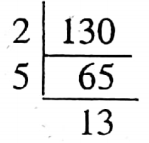
∴ 130 = 1 x 2 x 5 x 13

Here 33 and 130 are prime to each other.

The given numbers have no common factor except 1.

Hence the required H. C. F. is 1.

Practice Problems on HCF and LCM of Integers

Question 6. Examine whether 278 and 365 are prime to each other.

Solution:

Given:

278 and 365

Here we shall find the H. C. F. of the given numbers by the method of division


WBBSE Solutions For Class 6 Maths Chapter 1 Simplification Question 20WBBSE Solutions For Class 6 Maths Chapter 1 Simplification Question 20


∴ The H. C. F. of 278 and 365 is 1. Hence 278 and 365 are prime to each other.

Question 7. Find the H. C. F of 906, 1057, and 1510 by the division method.

Solution:

Given:

906, 1057, and 1510

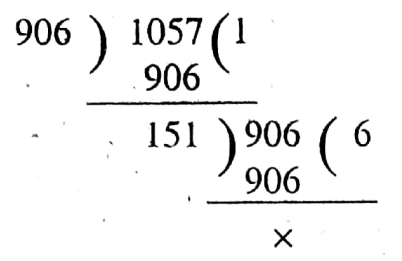
First, we find the H. C. F. of 906 and 1057.


WBBSE Solutions For Class 6 Maths Chapter 1 Simplification Question 21 Q 1


∴ The H. C. F. of 906 and 1057 is 151.

Now we shall find H. C. F. of 151 and 1510.


WBBSE Solutions For Class 6 Maths Chapter 1 Simplification Question 21 Q 2


∴ The H. C. F. of 151 and 1510 = 151.

Hence the required H. C. F. of 906, 1057, and 1510 = 151.

Question 8. Find the H. C. F. of 84, 112, 140.

Solution:

Given:

84, 112, 140.

Simplification For Class 6

WBBSE Solutions For Class 6 Maths Chapter 1 Simplification Question 22


Here we divide all the given numbers by their common prime factor 2 in the 1st row.

The quotients obtained are written in the 2nd row and divided into all the numbers in the 2nd row by their common prime factor 2 and the quotients are written in the 3rd row.

They are also divided by their common factor 7 and the quotients are written in the 4th row.

But the numbers in the 4th row have no common factor except 1 and the process is now completed.

∴ The required H. C. F. = product of the common prime factors

= 2 × 2 × 7 = 28.

The required H. C. F = 28.

Examples of Real-Life Applications of HCF and LCM

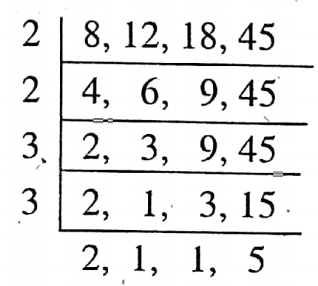
Question 9. Find the L. C. M. of 28, 35, 63, 84, 96.

Solution:

Given:

28, 35, 63, 84, 96


WBBSE Solutions For Class 6 Maths Chapter 1 Simplification Question 23


∴ The required L.C.M = 2 x 2 x 3 x 7 x 5 x 3 x 8

= 10080.

The required L.C.M = 10080.

Question 10

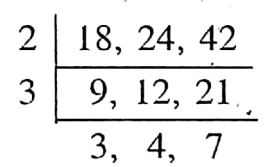
1. Find the least number which is exactly divisible by 18, 24, and 42.

Solution:

Given:

18, 24, and 42

Find the least number which is exactly divisible by 18, 24, and 42.


WBBSE Solutions For Class 6 Maths Chapter 1 Simplification Question 24 Q 1


 The L. C. M. of 18, 24, 42 = 2 x 3 x 3 x 4 x7 = 504.

∴ The required least number = 504.

2. Find the least number which is exactly divisible by 18, 39, 56, and 64.

Solution:

Given:

18, 39, 56, and 64

The required least number will be the L. C. M. of 18, 39, 56, and 64. 

Now,


WBBSE Solutions For Class 6 Maths Chapter 1 Simplification Question 24 Q 2

Simplification For Class 6

L.C.M. of 18, 39, 56 and 64 = 2 x 2 x 2 x 3 x 3 x 13 x 7 x 8 = 52416.

∴ The required least number = 52416.

Question 11.

The honorable Education Minister of the West Bengal Government has sent some books on Mathematics, Physical Science, and Life Science for class VI of Raghunath Vidyamandir. These books can be arranged in the school library in 20, 24, and 30 rows so that each row contains an equal number of books. How many least number of books has the minister sent?

Solution:

Given:

The honorable Education Minister of the West Bengal Government has sent some books on Mathematics, Physical Science, and Life Science for class VI of Raghunath Vidyamandir. These books can be arranged in the school library in 20, 24, and 30 rows so that each row contains an equal number of books.

Since each row contains an equal number of books the required number of books will be the L. C. M. of 20, 24, 30.

Now,


WBBSE Solutions For Class 6 Maths Chapter 1 Simplification Question 25
∴ L.C.M. of 20, 24, 30 = 2 x 2 x 5 x 3 x 2
= 120.
∴ The honorable Education minister has sent at least 120 books.
Conceptual Questions on Using LCM in Problem Solving

Question 12.

Find the H. C. F. and L. C. M. of 35, 45, and 50. Examine whether the product of the numbers and the product of their H. C. F. and L. C. M. are equal or not.

Solution:

Given:

35, 45, and 50


WBBSE Solutions For Class 6 Maths Chapter 1 Simplification Question 26


∴ H. C. E. of 35, 45, 50 = 5 and their L. C. M. = 5 x 7 x 9 x 10 = 3150. Product of H. C. F. and L. C. M. = 5 x 3150 = 15750.

Again the product of the numbers 35 x 45 x 50 = 78750

∴ Product of the numbers ≠ product of H.C.F. and L.C.M.

Question 13.

The sum of the two numbers is 150 and their H. C. F. is 15. Find the numbers.

Solution:

Since the H. C. F. of two numbers is 15, the numbers must be multiples of 15.

Let the numbers be 15x and 15 y where x and y are primes to each other.

∴ Their sum = 15x + 15y= 15 (x + y)

∴ By the given condition, we get, 15 (x + y) = 150

Dividing both sides by 15, we get, x + y = [latex]\frac{150}{15}\) = 10.

Now,

10 = 1+9=2+8=3+7=4+6=5+5.

Among them, 1, and 9 are prime to each other, and 3, and 7 are also prime to each other. 

So the numbers are either 15 x 1 = 15; 15 x 9 = 135

or, 15 x 3 = 45; 15 x 7 = 105 . 

∴ The required numbers are either 15, 135, or 45, 105.

Real-Life Scenarios Involving Equal Distribution Using HCF

Question 14.

If the H. C. F. and L. C. M. of two numbers be 5 and 75 respectively, then find the numbers.

Solution:

Since the H. C. F. of two numbers is 5, let the numbers be 5x and 5y, where x and y are primes to each other.

Then L. C. M. of 5x and 5y = 5xy. But the L. C. M. is 75.

∴ 5xy = 75.

Now dividing both sides by 5, we get, xy= 15.

But 151 x 15 = 3 x 5. Both the sets of numbers 1, 15, and 3, 5 are prime to each other.

∴ The numbers are either 5 x 1, 5 x 15 = 5, 75.

or, 5 x 3, 5 x 5 = 15, 25.

∴ The required numbers are either 5, 75

or 15, 25.

WBBSE Solutions For Class 6 Maths Chapter 1 Simplification Highest Common Factor And Lowest Common Multiple Of Integers

Chapter 1 Simplification Highest Common Factor And Lowest Common Multiple Of Integers

Question 1. 

1. Write down 2 numbers of two digits which are multiples of 4

Solution:

Two multiples of 4 of two digits are 12 and 16, because 4 × 3 = 12 and 4 × 4 = 16.

2. Write 6 multiples of 5 except 0;

Solution:

6 multiples of 5 except 0 are 5 × 15, 5 × 2 = 10, 5 × 3 = 15, 5 × 4 = 20, 5 × 5, 25 and 5 × 6 = 30.

Read And Learn More: WBBSE Solutions For Class 6 Maths Chapter 1 Simplification Solved Problems

3. Write two numbers whose L. C. M. is 12 and whose sum is 10;

Solution:

Two numbers are 4 and 6; because of the L. C. M. of 4 and 6 = 12 and whose sum 4+6= 10.

(Here 4 2 × 2 and 6 = 2 x 3. .. L. C. M.2 × 2 × 3 = 12).

WBBSE Solutions For Class 6 Maths Chapter 1 Simplification Highest Common Factor And Lowest Common Multiple Of Integers

WBBSE Class 6 HCF and LCM Simplification Notes

4. Write three numbers each of which has a factor of 4

Solution:

The required 3 numbers are 8, 12, and 16 because each of these numbers has a factor of 4.

5. Write three multiples of 7 greater than 50.

Solution:

Three multiples of 7 greater than 50 are 56, 63, and 70 because 56 > 50; 63 50; 70 > 50

56 = 7 × 8,

63 = 7 × 9, 

70 = 7 × 10.

WBBSE Solutions For Class 6 Geography WBBSE Solutions For Class 6 History WBBSE Solutions For Class 6 Maths
WBBSE Class 6 Geography Notes WBBSE Class 6 History Notes
WBBSE Class 6 Geography Multiple Choice Questions WBBSE Class 6 History MCQs WBBSE Notes For Class 6 School Science


Question 2.

1. Which is the smallest even prime number?

Solution:

The smallest even prime number is 2.

2. Which is the smallest odd prime number?

Solution:

The smallest odd prime number is 3.

3. What are the prime factors of 14?

Solution:

We know that 14= 1 × 2 × 7.

The factors of 14 are 1, 2, 7, and 14.

The prime factors of 14 are 2 and 7.

Short Questions on HCF and LCM

Question 3. 42 is the multiple of which of the following numbers? 

1. 5

2. 6

3. 7

4. 13.

Solution:

42 is divisible by both the numbers 6 and 7 but 42 is not divisible by 5 or 13.

So, 42 is the multiple of 6 and 7.

42 is not a multiple of 5. and 13.

Question 4. 11 is a factor of which of the following numbers?

1. 101

2. 111

3. 121

4. 112.

Solution: We know that 121 = 11 × 11.

∴ 11 is a factor of 121. 

Again the numbers 101, 111, and 112 are not divisible by 11.

So 11 is not a factor of 101, 111, or 112.

Question 5.

Find the H.C.F. by the resolution into prime factors of the numbers in each of the following cases:

1. 22, 44

Solution:

22 = 1 × 2 × 11

WBBSE Solutions For Class 6 Maths Chapter 1 Simplification Question 5 Q 1

44 = 1 × 2 × 2 × 11

WBBSE Solutions For Class 6 Maths Chapter 1 Simplification Question 5 Q 2

The factors of 22 are 1, 2, 11, 22 and that of 44 are 1, 2, 4, 11, 22, 44

WBBSE Solutions For Class 6 Maths Chapter 1 Simplification Question 5 Q 3

∴ The common factors of 22 and 44 are 1, 2, 11, and 22.

Among these factors, the highest factor is 22

∴ The required H. C. F. = 22.

2. 54, 72.

WBBSE Solutions For Class 6 Maths Chapter 1 Simplification Question 5 Q 1

WBBSE Solutions For Class 6 Maths Chapter 1 Simplification Question 5 Q 2

∴ So the factors of 54 are 1, 2, 3, 6,9, 18, 27, and 54.

WBBSE Solutions For Class 6 Maths Chapter 1 Simplification Question 5 Q 3

WBBSE Solutions For Class 6 Maths Chapter 1 Simplification Question 5 Q 4

∴ So the factors of 72 are 1, 2, 3, 4, 6, 8, 9, 12, 18, 24, 36, 72

∴ The common factors of 54 and 72 are 1, 2, 3, 6, 9, and 18.

Among these factors, the highest factor is 18.

∴ The required H. C. F. = 18.

Common Questions About Simplifying Fractions Using HCF

Question 6. Find the H. C. F. of 36 and 48 by resolution into factors.

Solution:

WBBSE Solutions For Class 6 Maths Chapter 1 Simplification Question 6 Q 1

∴ 36 = 2 × 2 × 3 × 3

∴ 48 = 2 × 2 × 2 × 2 × 3

Now

WBBSE Solutions For Class 6 Maths Chapter 1 Simplification Question 6 Q 2

WBBSE Solutions For Class 6 Maths Chapter 1 Simplification Question 6 Q 3

∴ The factors of 36 are 1, 2, 3, 4, 6, 9, 12, 18, and 36.

The factors of 48 are 1, 2, 3, 4, 6, 8, 12, 16, 24, and 48.

The common factors of 36 and 48 are 1, 2, 3, 4, 6, and 12.

Among these factors, the highest factor is 12.

∴ The required H. C. F. = 12.

Alternative Method:

WBBSE Solutions For Class 6 Maths Chapter 1 Simplification Question 6 Q 4

v

Here

WBBSE Solutions For Class 6 Maths Chapter 1 Simplification Question 6 Q 6 markings are common to both 36 and 48.

∴ The required H.C.F = 1 × 2 × 2× 3 =12.

Practice Problems on HCF and LCM

Question 7. Find the H. C. F. of 75 and 105 by factorization.

Solution:

WBBSE Solutions For Class 6 Maths Chapter 1 Simplification Question 7 Q 1

WBBSE Solutions For Class 6 Maths Chapter 1 Simplification Question 7 Q 2

WBBSE Solutions For Class 6 Maths Chapter 1 Simplification Question 7 Q 3

WBBSE Solutions For Class 6 Maths Chapter 1 Simplification Question 7 Q 4

Here

WBBSE Solutions For Class 6 Maths Chapter 1 Simplification Question Q 7 Q 5 marking is common to both 75 and 105.

∴ the required H.C.F = 1 × 3 × 5 = 15.

Question 8. Write two numbers whose H. C. F. is 7.

 Solution : 7 × 2 = 14; 7 × 3 = 21

2 and 3 are prime to each other, and the H. C. F. of 14 and 21 is 7.

The required two numbers are 14 and 21.

N.B. We can get an infinite number of such two numbers.

Question 9. By division method find the H. C. F. in the following cases:

1. 28, 35

Solution: 

WBBSE Solutions For Class 6 Maths Chapter 1 Simplification Question 9 Q 1


∴ the required H.C.F. = 7

2. 54, 72

WBBSE Solutions For Class 6 Maths Chapter 1 Simplification Question 9 Q 2


∴ The required H.C.f. = 18.

Examples of Real-Life Applications of HCF and LCM

Question 10. By division method, find the H. C. F. of 90 and 144.

Solution:

WBBSE Solutions For Class 6 Maths Chapter 1 Simplification Question 10


∴ The required H.C.F. = 18.

Question 11. What will be the greatest number by which 45 and 60 will be exactly divisible so that there will be no remainder in each case?

Solution:

The required greatest number will be the H. C. F. of 45 and 60.

Now,


WBBSE Solutions For Class 6 Maths Chapter 1 Simplification Question 11


∴ The H. C. F. of 45 and 60 = 15. So the required greatest number is 15.

Question 12.

1. The H. C. F. of two numbers is 1. How many such two numbers may exist? Find one pair of such numbers. What conclusion can you draw about such two numbers?

Solution:

There are infinite numbers of two numbers that have the H. C. F. 1. For example 2, 3; 5, 7; 9, 11, etc.

The required numbers are 9 and 11.

The numbers which have the H. C. F. 1 are prime to each other.

Conceptual Questions on Using HCF in Fraction Simplification

2. How many greatest number of persons can be distributed equally two kinds of sweets: 48 sweets of one kind and 64 sweets of another kind, without breaking the sweets?

Solution:

The required number of persons will be the H. C. F. of 48 and 64.

Now,

WBBSE Solutions For Class 6 Maths Chapter 1 Simplification Question 12

H.C. F. of 48 and 64 = 16

So the required greatest number of people is 16.

Question 13. Find the L. C. M. by factorization in each of the following cases:

 1. 25, 80

Solution:

WBBSE Solutions For Class 6 Maths Chapter 1 Simplification Question 13 Q 1

∴ 25 = 1 x 5 x 5

WBBSE Solutions For Class 6 Maths Chapter 1 Simplification Question 13 Q 2

∴ The required L.C.M = 1 x 5 x 5 x 2 x 2 x 2 x 2

= 400.

2. 36, 39

WBBSE Solutions For Class 6 Maths Chapter 1 Simplification Question 13 Q 3

∴ 36 = 2 x 2 x 3 x 3

WBBSE Solutions For Class 6 Maths Chapter 1 Simplification Question 13 Q 4

∴ 39 = 3 x 13

∴ The required L. C. M. = 2 x 2 x 3 x 3 x 13

= 468

Question 14. Find the L. C. M. by prime factors in each of the following cases:

1. 33, 132

Solution:

∴ 33 = 3 x 11

WBBSE Solutions For Class 6 Maths Chapter 1 Simplification Question 14 Q 2

∴ 132 = 2 x 2 x 3 x 11

∴ The required L. C. M. = 3 x 11 x 2 x 2 = 132.

Real-Life Scenarios Involving Equal Distribution Using HCF

2. 90, 144

WBBSE Solutions For Class 6 Maths Chapter 1 Simplification Question 14 Q 3

∴ 90 = 2 x 3 x 3 x 5

WBBSE Solutions For Class 6 Maths Chapter 1 Simplification Question 14 Q 4

∴ 144 = 2 x 2 x 2 x 2 x 3

 The required L. C. M. = 2 x 3 x 3 x 5 x 2 x 2 x 2 = 720.

WBBSE Solutions For Class 6 Maths Chapter 1 Simplification Prime And Composite Numbers Problems

Chapter 1 Simplification Prime And Composite Numbers Problems

Question 1. What is the smallest prime number?

Solution:

The smallest prime number is 2.

Question 2. Which number is neither prime nor composite?

Solution:

The number is 1, which is neither prime nor composite.

Question 3. Examine whether the following pair of numbers are prime to each other

1. 5, 7 

Solution:

WBBSE Class 6 Prime and Composite Numbers Notes

Given Numbers: 5, 7 

5 and 7 have no common factor except 1,

∴ 5 and 7 are prime to each other.

2. 10, 21.

Solution:

10 = 2 x 5 and 21 = 3 x 7.

∴ The factors of 10 are 1, 2, 5, and 10. 

Among them, 2 and 5 are the prime factors of

Again, the factors of 21 are 1, 3, 7, and 21. 

Among them, 3 and 7 are the prime factors of 21.

∴ 10 and 21 have no common factor other than 1.

So 10 and 21 are prime to each other.

Read And Learn More: WBBSE Solutions For Class 6 Maths Chapter 1 Simplification Solved Problems

Example 4. Write two composite numbers which are prime to each other. 

Short Questions on Prime and Composite Numbers

Solution:

Two composite numbers which are prime to each other

Two composite numbers 18 and 35 are prime to other.

Because, 18 = 2 x 3 x 3 and 35 = 5 x 7.

So 18 and 35 have no common factor except 1.

∴ 18 and 35 are two composite numbers but are prime to each other.

WBBSE Solutions For Class 6 Maths Chapter 1 Simplification Prime And Composite Numbers Problems

Example 5. Write down all the prime numbers between 100 and 200.

Solution:

The prime numbers between 100 and 200

The prime numbers between 100 and 200 are as follows

101, 103, 107, 109, 113, 131, 133, 137, 139, 141, 149, 151, 157, 161, 163, 167, 173, 179, 181, 191, 193, 197, 199.

Practice Problems on Prime and Composite Number Identification

WBBSE Solutions For Class 6 Geography WBBSE Solutions For Class 6 History WBBSE Solutions For Class 6 Maths
WBBSE Class 6 Geography Notes WBBSE Class 6 History Notes
WBBSE Class 6 Geography Multiple Choice Questions WBBSE Class 6 History MCQs WBBSE Notes For Class 6 School Science


Example 6. Find whether 331 is a prime number or not.

Solution:

Given:

331

Since 331 contains 1 in the unit’s place, therefore, 331 is not divisible

by any even number and also 331 is not divisible by 5.

Now the sum of the digits is 3+3 + 1 = 7. Therefore, the number 331 is not divisible by 3 or 9.

Now we divide the number 331 by 7, 11, 13, 17, etc., and we get,


WBBSE Solutions For Class 6 Maths Chapter 1 Simplification Question 6


The number 331 when divided by 19, the quotient is 17, which is less than the divisor 19, therefore further division by a prime number greater than 19 is not required.

Simplification For Class 6

∴ The number 331 is a prime number.

Example 7. Find the prime factors of 30030.

Solution :

The prime factors of 30030

Simplification For Class 6


WBBSE Solutions For Class 6 Maths Chapter 1 Simplification Question 7


∴ 30030 = 2 x 3 x 5 x 7 x 11 x 13

∴ The prime factors of 30030 are 2, 3, 5, 7, 11, and 13.


Example 8. Find the common factor or factors of the numbers 154, 195, and 714 by resolving them into prime factors.

Solution:

Given:

The common factor or factors of the numbers 154, 195, and 714 by resolving them into prime factor


WBBSE Solutions For Class 6 Maths Chapter 1 Simplification Question 8


∴ 154 = 1 X 2 x 7 x 11.

∴ 195 = 1 × 3 × 5 × 13

∴ 714 = 1 x 2 x 3 x 7 x 17.

Here we see that 154, 195, and 714 have no common factor except 1.

Therefore, 154, 195, and 714 are mutually prime to each other.

Examples of Real-Life Applications of Prime Numbers

Example 9. Find the common factors of the numbers 42, 66, and 78. Obtain the highest common factors of them.

Solution:

The common factors of the numbers 42, 66, and 78.


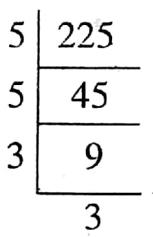
WBBSE Solutions For Class 6 Maths Chapter 1 Simplification Question 9

∴ 42 = 1 x 2 x 3 x 7.

∴ Factors of 42 are 1, 2, 3, 6, 7, 14, 21, and 42.


∴ 66 1 × 2 × 3 × 11

∴ Factors of 66 are 1, 2, 3, 6, 11, 22, 33, and 66.


∴ 78 1 X 2 X 3 X 13

∴ Factors of 78 are 1, 2, 3, 6, 13, 26, 39, and 78.

∴ The common factors of 42, 66, and 78 are: 1, 2, 3, 6

∴ Highest common factor

∴ The required highest common factor of the given numbers = 6.

Real-Life Scenarios Involving Factors and Multiples

Example 10. Examine, without actual division, whether the number 40821 is divisible by 3 or not.

Solution:

We know that any number will be divisible by 3 if the sum of the digits of the number is divisible by 3.

Here is the sum of the digits of the numbers 408214+0+8+2+1 = 15, which is divisible by 3.

Hence the number 40821 is divisible by 33


Example 11. Examine, without actual division, whether the number 55473 is divisible by 11 or not.

Solution:

We know that any number will be divisible by 11 if the difference between the sum of the digits in the odd places and even places of the number be zero or divisible by 11.

Here, the sum of the digits in the even places of the number 55473 = 5 + 7 = 12, and the sum of the digits in the odd places of the number 55473 = 5 + 4 + 3 = 12.

The difference of the sum of the digits in the odd places and even places = 12 12 = 0.

Hence the number 55473 is divisible by 11.


Example 12. Examine, without actual division, whether the number 908476118 is divisible by 11 or not.

Solution:

We know that any number will be divisible by 11 if the difference between the sum of the digits in the odd places and even places of the number be zero or divisible by 11.

Here, the sum of the digits in the odd places of the number 908476118 9+ 8 + 7+1+8=33 and that of the digits in the even places of the number 908476118 = 1 + 6 + 4 + 0 = 11.

.. The difference of the sum of the digits in the odd places and even places = 33 11 22, which is divisible by 11.

Hence the number 908476118 is divisible by 11.

Conceptual Questions on Prime Factorization

Example 13. Without actual division, Examine

1. if the number 85944 is divisible by 4.

2. if the number 705432700 is divisible by 4.

Solution:

We know that a given number is divisible by 4 if the last two digits, of the number, be zeroes or if the number formed by the last two digits of the given number is divisible by 4.

1. if the number 85944 is divisible by 4.

The number formed by the last two digits of the number 85944 is 44, which is divisible by 4.

∴ The number 85944 is divisible by 4.

2. if the number 705432700 is divisible by 4.

The last two digits of the number 705432700 are zeroes.

∴ The number 705432700 is divisible by 4.

WBBSE Notes For Class 6 Maths Chapter 1 Simplification Prime And Composite Numbers

Chapter 1 Simplification Prime And Composite Numbers

Chapter 1 Prime And Composite Numbers Definition: 

A number is said to be a prime number if it is divisible either by itself or by 1 only and is not divisible by any other number.

2, 3, 5, 7, 11, etc. are prime numbers. A prime number has no factor except the. the number itself and 1.

Definition:

  1. A number that is divisible by numbers other than itself and 1 is called a composite number.
  2. For example, 4, 12, 15, 18, 24, etc., numbers are composite numbers. A composite number is a multiple of two or more prime numbers.
  3. For example, 6 is a composite number and it is a multiple of the prime numbers 2 and 3.
  4. Again 12 is a composite number and it is a multiple of 2, 3, 4, and 6.
  5. Among them, 2 and 3 are the prime numbers, and 4, and 6 are composite numbers.
  6. Here 2, 3, 4, and 6 are the factors of 12.
  7. The number 1 is not a prime number, it is also not a composite number. 

Read And Learn More: WBBSE Notes For Class 6 Maths Chapter 1 Simplification

Determination of Prime Numbers :

  1. The method of determination of prime numbers among the natural numbers 1, 2, 3, 4, 5, 6, etc., is given below:
  2. First, we write down the natural numbers 1, 2, 3, 4, 5, 6, etc. consecutively.
  3. Then cut out every second number after 2. Thus all the multiples of 2 are canceled.
  4. Then cancel every third number after 3 and so all the multiples of 3 are canceled.
  5. Now cancel every fifth number after 5. Following the same procedure as the prime numbers 7, 11, etc., the numbers which are left after cancellation are the prime numbers.
  6. With the help of the above process, the prime numbers from 1 to 50 have been determined as follows

WBBSE Solutions For Class 6 Maths Chapter 1 Simplification Question 8

WBBSE Class 6 Prime and Composite Numbers Notes

  1. The remaining numbers are 1, 2, 3, 5, 7, 11, 13, 17, 19, 23, 29, 31, 37, 41, 43, 47.
  2. These numbers are prime numbers except 1.
  3. Therefore the prime numbers between 1 and 50 are 2, 3, 5, 7, 11, 13, 17, 19, 23, 29, 31, 37, 41, 43, 47.
  4. This method is called the Sieve of Eratosthenes. In third century B.
  5. C., Greek Mathematician Eratosthenes formulated a method by which prime numbers between 1 to 100 could be identified.
  6. In this method, the prime numbers can be easily found.
  7. out without finding factors or multiples.

WBBSE Notes For Class 6 Maths Chapter 1 Simplification Prime And Composite Numbers

Numbers Prime to each other or Co-prime numbers :

Definition:

  1. If two numbers are such that they do not have any common factors, or they have only common factor 1, then the numbers are said to be prime to each other (or Co-príme numbers).
  2. In the two numbers which are prime to each other or Co-prime numbers, there is no common factor other than 1.
  3. These numbers themselves may or may not be prime.

Important Definitions Related to Prime and Composite Numbers

For example

  1. 11 and 19 both the numbers are both prime and they do not have any common factor other than 1.
  2. Therefore 11 and 19 are prime to each other.
  3. Similarly, 11 and 13 are prime to each other because they do not have any common factor other than 1.
  4. Again 12 = 2 x 2 x 3 and 35 = 5 x 7. So the numbers 12 and 35 both are composite numbers i.e., they are not prime numbers.
  5. But there is no number common other than 1, by which both of them are exactly divisible i.e., they have no common factor.
  6. So the numbers 12 and 35 are prime to each other although they are not prime numbers.
WBBSE Solutions For Class 6 Geography WBBSE Solutions For Class 6 History WBBSE Solutions For Class 6 Maths
WBBSE Class 6 Geography Notes WBBSE Class 6 History Notes
WBBSE Class 6 Geography Multiple Choice Questions WBBSE Class 6 History MCQs WBBSE Notes For Class 6 School Science


Factors and Prime Factors:

  1. We know that,12 = 2 x 2 x 3. We can write,
  2. \(\left.\begin{array}{rl}
    12 & =1 \times 12 \\
    & =2 \times 6 \\
    & =3 \times 4
    \end{array}\right\}\)
  3. ∴ The factors of 12 are 1, 2, 3, 4, 6, and 12. 
  4. Among them, 2 and 3 are prime factors of 12. 
  5. So the prime factors of 12 are 2 and 3.
  6. Similarly, 
  7. \(\left.35=\begin{array}{c}
    1 \times 35 \\
    5 \times 7
    \end{array}\right\}\)
  8. ∴ The factors of 35 are 1, 5, 7, and 35. 
  9. Among them, 5 and 7 are prime factors.
  10. ∴ The prime factors of 35 are 5 and 7.

Simplification Maths Class 6

Definition:

  1. The numbers by which a given number is exactly divisible, then the numbers are called the factors of the given number.
  2. Among these factors, which factors are prime numbers are called prime factors.
  3. So the factors and prime factors of a given number are not the same.

Resolution of a number into Prime factors:

  1. In order to resolve a number into prime factors, the number should be continuously divided by suitable prime numbers, until the quotient comes to be a prime number.
  2. The successive divisors and the last quotient will be the prime factors.

Understanding Prime Numbers

Rule of Divisibility:

  1. The following are the rules to determine whether a natural number is divisible by other natural numbers or not.
  2. The natural number which has 0 or an even number in the unit’s place is divisible by 2.
    So all natural numbers having 0 or an even number in the unit’s place is divisible by 2. For example, 20, 26, 32, 34, etc. are divisible by 2.
  3. If the sum of the digits of a natural number is divisible by 3, the number is also divisible by 3.
    For example, the sum of the digits of the number 234 is 9 which is divisible by 3 and so the number 234 is divisible by 3.
  4. If the last two digits of a natural number be zeroes or if the number formed by the last two digits of the given natural number is divisible by 4, then the given natural number is divisible by 4.
    For example, the natural number 200, having the last two digits 0, is divisible by 4 and the number formed by the last two digits of the natural number 132 is 32, which is divisible by 4 and so the number 132 is divisible by 4.
  5. The natural numbers having 0 or 5 in the unit’s place are divisible by 5.
    For example, 150 and 205 are divisible by 5.
  6. The natural numbers which are divisible by both 2 and 3 are divisible by 6. For example, 78 and 126 are divisible by 6.
  7. In order to determine whether a natural number is divisible by 7 or not, it is better to divide the natural number by 7.
    If there is no remainder, then the given natural number must be divisible by 7.
  8. If the last 3 digits of a given natural number be zeroes or the number formed by the last 3 digits of the given natural number is divisible by 8, then the given natural number must be divisible by 8.
    For example, 1000 and 2152 both are divisible.. by 8.
  9. If the sum, of the digits of a number, is divisible by 9, then the number is divisible by 9.
    For example, the numbers 1107 and 1827 are divisible by 9.
  10. The natural numbers having 0 in the unit’s place must be divisible by 10.
    For example, 210, and 2350 both are divisible by 10.
  11. If the difference of the sum of the digits in the odd places and even places of a natural number by zero or divisible by 11, then the number must be divisible by 11.
    For example, the numbers 1474 and 61754 are divisible by 11, because for the number 1474:
  12. The sum of the digits in the odd places = 1 + 7 = 8 and the sum of the digits in the even places 4+4 = 8.
  13. The difference between these two numbers = is 8-8 = 0.
  14. Again for the number 61754:
  15. The sum of the digits in the odd places = 6 +7+4 = 17 and the sum of the digits in the even places = 1 + 5 = 6.
  16. The difference between these two numbers is 17 – 6 = 11, which is divisible by 11.
  17. Hence both the natural numbers 1474 and 61754 are divisible by 11.
  18. With the help of the above rules, we can determine whether a natural number is divisible, by 12, 15, 16, 18, 25, etc., or not.


WBBSE Solutions For Class 6 Maths Chapter 1 Simplification Solved Example Problems

Chapter 1 Simplification Solved Example Problems

Question 1: Simplify each of the cases (1), (2), (3), (4) Verify whether the results of the cases are equal or not.

1.10 + 8 ÷ (5 – 2)

Solution:

Given

10 + 8 ÷ (5 – 2)

= 10 + 8 ÷ 3

= 10 + \(\frac{8}{3}\)

= \(\frac{10+3}{3}\)

= \(\frac{38}{3}\)

10 + 8 ÷ (5 – 2)  = \(\frac{38}{3}\)

Read And Learn More: WBBSE Solutions For Class 6 Maths Chapter 1 Simplification Solved Problems

WBBSE Class 6 Simplification Example Problems

2. (10 + 8) ÷ (5 – 2)

Solution:

Given

(10 + 8) ÷ (5 – 2)

= 18 ÷ 3

= 6.

(10 + 8) ÷ (5 – 2) = 6.

WBBSE Solutions For Class 6 Maths Chapter 1 Simplification Solved Example Problems

3. (10 – 8)(5 – 2)

Solution:

Given

(10 – 8)(5 – 2)

= (2)(3)

= 6

(10 – 8)(5 – 2) = 6

Short Questions on Simplification Problems

4. 10 – 8 (5 – 2).

Solution:

Given

10 – 8 (5 – 2)

= 10 – 8 (3)

= 10 – 24

= – 14.

10 – 8 (5 – 2) = – 14.

Question 2.

Simplify :

1. (12 – 2) ÷ 2,

2. {90 – (48 – 21)} ÷ 7

Solution: 

Given

1. (12 – 2) ÷ 2

= 10 ÷ 2

= 5.

(12 – 2) ÷ 2 = 5.

2. {90 – (48 – 21)} ÷ 7

= {90 – 27} ÷ 7

= 63 ÷ 7

= 9.

{90 – (48 – 21)} ÷ 7= 9.

Common Simplification Problems and Solutions

Question 3

Evaluate:

1. (72 ÷ 8 x 9) – (72 ÷ 8 of 9)

2. {25 x 16 ÷ (60 ÷ 15) – 4 x (77 – 62)} ÷ (20 x 6 + 3)

3. 200 ÷ [88 – {(12 x 13) – 3 x (40 – 9)}]

Solution:

Given

1. (72 ÷ 8 x 9)- (72 ÷ 8 of 9)

= (9 x 9) – (72 ÷ 72)

= 81 – 1

= 80.

(72 ÷ 8 x 9)- (72 ÷ 8 of 9) = 80.

WBBSE Solutions For Class 6 Geography WBBSE Solutions For Class 6 History WBBSE Solutions For Class 6 Maths
WBBSE Class 6 Geography Notes WBBSE Class 6 History Notes
WBBSE Class 6 Geography Multiple Choice Questions WBBSE Class 6 History MCQs WBBSE Notes For Class 6 School Science


2. {25 x 16 ÷ (60 + 15) – 4 x (77 – 62)} ÷ (20 x 6 ÷ 3)

= {25 x 16 + 4 – 4 xl5} ÷ (20 x 2)

= {25 x 4 – 4 x 15} ÷ 40

= {100 – 60} ÷ 40

= 40 v 40

= 1

{25 x 16 ÷ (60 + 15) – 4 x (77 – 62)} ÷ (20 x 6 ÷ 3) = 1

Practice Problems on Simplification with Solutions

3. 200 ÷ [88 – {(12 x 13) – 3 x (40 – 9)}]

= 200 ÷ [88 – {156 – 3 x 31}] – 200 + [88 – {156 – 93}]

= 200 ÷ [88 – 63]

= 200 ÷ 25

= 8.

200 ÷ [88 – {(12 x 13) – 3 x (40 – 9)}] = 8.

Question 4

1. 256 ÷ \(\overline{16 \div 2}\) ÷ \(\overline{18 \div 9}\)  x 2

Solution :

256 + 16 + 2 + 18 + 9 x 2

= 256 + 8 – 2 x2

= 32 + 2 x 2

= 16 x 2

= 32.

256 + 16 + 2 + 18 + 9 x 2 = 32.

Class 6 Simplify Questions

2. 76 – 4 – [6 + {19 – (48 – 57-17)}] \(\overline{57 – 17}\)

Solution:


WBBSE Solutions For Class 6 Maths Chapter 1 Simplification Question 4 Q 2


3. [16 + {42 – \(\overline{38 + 2}\) }]12 + (24 + 6) x 2 + 4.

Solution:

WBBSE Solutions For Class 6 Maths Chapter 1 Simplification Question 4 Q 3

Examples of Real-Life Applications of Simplification

Question 5. Evaluate:

1. 4 x [24 – {(110 – \(\overline{11 + 3}\) x 4) + 9}] ÷ 2 of 9

Solution:

4 x [24 – {(110 – \(\overline{11 + 3}\) x 4) + 9}] ÷ 2 of 9


WBBSE Solutions For Class 6 Maths Chapter 1 Simplification Question 5 Q 1


2. (987 – \(\overline{43 + 25}\)) – 10 [5 + {(999 ÷ \(\overline{9 * 3}\)) + (\(\overline{8 * 9}\) ÷ 6) 4 }].

Solution:

(987 – \(\overline{43 + 25}\)) – 10 [5 + {(999 ÷ \(\overline{9 * 3}\)) + (\(\overline{8 * 9}\) ÷ 6) 4 }].


WBBSE Solutions For Class 6 Maths Chapter 1 Simplification Question 5 Q 2

Conceptual Questions on BODMAS and Simplification

Example 6. Evaluate:

[latex100-[60 \div \overline{3+2}\} \div\{(5 \text { of } 3) \div \overline{1+4}\}] \text { of } \overline{12+13}[/latex]

Solution:

\(100-[60 \div \overline{3+2}\} \div\{(5 \text { of } 3) \div \overline{1+4}\}] \text { of } \overline{12+13}\)


WBBSE Solutions For Class 6 Maths Chapter 1 Simplification Question 6


Example 7. Simplify:

\(4-[4+\{4-(\overline{4-4}) \text { of } 4\} \div 4]\)

Solution:

4-[4+\{4-(\overline{4-4}) \text { of } 4\} \div 4]

Simplification Questions For Class 6

WBBSE Solutions For Class 6 Maths Chapter 1 Simplification Question 7

Example 8. Simplify:

\(a-[a+\{a-(a+\overline{a-a}) \div a\}-a]\)

Solution:

\(a-[a+\{a-(a+\overline{a-a}) \div a\}-a]\)


WBBSE Solutions For Class 6 Maths Chapter 1 Simplification Question 8

Real-Life Scenarios Involving Mathematical Problem Solving

Question 9. Express the following in Mathematical Language and then solve it:

Father of Subhas plucked 125 guavas from their guava orchard and sold them at the rate of 2 each. Then he purchased 2 pens at the cost of 5 each and 2 exercise books at the cost of 20 each from the money he got by selling the navas. Then the remaining money was distributed between Subhas and his sister equally for eating sweets. How much money did Subhas receive?

Solution:

Expressing the given information in the language of mathematics, we get

Subhas received = [125 x 2 -((5 x 2) + (20 × 2)}] ÷ 2

Solution is Subhas received = [125 x 2 -((5 x 2) + (20 × 2)}] ÷ 2

= [250 (10+40)] ++ 2

= [125 x 2 -((5 x 2) + (20 x 2)}] ÷ 2 [25050] ÷ 2 

= [200] ÷ 2 

= 100.

∴ Subhas received 100.


Example 10. Express the following statement in Mathematical Language and then solve it:

Debapriyo, a student of class Six, received 10,000 as the first prize in the talent search competition in the village. Then he went to his house and he gave to his mother half the prize money and to his elder sister studying Physics Honours 1 half of the remaining money. After this, he purchased a watch by \(\frac{1}{20}\)th of the 20 prize money and purchased 10 pens at a cost of 5 each, 10 exercise books at a cost of 20 each and a book at a cost of 150 for his youngest brother. After these expenses, he kept the remaining money with his father for savings. What was the savings of Debapriyo?

Solution:

Expressing the given information in the mathematical language, we get

The savings of Debapriyo

= [{10,000 – (10,000 ÷ 2)) (10,000 (10,000 ÷ 2)} ÷ 2] – [(10,000 ÷ 20) + (5 x 10+ 20 x 10 + 150)]

= [{10,000 – 5000) – (10,000 – 5000) ÷ 2] – [500+ (50+ 200+ 150)]

= [5000 – 5000 ÷ 2] – [500 +400]

= [ 5000 – 2500] – 900 

= 2500 – 900

= 1600

The savings of Debapriyo was 1600.

WBBSE Notes For Class 6 Maths Chapter 1 Simplification

Simplification Maths Class 6

Chapter 1 Simplification

  1. Simplification of a mathematical quantity means that a simplified form is obtained after the application of different mathematical processes on it such that no further mathematical process can be applied to this simplified form.
  2. Suppose that you have to simplify “10 + 2”—here you have to obtain a simplified form on two real numbers 10 and 2 and there is a mathematical operation “+” (addition) in between them.
  3. We get a simplified real number 12 as a result of the mathematical operation “+” is applied on 10 and 2 and there you can not apply any other mathematical operation on 12.
  4. So the simplification of the mathematical quantity (10 + 2)—we get 12, i.e., 10+ 2 = 12.
  5. Similarly, 20 – 5 = 15, a simplification process. 4 x 5 = 20, 30 -r 5 = 6, etc. are examples of simplification.
  6. It is to be noted that by a “mathematical process or operation” we mean.
  7. Addition, Subtraction, Multiplication, Division,  etc. and we express them as +, -, x, ÷,  etc. respectively.
  8. Other than these operations, we also use the mathematical symbols ( ), { }, [ ], of, etc.
  9. These mathematical symbols denote also definite
  10. mathematical processes or operations like +, x, -, ÷, etc.
  11. For example, the mathematical operation “2 of 8” means 8 x 2 and the result of this quantity after the operation has been done is 16.
  12. Similarly, the symbols ( ), { }, [ ], etc. represent definite mathematical operations or processes.
  13. So we get the following mathematical operations: “+” means addition ; means subtraction ; “x” means multiplication, “÷” means division, “of’ means multiplication ; means first bracket ; “{ }” means second bracket ; “[ ]” means third bracket ;
  14. “—” means vinculum.
  15. Now if it is said that only one mathematical operation is to be done in a mathematical quantity, then we generally do not say that “Simplify” it, we say that you make the process directly,
  16. For example
  17. Add : 15 + 3
  18. or, Multiply: 12 x 5, etc. so to say “Simplify”—we mean generally do more than one mathematical process or operations,

Class 6 Math Solution WBBSE English Medium

Read And Learn More: WBBSE Notes For Class 6 Maths Chapter 1 Simplification

For example:

Simplify 10 ÷ 2 x 5 + 3-1. Here all four mathematical operations or processes “÷”, “x”, “+” and “-’’ are to be done.

Now the question is:

  1. Whether all the operations can be done simultaneously or not?
  2. If not, then which process or operation can be done at first, and which process can be done afterward?
  3. This must be known clearly, otherwise, the result will be different in different procedures.

For this you observe the following simplification :

24 + 6 + 2

= 4 + 2

= 6.

WBBSE Notes For Class 6 Maths Chapter 1 Simplification

Understanding BODMAS

  1. Here we have done the division (+) process first and then the addition (+) process has been done.
  2. Again, ,24 + 6 + 2 = 24 + 8 = 3. Here we have done an addition.
  3. (+) the process at first and then the division process has been done.
  4. As a result of which we get the answer 6 in the first case and 3 in the second case.
  5. So in the simplification of the same problem, we get different results in the different processes if we do not obey a definite rule. But this is not reasonable.
  6. For this Mathematicians have decided on a definite rule of an operational procedure for simplification which we should follow always.
  7. The operational rule for simplification is “VBODMAS”.
  8. Where V = Vinculum
  9. B = Brackets (1st, 2nd, 3rd) .
  10. O = Of
  11. D = Division
  12. M = Multiplication
  13. A = Addition
  14. S = Subtraction
  15. So for simplification, you have to start with, the operations vinculum, then the first bracket, 2nd bracket, 3rd bracket, of, and at last division, multiplication, addition, and subtraction correspondingly.
  16. It is to be noted that if any one of the mathematical operations is absent, then perform the next mathematical operation and so on and this rule can not be violated in any way.
  17. Sometimes in any of the simplifications, there may exist no definite mathematical operation between any two numbers or quantities
WBBSE Solutions For Class 6 Geography WBBSE Solutions For Class 6 History WBBSE Solutions For Class 6 Maths
WBBSE Class 6 Geography Notes WBBSE Class 6 History Notes
WBBSE Class 6 Geography Multiple Choice Questions WBBSE Class 6 History MCQs WBBSE Notes For Class 6 School Science


WBBSE Class 6 Simplification Notes

For example

  1. 12÷2 (5-3) in this simplification there is no mathematical operation between 2 and (5−3). In this case, the process i.e., the operation “x” between 2 and (5-3) is absent, you will always assume that there is “x” i.e., the product operation between these two quantities but you can not put directly “x”-sign between these two quantities. Because in that case, the answer may not be correct. For example, in the same simplification, we get 12÷2 (5-3) = 122 (2) = 12 ÷ 4 = 3
  2. This is the correct answer. But if you put the “x” sign between 2 and (5-3), then the simplification becomes
       12÷2 (5-3)
    = 12÷2 x (5-3)
    = 12÷ 2 x 26 x 2
    = 12 which is not the correct answer.
  3. Here we have done the division process first and then multiplication (whenever you put the “x” sign in the specified place) and the result of the simplification is wrong correspondingly. You will always be alert in this matter.

Simplification Questions For Class 6

Alertness regarding the withdrawal of the Vinculum sign:

  1. The students often make a mistake about the operation “Vinculum”, especially there is a “—” sign before the sign “Vinculum”. For example:
  2. \(22 \div 11-\overline{7-3}\) here” — ” sign exists before the sign Vinculum. Some students write this after the operation of Vinculum as 22 ÷ 11-7-3, which is totally wrong Because in this case,
    22 ÷11-7-3
    = 2-7-3
    = -5-3
    = -8.
  3. But the correct value of the simplification is \(22 \div 11-\overline{7-3}\)
    = 22÷11-4
    = 2-4
    = -2.
  4. So if there is a “—” sign before the sign Vinculum, then after the withdrawal of the vinculum sign, one must take care of the sign as follows
  5. The “+” sign becomes the “—” sign and the “—” sign becomes the “+” sign.
  6. Then only the correct value of the simplification will be obtained.
  7. So we write
  8. \(22 \div 11-\overline{7-3}\)
    = 211-7+3
    = 2-7+3
    = 2+3-7
    = 5-7
    = -2, which is the correct value of the simplification.

WBBSE Solutions For Class 9 Maths Arithmetic Chapter 1 Real Numbers

WBBSE Solutions For Class 9 Maths Arithmetic Chapter 1 Real Numbers

Class 9 Math Book Pdf WBBSE Arithmetic Chapter 1 Natural Numbers

WBBSE Class 9 Real Numbers Overview

  1. The numbers 1, 2,.3, 4, …… (to infinity) are called Natural Numbers or Counting Numbers.
  2. For the essentiality of counting different objects, these natural counting numbers have been created from the very beginning of human civilization.
  3. These numbers start from 1 and end at infinity.
  4. So, the series of these numbers is closed at the left and open at the right.
  5. The least natural number is 1.
  6. There is no greatest natural number.
  7. Natural numbers are usually denoted by the English alphabet N.
  8. Representing the natural numbers according to the set theory we get,
  9. N= {1, 2, 3, 4, ……..} or,
  10. N ={n: n ≥ 1 and n is a natural number}

Read and Learn More WBBSE Solutions For Class 9 Maths
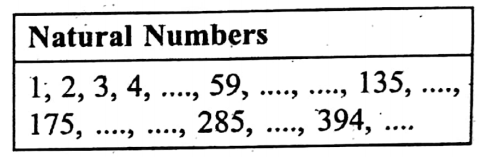
WBBSE Solutions For Class 9 Maths Chapter 1 Arithmetic Real Numbers 1

Properties and Characteristics of Natural Numbers:

  1. ‘O’ is not a natural number.
  2. The least natural number is 1.
  3. The numerical value of two consecutive natural numbers is always 1.
  4. The sum of two or more natural numbers is always a natural number.
    For example, 10 + 15 = 25, which is a natural number, and 6 + 14 + 112 = 132, which is also a natural number.
  5. The subtraction of two natural numbers may or may not be a natural number.
    For example, 25 – 14 =11, which is a natural number; On the other hand, 16 – 48 = – 32, which is not a natural number.
  6. The product of two natural numbers is a natural number.
    For example, 15 x 36 = 540, which is a natural number; 10 x 26 x 108 = 28080, which is a natural number.
  7. The division of two natural numbers may or may not be a natural number.
    For example, 50 ÷ 2 = 25, which is a natural number; But 75 ÷ 50 = 3/2 is a fraction, not a natural number.
  8. The natural numbers can be represented easily on the number line.
  9. Natural numbers are not dense on the number line, i.e., there is no other natural number between two consecutive natural numbers.
  10. Natural numbers are all positive numbers.

WBBSE Class 9 Real Numbers Solutions – Arithmetic Chapter 1 Whole numbers

  1. From the previous classes, it is known to all of us that 0 is not a natural number.
  2. Now, the numbers, generated by adding 0 to the natural numbers are called Whole Numbers.
  3. Therefore the numbers 0, 1, 2, 3, and 4, (to infinity) are called Whole Numbers.
  4. Whole numbers are generally denoted by the letter W of the English alphabet.
  5. W= {0, 1, 2, 3,4,…….}
  6. = {x : x ≥ 0, where x is zero or a natural number}.
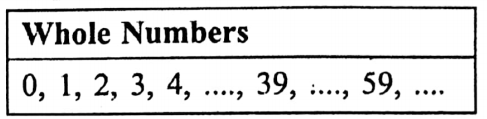
WBBSE Solutions For Class 9 Maths Chapter 1 Arithmetic Real Numbers 2

Properties and Characteristics of Whole Numbers

  1. The least whole number is 0.
  2. There is no greatest whole number.
  3. Whole numbers are not dense on the number line.
  4. The sum or product of two or more whole numbers is always a whole number.
  5. The subtraction or division of two whole numbers may or may not be a whole number.

WBBSE Solutions For Class 9 Maths Arithmetic Chapter 1 Real Numbers

West Bengal Board Class 9 Maths Solutions PDF Arithmetic Chapter 1 Integers

  1. You have already studied that all the natural numbers are positive and there exists always an additive inverse of these positive integers.
  2. For example, the additive inverse of 7 is (- 7); the additive inverse of 16 is (- 16), etc.
  3. These additive inverse numbers are called Negative Integers.
  4. Therefore, the integers greater than 0 i.e. the numbers 1, 2, 3, 4, (to infinity) are called Positive Integers.
  5. The integers less than 0 i.e. the numbers – 1, – 2, – 3, – 4, (to infinity) are called
  6. Negative Integers and the number 0 is called Neither Positive nor Negative Integers.
  7. Now, Negative integers, zero, and positive integers are together called integers.
  8. Integers are usually denoted by I or the English alphabet Z.
  9. Therefore, by set theory notation,
  10. I = {…… -4, – 3, – 2, – 1, 0, 1, 2, 3, 4,………. } or,
  11. Z ={….,- 4, – 3, – 2, – 1, 0, 1, 2, 3, 4, }
  12. Also, I or Z = {x: x is an integer}.
  13. Moreover, Negative integers are denoted by I or Zand Positive integers are denoted by I+ or Z+.
  14. ∴ I or Z= {  -4, -3,-2, – 1}.
  15. and I+ or Z+ = {1, 2, 3, 4, ………}.

WBBSE Solutions For Class 9 Maths Chapter 1 Arithmetic Real Numbers 3

Properties and Characteristics of Integers:

  1. here is no least or greatest integer.
  2. Integers are expanded to infinity on both sides left and right.
  3. The least positive integer is 1.
  4. The greatest negative integer is – 1.
  5. 0 is neither positive nor negative;
  6. There exists an additive inverse of each and every integer.
  7. The distance in the number line between any positive integer and its additive inverse is always equal.
  8. Integers are not dense in the number line, i.e., there exists no other integer between two consecutive integers.
  9. The sum, subtraction, and product of two or more integers are always an integer.
  10. The division of two integers may or may not be an integer.
  11. The sum of any positive integer and its additive inverse is always zero.

Types of Real Numbers Explained

NEET Biology Class 9 Question And Answers WBBSE Class 9 History Notes WBBSE Solutions for Class 9 Life Science and Environment
WBBSE Class 9 Geography And Environment Notes WBBSE Class 9 History Multiple Choice Questions WBBSE Class 9 Life Science Long Answer Questions
WBBSE Solutions for Class 9 Geography And Environment WBBSE Class 9 History Long Answer Questions WBBSE Class 9 Life Science Multiple Choice Questions
WBBSE Class 9 Geography And Environment Multiple Choice Questions WBBSE Class 9 History Short Answer Questions WBBSE Solutions For Class 9 Maths
WBBSE Solutions for Class 9 History WBBSE Class 9 History Very Short Answer Questions


Example 1. 

 If two integers a and b be such that -2 < a < 0 and 0 < b < 2, then show that

1. (a + b)belongs to the set of whole numbers W

Solution:

Given Two Integers a And b be Such That -2 < a < 0 and 0 < b < 2

– 2 < a <0 means that a is an integer that is greater than – 2, but less than 0.

∴ a = – 1.

0 < b < 2 means that b is an integer that is greater than 0, but less than 2.

∴b = 1.

Now, (1) a + b = – 1 + 1

= 0, which is a whole number,

∴ (a + b) belongs to W. (Proved)

2. (a – b) belongs to the set of natural numbers N.

Solution:

Given Two Integers a And b be Such That -2 < a < 0 and 0 < b < 2

(a – b) belongs to the set of natural numbers N

a – b = – 1– 1

= – 2, which is a negative integer.

∴ (a – b) does not belong to N. (Proved)

3. Given Two Integers a And b be Such That -2 < a < 0 and 0 < b < 2

(b – a) belongs to the set of integers Z.

b – a = 1 – (- 1)

= 1 + 1

= 2, which is an integer.

∴ (b – a) belongs to Z. (Proved)

Example  2. If two negative integers n1 and n2 be such that n1 ≠ – 1, n2 ≠ – 2 and – 3 < n1,n2 < 3 then find the values of

1. n1 + n2

2. n1 – n2

3. n1n2

4. \(\frac{n_1}{n_2}\)

Solution:

-3 < n1, n2 < 3 means that both n1 and n2 are two such negative integers, the values of which are greater than (-3), but less than 3.

∴ The value of n1 and n2 are -2 and -1.

Also, given that n1 ≠ -1

∴ n1 = -2 and n2 ≠ -2 ⇒ n2 = -1.

So,


1. n1+ n2

= – 2 + (- 1)

= – 2 – 1

= – 3


2. n1 – n2

= – 2 + (- 1)

= – 2 + 1

= – 1


3. n1. n2

= (-2). (-1)

= 2


4. \(\frac{n_1}{n_2}\)

= \(\frac{n_1}{n_2}\)

= \(\frac{-2}{-1}\)

= 2

Properties of Real Numbers for Class 9

Example 3. If – 5 < x< 5 and x is a negative integer, then find the values of

Solution:

Given – 5 < x< 5 and x is a negative integer

The meaning of – 5 < x< 5 is that x is greater than (- 5) and less than 5.

Now, the integers which are greater than – 5 and less than 5 are – 4, – 3, – 2, – 1, 0., 1, 2, 3, and 4.

Also,x is a negative integer.

∴ The values of x are – 4, – 3, – 2, – 1.

Class 9 Maths Chapter 1 Real Numbers WBBSE Arithmetic Chapter 1 Rational Numbers

Definition:

  1. The numbers that can be represented in the form \(\frac{p}{q}\)  where p and q are both integers and q ≠ 0, is called Rational Numbers.
  2. For example,  is a rational number; Because 5 and 7 are both integers.
  3. Therefore, all integers are Rational Numbers.
  4. Moreover, any natural number can be represented in the form \(\frac{p}{q}\)  where p and q are both integers and q ≠ 0.
  5. For example, 8 is a natural number, it can be represented in the form as follows
  6. \(8=\frac{8}{1}(p=8, q=1)=\frac{16}{2}(p=16, q=2)=\frac{24}{3}(p=24, q=3) \text {, }\)………etc.
  7. 8 is a rational number.
  8. Thus, it can be easily shown that any natural number can be represented in the form \(\frac{p}{q}\) where p and q
  9. q are both integers and q ≠ 0.
  10. Therefore, every natural number is a rational number.
  11. We can also write 0 in the form \(\frac{0}{1}\) =\(\frac{0}{2}\) = \(\frac{0}{3}\) = \(\frac{0}{4}\) = …..etc., where both the numerator and denominator
  12. are integers and the denominator is never zero.
  13. ∴ 0 (zero) is a rational number.
  14. Thus, all natural numbers including zero, i..e., the whole numbers are all rational numbers.
  15. Again, any negative integer such as -18, can be written in the form \(\frac{-18}{1}\) = \(\frac{-32}{2}\) = ……… etc.
  16. both the numerator and denominator are integers and the denominator is not zero.
  17. 18 is a rational number.
  18. Similarly, any negative integer can be represented in the form \(\frac{p}{q}\) where p and q are both integers and q ≠ 0.
  19. ∴ All the negative integers are rational numbers.
  20. From the above discussion, we can say that,
  21. The numbers that can be represented in the form of the division of two integers where the denominator is never zero are called rational numbers.
  22. The rational numbers are usually denoted by the English alphabet Q.
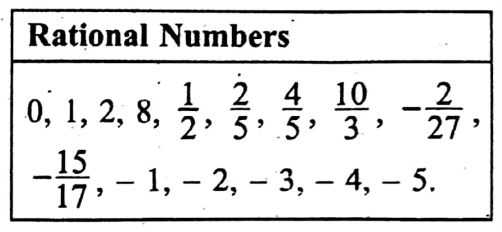
WBBSE Solutions For Class 9 Maths Chapter 1 Arithmetic Real Numbers 4

Equivalent Rational Numbers:

  1. You have already studied that a rational number can be represented in several manners, the value of each of which is equal.
  2. Such as \(\frac{2}{3}\)  is a rational number.
  3. It can be represented in different forms like  \(\frac{2}{3}\) = \(\frac{4}{6}\) = \(\frac{6}{9}\) = \(\frac{8}{12}\) = …………etc.,  where both the numerator and denominator are integers and the denominator is never zero.
  4. Each of these numbers is a rational number.
  5. Also, the value of each of these rational numbers is equal. These rational numbers are called equivalent rational numbers.
  6. Therefore, the rational numbers which are of equal values, but of different representations are called equivalent rational numbers to each other.
  7. Any rational number is usually represented in its lowest form (by simplification); i.e., the two integers forming the numerator and denominator of the lowest form (in the case of \(\frac{p}{q}\), p and q) are co-primes.

To insert one or more rational numbers in between two given numbers (Rational or integer):

  1. Let a and b be two given numbers (rationals or integers).
  2. We have to insert one or more than one rational numbers in between a and b. 
  3. We can do the same by different methods as follows

Method-1.

  1. When 1 rational number is to be inserted
  2. The given two numbers are a and b.
  3. Tthe required rational number = \(\frac{a+b}{2}\)

For example:

WBBSE Class 9 Maths Chapter 1 PDF Real Numbers on the Number Line

1. Insert one rational number between 3 and 4.

Solution:

Here, the given two numbers are 3 and 4.

So, taking a= 3 and b = 4, the required rational number

= \(\frac{a+b}{2}=\frac{3+4}{2}=\frac{7}{2}\)

2. Insert one rational number between 2 and \(\frac{3}{2}\).

Solution: The required rational number = \(\frac{2+\frac{3}{2}}{2}=\frac{7}{4}\)

3. Insert one rational number between \(\frac{5}{2}\) and 5.

Solution:

\(\frac{\frac{5}{2}+5}{2}=\frac{15}{4}\)

4. Insert one rational number between – 2 and \(\frac{3}{4}\).

 Solution: The required rational number = \(\frac{-2+\frac{3}{4}}{2}=\frac{\frac{-8+3}{4}}{2}=\frac{-\frac{5}{4}}{2}=-\frac{5}{8}\)

5. Insert one rational number between \(\frac{1}{7}\) and  \(\frac{1}{6}\).

Solution: The required rational number = \(\frac{\frac{1}{7}+\frac{1}{6}}{2}=\frac{\frac{6+7}{42}}{2}=\frac{\frac{13}{42}}{2}=\frac{13}{84}\)

Method-2.

When more than one rational numbers are to be inserted :

  1. Let a and b be two given numbers and we have to insert n rational numbers in between them.
  2. Then, the WORKING RULE is as follows:
  3. Step – 1: Bind (n + 1); The result of this sum will be the denominator of all the required rational numbers.
  4. Step – 2: Express an in such of its equivalent rational number, the denominator of which is the result of the sum {n + 1).
  5. Step – 3: Express b as an equivalent rational number, the denominator of which is the same as that of the expression of an in STEP – 1, i.e., (n + 1).
  6. Step – 4: Select n integers in between the numerator of the equivalent rational number obtained in STEP – 2 and the numerator of the equivalent rational number obtained in STEP-3. (Since n rational numbers have to be inserted).
  7. Step – 5: Write down the result of the sum.
  8. (n + 1) as the denominator of each of the integers obtained in STEP – 4.
  9. Step – 6: Represent the rational numbers obtained in STEP – 5 as their lowest forms by simplification
  10. Then, complete your answer by writing the rational numbers thus involved as the required rational numbers one after another.

For Example

1. Let 8 rational numbers are to be inserted between 6 and 7.

Then,

2. Step – 1: 8+1 = 9.

3. Step – 2: 6 = \(\frac{54}{9}\)

4. Step – 3: 7 = \(\frac{63}{9}\)

5. Step – 4: 55,56,58,59,60,61,62 [∵ these are between 54 and 53]

6. Step – 5: \(\frac{55}{9}, \frac{56}{9}, \frac{57}{9}, \frac{58}{9}, \frac{59}{9}, \frac{60}{9}, \frac{61}{9}, \frac{62}{9}\)

7. Step – 6: \(\frac{57}{9}=\frac{19}{3} ; \frac{60}{9}=\frac{20}{3}\)

∴ The Required rational numbers are \(\frac{55}{9}, \frac{56}{9}, \frac{57}{9}, \frac{58}{9}, \frac{59}{9}, \frac{60}{9}, \frac{61}{9}, \frac{62}{9}\)

Cautions:

1. If a and b are both rational numbers, then it may sometimes appear that the two numerators of the equivalent rational numbers obtained in STEP-2 or in STEP-3 having their denominators as the result of the sum (n + 1) are not integers.

2. For example, in the case of inserting 8 rational numbers in between \(\frac{1}{3} \text { and } \frac{1}{2}, \frac{1}{3}=\frac{3}{8+1}=\frac{3}{9}\), the numerator 3 of which is an integer, but \(\frac{1}{2}=\frac{\frac{9}{2}}{8+1}=\frac{\frac{9}{2}}{9}\) numerator \(\left(\frac{9}{2}\right)\) of which is not an integer.

3. In such a case, it is more convenient to take any multiple of (n + 1) such as 2 (n + 1), 3 (n + 1), 4 (n + 1), ………………etc. as the denominator of the rational numbers instead of (n + 1) as the same.

For example:

1. in the insertion of rational numbers in between \(\frac{1}{3}\) and \(\frac{1}{2}\) it is more convenient to take 6 x 9 = 54 as the denominator instead of taking
(n + 1) = 8 + 1 = 9 as the denominator.

2. Here, none of the numbers 2 x 9 = 18, 3 x 9 = 27, 4 x 9 – 36, 5 x 9 = 45 must not be taken as the denominator.

3. ∴ The selected denominator is 54.

4. So, \(\frac{1}{3}=\frac{18}{54} \text { and } \frac{1}{2}=\frac{27}{54}\)

5. Again, 8 integers in between 18 and 27 are 19, 20, 21, 22, 23, 24, 25, and 26.

6. ∴ The required rational numbers are

7. \(\frac{19}{54}, \frac{20}{54}, \frac{21}{54}, \frac{22}{54}, \frac{23}{54}, \frac{24}{54}, \frac{25}{54} \text { and } \frac{26}{54}\) i.e.,

8. \(\frac{19}{54}, \frac{10}{27}, \frac{7}{18}, \frac{11}{27}, \frac{23}{54}, \frac{4}{9}, \frac{25}{54} \text { and } \frac{13}{27}\)

9. If n is a large number, then it is not wise to follow the method described in method – 2, In this case, you should follow the general rule described in the following.

Method-3 : (General Rule)

Let the given numbers be a and b, where a < b and we have to insert n rational numbers in between a and b.

Then the WORKING RULE is

Step – 1: Find d, where d = \(\frac{b-a}{n+1}\)

Step – 2: Determine the rational numbers (a + d), (a + 2d), (a + 3d),…………………. , (a + nd).

Hence, the required rational numbers are (a + d), (a + Id), (a + 3d),……………………,  (a + nd)

For examples:

1. Insert 4 rational numbers between 3 and 4.

Solution:

Here, a = 3, b = 4 and n = 4.

∴ d = \(\frac{4-3}{4+1}=\frac{1}{5}\)

Now, a + d = \(3+\frac{1}{5}=\frac{16}{5}\)

a+2d= \(3+2 \times \frac{1}{5}=\frac{17}{5}\)

a+3d= \(3+3 \times \frac{1}{5}=\frac{18}{5}\)

a+4d=\(3+4 \times \frac{1}{5}=\frac{19}{5}\)

Hence, the required rational numbers are \(\frac{16}{5}, \frac{17}{5}, \frac{18}{5} \text { and } \frac{19}{5}\)

2. Insert 4 rational numbers in between \(\frac{1}{3}\) and \(\frac{2}{5}\).

Solution: Here, a = \(\frac{1}{3}\) , b = \(\frac{2}{5}\) n = 4.

∴ d = \(\frac{\frac{2}{5}-\frac{1}{3}}{4+1}=\frac{\frac{6-5}{15}}{5}=\frac{\frac{1}{15}}{5}=\frac{1}{75}\)

Now, \(a+d=\frac{1}{3}+\frac{1}{75}=\frac{25+1}{75}=\frac{26}{75}\);

\(a+2 d=\frac{1}{3}+2 \times \frac{1}{75}=\frac{1}{3}+\frac{2}{75}=\frac{25+2}{75}=\frac{27}{75}=\frac{9}{25}\)

\(a+3 d=\frac{1}{3}+3 \times \frac{1}{75}=\frac{1}{3}+\frac{1}{25}=\frac{25+3}{75}=\frac{28}{7.5}\);

\(a+4 d=\frac{1}{3}+4 \times \frac{1}{75}=\frac{1}{3}+\frac{4}{75}=\frac{25+4}{75}=\frac{29}{75}\);

Hence, the required rational numbers are \(\frac{26}{75}, \frac{9}{25}, \frac{28}{75} \text { and } \frac{29}{75}\)

Class 9 Maths Chapter 1 Exercise Solutions WBBSE Plotting of rational numbers in the number line:

We know that any integer can be represented in the form \(\frac{p}{q}\), where both p and q are integers and q ≠ 0.

Now,

1.

  1. If the given rational number is to be plotted to be a positive proper fraction then we divide the distance between 0 and 1 so many equal parts as the number given in the denominator of the given rational number.
  2. Then, we plot the given rational number in the number line by taking as many equal parts from 0 as are there in the numerator of the given number.
  3. If the given rational number is a negative proper fraction, we perform the same procedure by taking the distance between (- 1) and 0 in the number line.
  4. For example, let we have to plot the given rational number \(\frac{3}{7}\), which is a positive proper fraction in the number line.
  5. Then, we first, divide the distance between 0 and 1 into 7 equal parts (since the denominator of \(\frac{3}{7}\) is 7).
  6. Secondly, we take 3 (since the numerator of \(\frac{3}{7}\)  is 3) equal parts out of 7, starting from 0 to the right-hand side.
  7. Thus, we plot the given rational number in the number line.WBBSE Solutions For Class 9 Maths Chapter 1 Arithmetic Real Numbers 5
  8. Similarly, we can plot the rational number which is a negative proper fraction, in the number line.
  9. But in this case, we have to choose the distance in the number line between (-1) and 0.

WBBSE Solutions For Class 9 Maths Chapter 1 Arithmetic Real Numbers 6


2.

  1. If the given rational number, which is to be plotted is an improper fraction, then at the first, we express the number as the sum of an integral part and a proper fractional part.
  2. Hence, starting from 0 on the number line, we move towards the right-hand side of 0 (if the integral part is positive) or towards the left-hand side (if the integral part is negative) so many equal parts of the number line as the integral part detects and after all, we plot the proper fractional part of the given number in the just next equal part of the number line according to the rule (1) described in the above.
  3. Thus, any rational number which is an improper fraction can easily be plotted in the number line.
  4. For example, let we have to plot the rational number \(\frac{17}{3}\) in the number line.
  5. Then, expressing the given number as the sum of two parts an integral part and a proper fractional part, we get, \(\left(\frac{17}{3}=5+\frac{2}{3}\right)\)
  6. integral part = 5 and proper fractional part = \(\frac{2}{3}\).
  7.  So, moving 5 equal parts towards the right-hand side from 0 along the number line, we plot in \(\frac{2}{3}\) the 6th equal parts of the number line.
  8. Therefore, the point thus plotted in the 6th equal part of the number line represents the given rational number \(\frac{17}{3}\).WBBSE Solutions For Class 9 Maths Chapter 1 Arithmetic Real Numbers 7
  9. Similarly, Plotting the rational number \(-\frac{6}{5}\) in the number line, we get the following.

WBBSE Solutions For Class 9 Maths Chapter 1 Arithmetic Real Numbers 8

Class 9 Maths Chapter 1 Exercise Solutions WBBSE Decimal expression of rational numbers :

1. By simple division method, we get,

2. \(\frac{1}{2}=0 \cdot 5\);

3. \(\frac{1}{3}=0 \cdot 333 \ldots \ldots\);

4. \(\frac{1}{4}=0.25\);

5. \(\frac{1}{5}=0 \cdot 2\);

6. \(\frac{1}{6}=0 \cdot 166 \ldots \ldots\);

7. \(\frac{1}{7}=0 \cdot 142857142857 \ldots \ldots\);

8. \(\frac{1}{8}=0 \cdot 125\);

9. \(\frac{1}{9}=0 \cdot 1111 \ldots \ldots\);

10. \(\frac{1}{10}=0 \cdot 1\);

11. \(\frac{1}{11}=0.090909\);

12. Thus, any rational number can be expressed as a decimal fraction by a simple division process.

13. Again, we see that the representing decimal fractions are either

Class 9 Maths Real Numbers WBBSE Terminating decimal fractions:

  1. If the decimal representation of a rational number is terminating, then we see that the denominator of the number is either 2 or 5 or any multiple of both 2 and 5, and 2 x 5 = 10.
  2. Such as, \(\frac{1}{2}\) = 0 . 5 is a terminating decimal fraction and its denominator is 2.
  3. Similarly, \(\frac{1}{5}\) = 0 . 2 and \(\frac{1}{10}\)= 0.1 are two terminating decimal fractions and we see that both the numbers have the denominators and 10 respectively.
  4. Therefore, the rational numbers the denominator of which is 2 or 5 or any multiple of them, become terminating decimal fractions when represented in decimal fractions and vice versa.

Non-terminating decimal fractions:

  1. The non-terminating decimal fractions, i.e., the fractions in which the division process never ends are all recurring decimal fractions.
  2. One or more than one digit in this decimal fraction recures.


For Example:

1. \(\frac{1}{3}=0 \cdot 333 \ldots \ldots\) the recurring digit is 3.

2. \(\frac{1}{6}=0 \cdot 166 \ldots \ldots\) the recurring digit is 6

3. \(\frac{1}{7}=0 \cdot 142857142857 \ldots \ldots\) The recurring digits are 1, 4, 2, 8, 5, and 7.

4. \(\frac{1}{11}=0.090909\) the recurring digits are 0 and 9.

5. Therefore, the rational numbers when represented as decimal fractions are all non-terminating recurring.

6. From the above discussion, we can say that the decimal expression of a rational number is either terminating or non-terminating recurring.

7. Moreover, a number whose decimal expression is terminating or non-terminating recurring is rational.

Class 9 Maths Real Numbers WBBSE Characteristics and Properties of rational numbers :

  1. 0 is a rational number.
  2. The rational numbers are dense in the number line, i.e., there is an infinite number of rational numbers between any two rational numbers in the number line.
  3. The decimal expansion of rational numbers is either terminating or non-terminating recurring.
  4. The sum of two rational numbers is a rational number, i.e., if x, y, ∈ Z, then (x + y) ∈ Z. [Closure under addition property.]
  5. The product of two rational numbers is a rational number, i..e., if x, y ∈ Z, then xy ∈ Z.  [Closure under multiplication property.]
  6. Associative law for addition:
    If x, y, z ∈ Z, then x + (v + z) = (x + y) + z.
  7. Commutative law for addition:
    If x, y ∈ Z, then x + y = y + x.
  8. If x ∈ Z, then x + 0 = x = 0 + x; 0 is called the additive identity element.
  9. Ifx ∈ Z, x + (- x) = 0 = (- x) + x; (-x) is called the additive inverse of x.
  10. Associative law under multiplication:
    If x, y, z ∈ Z, then x.(y.z) = (x.y).z
  11. Commutative law under multiplication:
    If x, y ∈ Z, then x.y – yx.
  12. If x ∈ Z, then x.1 = x = 1. x; 1 is called the multiplicative identity element.
  13. Left distributive law :
    If x, y, z ∈ Z, then x.(y + z) = x.y + x.z
  14. Right distributive law:
    If x, y, z e Z, then (x + y).z = x.z + yz.
  15. Trichotomy law:
    If x, y ∈ Z, then either x = y or x > y or x < y.
  16. Transitivity law:
    If x, y ∈ Z and if x > y and y > z, then x > z.
  17. Monotone property of addition:
    If x, y, z ∈ Z, then x>y=>x+z>y + z.
  18. Monotone property of multiplication:
    If x, y, z ∈ Z, then x > y => x.z > y.z (z > 0).
  19. Cancellation law:
    If x, y, z ∈ Z, then x + z= y + z=>x=y

Class 9 Maths Chapter 1 Real Numbers WBBSE Arithmetic Chapter 1 Real Numbers Select The Correct Answer (MCQ)

1. 0 is a rational number. The rational number just next to it is

1. 1
2. 1/2
3. 1/10
4. Undetermined.

Solution:

0 is a rational number.

The rational number next to it is 0 0001, 0 001, 0 01, 0T, etc.

So the rational number just next to it is undetermined. ,

∴ The correct answer is 4. Undetermined.

2. \(\frac{p}{q}\) is a rational number, where p and q are two natural numbers and 0 < q < If the decimal expansion of \(\frac{p}{q}\) be a terminating decimal fraction, then q

1. 1
2. 2
3. 3
4. None of these

Solution: q is a natural number and 0 < q < 5

q={1,2, 3,4}

p is a natural number

p = 1, 2, 3, 4,……………….. etc.

If q = 1, then \(\frac{p}{q}\) is the natural number.

If q = 2, then \(\frac{p}{q}\) is the terminating decimal fraction.

If q = 3, then \(\frac{p}{q}\) is a non-terminating decimal fraction.

The correct answer is 4. None of these

3. The decimal expression of the rational number \(\frac{1}{2048}\) is a 

1. Terminating number.
2. Non-terminating number
3. Non-terminating recurring number
4. None of these

Solution:

= \(\frac{1}{2048}\)

= \(\frac{1}{(2)^{11}}\)

As the factors of denominators are 2.

So the number \(\frac{1}{2048}\)  is a terminating number

∴ The correct answer is 1. Terminating number.
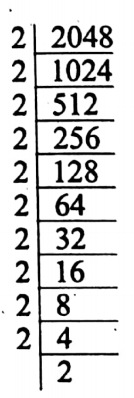
WBBSE Solutions For Class 9 Maths Chapter 1 Arithmetic Real Numbers 9

4. The decimal expansion of  \(\frac{1}{3125}\) is

1. Non-terminating number
2. Non-terminating recurring number
3. Terminating
4. None of these

Solution:

= \(\frac{1}{3125}\)

= \(\frac{1}{(5)^5}\)

As factors denominator are 5

So the number \(\frac{1}{3125}\) is terminating.

∴ The correct answer is 3. Terminating
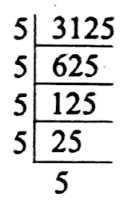
WBBSE Solutions For Class 9 Maths Chapter 1 Arithmetic Real Numbers 10

Class 9 Maths Real Numbers WBBSE – Arithmetic Chapter 1 Real Numbers Short Answer Type Questions

Examples 1.

Give 4 examples of rational numbers.

Solution: 4 rational numbers are \(\frac{1}{2}, \frac{2}{3}, \frac{7}{8}, \frac{5}{9}\)

Example 2.

Insert one rational number in between the following two given rational numbers in each case.

1. 4 and 5

Solution:

4 and 5

We get, \(\frac{4+5}{2}=\frac{9}{2}\)

∴ The required rational number = \(\frac{9}{2}\)

2. \(-1 \text { and } \frac{1}{2}\)

Solution:

\(-1 \text { and } \frac{1}{2}\)

We get, \(\frac{-1+\frac{1}{2}}{2}=-\frac{1}{4}\)

∴ The required rational number = \(-\frac{1}{4}\)

3. \(\frac{1}{4} \text { and } \frac{1}{3}\)

Solution:

\(\frac{1}{4} \text { and } \frac{1}{3}\)

We get, \(\frac{\frac{1}{4}+\frac{1}{3}}{2}=\frac{\frac{3+4}{12}}{2}=\frac{\frac{7}{12}}{2}=\frac{7}{24}\)

∴ The required rational number = \(\frac{7}{24}\)

Examples of Rational and Irrational Numbers

4. -2 and -1

Solution:

-2 and -1

we get, \(\frac{-2+(-1)}{2}=\frac{-2-1}{2}=-\frac{3}{2}\)

∴ The required rational number = \(-\frac{3}{2}\)

Example  3.  is a rational number, where p and q are both integers and q * 0. The decimal expansion of \(\frac{p}{q}\) gives a terminating decimal fraction. Then, what property q must satisfy?

Solution:

We know that if the decimal expansion of a rational number is a terminating fraction, then the denominator of the rational number must be 2 or 5

or (2 or 5)

or (any multiple of 2 and 5).

q = 2 or any multiple of 2,

or, q = 5 or any multiple of 5,

or, q = any multiple of both 2 and 5.

Example 4. What type of number will be resulted when the sum, subtraction, product, and division (divisor is not zero) of two rational numbers are taken?

Solution:

The sum, subtraction, product, and division (Divisor is not zero) of two rational numbers is a rational number.

WBBSE Class 9 Maths Chapter 1 Solutions – Real Numbers Long answer-Questions

Example 1.

Insert 3 rational numbers between each pair of rational numbers given below

1. 4 and 5

Solution:

4 and 5

We know that if a and be two rational numbers, then 3 rational numbers between a and b are given by a + d, a + 2d, and a + 3d,

where d = \(\frac{b-a}{3+1}=\frac{b-a}{4}\)

Now, Here , a = 4 and b = 5,

∴ d = \(\frac{5-4}{3+1}=\frac{1}{4}\)

∴ a + d = \(4+\frac{1}{4}=\frac{16+1}{4}=\frac{17}{4}\);

a + 2d = \(a+2 d=4+2 \times \frac{1}{4}=4+\frac{1}{2}=\frac{9}{2}\).

∴ The required rational numbers are \(\frac{17}{4}, \frac{9}{2} \text { and } \frac{19}{4}\)

2. \(\frac{1}{5} \text { and } \frac{1}{4}\)

Solution:

Here, a = \(\frac{1}{5}\) and b= \(\frac{1}{4}\)

∴ d = \(\frac{\frac{1}{4}-\frac{1}{5}}{3+1}=\frac{\frac{5-4}{20}}{4}=\frac{\frac{1}{20}}{4}=\frac{1}{80}\)

∴ a + d = \(\frac{1}{5}+\frac{1}{80}=\frac{16+1}{80}=\frac{17}{80}\)

a + 2d = \(\frac{1}{5}+2 \times \frac{1}{80}=\frac{1}{5}+\frac{1}{40}=\frac{8+1}{40}=\frac{9}{40}\)

a+3d = \(\frac{1}{5}+3 \times \frac{1}{80}=\frac{1}{5}+\frac{3}{80}=\frac{16+3}{80}=\frac{19}{80}\)

∴ The required rational numbers are \(\frac{17}{80}, \frac{9}{40} \text { and } \frac{19}{80}\)

Example 2.

Insert 5 rational numbers between \(\frac{3}{5}\) and \(\frac{4}{5}\).

Solution:

We know that 5 rational numbers between a and b are given by a + d, a + 2d, a + 3d,

a + 4d, and a + 5d, where d = \(\frac{b-a}{5+1}=\frac{b-a}{6}\)

Here a = \(\frac{3}{5}\) and b = \(\frac{4}{5}\),

∴ d = \(\frac{\frac{4}{5}-\frac{3}{5}}{6}=\frac{\frac{4-3}{5}}{6}=\frac{\frac{1}{5}}{6}=\frac{1}{30}\)

∴ a+d = \(\frac{3}{5}+\frac{1}{30}=\frac{18+1}{30}=\frac{19}{30}\)

a+2d = \(\frac{3}{5}+2 \times \frac{1}{30}=\frac{3}{5}+\frac{1}{15}=\frac{9+1}{15}=\frac{10}{15}=\frac{2}{3}[latex]

a+3d = [latex]a+3 d=\frac{3}{5}+3 \times \frac{1}{30}=\frac{3}{5}+\frac{1}{10}=\frac{6+1}{10}=\frac{7}{10}\);

a+4d = \(\frac{3}{5}+4 \times \frac{1}{30}=\frac{3}{5}+\frac{2}{15}=\frac{9+2}{15}=\frac{11}{15}\)

a+5d = \(=\frac{3}{5}+5 \times \frac{1}{30}=\frac{3}{5}+\frac{1}{6}=\frac{18+5}{30}=\frac{23}{30}\)

∴ The required rational numbers are \(\frac{19}{30}, \frac{2}{3}, \frac{7}{10}, \frac{11}{15} \text { and } \frac{23}{30}\)

Operations with Real Numbers

Example 3.

Insert 6 rational numbers between each pair of rational numbers given below :

1. 3 and 4 

2. 1 and 2

Solution:

We know that 6 rational numbers between a and b are given by a + d, a + 2d, a + 3d,

a + 4d, a + 5d and a + 6d, where d = \(\frac{b-a}{6+1}=\frac{b-a}{7}\)

Now,

1. 3 and 4 

Here, a = 3 and b = 4,

∴ d = \(\frac{4-3}{7}=\frac{1}{7}\)

a+d = \(3+\frac{1}{7}=\frac{21+1}{7}=\frac{22}{7}\)

\(a+2 d=3+2 \times \frac{1}{7}=3+\frac{2}{7}=\frac{21+2}{7}=\frac{23}{7}\);

\(a+3 d=3+3 \times \frac{1}{7}=3+\frac{3}{7}=\frac{21+3}{7}=\frac{24}{7}\);

\(a+4 d=3+4 \times \frac{1}{7}=3+\frac{4}{7}=\frac{21+4}{7}=\frac{25}{7}\);

\(a+5 d=3+5 \times \frac{1}{7}=3+\frac{5}{7}=\frac{21+5}{7}=\frac{26}{7}\);

\(a+6 d=3+6 \times \frac{1}{7}=3+\frac{6}{7}=\frac{21+6}{7}=\frac{27}{7}\)

∴ The required rational numbers are \(\frac{22}{7}, \frac{23}{7}, \frac{24}{7}, \frac{25}{7}, \frac{26}{7} \text { and } \frac{27}{7}\)


2. 1 and 2

Solution:

Here, a = 1 and b = 2,

∴ d = \(\frac{2-1}{7}=\frac{1}{7}\)

∴ a+d = \(a+d=1+\frac{1}{7}=\frac{7+1}{7}=\frac{8}{7}\)

∴ \(a+d=1+\frac{1}{7}=\frac{7+1}{7}=\frac{8}{7}\)

\(a+2 d=1+2 \times \frac{1}{7}=1+\frac{2}{7}=\frac{7+2}{7}=\frac{9}{7}\) \(a+3 d=1+3 \times \frac{1}{7}=1+\frac{3}{7}=\frac{7+3}{7}=\frac{10}{7}\) \(a+4 d=1+4 \times \frac{1}{7}=1+\frac{4}{7}=\frac{7+4}{7}=\frac{11}{7}\) \(a+5 d=1+5 \times \frac{1}{7}=1+\frac{5}{7}=\frac{7+5}{7}=\frac{12}{7}\) \(a+6 d=1+6 \times \frac{1}{7}=1+\frac{6}{7}=\frac{7+6}{7}=\frac{13}{7}\)

∴ The required rational numbers are \(\frac{8}{7}, \frac{9}{7}, \frac{10}{7}, \frac{11}{7}, \frac{12}{7} \text { and } \frac{13}{7}\)

Example 4.

Express the following rational numbers in decimal form and write what type of numbers the resulting decimal fractions are:

Solution:

1. 
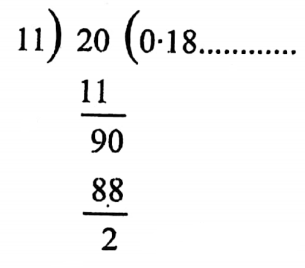
WBBSE Solutions For Class 9 Maths Chapter 1 Arithmetic Real Numbers 13

∴ 2 is the first dividend id repeated

∴ The digits 1 and 8 will repeat again and again in the long division and the division process will never end.

∴ \(\frac{2}{11}=0 \cdot 181818 \ldots \ldots \ldots \ldots \ldots \ldots \ldots \ldots\)

2. \(4 \frac{1}{8}=\frac{33}{8}\)

Solution:

\(4 \frac{1}{8}=\frac{33}{8}\)

Now,
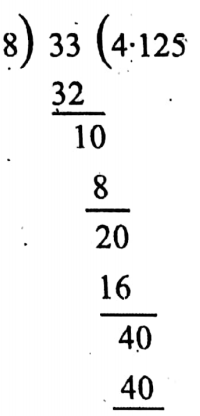
WBBSE Solutions For Class 9 Maths Chapter 1 Arithmetic Real Numbers 14

∴ \(4 \frac{1}{8}=4 \cdot 125\)

∴ The required decimal fraction is a terminating number.

WBBSE Class 9 Revision Notes on Real Numbers

3. 
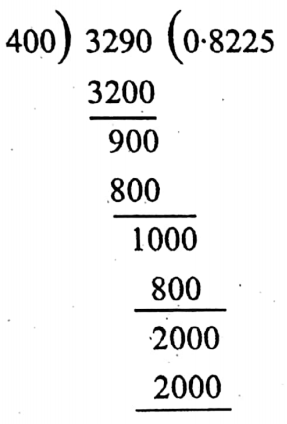
WBBSE Solutions For Class 9 Maths Chapter 1 Arithmetic Real Numbers 15

∴ \(\frac{329}{400}=0.8225\)

∴ A resulting decimal fraction is a terminating number.

Example 5.

Express the following decimal fractions in the form of \(\frac{p}{q}\) where p> q ∈ Z and q ≠ 0

1. \(0 \cdot \overline{6}\)

Solution:

\(0 \cdot \overline{6}\) = \(0.6666\ldots \ldots \ldots \ldots \ldots\)

Let x = \(0.6666\ldots \ldots \ldots \ldots \ldots\)

or, = 10x = \(6.6666\ldots \ldots \ldots \ldots \ldots\)

or, 10x = \(6+0.666 \ldots\ldots \ldots \ldots \)

or, 10x = 6 + x [ ∵ x = 0.6666……….. ]

or, 10x – x = 6

or, x = \(\frac{6}{9}=\frac{2}{3}\)

∴ \(0. \overline{6}=\frac{2}{3}\)

2. \(0.4 \overline{7}\)

Solution:

\(0.4 \overline{7}=0.4777\ldots \ldots \ldots \ldots \ldots\)

Let, x = 0.4777………

or, 10x = 4.777…………(1)

or, 100x = 47.777……………..(2)

Now (2) – (1)

100x – 10x = (47.777…………..) – (4.777……….)

90x = 43

x = \(\frac{43}{90}\)

∴ \(0.4 \overline{7}\) = \(\frac{43}{90}\)

3. \(0 . \overline{001}\)

Solution:

\(0 . \overline{001}\) = \(0.001001001\ldots \ldots \ldots \ldots \ldots\)

Let x = 0.00100101001………….

or, 1000x = 1.001001…………..

or, 1000x – x = 1

or 999x = 1

or, x = \(\frac{1}{999}\)

∴ \(0 . \overline{001}\) = \(\frac{1}{999}\)

4. 0.99999…………

Solution:

Let x = 0.999999…………….

or, 10x = 9.9999…………

or, 10x = 9 + 0.9999………

or, 10x = 9 + x [∵ 0.9999……..=x]

or, 10x – x = 9

or, 9x = 9

or, x = \(\frac{9}{9}\)

= 1

∴ 0.9999……. = 1 = \(\frac{1}{1}\ldots \ldots\).

Example 6.

If \(\frac{1}{7}\) = \(0 \cdot \overline{142857}\) then what will be the results of the rational fractions \(\frac{2}{7}, \frac{3}{7}, \frac{4}{7}, \frac{5}{7}\) and  \(\frac{6}{7}\) When without performing actual division, they are expressed as decimal fractions. Give reasons in favor of your answer.

Solution:

We have

\(\frac{2}{7}\) 

\(\frac{2}{7}\) = 2 x \(\frac{1}{7}\)

= 2 x \(0 \cdot \overline{142857}\)

= \(0 \cdot \overline{285714}\)

\(\frac{3}{7}\)

\(\frac{3}{7}\) = 3 x \(\frac{1}{7}\)

= 3 x \(0 \cdot \overline{142857}\)

= \(0 \cdot \overline{428571}\)

\(\frac{4}{7}\)

\(\frac{4}{7}\) = 4 x \(\frac{1}{7}\)

= 4 x \(0 \cdot \overline{142857}\)

= \(0 \cdot \overline{571428}\)

\(\frac{5}{7}\)

\(\frac{5}{7}\) = 5 x \(\frac{1}{7}\)

= 5 x \(0 \cdot \overline{142857}\)

= \(0 \cdot \overline{714285}\)

\(\frac{6}{7}\) 

\(\frac{6}{7}\) = 6 x \(\frac{1}{7}\)

= 6 x \(0 \cdot \overline{142857}\)

= \(0 \cdot \overline{0.857142}\)

We see from all the above non-terminating recurring numbers that the 6 digits 1, 2, 4, 5, 7, and 8 recure repeatedly in a cyclic order in the decimal expansions of the rational numbers \(\frac{2}{7}, \frac{3}{7}, \frac{4}{7}, \frac{5}{7}\) and  \(\frac{6}{7}\). This cyclic order is shown in the following

\(\frac{1}{7}\) starts from 1 : 142857

\(\frac{2}{7}\) starts from 2 : 285714

\(\frac{3}{7}\) starts from 4 : 428571

\(\frac{4}{7}\) starts from 5 : 571428

\(\frac{5}{7}\) starts from 7 : 714285

\(\frac{16{7}\) starts from 8 : 857142
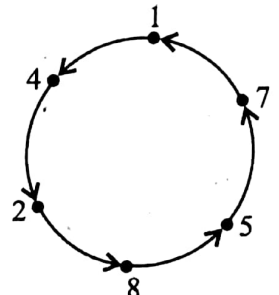
WBBSE Solutions For Class 9 Maths Chapter 1 Arithmetic Real Numbers 16

Arithmetic Chapter 1 Real Numbers Irrational Numbers

Definition:

  1. The numbers that cannot be expressed in the form \(/frac{p}{q}\).
  2. where p and q are both integers and q ≠ 0, are called irrational numbers.
  3. That is the number that cannot be expressed as the division of two integers (the divisor is never zero) are called irrational numbers.
  4. For example √2√3. √5. √7. √10, ………….0.020020002, etc.
  5. We can express √2 or √3 or….. in the following form √2 = \(=\frac{\sqrt{2}}{1}=\frac{2 \sqrt{2}}{2}=\frac{3 \sqrt{2}}{3}[latex], where p = √2 or, 2√2 or, 3√2……………… and q = 1,2,3 ……..etc.
  6. In these cases, q, i.e., the denominator of the number is an integer, but p, i.e., the numerator is not an integer, for the number √2,2√2 or, 3√2……. are not integers.
  7. ∴ The numbers √2 or √3 or…… cannot be expressed in the form where both p and q are integers and 90.
  8. Therefore, these numbers are irrational numbers.
  9. Since the number of irrational numbers is infinity, there is neither beginning nor an end to the irrational numbers.
  10. Therefore, these numbers are irrational numbers.
  11. Since the number of irrational numbers is infinity, there is neither beginning nor an end to the irrational numbers.

Decimal Expansion of Irrational Numbers:

  1. Finding the square root by division process, we can express the irrational numbers in the form of a decimal fraction.
  2. For example, let us express the irrational numbers
 
WBBSE Solutions For Class 9 Maths Chapter 1 Arithmetic Real Numbers 17


∴ √3 = 1.73205080756…………………….

Again,

WBBSE Solutions For Class 9 Maths Chapter 1 Arithmetic Real Numbers 18

∴ √7 = 2.645757131106……………

  1. Thus, we can express any irrational number in the form of a decimal fraction. It is noticed that the decimal fractions thus obtained have two common criteria, namely-
    1. The decimal fraction is non-terminating, i.e., the division process never ends;
    2. the decimal fraction is non-recurring, i.e., in the resulting decimal number no digit (or digits) recure.
  2. Therefore, we can say that the decimal expansion of any irrational number is non-recurring non-terminating.
  3. On the other hand, if the decimal expansion of any number is non-recurring and non-terminating, then it is an irrational number.

Algebraic and Transcendental irrational numbers:

  1. We know that
  2. √2 is a root of equation x² – 2 = 0;
  3. √3 is a root of equation x² – 3 = 0;
  4. √5 is a root of the equation x² – 5 = 0; etc.
  5. These types of irrational numbers are called algebraic irrational numbers.
  6. Therefore, the irrational numbers which are the roots of any algebraic equation are called algebraic irrational numbers.
  7. And, the irrational numbers which are not the roots of any algebraic equation are called Transcendental irrational numbers.
  8. For examples. π= 3.14159265358979323846264338327950……………..and e = 2.718281828………. are two transcedental irrational numbers.

Insertion of one or more than one irrational number in between two given rational numbers and insertion of one or more than one rational number in between two given irrational numbers:

1.  Insertion of one or more than one irrational number in between two given rational numbers:
  1. Let [latex]\frac{1}{3}\) and \(\frac{1}{2}\) be two given rational numbers. We have to insert one irrational number in between them.
  2. Now,
    \(\frac{1}{3}\) = 0.3333………. and \(\frac{1}{2}\) = 0.5
  3. In the first number (0.3333………) the digit just next to the decimal point is 3, while in the second, it is 5
  4. So, the digit just next to the decimal point of the required irrational number will be 4, which is between 3 and 5.
  5. ∴ The required irrational number = 0.40400400040000.
  6. Similarly, one irrational number in between \(\frac{1}{3}\) and \(\frac{1}{2}\) is 0.450450045000…………, because,
  7. \(\frac{1}{3}\) = 0.333…….. and \(\frac{1}{2}\) = 0.666…………….

2.  Insertion of one or more than one rational number in between two given irrational numbers:

  1.  Let √2 and √3 be two given irrational numbers.
  2. We have to insert one rational number between √2 and √3.
  3. Now, √21.41421356237………….. and √3=1.73205080756………..
  4. We see that the integral parts of both numbers are equal (1).
  5. Also, the digit just next to the decimal point is 4 in the first number and 7 in the second number. 
  6. Again, the digits 5 and 6 are between 4 and 7.
  7. The required rational number = 1.5.


Plotting of Irrational numbers on the number line :

  1. You have learned earlier that natural numbers, whole numbers, Integers, and rational numbers can be easily plotted on the number line.
  2. You have already practiced the various process and methods of plotting these numbers on the number line.
  3. So, our present task is how to plot irrational numbers on the number line. In order to do so, we shall use the geometric process and shall take the help of the well-known Pythagorus’theorem.
  4. But, what is Pythagoras’ theorem?


Pythagoras theorem :

Statement:

The area of the square drawn over the hypotenuse of any right-angled triangle is equal to the sum of the areas of the squares drawn over the two other sides of the triangle.

That is, let ABC be a right-angled triangle, whose B = 90°.

.. AC is the hypotenuse.

By Pythagoras’ theorem, AC2 = AB2+ BC2.

Geometrically, ACPQ = ABEF + BCRS.

Thus, according to this theorem of Pythagoras, we can write,

√2=√(1+1)=√((1)2+(1)2)

√3 = √(2+1) = √((√2)2 + (1)2)

√5 = √(4+1) = √((2)2 +(1)2)

√7=√(4+3) = √((2)2 +(√3)2)…………….etc,
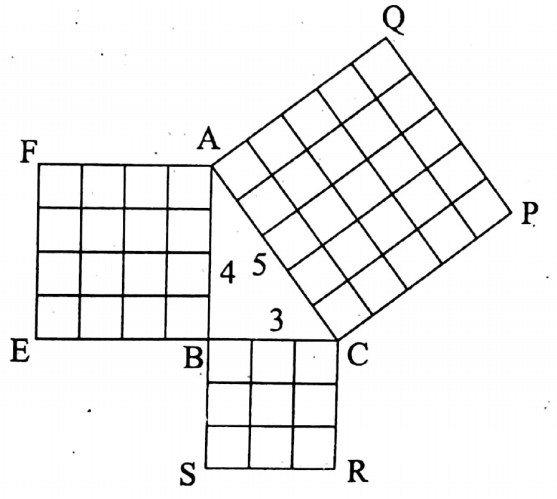
WBBSE Solutions For Class 9 Maths Chapter 1 Arithmetic Real Numbers 20

Now, using these formulas we can plot any irrational number in the number line geometrically.

We also represent the irrational numbers on the number line by the process of successive magnification, expressing the numbers in decimal form.

Thus, we can represent the irrational numbers on the number line by two methods:

  1. Geometric Method and
  2. Method of successive magnification.

1. Geometric Method:

  1. The WORKING RULE of this method is
  2. STEP-1: Write the given irrational number according to Pythagoras’ theorem.
  3.  STEP-2: Choose the hypotenuse and two other sides of the right-angled triangle from the formula thus obtained in STEP-1.
  4. STEP-3: Cut the distance equal to the length of any of the two other sides of the right-angled triangle from the point O (which denotes O) to either the right-hand side (when the given irrational number is positive) or to the left-hand side (when the given irrational number is negative).
  5. STEP-4: Draw a perpendicular straight line at the last point of this distance (obtained in STEP-3).
  6.  STEP-5: Join O to the top of the perpendicular by a scale. Then, it will be the hypotenuse. 
  7. STEP-6: Taking O as the center, draw an arc, the radius of which is equal to the hypotenuse obtained in STEP-5.
  8. Then the point of intersection of the arc to the number line will represent the required irrational number.

Example 1. Locate √2 on the number line.

Solution: From the Pythagoras theorem we get, (√2)² = (1)² +(1)²

∴ hypotenuse = √2 units and the length of the two other sides of the right-angled triangle are 1 unit each.

WBBSE Solutions For Class 9 Maths Chapter 1 Arithmetic Real Numbers 21

Now,

1. Cut OA = 1 unit from the right-hand side of the origin O( √2 is positive).

2. Draw AB (= 1 unit) perpendicular to the number line at A.

3. Join O to B by a scale.

4. Taking O as the center and OB as the radius, draw an arc on the right-hand side of O.

5. Let the arc intersects the number line at C.

Then, point C will represent the required irrational number √2 on the number line, i.e. OC = √2 units.

Example 2. Locate √3 on the number line.

Solution:

From Pythagoras’ theorem, we get. (√3)² – (√2)² + (1)².

∴ hypotenuse√3 units and the length of one side of the right-angled triangle = √2 units and the length of the other side = 1 unit.

Also, (√2)2 = (1)2+(1)2 So, at first, we have to locate √2 on the number and then √3.
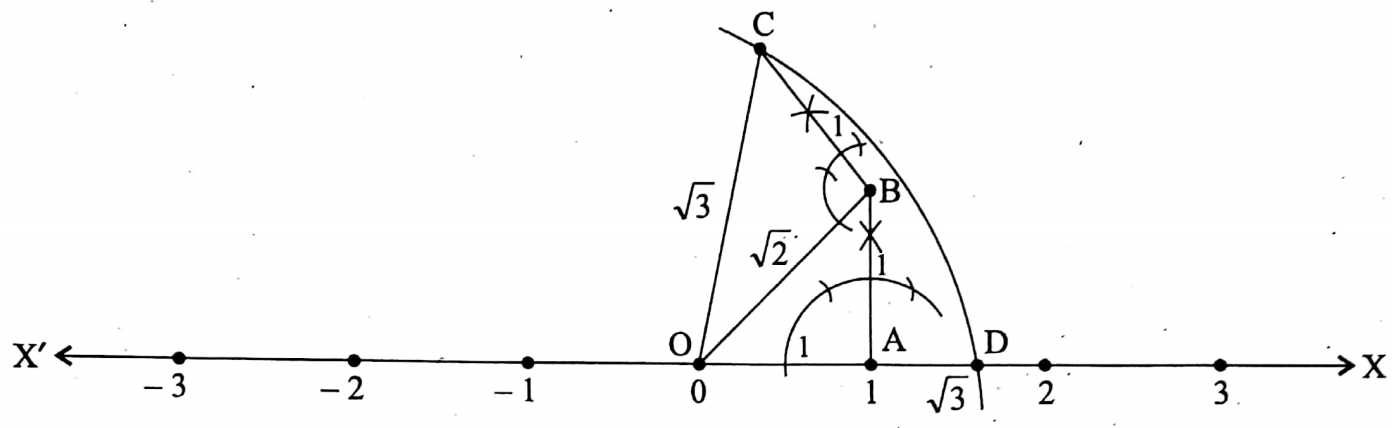
WBBSE Solutions For Class 9 Maths Chapter 1 Arithmetic Real Numbers 22

Now,

1. Cut OA = 1 unit 

2. Draw AB perpendicular to the number line such that AB = 1 unit. 

3. Join O to B by a scale. OB = √2 units.

4. Draw BC 1 OB, such that BC= 1 unit.

(√2)² +(1)² = √2+1

= √3 units.

5.  Join O to C by a scale. Then, OC = √(OB² + BC²)

= √((2)² + (1)²)

= √(2+1)

= √3 units.

6. Draw an arc on the right-hand side of O, by taking O as the center and OC as the radius.

Let the area intersects the number line in D.

Then, D will represent the required irrational number √3 on the number line, i.e., OD = √3 units.

From the above discussion you can, now easily represent the irrational numbers √5, √6, √7…etc., on the number line with the help of Pythagoras’ theorem geometrically.

General Rule:

We can now represent any irrational number of type √x, x>0 on the number line geometrically as follows:
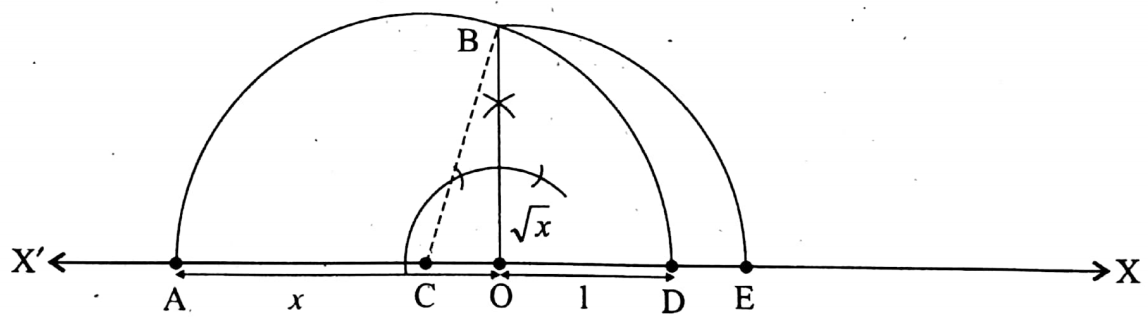
WBBSE Solutions For Class 9 Maths Chapter 1 Arithmetic Real Numbers 23

At First,

1. Draw \(\overline{\mathrm{OA}}\) = x on the number line (O denotes the number 0).

2. Take \(\overline{\mathrm{OD}}\) = 1 unit;

3. Find C, the mid-point of AD\(\overline{\mathrm{AD}}\);

4. Draw a semi-circle ABD with a center at C;

5. Draw \(\overline{\mathrm{OB}}\) perpendicular to the number line at O.

Let \(\overline{\mathrm{OB}}\) intersect the semi-circle in B.

Then, \(\overline{\mathrm{OB}}\) = √x;

6. Now, draw an arc with a center at O and a radius equal to \(\overline{\mathrm{OB}}\).

Let the arc intersects the number line in E.

Then E will represent the required irrational number √x, x>0, on the number line, i.e. OE = √x

Proof: AD \(\overline{\mathrm{AD}}\) = \(\overline{\mathrm{OA}}\) + \(\overline{\mathrm{OD}}\) = x + 1; C is the mid-point of \(\overline{\mathrm{AD}}\).

∴ \(\overline{\mathrm{AC}}\) = \(\overline{\mathrm{CD}}\) = \(\frac{x+1}{2}\)

Now, \(\overline{\mathrm{CO}}\) = \(\overline{\mathrm{CD}}\) – \(\overline{\mathrm{oD}}\) = \(\frac{x+1}{2}\) – 1

= \(\frac{x+1-2}{2}=\frac{x-1}{2}\)


Again, \(\overline{\mathrm{OB}}\) ⊥ \(\overline{\mathrm{AD}}\) [by construction]


∴ from the right-angled triangle BOC, by Pythagoras’ theorem, we get,


OB² = BC² – CO² = \(\left(\frac{x+1}{2}\right)^2\) – \(\left(\frac{x-1}{2}\right)^2\)


∵ \(\overline{\mathrm{AC}}\) = \(\overline{\mathrm{AC}}\) = \(\overline{\mathrm{CD}}\)the radius of the same circle

= x.1 [∵ ab= \(\left(\frac{a+b}{2}\right)^2\) – \(\left(\frac{a-b}{2}\right)^2\) = x

∴ OB² = x

or, OB = √x.

By construction OB = OE (radius of the same circle)

OE = OB = √x

 or, OE = √x

Thus, by this general rule, we can represent any irrational number of type √x, x>0 like √3.5, √4.7, √5.3. etc geometrically.

Method of successive magnification:

  1. The method in which any rational or irrational (Real) number can be represented on the number line by dividing the distance between two consecutive numbers into some equal parts with the help of a magnifying glass, is called the method of successive magnification.
  2. Let, you have to represent √11 on the number line, then you can do it by this method of successive magnification in the following manner:
  3. Since√11 = 3.31662479035
  4. is a non-terminating non-recurring number, the method mentioned above will be an endless one.
  5. So, we usually represent an approximate value of the given number, i.e….. Of √11 by computing two or three digits after the decimal point.
  6. It is regardless that he who can successively continue this process as many times so will get a more and more accurate approximation value of √11
  7. Now, let you want to represent 3-316 on the number line. It is clear that the number 3.316 is a number between 3 and 4.
  8. So, you should look closely at the portion of the number line between 3 and 4 and divide this portion into 10 equal parts. Locate the numbers as shown in the following.WBBSE Solutions For Class 9 Maths Chapter 1 Arithmetic Real Numbers 24
  9. Now, the number 3.316 is a number between 3.3 and 3.4.
  10. So, look closely at the portion between 3.3 and 3.4. of the (2) of the above.
  11. Magnifying this portion with a magnifying glass, divide it into 10 equal parts.
  12. Then locate the numbers as shown in the following figure.
  13. Again, the number 3.316 is a number between 3.31 and 3.32.
  14. Therefore, according to the same previous method, divide this portion of (1) of the above into 10 equal parts and locate the numbers as shown in the following:
  15. So, the number in the 6th position of the lastWBBSE Solutions For Class 9 Maths Chapter 1 Arithmetic Real Numbers 25WBBSE Solutions For Class 9 Maths Chapter 1 Arithmetic Real Numbers 26
  16. no (2) of the above will represent the required number 3.316 on the number line.
  17. Thus, by using the magnifying glass three consecutive times, you have become successful to represent the number 3.316 on the number line.
  18. If you use the magnifying glass in this manner further for 1 time, 2 times, 3 times, and so on, you will be able to represent the numbers 3.3166, 3.1662, 3.316624,……. respectively on the number line.
  19. Therefore, by this long method of successive magnification, we can represent any rational or irrational numbers on the number line.

Characteristics and properties of Irrational numbers:

  1. Irrational numbers are dense on the number line, i.e., there exist infinitely many irrational numbers in between any two irrational numbers on the number line.
  2. The sum of a rational and an irrational number is an irrational number.
  3. The difference between a rational and an irrational number is an irrational number.
  4. The product of a non-zero rational number to an irrational number is an irrational number.
  5. The division of a non-zero rational and an irrational number is an irrational number.
  6. The sum, difference, product, and division of two irrational numbers may or may not be irrational numbers.
  7. If x, and y be two irrational numbers, then
    1. x + y = y + x, i.e., the irrational numbers satisfy the commutative law for addition.
    2. xy= yx, i.e., the irrational numbers satisfy the commutative law for multiplication.
  8. The irrational numbers obey the associative law for both addition and multiplication, i.e., if x, y, be any three irrational numbers, then
    1. x + (y + z) = (x + y) + (Associative law for addition) and
    2. x (y z) = (xy) z (Associative law for multiplication).
  9. The irrational numbers obey the distributive laws, i.e., if x, y, and z be any three irrational numbers, then
    1. x (y + z) = xy+xz (Left distributive law) and
    2. (x + y) zxz+yz (Right distributive law)
  10. The irrational numbers can easily be represented on the number line.

Arithmetic Chapter 1 Real Numbers Select The Correct Answer (MCQ)

1. If √3 = 1-732 and √27 = 5.196 then (√27-√3)² =

1. (3-464)
2. (3-464………)
3. 24
4. 12

Solution:

= (√27-√3)2

=(√3×3×3-√3)2

=(3√3-√3)2

= (2√3)2

= 12

∴ The correct answer is 4. 12


2. If n ∈ N and 10<n< 12 then, \(\frac{1}{\sqrt{n}}\)

1. √11
2. 3-317
3. \(\frac{\sqrt{11}}{11}\)
4. 3.317

Solution: n ∈ N and 10 < n < 12

So, n = 11 

∴ \(\frac{1}{\sqrt{n}}=\frac{1}{\sqrt{11}}=\frac{1 \times \sqrt{11}}{\sqrt{11} \times \sqrt{11}}=\frac{\sqrt{11}}{11}\)

∴ The correct answer is 3. \(\frac{\sqrt{11}}{11}\).

Real Number Applications in Daily Life

3. If a be the least prime number and xn an = 0 then, \(\frac{\sqrt{6}}{\sqrt{x}}\)

1. √2
2. 3
3. 1·414
4. 1·732

Solution:

xn an = 0

x= an

x = a

As a be the least prime number. So the value of a is 2.

∴ \(\frac{\sqrt{6}}{\sqrt{x}}=\frac{\sqrt{6}}{\sqrt{2}}=\frac{\sqrt{2} \times \sqrt{3}}{\sqrt{2}}=\sqrt{3}=1.732 \ldots \ldots\)

∴ The correct answer is 4. 1·732.


4. \(\sqrt{6+\sqrt{6+\sqrt{6+\cdots \cdots \propto}}}\)

1. A negative integer
2. A rational number
3. An irrational number
4. None of these

Solution:

Let \(\sqrt{6+\sqrt{6+\sqrt{6+\cdots \cdots \propto}}}\)

\(x^2=6+\sqrt{6+\sqrt{6+\cdots \cdots \infty}}\)

x² = 6 = x

x² – x – 6 = 0

(x – 3)(x + 2) = 0

either x – 3 = 0 or x = 2

x + 2 = 0

x = -2

∴ The correct answer is 2. A rational number

Arithmetic Chapter 1 Real Numbers Short Answer Type Questions

Example 1. What do you mean by irrational numbers? Give 4 examples of irrational numbers.

Solution: The numbers which cannot be represented as the division (divisor is not zero) of two integers, are called irrational numbers.

Mathematically, if a number s cannot be represented in the form \(\frac{p}{q}\) where p and q are both integers and q ≠ 0, then s is c.alled an irrational number.

If any irrational number is represented in the form of a decimal fraction, it will be an

1. non-terminating and

2. Non-recurring number.

On the other hand, the numbers, the decimal expansion of which are non-terminating and non-recurring are called irrational numbers.

Example 2. Give 4 examples of irrational numbers.

Solution: 4 examples of irrational numbers are √2, √3, √5, and 0.10110111011110

Example 3. Write 4 numbers, the decimal expansion of which are non-terminating and nonrecurring.

Solution: We know that the decimal expansion of any irrational number is non-terminating and non-recurring.

∴ the required 4 numbers are √2, √3, √5, and √6.

Example 4. Are the square roots of all positive integers irrational? If not, then give an example of such a positive integer, the square root of which is a rational number.

Solution: No, the square roots of all the positive integers are not irrational.

For example, 4. Because √4 = 2. which is a rational number.

Arithmetic Chapter 1 Real Numbers Long Answer Type Questions

Example 1. Find out which one of the following numbers is rational and which one is the irrational number :

1. √23

Solution:
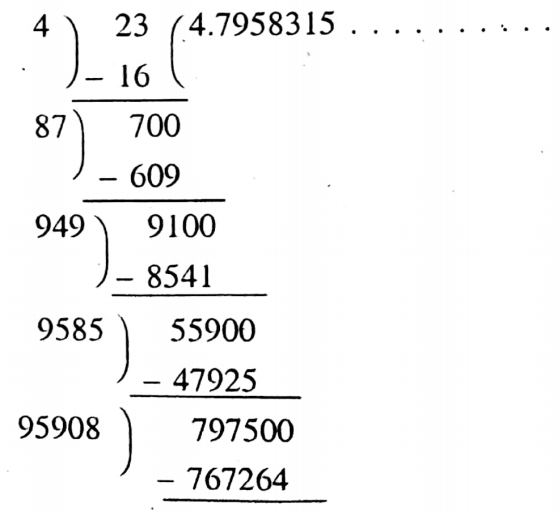
WBBSE Solutions For Class 9 Maths Chapter 1 Arithmetic Real Numbers 27

∴ 4.7958315………………. is a non-terminating and non-recurring number,

∴ √23 is an irrational number.

2. √225

Solution:
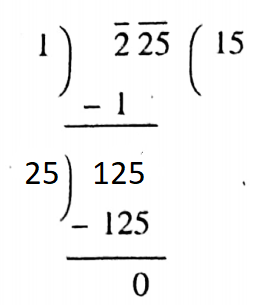
WBBSE Solutions For Class 9 Maths Chapter 1 Arithmetic Real Numbers 29

∴ √22525, which is a rational number.

∴ √225 is a rational number

3. 0.3796.

Solution:

0.3796 is a terminating number.

∴ 0.3796 is a rational number.


4. 7.478478………

Solution:

The number 7.478478… is non-terminating and recurring…

∴ 7.478478….. is a rational number.


5. 1.101001000100001

Solution:

The number 1.101001000100001…… is non-terminating and non-recurring.

∴ The number is irrational.


6. √50

Solution:
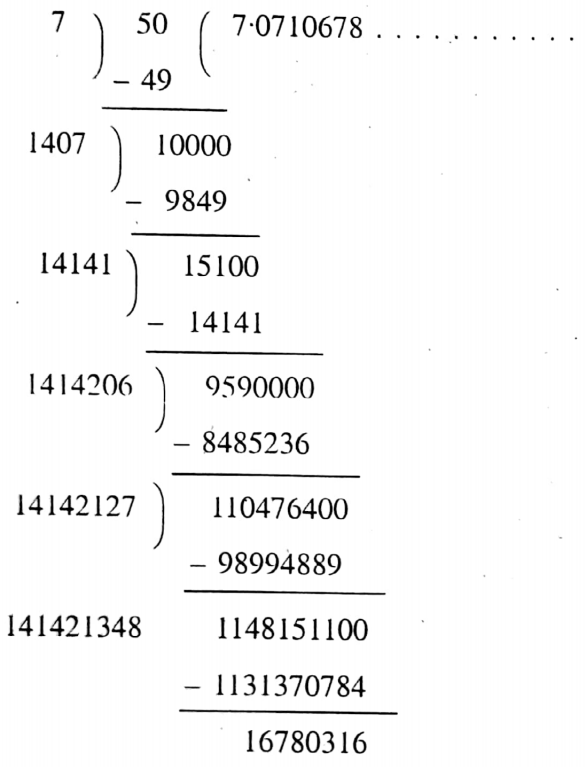
 

WBBSE Solutions For Class 9 Maths Chapter 1 Arithmetic Real Numbers 30

√50 = 7.0710678……… which is a non-terminating and non-recurring number.

√50 is irrational.


Aliter:

√50 = √(25×2) = √25 × √2 = 5√2

We know that √2 is an irrational number,

.. 5√2 is also an irrational number, [:: 5 € N]

√50 is an irrational number.


7. √42

Solution:
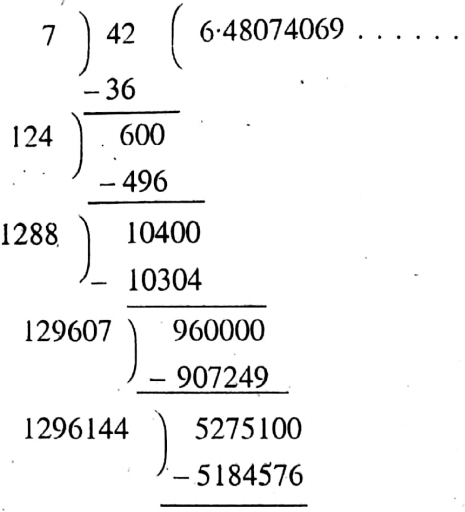
 

WBBSE Solutions For Class 9 Maths Chapter 1 Arithmetic Real Numbers 31


WBBSE Solutions For Class 9 Maths Chapter 1 Arithmetic Real Numbers 32

√42 = 6.48074069…………., which is a non-terminating and nonrecurring number.

∴ √42 is an irrational number.

8. √29

Solution:
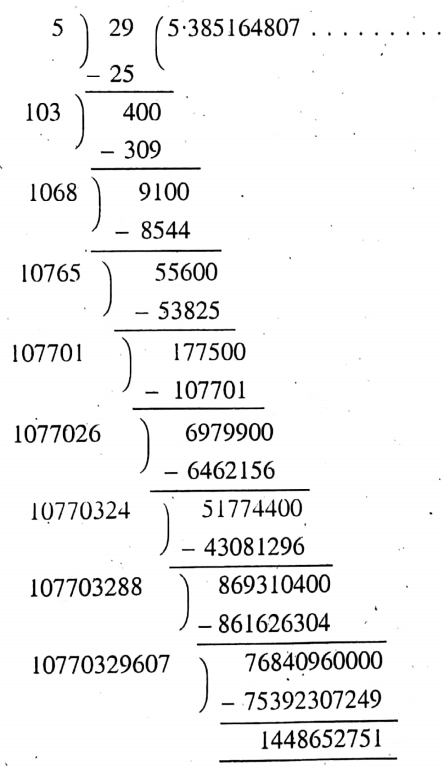
 

WBBSE Solutions For Class 9 Maths Chapter 1 Arithmetic Real Numbers 33

√29 = 5.385164807……… which is a non-terminating and non-recurring number.

√29  is an irrational number.

Common Misconceptions About Real Numbers

9. -√81

Solution:

 -√81=-√(9)²

= -9

= \(-\frac{9}{1}\)

-√81 is a rational number.

10. -1000

Solution:

-√10000 = -√100x 10

= – √100 × √10

= -10x √10

Now,
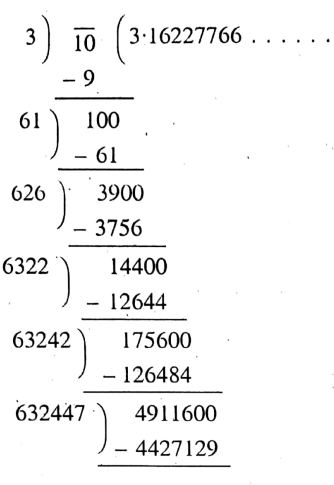
WBBSE Solutions For Class 9 Maths Chapter 1 Arithmetic Real Numbers 34


WBBSE Solutions For Class 9 Maths Chapter 1 Arithmetic Real Numbers 35


√10 = 3.16227766….

-10√10 = -10 x 3.16227766..

=-31.6227766-

-√10000 =  – 31.6227766…..……, which is a non-terminating and non-recurring number.

-√1000 is an irrational number.

Example 2. Determine whether the following given numbers are rationals or irrational:

1. √47

Solution:

√47 = 6.8556546004…………..(find the square root by long division method).

Now, the number 6.8556546004…. is non-terminating and non-recurring… √47 is an irrational number.

2. √625

Solution:
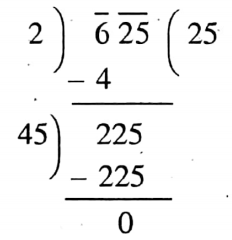
WBBSE Solutions For Class 9 Maths Chapter 1 Arithmetic Real Numbers 36.

√625 = 25, which is a rational number.

∴ √625 is a rational number.

3. 6.5757…

Solution:

6.5757…… = 6.57, Which is a non-terminating and recurring number. 

∴ 6.5757 is a rational number.

4. 2-√5

Solution:

2 of the number (2-√5) is rational, whereas √5 of the same number (2-√5) is irrational. 

We know that the difference between a rational and an irrational number is always irrational.

∴ (2-√5) is an irrational number.

5. (3+√23) -√23.

Solution:

(3+ √23) – √23=3+ √23-√23=3 which is a rational number,

∴ The given number is rational.

6. \(\frac{2 \sqrt{7}}{7 \sqrt{7}}\)

Solution:

\(\frac{2 \sqrt{7}}{7 \sqrt{7}}=\frac{2}{7}\),

where both 2 and 7 are integers and 7 ≠ 0,

∴ The given number is rational.

7. \(\frac{1}{\sqrt{2}}\)

Solution:

\(\frac{1}{\sqrt{2}}\);

Here, 1 is an integer, but √2 is not an integer.

So that the number \(\frac{1}{\sqrt{2}}\)  cannot be expressed in the form \(\frac{p}{q}\)

where p and q are both integers and q ≠ 0.

\(\frac{1}{\sqrt{2}}\) is an irrational number.

8. 2π

Solution:

2 of the number 2 is rational, but л is irrational.

Now, the product of a rational number to an irrational number is always irrational.

∴ 2π is an irrational number.

Example 3. Insert 3 irrational numbers in between \(\frac{5}{7}\) and \(\frac{9}{11}\)

Solution:

\(\frac{5}{7}=0 \cdot \overline{714285}\) (Do the division yourself) and \(\frac{9}{11}=0 \cdot \overline{81}\) (Do the division yourself)

Now, the number formed by the next two digits of the decimal point of the first number is 71 and that of the second number is 81.

So, constructing any three irrational numbers by taking any three values between 71 and 81, we get 72072007200072000072 . . . . ., 73073007300073000073. 74074007400074000074…

Hence, the required three irrational numbers are 0.72072007200072000072…………… 0.73073007300073000073……… and 0.74074007400074000074………….., etc.

Example 4. Π = \(\frac{c}{d}\) is the proportion of the circumference (let c) of a circle to the diameter (let d) of it, i.e. =, where c and d are both terminating then how is an irrational number? Explain.

Solution:

When we measure the circumference and diameter of a circle with the help of a scale or by any other means, the value of these measurements is, in practical, approximate rational numbers.

Again, any smallest change in the measurement of the circumference of the circle obviously causes a change in the measurement of its diameter.

So, it is very difficult to determine that actually which one of the measurements of c and d is irrational.

We generally write Π = \(\frac{22}{7}\), But \(\frac{22}{7}\) is an approximate value of π, not accurate value. That is why though Π = \(\frac{c}{d}\), л is an irrational number.

Example 5.

1. Both 0.2101 and 0.2 are rational numbers.

Solution: 

Both 0.2101 and 0.2 are rational numbers.

Now, the number formed by the three digits just next to the decimal point of the first number is 210 and that of the second number is 222.

So, we can take 215 and 220 in between 210 and 222 for our consideration. (Any other two numbers can be chosen).

∴ The required two rational numbers are 0.215 and 0.220 or 0.22.

2. 0.232332333233332…… and 0.212112111211112….. are both irrational numbers.

Solution:

0.232332333233332…… and 0.212112111211112….. are both irrational numbers.

Now, the number formed by the three digits just next to the decimal point of the second number is 212 and that of the first number is 232.

So, we can choose any 2 numbers 220 and 230 in between 212 and 232.

∴ The required rational numbers are 0.220 or 0.22 and 0.230 or 0.23.

Example 6. 

1. 

1. By taking any two irrational numbers, prove that their sum is a rational number.

Solution:

Let the irrational numbers be (2+ √3) and (2-√3).

Then 2+√3+2-√3-4,

which is a rational number.

∴ The sum of two irrational numbers is a rational number. (Proved)

2. By taking any two irrational numbers, prove that their difference is a rational number.

Solution:

 Let the irrational numbers be (√3+1) and. (√3-1)

Now, (√3+1)-(3-1)

=√3+1-√3+1 

1+1=2, which is a rational number.

2. Insert in between \(\frac{1}{7}\) and \(\frac{2}{7}\)

1. A rational number.

Solution: 

\(\frac{1}{7}\) = \(0 . \overline{142857}\) and \(\frac{2}{7}\) = \(0 . \overline{285714}\) (Do the two divisions yourself).

Now, the number formed by the two digits just next to the decimal point of the first number is 14 and that of the second number is 28.

Let us choose any number 15 between 14 and 28.

∴ The required rational number is 0.15.

Alter :

The required rational number = \(\frac{\frac{1}{7}+\frac{2}{7}}{2}=\frac{3}{14}\)

2. An irrational number.

Solution:

An irrational number in between \(\frac{1}{7}\) and \(\frac{2}{7}\) is 0.1501500150001…………………or 0.15155155515551……………

Example 7. Represent the number √(9.3) on the number line.
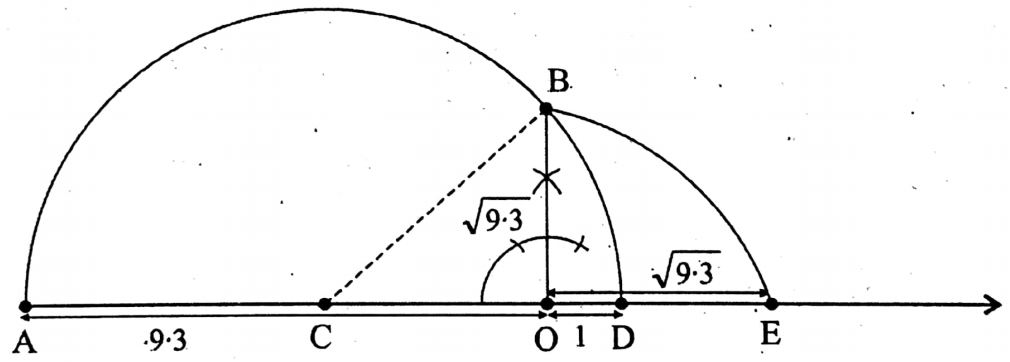
WBBSE Solutions For Class 9 Maths Chapter 1 Arithmetic Real Numbers 37


Solution:

At first,

1. Let us draw a straight line AO = 9.3 units such that O denotes the point 0 on the number line.

2. Let us then draw OD = 1 unit.

3. Let us determine the mid-point C of AD.

4. Let us draw a semi-circle with center C and radius CA or CD.

5. Let us draw OB 1 AD at O. Let OB intersects the semi-circle in B. So, OB = √(9.3).

6. Let us draw an arc with a center at O and a radius equal to OB.

Let this arc intersects the number line in E.

Therefore, point E will represent the number √(9.3) on the number line.

Proof: CO = CD-OD= \({10.3}{2}\) – 1

= 4.15     [ CD = \(\frac{A D}{2}=\frac{A O+O D}{2}=\frac{9 \cdot 3+1}{2}=\frac{10 \cdot 3}{2}\)

Now, from the right-angled triangle BOC, we get,

OB2 = BC2 – CO2 

= (5-15)2 – (4-15)2             [·.· BC=CD= \(\frac{10 \cdot 3}{2}\) = 5.15]

=26.5225-17-2225=9.3

OB2 9.3 or, OB = √(9.3),

∴ OE = OB = √(9.3).

Arithmetic Chapter 1 Real Numbers

In the previous sections, you have studied sufficiently- 

1. Natural numbers

2. Whole numbers

3. Integers

4. Rational numbers and

 5. Irrational numbers. 

In this section, we shall try to know about real numbers.

What is the real number?

All rational and Irrational numbers are together called real numbers.

Again, there are natural numbers, whole numbers, and integers (both positive and negative) in rational numbers.

So, we can say that natural numbers, whole numbers, integers, rational numbers, and irrational numbers are altogether called real numbers.

Any real number can be represented in any form of number by using the 10 digits 0, 1, 2, 3, 4, 5, 6, 7, 8, and 9 one time or more than one time, which have real values.

Since any natural, whole, integer, rational, and irrational number can be represented on the number line, and since the real numbers consist of them all the real numbers can be represented on the number line.

That is any real number can be represented on the number line by a certain point uniquely.

On the other hand, each and every point on the number line represents one and only one real number.

We can also say that any real number is either rational or irrational.

Therefore, the numbers, formed by the 10 digits 0, 1, 2, 3, 4, 5, 6, 7, 8, and 9 in any form, using the digits one time or more, than one time, which have real values, which can be represented on the number line and which are either rational or irrational are called real numbers.

For examples,

-7, 6, 5, 2, 0, 1, 2, 3,………, \(\frac{1}{2}\),\(\frac{1}{3}\),..…………,\(\frac{7}{9}\),\(\frac{10}{12}\),…………,√2, √3, √5,…..π, e………….etc, are all real numbers. 

The number of real numbers is infinity. 

The real numbers are usually denoted by R or IR.

Now, it, obviously, gives rise to the question of that is there any existence of non-real numbers.

 In reply, we must say Yes. For example, √3, √2, √1,………etc.

These numbers are called non-real or imaginary or complex numbers.

The study of these numbers is not our task in the present section.

You should study them later on in your higher mathematics classes.

Classification of real numbers :

We can classify the real numbers into two large sections

1. Rational  Number

  1. Natural numbers: 1, 2, 3, 4, ….. (to infinity)
  2. Whole numbers: 0, 1, 2, 3, 4,…. (to infinity)
  3. Integers:
    1. Negative integers:……..-3, -2, -1.
    2. Zero: 0
    3. Positive integers: 1, 2, 3, 4, ….…(to infinity)

Irrational numbers :

  1. Negative irrationals:……– √3, −√2,\(-\frac{1}{√2}\),\(-\frac{1}{√2}\),……..
  2. Positive irrationals:…….√2,……..√3,…………,√5,…………

Global diagram of Real numbers:
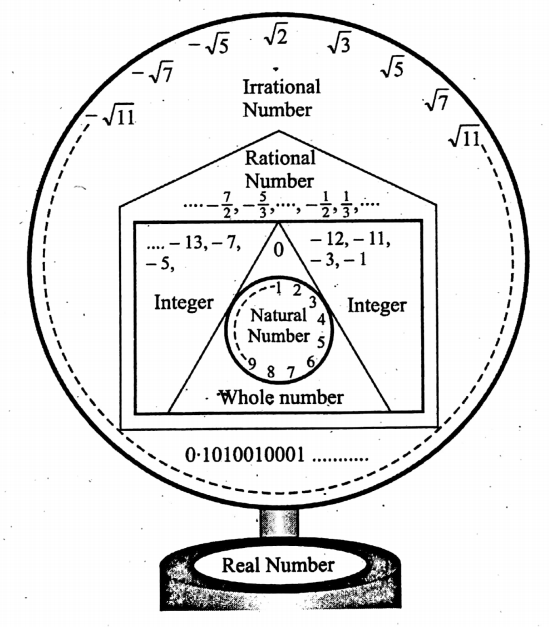
WBBSE Solutions For Class 9 Maths Chapter 1 Arithmetic Real Numbers 38


Properties of real numbers:

You have already known that real numbers include natural numbers, whole numbers, integers, rationals, and irrationals.

So, the properties that are satisfied by those numbers, are also the proporties of real numbers.

It, thus needs not to repeat the properties here.
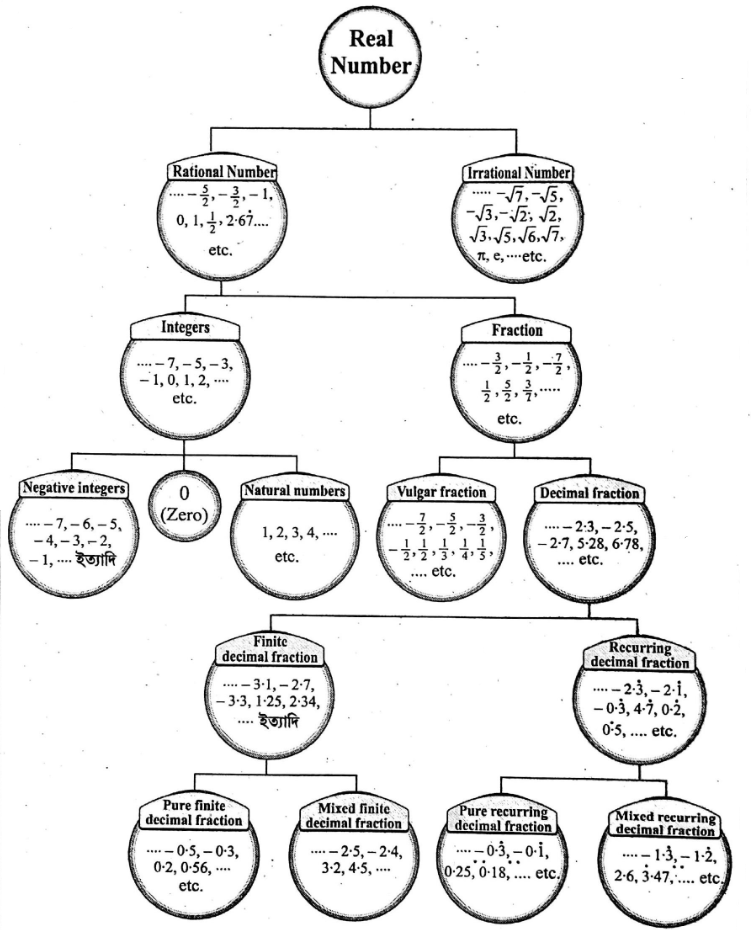
 

WBBSE Solutions For Class 9 Maths Chapter 1 Arithmetic Real Numbers 39


In stead, some useful formulas of real numbers are given below.

These are called the identities of positive real numbers. If a and b be two positive real numbers, then

A most important characteristic of real numbers is that real numbers are dense on the number line, i.e., there exists infinitely many numbers in between any two real numbers at a distance of considerably shortest (what shortest the distance may be).

Another important characteristic of real numbers is that each and every real numbers can be represented by a unique point on the number line.

On the other hand a point on the number line denotes one and only one real number.

Operations on real numbers :

According to the properties of real numbers:

1. The sum, difference, product and division of two real numbers is also a real number.

2. Real numbers satisfy the associative law, commutative law, distributive law, cancellation law, etc.

3. In you earlier classes, you have studied how to operate the mathematical operations (i.e., sum, difference, product and division) on natural numbers, whole numbers, integers, i.e., on rational numbers.

4. So, in this section, we shall discuss only the operations on irrational numbers.

5. Any irrational number can be represented in the form (a+b), where a and b are both positive integers and b is not a perfect square.

6. Here, a is called the rational part and √b is called the irrational part of the number.

7. Hence, (a+√b) is the sum of a rational and an irrational number, which is definitely an irrational number.

8. The conjugate irrational number of the irrational number (a+√b) is (a-√b) and vice versa, i.e. the two irrational numbers (a+ √b) and (a-√b) are conjugate to each other.

 The properties of conjugate irrational numbers are:

1. The sum of two conjugate irrational numbers is a rational number, such as 2+ √3+2-√3=4.

2. The product of two conjugate irrational numbers is a rational number.

Such as,

(2+3)(2-3)-(2)2-(√3)-4-3-1.

3. The difference of two conjugate irrational numbers is an irrational number. Such as, (2+√3)-(2-√3)-2+√3-2+√3=2√3.

4. The division of two conjugate irrational numbers an irrational number.

Such as

\(\frac{2+\sqrt{3}}{2-\sqrt{3}}=\frac{(2+\sqrt{3})(2+\sqrt{3})}{(2-\sqrt{3})(2+\sqrt{3})}\)

= \(\frac{(2+\sqrt{3})^2}{(2)^2-(\sqrt{3})^2}\)

= \(\frac{(2)^2+2 \cdot 2 \cdot \sqrt{3}+(\sqrt{3})^2}{4-3}\)

= \(\frac{4+4 \sqrt{3}+3}{1}\)

= 7 + 4√3

In this division, the irrational number in the denominator have been eliminated multiplying both numerator and denominator by another irrational number, which is conjugate to the denominator. It is called the rationalisation of the denominator.

Again, for any irrational number (a+√b).

1. If a+ √b=0, then a = b = 0.

2. If a = 0, then the irrational number (a + b) becomes a purely irrational number and if b = 0, then the irrational number (a+b) becomes a rational number.

If none of a and b is zero, the irrational number (a+√b) is called a mixed irrational number. 

3. If a+√b=c+ √d, where b and d are not perfect squares, then a = c and b = d.

Rationalisation of the denominator :

To rationalise the denominator of any irrational number, we usually follow the rules given below: 

1. If the denominator of the irrational number be a purely irrational number, then we product both the numerator and denominator of the number by that very purely irrational number.

For example,

\(\frac{2}{\sqrt{3}}=\frac{2 \times \sqrt{3}}{\sqrt{3} \times \sqrt{3}}\)

= \(\frac{2 \sqrt{3}}{3}\);

\(\frac{1}{2 \sqrt{7}}=\frac{1}{2 \sqrt{7}} \times \frac{\sqrt{7}}{\sqrt{7}}\)

= \(\frac{\sqrt{7}}{14}\)

2. If the denominator be a mixed irrational number, we product both the numerator and denominator of the number by the conjugate irrational number of the denominator.

For example,

\(\frac{1}{2-\sqrt{3}}=\frac{1}{2-\sqrt{3}} \times \frac{2+\sqrt{3}}{2+\sqrt{3}}\)

= \(\frac{2+\sqrt{3}}{(2)^2-(\sqrt{3})^2}\)

= \(\frac{2+\sqrt{3}}{4-3}\)

= 2 + √3

In the following examples your conception of how mathematical operations are performed on real numbers, especially on irrational numbers, will be more and more clear.

Arithmetic Chapter 1 Real Numbers Select The Correct Answer(MCQ)

1. Which one of the following is false? 

1. Every rational number is a real number
2. Every integer is a real number
3. Every irrational number is a real number
4. √2 is a rational number

Solution:

1. – 5,\(\frac{3}{4}\), \(\frac{5}{7}\) etc. all rational number is a real number..

2. -3, -2, 1, 5, 7, etc. All integer is a real numbers.

3. √3; √5 etc. are real numbers.

4. √2 = 1.414………….is irrational number.

∴ The correct answer is 4. √2 is a rational number

2. If a and b be two non-zero real numbers, then \((a b)^{-1}\)

1. (-a)(-b)
2. \(a^{-1} b^{-1} \text { or } b^{-1} a^{-1}\)
3. (-a) + (-b)
4. a.b

Solution:

\((a b)^{-1}\) = \(a^{-1} b^{-1}[/atex]

∴ The correct answer is 2. [latex]a^{-1} b^{-1} \text { or } b^{-1} a^{-1}\)

3. If * denotes the mathematical operation ‘addition’ and b is not a perfect square, a*√b will lie in

1. N
2. Z
3. Q
4. R

Solution:

The sum, difference, product, and division of two real numbers is also real number. 

So a + √b will be the real number (R).

∴ The correct answer is 4. R

4 Which one of the following is true?

1. √6+√3 =√7+ √2
2. √6+ √3>√7+ √2
3. √6+√3<√7.+√2
4. None of these

Solution:

(√6+ √3)² = (√6)² + (√3)² +2√6.√3

= 6+3+2√18

= 9+2√18 (√7+√2)²

= (√7)² + (√2)² +2.√7.√2

=7+2+2√14

=9+2√14

18 > 14

or, √18 > √14

or, 2√18 >2√14

or, 9+2√189+2√14

or, (√6+ √3)² > (√7 + √2)²

or, √6+ √3> √7+ √2

∴ The correct answer is 3. √6+√3<√7.+√2

Arithmetic Chapter 1 Real Numbers Short answer type Questions

Examples 1. Do the sum:

1. √12+ √108

Solution:

√12+ √108

= √4×3+√36×3

=√4× √3+√36×√3 

=2√3+6√3 

=8√3

√12+ √108 =8√3

2. √8+ √50

Solution:

√8+ √50

= √4×2+√25×2

= √4× √2+ √25× √2

=2√2+5√2

=7√2

√8+ √50 =7√2

Example 2. Subtract:

1. √175-√112

Solution :

√175-√112

=√25×7-√16×7

=√25×√7-√16×√7

=5√7-4√7

= √7

√175-√112 = √7

Converting Fractions to Decimals in Real Numbers

2. √147-√27.

Solution:

√147-√27

= √49×

= 3-√9×3

= √49× √3-√9× √3

=7√3-3√3

= 4√3

√147-√27 = 4√3

Example 3. Do the product: 

1 √7×3√7

Solution :

√7×3√7 

=3x(√7)²

= 3 x 7

= 21

√7×3√7  = 21

2. √18 × √72

Solution:

√18 × √72

= √(9×2) × √(36×2)

= √9 × √2 × √36 × √2

= 3√2 × 6√2

=3×6×(√2)²

=18×2

=36

√18 × √72 =36

3. 2√5× √32×3√2

Solution:

2√5 x √32 x 3√2

=2√5 × √16 x √2 x 3√2

=2√5 x √16 x√2 × 3√2

=2√5 × 4√2 × 3√2

=2 x 4 × 3 × √5 x √2 x √2

=24 × √5 x (√2)²

=24 × √(5×2)

=48√5

2√5 x √32 x 3√2 =48√5

4. (2√3+3√5) (3√2+5√3).

Solution:

(2√3+3√5) (3√2+5√3)

=2√3 × 3√2 + 2√3 x 5√3 + 3√5 × 3√2 + 3√5 x 5√3

=6 x √(3×2) + 10 x (√3)2 + 9 x √(5×2) + 15 × √(5×3)

=6√6+10×3+9√10+15√15

=6√6+30+9√10+15√15

=30+6√6+9√10+15√15

(2√3+3√5) (3√2+5√3) =30+6√6+9√10+15√15

Example 4. Do the division:

1. √243+ √108

Solution:

√243+ √108

= \(\frac{\sqrt{243}}{\sqrt{108}}=\frac{\sqrt{81 \times 3}}{\sqrt{36 \times 3}}\)

= \(\frac{\sqrt{81} \times \sqrt{3}}{\sqrt{36} \times \sqrt{3}}=\frac{9 \sqrt{3}}{6 \sqrt{3}}\)

= \(\frac{9}{6}\) = \(\frac{3}{2}\)

2. (2+√2)+(√2-1).

Solution:

(2+√2)+(√2-1)

= \(\frac{2+\sqrt{2}}{\sqrt{2}-1}=\frac{2+\sqrt{2}}{\sqrt{2}-1} \times \frac{\sqrt{2}+1}{\sqrt{2}+1}\)

= \(\frac{(2+\sqrt{2})(\sqrt{2}+1)}{(\sqrt{2})^2-(1)^2}\)

= \(\frac{2 \sqrt{2}+2+(\sqrt{2})^2+\sqrt{2}}{2-1}=\frac{3 \sqrt{2}+2+2}{1}\)

= 4 + 3√2

Example 5. Rationalize the denominator of

1. \(\frac{1}{\sqrt{7}}\)

Solution: 

\(\frac{1}{\sqrt{7}}\)

= \(\frac{1}{\sqrt{7}} \times \frac{\sqrt{7}}{\sqrt{7}}=\frac{\sqrt{7}}{(\sqrt{7})^2}=\frac{\sqrt{7}}{7}\)

2. \(\frac{1}{\sqrt{5}+\sqrt{3}}\)

Solution:

\(\frac{1}{\sqrt{5}+\sqrt{3}}\)

= \(\frac{1}{\sqrt{5}+\sqrt{3}} \times \frac{\sqrt{5}-\sqrt{3}}{\sqrt{5}-\sqrt{3}}=\frac{\sqrt{5}-\sqrt{3}}{(\sqrt{5})^2-(\sqrt{3})^2}\)

= \(\frac{\sqrt{5}-\sqrt{3}}{5-3}=\frac{\sqrt{5}-\sqrt{3}}{2}=\frac{1}{2}(\sqrt{5}-\sqrt{3})\)

3. \(\frac{1}{\sqrt{7}-1}\)

Solution:

\(\frac{1}{\sqrt{7}-1}\)

= \(\frac{1}{\sqrt{7}-1} \times \frac{\sqrt{7}+1}{\sqrt{7}+1}=\frac{\sqrt{7}+1}{(\sqrt{7})^2-(1)^2}\)

= \(\frac{\sqrt{7}+1}{7-1}=\frac{\sqrt{7}+1}{6}=\frac{1}{6}(\sqrt{7}+1)\)

4. \(\frac{1}{\sqrt{7}-\sqrt{6}}\)

Solution:

= \(\frac{1}{\sqrt{7}-\sqrt{6}} \times \frac{\sqrt{7}+\sqrt{6}}{\sqrt{7}+\sqrt{6}}=\frac{\sqrt{7}+\sqrt{6}}{(\sqrt{7})^2-(\sqrt{6})^2}\)

= \(\frac{\sqrt{7}+\sqrt{6}}{7-6}=\frac{\sqrt{7}+\sqrt{6}}{1}=\sqrt{7}+\sqrt{6}\)

Arithmetic Chapter 1 Real Numbers Long Answer Type Questions

Example 1. Simplify

1. 3√48 – 4√75 + 5√192

Solution:

\(3 \sqrt{48}-4 \sqrt{75}+5 \sqrt{192}\)

= \(3 \sqrt{16 \times 3}-4 \sqrt{25 \times 3}+5 \sqrt{64 \times 3}\)

= \(3 \times \sqrt{16} \times \sqrt{3}-4 \times \sqrt{25} \times \sqrt{3}+5 \times \sqrt{64} \times \sqrt{3}\)

= 3 x 4 x √3 – 4 x 5 x √3 + 5 x 8 x √3

= 12√3 – 20√3 + 40√3

= 32√3

2. (3+√3) (2+√2)

Solution:

(3+√3) (2+√2)

= 6 + 3√2 + 2√3 + √(3 x 2)

= 6 + 3√2 + 2√3 + √6

(3+√3) (2+√2) = 6 + 3√2 + 2√3 + √6

3. (√5 + √2)²

Solution:

(√5 + √2)²

= (√5 )² + 2 x √5 x √2 + (√2)²

= 5 + 2√10 + 2

= 7 + 2√10

(√5 + √2)² = 7 + 2√10

4. (√5 – √2)(√5 + √2)

Solution:

(√5 – √2)(√5 + √2)

= (√5)² – (√2)²

= 5 – 2

= 3

(√5 – √2)(√5 + √2) = 3

5. \(\frac{\sqrt{2}(2+\sqrt{3})}{\sqrt{3}(\sqrt{3}+1)}-\frac{\sqrt{2}(2-\sqrt{3})}{\sqrt{3}(\sqrt{3}-1)}\)

Solution:

\(\frac{\sqrt{2}(2+\sqrt{3})}{\sqrt{3}(\sqrt{3}+1)}-\frac{\sqrt{2}(2-\sqrt{3})}{\sqrt{3}(\sqrt{3}-1)}\) \(\frac{\sqrt{2}(2+\sqrt{3})}{\sqrt{3}(\sqrt{3}+1)}-\frac{\sqrt{2}(2-\sqrt{3})}{\sqrt{3}(\sqrt{3}-1)}\)

= \(\frac{\sqrt{2}(2+\sqrt{3})(\sqrt{3}-1)-\sqrt{2}(2-\sqrt{3})(\sqrt{3}+1)}{\sqrt{3}(\sqrt{3}+1)(\sqrt{3}-1)}\)

\(\frac{\sqrt{2}(2 \sqrt{3}-2+3-\sqrt{3})-\sqrt{2}(2 \sqrt{3}+2-3-\sqrt{3})}{\sqrt{3}\left\{(\sqrt{3})^2-(1)^2\right\}}\)

= \(\frac{\sqrt{2}(2 \sqrt{3}+1-\sqrt{3}-2 \sqrt{3}+1+\sqrt{3})}{\sqrt{3}(3-1)}\)

= \(\frac{\sqrt{2} \times 2}{\sqrt{3} \times 2}\)

= \(\frac{\sqrt{2}}{\sqrt{3}} \times \frac{\sqrt{3}}{\sqrt{3}}\)

= \(\frac{\sqrt{2 \times 3}}{(\sqrt{3})^2}=\frac{\sqrt{6}}{3}\)

Alternative Method:

1.

\(\frac{\sqrt{2}(2+\sqrt{3})}{\sqrt{3}(\sqrt{3}+1)}-\frac{\sqrt{2}(2-\sqrt{3})}{\sqrt{3}(\sqrt{3}-1)}\)

= \(\frac{\sqrt{2}(2+\sqrt{3})}{\sqrt{3}(\sqrt{3}+1)} \times \frac{\sqrt{3}(\sqrt{3}-1)}{\sqrt{3}(\sqrt{3}-1)}-\frac{\sqrt{2}(2-\sqrt{3})}{\sqrt{3}(\sqrt{3}-1)} \times \frac{\sqrt{3}(\sqrt{3}+1)}{\sqrt{3}(\sqrt{3}+1)}\)

= \(\frac{\sqrt{6}(2 \sqrt{3}-2+3-\sqrt{3})}{3(3-1)}-\frac{\sqrt{6}(2 \sqrt{3}+2-3-\sqrt{3})}{3(3-1)}\)

= \(\frac{\sqrt{6}(1+\sqrt{3})}{6}-\frac{\sqrt{6}(\sqrt{3}-1)}{6}\)

= \(\frac{\sqrt{6}}{6}(1+\sqrt{3}-\sqrt{3}+1)\)

= \(\frac{\sqrt{6}}{6} \times 2\)

= \(\frac{\sqrt{6}}{3}\)

2.

\(\frac{\sqrt{2}(2+\sqrt{3})}{\sqrt{3}(\sqrt{3}+1)}-\frac{\sqrt{2}(2-\sqrt{3})}{\sqrt{3}(\sqrt{3}-1)}\)

= \(\frac{\sqrt{2}}{\sqrt{3}}\left\{\frac{(\sqrt{3}+1)+1}{\sqrt{3}+1}-\frac{1-(\sqrt{3}-1)}{\sqrt{3}-1}\right\}\)

= \(\frac{\sqrt{2}}{\sqrt{3}}\left(1+\frac{1}{\sqrt{3}+1}-\frac{1}{\sqrt{3}-1}+1\right)\)

= \(\frac{\sqrt{2}}{\sqrt{3}}\left\{2+\frac{\sqrt{3}-1-\sqrt{3}-1}{(\sqrt{3}+1)(\sqrt{3}-1)}\right\}\)

= \(\frac{\sqrt{2}}{\sqrt{3}}\left(2+\frac{-2}{3-1}\right)\)

= \(\frac{\sqrt{2}}{\sqrt{3}}(2-1)\)

= \(\frac{\sqrt{2}}{\sqrt{3}} \times \frac{\sqrt{3}}{\sqrt{3}}\)

= \(\frac{\sqrt{6}}{3}\)

6. \(\frac{3 \sqrt{2}}{\sqrt{6}+\sqrt{3}}-\frac{2 \sqrt{6}}{\sqrt{3}+1}+\frac{2 \sqrt{3}}{\sqrt{6}+2}\)

Solution:

\(\frac{3 \sqrt{2}}{\sqrt{6}+\sqrt{3}}-\frac{2 \sqrt{6}}{\sqrt{3}+1}+\frac{2 \sqrt{3}}{\sqrt{6}+2}=\frac{3 \sqrt{2}}{\sqrt{6}+\sqrt{3}} \times \frac{\sqrt{6}-\sqrt{3}}{\sqrt{6}-\sqrt{3}}-\frac{2 \sqrt{6}}{\sqrt{3}+1} \times \frac{\sqrt{3}-1}{\sqrt{3}-1}+\frac{2 \sqrt{3}}{\sqrt{6}+2} \times \frac{\sqrt{6}-2}{\sqrt{6}-2}\)

= \(\frac{3 \sqrt{2}(\sqrt{6}-\sqrt{3})}{6-3}-\frac{2 \sqrt{6}(\sqrt{3}-1)}{3-1}+\frac{2 \sqrt{3}(\sqrt{6}-2)}{6-4}\)

= \(\frac{3 \sqrt{2}(\sqrt{6}-\sqrt{3})}{3}-\frac{2 \sqrt{6}(\sqrt{3}-1)}{2}+\frac{2 \sqrt{3}(\sqrt{6}-2)}{2}\)

= √2(√6 – √3) – √6(√3 – 1) + √3(√6 – 2)

\(\sqrt{12}-\sqrt{6}-\sqrt{18}+\sqrt{6}+\sqrt{18}-2 \sqrt{3}=2 \sqrt{3}-2 \sqrt{3}=0\)

7. \(\frac{4 \sqrt{3}}{2-\sqrt{2}}-\frac{30}{4 \sqrt{3}-\sqrt{18}}-\frac{\sqrt{18}}{3-2 \sqrt{3}}\)

Solution:

\(\frac{4 \sqrt{3}}{2-\sqrt{2}}-\frac{30}{4 \sqrt{3}-\sqrt{18}}-\frac{\sqrt{18}}{3-2 \sqrt{3}}\)

= \(\frac{4 \sqrt{3}(2+\sqrt{2})}{(2-\sqrt{2})(2+\sqrt{2})}-\frac{30(4 \sqrt{3}+\sqrt{18})}{(4 \sqrt{3}-\sqrt{18})(4 \sqrt{3}+\sqrt{18})}-\frac{\sqrt{18}(3+2 \sqrt{3})}{(3-2 \sqrt{3})(3+2 \sqrt{3})}\)

= \(\frac{4 \sqrt{3}(2+\sqrt{2})}{4^{-2}}-\frac{30(4 \sqrt{3}+\sqrt{18})}{48-18}-\frac{\sqrt{18}(3+2 \sqrt{3})}{9-12}\)

= \(\frac{4 \sqrt{3}(2+\sqrt{2})}{2}-\frac{30(4 \sqrt{3}+\sqrt{18})}{30}-\frac{\sqrt{18}(3+2 \sqrt{3})}{-3}\)

= 2√3(2 + √2) – (4√3 + 3√2) + √2(3 + 2√3)

= 4√3 + 2√6 – 4√3 – 3√2 + 3√2 + 2√6

= 4√6

Example 2. \(a^{\frac{1}{3}} b^{-\frac{1}{3}}+a^{-\frac{1}{3}} b^{\frac{1}{3}}\), then prove that a(bx³ – 3bx – a) = b²

Solution:

\(a^{\frac{1}{3}} b^{-\frac{1}{3}}+a^{-\frac{1}{3}} b^{\frac{1}{3}}\)

or, \(x^3=\left(a^{\frac{1}{3}} b^{-\frac{1}{3}}+a^{-\frac{1}{3}} b^{\frac{1}{3}}\right)^3\)

= \(\left(a^{\frac{1}{3}} b^{-\frac{1}{3}}\right)^3+\left(a^{-\frac{1}{3}} b^{\frac{1}{3}}\right)^3+3 \cdot a^{\frac{1}{3}} b^{-\frac{1}{3}} \cdot a^{-\frac{1}{3}} b^{\frac{1}{3}}\left(a^{\frac{1}{3}} b^{-\frac{1}{3}}+a^{-\frac{1}{3}} b^{\frac{1}{3}}\right)\)

= \(a b^{-1}+a^{-1} b+3 \cdot a^0 \cdot b^0 \cdot x=\frac{a}{b}+\frac{b}{a}+3 x=\frac{a^2+b^2+3 a b x}{a b}\)

or, \(a b x^3=a^2+b^2+3 a b x \text { 아, } a b x^3-3 a b x-a^2=b^2\)

or, \(a\left(b x^3-3 b x-a\right)=b^2\) (Proved)

Example 3. If x = \(=\frac{1}{2}\left\{\sqrt{\frac{a}{b}}-\sqrt{\frac{b}{a}}\right\}\) then find the value of \(\frac{2 a \sqrt{1+x^2}}{x+\sqrt{1+x^2}}\)

Solution:

\(x=\frac{1}{2}\left\{\sqrt{\frac{a}{b}}-\sqrt{\frac{b}{a}}\right\}\)

= \(\frac{a-b}{2 \sqrt{a b}}\)

∴ \(x^2=\frac{(a-b)^2}{4 a b}\) [squaring both the sides]

or, \(1+x^2=1+\frac{(a-b)^2}{4 a b}\)

= \(\frac{(a-b)^2+4 a b}{4 a b}\)

= \(\left(\frac{a+b}{2 \sqrt{a b}}\right)^2\)

or, \(\sqrt{1+x^2}=\frac{a+b}{2 \sqrt{a b}}\)

∴ \(\frac{2 a \sqrt{1+x^2}}{x+\sqrt{1+x^2}}=\frac{2 a \times \frac{a+b}{2 \sqrt{a b}}}{\frac{a-b}{2 \sqrt{a b}}+\frac{a+b}{2 \sqrt{a b}}}\)

= \(\frac{\frac{2 a(a+b)}{2 \sqrt{a b}}}{\frac{a-b+a+b}{2 \sqrt{a b}}}\)

= \(\frac{2 a(a+b)}{2 a}\)

= a + b

Example 4. 

1. If a = \(\frac{\sqrt{5}+1}{\sqrt{5}-1}\) and b = \(\frac{\sqrt{5}-1}{\sqrt{5}+1}\), then find the value of (5a² – 3ab + 5b²)

Solution:

a = \(\frac{\sqrt{5}+1}{\sqrt{5}-1}\) and b = \(\frac{\sqrt{5}-1}{\sqrt{5}+1}\)

\(a+b=\frac{\sqrt{5}+1}{\sqrt{5}-1}+\frac{\sqrt{5}-1}{\sqrt{5}+1}=\frac{(\sqrt{5}+1)^2+(\sqrt{5}-1)^2}{(\sqrt{5}-1)(\sqrt{5}+1)}=\frac{2(5+1)}{5-1}=3\)

Again,

\(a b=\frac{\sqrt{5}+1}{\sqrt{5}-1} \times \frac{\sqrt{5}-1}{\sqrt{5}+1}=1\)

Now, \(5 a^2-3 a b+5 b^2=5 a^2+10 a b+5 b^2-13 a b=5\left(a^2+2 a b+b^2\right)-13 a b\)

= \(5(a+b)^2-13 a b=5 \times(3)^2-13 \times 1=45-13=32\)

2. x = \(\frac{\sqrt{3}+\sqrt{2}}{\sqrt{3}-\sqrt{2}}\) and y = \(\frac{\sqrt{3}-\sqrt{2}}{\sqrt{3}+\sqrt{2}}\)

Solution:

x = \(\frac{\sqrt{3}+\sqrt{2}}{\sqrt{3}-\sqrt{2}}\) and y = \(\frac{\sqrt{3}-\sqrt{2}}{\sqrt{3}+\sqrt{2}}\)

∴ \(x+y=\frac{\sqrt{3}+\sqrt{2}}{\sqrt{3}-\sqrt{2}}+\frac{\sqrt{3}-\sqrt{2}}{\sqrt{3}+\sqrt{2}}=\frac{(\sqrt{3}+\sqrt{2})^2+(\sqrt{3}-\sqrt{2})^2}{(\sqrt{3}-\sqrt{2})(\sqrt{3}+\sqrt{2})}\)

= \(\frac{3+2 \sqrt{6}+2+3-2 \sqrt{6}+2}{3-2-}=\frac{10}{1}=10 \text { and } x y=\frac{\sqrt{3}+\sqrt{2}}{\sqrt{3}-\sqrt{2}} \times \frac{\sqrt{3}-\sqrt{2}}{\sqrt{3}+\sqrt{2}}=1\)

∴ \(3 x^2-5 x y+3 y^2=3 x^2+6 x y+3 y^2-11 x y=3\left(x^2+2 x y+y^2\right)-11 x y\)

= \(3(x+y)^2-11 x y=3 \times(10)^2-11 \times 1=300-11=289 .\)

3. x = √3 + √2 and y = √3 – √2

Solution:

x = √3 + √2 and y = √3 – √2

\(x+y=\sqrt{3}+\sqrt{2}+\sqrt{3}-\sqrt{2}=2 \sqrt{3} \text { and } x-y=2 \sqrt{2}\)

and \(x y=(\sqrt{3}+\sqrt{2})(\sqrt{3}-\sqrt{2})=3-2=1\)

Now, \(x^3+y^3=(x+y)^3-3 x y(x+y)=(2 \sqrt{3})^3-3 \times 1 \times 2 \sqrt{3}=24 \sqrt{3}-6 \sqrt{3}=18 \sqrt{3}\)

\(x^3-y^3=(x-y)^3+3 x y(x-y)=(2 \sqrt{2})^3+3 \times 1 \times 2 \sqrt{2}=16 \sqrt{2}+6 \sqrt{2}=22 \sqrt{2}\)

Example 5. Find the value of \(\frac{a^6+a^4+a^2+1}{a^3}\) , where a = 3 + 2√2.

Solution:

a = 3 + 2√2,

∴ \(\frac{1}{a}=\frac{1}{3+2 \sqrt{2}}\)

= \(\frac{3-2 \sqrt{2}}{(3+2 \sqrt{2})(3-2 \sqrt{2})}\)

= \(\frac{3-2 \sqrt{2}}{9-8}\)

= 3 – 2√2

∴ \(a+\frac{1}{a}=3+2 \sqrt{2}+3-2 \sqrt{2}\)

= 6

\(\frac{a^6+a^4+a^2+1}{a^3}=a^3+a+\frac{1}{a}+\frac{1}{a^3}\)

= \(\left(a^3+\frac{1}{a^3}\right)+\left(a+\frac{1}{a}\right)\)

Now,

\(\left(a+\frac{1}{a}\right)^3 \cdot-3 \cdot a \cdot \frac{1}{a}\left(a+\frac{1}{a}\right)+\left(a+\frac{1}{a}\right)\)

= \((6)^3-3 \times 6+6\)

= 216 – 18 + 6

= 204

Example 6. If x = \(\frac{1}{2-\sqrt{3}}\), then find the value of (x³ – 2x² – 7x + 4).

Solution:

\(x=\frac{1}{2-\sqrt{3}}\)

or, \(x=\frac{1}{2-\sqrt{3}} \times \frac{2+\sqrt{3}}{2+\sqrt{3}}\)

or, \(x=\frac{2+\sqrt{3}}{4^{-3}}\)

or, x = 2 + √3 or, x – 2 = √3

or, \((x-2)^2=3\)

or, \(x^2-4 x+4=3\)

or, \(x^2-4 x=-1\)

Now, \(x^3-2 x^2-7 x+4=x\left(x^2-4 x\right)+2 x^2-7 x+4\)

= \(x(-1)+2 x^2-7 x+4-x+2 x^2-7 x+4\)

= \(2 x^2-8 x+4=2\left(x^2-4 x\right)+4\)

= 2(-1) + 4

= -2 + 4

= 2

∴ The required value = 2.

Example 7. 

1. If x = \(\sqrt{\frac{\sqrt{5}+1}{\sqrt{5}-1}}\), then find the value of \(\left(x-\frac{1}{x}\right)\)

Solution:

x = \(\sqrt{\frac{\sqrt{5}+1}{\sqrt{5}-1}}\)

∴ \(\frac{1}{x}\)

∴ \(x-\frac{1}{x}=\frac{\sqrt{\sqrt{5}+1}}{\sqrt{\sqrt{5}-1}}-\frac{\sqrt{\sqrt{5}-1}}{\sqrt{\sqrt{5}+1}}=\frac{(\sqrt{\sqrt{5}+1})^2-(\sqrt{\sqrt{5}-1})^2}{\sqrt{(\sqrt{5}-1)(\sqrt{5}+1)}}=\frac{\sqrt{5}+1-\sqrt{5}+1}{\sqrt{5-1}}=\frac{2}{2}=1\)

2. If x = 8 + √28, and then find the value of\(\left(\sqrt{x}-\frac{1}{\sqrt{x}}\right)\)

Solution:

\(x=8+\sqrt{28}=1+2 \cdot 1 \cdot \sqrt{7}+(\sqrt{7})^2\)

= \((1+\sqrt{7})^2\)    [∴ \(\sqrt{28}=\sqrt{4 \times 7}=2 \sqrt{7}\)]

∴ \(\sqrt{x}=\sqrt{(1+\sqrt{7})^2}\)

= \(1+\sqrt{7}\)

∴ \(\sqrt{\mathrm{x}}-\frac{1}{\sqrt{\mathrm{x}}}=(1+\sqrt{7})-\frac{1}{1+\sqrt{7}}\)

= \((1+\sqrt{7})-\frac{1(\sqrt{7}-1)}{(\sqrt{7}+1)(\sqrt{7}-1)}\)

= \(1+\sqrt{7}-\frac{\sqrt{7}-1}{7-1}=1+\sqrt{7}-\frac{\sqrt{7}-1}{6}\)

= \(\frac{6+6 \sqrt{7}-\sqrt{7}+1}{6}=\frac{1}{6}(7+5 \sqrt{7}) .\)

Example 8. If x = \(\frac{\sqrt{3}}{2}\), then find the value of \(\frac{\sqrt{1+x}-\sqrt{1-x}}{\sqrt{1+x}+\sqrt{1-x}}\)

Solution:

\(x=\frac{\sqrt{3}}{2}\)

or, \(\frac{1}{x}=\frac{2}{\sqrt{3}}\)

or, \(\frac{1+x}{1-x}=\frac{2+\sqrt{3}}{2-\sqrt{3}}\)

or, \(\frac{1+x}{1-x}=\frac{(2+\sqrt{3})^2}{4-3}\)

or, \(\frac{1+x}{1-x}=(2+\sqrt{3})^2\)

or, \(\sqrt{\frac{1+x}{1-x}}=2+\sqrt{3}\)       [Squaring both the sides]

or, \(\frac{\sqrt{1+x}-\sqrt{1-x}}{\sqrt{1+x}+\sqrt{1-x}}=\frac{2+\sqrt{3}-1}{2+\sqrt{3}+1}\)

= \(\frac{1+\sqrt{3}}{3+\sqrt{3}}=\frac{(1+\sqrt{3})(3-\sqrt{3})}{(3+\sqrt{3})(3-\sqrt{3})}\)

=  \(\frac{3-\sqrt{3}+3 \sqrt{3}-3}{9-3}\)

= \(\frac{2 \sqrt{3}}{6}\)

= \(\frac{\sqrt{3}}{3} .\)

Example 9. If x = \(\frac{n-\sqrt{m^2-4 n}}{n+\sqrt{m^2-4 n}}\), then find the value of (m² -n² -4n)(x² + 1) +2(m² + n² – 4n) x = 0.

Solution:

\(x=\frac{n-\sqrt{m^2-4 n}}{n+\sqrt{m^2-4 n}}\)

or, \(\frac{x+1}{x-1}=\frac{n-\sqrt{m^2-4 n}+n+\sqrt{m^2-4 n}}{n-\sqrt{m^2-4 n}-n-\sqrt{m^2-4 n}}\)       [By Component and dividend]

or, \(\frac{x+1}{x-1}=\frac{n}{-\sqrt{m^2-4 n}}\)

or, \(\frac{(x+1)^2}{(x-1)^2}=\frac{n^2}{m^2-4 n}\)

or, \(\frac{(x+1)^2+(x-1)^2}{(x+1)^2-(x-1)^2}=\frac{n^2+m^2-4 n}{n^2-m^2+4 n}\)   [By Component and dividend]

or, \(\frac{x^2+1}{2 x}=\frac{m^2+n^2-4 n}{-\left(m^2-n^2-4 n\right)}\)

or, \(\left(x^2+1\right)\left(m^2-n^2-4 n\right)=-2\left(m^2+n^2-4 n\right) x\)

or, \(\left(m^2-n^2-4 n\right)\left(x^2+1\right)+2\left(m^2+n^2-4 n\right) x=0\)    (Proved).

Example 10. If x = \(\frac{\sqrt{a+2 b}+\sqrt{a-2 b}}{\sqrt{a+2 b}-\sqrt{a-2 b}}\), then prove that bx² – ax + b = 0.

Solution:

\(x=\frac{\sqrt{a+2 b}+\sqrt{a-2 b}}{\sqrt{a+2 b}-\sqrt{a-2 b}} \times \frac{\sqrt{a+2 b}+\sqrt{a-2 b}}{\sqrt{a+2 b}+\sqrt{a-2 b}}\)

or, \(x=\frac{a+2 b+a-2 b+2 \sqrt{(a+2 b)(a-2 b)}}{a+2 b-a+2 b}\)

or, \(x=\frac{2\left(a+\sqrt{a^2-4 b^2}\right)}{4 b}\)

or, \(x=\frac{a+\sqrt{a^2-4 b^2}}{2 b}\)

or, \(2 b x=a+\sqrt{a^2-4 b^2}\)

or, \(2 b x-a=\sqrt{a^2-4 b^2}\)

or, \((2 b x-a)^2=a^2-4 b^2\)

or, \(4 b^2 x^2-4 a b x+a^2-a^2+4 b^2=0\)

or, \(4 b^2 x^2-4 a b x+4 b^2=0\)

or, \(4 b\left(b x^2-a x+b\right)=0\)

or, \(b x^2-a x+b=0\) (Proved).

Alternative Method:

\(x=\frac{\sqrt{a+2 b}+\sqrt{a-2 b}}{\sqrt{a+2 b}-\sqrt{a-2 b}}\)

or, \(\frac{x+1}{x-1}=\frac{\sqrt{a+2 b}+\sqrt{a-2 b}+\sqrt{a+2 b}-\sqrt{a-2 b}}{\sqrt{a+2 b}+\sqrt{a-2 b}-\sqrt{a+2 b}+\sqrt{a-2 b}}\) [By component and dividend]

or, \(\frac{x+1}{x-1}=\frac{2 \sqrt{a+2 b}}{2 \sqrt{a-2 b}}\)

or, \(\frac{(x+1)^2}{(x-1)^2}=\frac{a+2 b}{a-2 b}\)

or, \(\frac{(x+1)^2+(x-1)^2}{(x+1)^2-(x-1)^2}=\frac{a+2 b+a-2 b}{a+2 b-a+2 b}\)

or, \(\frac{2\left(x^2+1\right)}{4 x}=\frac{2 a}{4 b}\)

or, \(\frac{x^2+1}{x}=\frac{a}{b}\)

or, \(b x^2+b=a x\)

or, \(\mathrm{bx}^2-\mathrm{ax}+\mathrm{b}=0\)  (Proved)

Example 11. Find the value of 8xy(x² + y²), when a+y = √3, and x-y = √2.

Solution:

Given Expression

= \(8 x y\left(x^2+y^2\right)=4 x y \cdot 2\left(x^2+y^2\right)\)

= \(\left\{(x+y)^2-(x-y)^2\right\}\left\{(x+y)^2+(x-y)^2\right\}\)     [Formula]

= \(\left\{(\sqrt{3})^2-(\sqrt{2})^2\right\}\left\{(\sqrt{3})^2+(\sqrt{2})^2\right\}=(3-2)(3+2)=5\)

Example 12. If x = \(\frac{\sqrt{5}-1}{\sqrt{5}+1}\) and y = \(\frac{\sqrt{5}+1}{\sqrt{5}-1}[latex] then find the value of

Solution:

x = [latex]\frac{\sqrt{5}-1}{\sqrt{5}+1}\) and y = \(\frac{\sqrt{5}+1}{\sqrt{5}-1}\)

∴ \(x+y=\frac{\sqrt{5}-1}{\sqrt{5}+1}+\frac{\sqrt{5}+1}{\sqrt{5}-1}=\frac{(\sqrt{5}-1)^2+(\sqrt{5}+1)^2}{5-1}=\frac{2(5+1)}{4}=3 \text {. and } x y=\frac{\sqrt{5}-1}{\sqrt{5}+1} \cdot \frac{\sqrt{5}+1}{\sqrt{5}-1}=1\)

Now, the given expression,

= \(\frac{x^2}{y}+\frac{y^2}{x}=\frac{x^3+y^3}{x y}=\frac{(x+y)^3-3 x y(x+y)}{x y}=\frac{(3)^3-3.1 .3}{1}=27-9=18\)

Example 13. If a²+b+2a√b = 7+4√3 and c²+d-2c√d = 1, then find the value of (a+b+c+d).

Solution:

Given a²+b+2a√b = 7+4√3 And c²+d-2c√d = 1

a²+b+2a√b = 7+4√3

or, \((a)^2+(\sqrt{b})^2+2 \cdot a \cdot \sqrt{b}=(2)^2+(\sqrt{3})^2+2: 2 \cdot \sqrt{3}\)

or, \((a+\sqrt{b})^2=(2+\sqrt{3})^2 \quad \text { or, } a+\sqrt{b}=2+\sqrt{3}\)

∴ a = 2 and b = 3 [By equating the rational and irrational parts]

Again, \(c^2+d-2 c \sqrt{d}=1 \text { or, }(c)^2+(\sqrt{d})^2-2 \cdot c \cdot \sqrt{d}=1\)

or, \((c-\sqrt{d})^2=1 \quad \text { or, } \quad c-\sqrt{d}=1\)

∴ c = 1, d = 0 [By equating the rational and irrational parts]

Now, the given expression = a + b + c + d = 2 + 3 + 1 + 0 = 6.

Example 14. If x = 1+√2+√3 and y = 1+√2-√3 then find the value of \(\frac{x^2+4 x y+y^2}{x+y}\)

Solution:

Given If x = 1+√2+√3 And y = 1+√2-√3

x = 1+√2+√3 and y = 1+√2-√3

∴ x + y = 1 + √2 + √3 + 1 + √2 – √3 = 2(1 + √2)

\(x y=(1+\sqrt{2}+\sqrt{3})(1+\sqrt{2}-\sqrt{3})=(1+\sqrt{2})^2-(\sqrt{3})^2=3+2 \sqrt{2}-3=2 \sqrt{2}\)

Now, the given expression = \(\frac{x^2+4 x y+y^2}{x+y}=\frac{(x+y)^2+2 x y}{x+y}=\frac{\{2(1+\sqrt{2})\}^2+2 \times 2 \sqrt{2}}{2(1+\sqrt{2})}\)

= \(\frac{4(3+2 \sqrt{2})+4 \sqrt{2}}{2(1+\sqrt{2})}=\frac{12+8 \sqrt{2}+4 \sqrt{2}}{2(1+\sqrt{2})}=\frac{12+12 \sqrt{2}}{2(1+\sqrt{2})}=\frac{12(1+\sqrt{2})}{2(1+\sqrt{2})}=6\)