WBBSE Solutions For Class 9 Maths Algebra Chapter 5 Linear Equations In Real Problems

WBBSE Solutions For Class 9 Maths Algebra Chapter 5 Linear Equations In Real Problems

Chapter 5 Linear Equations In Real Problems Formation of simultaneous linear algebraic equations of real mathematical problems

We have to face different types of mathematical problems in our daily life.

To solve these problems, we generally convert them to some simultaneous linear algebraic equations.

We have discussed in the previous chapter and some of its contents in brief.

According to that discussion and applying the concepts of solving simultaneous linear equations in two variables also discussed in that chapter, we shall study the method of solving real mathematical problems in the present chapter.

For this, we need to remember the following formulae:

Read and Learn More WBBSE Solutions For Class 9 Maths

Some Special formulae:

Formula-1: Distance Velocity x Time.

Formula-2: Velocity = \(\frac{Distance}{Time}\)

Formula-3: Time = \(\frac{Distance}{Velocity}\)

Formula-4: Transformation of units from km per hour to meter per sec

\(a \mathrm{~km} / \text { hour }=\frac{a \times 1000}{60 \times 60} \mathrm{~m} / \mathrm{sec}=\frac{5 a}{18} \mathrm{~m} / \mathrm{sec}\)

Formula-5: Transformation of units from m/sec to km/hour

\(b \mathrm{~m} / \mathrm{sec}=\frac{b \times 60 \times 60}{1000} \mathrm{~km} / \text { hour }=b \times \frac{18}{5} \mathrm{~km} / \text { hour }\)

Formula-6: If in steady water, the velocity of a boat = u km/hour and the velocity of the current = v km/hour (u > v), then

1. the velocity of the boat in favor of the current = (u + v) km/hour;

2. the velocity of the boat against the current = (v) km/hour.

Formula-7: From a fixed point if the velocities of two persons or of two objects be a km/hour and b km/hour (a> b), then

1. their relative velocity in the opposite directions = (a + b) km/hour;

2. their relative velocity in the same direction = (a – b) km/hour.

Formula-8:

1. If the unit’s digit and ten’s digit of a two-digit number be x and y respectively, then the number = 10y + x, and the number obtained by reversing the digits of it = 10x + y.

2. If the unit’s digit, ten’s digit, and hundred’s, digit of a three-digit number be x, y and z respectively, then the number = 100z + 10y + x

WBBSE Solutions For Class 9 Maths Algebra Chapter 5 Linear Equations In Real Problems

Solutions of simultaneous linear equations in two variables by different methods: 

We have already discussed four methods of solving different simultaneous linear equations in two variables in the previous chapter. The methods are:

  1. Method of elimination 
  2. Method of comparison 
  3. Method of substitution 
  4. Method of cross-multiplication.

To solve the above-mentioned equations, these methods are widely used. Observe the following examples.

WBBSE Class 9 Linear Equations in Real Problems Solutions

Question 1. Ritadevi bought 5 pens and 3 pencils for Rs. 34 from a shop. Sumitadevi has also bought 7 pens and 6 pencils for Rs. 53 from the same shop. Find the value of each pen and of each pencil.

Solution:

Given Ritadevi bought 5 pens and 3 pencils for Rs. 34 from a shop

Sumitadevi has also bought 7 pens and 6 pencils for Rs. 53 from the same shop

Let the value of each pen = Rs

By the first condition given,5x + 3y = 34………….(1)

By the second condition given, 7x+6y= 53…………..(2).

Now, multiplying (1) by 2 we get, 10x + 6y = 68……………(3)

Subtracting (2) from (3) we get, 10x-7x = 68-53

or 3x = 15

or, x = 5

Putting x = 5 in (1) we get, 5 x 5 + 3y = 34

or, 25+ 3y = 34.

or, 3y = 34 25 or, 3y = 9 or, y= \(\frac{9}{3}\) = 3.

∴ the value of each pen is Rs. 5 and that of each pencil is Rs. 3.

Question 2. The weights of Sitadevi and Gitadevi are together 85 kilograms. If half of the weight of Sitadevi is equal to \(\frac{4}{9}\)th part of the weight of Gitadevi, then determine the weight of each separately. 

Solution: 

Given

The weights of Sitadevi and Gitadevi are together 85 kilograms

Let the weight of Sitadevi x kg and the weight of Gitadevi = y kg.

By the first condition given, x+y= 85………………..(1)

By the second condition given, \(x \times \frac{1}{2}=y \times \frac{4}{9} \text {, or, } x=\frac{8 y}{9}\)…………(2)

Now, substituting x = \(\frac{8y}{9}\) in (1) we get, \(\frac{8 y}{9}+y=85\)

or, 8y+9y= 85 x 9 [multiplying by 9]

or, 17y=85 x 9

or, \(y=\frac{85 \times 9}{17}\)

or, y=45

Putting y 45 in (2) we get, x = \(x=\frac{8 \times 45}{9}=40\)

∴ the weight of Sitadevi is 40 kg and the weight of Gitadevi is 45 kg.

NEET Biology Class 9 Question And Answers WBBSE Class 9 History Notes WBBSE Solutions for Class 9 Life Science and Environment
WBBSE Class 9 Geography And Environment Notes WBBSE Class 9 History Multiple Choice Questions WBBSE Class 9 Life Science Long Answer Questions
WBBSE Solutions for Class 9 Geography And Environment WBBSE Class 9 History Long Answer Questions WBBSE Class 9 Life Science Multiple Choice Questions
WBBSE Class 9 Geography And Environment Multiple Choice Questions WBBSE Class 9 History Short Answer Questions WBBSE Solutions For Class 9 Maths
WBBSE Solutions for Class 9 History WBBSE Class 9 History Very Short Answer Questions


WBBSE Class 9 Maths Chapter 5 PDF Question 3. The present age of Sumitra is twice the present age of Sulekha. 10 years ago, the age of Sumitra was thrice the age of Sulekha. What are their present ages?

Solution:

Given

The present age of Sumitra is twice the present age of Sulekha

10 years ago, the age of Sumitra was thrice the age of Sulekha

Let the present age of Sumitra be x years and that of Sulekha be y years.

By the first condition given, x = 2y….. (1) 

and by the second condition given, x − 10 = 3 (y – 10)………………(2)

Now, substituting x = 2y in (2) we get, 2y – 10 = 3 (y-10),

or, 2y – 10 = 3y – 30 

or, 3y – 2y = 10 + 30 

or, y = 20.

Putting y 20 in (1) we get, x = 2 x 20 = 40.

∴ the present age of Sumitra is 40 years and that of Sulekha is 20 years.

WBBSE Class 9 Real-Life Applications of Linear Equations

Question 4. The value of the total number of 70 notes (currency) is Rs. 590, in which there are notes of Rs. 10 and Rs. 5. Find the number of each note.

Solution: 

Given:-

The value of the total number of 70 notes (currency) is Rs. 590, in which there are notes of Rs. 10 and Rs. 5.

Let the number of notes of Rs. 10 is x and that of Rs. 5 be y.

As per question, x + y = 70……. (1) 

and 10x + 5y = 590…….. (2)

Multiplying (1) by 5 we get, 5x+5y= 350………. (3) 

Subtracting (3) from (2) we get, 10x – 5x = 590 – 350

or, 5x = 240 

or, x = 48.

Putting x = 48 in (1) we get, 48+ y = 70

or, y = 70-48 = 22

∴ The number of notes of Rs. 10 is 48 and that of Rs. 5 is 22.

WBBSE Class 9 Algebra Chapter 5 Solutions Question 5. The denominator of a fraction is greater than the numerator of it by 5 and if 3 is added to both the numerator and the denominator the fraction becomes \(\frac{3}{4}\). Find the fraction.

Solution: 

Given

The denominator of a fraction is greater than the numerator of it by 5

Let the numerator of the fraction be x and the denominator of it be y.

∴ the fraction = \(\frac{x}{y}\)

By the first condition given, y = x + 5….. (1) 

and by the second condition given, \(\frac{x+3}{y+3}=\frac{3}{4}\)

Now substituting y = x + 5 in (2) we get, \(\frac{x+3}{x+5+3}=\frac{3}{4} \text { or, } \frac{x+3}{x+8}\) = \(\frac{3}{4}\)

or, 4x-3x=24 – 12 

or, x = 12.

Putting x = 12 in (1) we get, y = 12 + 5 = 17.

∴ The required fraction =  \(\frac{12}{17}\)

Alternative Method:

Let the numerator of the fraction = x,

the denominator = x + 5.

As per the question,  \(\frac{x+3}{x+5+3}=\frac{3}{4} \text { or, } \frac{x+3}{x+8}=\frac{3}{4}\)

or, 4x+12= 3x + 24

or, x = 12

∴ the denominator = x+5= 12 + 5 = 17.

∴ the required fraction = \(\frac{12}{14}\)

Solving Real Problems with Linear Equations

Class 9 Maths Chapter 5 Exercise Solutions WBBSE Question 6. If 21 is added to the first number of two given numbers, it becomes twice the second number and if 12 is added to the second number, it becomes twice the first number. Find the numbers.

Solution: 

Let the first number be x and the second number be y.

By the first condition given, x + 21 = 2y

or, x = 2y-21…… (1)

By the second condition given, y + 12 = 2x 

or, x = \(x=\frac{y+12}{2}\)…………(2)

The L.H.S.s of both (1) and (2) are equal,

∴ the RHSs of (1) and (2) must also be equal.

∴ 2y-21 = \(\frac{y+12}{2}\)

or, 4y – 42 = y+ 12

or, 4y- y = 12 + 42

or, 3y = 54 

or, y =  \(\frac{54}{3}\)

= 18.

Putting y = 18 in (2) we get, x = \(x=\frac{18+12}{2}=\frac{30}{2}=15\)

∴ the required fractions are 15 and 18.

Practice Problems for Chapter 5 Linear Equations

Question 7. A and B can complete \(\frac{2}{3}\)rd of a piece of work, if A works 3 days and B works 4 days together. While they can complete \(\frac{11}{12}\) part of the work, if A works 3 days and B works 6 days together. In how many days A and B will complete the work separately?

Solution:

Let A will complete the work in x days and B will complete the work in y days separately.

By the first condition given, \(\frac{3}{x}+\frac{4}{y}=\frac{2}{3}\)………….. (1)

A can complete in x days 1 part of the work

∴ A can complete in 1 day 1/x part of the work

A can complete in 3 days 3/x  part of the work

Similarly, B can complete in 4 days 4/y part of the work.

By the second condition given, \(\frac{3}{x}+\frac{6}{y}=\frac{11}{12}\)…….(2)

Now, subtracting (1) from (2) we get, 

\(\frac{6}{y}-\frac{4}{y}=\frac{11}{12}-\frac{2}{3} \text { or, } \frac{6-4}{y}=\frac{11-8}{12} \text { or, } \frac{2}{y}=\frac{3}{12} \text { or, } y=\frac{2 \times 12}{3}=8\)

Putting y 8 in (1) we get,

\(\frac{3}{x}+\frac{4}{8}=\frac{2}{3} \text { or, } \frac{3}{x}=\frac{2}{3}-\frac{1}{2} \text { or, } \frac{3}{x}=\frac{4-3}{6} \text { or, } \frac{3}{x}=\frac{1}{6} \text { or, } x=18\)

A will complete the work in 18 days and B will complete the work in 8 days separately.

Class 9 Maths Chapter 5 Exercise Solutions WBBSE Question 8. There are two kinds of syrup. In the first kind, there is 5 kg of sugar in 100 liters of syrup. While in the second kind, there is 8 kg of sugar in 100 liters of syrup. In how much quantities of these two kinds of syrup should be mixed so that there will have 93 kg of sugar in 150 liters of syrup? od valeun bebe po bad. ad hoc per amor e soltalo2

Solution: 

Given:-

There are two kinds of syrup. In the first kind, there is 5 kg of sugar in 100 liters of syrup.

While in the second kind, there is 8 kg of sugar in 100 liters of syrup

Let x liters of the first kind should be mixed with y liters of the second kind of syrup. x + y = 150……. (1)

Again, In the first kind, in 100 liters of syrup, there is 5 kg of sugar.

Again, In the first kind, in 1 liter of syrup, there is 5/100 kg of sugar.

Again, In the first kind, in x liters of syrup, there is \(\frac{5x}{100}\) kg of sugar.

= x/20 kg of syrup.

In the second kind, in 100 liters of syrup, there is 8 kg of sugar.

In the second kind, in 1 liter of syrup, there is 8/100 kg of sugar.

In the second kind, in y liters of syrup, there is \(\frac{8y}{100}\) kg of sugar.

= 2/25 kg of sugar. 

As per question,\(\frac{x}{20}+\frac{2 y}{25}=9 \frac{2}{3}\)

From (1) we get, y = 150 – x……………..(2)

Substituting y = (150 – x) in (2) we get, \(\frac{x}{20}+\frac{2(150-x)}{25}=9 \frac{2}{3}\)

or, \(\frac{x}{20}+\frac{300-2 x}{25}=\frac{29}{3}\)

or, \(\frac{5 x+1200-8 x}{100}=\frac{29}{3}\)

or, \(\frac{1200-3 x}{100}=\frac{29}{3}\)

or, 3600 – 9x = 2900

or, 9x = 700

or, x = \(\frac{700}{9}\) in (3) we get,

y = \(150-\frac{700}{9}=\frac{1350-700}{9}=\frac{650}{9}=72 \frac{2}{9}\)

∴ the required quantities are 77 \(\frac{7}{9}\) liters of the first kind and 72 \(\frac{2}{9}\) liters of the second kind.

WBBSE Class 9 Algebra Solutions

Question 9. If the length and breadth of a rectangle be increased by 2 meters and 3 meters respectively, the area of the rectangle is increased by 75 sq. meters. But if the length is decreased by 2 meters and the breadth is increased by 3 meters, the area of the rectangle increases by 15 sq. meters. Find the length and breadth of the rectangle.

Solution:

Given

If the length and breadth of a rectangle be increased by 2 meters and 3 meters respectively, the area of the rectangle is increased by 75 sq. meters.

But if the length is decreased by 2 meters and the breadth is increased by 3 meters, the area of the rectangle increases by 15 sq. meters.

Let the length and breadth of the rectangle be x meters and y meters respectively.

∴ the area of the rectangle = xy sq. meters.

By the first condition given, (x+2) (y+3)= xy + 75………..(1)

By the second condition given, (x-2) (y+3)= xy + 15…………(2)

Now, subtracting (2) from (1) we get, (y+3) (x + 2 – x + 2) = 75 – 15

or, (y+3)× 4 = 60 

or, y+3 = \(\frac{60}{4}\)

or, y + 3 = 15 

or, y = 12.

Putting y = 12 in (1) we get, (x+2)(12+3) = x x 12 + 75

Or, (x+2) x 15 = 12x + 75

Or, 15x + 30 = x x 12+75

or, 15x-12x=75 – 30 

or, 3x = 45 

or, x = \(\frac{45}{3}\) = 15 

∴ the length of the rectangle = is 15 meters and the breadth of the rectangle = is 12 meters.

Question 10. Babul said to Eeshan, “If you give me \(\frac{1}{3}\)rd of your money, I will have Rs. 200.” Eeshan said to Babul, “If you give me \(\frac{1}{2}\) of your money, I will have Rs. 200.” How much money did each of them possess?

Solution:

Let Eeshan have Rs. x and Babul have Rs. y

By the first condition given, y+x x \(\frac{1}{3}\) =200…….(1)

By the second condition given, x+y x \(\frac{1}{2}\) = 200……….(2)

Multiplying (2) by 2 we get, 2x + y = 400…….(3)

Now, subtracting (1) from (3) we get, 2x – \(\frac{x}{3}\) = 400 – 200

or, \(\frac{6x – x}{3}\) = 200

or, \(\frac{5x}{3}\) = 200

or, x=200 x \(\frac{3}{5}\) = 120

Putting x =120 in (3) we get, 2 x 120+ y = 400 or, 240 + y = 400

or, y = 160

∴ Eeshan possessed Rs. 120 and Babul possessed Rs. 160.

WBBSE Class 9 Algebra Solutions

Question 11. The amount t of money was u di friends was 2 less than the original, each of them would have got Rs 18. Again, had the number number of friends been 3 more than the original, each of them would have got Rs. 12. Determine the number of friends and the amount of money. 19 ft to 190 275

Solution: 

Given The amount t of money was u di friends was 2 less than the original, each of them would have got Rs 18.

Again, had the number number of friends been 3 more than the original, each of them would have got Rs. 12.

Let the number of friends is x and the amount of money be Rs.y.

By the first condition given, \(\frac{y}{x-2}\) = 18

or, y = 18(x – 2)…………..(1)

By the second condition given, \(\frac{y}{x+3}\) = 12 

or, y = 12 (x+3)………(2)

The LHSs of both (1) and (2) are equal, 

∴ the RHSs must also be equal.

∴ 18 (x – 2) = 12 (x + 3) 

or, 18x – 36 = 12x + 36

or, 18x – 12x = 36 + 36

or, 6x = 72 

or, x = \(\frac{72}{6}\) = 12

Putting x = 12 in (1) we get, y= 18 (12 – 2)

= 18 x 10

= 180.

∴ the required number of friends = 12 and the required amount of money = Rs. 180.

Question 12. There are coins of one rupee and 50 paise in a box owned by the elder brother of Mitali. The total value of the coins is Rs. 350. The sister of Mitali replaces \(\frac{1}{3}\)rd of the 50 paisa coins in the box by an equal number of one rupee coins, so that the total value of the coins now becomes Rs. 400. Determine the number of one rupee coins and 50 paisa coins each.

Solution:

Let the number of one rupee coin be x and the number of 50 paisa coins be y.

By the first condition given, x x 1 + y x \(\frac{50}{100}\) = 350 

[ ∵ One 50 paisa coin = Rs. \(\frac{50}{100}\) ]

or, x + y x \(\frac{1}{2}\) = 350

or, x = 350 – \(\frac{y}{2}\)……………(1)

By the second condition given, \(\left(x+\frac{y}{3}\right) \times 1+\left(y-\frac{y}{3}\right) \times \frac{50}{100}=400\)

or, \(x+\frac{y}{3}+\frac{2 y}{3} \times \frac{1}{2}=400\)

or, \(x+\frac{y}{3}+\frac{y}{3}=400\)

or, \(x+\frac{y+y}{3}=400\)

or, \(x+\frac{2 y}{3}=400\)

or, \(x=400-\frac{2 y}{3}\)……………(2)

The LHSS of (1) and (2) are equal, 

∴ the RHSS must also be equal.

∴ \(350-\frac{y}{2}=400-\frac{2 y}{3}\)

or, \(-\frac{y}{2}+\frac{2 y}{3}=400-350\)

or, \(\frac{-3 y+4 y}{6}=50\)

or, \(\frac{y}{6}=50\)

or, y = 300

Putting y 300 we get x = \(350-\frac{300}{2}\) = 350-150-200.

∴ the required number of one rupee coin is 200 and the number of 50 paisa coins is 300.

Key Concepts in Linear Equations for Real Problems WBBSE Class 9 Maths

Class 9 Maths Linear Equations Problems WBBSE Question 13. The time required by a motor. car to travel a certain distance is 3 hours less if its velocity is increased by 9 kilometers per hour. Again, if the velocity is decreased by 6 kilometers per hour, then the time required by the car to travel the same distance is 3 hours more. Find the velocity of the car and a certain distance.

Solution: 

Given

The time required by a motor. car to travel a certain distance is 3 hours less if its velocity is increased by 9 kilometers per hour.

Again, if the velocity is decreased by 6 kilometers per hour, then the time required by the car to travel the same distance is 3 hours more.

Let the velocity of the car = x km/hour and the certain distance = y km.

By the first condition given, \(\frac{y}{x+9}=\frac{y}{x}-3 \quad \text { or, } \frac{y}{x+9}=\frac{y-3 x}{x}\)

or, xy – 3x² + 9y – 27x = xy

or, -3x² – 27x = -9y

or, x2 + 9x = 3y 

or, y = \(y=\frac{x^2+9 x}{3}\) …………..(1)

By the second condition given, \(\frac{y}{x-6}=\frac{y}{x}+3\)

\(\frac{y}{x-6}=\frac{y+3 x}{x}\)

or, xy – 6y + 3x² – 18x = xy

or, – 6y+ 3x²-18x = 0

or, 6y= 3x²-18x 

or, 2y = x²-6x

or, y = \(y=\frac{x^2-6 x}{2}\)………(2)

Now, comparing (1) and (2) we get, \(\frac{x^2+9 x}{3}=\frac{x^2-6 x}{2}\)

or, 3×2-18x = 2x² + 18x 

or, 3x² – 18x – 2x²-18x

or, x² – 36x = 0 

or, x (x – 36) = 0

∴ either x = 0 

or, x – 36 = 0

x = 36. 

But x ≠ 0, 

∴ x = 36.

Putting x 36 in (1) we get, y = \(y=\frac{(36)^2+9 \times 36}{3}\) = 540

∴ the velocity of the motor car = 36 km/hour and the certain distance = 540 kilometres.

Important Concepts in Real-Life Applications of Linear Equations

Question 14. A number of two digits is 3 more than 4 times the sum of its digits. If the positions of the digits of the number be interchanged, then the new number thus formed is 18 more than the original number. Determine the number.

Solution:

Given

A number of two digits is 3 more than 4 times the sum of its digits.

If the positions of the digits of the number be interchanged, then the new number thus formed is 18 more than the original number.

Let the unit’s digit of the number be x and the ten’s digit of the number be y.

∴ the number = 10y+x……………(1)

By the first condition given, 10y + x = 4 (x + y) + 3

or, 10y+x=4x+4y+ 3 

or, 4x+4y+ 310y-x=0 

or, 3x6y+ 3 = 0 

or, x-2y+ 1 = 0…………….(2) [Dividing by 3]

By the second condition given, 10x + y = 10y + x + 18

or, 10x + y – 10y – x – 18 = 0

or, 9x – 9y – 18 = 0…………….(3) [Dividing by 9]

Now, from (2) and (3) we get by the method of cross-multiplication.

\(\frac{x}{(-2) \times(-2)-1 \times(-1)}=\frac{-y}{1 \times(-2)-1 \times 1}=\frac{1}{1 \times(-1)-(-2) \times 1}\)

or, \(\frac{x}{5}=\frac{-y}{-3}=\frac{1}{1}\)

∴ \(\frac{x}{5}\) = \(\frac{1}{1}\)

or, x = 5.

Again, \(\frac{-y}{-3}=\frac{1}{1}\)

or, y = 3.

Putting x = 5 and y = 3 in (1) we get, the number = 10 x 3 + 5 = 35.

∴ the required number = 35.

Practice Questions on Linear Equations in Real-Life Contexts

Question 15. The sum of the digits of a number consisting of two digits is 14 and if 29 is subtracted from the number, then the two digits of the number become equal to each other. Find the number. 

Solution:

Given

The sum of the digits of a number consisting of two digits is 14 and if 29 is subtracted from the number, then the two digits of the number become equal to each other

Let the unit’s digit and ten’s digit of the number be x and y respectively.

∴ The number = 10y + x……………..(1).

By the first condition given, x + y = 14 

or, y = 14 – x…………..(2)

When 29 is subtracted from the number, the new number (y-3) + (x + 1).

10y + x – 29 = 10y + x – 30 + 1 = 10

Here, the ten’s and unit’s digits of this new number are (y-3) and (x + 1) respectively. 

As per question, y3x + 1 or, 14-x-3x + 1 [Putting y=14x]

or, 11- x = x + 1 

or, x + x = 11 – 1 

or, 2x = 10 

or, x = 5. 

Putting x 5 in (2) we get, y = 14 – 59.

Now, substituting x = 5 and y = 9 in (1) we get, the number = 10 x 9 + 5 = 95.

∴ the required number = 95.

Class 9 Maths Linear Equations Problems WBBSE Question 16. A boatsman can travel by his boat a distance of 30 kilometers in 6 hours in favor of the current. While he comes back in 10 hours against the current. Find the velocity of the current and the velocity of the boat in still water. 

Solution:

Given

A boatsman can travel by his boat a distance of 30 kilometers in 6 hours in favor of the current. While he comes back in 10 hours against the current

Let the velocity of the current be x km/h and the velocity of the boat in still water be y km/h (y > x) 

∴ the velocity of the boat in favor of the current = (x + y) km / h. and the velocity of the boat against the current = (x + y) km/h [y>x]

By the first condition given, \(\frac{30}{x+y}\)……….(1) 

and by the second condition given,\(\frac{30}{y-x}\)………………….(2)

Now, dividing (2) by (1) we get, \(\frac{\frac{30}{y \frac{1}{30}}}{\frac{30}{x+y}}=\frac{10}{6}\)

or, \(\frac{30}{y-x} \times \frac{x+y}{30}=\frac{5}{3}\)

or, \(\frac{x+y}{y-x}=\frac{5}{3}\)

or, 3x + 3y = 5y- 5x 

or, 3x + 5x = 5y – 3y 

or, 8x = 2y 

or, y = 4x………. (3)

Putting y = 4x in (1) we get, \(\frac{30}{x+4x}\) = 6

or, \(\frac{30}{5x}\) = 6

Or, 30x = 30

or, x = \(\frac{30}{30}\) = 1

Putting x = 1 in (3) we get; y = 4 × 1 = 4.

∴ the velocity of the current = 1 km/h and the velocity of the boat in still water = 4 km/h.

Alternative Method:

Let the velocity of the boat in still water be x km/h and the velocity of the current be y km/h (x > y)

∴ the velocity of the boat in favor of the current = (x + y) km / h and the velocity of the boat against the current = (xy) km/h.

By the first condition given, \(\frac{30}{x+y}\) = 6

or, \(\frac{5}{x + y}\) = 1     [Dividing by 6]

or, x + y = 5 

or, x+y-5=0……………(1)

By the second condition given, \(\frac{30}{x-y}\) 

or,  \(\frac{3}{x-y}\) = 1      [Dividing by 10]

or, x-y = 3 

or, x-y-3 = 0…….(2)

From (1) and (2) we get by the method of cross-multiplication,

\(\frac{x}{1 \times(-3)-(-5) \times(-1)}=\frac{-y}{1 \times(-3)-(-5) \times 1}=\frac{1}{1 \times(-1)-1 \times 1} \text { or, } \frac{x}{-8}=\frac{-y}{2}=\frac{1}{-2}\)

∴ \(\frac{x}{-8}=\frac{1}{-2}\)

Or, \(x=\frac{-8}{-2}=4\) and \(\frac{-y}{2}=\frac{1}{-2}\)

or, \(-y=\frac{2}{-2}=-1 \text { or, } y=1\)

∴ the velocity of the current = 1 km/h and the velocity of the boat in still water 4 km/h

Common Mistakes in Solving Linear Word Problems

Class 9 Maths Linear Equations Problems WBBSE Question 17. A train was stopped for 1 hour for a special cause after 1 hour of its starting from the Howrah station and then traveling with a velocity of \(\frac{3}{5}\) part of past velocity, it reached the destination after 3 hours of its scheduled time. If the place of special cause were at a distance of 50 kilometers far away from the place the special cause had occurred, then the train would have reached the destination in a time which would be 1 hour and 20 minutes less than the time taken by it earlier. Calculate the total distance traveled by train and its past velocity of it.

Solution:

Let the total distance traveled by train be x km and the past velocity of it be y km/h.

∴ the scheduled time to reach the destination=- hours. 

The train traveled y km in the first 1 hour.

∴ the rest distance = (x-y) km.

The train traveled this rest distance with a velocity of \(y \times \frac{3}{5} \mathrm{~km} / \mathrm{h}=\frac{3 y}{5} \mathrm{~km} / \mathrm{h}\)

∴ the time required by the train to travel this rest distance \(\frac{x-y}{\frac{3 y}{5}} \text { hours }=\frac{5 x-5 y}{3 y} \text { hours }\)

As per the question, \(1+1+\frac{5 x-5 y}{3 y}=\frac{x}{y}+3 \quad \text { or, } \frac{3 y+3 y+5 x-5 y}{3 y}=\frac{x+3 y}{y}\)

or, \(\frac{5 x+y}{3}=x+3 y\)  [ ∵ y ≠ 0]

or, 5x + y = 3x + 9y

or, 5x – 3x = 9y – y

or, 2x = 8y

or, x = \(\frac{8y}{2}\) = 4y…………………(1)

If the special cause were at a distance 50 km far away from the place it had occurred then the rest distance would be (x – y – 50) km, and the required time to travel this distance would be 

\(\frac{x-y-50}{\frac{3y}{5}}\) hours = \(\frac{5x-5y-250}{3y}\) hours.

As per the question, \(1+\frac{50}{y}+1+\frac{5 x-5 y-250}{3 y}=\left(\frac{x}{y}+3\right)-1 \frac{20}{60}\)

or, \(\frac{3 y+150+3 y+5 x-5 y-250}{3 y}=\frac{x+3 y}{y}-1 \frac{1}{3}\)

or, \(\frac{5 x+y-100}{3 y}=\frac{x+3 y}{y}-\frac{4}{3}\)

or, 5x + y – 100 = 3x + 9y – 4y [multiplying by 3y]

or, 5x-3x + y – 9y+ 4y = 100 

or, 2x-4y= 100 

or, x-2y= 50

or, 4y-2y= 50 [by (1)] 

or, 2y = 50 

or, y = \(\frac{50}{2}\)

or, y = 25.

Putting y 25 in (1) we get, x = 4 x 25

= 100.

∴ the train traveled a total distance of 100 km and its past velocity of it was 25 km/hour.

Question 18. Matangini got 6 as the quotient and 6 as the remainder when she had divided the number of two digits by the sum of the digits. Had she divided the number obtained by interchanging the positions of the digits by the sum of the digits, then she would get 4 as the quotient and 9 as the remainder. Determine the number.

Solution: 

Given

Matangini got 6 as the quotient and 6 as the remainder when she had divided the number of two digits by the sum of the digits.

Had she divided the number obtained by interchanging the positions of the digits by the sum of the digits, then she would get 4 as the quotient and 9 as the remainder.

Let the unit’s digit and the ten’s digit of the number of x and y respectively. 

∴ the number be x and y respectively.

∴ the number = 10y+x………(1)

By the first condition given, \(\frac{10 y+x-6}{x+y}=6\)

or, 10y + x – 6 = 6x + 6y

or, 6x + 6y – 10y x + 6 = 0

or, 5x – 4y + 6=0………..(2)

By the second condition given, \(\frac{10 x+y-9}{x+y}=4\)

or, 10x+y-9=4x+ 4y 

or, 10x+y-9-4x-4y=0

or, 6x – 3y – 9 = 0 

or, 2x – y – 3 = 0 ………..(3) [Dividing by 3]

Now, from (2) and (3) we get by the method of cross-multiplication

\(\frac{x}{(-4) \times(-3)-6 \times(-1)}=\frac{-y}{5 \times(-3)-6 \times 2}=\frac{1}{5 \times(-1)-(-4) \times 2} \quad \text { or, } \frac{x}{18}=\frac{-y}{-27}=\frac{1}{3}\)

∴ \(\frac{x}{18}=\frac{1}{3}\) or, x = 6

Again, \(\frac{-y}{-27}=\frac{1}{3}\) or, y = 9.

Now, putting x 6 and y = 9 in (1) we get,

the number = 10 x 9+ 6 = 96.

the required number = 96.

Concepts Related to Age and Distance Problems Using Linear Equations

Question 19. In order to put some oranges into some boxes, Sankarbabu found that had he has been put 20 oranges more into each box, the number of boxes required would be 3 less than the original number. Again, had he put 5 oranges into each box, the number of boxes would be 1 more than the original number? Find the number of oranges and the number of boxes that Sankarbabu possessed.

Solution:

Given

putting some oranges into some boxes, Sankarbabu found that had he has been put 20 oranges more into each box, the number of boxes required would be 3 less than the original number.

Again, had he put 5 oranges into each box, the number of boxes would be 1 more than the original number

Let Sankarbabu possess x oranges and y boxes.

∴ the number of oranges that can be put into each box = \(\frac{x}{y}\)

By the first condition given, \(\frac{x}{\frac{x}{y}+20}=y-3\)

or, x = x + 20y – \(\frac{3x}{y}\) – 60

or, \(\frac{3x}{y}\) = 20y – 60

or, x = \(x=\frac{20 y^2-60 y}{3}\)…………..(1)

By the second condition given, \(\frac{x}{\frac{x}{y}-5}=y+1\)

or, x=x-5y+\(\frac{x}{y}\) -5 

or, \(\frac{x}{y}\) = 5y+5 

or, x = 5y²+5y………….(2)

Comparing the RHSS of (1) and (2) we get, \(\frac{20 y^2-60 y}{3}=5 y^2+5 y\)  [ ∵ LHSs are equal]

or, 20y² – 60y = 15y²+ 15y 

or, 5y²-75y = 0

or, y² 15y = 0 [Dividing by 5]

or y (y – 15) = 0 

or, y – 15 = 0 [ ∵ y not = 0] or, y = 15. 

Putting y = 15 in (2) we get, x = 5 x (15)² + 5 x 15 

or, x = 5 x 225+ 75

or, x = 1125 + 75 

or, x = 1200. 

∴ Sankarbabu possessed 1200 oranges and 15 boxes.

WBBSE Class 9 Revision Notes on Linear Equations

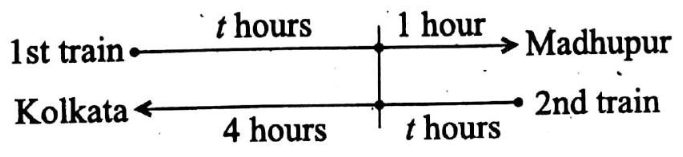
Question 20. Two trains start at the same time, one from Kolkata to Madhupur and the other from Madhupur to Kolkata. If they arrive at Madhupur and Kolkata respectively 1 hour and 4 hours after they cross each other, find the ratio of their velocities.

Solution:

Given

Two trains start at the same time, one from Kolkata to Madhupur and the other from Madhupur to Kolkata

If they arrive at Madhupur and Kolkata respectively 1 hour and 4 hours after they cross each other

Let the velocity of the first train be x km/hour and the velocity of the second train be y km/hour and let after t hours of their starting they cross each other.

WBBSE Solutions For Class 9 Maths Algebra Chapter 4 Linear Equations Question 20

As per the question, the distance covered by the 1st train in t hours is equal to the distance covered by

the second in 1 hour.

∴ \(t x=4 y \quad \text { or, } t=\frac{4 y}{x}\)…………(1)

Again, the distance covered by the first train in 1 hour is equal to the distance covered by the second in / hours.

∴ \(x=t y \text { or, } t=\frac{x}{y}\)………….(2)

Now, comparing the RHSS of (1) and (2) we get, \(\frac{4 y}{x}=\frac{x}{y}\)  [ ∵ LHSS are equal]

or, x2 = 4y2 

or, x = 2y [Taking square roots of both sides]

or, \(\frac{x}{y}=\frac{2}{1} \text { or, } x: y=2: 1\)

∴ the velocity of the 1st train: the velocity of the 2nd train = 2: 1

WBBSE Solutions For Class 9 Maths Algebra Chapter 4 Linear Equations

Class 9 Maths Linear Equations Problems WBBSE Algebra Chapter 4 Linear Equations

Chapter 4 Linear Equations Introduction:

You have studied a lot of what are equations in one and two variables, what are simultaneous linear equations in one and two variables, how graphs of these linear equations are drawn in the graph papers, and also how they are solved with the help of a graph, etc, in the previous chapter.

In the present chapter, we shall discuss the different methods of solving these simultaneous linear equations, especially in two variables without any drawing of graphs.

But first, we want to know the conditions for which two given simultaneous linear equations in two variables are solvable or not.

Read and Learn More WBBSE Solutions For Class 9 Maths

Class 9 Maths Linear Equations Problems WBBSE Chapter 4 Linear Equations Conditions For Which Two Simultaneous Linear Equations In Two Variables Are Solvable Or Not

  1. You have already known that the general or standard form of two simultaneous linear equations in two variables is:
  2. a1 + b1y + r, =0. where  a1, b1, c1 are constants and both a1 and b1, are hot zero simultaneously.
  3. a2x + b2y + c2 = 0, where a2, b2, c2 are constants and both a2 and b2 are not zero simultaneously.

We can determine whether these two equations are solvable or not by two methods :

  1. By drawing graphs
  2. By finding the relations among the ratios of the co-efficient of the same variable and of the constant terms of the two equations.

By drawing graphs :

  1. You have already learned the methods of drawing graphs of linear equations in one or two variables.
  2. So, it is now easy to you to draw the graphs of the above equations given in the standard form.
  3. You have also learned previously that the graphs of any linear equations, either in one or two variables are always some straight lines.
  4. Therefore, the two graphs of the given two simultaneous linear equations, in two variables must also be two straight lines.

Now, if these two straight lines—

  1. Intersect to each other, then the given two simultaneous equations are solvable and there is one and only one solution set of these two equations.
  2. Coincide then the given two simultaneous linear equations are solvable and there are infinitely many solution sets of these two equations.
  3. Are parallel to each other and the given two simultaneous linear equations are not solvable.
    Accordingly, there is no solution set for these two equations.

WBBSE Solutions For Class 9 Maths Algebra Chapter 4 Linear Equations

By finding the relations among the ratios between the coefficients of the same variable and of the constant terms of the two equations:

The coefficient of the variable x in the two simultaneous linear equations a1 x + b1 y + c1  = 0 and a2x + b2y + c2 = 0 are and a2 respectively.

The ratio of them is \(\frac{a_1}{a_2}\) The coefficient of the variable y are b1 and b2, the ratio of which is \(\frac{b_1}{b_2}\) The constant terms of the two equations are c1 and c2 the ratio of which is \(\frac{c_1}{c_2}\)

Now, if—

1. \(\frac{a_1}{a_2} \neq \frac{b_1}{b_2}\), then the given two simultaneous linear equations are solvable and there is one and only one set of solutions in this case.

2. \(\frac{a_1}{a_2}=\frac{b_1}{b_2}=\frac{c_1}{c_2}\) then the given two simultaneous linear equations are solvable and there are infinitely many sets of solutions in this case.

3. \(\frac{a_1}{a_2}=\frac{b_1}{b_2} \neq \frac{c_1}{c_2}\), then the two given simultaneous linear equations are not solvable and there is no set of solutions in this case.

From the above discussion, we can say that,

1. If \(\frac{a_1}{a_2} \neq \frac{b_1}{b_2}\), then the graph of the given two simultaneous linear equations intersect each other. The converse is also true.

2. \(\frac{a_1}{a_2}=\frac{b_1}{b_2}=\frac{c_1}{c_2}\), then the graph of the given two simultaneous linear equations coincide. The converse is also true.

3. If \(\frac{a_1}{a_2}=\frac{b_1}{b_2} \neq \frac{c_1}{c_2}\), then the graph of the given two simultaneous linear equations are parallel to each other. It is also true conversely.

Your conceptions about the solvability of two simultaneous linear equations will be clear in the following given examples.

Chapter 4 Linear Equations Select The Correct Answer (MCQ)

Question 1. If the simultaneous linear equations 3x + 4y 18 and kx 4y = 180 have no solution then the value of k is-

1. 0
2. 1
3. – 2
4. – 3

Solution: 

3x + 4y = 18 and kx – 4y= 180 have no solution

⇔ \(\frac{3}{k}\) = \(\frac{4}{-4}\) ≠ \(\frac{18}{180}\)

⇒ 4k =12

⇒ k = -3

The correct answer is 4. – 3

Class 9 Maths Linear Equations WBBSE Question 2. If the simultaneous linear equations ax + by + c = 0 and ax + b2y + c2 = 0 have only one solution, then the required condition is-

1. \(a_1 b_2=a_2 b_1\)
2. \(a_1 a_2=b_1 b_2\)
3. \(a_1 a_2=b_1 b_2 \neq c_1 c_2\)
4. \(a_1 b_2 \neq a_2 b_1\)

Solution:

If the simultaneous linear equations \(a_1 x+b_1 y+c_1=0 \text { and } a_2 x+b_2 y+c_2=0\) have only one solution.

∴ \(\frac{a_1}{a_2} \neq \frac{b_1}{b_2}\)

⇒ \(a_1 b_2 \neq a_2 b_1\)

∴ The correct answer is 4. \(a_1 b_2 \neq a_2 b_1\)

WBBSE Class 9 Linear Equations Solutions

Question 3. Two simultaneous linear equations in two variables will be inconsistent if their graphs be-

1. Intersecting
2. Parallel
3. Coincident
4. None of these

Solution:

Two simultaneous linear equations in two variables

will be inconsistent if their graphs be parallel.

∴ The correct answer is 2. Parallel

Class 9 Maths Linear Equations WBBSE Chapter 4 Short Answer Type Questions

Question 1. Write the equation of such a straight line which are parallel, 

Solution: 

The Equation Of A Straight Line

The equation of the straight line parallel to the graph of the equation x + 2y = 6 

is x+2y= 10 (the alternate answer may be), since \(\frac{1}{1}=\frac{2}{2} \neq \frac{6}{10}\)

[by the formula: \(\frac{a_1}{a_2}=\frac{b_1}{b_2} \neq \frac{c_1}{c_2}\)]

2. intersect with each other

Solution:

The equation of a straight line intersecting with the graph of the equation x + 2y = 6 is 2x + y

= 6 (the alternate answer may be), since \(\frac{1}{2} \neq \frac{2}{1}\)

[by the formula:  \(\frac{a_1}{a_2} \neq \frac{b_1}{b_2}\)]

3. coincide with the graph of a linear equation x + 2y = 6.

Solution:

Given x + 2y = 6

The equation of a straight line coinciding with the graph of the equation x + 2y = 6 is 4x + 8y= 24 (the alternate answer may be), since \(\frac{1}{4}=\frac{2}{8}=\frac{6}{24}\)

[by the formula: \(\frac{a_1}{a_2}=\frac{b_1}{b_2}=\frac{c_1}{c_2}\)]

WBBSE Class 9 Linear Equations Overview

Question 2. Find the value of p for which the equations 3x-4y = 1 and 9x+py = 2 will have only one set of solutions.

Solution:

Given 3x-4y = 1 and 9x+py = 2

The equations 3. x 4y = 1 and 9x+ py= 2 will have only one set of solutions if \(\frac{3}{9} \neq \frac{-4}{p}\)

[by the formula: \(\frac{a_1}{a_2} \neq \frac{b_1}{b_2}\)

or, \(\frac{1}{3} \neq \frac{-4}{p} \text { or, } p \neq-12\)

The given two equations will have only one set of solutions for all real values of p except (-12). 

Question 3. Find the values of r for which the equations rx + 2y = 5 and (r+ 1)x + 3y = 2 have no solution.

Solution: 

Given rx + 2y = 5 and (r+ 1)x + 3y = 2

Consider the Given Equations that rx + 2y = 5…….. (1) and (r + 1) x + 3y = 2………….(2)

 Now, since equations (1) and (2) have no solution,

\(\frac{r}{r+1}=\frac{2}{3}\)   [by the formula: \(\frac{a_1}{a_2}=\frac{b_1}{b_2}\)

or, 3r = 2r + 2 

or, 3r – 2r = 2 

or, r = 2.

. The required value of r is 2.

Class 9 Maths Linear Equations WBBSE Question 4. Find the value of p for which the equations px + 6yp = 0 and (p-1) x + 4y + (p-5)=0 have infinitely many sets of solutions.

Solution: 

Given rx + 2y = 5 and (r+ 1)x + 3y = 2

The equations px + 6y-p=0….. (1) and (p-1) x + 4y + (p – 5) = 0…. (2)

will have infinitely many sets of solutions if \(\frac{p}{p-1}=\frac{6}{4}=\frac{-p}{p-5}\)

[by the formula: \(\frac{a_1}{a_2}=\frac{b_1}{b_2}=\frac{c_1}{c_2}\)

or, 3p – 3 = 2p

or, 3p – 2p = 3 

or, p = 3.

Again, \(\frac{6}{4}=\frac{-p}{p-5} \quad \text { or, } \quad \frac{3}{2}=\frac{-p}{p-5}\)

or, 3p – 15 = – 2p

or, 3p + 2p = 15

or, 5p = 15

or, p = 3.

∴ The required value of p is 3.

Key Questions on Linear Equations for Class 9

Question 5. If x = 3t and y = \(\frac{2 t}{3}-1\)

Solution:

Given that x= 3y,

3t = 3 \(\frac{2 t}{3}-1\) [ x = 3t and y = \(\frac{2t}{3}\) – 1]

or, 3t = 2t – 3 

or, 3t – 2t = -3 

or, t = – 3.

WBBSE Class 9 Maths Chapter 4 PDF Question 6. Find the value of k for which the equations 2x+5y= 8 and 2x-ky = 3 will have no solution.

Solution: 

Given 2x+5y= 8 And 2x-ky = 3

The equations 2x+5y=8…….. (1) and 2x – ky = 3………. (2) will have no solution if \(\frac{2}{2}=\frac{5}{-k}\)

[by the formula: \(\frac{a_1}{a_2}=\frac{b_1}{b_2}\)]

or, 1 = \(\frac{5}{-k}\)

or, k = 5 or, k = 5.

∴ The required value of k is (-5).

Question 7. If x and y are real numbers and (x – 5)² + (x – y)²= 0, then find the value of x and y.

Solution:

Given (x – 5)² + (x – y)²= 0

In the equation (x – 5)² + (x – y)² = 0, the sum of two squares (x-5)² and (x – y)² is zero.

So, the value of these two squares will be zero each separately.

(x-5)² = 0x – 5 = 0

⇒ x = 5 and (x – y)² = 0 

x – y = 0

⇒x = y

y = 5 [ ∵ x = 5]

∴ The required values of x = 5 and y = 5.

NEET Biology Class 9 Question And Answers WBBSE Class 9 History Notes WBBSE Solutions for Class 9 Life Science and Environment
WBBSE Class 9 Geography And Environment Notes WBBSE Class 9 History Multiple Choice Questions WBBSE Class 9 Life Science Long Answer Questions
WBBSE Solutions for Class 9 Geography And Environment WBBSE Class 9 History Long Answer Questions WBBSE Class 9 Life Science Multiple Choice Questions
WBBSE Class 9 Geography And Environment Multiple Choice Questions WBBSE Class 9 History Short Answer Questions WBBSE Solutions For Class 9 Maths
WBBSE Solutions for Class 9 History WBBSE Class 9 History Very Short Answer Questions


WBBSE Class 9 Maths Chapter 4 PDF Question 8. Find the values of x and y if x² + y² – 2x + 4y=5.

Solution: 

Given x² + y² – 2x + 4y=5

x²+ y² – 2x + 4y = –5

or, (x² – 2x + 1) + (y²+ 4y + 4) = 0

or, (x – 1)² + (y + 2)² = 0.

Since the sum of two squares equals zero implies that the value of each of the squares is zero separately, 

we get, (x 1)² = 0

x – 1 = 0

⇒ x = 1 and (y+ 2)² = 0

y+2 = 0 

y = -2. 

The values of x = 1 and y = -2. 

Understanding Linear Equations in One Variable

Question 9. Find the values of r for which the equations rx – 3y – 1 = 0 and (4-r) x – y + 1= 0 will have no solution.

Solution:

Given rx – 3y – 1 = 0 And (4-r) x – y + 1= 0

The equations rx – 3y – 1 = 0………………..(1) and (4-r) x – y + 1 = 0………..(2)

will have no solution if \(\frac{r}{4-r}=\frac{-3}{-1}\)

[by the formula: \(\frac{a_1}{a_2}=\frac{b_1}{b_2}\)]

or, 12 -3r = r 

or, 4r = 12 

or, r = 3.

The required value of r = 3.

WBBSE Class 9 Algebra Solutions Question 10. Write the equation \(a_1 x+b_1 y+c_1=0, b_1 \neq 0\) b ≠ 0, in the form of y = mx + c, where m and c are constants.

Solutions:

We have, \(a_1 x+b_1 y+c_1=0 \text { or, } b_1 y=-a_1 x-c_1\)

or, y = \(-\frac{a_1}{b_1} x-\frac{c_1}{b_1}\)

or, y= \(\left(-\frac{a_1}{b_1}\right) x+\left(-\frac{c_1}{b_1}\right)\)

or, y = mx + c, where m = \(-\frac{a_1}{b_1} \text { and } c=-\frac{c_1}{b_1}\)

Practice Questions for Chapter 4 Linear Equations

Question 11. Find the value of k for which the equations kx 21y+ 150 and 8r – 7y = 0 will have only one set of solutions.

Solution: 

Given kx 21y+ 150 And 8r – 7y = 0

The equations kx 21y+ 15 = 0 ……(1) and 8x7y = 0 (2)

will have only one set of solutions if \(\frac{k}{8} \neq \frac{-21}{-7}\)

[by the formula:\(\frac{a_1}{a_2} \neq \frac{b_1}{b_2}\)]

\(\frac{k}{8}\) ≠ 3

or, k ≠ 24.

∴ The equations (1) and (2) will have only one set of solutions for all real values of k, except 24. 

WBBSE Class 9 Algebra Solutions Question 12. Find the values of a and b for which the equations 5x + 8y = 7 and (a + b) x + (a – b) y = (2a + b + 1) will have infinitely many sets of solutions.

Solutions:

Given 5x + 8y = 7 And (a + b) x + (a – b) y = (2a + b + 1)

The solutions 5x + 8y = 7……(1) and (a + b) x + (a – b) y = (2a + b + 1)……………(2)

will have infinitely many sets of solutions if \(\frac{5}{a+b}=\frac{8}{a-b}=\frac{7}{2 a+b+1}\)

[by the formula: \(\frac{a_1}{a_2}=\frac{b_1}{b_2}=\frac{c_1}{c_2}\)]

Now, \(\frac{5}{a+b}=\frac{8}{a-b}\)

or, 8a + 8b = 5a – 5b

or, 3a = –13 b

or, a = – \(\frac{13}{3}\) b…………..(3)

Again, \(\frac{8}{a-b}=\frac{7}{2 a+b+1}\)

or, 16a + 8b + 8 = 7a – 7b

or, 9a + 15b + 8 = 0

or, 9 x (– \(\frac{13}{3}\) b) + 15b +8 = 0    [by (3)]

or, –39b + 15b + 8 = 0 

or,  – 24b = 8 

or, b = \(\frac{-8}{-24}\)

= \(\frac{1}{3}\)

∴ a = \(-\frac{13}{3} \times \frac{1}{3}\) =\(-\frac{13}{9}\)

Chapter 4 Linear Equations Long Answer Type Questions

Question 1. Draw the graphs of the following equations to determine whether they are solvable or not. If solvable, find the set of solutions for a single solution and three sets of solutions for an infinite number of solutions :

1. 2x + 3y – 7 = 0; 3x + 2y 8 = 0

Solution: 

Given 2x + 3y – 7 = 0; 3x + 2y 8 = 0

We have, 2x + 3y-7=0

From (1) we get. \(\frac{2 x}{7}+\frac{3 y}{7}=1 \text { or, } \frac{x}{\frac{7}{2}}+\frac{y}{\frac{7}{3}}=1\)

∴ the graph of equation (1) intersects the x-axis at \(\left(\frac{7}{2}, 0\right)\) and the y-axis at \(\left(0, \frac{7}{3}\right)\)

From (2) we, get \(\frac{3 x}{8}+\frac{2 y}{8}=1 \text { or, } \frac{x}{\frac{8}{3}}+\frac{y}{4}=1\)

∴ the graph of the equation intersects the x-axis at \(\left(\frac{8}{3}, 0\right)\) and the y-axis at (0, 4).

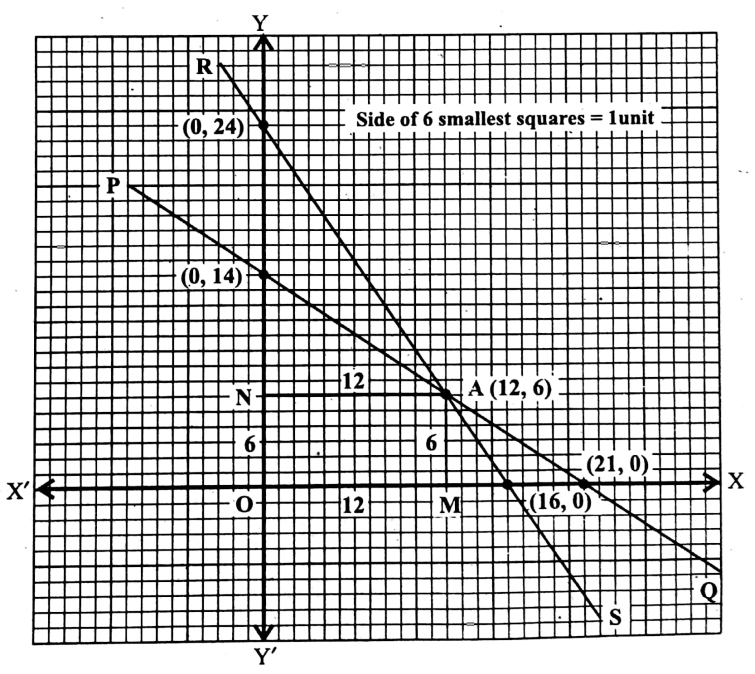
Now, by taking X’OX as the x-axis, YOY’ as the y-axis, and O as the origin and side of each smallest square = \(\frac{1}{6}\) unit, let us plot the point

\(\left(\frac{7}{2}, 0\right) \equiv\left(\frac{7}{2} \times 6,0 \times 6\right)=(21,0):\left(0, \frac{7}{3}\right) \equiv\left(0 \times 6, \frac{7}{3} \times 6,\right)=(0,14)\)

\(\left(\frac{8}{3}, 0\right) \equiv\left(\frac{8}{3} \times 6,0 \times 6\right)\) (16, 0) and (0, 4) = (0 x 6, 4 × 6) = (0,24) in the graph paper.

Then by joining the points (21, 0) and (0, 14) we get a straight line which is the required graph of equation (1). 

Let this straight line be PQ.

By joining the points (16, 0) and (0, 24) we get another straight line which is the graph of equation (2).

Let this straight line be RS.

It is clear from the graph that PQ and RS intersect each other at point A, the coordinates of which are (12, 6).

But, since the side of 6 smallest squares = 1 unit, the real value of (12, 6) = (\(\frac{12}{6}\), \(\frac{6}{6}\)) = (2, 1).

∴ the given equations are solvable and there is only one set of solutions, the values of which are

r = 2 and y = 1.

WBBSE Solutions For Class 9 Maths Algebra Chapter 4 Linear Equations Question 1 Q 1

Class 9 Maths Linear Equations Problems WBBSE Graphing Linear Equations for Class 9

2. 4xy = 11; – 8x + 2y = 22

Solution:

Given 4xy = 11; – 8x + 2y = 22

Given that 4x – y = 11……..(1) and –8x + 2y = 22…….(2)

From (1) we get, \(\frac{4 x}{11}+\frac{y}{-11}=1 \quad \text { or } \frac{x}{\frac{11}{4}}+\frac{y}{-11}=1\)

the graph of equation (1) intersects the x-axis at \(\left(\frac{11}{4}, 0\right)\) and the y-axis at (0, -11).

From (2) we get, \(\frac{-8 x}{-22}+\frac{2 y}{-22}=1 \text { or, } \frac{x}{\frac{11}{4}}+\frac{y}{-11}=1\)

the graph of equation (2) intersects the x-axis at \(\left(\frac{11}{4}, 0\right)\) and the y-axis at (0, -11).

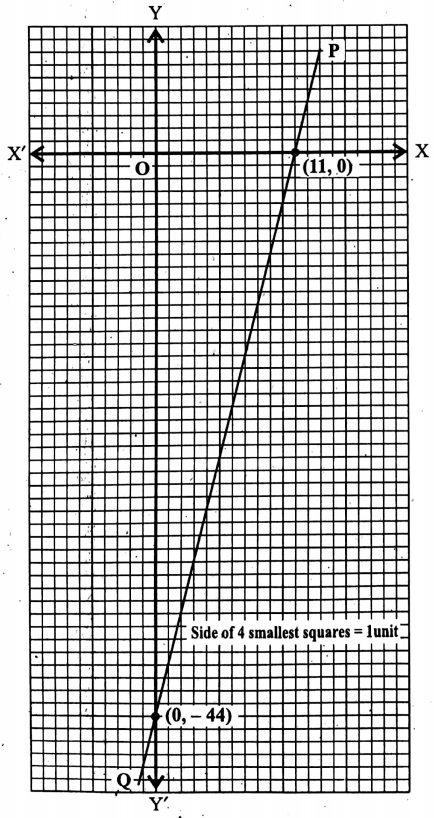
Now, by taking X’OX as the x-axis, YOY’ as the y-axis, and O as the origin and side of the 4 smallest squares = 1 unit,

let us plot the points \(\left(\frac{11}{4}, 0\right)\) = \(\left(\frac{11}{4} \times 4,0 \times 4\right)\)

= (11, 0) (0, -11) = (0 × 4, -11 x 4) = (0, 44) in the graph paper.

By joining these two points we get a straight X-line PQ (let). 

Since the next two points (11, 0) and (0, 44) are also the same by joining them we shall get the same straight-line PQ.

Therefore, the graphs of equations (1) and (2) coincide.

∴ there are infinitely many sets of solutions to the given two equations.

Now let x = 0 for the equation (1).

∴ by (1) we get, 4 x 0 – y = 11 

or, y = -11

∴ x = 0 and y = -11 is one set of solutions of the given equation (1).

Similarly, from (1) we get, if y = 0, x = and if y = 1, x 3.

∴ the required three sets of solutions the equations (1) and (2) are:

x = 0 and y = -11

x = \(\frac{11}{4}\) and y = 0

x = 3 and y = 1.

WBBSE Solutions For Class 9 Maths Algebra Chapter 4 Linear Equations Question 1 Q 2

Class 9 Maths Linear Equations Problems WBBSE Important Concepts in Linear Equations for Class 9

3. 7x+3y= 42; 21x+9y= 42.

Solution:

Given 7x+3y= 42 ; 21x+9y= 42

Given that 7x+3y= 42……………(1)

and 21x+9y= 42…………….(2)

From (1) we get, \(\frac{7 x}{42}+\frac{3 y}{42}=1 \text { or, } \frac{x}{6}+\frac{y}{14}=1\)

∴ the graph of equation (1) intersects the

x-axis at (6, 0) and the y-axis at (0, 14).

Again, from (2) we get, \(\frac{21 x}{42}+\frac{9 y}{42}=1 \text { or, } \frac{x}{2}+\frac{y}{\frac{14}{3}}=1 .\)

the graph of equation (2) intersects

the x-axis at (2, 0) and the y-axis at \(\left(0, \frac{14}{3}\right)\)

Now, by taking X’OX as the x-axis, YOY’ as the y-axis, and O as the origin and side of 3 smallest squares = 1 unit, let us plot the points (6, 0) = (6 x 3, 0 x 3) = (18, 0), (0, 14) = (0 x 3, 14 x 3) = (0, 42), (2, 0) = (2 x 3, 0 × 3) = (6, 0) 

and \(\left(0, \frac{14}{3}\right) \equiv\left(0 \times 3, \frac{14}{3} \times 3\right)\) = ( (0, 14) in the graph paper. 

Then by joining the points (18, 0) and (0, 42), we get a straight line, say PQ. 

Again, by joining the points (6, 0) and (0, 14) we get another straight line, says RS.

From the graph, we see that PQ || RS, i.e., the graphs of the given equations (1) and (2) are parallel to each other.

The given equations (1) and (2) are not solvable.

Question 2. Determine whether each pair of the following equations are solvable or not by finding the relations among the ratios of the coefficients of the same variable and the constant terms of each pair. Also, write whether the graphs of the equations of each pair are parallel or intersecting or coinciding, or not.

1. 5x + 3y= 11; 2x – 7y = 12

Solution: 

Given x + 3y= 11; 2x – 7y = 12

We have, 5x + 3y = 11……………….(1) and 2x – 7y = 12…………..(2)

Here, the ratio of the coefficients of x = \(\frac{5}{2}\) and the ratio of the coefficients of y = \(\frac{3}{-7}\)

Since, \(\frac{5}{2}\) ≠ \(\frac{3}{-7}\), the given equations (1) and (2) will have only one solution and they intersect to each

2. 6x-8y = 2; 3x-4y = 1

Given 6x-8y = 2; 3x-4y = 1

We have, 6x – 8y = 2…..…. (1) and 3x – 4y = 1………..(2)

Here, the ratio of the co-efficients of x = \(\frac{6}{3}\) = 2 and the co-efficients of y = =2. 

Also, the ratio of the constant terms of (1) and (2) is \(\frac{2}{1}\) = 2.

Since the ratios are all equal, the given two equations are solvable and their graphs of them coincide. 

3. 8x – 7y = 0; 8x – 7y = 56

Solution:

Given 8x – 7y = 0; 8x – 7y = 56

We have 8x – 7y = 0………(1) and 8x – 7y= 56…….(2)

Here, the ratio of the coefficients of x = \(\frac{8}{8}\) = 1, the coefficients of y = \(\frac{-7}{-7}\) =1

and the ratio of the constant terms = \(\frac{0}{56}\) =0. 

Since, 1 = 1 ≠ 0, 

∴ the given equations are not solvable and their graph of them are parallel to each other.

Class 9 Maths Linear Equations Problems WBBSE Different methods of solving two simultaneous linear equations in two variables:

  1. You have studied the easy method of solving linear equations in one variable in your earlier classes.
  2. In the present, we shall discuss the different methods of solving two simultaneous linear equations in two variables.

The methods are:

  1.  Method of elimination
  2.  Method of comparison
  3.  Method of substitution
  4.  Method of cross-multiplication.

1. Method of Elimination:

  1. In this method, the solution of one of the two given variables (generally x and y) is determined by eliminating the other variable with the help of simple algebraic operations.
  2. Since one variable of the two is eliminated to determine the other one, the method is known as the method of elimination.
  3. You have learned that the value of an equation does not change when it is multiplied or divided by a non-zero real number.
  4. Applying this principle, the coefficients of any one of the two variables (generally of that variable the signs of which are opposite to each other in the two equations) in the given two simultaneous linear equations, are made equal in this method and then that very variable is eliminated by the simple algebraic operations-addition or subtraction.

The working rule of this method is:

STEP-1: Equalize one of the two coefficients of any one of the two variables of the given simultaneous linear equations by multiplying or dividing them by any non-zero real numbers.

STEP-2: Eliminate that very variable by simple algebraic operations of addition or subtraction. 

STEP-3: Determine the value of the rest variable by solving the equation thus obtained in STEP-2.

STEP-4: On putting the value of the variable thus determined in any one (as per convenience) of the given two equations, find the solved value of the eliminated variable.
Therefore, the values of the variables thus obtained are the solutions of the two given simultaneous linear equations.
You can check whether the solutions thus determined are correct or not immediately by the following process:

1. Calculate the values of the LHS of both the given equations by putting the values of the variables thus obtained.

2. If these values are equal to the RHS in both equations, then your solved solutions are correct. If not, obviously they are incorrect.

Observe the following example minutely: 

Solve: 8x + 5y = 11; 3x – 4y = 10

Solution: 

Given 8x + 5y = 11; 3x – 4y = 10

Consider The Given Equation that 8x + 5y = 11………….(1) and 3x – 4y = 10……………(2).

Here the coefficients of x in both the equations are positive but the coefficients of y are in opposite signs, the first is ‘+’ and the second is ‘ – ‘;

So, it is convenient to equalize the coefficients of y.

Now, the co-efficient of y in the first equation is 5 and in the second, it is 4. 

The LCM of 5 and 4 is 20, i.e., we have to multiply the first equation by 4 to make 5 a number 20 and the second equation by 5 to make 4 a number 20.

Thus, by multiplying (1) by 4 and (2) by 5, we get,

32x + 20y = 44…..(3)

15x – 20y = 50………(4)

Adding (3) and (4), 47x = 94 or, x = \(\frac{94}{47}\) 

∴ x = 2.

Now, putting x = 2 in (1), we get, 8 x 2+5y= 11

or, 16+5y = 11 

or, 5y = 11 16 

or, 5y = -5 

or, y = -1.

∴ the required solution is x = 2, y = -1.

Proof of correctness:

LHS of (1) = 8x + 5y = 8 x 2 + 5 x (-1) 

= 16 – 5

 = 11 

= RHS.

LHS of (2) = 3x-  4y = 3 x 2 – 4 x ( -1) 

= 6 + 4 

= 10 

= RHS.

Hence the required solutions are correct.

Key Concepts in Linear Equations for WBBSE

2. Method of Comparison:

In this method, one of the two variables of the given two simultaneous linear equations is expressed in terms of the other variable and then the expressed parts of both equations are compared to get a new linear equation of one variable.

Hence the value of that variable is determined by solving this equation.

Since comparison is made to solve the given two simultaneous linear equations, the method is known as the method of comparison.

The working rule of this method is :

STEP-1: Express anyone (as per convenience) of the two variables in the first equation in terms of the other variable (i.e., there will be only one variable in the LHS of the first equation.)

STEP-2: Express the same variable in the second equation in terms of the other variable similarly. 

STEP-3: Compare the RHSS of both the equation, thus expressed to get a new linear equation of one variable, i.e. write RHS of the first equation equal to the RHS of the second equation.

STEP-4: Determine the value of the variable by solving the equation obtained in STEP-3.

Find the value of the other variable by putting the value of the variable obtained in STEP-4 in any one of the expressed equations in STEP-1 or STEP-2 and solving thereafter.

Therefore, the values of the variables thus obtained are the required solutions of the given two simultaneous linear equations.

Observe the following example :

Solve: 4x-3y = 18, 4y – 5x=-7.

Solution:

Given 4x-3y = 18, 4y – 5x=-7

We have, 4x – 3y = 18

or, 4x = 18+ 3y

or, x = \(\frac{18 + 3y}{4}\)…………(i)

4y – 5x = -7 

or, 5x = 7 – 4y 

or, x = \(\frac{4y + 7}{5}\) ……………(ii)

Now, comparing the RHSS of (1) and (2) we get,

\(\frac{3y + 18}{4}\) = \(\frac{4y + 7}{5}\) [ …LHSS are equal]

or, 16y+ 28 = 15y + 90

or, 16y – 15y = 90 – 28 

or, y = 62,

∴ y = 62.

Now putting y = 62 in (1) we get, x = \(\frac{3 \times 62+18}{4}=\frac{186+18}{4}=\frac{204}{4}\) =51.

∴ the required solution is x = 51, y = 62.

Class 9 Maths Linear Equations Problems WBBSE 3. Method of Substitution :

In this method, one variable of any one of the given two simultaneous linear equations is expressed in terms of the other variable.

Then this expressed the value of the variable is substituted against that variable in the other equation to get a linear equation of one variable.

Solving this equation we get the value of that variable.

Since the expressed value of one variable of any one of the given two simultaneous linear equations is substituted against the same variable in the other equation to get the solutions of the given equations, the method is known as the method of substitution.

The working rule of this method is:

STEP-1: Express one of the two variables of any one of the given two simultaneous linear equations in terms of the other variable.

STEP-2: In the other equation substitute that variable with this expressed value of the variable to get a linear equation of one variable.

STEP-3: Find the value of that variable by solving this linear equation.

STEP-4: Find the value of the other variable by putting the value of the variable obtained in STEP-3 in the expressed equation in STEP-1.

Therefore, the values of the variables thus obtained are the solutions of the given two simultaneous linear equations.

Observe the following equations:

Solve: 3xy = 7; 2x + 4y = 0

Solution:

Given 3xy = 7; 2x + 4y = 0

We have, 3x – y = 7

or, 3x = y + 7

or, x = \(\frac{y+7}{3}\) …………(1)

Substituting \(\frac{y+7}{3}\) in respect to x in 2x + 4y = 0 we get,

\(2 \times \frac{y+7}{3}+4 y\) =  or, \(\frac{2 y+14}{3}+4 y=0\)

or, 2y + 14+ 12y = 0

or, 14y  = -14 

or, y = \(\frac{-14}{14}\) 

or, y = -1.

Now, putting y = -1 in (1) we get, x = \(\frac{-1+7}{3}=\frac{6}{3}\) = 2.

∴ the required solution is x = 2, y = -1.

Practice Problems on Linear Equations

4. Method of Cross-multiplication:

In this method, two simultaneous linear equations given in the standard form (If not they should be expressed in the standard form) are solved by a formula.

The formula is:

If \(a_1 x+b_1 y+c_1=0 \text { and } a_2 x+b_2 y+c_2=0\) be two given simultaneous linear equations, then

\(\frac{x}{b_1 c_2-b_2 c_1}=\frac{-y}{a_1 c_2-a_2 c_1}=\frac{1}{a_1 b_2-a_2 b_1} \quad\left(a_1 b_2-a_2 b_1 \neq 0\right)\)

i.e., x = \(\frac{b_1 c_2-b_2 c_1}{a_1 b_2-a_2 b_1}\)

and y = \(\frac{a_2 c_1-a_1 c_2}{a_1 b_2-a_2 b_1}\)

This formula can be obtained by the cross-multiplication of the coefficients of the variables of the given two simultaneous linear equations. For this reason, this method is known as the method of cross-multiplication.

We can solve the simultaneous linear equations \(a_1 x+b_1 y+c_1=0\)…… (1) and

\(a_2 x+b_2 y+c_2=0\)………..(2) by the method of elimination.

Such as- multiplying (1) by a2 and (2) by a1 we get,

\(a_1 a_2 x+a_2 b_1 y+a_2 c_1=0\)…… (3)

and \(a_1 a_2 x+a_1 b_2 y+a_1 c_2=0\)……. (4) 

Now, subtracting (3) from (4) we get, \(a_1 b_2 y-a_2 b_1 y+a_1 c_2-a_2 c_1=0\)

or, \(y\left(a_1 b_2-a_2 b_1\right)=a_2 c_1-a_1 c_2\)

or, \(\frac{a_2 c_1-a_1 c_2}{a_1 b_2-a_2 b_1}\)………………..(5)

Again, multiplying (1) by b2 and (2) by b1, we get

\(a_1 b_2 x+b_1 b_2 y+b_2 c_1=0\)………………….(vi) 

and \(\frac{a_2 c_1-a_1 c_2}{a_1 b_2-a_2 b_1}\)…..(vii)

Now, subtracting (vi) from (vii) we get, \(a_2 b_1 x+a_1 b_2 x+b_1 c_2-b_2 c_1=0\).

or, \(\left(a_2 b_1-a_1 b_2\right) \ddot{x}=\left(b_2 c_1-b_1 c_2\right)\)

or,\(\frac{b_2 c_1-b_1 c_2}{a_2 b_1-a_1 b_2}=\frac{b_1 c_2-b_2 c_1}{a_1 b_2-a_2 b_1}\)……………(8)

From (v) and (viii) we get, 

\(\frac{x}{b_1 c_2-b_2 c_1}=\frac{y}{a_2 c_1-a_1 c_2}=\frac{1}{a_1 b_2-a_2 b_1}\)

or, \(\frac{x}{b_1 c_2-b_2 c_1}=\frac{-y}{a_1 c_2-a_2 c_1}=\frac{1}{a_1 b_2-a_2 b_1}, \quad\left(a_1 b_2-a_2 b_1 \neq 0\right)\)

Therefore, the method of cross-multiplication is nothing but the summarisation of the method of elimination.

Therefore, the required solution is

x = \(=\frac{b_1 c_2-b_2 c_1}{a_1 b_2-a_2 b_1} \text { and } y=\frac{a_2 c_1-a_1 c_2}{a_1 b_2-a_2 b_1}\)

Class 9 Maths Linear Equations Problems WBBSE The working rule of this method is :

STEP-1: Express the given two simultaneous linear equations in the standard form (ax+by+ c = 0) (if it is not given in the standard form).

STEP-2: Write 

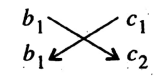
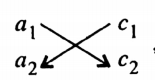
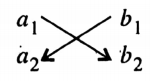
WBBSE Solutions For Class 9 Maths Algebra Chapter 4 Linear Equations 1

STEP-3: Write below the variable x the result of the following cross-multiplication:

WBBSE Solutions For Class 9 Maths Algebra Chapter 4 Linear Equations 2

,i.e. write \(\left(b_1 c_2-b_2 c_1\right)\) below x.

STEP-4: Write below the variable (-y), the result of the following cross-multiplication:

WBBSE Solutions For Class 9 Maths Algebra Chapter 4 Linear Equations 3

i.e. write \(\left(a_1 c_2-a_2 c_1\right)\) below (- y).

STEP-5: Write below (1), the result of the following cross-multiplication :

WBBSE Solutions For Class 9 Maths Algebra Chapter 4 Linear Equations 4

i.e. write \(\left(a_1 b_2-a_2 b_1\right)\) below (1).

STEP-6: After STEP-V, you shall get the equations

\(\frac{x}{b_1 c_2-b_2 c_1}=\frac{-y}{a_1 c_2-a_2 c_1}=\frac{1}{a_1 b_2-a_2 b_1}\)

From this equations write x = \(\frac{b_1 c_2-b_2 c_1}{a_1 b_2-a_2 b_1} \text { and } y=\frac{a_2 c_1-a_1 c_2}{a_1 b_2-a_2 b_1}\)

Therefore, the values of x and y thus, obtained are the solutions of the given two simultaneous linear equations.

Understanding Graphs of Linear Equations for Solutions

Observe the following example:

Solve: 7x – 3y – 31= 0; 9x – 5y – 41 = 0.

Solution:

Given 7x – 3y – 31= 0; 9x – 5y – 41 = 0

We have, 7x-3y 31 = 0…………….(1) and 9x – 5y – 41 = 0…………(2)

We get from (1) and (2) by the method of cross multiplication,

\(\begin{aligned}
& \frac{x}{\left|\begin{array}{ll}
b_1 & c_1 \\
b_2 & c_2
\end{array}\right|}=\frac{-y}{\left|\begin{array}{ll}
a_1 & c_1 \\
a_2 & c_2
\end{array}\right|}=\frac{1}{\left|\begin{array}{ll}
a_1 & b_1 \\
a_2 & b_2
\end{array}\right|} \text {, where } \\
& \left|\begin{array}{ll}
b_1 & c_1 \\
b_2 & c_2
\end{array}\right|=b_1 c_2-b_2 c_1 ;\left|\begin{array}{ll}
a_1 & c_1 \\
a_2 & c_2
\end{array}\right|=\left(a_1 c_2-a_2 c_1\right) ;\left|\begin{array}{ll}
a_1 & b_1 \\
a_2 & b_2
\end{array}\right|=\left(a_1 b_2-a_2 b_1\right) .
\end{aligned}\)

∴ the required solution is x = 4 and y = –1.

How to solve any two given simultaneous linear equations in two variables by all of the four methods described above is thoroughly discussed in the following examples:

Chapter 4 Linear Equations Select The Correct Answer (MCQ)

Question 1.

1. If y of equation \(\frac{2}{x}\) + \(\frac{7}{y}\) = 1 is expressed in term of x we get

1. y = \(\frac{7 x}{x-2}\)
2. y = \(y=\frac{7(x-2)}{x}\)
3. x = \(x=\frac{2 y}{y-7}\)
4. x = \(x=\frac{2(x-7)}{y}\)

Solution:

\(\frac{2}{x}+\frac{7}{y}=1\)

⇒ \(\frac{2}{x}=1-\frac{7}{y}\)

⇒ \(\frac{2}{x}=\frac{y-7}{y}\)

⇒ \(\frac{x}{2}=\frac{y}{y-7}\)

⇒ \(x=\frac{2 y}{y-7}\)

∴ The correct answer is 3. x = \(x=\frac{2 y}{y-7}\)

2. The value of x when y = \(\frac{7-4 x}{-5}\) is substituted in the equation 2x + 3y = 9 is

1. 1
2. 2
3. 3
4. 4

Solution:

∴ 2x + 3y = 9

∴ \(2 x+3 \times\left(\frac{7-4 x}{-5}\right)=9\)

⇒ \(2 x-\frac{21-12 x}{5}=9\)

⇒ \(\frac{10 x-21+12 x}{5}=9\)

⇒ 22x – 21 = 45

⇒ 22x = 45 + 21

⇒ \(x=\frac{66^3}{2 2}\)

⇒ x = 3

∴ The correct answer is 3. 3


WBBSE Class 9 Algebra Solutions 3. If r (x + y) = 2rs………(1) and s (x – y) = 2rs……..(2) be two equations, then the value of x obtained from (1) that should be substituted in equation (2) so as to determine the value of y is-

1. s – r
2. y – 2s
3. 2r – y
4. 2r+ y

Solution:

Given r (x + y) = 2rs and s (x – y) = 2rs

r (x + y) = 2rs…………..(1)

x + y = 2s

⇒ x = 2s – y

s (x – y) = 2rs…………..(2)

x – y = 2r

=> 2s-y- y = 2r

-2y= 2r – 2s

2y = 2s – 2r

y =  s – r

:. The correct answer is 1. s – r

Sample Solutions from WBBSE Class 9 Maths Chapter 4

Chapter 4 Linear Equations Short Answer Type Questions

Question 1. Solve the following simultaneous linear equations in two variables by the method of elimination.

1. \(x+y=48 ; \quad x+4=\frac{5}{2}(y+4)\)

Solution:

x + y = 48……..(1) \(x+4=\frac{5}{2}(y+4)\)…………….(2)

Subtracting (2) from (1) we get, \(y-4=48-\frac{5}{2}(y+4) \text { or; } y-4=48-\frac{5 y}{2}-10\)

or, \(y+\frac{5 y}{2}=38+4 \text { or, } \frac{7 y}{2}=42 \text { or, } y=42 \times \frac{2}{7}=12\)

Now, putting y = 12 in (1) we get, x + 12 = 48 

or, x= 48 – 12

or, x = 36

The required solution is x = 36, and y = 12.

WBBSE Class 9 Algebra Solutions 2. \(3 x-\frac{2}{y}=5 ; \quad x+\frac{4}{y}=4\)

Solution:

3x – \(\frac{2}{y}\) = 5……………………(1)

x + \(\frac{4}{y}\) = 2……………………(2)

Multiplying (1) by 2 we get,

6x – \(\frac{4}{y}\) = 10……………………(1)

x + \(\frac{4}{y}\) = 2……………………(2)

Adding, 6x + x = 10 + 4, 

or, 7x = 14 

or, x= \(\frac{14}{7}\) = 2

Putting x 2 in (1) we get, 3 x 2 – \(\frac{2}{y}\) = 5

or, 6 – \(\frac{2}{y}\) = 5

or, –  \(\frac{2}{y}\) = -1

or, y = 2 

∴ The required solution is x = 2, y = 2.

3. \(\frac{x}{2}+\frac{y}{3}=1 ; \frac{x}{3}+\frac{y}{2}=1\)

Solution:

\(\frac{x}{2}+\frac{y}{3}=1\)……………..(1)

\(\frac{x}{3}+\frac{y}{2}=1\)………………..(2)

Multiplying (1) by 3 and (2) by 2 we get,

\(\frac{3 x}{2}+y=3\)…………………(3)

\(\frac{2 x}{3}+y=2\)…………………(4)

\(\frac{3x}{2}\) – \(\frac{2x}{3}\) = 3 -2 (Subtracting)

or, \(\frac{9 x-4 x}{6}\) = 1 

or, \(\frac{5x}{6}\) = 1

or, x = \(x=\frac{6}{5}=1 \frac{1}{5}\)

Putting x = \(\frac{6}{5}\) in (4) we get,

\(\frac{2}{3} \times \frac{6}{5}+y=2 \text { or, } \frac{4}{5}+y=2 \text { or, } y=2-\frac{4}{5}=\frac{6}{5}=1 \frac{1}{5}\)

∴ The required solution is x = 1 \(\frac{1}{5}\) , y = 1 \(\frac{1}{5}\).

WBBSE Class 9 Algebra Solutions 4. \(\frac{x+y}{2}+\frac{3 x-5 y}{4}=2 ; \quad \frac{x}{14}+\frac{y}{18}=1\)

Solution:

\(\frac{x+y}{2}+\frac{3 x-5 y}{4}=2 \text { or, } \frac{x}{2}+\frac{y}{2}+\frac{3 x}{4}-\frac{5 y}{4}=2\)

or, \(\frac{5 x}{4}-\frac{3 y}{4}=2\)……………………(1)

\(\frac{x}{14}+\frac{y}{18}=1\)…………………….(2)

Multiplying (1) by \(\frac{2}{27}\) we get,

\(\frac{5 x}{54}-\frac{y}{18}=\frac{4}{27}\)……………..(3)

\(\frac{x}{14}+\frac{y}{18}=1\)…………………..(4)

\(\frac{5 x}{54}+\frac{x}{14}=\frac{4}{27}+1\) (Adding)

or, \(\frac{35 x+27 x}{378}=\frac{4+27}{27}\)

or, \(\frac{62 x}{378}=\frac{31}{27}\)

or, x = \(\frac{31}{27} \times \frac{378}{62}=7\)

∴ x = 7.

Putting x = 7 in (2) we get, \(\frac{7}{14}+\frac{y}{18}\) =1

or, \(\frac{1}{2}+\frac{y}{18}\) = 1

or, \(\frac{y}{18} = 1-\frac{1}{2}\)

\(\frac{y}{18}=\frac{1}{2}\)

y =\(\frac{18}{2}\) = 9

∴ The required solution is x = 7, y = 9.

5. \(\frac{x y}{x+y}=\frac{1}{5} ; \quad \frac{x y}{x-y}=\frac{1}{9}\)

Solution:

\(\frac{x y}{x+y}=\frac{1}{5}\)………………….(1)

and \(\frac{x y}{x-y}=\frac{1}{9}\)………………….(2)

from (1) we get, \(\frac{x+y}{x y}=5 \text { or, } \frac{x}{x y}+\frac{y}{x y}=5 \text { or, } \frac{1}{y}+\frac{1}{x}=5\)……………….(3)

From (2) we get, \(\frac{x-y}{x y}=9 \text { or, } \frac{x}{x y}-\frac{y}{x y}=9 \text { or, } \frac{1}{y}-\frac{1}{x}=9\)…………………(4)

Adding (3) and (4) we get, \(\frac{1}{y}+\frac{1}{y}=5+9 \text { or, } \frac{2}{y}=14 \text { or, } y=\frac{2}{14}=\frac{1}{7}\)

Putting y = \(\frac{1}{7}\)

or, \(\frac{1}{y}\) = 7 in (3) we get, \(7+\frac{1}{x}=5 \text { or, } \frac{1}{x}=-2 \text { or, } x=-\frac{1}{2}\)

∴ The required solution is x = – \(\frac{1}{2}\), y = \(\frac{1}{7}\)

6. \(\frac{1}{x-1}+\frac{1}{y-2}=3 ; \frac{2}{x-1}+\frac{3}{y-2}=5\)

Solution:

\(\frac{1}{x-1}+\frac{1}{y-2}=3\)…………………(1)

\(\frac{2}{x-1}+\frac{3}{y-2}=5\)……………………(2)

Multiplying (1) by 3 we get, \(\frac{3}{x-1}+\frac{3}{y-2}=9\)……………….(3)

Subtracting (2) from (3) we get, \(\frac{3}{x-1}-\frac{2}{x-1}\) = 9 – 5

or, \(\frac{3-2}{x-1}=4\)

or, \(\frac{1}{x-1}=4\)

or, 4x – 4 = 1

or, 4x = 5

or, x = \(x=\frac{5}{4}=1 \frac{1}{4}\)

Now, putting \(\frac{1}{x-1}=4\) in (1) we get, \(4+\frac{1}{y-2}=3\)

or, \(\frac{1}{y-2}=-1\)

or, -y + 2 = 1

or, y = 1

∴ The required solution is x = 1 \(\frac{1}{4}\), y = 1.

WBBSE Class 9 Algebra Chapter 4 Solutions Alternative Method:

Let, \(\frac{1}{x-1}=u\) and \(\frac{1}{y-2}=v\)

∴ From (1) we get, u + v = or 2u + 2v…………….(3)

From (2) we get,, 2u + 3v = 5………………………(4)

Subtracting, -v = 1 or v = -1.

from u + v = 3 we get, u – 1 = 3

or, u = 4

∴ u = 4 and v = -1.

or, \(\frac{1}{x-1}=4\)

or, \(\frac{1}{y-2}=-1\)     [∵ \(u=\frac{1}{x-1} \text { or, } v=\frac{1}{y-2}\)]

or 4x – 4 = 1

or, -y + 2 = 1

or, 4x = 5

or, -y = – 1

or, y = 1

or, x = \(\frac{5}{4}\)

= 1 \(\frac{1}{4}\)

∴ The required solution is x = 1 \(\frac{1}{4}\), y= 1.

WBBSE Class 9 Important Questions on Linear Equations

7. \((7 x-y-6)^2+(14 x+2 y-16)^2=0\)

Solution:

\((7 x-y-6)^2+(14 x+2 y-16)^2=0\)

∴ (7x – y – 6)² = 0

or, 7x – y – 6 = 0…………….(1)

[Since if the sum of two squares is zero, then the value of each of the squares must be zero separately.]

and (14x + 2y – 16)² = 0

or, 14x + 2y – 16 = 0

or, 7x + y – 8 = 0………………(2)

Now, subtracting (1) from (2) we get, y + y – 8 + 6 = 0 

or, 2y – 2 = 0 

or, 2y = 2 

or, y = \(\frac{2}{2}\) =1

Putting y = 1 in (1) we get, 7x – 1 – 6 = 0 

or, 7x – 7 = 0 

or, 7x = 7 

or, x= \(\frac{7}{7}\) = 1

The required solution is x = 1, y = 1.

8. \(a x+b y=1 ; b x+a y=\frac{(a+b)^2}{a^2+b^2}-1,(a \neq b)\)

Solution:

ax + by 1…………………..(1)

bx+ay = \(\frac{(a+b)^2}{a^2+b^2}-1\) = -1 

or, bx+ay = \(\frac{a^2+2 a b+b^2-a^2-b^2}{a^2+b^2}\)

or, bx+ay = \(\frac{2 a b}{a^2+b^2}\)………………….(2)

Now, multiplying (1) by a and (2) by b we get,

\(a^2 x+a b y=a\)…………………..(3)

\(b^2 x+a b y=\frac{2 a b^2}{a^2+b^2}\)……………..(4)

\(a^2 x-b^2 x=a-\frac{2 a b^2}{a^2+b^2}\) (Subtracting)

or, \(x\left(a^2-b^2\right)=\frac{a^3+a b^2-2 a b^2}{a^2+b^2}\)

or, \(x\left(a^2-b^2\right)=\frac{a^3-a b^2}{a^2+b^2}\)

or, x=\(\frac{a\left(a^2-b^2\right)}{\left(a^2+b^2\right)\left(a^2-b^2\right)}\)

or, \(\frac{a}{a^2+b^2}\)

Putting x = \(\frac{a}{a^2+b^2}\) in (1) we get, \(a \times \frac{a}{a^2+b^2}+b y=1\) = 1

or, \(\frac{a^2}{a^2+b^2}+b y=1\)

or, \(b y=1-\frac{a^2}{a^2+b^2}\)

or, \(b y=\frac{a^2+b^2-a^2}{a^2+b^2}\)

or, \(b y=\frac{b^2}{a^2+b^2}\)

or, \(y=\frac{b^2}{b\left(a^2+b^2\right)}\)

or, \(y=\frac{b}{a^2+b^2}\)    [∵b ≠ 0]

∴ The required solution is \(\frac{a}{a^2+b^2}, \quad y=\frac{b}{a^2+b^2}\)

Concepts Related to Solving Linear Equations for Class 9 Solutions

Question 2. Solve the following simultaneous linear equations in two variables by the method of comparison.

Step-by-Step Solutions for Linear Equations

1. \(2 x+\frac{3}{y}=5 ; 5 x-\frac{2}{y}=3\)

Solution:

\(2 x+\frac{3}{y}=5 \text { or, } 2 x=5-\frac{3}{y} \text { or, } x=\frac{1}{2}\left(5-\frac{3}{y}\right)\)…………………..(1)

\(5 x-\frac{2}{y}=3 \text { or, } 5 x=3+\frac{2}{y} \quad \text { or, } x=\frac{1}{5}\left(3+\frac{2}{y}\right)\)………………(2)

the LHSs of (1) and (2) are equal, by comparing the RHSs we get,

\(\frac{1}{2}\left(5-\frac{3}{y}\right)=\frac{1}{5}\left(3+\frac{2}{y}\right)\)

or, \(\frac{5}{2}-\frac{3}{2 y}=\frac{3}{5}+\frac{2}{5 y}\)

or, \(-\frac{3}{2 y}-\frac{2}{5 y}=\frac{3}{5}-\frac{5}{2}\)

or, \(\frac{-15-4}{10 y}\) =\(\frac{6-25}{10}\)

or, \(\frac{-19}{y}=\frac{-19}{1}\)

or, y =1.

Putting y 1 in (1) we get, x = \(\frac{1}{2}\left(5-\frac{3}{1}\right)=\frac{1}{2}(5-3)\)

or, x = \(\frac{1}{2} \times 2=1\)

∴ The required solution is x = 1, y = 1

WBBSE Class 9 Algebra Chapter 4 Solutions 2. \(2 x-3 y=8 ; \frac{x+y}{x-y}=\frac{7}{3}\)

Solution:

2x – 3y = 8 or, 2x = 8 + 3y or, x = \(\frac{8+3 y}{2}\)……………(1)

 \(\frac{x+y}{x-y}=\frac{7}{3}\)

or, 7x – 7y = 3x + 3y 

or, 7x – 3x = 3y + 7y 

or, 4 x = 10 y

or, x =  \(\frac{10y}{4}\)

or, x =  \(\frac{5y}{2}\)……………………..(2)

the LHSs of (1) and (2) are equal, comparing the RHSs we get,  \(\frac{8+3 y}{2}=\frac{5 y}{2}\)

or, 8+ 3y = 5y 

or, 3y – 5y = -8 

or, – 2y – 8 

or, -2y = -8

or, y = \(\frac{-8}{-2}\)

= 4.

Putting y = 4 in (2) we get, x = \(\frac{5 \times 4}{2}=10\)

∴ The required solution is x = 10, y = 4.

3. \(\frac{1}{3}(x-y)=\frac{1}{4}(y-1) ; \frac{1}{7}(4 x-5 y)=x-7\)

Solution:

\(\frac{1}{3}\) (x – y) = \(\frac{1}{4}\) (y – 1)

or, 4x – 4y = 3y – 3 

or, 4x = 3y – 3 + 4y 

or, 4x = 7y – 3

or, x = \(\frac{7 y-3}{4}\)……………. (1)

Again, \(\frac{1}{7}\)  (4x-5y) = x – 7 

or, 4x – 5y = 7x – 49  

or, 4x – 7x = – 49 + 5y 

or, – 3x = − (49 – 5y)

or, x = \(\frac{-(49-5 y)}{-3} \text { or, } x=\frac{49-5 y}{3}\)……………..·(2)

The LHSs of (1) and (2) are equal, comparing the RHSs we get, \(\frac{7 y-3}{4}=\frac{49-5 y}{3}\)

or, 21y – 9 = 196 – 20y 

or, 21y + 20y = 196 + 9 

or, 41y = 205 

or, y = \(\frac{205}{41}\)

Now, putting y = 5 in (1) we get, x = \(\frac{7 \times 5-3}{4}\)

or, x =\(\frac{35-3}{4}\)

or, x =\(\frac{32}{4}\)

or, x = 8

∴ The required solution is x = 8, y = 5.

4. \(\frac{x+1}{y+1}=\frac{4}{5} ; \quad \frac{x-5}{y-5}=\frac{1}{2}\)

Solution:

\(\frac{x+1}{y+1}=\frac{4}{5}\)

or, 5x + 5 = 4y + 4

or, 5x = 4y + 4 -5+or, x = \(\frac{4 y-1}{5}\)………………..(1)

Again, \(\frac{x-5}{y-5}=\frac{1}{2}\)

or, 2x – 10 = y -5

or, 2x = y – 5 + 10

or, x = \(\frac{y+5}{2}\)……………..(2)

The LHSs of (1) and (2) are equal, comparing the RHSs we get,

or, 8y – 2 = 5y + 25 

or, 8y- 5y = 25 + 2 

or, 3y = 27 

or, y = \(\frac{27}{3}\)

= 9

The required solution is x = 7, y = 9.

WBBSE Class 9 Algebra Chapter 4 Solutions 5. \(\frac{1}{x}+\frac{1}{y}=\frac{5}{6} ; \frac{1}{x}-\frac{1}{y}=\frac{1}{6}\)

Solution:

\(\frac{1}{x}+\frac{1}{y}=\frac{5}{6}\)

or, \(\frac{1}{x}=\frac{5}{6}-\frac{1}{y}\)………………….(1)

and \(\frac{1}{x}-\frac{1}{y}=\frac{1}{6} \text { or, } \frac{1}{x}=\frac{1}{6}+\frac{1}{y}\)…………………..(2)

The LHSS of (1) and (2) are equal, comparing the RHSS we get,

\(\frac{1+1}{y}=\frac{5-1}{6} \text { or, } \frac{2}{y}=\frac{4}{6}\)

4y = 12

or, y = 3.

Now putting y = 3 in (1) we get, \(\frac{1}{x}=\frac{5}{6}-\frac{1}{3}\)

\(\frac{1}{x}=\frac{5-2}{6}\) \(\frac{1}{x}=\frac{3}{6}\)

or, x = 2

∴ The required solution is x = 2, y = 3.

Alternative method:

Let \(\frac{1}{x}\) = u and \(\frac{1}{y}\) = v.

∴ \(\frac{1}{x}+\frac{1}{y}=\frac{5}{6} \Rightarrow u+v=\frac{5}{6} \text { or, } u=\frac{5}{6}-v\)…………………(1)

\(\frac{1}{x}-\frac{1}{y}=\frac{1}{6} \Rightarrow u-v=\frac{1}{6} \text { or, } u=\frac{1}{6}+v\)………………….(2)

The LHSs of (1) and (2) are equal, comparing the RHSs we get,

\(\frac{5}{6}-v=\frac{1}{6}+v \text { or, } v+v=\frac{5}{6}-\frac{1}{6} \text { or, } 2 v=\frac{4}{6} \text { or, } v=\frac{4}{2 \times 6}=\frac{1}{3}\)

From (1) we get, \(u=\frac{5}{6}-\frac{1}{3} \text { or, } u=\frac{5-2}{6}=\frac{3}{6}=\frac{1}{2}\)

∴ \(u=\frac{1}{2} \quad \text { or, } \frac{1}{x}=\frac{1}{2} \quad \text { or, } x=2\)

and \(v=\frac{1}{3} \quad \text { or, } \frac{1}{y}=\frac{1}{3} \quad \text { or, } y=3\)

The required solution is x = 2, y = \(\frac{2}{3}\)

6. \(\frac{x+y}{x y}=2 ; \quad \frac{x-y}{x y}=1,(x \neq 0, y \neq 0)\)

Solution:

\(\frac{x+y}{x y}=2 \text { or, } \frac{x}{x y}+\frac{y}{x y}=2 \text { or, } \frac{1}{y}+\frac{1}{x}=2 \text { or, } \frac{1}{y}=2-\frac{1}{x}\)………………(1)

\(\frac{x-y}{x y}=1 \text { or, } \frac{x}{x y}-\frac{y}{x y}=1 \text { or, } \frac{1}{y}-\frac{1}{x}=1 \text { or, } \frac{1}{y}=1+\frac{1}{x}\)………………..(2)

The LHSS of (1) and (2) are equal, comparing the RHSS we get,

\(2-\frac{1}{x}=1+\frac{1}{x} \text { or, } \frac{1}{x}+\frac{1}{x}=2-1 \text { or, } \frac{2}{x}=1\)

x = 2

Now putting x = 2

or, \(\frac{1}{x}\) = \(\frac{1}{2}\) in (1) we get,

\(\frac{1}{y}=2-\frac{1}{2} \text { or, } \frac{1}{y}=\frac{3}{2} \text { or, } y=\frac{2}{3}\)

∴ The required solution is x = 2, y = \(\frac{2}{3}\)

Alternative Method:

\(\frac{x+y}{x y}=2\)

or, x + y = 2xy

or, 2xy – x = y

or, x (2y – 1) = y

or, \(x=\frac{y}{2 y-1}\)………………….(1)

\(\frac{x-y}{x y}=1\)

or, x – y = xy

or, x – xy = y

or, x (1 – y) = y

or, \(x=\frac{y}{1-y}\)……………….(2)

The LHSS of (1) and (2) are equal, comparing the RHSS we get, \(\frac{y}{2 y-1}=\frac{y}{1-y}\)

or, 2y – 1 = 1 – y [ y ≠ 0]

or, 3y = 2

or, y = 2/3

putting y = 2/3 we get,

\(x=\frac{\frac{2}{3}}{1-\frac{2}{3}}=\frac{\frac{2}{3}}{\frac{1}{3}}=2\)

∴ The required solution is x = 2 y = 2/3

Study Guide for Class 9 Maths Linear Equation Questions

7. \(\frac{x+y}{5}+\frac{x-y}{4}=5 ; \frac{x+y}{4}+\frac{x-y}{5}=5 \frac{4}{5}\)

Solution:

\(\frac{x+y}{5}+\frac{x-y}{4}=5\)

or, \(\frac{4 x+4 y+5 x-5 y}{20}=5\)

or, 9x – y = 100

or, y = 9x – 100……………………(1)

\(\frac{x+y}{4}+\frac{x-y}{5}=5 \frac{4}{5}\)

or, \(\frac{5 x+5 y+4 x-4 y}{20}=\frac{29}{5}\)

or, 9x + y = 116 – 9x

or, y = 116 – 9x………………..(2)

The LHSs of (1) and (2) are equal, comparing the RHSs we get, 9x – 100 = 116 – 9x

or, 9x + 9x = 116+ 100 

or, 18x = 216 

or, x= \(\frac{216}{18}\)

Putting x = 12 in (1) we get, y = 9 x 12 100 

or, y = 108 – 100 

or, y = 8.

∴ The required solution is x = 12, y = 8.

Alternative Method:

\(\frac{x+y}{5}+\frac{x-y}{4}=5\)………….(1)

\(\frac{x+y}{4}+\frac{x-y}{5}=5 \frac{4}{5}\)…………….(2)

Let x + y = u and x – y = v

∴ from (1) we get, \(\frac{u}{5}+\frac{v}{4}=5\)

or, 4u + 5v = 100   [multiplying by 20]

or, 4u = 100 – 5v

or, u = \(u=\frac{100-5 v}{4}\)………………(3)

From (2) we get, \(\frac{u}{4}+\frac{v}{5}=\frac{29}{5}\)

or, 5u + 4v = 116   [multiplying by 20]

or, 5u = 116 – 4v

or, u = \(u=\frac{116-4 v}{5}\)………………..(4)

The LHSS of (3) and (4) are equal, comparing the RHSS we get,

\(\frac{100-5 v}{4}=\frac{116-4 v}{5}\)

or, 500 – 25v = 464 – 16v

or, -16 + 25v = 500 – 464

or, 9v = 36

or, \(\frac{36}{9}\)

= 4

putting v = 4 in (3) we get, u = \(\frac{100-5 \times 4}{4} \text { or, } u=\frac{100-20}{4} \text { or, } u=\frac{80}{4}\)

or, u = 20.

∴ u = 20

or, x + y = 20

or, x  = 20-y……………………(5)

and v = 4

or, x – y = 4

or, x = 4 +y……………………(6)

Comparing equations (5) and (6) we get

20 – y = 4 + y

or, y + y = 20 – 4

or, 2y  = 16

or, y = \(\frac{16}{2}\)

or, y = 8.

∴ putting y = 8 in (5) we get, x = 20 – 8

or, x = 12.

∴ the required solution is x = 12, y = 8.

WBBSE Class 9 Algebra Chapter 4 Solutions 8. 2 – 2 (3x – y) = 10(4 – y) – 5x = 4(y – x)

Solution:

Given 2 – 2 (3x – y) = 10(4 – y) – 5x = 4(y – x)

2 – 2 (3x – y) = 10(4 – y) – 5x = 4(y – x)

∴ 2 – 2(3x – y) = 4 (y – x)

or, 2 – 6x +2y = 4y – 4x

or, 2 – 6x +4x = 4y -2y

or, 2 – 2x = 2y

or, x = 1 – y……………..(1)

and 10(4 – y) – 5x = 4(y – x)

or, 40 – 10y – 5x = 4y – 4x

or, 40 – 5x + 4x = 4y + 10y

or, 40 – x = 14y

or, x = 40 – 14y…………………..(2)

The LHSs of (1) and (2) are equal, comparing the RHSs. we get, 1 – y = 40 – 14y 

or, 13y = 39

Or, y = \(\frac{39}{13}\) = 3.

Question 3. Solve the following simultaneous linear equations in two variables by the method of substitution:

1. \(2 x+\frac{3}{y}=1 ; 5 x-\frac{2}{y}=\frac{11}{12}\)

Solution:

\(2 x+\frac{3}{y}=1\)………………(1)

\(5 x-\frac{2}{y}=\frac{11}{12}\)…………………(2)

From (1) we get, \(\frac{3}{y}\) = 1 – 2x

or, y = \(\frac{3}{y}=1-2 x \text { or, } y=\frac{3}{1-2 x}\)……………..(3)

Substituting y = \(y=\frac{3}{1-2 x}\) in (2) we get, \(5 x-\frac{2}{\frac{3}{1-2 x}}=\frac{11}{12}\)

or, \(5 x-\frac{2(1-2 x)}{3}=\frac{11}{12}\)

or, \(\frac{15 x-2+4 x}{3}=\frac{11}{12}\)

or, \(\frac{19 x-2}{3}=\frac{11}{12}\)

or, 76x – 8 = 11

or, 76x = 19

or, x = \(\frac{19}{76}\)

or, x = \(\frac{1}{4}\)

putting x = \(\frac{1}{4}\) in (3) we get,

\(y=\frac{3}{1-2 \times \frac{1}{4}}\)

or, \(y=\frac{3}{1-\frac{1}{2}}\)

or, \(y=\frac{3}{\frac{1}{2}}\)

or, y = 6

∴ The required solution is x = \(\frac{1}{4}\), y = 6.

2. \(\frac{2}{x}+\frac{5}{y}=1 ; \frac{3}{x}+\frac{2}{y}=\frac{19}{20}\)

Solution:

\(\frac{2}{x}+\frac{5}{y}=1\)………………….(1)

and \(\frac{3}{x}+\frac{2}{y}=\frac{19}{20}\)……………………..(2)

From (1) we get, \(\frac{2}{x}\) = 1 – \(\frac{5}{y}\)

or, \(x=\frac{2}{1-\frac{5}{y}}\)

or, \(x=\frac{2}{\frac{y-5}{y}}\)

or, \(x=\frac{2 y}{y-5}\)………………..(3)

Substituting x = \(x=\frac{2 y}{y-5}\) in (2) we get,

\(\frac{3}{\frac{2 y}{y-5}}+\frac{2}{y}=\frac{19}{20}\)

or, \(\frac{3 y-15}{2 y}+\frac{2}{y}=\frac{19}{20}\)

or, \(\frac{3 y-15+4}{2 y}=\frac{19}{20}\)

or, \(\frac{3 y-11}{y}=\frac{19}{10}\)

or, 30y – 110 = 19y

or, 30y – 19y = 110

or, 11y = 110

or y = \(\frac{110}{11}\)

or, y = 10.

putting y = 10 in (3) we get, \(x=\frac{2 \times 10}{10-5}=\frac{20}{5}=4\)

Alternative Method:

Let \(\frac{1}{x}\) = u and \(\frac{1}{y}\) = v.

∴ from (1) we get, 2u + 5v = 1or 2u = 1 – 5v

or, u = \(\frac{1-5 v}{2}\)……………………(3)

From (2) we get, 3u + 2v = \(\frac{19}{20}\)

or, \(3\left(\frac{1-5 v}{2}\right)+2 v=\frac{19}{20}\)    (putting u = \(\frac{1-5 v}{2}\))

or, \(\frac{3-15 v+4 v}{2}=\frac{19}{20}\)

or, \(\frac{3-11 v}{1}=\frac{19}{10}\)

or, 30 – 110 v = 19

or, 110v = 11

or, v = \(\frac{11}{110}=\frac{1}{10}\)

(putting v = \(\frac{1}{10}\) in 93) we get, u = \(\frac{1-5 \times \frac{1}{10}}{2}\)

or, u = \(\frac{1-\frac{1}{2}}{2}=\frac{\frac{1}{2}}{2}=\frac{1}{4}\)

∴ u = \(\frac{1}{4}\)

or, \(\frac{1}{x}=\frac{1}{4}\)

or, x = 4 and v = \(\frac{1}{10}\)

or, \(\frac{1}{y}=\frac{1}{10}\)

o, y = 10

∴ The required solution is x = 4, y = 10.

3. \(\frac{x+y}{x y}=3 ; \quad \frac{x-y}{x y}=1\)

Solution:

\(\frac{x+y}{x y}=3\)……(1)

\(\frac{x-y}{x y}=1\)…………..(2)

from (1) we get, x + y = 3xy

or, 3xy – x = y

or, x (3y – 1) = y

or, \(x=\frac{y}{3 y-1}\)………..(3)

Substituting x = \(\frac{y}{3 y-1}\) in (2) we get, \(\frac{\frac{y}{3 y-1}-y}{\frac{y}{3 y-1} \times y}=1\)

or, \(\frac{\frac{y-3 y^2+y}{3 y-1}}{\frac{y^2}{3 y-1}}=1\)

or, \(\frac{\frac{2 y-3 y^2}{3 y-1}}{\frac{y^2}{3 y-1}}=1\)

or, \(\frac{2 y-3 y^2}{y^2}=1\)

or, 2y – 3y² = y²

or, 2y = 4y²

or, y = \(\frac{1}{2}\)

putting y = \(\frac{1}{2}\) in (3) we get, x = \(\frac{\frac{1}{2}}{3 \times \frac{1}{2}-1}=\frac{\frac{1}{2}}{\frac{1}{2}}=1\)

∴ The required solution is x = 1, y = \(\frac{1}{2}\)

Alternative Method:

\(\frac{x+y}{x y}=3\)………….(1)

\(\frac{x-y}{x y}=1\)………………(2)

From (1) we get, \(\frac{x}{x y}+\frac{y}{x y}=3\)

or, \(\frac{1}{y}+\frac{1}{x}=3\)

or, \(\frac{1}{y}=3-\frac{1}{x}\)………………………(3)

From (2) we get, \(\frac{x}{x y}-\frac{y}{x y}=1\)

or, \(\frac{1}{y}-\frac{1}{x}=1\)

or, \(3-\frac{1}{x}-\frac{1}{x}=1\)     (putting \(\frac{1}{y} = 3 – \frac{1}{x}\))

or, 3 – \(\frac{2}{x}\) = 1

or, \(\frac{2}{x}\)

or, x = 1.

putting x = 1 in (3) we get, \(\frac{1}{y}=3-\frac{1}{1} \text { or, } \frac{1}{y}=3-1 \text { or, } \frac{1}{y}=2 \text { or, } y=\frac{1}{2}\)

∴ The required solution is x = 1 y = \(\frac{1}{2}\)

4. \(\frac{x+y}{x-y}=\frac{7}{3} ; x+y=\frac{7}{10}\)

Solution:

\(\frac{x+y}{x-y}=\frac{7}{3}\)…………(1)

\(x+y=\frac{7}{10}\)……………(2)

From (1) we get, \(\frac{x+y}{x-y}=\frac{7}{3}\)

or, 7x – 3x = 3y + 7y 

or, 4x = 10y 

or, x = \(\frac{10y}{4}\)

or, x = \(\frac{5y}{2}\)………………(3)

Substituting x = \(\frac{5y}{2}\) in (2) we get,

\(\frac{5 y}{2}+y=\frac{7}{10} \text { or, } \frac{5 y+2 y}{2}=\frac{7}{10} \text { or, } \frac{7 y}{1}=\frac{7}{5} \text { or, } y=\frac{7}{5} \times \frac{1}{7} \text { or, } y=\frac{1}{5}\)

Putting y in (3) we get, x = \(\frac{5 \times \frac{1}{5}}{2} \text { or, } x=\frac{1}{2}\)

∴ the required solution is x = \(x=\frac{1}{2}, \quad y=\frac{1}{5}\)

5. \(\frac{x}{2}+\frac{y}{3}=1 ; \frac{x}{3}+\frac{y}{2}=1\)

Solution:

\(\frac{x}{2}+\frac{y}{3}=1\)………………(1)

\(\)……………….(2)

From (1) we get, \(\frac{y}{3}=1-\frac{x}{2} \text { or, } \frac{y}{3} \times \frac{3}{2}=\left(1-\frac{x}{2}\right) \times \frac{3}{2} \text { or, } \frac{y}{2}=\frac{3}{2}-\frac{3 x}{4}\)………….(3)

From (2) we get, \(\frac{x}{3}+\frac{3}{2}-\frac{3 x}{4}=1 \cdot\left[\text { Putting } \frac{y}{2}=\frac{3}{2}-\frac{3 x}{4}\right]\)

or, \(\frac{4 x-9 x}{12}=1-\frac{3}{2} \cdot \text { or, } \frac{-5 x}{12}=-\frac{1}{2} \text { or, } x=\frac{6}{5}=1 \frac{1}{5}\)

putting x = \(\frac{6}{5}\) in (1)we get,

\(\frac{\frac{6}{5}}{2}+\frac{y}{3}=1 \quad \text { or, } \frac{y}{3}=1-\frac{3}{5} \text { or, } \frac{y}{3}=\frac{2}{5} \quad \text { or, } y=\frac{6}{5} \quad \text { or, } y=1 \frac{1}{5}\)

∴ the required solution is \(=1 \frac{1}{5}, \quad y=1 \frac{1}{5}]\)

6. \(\frac{1}{3}(x-y)=\frac{1}{4}(y-1) ; \frac{1}{7}(4 x-5 y)=x-7\)

Solution:

\(\frac{1}{3}(x-y)=\frac{1}{4}(y-1)\)…………….(1)

\(\frac{1}{7}(4 x-5 y)=x-7\)…………….(2)

From (1) we get, 4x – 4y = 3y – 3

or, 4x = 7y -3

or,\(x=\frac{7 y-3}{4}\)………………(3)

Substituting \(x=\frac{7 y-3}{4}\) in (2) we get,

\(\frac{1}{7}\left(4 \times \frac{7 y-3}{4}-5 y\right)=\frac{7 y-3}{4}-7\)

or, \(\)

or, \(\frac{1}{7}(2 y-3)=\frac{7 y-31}{4}\)

or, 49y – 217 = 8y – 12

or, 49y – 8y = -12 + 217

or, 41y = 205

or, y = \(\frac{205}{41}\)

or, y = 5.

Now putting y = 5 in (3) we get,

\(x=\frac{7 \times 5-3}{4} \text { or, } x=\frac{35-3}{4} \text { or, } x=\frac{32}{4}=8\)

∴the required solution is x = 8, y = 5.

7. \(\frac{x}{14}+\frac{y}{18}=1 ; \frac{x+y}{2}+\frac{3 x-5 y}{4}=2\)

Solution:

\(\frac{x}{14}+\frac{y}{18}=1\)…………………(1)

\(\frac{x+y}{2}+\frac{3 x-5 y}{4}=2\)…………..(2)

From (2) we get, \(\frac{2 x+2 y+3 x-5 y}{4}=2\)or, 5x – 3y = 8

or, 5x = 3y + 8

or,\(x=\frac{3 y+8}{5}\)………….(3)

Now , substituting \(x=\frac{3 y+8}{5}\) in (1) we get, \(\frac{\frac{3 y+8}{5}}{14}+\frac{y}{18}=1\)

or, \(\frac{3 y+8}{70}+\frac{y}{18}=1 \text { or, } \frac{27 y+72+35 y}{630}=1\)

or, 62y + 72 = 360

or, 62y = 558

or, \(\frac{558}{62}\)

= 9

Now, putting  y =9 in (3), we get, \(x=\frac{3 \times 9+8}{5}\)

or, \(\frac{35}{5}

or, x = 7.

∴ The required solution is x = 7, y = 9.

Common Mistakes in Solving Linear Equations

8. [latex]p(x+y)=q(x-y)=2 p q \quad(p, q \neq 0)\)

Solution:

p (x + y) = q (x − y) = 2 pq

∴ p (x + y) = 2 pq 

or, x + y = 2q 

or, x = 2q-y……(1)

and q (x-y) = 2 pq 

or, x – y = 2p……(2) 

Substituting x = 2q-y in (2) we get, 2q-y- y = 2p 

or, 2q-2y= 2p

or, q-y=p 

or, y = q- p.

Putting y = q-p in (1) we get, x = 2q-q+p 

or, x = p + q

∴ The required solution is x = p + q, y=q-p.

Question 4. Solve the following simultaneous linear equations in two variables by the method of cross-multiplication

1. \(x+5 y=36 ; \frac{x+y}{x-y}=\frac{5}{3}\)

Solution:

x + 5y = 36 ……..(1)

and \(\frac{x+y}{x-y}=\frac{5}{3}\)…………..(2)

From (1) we get, \(\frac{x+y}{x-y}=\frac{5}{3}\)

or, 5x – 5y = 3x + 3y 

or, 5x-3x= 3y+5y 

or, 2x= 8y 

or, x = 4y

or, x4y+0=0…………….(4)

Now, by the method of cross-multiplication, we get from (3) and (4),

\(\frac{x}{0-144}=\frac{-y}{0+36}=\frac{1}{-4-5}\)


[ ∵ \(\frac{x}{\left|\begin{array}{cc}
5 & -36 \\
-4 & 0
\end{array}\right|}=\frac{-y}{\left|\begin{array}{cc}
1 & -36 \\
1 & 0
\end{array}\right|}=\frac{1}{\left|\begin{array}{rr}
1 & 5 \\
1 & -4
\end{array}\right|} \quad \text { or, } \frac{x}{-144}=\frac{-y}{36}=\frac{1}{-9}\)

or, \(\frac{x}{-144}=\frac{1}{-9} \quad \text { or, } x=\frac{-144}{-9}\)

or, x = 16

and \(\frac{-y}{36}=\frac{1}{-9} \text { or, }-y=\frac{36}{-9}\)

or, y = 4

∴ The required solution is x = 16, and y = 4.

2. \(\frac{x}{5}+\frac{y}{3}=\frac{x}{4}-\frac{y}{3}-\frac{3}{20}=0\)

Solution:

\(\frac{x}{5}+\frac{y}{3}=\frac{x}{4}-\frac{y}{3}-\frac{3}{20}=0\)

\(\frac{x}{5}+\frac{y}{3}+0=0\)………………(1)

and \(\frac{x}{4}-\frac{y}{3}-\frac{3}{20}=0\)………….(2)

From (1) and (2) by the method of cross-multiplication, we get,

\(\frac{x}{\frac{1}{3} \times\left(-\frac{3}{20}\right)-0 \times
\left(-\frac{1}{3}\right)}=\frac{-y}{\frac{1}{5} \times\left(-\frac{3}{20}\right)-0 \times \frac{1}{4}}=\frac{1}{\frac{1}{5} \times\left(-\frac{1}{3}\right)-\frac{1}{3} \times \frac{1}{4}}\)


[ ∵ \(\frac{x}{\left|\begin{array}{rr}
\frac{1}{3} & 0 \\
-\frac{1}{3} & -\frac{3}{20}
\end{array}\right|}=\frac{-y}{\left|\begin{array}{cc}
\frac{1}{5} & 0 \\
\frac{1}{4} & -\frac{3}{20}
\end{array}\right|}=\frac{1}{\left|\begin{array}{rr}
\frac{1}{5} & \frac{1}{3} \\
\frac{1}{4} & -\frac{1}{3}
\end{array}\right|}\) ]

or, \(\frac{x}{-\frac{1}{20}}=\frac{-y}{-\frac{3}{100}}=\frac{1}{-\frac{1}{15}-\frac{1}{12}}\)

or, \(\frac{x}{\frac{1}{20}}=\frac{-y}{\frac{3}{100}}=\frac{1}{\frac{9}{60}}\)

∴ \(\frac{x}{\frac{1}{20}}=\frac{1}{\frac{9}{60}} \quad \text { or, } \quad x=\frac{\frac{1}{20}}{\frac{9}{60}}\)

or, \(x=\frac{1}{20} \times \frac{60}{9} \text { or, } x=\frac{1}{3}\)

and \(\frac{-y}{\frac{3}{100}}=\frac{1}{\frac{9}{60}} . \quad \text { or, }-y=\frac{\frac{3}{100}}{\frac{9}{60}}\)

or, \(-y=\frac{3}{100} \times \frac{60}{9} \text { or, } y=-\frac{1}{5}\)

∴ The required solution is x = \(\frac{1}{3}\), y =- \(\frac{1}{5}\)

3. \(\frac{x+2}{7}+\frac{y-x}{4}=2 x-8 ; \frac{2 y-3 x}{3}+2 y=3 x+4\)

Solution:

\(\frac{x+2}{7}+\frac{y-x}{4}=2 x-8\)……………(1)

\(\frac{2 y-3 x}{3}+2 y=3 x+4\)……………..(2)

From (1) we get, 4x + 8 + 7y – 7x = 56x – 224 [multiplying by 28]

or, 59x – 7y – 232 = 0………………….(3)

From (2) we get, 2y – 3x+6y=9x+12 [multiplying by 3]

or, 12x – 8y+12= 0 

or, 3x – 2y+3=0……………………(4)

From (3) and (4) by the method of cross-multiplication, we get,

\(\frac{x}{(-7) \times 3-(-232) \times(-2)}=\frac{-y}{59 \times 3-(-232) \times 3}=\frac{1}{59 \times(-2)-(-7) \times 3}\)


[ ∵ \(\frac{x}{\left|\begin{array}{cc}
-7 & -232 \\
-2 & 3
\end{array}\right|}=\frac{-y}{\left|\begin{array}{cc}
59 & -232 \\
3 & 3
\end{array}\right|}=\frac{1}{\left|\begin{array}{cc}
59 & -7 \\
3 & -2
\end{array}\right|}\) ]

or, \(\frac{x}{-21-464}=\frac{-y}{177+696}=\frac{1}{-118+21}\)

or, \(\frac{x}{-485}=\frac{-y}{873}=\frac{1}{-97}\)

∴ \(\frac{x}{-485}=\frac{1}{-97} \text { or, } x=\frac{-485}{-97}\)

or, x = 5 and \(\frac{-y}{873}=\frac{1}{-97}\)

or, \(-y=\frac{873}{-97}\)

or, y = 9

∴ The required solution is x = 5, y = 9.

4. \(x+y=2 b ; x-y=2 a\)

Solution:

x+y=2b…..(1) and x-y=2a…..(2)

From (1) we get, x + y – 2b= 0…….(3)

From (2) we get, x- y-2a = 0…………….(4)

From (3) and (4) by the method of cross-multiplication, we get,

\(\frac{x}{1 \times(-2 a)-(-1) \times(-2 b)}=\frac{-y}{1 \times(-2 a)-1 \times(-2 b)}=\frac{1}{1 \times(-1)-1 \times 1}\)


[ ∵ \(\frac{x}{\left|\begin{array}{rr}
1 & -2 b \\
-1 & -2 a
\end{array}\right|}=\frac{-y}{\left|\begin{array}{ll}
1 & -2 b \\
1 & -2 a
\end{array}\right|}=\frac{1}{\left|\begin{array}{rr}
1 & 1 \\
1 & -1
\end{array}\right|}\) ]

or, \(\frac{x}{-2 a-2 b}=\frac{-y}{-2 a+2 b}=\frac{1}{-1-1}\)

or, \(\frac{x}{-2(a+b)}=\frac{-y}{-2(a-b)}=\frac{1}{-2}\)

∴ \(\frac{x}{-2((1+b))}=\frac{1}{-2}\)

or, \(\frac{-2(a+b)}{-2} \text { and } \frac{-y}{-2(a-b)}=\frac{1}{-2}\)

or, \(-y=\frac{-2(a-b)}{-2}\)

or, -y = a – b

or, y = b – a

x = a + b

∴ The required Solution is  x = a + b, y = b – a

5. \(\frac{x}{a}+\frac{y}{b}=2 ; a x-b y=a^2-b^2\)

Solution:

\(\frac{x}{a}+\frac{y}{b}=2 ; a x-b y=a^2-b^2\)………….(1)

and ax – by = a² – b²……….(2)

From (1) we get, \(\)…………….(3)

From (3) and (4) by the method of cross-multiplication, we get,

\(\frac{x}{\frac{1}{b} \times\left(b^2-a^2\right)-(-2) \times(-b)}=\frac{-y}{\frac{1}{a} \times\left(b^2-a^2\right)-(-2) \times a}=\frac{1}{\frac{1}{a} \times(-b)-\frac{1}{b} \times a}\)

or, \(\frac{x}{\frac{b^2-a^2}{b}-2 b}=\frac{-y}{\frac{b^2-a^2}{a}+2 a}=\frac{1}{-\frac{b}{a}-\frac{a}{b}}\)

or, \(\frac{x}{b^2-\frac{a^2-2 b^2}{b}}=\frac{-y}{\frac{b^2-a^2+2 a^2}{a}}=\frac{1}{-\left(\frac{b^2+a^2}{a b}\right)}\)

or, \(\frac{x}{-\frac{a^2+b^2}{b}}=\frac{-y}{\frac{a^2+b^2}{a}}=\frac{1}{-\frac{a^2+b^2}{a b}}\)

∴ \(\frac{x}{-\frac{a^2+b^2}{b}}=\frac{1}{-\frac{a^2+b^2}{a b}} \text { and } \frac{-y}{\frac{a^2+b^2}{a}}=\frac{1}{-\frac{a^2+b^2}{a b}}\)

or, \(x=\frac{-\frac{a^2+b^2}{b}}{-\frac{a^2+b^2}{a b}} \text { or, }-y=\frac{\frac{a^2+b^2}{a}}{-\frac{a^2+b^2}{a b}}\)

or, \(x=\frac{a^2+b^2}{b} \times \frac{a b}{a^2+b^2} \text { or, }-y=\frac{a^2+b^2}{a} \times\left(-\frac{a b}{a^2+b^2}\right)\)

or, x = a


or, -y = -b

or, y = b

∴ The required solution is x = a, y = b.

6. \(a x+b y=1 ; b x+a y=\frac{2 a b}{a^2+b^2}\)

Solution:

ax + by = 1………….(1)

and \(b x+a y=\frac{2 a b}{a^2+b^2}\)…………….(2)

From (1) we get, ax + by – 1 = 0…………….(3)

From (2) we get, \(b x+a y-\frac{2 a b}{a^2+b^2}=0\)………………(4)

From (3) and (4) we get by the method of cross-multiplication,

\(\frac{x}{b \times\left(-\frac{2 a b}{a^2+b^2}\right)-(-1) \times a}=\frac{-y}{a \times\left(-\frac{2 a b}{a^2+b^2}\right)-(-1) \times b}=\frac{1}{a \times a-b \times b}\)


[ ∵ \(\frac{x}{\left|\begin{array}{cc}
b & -1 \\
a & -\frac{2 a b}{a^2+b^2}
\end{array}\right|}=\frac{-y}{\left|\begin{array}{cc}
a & -1 \\
b & -\frac{2 a b}{a^2+b^2}
\end{array}\right|}=\frac{1}{\left|\begin{array}{ll}
a & b \\
b & a
\end{array}\right|}\) ]

or, \(\frac{x}{-\frac{2 a b^2}{a^2+b^2}+a}=-\frac{-y}{-\frac{2 a^2 b}{a^2+b^2}+b}=\frac{1}{a^2-b^2}\)

or, \(\frac{x}{\frac{-2 a b^2+a^3+a b^2}{a^2+b^2}}=\frac{-y}{\frac{-2 a^2 b+a^2 b+b^3}{a^2+b^2}}=\frac{1}{a^2-b^2}\)

or, \(\frac{x}{\frac{a^3-a b^2}{a^2+b^2}}=\frac{-y}{\frac{-a^2 b+b^3}{a^2+b^2}}=\frac{1}{a^2-b^2}\)

or, \(\frac{x}{\frac{a\left(a^2-b^2\right)}{a^2+b^2}}=\frac{-y}{\frac{-b\left(a^2-b^2\right)}{a^2+b^2}}=\frac{1}{a^2-b^2}\)

∴ \(\frac{x}{\frac{a\left(a^2-b^2\right)}{a^2+b^2}}=\frac{1}{a^2-b^2}\)

and \(\frac{-y}{\frac{-b\left(a^2-b^2\right)}{a^2+b^2}}=\frac{1}{a^2-b^2}\)

or, \(x=\frac{1}{a^2-b^2} \times \frac{a\left(a^2-b^2\right)}{a^2+b^2}\)

or, \(-y=\frac{1}{a^2-b^2} \times \frac{-b\left(a^2-b^2\right)}{a^2+b^2}\)

or, \(x=\frac{a}{a^2+b^2}\)

or, \(y=\frac{b}{a^2+b^2}\)

∴ the required solution is \(x=\frac{a}{a^2+b^2}, y=\frac{b}{a^2+b^2}\)

WBBSE Solutions For Class 9 Maths Algebra Chapter 2 Factorization

WBBSE Class 9 Maths Factorization Solutions – Algebra Chapter 1 Factorization

Chapter 1 Factorization Of The Polynomials By Using Identities:

  1. In the previous chapter, you have already learned a lot about polynomials.
  2. In this present chapter, we shall study the processes or methods of how to factorize those polynomials.
  3. Before doing it, we want to know what we mean by factorization.
  4. By factorization of a polynomial, we generally mean that the polynomial should be represented as the product of two or more than two polynomials and each of the polynomials thus obtained is called a factor of the original polynomial.
  5. i.e., the given polynomial will be divisible by each of these factors.
  6. By the usual division algorithm, we can check it.
  7. For example, let x2 + 2x be a polynomial. We have to factorize it.
  8. Now, x2 + 2x = x (x + 2).
  9. the polynomial (x2 + 2x) is represented as the product of two polynomials x and x + 2, which are called factors of the polynomial x2 + 2x, i.e., x2 + 2x is divisible by both x and x + 2.

Read and Learn More WBBSE Solutions For Class 9 Maths

WBBSE Solutions For Class 9 Maths Algebra Chapter 2 Factorization 1

and

WBBSE Solutions For Class 9 Maths Algebra Chapter 2 Factorization 2

In this sub-chapter, we shall use the following identities to factorize the polynomials given:

  1. (a + b)2 = a2 + 2ab + b2 = (a – b)2 + 4ab
  2. {a – b)2 = a2 – 2ab + b2 = (a + b)2 – 4ab
  3. a2 + b2 = (a + b)2 – 2ab = (a – b)2 + 2ab
  4. a2 – b2 = (a + b)(a – b)

In the following examples, you shall know about the different processes of factorization of the polynomials using the above identities.

WBBSE Solutions For Class 9 Maths Algebra Chapter 2 Factorization

WBBSE Class 9 Factorization Solutions

Examples 1. Factorize: 4x4 + 81.

Solution:

Given 4x4+81

4x4+81

= (2x2)2 +(9)2 = (2x2 +9)2 -2.2x2.9 [ Identity : a2 + b2 = (a + b)2 – 2ab ]

= (2x2 + 9) -(6x)2

= (2x2 + 9 + 6x) (2x2 +9-6x)

= (2x2 + 6x + 9) (2x2 -6x + 9)

4x4+81 = (2x2 + 6x + 9) (2x2 -6x + 9)

Question 2. Factorize: \(\frac{x^4}{16}\) – \(\frac{y^4}{81}\)

Solution:

\(\frac{x^4}{16}-\frac{y^4}{81}=\left(\frac{x^2}{4}\right)^2-\left(\frac{y^2}{9}\right)^2\)

= \(\left(\frac{x^2}{4}+\frac{y^2}{9}\right)\left(\frac{x^2}{4}-\frac{y^2}{9}\right)\)  [Identity: \(a^2-b^2=(a+b)(a-b)\)]

= \(\left(\frac{x^2}{4}+\frac{y^2}{9}\right)\left\{\left(\frac{x}{2}\right)^2-\left(\frac{y}{3}\right)^2\right\}\)

= \(\left(\frac{x^2}{4}+\frac{y^2}{9}\right)\left(\frac{x}{2}+\frac{y}{3}\right)\left(\frac{x}{2}-\frac{y}{3}\right)\)

WBBSE Class 9 Maths Factorization Solutions

Question 3. Factorize: \(m^2+\frac{1}{m^2}+2-2 m-\frac{2}{m}\)

Solution:

\(\mathrm{m}^2+\frac{1}{\mathrm{~m}^2}+2-2 \mathrm{~m}-\frac{2}{\mathrm{~m}}\)

= \((m)^2+2 \cdot m \cdot \frac{1}{m}+\left(\frac{1}{m}\right)^2-2\left(m+\frac{1}{m}\right)\) [Identity: \((a+b)^2=a^2+2 a b+b^2\)]

= \(\left(\mathrm{m}+\frac{1}{\mathrm{~m}}\right)^2-2\left(\mathrm{~m}+\frac{1}{\mathrm{~m}}\right)=\left(\mathrm{m}+\frac{1}{\mathrm{~m}}\right)\left(\mathrm{m}+\frac{1}{\mathrm{~m}}-2\right)\)

NEET Biology Class 9 Question And Answers WBBSE Class 9 History Notes WBBSE Solutions for Class 9 Life Science and Environment
WBBSE Class 9 Geography And Environment Notes WBBSE Class 9 History Multiple Choice Questions WBBSE Class 9 Life Science Long Answer Questions
WBBSE Solutions for Class 9 Geography And Environment WBBSE Class 9 History Long Answer Questions WBBSE Class 9 Life Science Multiple Choice Questions
WBBSE Class 9 Geography And Environment Multiple Choice Questions WBBSE Class 9 History Short Answer Questions WBBSE Solutions For Class 9 Maths
WBBSE Solutions for Class 9 History WBBSE Class 9 History Very Short Answer Questions

Question 4. Factorize: 3x (3x + 2z) – 4y (y + z).

Solution:

Given 3x (3x + 2z) – 4y (y + z)

3x (3x + 2z)- 4y (y + z)

= 9x2+ 6xz-4y2 -4yz

= (3x)2-(2y)2 +6xz-4yz

= (3x + 2y)(3x-2y) + 2z (3x-2y)    [ Identity : a2 – b2 = (a + b) (a – b)]

= (3x – 2y)(3x + 2 y + 2z)

3x (3x + 2z) – 4y (y + z) = (3x – 2y)(3x + 2 y + 2z)

WBBSE Class 9 Factorization Techniques

Question 5. Factorize : 3x2+4xy + y2 -2xz-z2

Solution:

Given 3x2+4xy + y2 -2xz-z2

3x2+4xy +y2-2xz- z2 = 4x2 -x2 +4xy+ y2 – 2xz – z2

= (2x)2 + 2.2x. y + (y)2 – (x2 + 2xz + z2)

= (2x + y)2 -(x + z)2 [ Identity : a2 + 2ab + b2 = (a + b)2]

= (2x + y + x + z)(2x + y-x-z) [ Identity : a2 – b2 = (a + b) (a – b)]

= (3x+y + z)(x+y-z)

3x2+4xy + y2 -2xz-z= (3x+y + z)(x+y-z)

Practice Questions for Chapter 2 Factorization

Class 9 Maths Factorization WBBSE Question 6. Factorize: x2-y2-6ax + 2ay +8a2

Solution:

Given x2-y2-6ax + 2ay +8a2

x2– y2-6ax +2ay +8a2 = (x)2-2.x.3a +(3a)2 – (a2-2ay + y2)

= (x – 3a)2 – (a- y)2 [ Identity : a2 – 2 ab + b2 = (a – b)2]

= (x-3a+a – y)(x-3a-a + y) [Identity : a2 – b2 = (a + b) (a – b)]

= (x-y-2a)(x + y-4a)

x2-y2-6ax + 2ay +8a2 = (x-y-2a)(x + y-4a)

Question 7. Factorise: a2– 9b2 + 4c2 – 25d2 – 4ac + 30bd

Solution :

Given a2– 9b2 + 4c2 – 25d2 – 4ac + 30bd

a2– 9b2 + 4c2 – 25d2 – 4ac + 30bd

= (a)2 – 2.a.2c + (2c)2 – {(3b)2 – 2.3b.5d + (5d)2)

= (a – 2c)2 – (3b – 5d)2 [ Identity : a2 – lab + ft2 = (a – ft)2]

= (a – 2c + 3b – 5d)(a – 2c – 3b + 5d) [ Identity : a2 – b2 = (a + b) (a – b)]

= (a + 3ft – 2c – 5d)(a – 3b – 2c + 5d)

a2– 9b2 + 4c2 – 25d2 – 4ac + 30bd = (a + 3ft – 2c – 5d)(a – 3b – 2c + 5d)

Question 8. (x2-y2)(a2– b2) + 4abxy. 

Solution :

Given (x2-y2)(a2– b2) + 4abxy

(x2-y2){a2-b2)+ 4abxy = x2a2-y2a2-x2b2 + y2b2 +2abxy + 2abxy

= (xa)2 + 2.xa.yb + (yb)2 – {(xb)2 – 2.xb.ya + (ya)2 }

= (xa + yb)2 – (xb – ya)2 [Identity : a2 + 2ab + b2 = (a + b)2 ; a2 – 2ab + b2 = (a – b)2]

= (xa + yb + xb -ya)(xa + yb – xb + ya) [Identity: a2 – b2 = (a + b) (a – b)]

= (ax + bx – ay + by)(ax -bx + ay + by)

(x2-y2)(a2– b2) + 4abxy = (ax + bx – ay + by)(ax -bx + ay + by)

Class 9 Maths Factorization WBBSE Question 9. Factorize: x2 – 2x – 22499.

Solution :

Given x2 – 2x – 22499

x2– 2x – 22499 = x2 – 2x+ 1 – 22500

= (x-1)2 – (150)2 [ Identity : a2 – 2ab + b2 = (a – b)2]

= (x – 1 + 150)(x – 1 – 150) [ Identity : a2 – b2 = (a + b) (a – b)]

= (x + 149)(x-151)

x2 – 2x – 22499 = (x + 149)(x-151)

Question 10.Factorize: 2b2c2+ 2c2a2+ 2a2b2-a4-b4 -c4.

Solution:

Given 2b2c2+ 2c2a2+ 2a2b2-a4-b4 -c4

2b2c2 +2c2a2 + 2a2b2 -a4-b4-c4

= 4b2c2 – 2b2c2 + 2c2a2 +2a2b2 -a4 – b4 -c4

= (2bc)2 – {(a2)2 +(-b2)2 +(-c2)2 + 2(a2)(-b2)+2(-b2)(-c2) + 2(-c2)(a2)}

= (2bc)2 -(a2 – b2 -c2)2 [ Identity : a2 + b2 + c2 + 2ab + 2bc + 2ca = (a + b + c)2]

= (2bc + a2 – b2 -c2)(2bc-a2 +b2 +c2 )

= {a2 -(b2 -2bc + c2)}(b2 + 2bc + c2) – a2 } = {(a)2 – (b- c)2} {(b + c)2 – (a)2 }

= (a + b – c)(a – b + c)(b + c + a)(b + c – a)

= (a + b + c)(b + c-a)(c + a-b)(a+b-c)

2b2c2+ 2c2a2+ 2a2b2-a4-b4 -c4 = (a + b + c)(b + c-a)(c + a-b)(a+b-c)

Factorization Problems with Solutions for Class 9

Question: 11 Factorize: \(x^4+\frac{1}{x^4}+1\)

Solution:

⇒ \(x^4+\frac{1}{x^4}+1=\left(x^2\right)^2+\left(\frac{1}{x^2}\right)^2+1\)

= \(\left(x^2+\frac{1}{x^2}\right)^2-2 \cdot x^2 \cdot \frac{1}{x^2}+1\) [Identity: \(a^2+b^2=(a+b)^2-2 a b\)]

= \(\left(x^2+\frac{1}{x^2}\right)^2-2+1=\left(x^2+\frac{1}{x^2}\right)^2-(1)^2\)

= \(\left(x^2+\frac{1}{x^2}+1\right)\left(x^2+\frac{1}{x^2}-1\right)\)  [Identity: \(a^2-b^2=(a+b)(a-b)\)]

= \(\left\{(x)^2+\left(\frac{1}{x}\right)^2+1\right\}\left(x^2+\frac{1}{x^2}-1\right)=\left\{\left(x+\frac{1}{x}\right)^2-2 \cdot x \cdot \frac{1}{x}+1\right\}\left(x^2+\frac{1}{x^2}-1\right)\)

= \(\left\{\left(x+\frac{1}{x}\right)^2-2+1\right\}\left(x^2+\frac{1}{x^2}-1\right)=\left\{\left(x+\frac{1}{x}\right)^2-(1)^2\right\}\left(x^2+\frac{1}{x^2}-1\right)\)

= \(\left(x+\frac{1}{x}+1\right)\left(x+\frac{1}{x}-1\right)\left(x^2+\frac{1}{x^2}-1\right)\)

Question 12. Factorize : (x2 – 1)(y2 – 1) – 4xy.

Solution:

Given (x2 – 1)(y2 – 1) – 4xy

(x2– 1)(y2 – 1) – 4xy = x2y2 – x2 – y2 + 1 – 2xy -2xy

= (xy)2 – 2.xy.1 + (1)2-{(x)2+2.x.y + (y)2}

= (xy -1)2 – (x + y)2 [Identity : a2 – 1ab + b2 = (a – b)2 ; a2 + 1ab + b2 = (a + b)2 ]

= (xy -1 + x + y)(xy -1 – x – y)

= (xy + x + y – 1)(xy – x – y – 1)

(x2 – 1)(y2 – 1) – 4xy = (xy + x + y – 1)(xy – x – y – 1)

Question 13. Factorize: (a2-b2) x2 -2ax + 1

Solution :

Given (a2-b2) x2 -2ax + 1

(a2-b2) x2 -2ax+1

= a2x2 -b2x2 -2ax + 1

= (ax)2 – 2.ax.1+(1)2 – (bx)2

= (ax-1)2 – (bx)2 [ Identity : a2 – lab + b2 = (a – b)2 ]

= (ax-1 + bx)(ax-1-bx) [ Identity : a2 – b2 = (a + b) (a – b)]

= (ax + bx- l)(ax-bx-1)

(a2-b2) x2 -2ax + 1 = (ax + bx- l)(ax-bx-1)

Question 14. Factorize: p2 + 2p-(q +1 )(q -1)

Solution:

Given p2 + 2p-(q +1 )(q -1)

p2+2p-(q +1 )(q -1) = p2 + 2p-(q2 -1) [ Identity : (a + b) (a – b) = a2 – b2 ]

= p2 + 2p – q2 +1

= (p)2 +2.p.1+(1)2 -(q)2

= (P +1)2-(q)2 [ Identity : a2 + 1ab + b2 = (a + b)2 ]

= (p + 1 + q)(p + 1- q) [Identity : a2 – b2 = (a + b) (a – b)]

= (p + q + 1)(p-q + 1)

p2 + 2p-(q +1 )(q -1) = (p + q + 1)(p-q + 1)

Question 15. Factorize x (x -1) – y (y -1). 

Solution:

Given x (x -1) – y (y -1)

x(x-1) – y (y-1) = x2 -x-y2 + y

= x2 – y2 – (x – y)

= (x + y)(x – y) – (x – y) [ Identity : a2 – b2 = (a + b) (a – Z>)}

= (x – y)(x + y – 1)

x (x -1) – y (y -1) = (x – y)(x + y – 1)

Key Concepts in Factorization for Class 9

Question 16. Factorize: (a + b + 1)2 – 4(a + b)-25.

Solution:

Given (a + b + 1)2 – 4(a + b)-25

(a + b+ 1)2 – 4(a+b) – 25

= (a + b + l)2 – (3)2 – 4 (a + b) – 16 [ ∵ 25 = 9 + 16 ]

= (a + b + 1 + 3 )(a + b+ 1 – 3) – 4(a + 6 + 4)[ Identity : a2 – b2 = (a + b) (a – b)]

= (a + b + 4 )(a + 6-2) – 4(a + b + 4) = (a + b + 4)(a + b – 2 – 4)

= (a + b + 4)(a + b – 6 )

(a + b + 1)2 – 4(a + b)-25 = (a + b + 4)(a + b – 6 )

Question 17. Factorize: m4 + m2n2 + n4.

Solution:

Given m4 + m2n2 + n4

m4+ m2n2 + n4 =(m2)2+2.m2.n2+(n2)2-m2n2

= (m2 + n2) – (mn)2 [ Identity : a2 + 2ab + b2 = (a + b)2 ]

= (m2+ n2+ mn)(m2 + n2 – mn)

= (m2 + mn + n2)(m2 -mn+ n2)

m4 + m2n2 + n4 = (m2 + mn + n2)(m2 -mn+ n2)

Question 18. Factorize: a2 – b2 – c2 + 2bc.

Solution :

Given a2 – b2 – c2 + 2bc

a2– b2 – c2 + 2bc -a2 – [b2 – 2bc + c2)

= (a)2 -(b-c)2 [ Identity : a2 – 2ab + b2 = (a – b)2 ]

= (a + b -c)(a -b + c) [ Identity : a2 – b2 – (a + b) (a – b)]

a2 – b2 – c2 + 2bc = (a + b -c)(a -b + c)

Question 19. Factorize: a4 – 6a2 + 1.

Solution:

Given a4 – 6a2 + 1

a4– 6a2 + 1 = (a2) -2.a2.1+(1)2 – 4a2

= (a2 -1) -(2a)2 [ Identity : a2 – lab + b2 = (a – b)2 ]

= (a2 -1 + 2a ) (a2 -1 -2a) [ Identity : a2 – b2 = (a + 6) (a – b)]

= (a2+2a-1) (a2-2a-1)

a4 – 6a2 + 1 = (a2+2a-1) (a2-2a-1)

Question 20. Factorize: a8 + a4 + 1.

Solution:

Given a8 + a4 + 1

a8+ a4 + 1 = (a4)² +2.a4.1+(1)2 – a4

= (a4 +1) -(a2) [ Identity : a2 + 2ab + b2 = (a + b)2 ]

= (a4 + 1 + a2) (a4 + l-a2) [ Identity : a2 – b2 = (a + b) (a – b)]

={(a2)2 +2.a2.l + (l)2 – a2} (a4 -a2 +1)

= {(a2 +1) – (a)2} (a4 -a2 +1) [ Identity : «2 + 2a6 + b2 = (a + b)2]

= (a2+1+ a)(a2+1-a)(a4-a2+1) [ Identity : a2 – b2 = (a + b) (a – b)]

= (a2 +a +1) [a2 – a + 1) (a4 -a2 + 1)

a8 + a4 + 1 = (a2 +a +1) [a2 – a + 1) (a4 -a2 + 1)

WBBSE Algebra Chapter 2 Revision Notes

Question 21. Factorize : 4x2– 9y2 – 4xz + 6yz.

Solution :

Given 4x2– 9y2 – 4xz + 6yz

4X2– 9y2 – 4xz + 6yz = (2.x)2 – (3y)2 – 2z (2x – 3y)

= (2x + 3y)(2x-3y) – 2z (2x – 3y) [ Identity : a2 – b2 = (a + b) (a-b)]

= (2x – 3y)(2x + 3y – 2z)

4x2– 9y2 – 4xz + 6yz. = (2x – 3y)(2x + 3y – 2z)

Question 22. Factorize : a2+ 2a – 323.

Solution :

Given a2+ 2a – 323

a2+ 2a – 323 =a2 + 2a +1-324

= (a + l)2 -(18)2 [ Identity : a2 + 2ab + b2 = (a + b)2]

= (a +1 +18)(a + 1-18) [ Identity : a2 – b2 = (a + 6)(a – b)]

= (a + 19)(a -17).

a2+ 2a – 323 = (a + 19)(a -17).

In this sub-chapter, we shall use the following identities to factorize the polynomials:

  1. a3 + b3 = (a + b)(a2 – ab + b2) = (a + b)3– 2ab (a+b)
  2. a3– b3= (a – b)(a2+ab+ b2)= (a – b)3 +3ab(a – b)
  3. (a+ b)3 = a3 + b3 + 3a2b+ 3ab2 = a3 + b3+ 3ab (a + b)
  4. (a- b)3=a3 – b3-3a2b + 3ab2 = a3 – b3 -3ab(a-b)
  5. a3 + b3 + c3– 3abc = (a + b + c)(a2 + b2 +c2 – ab – bc – ca)
    = \(\frac{1}{2}\)(a + b + c){(a – b)2 +(b-c)2 +(c-a)2}
    If a + b + c = 0, then a3 + b3 + c3 – 3abc = 0 x (a2 + b2 + c2 – ab – bc – ca)
    or, a3 + b3 + c3 – 3abc = 0
    or,
    a3 + b3 + c3 = 3abc.

Algebra Chapter 1 Factorization Select The Correct Answer (MCQ)


Question 1. If (x – a)3 + (x – b)3 + (x – c)3 – (x – a)(x – b)(x – c) = 0, then

1. a
2. b
3. c
4. \(\frac{a+b+c}{3}\)

Solution:

(x – a)3+ (x – b)3 + (x – c)3 – 3(x – a)(x – b)(x – c) = 0

(x-a + x- b + x- c){(x – a)2 + (x – b)2 + (x – c)2 – (x – a)(x – b) – (x – b)(x – c) – (x – c)(x – a)} = 0

(3x – a – b – c) = 0

3x = a + b + c

x = \(\frac{a+b+c}{3}\)

∴ The correct answer is 4. \(\frac{a+b+c}{3}\)

Question 2. The number of factors of (a6 – b6) is—

1. 1
2. 2
3. 3
4. 4

Solution:

(a6 – b6)

= (a3)2 – (b3)2

= (a3 + b3)(a3 – b3)

= (a + b)(a2 – ab + b2)(a – b)(a2 + ab + b2)

∴ The number of factors = 4

∴ the correct answer is 4. 4

Question 3. (413+ 1) is divisible by

1. 40
2. 2.
3.42
4. 43

Solution:

413+ 1 = (41)3+ (1)3

= (41 + 1){(41)2 – 411 + (1)2}

= 42 (412 -41+1)

(413 + 1) is divisible by 42.

∴ The correct answer is 3. 42.

Question 4. If a = -1, b = 2, c = 3, then \(\frac{a^3+b^3+c^3-3 a b c}{(a-b)^2+(b-c)^2+(c-a)^2}\) =

1. 0
2. – 1
3. 1
4. 2

Solution:

⇒ \(\frac{a^3+b^3+c^3-3 a b c}{(a-b)^2+(b-c)^2+(c-a)^2}\)

= \(\frac{(a+b+c)\left(a^2+b^2+c^2-a b-b c-c a\right)}{(a-b)^2+(b-c)^2+(c-a)^2}\)

= \(\frac{\frac{1}{2}(a+b+c)\left(2 a^2+2 b^2+2 c^2-2 a b-2 b c-2 c a\right)}{(a-b)^2+(b-c)^2+(c-a)^2}\)

= \(\frac{\frac{1}{2}(a+b+c)\left\{\left(a^2-2 a b+b^2\right)+\left(b^2-2 b c+c^2\right)+\left(c^2-2 c a+a^2\right)\right.}{(a-b)^2+(b-c)^2+(c-a)^2}\)

= \(\frac{\frac{1}{2}(a+b+c)\left\{(a-b)^2+(b-c)^{2-}+(c-a)^2\right\}}{\left\{(a-b)^2+(b-c)^{2-}+(c-a)^2\right\}}\)

= \(\frac{1}{2}(a+b+c)=\frac{1}{2}(-1+2+3)=\frac{1}{2} \times 4=2\)

∴ the correct answer is 4. 2


Question 5. \(\frac{(4.125)^3-(0.125)^3}{(4.125)^2 \cdot+4.125 \times 0.125+(0.125)^2}=?\)

1. 4.25
2. 4
3. -4.25
4. -4

Solution:

⇒ \(\frac{(4.125)^3-(0.125)^3}{(4.125)^2 \cdot+4.125 \times 0.125+(0.125)^2}\)

= \(\frac{(4.125-0.125)\left\{(4.125)^2+4.125 \times 0.125+(0.125)^2\right\}}{\left\{(4.125)^2+4.125 \times 0.125-(0.125)^2\right\}}\)

= 4.125 – 0.125 = 4

∴ The correct answer is 2. 4

Practice Questions for WBBSE Factorization

Question 6. \(\frac{(999)^3-1}{(999)^2-1}=?\)

1. 1000
2. 998
3. 999.01
4. 999.001

Solution:

⇒ \(\frac{(999)^3-1}{(999)^2-1}\)

= \(\frac{(999)^3-(1)^3}{(999)^2-(1)^2}=\frac{(999-1)\left\{(999)^2+999 \times 1+(1)^2\right\}}{(999+1)(999-1)}\)

= \(\frac{998 \times\left\{(1000-1)^2+999+1\right\}}{1000 \times 998}=\frac{(1000)^2-2 \times 1000 \times 1+(1)^2+1000}{1000}\)

= \(\frac{1000000-2000+1+1000}{1000}=\frac{999001}{1000}=999.001\)

∴ the correct answer is 4. 999.01


Question 7. If a3 + b3 + c3 – 3abc = k (a + b + c){(a – b)2 + (b – c)2 + (c – a)2}, then k =

1. 0
2. \(\frac{1}{2}\)
3. \(– \frac{1}{2}\)
4. 2.

Solution:

a3 + b2 + c3 – 3abc = k (a + b + c){(a – b)2 + (b – c)2 + (c – a)2}

= (a + b + c)(a2 + b2 + c2 – 3abc)

= k (a + b + c)(a2 – 2ab + b2 + b2 – 2be + c2 + c2 – 2ca + a2)

= (a + b + c)(a2 + b2 + c2 – 3abc)

= k (a + b + c)(2a2 + 2b2 + 2c2 + 2ab – 2be – 2cd)

= (a + b + c)(a2 + b2 + c2 – 3abc)

= 2k (a + b + c)(a2 + b2 + c2 – ab – bc – ca)

2k = 1

k = \(\frac{1}{2}\)

∴ The correct answer is 2. \(\frac{1}{2}\)

Algebra Chapter 1 Factorization Short Answer Type Questions

Question 1. Factorize: 24a3– 3.

Solution:

Given 24a3– 3

24a3– 3 = 3 (8a3 – 1)

= 3{(2a)3-(1)3}

= 3(2a-1){(2a)2 + 2a.1 + (1)2}

= 3 (2a – 1)(4a2 + 2a + 1)

24a3– 3 = 3 (2a – 1)(4a2 + 2a + 1)

Question 2. Factorize : x3– 6x + 4. 

Solution:

Given x3– 6x + 4

x3  6x + 4 = x3  6x + (12 – 8)

= x3 – 8 – 6x + 12

= (x – 2)(X2 + x.2 + 22) – 6(x – 2)

= (x – 2)(x2 + 2x+ 4) – 6(x – 2)

= (a – 2)(a2 + 2a + 4 – 6)

= (x – 2)(x2 + 2x – 2)

x3  6x + 4 = (x – 2)(x2 + 2x – 2)

Important Concepts in Factorization for Class 9

Question 3. Factorize: x3 – 4x + 3.

Solution :

Given x3 – 4x + 3

x3– 4x + 3 = x3 – 4x + (4 – 1)

= x3– 1 – 4a + 4

=(x)3 – (1)3 – 4x + 4

= (a – 1)(a2 + a. 1 + 12) – 4(a – 1)

= (x – 1)(x2 + x +1 – 4)

= (x – 1)(x2 + x – 3)

x3– 4x + 3 = (x – 1)(x2 + x – 3)

Question 4. Factorize: a3 + 5x – 6.

Solution :

Given a3 + 5x – 6

x3+ 5x – 6 = a3 + 5a – (5 + 1)

= x3 – 1 + 5x – 5

= (x)3 – (1)3 + 5x – 5

= (x – 1 )(x2 +x.1 +12) + 5(x – 1)

= (x – 1)(x2 + a + 1) + 5 (x – 1)

= (x – 1)(x2 +x + 1+ 5)

= (x – 1)(x2 + x + 6)

x3+ 5x – 6 = (x – 1)(x2 + x + 6)

Question 5. Factorize: x3 – 3x + 2.

Solution:

x3– 3x + 2 = x3 – 3x + (3 – 1)

= x3 – 1 -3x + 3

= (x)3 – (1)3 – 3x + 3

= (x – 1)(x2+ x.1 +12) – 3 (x -1)

= (x – 1)(x2 + x + 1) – 3 (x – 1)

= (x – 1)(x2+ x + 1- 3)

= (x -1)(x2 + x – 2)

= (x – 1)(x2 -1 + x – 1)

= (x – 1){(x + 1)(x -1) + 1 (x -1)}

= (x – 1)(x – 1)(x + 1 + 1)

= (x – 1)2(x + 2)

x3– 3x + 2 = (x – 1)2(x + 2)

Question 6. Factorize: m6 – 64n6.

Solution:

Given m6 – 64n6

m6 – 64n6 = (m3) -(8n3)2

= (m3+8n3)(m3-8n3)

= {(m)3+ (2n)3}{(m)3 – (2n)3}

= (m + 2n) |(m)2 – m.2n + (2n)2 {(m – 2n){(m)2 + m.2n + (2n)2}

= (m + 2n)(m2 -2mn + 4n2)(m-2n)(m2 +2mn + 4n2)

= (m – 2n)(m + 2n)(m2 -2mn + 4n2)(m2 + 2mn + 4n2)

m6 – 64n6 = (m – 2n)(m + 2n)(m2 -2mn + 4n2)(m2 + 2mn + 4n2)

Understanding Algebraic Identities for Factorization Solutions

Question 7. Factorize: x3 + 2x + 3.

Solution :

Given x3 + 2x + 3

x3+ 2x + 3 = x3 + 2x + (2 + 1)

= x3 + 1 + 2x + 2

= (x)3 + (1)3 + 2x + 2

= (x + 1)(x2 – x + 1) + 2 (x + 1)

= (x + 1)(x2 – x + 1+ 2)

= (x + 1)(x2 -x +3)

x3+ 2x + 3 = (x + 1)(x2 -x +3)

Question 8. Factorize : 2a3 -a2 – 1.

Solution :

Given 2a3 -a2 – 1

2a3– a2 – 1 = 2a3 – a2 – (2 – 1)

= 2a3 – 2 – a2 + 1

= 2 (a3 – 1) – 1 (a2-1)

= 2 (a – 1 )(a2 + a + 1) – 1 (a – 1)(a+ 1)

=(a-1){2(a2 +a + 1)-1(a + 1)}

= (a – 1)(2a2 + 2a + 2 – a – 1)

= (a – 1)(2a2 + a + 1)

2a3– a2 – 1 = (a – 1)(2a2 + a + 1)

Question 9. Factorize: 3y3 + 2y + 5.

Solution:

Given 3y3 + 2y + 5

3y3+ 2y + 5 = 3y3 + 2y + (3 + 2)

= 3y3 + 3 + 2y + 2

= 3 (y3 + 1) + 2 (y + 1)

= 3 {(y)3 +(1)3} + 2(y + 1)

=3(y + l)(y2-y + 1) + 2(y + 1)

= (y + 1) {3(y2-y + 1) + 2}

= (y + 1)(3y2-3y + 3 + 2)

= (y + 1)(3y2 -3y + 5)

3y3+ 2y + 5 = (y + 1)(3y2 -3y + 5)

Sample Solutions from WBBSE Class 9 Maths Chapter 2

Question 10. Factorize: a3 – 12a – 16.

Solution:

Given a3 – 12a – 16

a3– 12a. – 16 = a3 – 12a – (24 – 8) = a3 + 8 – 12a – 24

= (a)3 + (2)3 – 12a – 24

= (a + 2) ((a)2 -a.2 + 22)-12(a + 2)

= (a + 2)(a2-2a + 4)-12(a + 2)

(a + 2)(a2-2a + 4-12) = (a + 2)(a2 -2a-4-4)

= (a + 2){(a)2-(2)2-2a-4}

= (a + 2) {(a + 2)(a – 2) – 2(a + 2)}

= (a + 2)(a + 2)(a – 2 – 2)

= (a + 2)2(a-4).

a3– 12a. – 16 = (a + 2)2(a-4).

(a + 2)(a2-2a + 4-12) = (a+2)(a2-2a-8)

=(a+ 2)(a2-4a+2a-8)

= (a + 2) {a(a – 4) + 2(a – 4)}

= (a + 2)(a – 4)(a + 2)

= (a + 2)2(a-4)

Question 11. Factorize: a3 + 5a + 6.

Solution :

Given a3 + 5a + 6

x3+ 5x + 6 = x3 + 5x + (5 + 1)

= x3 + 1 + 5x + 5

= (x)3 + (1)3 + 5x + 5

= (x + 1 )(x2 – x + 1) + 5 (x + 1)

= (x + 1)(x2 – x + 1 + 5)

= (x + 1)(x2 – x + 6).

a3 + 5a + 6 = (x + 1)(x2 – x + 6).

Question 12. Factorize: p3 – 7p – 6.

Solution:

Given p3 – 7p – 6

p3– 7p – 6 = p3 – 7p – (7 – 1)

= p3 – 7p – 7 + 1

= (p)3 + (1)3 – 7p -1

=(p + 1)(p2 – p + 1) – 7(p + 1)

= (P+ 1)(p2 – p + 1 – 7)

= (p + 1)(p2-p -6)

= (p + 1)(p2 – 3p + 2p – 6)

= (p + 1){p(p-3) + 2(p-3)}

= (p + 1)(p – 3)(p + 2)

= (p + 1)(p + 2)(p – 3)

p3 – 7p – 6 = (p + 1)(p + 2)(p – 3)

Question 13. Factorize : x3 – 3x2 + 4.

Solution:

Given x3 – 3x2 + 4

x3– 3x2 + 4 = x3 – 3x2 + (3 + 1)

= (x)3 + (1)3 – 3x2 + 3

= (x + 1)(x2 – x + 1) – 3 (x2 – 1)

= (x + 1)(x2 – x + 1) – 3 (x + 1)(x – 1)

={(x +1) (x2 – x + 1-3)(x-1)}

= (x+ 1)(x2 – x + 1 -3x + 3)

= (x + 1)(x2 -4x + 4)

= (x+1){(x)2-2.x.2 + (2)2}

= (x + 1)(x – 2)2

x3 – 3x2 + 4 = (x + 1)(x – 2)2

Question 14. Factorize : a³ – a² – 18.

Solution :

Given a³ – a² – 18

a³ – a² – 18 = a³ – a² – (27 – 9)

= a³ – 27 – a² + 9

= (a)³ – (3³-{(a)² -(3)²}

= (a-3) {(a)² + a.3+(3)²}-(a + 3)(a -3)

= (a – 3)(a² + 3a + 9) – (a + 3)(a -3)

= (a – 3)(a² + 3a + 9 – a – 3)

= (a – 3)(a² + 2a + 6)

a³ – a² – 18 = (a – 3)(a² + 2a + 6)

Question 15. Factorize : 8a³ + 4a – 3.

Solution :

Given 8a³ + 4a – 3

8a³ + 4a – 3 = 8a³ + 4a – (2 + 1)

= 8a³ + 4a – 2 – 1

= (2a)³ – (1)³ + 4a – 2

= (2a – 1){(2a)² + 2a.1 + (1)²} + 2 (2a – 1)

= (2a – 1)(4a² + 2a + 1) + 2 (2a – 1)

= (2a – 1)(4a² + 2a + 1 + 2)

= (2a – 1)(4a² + 2a + 3)

8a³ + 4a – 3 = (2a – 1)(4a² + 2a + 3)

Step-by-Step Factorization Examples for Class 9

Question 16. Factorize: x6 + 27.

Solution :

Given x6 + 27

x6 + 27 = (x²) + (3)³

= (x²+3){(x²)² – x².3 + (3)²}

= (x² + 3)(x4-3×2+9)

= (x² + 3){(x²)² +2.x².3 + (3)2 -9x²}

= (x² + 3){(x² + 3)² -(3x)²}

= (x² + 3)(x² +3 + 3x)(x² +3-3x)

= (x²+ 3)(x² + 3x + 3)(x² – 3x + 3)

x6 + 27 = (x²+ 3)(x² + 3x + 3)(x² – 3x + 3)

Question 17. Factorize: x6 – 64.

Solution:

Given x6 – 64

x6– 64 = (x3)2 -(8)2

= (x3 +8)(x3 -8)

= {(x)3 + (2)3}{(x)3 – (2)3}

= (x + 2)(x2  – x.2 + 22)(x-2)(a2 + x.2 + 22)

= (x + 2)(x2 – 2x + 4)(x – 2)(x2 + 2a + 4)

= (x-2)(x + 2)(x2-2x + 4)(x2 +2x + 4)

x6– 64 = (x-2)(x + 2)(x2-2x + 4)(x2 +2x + 4)

Concepts Related to Polynomial Factorization for Class 9 Solutions

Question 18. Factorize: 8 (x – 3)3 + 343.

Solution:

Given 8 (x – 3)3 + 343

8 (x- 3)3 + 343 = {2(x-3)}3 + (7)3 = (2x-6)3 + (7)3

= (2x – 6+ 7) {(2x-6)2-(2x-6).7 + (7)2 }

= (2x + 1) {(2x)2 – 2.2x.6 + (6)2 – 14x + 42 + 49}

= (2x + 1)(4x2-24x + 36 – 14x + 91)

= (2x +1)(4x2 – 38x +127)

8 (x – 3)3 + 343 = (2x +1)(4x2 – 38x +127)

Question 19. Factorize: x12 – y12

Solution:

Given x12 – y12

x12– y12 = (x6)2 – (y6)2

= (x6 + y6)(x6 – y6)

= {(x2)3 + (y2.)3}{(x3)2 + (y)3)2)}

= [(x2 + y)2{(x2)²- x2y2 +(y2)2}][(x3 + y3)(x3 -y3)]

= {x2+ y2}[x4-x2y2+y4](x+y)(x2-xy + y2}(x-y)(x2+xy + y2)

= (x – y)(x + y)(x2 + y2)(x2 -xy + y2)(x2 + xy + y2)(x4 -x2y2+y4)

x12 – y12 = (x – y)(x + y)(x2 + y2)(x2 -xy + y2)(x2 + xy + y2)(x4 -x2y2+y4)

Question 20. Factorize: t 9 – 512.

Solution:

Given t 9 – 512

t9 – 512 = (t3)3-(8)3

= (t3-8)((t3)2 + t3.8 + (8)2)

= {(t)3-(2)3} {t6+8t3+64}

= (t-2)(t2+t2 + 22)(t6+ 8t3+ 64)

= (t-2)(t2 +2t + 4)(t6 + 8t3 + 64)

t 9 – 512= (t-2)(t2 +2t + 4)(t6 + 8t3 + 64)

Question 21. Factorize: \(\frac{1}{8 a^3}+\frac{8}{b^3}\)

Solution:

\(\frac{1}{8 a^3}+\frac{8}{b^3}=\left(\frac{1}{2 a}\right)^3+\left(\frac{2}{b}\right)^3\) \(\left(\frac{1}{2 a}+\frac{2}{b}\right)\left\{\left(\frac{1}{2 a}\right)^2-\frac{1}{2 a} \cdot \frac{2}{b}+\left(\frac{2}{b}\right)^2\right\}\)

= \(\left(\frac{1}{2 a}+\frac{2}{b}\right)\left(\frac{1}{4 a^2}-\frac{1}{a b}+\frac{4}{b^2}\right)\)

Question 22. Factorize: a 3 + 3a2b + 3ab2 + ft3 – 8.

Solution :

Given a 3 + 3a2b + 3ab2 + ft3 – 8

a3+ 3a2b + 3ab2 + b3 – 8 = (a+b)3 – (2)³

= (a + b – 2){(a + b)2 + (a + b).2 + 22 }

 = (a+b-2)(a2 + 2ab + b2 + 2a + 2b + 4).

3 + 3a2b + 3ab2 + ft3 – 8  = (a+b-2)(a2 + 2ab + b2 + 2a + 2b + 4).

Question 23. Factorize: 8a3 – b3 – 4ax + 2bx.

Solution:

Given 8a3 – b3 – 4ax + 2bx

8a3– b3 – 4ax + 2bx = (2a)3 – (b)3 – 4ax + 2bx .

= (2a – b) {(2a)2 + 2a.b + (b)2 } – 2x (2a – b)

= (2a-b)(4a2 +2ab + b2}-2x(2a-b)

= (2a-b)(4a2 +2ab + b2-2x)

8a3 – b3 – 4ax + 2bx = (2a-b)(4a2 +2ab + b2-2x)

Question 24. Factorize: x3 -6x2 + 12x – 35.

Solution:

Given x3 -6x2 + 12x – 35

x3– 6x2 + 12x – 35 = (x)3 – x2.2 + 3x.22 -(2)3 -27

= (x – 2)3 – (3)3

= (x – 2- 3) {(x – 2)2 + (x – 2).3 + 32 }

= (x – 5) (x2 – 2. x.2 + 22 + 3x – 6 + 9)

= (x – 5)(x2 – 4x+ 4 +3x+ 3)

= (x-5)(x2 – x + 7)

x3 -6x2 + 12x – 35 = (x-5)(x2 – x + 7)

Question 25. Factorize: \(x^3+\frac{1}{x^3}-2 x-\frac{2}{x}\)

Solution:

\(x^3+\frac{1}{x^3}-2 x-\frac{2}{x}=(x)^3+\left(\frac{1}{x}\right)^3-2\left(x+\frac{1}{x}\right)\)

= \(\left(x+\frac{1}{x}\right)\left\{(x)^2-x \cdot \frac{1}{x}+\left(\frac{1}{x}\right)^2\right\}-2\left(x+\frac{1}{x}\right)\)

= \(\left(x+\frac{1}{x}\right)\left(x^2-1+\frac{1}{x^2}-2\right)=\left(x+\frac{1}{x}\right)\left(x^2+\frac{1}{x^2}-3\right)\)

Question 26. Factorize : 8a3 – b3 + 1 + 6ab.


Solution :

Given 8a3 – b3 + 1 + 6ab

8a3– b3 + 1 + 6ab = (2a)3 – (b)3 + 1 + 6ab

= (2a-b)3+ 3.2a.b(2a-b) + 1 + 6ab

= (2a-b)3 + (1)3 + 6ab (2a – 6) + 6ab

= (2a-b + 1){(2a-b)2-{2a-b)1 + 12) + 6ab (2a-b +1)

= (2a -6 + 1) {(2a)2 – 2.2a. 6 + (b)2 – 2a + 6 + 1} + 6ab (2a – b +1)

= (2a – 6 + 1) (4a2 – 4a6 + b2 – 2 a+b + 1) + 6 ab (2a – b +1)

= (2a -6 + 1)(4a2 -4a6 + 62 -2a+b + 1+ 6ab)

= (2a – b + 1)(4a2 + 2 ab + b2 – 2a + b + 1)

Using formula:

8a3 – 63 + 1 + 6ab = (2a)3 +(-6)3 +(1)3 – 3.2a.(-b).1

={2a + (-6) + 1}{(2a)2 +{-b)2 +(1)2 -2a.(-b) – (-b.) 1 – 1.2a }

= (2a-b + 1)(4a2 +b2 +1 + 2ab + b -2a)

8a3 – b3 + 1 + 6ab = (2a-b + 1)(4a2 +b2 +1 + 2ab + b -2a)

Question 27. Factorize : a6 + 32a3 – 64.

Solution:

Given a6 + 32a3 – 64

\(a^6+32 a^3-64=a^6+8 a^3+24 a^3-64=\left(a^2\right)^3+(2 a)^3+24 a^3-64\)

= \(\left(a^2+2 a\right)^3-3 \cdot a^2 \cdot 2 a\left(a^2+2 a\right)+24 a^3-64\)

= \(\left(a^2+2 a\right)^3-6 a^3\left(a^2+2 a\right)+24 a^3-64\)

= \(\left(a^2+2 a\right)^3-(4)^3-6 a^3\left(a^2+2 a\right)+24 a^3\)

= \(\left(a^2+2 a-4\right)\left\{\left(a^2+2 a\right)^2+\left(a^2+2 a\right) \cdot 4+(4)^2\right\}-6 a^3\left(a^2+2 a-4\right)\)

= \(\left(a^2+2 a-4\right)\left\{\left(a^2\right)^2+2 \cdot a^2 \cdot 2 a+(2 a)^2+4 a^2+8 a+16\right\}-6 a^3\left(a^2+2 a-4\right)\)

= (a2 + 2a-4)(a4 +4a³ +4a2 + 4a2 + 8a + 16-6a3)

= (a 2 + 2a – 4) (a4 – 2a2 + 8a2 + 8a + 16).

a6 + 32a3 – 64 = (a 2 + 2a – 4) (a4 – 2a2 + 8a2 + 8a + 16).

Question 28. Factorize : x3 + y3 – 12xy + 64.

Solution:

Given x3 + y3 – 12xy + 64

= (x + y)3 + (4)3 – 3xy(x + y) – 12xy

= (x + y + 4){(x + y)2 – (x + y).4 + 42} – 3xy(x + y + 4)

= (x + y + 4)(x2 + 2xy + y2 – 4x – 4y + 16 – 3xy)

= (x + y + 4)(x2 – xy + y2 – 4x – 4y + 16)

Question 29. Factorize: (2x – y)3 – (x + y)3 + (2y – x)3.

Solution:

Given (2x – y)3 – (x + y)3 + (2y – x)3

= (2x – y – x – y)3 + 3(2x – y)(x + y)(2x – y – x – y) + (2y – x)3

= (x – 2y)3 + 3(2x – y)(x + y)(x – 2y) + {-(x – 2y)}3

= (x – 2y)3 + 3(x + y)(x – 2y)(2x – y) – (x – 2y)3 = 3(x + y)(x – 2y)(2x – y).

Question 30. \(a^3+\frac{1}{a^3}+\frac{26}{27}\)

Solution:

⇒ \(a^3+\frac{1}{a^3}+\frac{26}{27}\) = \(\left(a+\frac{1}{a}\right)^3-3 \cdot a \cdot \frac{1}{a}\left(a+\frac{1}{a}\right)+1-\frac{1}{27}=\left(a+\frac{1}{a}\right)^3-\left(\frac{1}{3}\right)^3-3\left(a+\frac{1}{a}\right)\)

= \(\left(a+\frac{1}{a}-\frac{1}{3}\right)\left\{\left(a+\frac{1}{a}\right)^2+\left(a+\frac{1}{a}\right) \cdot \frac{1}{3}+\left(\frac{1}{3}\right)^2\right\}-3\left(a+\frac{1}{a}-\frac{1}{3}\right)\)

= \(\left(a+\frac{1}{a}-\frac{1}{3}\right)\left(a^2+2 \cdot a \cdot \frac{1}{a}+\frac{1}{a^2}+\frac{a}{3}+\frac{1}{3 a}+\frac{1}{9}-3\right)\)

= \(\left(a+\frac{1}{a}-\frac{1}{3}\right)\left(a^2+\frac{1}{a^2}+2+\frac{a}{3}+\frac{1}{3 a}-\frac{26}{9}\right)=\left(a+\frac{1}{a}-\frac{1}{3}\right)\left(a^2+\frac{1}{a^2}-\frac{8}{9}+\frac{a}{3}+\frac{1}{3 a}\right)\)

Study Guide for Class 9 Algebra Factorization Questions

Question 31. Find the value of (80)3– (51)3– (29)3.

Solution :

Given (80)3– (51)3– (29)3

Here, (80)3+ (- 51)3 + (- 29)3

Let, 80 – a, -51 = b, and -29 = c.

∴ a+b+c = 80 – 51 – 29 = 0

a3 + b3 + c3 = 3abc (by formula)

(80)3 + (-51)3 + (- 29)3 = 3 x 80 x (-51) x (- 29)

or, (80)3 – (51)3 – (29)3 = 354960.

Question 32. If a+ b .+ c = 9, a2 + b2 + c2 = 27 and a3 + b2 + c3 = 81, then find the value of 3abc.

Solution :

Given a2 + b2 + c2 = 27 and a3 + b2 + c3 = 81

We know, (a+ b + c)2 = a2 + b2 + c2 + 2 (ab + bc + ca)

or, 92 = 27 + 2 (ab + be + ca) or, 2 (ab + be + ca) = 54

or, ab + bc + ca = 27

Again, a2 + b2 + c2 – 3abc = (a + b + c)(a2 + b2 + c2 – ab – bc – ca)

or, 81 – 3abc = 9 (27 – 27)

or, 81 – 3abc = 9 x 0

∴ 3abc = 81

Question 33. If a+ b+ c = 8, abc = 8 and ab + be + ca = 10, then determine the value of a3 + b3 + c3.

Solution:

Given abc = 8 And ab + be + ca = 10

We know, (a + b+ c)2 = (a2 + b2 + c2) + 2 (ab + bc + ca)

or, 82 = (a2 + b2 + c2) + 2 x 10 or, a2 + b2 + c2 = 64 – 20 = 44

Again, a2 + b3 + c3 – 3abc = (a + b + c)(a2 + b2 + c2 – ab – be – ca)

or, a³ + b3 + c3 – 3 x 8 = 8 (44 – 10)

or, a3 + b3 + c3 – 24 = 8 x 34

or a3 + b3 + c3 = 296,  it is the required value.

Algebra Chapter 1 Factorization By Splitting Middle Term

You have already learned that the standard form of a quadratic polynomial is ax2 + bx + c, a ≠ 0.

There are three terms in this expression, which are ax2, bx, and c.

The coefficient of the term ax2 is a, of the term bx is b and c is a constant term.

If a polynomial is given in this standard form, then to factorize this polynomial, we split the coefficient b of its middle term bx into two such parts that the algebraic sum of them is b and the product of them is ac, i.e., if these two parts be a and β, then α + β = b and αβ = ac.

∴ \(a x^2+b x+c=a x^2+(\alpha+\beta) x+\frac{\alpha \beta}{a}\)

= \(a x^2+\alpha x+\beta x+\frac{\alpha \beta}{a}\)

= \(\mathrm{x}(\mathrm{ax}+\alpha)+\frac{\beta}{\mathrm{a}}(\mathrm{ax}+\alpha)\)

= \((a x+\alpha)\left(x+\frac{\beta}{a}\right)\)

= \((a x+\alpha)\left(\frac{a x+\beta}{a}\right)\)

= \(\frac{1}{a}(a x+\alpha)(a x+\beta)\)

Again, if the polynomial is given in the form x2 + bx + c, then a + (3 – b and a(3 = c,

In this case, x2 + bx + c = x2 + (a + (3) x + a(3 = x2 + ax + |3jc + a(3

= x (x + a) + (3 (x + a) = (x + a) (x + (3).

Whether it is possible or not to factorize a given polynomial by this method of splitting the middle term generally depends on the following two conditions of the polynomial:

  1. The given polynomial should be a trinomial or it can be reduced to a trinomial.
  2. Amongst the three terms of the trinomial, the index of the variable of the first term must be an even positive integer and the difference between the two indices of the variables of any two consecutive terms must always be equal.
    Such as the three terms of the polynomial ax2 + bx + c are ax2, bx, and c.
    The index of the variable x of the first term ax2 is 2, which is an even positive integer, that of the second term is 1 and that of the third term is 0 (the index of the variable, assumed as x0, is always taken as 0).
    That is, the indices of the three terms of the given polynomial are 2, 1, and 0, the differences of which are always equal as (2 – 1) = 1, (1 – 0) = 1, being taken consecutively.
    Accordingly, if the index of the variable of the first term of the polynomial is 4, the two other indices must be 2 and 0 respectively.
    Similarly, if the index of the variable of the first term is 6, the other two indices must be 3 and 0 respectively.
    Only for this type of permutation of the indices of the variable of any given polynomial, it can be factorized by this method of splitting, the middle term.

Question 1. Factorize: x2 – 19x – 20.

Solution :

Given x2 – 19x – 20

x2-19x-20 = x2 – (20 – 1)x – 20 = x2 – 20x + x – 20

= x (x – 20) + 1 (x – 20) = (x – 20)(x + 1)

x2 – 19x – 20 = x (x – 20) + 1 (x – 20) = (x – 20)(x + 1)

Question 2. Factorize: 420 + x – x2.

Solution :

Given 420 + x – x2

420 + x- x2 = 420 + (21 – 20) x – x2

= 420 + 21x – 20x – x2

= 21 (20 + x) – x (20 +x) = (20 + x )(21 – x) .

420 + x – x2 = 21 (20 + x) – x (20 +x) = (20 + x )(21 – x) .

Question 3. Factorize: a2b2 – abc – 182 c2.

Solution :

Given a2b2 – abc – 182 c2

a2b2– abc – 182 c2 = a2b2 – (14 – 13)abc – 182c2

= a2b2 – 14abc + 13abc – 182 c2 = ab (ab – 14c) + 13c (ab – 14c)

= (ab – 14c)(ab + 13c)

a2b2 – abc – 182 c2 = (ab – 14c)(ab + 13c)

Question 4. Factorise : x4– 10x2 +16

Solution :

Given x4– 10x2 +16

x4– 10x2 + 16 = x4 – (2 + 8)x2 + 16 = x4 – 2x2 -8x2+16

= x2 (x2 – 2) – 8 (x2 – 2) = (x2 – 2)(x2 – 8)

x4– 10x2 +16 = (x2 – 2)(x2 – 8)

Question 5. Factorize: a6 – 7a3 – 60.

Solution :

Given a6 – 7a3 – 60

a6– 7a3 – 60 = a6 – (12 – 5)a3 -60

= a6 – 12a3 + 5a3 – 60

= a3 (a3 – 12) + 5 (a3 – 12)

= (a3 – 12)(a3 + 5)

a6 – 7a3 – 60 = (a3 – 12)(a3 + 5)

Understanding Algebraic Identities in Factorization

Question 6. Factorise : a8– a4 – 2

Solution :

Given a8– a4 – 2

a8– a4 – 2 = a8 – (2 – 1) a4 – 2

= a8 – 2a4 + a4– 2

= a4 (a4 – 2) + 1 (a4 – 2)

= (a4 – 2)(a4 + 1)

a8– a4 – 2 = (a4 – 2)(a4 + 1)

Question 7. Factorise : a6b6– ab3 – 6

Solution :

Given a6b6– ab3 – 6

a6b6– a3b3 – 6 = a6b6 – (3 – 2)a3b3 – 6 = a6b6 – 3a3b3 + 2a3b3 – 6

= a3b3 (a3b3 – 3) + 2 (a3b3 – 3) = (a3b3 – 3)(a3b3 + 2)

a6b6– ab3 – 6 = (a3b3 – 3)(a3b3 + 2)

Question 8. Factorize: x2-√3x-18.

Solution:

Given x2-√3x-18

x2– √3x-18 = x2 – (3√3 – 2√3)x – 18 [ ∵ 3√3 x 2√3 =3 = 18]

= x2 -3√3x + 2√3x-18

= x(x-3√3) + 2√3(x-3√3)

= (x- 3√3)(x-2√3).

x2-√3x-18 = (x- 3√3)(x-2√3).

Question 9. Factorize: (x + 1)(x + 2)(3x – 1)(3x – 4) + 12. 

Solution :

Given (x + 1)(x + 2)(3x – 1)(3x – 4) + 12

(x+ 1)(x + 2)(3x-1)(3x-4) + 12 = {(x + 1)(3x – 1)} {(x + 2)(3x-4)} +12

= (3x2 + 3x – x -1)(3x2 + 6x – 4x – 8) +12

= (3x2 + 2x – 1)(3x2 + 2x – 8) +12

= (a-1)(a-8) + 12     [putting 3x2 + 2x = a]

= a2 – a – 8a+8 + 12

=a2 – 9a + 20

=a2 – (4 + 5)a + 20

=a2 – 4a – 5a+ 20

= a(a – 4) – 5 (a – 4)

= (a – 4)(a – 5) = (3x2 + 2x – 4)(3x2 + 2x – 5)      [ putting a = 3x2 + 2x]

=(3x2 + 2x-4){3x2+(5-3)x-5}

= (3x2+2x-4){3x2+5x-3x-5}

= (3x2+2x-4){x(3x + 5)-1(3x + 5)}

= (3x2+2x-4)(3x + 5)(x-1)

= (x-1)(3x + 5)(3x2+2x-4)

(x + 1)(x + 2)(3x – 1)(3x – 4) + 12 = (x-1)(3x + 5)(3x2+2x-4)

Question 10. Factorize : (x2 + 5x + 4)(x2 + 5x + 6)-15

Solution:

Given (x2 + 5x + 4)(x2 + 5x + 6)-15

(x2 + 5x + 4)(x2 + 5x + 6)-15

Let, x2+ 5x =a.

∴ Given expression

= (a + 4)(a + 6) – 15

= a2 + 4a + 6a + 24 – 15

= a2 + 10a + 9

= a2 + (1 + 9)a + 9

= a2 + a + 9a + 9

= a(a + 1) + 9(a + 1)

= (a + 1)(a + 9)

= (x2 + 5x + 1)(x2 + 5x + 9) [Putting a = x2 + 5x]

= (a + 4)(a + 6) – 15

= a2 + 4a + 6a + 24 – 15

= a2 + 10a + 9

= a2 + (1 + 9)a + 9

= a2 + a + 9a + 9

= a(a + 1) + 9(a + 1)

= (a + 1)(a + 9)

= (x2 + 5x + 1)(x2 + 5x + 9) [Putting a = x2 + 5x]

Question 11. Factorize : x2 – bx – (a + 3b)(a + 2b).

Solution:

Given x2 – bx – (a + 3b)(a + 2b)

x2 – bx – (a + 3b)(a + 2b) = x2 – {(a + 3b) – (a + 2b)}x – (a + 3b)(a + 2b)

= x2 – (a + 3b)x + (a + 2b)x – (a + 3b)(a + 2b)

= x(x – a – 3b) + (a + 2b)(x – a – 3b)

= (x – a – 3b)(x + a + 2b)

x^2-b x-(a+3 b)(a+2 b)=x^2-\{(a+3 b)-(a+2 b)\} x-(a+3 b)(a+2 b)

= x^2-(a+3 b) x+(a+2 b) x-(a+3 b)(a+2 b)

= x(x – a – 3b) + (a + 2b)(x – a – 3b)

= (x – a – 3b)(x + a + 2b)

Question 12. Factorize: (a- 1) x2 – x – (a – 2)

Solution:

Given 

(a- 1) x2 – x – (a – 2)

(a – 1)x2 – x – (a –  2) = (a – 1)x2 – {(a – 1) – (a – 2)}x – (a – 2)

= (a – 1)x2 – (a – 1)x + (a – 2)x – (a – 2)

= (a – 1)x(x – 1) + (a – 2)(x – 1)

= (x – 1){(a – 1)x + a – 2}

= (x – 1)(ax – x + a – 2)

Question 13. Factorize : x2 + 4px + 4p2 + 2x + 4p – 15.

Solution:

Given x2 + 4px + 4p2 + 2x + 4p – 15

x2 + 4px + 4p2 + 2x + 4p – 15 = x2 + (4p + 2)x + 4p2 + 4p – 15

= x2 + (4p + 2)x + 4p2 + (10 – 6)p – 15

= x2 + (4p + 2)x + 4p2 + 10p – 6p – 15

= x2 + (4p + 2)x + 2p(2p + 5) – 3(2p + 5)

= x2 + {(2p + 5)x + (2p – 3)x + (2p + 5)(2p – 3)

= x2 + (2p + 5)x + (2p – 3)x + (2p + 5)(2p – 3)

= x(x + 2p + 5) + (2p – 3)(x + 2p + 5) = (x + 2p + 5)(x + 2p – 3)

Question 14. Factorize : p2 + 2p – (q + 1)(q – 1).

Solution:

Given p2 + 2p – (q + 1)(q – 1)

p2 + 2p – (q + 1)(q – 1) = p2 + {(q + 1) – (q – 1)}p – (q + 1)(q – 1)

= p2 + (q + 1)p – (q – 1)p – (q + 1)(q – 1)

= p(p + q + 1) – (q – 1)(p + q + 1)

= (p + q + 1)(p – q + 1).

Question 15. Factorize: (x – 1)(x – 2)(x +3)(x+ 4) – 36.

Solution:

Given (x – 1)(x – 2)(x +3)(x+ 4) – 36

(x – 1)(x – 2)(x + 3)(x + 4) – 36 = {(x – 1)(x + 3)}{(x – 2)(x + 4)} – 36

= (x2 – x + 3x – 3)(x2 – 2x + 4x – 8) – 36

= (x2 + 2x – 3)(x2 + 2x – 8) – 36

= (a – 3)(a – 8) – 36  [Putting x2 + 2x = a]

= a2 – 3a – 8a + 24 – 36 = a2 – 11a – 12

= a2 – (12 – 1)a – 12 = a2 – 12a + a – 12

= a(a – 12) + 1(a – 12) = (a – 12)(a + 1)

= (x2 + 2x – 12)(x2 + 2x + 1) ]Putting a = x2 + 2x]

= (x2 + 2x – 12)(x + 1)2

= (x + 1)(x + 1)(x2 + 2x – 12)

Question 16. Factorize: p2+ p-(a + l)(a + 2).

Solution:

Given p2+ p-(a + l)(a + 2)

\(p^2+p-(a+1)(a+2)=p^2+\{(a+2)-(a+1)\} p-(a+1)(a+2)\)

= \(p^2+(a+2) p-(a+1) p-(a+1)(a+2)\)

= p(p + a + 2) – (a + 1)(p + a + 2)

= (p + a + 2)(p – a – 1)

Question 17. Factorize : (x-y)2-x + y-2

Solution:

Given (x-y)2-x + y-2

(x – y)2 – x + y – 2

= (x – y)2 – (x – y) – 2

= (x – y)2 – (2 – 1)(x – y) – 2

= (x – y)2 – 2(x – y) + (x – y) – 2

= (x – y)(x – y – 2) + 1(x – y – 2)

= (x – y – 2)(x – y + 1)

Question 18. Factorize : x2 + 6x – 27.

Solution:

Given x2 + 6x – 27

x2 + 6x – 27 = x2 + (9 – 3)x – 27

= x2 + 9x – 3x – 27

= x(x + 9) – 3(x + 9)

= (x + 9)(x – 3)

Question 19. Factorize : (x – 2)2 – 5 (x – 2) + 6.

Solution:

Given (x – 2)2 – 5 (x – 2) + 6

\((x-2)^2-5(x-2)+6=(x-2)^2-(2+3)(x-2)+6\)

= \((x-2)^2-2(x-2)-3(x-2)+6\)

= (x – 2)(x – 2 – 2) – 3(x – 2 – 2)

= (x – 2)(x – 4) – 3(x – 4)

= (x – 4)(x – 2 – 3)

= (x – 4)(x – 5)

Question 20. Factorize : x2 – x – 6.

Solution:

Given x2 – x – 6

x2 – x – 6 = x2 – (3 – 2)x – 6

= x2 – 3x + 2x – 6

= x(x – 3) + 2(x – 3) = (x – 3)(x + 2)

Question 21. Factorize : \(a^2+\left(p+\frac{1}{p}\right) a+1\)

Solution:

\(\mathrm{a}^2+\left(\mathrm{p}+\frac{1}{\mathrm{p}}\right) \mathrm{a}+1=\mathrm{a}^2+\mathrm{pa}+\frac{\mathrm{a}}{\mathrm{p}}+1\)

= \(\mathrm{a}(\mathrm{a}+\mathrm{p})+\frac{1}{\mathrm{p}}(\mathrm{a}+\mathrm{p})\)

= \((a+p)\left(a+\frac{1}{p}\right)\)

Question 22. Factorize : x4 + x2 – 2.

Solution:

Given x4 + x2 – 2

\(x^4+x^2-2=x^4+(2-1) x^2-2\)

= \(x^4+2 x^2-x^2-2\)

= \(x^2\left(x^2+2\right)-1\left(x^2+2\right)\)

= \(\left(x^2+2\right)\left(x^2-1\right)\)

= \(\left(x^2+2\right)(x+1)(x-1)\)

= \((x-1)(x+1)\left(x^2+2\right)\)

Question 23. Factorize : \(x^2-\left(2 a+\frac{1}{a}\right) x+2\)

Solution:

Given

\(x^2-\left(2 a+\frac{1}{a}\right) x+2=x^2-2 a x-\frac{x}{a}+2\)

= \(x(x-2 a)-\frac{1}{a}(x-2 a)\)

= \((x-2 a)\left(x-\frac{1}{a}\right)\)

Question 24. Factorize : (a -1) x2 + x – (a – 2).

Solution:

Given (a -1) x2 + x – (a – 2)

\((a-1) x^2+x-(a-2)=(a-1) x^2+\{(a-1)-(a-2)\} x-(a-2)\)

= \((a-1) x^2+(a-1) x-(a-2) x-(a-2)\)

= (a – 1)x(x + 1) – (a – 2)(x + 1)

= (x + 1){(a – 1)x – (a – 2)}

= (x + 1)(ax – x – a + 2)

WBBSE Class 9 Algebra Solutions – Algebra Chapter 1 Factorization Vanishing  Method Or Trial Method

  1. The vanishing method or trial method of factorization of any given polynomial is a method of determining the factor (or factors) of the polynomial by finding its zero (or zeroes).
  2. This zero (or zeroes) is determined by experiment or trial, i.e., the values of the variable (or variables) for which the value of the given polynomial is zero, are determined by experiments or trials.
  3. For example, let f(x) = x2 + 2x – 3 be a given polynomial, we have to find its zero (or zeroes), i.e., we want to determine the values of the variable x for which the value of / (a) is zero.
  4. Now putting x = 0 in f (x) we get, f (0) = 02 + 2-0 – 3 = – 3 ≠ 0.
  5. Putting x = I in f(x) we get, f(I) = l2 + 2-l – 3 = 1 + 2- 3 = 0
  6. x = l is a zero of the polynomial f(x) = x2 + 2x  3.
  7. Again, putting x = 2 in f (x) we get, f (2) = 22 + 2-2 – 3 = 4 + 4 – 3 = 5 ≠ 0.
  8. Putting x = 3 in f (x) we get, f (3) = 32 + 2-3 – 3 = 9 + 6 – 3 = 12 ≠ 0.
  9. Putting x = – 3 in f (x) we get, f (- 3) = (- 3)2 + 2 x (- 3) – 3 = 9 – 6 – 3 = 0.
  10. ∴ x = – 3 is another zero of the polynomial f(x) = x + 2x  3.
  11. Thus, the zeroes of the given polynomial are determined by putting the different values of the variable in the given polynomial on a trial basis.
  12. Now. the question is there any easy rule or method of finding the exact values of the variable for which1 the value of the polynomial is zero? In reply, it can be said that
  13. 1. If the co-efficient of the term, contains the highest power of the variable of the polynomial then the zero of this polynomial will be any one of the factors of the constant term of the polynomial Such as the coefficient of x2, the term containing the highest power of a, in the polynomial
  14. f(x) = x2 + 2x – 3 is 1, therefore the zeroes of f(x) will be any one of (± 1) and (± 3), which are the factors of the constant term 3 of f(a).
  15. We have already seen in the above that (+ 1) and (- 3) are two zeroes of f(x) = x2 + 2x – 3.
  16. If the co-efficient of the term containing the highest power of the variable in the given polynomial is a and the constant term is 1, then the zeroes of the polynomial are either the factors of a or the factors of c or the numbers obtained by the division of \(\)
  17. For example, let f (x) = 2x2 + x – 3 be a polynomial.
  18. We have to factorize it.
  19. Then the coefficient of the term containing the highest power of the variable a in the polynomial is 2, the factors of which are ± 1 and ± 2.
  20. Also, the factors of the constant term 3 are ± 1 and ± 3. So, the zeroes of f(x) must lie amongst the number ± 1, ±2, ±3, ±\(\frac{1}{3}\),±\(\frac{2}{3}\),±\(\frac{3}{2}\).
  21. Generally, taking these values of x, trials are made successively, and we shall get the zeroes of f(x).

Now,

f(-1) = 2.(-1)2 + (-1) – 3

= 2 – 1 – 3 = -2 ≠ 0

f(1) = 2.12 + 1 – 3

= 2 + 1 – 3

= 0

∴ x = 1 is a zero of the polynomial f(x) = 2x2 + x – 3.

Again,

\(f(-2)=2 \cdot(-2)^2+(-2)-3=8-2-3=3 \neq 0\) \(f(2)=2 \cdot 2^2+2-3=8+2-3=7 \neq 0\) \(f(-3)=2 \cdot(-3)^2+(-3)-3=18-3-3=12 \neq 0 .\) \(f\left(-\frac{1}{3}\right)=2 \cdot\left(\frac{1}{3}\right)^2+\left(-\frac{1}{3}\right)-3=\frac{2}{9}-\frac{1}{3}-3=\frac{-28}{9} \neq 0 .\) \(f\left(\frac{1}{3}\right)=2 \cdot\left(\frac{1}{3}\right)^2+\frac{1}{3}-3=\frac{2}{9}+\frac{1}{3}-3=\frac{-22}{9} \neq 0 .\) \(f\left(\frac{2}{3}\right)=2 \cdot\left(\frac{2}{3}\right)^2+\frac{2}{3}-3=\frac{8}{9}+\frac{2}{3}-3=\frac{-13}{9} \neq 0 .\) \(f\left(-\frac{2}{3}\right)=2 \cdot\left(-\frac{2}{3}\right)^2+\left(-\frac{2}{3}\right)-3=\frac{8}{9}-\frac{2}{3}-3=\frac{-25}{9} \neq 0 .\) \(f\left(-\frac{3}{2}\right)=2 \cdot\left(-\frac{3}{2}\right)^2+\left(-\frac{3}{2}\right)-3=\frac{9}{2}-\frac{3}{2}-3=0\)

∴ x = –\(\frac{3}{2}\) is a zero of the polynomial f(x) = 2x2 + x – 3.

It is a lengthy process. So that we take a probable value of x by general observation and then determine the zeroes of the given polynomial by successive trials.

After the determination of the zeroes of the polynomial by this trial method, we use the factor theorem to identify the factors of the polynomial.

For example, let x = a be a zero of the polynomial f(x).

Then according to the factor theorem, (x – a) is a factor of f (x).

In this way, is it possible to know exactly how many factors are there in a given polynomial?

The answers are:

1. If the given polynomial is a quadratic one, then there exists only two factors of the polynomial and both factors are linear.

2. if it is a cubic one, then

  1. There exist three factors each of which is a linear polynomial; or
  2. There exist two factors of which one is linear and the other is a quadratic polynomial.

3. if it is a biquadratic one, then

  1. There exist four factors, each of which is a linear polynomial; or
  2. There exist two factors, one of which is linear and the other is a cubic polynomial; or
  3. There exist two factors, each of which is a quadratic polynomial; or
  4. There exist three factors, one of which is quadratic and the other two are linear polynomials.


According to the above pattern, the polynomials of degrees more than four will have factors more than four.

However, the sum of the degrees of each factor is always equal to the degree of the original polynomial.

If (x – a) is a factor of the polynomial fn(x) of degree n, then fn (x) = (x − a) fn-1 (x).

Similarly, if (x – b) is another factor of fn (x), then

fn (x) = (x – a) (x – b) fn-2 (x), and so on.

So, (x-1) and (x + 3) are the two factors of the polynomial f (x) = x2+2x-3, such that f(x) = x2+2x-3= (x − 1)(x+3).

Again, after determining one of the factors of the given polynomial, we can factorize it in the following manner:

x2 + 2x – 3

= x2 – x + 3x – 3

= x(x – 1) + x(x – 1)

= (x – 1)(x + 3).

Here, (x – 1) is assumed as the known factor which is determined at the first time.

Now,

WBBSE Solutions For Class 9 Maths Algebra Chapter 2 Factorization 4

∴ x2 + 2x – 3 = (x – 1) (x + 3).

∴ After the determination of one of the two factors of a given polynomial of degree 2, we can find the other factor by a simple division algorithm.

Since the factor theorem is used in this vanishing or trial method, it is also known as the method of factorization of polynomials by using the factor theorem.

Observe the following examples to know much more about this method of factorization.

WBBSE Class 9 Algebra Solutions Question 1. Factorize (using factor theorem): 12 – 7x + 1.

Solution: Let f (x) = 12x2 – 7x + 1.

Here, the co-efficient of x2 is 12, the factors of which are ± 1, ± 2, ± 3, ± 4, ± 6, ± 12 and the constant term is 1, the factors of which are ± 1. .

the zeroes of f(x) must be among the numbers

±1,±2,±3,±4,±6,±12, ±\(\pm \frac{1}{2}, \pm \frac{1}{3}, \pm \frac{1}{4}, \pm \frac{1}{6}, \pm \frac{1}{12}\)

But, by general observations, let us choose x = \(\frac{1}{3}\)

Now,

⇒ \(f\left(\frac{1}{3}\right)=12 \times\left(\frac{1}{3}\right)^2-7 \times \frac{1}{3}+1=\frac{12}{9}-\frac{7}{3}+1=0\)

∴ x = \(\frac{1}{3}\) is zero of f(x).

according to the factor theorem (3x-1) is a factor of f (x).

Now,

122 -7x + 1 = 122 – 4x – 3x + 1 = 4x (3x – 1) – 1 (3x – 1) = (3x – 1)(4x -1)

Question 2. Factorize(using factor theorem): x4+ 3x3 + 3x2 + 2x + 1

Solution:

Given x4+ 3x3 + 3x2 + 2x + 1

Let, f(x) = x4 + 3x3 + 3x2 + 2x + 1

∴ f(-1) = (-1)4 + 3.(-1)3 + 3.(-1)2 + 2(-1) + 1

= 1 – 3 + 3 – 2 + 1 = 0

∴ (x + 1) is a factor of f(x).

Now,

x4 + 3x3 + 3x2 + 2x + 1 = x4 + x3 + 2x3 + 2x2 + x2 + x + x + 1

= x3(x + 1) + 2x2(x + 1) + x(x + 1) + 1(x + 1)

= (x + 1)(x3 + 2x2 + x + 1)

Question 3. Factorise (using factor theorem): x3-x2 -(2-√2)x + √2.

Solution:

Given x3-x2 -(2-√2)x + √2

Let, f(x) = x3 – x2 – (2 – √2)x + √2

∴ f(-1) = (-1)3 – (-1)2 – (2 – √2)x + √2

= -1 – 1 + 2 – √2 + √2 = 0

∴ (x + 1) is a factor of f(x)

Now,

\(x^3-x^2-(2-\sqrt{2}) x+\sqrt{2}=x^3+x^2-2 x^2-2 x+\sqrt{2} x+\sqrt{2}\)

= x2(x + 1) – 2x(x + 1) + √2(x + 1)

= (x + 1)(x2 – 2x + √2)

Class 9 Maths Chapter 2 Exercise Solutions WBBSE Question 4. Factorize(using factor theorem) : x3 – 3x2 – 9x – 5.

Solution:

Given x3 – 3x2 – 9x – 5

Let, f(x) = x3 – 3x2 – 9x – 5

f(-1) = (-1)3 – 3(-1)2 – 9(-1) – 5

= -1 – 3 + 9 – 5 = 0

∴ (x + 1) is a factor of f(x).

Now, x3 – 3x2 – 9x – 5 = x3 + x2 – 4x2 – 4x – 5x – 5

= x2(x + 1) – 4x(x + 1) – 5(x + 1)

= (x + 1)(x2 – 4x – 5)

Again,

let g(x) = x2 – 4x – 5

∴ g(-1) = (-1)2 – 4(-1) – 5

= 1 + 4 = 5

= 0

∴ (x + 1) is a factor of f(x)

∴ x2 – 4x – 5 = x2 + x – 5x – 5

= x(x + 1) – 5(x + 1) = (x + 1)(x – 5)

So, f(x) = (x + 1)  g(x) = (x + 1)(x + 1)(x – 5)

∴ x3 – 3x2 – 9x – 5 = (x + 1)(x + 1)(x – 5)

Question 5. Factorize(using factor theorem) : 8a3 + 4a – 3.

Solution:

Given 8a3 + 4a – 3

Let, f(a) = 8a3 + 4a – 3

∴ \(f\left(\frac{1}{2}\right)=8 \times\left(\frac{1}{2}\right)^3+4 \times \frac{1}{2}-3\)

= 1 + 2 – 3

= 0

∴ (2a – 1) is a factor of f(a).

Now,

8a3 + 4a – 3

= 8a3 – 4a2 + 4a2 – 2a + 6a – 3

= (2a – 1)(4a2 + 2a + 3)

= 4a2(2a – 1) + 2a(2a – 1) + 3(2a – 1)

Class 9 Maths Chapter 2 Exercise Solutions WBBSE Question 6. Factorize (using factor theorem): 2x3 – x – 1.

Solution:

Given 2x3 – x – 1

Let, f(x) = 2x3 – x – 1

∴ f(1) = 2.13 – 1 – 1

= 2 – 1 – 1

= 0

∴ (x – 1) is a factor of f(x).

Now, 2x3 – x – 1 = 2x3 – 2x2 + 2x2 – 2x + x – 1

= 2x2(x – 1) + 2x(x – 1) + 1(x – 1)

= (x – 1)(2x2 + 2x + 1)

Question 7. Factorize(using factor theorem) : 4a3– 9a2 + 3a + 2.

Solution:

Given 4a3– 9a2 + 3a + 2

Let, f(a) = 4a3 – 9a2 + 3a + 2

∴ f(1) = 4.13 – 9.12 + 3.1 + 2

= 4 – 9 + 3 + 2

= 0

∴ (a – 1) is a factor of f(a)

Now, 4a3 – 9a2 + 3a + 2 = 4a3 – 4a2 – 5a2 + 5a – 2a + 2

= 4a2(a – 1) – 5a(a – 1) – 2(a – 1)

= (a – 1)(4a2 – 5a – 2)

Question 8. Factorize(using factor theorem): 5a3 + 11a2+4a – 2.

Solution:

Given 5a3 + 11a2+4a – 2

Let, f(a) = 5a3 + 11a2 + 4a – 2

∴ f(-1) = 5.(-1)3 + 11.(-1)2 + 4.(-1) – 2

= -5 + 11 – 4 – 2 = 0

∴ (a + 1) is a factor of f(a).

Now, 5a3 + 11a2 + 4a – 2 = 5a3 + 5a2 + 6a2 + 6a – 2a – 2

= 5a2(a + 1) + 6a(a + 1) – 2(a + 1)

= (a + 1)(5a2 + 6a – 2)

WBBSE Class 9 Maths Chapter 2 PDF

Question 9. Factorize (using factor theorem): 2y3 – 5y2 – 19y + 42.

Solution:

Given 2y3 – 5y2 – 19y + 42

Let, f(y) = 2y3 – 5y2 – 19y + 42

∴ f(2) = 2.23 – 5.22 – 19.2 + 42

= 16 – 20 – 38 + 42

= 0

∴ (y – 2) is a factor of f(y)

Now, 2y3 – 5y2 – 19y + 42 = 2y3 – 4y2 – y2 + 2y – 21y + 42

= 2y2(y – 2) – y(y – 2) – 21(y – 2)

= (y – 2)(2y2 – y – 21)

= (y – 2){2y2 – (7 – 6)y – 21}

= (y – 2)(2y2 – 7y + 6y – 21)

= (y – 2){y(2y – 7) + 3(2y – 7)}

= (y – 2)(y + 3)(2y – 7).

Question 10. Factorize (using factor theorem): x3 – 9x2 + 23x – 15.

Solution:

Given x3 – 9x2 + 23x – 15

Let, f(x) = x3 – 9x2 + 23x – 15

∴ f(1) = 13 – 9.12 + 23.1 – 15 = 1 – 9 + 23 – 15 = 0

∴ x = 1 is a zero of f(x)

∴ x = 1 is a zero of f(x)

Now, x3 – 9x2 + 23x – 15 = x3 – x2 – 8x2 + 8x + 15x – 15

= (x – 1){x2 – (3 + 5)x + 15}

= (x – 1)(x2 – 3x – 5x + 15)

= (x – 1){x(x – 3) – 5(x – 3)}

= (x – 1)(x – 3)(x – 5).

WBBSE Class 9 Maths Chapter 2 PDF

Question 11. Factorize (using factor theorem): a4+ 5a³ + 8a² + 5a + 1.

Solution:

Given a4+ 5a³ + 8a² + 5a + 1

Let, f (a) = a4+ 5a³ + 8a² + 5a + 1

∴ f(-1)=(-1)4 +5.(1)³ + 8.(-1)² + 5. (1) + 1

= 1 – 5 + 8 – 5 + 1

=0

a = 1 is a zero of f (a)

i.e., (a + 1) is a factor of f(a).

Now, f(a)= a4 + 5a³+ 8a²+ 5a + 1

= a² + a² + 4a³ + 4a² + 4a² + 4a + a + 1

= a³ (a + 1) + 4a² (a + 1) + 4a (a + 1) + 1 (a + 1)

=(a+1)(a³ + 4a² + 4a+1)

= (a + 1) g (a) ………… (1),

where g(a) = a³ + 4a² + 4a + 1

g(-1)=(-1)³+ 4. (-1)²+ 4. (-1) + 1

= 1+ 4 – 4 + 1

= 0

a = 1 is a zero of g (a)

∴ (a+1) is a factor of g (a).

g (a)= a³ + 4a² + 4a+1

= a³ + a² + 3a² + 3a + a + 1

= a¹ (a+1)+ 3a (a + 1) + 1 (a + 1) 

= (a+1)(a² + 3a + 1)

∴ f (a) = (a + 1) g (a) [by (1)] 

= (a + 1)(a + 1)(a² + 3a + 1) [ by (2) ]

= a4+ 5a³ + 8a² + 5a + 1 

= (a+1)(a + 1)(a² + 3a + 1).

a4+ 5a³ + 8a² + 5a + 1 = (a+1)(a + 1)(a² + 3a + 1).

West Bengal Board Class 9 Factorization Question 12. Factorize(using factor theorem): 2x4 – 5x3 + 6x2 – 5x + 2.

Solution:

Given 2x4 – 5x3 + 6x2 – 5x + 2

Let. f (x) = 2x4 – 5×3 +62-5x+2

f(1) 2 = (1)4– 5. (1)³ + 6. (1)² – 5. (1) +2

= 25 +65 +2

=0

x = 1 is a zero of f (x).

∴ (x – 1) is a factor of f (x).

f(x)=2x4 – 5x³ + 6x² – 5x + 2

=2x4 – 2x³ – 3x² + 3x² + 3x² – 3x – 2x + 2

=2(x-1)-3(x-1)+3(x-1)-2(x-1)

=(x – 1)(2x³ – 3x² + 3x – 2)……….(1), 

where g(x) = 2x³ – 3x² + 3x – 2

= (x – 1) g (x)

∴ g (1) = 2.1³ – 3. 1² + 3.1-2

= 2 – 3 + 3 – 2

=0

∴ x = 1 is a zero of g (x).

∴ (x – 1) is a factor of g (x).

g (x)=2x³ – 3x² + 3x – 2

= 2x³ – 2x² – x² +2x – 2

=2x²(x-1) – x (x 1) + 2(x-1)

= (x – 1)(2x² – x + 2).

f(x) = (x – 1) g (x) [ by (1) ] = 2x4 – 5x³ + 6x² – 5x + 2

= (x 1)(x – 1)(2x² – x + 2) ……………(2)

= (x – 1)(x – 1)(2x² – x + 2) [ by (2)]

∴ 2x4 – 5x³ + 6x² -5x + 2 = (x – 1)(x – 1)(2x² – x + 2)

West Bengal Board Class 9 Factorization – Algebra Chapter 1 Factorization Of Polynomials Of Three Variables In A Cyclic Order

  1. There are some polynomials that have three variables. The important criteria of these variables are that they are arranged in a cyclic order. So, what is a cyclic expression? 
  2. Observe the expression (ab+bc+ca) minutely. There are three variables namely a, b, and c in this expression.
  3. There are also three terms in this expression. The terms are ab, bc, and ca.
  4. The first (alphabets) of the terms are a, b, and c and the second alphabets are b, c, and a.
  5. The first arrangement is; at first a, then b, and then c.
  6. The second arrangement is at first b, then c, and then a.
  7. Now, if these three variables be fixed in a circular ring and are then revolved clockwise, we see that these three variables a, b, and c are always crossing a fixed point P (as in the figure) along the horizontal line according to a fixed order of which there is no exception, i.e., the order of crossing the point P is b after a, c after b and again a after c.

WBBSE Solutions For Class 9 Maths Algebra Chapter 2 Factorization Question 1

  1. Therefore, we can say that the variables a, b, and c are arranged in the expression (ab+bc+ca) in a cyclic order and we call this type of expression the cyclic expression.
  2. Hence, if the variables of any polynomial be arranged in a cyclic order within it, the polynomial is called a cyclic expression or cyclic polynomial.
  3. For examples, a + b + c; ab + bc + ca, a2b2 + b2c2 + c2a2, a2 (b – c) + b2 (c – a) + c2 (a – b), a2 (b+c) + b2 (c + a) + c2 (a + b),…… etc are cyclic expressions.
  4. Our interest is to factorize these expressions.
  5. To do so, the principle we generally apply is
  6. If (a+b) is a factor of any cyclic expression, then (b + c) may be a factor of the same and if (b+c) is a factor of the cyclic expression, then (c + a) may also be a factor of the same. Because, (a + b), (b + c), and (c + a) are arranged in a cyclic order.
  7. Similarly, if (a – b) is a factor of any cyclic expression, then (b – c) may be a factor of the same, and if (b – c) is a factor of any cyclic expression, then (c – a) may also be a factor of the same, for the expressions (a – b), (b – c) and (c – a) are arranged in a cyclic order.
  8. We shall factorize the cyclic polynomials according to the above principle.
  9. You should have a keen observation of how this principle is applied in the following examples.

Class 9 Maths Chapter 2 Factorization WBBSE Question 1. Factorize : a2(b+c) + b2(c+a)+ c2(a + b) + 2abc.

Solution:

Given a2(b+c) + b2(c+a)+ c2(a + b) + 2abc

⇒ \(\begin{aligned}
& a^2(b+c)+b^2(c+a)+c^2(a+b)+2 a b c \\
& =a^2(b+c)+b^2 c+a b^2+c^2 a+b c^2+a b c+a b c \\
& =a^2(b+c)+b c(b+c)+a b(b+c)+c a(b+c) \\
& =(b+c)\left(a^2+b c+a b+c a\right) \\
& =(b+c)\{a(c+a)+b(c+a)\} \\
& =(b+c)(c+a)(a+b)
\end{aligned}\)

Question 2. Factorize : a2(b-c) +b2(c-a) + c2(a-b).

Solution:

Given a2(b-c) +b2(c-a) + c2(a-b)

⇒ \(\begin{aligned}
& a^2(b-c)+b^2(c-a)+c^2(a-b) \\
& =a^2(b-c)+b^2 c-a b^2+c^2 a-b c^2 \\
& =a^2(b-c)+b c(b-c)-a\left(b^2-c^2\right) \\
& =(b-c)\left\{a^2+b c-a(b+c)\right\} \\
& =(b-c)\left(a^2+b c-a b-c a\right) \\
& =(b-c)\{b(c-a)-a(c-a)\} \\
& =(b-c)(c-a)(b-a) \\
& =-(b-c)(c-a)(a-b)[b-a=-(a-b)]
\end{aligned}\)

Question 3. Factorize : a2(b+c) + b2(c+a) + c2(a + b) + 3abc.

Solution:

Given a2(b+c) + b2(c+a) + c2(a + b) + 3abc

⇒ \(\begin{aligned}
& a^2(b+c)+b^2(c+a)+c^2(a+b)+3 a b c \\
& =a^2 b+c a^2+b^2 c+a b^2+c^2 a+b c^2+a b c+a b c+a b c \\
& =\left(a^2 b+a b c+c a^2\right)+\left(a b^2+b^2 c+a b c\right)+\left(a b c+b c^2+c^2 a\right) \\
& =a(a b+b c+c a)+b(a b+b c+c a)+c(a b+b c+c a) \\
& =(a b+b c+c a)(a+b+c)
\end{aligned}\)

Class 9 Maths Chapter 2 Factorization WBBSE Question 4. Factorize: a3(b-c)+ b3(c-a) + c3(a-b)

Solution:

Given a3(b-c)+ b3(c-a) + c3(a-b)

⇒ \(\begin{aligned}
& a^3(b-c)+b^3(c-a)+c^3(a-b)=a^3(b-c)+b^3 c-a b^3+c^3 a-b c^3 \\
& =a^3(b-c)-a\left(b^3-c^3\right)+b c\left(b^2-c^2\right) \\
& =(b-c)\left\{a^3-a\left(b^2+b c+c^2\right)+b c(b+c)\right\} \\
& =(b-c)\left(a^3-a b^2-a b c-c^2 a+b^2 c+b c^2\right) \\
& =(b-c)\left\{-a\left(c^2-a^2\right)+b^2(c-a)+b c(c-a)\right\} \\
& =(b-c)(c-a)\left\{-a(c+a)+b^2+b c\right\} \\
& =(b-c)(c-a)\left(-c a-a^2+b^2+b c\right) \\
& =(b-c)(c-a)\left\{-c(a-b)-1\left(a^2-b^2\right)\right\} \\
& =(b-c)(c-a)(a-b)\{-c-1(a+b)\} \\
& =(b-c)(c-a)(a-b)(-c-a-b) \\
& =-(a-b)(b-c)(c-a)(a+b+c) .[-c-a-b=-(a+b+c)]
\end{aligned}\)

Question 5. Factorize : a(b2+ c2) + b(c2 + a2) + c(a2 +b2) + 3abc.

Solution:

Given a(b2+ c2) + b(c2 + a2) + c(a2 +b2) + 3abc

⇒ \(\begin{aligned}
& a\left(b^2+c^2\right)+b\left(c^2+a^2\right)+c\left(a^2+b^2\right)+3 a b c \\
& =a b^2+a c^2+b c^2+a^2 b+c a^2+b^2 c+a b c+a b c+a b c \\
& =\left(a^2 b+a b c+c a^2\right)+\left(a b^2+b^2 c+a b c\right)+\left(a b c+b c^2+c^2 a\right) \\
& =a(a b+b c+c a)+b(a b+b c+c a)+c(a b+b c+c a) \\
& =(a b+b c+c a)(a+b+c)
\end{aligned}\)

Question 6. Factorize: bc (b +c) +ca (c + a) +ab (a + b) + a3 + b3 + c3

Solution: 

Given bc (b +c) +ca (c + a) +ab (a + b) + a3 + b3 + c3

⇒ \(\begin{aligned}
& \{b c(b+c)+c a(c+a)+a b(a+b)+3 a b c\}+\left(a^3+b^3+c^3-3 a b c\right) \\
& =\left(b^2 c+b c^2+c^2 a+c a^2+a^2 b+a b^2+a b c+a b c+a b c\right)+\left(a^3+b^3+c^3-3 a b c\right) \\
& =\left(a^2 b+a b^2+a b c\right)+\left(a b c+b^2 c+b c^2\right)+\left(c a^2+a b c+c^2 a\right)+\left(a^3+b^3+c^3-3 a b c\right) \\
& =a b(a+b+c)+b c(a+b+c)+c a(a+b+c)+\left(a^3+b^3+c^3-3 a b c\right) \\
& =(a+b+c)(a b+b c+c a)+(a+b+c)\left(a^2+b^2+c^2-a b-b c-c a\right) \\
& =(a+b+c)\left(a b+b c+c a+a^2+b^2+c^2-a b-b c-c a\right) \\
& =(a+b+c)\left(a^2+b^2+c^2\right)
\end{aligned}\)

WBBSE Class 9 Algebra Chapter 2 Solutions Question 7. Factorize: a (b-c)3 + b (c-a)2+c (a-b)3.

Solution:

Given a (b-c)3 + b (c-a)2+c (a-b)3

⇒ \(\begin{aligned}
& a(b-c)^3+b(c-a)^3+c(a-b)^3 \\
& =a\left(b^3-3 b^2 c+3 b c^2-c^3\right)+b\left(c^3-3 c^2 a+3 a^2-a^3\right)+c\left(a^3-3 a^2 b+3 a b^2-b^3\right) \\
& =a b^3-3 a b^2 c+3 a b c^2-c^3 a+b c^3-3 a b c^2+3 a^2 b c-a^3 b+c a^3-3 a^2 b c+3 a b^2 c-b^3 c \\
& =a b^3-c^3 a+b c^3-a^3 b+c a^3-b^3 c \\
& =a\left(b^3-c^3\right)-a^3(b-c)-b c\left(b^2-c^2\right) \\
& =(b-c)\left\{a\left(b^2+b c+c^2\right)-a^3-b c(b+c)\right\} \\
& =(b-c)\left(a b^2+a b c+c^2 a-a^3-b^2 c-b c^2\right) \\
& =(b-c)\left\{a\left(c^2-a^2\right)-b^2(c-a)-b c(c-a)\right\} \\
& =(b-c)(c-a)\left\{a(c+a)-b^2-b c\right\} \\
& =(a-b)(b-c)(c-a)(a+b+c)
\end{aligned}\)

Question 8. Factorize: x(y -z)2+y (z – x)2 + z(x – y)2 + 8xyz.

Solution:

Given x(y -z)2+y (z – x)2 + z(x – y)2 + 8xyz

⇒ \(\begin{aligned}
& x(y-z)^2+y(z-x)^2+z(x-y)^2+8 x y z \\
& =x\left(y^2-2 y z+z^2\right)+y\left(z^2-2 z x+x^2\right)+z\left(x^2-2 x y+y^2\right)+8 x y z \\
& =x y^2-2 x y z+z^2 x+y z^2-2 x y z+x^2 y+x^2-2 x y z+y^2 z+8 x y z \\
& =x y^2+z^2 x+y z^2+x^2 y+x^2+y^2 z+2 x y z \\
& =x y(x+y)+y z(x+y)+z x(x+y)+z^2(x+y) \\
& =(x+y)\left(x y+y z+z x+z^2\right) \\
& =(x+y)\{z(y+z)+x(y+z)\} \\
& =(x+y)(y+z)(z+x)
\end{aligned}\)

Question 9. Factorize: a4(b-c) + b4(c-a) + c4(a-b).

Solution:

Given a4(b-c) + b4(c-a) + c4(a-b)

⇒ \(\begin{aligned}
& a^4(b-c)+b^4(c-a)+c^4(a-b)=a^4(b-c)+b^4 c-a b^4+c^4 a-b c^4 \\
& =a^4(b-c)+b c\left(b^3-c^3\right)-a\left(b^4-c^4\right) \\
& =(b-c)\left\{a^4+b c\left(b^2+b c+c^2\right)-a(b+c)\left(b^2+c^2\right)\right\} \\
& {\left[ b^4-c^4=(b-c)(b+c)\left(b^2+c^2\right)\right]} \\
& =(b-c)\left(a^4+b^3 c+b^2 c^2+b c^3-a b^3-a b^2 c-a b c^2-a c^3\right) \\
& =(b-c)\left\{-a\left(c^3-a^3\right)+b c^2(c-a)+b^2 c(c-a)+b^3(c-a)\right\} \\
& =(b-c)(c-a)\left\{-a\left(c^2+c a+a^2\right)+b c^2+b^2 c+b^3\right\} \\
& =(b-c)(c-a)\left(-a c^2-c a^2-a^3+b c^2+b^2 c+b^3\right) \\
& =(b-c)(c-a)\left\{-c\left(a^2-b^2\right)-c^2(a-b)-1\left(a^3-b^3\right)\right\} \\
& =(b-c)(c-a)(a-b)\left\{-c(a+b)-c^2-1\left(a^2+a b+b^2\right)\right\} \\
& =(b-c)(c-a)(a-b)\left(-c a-b c-c^2-a^2-a b-b^2\right) \\
& =-(a-b)(b-c)(c-a)\left(a^2+b^2+c^2+a b+b c+c a\right)
\end{aligned}\)

WBBSE Class 9 Algebra Chapter 2 Solutions Question 10. Factorize : a3(b2-c2) + b3(c2-a2)+c3 (a2 -b2).

Solution:

Given a3(b2-c2) + b3(c2-a2)+c3 (a2 -b2)

⇒ \(\begin{aligned}
& a^3\left(b^2-c^2\right)+b^3\left(c^2-a^2\right)+c^3\left(a^2-b^2\right) \\
& =a^3\left(b^2-c^2\right)+b^3 c^2-a^2 b^3+c^3 a^2-b^2 c^3 \\
& =a^3\left(b^2-c^2\right)+b^2 c^2(b-c)-a^2\left(b^3-c^3\right) \\
& =(b-c)\left\{a^3(b+c)+b^2 c^2-a^2\left(b^2+b c+c^2\right)\right\} \\
& =(b-c)\left(a^3 b+c a^3+b^2 c^2-a^2 b^2-a^2 b c-c^2 a^2\right) \\
& =(b-c)\left\{-a^2 b(c-a)+b^2\left(c^2-a^2\right)-a^2(c-a)\right\} \\
& =(b-c)(c-a)\left\{-a^2 b+b^2(c+a)-c a^2\right\} \\
& =(b-c)(c-a)\left(-a^2 b+b^2 c+a b^2-c a^2\right) \\
& =(b-c)(c-a)\left\{-a b(a-b)-c\left(a^2-b^2\right)\right\} \\
& =(b-c)(c-a)(a-b)\{-a b-c(a+b)\} \\
& =(b-c)(c-a)(a-b)(-a b-c a-b c) \\
& =(a-b)(b-c)(c-a)(a b+b c+c a)
\end{aligned}\)

Question 11. Factorize: a² + (x²+y²)a + (x² – y²)²

Solution:

Given a² + (x²+y²)a + (x² – y²)²

⇒ \(\begin{aligned}
& a^2+2\left(x^2+y^2\right) a+\{(x+y)(x-y)\}^2 \\
& =a^2+2\left(x^2+y^2\right) a+(x+y)^2(x-y)^2 \\
& =a^2+\left\{(x+y)^2+(x-y)^2\right\} a+(x+y)^2(x-y)^2 \\
& {\left[(x+y)^2+(x-y)^2=2\left(x^2+y^2\right)\right]} \\
& =a^2+(x+y)^2 a+(x-y)^2 a+(x+y)^2(x-y)^2 \\
& =a\left\{a+(x+y)^2\right\}+(x-y)^2\left\{a+(x+y)^2\right\} \\
& =\left\{a+(x+y)^2\right\}\left\{a+(x-y)^2\right\} \\
& =\left(a+x^2+2 x y+y^2\right)\left(a+x^2-2 x y+y^2\right)
\end{aligned}\)

WBBSE Solutions For Class 9 Maths Algebra Chapter 1 Polynomials

WBBSE Class 9 Maths Algebra Chapter 1 Solutions

Chapter 1 Polynomials:

Definition Of A Polynomial :

If x is variable, n is a whole number, and a0, a1 a2, and an (an ≠ 0) be all constant real numbers, then the expression.

\(a_n x^n+a_{n-1} x^{n-1}+a_{n-2} x^{n-2}+\cdots \cdots+a_1 x+a_0\) is called a polynomial of the variable x.

Similarly, if x, and y be two variables, and n be a whole number, then the expression

\({ }^n \mathrm{C}_0 x^n+{ }^n \mathrm{C}_1 x^{n-1} y+{ }^n \mathrm{C}_2 x^{n-2} y^2+\cdots \cdots+{ }^n \mathrm{C}_{n-1} x y^{n-1}+{ }^n \mathrm{C}_n y^n\) is called a polynomial of the variables x and y.

For example, each of the expressions 2, 10, 6x, 8x + 1, x2 + 4x + 2, x3 + 3x + 2x + 2, x4 + 3x3 + 2x2 + 8x + 4, etc are polynomials.

Because the index of the variables of each term of these expressions is a whole number.

Similarly, x + y + 2xy, x + y + z + 3xyz, etc are also polynomials, because here also the indices of variables of each term are whole numbers.

Read and Learn More WBBSE Solutions For Class 9 Maths

Class 9 Maths Polynomials WBBSE – Term Of Polynomials

Let p (x)= \(a_n x^n+a_{n-1} x^{n-1}+\cdots \cdots \cdots+a_1 x+a_0 \quad\left(a_n \neq 0\right)\) be a polynomial. 

Here the expressions \(a_n x^n, a_{n-1} x^{n-1}, \cdots \cdots \cdots a_1 x, a_0\) are called terms of the polynomial. Clearly, there are (n + 1) number of

terms in this polynomial, of which

the first term = \(a_n x^n\)

WBBSE Solutions For Class 9 Maths Algebra Chapter 1 Polynomials

WBBSE Class 9 Polynomials Solutions

second term = \(a_{n-1} x^{n-1}\)

………………………………

……………………………..

(n + 1)-th term = a0.

For example, there are 4, terms in the polynomial x³+3x²+2x+ √2 which are x³, 3x², 2x, and 2.

Similarly, the polynomial

4 consists of only one term 4,

x + 1 consists of two terms x and 1,

x²+√2x+√3 consists of three terms x², √2x and √3.

Also, x + y + z consists of 3 terms,

x+y+z+2xyz consists of 4 terms, etc.

Class 9 Maths Polynomials WBBSE – Chapter 1 Coefficients Of Polynomials

Let p (x) = \(a_n x^n, a_{n-1} x^{n-1}, \cdots \cdots \cdots a_1 x, a_0\)

The terms of this polynomial are

\(a_n x^n, a_{n-1} x^{n-1}, \cdots \cdots \cdots a_1 x, a_0\)

Each of these terms contains variables (with their indices).

Such as, in the term \(a_n x^n\), the variable is xn (with index n)

in the term \(a_{n-1} x^{n-1}\), the variable is xn-1 (with index n – 1)

…………………………………………………………………………………………………………………………………………

…………………………………………………………………………………………………………………………………………

in the term ax, the variable is x (with index 1)

in the term, a the variable is  (with index 0).

Now, the constant part except this variable part of each term of the polynomial is called the coefficient of that term.

For examples,

The coefficient of the term of the polynomial 10=10, since 10 = 10x0

or, 10 = 10.y°

or, …………..etc.

Similarly, the coefficient of the term x in \(\left(x+\frac{1}{2}\right)\) = 1. and of x° = \(\frac{1}{2}\)

the coefficient of x² of (x²+√3x+√7)-1, of x=√3 and of x-√7.

Also, the co-efficient of the term 2xy in (x²+y+z+ 2xy +2yz + zx) = 2, of x² = 1,….. etc. 

Again, in the expansion of (x + 2)², the co-efficient

of x° = 4

of x1 = 4

of x2 = 1, since (x + 2)2 = x2 + 4x + 4.

In the expansion of (x + 3)3, the co-efficient

of x3 = 1,

of x2 = 9,

of x1 = 27, and

of x° = 27, since (x + 3)3 = x3 + 9X2 + 27 x + 27.

NEET Biology Class 9 Question And Answers WBBSE Class 9 History Notes WBBSE Solutions for Class 9 Life Science and Environment
WBBSE Class 9 Geography And Environment Notes WBBSE Class 9 History Multiple Choice Questions WBBSE Class 9 Life Science Long Answer Questions
WBBSE Solutions for Class 9 Geography And Environment WBBSE Class 9 History Long Answer Questions WBBSE Class 9 Life Science Multiple Choice Questions
WBBSE Class 9 Geography And Environment Multiple Choice Questions WBBSE Class 9 History Short Answer Questions WBBSE Solutions For Class 9 Maths
WBBSE Solutions for Class 9 History WBBSE Class 9 History Very Short Answer Questions

Class 9 Maths Polynomials WBBSE –  Chapter 1 Degree Of Polynomials

WBBSE Class 9 Polynomials Overview

The highest power of the variable, (if there is only one variable) present in any term of a polynomial or the highest sum of the powers of the variables (if there is more than one variable), present in any term of a polynomial is called the degree of the polynomial.

For examples,

The highest power of x of the polynomial q (x) = x + 1 is 2. The degree of q (x) is 2.

The highest power of x of the polynomial g(x) = x4+3x3+2x2+x + √7 is 4, and

∴ The degree of g (x) is 4.

Similarly, the highest sum of the powers of the variables of the term 3xy of the polynomial f (x, y) = x + y + 3xy is 2. (Power of x = 1, power of y = 1, the power of xy = 1 + 1 = 2), the degee of f (x, y) is 2.

Again, the highest sum of the powers of the variables of the term 3xyz of the polynomial/ (x, y, z) = x + y + z + 3xyz is 3 (power of x = 1, power of v = 1, power of z = 1, power of xyz = 1 + 1 + = 3),

∴ The degree of f (x, y, z) is 3.

Thus, the degree of the polynomial

p(x) = anxn +an-1xn-1 + +a1x + a0 is n, since highest power of x is n.

Types of Polynomials: Polynomials can be classified into two different types

1. On the basis of the number of terms:

In any polynomial, one or more than one term exists. On the basis of these terms, the polynomials are called

1 Monomial

2 Binomials

3 Trinomials

4 Tetranomials

………………

n Polynomials.

1. Monomials:

The polynomials which have only one term are called monomials. Such as–

q(x)=\(6=6 x^0, g(x)=3 x, f(x)=10 x, h(x)=x^2\) ,….. etc.

2. Binomials:

The polynomials consisting of only two terms are called binomials. Such as-

1 + x, x² + 1, y² + 2, x³ + 1,….. etc.

3. Trinomials:

The polynomials having three terms are called trinomials. Such as- 

x² + x + 1, y² + 2y²+1, z²+2x+√3,……… etc.

4. Tetranomials :

The polynomials having four terms are called trinomials. Such as—

x³ + 3x² + x + √5, y³ + 2y² + 4y + 1,.….. etc.

Key Questions on Polynomials for Class 9

2. On the basis of degree: Polynomials can be classified on the basis of their degrees as follows:

1. Constant Polynomials

2. Linear Polynomials

3. Quadratic Polynomials

4. Cubic Polynomials

5. Biquadratic Polynomials

………………………………

n. n-Polynomials etc.

Understanding Polynomials in One Variable

1. Constant Polynomials :

Polynomials of degree 0 are called constant polynomials. Such as-

-3, -1, 0, 2, 4, 6, 8, √2, √3,……… etc.

2. Linear Polynomials :

The polynomials which have the degree 1, are called linear polynomials. Such as- 2x+1, 3y, 5z+2, 6u+ √2,……… etc.

Class 9 Maths Chapter 1 Solutions West Bengal

The standard form of linear Polynomials:

The standard form of linear polynomials is ax + b where a 0, a, and b are constants and x variable.

For examples, x + 1, here a = 1, b = 1,

4x + 3, here a= 4, b = 3,

10y+2, here a= 10, b = 2,…. etc.

The graph of any linear polynomial is always a straight line. To prove this, let us draw the graph of the linear polynomial f (x) = x + 4.

Let f (x)=y,

y = x+4 = the following chart:
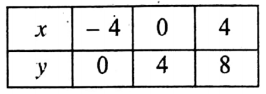
WBBSE Solutions For Class 9 Maths Algebra Chapter 1 Polynomials 1

WBBSE Solutions For Class 9 Maths Algebra Chapter 1 Polynomials 2

Practice Questions for Chapter 1 Polynomials

Clearly, we see from the above graph that, the graph of the linear polynomial f (x) = x + 4 is a straight-line PQ.

Similarly, we can show that the graph of any linear polynomial is a straight line.

If the linear polynomial is of the form of f (x)= mx, where m is a constant, or, of the form of y = mx (y = f (x)), then the straight line always passes through the origin.

Thus, the graph of ƒ (x) = 2x is a straight line passing through the origin (Draw the graph yourself).

Class 9 Maths Chapter 1 Solutions West Bengal

3. Quadratic Polynomials:

The polynomials of degree 2 are called quadratic polynomials. Such as

x²+1, 2x² −3x+2, y² + √2y + √7,…….. etc.

Standard form :

The standard form of quadratic polynomials is ax2+ bx + c, a 0, a, b, c are constants.

For examples x²+ 4x + 4, here a = 1, b = 4, c=4

2y²+ 3y+1, here a = 2, b = 3, c = 1.

3z² + 2 = 3z² + 0z + 2, here a= 3, b = 0, c = 2.

4. Cubic Polynomials:

The polynomials of degree 3 are called cubic polynomials. Such as

x³+1, x³ – 1, y³ + 3y² + 3y + 1, ……………etc.

Standard form:

The standard form of cubic polynomials is ax³ + bx² + cx+d, where a 0 and a, b, c, d are constants. 

For examples, x³ + x² + 2x + 1; here a = 1, b = 1, c = 2, d = 1.

y³ + 2y² – y + √2; here a = 1, b = 2, c=-1, d= √2

If a = 0 of any cubic polynomial, then it reduces to a quadratic polynomial.

WBBSE Class 9 Polynomials Solutions

5. Biquadratic Polynomials:

Polynomials having degree 4 are called biquadratic polynomials. Such as-

√2x² +1, x² +3x² +2, y4 + √7y³+ y + 1, ….. etc.

Standard form :

The standard form of biquadratic polynomials is ax4+ bx³  + cx² + dx + e, where a 0 and a, b, c, d, e are constants.

For examples,

x²  + x³ + 2x² + 3x + 1; here a = 1, b = 1, c = 2, d = 3, e = 1.

y4+2y³+3y-y+√2, here a = 1, b = 2, c = 3, d = –1, e = √2

If a = 0 of any biquadratic polynomial, then it reduces to a cubic polynomial.

6. n-Polynomials:

Polynomials of degree n are called n-polynomials. Such as \(x^n+1, y^n-1, u^n+u^{n-1}+1\) + 1,……… etc.

Standard form :

The standard form of n-polynomials is p (x) =\(a_n x^n+a_{n-1} x^{n-1}+a_{n-2} x^{n-2}+\cdots \cdots \cdots+a_1 x+a_0\), where \(a_n \neq 0, a_0, a_1, a_2, \cdots \cdots \cdots \cdots \cdots, a_{n-2}, a_{n-1}, a_n\), are constants and n is a whole number.

Zeros of Polynomials Explained

Zero Polynomials:

If p(x) = \(a_n x^n+a_{n-1} x^{n-1}+a_{n-2} x^{n-2}+\cdots \cdots \cdots+a_1 x+a_0=0\)

∴ \(a_0=a_1=a_2=\cdots \cdots \cdots \cdots \cdots=a_{n-1}=a_n=0\), then p (x) is called a zero polynomial.

It has already been noticed before that the degree of zero polynomials is undefined.

WBBSE Class 9 Polynomials Solutions

Properties of Polynomials :

1. The sum of two polynomials is a polynomial.

For example, let f (x) = x² + 1 and g (y) = y + √2 be any two polynomials.

Then f(x)+g (y) = x²+1+y+ √2 = x²+y+1+√2, which is also a polynomial.

2. The difference between two polynomials is a polynomial.

For examples, let f (x) = x² + 2x + 3 and g (x) = x² – x – 1.

∴ f(x) – g (x) = x²+2x+3-x²+x+1=3x+4, which is a polynomial.

g(x) − f(x) = x² – x – 1 – x² – 2x -3 = -3 x -4, which is also a polynomial.

3. The product of two polynomials is a polynomial.

For example, let f (x) = x + 1 and g (x) = x²+x+1.

∴ f(x) . g(x) = (x+1)(x² + x + 1) = x² + x² + x + x²+x+1

= x³ + 2x² + 2x +1, which is a polynomial.

4. The division between two polynomials may or may not be a polynomial. For example, let f(x) = x³ and g(x) = x.

Now, \(\frac{f(x)}{g(x)}=\frac{x^3}{x}=x^2\) = x² , which is a polynomial.

But, \(\frac{g(x)}{f(x)}=\frac{x}{x^3}=\frac{1}{x^2}=x^{-2}\) is not a polynomial, since here the index of x is (-2), which is not a whole number.

WBBSE Class 9 Polynomials Solutions Chapter 1 Polynomials Select The Correct Answer (MCQ)

Examples 1.

1. Which one of the following is not a polynomial?

  1. 0
  2. \(\frac{x+\frac{1}{x}}{\frac{1}{x}}\)
  3. – a (a = constant)
  4. √t, t = variable

Answer:

4. is correct since √t = t1/2 and \(\frac{1}{2}\)is not a whole number.

2. Which one of the following is a polynomial of degree 0?

  1. 0
  2. – k² (k = constant)
  3. x (x = variable)
  4. √2t,(t = variable)

Answer:

2. is correct, since – k²= – k.x0, i.e. the highest power of the variable is 0.

3. Which one of the following is a linear polynomial of one variable?

  1. √5x
  2. 2 – x – x²
  3.  x – y + xy
  4. xn+2 (n = constant)

Answer:Class 9 Maths Chapter 1 Polynomials WBBSE

1. is correct, since √5x is of one variable (x) and the highest power of x is 1 is a constant. 

∴ √5x is a linear polynomial of one variable.

Important Concepts in Polynomials for Class 9

4. The degree to which one of the following polynomials is undefined?

  1. 0
  2. – 1
  3. + 1 (= variable)
  4. kt (k = constant)

Answer:

1. is correct since 0 = 0. x0 = 0.x¹ = 0.x²……… etc, i..e., the highest power of the variable is not fixed or is not possible to determine.

∴ the degree of the polynomial 0 is undefined.

5. Which one of the following is a quadratic polynomial of one variable?

  1. x + y – xy
  2. x+1 (n= least natural number)
  3. a² (a = constant)
  4. 2t (variable)

Answer:

2. is correct, since n = 1 ( least natural number = 1), 

∴ \(x^{n+1}=x^{1+1}=x^2\) i.e., the degree of the polynomial x² is 2.

Remainder Theorem for Class 9

Class 9 Maths Chapter 1 Polynomials WBBSE

6. Which one of the following is a quadratic polynomial of two variables?

  1. x + y + xy
  2. x² + x + 1
  3. 2-y-y²
  4. ax² + bx + c (a + 0)

Answer:

1. is correct, since there are two variables x and y in this expression, and the power of

x + y =1+1 = 2.

7. The co-efficient of x2 of the polynomial &x 19 is

  1. 0
  2. 8
  3. 19
  4. None of these

Answer:

1. is correct, since there is no term containing.

∴ The co-efficient of x² is 0.

8. The co-efficient of x of the polynomial √11 – 3√11x + x² is

  1. no co-efficient
  2. 0
  3. √11
  4. None of these

Answer:

3. is correct, since, we know that x0 = 1.

∴ The term containing xo is a constant term, i..e, √11.

9. The binomials of one variable having degree 17 are

  1. x17+ y
  2. y17 + 1
  3. x17 +y17
  4. y – x17

Solution:

2. Is correct, since it is a polynomial of one variable (y) and the highest power of the variable is 17, i.e., the degree of the polynomial is 17.

10. x + \(\frac{5}{x}\) is

  1. A polynomial of one variable
  2. A linear polynomial of one variable
  3. A quadratic polynomial of one variable
  4. Not a polynomial

Solution:

2. Is correct, since \(x+\frac{5}{x}=x+5 x^{-1}\) and the power of x-1 is (-1), which is not a whole number.

Class 9 Maths Chapter 1 Polynomials WBBSE Polynomials Short Answer Type Questions (SAQ)

Question 1.

1. Find the degrees of the polynomials

1. 5t-√7

Solution:

The variable of the polynomial 5t-√7 is t, the highest power of which is 1.

∴ The degree of the polynomial is 1.

2. 3

Solution: 

3 is a constant term, i.c., the power of the variable (whatever it may be) is 0. (3 = 3. X0 or 3.y0 or ……… etc.)

∴ The degree of the polynomial is 0.

Understanding Polynomial Functions for Solutions

2. What are the coefficients of x² of the two given polynomials?

1. \(\frac{\pi}{2} x^2+x\)

Solution:

The term of the given polynomial containing 2 is \(\frac{\pi}{2} x^2\)

Hence, the coefficient is \(\frac{π}{2}\)

2. √2x-1

Solution:

There is no term containing x² in the given polynomial (√2x-1).

Hence, the co-efficient of x² is 0.

Factorization Techniques for Class 9 Polynomials

3. Given one example of a binomial of degree 35 and a monomial of degree 100 each. 

Solution:

A binomial of degree 35 is x35+1 and a monomial of degree 100 is y100

4. What do you mean by linear polynomials? Give an example.

Solution:

Linear Polynomials:-

The polynomials of degree 1, i.e., the polynomials in which the highest power of the variable (or variables) is 1, are called linear polynomials.

Example: (x + 1) is a linear polynomial.

Class 9 Maths Polynomials WBBSE Long Answer Type Questions

Question 1. Write which of the following algebraic expressions are polynomials and also state the degree of those which are polynomials :

1. 4x²-3x+√7

Solution:

4x²-3x+√7 is a polynomial since all the powers (2, 1, 0) of the variable x are whole numbers.

The degree of the polynomial is 2 since the highest power of the variable x is 2.

2. y²+ √2

Solution:

The algebraic expression (y²+√2) is a polynomial since all the indices (2, 0) of the variable y are whole numbers.

The degree of this polynomial is 2 since the highest power of the variable y is 2.

3. y³ – \(\frac{3}{4}\)y + √7

Solution:

(y³ – \(\frac{3}{4}\) y + √7) is a polynomial, since all the powers (3, 1, 0) of the variable y are whole numbers. The degree of this polynomial is 3 since the highest power of the variable y is 3.

4. \(\frac{1}{x}\) – x² + 2x + √3

Solution:

(\(\frac{1}{x}\) − x² +2x+ √3) is not a polynomial, since the power of the variable x of the term \(\frac{1}{x}\) = x (-)1 is (1), which is not a whole number.

5. 2x6– 4x5 +7×2 + 3

Solution:

(2x6 – 4x + 7x² +  3) is a polynomial, since all the powers (6, 5, 2, 0) of the variable x are whole numbers.

The degree of this polynomial is 6 since the highest power of the variable x is 6.

6. x² + 2x-1 + 4

Solution:

(x-2 + 2x-1 + 4) is not a polynomial, since the powers (-2 and – 1) of the variable x are not whole numbers.

7. \(\frac{1}{x}\) – x + 2

Solution:

(\(\frac{1}{x}\) – x + 2) is not a polynomial, since the power of the variable x of its term \(\frac{1}{x}\) = x (-)1 is (-1) which is not a whole number.

8. x15 – 1

Solution:

The algebraic expression (x15 – 1) is a polynomial since all the powers (15 and 0) of its variable x are whole numbers.

The degree of this polynomial is 15 since the highest of its variable x is 15.

9. 3√t + \(\frac{t}{27}\)

Solution:

(3√t + \(\frac{t}{27}\)) is not a polynomial, since the index of its variable r in the term \(\sqrt[3]{t}=t^{\frac{1}{3}} \text { is } \frac{1}{3}\) which is not a whole number.

10. \(\frac{1}{√2}\)x² – √2x+2

Solution:

The algebraic expression \(\left(\frac{1}{\sqrt{2}} x^2-\sqrt{2} x+2\right)\) is a polynomial, since all the powers (2, 1, 0) of its

variable x are whole numbers.

The degree of this polynomial is 2 since the highest power of its variable x is 2.

Sample Solutions from WBBSE Class 9 Maths Chapter 1

11. 0

Solution:

0 is a polynomial, since 0= 0. x0 = 0. x¹ = 0.x², i.e., O can be expressed as a co-efficient of any one of x0, x¹, x¹, …….etc, where the indices (0, 1, 2, ……. ) of the variable x all of which are whole numbers.

The degree of this polynomial is undefined since the highest power of the variable x is impossible to determine.

12. 15

Solution:

15 is a polynomial since 15 can be expressed as 15x0 (..x0 = 1), i.e., the index (0) of the variable x is 0, which is a whole number.

The degree of this polynomial is 0 since the highest power of its variable x is 0.

13. y³ + 4

Solution:

The algebraic expression (y³ + 4) is a polynomial since all the indices (3, 0) of its variable y are whole numbers.

The degree of this polynomial is 3 since the highest power of its variable y is 3.

14. z+ \(\frac{3}{z}\) +2

Solution:

⇒ \(\left(z+\frac{3}{z}+2\right)\) is not a polynomial, since the index of the variable z in the term is not a whole number.

⇒ \(\frac{3}{z}=3 z^{-1}\) is (- 1)

Question 4. Find the coefficients as per the directions given in the following polynomials:

1. The co-efficient of x² in the polynomial 2 + x + x². 

Solution:

The coefficient of x in the polynomial 2 + x + x² is 1, since x² = 1x². 

2. The co-efficient of x² in the polynomial 2 − x² + x3.

Solution:

The co-efficient of x² in the polynomial (2-x+x³) is (-1), − x² = (− 1). x².

3. The co-efficient of x in the polynomial x² −x + 2.

Solution:

The co-efficient of x in the polynomial x – x + 2 is (− 1), since – x = (− 1) · x. 

4. The co-efficient of x³ in the polynomial 5x³ – 13x² + 2.

Solution:

The co-efficient of x³ in the polynomial 5x³ – 13x²+ 2 is 5 since the term containing x³ is 5x³.

Question 5. 

1. Give two different examples of monomials of degree 4, having only one variable.

Solution:

Two different monomials of degree 4, having only one variable are 2x4 and y4.

2. Give two different examples of monomials of degree 3 having only one variable. 

Solution:

Two different monomials of degree 3, having only one variable are x³ and 2y³.

Question 6. 

1. Give an example of a binomial of degree 0.

Solution: 

A binomial of degree 0 is a + b, where both a and b are constant.

2. Give an example of a trinomial of degree 0.

Solution:

A trinomial of degree 0 is a + b + c, where a, b, and c are constants.

Question 7. Write which of the following polynomials are linear, quadratic, and cubic polynomials:

1. x² + x

Solution:

(x² + x) is a quadratic polynomial, since the highest power of its variable x is 2.

2. x – x³

Solution:

(x-x³) is a cubic polynomial, since the highest power of its variable is 3.

3. 2

Solution:

is a quadratic polynomial, since its highest index is 2.

4. y + y²+ 4 

Solution:

(y+ y²+ 4) is a quadratic polynomial, since the highest index of its variable is 2.

5. 3t

WBBSE Class 9 Maths Algebra Solutions

Solution:

3t is a linear polynomial since the highest power of its variable t is 1.

6. 7x³

Solution:

7x³ is a cubic polynomial since the highest power of its variable x is 3.

7. 1 + x

Solution:

(1 + x) is a linear polynomial, since the highest index of its variable x is 1.

8. x² + y² + a²

Solution:

(x²+ y²+ a²) is a quadratic polynomial, since the highest index of both the variables x and y of it is 2.

9. x + y + z

Solution:

(x+y+2) is a linear polynomial, since the highest power of both the variables x and y of it is 1.

10. x + y = xy

Solution:

(x + y = xy) is a quadratic polynomial, since the power of the term xy in it is (1 + 1) = 2, which is the highest among all others.

WBBSE Class 9 Maths Algebra Solutions

Question 8. Find the number of terms of each of the following binomials:

1. (1 + x)²

Solution:

The required number of terms = 2 + 1 = 3.

2. (2 + y)³

Solution:

The required number of terms = 3 + 1 = 4.

3. (1 + z)10

Solution:

The required number of terms = 10 + 1 = 11.

4. (a + x)100 

Solution:

The required number of terms = 100 + 1 = 101. 

5. \(\left(1+x^2\right)^q\)

Solution:

The required number of terms = q + 1.

6. (1+ y³)7

Solution:

The required number of terms = 7+ 1 = 8.

7. {(a – x) (a + x)}20

Solution:

Here, the given expression = {(ax) (a + x)}20 = (a² – x²)20

∴ The required number of terms = 20 + 1 = 21.

WBBSE Class 9 Maths Algebra Solutions

8. \(\left(\frac{x+2 x^2+x^3}{x}\right)^n\)

Solution:

Given expression \(\left(\frac{x+2 x^2+x^3}{x}\right)^n\)

= (1 + 2x + x2)n  = {(1 + x)2}n  = (1 + x)2n 

∴ The required number of terms = 2n + 1.

WBBSE Class 9 Maths Algebra Solutions Chapter 1 Polynomials Zero Polynomials

Let p (x) be a polynomial and p(x) = anxn+an-1 xn-1 + …………………. + a1x+a0,an ≠ 0 where n is a whole number and a0, a1, . . . . ,an are constants.

Now, on putting x = 0 in p (x), we get,

p(0) = an.1n +a0-10n-1 + ………………………..+a1.0 + a0 = a0

 Again, on putting x = 1 in p (x), we get,

p (1) =an.1n +an_l.1n1 + ……………………… +a1.1 + a0

= \(a_n+a_{n-1}+\cdots \cdots \cdots+a_1+a_0\)

= \(a_0+a_1+a_2+\cdots \cdots \cdots+a_{n-1}+a_n\)

In this way, by putting a real number instead of x in p (x), we get different values of p (x).

These values are called the value of the polynomial for that certain value of x.

Common Mistakes in Polynomial Problems

For example, let p (x) = x + 1 be a polynomial.

Now, At x = 0, p (x) = p (0) = 0 + 1 = 1.

At x = 1, p (x) = p (1) = 1 + 1 = 2.

At \(x=2, p(x)=p(2)=2+1=3

At x=a, p(x)=p(a)=a+1

At x=n, p(x)=p(n)=n+1\)

Again, let f (x) = 2x2 – 3x + 4.

f(0) = 2 – 02 – 3 – 0 + 4 = 4,

f(1) = 2-12 – 3 – 1 + 4 = 3,

f(2) = 2 – 22 – 3 – 2 + 4 = 6  etc.

Similarly, if g (t) = 4f4 – 3t3 + 2t2 + 4, then

g (0) = 4.04 – 3.03 + 2.02 + 4 = 4

g (1) = 4.14 – 3.13 + 2.12 + 4 = 7

g (2) = 4.24 – 3.23 + 2.22 + 4 = 52.……….etc.

WBBSE Class 9 Maths Algebra Solutions Zero of linear Polynomials:

The value of the variable in a linear polynomial for which the value of the polynomial is zero is called the zero of that linear polynomial.

For example, let p (x) = x + 8 be a linear polynomial, then p (- 8) = – 8 + 8 = 0,

∴ (- 8) is a zero of the polynomial.

Also, let a be another zero of p (x) = x + 8

P (a) = 0 => a + 8 = 0

=> a = – 8.

∴ There is one and only one zero of a linear polynomial.

Zero of constant Polynomials: 

Let p (x)= 10 be a constant polynomial.

We can write, p (x) = 10. xº, x ≠ 0, (∵ xº = 1),

∴ p (1) = 10. 1o = 10.1 = 10 ( ∵ 1º = 1),  p (2) = 0. 2º = 10.1 = 10 ( ∵ 2º = 1), ………………. etc.

So, for no real value of x, the value of p (x) = 10 is zero.

Similarly, it can be proved that the value of any constant polynomial is never zero for any real value of its variable (or variables).

∴ There are no zeros of the constant polynomials.

Zero of zero polynomials: 

Let p (x) = 0 be a zero polynomial.

We can write, p (x) = 0x°, x ≠ 0 ( ∵ x° = 1)

Clearly, p (0) = 0.

Also, p (1) = 0.1º = 0; p (2) = 0.2º = 0; p (3) = 0.3º = 0,……… etc.

∴ 0, 1, 2, 3 …….. etc are the zeros of the zero polynomial p (x) = 0.

i.e., for every real value of x, p (x) = 0.

∴ Each and every real number is a zero of the zero polynomials.

WBBSE Class 9 Maths Algebra Solutions – Determination of the zero of the polynomials: 

Let p (x) = x + 3 be a polynomial.

We want to determine the zero (or zeroes) of it.

So that p (x) = 0 ⇒ x + 3 = 0 ⇒ x = -3

∴ (-3) is a zero of the polynomial p (x) = x + 3.

Again, let p (x) = x² – 3x + 2

Now, p (x) = x² – 3x + 2 = 0 x² – 2x – x + 2=0

⇒ x (x-2) -1( x-2) = 0

⇒ x – 2 = 0 or, x = 2 and x (x – 2) (x – 1)= 0

1 = 0 or, x = 1.

∴ 1 and 2 are two zeroes of p (x) = x² – 3x + 2. 

Therefore, to determine the zeroes of any polynomial, we first assume the given algebraic expression equal to zero obtaining an algebraic equation thereby. 

Later on, solving that equation, we find the value (or values) of the variable of that polynomial given. 

The values thus obtained are the required zero (or zeroes).

WORKING RULE:

STEP-I: Put the given algebraic expression equal to zero.

STEP-II: Find the value (or values) of the variable (or variables) consisting of the polynomial. 

From the above discussions we can conclude that:

  1. There may or may not have a zero of a given polynomial.
  2. The zero of a zero polynomial is any real number.
  3. The zero of a zero polynomial is any real number.
  4. It is not necessarily true that the zero of a zero polynomial is always 0.
  5. 0 may be the zero of a polynomial.
  6. There may exist more than one zero of a polynomial.
  7. There is one and only one zero of a linear polynomial.

Class 9 Maths Chapter 1 Exercise Solutions WBBSE Algebra Chapter 1 Polynomials Multiple Choice Question and Answers

Examples 1. 

1. If p(x) \(\frac{x^2-64}{x-8}\) then p (8) =

1. 1
2. 0
3. 16
4. Undefined

Solution:

p\((\mathrm{x})=\frac{\mathrm{x}^2-64}{\mathrm{x}-8}=\frac{(\mathrm{x})^2-(8)^2}{\mathrm{x}-8}\)

= \(\frac{(\mathrm{x}+8)(\mathrm{x}-8)}{(\mathrm{x}-8)}\)

= \(\mathrm{x}+8\)

∴ \(\mathrm{p}(8)=8+8=16\)

2. If p (x) = x²+9x – 6, then p (0) =

  1.  – 6
  2. 0
  3. 1
  4. 4

Solution:

p (0) = 0² + 9.0 – 6

= 0 + 0 – 6

= -6.

p (0) = -6.

3. If f(x+1)= 2x² – 3x -1, then f(0) = 4.

1. – 1
2. – 2
3. 0
4. 4

Solution:

f (x + 1) = 2x² -3x-1

f(-1 + 1) = 2-(-1)² – 3.(-1) – 1

(putting x = – 1) 

or, f (0) = 2 + 31

or, f (0) = 4.

f (0) = 4

Concepts Related to Polynomial Degree and Coefficients for Class 9 Solutions

4. If f(x) = x when 0 < x < 1

= 2 – x when 1 ≤ x ≤2

= \(x-\frac{x^2}{2}\) when x², then f(1.5) =

1. 1.5
2. 0.5
3. 0.375
4. 1.

Solution:

When x = 15, 1 ≤ x ≤2

⇒ 1≤ 1.5 ≤ 2.

∴ if x = 1.5, then f(x) = 2 – x

f (1.5) = 2 – 1.5

= 0.5

5. If f (x) = \(\frac{1-x}{1+x}\) then f (\(\frac{1}{x}\))

1. \(\frac{1-x}{1+x}\)

2. \(\frac{x-1}{x+1}\)

3. \(\frac{1+x}{1-x}\)

4. \(\frac{x+1}{x-1}\)

Solution:

f(x) = \(\frac{1-x}{1+x}\)

∴ f(x) = \(f\left(\frac{1}{x}\right)=\frac{1-\frac{1}{x}}{1+\frac{1}{x}}=\frac{x-1}{x+1}\)

WBBSE Class 9 Maths Algebra Chapter 1 Solutions 

6. If f(x) = -6 + 10x – 7x², then ƒ(− 1) =

  1.  -3
  2. -6
  3. -23
  4. -9

Solution:

When f(-1) = -6 + 10 x (-1) – 7 x (-1)²

= – 6 – 10 – 7

= – 23.

ƒ(− 1) = – 23.

7. The zero of the polynomial p (x) = x² – 2x – 8 is

  1. – 2
  2. 1
  3. 0
  4. 1

Solution:

As per question, x² – 2x – 8 = 0

or, x² – 4x + 2x – 8 = 0

or, x (x-4) + 2(x-4) = 0 

or, (x-4) (x + 2) = 0.

∴ either x – 40 ⇒ x = 4

or, x + 2 = 0 ⇒ x = -2. 

∴ – 2 is a zero of p (x).

8. What is the zero of p (x) = 2x-3?

  1. \(– \frac{2}{3}\)
  2. \(– \frac{3}{2}\)
  3. \(\frac{2}{3}\)
  4. \(\frac{3}{2}\)

Solution:

As per question, 2x – 3 = 0 ⇒ 2x =3 ⇒ x = \(\frac{3}{2}\)

9. If p (x) =x+4, then the value of [p (x) + p (-x)] is

1. – 8
2. 8
3. 2x
4. -2x

Solution: 

Given p (x) = x + 4 = p(x) = x + 4

∴ [p(x) + p (-x)] = x + 4x + 4 = 8.

WBBSE Class 9 Algebra Revision Notes

10. The zero of the polynomial f (x) = ax + b (a + 0) is

  1. \(\frac{a}{b}\)
  2. \(\frac{b}{a}\)
  3. \(-\frac{a}{b}\)
  4. \(-\frac{b}{a}\)


Solution: 

As per question, ax + b = 0

⇒ ax = -b

x = \(– \frac{b}{a}\)

WBBSE Class 9 Maths Algebra Chapter 1 Solutions Polynomials Short Answer Type Questions

Question 1.

1. If (3x – 1)7 = \(a_7 x^7+a_6 x^6+a_5 x^5+\ldots+a_1 x+a_0\), then find the value of \(a_7+a_6+a_5+\ldots+a_0\)

Solution:

Given

If (3x – 1)7 = \(a_7 x^7+a_6 x^6+a_5 x^5+\ldots+a_1 x+a_0\)

Putting x = 1. in the given equation,

We get, (3.1 – 1)7 = \(a_7 \cdot 1^7+a_6 \cdot 1^6+a_5 \cdot 1^5+\ldots+a_1 \cdot 1+a_0\)

(3 – 1)7 = \(a_7+a_6+a_5+\ldots \ldots+a_1+a_0 or, 2^7=a_7+a_6+a_5+\ldots . . . .+a_1+a_0\)

or, 128 = \(a_7+a_6+a_5+\ldots \ldots+a_1+a_0\)

∴ \(a_7+a_6+a_5+\ldots \ldots \ldots+a_0=128\)

2. If p (x) = 4, then find p (x) + p (-x).

Solution:

p (x) = 4,

∴ p (x) = 4, p (x) + p (x) = 4 + 4

= 8.

p (x) + p (-x) = 8.

3. If f(y)= \(\frac{y+1}{y+2}\), then find ƒ(0) + f(-1).

Solution:

f(y) = \(\frac{y+1}{y+2}\)

∴ f(0) = \(\frac{0+1}{0+2}=\frac{1}{2}\)

and f(-1) = \(\frac{-1+1}{-1+2}=\frac{0}{1}\)

= 0.

ƒ(0) + f(-1) = 0.

4. If f(x) = \(\frac{2-x}{2+x}\) then determine f (x−1).

Solution: 

Given that f(x) = \(\frac{2-x}{2+x}\)

⇒ \(f\left(x^{-1}\right)=\frac{2-x^{-1}}{2+x^{-1}}=\frac{2-\frac{1}{x}}{2+\frac{1}{x}}=\frac{2 x-1}{2 x+1}\)

5. If f(x+2)=x² + 2x + 3, then find f (x + 4)

Solution:

Given that f(x + 2)= x² + 2x + 3.

Putting (x+2) instead of x in (1) we get,

f(x + 2 + 2) = (x + 2)² + 2 (x + 2) 3.

or, f(x+4)= x² + 4x + 4 + 2x + 4 + 3

= x² + 6x + 11

f(x+4) = x² + 6x + 11.

6. If f(\(\frac{1}{y}\) = \(\frac{2}{y}\) – \(\frac{1}{y^2}\) then find f(y).

solution:

Given that f(\(\frac{1}{y}\) = \(\frac{2}{y}\) – \(\frac{1}{y^2}\))………………………….(1)

Putting \(\frac{1}{y}\) instead of y in (1) we get, \(f\left(\frac{1}{\frac{1}{y}}\right)=\frac{2}{\frac{1}{y}}-\frac{1}{\left(\frac{1}{y}\right)^2}\)

= \(2 \times \frac{y}{1}-\frac{1}{\frac{1}{y^2}}\)

= \(2 y-y^2\)

f\(\left(1 \times \frac{y}{1}\right)=2 y-y^2\)

⇒ f(y)=\(2 y-y^2\)

WBBSE Class 9 Maths Algebra Chapter 1 Solutions 

Study Guide for Class 9 Algebra Polynomials Questions

7. Find the zero of the polynomial f (x) = x² – 3x + 2.

Solution:

f(x) = x² – 3x + 2 = 0

or, x²-x- x- 2x + 2 = 0.

or, x (x-1)-2(x-1)= 0

or, (x-1) (x-2)=0.

∴ Either x 10 x = 1;

or, x-2=0x = 2.

∴ The required zeroes are 1 and 2.

8. Determine the zeroes of, the polynomial p (x) = x² – 2x – 8. 

Solution:

p (x)=0 ⇒ x²-2x-8= 0 

or, x²-4x+2x-8=0 

or, x (x-4)+2 (x-4)= 0 

or, (x-4) (x+2)= 0.

∴ Either x – 4 = 0 ⇒ x = 4

or, x + 2 = 0

x = -2.

∴ The required zeroes are -2 and 4.

9. If f (x) = 0 when x is an integer

 = 2 when x is not an integer,

then find

1.  f(0)

Solution :

(a) 0 is an integer, 

∴ f(x) = 0 f (0) = 0. 

2. f (√2)

Solution:

√2 is not an integer,

∴ f(x)=2

f(√2)=2.

10. If f(x) = 2x + 3, then x is rational.

= x2 + 1, when x is irrational.

then find

1. f (0)

Solution:

0 is a rational number,

∴ f (x) = 2x + 3

⇒f (0) 2.0 + 3 = 0 + 3 = 3.

2. f (π).

Solution:

f (π) is an irrational number, 

∴ f(x) = x² + 1

f(π) = π² + 1.

WBBSE Class 9 Maths Algebra Chapter 1 Solutions – Polynomials Long Answer Type Questions


Question 1. If f (x) = ax + b and f(0) = 3, f(2)= 5, then find the value of a and b. 

Solution:

Given that f (x) = ax + b = f (0) = a0 + b = b.

Also, f (0) = 3. (Given) b= 3 [ b = f (0) = 3]

Again, f(2) = a.2 + b 

= 2a + b 

= 2a + 3 [ ∵ b = 3]

As per the question, f(2) = 5

2a +3 = 5

2a = 2 

⇒ a = 1.

∴ the required value: a = 1, b = 3.

Question 2. If f (x) = ax² + bx + c and ƒ (0) = 2, f(1) = 1, f(4) = 6, then find the values of a, b, and c. 

Solution:

Given that f(x) = + bx + c,

∴ f (0) = a.0²+ b.0 + c = c.

As per the question, f (0) = 2

c = 2  [ ƒ (0) = c]

Again, f (x) = ax² + bx + c, 

∴ f(1) = a.1² + b.1 + c = a+b+c.

As per question, f(1) = 1, a+b+c=1 

or, a+b+2= 1 ( c=2) or, a=-1-b…. (1) 

Also, f (x) = ax² + bx + c

f(4) = a4²+ b4 + c = 16a + 4b+c,

= 16 (-1 – b) + 4b+ 2 [a= -1 – b and c = 2]

= 16 – 16b + 4b+2= -12b – 14.

As per the question, f(4) = 6 

=> -12b – 14 = 6

or, -12b = 20

b = \(\frac{20}{-12}\)

= \(– \frac{5}{3}\)

Now, we get from (1), a = -1 –\(\frac{5}{3}\) = -1 + \(\frac{5}{3}\)

= 2/3.

∴ a = 2/3, b = \(– \frac{5}{3}\)

Question 3. If f(x) = \(\frac{a(x-b)}{a-b}+\frac{b(x-a)}{b-a}\), then prove that f(a) + f(b) = a+b.

Solution:

Given that \(\frac{a(x-b)}{a-b}+\frac{b(x-a)}{b-a}\)

∴ \(\mathrm{f}(\mathrm{a})=\frac{\mathrm{a}(\mathrm{a}-\mathrm{b})}{\mathrm{a}-\mathrm{b}}+\frac{\mathrm{b}(\mathrm{a}-\mathrm{a})}{\mathrm{b}-\mathrm{a}}\)

= \(\mathrm{a}+\frac{\mathrm{b} \cdot 0}{\mathrm{~b}-1}\)

= \(\mathrm{a}+0\)

= \(\mathrm{a}\)

f(b)=\(\frac{a(b-b)}{a-b}+\frac{b(b-a)}{b-a}\)

=\(\frac{a \cdot 0}{a-b}+b\)

=0+b

=b

∴ \(\mathrm{f}(\mathrm{a})+\mathrm{f}(\mathrm{b})=\mathrm{a}+\mathrm{b}\) Proved

Question 4. If f(x) = \(\frac{a x-b}{b x-a}\). then find the value of f(x).f(\(\frac{1}{x}\))

Solution:

Given that f(x) = \(\frac{a x-b}{b x-a}\)

∴ \(f\left(\frac{1}{x}\right)=\frac{a \cdot \frac{1}{x}-b}{b \cdot \frac{1}{x} a}\) [Putting \(\frac{1}{x}\) instead of x]

= \(\frac{\frac{a}{x}-b}{\frac{b}{x}-a}=\frac{\frac{a-b x}{x}}{\frac{b-a x}{x}}\)

= \(\frac{a-b x}{b-a x}\)

∴ \(f(x) \cdot f\left(\frac{1}{x}\right)=\frac{a x-b}{b x-a} \times \frac{a-b x}{b-a x}\)

= \(\frac{a x-b}{b x-a} \times \frac{-(b x-a)}{-(a x-b)}\)

=1

Question 5. If f (x) = x²- 5x + 6, then find f (x² + 2).

Solution:

Given that f(x) = x²- 5x + 6.

∴ f(x² + 2) = (x2 + 2)² – 5 (x²+2)+6 (Putting (x²+2) instead of x.) 

= (x²)² + 2x².2 + (2)² – 5x² – 10 +6

= x4 + 4x² + 4 – 5x²- 4 

= x4 – x²

:. f(x² + 2) = x4 – x².

Question 6. If f(x) =3x, then prove that f (x + 1) = 9f (x – 1).

Solution:

Given that f (x) = 3x,

:. f (x + 1) = 3x+1 = 3x .3…… (1)

and f (x-1)=3x-1

= 3x.3-1

= 3x \(\frac{1}{3}\)

∴ 9ƒ (x-1)=9 × 3x . \(\frac{1}{3}\) =3x .3…………….(2)

∴ from (1) and (2) we get, f (x + 1) = 9 f (x – 1). (Proved)

Question 7. If f (x) = x9 – 6x8– 2x7 + 12x6 + x4 – 7x³ + 6×2 + x – 3, then find the value of f (6). 

Solution:

Given that f= x9 – 6x8 – 2x7 + 12x+x+ – 7x³ + 6x² + x-3.

∴ f (6) = 69 – 6.68 – 2.67+ 12.6 + 64 – 7.6³ + 6.6² + 6-3

=69 -69 -2.67 +2.6.66 + 6.6³ -7.6³ +6³ +6³

=-2.67 +2.67 +7.6³ -7.6³ + 6-3

= 6 – 3 

= 3.

∴ the required value = 3.

Question 8. If f (x) = log3x and g (x) = x2, then prove that f (g (3)) = 2.

Solution: 

Given that g (x) = x², . 8 (3) = 3² = 9.

Again, given that f(x) = log3x, 

∴ f (9) = log39 = log3

2 log33 (by the formula of log)

= 2 x 1 (log33 = 1) = 2.

Now, f (g (3)) = f (9) [ ∵ g (3) = 9]

= 2 [ ∵ f (9)=2]

∴ f (g (3)) = 2. (Proved)


Algebra Chapter 1 Polynomials Identity And Equation


Identity:

Definition: If two mathematical statements are related by the sign ‘equal’ in such a way that for any real value of the variable (or variables) existing in it, the left-hand side and the right-hand side of the relation are always equal, then the relation is called an identity.

For example, we know that (x + y)²=x+2xy + y². Then this relation is an identity; since for any real value of the two variables x and y, the left-hand side and the right-hand side are equal. Let x = 1 and y = 2 be any two real values of x and y. Now,

L.H.S.= (x + y)²

= (1 + 2)²

= 3²

= 9 and

R.H.S.= x²+2xy + y²

= 1² + 2(-1)(-2) +2²

= 1 + 4 +4 

= 9.

∴ L.H.S.  = R.H.S.

Similarly, it can be shown that for any other real values of x and y, the relation is true. 

∴ (x + y)² = x² + 2xy + y² is an identity.

Mathematically, for any real value of x if p (x) = 0, then the relation p (x) = 0 is called an identity.

Equation Definition:

If two mathematical statements are related by the sign ‘equal’ in such a way that for a certain number of real values of the variable (or variables) existing in it, the left-hand side and the right-hand side of the relation are always equal then the relation is called an equation.

For example, let p (x) = x²-1 and p (x) = 0, ie, 1 = 0, then it is an equation. Since x = 2 and x= 3 are only the two certain real values of the variable for which the left-hand side and the right-hand side of this relation are equal.( 2² – 5 – 2 + 6= 0 and 3² – 5.3 + 6 =0).

For any other real value of x, the relation is not satisfied.

Mathematically, if for a certain number of real values of x, the relation p (x) = 0 is true, then p (x) = 0 is called an equation.


Algebra Chapter 1 Polynomials Roots of Polynomial


Definition:

The real value (or values) of the variable (or variables) existing in the equation of a polynomial for which the equation is satisfied is called a root of the equation.

For example, let p (x) = x²-1 and p (x) = 0, i..e., x² – 10 be an equation of a polynomial. 

Then we get, p (1) =  1² – 1= 0

Also p (-1) = (-1)²-1 = 0.

∴ 1 and – 1 are two real values of x for which the equation p (x) = 0 is satisfied.

∴ 1 and – 1 are the two roots of the equation p (x) = 0.

Division algorithm of Polynomials:

In the previous classes, you have done a lot of divisions of constant numbers, especially in the arithmetic section. Such as-
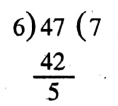
WBBSE Solutions For Class 9 Maths Algebra Chapter 1 Polynomials 1

Here, Dividend = 47

Divisor = 6

Quotient = 7 and 

Remainder = 5.

The formula regarding this division you have learned in arithmetic is Dividend = Divisor x Quotient + Remainder,

 i.e. 47 = 6 x 7 + 5.

This very formula of arithmetic is generally used as a Division algorithm in algebra.

In algebra, Dividend = f (x), where f (x) is a polynomial

 Divisor = g(x) where g (x) is a non-zero polynomial

Quotient = q(x), where q (x) is a polynomial and Remainder = r (x) where r (x) is also a polynomial of degree less than that of g (x).

∴ according to the Division algorithm, \(\underset{\text { (Dividend) }}{f(x)}=\underset{\text { (Divisor) }}{g(x)} \times \underset{\text { (Quotient) }}{q(x)}+\underset{\text { (Remainder) }}{r(x)}\)

Since f (x), g (x), q (x) and r (x) are all polynomials the followings are remembered seriously:

1. The degree of f (x) must be equal to or more than that of g (x), i.e., the degree of the dividend must be equal to or more than the degree of the divisor.

If it comes to any case that the degree of the dividend is less than the degree of the divisor, then the whole division algorithm changes to the form of indices and we shall discuss it in the next chapters.

In this chapter, we shall deal with those division algorithms, where the degree of the dividend is equal to or more than that of the divisor.

2. The degree of the divisor is always at least 1 degree higher than that of the remainder, i.e., if the degree of the remainder is 1, the degree of the divisor must be at least (1 + 1) = 2, if the degree of the remainder is 2, then that of the divisor must be at least (2 + 1) = 3, etc.

Therefore, the Degree of g (x) > Degree of q (x).

3. If (x) = 0, i.e., the remainder is a zero polynomial, then f (x) = g(x) × g (x).

In such cases, we say that the dividend (f(x)) is divisible by the divisor (g(x)) and g (x) and q (x) are both the factors of f (x).

Again, f(x) must be a multiple of both g (x) and q (x).

For example,
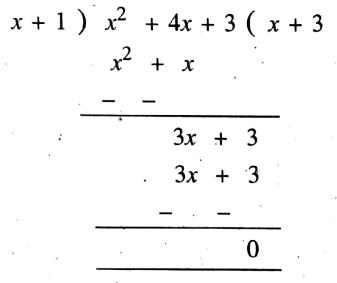
WBBSE Solutions For Class 9 Maths Algebra Chapter 1 Polynomials 3


In this division algorithm,

Dividend = x²+ 4x + 3 = f (x),

Divisor = x + 1 = g(x)

Quotient = x +3 and q (x),

Remainder = 0 = r (x).

Since (x) = 0, both the polynomials

g(x) = x + 1 and q (x) = x + 3 are factors of the polynomial f (x) = x² + 4x + 3. 

Therefore, the theorem related to the factors of a polynomial is as follows:

Theorem :

If f (x) is a polynomial of the variable x and if for any x = a, f (x) = 0, then (x – a) is a factor of f (x).

For example, let f (x) = x²- 7x + 10 be a polynomial of x.

Putting x = 2 in f (x) we get, f(2) = 2² -7 x 2+10

= 4 -14 + 10

= 0.

∴ (x -2) is a factor of f (x) = x² – 7x + 10, i.e., the polynomial x² – 7x + 10 is divisible by x-2. 

∴ we can say that the polynomial f (x) is divisible by (x – a) if f (a) = 0.

Conversely, if f (x) = 0, then the polynomial f (x) is divisible by x-a, i.e., (x – a) is a factor of f(x) or f (x) is a multiple of x-a.


Algebra Chapter 1 Polynomials Remainder theorem

Remainder Theorem

If f (x) is a polynomial of degree n (n ≥ 1) and a is any real number, then the remainder, when f(x) is divided by (x-a), is f(a).

Proof:

Let f (x) be a polynomial of degree n (n ≥ 1) and let f (x) is divided by (x-a), the unique quotient is q(x) and the unique remainder is r (x),

i..e, f (x) = (x − a) q (x) + r (x).

According to the division algorithm, the degree of r (x) is less than the degree of the division (x − a). 

Now, the degree of (x – a) = 1.

∴ the degree of r (x) = 0.

∴ (x) is a constant. 

Let r (x) = r.

:. f(x) = (x − a) q (x) + r…… (1)

Since (1) is an identity,

∴ for any real value of x, (1) must be satisfied.

Thus, for any real value a of x, the identity (1) must also be satisfied.

∴ f (a) = (a – a) q (a) + r or, f (a) = 0 + r or, f (a) = r

∴ r = f (a), i.e., the remainder = f (a). (Proved)


Algebra Chapter 1 Polynomials Select The Correct Answer (MCQ)


Question 1.

1. If P (x) = x+ax² + 6x + a be divided by (x + a), the remainder is-

1. 5a
2. – 5a
3. – a
4. a

Solution:

If P (x) = x² + ax² + 6x + a be divided by (x + a), then the remainder is

P(-a) = \((-a)^3+a \times(-a)^2+6(-a)+a\)

= \(-\not a^z+\not A^3-6 a+a\)

=-5 a

∴ The correct answer is 2. – 5a

2. If the polynomial P(x) = x² – 2x + a be divided by (x-3), the remainder is 0. Then a =

1. 0
2. – 1
3. – 3
4. 3

Solution:

If P(x) =  x² – 2x + a is divided by (x-3), the remainder is

P (3) = (3)² – 2 x 3 + a

=9-6+ a

= a + 3

According to question, a + 3 = 0 

a = -3

∴ The correct answer is 3. – 3

3. If f (x) = x² + ax – 2a² + 1, g(x) = x – a, q(x) = x + 2a and f (x) = g(x). q(x) + r (x) then

1. 1
2. 0
3. a
4. -2a

Solution:

f(x) = g(x) . q(x) + r(x)

⇒ \(x^2+a x-2 a^2+1=(x-a)(x+2 a)+r(x)\)

⇒ \(x^2+a x-2 a^2+1=x^2+2 a x-a x-2 a^2+r(x)\)

⇒ \(x^2+a x-2 a^2+1-x^2-2 a x+a x+2 a^2=r(x)\)

r(x)=1

∴ The required answer is 1. 1


Algebra Chapter 1 Polynomials Short Answer Type Questions


Question 1. Using the remainder theorem, find the remainder when x³-3x² + 2x + 5 is divided by

1. x² and 

Solution:

x + 2 =0

⇒ x= -2.

∴ The required remainder = (-2)³ – 3 (-2)² + 2 (-2) + 5

= – 8 – 12 – 4 + 5

= -19.

The required remainder = -19.

2. 2x + 1.

Solution:

2x + 1 = 0

2x – 1

x = \(– \frac{1}{2}\)

∴ The required remainder \(\left(-\frac{1}{2}\right)^3-3\left(-\frac{1}{2}\right)^2+2\left(-\frac{1}{2}\right)+5\)

= \(-\frac{1}{8}-\frac{3}{4}-1+5\)

= \(\frac{25}{8}\)

= \(3 \frac{1}{8}\)

Question 2. Using the remainder theorem determines the remainders when the following polynomials are divided by (x-1)

1. x³ – 3x² + 4x + 50

Solution:

x-1 = 0 ⇒ x = 1.

The required remainder = 1³ – 3.1² + 4.1 + 50

= 1 – 3 + 4+ 50

= 52

The required remainder = 52

2. 11x³ – 12x² – x + 7

Solution:

The required remainder = 11.1³ – 12.1² – 1 + 7

= 11 – 12 + 6

= 5.

The required remainder = 5.

Question 3. Find the remainder using the remainder theorem, when 

1. (x³-6x² + 9x – 8) is divided by x-3.

Solution:

x – 3 = 0

x = 3.

∴ The required remainder = 3³ – 6.3² + 9.3 – 8

= 27 – 54 + 27 – 8

= -8

The required remainder = -8

2. (x³ – ax² + 2x – a) is divided by x-a.

Solution:

x – a = 0

⇒ x = a.

The required remainder = a³ – a.a² + 2a – a 

= a³ – a³ + 2a – a 

= a.

The required remainder = a.

Question 4. Using the remainder theorem, examine whether (2x + 1) is a multiple of the polynomial p (x) = 4x³ + 4×2 – x – 1 or not.

Solution:

2x + 1 = 0

2x  = -1

⇒ x = \(– \frac{1}{2}\)

Now, \(p\left(-\frac{1}{2}\right)=4 \times\left(-\frac{1}{2}\right)^3+4 \times\left(-\frac{1}{2}\right)^2-\left(-\frac{1}{2}\right)-1\)

= \(4 \times-\frac{1}{8}+4 \times \frac{1}{4}+\frac{1}{2}-1\)

=0

∴ p (x) is a multiple of (2x + 1).

Question 5. Find the value of an if the remainders, when both the polynomials (ax + 3x² – 3) and (2x³- 5x + a) are divided by (x-4), are the same.

Solution: 

x – 4 = 0

⇒ x= 4.

So, when (a³ + 3x² -3) is divided by (x-4),

the remainder = a.4³ + 3.4² – 3

= 64a + 48 – 3

= 64a + 45.

Again, when (2x³ – 5x + a) is divided by (x-4).

the remainder = 2.4³ – 5.4 + a

= 128 – 20 + a

= a + 108

As per question, 64a + 45 = a + 108 

or, 63a = 63 

or, a = 1.

The required value of a = 1.

Practice Questions for Class 9 Polynomials

Question 6. If the polynomials x³ + 2x²-px-7 and x³+ px² – 12x + 6 be divided by (x + 1) and (x-2) respectively, the remainders are r1 and r2 and if 2r1 + r2 = 6, then find the value of p.

Solution: 

x+1 = 0

⇒ x = -1.

∴ \(\mathrm{r}_1=(-1)^3+2 \times(-1)^2-\mathrm{p} \times(-1)-7\)

= \(-1+2+\mathrm{p}-7\)

= \(\mathrm{p}-6\)

Again, \(x-2=0 \Rightarrow x=2\).

∴ \(r_2=(2)^3+p \cdot(2)^2-12 \times 2+6\)

=8+4 p-24+6

=4 p-10

As per the question, \(2 r_1+r_2=6\)

⇒ \(2(\mathrm{p}-6)+4 \mathrm{p}-10\)

=6

⇒ \(2 \mathrm{p}-12+4 \mathrm{p}-10=6\)

⇒ \(6 \mathrm{p}=28\)

⇒ \(\mathrm{p}=\frac{14}{3}\)

⇒ \(\mathrm{p}=4 \frac{2}{3}\)

The required value of p = 4\(\frac{2}{3}\)

Question 7. Find the remainder when

1. (x³ + 3x³ + 3x + 1) is divided by (x + π)

Solution:

Given (x³ + 3x³ + 3x + 1):-

x +π = 0

⇒ x = -π.

The required remainder = (-π)³ + 3 (- π)² + 3 (− π) + 1

= – π³ + зπ² – зπ + 1.

The required remainder = – π³ + зπ² – зπ + 1.

2. (x³ – ax² + 6x – a) is divided by (x-a)

Solution:

Given (x³ – ax² + 6x – a)

x – a = 0

x = a.

The required remainder = a³ – a.a² + 6·a – a 

= a³ – a³ + 6a – a

= 5a.

The required remainder = 5a.

Question 8. Prove that (3x³+ 7x) is not a multiple of (7 + 3x).

Solution: 

Given Polynomial (3x³+ 7x)

7+ 3x = 0

3x = – 7

⇒ x = \(– \frac{7}{3}\)

Now, \(3 x^3+7 x=3 \times\left(-\frac{7}{3}\right)^3+7 \times-\frac{7}{3}\)

= \(-\frac{343}{9}-\frac{49}{3}\)

= \(-\frac{490}{9}\)

= \(-54 \frac{4}{9}\)

3x³ + 7 x ≠ 0,

∴ (3x³ + 7x) is not a multiple of (7 + 3x). (Proved).

Question 9. The polynomial (px² + qx + r) is divisible by (x² – 1) and if x = 0, the value of the polynomial is 2. Determine the values of p, q, and r.

Solutions:

Given Polynomial (px² + qx + r):-

x² – 1 = 0

or, x² = 1

or, x = ± 1.

By the first condition given,

p.1²+q.1+r=0 

or, p + q + r = 0……. (1)

and p.(-1)²+q.(-1) + r = 0 

or, p – q + r = 0……..(2)

 By the second condition given,

p.0²+q.0+ r = 2

or, r = 2.

∴ From (1) we get, p+q=2, and from (2) we get

p – q = -2

∴ p = -2, q = 0 and r = 2.

Question 10. If the polynomial (x+4x²+4x-3) is divided by x, what should be the remainder? 

Solution : 

Given Polynomial (x+4x²+4x-3)

x can be written as (x = 0).

∴ x = 0

∴ The required remainder = 0³ + 4.0² + 4.0 – 3

= -3.

∴ The Reminder Is -3


Algebra Chapter 1 Polynomials Long Answer Type Questions


Question 1. Identify the identities and the equations among the following statements

1. x² – (a + b) x + ab = 0

Solutions: 

x² – (a + b) x + ab = 0 

or, x² – ax – bx+ ab = 0.

or, x (x – a) b (x – a) = 0 

or, (x − a) (x – b) = 0.

∴ either x – a = 0⇒x= a 

or, x-b=0

⇒ x = b.

The given statement is satisfied for only two values of x = a and x = b of x and is not satisfied for any other real value of x.

. The given statement is an equation.

2. (x+y) (x – y) = x² – y²

Solution:

Given statement is (x + y) (x − y) = x² – y².

Let x = 2 and y= 1.

∴ L.H.S. = (2 + 1) (2 – 1) 

= 3.1 

= 3.

R.H.S. = (2)² – (1)²

= 4 – 1

= 3.

L.H.S. = R.H.S, i.e, the statement is true for x = 2 and y = 1.

Again, let x = 4, y = 2.

∴ L.H.S.. = (4 + 2) (4 – 2) 

= 6 x 2 

= 12.

R.H.S. = (4)² – (2)²

= 16 – 4

= 12.

∴ L.H..S. = R.H.S., i.e, the statement is true for x = 4 and y = 2.

Similarly, let x = m, y = n (m, n ∈ N);

∴ L.H.S. = (m + n) (m – n)

= m² + mn – mn – n²

= m² – n².

R.H.S.= m² – n²

L.H.S. = R.H.S., i.e. the statement is for x = m and y = n, where m, n ∈ N.

Thus, it can be shown that for any real value of x and y, the given statement is true.

∴ The given statement is an identity.

3. x² – (2a + \(\frac{1}{a}\)) x + 2 = 0

Solution:

x² – (2a + \(\frac{1}{a}\)) x + 2 = 0

or, x² – 2ax – \(\frac{1}{a}\) + 2 = 0.

∴ either x – 2a = 0 

x = 2a,

or, x – \(\frac{1}{a}\) = 0

x = \(\frac{1}{a}\)

the statement is true for only two values of x.

∴ The given statement is an equation.

4. ab = \(\left(\frac{a+b}{2}\right)^2-\left(\frac{a-b}{2}\right)^2\)

Solution:

The given statement is ab = \(\left(\frac{a+b}{2}\right)^2-\left(\frac{a-b}{2}\right)^2\)

Let a 1 and b = 1,

∴ L.H.S. ab 1 x 1 = 1 and R. H.S.= \(\left(\frac{1+1}{2}\right)^2-\left(\frac{1-1}{2}\right)^2\) = 12 – 0

= 1.

∴ L.H.S. R.H.S., i.e., the statement is true for a = 1, b = 1.

Again, Let a = m and b = n.

∴ L.H.S. m x n = mn and R.H.S.

= \(\left(\frac{\mathrm{m}+\mathrm{n}}{2}\right)^2-\left(\frac{\mathrm{m}-\mathrm{n}}{2}\right)^2=\frac{(\mathrm{m}+\mathrm{n})^2}{4}-\frac{(\mathrm{m}-\mathrm{n})^2}{4}\)

= \(\frac{\mathrm{m}^2+2 \mathrm{mn}+\mathrm{n}^2-\mathrm{m}^2+2 \mathrm{mn}-\mathrm{n}^2}{4}\)

= \(\frac{4 \mathrm{mn}}{4}\)

= \(\mathrm{mn}\)

∴ L.H.S. R.H.S., i.e. the statement is true for a = m and b = n.

In a similar way, it can be shown that for any real value of a and b, the given statement is true. 

The given statement is an identity.

Question 2. Find the roots of each of the following equations of polynomials

1. p(x) = 2x + √11

Solutions: 

p(x) = 0 = 2x+√11 = 0

⇒ 2x = -√11

⇒ x = \(– \frac{√11}{2}\)

∴ The required root = \(– \frac{√11}{2}\)

2. p (x, y) = x² + y² – 2x + 1

Solution:

p (x, y) = x²+ y²-2x+1 = 0

x²-2x+1+ y² = 0

(x – 1)² + y² = 0 both (x – 1² = 0 and y² = 0

⇒ x – 1 = 0

⇒ x = 1

∴ The required roots are x = 1 and y = 0.

3. p (x) = ax² + bx + c, a 0 and a, b, c are constants.

Solution:

p(x) = 0

ax² + bx + c = 0

x² + \(\frac{b}{a}\) x + \(\frac{c}{a}\) = 0 [Dividing by a]

⇒ \((x)^2+2 \cdot x \cdot \frac{b}{2 a}+\left(\frac{b}{2 a}\right)^2=\left(\frac{b}{2 a}\right)^2-\frac{c}{a} \Rightarrow\left(x+\frac{b}{2 a}\right)^2=\frac{b^2}{4 a^2}-\frac{c}{a}\)

⇒ \(\left(x+\frac{b}{2 a}\right)^2=\frac{b^2-4 a c}{4 a^2} \Rightarrow x+\frac{b}{2 a}= \pm \sqrt{\frac{b^2-4 a c}{4 a^2}}\)

⇒ \(x=-\frac{b}{2 a} \pm \frac{\sqrt{b^2-4 a c}}{2 a} \doteq \frac{-b \pm \sqrt{b^2-4 a c}}{2 a}\)

∴ The required roots are = \(\frac{-b \pm \sqrt{b^2-4 a c}}{2 a}\)

4. p(x) = x² – \(\frac{2}{p}\) (p²+1)x+4

Solution:

p(x) =0 \(\Rightarrow \mathrm{x}^2-\frac{2}{\mathrm{p}}\left(\mathrm{p}^2+1\right) \mathrm{x}+4=0\)

⇒ \(\mathrm{x}^2-2 \mathrm{px}-\frac{2 \mathrm{x}}{\mathrm{p}}+4=0\)

⇒ \(\mathrm{x}(\mathrm{x}-2 \mathrm{p})-\frac{2}{\mathrm{p}}(\mathrm{x}-2 \mathrm{p})=0\)

⇒ \((\mathrm{x}-2 \mathrm{p})\left(\mathrm{x}-\frac{2}{\mathrm{p}}\right)=0\)

∴ either x-2p=0

⇒ \(\mathrm{x}=2 \mathrm{p}\)

or, \(\mathrm{x}-\frac{2}{\mathrm{p}}=0\)

⇒ \(\mathrm{x}=\frac{2}{\mathrm{p}}\)

∴ The required roots are 2p and \(\frac{2}{p}\).

Question 3. 

1. Find the root of the equation of the linear polynomial f (x) = 2x + 3.

Solutions:

2x + 3 = 0

or, 2x = 3

or, x = \(– \frac{3}{2}\)

∴ The required root = \(– \frac{3}{2}\)

2. Show that if one of the roots of the equation of the quadratic polynomial x² – 6ax – 91 = 0 is 7; then the other root is (-13).

Solutions:

One root of x² – 6ax – 91 = 0 is 7

∴ 7² – 6a7 – 91 = 0 

or, 49 – 42a = 91 

or, 42a = – 42 

or, a = \( – \frac{42}{42}\)

∴ the given equation is x² – 6 (-1). x-91 = 0.

or, x² + 6x – 91 = 0.

Now, x²+ 6x-91 = 0

x² + 13x-7x-91 = 0

⇒ x(x + 13) -7(x + 13) = 0

(x+13) (x-7)=0

∴ Either x + 13 = 0 

x = -13, 

or, x-7 = 0

⇒ x = 7.

∴ The other root = – 13. (Proved)

Alternative Method:

Let the other root = β

We know that the product of the roots, where the equation is ax² + bx + c = 0.

Here, a = 1 and c = – 91.

∴ 7β = \(– \frac{91}{1}\)

β = -13

The other root = -13.

Question 4. If the polynomial x4 – 2x³ + 3x² – a – ax + b is divided by (x 1) and (x + 1), the respective remainders are 5 and 19. Determine the remainder when the polynomial is divided by (x + 2).

Solution:

Given

If the polynomial x4 – 2x³ + 3x² – a – ax + b is divided by (x 1) and (x + 1), the respective remainders are 5 and 19.

x+1 = 0

⇒ x = 1.

By the first condition given, 14 – 2.1³ + 3.1² – a.1 + b = 5

or, 1 – 2 + 3 – a+b= 5

or, b = a + 3……….(1).

Again, x + 1 = 0 or, x = -1.

By the second condition given,

(-1)4 – 2(-1)³ + 3 x (1)² – a x (-1) + b = 19

or, 1 + 2 + 3 + a + b = 19 

or, a + b = 13

or, a + a + 3 = 13 [from (1)]

or, 2a = 10

or, a = 5

∴ From (1) we get, b = 5 + 3 = 8 ( a = 5 )

Now, x + 2 = 0

or, x = -2.

By the third condition given,

∴ The required number = (-2)4 – 2(-2) + 3(-2)² – a (-2) + b

= 16+ 16 + 12 + 2a + b

= 44 + 2 x 5+ 8

= 52 + 10

= 62.

The required number = 62.

Question 5. The polynomial (x³+ px² -x+ q) is divisible by (x² – 1) and when it is divided by (x²), the remainder is 15. Find the values of p and q.

Solution:

Given

The polynomial (x³+ px² -x+ q) is divisible by (x² – 1) and when it is divided by (x²), the remainder is 15.

x² – 1 = 0

or, x² = 1

or, x = ± 1.

Again, x – 2 = 0 

or, x = 2.

By the first condition given, 1³+ p.1² – 1 + q = 0

or, 1 + p – 1 + q = 0 

or, q = – p.

Again, (1)³ + p.(-1)² – (-1) + q=0

or, 1+p+ 1+ q = 0

or, q = -p

∴ q = -p……….. (1)

By the second condition given, 2³ + p.2² – 2 + q = 15

or, 8+ 4p²+q= 15

 or, 4p – p = 15 – 8 +2 [by (1)]

or, 3p = 9 

or, p = 3.

From (1) we get, q=3.

∴ p = 3 and q = -3.

Class 9 Maths Chapter 1 Polynomials WBBSE  – Polynomials Factor Theorem

Factor theorem :

If p (x) is a polynomial of degree n (n ≥ 1) and a be any real number, then

1. (x – a) is a factor of p (x) when p (a) = 0

2. p (a) = 0 when (x – a) is a factor of p (x)

Proof :

According to the remainder theorem, if p (x) is divided by (x-a), then a polynomial q (x) is obtained such that 

p (x) = (x – a) q (x) + p (a) …………………… (1)

1. When p (a) = 0, from (1) we get, p (x) = (x – a) q(x) + 0

or, p (x) = (x – a) q (x)

(x – a) is a factor of p (x). (Proved)

2. When (x – a) is a factor of p (x), p (x) = (x – a) q(x) ……. (2)

where q(x) is obtained on dividing the polynomial p (x) by (x-a).

Now putting x – a = 0 or, x = a in (2) we get,

p (a) = (a – a) q (a) 

or, p (a) = 0 x q (a) 

or, p (a) = 0.

p (a) 0. (Proved)

From the factor theorem, we get the following corollaries:

1. (x+a) is a factor of p (x) if p (-a) = 0.

2. (ax + b) are the factors of p (x) if p \(\left(\mp \frac{b}{a}\right)\) = 0.

In the following examples, you should know much more about the applications of the factor theorem.


Class 9 Maths Chapter 1 Polynomials WBBSE Select The Correct Answer (MCQ):

Question 1. 

1. If for the polynomial f(x), f(1/2)=0, then one of the factors of f (x) is —

1. x – 1

2. x + 1

3. 2x-1

4. 2x + 1

Solution:

f(1/2) = 0

∴ x = 1/2

or, 2x = 1 

or, 2x – 1 = 0

i.e., (2x-1) is a factor of f (x).

2. If the polynomial p (x) = x+6x² + 4x + k is divisible by (x + 2), then k =

1. – 6

2. – 7

3. – 8

4. – 9

Solution: 

As per the question, (x+2) is a factor of p (x).

∴ p (-2) = 0 ( ∵ x+2 = 0 ⇒ x =-2) 

or, (-2)³ + 6 x (-2)² + 4 x (2) + k = 0 

or, -8 + 24 + 8 + k = 0 

or, k = − 8.

3. If (x – 1) is a factor of the polynomial f (x), but not a factor of the polynomial g (x), then (x 1) is a factor of which one of the following?

1. f (x) – g(x)
2. f (x) + g(x)
3. f (x) g (x)
4. (f(x)+ g(x)) g (x)

Solution:

Again, (x-1) is not a factor of g(x), ∴ g(1) ≠ 0.

Now, f(1)-g(1)=0-g(1) ≠ 0[because g(1) ≠0]

∴ (x-1) is not a factor of {f(x)-g(x)}.

f(1)+g(1)=0+g(1)=g(1) ≠ 0[because g(1) ≠ 0]

∴ (x-1) is not a factor of {f(x)+g(x)}.

f(1) x g(1)=0 x g(1)=0[because g(1) ≠ 0]

∴ (x-1) is a factor of f(x) g(x).

Also {f(1)+g(1)} g(1)={0+g(1)} g(1)={g(1)}² ≠ 0

∴ (x-1) is not a factor of {f(x)+g(x)} g(x).

4. If (n² – 1) is one of the factors of the polynomial f(n) = an4 + bn³ + cn² + dn+e, then

1. a + c + e = b + d.
2. a + b + e = c + d
3. a + b + c = d + e
4. b + c + d = a + e

Solution:

n² – 1 = 0

⇒ n = ± 1.

As per the question, f (1) = 0 and f (-1) = 0.

Now, f(1) = 0 a.14 + b.13 + c.1² + d.1 + e = 0 

or, a + b + c + d + e = 0. 

Also, f (-1) = 0 a.(− 1)² + b.(− 1)³ + c.(− 1)² + d.(− 1) + e = 0.

⇒ a – b + c – d + e = 0

⇒ a + c + e = b + d.

1. a + c + e = b + d. is the correct answer.

5. (x + 1) will be a factor of the polynomial p (x) = x + 1, when

1. n is a positive integer
2. n is a negative integer
3. n is an even positive integer
4. n is an odd positive integer

Solution:

(x + 1) is a factor of p (x) = xn + 1

∴ p(- 1) = 0 ( ∵ x + 1 = 0 ⇒ x = 1)

or, (- 1)n + 1 = 0 ……… (1)

Now, if n be an even positive integer, let n = 2m, where m is any natural number.

∴ from (1) we get, (- 1)2m+ 1 = 0 

or, ((-1)2)m + 1 = 0 

or, 1m + 1 = 0

or, 1+1=0( m is any natural number) 

or, 2 = 0, which is clearly impossible.

∴ n is not an even positive number.

Now, if n is an odd positive integer, let n = 2m+ 1, where m is any natural number.

∴ from (1) we get, (- 1)2m+1 + 1 = 0

or, (- 1)2m x (-1) + 1 = 0         

or, (-1)2m x (-1)+ 1 = 0 

or, 1 x (-1) + 10 [∵ m is any natural number]

or, 1 + 1 = 0 [∵ 1 x -1 = -1]

or, 0 = 0, which is possible.

∴ If n is an odd positive integer, then p (− 1) = 0.

4. n is an odd positive integer is a correct answer.

6. If x be a factor of the polynomial p (x) = (x -1) (x + 2) (x + 3), then p (0) =

1. 2

2. 3

3. 4

4. 6

Solution:

p (0) = (0 – 1) (0 + 2) (0 – 3) 6. 

4. 6 is correct.

7. If (x + 1) be a factor of the polynomial p (x) = x²+k, then k =

1. -1

2. 0

3. 1

4. 2

Solution: p(- 1) = 0 [ …. x + 1=0 or, x = – 1 ]

or, (- 1)3 + k = 0

or, – 1 + k = 0

or, k = 1.

3. 1 is correct.

8. If one of the factors of the polynomial p (a) = a4 + x2 – 20 be (x2 + 5), then the other factor is

1. x2 + 4
2. x2 – 4
3. x2 – 1
4. x2 – 5

Solution:

Let the other factor = x2+ a.

(x2 + 5) (x2 + a) = x4 + x2 – 20

or, x4 + 5x2 + ax2 + 5a = x4 + x2 – 20

or, x4 + (5 + a)x2 + 5a = x4 + x2 – 20, which is an identity.

5a = – 20      [Equating the constant terms]

or, a = – 4

∴ The required factor = x2 – 4.

Alternative Method:

x4 + x2 – 20 = x4 + 5x2 – 4x2 – 20

= x2 (x2 + 5) – 4 (x2 + 5)

= (x2 + 5) (x2 – 4).

∴ The required factor = x2 – 4.

9. If f(x) = kx2-3x + k and g (x) = x – 1 be two polynomials, then g (x) will be a factor of f(x) when k=

  1. \(\frac{2}{3}\)
  2. \(\frac{3}{2}\)
  3. \(– \frac{3}{2}\)
  4. \(– \frac{2}{3}\)

Solution:

g(x) will be a factor of f (x) when /(1) = 0 [ ∵ g (x) = 0 x – 1 = 0 or, x = 1]

or, k.12 – 3.1 + k = 0

or, k – 3 + k = 0

or, 2k = 3

or, k = \(\frac{3}{2}\)

10 . Which one of the following is a factor of the polynomial p(x) =4x³+ 4x²- x – 1?

1. 2x – 1
2. x
3. x + 1
4. 2x + 1.

Solution:

2x – 1 = 0

x = \(\frac{1}{2}\)

∴ \(p\left(\frac{1}{2}\right)=4 \times\left(\frac{1}{2}\right)^3+4 \times\left(\frac{1}{2}\right)^2-\frac{1}{2}-1=\frac{1}{2}+1-\frac{1}{2}-1=0\)

∴ (2x – 1 )is a factor of p(x),

i,e., 1. 2x – 1 is the correct.


Algebra Chapter 1 Polynomials Short Answer Type Questions


Question 1.

1. If (x – 1) be a factor of (4x2 – kx + 1), find the value of k.

Solution :

Given That (x – 1) Is The  Factor Of The Polynomial (4x2 – kx + 1)

x – 1 = 0

=> x= 1.

As per question, 4.12 – k. 1 + 1 = 0 or, 4 – k + 1 = 0

or, k = 5

The Value Of k Is 5.

2. Determine whether n is an odd or even positive integer, when (a + 1) is a factor of (xn – 1).

Solution:

Given That (a + 1) Is A Factor Of (xn – 1)

x+1=0=>x = -1.

Now, putting x = – 1 in xn – 1 we get,

(-1)n – 1 = (- 1)2m – 1 when n is an even positive integer, let n = 2m, m ∈ N.

{(-1)²}m – 1 = 1m – l = 1 – I = 0,

∴ n is an even positive integer.

3. If (x + a) is one of the factors of the polynomial x3 + ax2 – 2x + a – 12, then find the value of a.

Solution:

Given Polynomial x3 + ax2 – 2x + a – 12

x + a = 0

x = -a

x3 + ax2 – 2x + a – 12 = (- a)3 + a x (- a)2 – 2 x (- a) + a – 12

= – a3 + a3 + 2a + a – 12 = 0

= 3a – 12 = 0

As per question, 3a – 12 = 0

or, 3a = 12

or, a = 4.

∴ The Value Of a is 4

4. If (x- 3) be a factor of the polynomial (k2x3 – kx2 + 3kx – k), then find the value of k

Solution:

x-3 = 0=>x=3

Now, k2x3 – kx2 + 3kx – k = k2.33 – k32 + 3k³ – k – k (27 k – 1).

As per the question, k (27 k – 1) = 0

∴ Either k = 0

or, 27k -1=0

or, k = \(\frac{1}{27}\)

k = 0 or \(\frac{1}{27}\)


Algebra Chapter 1 Polynomials Long Answer Type Questions


Question 1. Determine for which cases of the following the polynomial g (x) will be a factor of f(x).

1. When f(x) = 3x3 + x2 – 20x + 12 and g (x) = 3x – 2,

 Solution:

g (x) = 0 => 3x 2 = 0 => 3x = 2 =>x = \(\frac{2}{3}\)

∴ \(\mathrm{f}\left(\frac{2}{3}\right)=3 \cdot\left(\frac{2}{3}\right)^3+\left(\frac{2}{3}\right)^2-20 \times \frac{2}{3}+12\)

= \(\frac{8}{9}+\frac{4}{9}-\frac{40}{3}+12\)

= \(\frac{8+4-120+108}{9}\)

= \(\frac{0}{9}\)

=0

∴ g(x) is factor of f(x)

2. When f(x) = x4 – x2 – 12 and g (x) = x + 2.

Solution:

g(x) = 0

=> x+2 = 0

=> x = -2.

f (- 2) = (- 2)4 – (- 2)² – 12

= 16 – 4 – 12

= 0.

∴ g (x) is a factor of f (x).

Question 2. Find the value of k if the polynomial p (x) = 2x4 + 3x3 + 2kx2 + 3x + 6 is divisible by (x + 2).

Solution :

If p(x) is divisible by (x + 2), then p (- 2) = 0 [ ∵ x + 2 = 0 => x = – 2]

2.(-2)4 + 3.(- 2)3 + 2k.(- 2)2 + 3.(- 2) + 6 = 0

or, 2 x 16 + 3 x (-8) + 2k x 4-6 + 6 = 0

or, 32 – 24 + 8k = 0

or, &k = – 8

or, k = -1

The value of k = -1

Question 3. Determine the values of a and b if x2 – 4 is a factor of the polynomial ox4 + 2x3 – 3x2 + bx – 4.

Solution:

x2-4 = 0

=>x2 = 4

=>x = ±2.

As per question, a.(2)4 + 2.(2)3 – 3.(2)2 + b.2-4 = 0

or, 16a + 16 – 12 + 2b – 4 = 0

or, 16a + 2b = 0 or, 8a + b = 0 or, b = – 8a ……..(1)

Again, a.(- 2)4 + 2.(- 2)3 – 3.(- 2)2 + b.(- 2) – 4 = 0

or, 16a – 16 – 12 – 2b – 4 = 0

or, 16a – 2b = 32

or, 16a – 2 x (- 8a) = 32 [from (1)]

or, 16a + 16a = 32.

or, 32a = 32

or, a = 1.

From (1) we get. b = – 8 x 1 = – 8.

∴ The required values are a = 1, and b = – 8.

Question 4. If n is any positive integer (even or Odd), prove that (x – y) is a factor of the polynomial xn – yn.

Solution :

Let p (a) = xn – yn and g (x) = x – y

Then, if p (x) is divided by g (a), we get a polynomial q (x) as the quotient and the remainder R, which is independent of a such that

p {x) = g (x) q (x) + R or, xn – yn = (x – y) q (x) + R ……………………………..(1)

Since (1) is an identity, it is true for all real values of x ( …. R is independent of x).

On putting x – y = 0 or, x = y in (1), we get, yn – yn = (y – y) q (x) + R or, yn – yn = 0 x q (x) + R or, 0 = 0 + R

[ ∵ n is a positive integer (odd or even), ∴ yn – yn– = 0],

or, R = 0,

∴ f (x) = g (x) x q (x) or, xn – yn = (xn  – yn) q (x).

(x – y) is a factor of xn – yn (Proved).

Alternative Method:

x – y = 0

x = y

Now, x– y n = y– y n= 0 [∵ n is a positive integer (odd or even)]

∴ (x – y) is a factor of x– y n.(proved)

Question 5. Prove that (x – y) can never be a factor of the polynomial x + y, where n is any positive integer (odd or even).

Solution:

Let f (x) = xn + yn and g (x) = x – y. 

If f (x) is divided by g (x) we get a polynomial q(x) as the quotient and the remainder R, which is independent of x, such that xn + yn = (x – y)q (x) + R…….. (1)

Now, (1) is an identity.

So it is true for all values of x [∵ R is independent of x]

∴ On putting x – y = 0 or, x = y in (1) we get,

Yn + yn (y- y) q (x) + R 

or, 2yn= 0x q(x) + R [∵ n is a positive integer (odd or even)] 

or, R = 2yn ≠ 0

(x – y) is never a factor of xn + yn (Proved)

Alternative Method:

x – y = 0

⇒ x = y

∴ xn + yn = yn + yn = 2yn [ ∵ n is a positive integer (odd or even)]

∴ x n+ yn  ≠ 0

∴ (x-y) can never be a factor of xn + yn (Proved)

Question 6. If (x + 1) and (x + 2) be any two factors of the polynomial (x³ + 3x² + 2ax + b), then determine the value of a and b.

Solution: 

x + 1 = 0 or, x = = – 1.

∴ x³ + 3x² + 2ax + b = (-1)² + 3.(-1)² + 2a.(-1) + b

= – 1 + 3 – 2a + b = 2a + b + 2 …….(2)

As per question, 2a + b + 20 or, b = 2a – 2.

Again, x+20 ⇒ x=-2.

x² + 3x² + 2ax + b = (-2)+ 3 x (-2)²+ 2a x (-2)+b

= – 8 + 12 – 4a + b 

= – 4a + b + 4.

As per question, – 4a + b + 4 = 0

or, – 4a + 2a – 2 +4 = 0 [by (1)]

Or, – 2a + 2 = 0 

or, 2a = -2

or, a = 1

∴ From (1) we get, b = 2 x 12

= 2 – 2

= 0.

The required values are a = 1 and b = 0.

Question 7. Determine the values of a and b when the polynomial (ax + bx² + x 6) is divided by (x – 2), the remainder is 4, and (x+2) is a factor of the polynomial.

Solution:

x-2=0

⇒ x= 2.

As per question, a.2³ + b.2² +26= 4

or, 8a+ 4b = 8

or, 2a + b = 2

or, b = 2-2a …..(1)

Again, x+2 = 0 or, x = – 2

As per question, a.(-2)³ + b.(-2)² + (-2)-6 = 0 

or, 2a + b.2 = 0 [Dividing by 4] 

or, 2a + 2a = 0

or, 4a= 0 

or, a = 0.

∴ The required values are a = 0 and b = 2 – 2(0)

= 2.

Question 8. Find the relation between p and r if (x – \(\frac{1}{2}\) be two factors of the polynomial px² + 5x + r.

Solution:

To Find The Relation Between p And r

Given Polynomial px² + 5x + r

x – 2 = 0

⇒ x = 2.

∴ \(p .2^2+5.2+r=0 \text { or, } 4 p+10+r=0 \text { or, } 4 p+r=10 \cdots \text { (1) }\)

Again, \(x-\frac{1}{2}=0 \Rightarrow x=\frac{1}{2}\)

∴ \(p \cdot\left(\frac{1}{2}\right)^2+5 \cdot \frac{1}{2}+r=0 \text { or, } \frac{p}{4}+\frac{5}{2}+r=0 \text { or, } p+10+4 r=0\)

or, \(p+4 r=-10 \ldots \cdots \cdots \text { (2) }\)

from (1) and (2) we, get 4 p+r=p+4 r.

or, 3 p=3 r or, p=r, ∴ The required relation is p=r.

Question 9. If (x + b) is a common factor of both the polynomials (x² + px + q) and (x² + lx + m), then prove that b = \(\frac{q-m}{p-l}\)

Solution:

Given Two Polynomial (x² + px + q) and (x² + lx + m) 

And Given That The Common Factor x+b

x+b=0

⇒ x = – b.

(-b)² + p. (-b) + q = 0 

or, b² – pb + q = 0…………(1)

Again, b² + 1 (-b) + m = 0 or, b² – 1b + m = 0……(2) 

Subtracting (2) from (1) we get, b (1 – p) + q – m=0

or, b = \(\frac{m-q}{l-p}\) = \(\frac{q-m}{p-l}\)(Proved)

Question 10. Find the condition for which the polynomial x³+(a + b) x + p is divisible by (x + a + b).

Solution: 

Given Polynomial x³+(a + b) x + p

x+a+b = 0

⇒x = – b.

As per question, (-a – b)3 + (a + b) (-a – b) + p = 0

or, – (a + b)³ – (a + b)² + p = 0 

or, p = (a + b)³ + (a + b)²

or, p = (a + b)² + (a + b + 1), which is the required condition.

Question 11. If both the polynomials x41 +a and x41+ b be divisible by (x + 1) prove that a + b = 2.

Solution:

Given Polynomial x41 +a and x41+ b

x+1 = 0

⇒ x = -1.

n = 0.

Now, (x + 1) is a factor of x41 + a

(-1)41 + a = 0

or, 1+ a = 0 

or, a = 1.

Again, (x + 1) is a factor of x41+ b.

(-1)41+ b = 01+b=0 

or, b = 1.

a + b= 1 + 1 

= 2. (Proved)

Question 12. If the polynomial (xn + 1) is divisible by both (x + a) and (x + b), then prove that

Solution:

Given Polynomial  (xn + 1):-

(xn+ 1) is divisible by (x + a).

(a)n + 10          [∵ x+a = 0 ⇒ x = -a]

or, (-a)n = 1…….…. (1)

Again, (xn+1) is divisible by (x + b).

∴ (b)n + 1 = 0     [∵ x+b=0 x = b]

or, (-b)n= -1……….(2)

From (1) and (2) we get,

(-a)n = (-b)n or, \(\frac{(-a)^n}{(-b)^n}=1\)

Or, \(\left(\frac{-a}{-b}\right)^n=1 \text { or, }\left(\frac{a}{b}\right)^n=\left(\frac{a}{b}\right)^0\left[∵\left(\frac{a}{b}\right)^0=1\right]\)

or, n = 0,

∴ n = 0. (Proved)



WBBSE Solutions For Class 9 Maths Arithmetic Chapter 2 Profit And Loss

WBBSE Solutions For Class 9 Maths Arithmetic Chapter 2 Profit And Loss

Arithmetic Chapter 2 What is Cost Price?

Cost Price:-

  1. The price at which an article is bought is called the cost price of that article.
  2. For example, let you have bought a pen for ₹ 10.
  3. Then the selling price of the pen is ₹ 10.
  4. Or let, you have bought a book for ₹ 60, then the cost price of the book is ₹ 60.
  5. We generally calculate profit and loss on the basis of cost price in any business.
  6. Sometimes, there are some goods, which are manufactured or produced in the factories, such as soaps, toothpaste, toothbrush, etc.
  7. In these cases, there are no-cost prices of the goods, but we consider their production costs.
  8. The article is called its production cost.
  9. So, the cost is required to produce For example, if the cost to produce a soap is ₹ 12, then the production cost of the soap is ₹ 12.
  10. In these cases, the profit and loss are usually calculated on the basis of production cost.
  11. Moreover, when an article is bought, then it is obvious that someone sells it.
  12. So, the cost price of an article may be the selling price in some other context, i.e. to any person which is the cost price, to another person it is the selling price.
  13. So, in any mathematical problem, we should be very careful that just which price has been described as the cost price.
  14. But, in general, the price at which an article is bought is called its cost price.

Read and Learn More WBBSE Solutions For Class 9 Maths

WBBSE Class 9 Maths Chapter 2 Solutions What is Selling Price

WBBSE Class 9 Profit and Loss Overview

Selling Price

  1. The price at which an article is sold is called its selling price ($.P.).
  2. For example, let you have sold a clock to Surjya at ₹ 250.
  3. So, the selling price of the clock is ₹ 250.
  4. Or, if you have sold a radio to Ananya at ₹ 400, then the selling price of the radio is ₹ 400.
  5. Now, the selling price of an article may or may not be more than its cost price.
  6. For, let the pen you have bought for ₹ 10, has sold to Ganesh at ₹ 12.
  7. Then, here the selling price is more than the cost price.
  8. When you will sell the pen to Ganesh at ₹ 8, the selling price will be less than the cost price. 

To solve any mathematical problem regarding profit and loss, you should have to keep a keen sight of the following:

  1. What is the cost price and which is the selling price? Because, if these two prices are known, then it is easy to solve any problem regarding profit and loss.
  2. If these two prices are not given directly, then try to find them by any other mathematical process. 
  3. It is impossible to calculate profit or loss if the cost price of an article and the selling price of another article are given.
  4. So it is clear that the selling price of that article, which has been just bought, should be found out.1. For example, what is the percentage of profit or loss, when Bananas are bought at the rate of 6 per ₹ 1 and sold at the rate of 5 per ₹ 1? Here, the number of Bananas is 6 when it is bought, but the number is 5 when it is sold. So, it is difficult to calculate the profit or loss.2. So, if the number of Bananas is 6 when it is bought, the number of Bananas must be 6 when it is sold.3. That is, the number of Bananas both bought and sold must be the same.

WBBSE Solutions For Class 9 Maths Arithmetic Chapter 2 Profit And Loss

WBBSE Class 9 Maths Chapter 2 Solutions – What Is Profit

Basic Formulas for Profit and Loss

Profit:-

You have already heard that the selling price of an article may or may not be more than its cost price, i.e., Cost price < Selling price or Cost price > Selling price.

If the selling price is more than the cost price (Selling price > Cost price), then we say that profit has been generated, and to what extent the selling price is more than the cost price is called the profit. Therefore, if the selling price of an article is more than its cost price, then the difference between the two prices is called a Profit or Gain.

Mathematically, Profit = (S.P.) – (C.P.)……..(1)
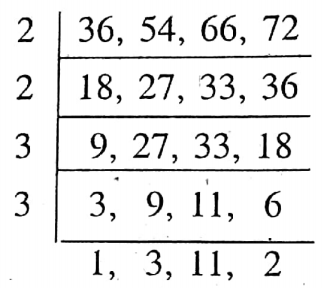
For example, let you have bought 1 kg of sugar for 40 and have sold it at ₹ 45.

Then, the profit = (₹ 45 – ₹ 40)

= ₹ 5.

Corollary:

From the formula (1), we get

(1) C.P. = S.P. – Profit…….[1. (1)]

(2) S.P. = C.P. + Profit……..[1. (2)]

For example, Sarmistha gains ₹ 20 by selling a shirt for ₹ 120.

Here, S.P. = ₹ 120 and Gain = ₹ 20.

Hence, by the formula [1 (1)],

the C.P. of the article = S.P. – Gain (₹ 120 – ₹ 20) = ₹ 100

Again let, Gargi sells a soap with a gain of 2 by buying it at ₹ 50.

Here, C.P. = ₹ 50 and Gain = ₹ 2.

∴ By the formula 1 (2), the S.P. of the soap

= C.P. + Gain = (₹ 50 + ₹ 2) = ₹ 52.

NEET Biology Class 9 Question And Answers WBBSE Class 9 History Notes WBBSE Solutions for Class 9 Life Science and Environment
WBBSE Class 9 Geography And Environment Notes WBBSE Class 9 History Multiple Choice Questions WBBSE Class 9 Life Science Long Answer Questions
WBBSE Solutions for Class 9 Geography And Environment WBBSE Class 9 History Long Answer Questions WBBSE Class 9 Life Science Multiple Choice Questions
WBBSE Class 9 Geography And Environment Multiple Choice Questions WBBSE Class 9 History Short Answer Questions WBBSE Solutions For Class 9 Maths
WBBSE Solutions for Class 9 History WBBSE Class 9 History Very Short Answer Questions

WBBSE Class 9 Maths Chapter 2 Solutions – What is Loss

Loss:-

You know that the selling price of an article may or may not be less than its cost price.

If the selling price is less than its cost price, then we say that a Loss has been generated.

Therefore, if the selling price of an article is less than its cost price, then the difference between the two prices is called a Loss.

Mathematically, Loss = (C.P.) – (S.P.) ……. (2)

For example, let Moetreyee buys 14 pencils for 40 and sells all of them, at ₹ 36.

Here, C.P. =  ₹ 40 and S.P. = ₹ 36.

∴ Loss (C.P.) – (S.P.)

= (₹ 40 – ₹ 36)

 = ₹ 4.

Corollary:

From the formula (2), we get

(1) C.P. =  S.P. + Loss……[2. (1)]

(2) S.P. = C.P. – Loss……[2. (2)]

For example, let Arunima sells a packet of tea with a loss of 8 by buying it for 68.

Here, C.P. = ₹ 68 and Loss =₹ 8.

∴ By the formula [2. (2)],

S.P. C.P. Loss (₹ 68 – ₹ 8) = ₹ 60.

Again let, Debdulal lose ₹ 7 by selling a C.D. at ₹ 25.

Here, S.P = ₹ 25 and Loss = ₹ 7.

∴ By the formula 2. (1), C.P. = S.P. + Loss = (₹ 25 + ₹ 7) = ₹ 32.

Arithmetic Chapter 2 Rate of Profit and Loss

Calculating Profit Percentage Examples

After buying and selling an article, we have to calculate usually two rates

1. Rate of Profit:

It is a vital question that exactly what the rate of profit is.

Because there are different types of rates.

Such as, rate w.r.t. 10, rate w.r.t. 100, rate w.r.t. 1000, ….. etc.

In this book, we are clearly interested in the rate w.r.t. 100, i.e., we want to find the percentage of profit or the profit percent.

Now, the percentage of Profit or the Profit percent means the units of Profit generated by 100 units of the article concern.

Thus, the percentage of Profit = a % means that a unit of Profit has been generated by 100 units of the article.

Similarly, it means that a is the profit when the C.P. is 100, or, a kg is the profit when the total amount of the article is 100 kg.

Therefore,

1. Percentage of Profit on C.P. = \(\frac{\text { Total Profit }}{\text { C.P. }} \times 100 \%\) …………………(3)

2. Percentage of Profit on S.P. = \(\frac{\text { Total Profit }}{\text { S.P. }} \times 100 \%\) ………………(4)

If the total profit is not given, only the C.P. and S.P. are given, then

2. Percentage of Profit on C.P. =  \(\frac{\text { S.P.-C.P. }}{\text { C.P. }} \times 100 \%\) ……………..(5)

3. Percentage of Profit on S.P. =  \(\frac{\text { S.P.-C.P. }}{\text { C.P. }} \times 100 \%\)……………..(6)

Corollary:

1. C.P. =  \(\frac{\text { Total Profit }}{\text { Percentage of Profit }} \times 100 \%\) ………….. [3. (1)]

For example, Gitadevi gains 40 by selling a clock at a profit of 10%, find the C.P. of the clock.

Here, Total Profit = 40 and Percentage of Profit = 10%.

∴ By 3. (1) we get,

C.P. =  \(\frac{\text { Total Profit }}{\text { Percentage of Profit }} \times 100 \%\)

= \(\frac{₹ 40}{10 \%} \times 100 \%\)

= (40) x 10

= 400 

2. S.P. = \(\frac{\text { Total Profit }}{\text { Percentage of Profit }} \times 100 \%\) ……………[4.(1)]

For Example,

For example, Sankarbabu gains ₹ 24 by selling a radio at a profit of 4% on S.P. What is the S.P. of the radio?

Here, percentage of Profit = 4% and Total Profit = ₹ 24

∴ By 4. (1), we get, S.P. = \(\frac{\text { Total Profit }}{\text { Percentage of Profit }} \times 100 \%\)

= \(\frac{₹ 24}{4 \%} \times 100 \%\)

= (₹ 24) x 25 

= ₹ 600.

3. C.P. =  \(\) ……………[5(1)]

For example, Santidevi sold a blanket at ₹ 440 at a profit of 10%. What is the C.P. of the blanket? Here, S.P. ₹ 440 and Percentage of Profit = 10%

∴ By 5. (1) we get, C.P.=  \(\frac{\text { S.P. }}{\text { Percentage of Profit }+100 \%} \times 100 \%\)

=  \(\frac{₹ 440}{10 \%+100 \%} \times 100 \%\)

=  \(\frac{₹ 440}{110 \%} \times 100 \%\)

= \(₹ \frac{440 \times 10}{11}\)

= ₹ 400.

Class 9 Maths Profit and Loss WBBSE

4. S.P.= \(\frac{\text { C.P. }}{100 \%-\text { Percentage of Profit }} \times 100 \%\)…………………[6(1)]

For example, Shyambabu sold a bicycle to Pabanbabu by buying it for ₹ 980 and gained 2% on S.P. What was the S.P. of the bicycle?

Here, C.P. = 980 and Percentage of Profit 

= 2% (on S.P.)

∴ by 6. (1) we get, S.P. = \(\frac{\text { C.P. }}{100 \%-\text { Percentage of Profit }} \times 100 \%\)

= \(\frac{₹ 980}{100 \%-2 \%} \times 100 \%\)

= \(\frac{₹ 980}{98 \%} \times 100 \%\)

= ₹ (10 x 100) 

= ₹ 1000.

2. Rate of Loss:

Rate of Loss means out of what units, how many units have been lost.

If the unit in the given problem is then the term Percentage of Loss means that out of 100, how many?

have been lost When the unit is kg, then it means that out of 100 kg, how many kg have been lost Thus, Total Loss C.P. Total Loss S.P.

1. Percentage of Loss on C.P.= \(\frac{\text { Total Loss }}{\text { C.P. }} \times 100 \%\)………………..(7)

2. Percentage of Loss on S.P.= \(\frac{\text { Total Loss }}{\text { S.P. }} \times 100 \%\)…………..(8)

If the total loss is not given, only the C.P. and S.P. are given, then

3. Percentage of Loss on C.P.= \(\frac{(\text { C.P. })-(\text { S.P. })}{\text { C.P. }} \times 100 \%\) ……………….(9)

4. Percentage of Loss on S.P. = \(\frac{(\text { C.P. })-(\text { S.P. })}{\text { S.P. }} \times 100 \%\) …..…………..(10)

Class 9 Maths Profit and Loss WBBSE

Corollary:

1. C.P. = \(\frac{\text { Total Loss }}{\text { Percentage of Loss }} \times 100 \%\) ………..[7(1)]

For example, Prasantababu sold a T.V. with a loss of 200 at a loss of 10%. What is the C.P. of the T.V.?

Here, the total loss = 200 and the percentage of loss = 10%

∴ By 7 (1) we get, C.P.= \(\frac{\text { Total Loss }}{\text { Percentage of Loss }} \times 100 \%\)

= \(\frac{₹ 200}{10 \%} \times 100 \%\)

= ₹ 2000.

2. S.P.= \(\frac{\text { Total Loss }}{\text { Percentage of Loss }} \times 100 \%\) ……….[8(1)]

For example, Swapanbabu sold a goat with a total loss of 225 at a loss of 15% on S.P.

Find the S.P. of the goat.

Here, the percentage of loss is 15%, and the Total loss = ₹ 225.

∴ by 8 (1) we get, S.P.= \(\frac{\text { Total Loss }}{\text { Percentage of Loss }} \times 100 \%\)

= \(\frac{₹ 225}{15 \%} \times 100 \%\)

= ₹ 1500.

3. C.P.= \(\frac{\text { S.P. }}{100 \% \text {-Percentage of loss }} \times 100 \%\) ……………..[9(1)]

For example, Ranjan Kumar sold an article at 2400 at a loss of 20% on S.P. What is the C.P. of the article?

Here, S.P. 2400 and Percentage of loss = 20% on S.P.

∴ by 9 (1) we get, C.P.= \(\frac{\text { S.P. }}{100 \% \text {-Percentage of loss }} \times 100 \%\)

= \(\frac{₹ 2400}{100 \%-20 \%} \times 100 \%\)

= \(\frac{₹ 2400}{80 \%} \times 100 \%\)

= ₹ 3000.

Class 9 Maths Profit and Loss WBBSE

4. S.P.= \(\frac{\text { C.P. }}{\text { Percentage of loss }+100 \%} \times 100 \%\) ………..[10(1)]

For example, Bimanbabu bought a book for 1000 and sold it to his colleague. 

This causes him a loss of 25% on S.P. What is the S.P. of the book?

Here C.P. = ₹ 1000 and Percentage of loss = 25%

. by 10 (1) we get, S.P. = \(\frac{\text { C.P. }}{\text { Percentage of loss }+100 \%} \times 100 \%\)

= \(\frac{₹ 1000}{25 \%+100 \%} \times 100 \%\)

= \(\frac{₹ 1000}{125\%} \times 100 \%\)

=₹ 800

Class 9 Maths Chapter 2 Profit and Loss WBBSE –  What is meant by the market price

Market Price:-

The price which is marked on an article is called the Marked Price (M.P.) or List price of that article.

For example, let the price of a book has been typed 75.

Then the marked price (M.P.) or the list- the price of the book is 75.

Class 9 Maths Chapter 2 Profit and Loss WBBSE – Discount

Discount:-

A seller may or may not sell his article at the marked price or list price. If he sells his article at a price less than the marked price, then the less price at which the article is sold is called the discount.

Therefore, the less price or the deduction price from the marked price, at which any article is sold to the customers, is called the discount.

For example, Mantubabu sells a book of marked price ₹120 at ₹100. 

Then the discount = ₹ (120-100)

= ₹ 20.

∴ Discount = (M.P.) – (S.P.)………….(11)

Corollary: 

M.P. = S.P. + Discount …….. [11. (1)]

S.P.  = M.P. – Discount ……….. [11. (2)]

For examples.

Calculating Loss Percentage with Examples

1. Anjanbabu sells a book at ₹ 105 with a discount of ₹ 35. 

What is the M.P. of the book?

 Here S.P. ₹105 and Discount = ₹35.

∴ M.P. of the book = S.P. + Discount [by 11. (1)] 

= ₹ 105 + ₹ 35 

= ₹140.

Class 9 Maths Chapter 2 Exercise Solutions WBBSE

2. Udaynarayan Chowdhury allows a discount of ₹ 800 while selling a blanket of marked price ₹ 8400. 

What is the S.P. of the blanket?

Here M.P. ₹ 8400 and Discount = ₹ 800.

∴ S.P. of the blanket = (M.P.) – Discount [by 11. (2)]

= ₹ 8400 

= ₹ 800

= ₹ 7600.

Generally, the discounts are given in the form of percentages, such as 2% discount, 10% discount, 25% discount,…… etc.

In these cases, the percentage of discount = \(\frac{\text { Total discount }}{\text { M.P. }} \times 100 \%\) ……….(12)

and Total discount = M.P. x Percentage of discount………(13)

If the total discount is not given, only the M.P. and the S.P. are given, then

Percentage of discount = \(\frac{(\text { M.P. })-(\text { S.P. })}{\text { M.P. }} \times 100 \%\) ………(14).

and S.P. =  M.P. – Total discount

= (M.P.) – (M.P. x Percentage of discount) ………..(15)

Sometimes, discounts are allowed for two or more two times.

 These discounts can easily be calculated successively.

 Also, these discounts can be reduced to a single discount. 

This single discount is called the equivalent discount.

Class 9 Maths Chapter 2 Exercise Solutions WBBSE

Therefore, the discount which is generated by the deduction of two or more successive discounts to a single or unit discount is called the equivalent discount of that successive discount.

Let a salesman sell an article allowing three successive discounts of 10% each. 

Then what will be the equivalent discounts of these three successive discounts?

To find the E.D. (Equivalent Discount),

Let the M.P. = ₹ 100

∴ The first discount = 100 x 10% 

= \(₹ 100 \times \frac{10}{100}\)

= 10.

∴ Second discount = (100-10) × 10% 

= \(₹ 90 \times \frac{10}{100}\)

= ₹ 9

∴ Third discount ₹ (90 – 9) x 10%

= \(₹ 81 \times \frac{10}{100}\)

= ₹ 8.10.

∴ The total discount =  ₹(10 + 9 + 8.10)

= ₹ 27.10

Since, the M.P. = ∴ 100,

∴ The E.D = 27.1%

General formula

1. If the two successive discounts be .x% and y%, 

then the E.D.= \(\left(x+y-\frac{x y}{100}\right) \%\)………….…… [16. (1)]

2. If the three successive discounts be x%, y%, and 2%, then the

E.D. = \(\left(x+y+z-\frac{x y+y z+z x}{100}+\frac{x y z}{10000}\right) \%\) ………………..[16. (2)]

For example, a shopkeeper allowed three successive discounts of 10%, 15%, and 25% to sell an almirah. What will be the E.D.?

Here, x = 10, y = 15 and z = 25.

∴ by 16. (2) we get E.D.=\(\left(10+15+25-\frac{10 \times 15+15 \times 25+25 \times 10}{100}-\frac{10 \times 15 \times 25}{10000}\right) \%\)

= (50-7.75%+ 0.375)%

=  42.625%.

WBBSE Class 9 Maths Chapter 2 Solutions Calculation of Profit and Loss with the help of graph:

We can easily draw a graph on the graph paper by taking the C.P. of an article as the x-axis and the S.P. of the article as the y-axis.

Since the C.P. of an article is directly proportional to the S.P., the graph will be a straight line.

We can know much information about the business including the C.P. and the S.P. of the article in this graph.

Observe the following example :

Calcutta Book House, a well-known and reputed publishing company, launched a Math book for class IX in 2015. The production cost of the book is 200. The company has decided that by allowing a discount of 10% he will earn a profit of 10% per book.

Draw a graph of the information given above and answer the following questions from the graph:

1. What is the relation between the production cost and the S.P.?

2. If the production cost is reduced by 10%, what would be the S.P. of the book?

3. If the S.P. of the book be

4. If the S.P. of each book be

300, then what would be the production cost of it?

270, then what M.P. will have to be fixed up for each book? Here, it is to be earned a profit of 10% per book on the production cost.

So, the S.P.of each book = ₹ (200 + 200 x 10%)

= \(₹\left(200+200 \times \frac{10}{100}\right)\)

= ₹ (200 + 20)

= ₹ 220

Then we get the following table:

WBBSE Solutions For Class 9 Maths Arithmetic Chapter 2 Profit And Loss 1

Now, taking the length of each side of the least squares of the graph paper as 20 units, we plot the two points (0, 0) and (200, 220), i.e. the C.P.s are taken along the x-axis, and the S.P.s are taken along the y-axis.

WBBSE Solutions For Class 9 Maths Arithmetic Chapter 2 Profit And Loss 2

Now, let O be the origin (0, 0) and A denotes the point (200, 220). Let us draw a straight line joining O and A.

So, the graph obtained from the given information is a straight line.

WBBSE Class 9 Maths Chapter 2 Solutions From the graph, we see that:

1. Since the graph is a straight line, the C.P. of the book is directly proportional to the S.P. of it.

2. By reducing the production cost by 10%, we get, the new production cost

= ₹ (200 – 200 × 10%)

 = \(₹\left(200-200 \times \frac{10}{100}\right)\)

= ₹ (200 – 20)

= ₹ 180

Again, the length of each side of the least squares of the graph paper = ₹ 20.

∴ ₹180 = \(\frac{180}{20}\) units

= 9 units.

So, moving 9 units right to the origin O along the x-axis and then moving upwards parallel to the y-axis we get a point on the straight line of the graph, which is at a distance of 10 units from the x-axis. 

But, 10 units = ₹ 10×20 

= ₹ 200.

∴ If the production cost is reduced by 10%, the S.P. 200.

3. According to the construction,

₹ 20 = 1 unit

∴ ₹1 = \(\frac{1}{20}\)

∴ ₹ 300= -units = 15units.

Now, the x-coordinate of the point on the straight line of the graph from which by moving 15 units parallel to the y-axis we get the x-axis, as 14, i.e., we have to move 14 units right to the origin O.

 C.P. 14 units  = ₹ 14 x 20       [∵ 1 unit = ₹ 20] 

= ₹ 280

∴ The required C.P. = ₹ 280.

4. A discount of 10% on the M.P. is allowed for each book, i.e., 

if the M.P. be 100 then the S.P. = ₹ (100-10)

= ₹90.

Thus, when the S.P. is ₹ 90, the M.P. = ₹ 100

Thus, when the S.P. is ₹ 1, the M.P. = \(\frac{100}{90}\)

Thus, when the S.P. is ₹ 270, the M.P. = \(₹ \frac{100 \times 270}{90}\)

∴ The required M.P. = ₹ 300.

Thus, with the help of a graph, we can know much information related to profit and loss, such as C.P., S.P., percentage of Profit, Percentage of Loss, M.P., Discount, etc.

WBBSE Class 9 Profit and Loss Solutions Some essential formulas :

Real-Life Applications of Profit and Loss

1. If the percentage of Profit on C.P. be x%, then the percentage of profit on

S.P. = \(\frac{x}{100+x} \times 100 \%\) ………...(17)

2. If the percentage of profit on S.P. be x%, then the percentage of profit on.

C.P.= \(\frac{x}{100-x} \times 100 \%\) …………….(18)

3. If the percentage of loss on C.P. be y%, then the percentage of loss on

S.P. = \(\frac{x}{100-y} \times 100 \%\) …………..(19)

4. If the percentage of loss on S.P. be y%, then the percentage of loss on

C.P. = \(\frac{x}{100+y} \times 100 \%\) ………….(20)

5. If the C.P. of x particle is equal to the S.P. of y particle, then there will be

1. A profit of x > y and the percentage of profit = \(\frac{x-y}{y}\) ……….(21)

2. A loss of x <y and the percentage of loss = \(\frac{y-x}{y}\) ………..(22)

6. If the C.P. of an articular is a, then

1. At a profit of x%, the S.P. = \(\left(a+\frac{a x}{100}\right)\) ……………..(23)

2. At a loss of y%, the S.P. = \(\left(a-\frac{a x}{100}\right)\) …………….(24)

7. If the S.P. of an article is b, then

1. At a profit of x%, the C.P. = \(\frac{100 b}{100+x}\) ……………(25)

2. At a loss of y%, the C.P. = \(\frac{100 b}{100-x}\) ………….(26)

8. If the proportion of the C.P. and the S.P. of an article is a: b, then there will be

1. A profit if a <b and the percentage of profit = \(\frac{b-a}{a} \times 100 \%\) …….….(27)

2. A loss if a> b and the percentage of loss = \(\frac{a-b}{a} \times 100 \%\) ………….(28)

WBBSE Class 9 Maths Chapter 2 Notes

Note: 

1. Percentage of profit on S.P. = \(\frac{b-a}{a} \times 100 \%\) ……….(29)

2. Percentage of loss on S.P. = \(\frac{a-b}{a} \times 100 \%\) …………(30)

9. An article gains so much when it is sold at b1 by as it losses when sold at b2 (b1> b2), then the C.P. of the article

S.P. = \(₹ \frac{b_1+b_2}{2}\)……………..(31)

10.

1. An article gains x,% when it is sold at b. The article will gain x2% when the

S.P.= \(\left(\frac{100+x_2}{100+x_1}\right)\) ………….(32)

2. An article gains x% when it is sold at b. The article will gain y% when the

S.P. = \(₹\left(\frac{100-y}{100+x}\right) \times b\) …………(33)

3. An article losses y% when it is sold at b. The article will gain x% when the

S.P. = \(₹\left(\frac{100+x}{100-y}\right) \times b\) ………….(34)

4. An article losses y1% when it is sold at b. The article will loss y2%, when the

S.P. =  \(\left(\frac{100-y_2}{100-y_1}\right)\) ……………(35)

11.

1. An article was sold at a loss of y%. If the C.P. of the article had been less and the S.P. more than the previous, then there would have been a profit of x%.

∴ The C.P. of the article = \(=\frac{10(a+b)+a x}{x+y}\) ………..(36)

2. An article was sold at a profit of x%. If the C.P. of the article had been a more and the S.P. had been b less than the previous, then there would have been a loss of y%.

∴ The C.P. of the article = \(\frac{a y-100(a+b)}{x+y}\) …………(37)

12. The total C.P. of two articles is a. If one of them be sold at a profit of x% and the other at a loss of y%, then there would have been a profit of 2% (x > z) on the total C.P.

∴ The C.P. of one article = \(=\frac{a(y+z)}{x+y}\) and the C.P. of the other = \(=\frac{a(x-z)}{x+y}\) ………(38)

13. An article of a per kg is mixed with another article of b per kg and then the mixture is sold at a rate of c per kg so as to gain x% on the total C.P. Then the ratio of the mixture of the two articles is given by

= {bx – 100 (c – b)}:{100 (c – a) – ax} ………………………(39)

14. The M.P. of an article is fixed up b by raising its production cost a%. But during the selling of the article, a discount of x% is allowed on the M.P. Then

1. Percentage of Profit = \(\left\{a-x\left(1+\frac{a}{100}\right)\right\} \% \text { if } a>x\) ………..[40(1)]

2. Percentage of loss = \(\left\{x\left(1+\frac{a}{100}\right)-a\right\} \% \text { if } x>a\) …………….[40(2)]

15. The M.P. of an article is a. If three successive discounts of x%, y%, and 2% be allowed on the M.P., then

the S.P. of the article = a – a x (E.D.%), where E.D.%

=\(\left(x+y+z-\frac{x y+y z+z x}{100}+\frac{x y z}{10000}\right) \%=a-\frac{a}{100} \times \mathrm{E} . \mathrm{D} .\)  (Equivalence discount)………………(41)

WBBSE Class 9 Maths Chapter 2 Notes

16.

1. The production cost of an article is ₹ a. The producer sells it to the wholesaler at ₹ b, the wholesaler sells it to the retailer at ₹ c and the retailer sells it to the customer at ₹ d. Then,

The percentage of profit of the producer = \(\frac{b-a}{a} \times 100 \%\) ……………[42(1)]

The percentage of profit of the wholesaler = \(\frac{c-b}{b} \times 100 \%\) ………….[42(2)]

The percentage of profit of the retailer = \(\frac{d-c}{c} \times 100 \%\) ……………… [42(3)]

2. A producer sells his product to the wholesaler at a profit of x%, the wholesaler sells it to the retailer at a profit of y% and the retailer sells it to the customer at a profit of z% for ……. ₹ a. Then, the production cost of the article……

=  \(₹ \frac{1000000 a}{(100+x)(100+y)(100+z)}\) ……..[43(1)]

The C.P. of the wholesaler  =  \(₹ \frac{10000 a}{(100+y)(100+z)}\)………………..[43(2)]

The C.P. of the retailer = \(₹ \frac{100 a}{(100+z)}\) ………………..[43(3)]

17. If y articles are sold at b by buying x articles for a, then

1. there will be a profit if bx > ay and

the percentage of profit = \(\frac{b x-a y}{a y} \times 100 \%\) ……………………..[44(1)]

2. there will be a loss if bx < ay and

the percentage of loss = \(\frac{a y-b x}{a y} \times 100 \%\) ………………..[44(2)]

3. if a = b and x>y, then there will be a profit, and the percentage of profit

= \(\frac{x-y}{y} \times 100 \%\) ………………..[44(3)]

4. If a = b and x <y, then there will be a loss, and the percentage of loss

= \(\frac{y-x}{y} \times 100 \%\) ………….[44(4)]

18. An article is sold at the M.P. by buying it at a discount of x%, then

the percentage of profit = \(\frac{x}{100-x} \times 100 \%\)…………….(45)

WBBSE Class 9 Maths Chapter 2 PDF Arithmetic Chapter 2 Profit And Loss Select the Correct Answer(MCQ)

Mcq’s in Profit and Loss Calculations 

Question 1. If the ratio of the S. P. of an article to its M. P. be 4: 5, then the discount allowed =

1. 1
2. 1
3. 20%
4. 25%

Solution: 

Let S. P. of an article be ₹ 4x and M. P. be ₹ 5x     [ x is common multiple and x > 0]

Discount is (₹ 5x – ₹ 4x) = x

∴ Discount = \(\left(\frac{₹ x}{₹ 5 x} \times 100\right) \%\)

= 20%

∴ The correct answer is 3. 20%

Question 2. The C. P. of an article is a. The M. P. of the article is b and the discount is x%. Which one of the following conditions is correct so that these will be a profit on selling the article?

1. x < 100

2. x >100 

3. x < 100

4. x  > 100 

Solution: M. P. of an article is b and the discount is x%.

∴ The correct answer is 1. x < 100

Class 9 Maths Chapter 2 Exercise Solutions WBBSE – Profit And Loss Short Answer Type Questions

Difference Between Cost Price, Selling Price, and Profit

Examples 1. Rambabu buys 10 apples for 30 and sells them at a rate of 42 per dozen. Find the percentage of profit or loss.

Solution:

1. By arithmetic rule:

Rambabu buys 10 apples for 30.

Rambabu buys 10 apples for \(\frac{30}{10}\)

Rambabu buys 10 apples for \(₹ \frac{30 \times 12}{10}=₹ 36\)

Rambabu sells 12 apples at 42.

∴ Total profit (42 – 36) =

∴ The percentage of profit = \(\frac{6}{36} \times 100 \%\)

= \(16 \frac{2}{3} \%\)

The percentage of profit = \(16 \frac{2}{3} \%\)

2. By competitive exam rule (Short-cut rule) :

Percentage of profit = \(\frac{42 \times 10-30 \times 12}{30 \times 12} \times 100 \%\)

=  \(\frac{420-360}{360} \times 100 \%\)

=  \(\frac{100}{6} \%\)

=  \(16 \frac{2}{3} \%\)

[By formula 44. (1), here a= 30, b = 42, x = 10, y = 12.]

Class 9 Maths Chapter 2 Exercise Solutions WBBSE

Example 2. Badalbabu sold an article at a loss of 20%. Had the S.P. of the article been 200 more, there would have been a profit of 5%. What was the S.P. of the article?

Solution: 

1. By arithmetic rule:

If the C.P. be 100, then at a loss of 20%, the S.P. (100-20) 80, and at a profit of 5%, S.P. (100+5)=

105.

∴ The S.P. becomes ₹(105 – 80) = 25 more than the previous.

Now,

if the S.P. is 25 more, the C.P. = ₹ 100

if the S.P. is 1 more, the C.P. = \(\frac{100}{25}\)

if the S.P. is 200 more, the C.P. = \(₹ \frac{100 \times 200}{25}\)

∴ The required C.P. = ₹ 800.

2. By algebraic rule:

Let the C.P. = ₹ x.

∴ At a loss of 20%, the S.P. = \(\left(x-x \times \frac{20}{100}\right)\)

= \(\frac{4x}{5}\)

and at a profit of 5%, the S.P. = \(₹\left(x+x \times \frac{5}{100}\right)=₹ \frac{21 x}{20}\)

As per question, \(\frac{21x}{20}\) –  \(\frac{4x}{5}\)

= 200

or,\(\frac{21 x-16 x}{20}=200\)

or, \(\frac{5x}{20}\)

or,x = 800

∴ The required C.P = ₹ 800

3. By Competitive exam. rule (Short-cut rule):

The C.P. of the article  =  \(₹ \frac{100(0+200)+0 \times 5}{5+20}\)

= ₹ 800

The C.P. of the article = ₹ 800

Discount Calculation in Profit and Loss

Example 3. Supriya by selling her chair at 370 gains so much as she losses by selling it at 210. What was the C.P. of the chair?

Solution: 

1. By arithmetic rule:

Profit 370 – C.P. and Loss C.P. – 210.

As per the question, 370 – C.P. = C.P. – 210.

or, C.P. +  C.P = 370 +  210

or, 2 x C.P. = ₹ 580

or, C.P. = ₹ \(\frac{580}{2}\)

= ₹ 290,

∴ The required. C.P. = ₹290.

2. By algebraic rule:

Let C.P. = ₹ x,

∴ Profit = ₹ (370 – x)

and Loss = ₹  (x-210)

As per the question, 370 –  x = x 210.

or, x + x = 370 + 210

or, 2x = 580

or, x \(\frac{580}{2}\)

= 290.

∴ The required C.P. = ₹ 290.

3. By competitive exam. rule (Short-cut rule) :

The required C.P. = \(₹ \frac{370+210}{2}\)

= ₹ \(\frac{580}{2}\)

=290.

[By formula (31), here b1 = 370, b2 = 210.]

Class 9 Maths Chapter 2 Exercise Solutions WBBSE Example 4. Laxmanbabu bought a book from the market with a discount of 25%. If it had been sold by him to Arunbabu at the price of M.P., then what would have been the percentage of profit? 

Solution: 

1. By arithmetic rule:

At a discount of 25%, if the M.P. of the book is ₹ 100, then the S.P. of the book ₹ (100-25) = ₹ 75.

∴ The C.P. of Laxmanbabu ₹ 75

The S.P. of the book ₹ 100, when it is sold at M.P.

∴ The percentage of profit =  \(\frac{100-75}{75} \times 100 \%\)

= \(33 \frac{1}{3} \%\)

2. By algebraic rule:

Let the M.P. be ₹ x.

At a discount of 25%, the C.P. of Laxmanbabu = \(₹\left(x-x \times \frac{25}{100}\right)=₹ \frac{3 x}{4}\)

The S.P. of the book = ₹ x, when it is sold at M.P.

The percentage of profit = \(\frac{x-\frac{3 x}{4}}{\frac{3 x}{4}} \times 100 \%\)

=  \(\frac{\frac{x}{4}}{\frac{3 x}{4}} \times 100 \%\)

=  \(=33 \frac{1}{3} \%\)

3. By competitive exam. rule (Short-cut rule) :

The required percentage of profit = \(\frac{25}{100-25} \times 100 \%\)

=  \(\frac{25}{75} \times 100 \%\)

=  \(\frac{1}{3} \times 100 \%\)

=  \(\frac{100}{3} \%\)

=  \(33 \frac{1}{3} \%\)

Class 9 Maths Chapter 2 Solutions West Bengal – Profit And Loss Long answer type Questions

Example 1. Anis’s uncle sold his umbrella at a profit of 5%. Had it been sold for 34 less and the C.P. of the umbrella had been 20% less than the previous, there would have been a profit of 10%. What was the C.P. of the umbrella?

Solution: 

1. By arithmetic rule :

At a profit of 5%, if the C.P. of the umbrella is 100, then its S.P. = (100 + 5)

= 105.

At a reduction of 20%, the C.P. of the umbrella = ₹(100 – 20)

= 80.

Then, at a profit of 10%, the S.P. =  \(₹\left(80+80 \times \frac{10}{100}\right)\)

∴ The S.P. becomes =  (105 – 88)

= ₹ 17 less than the previous.

∴ The S.P. becomes ₹ 17 less when the C.P. of the umbrella = ₹ 100

The S.P. becomes ₹1 less when the C.P. of the umbrella = ₹ \(\frac{100}{17}\)

the S.P. becomes ₹ 34 less when the C.P. of the umbrella = \(₹ \frac{100 \times 34}{17}\)

∴ The required C.P. = ₹ 200.

2. By Algebraic rule:

Let the C.P. of the umbrella be x.

At a profit of 5%, the S.P. = ₹\(\left(x+x \times \frac{5}{100}\right)\)=₹ \(\frac{21 x}{20}\)

At 20% less, the C.P. = ₹\(\left(x-x \times \frac{20}{100}\right)\)=₹ \(\frac{4 x}{5} .\)

At a profit of 10%, the S.P. = ₹\(\left(\frac{4 x}{5}+\frac{4 x}{5} \times \frac{10}{100}\right)\)=₹ \(\frac{22 x}{25}\)

As per question, \(\frac{21 x}{20}-\frac{22 x}{25}=34\)

or, \(\frac{105 x-88 x}{100}=34\)

or, 17x = 34 x 100

or, \(x=\frac{34 \times 100}{17}\)

or, x = 200

∴ the required C.P. = 200.

3. By competitive exam. rule (Short – cut rule):

The required C.P.

= ₹ \(\frac{10000 \times 34}{100(100+5)-(100-20)(100+10)}\)

= ₹ \(\frac{10000 \times 34}{10500-80 \times 110}=₹ \frac{10000 \times 34}{10500-8800}\)

= ₹ \(\frac{10000 \times 34}{1700}=₹ 200\)

Example 2. By selling 12 articles per rupee, there is a loss of 4%. How many articles should be sold per rupee so as to gain 44% ?

Solution:

By arithmetic rule :

At a loss of 4%, the C.P. of 12 articles  = \(₹ \frac{100}{100-4}\)

= ₹ \(\frac{100}{96}\)

= ₹ \(\frac{25}{44}\)

At a profit of 44% the S.P. of 12 articles = \(₹\left(\frac{25}{24}+\frac{25}{24} \times \frac{44}{100}\right)\)

= \(₹ \frac{25}{24}\left(1+\frac{11}{25}\right)\)

= ₹ \(\frac{36}{24}\)

= ₹ \(\frac{3}{2}\)

∴ For \(\frac{3}{2}\), the number of articles to be sold = 12.

For 1 the number of articles to be sold = \(\frac{12}{\frac{3}{2}}\)

= \(\frac{12 \times 2}{3}\)

= 8

∴ the required number of articles = is 8.

Example 3. The mother of Prosanto’s uncle producing two sarees sold one of them, at a profit of 15% and the other at a profit of 20%. Thus, she had a total profit of 262.50. If the ratio of the production costs of two sarees is 1: 3, then find the production cost of each.

Solution:

By arithmetic rule:

The ratio of the production costs of two sarees is given by 1: 3.

∴ If we let, the production of one of the sarees be ₹ 100, then that of the other = ₹ 3 × 100 

= ₹ 300.

At a profit of 15%, the profit generated by the first saree = ₹ 15.

At a profit of 20%, the profit generated by the second saree = \(₹ \frac{20 \times 300}{100}\)

= ₹ 60

∴ The total profit = ₹ (15+60) 

= ₹ 75.

When the total profit is ₹ 75, the production cost of the first is ₹ 100

When the total profit is ₹ 1, the production cost of the first is ₹ \(\frac{100}{75}\)

When the total profit is ₹ 262.50 the production cost of the first is ₹ \( \frac{100 \times 262 \cdot 50}{75}\)

= ₹ 350.

∴ The production cost of the second = ₹ 350 x 3

= ₹ 1050.

∴ The required production costs are ₹ 350 and ₹ 1050 respectively.

Example 4. Biswakarma Sutradhar produced two cots and fixed the M.P. of each cot 1250. He gained a profit of 15% by selling one of cots with a discount of 8%. If he sold the second cot at 1120, then find the percentage of profit earned by him.

Solution:

By arithmetic rule:

At a discount of 8%, if the M.P. be 1250, then the S.P. = \(\left(₹ 1250-1250 \times \frac{8}{100}\right)\)

= ₹1150.

Again, at a profit of 15%, if the S.P. be ₹ 1150,

The production cost = \(₹ \frac{100 \times 1150}{100+15}\)

∴ The production cost of each cot = ₹ 1000.

∴ The production costs of two cots ₹ 1000 x 2 = ₹ 2000

The S.P. of two cots ₹ (1150+1120) = ₹ 2270.

∴ The total profit = ₹ (2270-2000) = 270.

The percentage of profit = \(\frac{270}{2000} \times 100 \%\)

= \(13 \frac{1}{2} \%\)

Word Problems on Profit and Loss for Class 9

Example 5. Suvradevi bought some lozenges at a rate of 15 per 2 rupees. She sold half of the lozenges at a rate of 5 per rupee and the rest at a rate of 10 per rupee. Find the percentage of her profit or loss.

Solution:

1. By arithmetic rule:

Suvradevi buys 15 lozenges for rupees 2.

∴ She buys 100 rupees \(\frac{15}{2} \times 100\) lozenges = 750 lozenges.

Now, half of 750 lozenges = \(\frac{750}{2}\) lozenges 375 lozenges

She sells 5 lozenges at ₹ 1

∴ She sells 1 lozenges at \(₹ \frac{1}{5} \times 375\)

= ₹ 75

Also, she sells 10 lozenges at ₹ 1.

∴ Also, she sells 10 lozenges at \(₹ \frac{1}{10} \times 375\)

= ₹ \(\frac{75}{2}\)

∴ The total S.P. =  \(₹\left(75+\frac{75}{2}\right)\)

 \(\frac{225}{2}\)

∴ Total profit = \(₹\left(\frac{225}{2}-100\right)\)

 \(\frac{25}{2}\)

∴  Percentage of profit = \(\frac{25}{2} \%\)

=  \(12 \frac{1}{2} \%\)    [ C.P. = ₹ 100]

2. By competitive exam. rule (Short-cut rule):

The required percentage of profit = \(\left\{\frac{15}{2}\left(\frac{5+10}{2 \times 5 \times 10}\right)-1\right\} \times 100 \%\)

= \(=\left(\frac{15}{2} \times \frac{15}{100}-1\right) \times 100 \%\)

= \(\frac{25}{200} \times 100 \%\)

= \(\frac{25}{2} \%\)

= \(12 \frac{1}{2} \%\)

Example 6. A person bought some mangoes at a rate of 15 per rupee. He also bought the same number of mangoes at a rate of 12 per rupee. By mixing the mangoes, he sold all the mangoes at a rate of 13 per rupee. Find his percentage of profit or loss.

Solution:

1. By arithmetic rule:

The person bought 15 mangoes for 1 rupee.

The person bought 1 mango for \(\frac{1}{15}\) rupee 

Again, the person bought 12 mangoes for 1 rupee.

Again, the person bought 1 mango for \(\frac{1}{12}\) rupee.

He bought (1+1)= 2 mangoes for \(₹\left(\frac{1}{15}+\frac{1}{12}\right)\)

= ₹ \(\frac{3}{20}\)

∴ He bought 1 mango \(₹ \frac{3}{20 \times 2}\)

= ₹ \(\frac{3}{40}\)

Again, he sold 13 mangoes (after mixing) at ₹ 1.

Again, he sold 1 mango (after mixing) at ₹ \(\frac{1}{13}\)

∴ Profit = \(₹\left(\frac{1}{13}-\frac{3}{40}\right)\)   \(\frac{1}{13}\) > \(\frac{3}{40}\)

= ₹ \(\frac{40-39}{520}\)

∴ The percentage of profit = \(\frac{\frac{1}{520}}{\frac{3}{40}} \times 100 \%\)

= \(\frac{1}{520} \times \frac{40}{3} \times 100 \%\)

= \(2 \frac{22}{39} \%\)

2. By algebraic rule:

Let the person buy x mangoes at the first lot. 

So, he also bought x mangoes at the second lot.

 Now, the person bought 15 mangoes for 1

 Now, the person bought x mangoes for \(₹ \frac{1}{15} \times x\)

= ₹ \(\frac{x}{15}\)

Again, he bought 12 mangoes for ₹ 1.

Again, he bought x mangoes for \(₹ \frac{1}{12} \times x\)

= ₹ \(\frac{x}{12}\)

.. He bought (x + x) = 2x mangoes for\(₹\left(\frac{x}{15}+\frac{x}{12}\right)\)

= ₹ \(\frac{3x}{20}\)

The person sold 13 mangoes (after mixing) at 1.

The person sold 2x mangoes at \(₹ \frac{1}{13} \times 2 x\)

= ₹ \(frac{2x}{13}\)

The percentage of profit = \(\frac{\frac{2 x}{13}-\frac{3 x}{20}}{\frac{3 x}{20}} \times 100 \%\)

=  \(\frac{x}{260} \times \frac{20}{3 x} \times 100 \%\)

=  \(\frac{100}{39} \%\)

=  \(2 \frac{22}{39} \%\)

3. By competitive exam rule (Short-cut rule):

The required percentage of profit =  \(\frac{2 \times 15 \times 12-15 \times 13-12 \times 13}{13(15+12)} \times 100 \%\)

=  \(\frac{360-195-156}{13 \times 27} \times 100 \%\)

=  \(\frac{9}{13 \times 27} \times 100 \%\)

=  \(\frac{100}{39} \%\)

=  \(2 \frac{22}{39} \%\)

Example 7. A person sold two houses each for ₹ 39100. He made a profit of 15% on the first house and a loss of 10% on the second. What was his net profit or loss?

Solution:

1. By arithmetic rule:

At a profit of 15% if the S.P. be ₹ (100 + 15) = ₹ 115, the profit = ₹15

if the S.P. be ₹ 1 = ₹ 115, the profit = ₹ \(\frac{15}{115}\)

if the S.P. be ₹ 39100 = ₹ 115, the profit = ₹ \(\frac{15 \times 39100}{115}\)

= ₹ 5100.

At a profit of 15% if the S.P. be ₹ (100 – 10) = ₹ 90, the loss = ₹10.

if the S.P. be ₹ 1 = ₹ 90, the loss = ₹\(\frac{10}{90}\)

if the S.P. be ₹ 39100 = ₹ 90, the loss = ₹ \(\frac{10 \times 39100}{90}\)

= ₹ \(\frac{39100}{9}\)

∴ His net profit = \(₹\left(5100-\frac{39100}{9}\right)\)

= \(₹ \frac{45900-39100}{9}\)

= ₹ \(\frac{6800}{9}\)

= \(₹ 755 \frac{5}{9}\)

2. By algebraic rule:

Let the C.P. of the first house be = ₹ x.

∴ The profit on the first house = \(x \times \frac{15}{100}\)

= ₹\(\frac{3x}{20}\)

As per question, \(x+\frac{3 x}{20}\) =39100

or, \(\frac{23x}{20}\)  = 39100

or, x = \(\frac{39100 \times 20}{23}\)

= 5100.

∴ The profits on the first house = 5100.

Again, let the C.P. of the second house be y.

∴ The loss on the second house = ₹ \(y \times \frac{10}{100}\)

= ₹ \(\frac{y}{10}\)

As per question, \(y-\frac{y}{10}\) = 39100

or, \(\frac{9y}{10}\)= 39100

Or, \(\frac{y}{10}\) = \(\frac{39100}{9}\)

∴ The loss on the second house = ₹ \(\frac{39100}{9}\)

His net profit = \(\left(5100-\frac{39100}{9}\right)\)

= ₹ \(755 \frac{5}{9}\)

3. By competitive exam. rule (Short-cut rule):

The required net profit

= \(\frac{100(15-10)-2 \times 15 \times 10}{(100+15)(100-10)} \times 39100\)

= \(₹ \frac{200}{115 \times 90} \times 39100=₹ \frac{6800}{9}=₹ 755 \frac{5}{9}\)

Formula: Two articles are sold each for ₹ a. There was a profit of x% on the first article and a loss of y% on the second article, then

1. Net Profit = \(₹ \frac{100(x-y)-2 x y}{(100+x)(100-y)} \times a\) , when this expression is positive.

2. Net Loss = \(₹ \frac{100(y-x)+2 x y}{(100+x)(100-y)} \times a\) , when this expression is negative.

Example 8. The M.P. of a bicycle is 4000. While selling the bicycle if three successive discounts of 20%, 10%, and 5% are allowed, then what price will the customer pay for it? 

Solution:

1. By algebraic rule:

Let the customer will pay ₹ x for the bi-cycle..

Now, if the M.P. of the bi-cycle before the third discount of 5% be a, then

\(x=\left(a-a \times \frac{5}{100}\right)=\frac{19 a}{20}\)          ……(1)

Also, \(a=\left(b-b \times \frac{10}{100}\right)\), where b = M.P. before the second discount of 10% = \(\frac{9b}{10}\)             ……..(2)

Again, \(b=\left(c-c \times \frac{20}{100}\right)\) where c = M.P. before the first discount of 20% = ₹4000.

or, \(b=\frac{4 c}{5}=₹ \frac{4 \times 4000}{5}=₹ 3200\)

From (2) we get, \(a=₹ \frac{9 \times 3200}{10}=₹ 2880\)

From (1) we get, \(x=₹ \frac{19 \times 2880}{20}=₹ 2736\)

∴ The customer will pay ₹2736 to buy the bi-cycle.

2. By competitive exam rule(Shortcut rule):

The required C.P.

= \(₹\left\{4000-\frac{4000}{100}\left(20+10+5-\frac{20 \times 10+10 \times 5+5 \times 20}{100}+\frac{20 \times 10 \times 5}{10000}\right)\right\}\)

= \(₹\left\{4000-40\left(35-\frac{350}{100}+\frac{1}{10}\right)\right\}\)

= ₹{4000 – 40 x (35 – 3.5 + 0.1)}

= ₹(4000 – 40 x 31.6)

= ₹(4000 – 1264) = ₹2736.

Example 9. Rambabu bought oil for 36000. He sold  ⅓ rd of the oil at a loss of 20% and 2/5th of the oil at a profit of 25%. At what percentage of profit the rest of the oil should he sell so as to earn a profit of 10% as a whole?

Solution:

1. By arithmetic rule:

\(\frac{1}{3}\) of ₹36000 = ₹ 12000; ∴ Loss = \(₹ 12000 \times \frac{20}{100}=₹ 2400\)

\(\frac{2}{5}\) of ₹36000 = ₹14400; ∴ Profit = \(₹ 14400 \times \frac{25}{100}=₹ 3600\)

Again, total profit on ₹36000 = \(₹ 36000 \times \frac{10}{100}=₹ 3600 .\)

The rest of the oil is of ₹{36000 – (12000 + 14400)} = ₹9600.

∴ If he sells the oil of ₹9600 at ₹{3600 – (3600 – 2400)} = ₹2400, then he will earn a profit of 10% as a whole.

∴ The required percentage of profit = \(\frac{2400}{9600} \times 100 \%=25 \%\)

2. By algebraic rule:

Let the rest of the oil will have to sell at a profit of x%.

Now, the rest part of the oil = \(\left\{1-\left(\frac{1}{3}+\frac{2}{5}\right)\right\}\) part

= \(/frac{4}{15}\)

Also, at a profit of 10%, the total profit = \(₹ 36000 \times \frac{10}{100}=₹ 3600 \text {. }\)

By the given condition,

\(\left(\frac{2}{5} \text { of } 36000\right) \times 25 \%-\left(\frac{1}{3} \text { of } 36000\right) \times 20 \%+\left(\frac{4}{15} \text { of } 36000\right) \times x \%=3600\)

or, \(14400 \times \frac{25}{100}-12000 \times \frac{20}{100}+9600 \times \frac{x}{100}=3600\)

or, 3600 – 2400 + 96x = 3600

or, 96x = 2400

or, x = 25.

∴ The required percentage of profit = 25%.

3. By competitive exam rule (Short-cut rule):

The required percentage = \(\frac{10-25 \times \frac{2}{5}+20 \times \frac{1}{3}}{1-\frac{1}{3}-\frac{2}{5}} \%=\frac{10-10+\frac{20}{3}}{\frac{4}{15}} \%=\frac{20}{3} \times \frac{15}{4} \%=25 \%\)

Formula: \(\frac{1}{x}\) part of an article of C.P. A is sold at a loss of a% and \(\frac{1}{y}\) part of the same at a profit of b%. At what percentage of profit the rest part of the article should be sold so as to gain c% as a while.

The required percentage = \(\frac{c-b \times \frac{1}{y}+a \times \frac{1}{x}}{1-\left(\frac{1}{x}+\frac{1}{y}\right)} \%\)

Example 10. While preparing a mixture of tea, 2% of tea is lost. In what ratio should a trader mix two kinds of tea costing 60 per kg and 45 per kg respectively so that he may gain 25% on selling the mixed tea at 62.50 per kg?

Solution:

1. By arithmetic rule:

At a profit of 25%, if the S.P. be ₹62.50, then the C.P. = \(₹ \frac{100}{100+25} \times 62 \cdot 50=₹ 50 .\)

∴ the C.P. of the mixed tea = ₹ 50 per kg.

But 2% of the mixed tea is lost, i.e., out of 1kg = 1000 gm, \(1000 \times \frac{2}{100} \mathrm{gm}\) is lost.

Now, the C.P. of 20 gm tea = \(₹ \frac{50}{1000} \times 20=₹ 1\)

So, in stead of mixed tea of ₹ 50, the mixed tea of ₹(50 – 1) = ₹ 49 has to be sold.

∴ The required ratio = \(\frac{49-45}{60-49}\) = \(\frac{4}{11}=4: 11\)

2. By algebraic rule:

Let x kg of the first kind of tea be mixed with y kg of the second kind of tea.

The total mixed tea = (x + y) kg.

But 2% of the mixed tea is lost.

At a profit of 25%, if the S.P.  be ₹ 62.50, then the C.P. = \(₹ \frac{100}{100+25} \times 62 \cdot 50=₹ 50\)

∴ the C.P. of the mixed tea = ₹ 50 per kg.

But 2% of the mixed tea is lost i.e., out of 1kg = 1000 gm, \(1000 \times \frac{2}{100} \mathrm{gm}=20 \mathrm{gm}\) is lost.

Now, the C.P. of 20 gm tea = \(₹ \frac{50}{1000} \times 20=₹ 1\)

So, in stead of mixed tea of ₹50, the mixed tea of ₹(50 – 1) = ₹49 has to be sold.

∴ The required ratio = \(\frac{49-45}{60-49}\) = \(\frac{4}{11}=4: 11\)

3. By competitive exam rule (Short cut rule):

The required ratio = \(\frac{(100-2) \times 62 \cdot 50-(100+25) \times 45}{(100+25) \times 60-(100-2) \times 62 \cdot 50}=\frac{6125-5625}{7500-6125}=\frac{500}{1375}=\frac{4}{11}=4: 11\)

Formula: While preparing mixture of tea x% of tea is lost. If one kind of tea costing ₹ a per kg be mixed with another kind of tea costing ₹ b per kg in the ratio p : q and be sold at a rate of ₹ c per kg., then there is a profit of y%, where \(\frac{p}{q}=\frac{(100-x) c-(100+y) b}{(100+y) b-(100-x) c}\)

Example 11. A sold a watch to B at a loss of 10%, and B sold it to C at a profit of 10%. If A had sold the watch for the price C paid, how much percent would A have gained or lost?

Solution:

1. By arithmetic rule :

A sold the watch to B at a loss of 10%

∴ if the C.P. of A be ₹100, the S.P. of A = ₹(100 – 10) = ₹90

∴ the C.P. of B = ₹90

Again, B sold the watch to C at a profit of 10%

∴ If the C.P. of B be ₹100, the S.P. of B = ₹(100 + 10) = ₹110

∴ If the C.P. of B be ₹1, the S.P. of B = ₹ \(\frac{110}{100}\)

If the C.P. of B be ₹90, the S.P. of B = \(₹ \frac{110 \times 90}{100}=₹ 99\)

∴ The C.P. of C = ₹99

Now, if A had sold the watch at ₹99, then the total loss = ₹(100 – 99) = ₹1

∴ The Percentage of loss = \(\frac{1}{100} \times 100 \%=1 \%\)

2. By algebraic rule:

A sold the watch to B at a loss of 10%

∴ if the C.P. of A be ₹ 100, the S.P. of A = ₹(100 – 10) = ₹90

∴ the C.P. of B = ₹90

Again, B sold the watch to C at a profit of 10%

∴ If the C.P. of B be ₹100, the S.P. of B = ₹(100 + 10) = ₹110

∴ If the C.P. of B be ₹1, the S.P. of B = \(₹\frac{110}{100}\)

If the C.P. of B be ₹90, the S.P. of B = \(₹ \frac{110 \times 90}{100}=₹ 99 .\)

∴ The C.P. of C = ₹ 99

Now, if A had sold the watch at .4 99, then the total loss = ₹(100 – 99) = ₹1

∴ The percentage of loss = \(\frac{1}{100} \times 100 \%=1 \%\)

3. By Competitive exam rule (shortcut rule):

The required percentage of loss = \(\left\{100-\frac{(100-10)(100+10)}{100}\right\} \%\)

= \(\left(100-\frac{90 \times 110}{100}\right) \%=(100-99) \%=1 \%\)

Formula: A sold an article to B at a loss of x%, B sold it to C at a profit of y%. If A had sold the article for the price C paid, then

(1) Loss = \(\left\{100-\frac{(100-x)(100+y)}{100}\right\} \%\)

(2) Profit = \(\left\{\frac{(100-x)(100+y)}{100}-100\right\} \%\)

Example 12. By selling 40 meters of cloth there is a loss equal to the C.P. of 6 meters of cloth, Find the percentage of loss.

Solution: 

1. By arithmetic rule:

We know that S.P. = C.P. – loss

As per question,

S.P. of 40 m clothes = C.P. of 40m clothes – C.P. of 6m clothes.

∴ S.P. of 40m clothes = C.P. of 34m clothes

∴ C.P. : S.P. = 40 : 34 = 20 : 17

∴ The percentage of loss = \(\frac{20-17}{20} \times 100 \%=15 \%\)

2. By algebraic rule:

We know that S.P. = C.P. – loss

As per question,

S.P. of 40m clothes = C.P. of 40 m clothes – C.P. of 6m clothes.

∴ S.P. of 40m clothes = C.P. of 34m clothes

∴ C.P. : S.P. = 40 : 34 = 20 : 17

∴ The percentage of loss = \(\frac{20-17}{20} \times 100 \%=15 \%\)

3. By competitive exam rule (shortcut rule):

The required percentage of loss = \(\frac{6}{40} \times 100 \%=15 \%\)

Formula: By selling x units of an article, if there be a profit or loss equal to the C.P. of its y units, then

(1) percentage of profit = \(\frac{y}{x+y} \times 100 \%\)

(2) percentage of loss = \(\frac{y}{x}\) x 100%

WBBSE Solutions For Class 6 Maths Chapter 1 Simplification Unitary Method

Chapter 1 Simplification Unitary Method

Unitary Method :

  1. The unitary method is a method of solving a problem by obtaining the value of one unit of material from some given value of the material.
  2. Suppose you are given that the cost of 10 pens is 50. You have to obtain the cost of 16 pens.
  3. Here we have to find the cost of one pen, then find the total cost of 16 pens.
  4. So the cost of 10 pens = 50
  5. ∴ The cost of 1 pen = ₹ \(\frac{50}{10}\) = 5
  6. (Here the number of pens is less, so the cost would be less.
  7. Therefore, the division process must be done.)
  8. ∴ The cost of 16 pens = ₹ (5 x16) = ₹ 80.
  9. (Here the number of pens is more, so the cost would be more. Therefore, the multiplication process must be done.)
  10. Similarly, if the cost of 5 apples is 30, then what is the cost of 12 apples?
  11. So to solve this problem, we can take the help of the above unitary method.
  12. Here cost of 5 apples = ₹ 30
  13. ∴ Cost of 1 apple = ₹ \(\frac{30}{5}\) =₹ 6
  14. So the cost of 12 apples = 6 x 12 = ₹  72.
  15. In general, two variables are so related that if one variable increases which cause, the increase of the other variable, or the decrease of one variable causes the decrease of the other variable, then the relation is said to be direct relation.
  16. On the other hand, if the increase of one variable causes the decrease of the other variable or the decrease of one variable causes the increase of the other variable, then the relation between the variable is said to be indirect relation or inverse relation.
  17. For example, the number of books is variable and the cost of the books is another variable.
  18. There exists a direct relation between these two variables.
  19. This means that the increase in the number of books causes an increase in the cost of the books or the decrease in the number of books causes a decrease in the total cost of the books.
  20. The relation between the variable is direct.
  21. Again let us consider that some men complete work in some days.
  22. Here for the same amount of work done the number of days required is a variable and the number of men required is the other variable.
  23. For the same amount of work, if the number of men is more they would take less number of days to finish the work.
  24. Also if the number of men is less then they would take more days to finish the work.
  25. The relation between the variables is indirect or inverse.
  26. The relation between the number of books and their cost is a direct relation i.e., the increase in the number of books causes an increase in their cost and the decrease in the number of books causes a decrease in their total cost.
  27. On the other hand, the relation between the number of daily working hours to complete work and the number of days required is inverse relation, i.e., the increase in the daily working hours causes the decrease in the number of days required to complete the work and the decrease of the daily working hours causes the increase of the number of days required to complete the work.

class 6 math wbbse solution

WBBSE Solutions For Class 6 Maths Chapter 1 Simplification Unitary Method

WBBSE Class 6 Unitary Method Notes

So there exist two variables in general two relations:

Read And Learn More: WBBSE Solutions For Class 6 Maths Chapter 1 Simplification Solved Problems 

  1. Direct Relation
  2. Indirect or Inverse Relation.
    For direct relation, the value of unit quantity would be less and for inverse relation, the value of unit quantity would be more.
    To solve this type of problem, first, you have to ascertain which type of relationship exists between the variables, then solve the problem using the unitary method otherwise the wrong results may come.
    You observe the following worked-out examples, then you will have a clear concept or idea about the unitary method.
WBBSE Solutions For Class 6 Geography WBBSE Solutions For Class 6 History WBBSE Solutions For Class 6 Maths
WBBSE Class 6 Geography Notes WBBSE Class 6 History Notes
WBBSE Class 6 Geography Multiple Choice Questions WBBSE Class 6 History MCQs WBBSE Notes For Class 6 School Science


Class 6 West Bengal Board Math Solution

Question 1. If 40 laborers can take 35 days to construct a part of the embankment of the Matla River, then how many laborers will be required to construct the same part of the bank in 28 days?

Solution:

Given:

40 laborers can take 35 days to construct a part of the embankment of the Matla River

A part of the embankment of the Matla River can be constructed in 35 days by 40 laborers.

∴ The same part can be constructed in 1 day by 40 x 35 laborers.

∴ In 28 days the same part can be constructed by

WBBSE Solutions For Class 6 Maths Chapter 1 Simplification Unitary Method Question 1

laborers

= (10 × 5) = 50 labourers

∴ 50 laborers can be required.

Short Questions on Unitary Method Problems

Question 2. Debarsi, Debalina, Debmalya, and Debdut can do 150 sums in 6 days. If each of them can do a same number of sums per day, then how many days will be required to do 250 sums by Debarsi and Debalina?

Solution :

Given:

Debarsi, Debalina, Debmalya, and Debdut can do 150 sums in 6 days. If each of them can do a same number of sums per day

Here total number of men = 4, the number of days = 6, and the number of sums = 150.

It is also given that each of them can do every day a same number of sums.

So, 4 persons can do 150 sums in 6 days

1 person can do 150 sums in 6 x 4 = 24 days

1 persons can do 150 sums in \(\frac{24}{150}\)

2 persons can do 1 sums in \(\frac{24}{150 x 2}\) day

∴ 2 persons can do 250 sums in


WBBSE Solutions For Class 6 Maths Chapter 1 Simplification Unitary Method Question 2


days = 2 x 10 = 20 days

∴ The total number of required days = 20.

Question 3. 45 laborers can dig a well in 24 days. If the well can be dug in 18 days, then how many more laborers will be required?

Solution: 

Given:

45 laborers can dig a well in 24 days. If the well can be dug in 18 days

A well can be dug in 24 days by 45 laborers.

The well can be dug in 1 day by 45 x 24 laborers.

The well can be dug in 8 days by 


WBBSE Solutions For Class 6 Maths Chapter 1 Simplification Unitary Method Question 3


= 60 laborers.

There are already 45 laborers.

∴ 60 – 45 = 15 more laborers will be appointed.

Common Questions About Unitary Method Calculations

Question 4. : If 2 men can polish \(\frac{1}{3}\) part of a table in one day, then how many men will be required to polish \(\frac{2}{3}\) part of the table in 2 days?

Solution :

Given:

2 men can polish \(\frac{1}{3}\) part of a table in one day

\(\frac{1}{3}\) part of a table can be polished in 1 day by 2 men

∴ 1 part of the table can be polished in 1 day by 2 x \(\frac{3}{1}\) men

∴ 1 part of the table can be polished in 2 days by \(\frac{2 \times 3}{1 \times 2}\)

\(\frac{2}{3}\) part of the table can be polished in 2 days by \(\frac{2 \times 3}{1 \times 2} \times \frac{2}{3}\)

∴ The required number of men = 2.


Question 5. 175 kg of rice is required for a week for a mid-day meal of 500 students. After 75 kg of rice has been used, how long will the remaining rice last for 400 students?

Solution:

Given:

175 kg of rice is required for a week for a mid-day meal of 500 students. After 75 kg of rice has been used

One week 7 days.

Amount or remaining rice = (175 – 75) kg = 100 kg.

175 kg of rice will last 500 students for 7 days

1 kg of rice will last for 500 students for \(\frac{7}{175}\) days

1 kg of rice will last for 1 student for \(\frac{7 \times 500}{175}\) days

100 kg of rice will last for 1 student for \(\frac{7 \times 500}{175} \times 100\) days

100 kg of rice will last 400 students for 

WBBSE Solutions For Class 6 Maths Chapter 1 Simplification Unitary Method Question 5


 Days = 5 days

The remaining rice will last for 400 students for 5 days.

Practice Problems on Unitary Method

Question 6. If the price of 15 books is 1275, then how many books will be purchased for 2125?

Solution:

Given:

The price of 15 books is 1275

For₹ 1275, the number of books purchased = is 15

For ₹ 1, the number of books be purchased = \(\frac{15}{1275}\)

For ₹ 2125, the number of books be purchased = \(\frac{15 \times 2125}{1275}\)

∴ The required number of books = is 25.


Question 7. Sita, Gita, and Rita can complete a piece of work separately in 12 hours, 15 hours, and 18 hours respectively. If they do it together then in how many hours will they complete \(\frac{1}{2}\)of the work?

Solution:

Given:

Sita, Gita, and Rita can complete a piece of work separately in 12 hours, 15 hours, and 18 hours respectively.

Here the whole of the work = 1 part. 

Then Sita can complete the work in 12 hours. 

∴ Sita in 12 hours, can do 1 part of the work In 12 hours, Sita can do 1 part of the work

∴ In 1 hour, Sita can do \(\frac{1}{12}\) part of the work. 

Gita can do in 15 hours 1 part of the work.

In 1 hour, Gita can do \(\frac{1}{15}\) part of the work.

In 18 hours, Rita can do 1 part of the work.

∴ In 1 hour, Rita can do \(\frac{1}{18}\) part of the work.

So in 1 hour Sita, Gita, and Rita together can do (\(\frac{1}{12}\) + \(\frac{1}{15}\) + \(\frac{1}{18}\) part of the work

= \(\frac{15 + 12 + 10}{180}\) part

= \(\frac{37}{180}\) part of the work.

∴ Sita, Gita, and Rita together can do \(\frac{37}{180}\) part of the work in 1 hour.

∴ Sita, Gita, and Rita together can do 1 part of the work in \(\frac{1 \times 180}{37}\) hours

They together can do \(\frac{1}{2}\)  part of work in \(\frac{1 \times 180}{2 \times 37}\) hours

= \(\frac{90}{37}\) hours = 2 \(\frac{16}{37}\)  hours.

∴ The required time = 2 \(\frac{16}{37}\)hours.

Examples of Real-Life Applications of Unitary Method

Question 8. : 4 tractors are required to cultivate 360 bighas of land in 20 days. How many tractors will be required to cultivate 1800 bighas of land in 10 days? 

Solution:

Given:

4 tractors are required to cultivate 360 bighas of land in 20 days.

To cultivate 360 bighas of land in 20 days 4 tractors are required.


WBBSE Solutions For Class 6 Maths Chapter 1 Simplification Unitary Method Question 8


Question 9. There are 20 boys in a hostel and 150 kg of atta is stored for them for 30 days. But 30 kg of atta was wasted and 5 boys went home from the hostel. How long will the remaining boys be fed with the remaining amount of atta?

Solution:

Given:

There are 20 boys in a hostel and 150 kg of atta is stored for them for 30 days. But 30 kg of atta was wasted and 5 boys went home from the hostel.

The total amount of atta stored in the hostel was 150 kg and the amount of atta wasted was 30 kg.

∴ Remaining amount of atta= (150 – 30) = 120 kg

The remaining number of boys in the hostel = is 20 – 5 = 15.

In mathematical language, we have


WBBSE Solutions For Class 6 Maths Chapter 1 Simplification Unitary Method Question 9 Q 1


WBBSE Solutions For Class 6 Maths Chapter 1 Simplification Unitary Method Question 9 Q 2

Conceptual Questions on Direct and Inverse Variation in Unitary Method

Question 10. 15 vans can carry 75 quintals of fish in 40 minutes. How long will 20 vans carry 100 quintals of fish?

Solution:

Given:

15 vans can carry 75 quintals of fish in 40 minutes.

In mathematical language, we have,

WBBSE Solutions For Class 6 Maths Chapter 1 Simplification Unitary Method Question 10 Q 1


WBBSE Solutions For Class 6 Maths Chapter 1 Simplification Unitary Method Question 10 Q 2

Real-Life Scenarios Involving Cost and Quantity Calculations

Question 11. 12 farmers can cultivate land in 7 days working 6 hours a day. How many farmers will be required to cultivate that land in 9 days working 4 hours a day?

Solution:

Given:

12 farmers can cultivate land in 7 days working 6 hours a day.

In mathematical language, we have,

WBBSE Solutions For Class 6 Maths Chapter 1 Simplification Unitary Method Question 11 Q 1


WBBSE Solutions For Class 6 Maths Chapter 1 Simplification Unitary Method Question 11 Q 2


Question 12. A compositor can compose 11 pages in 8 hours. How many days will be required to compose a book containing 264 pages working 6 hours on average per day?

Solution:

Given:

A compositor can compose 11 pages in 8 hours

In mathematical language, we have,

Wb Class 6 Maths Solutions

WBBSE Solutions For Class 6 Maths Chapter 1 Simplification Unitary Method Question 12 Q 1


WBBSE Solutions For Class 6 Maths Chapter 1 Simplification Unitary Method Question 12 Q 2

WBBSE Solutions For Class 6 Maths Chapter 1 Simplification Miscellaneous Examples

Chapter 1 Simplification Miscellaneous Examples

Miscellaneous Examples

Example 1. Find the greatest number by which 10019 and 10621 will be exactly divisible.

Solution: 

Given: 10019 and 10621

The required greatest number will be the H. C. F. of 10019 and 10621.

Wbbse Class6 Math Solution

WBBSE Solutions For Class 6 Maths Chapter 1 Simplification Question 1

∴ The H.C.F. of 10019 and 10621 is 43.

So the required greatest number = is 43.

Read And Learn More: WBBSE Solutions For Class 6 Maths Chapter 1 Simplification Solved Problems

WBBSE Class 6 Simplification Examples

WBBSE Solutions For Class 6 Maths Chapter 1 Simplification Miscellaneous Examples

Example 2. Find the greatest number that will divide 1347, 2046, and 2568 leaving the remainder 8, 5, and 7 respectively.

Solution:

Given:

1347, 2046, and 2568 leaving the remainder 8, 5, and 7 respectively

We have to find the greatest number that will divide 1347, 2046, and 2568 leaving the remainder 8, 5, and 7 respectively.

∴ 1347 – 8 = 1339; 2046 – 5 = 2041; 2568 – 7= 2561.

Therefore, the numbers 1339, 2041, and 2561 must be divisible by the required greatest number and so the H. C. F. of these numbers will be the required greatest number.

WBBSE Solutions For Class 6 Maths Chapter 1 Simplification Question 2 Q 1

WBBSE Solutions For Class 6 Maths Chapter 1 Simplification Question 2 Q 2

∴ H.C.F. 1339, 2041, and 2561 = 13.

Wbbse Class 6 Math Solution

WBBSE Solutions For Class 6 Geography WBBSE Solutions For Class 6 History WBBSE Solutions For Class 6 Maths
WBBSE Class 6 Geography Notes WBBSE Class 6 History Notes
WBBSE Class 6 Geography Multiple Choice Questions WBBSE Class 6 History MCQs WBBSE Notes For Class 6 School Science


Example 3. Find the least number which when divided by 12, 18, 24, 36, and 45 will leave a remainder of 8 in each case.

Solution:

Given:

12, 18, 24, 36, and 45 will leave a remainder of 8 in each case

The L. C. M. of 12, 18, 24 36, and 45 will be the least number, which must be divisible by these numbers.

So the required least number exceeds the L. C. M. by 8 as it leaves a remainder of 9 in each case.

Now first we shall find the L. C. M. of the given numbers.

WBBSE Solutions For Class 6 Maths Chapter 1 Simplification Question 3

∴ L. C. M. 2 × 2 × 3 × 3 × 2 × 5 = 360.

So the required least number = 360+ 8 = 368.

Example 4. Find the greatest number which will divide 98, 137, and 202 so as to leave the same remainder in each case.

Solution:

Given:

98, 137, and 202 so as to leave the same remainder in each case

Since the required number when divides 98, 137, and 202 leaves the same remainder in each case, therefore (137 – 98) or 39 and (202 – 137) or 65 must be divisible by the required greatest number. 

So the required greatest number will be the H. C. F. of 39 and 65.

Now the H. C. F. of 39 and 65 = 13.

The required greatest number = is 13.

Example 5. Find the least number which when added to 5 will be exactly divisible by 36, 54, 66, and 72.

Solution:

Given:

36, 54, 66, and 72.

Here we shall first find the L. C. M. of 36, 54, 66, and 72.

WBBSE Solutions For Class 6 Maths Chapter 1 Simplification Question 5

L.C. M. = 2 × 2 × 3 × 3 × 3 × 11 × 2 = 2376.

So 2376 is the least number that must be divisible by 36, 54, 66, and 72.

But the required number will be 5 less than 2376.

∴ The required least number is 2376 – 5 = 2371.

Short Questions on HCF and LCM

Example 6. From what least number should 7 be subtracted to make it divisible by 65, 91, 104, and 195?

Solution:

Given:

65, 91, 104, and 195

Here we shall first find the L. C. M. of 65, 91, 104, and 195.

WBBSE Solutions For Class 6 Maths Chapter 1 Simplification Question 6

∴ So L. C. M. = 5 × 13 × 7 × 8 × 3 = 10920.

So 10920 is the least number that must be divisible by 65, 91, 104, and 195.

The required least number will be 7 more than the L. C. M.

Hence the required least number = 10920 + 7

= 10927.

Example 7. Find the greatest number of 5 digits which is exactly divisible by 24, 36, 54, and 72.

Solution:

Given:

24, 36, 54, and 72

First, we shall find the L. C. M. of 24, 36, 54, 72.

WBBSE Solutions For Class 6 Maths Chapter 1 Simplification Question 7 Q 1

∴ L. C. M. = 2 × 2 × 2 × 3 × 3 × 3 = 216.

Since L. C. M. of the given numbers is the least number that is divisible by the numbers individually, the required number will also be divisible by the L. C. M.

The greatest number of 5 digits = 99999.

WBBSE Solutions For Class 6 Maths Chapter 1 Simplification Question 7 Q 2

∴ The greatest number of 5 digits divisible by 216 = 99999 – 207

= 99792

Hence the required number = 99792.

Practice Problems on HCF and LCM

Example 8. Find the least number of 6 digits which is exactly divisible by 33, 55, 66, and 88.

Solution:

Given:

33, 55, 66, and 88

First, we shall find the L. C. M. of 33, 55, 66, 88.

WBBSE Solutions For Class 6 Maths Chapter 1 Simplification Question 8 Q 1

∴ L. C. M. = 11 × 2 × 3 × 5 × 4 = 1320.

So L. C. M. of the given numbers is the least number divisible by the numbers individually and the required number will also be divisible by 1320.

The least number of 6 digits = 100000.

Examples of Real-Life Applications of HCF and LCM

WBBSE Solutions For Class 6 Maths Chapter 1 Simplification Question 8 Q 2

1320 – 1000 = 320

∴ 100000 + 320 = 100320.

So the least 6-digit number divisible by the given numbers = 100320.

Example 9. Find the least number between 800 and 900 which when divided by 46 and 69 will leave a remainder of 5 in each case.

Solution:

Given:

The least number between 800 and 900 which when divided by 46 and 69 will leave a remainder of 5 in each case

WBBSE Solutions For Class 6 Maths Chapter 1 Simplification Question 9 Q 1

L. C. M. of 46 and 69 = 23 × 2 × 3 = 138.

wbbse class 6 math solution

WBBSE Solutions For Class 6 Maths Chapter 1 Simplification Question 9 Q 2

138 – 110 = 28

∴ 800 + 28 = 828.

 828 is a number lying between 800 and 900 which is divisible by the L. C. M. of 46 and 69.

So 828 is divisible by 46 and 69 individually also.

But there is a remainder 5.

Hence the required number = 828 + 5

= 833.

The least number is = 833.

Example 10. Find the least number which when divided by 56, 70, 84, and 140 will leave the remainder of 49, 63, 77, and 133 respectively.

Solution:

Given:

56, 70, 84, and 140 will leave the remainder of 49, 63, 77, and 133 respectively

We have, 56 497; 7063 = 7; 84 77 = 7; 140 133 7.

The required number when added to 7 becomes exactly divisible by 56, 70, 84, and 140.

wbbse class 6 math solution

WBBSE Solutions For Class 6 Maths Chapter 1 Simplification Question 10

∴ L. C. M. of 56, 70, 84, and 140 = 7 × 2 × 2 × 5 × 2 × 3 = 840.

So 840 is the least number exactly divisible by 56, 70, 84, and 140.

The required number = is 840 – 7

= 833.

The least number  is= 833.

Conceptual Questions on Using HCF in Fraction Simplification

Example 11. What least number of 6 digits has 233 as a factor?

Solution:

Given:

6 digits has 233 as a factor

Here the required least number of 6 digits should be divisible by 233. 

The least number of 6 digits = 100000.

WBBSE Solutions For Class 6 Maths Chapter 1 Simplification Question 11

233 – 43 = 190.

∴ 100000 + 190 = 100190

So the required least number = 100190.

Example 12. Find the least number which when divided by 6, 8, and 10 will leave a remainder of 3 in each case but will leave no remainder when divided by 11. 

Solution:

Given:

6, 8, and 10 will leave a remainder of 3 in each case but will leave no remainder when divided by 11

L.C. M. of 6, 8, 10 = 120.

∴ The required number will be 3 more than the least multiple of 120 and is divisible by 11.

120 × 1+3 = 123, it is not divisible by 11.

120 × 2 + 3 = 243, it is not divisible by 11.

120 × 3 + 3 = 363, which is divisible by 11.

Hence the required least number = is 363.

Example 13. Four bells toll together and then begin to toll at intervals of 12, 15, 18, and 20 seconds respectively. When will they toll together again?

Solution:

Given:

Four bells toll together and then begin to toll at intervals of 12, 15, 18, and 20 seconds respectively.

The time between the two consecutive simultaneous tolls of the four bells will be exactly divisible by 12, 15, 18, and 20 seconds i.e., will be exactly divisible by the L. C. M. of 12, 15, 18, and 20.

WBBSE Solutions For Class 6 Maths Chapter 1 Simplification Question 13.

wbbse math solution class 6

∴ L. C. M. = 2 × 2 × 3 × 5 × 3 = 180.

So the required time = 180 seconds 3 min.

∴ The bells will toll together again after 3 min.

WBBSE Solutions For Class 6 Maths Chapter 1 Simplification Decimal Fraction Examples

Chapter 1 Simplification Decimal Fraction Examples

Question 1. Express the following numbers in decimal fractions:

1. 2 + \(\frac{3}{10}\) 

Class 6 West Bengal Board Math Solution :

2 + \(\frac{3}{10}\) =  2 + 0.3

= 2.3

Class 6 West Bengal Board Math Solution

2. 10 + 7 + \(\frac{8}{1000}\)

Solution:

10 + 7 + \(\frac{8}{1000}\)

= 17 +.008

= 17.008

WBBSE Solutions For Class 6 Maths Chapter 1 Simplification Decimal Fraction Examples

WBBSE Class 6 Decimal Fraction Simplification Notes

3. 6 one-tenths

Solution:

6 one-tenths 0.6

Wbbse Class 6 Maths Solutions

4. 9 one-hundredths

Solution:

9 one-hundreths =0.09

Read And Learn More: WBBSE Solutions For Class 6 Maths Chapter 1 Simplification Solved Problems

5. Four one-thousandths

Class 6 West Bengal Board Math Solution:

Four one-thousandths = 0.004


6. Two hundred three decimal four five

Solution:

Two hundred three decimal four five = 203.45

WBBSE Solutions For Class 6 Geography WBBSE Solutions For Class 6 History WBBSE Solutions For Class 6 Maths
WBBSE Class 6 Geography Notes WBBSE Class 6 History Notes
WBBSE Class 6 Geography Multiple Choice Questions WBBSE Class 6 History MCQs WBBSE Notes For Class 6 School Science


7. Four thousand two units five one-thousandths 

Class 6 West Bengal Board Math Solution:

Four thousand two units five one-thousandth = 4002.005


8. 400 + 50 + \(\frac{9}{100}\) + \(\frac{1}{1000}\)

Solution:

400 + 50 + \(\frac{9}{100}\) + \(\frac{1}{1000}\)

= 450 +0.09 + 0·001 = 450.091


9. Two lac two units four 100 1000 one-thousandths

Solution:

Two lac two units four one-thousandths = 20002.004


10. Six hundred twenty-nine decimal zero five. 

Class 6 West Bengal Board Math Solution :

Six hundred twenty-nine decimal zero five = 629.005

Short Questions on Simplifying Decimal Fractions

Question 2. Put the following decimal numbers in the respective places of the place value table and then express them in words:

1. 27.9

2. 1.28

3. 65.134

4. 42.009

5. 38.205

6. 4003.08

7. 712.5

8. 45.06

Solution:


WBBSE Solutions For Class 6 Maths Chapter 1 Simplification Decimal Fraction Examples Question 2


Expression in Words:

1. 27.9 = Twenty-seven decimal nine or Twenty-seven nine one-tenths.

2. 128 = One unit two one-tenths eight one-hundred.

3. 65.134 = Sixty-five one one-tenths three one-hundredths four one-thousandths.

4. 42.009 = Forty-two nine one-thousandths or forty-two decimal zero nine. 

5. 38.205 = Thirty-eight two one-tenths five one-thousandths

6. 4003.08 = Four thousand three eight one-hundredths.

7. 712.5 = Seven hundred twelve five one-tenths.

8. 45.06 = Forty-five six one-hundredths or forty-five decimal zero six.

Common Questions About Decimal Fraction Simplification

Question 3. Complete the following tables:


WBBSE Solutions For Class 6 Maths Chapter 1 Simplification Decimal Fraction Examples Question 3 Q 1


WBBSE Solutions For Class 6 Maths Chapter 1 Simplification Decimal Fraction Examples Question 3 Q 2


Class 6 West Bengal Board Math Solution:


WBBSE Solutions For Class 6 Maths Chapter 1 Simplification Decimal Fraction Examples Question 3 Q 3


WBBSE Solutions For Class 6 Maths Chapter 1 Simplification Decimal Fraction Examples Question 3 Q 4


Question 4. Convert the following decimal fractions to vulgar fractions:

1. 0.3

Solution:

0.3 = \(\frac{3}{10}\)


2. 0.039

Solution: 

0.039 = \(\frac{39}{1000}\)


Question 5. Put >, = or < in the blank spaces of the following:

1. 5.0    WBBSE Solutions For Class 6 Maths Chapter 1 Simplification Decimal Fraction Examples Question 5     0.5

Solution:

The left-hand number is 5.0, and its integral (or whole part) part is 5. 

The right-hand number is 0.5, its integral part is 0.

∴ 5.0    WBBSE Solutions For Class 6 Maths Chapter 1 Simplification Decimal Fraction Examples Question 5 Q 1    0.5.


2. 72.1    WBBSE Solutions For Class 6 Maths Chapter 1 Simplification Decimal Fraction Examples Question 5    72.10

Solution:

The whole or integral parts of both the left-hand number and right-hand number are the same (each equal to 72) and also in the decimal part both the numbers have the same one-tenths and so both the numbers are equal.

∴ 72.1    WBBSE Solutions For Class 6 Maths Chapter 1 Simplification Decimal Fraction Examples Question 5 Q 2    72.10.


3. 68.5    WBBSE Solutions For Class 6 Maths Chapter 1 Simplification Decimal Fraction Examples Question 5    68.52

Solution:

The integral part of both the numbers is the same; in the decimal part both the numbers have the same one-tenths (each equal to 5) but the one-hundredth part of the left-hand number is 0 and in the right-hand number, the one-hundredth part is 2.

So the right-hand number is greater than the left.

∴ 68.5    WBBSE Solutions For Class 6 Maths Chapter 1 Simplification Decimal Fraction Examples Question 5 Q 3     68.52.

Practice Problems on Simplifying Decimal Fractions

4. 72.93    WBBSE Solutions For Class 6 Maths Chapter 1 Simplification Decimal Fraction Examples Question 5    729.3

Solution:

The integral part of the left-hand number is 72 and that of the right-hand number is 729.

∴ 72.97    WBBSE Solutions For Class 6 Maths Chapter 1 Simplification Decimal Fraction Examples Question 5 Q 3   729.3.


5. 42.6    WBBSE Solutions For Class 6 Maths Chapter 1 Simplification Decimal Fraction Examples Question 5     42.600

Solution:

Both numbers have same the same integral part as well as the decimal part. 

So the numbers are the same.

∴ 42.6    WBBSE Solutions For Class 6 Maths Chapter 1 Simplification Decimal Fraction Examples Question 5 Q 2    42.600.


6. 2.33    WBBSE Solutions For Class 6 Maths Chapter 1 Simplification Decimal Fraction Examples Question 5    3.22

Solution:

The integral part of the left-hand number is 2 and that in the right-hand number is 3.

2.33      WBBSE Solutions For Class 6 Maths Chapter 1 Simplification Decimal Fraction Examples Question 5 Q 3     3.22.


7. 92.4    WBBSE Solutions For Class 6 Maths Chapter 1 Simplification Decimal Fraction Examples Question 5    924.00

Solution:

924 = 924.0 = 924.00

∴ 924    WBBSE Solutions For Class 6 Maths Chapter 1 Simplification Decimal Fraction Examples Question 5 Q 2     924.00.


8. 10.01    WBBSE Solutions For Class 6 Maths Chapter 1 Simplification Decimal Fraction Examples Question 5    10.10

Solution:

Since both the numbers have the same integral parts and the one-tenths of the left-hand number is 0 but the right-hand number is 1.

∴ 10.01    WBBSE Solutions For Class 6 Maths Chapter 1 Simplification Decimal Fraction Examples Question 5 Q 3    10.10.


Question 6. Arrange the following numbers in ascending order of magnitude:

1. 0.534, 0.52, 5.34, 0.513

Class 6 West Bengal Board Math Solution:

Given

0.534, 0.52, 5.34, 0.513

The integral parts of the given numbers are 0, 0, 5, and 0.

∴ 5.34 is the greatest number.

Again,

0.534 = 0.534

0.52 = 0.520

0.513 = 0.513

As, 513 < 520 < 534

∴ 513 < 520 < 534.

So arranging the given numbers in ascending order of magnitude, we get,

0.513, 0.52, 0.534; 5.34.


2. 0.536, 0.335, 0.3354,. 0.52.

Solution:

Given

0.536, 0.335, 0.3354,. 0.52

The integral parts of the given numbers are the same, we have,

0.536 = 0.5360

0.335 = 0.3350

0.3354 = 0.3354

0.52 = 0.5200

∴ As, 3350 <  3354 < 5200 < 5360

0.0335 < 0.3354 < 0·5200 < 0.536

or, 0.335 < 0.3354 <0.52 < 0.536

So arranging the given numbers in ascending order of magnitude we get,

0.335, 0.3354, 0.52, 0:536


Question 7. Arrange the following numbers in descending order of magnitude:

1. 13.3, 11.3, 1.33, 2.31; 

Class 6 West Bengal Board Math Solution

\(\left.\begin{array}{l}
13 \cdot 3=13 \cdot 30 \\
11 \cdot 3=11 \cdot 30 \\
1 \cdot 33=1 \cdot 33 \\
2 \cdot 31=2 \cdot 31
\end{array}\right\}\)

The integral parts of the given numbers are

13, 11, 1, 2.

∵ 13 > 11 2 > 1

∴ 13.30 11.30 > 2.31> 1-33

Arranging the numbers in descending order of magnitudes, we get,

13.3, 11.3, 2.31, 1.33.


2. 3.007, 3.07, 37.30, 7.13

Class 6 West Bengal Board Math Solution:

\(\left.\begin{array}{l}
3 \cdot 007=3 \cdot 007 \\
3 \cdot 07=3.070 \\
37 \cdot 30=37 \cdot 300 \\
7 \cdot 13=7 \cdot 130
\end{array}\right\}\)

3.007, 3.07, 37.30, 7.13

We get, 37.300 > 7.130

The integral parts of the given numbers are

3, 3, 37, 7

∵ 37 > 7 > 3

We get,

∴ 37.300 > 7.130 > 3.070 > 3.007  ( ∵ 3.070> 3.007)

or, 37.30 > 7.13 > 3.07 > 3.007.

So arranging the given numbers in descending order of magnitudes, we get 37.30, 7.13, 3.07, 3.007.

Important Definitions Related to Decimal Fractions

Question 8. Expand the following numbers according to the place value of the digits:

1. 101.153 

Class 6 West Bengal Board Math Solution:

101-153 = 101 + \(\frac{1}{10}\) +  \(\frac{5}{100}\) +  \(\frac{3}{1000}\)

= 100 + 1 +  \(\frac{1}{10}\) + \(\frac{5}{100}\) +  \(\frac{3}{1000}\)


2. 57.031.

Solution:

57.031 = 57 + \(\frac{3}{100}\) +  \(\frac{1}{1000}\)

= 50 + 7 + \(\frac{3}{100}\) +  \(\frac{1}{1000}\)

Wbbse Class 6 Maths Solutions

Question 9. Find the values of the following:

1. 0.07 + 0.09

Class 6 West Bengal Board Math Solution :

WBBSE Solutions For Class 6 Maths Chapter 1 Simplification Decimal Fraction Examples Question 9 Q 1


∴ 0.07 + 0.09 = 0.16.


2. 4.11 + 1.6

Solution:

4.11 = 4.11;  1.6 = 1.60

WBBSE Solutions For Class 6 Maths Chapter 1 Simplification Decimal Fraction Examples Question 9 Q 2


∴ 4.11 + 1.6 = 4.11 + 1.60

= 5.71


3. 312.61+ 276.72

Class 6 West Bengal Board Math Solution:

312.61+ 276.72


WBBSE Solutions For Class 6 Maths Chapter 1 Simplification Decimal Fraction Examples Question 9 Q 3


∴ 312.61 + 276.72 = 586.33

Wbbse Class 6 Maths Solutions

4. 5 – 0.555

Solution:

5 = 5.000;  5.000 =  0.555


WBBSE Solutions For Class 6 Maths Chapter 1 Simplification Decimal Fraction Examples Question 9 Q 4


∴ 5 – 0.555 = 5.000 – 0.555 = 4.445.


5. 27.56+14.69

Examples of Real-Life Applications of Decimal Fractions

27.56 + 14.69 = 42.25.


WBBSE Solutions For Class 6 Maths Chapter 1 Simplification Decimal Fraction Examples Question 9 Q 5


6. 4.3 +36.4

Solution:

4.3 = 4.3; 3 = 3.0; 6.4 = 6.4


WBBSE Solutions For Class 6 Maths Chapter 1 Simplification Decimal Fraction Examples Question 9 Q 6


WBBSE Solutions For Class 6 Maths Chapter 1 Simplification Decimal Fraction Examples Question 9 Q 7


∴ 4.3 + 3 – 6.4 = 4.3 + 3.0 – 6.4 = 0.9.


7. 3.36 – 4.62 + 2.18

Conceptual Questions on Operations with Decimal Fractions

3.36 4.62 + 2.18 = 3.36+ 2.184.62.

WBBSE Solutions For Class 6 Maths Chapter 1 Simplification Decimal Fraction Examples Question 9 Q 8


WBBSE Solutions For Class 6 Maths Chapter 1 Simplification Decimal Fraction Examples Question 9 Q 9


∴ 3.36 = 4.62 + 2.18

= 3.36 + 2.18 – 4.62 = 0.92.


8. 2.67 – 3.727 + 4.2

Class 6 West Bengal Board Math Solution:

2.67 – 3.727 + 4.2


WBBSE Solutions For Class 6 Maths Chapter 1 Simplification Decimal Fraction Examples Question 9 Q 10


WBBSE Solutions For Class 6 Maths Chapter 1 Simplification Decimal Fraction Examples Question 9 Q 11


∴ 2.67 – 3.727 + 4.2

= 2.670 + 4·200 – 3.727 = 3.143


Question 10. For an occasion at our house, Father bought rice for 200, pulses for 125.50, and fish for what was spent by Father? 242.50. How much total amount of money

Solution :

WBBSE Solutions For Class 6 Maths Chapter 1 Simplification Decimal Fraction Examples Question 10


Father spent 568.00 as the total amount of money for the occasion.


Question 11. Your exercise book is rectangular in shape and its length is 24.25 cm and its breadth is 10.75 cm. What is the perimeter of your exercise book?

Solution:

The perimeter of the exercise book = 2 (Length + Breadth)

= 2 (24.25 + 10.75) cm (2 x 35.00) cm 70 cm.


WBBSE Solutions For Class 6 Maths Chapter 1 Simplification Decimal Fraction Examples Question 11


The perimeter of the exercise book = is 70 cm.


Question 12. You had 5. You bought a pen for 3.50. How much money is left with you at present?

Solution :

₹ 5 = ₹ 5.00


WBBSE Solutions For Class 6 Maths Chapter 1 Simplification Decimal Fraction Examples Question 12


∴ 1.50 is left with you at present.


Question 13. What must be added to 2.75 to get 3?

Solution

Now 3 = 3.00


WBBSE Solutions For Class 6 Maths Chapter 1 Simplification Decimal Fraction Examples Question 13


∴ 0.25 must be added.


Question 14. Taniya cuts off a length of 8.5 cm of string from a string of length 12.5 cm. What is the length of the string left?

Solution:

The total length of the string = is 12.5 cm.

From it, a length of 8.5 cm is cut off.


WBBSE Solutions For Class 6 Maths Chapter 1 Simplification Decimal Fraction Examples Question 14


∴ The length of the string is still left = 4 cm.


Question 15. What must be added to 2.172 to get 5?

Solution: 

5 = 5.000


WBBSE Solutions For Class 6 Maths Chapter 1 Simplification Decimal Fraction Examples Question 15


2.828 is to be added.

Real-Life Scenarios Involving Measurements and Money

Question 16. 2.647 is subtracted from 4.15. How much is to be added to the result of subtraction to get 10?

Solution:

4.15 = 4.150

WBBSE Solutions For Class 6 Maths Chapter 1 Simplification Decimal Fraction Examples Question 16 Q 1


∴ The result of subtraction = 1.503.

Now we have to find how much is to be added to 1-503 to get 10.

Now 10 = 10.000

WBBSE Solutions For Class 6 Maths Chapter 1 Simplification Decimal Fraction Examples Question 16 Q 2


∴ 8.497 must be added.


Question 17. In a long-jump competition, Susmita jumped 179.25 cm and Sagarika jumped 182.88 cm. Who and how much more length did jump? 

Solution: Susmita jumped 179.25 cm and Sagarika jumped 182.88 cm.

As 179.25 cm < 182.88 cm, therefore Sagarika jumped more length than Susmita.


WBBSE Solutions For Class 6 Maths Chapter 1 Simplification Decimal Fraction Examples Question 17


∴ Sagarika jumped 3.63 cm more in length than Susmita.


Question 18. Simplify :

1. \(\frac{10 \cdot 573+2 \cdot 227-1 \cdot 8}{2 \cdot 347-4 \cdot 32+12 \cdot 973}\)

Solution:

The given expression = \(\frac{10 \cdot 573+2 \cdot 227-1 \cdot 8}{2 \cdot 347-4 \cdot 32+12 \cdot 973}\)


WBBSE Solutions For Class 6 Maths Chapter 1 Simplification Decimal Fraction Examples Question 18 Q 1.


2. \(\frac{4 \cdot 5-6 \cdot 12+7 \cdot 432-1 \cdot 1}{5 \cdot 234+10 \cdot 2-2 \cdot 33-8 \cdot 392}\)

Solution:

The given expression = \(\frac{4 \cdot 5-6 \cdot 12+7 \cdot 432-1 \cdot 1}{5 \cdot 234+10 \cdot 2-2 \cdot 33-8 \cdot 392}\)


WBBSE Solutions For Class 6 Maths Chapter 1 Simplification Decimal Fraction Examples Question 18 Q 2


Question 19. A man gave 0-5 part of his own property to his wife, 0.2 part to his son, and 0.25 part to his daughter. If he had still the property whose value is ₹ 5000. What is the value of the whole property? What is the value of the property of his wife?

Solution:

Let the whole property = 1 unit.

∴ The total part of the property that his wife, son, and daughter got (0.502+0.25) = 0.95 part

∴ The remaining part of the property = (1 – 0.95) = 0.05 part

∴ Value of 0.05 part of the property = ₹ 5000

∴ Value of the whole property = ₹ (5000 ÷ 0.05) = ₹ 100000.

∴ The value of his wife’s property =  ₹ 100000 × 0.5 = ₹ 50000

So the value of the whole property = ₹ 100000. and the value of the wife’s property

= ₹ 50,000.

WBBSE Notes For Class 6 Maths Chapter 1 Simplification Decimal Fraction

Chapter 1 Simplification Decimal Fraction

Decimal Fraction:

  1. You have already studied integers and vulgar fractions in detail.
  2. In the present article, we shall discuss decimal fractions in detail.

What is Decimal Fraction :

  1. When we express a proper fraction or an improper fraction or a mixed fraction by a decimal point (.), then the fraction is called a Decimal Fraction.
  2. For example, \(\frac{1}{2}\) is a proper fraction; when we express it by a decimal fraction then we write it as 0.5 i.e., \(\frac{1}{2}\) = 0.5.
  3. Again, \(\frac{13}{4}\) is an improper fraction; it is expressed in decimal fraction as 3.25 i.e.,
  4. \(\frac{13}{4}\) = 3.25
  5. In a similar way a mixed fraction 4 \(\frac{1}{2}\) can be expressed in a decimal fraction as 4.5.

Read And Learn More: WBBSE Notes For Class 6 Maths Chapter 1 Simplification

Wbbse Class 6 Maths Solutions

Examples of Decimal Fractions :

0.32, 1.57, 11.004, 102.59, etc. are examples of Decimal Fractions.

WBBSE Solutions For Class 6 Maths Chapter 1 Simplification Decimal Fraction 1

WBBSE Class 6 Simplification of Decimal Fractions Notes

Role of Decimal Point:

  1. The role of a decimal point in any number is to make out a clear concept about the integral part and the fractional part of the number.
  2. The left-hand part of the decimal point is called the integral part and the right-hand part of the decimal point including the decimal point is called the fractional part. 
  3. For example, 2.04 is a decimal number and it contains 2 on the left side of the decimal point. 
  4. So the integral part of the number is 2 and the number contains 04 after the decimal point in the right side of the decimal point including the decimal point and so the fractional part is .04.
  5. If a decimal-number be such that there is no significant digit in the number in the left side of the decimal point then the integral part of the number is taken as 0.
    For example, the integral part of the number 0.0025 is 0 and the integral part of the number 0.9015 is zero.

Wbbse Class 6 Maths Solutions

How to write a decimal fraction?

Decimal fraction:

  1. The last digit i.c., the digit in the extreme right side place of an integral part of a number is called the unit’s place digit.
    After this unit’s place digit (the just right side of the unit’s place digit) there is a point (.) written which is called the decimal point.
  2. After writing this decimal point, the digits of the fractional part of the number, then only the complete decimal fraction are written.
  3. For example, if for a number, the integral part is 245 and the fractional part is 356 then the decimal fraction is 245.356.

Why the name of the point (.) is the decimal point?

  1. The point (.) is used for multiplication or division by 10 only, that’s why the point () is called the decimal point.
  2. Suppose a decimal point exists in a number.
  3. If the decimal point is shifted one place towards the right, then the value of the number increases 10 times, which means that the new number becomes 10 times the previous number, or in other words, the previous number is multiplied by 10.
  4. Again if the decimal point is shifted one place towards the left, then the value of the new number is obtained by dividing the previous number by 10.
  5. Suppose the given number is 2456.1251.
  6. If we write 24561.251, this means that 2456.1251 is multiplied by 10.
  7. If we write 245612.51, this means that 2456.1251 is multiplied by 100.
  8. If we write 2456125.1, this means that 2456.1251 is multiplied by 1000.

Understanding Decimal Fraction Simplification for Kids

In a reverse way:

  1. If we write 245.61251, this means that 2456.1251 is divided by 10.
  2. If we write 24.561251, this means that 2456.1251 is divided by 100.
  3. If we write 2.4561251, this means that 2456.1251 is divided by 1000.
WBBSE Solutions For Class 6 Geography WBBSE Solutions For Class 6 History WBBSE Solutions For Class 6 Maths
WBBSE Class 6 Geography Notes WBBSE Class 6 History Notes
WBBSE Class 6 Geography Multiple Choice Questions WBBSE Class 6 History MCQs WBBSE Notes For Class 6 School Science

The Usefulness Of The Decimal System

The utility of the Decimal system is:

  1. Large multiplication or division by 10 or by its multiplier is very easy in the decimal system, unlike multiplication or division by other numbers.
    In the decimal system only shifting of decimal point towards right or left can be done.
  2. The units of length, mass and time, etc. can be expressed easily.

Wbbse Class 6 Maths Solutions

The Face-value and Place-value of the digits in Decimal Fractions:

The face value of a digit in any number is its own value while is the same everywhere.

In other words, the face value of a digit in any number is its absolute value.

For example, in the number 246, the face value of 2 is 2; the face value of 4 is 4 and the face value of 6 is 6.

Again in the number 24.567, the face value of 7 is 7; the face value of 2 is 2, etc.

But the place value of any digit in a number is the product of the digit and the place value of that place where the digit is placed.

For example, the place value of 5 in the number 258 is 5 x 10 = 50, because, 5 is placed in the ten’s place.

In order to determine the place value of any digit in any number, we follow the following rule which you have also learned already 


WBBSE Solutions For Class 6 Maths Chapter 1 Simplification Decimal Fraction 2


For decimal fractions, the place value of any digit after the decimal point can be determined according to the following rule:

WBBSE Solutions For Class 6 Maths Chapter 1 Simplification Decimal Fraction 3

Wbbse Class 6 Maths Solutions

In the decimal fraction 84.7325.

The place value of 7=7 x \(\frac{1}{10}\)

= \(\frac{7}{10}\)

= 0.7

The place value of 3 = 3 x \(\frac{1}{100}\)

\(\frac{3}{100}\)

= 0.002

The place value of 2 = 2 × \(\frac{1}{1000}\)

= \(\frac{2}{1000}\)

The place value of 5 = 5 x \(\frac{1}{10000}\)

= \(\frac{5}{10000}\)

= 0.0005

Short Questions on Simplifying Decimal Fractions

How to read Decimal Fraction:

  1. Let 6.25 be a given decimal fraction. How will we read it? We see that the integer before the decimal point is 6 and the number after the decimal point is 25.
  2. The given decimal fraction can be read as “six decimal two five” or “six decimal two one-tenths five one-hundredths.
  3. Now let the decimal fraction 0-002 be given. This decimal fraction can be read as “zero decimal zero two” “zero decimal 2 one-thousandth” or simply “two one-thousandths”.
  4. Similarly, 1247-253 = 1 thousand 2 hundred 4 tens 7 units decimal 2 one-tenths 5 one-hundredths 3 one-thousandths.
  5. 42.538 4 tens 2 units decimal 5 one-tenths 3 one-hundredths 8 one-thousandths. 0.237 2 one-tenths 3 one-hundredths 7 one-thousandths.


Conversion Of Decimal Fraction Into Vulgar Fraction

  1. In order to convert a decimal fraction into a vulgar fraction, omit the decimal point.
  2. Take the number thus obtained as the numerator of the required vulgar fraction.
  3. The denominator will be the number obtained by putting as many zeroes as there is a number of digits after the decimal point of the given decimal fraction towards the right of 1.
  4. Then reduce this fraction to the lowest term.
  5. If the fraction thus obtained is an improper fraction, then convert it into a mixed fraction.


Example 1. Convert 2.175 into Vulgar fraction.


Class 6 Wb Board Math Solution :

Given :

2.175

2.175 = \(\frac{2175}{1000}\)

= \(\frac{87}{40}\)

= \(2 \frac{7}{40}\)

Omitting the decimal point from the given decimal fraction 2:175, we get the number 2175. This is taken as the numerator.

There are 3 digits after the decimal point in the given decimal fraction. So the denominator will be 1000 which is obtained by putting 3 zeroes to the right side of 1.

∴ The vulgar fraction = \(\frac{2175}{1000}\)

Reducing it to the lowest term, we get, \(\frac{87}{40}\)

‍∴ But this is an improper fraction.

Converting it into a mixed fraction, we get 2 \(\frac{7}{40}\)

The required vulgar fraction = 2 \(\frac{7}{40}\)

Common Questions About Decimal Simplification Techniques

Example 2. Convert 0.06235 into Vulgar fraction.

Solution:

Given: 0.06235

0.06235 = \(\frac{6235}{100000}\)

= \(\frac{1247}{20000}\)

Example 3. Convert the following decimal fractions into Vulgar fractions: 2.39; 0.0255; 1.3608; 0.045045.


Class 6 Wb Board Math Solution :

Given: 2.39; 0.0255; 1.3608; 0.045045

2.39 = \(\frac{239}{100}\) = 2 \(\frac{39}{100}\)

0.0255 = \(\frac{255}{10000}\)

= \(\frac{51}{2000}\)

1.3068 = \(\frac{13608}{10000}\)

= \(\frac{1701}{1250}\)

= 1 \(\frac{451}{1250}\)

0.045045 = \(\frac{45045}{1000000}\)

= \(\frac{9009}{20000}\)

Practice Problems on Decimal Fraction Simplification

Conversion of Vulgar Fraction Into Decimal Fraction

In order to convert a Vulgar fraction into a decimal fraction, divide the numerator of the Vulgar fraction by its denominator.

Example 1. Express as a decimal fraction.

Solution :

WBBSE Solutions For Class 6 Maths Chapter 1 Simplification Decimal Fraction Question 1

So the required decimal fraction is 0.4016.


Example 2. Express 3 \(\frac{7}{50}\) as a decimal fraction.


Class 6 Wb Board Math Solution:

3 \(\frac{7}{50}\)

3 \(\frac{7}{50}\)

= \(\frac{157}{50}\)

= 3.14


WBBSE Solutions For Class 6 Maths Chapter 1 Simplification Decimal Fraction Question 2

Examples of Real-Life Applications of Decimal Simplification

Example 3. Express \(\frac{9}{10}, \frac{73}{100}, \frac{31}{1000}, 2 \frac{3}{1000}\) as decimal fractions.

Solution:

\(\frac{9}{10}, \frac{73}{100}, \frac{31}{1000}, 2 \frac{3}{1000}\)

\(\frac{9}{10}\) = 9 ÷ 10

= 0.9

\(\frac{73}{100}\) = 73 ÷ 100

= 0.73

\(\frac{31}{1000}\) = 31 ÷ 1000

= 0.031

2 \(\frac{3}{1000}\) = \(\frac{2003}{1000}\)

= 2003 ÷ 1000

= 2.003


Example 4. Convert 13 \(\frac{17}{75}\) into decimal fractions up to 3 places of decimal.

Solution:

13 \(\frac{17}{75}\)

The given mixed fraction can be converted into decimal fractions up to 3 places of decimal as worked out in example 2.

The given mixed vulgar fraction can also be converted into decimal fractions up to 3 places of decimal alternatively as follows:

The integer contained in the given mixed fraction is 13, this integer will also remain in the decimal fraction.

Therefore, at first, the fraction is to be converted \(\frac{17}{75}\) into a decimal fraction and then put integer 13 to the left of the decimal point.


D:\Ameerun 3\decimal imagsa chap 1 class 6\WBBSE Solutions For Class 6 Maths Chapter 1 Simplification Decimal Fraction Question 4.png


∴ \(\frac{17}{75}\) = 226 (upto 3 places of decimal).

∴ The required decimal fraction = 13.226 (up to 3 places of the decimal).


Important Definitions Related to Decimal Fractions

Addition And Subtraction Of Decimal Fractions

The decimal fractions which are to be added or subtracted are to be written one below the other in such a way that their decimal points must be one below the other.

The digits in the units, tens, thousands, tenths, hundredths, thousandths’ place, etc. of one decimal fraction should be written below the digits in the respective places of the other decimal fractions.

Then using the usual procedure of addition and subtraction of integers, the addition and subtraction of the given decimal fractions are done, and put the decimal point in the result is just below the decimal column.

If there are one, two, or three digits after the decimal point in a decimal fraction, that is, if there are tenths, hundredths, or thousandths’ place digits in a decimal fraction after the decimal point, one can place the zeroes according to the requirements after the last digit and then the addition and subtraction can be done.


Example 1. Add: 289.7, 25.379, 93.25, 7.5278


Class 6 Wb Board Math Solution :

Given: 289.7, 25.379, 93.25, 7.5278

WBBSE Solutions For Class 6 Maths Chapter 1 Simplification Decimal Fraction Question 1

∴ The required sum = 415.8568.

Conceptual Questions on Converting Decimals to Fractions and Back

Example 2. Subtract 87.5923 from 205.31.

Solution:

Given: 87.5923 And 205.31


WBBSE Solutions For Class 6 Maths Chapter 1 Simplification Decimal Fraction Question 2


∴ The required result = 117.7177

WBBSE Solutions For Class 6 Maths Chapter 1 Simplification Fraction In Real Mathematical Problem And The Application Of The Rules Of Fraction

Chapter 1 Simplification Fraction In Real Mathematical Problem And The Application Of The Rules Of Fraction

In our daily real life, we always face different types of mathematical problems related to fractions.

We solve these problems by applying the rules of fractions. 

We discuss these in the following examples

Read And Learn More: WBBSE Solutions For Class 6 Maths Chapter 1 Simplification Solved Problems

Question 1. How much money is to be taken from \(\frac{3}{5}\) part of ₹ 175 so that still there remains ₹45?

Solution :

Given:

Question 1

Since there remains Rs 45 if some money is taken from 105, the amount of money taken = ₹ (105 – 45) = ₹ 60.

∴ The required sum of money to be taken out from ₹ 105 is ₹ 60.

WBBSE Solutions For Class 6 Maths Chapter 1 Simplification Fraction In Real Mathematical Problem And The Application Of The Rules Of Fraction

WBBSE Class 6 Simplifying Fractions Notes

Question 2. If ₹ 35 is added to \(\frac{5}{7}\) part of some money, then the sum should be ₹ 65. Find the amount of money.

Solution:

Given:

₹ 35 is added to \(\frac{5}{7}\) part of some money, then the sum should be ₹ 65.

Since ₹ 35 be added to \(\frac{5}{7}\)  part of the required money, then the sum should be ₹ 65

\(\frac{5}{7}\) part of the money ₹ (65 – 35) = ₹ 30

∴ The required amount of money = \(₹\left(30 \div \frac{5}{7}\right)\)

WBBSE Solutions For Class 6 Maths Chapter 1 Simplification Fraction In Real Mathematical Problem And The Application Of The Rules Of Fraction Question 2

= ₹ 42

∴ The required amount of money is = ₹ 42.

WBBSE Solutions For Class 6 Geography WBBSE Solutions For Class 6 History WBBSE Solutions For Class 6 Maths
WBBSE Class 6 Geography Notes WBBSE Class 6 History Notes
WBBSE Class 6 Geography Multiple Choice Questions WBBSE Class 6 History MCQs WBBSE Notes For Class 6 School Science


Wbbse Class 6 Maths Solutions

Question 3. How much will be added to \(\frac{7}{25}\) part of 4 so that the sum will be \(2 \frac{3}{5}\)

Solution:

Given:

Question 3

Question 4. What do you mean by half of a piece of bread?

Solution:

By half of a piece of bread, are mean that \(\frac{1}{2}\) part of the piece of the bread.

Short Questions on Fraction Simplification

Question 5. How much will be added to \(\frac{2}{3}\) so that the sum will be 2?

Solution: The required number = \(\left(2-\frac{2}{3}\right)\)

Question 5

∴ If \(1 \frac{1}{3}\) be added to \(\frac{2}{3}\) , then the sum will be 2.

Question 6. What part of the total number of prime numbers between 1 and 10 is the total number from 1 to 10?

Solution: Total number of numbers from 1 to 10 = 10.

The prime numbers between them are 2, 3, 5, and 7.

So a total number of prime numbers between 1 and 10 = 4.

The required part = \(\frac{4}{10}\)

= \(\frac{2}{5}\)

So the total number of prime numbers between 1 and 10 to the total numbers from 1 to 10 = \(\frac{2}{5}\) part.

Common Questions About Fraction Rules

Question 7. \(\frac{5}{7}\) part of school gate is painted. How many parts of the gate is still to be painted?

Solution:

Given:

\(\frac{5}{7}\) part of school gate is painted.

Let the total part of the complete gate of the school = 1.

Its \(\frac{5}{7}\) part is painted.

∴ The required part of the gate of the school is still to be printed = \(\left(1-\frac{5}{7}\right)\) part

= \(\frac{7-5}{7}\)part 

= \(\frac{2}{7}\)part.

Question 8. I have large chocolate which is divided into 8 equal parts. Among these pieces, 3 pieces are given to my sister and 2 pieces are given to my brother. The remaining pieces are eaten by me. What part of the chocolate is distributed to each of us?

Solution:

Given:

I have large chocolate which is divided into 8 equal parts. Among these pieces, 3 pieces are given to my sister and 2 pieces are given to my brother. The remaining pieces are eaten by me.

Since the chocolate is divided into 8 equal parts,

∴ Each piece = \(\frac{1}{8}\) part of the chocolate

My sister is given 3 pieces.

So she has received \(\left(3 \times \frac{1}{8}\right)\) part = \(\frac{3}{8}\) part of the chocolate.

My brother is given 2 pieces. 

So he has received \(\left(2 \times \frac{1}{8}\right)\) part = \(\frac{1}{4}\) part of the chocolate.

I have taken {8 – (3 + 2)) pieces = 3 pieces. 

So I have received \(\left(3 \times \frac{1}{8}\right)\) = \(\frac{3}{8}\) part of the chocolate.

∴ The distribution of the chocolate is as follows:

sister = \(\frac{3}{8}\) part,

brother = \(\frac{1}{4}\) part,

Myself = \(\frac{3}{8}\) part of the chocolate.

Practice Problems on Fraction Simplification

Question 9. There are some oranges in the basket. Half of the oranges are given to my grandfather and then there are still 2 oranges left in the basket. How many oranges are there in the basket at first before distributing them to the grandfather?

Solution:

Given:

There are some oranges in the basket. Half of the oranges are given to my grandfather and then there are still 2 oranges left in the basket.

Let the total part of the oranges at first in the basket be 1 part.

\(\frac{1}{2}\) part of the organges be given to my grandfather.

∴ Still left \(\left(1-\frac{1}{2}\right)\) part = \(\frac{1}{2}\) part of the oranges in the basket.

By the given condition, \(\frac{1}{2}\) part of the oranges = 2.

∴ Original number of oranges in the basket = \(\left(2 \div \frac{1}{2}\right)\)

= \(2 \times \frac{2}{1}\)

= 4.

So there are 4 oranges in the basket at first, before distributing them to my grandfather.


Question 10. There are two glasses of the same measurement. A mixture of sweet drinks is prepared in both glasses. The first glass contains sugar \(\frac{1}{5}\)th part of it while the second glass contains sugar \(\frac{2}{7}\)th part of it. Without drinking the mixtures, determine which glass contains more sugar.

West Bengal Board Class 6 Math Solution :

Given:

There are two glasses of the same measurement. A mixture of sweet drinks is prepared in both glasses. The first glass contains sugar \(\frac{1}{5}\)th part of it while the second glass contains sugar \(\frac{2}{7}\)th part of it.

The glasses contain sugar \(\frac{1}{5}\) part and \(\frac{2}{7}\) part respectively.

The denominators of the fractions are 5 and 7.

Question 10


Question 11. I had 20 and I spent 5. What part of my money did I spend and what part of my money had I still left?

West Bengal Board Class 6 Math Solution : I had ₹ 20 and I spent ₹ 5.

I spent \(\frac{5}{20}\) part of my money or, \(\frac{5}{20}\) part of my money.

Now money left to me ₹ (20 – 5) = ₹ 15.

It is  \(\frac{15}{20}\) part of my money or, \(\frac{3}{4}\) part of my money.

∴  \(\frac{3}{4}\) part of my money still left to me.

Alternative method:

Since I spent  \(\frac{1}{4}\)  part of my money, so I had left 1 –  \(\frac{1}{4}\) 

part or  \(\frac{3}{4}\) part of my money with me.

Question 12. Taniya have 36 oranges. She will give me \(\frac{2}{3}\) part of her oranges. How many oranges will she give me?

West Bengal Board Class 6 Math

Solution :

Given:

Taniya have 36 oranges. She will give me \(\frac{2}{3}\) part of her oranges.

Taniya has 36 oranges.

Question 12

∴ Taniya will give me 24 oranges.

Question 13. Natasha has 15 metres long orange coloured tape. She has cut \(\frac{1}{3}\) part of the tape. What part of the tape still she has left and what is its length?

Class 6 Wb Board Math

Solution :

Given:

Natasha has 15 metres long orange coloured tape. She has cut \(\frac{1}{3}\) part of the tape.

Total length of the tape = 15 metres. 

She has cut \(\frac{1}{3}\) part of the tape.

∴ \(\left(1-\frac{1}{3}\right)\) = \(\frac{2}{3}\) part.

Natasha has left  \(\frac{2}{3}\) part of the tape with her. Its length = 15 x \(\frac{2}{3}\)

= 10 metres.

∴ Natasha has left  \(\frac{2}{3}\) part of the tape and its length is 10 metres.


Question 14. At the beginning of the school, the water tank was in full; it was seen that at the time of tiffin \(\frac{1}{4}\) part of the tank was spent and at the time of closing the school \(\frac{1}{3}\) part of the tank was spent. What part of the tank water was left after closing the school?

Important Definitions Related to Fraction Simplification

Solution :

Given:

At the beginning of the school, the water tank was in full; it was seen that at the time of tiffin \(\frac{1}{4}\) part of the tank was spent and at the time of closing the school \(\frac{1}{3}\) part of the tank was spent.

A total part of the tank water was spent at the time of closing the school

Question 14

∴ After closing the school \(\frac{5}{12}\) part of the tank water was left.


Question 15. Dibakarbabu has 25 bighas of land and Ushadevi has 15 bighas of land. They have cultivated paddy 16 bighas and 8 bighas of land respectively. What part of their lands have been used to cultivate paddy respectively and who has used more lands to cultivate paddy?


Class 6 Wb Board Math

Solution :

Given :

Dibakarbabu has 25 bighas of land and Ushadevi has 15 bighas of land. They have cultivated paddy 16 bighas and 8 bighas of land respectively. What part of their lands have been used to cultivate paddy respectively

Dibakarbabu has 25 bighas of land and he has cultivated paddy in 16 bighas of land.

∴ Dibakarbabu \(\frac{16}{25}\) part of his land has been used to cultivate paddy.

Ushadevi has 15 bighas of land and she has cultivated paddy in 8 bighas of land.

∴ Ushadevi \(\frac{8}{15}\) part of her land has been used to cultivate paddy.

Now, the denominators of \(\frac{16}{25}\) and \(\frac{8}{15}\).


∴ L.C. M. of 25 and 15 = 5 x 5 x 3 = 75.

75 ÷ 25 = 3

75 ÷ 15 = 5

∴ \(\frac{16}{25}=\frac{16 \times 3}{25 \times 3}=\frac{48}{75} ; \quad \frac{8}{15}=\frac{8 \times 5}{15 \times 5}=\frac{40}{75}\)

As, 49 > 40, 

∴ \(\frac{48}{75}>\frac{40}{75} \text { or, } \frac{16}{25}>\frac{8}{15}\)

∴ Dibakarbabu has cultivated paddy on more land than that of Ushadevi.


Question 16. \(\frac{5}{12}\) part of a property is sold. If the value of the remaining part of the property is ₹ 70,000, then find the value of \(\left(\frac{7}{9} \text { of } \frac{8}{21} \div \frac{64}{27}\right)\) part of the whole property.

Examples of Real-Life Applications of Fraction Simplification

Solution:

Given:

\(\frac{5}{12}\) part of a property is sold. If the value of the remaining part of the property is ₹ 70,000

Let the whole property = 1.

∴ The remaining part of the property = \(\left(1-\frac{5}{12}\right)\)

= \(\frac{7}{12}\)

So the value of \(\frac{7}{12}\) part of the whole property = ₹ 70,000

The value of the whole property = ₹ (70,000 ÷ \(\frac{7}{12}\))

=₹ ( 70,000 x \(\frac{12}{7}\))

= ₹ 120000

Again, 


WBBSE Solutions For Class 6 Maths Chapter 1 Simplification Fraction In Real Mathematical Problem And The Application Of The Rules Of Fraction Question 16


∴ The value of \(\frac{1}{8}\) part of the property = ₹ (120000 x \(\frac{1}{8}\)) = 15000.

So the required value of ₹ is 15000.

Question 17. \(\frac{3}{5}\) of the soldiers in a regiment were killed in a battle, \(\frac{7}{27}\) of the soldiers in the regiment were captured by the enemy and the remaining 1900 soldiers fled away. How many soldiers were in the regiment? 


Class 6 Wb Board Math

Solution :

Given:

\(\frac{3}{5}\) of the soldiers in a regiment were killed in a battle, \(\frac{7}{27}\) of the soldiers in the regiment were captured by the enemy and the remaining 1900 soldiers fled away.

Let the total number of soldiers in Regiment 1.

∴ \(\frac{3}{5}\) + \(\frac{7}{27}\) =  \(\frac{81+35}{1355}\)

=  \(\frac{116}{135}\)

So \(\frac{116}{135}\) part of the soldiers in the regiment were killed and captured. 

The remaining part of the soldiers in the regiment = (1 – \(\frac{116}{135}\)) = \(\frac{19}{135}\)

So,  \(\frac{19}{135}\) part of the soldiers of the regiment fled away.

 \(\frac{19}{135}\) part of the soldiers in the regiment = 1900

So total number of soldiers in the regiment = 1900 ÷ \(\frac{19}{135}\)

= 1900 x \(\frac{135}{19}\)

=13500

∴ There were 13500 soldiers in the regiment.


Question 18. A person distributed \(\frac{5}{8}\) part of his savings to his son, \(\frac{1}{6}\) part to his daughter and the rest to his wife. If his wife got savings?

Conceptual Questions on Equivalent Fractions and Simplification

Solution:

Given:

A person distributed \(\frac{5}{8}\) part of his savings to his son, \(\frac{1}{6}\) part to his daughter and the rest to his wife.

Let the total of the person’s savings = 1

∴ \(\frac{5}{8}\) + \(\frac{1}{6}\) = \(\frac{15+4}{24}\)

= \(\frac{19}{24}\) part

So \(\frac{19}{24}\) part of the savings were distributed to the son and daughter.

∴ The remaining part of the savings = (1- \(\frac{19}{24}\))

= \(\frac{5}{24}\)

So \(\frac{5}{24}\) part of the savings = 15000

∴ Total savings = ₹ (15000 ++ \(\frac{5}{24}\))

= ₹ ( 15000 x \(\frac{24}{4}\))

=₹ 72000

So the total savings of the person = ₹ 72000.

Real-Life Scenarios Involving Cooking and Measurements

Question 19. A person on his death bed divided his property in such a manner that his wife got part of his property and his sons got \(\frac{1}{3}\) the rest of the property equally each. If the wife’s portion was 3 times that of a son, find the number of sons.

West Bengal Board Class 6 Math

Solution:

Given:

A person on his death bed divided his property in such a manner that his wife got part of his property and his sons got \(\frac{1}{3}\) the rest of the property equally each. If the wife’s portion was 3 times that of a son,

Let the person’s total property = 1.

∴ Wife got = \(\frac{1}{3}\) part.

So the remaining part = (1 – \(\frac{1}{3}\)) part

= \(\frac{2}{3}\) part.

∴ Sons got \(\frac{2}{3}\) part of the property.

Since the wife’s portion was 3 times that of a son.

∴ Each son got = (\(\frac{1}{3}\) ÷ 3) part = (\(\frac{1}{3}\) x \(\frac{1}{3}\)) part

= \(\frac{1}{3}\) part.

∴ Number of sons = (\(\frac{2}{3}\) ÷ \(\frac{1}{9}\))

WBBSE Solutions For Class 6 Maths Chapter 1 Simplification Fraction In Real Mathematical Problem And The Application Of The Rules Of Fraction Question 19

= 6

The number of sons = 6


Question 20. From a sum, \(\frac{1}{4}\) part of it is spent. If 45 is spent from part \(\frac{1}{3}\) of the rest, an amount of Rs. 30 still remains. What is the original sum?

Solution :

Given:

From a sum, \(\frac{1}{4}\) part of it is spent. If 45 is spent from part \(\frac{1}{3}\) of the rest, an amount of Rs. 30 still remains.

After spending \(\frac{1}{4}\) part of the original sum there remains (1 – \(\frac{1}{4}\)) part

= \(\frac{3}{4}\) part of the total sum.

\(\frac{1}{3}\) part of the rest = \(\frac{1}{3}\) x \(\frac{3}{4}\) = \(\frac{1}{4}\) part of the original sum.

By the given condition, if ₹ 45 is spent from \(\frac{1}{4}\) part of the original sum and there still remains ₹ 30. This means that = ₹ 75.

part of the original sum = ₹ (45+30)

∴ Original sum = ₹ = (75 ÷ \(\frac{1}{4}\)) ₹ (75 x 4)

= ₹ 300.

The original sum = ₹ 300.